Category: Uncategorized

  • Write About Your Furry Friends: 21 Pet Publications That Want Your Stories

    Write About Your Furry Friends: 21 Pet Publications That Want Your Stories

    Your dog is the smartest and cat is the cuddliest. Surely, you have a tale or two about the time Charlie ate the couch cushions, or Daisy unboxed the UPS delivery.

    Pets can be a wonderful inspiration, and there are many outlets looking for your stories.

    Study the magazine or website to get a feel for the tone and content. If you’re writing an expository feature, be sure to research fully and use accurate citations. If you are working on a personal story, write from the heart. Good hi-res photos are usually welcome.

    [sps_reusable_block post_id=43045]

    21 publications that want your pet stories

    Why not combine your love of animals with your talent in writing? Here are 21 outlets to pitch. 

    To help you find the right fit, we’ve compiled a list of publications that will consider your pet articles, as well as tips on how to pitch the editor, how to contact and, whenever possible, how much the outlet pays. The details of payment often depend on each editor, the amount of work involved and your experience.

    Here are 21 opportunities for pet writers.

    1. All Creatures

    This national magazine features heartwarming stories about the animals who share our lives. They publish true first person accounts, interviews and inspiring articles. One way to break in is by submitting much-needed material to these columns: Is This for Real? Their Mysterious Ways, Creature Comforts and Should I Be Worried? (Study the magazine for examples.)

    Payment: Varies with pitch, length of article, research involved, etc.

    How to pitch: Pitch allcreatures@guideposts.org. Include as many specifics in the subject line as possible. (i.e. “Submission: Mysterious Horse Sighting Confirmed Mom Was Watching Over Us”).

    2. Simply Pets

    Simply Pets is a lifestyle magazine for the whole family, available digitally or in print and sold in Barnes & Noble stores. The website describes the magazine as “one that represents you as a pet parent, as well as your petkids, your values and your interests as a pet-loving person.”

    Payment: No monetary compensation, but author bio and links will promote you to their audience.   

    How to pitch: Check out their submission guidelines and email info@simplypetsmagazine.com with “Great story to be told” in the subject line.   

    3. Chicken Soup for the Soul

    The brand’s popularity and the high volume of stories in each book make Chicken Soup for the Soul an exciting market for authors. Each volume features 101 true stories submitted by writers just like you. For animal lovers, there are opportunities to contribute to a new dog book and a new cat book each year. All stories should be true and written in first person.

    Payment: $200, plus 10 free copies of the book where your story appears.

    How to pitch: Submissions are accepted only through the website form. 

    4. The Bark

    Well-researched, journalistic articles are most likely to find a home in this magazine, seeking to publish “literate and entertaining” dog-centric articles and stories. They also accept shorter web articles (less than 600 words).

    Payment: Print magazine payment varies according to complexity and length of article, and is individually negotiated. Articles published on the website offer writers a one-year complimentary subscription to The Bark.

    How to pitch: Submit magazine article or queries to submissions@thebark.com, submit website articles to editor@thebark.com with “YOUR LAST NAME and WEB ORIGINALS SUBMISSION” in the subject line.

    5. The Dodo

    This website posts entertaining, highly shareable animal videos and stories. Writers have an opportunity to tell stories that go along with their videos and slide shows. Think popular, trendy, and amazing!

    Payment: This information is not disclosed on the website.

    How to pitch: Send your pitch here.  

    6. Dogster

    Dogster is a popular magazine and website where dog lovers come together for expert advice on everything from dog breeds, to barking, to training issue, to dog cancer treatments.

    Payment: Varies.

    How to pitch: Submit queries only (no fully written articles) here.

    7. Catster

    Cat lovers will find informative articles in this magazine and website, on topics such as cat breeds, vocalizations, feeding and health and wellness.

    Payment: Varies

    How to pitch: Submit queries only (no fully written articles) here.

     8. Animal Wellness

    Articles in this magazine focus on holistic healing and provide readers with information to help them make health care choices for their dogs and cats. They’re looking for articles on topics including physical, emotional and spiritual wellbeing. To break in, consider writing short features such as Animal Passages, Warm & Fuzzy, and Tail End. (See magazine for examples.)

    Payment: Varies with pitch, length of article, research involved, etc.

    How to pitch: Send complete articles or story outlines to ann@redstonemediagroup.com

    9. Guideposts

    This inspirational magazine is always looking for great animal stories. Guideposts publishes true, first person stories about people who have attained a goal, surmounted an obstacle or learned a helpful lesson through their faith. When writing about your pet, be sure to write about how that pet has helped you heal, physically or emotionally.  

    Payment: Varies with pitch, length of article, research involved, etc.

    How to pitch: Submit your query here. 

    10. Pets in the City Magazine

    You’ll find multiple opportunities for submitting to this print and digital pet magazine. They’re looking for informative articles, profiles of local rescue organizations, articles on breed profiles, training how-to’s, seasonal tips and informational guides on exotic pets. 

    Payment: This information is not disclosed on the website.

    How to pitch: Query with a short synopsis of your article to Editor@PetsInTheCityMagazine.com with “Submission: article/store title xx word count” in subject line.

    You can also submit these short features:

    • Rescue Stories: Submit your short (300 words) story about a pet you got from a shelter or rescue group. (Include a high resolution JPEG image of your pet) to info@petsinthecitymagazine.com with “PIC Rescue story” in the subject line.
    • Goodbye Tribute: Submit your short (250 words) tribute to your late pet. (Include a high resolution JPEG of your pet) to: info@petsinthecitymagazine.com: with “PIC Saying Goodbye” in the subject line.  

    11. Love of a Cat

    Do you have an uplifting, true story about you and your cat? Or an expert post about natural cat health and wellbeing? This site is looking for helpful posts including DIY eco cat toys, green cat care options, and helpful or inspiring content about cat healing, behavior, and healthy and holistic feeding. Articles that are 500-1,300 words is the ideal range.

    Payment: No monetary compensation.

    How to pitch: Use the contact form found here – https://loveofacat.com/contact/

    [sps_reusable_block post_id=43045]

    12. Your Pet Space

    This website offers a wide range of perspectives on a variety of pets and pet subjects. They’re looking for helpful articles, as well as posts from nonprofit organizations and pet vendors about their work and products.

    Payment: $20/article

    How to pitch: Query managing editor Jessica Smith at managerjessica@yourpetspace.info

    13. The Chronicle of the Horse

     The Chronicle of the Horse is a national bi-weekly magazine focused on dressage, jumping, foxhunt, steeplechase racing and other sport horse news. In addition, they publish articles on horse care and profiles of prominent horse people. They occasionally accept humor, human interest and historical articles.

    The Chronicle of the Horse Untacked, a sister publication, is looking for articles on fashion, travel, product reviews and other elements of the equestrian lifestyle.

    Payment: News stories (approximately 1,500 words) offer payment of $165-$220. Feature articles offer payment of (approximately 1,500-2,500 words) $150-$400.

    How to pitch: Submit stories to brasin@coth.com

    14. Horse Network

    It’s hard to imagine an aspect of equestrian life and horsemanship that isn’t covered on this website. Subjects include horse sports, trends, training, health, cowboy culture, fashion, art, literature and more. They are currently seeking articles on horse health, profiles, interviews, and human interest stories.

    Payment: $50 and up for an article. In addition, you’ll receive extra compensation ($100) if your post becomes popular on social media.

    How to pitch: Submit your work here.

    15. Reptiles Magazine

    Reptiles is a bimonthly magazine catering to reptile and amphibian hobbyists at all levels of experience, from beginner to veteran. They are seeking articles on pet reptile husbandry, breeding “herps” in captivity, field herping/travel, conservation and health.

    Payment: $300 on average, for a 2,000 to 2,500 word piece with photos.

    How to pitch: Email your query to reptileseditorial@gmail.com

    16. Tropical Fish Hobbyist

    If your hobby involves aquariums and fishkeeping, you may find just the right outlet for your writing in Tropical Fish Hobbyist. They’re seeking articles about freshwater fish, saltwater fish, aquatic plants, aquarium basics, food and feeding. Articles should be between 10,000 and 20,000 characters-with-spaces.

    Payment: This information is not disclosed on the website.

    How to pitch: Submit manuscripts as email attachments to associateeditor@tfh.com 

    17. Continental Kennel Club

    The CKC audience includes dog breeders, dog owners, canine professionals, puppy buyers, affiliate clubs and event participants. According to their website, “If you’re as passionate about dogs as we are, we would love to feature your work on our site.” They are looking for articles on responsible breeding, training, health, nutrition, grooming, lifestyle, travel, DIY projects, recipes, and opinion pieces.

    Payment: No monetary compensation.

    How to pitch: Submit your work to editor@ckcusa.com

    18. I Heart Pets

    This website is devoted to “finned, feathered and furry fun.” The site is full of sharable photos and videos, and you can also submit your true stories.

    Payment: This information is not disclosed on the website.

    How to pitch: Send your story to IHeartPetsOnline@gmail.com

    19. The Wildest

    The Wildest is a site for all things pets. Everything from what it’s like to be a pet owner, practical tips and advice and interesting stories can be found on their site.

    Payment: Not specified

    How to pitch: Send a message online with a brief 1-2 paragraph pitch

    20. PetSci

    PetSci is a site that aims to remove any confusion when it comes to looking after a pet. They provide articles and advice on how best to take care of your pet’s health.

    Payment: Not specified

    How to pitch: Follow the guidelines as per their site and the article will be confirmed as to be published or rejected shortly after submission

    21. Bird Watching

    As the name suggests, this website and in print magazine is dedicated to all things bird watching. With features including interviews, bird watching advice and much more.

    Payment: Not specified

    How to pitch: The ‘contact us’ page on their site lists numerous emails for the editorial team, so pitch your idea directly to one of them

    Have you pitched any of these pet publications? Do you have other favorites you’d add to the list?

    Photo via 4 PM production / Shutterstock 

    [sps_reusable_block post_id=43045]


  • 23 Best Travel Blogs: Discover Inspiration and Guest Blogging Opportunities

    23 Best Travel Blogs: Discover Inspiration and Guest Blogging Opportunities

    Did you know the spark behind some of the best travel blogs today started in the 1700s?

    That’s right, travel writing rose to popularity with the use of paper, long before the age of online blogs and social media. Today, travel blogs document the world through the eyes of individuals, couples, and families. 

    But why is this form of blogging so popular? How can joining the ranks of the best travel blogs impact you and your writing? You might be surprised at the diversity of travel blogs, where people go, why they travel, and their purpose behind their globetrotting. 

    Best Travel Blogs and Their Rise To Popularity

    With work moving online, especially in the last three years, writers are free to travel the world. Some of the best travel blogs are powerful in several key ways, not least of which is their capacity to record events taking place around the world. 

    What makes the best travel blogs so beloved is multifaceted, but a few reasons behind the art of travel blogs are the following: 

    • Provide followers a personalized look around the world
    • Create another form of education for viewers 
    • Teach about cultures, individuals, and historical landmarks 

    However, travel blogging is also a great side hustle that you can turn into a lucrative career. Once you build up a following, you can transition from working to travel into traveling to work. Let’s take a look at some of the best travel blogs.

    The Shooting Star 

    Shivya Nath is an award-winning traveler who writes about sustainable travel, conscious living, veganism, and climate change. Her blog brings in thousands of views on a monthly basis. Shivya’s blog is a personal one, so while she does not seem to accept guest posts, she’s a great blogger to learn from.

    Joshua Berman

    This blog stands out among travel blogs for its rich content, niché, and adventurous focus. With a variety of posts and focuses, Joshua keeps a content-heavy blog with numerous resources. If you’re looking to get your foot in the door, you may want to inquire if he accepts guest posts. 

    Hike and Dine

    Do you love travel blogs that focus on the beauty of nature but also the deliciousness of food? Do you have an experience you’d love to share with a large audience? Contact Hike and Dine and share your story!

    Notes from the Road

    This personal blog shares not just well-crafted notes from the road of travel but artistic photography that draws you into the traveling experience. 

    Under The Overpass

    An entirely different form of travel, Mike Yankoski shares his story through handwritten journal entries recorded during the time he chose to spend homeless. This travel blog is far from glamorous but deeply inspiring.

    Uncornered Market

    This husband and wife team joins together to bring you a variety of experiences and resources. Running a career with a variety of offerings, they may be open to a guest blog, provided you share why your contribution could benefit their site. 

    My Family Travels

    This family travel website hosts a variety of posts from various bloggers. If you’re looking to up the number of travel blogs you’ve written for, contact this highly detailed travel team.

    Adventurous Kate

    With 83 countries under her belt and adventuring to all seven continents, Kate brings a bold flare to travel blogs. If you’re a female traveling solo, you may be able to contribute to her articles.

    Nomad Flag

    Keith has more than 25 years of travel experience. Seeking to learn from established travel blogs? Look no further than the Nomad Flag.

    An English Travel Writer

    Jenny shares her English travel experiences with a friendly voice and photos that bring her experiences to life.

    Nomadic Matt

    Matt teaches travelers how to travel smart and cheap and even offers a blogging training program.

    Oneika the Traveller

    This Emmy Award-winning journalist is a self-proclaimed perpetual explorer. An on-camera host for Travel Channel and NBC, she has set foot in 120 countries. 

    Globe Trotting

    Travel blogs targeting families can be a huge help to young parents. Need advice on how to take your next adventure? Check out Globe Trotting!

    Travis Levius

    A luxury travel journalist, Travis’s travel blogs will take you on otherworldly adventures across the globe. 

    The Incidental Tourist 

    Dawn’s blog offers extensive travel resources. She also invites you to contact her for potential collaborations. 

    Lydia Scapes

    Looking for some adventure travel, specifically climbing? Lydia has you covered from tips on staying in Rome to climbing gear you shouldn’t go without. 

    O. Christine

    O. Christine is an established travel blogger who partners with brands. While she does not accept guest posts, she does offer ways to work together. 

    Wild Blue Family

    Wild Blue is a family-run travel blog who calls Hawaii their base camp. The parents’ first date was a hike, so joining the ranks of travel blogs is a natural next step. They do accept sponsored posts.

    Where the Kids Roam

    One of many family travel blogs, this one is run by the father who writes in a quirky, yet enlightening, voice.

    Meet Me Here

    Paul focuses on experiencing the world through taste and helping others travel. While most travel blogs center around the blogger’s travels, Paul’s focus is helping his readers experience the delights of Georgia. 

    Intrepid Times

    If you’d like to submit your work to an already established travel writing blog, or enter a competition, Intrepid Times is for you. They also offer a writing internship. 

    Travel Writing World

    This award-winning travel writing podcast and website also offers podcast interviews, author profiles, articles, and book reviews. If you fit one of these categories, you may want to reach out about a potential collaboration. 

    Wanderlust Marriage

    This couple met in Brugge, Belgium in 2002. They were simply solo, post-college backpackers heading to the same location—Amsterdam. Fast forward and they now help travelers create the best experiences, memories, and budget-friendly trips.

    How To Break Into the Travel Blogs Niché

    After viewing so many phenomenal travel blogs, you may feel the slow dread of Imposter Syndrome creeping up. Instead of focusing on the places you haven’t traveled, focus on the places you have been, even if it’s only the town you were born in. Meet Me Here is a great example of how to build travel blogs out of a single location. Hike and Dine’s niché focuses on its two most-loved activities.

    If you’re unsure how to break in, ask yourself the following: 

    • What do I particularly gravitate to?
    • How does travel add a new angle?
    • What travel blogs should I learn from?
    • What ones could I learn to build ideas from?

    Travel blogs differ in a variety of ways, each bringing their unique angle to the experience of travel. Whether you love rock climbing or a glass of wine after a day hike, you can find your niché among travel bloggers. 

    Don’t forget that travel blogs do not usually begin as an award-winning site. It takes time to build your credibility and following, but with persistence in the right direction, you can do so.

    Don’t forget to enjoy the journey, pun intended, and let us know where you travel to!

  • How To Use Storytelling In Writing In 4 Essential Steps

    How To Use Storytelling In Writing In 4 Essential Steps

    You might have heard how important storytelling is when it comes to content and writing in general.

    No matter what type of writing you are doing, learning how to use storytelling to your advantage can help your work stand out and draw in readers.

    If you don’t know how to use storytelling in writing, thankfully there are some tips you can use to bring your writing to life, even if you are not doing creative writing.

    Throughout this article we will break down the fundamentals of storytelling, why all writers should learn the essentials, and then dive into some tactical things you can use in your writing.

    What Is Storytelling?

    Storytelling is the art of using a story to convey a message and to draw readers in and give them a reason to be emotionally involved in your writing.

    Storytelling is the social and cultural activity of sharing stories, sometimes with improvisation, theatrics or embellishment. Every culture has its own stories or narratives, which are shared as a means of entertainment, education, cultural preservation or instilling moral values.

    From Wikipedia

    Once you know the core elements of storytelling, you can start to use those tactics in everything you write to make it more engaging and interesting.

    Most of us think of fiction writing when it comes to storytelling, but you can use it in almost any kind of writing. Even if you do not write fiction, it can be good to practice storytelling as a way to draw more attention to your writing and level up as a writer in general.

    Why Is Storytelling Important?

    For the most part, humans remember and become more attached to stories than almost anything else. There is a reason we love reading books, watching movies, and telling stories at social gatherings. It is because we love that stories do to us.

    For example, we can hear statistics and data about events in the world, but we connect to it and remember things more when storytelling is involved. It is why you can remember stories you heard and can repeat them better than you can recall facts you learned in school.

    When we talk to people in our lives, we share stories and it is how we relate to each other.

    If you want to be a writer, no matter what writing niche you pick, knowing how to use storytelling to your advantage can help grow your career in ways you never planned.

    title card for how to use storytelling in writing

    Why Storytelling Matters In Blogging

    If you want your blog to stand out and start to hook readers, you will need to use elements of storytelling to grab attention.

    It is one of the best ways to build a following and create content that people want to share. Not enough blogs utilize storytelling in their posts, so it is a great tool to use to stand out between so many competitors.

    Including a story is also a way for your reader to really understand and visualize what you are trying to say and understand your message in a way that they would not otherwise.

    Benefits of Using Storytelling

    Storytelling is a great way to grab people’s attention and keep it hooked.

    There is something uniquely human about the love of stories and our desire to always keep them in our lives, even if it is

    You will often find that you can increase engagement as well when you use stories. People love to comment and engage on particular stories.

    Think about the creator behind Humans Of New York who simply walked around New York (and eventually then multiple places in the world) where he would ask people to share their stories. It captivated people around the world and garnered a lot of attention.

    Storytelling gives people a reason to share content, too, as it is more interesting than a blog that is just about a particular topic.

    How to Use Storytelling In Writing

    Now that we have covered the basics of why storytelling matters and what it is, now is the time to dive into the tactical things you can use to start bringing more stories into your writing.

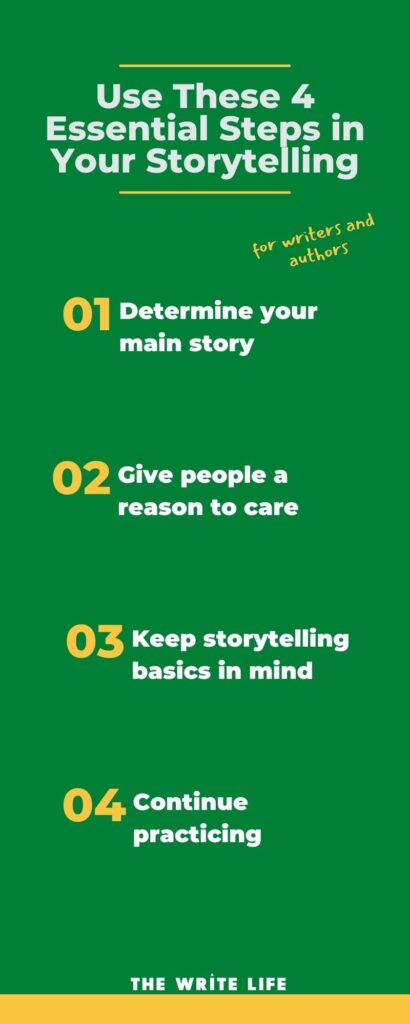
    Determine your main story

    In almost any story, there is a beginning, a middle, and an end. If you want to use storytelling in your writing, you need at least those three main points of your story outlined so you know what to include.

    That makes it incredibly simplified, but it is the best place to start if you are new to telling stories.

    Give people a reason to care

    First, you will need to think about who you are telling the story, the purpose of the story in the first place, and how those two go together.

    Sure, you can write a story for the sake of sharing a story, but often you will have a particular reason to share a certain story and a certain person you want to read it.

    This is especially true if you are blogging or doing any kind of writing for marketing or branding purposes.

    It might seem tedious to spend the amount of time thinking about the reader and what they need out of your writing, but it will be worth it.

    Keep some of these storytelling basics in mind

    There are some things you will and will not want to include in your writing.

    For example, take out cold, boring language. This is particularly common with businesses that use storytelling, where they rely on a ton of jargon and business-speak and avoid getting into the flow of telling a story.

    You will also want to highlight sensations and the senses when it comes to writing a story, since that is what makes them so visual. You will want to talk about how things smell, taste, look, feel, sound, and so on. It can draw them in and help them put themselves in a position to feel the story.

    Write the story as if you were telling it to someone you were with. That is a great way to write a story in a natural way.

    Continue practicing

    One of the main things you need to keep in mind if you want to use storytelling in writing is you will need to practice over and over in order to be an effective storyteller.

    Vertical graphic that says Use these 4 essential steps in your storytelling. 1) determine your story 2) give people a reason to care 3) keep storytelling basics in mind 4) continue practicing
  • Affect vs Effect: How to Choose the Right Word for Your Writing

    Affect vs Effect: How to Choose the Right Word for Your Writing

    Ever sat down to write a piece of text and found yourself stuck on whether to use effect or affect? You’re not the only one!

    In fact, learning the difference between affect vs effect is one of the most common questions people have, which is understandable seeing as they can both be verbs and nouns, and their meanings can overlap—triple threat! 

    Here’s how to remember affect vs effect 

    • Affect is a verb (an action word)
    • Effect is a noun (an object word)

    How to use affect:

    Affect refers to a change being produced or an act taking place.

    For example, “the hot weather affected the plants.” This implies that there has been a change in the plants because of the heat. 

    Another way you can use the verb affect is if you’re referring to the idea of moving the feelings of something or someone.

    For example, “The performance deeply affected her,” meaning feelings and thoughts had been altered. 

    When you want to imply some sort of chance or to describe an action taking place, you’ll want to use the word affect.

    How to use effect:

    You’ll most likely see effect used as a noun to talk about the consequence or result of something.

    An example of this would be, “Her low mood was an effect of her failed driving test.” 

    Used in this way, effect tells us the end result of something, whereas affect is talking about an action and an influence that something had on something else. 

    Affect vs Effect in a Sentence 

    Daisy pushes Stanley into the puddle. 

    Daisy has affected where Stanley was standing (because there has been a change).

    Stanley being wet is the effect of Daisy pushing him (falling into the puddle was the result of being pushed). 

    Examples of When to Use Affect vs Effect

    • What effect did the loss have on the team?
    • Did her words have any effect on you?
    • The second cup of coffee had no effect on her
    • A surprising effect of winning the award was that her sister was jealous 
    • How will remote working affect our working hours?
    • If I take this class it will negatively affect my grade in my other classes
    • The weather today will affect my journey into work
    • You know smoking cigarettes will affect your skin as you get older, right? 

    Using Effect and Affect in Sentences 

    • Scary movies can affect my sleep | Scary movies don’t have an effect on me
    • My mom’s opinion has affected my decision to go to college | My mom’s opinion has had an effect on whether I should pursue college
    • The car incident has affected my ability to drive alone | The car incident has had an effect on my ability to drive alone 

    Here are additional examples of how to use affect and effect in your writing.

    Common Mistakes People Make With the Affect vs Effect

    You’ll see both affect and effect show up in more formal settings, especially in politics and on the news. It can get tricky to know which word to use when writing on your own. Let’s clear up some common misconceptions.

    Is it Effect Change or Affect Change?

    The right phrase here is “effect change,” because you’re saying you want to cause change.

    You want there to be change as a result and remember, effect = result. 

    For example, “As your new leader, I promise to effect change in the system,” which translates to “I want to bring about change.”

    Is it Into Affect or Into Effect? 

    The correct phrase in this instance is “into effect,” as we’re using the term as a noun to refer to something officially beginning.

    For example, “These new rules will go into effect on Monday morning.” 

    Is it Take Affect or Take Effect?

    This is another phrase that often people get confused about. The right wording is “take effect,” as we’re referring to something beginning to apply. 

    For example, “The new medication will begin to take effect within three hours.”

    Essentially, the consequences of the medication will show soon.

    In Summary: Effect vs Affect

    Here’s an affect vs effect trick I like to use to remember which word I want to use:

    • Effect = results
    • Affect = change

    When we use the word affect, we’re referring to something producing a change or influencing something.

    For example, the weather will affect the traffic.

    When we use the word effect, we’re talking about the result of the change.

    For example, the effects of the weather have made the traffic heavier.

    This is certainly a case of practice makes perfect so be sure to let us know how you get on with perfecting the difference. If you need further help with this topic, check out more info on affect vs. effect here.

    We hope this guide was helpful!

    101 Creative Writing Prompts
    That Will Get You Excited to Write

    Grab it for free 👇

      We’ll also send you our newsletter, which offers advice on freelancing and publishing.
      You can unsubscribe at any time.

    • Is ClickBank Legit? (2024 Review)

      Is ClickBank Legit? (2024 Review)

      Anyone who runs a blog and gets a decent amount of traffic is probably wondering how to start to make money with their site.

      When you start to look around the internet for ways to monetize your blog, you will most likely come across Clickbank as an option.

      You might wonder if it is a good platform to use to either sell your own products or sell the products of other people.

      If you have wondered is clickbank legit, how it works, how much you can make, and all the other basics you will need to know, this article will cover it all from top to bottom.

      [sps_reusable_block post_id=43047]

      What Is Clickbank?

      Clickbank is an affiliate marketplace and an e-commerce platform for people to sell their digital products. They let some physical products be sold as well, but double check if yours are allowed before you jump on there and sign up.

      Instead of having to go out and hunt for your own affiliate marketing programs, applying for each one, and keeping track of them all, clickbank brings it all into one central location.

      Clickbank offers thousands of unique products (at the time of writing this, over 4,000 products) and programs so you can find the right fit for your blog and for your audience.

      If you sell your own digital products, Clickbank is also a great option for you to sell more of them since other people can go on there and sell your products for you.

      How To Monetize With Clickbank

      If you are ready to monetize your work, you first need to sign up for Clickbank.

      Clickbank is also free to join as an affiliate and there is no screening process so you can simply sign up and get started making money right away. If you want to sell your own products, you will need to pay $49.95 to start offering your goods and services.

      When you pick a product on Clickbank to sell to your audience, you can make between 1% and 75% commission.

      The seller is the one to set their own affiliate rate, and often they will offer a good deal to start to attract affiliates.

      There is also another option to make money with Clickbank and that is for you to create and list your own offerings. Then, people who also use the platform can sell your producs (while earning their own affiliate income, as well).

      Both options are a great way for you to start making money online, which is all done easily through Clickbank.

      Types of Products on ClickBank

      On Clickbank, there are a ton of products in a wide variety of niches.

      Some of them include:

      • Education
      • Health and Fitness
      • Cooking
      • Traveling
      • Sports and competitive games
      • Beauty
      • Entertainment
      • Financial
      • Legal
      • Survival
      • Weight loss and diets
      • Investing
      • Real estate

      That is just the tip of the iceberg when it comes to the variety of products on there. You will be able to find a product for almost any niche you are in.

      Of course, you will want to find products that are related to your niche or else your audience might not be interested in them.

      Selling Clickbank products

      If you want to start making money with Clickbank as an affiliate, the first thing you will need to do is figure out which platform you want to sell through.

      If you already have an audience on a certain platform, that can help a lot. That will often be the first place you will want to start to offer this affiliate product.

      You should take some time to figure out why your audience would love this product, because that will help you craft a message that can help you sell more of them.

      The last thing you want to do is just pitch them some generic product without giving them a reason to buy the product or building any desire to do so.

      You could sell products through:

      • Your email list
      • Your YouTube channel
      • Your social media channels
      • On your website
      • In your blogs

      Selling Your Own Clickbank Digital Product

      If you are taking the time to put your own product up on Clickbank, you will want to spend a little time sprucing up your copywriting skills.

      When customers come to your landing page, you want to make sure it is up to date and ready to show them why they should buy your product.

      A big problem for bloggers who sell digital products is getting leads to their website, which is something that Clickbank can also help with. Even for the people who do not buy your product, you might be able to convince them to sign up for your newsletter, giving you a chance to sell to them again down the line.

      Is Clickbank Legit?

      Overall, yes. Clickbank is a legitimate site to help bloggers make money.

      Now, what it does not do is magically create those sales for you. You will still be in charge of getting eyeballs to your offerings and making sure your potential customers can find it.

      Clickbank simply offers the framework for you to succeed as long as you can make the sales on your own.

      One thing you will need to do, though, is check out the people who have products you are offering to your audience.

      Clickbank does not personally go through and vet every single product on their platform. Yes, they take down spam or fake products, but outside of that it is up to you to do your due diligence.

      Check out the product, check out the company offering the product, take a look through their website and social media profiles, and so on.

      No matter how good the commission rate is, you will want to do your homework so you can happily offer a product. Otherwise, you can destroy the trust between you and your audience you have worked so hard to build.

      Why You Should Join Clickbank

      If you sell products, using Clickbank is a helpful platform in order for you to sell more of them without as much effort on your end.

      Because people can log in and see your product as an offer, they can sell it for you (while getting a cut, of course). It is one of the better options when it comes to making money with your work, since you are not paying these people upfront to promote your product.

      If you are on the opposite end, it makes sense to join Clickbank because you can sell other people’s products to your audience.

      This can save you time from how long it can take to create your own product and instead just start selling other people’s hard work while you earn a cut.

      If you already have an audience, it can make sense to offer them more products that would help them and are already in your niche. Overall, it is a win-win for everyone.

      [sps_reusable_block post_id=43047]

      Ready To Make Money With Your Writing?

      If you are great at writing, and are looking for ways to make more money, being a freelance writer might be a perfect fit for you.

      Inside the Freelance Writers Den, you will learn all of the tips and tricks to boost your writing career and start making money without having to rely on affiliate sales.

      Want To Make More Money With Your Writing Skills?

      While it is great to be an affiliate and make money that way, if you are a good writer, you can make money in a wide variety of ways

      The Freelance Writers Den will help you succeed as a freelancer and give you all the tools you need to start getting clients.

    • What is Symbolism

      What is Symbolism

      One of the most exciting things about consuming art, whether that art is a T.V. show, painting, or novel, is dissecting the layers of meaning within a given piece. There’s the literal things which happen in the novel, and then there’s the symbolic meaning—and the thing is, you probably already pick up on a lot of it without realizing.

      Artists rely on symbols to add depth and layers of meaning to their work, but this only works if the reader understands symbols to begin with. Luckily, in this article, we’re going to cover the basics of symbolism: we’ll talk about what symbolism is, discuss different types, talk about how to use it, and review some examples.

      Not only will this help you add meaning to your own work, but it’ll help you better understand the media you come across—look for these symbols the next time you’re watching T.V. or reading a book!

      What is symbolism?

      First things first: what is symbolism?

      A symbol imparts meaning beyond what is literally portrayed. For an easy example, think of a heart—not an anatomical heart, but a cutesy red Valentine’s-day situation. When you see one of those, you immediately associate a bunch of other stuff with it—Valentine’s Day, maybe, or the idea of love, or cute things, or sweet things.

      Or, you may say, you get angry, because you think all that stuff is stupid. But this doesn’t mean that you’re not getting the symbolism. If you weren’t getting the symbolic meaning, you would have an entirely neutral reaction, because you associate nothing with hearts. Since you see the heart and lovey-dovey stuff comes to mind, your reaction, angry or otherwise, has to do with how you’ve interpreted that symbolic meaning.

      Symbols create a kind of shorthand for artists and readers alike. If I show you a heart, you automatically apply a meaning to it based on your experience as a person in our society. If I then show you cutesy hearts only alongside gory or unseemly images, this will create a unique type of unease—I’m juxtaposing an image associated with simple, good feelings with images associated with bad feelings.

      See the layers?

      Different types of symbolism

      There are lots of ways artists can use symbols to build meaning and play with reader expectations. Let’s talk about a few of them. This list isn’t an all-encompassing guide, but instead a sort of starter pack for types of symbols used not only in writing, but in media generally.

      Metaphor

      A metaphor is when an author compares two things by saying that one of them is the other. This is different from a simile, where the author uses ‘like’ or ‘as.’ Metaphor is more direct, forcing the audience to consider what these two things (even if they seem unlike one another at first glance) have in common.

      Consider “all the world’s a stage” from Shakespeare’s As You Like It as an example. He presents the metaphor and then expands upon it in the monologue—this is a classic use of metaphor.

      Simile

      A simile is the comparison of two things using ‘like’ or ‘as.’ If we were to change “all the world’s a stage” to “all the world is like a stage,” we would be making it a simile. Simile is often used for aesthetic description—it gets across a clearer picture, if the author chooses her words correctly.

      In Normal People, for example, Sally Rooney, in one passage, describes the sky as “stretched taut and featureless like silk.” This evokes a strong image in the reader’s mind—you can imagine a piece of silk being pulled tight over the character’s heads. Additionally, ‘taut and featureless’ does some work in setting a mood here—this description precedes a very tense, uncomfortable dinner.

      Personification

      Personification is the attribution of person-like qualities to an object. Authors do this to add some texture and strength to their imagery, but personification specifically draws on a reader’s empathy. If something walks or talks or moves like a person, we subconsciously associate it with personhood, and this empathetic connection can be powerful.

      If you’re reading a good book with great descriptions, you might say the story “leapt off the page.” You’ve probably heard of lights or shadows “dancing,” or wind “howling.” These are all examples of personification.

      Allegory

      Allegory is a type of extended metaphor where the characters, setting, and plot all have a shared symbolic meaning which, when analyzed, gets across a message, which is generally moral in nature. 

      George Orwell’s Animal Farm is perhaps the most widely-known example. On the surface, it’s a novel about some very strange farm animals. If you pay attention to the clues Orwell plants throughout the story, it’s actually a moral argument against capitalism.

      Color Symbolism

      The meaning we attribute to colors impacts all kinds of visual media. Not only do writers use it to paint a picture in their readers’ minds, but anyone working in film uses it to impart visual meaning. People working in graphic design or marketing have to learn a ton about not only popular symbols, but also color theory, since colors have such powerful implied meanings.

      These meanings might change from culture to culture, so this is a pretty Western-centered list—if you’re from a culture where these colors have different meanings, you might see them used in different ways.

      Green

      Green often communicates prosperity. It signals abundance and brings to mind the green of prosperous crops or bustling forests. It might also point to rebirth, as in spring, jealousy or greed, or money.

      Red

      Red communicates passion or an intensity of feeling. Red is the color of blood, so it might evoke war, violence, or rage. It might also evoke powerful feelings of love, especially lust. It could also be used as a warning sign to herald upcoming danger. 

      Think of Melisandre in Game of Thrones, for example, who acts as a prophet for the Lord of Light. The Lord of Light demands violent sacrifices in the form of burning people alive, and Melisandre seduces powerful men to bend them to the Lord of Light’s will. She has red hair, she dresses in red, and the Lord of Light’s banner is red—this is all intentional.

      Black

      Black often signals death or the unknown. It might also be used to signal rebellion, strength, or authority—characters associated with black might be going against the status quo in some way or another.

      White

      White often signals life, rebirth, purity, or innocence. It also has strong medical associations and might be used to invoke a clinical, sterile environment—the blankness and starkness which white communicates can provide brightness, but also a lot of unease.

      Blue

      Blue reminds us of water, which makes us think of life, wisdom, freedom, or inspiration. If you’re into astrology, blue is meant to get across that ‘water sign’ aesthetic—things that are blue are meant to be intuitive, creative, and sensitive.

      Brown

      Brown reminds us of the earth. Brown might be associated with harvest, food, nourishment, and especially home and hearth. It’s a grounding color, so it also lends security, heart, and warmth wherever it shows up.

      How to use symbolism

      Now that you’ve got an idea of what symbols might look like out in the wild, let’s talk about how to apply them to your own work.

      Watch for symbols

      The first step is noticing which symbols are used, where they’re used, and how they’re used. This might sound like I’m assigning you a ton of research, but I’m really not—just pay attention to the colors, images, words, and phrases you see repeated in literature, shows, movies, and advertising.

      You might start noticing that red is used a lot in stores to communicate urgency—buy this now—or that in a lot of mainstream media, characters associated with darker color palettes are often considered by the text to be morally corrupt (a direct result of our society’s colorism). This will definitely ruin your life a little bit, but it will also make you much more aware of what you’re bringing to your own work.

      Use symbols intentionally for subversion

      Once you understand how symbols are usually used, you can use them in new, interesting ways. A lot of cliches associated with imagery are also overused similes and metaphors—to say that something is “cold as ice” doesn’t do anything new for a reader, who has heard it before, so it kind of means nothing.

      You want to reach for new associations and make comparisons that the reader hasn’t heard before. This is one of the ways you can work to create interesting, compelling artwork, and it starts with noticing these associations in real life for yourself.

      Add symbolism in revision

      Sometimes, a great idea for a story springs up around a metaphor, especially if you’re writing an allegory, which is pretty much all metaphor. In this case, you need to outline the terms of the metaphor up front and know what you’re doing as you go.

      Otherwise, worry about symbolism in revision. This is the kind of thing that can really bog you down in your first draft, where your chief goal ought to be literally just finishing the manuscript. Once you’re done, go through and see what kinds of symbols reappear in your work. If you were intentionally using symbols in draft one, how did you do, and how will your revisions change these symbols?

      Famous examples of symbolism

      Here’s a few examples of symbolism that you’ve probably read before:

      The green light in The Great Gatsby by F. Scott Fitzgerald

      The green light in The Great Gatsby symbolizes all of Jay Gatsby’s hopes and dreams—chiefly, it represents his desire for Daisy. Why green and not red? Gatsby’s drive for Daisy is inseparable from his drive for money, which he hopes will win her over.

      The “A” in The Scarlet Letter by Nathaniel Hawthorne

      The “A” in The Scarlet Letter means ‘adulterer,’ and it ostracizes Hester from the community. Throughout the novel, though, the ‘A’ changes its meaning—’aristocrat’ and ‘angel’ are also applicable.

      Out, out damned spot from Macbeth by Shakespeare

      Lady Macbeth tries to clean her hands in Macbeth during the “out, out, damned spot” monologue. This symbolizes her role in the violence to come—she can’t get the spot off her hands, just like she can’t rid herself of the bloodshed for which she is responsible. Try as she might, she can’t get the blood off her hands.

      Sauron from The Lord of the Rings by JRR Tolkein
      Sauron is a great example of how characters might be used as symbols within a story. Sauron is a dark wizard who aims to use the power of the Ring in his pursuit of world domination. He symbolizes the triumph of evil, and the entire plot of The Lord of the Rings grapples with this idea that the long, difficult journey and sacrifices of good people can save the world.

      New call-to-action
    • How to Write Female Book Characters

      How to Write Female Book Characters

      If you’ve spent any amount of time in online reading or writing circles, you’ve probably come across posts like this titled ‘X Times Men Didn’t Know How to Write Female Characters,’ each featuring screenshots of tragically sexist prose. Or maybe you, like me, were forged in the unforgiving fires of 2012-era Tumblr and have seen loads of posts like this or this.

      My point is, it’s not exactly news that badly-written women are an unfortunate feature in our media. While men often write the most egregiously poorly-written women, it’s not just men at fault here—people across the gender spectrum seem to struggle with writing compelling, three-dimensional women.

      If you don’t want your novel to end up screenshotted and added to the next article compiling grave, mildly-to-severely sexist authorial mistakes for the purpose of public shaming (which I do, in case it’s unclear, support), you’ll want to learn how to write women well. And luckily for you, that’s what we’re here to do today.

      In this article, we’ll talk about how to write compelling women, we’ll take a look at some common mistakes authors make when writing women, and we’ll look at some examples of well-written and not-so-well written women in movies, T.V., and books.

      How to write compelling women

      First things first, let’s talk about how to write female characters well.

      1. Women are people

      I’m going to get into detail about specific problems I see, but the bottom line and main takeaway is this: women are people, and female characters are characters. Writing a good female character means writing a good character.

      Female characters should be just as deep, interesting, and complex as male characters, and they shouldn’t be defined solely by being a woman (much in the way you wouldn’t define a male character by their identification as male).

      2. Give them complex motives

      What does your female character want, and why?

      You want to avoid ‘because she’s a woman, and women want that/behave like that/expect that’ as an answer. 

      Consider their upbringing and perspective. If this is a fantasy world, consider whether sexism plays a role in the way they interact with the world and how that character deals with it. How does this character see things? Once you have a solid idea of this, you can more accurately get at what this character wants and how they, as a person, will react to any given situation.

      3. Flesh out their interests and hobbies

      What’s your female character’s favorite movie, and why? What kind of food does she like? Where does she work, and does she like her job? Let her be a real person, and let her be a little weird. She should have anxieties, fears, dreams, and interests, and they should not all have to do with what men think of them.

      4. Honestly consider their relationships to other characters

      When writing relationships between any two characters, you’re looking at character A through the eyes of character B (and vice versa). You’re the author, so you already know what’s going to happen, and sometimes this makes it tricky to really piece out what information is literally there, in the text, and what you’ve got in your head.

      If you flesh out your female character like we talked about earlier, this is easier to do. You can tell, based on what kind of person she is, how she’s going to respond to other people. For example, if most people are at work, they won’t be flattered by strangers approaching them and hitting on them—they’ll feel uncomfortable, maybe even frightened.

      5. If the anatomy isn’t your own, research it

      This isn’t advice for female characters, strictly speaking, but it does often come up with specifically cis men writing cis women. If you’re writing about an anatomy that isn’t your own, research it a bit. It’ll be very silly if your book comes out and you let the whole world know that you have no idea what a tampon is or how it works—Google could have saved you.

      6. If the experience isn’t your own, get a second opinion

      Similarly, if you’re writing a perspective that isn’t your own, get a second opinion from that perspective. If you’re writing a trans woman, you’ll want to have trans women beta read your story and critique it so you can be sure that you’re offering a realistic, appropriate representation of a character in that demographic.

      Common mistakes when writing women

      So, what are some things to avoid when you’re writing women? I’ve compiled a list of tips, as well as some tropes to look out for as signs that you might need to rehash your approach to female characters.

      1. The lamp trope

      If you could replace the woman (or women) in your story with a lamp or sack of jewels without the story changing much, this suggests that the woman serves no purpose except to be rescued by the protagonist. This is objectification, and this woman is probably exceedingly one-dimensional. 

      2. One-dimensional women

      Writing women as vapid, vain harpies who care only about men and who hate every other woman is pretty overdone and generally insulting. Some women are vain, just like some men are vain, and some women are overly fixated on the opinions of men, just as men can fixate on the opinions of women, but as a character type, it’s often shallow, mean, and does more to point to the author’s internal sexism than to that specific character’s flaws.

      3. Fridging

      ‘Fridging’ is when a female character is introduced only to serve as a tragic backstory for the male protagonist. It’s usually his wife, and she almost always dies in some horribly brutal way which fuels his need for revenge. We get no sense of what the wife was like as a person, or she’s just vaguely perfectly feminine and lovely.

      Yes, people’s wives do die, and sure, I get that you want your male protagonist to have a compelling reason to be so brooding and tough. But inventing a woman to brutalize solely to enhance a male character’s Edge Factor isn’t the way to do it.

      4. Needless sexualization

      When men are described, we rarely get passages about how their jeans stretch over their butts or how their nipples show through their shirts. The purpose of introducing them isn’t to tell us how hot they are—it’s to tell us what they look like. However, it’s very normalized to introduce women in a way that clearly intends to show off how sexy the author wants us to think she is.

      Sometimes people argue that this is done because the male protagonist sees her that way. But the thing is, if the male protagonist is seeing her primarily as a sex object, that’s a serious character flaw which needs to be addressed, challenged, or otherwise explored unless you want your readers to think he’s deeply sexist. And it never is addressed! Weird.

      Examples of great (and not so great) women in fiction

      The Good

      1. Katniss Everdeen from The Hunger Games by Suzanne Collins

      Katniss is a wonderfully written teenager, at least in my opinion. Her relationships with her family are hugely important, her role as her family’s provider is instrumental to her character, and her motives are strong, complex, and not at all male-centric—she volunteers for the Hunger Games in the first place to save her sister, Prue.

      When it comes to romance, at least in the books, we never shake the lens of the Capitol. This is extremely deliberate, and it means that Katniss isn’t just a lovestruck teenager helplessly torn between two boys. She’s a kid fighting for her life while also being pressured to perform love for her family’s survival. Her feelings are being messed with, and this is incredibly compelling as a conflict.

      2. Shiv from Succession

      Women do not have to be good people to be good characters! Shiv from Succession is a solid example. She’s seriously abusive to her partner, Tom, she’s incredibly calculating, and she’s willing to throw anyone and anything under the bus in the name of getting in her father’s good graces.

      But this doesn’t come from her womanhood—it comes from her upbringing. All of the Roy siblings are impacted by their father’s abuse in their own way, and while hers is definitely influenced by her womanhood and by navigating the intense sexism of an ultra-conservative environment, they’re not just ‘because she’s a girl.’

      3. Amy from Gone Girl by Gillian Flynn

      Even if you haven’t read Gone Girl, you’ve probably heard of the ‘Cool Girl’ monologue. In Gone Girl, Amy’s playing with everyone’s expectations of who she is because of her womanhood—she’s able to deceive her husband, for example, because she knows how he perceives her based on his sexism and she knows how to use that against him. This makes her incredibly complicated as a character, and her manipulation adds a ton of nuance to her very strong choices.

      Again, not a perfect character—she’s not the pinnacle of feminism or divine femininity or anything. But she’s a woman written holistically, and that makes her interesting.

      The Not-So-Great

      1. Mikaela Banes in Transformers (dir. Michael Bay)

      This is maybe a tired example, but Mikaela Banes as played by Megan Fox is an example of the ‘Cool Girl’ ideal Amy rails against in Gone Girl. Mikaela’s versed in mechanics, a male-approved skill, but she owes all of her knowledge to her father. Thanks to a man, she knows about boy stuff. And she isn’t exactly presented by the camera as a respected auto mechanics expert—instead, we get leering shots of her bent over the hood of a car, encouraging the audience to stare at her body instead of listen to what she’s saying. She’s a character with the potential to be interesting—the bones are there—but the writing isn’t interested in exploring her character beyond how she serves as a love interest for our male protagonist.

      2. Anastasia Steele from Fifty Shades of Grey by E.L. James

      Anastasia Steele is the protagonist of Fifty Shades, and she’s written by a woman, but neither fact makes her a well-written female character. She’s incredibly naive—even by the end of the Fifty Shades trilogy, after she’s been exposed to tons of kink-related stuff (badly represented and explained kink, but still), she reacts like she’s never heard of sex before. It’s not a problem that she starts the series insecure, cloying, and naive, but it is a problem that she never grows, develops, or gains any agency in her relationship with Christian Grey.

      3. Christina from The Book of Henry

      In his essay “The Art of Storytelling and the Book of Henry,” Dan Olson explains how Christina functions as an example of the lamp trope. Christina is the step-daughter of the police commissioner Glenn, and they’re neighbors to the film’s protagonist, Henry. Henry sees Christina being abused by Glenn, and this is the impetus for his plan (and the film’s central plot) to kill Glenn. Olson explains that the film is, in concept, about a plan to save Christina, but in fact, Christina is really just an excuse—because the film isn’t interested with Christina as a character, she’s just a flat, one-dimensional excuse for Henry to make a plan to kill Glenn.

      New call-to-action
    • How to Write True Crime In 4 Essential Steps

      How to Write True Crime In 4 Essential Steps

      Since more people than ever before are interested in true crime stories, you might have wondered how to write true crime and what it takes to be successful.

      Out of all the book genres in the world, true crime requires a lot of research and a committed writer who is ready to tell the story behind a gruesome or other type of crime.

      It is certainly not a genre for the faint of heart, but for many writers it is certainly worth it. It will take considerable amount of research skills and time dedicated to talking to people involved in the case, attending trials when you can, and understanding how cases are solved.

      If you have wondered about the true crime book genre, how to write true crime, and wondered what it takes for you to get your foot in the door, we will cover that and more.

      What Defines True Crime Writing

      True crime is an arm off of journalist-style writing. Meaning, it should be objective and focus as much on the facts as possible.

      Of course, not all true crime stories are about murder since there are many other types of crimes out there in the world that are done every day, but murders are the most well-known type of true crime story.

      This is not like crime fiction writing where you want to tell dramatic stories and have some shocking twists. It will be essential for you to stick to the facts as much as possible.

      Yes, there will be sometimes where you have to make assumptions on how dialogue went and what people talked about in specific scenarios, but you want to remain as close as possible to the facts as you see them.

      How True Crime Articles and Nonfiction Books Grip Readers

      People do have a morbid curiosity in general, but for many writers, they love to help try and solve a crime that has plagued an area. Or maybe the crime has already been solved but you are determined to put some of the pieces together.

      As a writer, you can also help bring light to forgotten crimes and help bring closure. Not every writer and written piece helps solve crimes, but every now and then that can be the case.

      As a writer, you will need to take your work seriously to help tell the story to the best of your ability.

      How to Write True Crime

      If you are ready to write true crime, let’s talk about how you can start to put together your first story.

      #1 – Research

      While you will spend a lot of time writing, you are going to be spending more time researching than you ever imagined. It is essential for you to get your facts right for true crime books.

      If you put something untrue in your books, people will now view the whole book with a skeptical lens, and possibly your future work as well.

      This means you not only will Google and research, but you will possibly need to interview people as well and attend trials, just to double-check your facts.

      Always keep in mind that you are writing about real people and real stories, so it is essential to do the best you can to tell the correct story. Not everyone will agree or like everything you say, that’s a given, but you need to get as close to the truth as you can.

      #2 – #1 -Figure out your goal

      Before you start formatting all of your research into a book, you will want to spend some time thinking about your goal for writing your book or article.

      Do you want people to understand the killer? Do you want the crime to speak to a larger crime trend? Do you want to warn others about what killers do so people can stay vigilant? Do you just to tell a story of one crime so people know the truth?

      Above all, you need to give people a reason to pick up your book. You should quickly be able to answer, “Why should someone read this book?”

      This will also help you focus what you are going to include in the overall book. It would be great if you could include everything, but you will often have to make hard choices about which facts and personal accounts go into your book.

      #3 – Decide how much of your own story will be in the book

      Some books, such as I’ll Be Gone In The Dark by Michelle McNamara, include personal stories from the author. Hers story is about how she became obsessed with this case and her journey of putting the clues together.

      Another example includes The Stranger Beside Me by Ann Rule, where she tells the story of her personal friendship with Ted Bundy while people are also trying to find a killer in her local area (spoilers: it’s him).

      It will be up to you as the author what you choose to include. Sometimes adding in your personal narrative makes the story stronger, and sometimes it makes it weaker.

      #4 – Put the story together

      Now is the time to commit and do the hard work of actually putting your story together.

      You might need to create one of those true crime type of boards you see in tv shows where you need to lay out everyone involved and all of the stories that tie everyone together.

      Know that you will probably have to go through a ton of drafts just to make sure you get everything right and accurate.

      Successful True Crime Writer Example

      While there are many, many successful true crime writers, Ann Rule was one of the most well-known.

      As the writer of 37 true crime books, Ann Rule knows a thing or two about publishing true crime books.

      She understood that it was a hard field to break into, but she said, “You can’t let the naysayers make think you can’t make it, because you can.”

      One of her top recommendations for true crime writers (besides writing often) is to attend as many of the trials as you can fit into your schedule. You will want to take the time to not only go over the facts, but deeply analyze everyone involved. Watch how the killer moves in his chair, watch how the jury reacts to certain facts, observe how witnesses talk.

      The trial can teach you so much about the whole crime.

      Mistakes True Crime Writers Make

      If you want to succeed as a true crime writer, you will need to make sure you know how to analyze and organize research.

      Some of the biggest mistakes true crime writers make it not double checking their facts or rushing through chapters just to get them done so they can move onto other parts.

      Many writers also let their own views interfere with their writing and taint how they present the facts because they are trying to persuade readers to go with their point of view.

      There are a few common mistakes true crime writers make.

      The first one, is becoming so obsessed with the case that it steals your sanity.

      Ready to Write Your Book?

      Ready to start writing your book and getting it ready for publication?

      You do not want to miss out on the nonfiction webinar with all of the tools you need to start putting your book together:

    • How To Create A Blog Post Template (+ 5 Popular Templates)

      How To Create A Blog Post Template (+ 5 Popular Templates)

      If you are a blogger, you know how much time and sanity you can save by having a blog post template ready to go.

      Depending on the type of blogs and articles you create, you might have a wide variety of templates and designs, or you might just have a handful you cycle through. Either way, the sooner you can put them together, the better.

      For anyone who has writers on staff or even accepts guest posts, having templates ready to go to send people can save you so much time later on for formatting and editing the posts to fit into your website’s style.

      In this post, we’ll be going over some of the main types of blogs that people create and give you some tips for making a blog post template for each one of them.

      Why Create Blog Post Templates

      Having blog post templates on hand and ready to go can save you so much time as a blogger. They can also help make sure you don’t forget any part of a blog and you simply follow the template all the way until the blog is done.

      Blog post templates can also help you keep your blog brand consistent because all of your posts will be formatted and written in a cohesive way.

      If you end up outsourcing or hiring writers for your website, you will find so much time saved for everyone if you have blog post templates. That way, everyone can stay on the same page with how each blog is expected to look and flow together.

      Whether or not you have a team or it is just you writing them, you cannot go wrong with using a template to have on hand.

      What To Include In A Blog Template

      Naturally, it will depend on the type of template you are creating, but there are some fundamentals you will want to consider.

      Some things you might want to include:

      • Introduction formatting or rules. You might want to have it only be a certain amount of sentences or to include the main keyword.
      • Main keyword rules for each post. How often should they be included? Do you want to put them in a header? Do you have any other SEO needs?
      • Formatting rules throughout the post. You might want to include rules like inserting a call to action after the table of contents
      • Content rules. Depending on the type of content you are writing (we will dive into examples of different blog posts below), you might want to have different rules for how the information is structured and put together.

      Blog Post Template

      When it comes to blog post templates, you will want to make some basic ones based on what you want and write the most often.

      Although there are a lot of different kinds of blogs out there, lets cover five different options that are some of the most common so you can start to create your templates.

      #1 – Listicle Blog Template

      If you do not know, listicle blogs are exactly what they sound like: they are a general blog that has a whole list.

      It might be something like Top 10 products in your niche, 25 best books to read, 13 best coffee makers, and so on. You get the idea. They typically bring in a lot of traffic because people love lists and they rank well in Google.

      For this blog post, you will need to decide the heading size for each list. You’ll also need to decide how the numbers are outlined and if things like bullet points will be used.

      You should also explain why you put this list together. Maybe it’s to save the reader time or to give them tips that can help them level up a skill. No matter what it is, you should be incredibly clear on what they will receive by reading the list.

      For example, each item in the list could be labeled as 1., 2., and each of the titles will be Heading 2 sized.

      #2 – How-To Blog Template

      How-to blogs are where you take the time to explain a topic and give a deeper tutorial on the topic.

      You will first need to analyze the level of the person you are writing this article for. You might be aiming it at total beginners or it might be a blog post for experts.

      Determining that ahead of time will help you figure out the language you need to use in your blog post.

      Generally, you will want to start by introducing the topic and explaining to the reader what they’re going to learn by the end of the post.

      From there, you will want to go step by step through what you are explaining to make sure it flows in a cohesive way.

      #3 – Review Blog Template

      Whether you choose to review a single product, or compare a lot of different products together at the same time, you will still need some basic outlines of this post.

      Review posts are what they sound like: You spend the time reviewing a product or service and giving your feedback to the reader.

      You have most likely come across review posts when you are looking to buy something yourself and you want to make sure it is worth the money or meets the quality you want.

      In review blog post templates, you will want to start with an overview of what the review is about. From there, you can dive into the product itself and discuss each part of the product or service to give an overview of what people need to know.

      Once you go through all of the features and explain your thoughts, you will want to end it with a conclusion of some kind.

      #4 – Case Study Blog Template

      If you do not already publish case studies, you should. Depending on your blog topic, this is a great way to stand out and start to put your expertise together in a professional way.

      There is some overlap between how-to blog posts and case studies, but case studies provide an exactly real example.

      For example, if you were a copywriter, you could show exactly the before and after steps you did to help a client increase the email subscribers on their list.

      With case studies, it helps to get as detailed as possible with every single step you take along the way. This will require you to keep detailed records of everything you did so you can document it.

      For these templates, first you will want to start with what the case study is about. What were your thoughts, what were your ideas to solve it, how long did it take, and what will the reader understand by the end of the case study?

      From there, you will want to dive into the specific steps you took along the way and explain why you chose them.

      #5 – News

      This one is often pretty basic. You will want to follow journalist writing principles and include the main point of the news in the beginning of the blog post.

      However, you might want to set your own rules for word counts, the types of images to be used, and any other date-specific formatting rules since news is typically time based and not evergreen.

      What To Do Next

      Ready to send some pitches and grow your website?

    • Book Writing Process

      Book Writing Process

      Writing a book is an art form, and that means that there’s not one right way to do it—it’s going to look different for everyone, and as long as someone’s method works for them, it’s fine.

      That said, if you’re a new writer looking for advice, this can make a project as big as a novel feel daunting. How do you even start to tackle a project that might be a few hundred thousand words long before it’s over?

      If you’re a painter, you need to learn about different methods and techniques and try each to see which resonates with you—you learn how people have been doing it, because that gives you a foundation of information to work with. With that foundation, you’ll eventually gain the experience necessary to use what works for you and leave the rest.

      It’s the same with writing. While you’ll eventually reach a point where you’ve got a book writing process which works for you, you may need to try a few different methods before striking gold. In this article, I’ve got five methods for you to add to your toolkit—feel free to mess with them as you need to so they’re effective for your project’s needs.

      For each process, I’m going to talk about how it works, who it might be helpful for, and what sorts of tweaks you could make to give you an idea of how to customize these processes. But before we get into that, I want to talk about brainstorming and outlining.

      Brainstorming and Outlining

      Before you start actually writing your book, you’re going to want some idea of what the book is about. You’ll probably need to know: 

      – who the characters are

      – where the characters are

      – what the characters want (at least in the beginning)

      & what the book is About (what big themes or ideas you intend to explore).

      Some writers have this more or less all in their head before they sit down to write, but I recommend jotting it down. Here are a few ways you might brainstorm before you start getting into the meat of your novel:

      1. Mind Map

      Write a word in the center of a piece of paper related to your novel—it might be a character’s name, the setting, an idea, a theme, whatever. Draw two lines away from that word and write the first related thing that comes to mind, and do this until the page is full of characters, plot points, settings, phrases, and so on which correspond to your novel.

      2. Stream of Consciousness

      Set a timer for two, five, or ten minutes (whatever works for you) and write down literally whatever comes to mind. If you’re writing ‘I don’t know what to write and I think this brainstorming idea is terrible,’ that’s cool. Keep going until you’ve got enough to work with.

      How do you know you’ve got enough to work with?

      There’s not a hard rule, but basically, you’ve got enough to work with when you feel that the brainstorming process is done. You feel ready to start writing. You may need to revisit the brainstorming process while you’re writing to work out plot holes or sticky spots, and that’s fine! This is just to help you get started with a solid foundation.

      And once you’ve got that foundation, you’re ready to write your book, and that’s where these five processes come in.

      The Snowflake Method

      Randy Ingermanson’s Snowflake Method is built on the idea that “good fiction doesn’t just happen, it’s designed.”  The Snowflake Method forces you to start small and expand outwards until you’ve got a fully fledged novel. This process is outlined in detail on Ingermanson’s website, but we’ll go over a brief summary here.

      Steps 1-7: Synopses and Character Description

      You start with an elevator pitch for your novel. If you’re not sure how to write one, look up one-sentence novel descriptions to get a feel for how they should look—they’re basically a summary intended to sell the listener on the story.

      Steps 8-9: Outlining

      Here, Ingermanson instructs to use a spreadsheet to outline your novel. You’ll use one line for each scene. Then, you take this information and write out a narrative description—basically, you’re converting the spreadsheet to a word document and writing out how the book plays out. He says this step is optional.

      If you’re using software like Scrivener, there might be a feature built-in for you to list your scenes. Otherwise, Google Sheets is free.

      Step 10: Drafting

      Draft the novel! You might need to take breaks to edit the design documents you’ve been creating as things change, and that’s okay. Ingermanson explains that these design documents will have to be edited if you’re doing well—as your ideas develop and change, you’ll have to reflect those changes in the pitch, character synopses, and plot summary.

      The Snowflake Method is great because it offers structure for the process without enforcing structure on your book itself. You can use this process with whichever plot structure you like, and at the end of it, you’ve got the documentation you’ll need to sell this book to publishers or market this book on your own as an indie author.

      If you’re going to tweak this method, tweak the time frames—Ingermanson lists how long each step should take (which is hugely helpful for keeping creative momentum going), but if you need to take more or less time on a given step or if you need to take breaks between steps, no one’s stopping you.

      New call-to-action

      Discovery Draft

      A discovery draft is what a lot of writers might refer to as ‘pantsing.’ For this, you might or might not have much idea of what you’re going to write about—if you have anything written down, it’s probably just a premise or starting point: a character in an interesting setting, a specific fight, whatever.

      The idea of a discovery draft is that you sit down and draft the novel as quickly as possible, figuring out details about characters, plot, and all that as you go. Some discovery drafters will edit as they go—I recommend that you don’t, but do make notes or keep a separate document going with the changes that come to mind as you work.

      This allows for a lot of creative momentum, because you’re discovering the story as you go—it’s exciting. The downside is that because you might not know where you’re going, you may get stuck. If this happens, I recommend slapping down a note that says “GOT STUCK HERE” and jumping to the next scene. If you don’t know what the next scene is going to be, that’s also okay. You can pause and brainstorm to figure out what happens next, or just decide what would be the worst possible (and realistic) thing to happen to these characters at this time and go with that.

      You’ll end up with a first draft that’s also an outline and also a character sheet. Once you’ve finished this draft, go through and identify character arcs and plot arcs and determine how to hone them. Almost none of your discovery draft is likely to end up in the finished product, but that’s true of any first draft.

      Bullet Point Outline

      A bullet point outline is a great option if you’re looking for something super flexible, and it’s the foundation for many other methods you’ll see. Basically, this is the spreadsheet step in the Snowflake Method.

      On a piece of paper, in a word document, or on a spreadsheet—doesn’t matter—you’ll dedicate a line to each plot point.

      If you want a super detailed outline, you might write each beat as its own line. If you do this, I recommend organizing your outline so that each chapter has its own heading, just to keep everything streamlined and easy to refer to. You can use highlighters or different-colored fonts to color-code based on character, subplot, or whatever you desire.

      If you don’t want to get that detailed, you can write down the major plot points in your novel and forget the rest.

      As long as you have enough information to feel comfortable drafting, you’re good to go. A detailed outline can help save time in the drafting process, but a loose outline might make you feel a little more free to change things up as you draft—if you get lost along the way, skip along to the next beat, and figure out how to close that gap when you revise.

      Start at the End

      Have you heard of Sagging Middle Syndrome? It describes the phenomenon wherein you breeze through the setup of your novel, then stall out in the middle—around the middle of act two, it becomes impossible to reach the climax. Characters hang out doing unrelated shenanigans until the climax comes to rescue them (and the reader).

      This is a pretty natural thing to happen, especially in a first draft. If it’s a particularly tough struggle for you, try starting your novel at the end. Where do your characters end up? Who wins, and what happens as a result of that? Knowing how the story ends makes it easier to figure out how to get there.

      Another variant on this method is starting with the climax. If you’re the type of author to get an idea for a really cool climax before you think of anything else, just write that climax down. Yes, it’ll probably change dramatically as you rework it—this is inevitable.

      After you’ve written the end or the climax or whichever scene you’ve decided to start with, ask yourself the following questions:

      – who are these characters?

      – how did they get here?

      – who ultimately wins in this confrontation?

      You can keep working backward, or you can pause and switch to a bullet outline—whatever works for you.

      Storyboard Method

      If you’re a visual learner, this might be your ticket.

      Storyboards are commonly used for visual mediums like comic books, T.V., or movies, but you can use them for novels, too. Use index cards to draw out the scenes you want to have happen in your novel and tape them to a piece of posterboard, the floor, the refrigerator, or your bedroom wall. Instead of drawing the scenes, you could also write them out using short sentences or descriptions.

      Again, if you want to use color-coding or some other unique marker to pick out characters and subplots, go for it! If not, cool. This method is great because it allows you to literally see missing spots in your plot, and it allows you to literally pick up and move scenes and see what they’d look like in other parts of the story.

      Some writing software like Scrivener has features which allow you to do this, so if you’re looking for a way to do this that saves some space, you might find that useful.

      When you’ve got everything lined up the way you want it, take that information and put it into a word document. This will serve as a bare-bones first draft, which you can get straight into revising!

      New call-to-action