Category: Craft

  • How Smart Writers Deal With One-Star Reviews (Hint: Not By Crying Yourself to Sleep)

    How Smart Writers Deal With One-Star Reviews (Hint: Not By Crying Yourself to Sleep)

    I’d written the manuscript for my novel, Willows, about two years prior and promptly abandoned it, leaving it to lie dormant in my Dropbox. One day my writing partner discovered it and blew the dust (or whatever digital files gather when they’re abandoned) off it.

    “Get it out there,” she said.

    “It needs to be seen,” she said.

    “Publish it on Amazon,” she said.

    So last year we embarked on our self-publishing journey, and soon the book was ready and uploaded to Amazon and ready to set the world on fire.

    After initial sales from friends, family, and well-wishers, Willows settled into a groove. I’ve had more sales than I thought I would, and on my free days the book was downloaded more than 2,000 times and earned a few good reviews. I wasn’t quite in Lee Child or Stephen King territory just yet, but for my first effort I considered it an OK start.

    All in all, I’ve loved my first foray into self-publishing. Despite my complaints and some infuriating moments (like MS Word somehow reversing all my changes and auto correct reversing my edits and changing a character’s name mid-novel), I’ve enjoyed it.

    However, the thing I looked forward to, more than anything, was my first review. After all, I wanted what all writers want: to know if I’m any good. I needed to know if I was just fooling myself with this writing jazz. Should I chuck the whole thing? Would people enjoy my work? We would see.

    When those first reviews start trickling in

    I expected some initial good reviews. Family and friends eager to support you will give you five-star reviews and say things that make you sound like the next big literary star. I truly appreciated these, but the reviews I treasured the most were the ones from complete strangers, who gave honest, constructive criticism.

    So, when I got my first one star review, I was shocked! I reread it a few times to make sure I’d read it right.

    The reviewer had downloaded my book on a free day, read it (I assume) and was not thrilled. I was flabbergasted. Willows was my first novel; I knew I would be no danger to the authors on the bestseller list, but I never expected that kind of review.

    I laughed it off and chalked it up to someone who didn’t give the book a chance or maybe didn’t care for the genre, and resolved to ignore it. Twenty minutes later… okay, two minutes later — when I was supposed to be writing — I read the bad review again.

    Does one bad apple spoil the whole bunch?

    Then, just like we do in many other areas of life, I totally disregarded the sincere encouragement and kind words I’d received from friends, family and complete strangers and concentrated on my one bad review.

    Was there something I could have done to make the book better? I went back to the manuscript and pored over it to see if there was something I missed, or if there were there any edits I could have made to win this lone reviewer over.

    I tried to return to writing but the review was on my mind. It buzzed around my head like flies at a picnic, distracting me from my work.

    Too distracted and annoyed to write, I picked up my favorite book about writing, Stephen King’s On Writing: A Memoir of the Craft. I opened the book and my eye fell on this quote:

    “You can’t please all of the readers all of the time; you can’t please even some of the readers all of the time, but you really ought to try to please at least some of the readers some of the time.”

    That is exactly what I tried to do: please some of the readers. I had tried my best, and it pleased some of the readers. Reading King’s quote took me out of my bad review funk and focused my attention on where it should be: on my work.

    Dealing with a negative review

    If you’re a writer, especially a newbie, and you’ve received a bad Amazon review, here are my three steps to deal with it:

    1. Ignore it

    2. Ignore it

    3. Use it as motivation to make your next article or manuscript even better
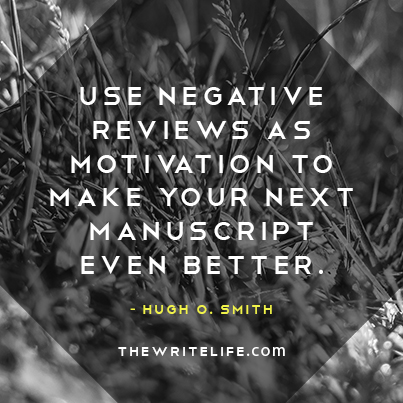
    Use negative reviews as motivation

    Thanks, Ms. One Star Reviewer, for your message. I’ve gotten you out of my system and used your words as inspiration. I hope I don’t ever encounter you again, but if (when) I do, I’ll know how to handle you.

    Have you ever dealt with a negative review? How did you respond?

  • Yes, Fiction Writers Can Develop Awesome Online Platforms, Too

    Yes, Fiction Writers Can Develop Awesome Online Platforms, Too

    You know you should create your own online home and “develop a readership” before your book comes out. But what exactly does that mean? How do you actually do that?

    When I first started building an audience for my book, I wanted to find examples of individuals who were doing it well. There are lots of great examples from the non-fiction world, but how are fiction writers accomplishing this? How were they structuring their online presence? How were they interacting with potential readers? And what the heck were they writing and talking about?

    Stellar examples of authors with engaged readerships

    If you spend any time on various online platforms, you’ll find a lot of marginal content: individuals who are purely self-promotional or websites with poor design. To give you some great models to emulate, here are some examples of authors who are engaging their readers in a meaningful way.

    Blogging

    Many of us know Joanna Penn from her popular blog, The Creative Penn, but she is also an accomplished mystery/suspense author.

    Joanna has successfully made the leap from self-published to traditionally published author. At her author site, JFPenn.com, she blogs about ancient books, cities, and the psychology of religion — all common themes in her novels. She also interviews other authors in the same genre.

    Joshilyn Jackson also provides a great example of what to write about on a blog. She’s had her blog since 2004 — eons in the blogging world. Joshilyn makes a big distinction between blogging for writers and blogging for readers. She blogs for her readers and mostly blogs about “ridiculous stories of the messes I tend to get myself into.” Joshilyn’s blog has the same strong voice and wittiness that she’s known for in her novels.

    Facebook

    Dana Stabenow is a mystery author with more than 20 published novels. She’s a master at cultivating an engaged readership. A group of dedicated fans dubbed themselves the “Danamaniacs” over twelve years ago. They have their own Facebook page to discuss Dana’s work and hold online chats.

    Dana has offered a digital newsletter, the “Roadhouse Report,” since 2004. Dana is also active on Facebook and posts frequently about life in Alaska — her home and the setting for all of her novels — and other topics she finds interesting or intriguing. With more than 11,000 Facebook fans and 1,200+ Danamaniacs, she has a loyal and engaged group of readers.

    Pinterest

    The tagline of fantasy author Justine Musk’s site is “because you are a creative badass.” She has two traditionally published novels and an active presence on Twitter.

    What makes Justine unique is she’s using Pinterest as a planning tool for her next novel. The images she pins range from tattoos to quotes that hint at a troubled soul and a dark side. I know I’m intrigued. (Inspired by this idea? Click to tweet it!)

    Online forums

    Neil Gaiman’s work ranges from comics, short stories and novels to films. He posts frequently in his online journal but he has also created a message board where readers can interact and discuss his work. Go check the forums to see how they work, but beware the rabbit hole: there are over 250,000 posts.

    Twitter

    Maureen Johnson, a UK-based author dubbed the “Queen of Teen,” has an active presence on Twitter. She’s recently taken up knitting and has promised a badly knitted scarf for anyone who could help her gather 8,000 Twitter followers after a snubbing by @Huffpostbooks.

    Whether that was an ill-willed or in-jest comment, Maureen isn’t afraid to let herself be seen and she posts witty comments about current events and quirky things that catch her eye. She’s funny, relevant and her followers love her.

    Google+

    John Scalzi writes sci-fi fantasy and graphic novels. He’s active on Google+ and often posts upcoming book covers for his graphic novels. He also engages his readers in photo caption contests and posts teasers of first lines of his work-in-progress.

    Finding common themes in your writing is a great place to start engaging your audience for a fiction writer. Much in the same way that it takes some trial and error to develop your voice as an author, it will also take some time to find your online voice on your platform of choice. You may even need to experiment with several platforms before you find one that’s the best fit for you.

    Five steps to developing your own engaged readership

    So how do you follow in these great authors’ footsteps? Here are a few places to start.

    1. Observe some fiction authors with great engagement. You can start by following our list, but aim for 10-15 different authors to see a wide variety of examples.

    2. What do you like about how they engage their readers?

    3. What do you dislike?

    4. Model the style of the authors whose engagement resonates with you on the platform of your choosing.

    5. Continue to hone your voice and find your own style.

    Bonus points: Eventually you’ll want to provide your fans an opportunity to not only interact with you but also interact with one another.

    Most importantly? Be yourself.

    Regardless of which platform you choose for concentrating your energies, building an online engagement with your readers is time well spent. You’ll be building loyal fans, one reader at a time.

    Did we miss any fiction authors who have great reader engagement online? Let us know in the comments.

  • Moving Beyond Deadlines to Accomplish Your Big Writing Goals

    Moving Beyond Deadlines to Accomplish Your Big Writing Goals

    When we first start writing professionally, we become very focused on deadlines. What’s due this week? What’s due next week?

    But eventually you start to think beyond that. You realize that productivity isn’t just about getting things done. It’s about making progress toward big goals that matter to you.

    In the thick of daily to-dos, you need to make space for the speculative long term projects — the must-read articles, the books — that will make your career.

    So how do you do that?

    Turning your goals into reality

    It’s an ongoing process, but here’s an approach that works for me.

    Every year, I make a list of my annual goals. By January, I write a prospective performance review that I’d like to give myself. What would I like to say, come next December, that I’ve done? Maybe it’s finish the draft of a novel, or come up with a workable idea for my next non-fiction book. I don’t put many hypothetical accomplishments on this list, but the ones that make it on should be big.

    And then, this is key: as I’m making my weekly to-do lists, I keep those annual goals in mind. Every week, I need to do something to make progress toward these goals. I need something on my weekly to-do list that will help turn my prospective performance review into a reality. (Like this idea? Click to tweet it.)

    The good news is that a year is a lot of time. By starting early, progress can be sustainable and steady.

    If you want to write a 70,000 word manuscript, for instance, writing 2,500 words per week will get you there in 28 weeks — mid-way through July. That’s just 500 words per workday. That’s probably doable, no matter what else you’ve got going on.

    Big ideas — like a concept for a blog or non-fiction book — are sometimes nebulous things to pin down, but there are still steps you can take to make their capture more likely. Carve out one hour a week for four weeks to peruse the bookstore or library. For the next month, carve out two hours a week to brainstorm. Schedule calls with people who know you well, and who can give you feedback on your ideas.

    When the going gets tough

    To be sure, you may be tempted to chuck these tiny steps when life gets busy. So whatever your small steps are, find a way to keep yourself accountable.

    When I was trying to crank out a draft of a novel this spring, I found an accountability partner. Every Friday, I emailed her to let her know how many words I’d written. She emailed me to let me know that she’d made progress toward her goals. Since I didn’t want to send an email saying I’d failed, usually, I did what I set out to do.

    The result? As I’m writing this in August, I’ve finished my novel draft, and have a non-fiction proposal idea in to my publisher. There’s still plenty of work to be done on both fronts, but my fall will be much more relaxed knowing I’ve crossed these big goals off my list. It will give me time to start thinking about next year — and what I’ll be writing then.

    What are your big writing goals for this year?

  • What Just 2 Hours Can Do for Your Writing Career

    What Just 2 Hours Can Do for Your Writing Career

    It can be difficult to find time to write.

    Especially for those of us with day jobs or businesses or freelance gigs — and let’s face it, that’s most of us — it’s not easy to make progress on the writing projects we really care about.

    If you can relate, have a look at this post by business coach Charlie Gilkey on the two-hour rule.

    Charlie says you don’t need to dedicate an entire day or week to your creative project. Instead, set aside just two hours — and you’ll make impressive progress.

    Why does the two-hour rule work? Because it’s doable; most of us can carve two hours out of our day without falling behind on other responsibilities. It also fits into the ebb and flow of our creative energy; it’s enough time to get into a groove, but it’s also a good end point, since a lot of us can’t concentrate for more than two hours anyhow.

    Think this approach could work for you? Check out Charlie’s full post here.

    And let us know in the comments: Does two hours sound like the perfect amount of time to create? Or are you more productive with shorter or longer chunks of time?

  • The Worst Ways to Begin Your Novel: Advice from Literary Agents

    The Worst Ways to Begin Your Novel: Advice from Literary Agents

    No one reads more novel beginnings than literary agents.

    They’re the ones on the front lines, sifting through inboxes and slush piles. And they can tell us which Chapter One approaches are overused and cliché, as well as which writing techniques just plain don’t work when you’re writing a book.

    Below, find a smattering of feedback from experienced literary agents on what they hate to see in the first pages of a writer’s submission. Consider this a guide on how to start a novel. Avoid these problems and tighten your submission!

    Here are some of the worst ways to start a novel.

    False beginnings

    “I don’t like it when the main character dies at the end of Chapter One. Why did I just spend all this time with this character? I feel cheated.”
    Cricket Freeman, The August Agency

    “I dislike opening scenes that you think are real, then the protagonist wakes up. It makes me feel cheated.”
    Laurie McLean, Foreword Literary

    In science fiction

    “A sci-fi novel that spends the first two pages describing the strange landscape.”
    Chip MacGregor, MacGregor Literary

    Prologues

    “I’m not a fan of prologues, preferring to find myself in the midst of a moving plot on page one rather than being kept outside of it, or eased into it.”
    Michelle Andelman, Regal Literary

    “Most agents hate prologues. Just make the first chapter relevant and well written.”
    Andrea Brown, Andrea Brown Literary Agency

    “Prologues are usually a lazy way to give back-story chunks to the reader and can be handled with more finesse throughout the story. Damn the prologue, full speed ahead!”
    Laurie McLean, Foreword Literary

    Exposition and description

    “Perhaps my biggest pet peeve with an opening chapter is when an author features too much exposition – when they go beyond what is necessary for simply ‘setting the scene.’ I want to feel as if I’m in the hands of a master storyteller, and starting a story with long, flowery, overly-descriptive sentences (kind of like this one) makes the writer seem amateurish and the story contrived. Of course, an equally jarring beginning can be nearly as off-putting, and I hesitate to read on if I’m feeling disoriented by the fifth page. I enjoy when writers can find a good balance between exposition and mystery. Too much accounting always ruins the mystery of a novel, and the unknown is what propels us to read further.”
    Peter Miller, PMA Literary and Film Management

    “The [adjective] [adjective] sun rose in the [adjective] [adjective] sky, shedding its [adjective] light across the [adjective] [adjective] [adjective] land.”
    Chip MacGregor, MacGregor Literary

    “I dislike endless ‘laundry list’ character descriptions. For example: ‘She had eyes the color of a summer sky and long blonde hair that fell in ringlets past her shoulders. Her petite nose was the perfect size for her heart-shaped face. Her azure dress — with the empire waist and long, tight sleeves — sported tiny pearl buttons down the bodice. Ivory lace peeked out of the hem in front, blah, blah.’ Who cares! Work it into the story.”
    Laurie McLean, Foreword Literary

    [twl_reusable_block post_id=41455]

    Starting too slowly

    “Characters that are moving around doing little things, but essentially nothing. Washing dishes & thinking, staring out the window & thinking, tying shoes, thinking.”
    Dan Lazar, Writers House

    “I don’t really like ‘first day of school’ beginnings, ‘from the beginning of time,’ or ‘once upon a time.’ Specifically, I dislike a Chapter One in which nothing happens.”
    Jessica Regel, Foundry Literary + Media

    In crime fiction

    “Someone squinting into the sunlight with a hangover in a crime novel. Good grief — been done a million times.”
    Chip MacGregor, MacGregor Literary

    In fantasy

    “Cliché openings in fantasy can include an opening scene set in a battle (and my peeve is that I don’t know any of the characters yet so why should I care about this battle) or with a pastoral scene where the protagonist is gathering herbs (I didn’t realize how common this is).”
    Kristin Nelson, Nelson Literary

    Voice

    “I know this may sound obvious, but too much ‘telling’ vs. ‘showing’ in the first chapter is a definite warning sign for me. The first chapter should present a compelling scene, not a road map for the rest of the book. The goal is to make the reader curious about your characters, fill their heads with questions that must be answered, not fill them in on exactly where, when, who and how.”
    Emily Sylvan Kim, Prospect Agency

    “I hate reading purple prose – describing something so beautifully that has nothing to do with the actual story.”
    Cherry Weiner, Cherry Weiner Literary

    “A cheesy hook drives me nuts. They say ‘Open with a hook!’ to grab the reader. That’s true, but there’s a fine line between an intriguing hook and one that’s just silly. An example of a silly hook would be opening with a line of overtly sexual dialogue.”
    Daniel Lazar, Writers House

    “I don’t like an opening line that’s ‘My name is…,’ introducing the narrator to the reader so blatantly. There are far better ways in Chapter One to establish an instant connection between narrator and reader.”
    Michelle Andelman, Regal Literary

    “Sometimes a reasonably good writer will create an interesting character and describe him in a compelling way, but then he’ll turn out to be some unimportant bit player.”
    Ellen Pepus, Signature Literary Agency

    In romance

    “In romance, I can’t stand this scenario: A woman is awakened to find a strange man in her bedroom — and then automatically finds him attractive. I’m sorry, but if I awoke to a strange man in my bedroom, I’d be reaching for a weapon — not admiring the view.”
    Kristin Nelson, Nelson Literary Agency

    In a Christian novel

    “A rape scene in a Christian novel in the first chapter.”
    Chip MacGregor, MacGregor Literary

    Characters and backstory

    “I don’t like descriptions of the characters where writers make them too perfect. Heroines (and heroes) who are described physically as being virtually unflawed come across as unrelatable and boring. No ‘flowing, wind-swept golden locks’; no ‘eyes as blue as the sky’; no ‘willowy, perfect figures.’ ”
    Laura Bradford, Bradford Literary Agency

    “Many writers express the character’s backstory before they get to the plot. Good writers will go back and cut that stuff out and get right to the plot. The character’s backstory stays with them — it’s in their DNA.”
    Adam Chromy, Movable Type Management

    “I’m turned off when a writer feels the need to fill in all the backstory before starting the story; a story that opens on the protagonist’s mental reflection of their situation is a red flag.”
    Stephany Evans, FinePrint Literary Management

    “One of the biggest problems is the ‘information dump’ in the first few pages, where the author is trying to tell us everything we supposedly need to know to understand the story. Getting to know characters in a story is like getting to know people in real life. You find out their personality and details of their life over time.”
    Rachelle Gardner, Books & Such Literary

    This column is excerpted from Guide to Literary Agents, from Writer’s Digest Books. We updated this post in August 2019 so it’s more useful and relevant for our readers!

    Photo via  Farknot Architect/ Shutterstock 
    links
    no
    1