Tag: new clients

  • 7 Secrets to Turning New Clients Into Repeat Customers

    7 Secrets to Turning New Clients Into Repeat Customers

    Once you’ve successfully pitched a new client and have an assignment, how can you turn that initial assignment into future work with repeat customers?  

    A first assignment with a new editor is like an audition. If you perform and work well with the editor, it can be the beginning of a lucrative long-time relationship.

    Follow these tips to turn a client into a repeat client.

    1. Know all the facts

    When you receive an assignment, spend some time looking through all the emails you and the editor have exchanged and any notes from phone calls. If you have a formal assignment letter or supplementary materials, take time and go through everything. It’s important to know exactly what is required for the piece.

    I always compile all this information into a single document so I have it all in one place for easy reference.

    If you have any questions, be sure to ask your editor right away. It’s okay to have questions. If you’re not sure if there’s a particular person they would like you to interview, ask. If you think it might work well to write the piece in Q&A format, but you’re not sure if your editor is receptive to that format, inquire.

    You don’t want to barrage your editor with unnecessary questions, but if you’re confused about something, ask as soon after you receive the assignment as possible. You don’t want to ask basic questions about the assignment the day before (or worse yet, the day of) deadline.

    2. Triple-check your facts

    Before you turn in an article, double or even triple-check your facts. You don’t ever want to get a fact wrong, but if you’re working with a new editor even a small mistake can harm your relationship before it gets off the ground.

    Check the spelling of each person’s name, all the locations you’ve mentioned, dates, numbers, URLs and anything else you can.

    I like to go through a digital draft of my article and use one color to highlight everything that needs a fact-check and a different color for the quotes. I listen to my interview recordings and check that the quotes are all accurate. Then, I go and double-check each fact.

    It’s best to find two sources to confirm each fact, but that’s not always possible. Once I confirm each fact or quote, I remove the highlighter from that line until all the highlights are removed.

    3. Turn your work in early

    Sure, turning your work in at 4:59 p.m. on deadline day is getting it in on time if your deadline is 5 p.m.. But if you’re working with a new editor, why not turn it in a day or two early?

    Anyone can have a last-minute emergency, but if you have a couple buffer days, the odds are much less likely that a last-minute emergency will interfere with your deadline.

    But don’t be upset if your editor doesn’t get back to you quickly. Sometimes editors will assign a particular deadline because that’s the day after the last issue goes to press, or perhaps after they get home from vacation.

    Just because you send it in early doesn’t mean they’ll be able to read and respond early, so be patient.
    repeat customers4. Be responsive to feedback

    When you turn an article in, you’ll usually have a few edits to make. When your editor asks for changes, be sure to respond promptly and do your best to turn it around quickly.

    Try and take a look at your editor’s comments and questions as soon as possible. If you have any questions, reach out to them right away and ask.

    If you disagree with an edit, it’s okay to push back gently. Many editors view the editing process as a collaborative endeavor.

    5. If something goes wrong, address it

    If something goes wrong when you’re reporting, writing or editing a piece, don’t close your eyes and hope things will sort themselves out. Address any issues promptly. Whether it’s an impossible-to-reach subject or a technical glitch on your end, communicate with your editor.

    Sometimes things go wrong. Sometimes it’s your fault and sometimes it’s not. Either way, it’s important to communicate as soon as possible to find a solution.

    6. Wrap it up right

    At some point, whether it’s when you turn your draft in or when you’re wrapping up your edits, be sure to thank your editor for the opportunity. If you like working with them, let them know and tell them you hope to work together again soon.

    Don’t clog up your editor’s inbox with unnecessary emails, and don’t be over the top, but thanking them and letting them know you like working together and hope to do so again soon is a good thing.

    Be sure to share the story on social media and tag the publication and possibly your editor as well if you think they’d be agreeable to it. Of course, don’t link to their personal Facebook page, but if it feels right to give them a Twitter mention, go for it.

    7. Pitch again soon

    After you wrap up the piece, don’t let too much time pass before pitching again. In two or six months, your name might ring a distant bell to the editor, but editors work with a lot of writers and it’s easy to forget a person they’ve only worked with once.

    Keep your name at the front of their mind by pitching other ideas quickly. Reach out within a week with some fresh ideas. Then, you’ll be on the top of your mind, and they’ll remember how great you were to work with.

    From time to time, you can also drop them a note and ask if they have any particular holes they’re looking to fill. Sometimes, an editor will have a particular department they need pitches for and if you can fill in quickly and save the day, they’ll remember you as the pinch hitter who comes through in a jam—and that’s exactly how you want to be known. But be sure not to email too often or you risk annoying the editor.

    Using these tips will help make a good impression when you’re working with a new editor. And they will hopefully lead to a second, third, and even more assignments.

    Your Turn: How have you turned a new client into a repeat client?

  • Ready for More Freelance Writing Gigs? Goodbye Elance, Hello Upwork

    Ready for More Freelance Writing Gigs? Goodbye Elance, Hello Upwork

    If you use Elance to find freelance writing gigs, listen up: The Elance-oDesk power couple rebranded in May to become Upwork, and the way you grab freelance gigs through the platform is changing.

    There’s drama! And intrigue! And, don’t worry, I’m going to explain it all to you.

    If you’re new to Elance, the platform is a freelance marketplace that connects you with projects and clients you can bid on. Many freelancers run their entire business on the platform — it not only provides new jobs, but also payment protection, hourly tracking and an impressive profile where clients can browse reviews and work history.

    As Elance changes though, there are a few names being thrown around, so let’s take a second to break down the cast of characters:

    • Elance and oDesk, two of the biggest freelance marketplaces, merged in 2013, but retained their two separate platforms for connecting freelance professionals with gigs.
    • That merged company recently rebranded and, as of this May 2015, is called Upwork.
    • Upwork is a new platform, most similar to oDesk (which now redirects to Upwork.com). The Elance platform will phase out by early 2016.
    • If you’re an Elance user, you’ll need to learn to use Upwork, which includes copying over your profile. (Not ideal, but also doable.)

    Got it? Excellent. Let’s continue.

    What’s up with Upwork?

    These changes are mostly brand-related, with the added bonus of a slicker website and mobile app. On its blog, Upwork’s product team is also promising upcoming improvements that support “faster hiring and better collaboration to support for larger teams and enhanced professional growth.”

    In an article on TechCrunch, Ingrid Lunden writes that with the rebrand comes changes like “a new mobile app, new search algorithms, faster processing and a real-time chat service — a completely free product that Upwork’s new CEO Stephane Kasriel describes as a ‘Slack killer’.”

    The two biggest changes:

    Push notifications

    Speed is king when it comes to pitching your work, and Upwork is pushing it even harder. When clients invite you to apply for a job or respond to an application, you’ll get a push notification directly to your phone.

    Danny Margulies, creator of Secrets Of A Six-Figure Elancer/Upworker, wrote on the Upwork blog, “This gives you a huge advantage; since online hiring tends to move at an accelerated pace, being ‘in the right place at the right time’ can make all the difference.”

    New message center

    The Upwork Message Center lets companies chat with freelancers who are immediately available for work, which is convenient both for freelancers who are ready to earn and companies who need immediate help. It’s also helpful for clients who want to communicate with a team.

    New access to more work categories

    Additional product-specific changes affect how you’ll work and get paid. Upwork’s new FAQ page has a fantastic group of downloadable guides explaining these changes. For example:

    • Unlike on Elance, you must set a public hourly rate and all earnings are public on your profile. A new “job success” score summarizes your activity.
    • All members now have access to all job categories, while on Elance you had to upgrade in order to access this feature. This is a great opportunity to land diverse clients while stretching your skills.
    • When logging time, Upwork captures not only screenshots, but mouse movements and keystrokes. When it’s time to get paid, clients are automatically charged every Monday.

    You will have to copy your Elance profile over to Upwork, but that’s the only extra step involved in the change. Not to fret — you won’t lose all the work you put into that profile.

    At Upwork, quicker is better

    The changes boil down to this description by Elaine Pofeldt at Forbes: “Upwork is looking to gain an edge by enabling clients to hire freelancers more quickly.”

    Lunden at TechCrunch adds that the goal is to make “discovery and check-out as quick and seamless as possible: all friction points become chances to lose your potential customers.”

    Upwork’s updated algorithms aim to better match clients to freelancers. So instead of the three weeks it often takes to hire a contractor, the new platform now only takes minutes.

    The inevitable blowback

    Professional marketplaces like Upwork hope to automate work, taking out as much of the human error and obnoxious quirks of freelancing as possible. The Uber for the remote work set. As smooth as buying on Amazon.

    But is that possible? And do we want it?

    Like any product change, some long-time Elance users aren’t happy. The downside to “only taking minutes” means freelancers need to be ready, at any time, to respond to potential sources of work. You’re rewarded for being chained to your smartphone, accessible at all hours of the day.

    I don’t know about you, but I work best when I’m not interrupted. And if I need more clients, I still don’t want paid work I’ve already landed to be interrupted by a frantic pitch.

    On top of the new time crunch, Upwork’s FAQ states, “Files, messages, funds in your account, withdrawal methods, tax forms, reports, skill tests, Connects, and ongoing jobs cannot be imported to Upwork. You will still be able to access them on Elance. Also note that while your work from Elance is shown on your profile, it is not included in your Upwork account’s other records or reports.”

    This sounds like a big hassle. And it also sounds like Elance wasn’t particularly communicative about these changes, leaving many freelancers in the lurch — and even worse, unable to access their work due to site maintenance.

    In a TechCrunch comment, Andy Tallent writes, “They have made the site more difficult for freelancers and ignore the feedback from the hand that literally feeds them.”

    But I’ve been on both sides of major site changes at tech companies, and for every hater and troll, there are a dozen other freelancers hard at work merging their profiles, already crushing it, grateful for the advantages of new technology.

    Them’s the breaks, I guess.

    The good news for freelance writers

    The good news is that these changes seem to be focused on connecting companies more quickly with freelancers, which means more work coming your way… and who can argue with that?

    Sure, it’s a pain to learn a new platform if you’re cozy with Elance, but the changes seem worth it for the long term.

    What do you think? If you’re on Elance, are you excited about the new Upwork platform? If you’re not, do these changes make you more likely to sign up?

  • How Elance Writing Jobs Helped One Writer Earn $113,553 Last Year

    How Elance Writing Jobs Helped One Writer Earn $113,553 Last Year

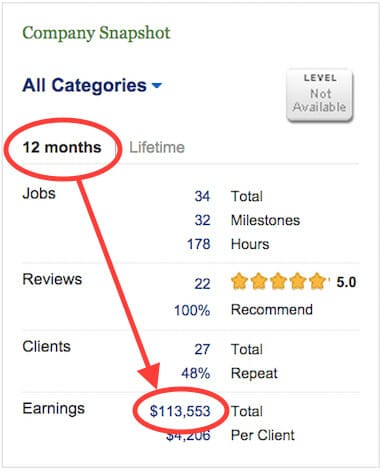
    Most people are surprised to find out that I earned six figures in 12 months using Elance as my only source of clients.

    I get it: In the minds of most writers, freelancing platforms like Elance tend to conjure up images of penny-per-word hell.

    There’s a good reason for this reputation. Many clients are attracted to freelancing sites because they can hire writers at a discount.

    But that’s only part of the story.

    In my experience, Elance also offers writers a great opportunity to make an excellent living — without all the hassles of “real world” freelancing.

    Nor was building up my six-figure Elance income as mysterious or challenging as you might think it would be — especially once I decided to reject conventional wisdom and stop following the masses.

    Even if you’ve had a bad experience freelance bidding sites, bear with me: Here’s how I make money as a freelance writer on Elance.

    Company Snapshot

    Getting started as a freelance writer

    When I set out to become a copywriter and start freelancing in July of 2012 — with no previous experience to speak of — Elance seemed like a good way to get my feet wet.

    So I spent dozens of hours researching the idea, devouring blog posts, articles and forum threads on the subject. Unfortunately, my main takeaway from all this reading was that there seemed to be an invisible “cap” on what an Elance writer could earn.

    But a few weeks into my Elance adventure, I’d already landed two $50-an-hour jobs. At that point, I realized that one of two things was true:

    A) I’d been super lucky and managed to find the only two decent-paying clients on Elance, or

    B) There were more of those decent-paying clients out there, and I could make great money if I could figure out how to attract them.

    So I spent the next few months developing strategies and tactics specifically designed to pull in the highest-quality clients Elance had to offer.

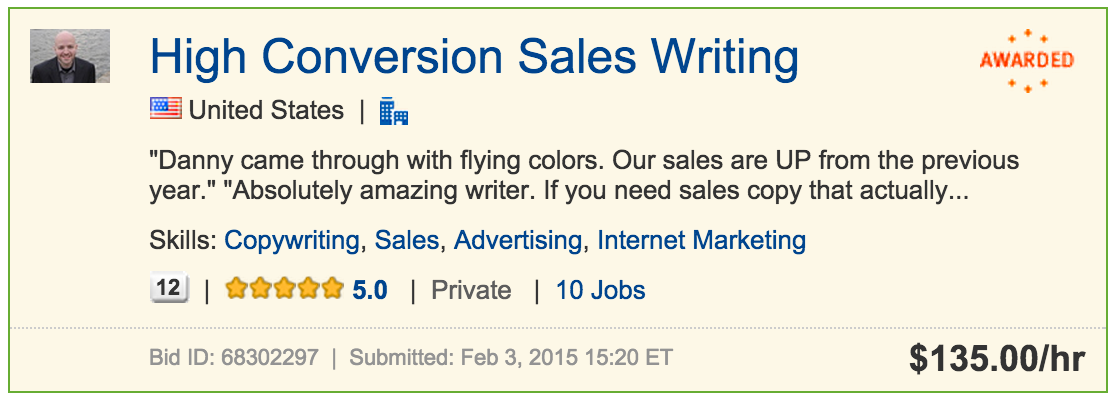
    It wasn’t long before my hourly rate rose from $50, to $75 and ultimately, $125 and beyond.

    High Conversion Sales Writing

    The challenges most freelancers experience on Elance have less to do with supply and demand, and more to do with not knowing how to find and secure the best-paying work.

    Here are some counterintuitive approaches I’ve used to overcome these challenges, winning more work and charging higher rates than my competitors — while spending less time grinding away at the keyboard.

    1. Don’t compete on price

    Lowering your price on Elance can seem like the right way to deal with low-bidding competitors. But it’s a game you won’t win, and can’t even afford to play.

    Personally, I love seeing gaggles of writers racing to the bottom on price: It tells me there’s a lack of quality options available to clients.

    Writers who charge bargain rates don’t have time to hone their craft; they’re too busy working their way to burnout. So I go the opposite way — offering high-quality work for a premium price.

    There’s nothing mysterious about this plan. I spend a lot of time educating myself about my craft and my niche, and it makes me more valuable than most of my competitors.

    Mostly, this strategy involves reading. I regularly pore over a plethora of writing blogs (like the one you’re reading right now) and books like Made to Stick by Chip and Dan Heath (a must-read for all writers), all of which have helped me improve my skills in different ways.

    You might think that all of your competitors are gaining the same knowledge as you are through reading, but they aren’t. This simple habit gives you a huge advantage in the marketplace and allows you to charge above-average prices.

    2. Choose a specialty

    Most Elancers are scared to choose a niche, for fear of shutting out most of the clients they encounter.

    So they stick to being the “Jack of all trades.” Or they choose several niches, and misguidedly try to tie them all together (e.g. Resume Writer / Novel Editor / White Paper Author).

    My advice? Forget about “most clients.”

    Successful freelancing isn’t about catering to the masses. It is, to paraphrase Seth Godin, about finding the “weird” clients who are a perfect fit for you.

    The irony of choosing a specialty on Elance is that, far from limiting yourself, you’ll now appear even more valuable to the clients who want and need you the most. It’ll be easier for them to find you, and easier for you to charge them what you’re really worth.

    3. To win big, aim small

    Bigger jobs on Elance come with a paradox: Though they offer more income potential, they also draw out more competition.

    Like this one:

    Job Ad

    Snagging these long-term or recurring jobs can seem like winning the lottery. But you’re also competing against about as many other people as you would in the actual lottery. Instead, I’ve developed a strategy to flip the odds in my favor.

    Rather than trying to get the client to award me the whole enchilada, I offer them a small trial job. This has many benefits, like:

    • Helping me stand out from the crowd (who are all pushing for the “big contract”)
    • Making it easier for the client to say yes, since there’s less commitment required
    • Giving me added credibility and posture (i.e. I don’t appear desperate)
    • Offering me a chance to test the waters, just in case the client turns out to not be a good fit

    For the job above, instead of forcing the client into the big decision of hiring me for a three-month blogging contract, I suggested we start with a single blog post.

    As you can see from the screenshot below, this approach worked out great for both of us, and has been a great income stream for me over the course of a just a few months.

    Blog Writer - Fixed Price

    (Of course, this strategy requires some confidence, which goes back to expertly honing your skills. As the great Jim Rohn said, “Work harder on yourself than you do on your job.”)

    4. Tap into the “Hidden Elance Economy”

    The only thing more fun than finding lots of clients is having them find you.

    While Elance’s jobs marketplace is great for finding new work, many of the best clients use the “search” feature to scout for writers before they consider posting a job.

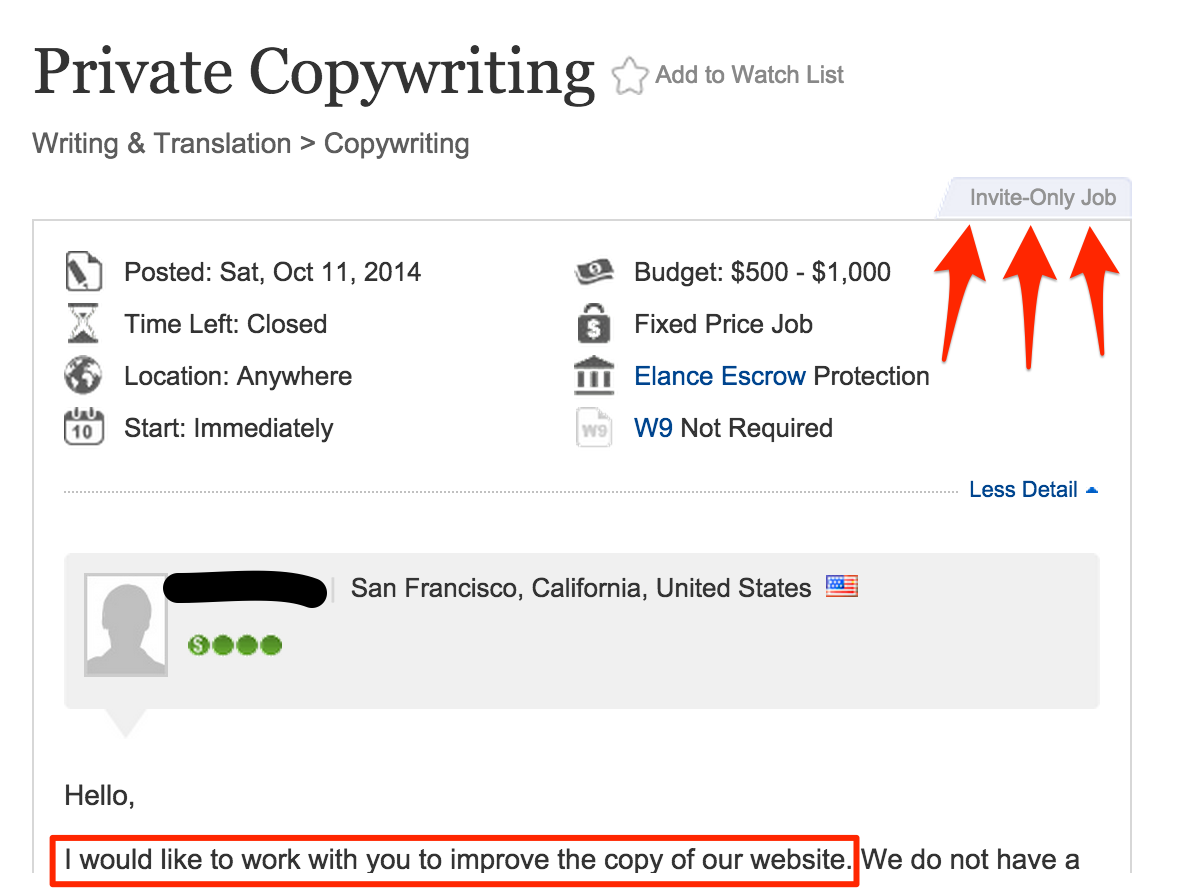
    If one of these clients likes what they see in your profile, they just might go ahead and invite you to a job they created just for you. Like this one:

    Hidden Elance Economy

    I call this the “Hidden Elance Economy” because it’s totally invisible to anyone but you!

    Receiving high-quality, private invites like this one allows you to charge more for your work, and gives you a passive stream of new leads to choose from.

    Here are some tips for taking advantage of these opportunities:

    • Word your profile carefully so clients can easily see exactly what services you offer and the type of client you work best with (if you aren’t sure, don’t worry, you’ll figure it out once you get a feel for the market)
    • Over-deliver to clients so they write you the sort of amazing reviews that attract even more awesome clients
    • End your profile with a call-to-action letting clients know they can invite you to a private job (otherwise, how will they know?)

    Have you found decent-paying writing jobs on Elance?

    In my experience, Elance can be an enormously rewarding source of freelancing business, way beyond what the average writer imagines.

    But you need to choose the right approaches to make it work. “Going with the flow” is just a race to the bottom. Instead, be strategic and you just might find yourself with lucrative jobs and quality clients.

    Have you tried Elance as a source of writing jobs? What was your experience like, and looking back, would you do anything differently?