Blog

  • Where to Submit Short Stories: 30 Options for Writers

    Where to Submit Short Stories: 30 Options for Writers

    Good news! You can finally stop stressing about where and how to submit your short stories—we compiled a list for you. 

    Trying to find a sense of community comes with the territory of being a writer. Whether you’re looking for the right writing contests or residencies, it’s hard to know where to begin and how to find the right home for your personal work. 

    In this guide, you’ll find 30+ magazines and literary journals that publish short fiction (and nonfiction). Our list includes a mix of publications across various genres and styles, ranging from prestigious, highly competitive options to those specifically seeking new and emerging voices.

    Plus, international writers, a lot of these are open to you, too! 


    30 Outlets that Publish Short Stories

    While we’ll give you a brief idea of the flavor of each magazine and site, you’ll definitely want to spend some time reading your target publications before submitting to become familiar with the sort of pieces they prefer. 

    Many of these short story publishers accept original submissions that are simultaneously submitted elsewhere. Just make sure to withdraw your submitted submissions if you get your story published!

    Ready to get started? Here’s where to submit short stories.

    1. The New Yorker

    Might as well start with a bang, right? Adding publication in The New Yorker to your portfolio puts you in a whole new league, though it won’t be easy. Author David. B. Comfort calculated the odds of acceptance at 0.0000416 percent!

    It accepts both standard short fiction as well as humorous short fiction for the “Shouts & Murmurs” section. No word counts are mentioned, though a quick scan of the column shows most pieces are 600 to 1,000 words.

    Deadline: Open

    Payment: Huge bragging rights; pay for unsolicited submissions isn’t specified. As of this post’s publication, no rates specifically for short stories

    2. The Atlantic

    Another highly respected magazine, The Atlantic, publishes both big names and emerging writers in fiction and nonfiction. Submission guidelines advise, “A general familiarity with what we have published in the past is the best guide to what we’re looking for.”

    Deadline: Open. Fiction stories are submitted to fiction@theatlantic.com

    Payment: Unsolicited submissions are generally unpaid

    3. The Threepenny Review

    The 3P Review is quarterly arts magazine focuses on literature, arts and society, memoir and essay. Short stories should be no more than 4,000 words, while submissions to the “Table Talk” section (pithy, irreverent and humorous musings on culture, art, politics and life) should be 1,000 words or less.

    Deadline: January 1 to April 30

    Payment: $400 for short stories; $200 for Table Talk pieces

    4. One Story

    One Story is just what the name says: a literary magazine that publishes one great short story every three to four weeks, and nothing more.

    Its main criteria for a great short story? One “that leaves readers feeling satisfied and [is] strong enough to stand alone.” Stories can be any style or subject but should be between 3,000 and 8,000 words.

    Deadline: January 15 – May 31 | September 3 – November 14

    Payment: $500 plus 25 contributor copies

    5. AGNI

    Thought-provoking is the name of the game if you want to get published in AGNI. Its editors look for pieces that hold a mirror up to the world around us and engage in a larger, ongoing cultural conversation about nature, mankind, the society we live in and more.

    There are no word limits, but shorter is generally better; “The longer a piece is, the better it needs to be to justify taking up so much space in the magazine,” note the submission guidelines.

    Deadline: Open September 1 to December 15; February 15 to May 31

    Payment: $10 per printed page (up to a max of $150) plus a year’s subscription, two contributor’s copies and four gift copies

    6. Kindle Vella

    Rather than seeking a magazine or journals editorial approval, you can publish directly to Kindle Vella’s short story program. Here, your work will go directly to market and its success will be determined by the general public, not by an editorial team. You also don’t have to wait months on a response as to whether your short story will be published. You can upload and be published on Kindle Vella in under 48 hours.

    For a full review of Kindle Vella, read this article.

    Deadline: Open

    Payment: Royalties on KDP reads

    7. Barrelhouse

    Published by an independent nonprofit literary organization, Barrelhouse’s biannual print journal and online issue seek to “bridge the gap between serious art and pop culture.” Its editors look for quality writing that’s also edgy and funny—as they say, they “want to be your weird Internet friend.”

    There’s no hard word count, but try to keep your submission under 8,000 words.

    Deadline: Currently open for book reviews only. Check the webpage to see all open categories and sign up for the email list to receive updates on submissions

    Payment: $50 to print and online contributors; print contributors also receive two contributor copies

    8. The Cincinnati Review

    The Cincinnati Review publishes work by writers of all genres and at all points of their careers. Its editors want “work that has energy,” that is “rich in language and plot structure” and “that’s not just ecstatic, but that makes its reader feel ecstatic, too.”

    Fiction and nonfiction submissions should be no more than 40 double-spaced pages.

    Deadline: The review accepts submissions during three time periods, September, December, and May. Submit earlier in the month because they will stop accepting submissions when their cap is reached.

    Payment: $25 per page for prose in journal

    9. The First Line

    This cool quarterly is all about jumpstarting that pesky writer’s block. Each issue of The First Line contains short fiction stories (300 to 5,000 words) that each begin with the same pre-assigned first line. 

    If you really want to get ambitious, you can also write a four-part story that uses each of that year’s first lines (which is due by the next year’s spring issue deadline). To find each issue’s assigned first line, check out the submission guidelines.

    Deadline: February 1 (spring); May 1 (summer); August 1 (fall); November 1 (winter)

    Payment: $25 to $50 (fiction); $25 (nonfiction) plus a contributor’s copy

    10. The Georgia Review

    Another one high on the prestige list, The Georgia Review features a wide variety of essays, fiction, book reviews, and more across a wide range of topics. You can read specific requirements for each in the submission guidelines, but the common theme among them all is quality, quality, quality.

    Bear in mind submitting requires a $3 processing fee if you’re not a subscriber.

    Deadline: Opens on August 15

    Payment: $50 per printed page; contributors also receive a one-year subscription to the quarterly and a 50% discount on additional copies of that issue

    Freelance Writer’s Pitch Checklist
    Grab it for free 👇

    Convince more editors to say YES to your pitches!

      We’ll also send you our weekly newsletter, which offers helpful advice for freelancing and publishing. You can unsubscribe at any time.

      11. Boulevard Magazine

      Boulevard Magazine is always on the lookout for “less experienced or unpublished writers with exceptional promise.” It accepts prose pieces (fiction and nonfiction) up to 8,000 words (note: no science fiction, erotica, westerns, horror, romance or children’s stories).

      There is an online submission fee of $3. Free if submitting by post.

      Deadline: Open November 1 to May 1

      Payment: $100 to $300

      12. Story

      Story Magazine is, you guessed it, all about the story, whatever shape it takes. Each issue—printed tri-annually in February, June, and November—is “devoted to the complex and diverse world of narrative with a focus on fiction and nonfiction.” Luckily, you don’t have to stick to any formal guidelines in regards to style, content, or even length; they consider all “short” narrative length work, from flash fiction to novellas. There is a $3 submission fee.

      Deadline: Open

      Payment: Regular payment rate is $10 per page upon publication

      13. Vestal Review

      Prefer to keep your short stories extra short? Vestal Review publishes flash fiction of no more than 500 words. Its editors are open to all genres except for syrupy romance, hard science fiction and children’s stories, and they have a special fondness for humor. R-rated content is OK, but stay away from anything too racy, gory or obscene.

      There is a submission fee of $2 for each submission. 

      Deadline: Submission periods are February to May and August to November

      Payment: The author of an accepted print submission gets $25 and a print copy; $10 for accepted web submissions

      14. Flash Fiction Online

      Flash Fiction Online allows for slightly longer flash stories—between 500 and 1,000 words. Its editors like sci-fi and fantasy but are open to all genres (except for nonfiction and poetry!). As with Vestal, stay away from the heavier stuff like erotica and violence. What they’re looking for is developed, empathetic characters and discernible, resolved plots. Unlike many of the other publications, they will accept previously published work, which you’d submit in the reprint category.  

      Deadline: Open each month for submissions from the 1st to the 21st of the month.

      Payment: $80 per story; two cents per word for reprints

      15. Black Warrior Review

      Black Warrior Review publishes a mix of work by up-and-coming writers and nationally known names. Fiction pieces of up to 7,000 words should be innovative, challenging, and unique; its editors value “absurdity, hybridity, the magical [and] the stark.”

      BWR also accepts flash fiction under 1,000 words and nonfiction pieces (up to 7,000 words) that complicate western traditions of truth-telling, and “foregrounds the history of emotions rather than the history of facts.” There is a $3 submission fee.

      Deadline: Submission periods are December 1 to March 1 and June 1 to September 1

      Payment: A one-year subscription to BWR and a nominal lump-sum fee (amount not disclosed in its guidelines)
      16. The Sun Magazine

      The Sun Magazine offers some of the biggest payments we’ve seen, and while its guidelines specifically mention personal writing and provocative political/cultural pieces, they also say editors are “open to just about anything.”

      Works should run no more than 7,000 words. Submit something the editors love, and you could get a nice payday.

      Deadline: Open

      Payment: $300 to $2,000

      17. Virginia Quarterly (VQR)

      A diverse publication that features both award-winning and emerging writers, VQR accepts short fiction (3,500 to 8,000 words) but is not a fan of genre work like romance, sci-fi and fantasy. It also takes nonfiction (3,500 to 9,000 words) like travel essays that examine the world around us.

      Deadline: Submissions read July 1 to July 31

      Payment: Generally $1,000 and above for short fiction and prose (approximately 25 cents per word) with higher rates for investigative reporting; $100 to $200 for content published online

      18. Ploughshares

      Ploughshares’ award-winning literary journal is published by Boston’s Emerson College. They accept fiction and nonfiction under 7,500 words and require a $3 service fee if you submit online (it’s free to submit by mail, though they prefer digital submissions). You can also submit your significantly longer work (7,500 to 20,000 words) to the Ploughshares Solos series!

      Deadline: June 1 to January 15 at noon Eastern Time

      Payment: $45 per printed page (for a minimum of $90 per title and a maximum of $450 per author); plus two contributor copies of the issue and a one-year subscription

      19. Carve Magazine

      Writers are in for a treat! Carve Magazine accepts poetry, short stories and nonfiction submissions, not exceeding 10,000 words. They accept literary fiction only and are not open to genre fiction (i.e. thriller, horror, romance, etc.). They also accept novel excerpts but only those that can stand alone in the story. There’s a $3 submission fee, but you can subscribe to the magazine to skirt past it.

      Deadline: Open all-year-round from anywhere in the world

      Payment: Pays $100 and offers feedback on 5 to 10% of declined submissions

      20. Daily Science Fiction

      Sci-fi and fantasy writers, this one’s for you. Daily Science Fiction is looking for character-driven fiction, and the shorter, the better. While their word count range is 100 to 1,500 words, they might consider flash series—AKA three or more flash tales built around a common theme. 

      Deadline: Open except for the period between December 24 to January 2

      Payment: Eight cents per word, with the possibility of additional pay for reprints in themed Daily Science Fiction anthologies

      Freelance Writer’s Pitch Checklist
      Grab it for free 👇

      Convince more editors to say YES to your pitches!

        We’ll also send you our weekly newsletter, which offers helpful advice for freelancing and publishing. You can unsubscribe at any time.

        21. JMWW

        JMWW is a literary journal that publishes fiction stories with up to 300 words and flash fiction of no longer than 1.500 words, and it’s open to any genre as long as the story is well-crafted. To up your chances of catching the editors’ eyes, note that they like “strong characters whose motivations are not always known to us but can be explained within the confines of common sense,” as well as surprise endings (nothing gimmicky). 

        Deadline: Open

        Payment: No pay specified

        22. Smokelong Quarterly

        SmokeLong, a literary mag devoted to flash fiction, publishes flash narratives up to 1000 words—and that’s a firm word limit, so be sure to stick to it. The SLQ aesthetic remains “an ever-changing, ever-elusive set of principles,” but it most likely has to do with these kinds of things: language that surprises and excites, narratives that strive toward something other than a final punch line or twist, and more which you can see in the submission guidelines. Think you can handle that?

        Deadline: Open

        Payment: $50 per story upon publication in the quarterly issue

        23. The Master’s Review

        The Master’s Review’s New Voices category is open to any new or emerging author who has not published a work of fiction or narrative nonfiction of novel length—not including authors with short story collections. Submit your flash fiction of 1,000 words or your piece of fiction or narrative nonfiction of up to 7,000 words. Though, editors are honest: There are no submission fees, but they’re highly selective. 

        Deadline: Open

        Payment: A flat rate of $100 for flash-length stories; $200 for short fiction

        24. Ruminate Magazine

        Both emerging and established writers are encouraged to submit fiction or creative nonfiction stories that “engages the contemplative spirit of our journal and embraces curiosity and discovery rather than resolution.” Both genres are capped at a word count of 5,500 words. 

        Want another option? There’s no pay for this one (just contributor copies), but The Waking is Ruminate Magazine’s online publication space and they’re looking for short-form prose, fiction and nonfiction that is “holy, nutritious and crucial.” Keep your submissions to 1,000 words or less.

        Deadline: July 2, 2020; fiction reading periods are April 1 to June 30; January 15 to June 30 for nonfiction

        Payment: $20 per 400 words, plus contributor copies

        25. Asimov’s Science Fiction

        Have you ever wondered where George R. R. Martin’s Daenerys Targaryen first appeared on the printed page? Well, this is it! An established market for science fiction stories, Asimov’s Science Fiction magazine has won numerous Hugo and Nebula Awards, and the writers they’ve published have led successful careers

        They want you to submit your character-oriented, “serious, thoughtful, yet accessible fiction,” but there’s room for humor as well. While science fiction dominates what the magazine publishes, you’re welcome to submit borderline fantasy, slipstream and surreal fiction—steer clear of sword and sorcery, explicit sex or violence. While there’s no specific word count, ASF seldom buys stories shorter than 1,000 words or longer than 20,000 words. 

        Deadline: Open

        Payment: 8 to 10 cents per word for short stories up to 7,500 words; 8 cents per word for each word over 7,500

        Check out this helpful video from our friends at selfpublishing.com for writing a short story.

        26. Slice Magazine

        Got a fresh voice and a compelling story to share? This one’s for you. To bridge the gap between emerging and established authors, SLICE offers a space where both are published side-by-side. In each issue, a specific cultural theme becomes the catalyst for articles, interviews, stories and poetry from renowned writers and lesser-known voices alike. Short fiction and nonfiction submissions should be 5,000 words max.

        Deadline: Slice published their final issue in the fall of 2021 and are no longer looking for submissions

        Payment: $400 for stories and essays; $150 for flash fiction pieces; $100 for poems

        27. Cricket Media

        Cricket Media wants to publish your finest quality writing for children of all ages in one of its four literary magazines—you have options! Open to submissions from writers of every level of experience, CM’s mags are interested in a lot of things, no matter what genre: realistic contemporary fiction, historical fiction, science fiction and fantasy, folk tales, myths and legends, humor, and even westerns. Their advice? Focus on telling a good story that’s well-plotted, character-driven and has a satisfying conclusion.

        Most stories are 1200 to 1800 words in length; however, they occasionally serialize longer stories of up to 6,000 words. 

        Deadline: Varies; check the guidelines to learn the deadlines for each lit mag 

        Payment: Up to 25 cents per word 

        28. The Dark Sire

        Horror writers, you’re up! A fairly new literary journal, The Dark Sire is a quarterly online and print journal that “explores speculative fiction works for enthusiasts” of gothic, horror, fantasy and psychological realism in short fiction, poetry and art. ​Subjects of particular interest include: vampires, monsters, old castles, dragons, magic, mental illness, hell, disease and decay of society. No word count. 

        Deadline: Open

        Payment: None, but they promote writers through author events, social media outreach and the (in development) TDS podcast

        29. The Common

        Based at Amherst College, The Common is an award-winning print and digital literary journal published biannually in the fall and spring. They seek fiction and nonfiction stories and dispatches (800-word notes, news and impressions from around the world) that “embody a strong sense of place: pieces in which the setting is crucial to character, narrative, mood and language.” Stick to a 10,000 word-count and you’re solid. There is a $3 submission fee.

        Deadline: Reading periods are March 1 to June 1 and September 1 to December 1; subscribers can submit for free year-round

        Payment: $100 for fiction and nonfiction submissions; $50 per dispatch

        30. The Antioch Review

        The Antioch Review is currently paused and not accepting submissions. Check back in the future.

        The Antioch Review rarely publishes more than three short stories per issue, but its editors are open to new as well as established writers. Authors published here often wind up in Best American anthologies and as the recipients of Pushcart prizes.

        To make the cut, editors say, “It is the story that counts, a story worthy of the serious attention of the intelligent reader, a story that is compelling, written with distinction.” Word count is flexible, but pieces tend to be under 5,000.

        Deadline: When operational, open except between June 1 to August 31. No electronic submissions

        Payment: $20 per printed page plus two contributor copies

        31. Literary Orphans

        Literary Orphans is currently paused and not accepting submissions. Check back in the future.

        Fiction comes first for this short fiction and art magazine. Editors want your fiction of any genre, but they have a need for micro-fiction, flash, and short stories that are 2,000 words or less (but 1,500 is their sweet spot!). Creative nonfiction is also accepted for the bi-monthly Literary Orphans issue on the main website; just keep your story to 5,000 words max. Plus, teens under 19, there’s a category for you, too. Submit a story of no more than 3,000 words to its “TEEN SPIRIT” section

        Because they receive a high volume of submissions, editors ask that you submit your *best* piece. But here’s where it gets interesting: If you can’t choose just one, send both! (As long as both stories combined don’t surpass 2,000 words.)

        Deadline: Currently no open calls for submission, but check back in the future!

        Payment: Not specified

        Short Story Submission Tips

        With hard work and patience you can see your short stories published!

        Here are a few tips to keep in mind when looking to submit short stories

        • Take time to read through the literary magazines before you submit. You will have a better idea of what they are looking and know which magazines fit best with your writing style
        • Read the submission details before you submit. Each publication has different specifications for submissions – make sure you fulfill their requirements
        • Be patient. Many of these publications have a small team and a lot of submissions. It is normal to wait several months before hearing whether an article will be published or not
        • Keep track of which articles you have submitted to which publications. Because can submit the same short story to multiple publications, you will need to withdraw that article if it gets published. You don’t want to accidentally publish the same piece in multiple places
        • Don’t give up! While you might receive multiple rejections before you get your first piece published, with hard work it will be worth the wait once you get your first piece in print!

        The original version of this story was written by Kelly Gurnett. We updated the post so it’s more useful for our readers.

        Photo via Nito/ Shutterstock 
      • How to Format a Book: 10 Tips Your Editor Wants You to Know

        How to Format a Book: 10 Tips Your Editor Wants You to Know

        I know. With the greatest of respect for book designers and internal formatters, formatting isn’t exactly the sexiest of topics for an author to consider. But, if you don’t know how to format a book it can cost you a reader. You’d much rather paint a new world on the canvas of your book than talk about unadorned, 12-point Times New Roman.

        Unless you prefer your friends to be story nerds or those who lean toward obsessive-compulsive tendencies when it comes to grammar, you shouldn’t necessarily seek to befriend your editor.

        However, you should seek to do everything in your power to be a professional friend of your editor. One of the simplest ways to do that, which too many authors fail to consider, is formatting.

        book open on a table
        You’ve written a book, and now you need to figure out the manuscript format. Do yourself (and your editor!) a favor and follow this advice.

        Why Formatting is Important

        When you skip over the basics of how your manuscript is formatted, you’re subconsciously showing a lack of respect for your craft (and your editor). If you send a poorly formatted manuscript to your editor, they very likely won’t say anything, but I can promise you that they’re thinking one of two things.

        1. I can hardly read this manuscript
        2. I’m wasting my time reformatting this manuscript

        In these instances, an editor will either edit your manuscript as-is or spend the time you’re paying them for to do the work you could have (and should have) done yourself.

        But once you incorporate the standardized basics of formatting a manuscript in preparation for your editor, you’ll see that it will save both you and your editor a lot of time and frustration.

        How to Format Your Book

        While this article attempts to offer standardized recommendations, some editors, literary agents or publishing houses may have their own formatting stipulations. Always be sure to scan websites for that information, and when in doubt, ask.

        The following formatting recommendations hold true for both fiction and nonfiction manuscripts in the United States. Any accepted variations are noted, and comments are appreciated with regard to differences for international markets.

        Here’s what’s expected for a standard manuscript format.

        1. Use black, 12-point, Times New Roman as the font

        Yes, Times New Roman is boring, but it’s essentially on every computer ever made.

        Don’t use a cool font for effect. Save that for your book’s interior design, which comes much later after the editing process.

        Font trivia: Times New Roman is no longer used by The Times.

        2. Use the U.S. standard page size of 8.5×11 inches and set your margins to 1 inch on all sides

        Starting a new document in Word defaults to these parameters, but if you’re exporting to Word from your word processor of choice, double-check the output to ensure your page size and margins are correct.

        To set page size in Word, go to File>Page Setup and look at the drop-down menu for Page Size.

        To set margins in Word, go to Format>Document.

        3. Set alignment to left justified

        Left justified text is also known as ragged right text. The text will align itself along its left side, leaving its right side nonuniform (unjustified).

        To set alignment in Word, select all of your text, then click the left justification icon in the Home tab or select Format>Paragraph and choose “Left” in the Alignment drop-down box.

        4. Use a single space after periods

        If you were trained to type two spaces after a period, retrain yourself.

        In the digital age, use a single space. (For why, see “Space Invaders.”)

        Tip: if your manuscript has two spaces after a period, use your word processor’s Find and Replace tool. Type two spaces into “Find” and one space into “Replace” then hit “Replace All” with reckless, typing-teacher-be-damned abandon.

        5. Use double-spaced line spacing

        This may be the greatest help to your editor.

        You want to ensure they see your every last word, so give your words room to breathe on the page.

        Tip: if you’ve already written your book with different line spacing, select all of your text in Word, click Format>Paragraph, then select “Double” in the drop-down box under “Line spacing.”

        How to Format a Book

        6. Indent all paragraphs by .5 inches, and don’t hit tab or space to indent

        This may be every editor’s pet peeve. Setting tabs and hitting tab aren’t the same thing.

        If you’re a tab-hitter or space-space-space-space-spacer, select all of your text in Word, then set indentation using Format>Paragraph. Under “Indentation” and by “Left,” type .5. under “Special,” then choose “First line” from the drop-down menu.

        Note: Generally, the first paragraph of any chapter, after a subhead, or following a bulleted or numbered list isn’t indented.

        7. Format paragraphs according to genre standards

        Fiction authors should use indented paragraphs without full paragraph breaks. Nonfiction authors may opt for no indentation so long as paragraphs are separated by a full paragraph break.

        Tip: Crack open a book in your genre to see what the paragraphing conventions are, then emulate.

        8. Use page breaks

        To begin a new chapter, don’t just keep hitting return until you create a new page. Rather, use page breaks.

        In Word, place the cursor at the end of a chapter, then click “Insert>Break>Page Break” in Word’s top menu.

        9. Number your pages

        Don’t begin numbering on your title page. Rather, begin numbering on the page your story begins.

        To place page numbers in Word, double-click within the header area of the page on which your story begins and click “Insert > Page Numbers,” then select your preferred options. Choose to place your page numbers at the top left of the page.

        10. Send your manuscript as one Word document (.doc /.docx)

        You don’t have to compose your masterpiece in Word, but because Word’s “Track Changes” feature is still the de facto editing tool of choice, your editor will appreciate receiving a Word file.

        And whatever you do, never send your editor individual chapters as separate files.

        Alternate Option: Use Software to Help Learn How to Format a Book

        While you can do most of these steps in Microsoft Word or Google Docs while writing your manuscript, when it comes time to turn it into a format that is used in the marketplaces, you’ll probably want specialized book formatting software. This kind of software can help you with both ebooks and paperbacks.

        While there are a number of options out there, one of the best is Atticus. It will help you produce professional-looking books easily, with no technical background. Plus, with all of its features, you can customize your book and make it truly unique.

        These 10 easy-to-follow steps will put you on your editor’s good side. While each of these issues typically doesn’t take too much time to rectify, the problems are compounded when an editor has to fix more than a few.

        Just remember, when an editor receives a well-formatted manuscript, they can immediately begin the work that you’re actually paying them to do: editing!

        This is an updated version of a story that was previously published. We update our posts as often as possible to ensure they’re useful for our readers.

        Photo via Chinnapong/Shutterstock

      • IAPWE Review: Should I Join? How Much Does it Cost? Is it a Scam?

        IAPWE Review: Should I Join? How Much Does it Cost? Is it a Scam?

        If you’ve been looking for a IAPWE review, you’ve come to the right place. But first things first, what is IAPWE? This stands for the International Association of Professional Writers and Editors and their stated mission is to “bring legitimate opportunities to professional writers and editors.”

        Sounds great, right?

        Before we get too far in, if you’re looking for a quick review here’s what you need to know: IAPWE is more of a job board than an actual program that hires writers. This distinction is quite unclear on their website, which is the main takeaway from this review. We won’t go so far as to call the organization a scam, but there are a few red flags to pay attention to.

        [sps_reusable_block post_id=43043]

        When you Google “International Association of Professional Writers and Editors” or “IAPWE” and look at the “people also ask” area you see questions like,

        • Is the IAPWE or International Association of Professional Writers and Editors legit?
        • How much does the International Association of Professional Writers and Editors pay?
        • Are paid online writing jobs legit?

        So as you can see, other people have questions too.

        We’ll do our best to narrow in on what IAPWE offers, how they accept writers (and what that means exactly), and talk about a few other people’s experiences with the IAPWE program. But first…

        Meme of Futurama character Phillip J. Fry making a suspicious face. The text says "Not sure if this is a scam or the best job ever." This is to illustrate the article IAPWE Review

        Is IAPWE a Scam?

        IAPWE is not BBB accredited and currently has a BBB rating of B.

        Reading through the IAPWE review posts shows quite a few unhappy people, mostly when it comes to canceling their memberships. From the reviews, it sounds like when you’re ready to cancel your annual membership you’ll have to jump through a few hoops.

        IAPWE might post legitimate opportunities in their job board, but one huge problem is they don’t mention how the job board works on their website. It also doesn’t indicate how long it will take to get approved, that you’re not working directly with the company, or that there’s a monthly fee for this service.

        Another confusing aspect of the website is there’s a listed rate, but it’s actually a job board. Does that mean they only post jobs that fit within those rates? Unclear.

        Professional writers and editors are generally happy to pay for membership in a freelancing group or mentorship/networking program, as long as the cost is worth it. However, because the fees seem to be hidden, and reviews indicate the actual writing jobs weren’t worth the cost, that’s a red flag.

        With this in mind, it might not be fair to say IAPWE is a scam, but there are some deceptive tactics. Whether that’s intentional or just poor website design and copywriting…well, we’ll leave that up to you to decide.

        Another note is they don’t post too much on their social media. This on its own doesn’t mean much, but I thought it worth mentioning.

        While I wouldn’t go so far as to call IAPWE a scam, since no one said the jobs themselves are actually fake, the true value the organization brings to freelance writers and editors is unclear.

        IAPWE Reviews (What Others Have to Say)

        I hunted around the Internet to see what people had to say about their firsthand experience with IAPWE. Here are a few less-than-positive ones to check out:

        For a positive review, I found this comment in a Reddit thread,

        I actually know quite a few people that have secured writing gigs via IAPWE. They’re not a “known scam,” they just need a lot of effort to utilize their resources, which can be tedious. I think many people want a quick, easy, high-paying assignment, with little to no effort. As IAPWE is not a get-rich-quick site, it leads to many negative reviews. The moral is: it’s not for everyone. Just because something doesn’t work for you, does not mean it won’t work for others.

        Reddit—PSA: The International Association of Professional Writers and Editors (IAPWE) is apparently not a legit organization.

        What is the International Association of Professional Writers and Editors (IAPWE)?

        IAPWE says it’s an organization that helps writers and editors succeed. Their website has articles and other resources for professionals to help them break into the industry and start their careers. They’re most popular for their job board, which lists a variety of jobs for both writers and editors.

        The questions we’re wondering are: are the jobs good quality and is the organization worth joining?

        How Much Does an IAPWE Membership Cost?

        Once you’re accepted into IAPWE, it seems as though you then need to upgrade your account to be able to access the job opportunities.

        There are conflicting numbers out there, but it seems to currently cost between $6 and $15 per month to access to the job board. This works out to between $72 and $180 per year, and you can write this type of expense off on your taxes in most countries.

        How to Work with IAPWE

        Most reviewers have mentioned coming across IAPWE hiring posts on Craigslist or job boards separate from the IAPWE job board.

        On the IAPWE website, it’s not easy to see how to apply to be a member. I had to search for the page on Google to find the application page!

        Below is a screenshot of the application page from 2022, at the time of this articles first writing (it has since been updated).

        This is a screenshot of an application page from IAPWE as part of an IAPWE review. It was taken in 2022

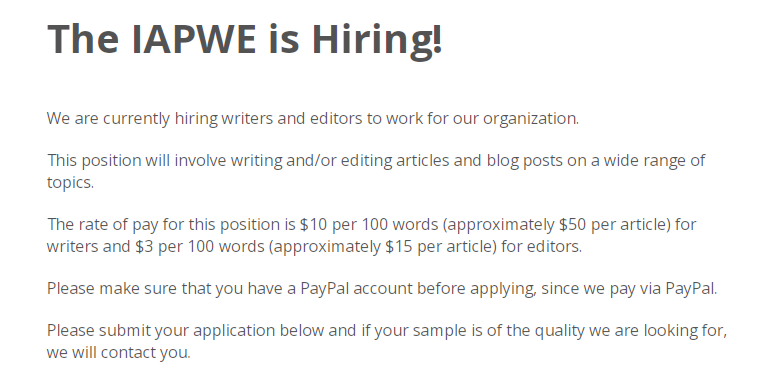
        If you have images turned off, here’s the short version of the screenshot: the IAPWE pay rate is $10 per 100 words and each article is approximately 500 words. For editors, their rate is $3 per 100 words.

        However, on this job post board for IAPWE, the rate is different. It lists $20 per 100 words.

        It also mentions on that site that 17,357 people have applied to this job. It says the salary is $40,000-$50,000 and that applicants must, “Work well as a team member with the rest of our content management and editorial staff.”

        We’ll also point out this information was gathered in 2022 when the article was originally written and it still states this is 2023 when we reviewed the links again.

        Here are the topics they currently offer writers and editors:

        • Health and Beauty
        • Fitness
        • Home Décor
        • Fashion
        • Sports
        • Do It Yourself (DIY)
        • Finance
        • Legal
        • Medical
        • Family/Parenting
        • Relationships
        • Real Estate
        • Restaurants
        • Contracting (Plumbing, Pool Building, Remodeling, etc.)

        Depending on your current rates as a freelance writer or editor, this might seem like a decent amount. But it also might not seem like enough. These rates are better than a lot content mills that pay closer to $0.02 per word instead of $0.10 per word.

        According to online reviews for IAPWE, once you’re approved and accepted as a member, you have access to the job board. You’re not given a position in the company and jobs aren’t a given.

        The organization pulls from 100 different companies—but they claim to only post legitimate freelance jobs. While I did not personally apply for IAPWE, some reviewers said it can take a month or more to hear back from them once you apply.

        Why Writers Should Double-Check Any Program Before Joining

        So many people dream of being able to write and work from home, and scammers know this. You should keep in mind that any program that says it’s an easy to industry to get into in just a few hours should raise some red flags.

        That’s not about this specific program, this should be a rule for any program or organization you want to join going forward.

        If you want to become a freelance writer, just know that there are as many legitimate programs and organizations out there as there are scams. For this reason, it’s always a good idea to do your due diligence and make sure it’s legitimate before you sign up. (Just like you’re doing now!)

        While no program is guaranteed to work and make you rich, you at least need to make sure it’s legitimate and can get you results if you put the work in.

        The Pros and Cons to Wrap Up This IAPWE Review

        You’ve made it to the end of the post! Well done! Here’s a quick review of what we talked about.

        Pros to Joining IAPWE

        • You’ll get access to resources about becoming a professional writer or editor
        • You have access to legitimate jobs all in one place

        Cons to Joining IAPWE

        • You have to pay a monthly fee to access the job board
        • It can be difficult to cancel your membership
        • It’s unclear if the posted jobs are worth the monthly fee

        Here’s an Alternative!

        If you’re just getting started as a freelancer, then we recommend the Freelance Writers Den. They have an incredible community and a wealth of helpful resources to help you grow your income as a freelance writer, editor, proofreader, and more. There is also a monthly fee for this membership program, so once again—make sure it’s right for you before joining!

        For a full review on the program, check out this article.

        [sps_reusable_block post_id=43043]

      • What Is A Good Typing Speed? + 5 Tools To Improve Yours

        What Is A Good Typing Speed? + 5 Tools To Improve Yours

        Have you ever wondered what is a good typing speed? And are there ways to improve your overall typing skills?

        Keep reading to learn what makes a good typing speed, things that influence typing speed, and how you can measure and improve your personal typing speed.

        Why Typing Speed Matters

        If you can type with speed and accuracy, you will also often be productive. Depending on the type of work you do, having a fast typing speed will benefit your career.

        Whether or not you can type fast is not always a reason you will succeed or fail as a freelance writer.

        However, it can change how fast you can work and help you get your work done at a steady rate. If you can type faster and write at a quick pace, you can get more words done per hour so you can make more money.

        Sure, not every job as a freelance writer is based on how many words you can write per hour or how fast you can type, but being able to be proficient at what you do can save you a ton of time in the long run.

        If you are able to write more throughout the day, then you can take on more work at any given moment. Or, you can knock out things like busy work faster than you could otherwise.

        Being able to type fast can also help you do other things such as answer emails faster or do school assignments so you can work through your tasks faster in a day.

        Typing speed might also be something potential employers consider in order to hire you. It will show them that you can complete your work in a reasonable amount of time.

        What Is a Good Typing Speed?

        For the most part, you are going to have your words measured by a metric called wpm, which stands for words per minute. You might also see CPM, which stands for characters per minute.

        Most people will use a typing speed test to get an idea of how fast they are typing. That way, they can know if they are improving or not because when you can measure your speed, you can track your improvements over time.

        If you wanted to know actual numbers, here are some for you to use to measure your skills.

        Average typing speed

        • 40 wpm and over
        • 200 cpm and over

        Above average typing speed

        • 50 wpm and over
        • 250 cpm and over

        Productive typing speed

        • 60 wpm and over
        • 300 cpm and over

        High typing speed

        • 70 wpm and over
        • 350 cpm and over

        Competitive speed

        • 120 wpm and over
        • 600 cpm and over

        Keep in mind, there are some factors, such as the age of the person typing, that you might have to research or consider when it comes to measuring a good typing speed.

        What Influences Typing Speed?

        More than anything, learning how to properly type will help improve your typing speed.

        Some people only use their forefingers in order to type and that is not the most efficient way to type, even though a lot of people do it. You will want to practice using all of your fingers to type because it can help increase the amount of keys you can type in short intervals.

        There are also a wide variety of keyboard types out there that might be a better fit for you and how you prefer to

        Being sure to practice a lot and in an intentional way can also help you improve your typing speed. Challenge yourself to type faster or use different types of tools and tests to measure where you currently are and how to get better.

        Tools to Measure Typing Speed and Improve Your Skills

        While there are a ton of tools out there (and some free ones) to measure typing speed, we are going to focus on just a few of the popular ones so you can pick one that works best for you.

        We will also go over which ones of them offer you the ability to improve your typing speed as well.

        1. Typing.com

        Typing is a great resource that give you access to free timed tests. You can take various timed test (1 minute, 3 minutes, 5 minutes) or page tests (1 page, 2 pages, 3 pages) to get an overall idea at your typing speed.

        It is also a great site if you want to sign up for an account and start to improve your typing skills. Typing has a friendly user interface, making it a option for any age group to use.

        2. Ratatype

        Ratatype is another option that can help measure your typing speed to get an idea of where you are with your current skill set.

        There are some free typing lessons for you to use on their site as well, so you can actively try and improve your typing speed.

        They also offer options for teachers, corporate offices, and group settings, depending on what you need. There are also different game modes to make learning typing even more fun.

        3. Typing Trainer

        Typing Trainer is a free program that gives you different games, races, and challenges in order to help you improve your typing skills. With built-in lessons, you can go at a pace that works best for you.

        According to their website, in just four hours you can master the basics of typing so you can improve your typing speed. On top of the four basic hours, there are five hours of extra work for you to master even more things.

        4. GoodTyping

        GoodTyping offers 27 guided lessons to teach you the basics of typing. It is all web-based, as most of them are, but that keeps you from having to download anything extra or some additional software in order to get your lessons done.

        For extra fun, there are other typing courses in different languages. That can help if you need to type in multiple languages and need to improve your skills in that area as well. As you complete the courses, you can also get a typing certificate to certify your skills and speed.

        5. Typing Cat

        Typing Cat has the goal of improving your typing skills in a matter of 10 minutes a day. This is one that is not free, but it has more advanced features than you see on some of the other typing programs out there.

        It offers custom courses once it learns how you type and you also will have access to courses that were created by other users.

        What to Do Next

        Want to practice your typing? Use these prompts to get started!

        101 Creative Writing Prompts
        That Will Get You Excited to Write

        Grab it for free 👇

          We’ll also send you our newsletter, which offers advice on freelancing and publishing.
          You can unsubscribe at any time.

        • How to Write a Student Memoir: 6 Simple Ways to Embrace Nostalgia

          How to Write a Student Memoir: 6 Simple Ways to Embrace Nostalgia

          If you’re wondering how to write a student memoir (and how it’s different than a regular memoir), then you’re in the right place.

          No matter what stage you’re at in your educational journey, writing a student memoir can be a therapeutic experience for you and eye-opening for your readers. Documenting your experiences, emotions, and growth is also an excellent practice so even if your draft never leaves your hard drive, it will still be a worthy exercise. 

          What is a Student Memoir Anyway?

          A student memoir is much like any other memoir. A memoir is a narrative told from the perspective of the author and focuses on a pivotal moment or time in their life.

          Therefore, a student memoir is written by a student and recounts a pivotal moment or time in their academic career. 

          A memoir differs from biographies and autobiographies in a few key ways.

          • A biography is written about a person from an outside perspective
          • An autobiography is more similar, where it is written by or from the perspective of the subject/author. However it spans their entire life rather than the narrow focus of a memoir

          Readers for student memoirs are usually other students, or people who have been through school. They studied in different contexts for varying lengths of time and have at least some understanding of the experiences of being a student. 

          How to Write a Student Memoir

          Similar to journal writing, a memoir is successful if readers feel like they’re experiencing life with you. Here are six simple guidelines to follow that will help you figure out how to write a student memoir that’s memorable and captivating. 

          1. Find Your Topic

          Consider your time as a student. Was there a moment or time that stands out to you? A pivotal moment where something happened or a decision was made and changed everything for better or for worse? Did this happen a long time ago or are you going through it right now? Considering examples of successful memoirs can help inspire you at this stage.

          When selecting the focus of your student memoir, consider the relationships, obstacles, triumphs and other factors that are relevant to the event or time period. Think about the central themes, transformations, and lessons that came out of that time of your life. 

          2. Give it Structure

          Once you have a topic, it is time to determine how you are going to organize your thoughts to get your story and message across. Consider the arc of your story—how you get from point A to point B and how best to guide your audience on this journey. 

          Chronological, past versus present, thematic and internal conflict are all common memoir structures. By outlining key events and turning points, you can determine which structure is best suited to effectively tell your story, keeping readers engaged from start to finish. 

          3. Develop Your Voice

          What makes memoirs so compelling, often, is the author’s voice that shines through. An epic story with twists and turns is one thing, but it is how you tell that story that sets it apart. When a story has a strong, authentic voice the reader feels like they are right there with you or are being told it by a trusted friend.

          Experiment with different tones and writing styles until you find one that comes naturally and helps you get your stream of consciousness from the eyes and mind that experienced it onto the page. Stories written with exceptional tone and voice have the power to connect with readers on a personal level. If it comes naturally, infusing humor, wit, and emotion can help bring out your personality and voice. 

          4. Write Authentically

          One element that often goes hand in hand with voice is authenticity. When you are telling an authentic story, your voice will often come naturally. What is the point in writing a memoir if it’s not genuine? Then it just becomes a work of fiction. Get ready to be raw, honest and vulnerable as you lay it all out on the pages. 

          Even if it’s difficult, it is essential that you are being real with your readers and sharing your honest thoughts and feelings from when you were a student. When writing any type of memoir it is important to accurately recount events to the best of your ability and avoid turning yourself into a hero or victim if that is not what happened. Maybe you’re the villain, and that’s OK! Remember, your readers are interested in the true story, you don’t need to make it up. Just be authentically you.

          5. Reflect and Revise

          Reflection is a very important component of writing, particularly with memoirs. You should be reflecting before, during and after the writing process. At the end of your writing journey, take the time to properly reflect on your work and make revisions to improve elements such as the flow, tone, accuracy and consistency of your student memoir. 

          We often have a much harder time critiquing and finding flaws in our own work. That is where a fresh pair of eyes come in handy. If you don’t have an editor, seek feedback from a trusted friend, classmate or family member who can point out how you can improve your memoir to produce an even more compelling narrative. 

          6. Share Your Finished Piece

          You did it! You are finally ready to send a piece of you out into the world. Depending on what your goal for your student memoir is, you have many different options for how to share it. A few options to consider are publishing it on a personal blog or website, submitting it to a writing contest, a literary magazine or self-publishing. 

          However you choose to tell your story, embrace the sense of accomplishment from finishing your own student memoir and sharing the events, genuine thoughts and feelings from a pivotal time in your academic career that led you to where you are today. 

          Student memoirs speak to the inner child in all of us and have the unique power of bringing audiences back in time to their own school days while stepping into the author’s shoes. Celebrating the complexity of student life with all its highs and lows, a student memoir makes for an engaging story when told by the authentic voice of a vulnerable author.

          The Write Life has teamed up with Self-Publishing School to create a training called, Writing and Publishing Your Life Story. In it, you’ll learn the three core elements of memorable memoirs. Click here to sign up for this free workshop.

        • 4 Surefire Ways to Write an Effective Think Piece

          4 Surefire Ways to Write an Effective Think Piece

          Have you ever wondered how to write a think piece? Sometimes, a writer’s role is to report and present information in an unbiased manner. And sometimes your job is to write a think piece.

          Writing a compelling think piece is meant to make the audience, well, think!

          Exploring complex issues and taking a stance on one side of the fence takes guts, but can reward you with highly insightful counter arguments and analyses from all sides if you can engage your writers enough to start a discussion. 

          Use your soapbox think piece to challenge beliefs and norms and share your opinion on a passionate topic.

          Whether your topic is social, cultural, political or personal, take this opportunity to shake up the status quo by infusing your unique voice, compelling argument and fresh perspective into the discussion. 

          How to Write a Think Piece 

          Similar to opinion writing, a think piece is an article that doesn’t only share facts, but focuses on personal opinions. The goal of a think piece is to spark a discussion on both sides of the topic. Your work should compel readers to critically think about your points and share their own thoughts and counterarguments. 

          Here’s how to write a think piece.

          Do Your Research 

          No matter what you are writing, doing thorough research is key. Even if you already feel like an expert on your topic, it is still important to do more research to be up-to-date with all of the latest information. Being able to present research and sources to back up your opinions also gives your argument more credibility. 

          Start your research by looking for reliable sources that have already published articles on the topic.

          When crafting the argument for your op-ed, read through multiple articles and be sure to take the time to reflect and ask questions about what you’re reading. Will this strengthen my argument? Does this oppose or support my perspective? Is this information accurate or helpful? 

          When going through the steps for how to write a think piece, prioritize research. This process will help you become more familiar with your topic and also help you anticipate counterarguments.

          Don’t be afraid of sources that do not align with the argument of your think piece. Remember, you are sharing your opinion, supported by your research, but not everyone will share your perspective on complex issues. If we all shared the same ideas and opinions, how could we practice critical thinking and engage in powerful discussions and debates? 

          Good research will help you feel more confident during the writing process with your well-thought out and supported ideas, and it also enhances the quality and credibility of your think piece. 

          Set a Structure 

          Even the strongest argument can get lost in translation if the think piece does not have a strong and solid structure to carry the message. 

          Just like structuring any article, there are many routes you can go but not all of them will help you create a smooth-sounding cohesive narrative that makes readers stop and think. Without proper structure, your ideas can get easily missed, mixed up and forgotten in a jumbled mess leading to nowhere. 

          Start by outlining the purpose of your think piece and the main points or arguments you want to get across.

          How do these ideas fit together? What is the logical order to arrange them in?

          These are important questions to consider and there often is not one correct way to organize your ideas. However you are best able to organize your own thinking and effectively guide your readers through your think piece should determine the order. 

          Even though a think piece does not use the most formal writing style, that does not mean it should not have a structural framework. Use headings and subheadings to act as signposts and visual breaks to help readers navigate the piece. Catchy or witty headings and subheadings help grab the reader’s attention and let them know what to expect. 

          Meme with Woody and Buzz from Toy Story. Buzz is gestering to the distance while Woody looks worried. Text reads "Think pieces. Think pieces everywhere."

          How to Write a Think Piece: Engage the Reader 

          If you’re wondering how to write a think piece, keep this in mind: it is essential to capture your reader’s attention right off the bat and to maintain it throughout.

          One of the best ways to keep readers engaged is by using storytelling. We are naturally drawn to good storytellers who can hold our interest from start to finish with emotion and charisma. Using storytelling techniques such as including personal stories, anecdotes and imagery can help make your work more engaging, relatable and memorable for readers. 

          A good way to get readers to relate to and connect with your ideas is by using real-world examples.

          Presenting your thoughts abstractly can leave some readers in the dark, not able to make connections and ultimately missing the main idea and appeal you were trying to get across. When readers can relate to concrete examples, it helps them see how your ideas relate to their own lives, making your think piece more relevant and engaging. 

          Remember that a think piece is also supposed to spark reflection and conversation among your audience. Encourage active engagement and critical thinking by posing thought provoking questions that challenge conventional beliefs. Be open to hearing varying opinions from readers and use these differing perspectives to springboard into new realms of thought and questioning. 

          Present a Balanced Argument

          It may seem counterintuitive, but it is important to acknowledge the opposing side of your argument. 

          If you’re wondering how to write a think piece, think of it like this: don’t get wrapped up in only sharing one point of view (yours). Look at other sides to the story as well.

          Being able to speak to counterarguments shows intellectual honesty and actually strengthens your own argument by showing openness and credibility. 

          Going back to the research stage of the writing process, you will have found other articles and think pieces directly in opposition to your own ideas. Don’t shy away and try to hide these! Reviewing these arguments helps you paint a more well rounded image of the issue in your own mind and allows you to illustrate that in your writing. 

          When you share differing viewpoints, remember to do it fairly and respectfully. While you don’t have to go into as much detail as you would for your own viewpoint, be sure to give a clear, accurate representation of both sides of the coin. This shows your readers that you are open minded by taking the time to consider all of the angles and are open to discussion from multiple perspectives. 

          Embrace the power of your voice! With some research, organization and open mindedness, you can take your passion and turn it into a well-crafted, thought-provoking think piece that will hook readers and prompt them to reflect on their own beliefs. 

          A willingness to share personal anecdotes, be a little vulnerable and show some humility can go a long way to connecting with readers and encouraging them to share their own opinions on the topic to stoke an enriching discussion. 

          Let us know if this helps you better understand how to write a think piece!

          Freelance Writer’s Pitch Checklist
          Grab it for free 👇

          Convince more editors to say YES to your pitches!

            We’ll also send you our weekly newsletter, which offers helpful advice for freelancing and publishing. You can unsubscribe at any time.

          • How To Use ChatGPT As A Freelancer: 3 Pros To Leverage, 2 Cons To Avoid

            How To Use ChatGPT As A Freelancer: 3 Pros To Leverage, 2 Cons To Avoid

            ChatGPT was released in November 2022, so by now you may wonder how to use ChatGPT as a freelancer.

            If you write for a living, hope to take your freelance side hustle to the next level, or are interested in simply learning a bit more about AI, then keep reading.

            You may have questions such as:

            Like all forms of artificial intelligence, with ChatGPT comes benefits and uses, and also a number of things to avoid.  

            [sps_reusable_block post_id=43047]

            What Is ChatGPT?

            ChatGPT is a large language model with chat functionality. A form of artificial intelligence, it uses its name to explain its function: The first part, chat, references that it is a chatbot. GPT represents its functionality—Generative Pre-trained Transformer

            “ChatGPT is a sibling model to InstructGPT, which is trained to follow an instruction in a prompt and provide a detailed response.”

            OpenAI

            Due to its chatbot capabilities, OpenAI states that you can expect ChatGPT to:

            • Answer follow-up questions
            • Admit its mistakes
            • Challenge incorrect premises
            • Reject inappropriate requests

            Now that you have a brief overview of what it is, it’s time to dive into its benefits. If you can’t articulate the positives of using ChatGPT, it will be difficult to discover how to use ChatGPT as a freelancer. 

            The Benefits of ChatGPT 

            If you’ve ever used chat boxes for simple tasks like making a return or trying to find an answer to a question, you may have grown frustrated with the lack of capabilities in some chat systems. This is where the benefits of ChatGPT come in. 

            During its design process, it was tested with humans and created to provide conversational answers to normal, every day communication styles. The more touchpoints it has, the more efficient it becomes.

            Think of it like trying out speech-to-text software. At first, you may have to go through and edit copious amounts of words. But, as the software learns how you speak, it picks up on your words that much better. ChatGPT is similar in that the more it is used, the better it becomes. If you’re wondering how to use ChatGPT as a freelancer, you may want to simply give it some time. 

            Additionally, rather than ask a chatbot a question and have to choose from a few predetermined answers, ChatGPT was designed to respond to natural, written conversation. This makes using ChatGPT that much simpler, streamlined, and natural. 

            Various Uses

            Depending on your goals, ChatGPT has a variety of capabilities. While not limited to the following, below is a brief list to get you started.

            Use ChatGPT as a Search Engine 

            The phrase “Google it” is basically a verb, and now ChatGPT provides its own search engine functions. While Google will present you with a variety of websites to find your answer on, ChatGPT gives you the answer itself. 

            Let ChatGPT Draft Your Articles 

            In addition to providing you with answers to your search engine queries, this large language model also has the capacity to draft content for you. Notice the keyword draft content. While it may feel like using ChatGPT is an efficient way to write your long-form articles, it’s unlikely to be as effective as your own writing. 

            Update Your Resume or CV

            Choosing how to use ChatGPT as a freelancer may start with letting it create your next resume or even cover letter. This feature is argued as one of its most useful functions. Rather than stare at the blinking cursor and wonder how to start, ChatGPT can create your first draft. 

            How To Use ChatGPT As A Freelancer | Things To Avoid 

            While there are many helpful functions of ChatGPT, particularly when it comes to how to use ChatGPT as a freelancer, there are specific aspects you should be wary of, and perhaps avoid altogether. In a technical feature article, Ben Lutkevich describes language modeling as the following: 

            “The use of various statistical and probabilistic techniques to determine the probability of a given sequence of words occurring in a sentence. Language models analyze bodies of text data to provide a basis for their word predictions.”

            Ben Lutkevich

            Let’s break this thought down into a few key takeaways.

            “Determine the probability of a given sequence of words…”

            ChatGPT relies on determining the probability of verbiage from the previously established rules based on the contexts it knows. For instance, the word you often follows the word thank. This sequence, thank you, is an established rule.

            But what if you want to create unique verbiage or provide information that is dissimilar to what is already established? When deciding how to use ChatGPT as a freelancer, it’s crucial to note that it determines “the probability of a given sequence of words” (emphasis added). 

            Avoid relying solely on ChatGPT for facts, grammar, and always remember it has a limited context. 

            “Analyze bodies of text data to provide a basis for their word predictions…” 

            In addition, if you want to know how to use ChatGPT as a freelancer in a way that helps, rather than hinders, your credibility, understanding where it draws its information from is a must. 

            Unlike heading down to your local library, the bodies of text that ChatGPT indexes are restricted to copy previously published on the Internet. It’s common knowledge that not everything you read online is fact, and this applies to ChatGPT just as it does other platforms, softwares, and general Internet usage.

            When deciding how to use ChatGPT as a freelancer, one of your first choices should be to always double check your facts. But more than just fact checking, creating original content can be difficult using ChatGPT. 

            Yes, depending on how you phrase your requests or prompts, your answers will likely look somewhat different than the responses others receive. However, all users draw from the same body of text data. Every answer comes from the same pool.

            If you’re looking for original work with a unique foundation, you may want to draft your own copy. 

            Next Steps: How To Use ChatGPT As A Freelancer, Positively

            Never underestimate the power of being forthright when it comes to your freelance work. If you want to use ChatGPT to create a long-form article for a client, or they hired you to write their cover letter and resume, you will likely want to mention your intentions. 

            ChatGPT is a great place to brainstorm content, create outlines, and sometimes, use it as a base for your rough drafts. That said, if a client hires you to create original content for their company, if you decide to use AI, it’s crucial to proceed with caution. 

            • Recognize that ChatGPT pulls data from previously published sources
            • Understand that ChatGPT needs fact-checked  
            • Always, always, always edit 

            As you move forward with how to use ChatGPT as a freelancer, don’t be afraid of using this resource to help create content more efficiently. At the same time, do be wary of its effectiveness. 


            If you’re a freelancer, you write for human readers who desire quality content that is fact-checked, original, and thoughtfully created. If ChatGPT can be a stepping stone in helping you get there, you’ve just added another tool to your freelancer toolkit!

          • 23 Best Travel Blogs: Discover Inspiration and Guest Blogging Opportunities

            23 Best Travel Blogs: Discover Inspiration and Guest Blogging Opportunities

            Did you know the spark behind some of the best travel blogs today started in the 1700s?

            That’s right, travel writing rose to popularity with the use of paper, long before the age of online blogs and social media. Today, travel blogs document the world through the eyes of individuals, couples, and families. 

            But why is this form of blogging so popular? How can joining the ranks of the best travel blogs impact you and your writing? You might be surprised at the diversity of travel blogs, where people go, why they travel, and their purpose behind their globetrotting. 

            Best Travel Blogs and Their Rise To Popularity

            With work moving online, especially in the last three years, writers are free to travel the world. Some of the best travel blogs are powerful in several key ways, not least of which is their capacity to record events taking place around the world. 

            What makes the best travel blogs so beloved is multifaceted, but a few reasons behind the art of travel blogs are the following: 

            • Provide followers a personalized look around the world
            • Create another form of education for viewers 
            • Teach about cultures, individuals, and historical landmarks 

            However, travel blogging is also a great side hustle that you can turn into a lucrative career. Once you build up a following, you can transition from working to travel into traveling to work. Let’s take a look at some of the best travel blogs.

            The Shooting Star 

            Shivya Nath is an award-winning traveler who writes about sustainable travel, conscious living, veganism, and climate change. Her blog brings in thousands of views on a monthly basis. Shivya’s blog is a personal one, so while she does not seem to accept guest posts, she’s a great blogger to learn from.

            Joshua Berman

            This blog stands out among travel blogs for its rich content, niché, and adventurous focus. With a variety of posts and focuses, Joshua keeps a content-heavy blog with numerous resources. If you’re looking to get your foot in the door, you may want to inquire if he accepts guest posts. 

            Hike and Dine

            Do you love travel blogs that focus on the beauty of nature but also the deliciousness of food? Do you have an experience you’d love to share with a large audience? Contact Hike and Dine and share your story!

            Notes from the Road

            This personal blog shares not just well-crafted notes from the road of travel but artistic photography that draws you into the traveling experience. 

            Under The Overpass

            An entirely different form of travel, Mike Yankoski shares his story through handwritten journal entries recorded during the time he chose to spend homeless. This travel blog is far from glamorous but deeply inspiring.

            Uncornered Market

            This husband and wife team joins together to bring you a variety of experiences and resources. Running a career with a variety of offerings, they may be open to a guest blog, provided you share why your contribution could benefit their site. 

            My Family Travels

            This family travel website hosts a variety of posts from various bloggers. If you’re looking to up the number of travel blogs you’ve written for, contact this highly detailed travel team.

            Adventurous Kate

            With 83 countries under her belt and adventuring to all seven continents, Kate brings a bold flare to travel blogs. If you’re a female traveling solo, you may be able to contribute to her articles.

            Nomad Flag

            Keith has more than 25 years of travel experience. Seeking to learn from established travel blogs? Look no further than the Nomad Flag.

            An English Travel Writer

            Jenny shares her English travel experiences with a friendly voice and photos that bring her experiences to life.

            Nomadic Matt

            Matt teaches travelers how to travel smart and cheap and even offers a blogging training program.

            Oneika the Traveller

            This Emmy Award-winning journalist is a self-proclaimed perpetual explorer. An on-camera host for Travel Channel and NBC, she has set foot in 120 countries. 

            Globe Trotting

            Travel blogs targeting families can be a huge help to young parents. Need advice on how to take your next adventure? Check out Globe Trotting!

            Travis Levius

            A luxury travel journalist, Travis’s travel blogs will take you on otherworldly adventures across the globe. 

            The Incidental Tourist 

            Dawn’s blog offers extensive travel resources. She also invites you to contact her for potential collaborations. 

            Lydia Scapes

            Looking for some adventure travel, specifically climbing? Lydia has you covered from tips on staying in Rome to climbing gear you shouldn’t go without. 

            O. Christine

            O. Christine is an established travel blogger who partners with brands. While she does not accept guest posts, she does offer ways to work together. 

            Wild Blue Family

            Wild Blue is a family-run travel blog who calls Hawaii their base camp. The parents’ first date was a hike, so joining the ranks of travel blogs is a natural next step. They do accept sponsored posts.

            Where the Kids Roam

            One of many family travel blogs, this one is run by the father who writes in a quirky, yet enlightening, voice.

            Meet Me Here

            Paul focuses on experiencing the world through taste and helping others travel. While most travel blogs center around the blogger’s travels, Paul’s focus is helping his readers experience the delights of Georgia. 

            Intrepid Times

            If you’d like to submit your work to an already established travel writing blog, or enter a competition, Intrepid Times is for you. They also offer a writing internship. 

            Travel Writing World

            This award-winning travel writing podcast and website also offers podcast interviews, author profiles, articles, and book reviews. If you fit one of these categories, you may want to reach out about a potential collaboration. 

            Wanderlust Marriage

            This couple met in Brugge, Belgium in 2002. They were simply solo, post-college backpackers heading to the same location—Amsterdam. Fast forward and they now help travelers create the best experiences, memories, and budget-friendly trips.

            How To Break Into the Travel Blogs Niché

            After viewing so many phenomenal travel blogs, you may feel the slow dread of Imposter Syndrome creeping up. Instead of focusing on the places you haven’t traveled, focus on the places you have been, even if it’s only the town you were born in. Meet Me Here is a great example of how to build travel blogs out of a single location. Hike and Dine’s niché focuses on its two most-loved activities.

            If you’re unsure how to break in, ask yourself the following: 

            • What do I particularly gravitate to?
            • How does travel add a new angle?
            • What travel blogs should I learn from?
            • What ones could I learn to build ideas from?

            Travel blogs differ in a variety of ways, each bringing their unique angle to the experience of travel. Whether you love rock climbing or a glass of wine after a day hike, you can find your niché among travel bloggers. 

            Don’t forget that travel blogs do not usually begin as an award-winning site. It takes time to build your credibility and following, but with persistence in the right direction, you can do so.

            Don’t forget to enjoy the journey, pun intended, and let us know where you travel to!

          • There are More than 1,700 Words Invented by Shakespeare. Here Are Our Top 50

            There are More than 1,700 Words Invented by Shakespeare. Here Are Our Top 50

            Did you know there are 1,700+ words invented by Shakespeare used in his plays and poems?

            Shakespeare Birthplace Trust says he did this “often by combining words, changing nouns into verbs, adding prefixes or suffixes, and so on.”

            Perhaps even more interesting is although these words and phrases were invented in the 16th century, many of them are still in use today! 

            Keep reading as we explore 50 of our favorite phrases and words invented by Shakespeare and share a bit of the story behind them where we can. 

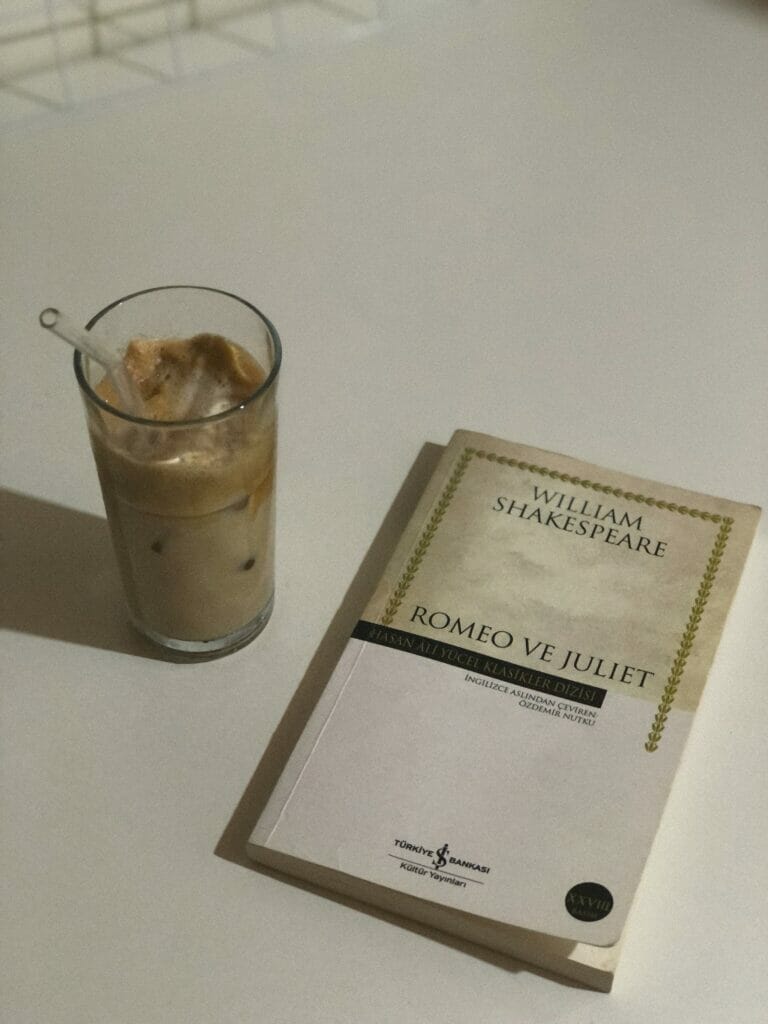
            Overhead photograph of an iced coffee beverage with a straw sitting next to a paperback copy of William Shakespeare's Romeo and Juliet. One of the words invented by Shakespeare appears in this play—alligator, believe it or not.

            Words Invented by Shakespeare (with Some Origins) 

            Considered the greatest playwright in English history, William Shakespeare was a prolific writer and left an incredible mark on literature and western culture.  Here are 25 words he is credited with inventing.

            1. Addiction—Exemplified in Othello, the word “addiction” is used to describe the state of being dedicated or devoted to a thing, unlike the modern usage of the word relating to bad habits like smoking
            2. Assassination—Found in Macbeth, the word “assassination” holds its same meaning by being a timed poisoning or utter destruction of something
            3. Bedroom—This word still holds the same meaning as when it was added to A Midsummer Night’s Dream
            4. Champion
            5. Cold-Blooded—When first used, this word was used metaphorically whereas now it’s used as a reference to serial killers and vampires
            6. Critic—Found in Love’s Labour Lost to mean someone who judges merit
            7. Dwindle
            8. Elbow
            9. Fashionable—Cited in Troilus and Cressida, this 11-letter word has stood the test of time in various industries today
            10. Generous
            11. Gloomy
            12. Hint
            13. Inaudible—Shakespeare added the negation of “in” before a word where it had never been before
            14. Lackluster
            15. Lonely
            16. Moonbeam
            17. Multitudinous—There are two meanings that Shakespeare derived from this word. One describes a body of water and the other is related to common people
            18. Obscene—Meaning “repulsive or disgusting,” this term was first found in Love’s Labour Lost
            19. Puking
            20. Perusal
            21. Pious
            22. Radiance
            23. Reliance
            24. Submerge
            25. Swagger—This was way before Justin Bieber! Shakespeare meant “swagger” to mean “strutting with a defiant air” 

            25 Common Phrases Shakespeare Invented

            Here are a few phrases that first came William Shakespeare. See how many you recognize and use! 

            1. All’s well that ends well
            2. Break the ice
            3. Eaten out of house and home
            4. Fair play
            5. Good riddance
            6. Heart of gold
            7. In a pickle
            8. Laughing stock
            9. Love is blind
            10. Wild-goose chase
            11. Vanish into thin air
            12. Naked truth 
            13. A piece of work 
            14. Fight fire with fire
            15. What’s done is done 
            16. Wear your heart on your sleeve
            17. Seen better days 
            18. Set your teeth on edge 
            19. Too much of a good thing 
            20. The world is my oyster
            21. A sorry sight 
            22. Green-eyed monster
            23. Heart of hearts
            24. Dead as a doornail 
            25. Bated breath 

            Some of these phrases may have existed in speech before Shakespeare documented them in his work. However, his usage caused them to enter popular culture and influence our word choices, even today. 

            Shakespeare’s Invented Words Showcases the Flexibility of the English Language

            What’s so interesting about these terms being used today is that it demonstrates just how enduring our language is. Can you believe these 16th-century words and phrases still (basically) mean the same thing? It also shows us how flexible English can be. If we need a word, we can make one.

            For example, as of February 2023, there were already 313 new entries and 130 new definitions added to the dictionary in 2023 such as:

            • Digital nomad
            • Rage farming
            • Folx
            • Petfluencer

            Language is how we express our human experience, and the words and phrases we use will endure or flex based on what we need in any given moment. 

            While many of the words invented by Shakespeare are more heavily used in England and the United Kingdom, English speakers around the world will be familiar with some, if not most, of our curated list! 

            Want more writing advice?

            Subscribe to get our latest content by email.

              We won’t send you spam. Unsubscribe at any time.

            • 7 Screenwriting Software Options Every Filmmaker Will Love

              7 Screenwriting Software Options Every Filmmaker Will Love

              Have you ever thought about screenwriting software? As a screenwriter, you want to spend most of your time writing and less time worrying about typeface and line spacing. The right program can help.

              And in TV, where every line counts and people are waiting on your pages to shoot, you want to be able to type away without worrying about whether you’re maximizing every last space and margin.

              As a script coordinator on award-winning television shows, I’m responsible for tracking revisions, editing for continuity and helping find trims and cuts to make that page count—so I’ve come across many different screenwriting software tools that can take your script from the writers room, to set, to post.

              Man sitting at a desk working on a script.

              Screenwriting software, including some free options

              Lights, camera, write! With so many options for scriptwriting software, it can feel overwhelming to choose one—especially with varying price tags. 

              We’ve rounded up the most popular screenwriting options for every budget to help you write your next Oscar (or Emmy!) winner. Or at least finally finish that script you’ve been working on.

              Here are some of the best script-writing software:

              1. Final Draft

              Final Draft has been on the market since 1991 and has long been considered the industry standard. 

              It’s used by heavy-hitters like James Cameron, J.J. Abrams and Matthew Weiner, and is the number-one selling screenwriting software in the world, available for Windows, Mac, and iPad.

              Natalie Bounassar, television writer and blogger, is quick to recommend this above all other options:

              “Final Draft is my screenwriting software of choice. It’s an intuitive program that takes the work out of the technical process of crafting a script and allows you to focus instead on your creative process.”

              Natalie Bounassar

              And she’s right: using one of the company’s 100 templates, you can create screenplays, stage plays, teleplays for any project you’re working on. The software even provides glimpses into how Emmy-winning dramas like “Game of Thrones” or “Better Call Saul” are formatted, making your spec writing a breeze. If you’re working on a comedy sample, there are templates available for this too, including the formats for “Veep” and “Silicon Valley.”

              In addition to being the industry standard for personal writing, Final Draft is popular in TV writers’ rooms across the business. Because of its ease in tracking revision pages, many of your favorite TV shows require staff to use this program as scripts are brought to the screen. Final Draft has an excellent customer service support line to support these writers for bumps along the way. 

              But it’s also the most expensive screenwriting software available, and it has been slow to adapt to include newer features that programs like Scrivener and WriterDuet offer.

              Final Draft 11 has been particularly challenging for many writers, as these Amazon reviews point out (including issues opening documents made in Final Draft 11 with any earlier versions).

              However, Final Draft 11 offers a live chat function that allows you to write and edit with your partner in real time, and you can save your files using Dropbox and iCloud, though it’s not as effortless as in some other programs.

              Cost: Around $250 at the time of this writing

              2. Fade In

              Billed as “More than just your final draft,” Fade In offers the powerful tools screenwriters expect without a lot of the extra fluff that makes programs like Final Draft slow to learn and use.

              Like the end credits of a movie, Fade In’s interface is primarily black and white, which is easier on our exhausted writer’s eyes. You can import and export files made with other programs,  making it easy to collaborate with people using, say, Final Draft or MovieMagic. Reversely, Fade In allows you to save your own files in plain text so you can open using another program later on.

              Fade In also offers robust organization (color-coding, index cards and marking significant sequences), a Dialogue Tuner (to see and edit a single character’s dialogue all in one place) and report downloads (scenes, cast, locations, and more).

              Fade In is the most compatible and user-friendly of these options, and it comes with all the bells and whistles an expensive program like Final Draft offers. While this program is great for personal use, it’s not used industry-wide, so you might have to use a different program for some projects.

              Cost: Around $50 at the time of this writing

              3. Arc Studio Pro

              One of the newer professional screenwriting tools, Arc Studio provides an easy-to-learn screenwriting software interface with professional features and a free browser version. It’s great for professionals or newbies to screenwriting.

              One of the great things about Arc Studio is you can collaborate with other writers in real time, similar to Google Docs. You can easily export your screenplay as a PDF or .fdx file for sharing and collaborating with others. It also allows you to access and write your screenplay from the downloadable software, or in your browser, or from the iOS app on your iPhone or iPad.

              Arc Studio offers an intuitive outlining tool for breaking your story and figuring out your characters’ arcs. And it has automatic cloud storage with the ability to save to Google Drive or your hard drive.

              If you need production tools like colored pages and starred revisions, you won’t get that with this tool, though the company says those features are coming soon.

              Cost: Free, with option to upgrade to the $99/year Pro version at the time of this writing

              4. Celtx

              If you’re not ready to splurge on an expensive screenwriting software, Celtx is a popular option without the hefty price tag. Having started as a free scriptwriting software, Celtx has grown to be a budget-friendly option with many of the same formatting features other programs offer.

              Celtx features are pared down, but their free version offers formatting for screenplays, storyboards, catalogs and more. The paid versions also work in tandem with its mobile apps so you can work offline and on-the-go.

              Web-based Celtx Edge uses a collaborative model that allows an entire production team or scriptwriting class to collaborate on a project via browser. Celtx also includes the ability to change formats, so if you’re writing a stage play that you suddenly realize would be great as a short film, Celtx can easily convert between formats.

              One thing to look out for when using Celtx is it will often incorrectly format characters, parentheticals and stage directions. In a cutthroat industry where every punctuation counts, you’ll have to do a thorough job checking your script after it’s saved as a .pdf file before sending it to other professionals in the industry.

              Cost: Free, with upgrades available for $19.99 per month at the time of this writing

              5. WriterDuet

              WriterDuet’s motto is “You don’t need to spend $200 just to fit in” and the company’s features prove it values script content over formatting. It’s one of the first screenwriting programs on the market to offer simultaneous writing and editing options for you and your writing partner, and its this feature that users cite as the reason they prefer it over Final Draft or Movie Magic.

              WriterDuet has a neat feature to help shorten your script by automatically searching for places where you can cut a few lines. Same thing for error-checking: The software finds incorrect formatting, typos, characters with similar names and more.

              You can even analyze your script by reviewing statistics on action versus dialogue, density and how characters speak.

              WriterDuet has cloud storage with the ability to save to Dropbox, Drive and your hard drive with additional automatic backups.

              Cost: Free version, with option to upgrade to the $99 Pro version, as well as student pricing at the time of this writing

              6. Scrivener

              If your work goes beyond screenwriting, and includes other types of writing like fiction, Scrivener’s your best bet.

              The popular tool offers formatting options for all of the above, but with the added bonus of being able to visualize scenes that need to be grouped together. Novelists swear by its ease of use and enjoy the benefits of this highly-visual platform. Scrivener’s corkboard feature allows you to make sense of all your notes and scenes — almost like creating a storyboard.

              If you plan to take your script through filming, Scrivener falls short for long-term use. Users indicate that collating pages into a pdf, a seamless process in Final Draft, is far more complicated when used here. While great for character development, research and structure, it’s not compatible with the software producers and directors use to actually turn a script into a movie. You’ll need to convert your screenplay into another format, making it sluggish for last-minute rewrites.  

              Check out Scrivener’s tutorials and our review of Scrivener, or consider investing in a course like Learn Scrivener Fast, which will teach you everything you need to know to become a master of the tool.

              Cost: $45 for Mac, $40 for Windows at the time of this writing

              7. Movie Magic Screenwriter

              Movie Magic is the official screenwriting software of the Writers Guild of America East, but some people in the industry consider it old-school.

              Like almost every tool available, Movie Magic automatically formats your script to industry standards, and it offers many of the same perks as Final Draft. You can quickly change the layout of the interface to have as many or few distractions as you want.

              It’s also one of the only softwares that offers, in addition to TV and Screenplay templates, novel, comic book writing, and radio play (ie, podcast!) formats, making it a “one-stop shop” for whatever kind of writing you want. And you can collaborate with other writers online in real time using iPartner.

              However, while Movie Magic was once the industry standard, it has lessened in popularity as other, more innovative tools have come on the market. It doesn’t offer a direct import for Final Draft documents, so keep that in mind if you’re working in a television writers room with Final Draft users.

              Cost: $249.95, includes three activations at the time of this writing

              You never want to give someone a reason not to read your script, and when the difference between “consider” and “pass” could be just a few formatting issues, make sure you have a program that takes care of that for you! Screenwriting software allows you to focus on the important part of this process, the writing.

              Whether you’re a writer’s-room regular or a student working solo, find the tool that makes the most sense for you, learn it well, and stick with it.

              Which screenwriting software do you prefer? Anything missing from our list?

              The original version of Screenwriting Software Options was written by Marian Schembari. In 2020 we updated the post so it’s more useful for our readers. In 2023 we refreshed this post so it was still accurate.

              This post contains affiliate links. That means if you purchase through our links, you’re supporting The Write Life—and we thank you for that!