Category: Craft

  • 5 Lessons From J-School That Will Make You a Better Writer

    5 Lessons From J-School That Will Make You a Better Writer

    Becoming a journalist was a long-held dream of mine, and majoring in journalism when I started college was a no-brainer.

    However, during my freshman year I realized reporting was not for me. While I considered switching to a new major, journalism taught me many lessons about both writing and life, and I’m glad I stuck with it. While I now focus more on marketing and PR and won’t be breaking the next presidential scandal, my experience in journalism school was invaluable in shaping me as a writer.

    Considering attending a journalism program? Here are the top things I learned in J-school.

    1.  The worst possible mistake is a factual error

    At Northwestern’s Medill School, the “Medill F” is infamous — it even has its own Twitter account. Anytime a journalism student makes a factual error, he or she automatically fails the assignment.

    Getting the facts straight is crucial. As a journalist (or marketer, communicator or advertiser), you’re only as good as your last story (or Tweet, blog post or press release). If you make mistakes when it comes to the facts, you’ll be sacrificing your reputation.

    The Medill F taught me to review and fact-check my work a extra time before submitting it. It might take a little longer, but consistently providing high-quality, accurate work makes clients happy — and more likely to refer me to their contacts.

    2. A strong knowledge of AP Style and grammar is invaluable

    In the journalism industry, adherence to Associated Press (AP) Style reaches religious levels, and the AP Stylebook is basically a journalist’s holy book. Because of this fervor, journalism school subjected me to class after class of grueling style and grammar training, but I wouldn’t take back one second.

    Think writing AM instead of a.m. won’t make a difference? Think again — unless you’re referencing the radio frequency. A firm knowledge of the rules of writing helps professional writers differentiate themselves from the amateurs and impress clients. Study, practice and hone your skills.

    While different clients will require you to follow different style guides (such as MLA, Chicago, APA or an in-house guide), understanding and sticking to their preferred guide demonstrates your attention to detail — and that helps you stand out as a writer to re-hire.

    3.  Journalists are people too, and people make mistakes

    Factual errors are considered unforgivable sins by some (see “Medill F”), but other journalistic errors are excusable at times. Once, I recorded a great interview on my camera — only to discover that its memory card was full. Another time, my dog actually ate my interview notes.

    While it may be horribly embarrassing to have to ask a source to repeat an interview, more often than not, people are understanding and accommodating. Messing up once in a while is not the end of the world and it doesn’t mean you’re a failure. (Just make sure you learn from your mistakes so you don’t repeat them!)

    4.  Journalism is not for the timid, awkward or fearful

    Journalists are notorious for being nosy, pushy and relentless, but this is how some of the best stories are told. As a measly freshman who’d get nervous interviewing his own mom, I learned quickly that the best stories take some nudging (and sometimes, a little bravado).

    For one project, I chronicled the start of the season for Northwestern’s successful women’s lacrosse team. I wanted footage of a certain early morning boxing workout, but video equipment was not officially allowed into the gym. Regardless, I went to the practice and confidently set up my equipment, though I was nervous. While the gym owner was displeased and clearly wished I wasn’t there, I explained I was capturing footage for a school project and would be out of the way within a few hours. He let me stay. At times, breaking the rules pays off.

    When a source is slow to respond or flat-out rude, persistence is the key to getting that dream interview. Be friendly and gracious, but follow up consistently to pursue the conversation or information you need.

    5.  The human connection is paramount

    Sometimes journalists (and freelance writers) spend hours crafting the perfect set of interview questions only to have them dashed minutes into the interview. Though it may feel like you just wasted your time, you’ve actually stumbled onto something more valuable.

    When you truly connect with someone you’re talking to and the conversation takes on a life of its own, that person becomes more than an interview source. After all, the point of journalism is to tell a story, and the best way to do so is to get lost in a conversation.

    During my junior year, I planned to do a story about senior citizens and the holiday season. I talked to my first sources during Thanksgiving break, and while we started talking about the holidays, the attack on Pearl Harbor came up because that too was toward the end of the year — and I quickly realized that year would be the 70th anniversary.

    Our conversation turned from the holidays to memories of Pearl Harbor and what life was like at the time, as well as what my sources learned from the event and how they thought times had changed. Had I stuck to my original plan, I would have missed an incredible opportunity to tell a great story.

    Have you attended or considered attending journalism school? What were your most important lessons? What do you wish you had learned?


  • 3 Common Writing Myths and How One Writer Challenged Them

    3 Common Writing Myths and How One Writer Challenged Them

    I was a child writer. As early as first or second grade, I spent most of my free time filling up notebooks with story ideas and character sketches. Somewhere in my closet are several picture book manuscripts I wrote during grade school. On my hard drive is a 160,000-word epic of adolescent angst from my last year of high school. I’ve got dozens of scripts and short stories left over from college.

    Fortunately, none of them were published — but it was a close call. During most of that time, I was actively sending out query letters to agents and publishers. I didn’t want to be a published writer when I grew up. I wanted to be one now.

    Looking back, I’m glad it didn’t work out. I’m much more savvy about the publishing industry these days, and I’d rather build up my career slowly than have to distance myself from my embarrassing early work. Besides, a lot of what I believed about writing was just plain wrong.

    The advice I read in how-to guides and on my favorite authors’ blogs wasn’t always what I needed to hear. Here are three false assumptions I’ve had to work hard to overcome:

    1. Writing requires a lot of time

    As a kid, I had the false impression that to be a “real” writer meant writing all the time. One of the reasons I wanted to be published while I was young was so that I wouldn’t be stuck in a day job, trying to finish up a manuscript after a full day’s work.

    Many of the writing guides I read suggested that the average book takes a year to write. But was that a year of full-time writing, or part-time? Would I have to get up at 5 a.m. to squeeze in my writing between other commitments? I squandered my college years, thinking that I couldn’t possibly be a full-time writer and a full-time student. I procrastinated on many of my manuscripts because I wanted to set aside a whole year to write them.

    I couldn’t have been more wrong. Not only was I unlikely to “find the time” all at once, but it flew in the face of how writing actually works for me. Even if I have a full day set aside to write, the most I’m likely to work on a given manuscript is a few hours. Having other commitments and responsibilities — even other writing gigs — can actually increase my productivity, because I can switch between multiple projects.

    Lesson 1: Writing isn’t a zero-sum game; you can fit it in between other gigs. Even full-time writers take on other projects to keep themselves busy.

    2. Creative writing classes are worthless

    As a kid, I remember hearing the same advice from several authors I respected: that you “can’t teach writing”, and the only way to be a better writer is to write. For some reason, that left me with the notion that studying writing wouldn’t get me anywhere — that it wouldn’t be worthwhile to take creative writing classes in college.

    I’d heard that writing seminars were particularly rough on fantasy/sci-fi writers, and that MFA programs were best suited to “literary” fiction. So instead of attending college as a creative writing major, I studied film and signed up for a few writing workshops on the side.

    What I failed to realize was that even if you can’t teach good writing, you can learn a lot from group critiques and by reading your work in front of others. The years when I had deadlines to meet for my fiction classes were the years I was most productive as a writer.

    Not only that, but writing classes and conferences can be key to networking with other writers and keeping tabs on the publishing industry. That’s how you’ll find out which magazines to submit to, which writers’ groups to join and which grants or residencies to apply for.

    Lesson 2: Writing workshops aren’t just about teaching people how to write. They’re also about feedback, deadlines, and making connections.

    3. Self-publishing is bad

    I grew up long before print-on-demand publishing, when “vanity presses” were the latest scam. I’d heard stories about writers who’d paid thousands of dollars to print copies of books that were now sitting unsold in their basements. As far as I was concerned, there was one simple rule: never pay to get published.

    That idea was pretty well-ingrained in my head by the time ebooks came along, and for a while I strongly resisted the urge to self-publish. The few success stories I read about seemed like outliers, and I wouldn’t feel like a “real” writer unless I got a traditional book deal.

    But soon it became obvious that the industry was changing, and an old-school publishing contract was no guarantee of success. Even if I did get one, I’d be expected to do most of the marketing myself, and I’d probably have to pay for a book tour out-of-pocket!

    By choosing the self-publishing route, I can release my books on my own terms, with very little up-front cost. Even if my first books don’t sell, I’ll be learning the process: how to format books for Kindle or print-on-demand; host Goodreads giveaways; run a crowdfunding campaign and more. Why not start learning while I have the chance?

    Lesson 3: Don’t let the stigma of self-publishing scare you off. Getting your books out into the world may be better than letting your manuscripts collect dust.

    What ideas about writing and publishing did you have growing up that may not be true any more? How did you learn to get past your early assumptions about writing?

  • What Are Your Favorite Writing Websites?

    What Are Your Favorite Writing Websites?

    While there’s still time to make progress on your writing goals in 2014 (65 days!), for many, January will mean outlining priorities and kickstarting progress.

    That’s where our 100 Best Websites for Writers list comes in.

    We first published this list in early 2014, and now we’re updating and adding to it for 2015.

    Whether your goal for 2015 is to self-publish a novel or raise your freelance writing rates, up your guest posting game or find a writing partner-in-crime, we’ve got you covered with this list of websites for writers. We want to make sure we include valuable resources, and to do that, we need your help.

    What’s your favorite writing website? Which blogs do you visit for inspiration, information or writing-related entertainment? Which sites have earned bookmark status on your toolbar? Who do you want to nominate for our list?

    Let us know your favorite sites in the comments. We’re looking forward to sharing the list with you in January!

  • Write Every Day: How to Meet Your Daily Writing Goals

    Write Every Day: How to Meet Your Daily Writing Goals

    If you still have doubts about whether you should be writing every day, it’s time to kick them to the curb.

    Writer after established writer gives the same advice: to build your writing skills, you need to stretch them on a daily basis.

    Stephen King says you should write every day until you meet a predetermined word count. Of course, it doesn’t have to be 2,000 words, but you have to start somewhere.

    Author Bill O’Hanlon recommends starting by writing for 15 minutes a day. And this doesn’t mean spending 15 minutes staring at a blank screen or rewriting that first sentence for the 15th time. It means making a genuine effort to write, whether it’s starting the next chapter of your novel or simply freewriting.

    Whether you write to a particular word count goal or choose a time limit, you need to find a strategy that works for you. Just remember: it doesn’t matter which method you pick as long as you use it.

    Create a habit of writing every day

    While “just sit down and write” is common advice, creating a habit of writing every day can be challenging for different reasons. Some writers struggle to find time to write creatively between unpredictable schedules, full-time jobs or families.

    First, acknowledge your time or energy constraints — the size of your canvas, as James Clear calls it. Then, work within them to train yourself to write, using strategies like freewriting, creative rituals and eliminating all distractions.

    Make tomorrow’s first step simple

    Starting to write each day can be the hardest part, but you can set yourself up for success with a little preparation at the end of each day.

    One strategy is to stop writing mid-sentence at the end of every day. This way, the next day you won’t spend hours trying to figure out where to start; you simply finish that sentence and keep going.

    Take it a step further by copying that last sentence into a separate document at the end of each day. Spend some time writing out a few possible directions or a brief outline for tomorrow’s writing.

    The next day, work only from that new document. This way, you won’t be distracted by the possibility of editing yesterday’s work — you’ll be focused on creating today’s.

    Use technology to help you

    Blogger Buster Benson suggests writing 750 words each day. To help himself and others meet this goal, he built 750 Words.

    [bctt tweet=”Use technology to help you write daily. @Buster suggests writing 750 words each day. “]

    This simple tool provides a distraction-free writing environment and lets you know once you reach your daily goal. The writing you produce is totally private, and a subscription is $5 a month after a free 30-day trial.

    Sticking to a tighter budget? Try some of the many free apps and programs available to help your concentration and productivity.

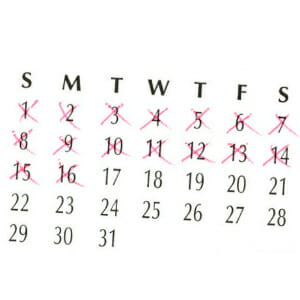
    Try Seinfeld’s calendar system

    Someone once asked Jerry Seinfeld for advice on becoming a great comedian. His reply was simple: buy a big wall calendar and hang it somewhere you’ll see it often.

    Every day you meet your writing goal, mark a big X in red marker over that day on the calendar.

    “After a few days you will have a chain. Just keep at it and the chain will grow longer every day. You’ll like seeing that chain, especially when you get a few weeks under your belt. Your only job is to not break the chain.”

    Easy, right? Just don’t break the chain.

    Use this technique to meet specific writing goals. For instance, if you’d like to write a ebook, track your writing specific to that project on your giant calendar — if it’s in addition other writing, just use another color of marker.

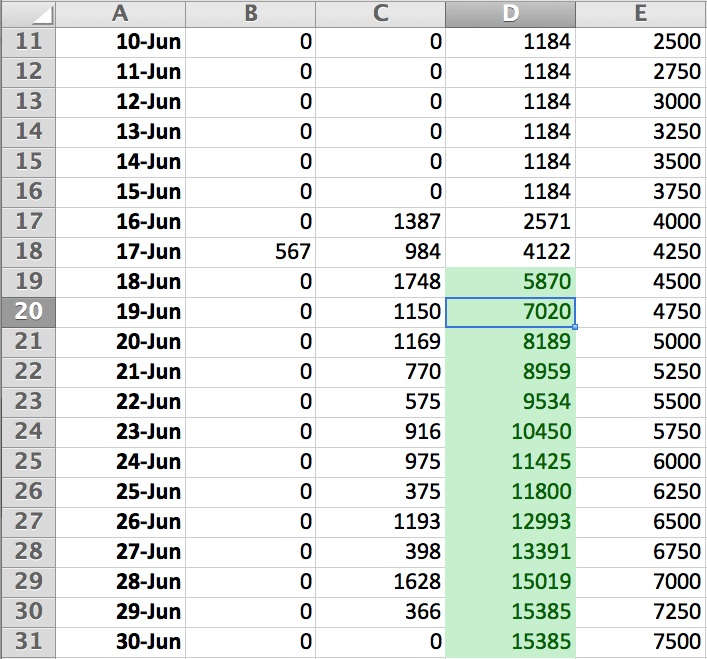
    Don’t have (or want to buy) a calendar? Writer Nora Bailey created an Excel spreadsheet formatted as calendar, with number of words written under specific days. When she meets her writing goal each day, the “total words” field automatically turns green.

    Image: Writing Calendar in Excel

    It’s deceptively simple to negotiate with yourself that you won’t be doing any writing today. You can say it’s late, you don’t feel like it or simply deny that you ever really wanted to start writing. The trick is in putting those excuses aside and putting pen to paper, fingers to keyboard.

    There’s no one strategy that helps all writers write every day. Experiment to find one that works well for you!

    Do you write every day? How do you make it a priority and maintain the habit?
    links
    no
    1

  • Writing a Novel? 6 Visual Storytelling Techniques to Borrow From Film and TV

    Writing a Novel? 6 Visual Storytelling Techniques to Borrow From Film and TV

    Many of us were raised watching thousands of movies and television shows. The style, technique and methods used in film and TV are so familiar to us, we process them comfortably. To some degree, we now expect these elements to appear in the novels we read — if not consciously, then subconsciously.

    We know what makes a great, riveting scene in a movie, and what makes a boring one — at least viscerally. And though our tastes differ, certainly, for the most part we agree when a scene “works” or doesn’t. It either accomplishes what the writer or director has set out to do, or it flops.

    As writers, we can learn from this visual storytelling; what makes a great movie can also strengthen a novel or short story. Much of the technique filmmakers use can be adapted to fiction writing.

    Break up your scenes into segments

    Just as your novel comprises a string of scenes that flow together to tell your story, so do movies and television shows.

    However, as a novelist, you lay out your scenes much differently from the way a screenwriter or director does. Whereas you might see each of your scenes as integrated, encapsulated moments of time, a movie director sees each scene as a compilation of a number of segments or piecesa collection of camera shots that are subsequently edited and fit together to create that seamless “moment of time.” By thinking in terms of segments in creating each scene, writers can create a dynamic, visually powerful story.

    So how can novelists structure scenes with cinematic technique in a way that will supercharge their writing? Here are six steps that will help you structure your novel as if you were a filmmaker:

    1. Identify key moments

    Think through your scene and try to break it up into a number of key moments. First, you have the opening shot that establishes the scene and setting. Then, identify some key moments in which something important happens, like a complication or twist, then jot those down.

    Then write down the key moment in the scene  — the “high moment” — that reveals something important about the plot or characters. That should come right at or very near the end. You may have an additional moment following that is the reaction or repercussion of the high moment.

    2. Consider your POV

    Now you have a list of “camera shots.” Think of each segment on your list, then imagine where your “camera” needs to be to film this segment.

    Remember, you are in a character’s POV — either a first-person narrator telling and experiencing the story or a third-person character in that role. So consider where that character is physically as he sees and reacts to the key moments happening in your scene. You now have your “direction” so that you can write this scene dynamically. Come in close to see important details. Pull back to show a wider perspective and a greater consequence to an event.

    3. Add background noise

    Consider what sounds are important in this scene. They could be ordinary sounds that give ambiance for the setting, but also think of some sound or two that you can insert into the scene that will stand out and deepen the meaning for your character.

    Church bells ringing could remind a character of her wedding day as she heads to the courthouse to file divorce papers. Birds chirping happily in a tree next to a grieving character can sound like mocking and deepen the grief.

    4. Color your scenes

    Colors can be used for powerful effect. Different colors have strong psychological meaning, and filmmakers often use color very deliberately. Red implies power; pink, weakness. You can “tinge” your scenes with color and increase the visual power. Color can also add symbolism to an object or be a motif.

    Want to learn more? A great book to read is Patti Bellantoni’s If It’s Purple, Someone’s Gonna Die.

    5. Think about camera angles

    The angle of a “shot” also has powerful psychological effect. A camera looking up at a character implies he is important or arrogant or powerful or superior. A camera looking down implies someone who is weak or inferior or oppressed or unimportant.

    If your character is in a scene with others and feels superior, you might have him elevated or being seen from below to emphasize this. A woman being fired might be sitting in a chair with the boss standing over her. These little touches add visual power.

    6. Include texture and detail

    Consider adding texture. Too often, novelists put their characters in boring settings, without saying where they are, what time of year it is, or what the weather is like. We exist in a physical world, and movies showcase setting and scenery in great detail.

    Add texture to your scene by infusing it with weather and sensual details of the surrounding area. The feeling of the air in late fall in the middle of the night in Vermont as two characters walk through a park is texture the reader will “feel” if you bring it to life in your scene.

    Novelists who think like filmmakers can create stunningly visual stories that will linger long after the last page is read. Spend some time using a filmmaker’s eye to take your scenes to the next level, giving them dynamic imagery and sensory details as well as deliberately placing characters, colors and sounds in your scenes for targeted psychological effect.

    If we want to move readers emotionally by our stories, the best way is to bring our novel to life by using cinematic techniques.

    Have you tried using these cinematic techniques to bring your story to life? Can you think of a novel you’ve read that used colors or sounds in a significant symbolic way? Share in the comments!

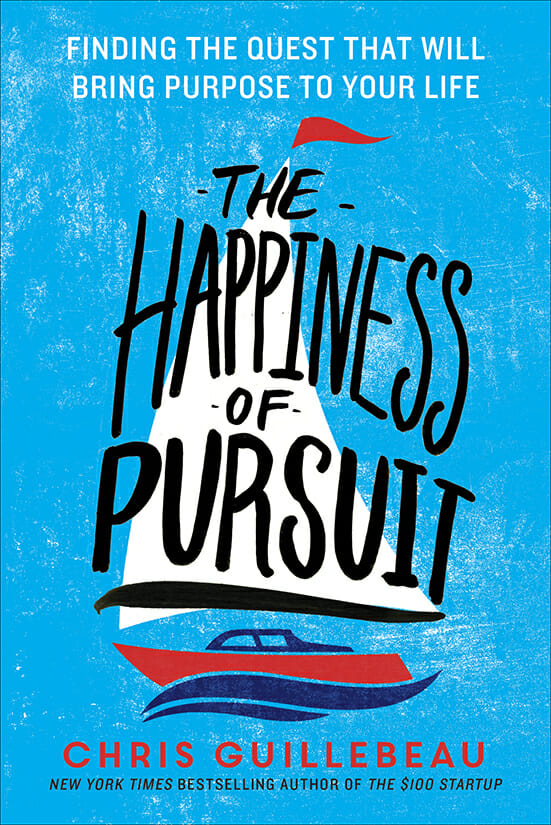
  • What’s Your Writing Quest? Enter to Win a Copy of The Happiness of Pursuit

    What’s Your Writing Quest? Enter to Win a Copy of The Happiness of Pursuit

    What’s your big writing goal?

    We’re not talking about small, easily achievable, “write-a-blog-post”-type tasks from your to-do list. We mean a big goal — the one that exhilarates, energizes and even scares you a little bit. It’s the goal that seems almost unreachable,

    Working toward a big goal like this is a kind of quest. And undertaking a quest, explained Chris Guillebeau in a recent blog post, tends to challenge, change and benefit you:

    By the time I came to the end, I was a very different person. As I learned, this is a common feature of quests. You set out to accomplish something, and hopefully you do — but something else usually happens along the way, too.

    Whether it’s building your freelance business to the point where you can quit your job, or finally finishing and self-publishing your novel, you likely have one of these big goals on your radar, and we want to hear about it.

    What’s your writing quest? What big project are you pursuing?

    We asked a few writing friends about their quests. Here’s what they’re working on.

    Image: Jessica LawlorJessica Lawlor, founder of the Get Gutsy Blog

    I’m on a quest to help others get gutsy … and to step outside my own comfort zone in the process! I recently published an ebook about getting gutsy, and the next step in my quest is to launch a 30-day email course with tips, tools and inspiration for stepping outside your comfort zone to reach your goals and live a life that makes you truly happy.

    I’ve got the bare bones for the course developed, but now need to buckle down, get organized and begin the scary part — actually writing the content. After the course is complete, I plan to turn it into a book.

    This quest terrifies me, but I’ve always loved and lived by the saying, “If your dreams don’t scare you, they’re not big enough.” Here’s to the quest!

    Image: Peggy Frezon and KellyPeggy Frezon, author of dog books, including Heart to Heart, Hand in Paw

    wI’m on a quest to talk to people about their amazing and heartwarming animal tales, and share them, whether it’s on my new blog for Guideposts magazine, Pawprints on my Heart, or in my forthcoming book for Paraclete Press, Greetings at the Front Door (fall 2015).

    It’s easy for me to get inspired about pets, as my dogs Kelly and Ike are right here by my feet (or in my lap!) as I’m working. What’s sometimes more difficult is finding others who are willing to share how their pets have changed their lives. I’m constantly on the lookout for pet lovers who might open up to me with their stories! Each time I discover a new human-pet connection, I’m reminded of why I go to such great lengths to find them.

    Image: Alexis GrantAlexis Grant, founder of The Write Life

    I’m on a quest to rewrite my travel memoir and get it out to the world, whether that’s through traditional publishing or self-publishing.

    I’ve been working on this story — about backpacking through Africa on my own — since 2008, and I’m itching to get it done. I’ve just got to push through this last round of rewriting to get there!

  • Writing Fiction: 3 Ways to Build a Stronger Story

    Writing Fiction: 3 Ways to Build a Stronger Story

    Authors face a great many challenges as we put together our manuscripts. Primary among them is working to erase our tracks on the page, creating a seamless connection between readers and our fictional world.

    In this, Kevin Spacey’s quote from The Usual Suspects (originally from Charles Baudelaire’s The Generous Gambler and paraphrased in C.S. Lewis’ The Screwtape Letters) is remarkably apt:

    “The greatest trick the devil ever pulled was convincing the world he didn’t exist.”

    So how do all we author-devils go about convincing our readers we don’t exist?

    After analyzing all 71 individual scenes in the latest draft of my novel, I discovered one common problem: my authorial presence on the page created barriers between the action and the reader. I needed to get out of the way.

    Narrowing in revealed three main areas where my footprints on the page depressed the action. I had created a protagonist I really liked, but who was onedimensional; I was filtering the action in my descriptions; and I was oversharing irrelevant setting and description details.

    Developing solutions to each challenge tightened my scenes and helped build a closer connection to the conflict playing out across the narrative. Here’s how I did it:

    1. Issue: A one-dimensional, likable protagonist

    When I’m reading a novel and I encounter a one-dimensional protagonist, it’s like I’ve sat down in a poorly made chair. I immediately wonder, “Who made this?” If a reader asks that question of a story, the author may not have done enough work to create a character independent of themselves and let the reader experience the tale without wondering how it was made.

    Great stories seem organic, as though the author channeled them, rather than created them. The writing can be brilliant, and the reader will notice the beauty in the construction of sentences and paragraphs, but what they absolutely shouldn’t notice are clunky story mechanics, including poorly realized characters. These reveal a sort of clumsiness — and clumsiness draws the author out into the open.

    [bctt tweet=”Great stories seem organic, as though the author channeled them, rather than created them. “]

    It’s tough to give your hero faults and flaws: vanity, an ego, even dark, criminal impulses. If you do, how can he or she possibly remain a good protagonist? Aren’t all our heroes free of vice?

    The most believable heroes are people not too different from us, with all the complexities and challenges we face each and every day. A great story, in which your protagonist achieves great things, is all the more satisfying when that character reaches her goal despite the challenges of her situation and setbacks that real or perceived imperfections cause. As David Corbett says in his epic The Art of Character:

    “Its far more important that we empathize with a character than like her, which is just as true of villains as heroes. And empathy is created by a well-drawn character taking on a convincing dramatic problem, in which compelling wants are at stake in the face of potentially overwhelming opposition. We feel for such a character, even if she is imperfect, for we all understand that necessity compels us to act as we must, not as we should.”

    Our characters acting as they must — and not as they should — is a hallmark of separation from the author. It is the antithesis of contrivance because, as protagonists become believable individuals — with warts and all — they tend to make decisions that reflect their many varied facets.

    Solution: Give your protagonist flaws

    Learn to cultivate flaws in your protagonists. Collect and log them. If you don’t know where to begin, gather inspiration on key character flaws, and learn why your character needs them. We like flaws because they make our characters vulnerable and allow us to empathize with them — precisely because they are not perfect, because they are like us.

    My protagonist, Duncan, had many likeable qualities in my first draft. He was well-intentioned, moral and without vice; a victim but rarely a predator. And, over the course of the book, while he dealt with certain troublesome episodes, nothing forced him to change. His flaws were in no way tied to the obstacles blocking him from achieving his goals. He was without reproach; in other words, boring.

    In my rewrite, I peppered Duncan with flaws. I wrote about what might shame or embarrass him. I flung at him snobbery, pedantry and annoying idiosyncrasies. I applied these flaws to specific scenes to see how they would change his decisions — and noticed an immediate and remarkable positive effect.

    Suddenly, Duncan was making his own choices, rather than me making them for him. He began acting as he must, not as he should — and in doing so gained an important separation from my undue influence.

    2. Issue: Filtering the action and description

    Certain words filter the action from the point-of-view character to the reader. They disrupt your story’s flow by creating distance between the reader and the action on the page.

    These filter words riddled my first pass with such interruptions. In fact, here are just a few from my finished first draft, in order of their egregiousness:

    to look: 300

    to think:  111

    to see: 91

    to hear: 66

    to feel (or feel like):  51

    to seem: 50

    to realize:  13

    to wonder:  9

    to watch: 8

    to decide: 8

    to touch:  5

    Solution: Ruthlessly remove filter words

    At first, it’s tough to spot these filter words. Here are a few of my favorite resources on reducing filters and eliminating telling words. Author Jami Gold has an impressive list for creating specific Word Macros that help you find filter words during your revision phase.

    Below are three examples of where I found and removed filters:

    Filter: “Nonsense,” Duncan said, feeling the letters N and S crash against the numb shores of this front teeth prior to completing the sounds.

    No Filter: “Nonsense,” Duncan said — the letters N and S crashed against the numb shores of his front teeth.

    Filter: “I advise you to pay thanks to the general for bestowing this honor upon you, rather than question the method of payment. You and I both know what this order will do for . . .” he looked around at the dirt pens, the long grass and the crumbling house, muddied, with hay tipping over onto the roof, “this business.”

    No Filter: “I advise you to pay thanks to the general for bestowing this honor upon you, rather than question the method of payment,” the soldier said. The heat was sweltering in the crumbling  pens. Muddied, matted hay hung from the roof. He drew his sleeve to his nose. “You and I both know what word of our order will do for . . . this business.”

    Filter: “Sure, sure,” she said. “Does he know he’s meeting you . . . Duncan?” She looked down over her empty pad toward his name, scribbled in eyeliner pencil.

    No Filter: “Sure, sure,” Sheila said. “Does he know he’s meeting you . . . Duncan?” She drew her painted fingernail down over the empty pad and toward where his name was scribbled in eyeliner pencil.

    As with many writing rules, consider it a suggestion more than a fundamental requirement. You may find mere awareness of filters helps you to write tighter, more vivid descriptions.

    3. Issue: Oversharing setting and description details

    Writers know more about their story’s setting and their characters’ thoughts than anyone else. The problem is, we often share more than is necessary, leading to large chunks of description and internal monologue that break a scene’s momentum.

    We all know the rule: show more and tell less. But it’s become a cliche because it can be interpreted about a million different ways — so what the heck does it mean in practice?

    When we write scenes, we present an isolated viewpoint on a moment of conflict to advance the story for the reader. In a moment of conflict, people rarely notice what’s happening around them. They don’t take in exhaustive setting details or spend time trying to analyze their surroundings. They are in the action — where every move, every word, every detail either helps them get what they want, or pushes it further away.

    Imagine being in the front row of a play. To access the moment of conflict on stage, you need to be close to the action as it occurs. If a narrator is standing between you and the actors, they depress the intimacy of the action. So, showing is largely about getting out of the way of the action — drawing out into plain view only those items that advance the scene.

    Subtext is important here — the ability to tease out items that add meaning to a scene without drawing too much attention to them. For example, consider Big Jim Rennie’s golden baseball in Stephen King’s Under the Dome. To Rennie, the baseball at first represents power and prestige, until it becomes a literal manifestation of those delusions. When the violent drama finally plays out on the page, the baseball’s established subtext enriches the scene without impeding the action.

    Solution: Visualize your telling

    In a pass during your rewrite, visualize where you tell more than show. In each scene, create two different highlights — yellow for setting and pink for internal monologue. Highlight the blocks, then print out the scene and look at where your interjections slow the action of that scene. What details are unnecessary to the subtext of that isolated moment?

    Of course, telling can be useful for summary scenes to help the reader understand the aftermath of several intense scenes of conflict. In many plays, narrators come on stage at the beginning, in between scenes, and maybe at the end to recap the action. Such pacing mechanisms give the reader time to take a breath before plunging back into the action. But in most cases, scenes benefit from cutting down — or eliminating altogether — those interjections that slow action and impede the story.

    Have you found it challenging to remove yourself from a story? How do you take yourself out of your fiction writing?

  • Your Messy Desk is Hurting Your Writing Career. Here’s How to Declutter

    Your Messy Desk is Hurting Your Writing Career. Here’s How to Declutter

    Do you have a messy desk? It may be affecting your writing career!

    You want to write, but you can’t. It’s not writer’s block, a lack of ideas or a blank wall. Instead, it’s information overload with myriad to-dos fighting for precedence in your mind.

    You start to make a list, but your desk is a mess, with piles of papers (all important), post-it reminders (even more important) and books (most important of all) haphazardly stacked on every inch of space. How can you begin to work in this environment?

    Got a messy desk? What does your #writespace look like? Share a photo on Facebook, Twitter or Pinterest with the hashtag #writespace and tag us @thewritelife!

    Clutter’s effect on creativity and productivity

    Clutter makes it difficult to focus on one task or object, according to researchers at Princeton University’s Neuroscience Institute. Your brain has a limited ability to process information, so a disorganized work environment pulls your attention in different directions—and away from your writing.

    And it’s not just physical clutter; a digital build-up of emails and social media notifications can be just as bad for us, according to Mark Hurst in Bit Literacy: Productivity in the Age of Information and E-mail Overload.

    What does that mean for writers? Dividing your attention between several stimuli—like your novel’s plot hole, your messy desk and your Twitter feed—often results in increased stress and decreased creativity and productivity.

    Try these strategies to take control of the clutter and manage your writing space, both external and internal.

    Messy desk? Declutter your physical space

    Clearing the detritus from your workspace allows you to start fresh. Plus, getting up from your desk and moving around is a great break from work; who knows what new ideas you might inspire by getting your blood flowing?

    1. Clear your desk

    Here’s a quick way to clear your messy desk. Set a timer for five minutes. Take everything off your desk and from your drawers (except your computer or notebook and pen, of course). Put every other item in a box, out of sight. As you work for the next three days, if you need an item, bring it back to your desk.

    2. Organize your less-necessary items

    Anything left in the box after three days isn’t crucial. Go through it and sort the items into two piles: file or discard. Save the items you need, like receipts and invoices, but be tough on yourself. Do you really need those to-do lists from two months ago?

    3. Improve your storage system

    Where you keep your go-to objects is important, but only the ones you use the most should make it to your workspace.

    Place your most used items within reach for easy access, like in the top drawers of your desk or on a nearby shelf. Less-important tools should be out of sight and filed away. While your computer might live on top of your desk, your thesaurus might only come out during rewrites.

    4. Set yourself up for success each day

    Before you quit working at the end of the day, take a few minutes to set everything back in its place. This way, the next time you sit down in your clean, uncluttered space, you’ll be able to get right to work.

    Declutter your mental space

    Even the most spotless desk won’t help a busy, distracted or disorganized mind from focusing on writing. Try one of these strategies to clear your mind and help you get back to work.

    5. Journal

    It’s a popular option for a reason: journaling about what’s bothering you helps reorganize your thoughts. Whether it’s your novel’s plot, your personal life or the challenges of freelance life, writing your problem out will help make space for new approaches and solutions.

    6. Make a to-do list to clean up your messy desk

    Trying to remember everything you need to do in the next day or week isn’t conducive to doing quality work. Instead, follow productivity guru David Allen’s advice and write everything down.

    Create a system to manage your tasks and schedules so you stay organized—and can get back to work. Need help? Try one of these free tools and apps.

    7. Make a to-do-later list

    Don’t stop your writing session to research a quick fact for your story or find that link you want to include in your blog post. Instead, keep a running list of small tasks that come to mind while you’re working, but don’t interrupt your writing. You can always look up a tiny detail, like the price of the first iPhone, once you’ve written the rest of your article or chapter.

    7. Turn off notifications

    Anything that makes a noise or pops up is distracting. Turn off all notification signals while you write: put your phone on silent or Do Not Disturb mode, turn off email notifications and close or silence social media sites.

    8. Clear your inbox

    While you might not want to pursue Inbox Zero, purging your inbox of unread newsletters and messages helps restore a sense of control. Take 30 minutes to scan your emails and delete unnecessary ones.

    Maintain this change by unsubscribing from newsletter that are no longer relevant, or use a service like Unroll.me to bundle them into one scannable message.

    Enjoy your uncluttered writing space

    Putting these strategies to work doesn’t mean you’ll need to become Sam or Susie Spotless, magically organized and perfectly calm; as Mikael Cho points out in a post on Lifehacker, you want the space to feel like it’s yours.

    While clutter has been shown to negatively affect your performance, it is your perception of clutter that matters, not someone else’s. If having a notebook, pen, or a photo of your significant other on your desk, doesn’t feel like clutter to you, then it’s not.

    The key is simply to create more space, both external and internal, in your writing life—helping inspire new ideas, more creativity and better productivity.

    How does cleaning up your messy desk and decluttering your writing space help you? Share your thoughts and photos with the #writespace hashtag on Facebook, Twitter and Pinterest, and tag us @thewritelife!

  • How to Stay Sane While Building Your Writing Career Part Time

    How to Stay Sane While Building Your Writing Career Part Time

    Do you have all day, every day, to write?

    Nope?

    Me neither.

    In fact, pretty much every professional writer — whether they’re a novelist, freelancer, nonfiction author or blogger — has to start building their career around an already-busy life.

    Maybe you’re working full time in a 9 to 5 role. Maybe you’ve got young kids. Maybe your life is packed with volunteering, caring or other commitments.

    Or maybe you’re unwell or have a disability, and that means you can only write for an hour or two each day.

    It can be really frustrating trying build your career when you can only work part time.

    But it can be done … and you don’t need to drive yourself (and your loved ones) insane while doing it. Here’s how.

    Don’t compare yourself with full-timers

    It’s all too easy to look at what other writers are doing and feel bad that you can’t match up.

    But if you’re comparing yourself with someone who’s working full time (or close to) and who’s established in his career, you’re setting yourself up for disappointment.

    Sure, Joe Blogger can turn out five great posts a week when he’s making a full-time living from his blog and doesn’t have to work another job.

    Sure, Ann Author can put out a whole trilogy of novels every year — but she has all day, every day to work on them because she has a backlist of nine novels providing her with an income.

    You don’t know what life was like when they started out. Perhaps Joe Blogger struggled for two years before he had enough of a blog audience to make even $100 a month. Perhaps Ann Author took 10 years to write her first novel, because she was working around her kids.

    If you must make comparisons, compare yourself today with yourself a month ago (or three months ago, or a year ago). How have you improved since then? What have you learned? What have you accomplished?

    Focus on one core area

    In the early days of your career, it’s tempting to cast a wide net: to try out lots of different types of writing and lots of different marketing methods, hoping that something will pay off.

    Spreading your attention too thin, though, means you’ll struggle to make headway in any area — especially as your time is limited.

    Instead, choose one core area to focus on. Don’t try to get your blog underway and write a novel at the same time. Don’t offer every writing service possible to your clients. Pick one speciality, and stick with it.

    You’ll learn faster, you’ll build up your experience and expertise quickly, and you’ll make encouraging progress that helps keep you motivated.

    Find your best (available) time of day to write

    Are you a morning lark or a night owl? Different people work best at different times of day — here’s a fascinating visual look at the routines of some famous creative people.

    I’ve always been a morning person, though these days I find I can write well in the afternoons too. Evenings are my biggest “slump” time — I find it hard to focus and be creative then.

    Chances are, you already have a reasonable idea of when you’re at your best, but it’s worth experimenting to see if a different time of day could suit you better (especially if your day job or other commitment takes up your best writing hours).

    Think about:

    • Getting up 30 minutes earlier to write before the rest of the family is awake. Leave everything set up to write the night before (e.g. your laptop ready on the kitchen table).
    • Writing during your lunch hour — can you get out of the office to a coffee shop or library, so colleagues don’t disturb you?
    • Using your best hours on the weekends — maybe you’d love to write between 9am and 11am, and you can’t do that during the week.

    Move toward cutting or quitting other work

    This might seem a long way off right now, but if you plan for it, you might be able to cut down your hours at your day job sooner than you think.

    If you currently have a full-time job, could you work four days a week instead of five, giving you one full day to write? That might mean saving up an emergency fund, cutting your spending or ensuring you have some regular writing income.

    If you do need to work your full-time hours, could you work them in a condensed way across four or four-and-a-half days?

    If your life is full of voluntary commitments, can you cut back on some of these? You’re not being selfish if you make time for your writing career — it’s important and worthwhile.

    If you have young children, can you pay for some childcare or arrange an informal childcare swap with a friend?

    Rearranging the elements of your life takes time. Getting clear about what you want and working out what steps you need to take to get there helps you make real progress. Simply carrying on and hoping things change won’t get you far.

    Create systems to make writing easier

    Whatever sort of writing you do, there’s a good chance you carry out the same sorts of tasks over and over again.

    That could be answering emails, writing blog posts, posting updates on social media, carrying out work for clients or almost anything else.

    Every task, however complex, can be broken down into a process of steps. Creating a checklist or a template could save you a huge amount of time.

    [bctt tweet=”Creating a checklist or a template could save you a huge amount of time in your writing.“]

    For instance, if you find yourself spending hours responding to prospective client‘s enquiries, you could create an “FAQ” page on your site that addresses some of the most common ones.

    Even something like “write next novel chapter” could be turned into a process — perhaps you’ll spend five minutes brainstorming ideas for the chapter, then five minutes deciding on the order of events, before jumping into the writing itself.

    Systems will:

    • Save you time: it’s quicker to add a couple of personalising lines to a standard template email than to write the whole thing from scratch every time you reply to a client inquiry.
    • Save you brainpower: it’s much easier to run through a checklist than to have everything in your head (worrying constantly that you’ll forget a crucial step).
    • Make it easier for you to hand work over: at some stage, your business won’t be able to grow any further without you hiring help.

    I have every sympathy for writers building a career while juggling other commitments too. I started out writing around my full-time day job, and now have a toddler daughter (and another baby on the way).

    The truth, though, is that pretty much every writer has to fit their writing around everything else when they first start out. You want to make this phase as easy as possible, and you also want to give yourself a good chance of exiting it quickly — so you can write full time (or as near to full time as you want).

    Do you have a particular problem or struggle that’s holding you back as a part-time writer? Or have you successfully made the part-time-to-full-time transition?

  • Writing Spaces: Where 9 Famous Creatives Do Their Best Work

    Writing Spaces: Where 9 Famous Creatives Do Their Best Work

    Where’s your favorite place to write?

    Does your writing space help you be productive and stay organized?

    If you need some inspiration, check out the writing spaces and environments of these famous artists, writers and storytellers.

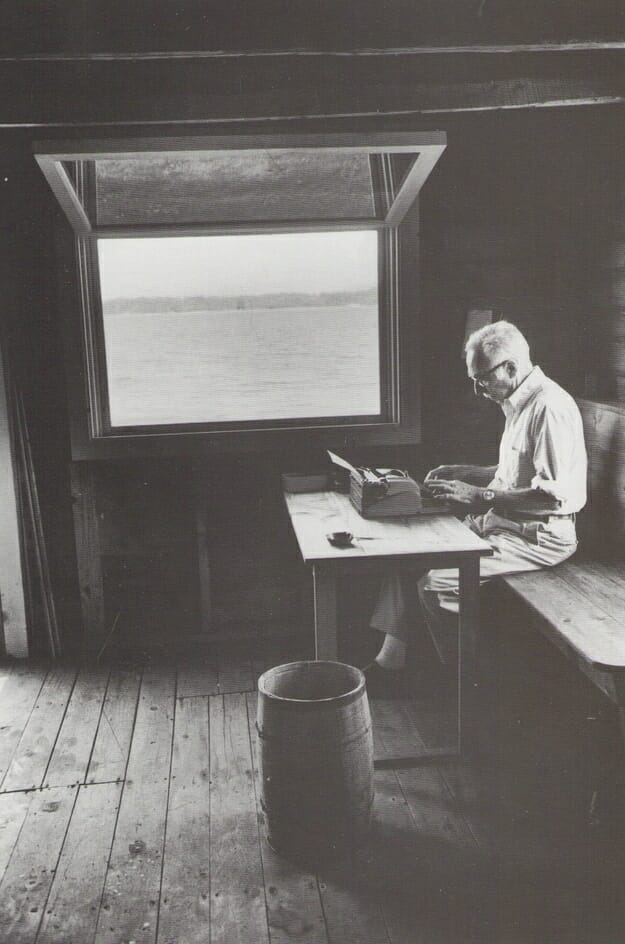
    1. E.B. White, author

    Sometimes all you need is a comfortable desk with a view of the outdoors for inspiration. (Ideally, near a farm with plenty of interesting animals, including a few spiders.)

    Image: e.b. White

    Image credit

    2. Jane Austen, author

    This table may be tiny, but it supported the creation of her later works, including Emma, Persuasion, and a revision of Pride and Prejudice.

    Image: Jane Austen

    Image credit

    3. Mark Twain, author

    When you’re struggling to write, sometimes taking a break can help get your creative juices flowing. Perhaps a game of pool would inspire some ideas?

    Image: Mark Twain

    famouscreatives

    4. Nigella Lawson, chef and food writer

    When you’re looking for inspiration, having all your favorite books within arm’s reach certainly can’t hurt.

    Image: Nigella Lawson

    5. Steve Jobs, inventor

    Jobs was well-known minimalist. He described one home by saying, “All you needed was a cup of tea, a light, and your stereo.”

    Image: Steve Jobs

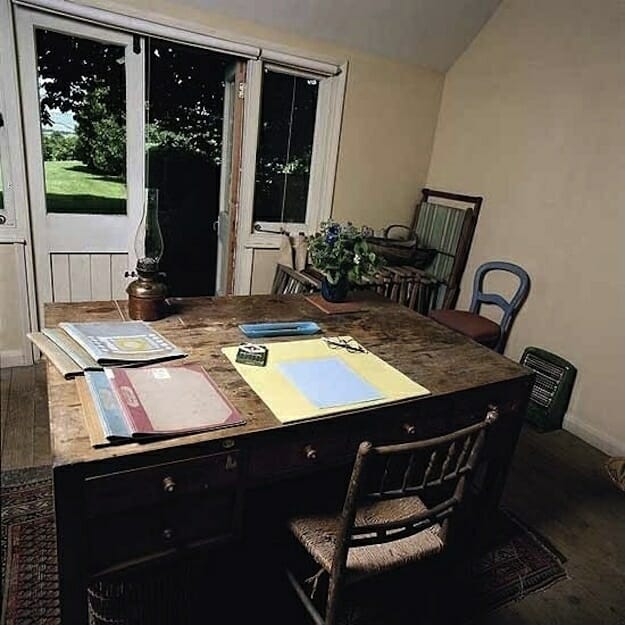
    6. Virginia Woolf, author

    This simple desk and chair overlooking the outdoors were ideal for writing, at least in the summer. Woolf noted that this converted toolshed was so cold in the winter that she couldn’t hold a pen!

    Image: Virgina Woolf's Desk

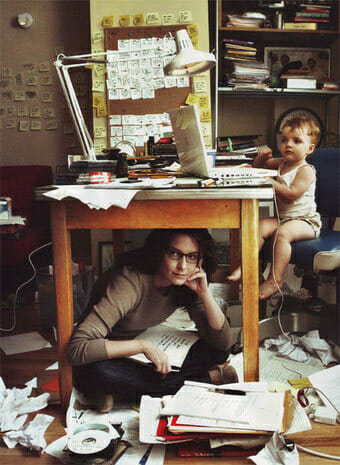
    7. Tina Fey, author and comedian

    Were you wondering about the workspace that may have inspired 30 Rock, Mean Girls or Bossypants?

    Image: Tina Fey

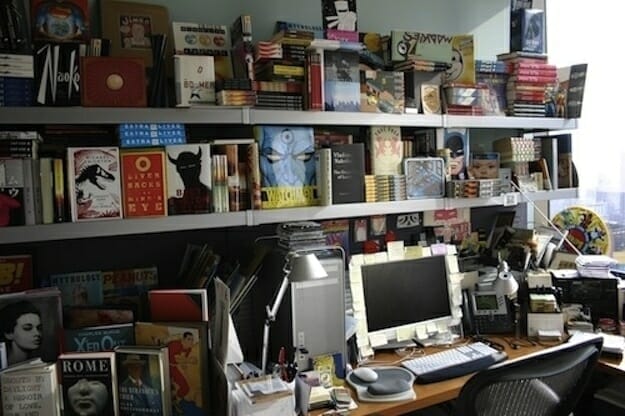
    8. Chip Kidd, book cover designer

    Many artists find their creative inspiration in other books, authors and stories.

    Image: Chip Kidd

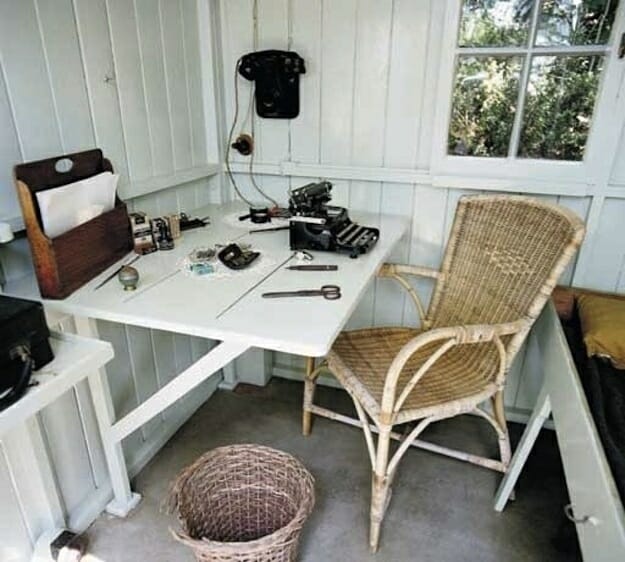
    9. George Bernard Shaw, playwright

    Keep it simple with a typewriter, a clean white desk and a small window in a private place. That last one was key for Shaw, who once confessed, “People bother me. I came here to hide from them.”

    Image: George Bernard Shaw

    What’s your favorite place to write?