Category: Craft

  • How to Write a Student Memoir: 6 Simple Ways to Embrace Nostalgia

    How to Write a Student Memoir: 6 Simple Ways to Embrace Nostalgia

    If you’re wondering how to write a student memoir (and how it’s different than a regular memoir), then you’re in the right place.

    No matter what stage you’re at in your educational journey, writing a student memoir can be a therapeutic experience for you and eye-opening for your readers. Documenting your experiences, emotions, and growth is also an excellent practice so even if your draft never leaves your hard drive, it will still be a worthy exercise. 

    What is a Student Memoir Anyway?

    A student memoir is much like any other memoir. A memoir is a narrative told from the perspective of the author and focuses on a pivotal moment or time in their life.

    Therefore, a student memoir is written by a student and recounts a pivotal moment or time in their academic career. 

    A memoir differs from biographies and autobiographies in a few key ways.

    • A biography is written about a person from an outside perspective
    • An autobiography is more similar, where it is written by or from the perspective of the subject/author. However it spans their entire life rather than the narrow focus of a memoir

    Readers for student memoirs are usually other students, or people who have been through school. They studied in different contexts for varying lengths of time and have at least some understanding of the experiences of being a student. 
    How to Write a Student Memoir

    Similar to journal writing, a memoir is successful if readers feel like they’re experiencing life with you. Here are six simple guidelines to follow that will help you figure out how to write a student memoir that’s memorable and captivating. 

    1. Find Your Topic

    Consider your time as a student. Was there a moment or time that stands out to you? A pivotal moment where something happened or a decision was made and changed everything for better or for worse? Did this happen a long time ago or are you going through it right now? Considering examples of successful memoirs can help inspire you at this stage.

    When selecting the focus of your student memoir, consider the relationships, obstacles, triumphs and other factors that are relevant to the event or time period. Think about the central themes, transformations, and lessons that came out of that time of your life. 

    2. Give it Structure

    Once you have a topic, it is time to determine how you are going to organize your thoughts to get your story and message across. Consider the arc of your story—how you get from point A to point B and how best to guide your audience on this journey. 

    Chronological, past versus present, thematic and internal conflict are all common memoir structures. By outlining key events and turning points, you can determine which structure is best suited to effectively tell your story, keeping readers engaged from start to finish. 

    3. Develop Your Voice

    What makes memoirs so compelling, often, is the author’s voice that shines through. An epic story with twists and turns is one thing, but it is how you tell that story that sets it apart. When a story has a strong, authentic voice the reader feels like they are right there with you or are being told it by a trusted friend.

    Experiment with different tones and writing styles until you find one that comes naturally and helps you get your stream of consciousness from the eyes and mind that experienced it onto the page. Stories written with exceptional tone and voice have the power to connect with readers on a personal level. If it comes naturally, infusing humor, wit, and emotion can help bring out your personality and voice. 

    4. Write Authentically

    One element that often goes hand in hand with voice is authenticity. When you are telling an authentic story, your voice will often come naturally. What is the point in writing a memoir if it’s not genuine? Then it just becomes a work of fiction. Get ready to be raw, honest and vulnerable as you lay it all out on the pages. 

    Even if it’s difficult, it is essential that you are being real with your readers and sharing your honest thoughts and feelings from when you were a student. When writing any type of memoir it is important to accurately recount events to the best of your ability and avoid turning yourself into a hero or victim if that is not what happened. Maybe you’re the villain, and that’s OK! Remember, your readers are interested in the true story, you don’t need to make it up. Just be authentically you.

    5. Reflect and Revise

    Reflection is a very important component of writing, particularly with memoirs. You should be reflecting before, during and after the writing process. At the end of your writing journey, take the time to properly reflect on your work and make revisions to improve elements such as the flow, tone, accuracy and consistency of your student memoir. 

    We often have a much harder time critiquing and finding flaws in our own work. That is where a fresh pair of eyes come in handy. If you don’t have an editor, seek feedback from a trusted friend, classmate or family member who can point out how you can improve your memoir to produce an even more compelling narrative. 

    6. Share Your Finished Piece

    You did it! You are finally ready to send a piece of you out into the world. Depending on what your goal for your student memoir is, you have many different options for how to share it. A few options to consider are publishing it on a personal blog or website, submitting it to a writing contest, a literary magazine or self-publishing. 

    However you choose to tell your story, embrace the sense of accomplishment from finishing your own student memoir and sharing the events, genuine thoughts and feelings from a pivotal time in your academic career that led you to where you are today. 

    Student memoirs speak to the inner child in all of us and have the unique power of bringing audiences back in time to their own school days while stepping into the author’s shoes. Celebrating the complexity of student life with all its highs and lows, a student memoir makes for an engaging story when told by the authentic voice of a vulnerable author.
    The Write Life has teamed up with Self-Publishing School to create a training called, Writing and Publishing Your Life Story. In it, you’ll learn the three core elements of memorable memoirs. Click here to sign up for this free workshop.
  • 4 Surefire Ways to Write an Effective Think Piece

    4 Surefire Ways to Write an Effective Think Piece

    Have you ever wondered how to write a think piece? Sometimes, a writer’s role is to report and present information in an unbiased manner. And sometimes your job is to write a think piece.

    Writing a compelling think piece is meant to make the audience, well, think!

    Exploring complex issues and taking a stance on one side of the fence takes guts, but can reward you with highly insightful counter arguments and analyses from all sides if you can engage your writers enough to start a discussion. 

    Use your soapbox think piece to challenge beliefs and norms and share your opinion on a passionate topic.

    Whether your topic is social, cultural, political or personal, take this opportunity to shake up the status quo by infusing your unique voice, compelling argument and fresh perspective into the discussion. 

    How to Write a Think Piece 

    Similar to opinion writing, a think piece is an article that doesn’t only share facts, but focuses on personal opinions. The goal of a think piece is to spark a discussion on both sides of the topic. Your work should compel readers to critically think about your points and share their own thoughts and counterarguments. 

    Here’s how to write a think piece.

    Do Your Research 

    No matter what you are writing, doing thorough research is key. Even if you already feel like an expert on your topic, it is still important to do more research to be up-to-date with all of the latest information. Being able to present research and sources to back up your opinions also gives your argument more credibility. 

    Start your research by looking for reliable sources that have already published articles on the topic.

    When crafting the argument for your op-ed, read through multiple articles and be sure to take the time to reflect and ask questions about what you’re reading. Will this strengthen my argument? Does this oppose or support my perspective? Is this information accurate or helpful? 

    When going through the steps for how to write a think piece, prioritize research. This process will help you become more familiar with your topic and also help you anticipate counterarguments.

    Don’t be afraid of sources that do not align with the argument of your think piece. Remember, you are sharing your opinion, supported by your research, but not everyone will share your perspective on complex issues. If we all shared the same ideas and opinions, how could we practice critical thinking and engage in powerful discussions and debates? 

    Good research will help you feel more confident during the writing process with your well-thought out and supported ideas, and it also enhances the quality and credibility of your think piece. 

    Set a Structure 

    Even the strongest argument can get lost in translation if the think piece does not have a strong and solid structure to carry the message. 

    Just like structuring any article, there are many routes you can go but not all of them will help you create a smooth-sounding cohesive narrative that makes readers stop and think. Without proper structure, your ideas can get easily missed, mixed up and forgotten in a jumbled mess leading to nowhere. 

    Start by outlining the purpose of your think piece and the main points or arguments you want to get across.

    How do these ideas fit together? What is the logical order to arrange them in?

    These are important questions to consider and there often is not one correct way to organize your ideas. However you are best able to organize your own thinking and effectively guide your readers through your think piece should determine the order. 

    Even though a think piece does not use the most formal writing style, that does not mean it should not have a structural framework. Use headings and subheadings to act as signposts and visual breaks to help readers navigate the piece. Catchy or witty headings and subheadings help grab the reader’s attention and let them know what to expect. 

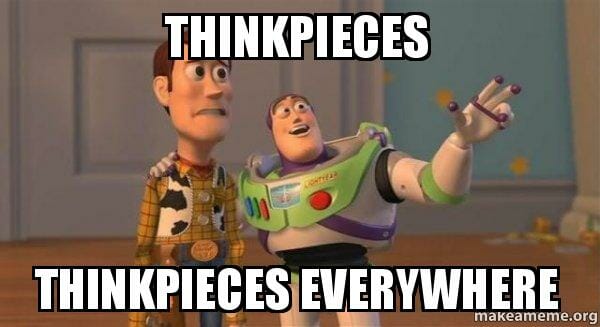
    Meme with Woody and Buzz from Toy Story. Buzz is gestering to the distance while Woody looks worried. Text reads "Think pieces. Think pieces everywhere."

    How to Write a Think Piece: Engage the Reader 

    If you’re wondering how to write a think piece, keep this in mind: it is essential to capture your reader’s attention right off the bat and to maintain it throughout.

    One of the best ways to keep readers engaged is by using storytelling. We are naturally drawn to good storytellers who can hold our interest from start to finish with emotion and charisma. Using storytelling techniques such as including personal stories, anecdotes and imagery can help make your work more engaging, relatable and memorable for readers. 

    A good way to get readers to relate to and connect with your ideas is by using real-world examples.

    Presenting your thoughts abstractly can leave some readers in the dark, not able to make connections and ultimately missing the main idea and appeal you were trying to get across. When readers can relate to concrete examples, it helps them see how your ideas relate to their own lives, making your think piece more relevant and engaging. 

    Remember that a think piece is also supposed to spark reflection and conversation among your audience. Encourage active engagement and critical thinking by posing thought provoking questions that challenge conventional beliefs. Be open to hearing varying opinions from readers and use these differing perspectives to springboard into new realms of thought and questioning. 

    Present a Balanced Argument

    It may seem counterintuitive, but it is important to acknowledge the opposing side of your argument. 

    If you’re wondering how to write a think piece, think of it like this: don’t get wrapped up in only sharing one point of view (yours). Look at other sides to the story as well.

    Being able to speak to counterarguments shows intellectual honesty and actually strengthens your own argument by showing openness and credibility. 

    Going back to the research stage of the writing process, you will have found other articles and think pieces directly in opposition to your own ideas. Don’t shy away and try to hide these! Reviewing these arguments helps you paint a more well rounded image of the issue in your own mind and allows you to illustrate that in your writing. 

    When you share differing viewpoints, remember to do it fairly and respectfully. While you don’t have to go into as much detail as you would for your own viewpoint, be sure to give a clear, accurate representation of both sides of the coin. This shows your readers that you are open minded by taking the time to consider all of the angles and are open to discussion from multiple perspectives. 

    Embrace the power of your voice! With some research, organization and open mindedness, you can take your passion and turn it into a well-crafted, thought-provoking think piece that will hook readers and prompt them to reflect on their own beliefs. 

    A willingness to share personal anecdotes, be a little vulnerable and show some humility can go a long way to connecting with readers and encouraging them to share their own opinions on the topic to stoke an enriching discussion. 

    Let us know if this helps you better understand how to write a think piece!

    Freelance Writer’s Pitch Checklist
    Grab it for free 👇

    Convince more editors to say YES to your pitches!

      We’ll also send you our weekly newsletter, which offers helpful advice for freelancing and publishing. You can unsubscribe at any time.

    • There are More than 1,700 Words Invented by Shakespeare. Here Are Our Top 50

      There are More than 1,700 Words Invented by Shakespeare. Here Are Our Top 50

      Did you know there are 1,700+ words invented by Shakespeare used in his plays and poems?

      Shakespeare Birthplace Trust says he did this “often by combining words, changing nouns into verbs, adding prefixes or suffixes, and so on.”

      Perhaps even more interesting is although these words and phrases were invented in the 16th century, many of them are still in use today! 

      Keep reading as we explore 50 of our favorite phrases and words invented by Shakespeare and share a bit of the story behind them where we can. 

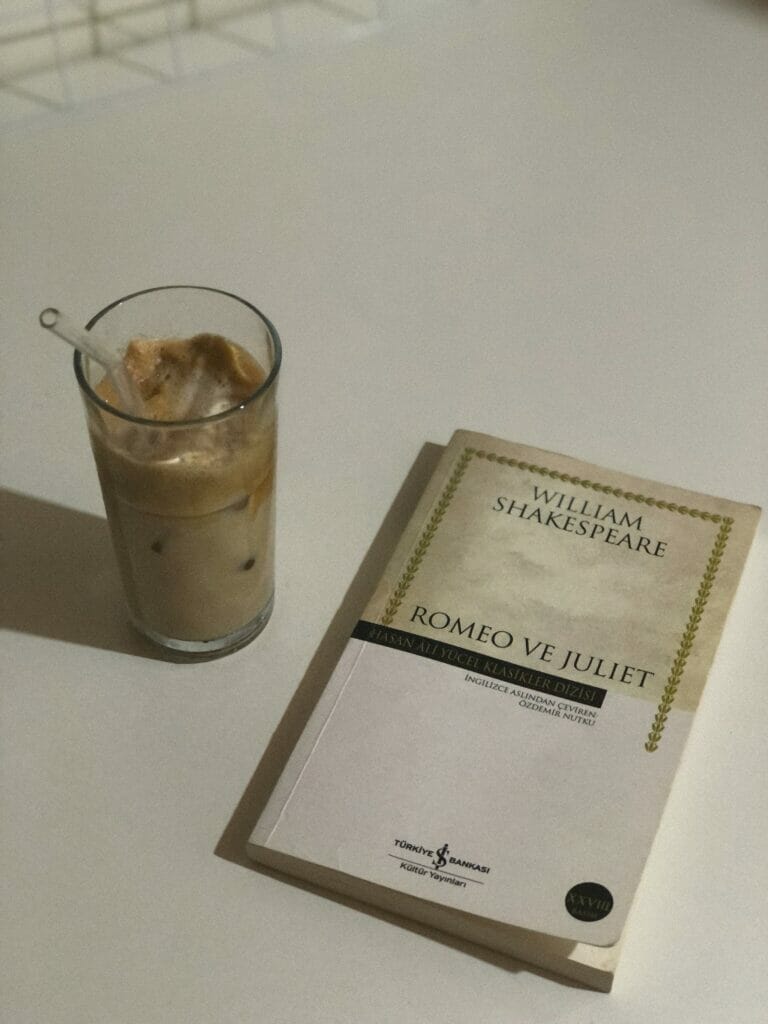
      Overhead photograph of an iced coffee beverage with a straw sitting next to a paperback copy of William Shakespeare's Romeo and Juliet. One of the words invented by Shakespeare appears in this play—alligator, believe it or not.

      Words Invented by Shakespeare (with Some Origins) 

      Considered the greatest playwright in English history, William Shakespeare was a prolific writer and left an incredible mark on literature and western culture.  Here are 25 words he is credited with inventing.

      1. Addiction—Exemplified in Othello, the word “addiction” is used to describe the state of being dedicated or devoted to a thing, unlike the modern usage of the word relating to bad habits like smoking
      2. Assassination—Found in Macbeth, the word “assassination” holds its same meaning by being a timed poisoning or utter destruction of something
      3. Bedroom—This word still holds the same meaning as when it was added to A Midsummer Night’s Dream
      4. Champion
      5. Cold-Blooded—When first used, this word was used metaphorically whereas now it’s used as a reference to serial killers and vampires
      6. Critic—Found in Love’s Labour Lost to mean someone who judges merit
      7. Dwindle
      8. Elbow
      9. Fashionable—Cited in Troilus and Cressida, this 11-letter word has stood the test of time in various industries today
      10. Generous
      11. Gloomy
      12. Hint
      13. Inaudible—Shakespeare added the negation of “in” before a word where it had never been before
      14. Lackluster
      15. Lonely
      16. Moonbeam
      17. Multitudinous—There are two meanings that Shakespeare derived from this word. One describes a body of water and the other is related to common people
      18. Obscene—Meaning “repulsive or disgusting,” this term was first found in Love’s Labour Lost
      19. Puking
      20. Perusal
      21. Pious
      22. Radiance
      23. Reliance
      24. Submerge
      25. Swagger—This was way before Justin Bieber! Shakespeare meant “swagger” to mean “strutting with a defiant air” 

      25 Common Phrases Shakespeare Invented

      Here are a few phrases that first came William Shakespeare. See how many you recognize and use! 

      1. All’s well that ends well
      2. Break the ice
      3. Eaten out of house and home
      4. Fair play
      5. Good riddance
      6. Heart of gold
      7. In a pickle
      8. Laughing stock
      9. Love is blind
      10. Wild-goose chase
      11. Vanish into thin air
      12. Naked truth 
      13. A piece of work 
      14. Fight fire with fire
      15. What’s done is done 
      16. Wear your heart on your sleeve
      17. Seen better days 
      18. Set your teeth on edge 
      19. Too much of a good thing 
      20. The world is my oyster
      21. A sorry sight 
      22. Green-eyed monster
      23. Heart of hearts
      24. Dead as a doornail 
      25. Bated breath 

      Some of these phrases may have existed in speech before Shakespeare documented them in his work. However, his usage caused them to enter popular culture and influence our word choices, even today. 

      Shakespeare’s Invented Words Showcases the Flexibility of the English Language

      What’s so interesting about these terms being used today is that it demonstrates just how enduring our language is. Can you believe these 16th-century words and phrases still (basically) mean the same thing? It also shows us how flexible English can be. If we need a word, we can make one.

      For example, as of February 2023, there were already 313 new entries and 130 new definitions added to the dictionary in 2023 such as:

      • Digital nomad
      • Rage farming
      • Folx
      • Petfluencer

      Language is how we express our human experience, and the words and phrases we use will endure or flex based on what we need in any given moment. 

      While many of the words invented by Shakespeare are more heavily used in England and the United Kingdom, English speakers around the world will be familiar with some, if not most, of our curated list! 

      Want more writing advice?

      Subscribe to get our latest content by email.

        We won’t send you spam. Unsubscribe at any time.

      • 7 Screenwriting Software Options Every Filmmaker Will Love

        7 Screenwriting Software Options Every Filmmaker Will Love

        Have you ever thought about screenwriting software? As a screenwriter, you want to spend most of your time writing and less time worrying about typeface and line spacing. The right program can help.

        And in TV, where every line counts and people are waiting on your pages to shoot, you want to be able to type away without worrying about whether you’re maximizing every last space and margin.

        As a script coordinator on award-winning television shows, I’m responsible for tracking revisions, editing for continuity and helping find trims and cuts to make that page count—so I’ve come across many different screenwriting software tools that can take your script from the writers room, to set, to post.

        Man sitting at a desk working on a script.

        Screenwriting software, including some free options

        Lights, camera, write! With so many options for scriptwriting software, it can feel overwhelming to choose one—especially with varying price tags. 

        We’ve rounded up the most popular screenwriting options for every budget to help you write your next Oscar (or Emmy!) winner. Or at least finally finish that script you’ve been working on.

        Here are some of the best script-writing software:

        1. Final Draft

        Final Draft has been on the market since 1991 and has long been considered the industry standard. 

        It’s used by heavy-hitters like James Cameron, J.J. Abrams and Matthew Weiner, and is the number-one selling screenwriting software in the world, available for Windows, Mac, and iPad.

        Natalie Bounassar, television writer and blogger, is quick to recommend this above all other options:

        “Final Draft is my screenwriting software of choice. It’s an intuitive program that takes the work out of the technical process of crafting a script and allows you to focus instead on your creative process.”

        Natalie Bounassar

        And she’s right: using one of the company’s 100 templates, you can create screenplays, stage plays, teleplays for any project you’re working on. The software even provides glimpses into how Emmy-winning dramas like “Game of Thrones” or “Better Call Saul” are formatted, making your spec writing a breeze. If you’re working on a comedy sample, there are templates available for this too, including the formats for “Veep” and “Silicon Valley.”

        In addition to being the industry standard for personal writing, Final Draft is popular in TV writers’ rooms across the business. Because of its ease in tracking revision pages, many of your favorite TV shows require staff to use this program as scripts are brought to the screen. Final Draft has an excellent customer service support line to support these writers for bumps along the way. 

        But it’s also the most expensive screenwriting software available, and it has been slow to adapt to include newer features that programs like Scrivener and WriterDuet offer.

        Final Draft 11 has been particularly challenging for many writers, as these Amazon reviews point out (including issues opening documents made in Final Draft 11 with any earlier versions).

        However, Final Draft 11 offers a live chat function that allows you to write and edit with your partner in real time, and you can save your files using Dropbox and iCloud, though it’s not as effortless as in some other programs.

        Cost: Around $250 at the time of this writing

        2. Fade In

        Billed as “More than just your final draft,” Fade In offers the powerful tools screenwriters expect without a lot of the extra fluff that makes programs like Final Draft slow to learn and use.

        Like the end credits of a movie, Fade In’s interface is primarily black and white, which is easier on our exhausted writer’s eyes. You can import and export files made with other programs,  making it easy to collaborate with people using, say, Final Draft or MovieMagic. Reversely, Fade In allows you to save your own files in plain text so you can open using another program later on.

        Fade In also offers robust organization (color-coding, index cards and marking significant sequences), a Dialogue Tuner (to see and edit a single character’s dialogue all in one place) and report downloads (scenes, cast, locations, and more).

        Fade In is the most compatible and user-friendly of these options, and it comes with all the bells and whistles an expensive program like Final Draft offers. While this program is great for personal use, it’s not used industry-wide, so you might have to use a different program for some projects.

        Cost: Around $50 at the time of this writing

        3. Arc Studio Pro

        One of the newer professional screenwriting tools, Arc Studio provides an easy-to-learn screenwriting software interface with professional features and a free browser version. It’s great for professionals or newbies to screenwriting.

        One of the great things about Arc Studio is you can collaborate with other writers in real time, similar to Google Docs. You can easily export your screenplay as a PDF or .fdx file for sharing and collaborating with others. It also allows you to access and write your screenplay from the downloadable software, or in your browser, or from the iOS app on your iPhone or iPad.

        Arc Studio offers an intuitive outlining tool for breaking your story and figuring out your characters’ arcs. And it has automatic cloud storage with the ability to save to Google Drive or your hard drive.

        If you need production tools like colored pages and starred revisions, you won’t get that with this tool, though the company says those features are coming soon.

        Cost: Free, with option to upgrade to the $99/year Pro version at the time of this writing

        4. Celtx

        If you’re not ready to splurge on an expensive screenwriting software, Celtx is a popular option without the hefty price tag. Having started as a free scriptwriting software, Celtx has grown to be a budget-friendly option with many of the same formatting features other programs offer.

        Celtx features are pared down, but their free version offers formatting for screenplays, storyboards, catalogs and more. The paid versions also work in tandem with its mobile apps so you can work offline and on-the-go.

        Web-based Celtx Edge uses a collaborative model that allows an entire production team or scriptwriting class to collaborate on a project via browser. Celtx also includes the ability to change formats, so if you’re writing a stage play that you suddenly realize would be great as a short film, Celtx can easily convert between formats.

        One thing to look out for when using Celtx is it will often incorrectly format characters, parentheticals and stage directions. In a cutthroat industry where every punctuation counts, you’ll have to do a thorough job checking your script after it’s saved as a .pdf file before sending it to other professionals in the industry.

        Cost: Free, with upgrades available for $19.99 per month at the time of this writing

        5. WriterDuet

        WriterDuet’s motto is “You don’t need to spend $200 just to fit in” and the company’s features prove it values script content over formatting. It’s one of the first screenwriting programs on the market to offer simultaneous writing and editing options for you and your writing partner, and its this feature that users cite as the reason they prefer it over Final Draft or Movie Magic.

        WriterDuet has a neat feature to help shorten your script by automatically searching for places where you can cut a few lines. Same thing for error-checking: The software finds incorrect formatting, typos, characters with similar names and more.

        You can even analyze your script by reviewing statistics on action versus dialogue, density and how characters speak.

        WriterDuet has cloud storage with the ability to save to Dropbox, Drive and your hard drive with additional automatic backups.

        Cost: Free version, with option to upgrade to the $99 Pro version, as well as student pricing at the time of this writing

        6. Scrivener

        If your work goes beyond screenwriting, and includes other types of writing like fiction, Scrivener’s your best bet.

        The popular tool offers formatting options for all of the above, but with the added bonus of being able to visualize scenes that need to be grouped together. Novelists swear by its ease of use and enjoy the benefits of this highly-visual platform. Scrivener’s corkboard feature allows you to make sense of all your notes and scenes — almost like creating a storyboard.

        If you plan to take your script through filming, Scrivener falls short for long-term use. Users indicate that collating pages into a pdf, a seamless process in Final Draft, is far more complicated when used here. While great for character development, research and structure, it’s not compatible with the software producers and directors use to actually turn a script into a movie. You’ll need to convert your screenplay into another format, making it sluggish for last-minute rewrites.  

        Check out Scrivener’s tutorials and our review of Scrivener, or consider investing in a course like Learn Scrivener Fast, which will teach you everything you need to know to become a master of the tool.

        Cost: $45 for Mac, $40 for Windows at the time of this writing

        7. Movie Magic Screenwriter

        Movie Magic is the official screenwriting software of the Writers Guild of America East, but some people in the industry consider it old-school.

        Like almost every tool available, Movie Magic automatically formats your script to industry standards, and it offers many of the same perks as Final Draft. You can quickly change the layout of the interface to have as many or few distractions as you want.

        It’s also one of the only softwares that offers, in addition to TV and Screenplay templates, novel, comic book writing, and radio play (ie, podcast!) formats, making it a “one-stop shop” for whatever kind of writing you want. And you can collaborate with other writers online in real time using iPartner.

        However, while Movie Magic was once the industry standard, it has lessened in popularity as other, more innovative tools have come on the market. It doesn’t offer a direct import for Final Draft documents, so keep that in mind if you’re working in a television writers room with Final Draft users.

        Cost: $249.95, includes three activations at the time of this writing

        You never want to give someone a reason not to read your script, and when the difference between “consider” and “pass” could be just a few formatting issues, make sure you have a program that takes care of that for you! Screenwriting software allows you to focus on the important part of this process, the writing.

        Whether you’re a writer’s-room regular or a student working solo, find the tool that makes the most sense for you, learn it well, and stick with it.

        Which screenwriting software do you prefer? Anything missing from our list?

        The original version of Screenwriting Software Options was written by Marian Schembari. In 2020 we updated the post so it’s more useful for our readers. In 2023 we refreshed this post so it was still accurate.

        This post contains affiliate links. That means if you purchase through our links, you’re supporting The Write Life—and we thank you for that!

      • Our Top 10 Best Poetry Books of All Time

        Our Top 10 Best Poetry Books of All Time

        Poetry is a timeless art that captures the beauty of language, incorporates the art of storytelling, and impacts us on an emotional level. But with so much poetry out there in the world, where do you start? This post explores some of the best poetry books and poems—both fiction and non-fiction. 

        Overhead shot of a styled table with lace, flowers, tea, and two poetry books. The books are open and there are hands on one of the books as the person reads.

        Best Poetry Books and Poems (According to The Write Life)

        In times of loss, love, and everything in between, turning to the world of carefully poetic words to help make sense of emotions can be powerful. To this day, we can reflect on the experiences of these great poets and learn from them to understand our own personal thoughts. 

        Choosing favorites is always subjective, but in our search for the best poetry books and poems we tried to find something to suit most every occasion.

        Leaves of Grass by Walt Whitman

        Walt Whitman’s Leaves of Grass is a celebration of life, democracy, and the beauty of the natural world. Originally published in 1855, the collection underwent several revisions throughout Whitman’s life.  With its free verse and unapologetic embrace of individualism, Leaves of Grass broke away from traditional poetic conventions and set a new standard for American poetry.

        And Still I Rise by Maya Angelou

        Published in 1978, And Still I Rise is a collection of 32 short poems that are divided into three main sections. Speaking on concepts from love and dreams, to longing and living in the American South, Angelou uses this poetry book to invite readers into her trials growing up while acknowledging the many oppressions faced by Black people throughout time.  The poems are in first-person lyrics, which helps to make the poems intimate and engaging. The variation in line lengths also gives the poems unpredictability as they reflect the events of Angelou’s life. 

        The Iliad and The Odyssey by Homer

        Dating back to ancient Greece, Homer’s epics The Iliad and The Odyssey stand as monumental works of poetry. These epic poems are filled with heroic tales, gripping narratives, and complex characters. The Iliad portrays the Trojan War, while The Odyssey follows the arduous journey of Odysseus. These classics remain fundamental in shaping Western literature and continue to inspire countless works to this day.

        Selected Poems by John Keats

        John Keats’ most celebrated pieces of work can be found in his book, Selected Poems, including “Ode on a Grecian Urn.” The book was first published in 1947 and contains poems published during Keats’ lifetime. With themes of beauty, hardships, grief, and love being explored in this book, the collection covers a range of emotions, engaging the reader in many ways and making it a top favorite for us. 

        Divine Comedy by Dante Alighieri

        As a long narrative poem, Dante’s Divine Comedy takes readers on a guided tour through Hell, Purgatory, and Paradise. This epic poem, written in the 14th century, explores themes of sin, redemption, and the complexities of human existence. Through vivid imagery, profound symbolism, and remarkable storytelling, Dante’s masterpiece remains an unparalleled exploration of the human soul while blending both reason and faith to explain social chaos. The series of illustrations and diagrams made the book engaging while playing a part in explaining some of the classic literature. 

        The Waste Land by T.S. Eliot

        T.S. Eliot’s The Waste Land stands as a landmark in modernist poetry. Published in 1922, this influential work captures the disillusionment and despair felt by many after World War I. Through its fragmented structure, intertextual references, and multilingual lines, Eliot skillfully depicts a post-war landscape plagued by spiritual emptiness and societal decay.

        Here is a snippet of one of the poems from his book: 

        After the torchlight red on sweaty faces
        After the frosty silence in the gardens
        After the agony in stony places
        The shouting and the crying
        Prison and palace and reverberation
        Of thunder of spring over distant mountains
        He who was living is now dead
        We who were living are now dying
        With a little patience

        The Waste Land Part V – What the Thunder said

        The Collected Poems by Sylvia Plath

        Sylvia Plath’s The Collected Poems offers a poignant glimpse into the troubled yet brilliant mind of the poet. Published posthumously in 1981, Plath’s poems explore themes of identity, feminism, and mental anguish. Her raw and confessional style, as showcased in works like “Daddy” and “Lady Lazarus,” continues to captivate readers and inspire generations of poets.

        The Love Poems of Rumi and The Essential Rumi by Rumi

        Jalal ad-Din Muhammad Rumi, the 13th-century Persian poet, wrote verses that transcend time and cultural boundaries. In The Love Poems of Rumi, readers are transported to a world of mystical love, spirituality, and divine union. Rumi’s poetry speaks to the depths of the human soul, offering profound insights and a profound connection to religion. 

        Another poetry book we highly recommend reading by Rumi is The Essential Rumi. Exploring themes of silence, separation, emptiness and loss, the book has been known to help readers understand and heal through some of the most difficult emotions to encounter. 

        The Raven and Other Poems by Edgar Allan Poe

        Edgar Allan Poe, a pioneer in the modern detective story, crafts his dark and haunting tales through poetry. The Raven and Other Poems showcases Poe’s mastery of rhythm, rhyme, and imagery.  With works like “The Raven,” “Annabel Lee,” and “The Bells,” Poe delves into themes of grief, madness, and the fragility of the mind, making this book known for its very spooky and chilling verses. 

        Set Me on Fire: A Poem for Every Feeling by Ella Risbridger

        Published in 2019, Set Me On Fire is a contemporary take on classic poems, which introduces refreshing perspectives, voices from around the world, and themes that were dared to be explored in earlier centuries.  Discussing concepts of trauma, rage, and happiness, this poetry book anthology is ideal for anyone looking to understand any emotion they may be going through.

        Summary | The Best Poetry Books

        We’ve unveiled the best poetry books (in our opinion), but there are many other wonderful poets and poems out there to discover.

        [sps_reusable_block post_id=43050]

      • How To Use Storytelling In Writing In 4 Essential Steps

        How To Use Storytelling In Writing In 4 Essential Steps

        You might have heard how important storytelling is when it comes to content and writing in general.

        No matter what type of writing you are doing, learning how to use storytelling to your advantage can help your work stand out and draw in readers.

        If you don’t know how to use storytelling in writing, thankfully there are some tips you can use to bring your writing to life, even if you are not doing creative writing.

        Throughout this article we will break down the fundamentals of storytelling, why all writers should learn the essentials, and then dive into some tactical things you can use in your writing.

        What Is Storytelling?

        Storytelling is the art of using a story to convey a message and to draw readers in and give them a reason to be emotionally involved in your writing.

        Storytelling is the social and cultural activity of sharing stories, sometimes with improvisation, theatrics or embellishment. Every culture has its own stories or narratives, which are shared as a means of entertainment, education, cultural preservation or instilling moral values.

        From Wikipedia

        Once you know the core elements of storytelling, you can start to use those tactics in everything you write to make it more engaging and interesting.

        Most of us think of fiction writing when it comes to storytelling, but you can use it in almost any kind of writing. Even if you do not write fiction, it can be good to practice storytelling as a way to draw more attention to your writing and level up as a writer in general.

        Why Is Storytelling Important?

        For the most part, humans remember and become more attached to stories than almost anything else. There is a reason we love reading books, watching movies, and telling stories at social gatherings. It is because we love that stories do to us.

        For example, we can hear statistics and data about events in the world, but we connect to it and remember things more when storytelling is involved. It is why you can remember stories you heard and can repeat them better than you can recall facts you learned in school.

        When we talk to people in our lives, we share stories and it is how we relate to each other.

        If you want to be a writer, no matter what writing niche you pick, knowing how to use storytelling to your advantage can help grow your career in ways you never planned.

        title card for how to use storytelling in writing

        Why Storytelling Matters In Blogging

        If you want your blog to stand out and start to hook readers, you will need to use elements of storytelling to grab attention.

        It is one of the best ways to build a following and create content that people want to share. Not enough blogs utilize storytelling in their posts, so it is a great tool to use to stand out between so many competitors.

        Including a story is also a way for your reader to really understand and visualize what you are trying to say and understand your message in a way that they would not otherwise.

        Benefits of Using Storytelling

        Storytelling is a great way to grab people’s attention and keep it hooked.

        There is something uniquely human about the love of stories and our desire to always keep them in our lives, even if it is

        You will often find that you can increase engagement as well when you use stories. People love to comment and engage on particular stories.

        Think about the creator behind Humans Of New York who simply walked around New York (and eventually then multiple places in the world) where he would ask people to share their stories. It captivated people around the world and garnered a lot of attention.

        Storytelling gives people a reason to share content, too, as it is more interesting than a blog that is just about a particular topic.

        How to Use Storytelling In Writing

        Now that we have covered the basics of why storytelling matters and what it is, now is the time to dive into the tactical things you can use to start bringing more stories into your writing.

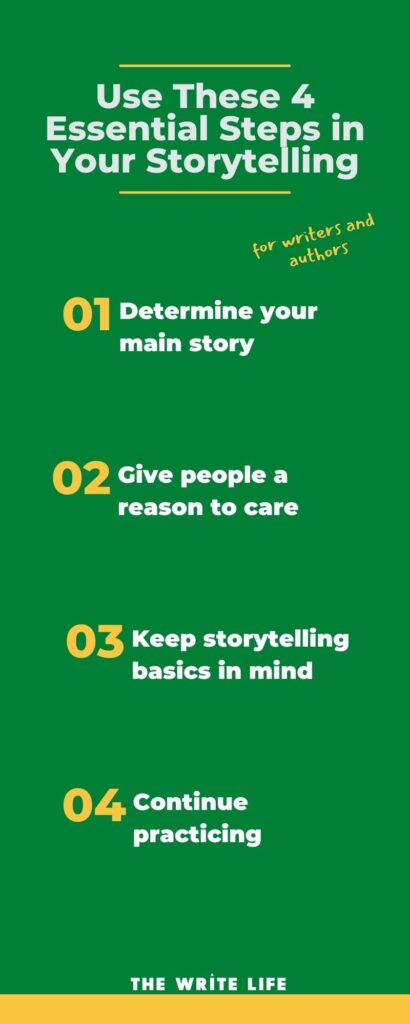
        Determine your main story

        In almost any story, there is a beginning, a middle, and an end. If you want to use storytelling in your writing, you need at least those three main points of your story outlined so you know what to include.

        That makes it incredibly simplified, but it is the best place to start if you are new to telling stories.

        Give people a reason to care

        First, you will need to think about who you are telling the story, the purpose of the story in the first place, and how those two go together.

        Sure, you can write a story for the sake of sharing a story, but often you will have a particular reason to share a certain story and a certain person you want to read it.

        This is especially true if you are blogging or doing any kind of writing for marketing or branding purposes.

        It might seem tedious to spend the amount of time thinking about the reader and what they need out of your writing, but it will be worth it.

        Keep some of these storytelling basics in mind

        There are some things you will and will not want to include in your writing.

        For example, take out cold, boring language. This is particularly common with businesses that use storytelling, where they rely on a ton of jargon and business-speak and avoid getting into the flow of telling a story.

        You will also want to highlight sensations and the senses when it comes to writing a story, since that is what makes them so visual. You will want to talk about how things smell, taste, look, feel, sound, and so on. It can draw them in and help them put themselves in a position to feel the story.

        Write the story as if you were telling it to someone you were with. That is a great way to write a story in a natural way.

        Continue practicing

        One of the main things you need to keep in mind if you want to use storytelling in writing is you will need to practice over and over in order to be an effective storyteller.

        Vertical graphic that says Use these 4 essential steps in your storytelling. 1) determine your story 2) give people a reason to care 3) keep storytelling basics in mind 4) continue practicing
      • Which Citation Style Reigns Supreme? Endnotes vs Footnotes

        Which Citation Style Reigns Supreme? Endnotes vs Footnotes

        There’s often confusion with endnotes vs footnotes, and when to use one instead of the other. They kind of look the same but they serve different functions.

        What is a Footnote? 

        A footnote is an in-text citation found in the footer of the page.

        You’ll know it’s a footnote when you see a superscript number (a small, raised number) next to a word or chart, which links to a short citation at the bottom of the page.  The footnote will contain additional context or information.

        What is an Endnote?

        An endnote is an in-text citation found at the end of the chapter or document. 

        Similar to a footnote, an endnote gives the reader more information about a topic. However, their location at the end of a chapter allows for them to contain more content than a footnote as there is more space than at the bottom of the page. 

        Endnotes vs Footnotes: Which to Use When

        Endnotes and footnotes are citations, and they both provide additional information to readers without interrupting the flow of words.

        In general, citations are required when writing an academic paper or research study. They’re also expected for essays, certain non-fiction books, and journal articles.

        Which citation you go with often depends on the style you’re writing to so take a moment to check the style requirements and become familiar with their prefered citation method.

        If you aren’t using many citations and they’re short, then footnotes are fine. If you have longer citations and require additional space, then endnotes may serve you better.

        In general, the use of footnotes in most academic writing is now considered a bit outdated and has been replaced by endnotes, which are much easier to place in your paper, even with the advent of word processing programs. However, some disciplines, such as law and history, still predominantly utilize footnotes.

        USC Libraries Research Guides

        The format you use depends on what you’re writing (books, articles, essays, etc. have different requirements) and what style you’re using. However, citations contain similar elements: 

        • A superscript number within the body of text, which corresponding number contains additional information
        • A page number or reference, which tells you the source of the information within the text 

        Here’s an example of a citation: 

        1. Carolyn Kay, Art and the German Bourgeoisie: Alfred Lichtwark and Modern Painting in Hamburg, 1886-1914 (Toronto: University of Toronto Press, 2002), 100.

        Novels that Use Citations

        Many non-fiction works use citation, but did you know some fiction work use them too? In these cases, authors utilize footnotes or endnotes to introduce readers to a new world with additional commentary. Citations can also add understanding to a character or a subject, making the story even more interesting. 

        Here’s a few examples of novels that utilize citations: 

        The Mezzanine by Nicholson Baker (2020)

        This short novel uses footnotes to tell the unspoken thoughts of a man on his lunch break. The author adds footnotes to give us an insight into the narrator’s mind, drawing out his frustrations, thoughts, and expressions. 

        Crazy Rich Asians by Kevin Kwan (2013)

        The satirical novel that made us fall in love and laugh at the same time also used excessive footnotes, which acted as witty interjections. Being a novel centered on the money-powered families of East Asia, the footnotes offer a mix of gossip and affirmations for the reader to refer to throughout. 

        Jonathan Strange & Mr Norrell by Susanna Clarke (2004)

        In this novel, footnotes are used to determine which characters get to take up the majority of the body text, and which ones simply reside at the bottom of the page. This is one way authors can use footnotes to place importance (or lack of) on certain characters or objects.

        Summary: Endnotes vs Footnotes

        Endnotes and footnotes serve to add information and context for readers to help deepen their understanding on a topic. While footnotes are shorter and sit within the page footer, endnotes are typically longer and are found at the end of a chapter or section.  When it comes to endnotes vs footnotes, which do you prefer?

        Want more writing advice?

        Subscribe to get our latest content by email.

          We won’t send you spam. Unsubscribe at any time.

        • Writing a Narrative Poem: Everything You Need to Know (A Step by Step Guide)

          Writing a Narrative Poem: Everything You Need to Know (A Step by Step Guide)

          When we think of poetry, the first thing that usually comes to people’s mind is rhymes (a close second: the other assumption that all poems are short!). 

          But of course, this doesn’t capture the entire poetry genre. 

          Narrative poetry is one of the most unique forms of literature because of their ability to capture plot, characters, and dialogue all in one poem—often with very little rhyming, if any. 

          This is a step-by-step guide to writing a narrative poem, including what they are, how to write an epic narriative poem, and some awesome examples to inspire you. 

          What is a Narrative Poem? 

          A narrative poem is a form of poetry, which involves telling a story. The poet will use various elements of storytelling to create a plot, introduce characters, and set a certain scene–while using elements of poetry like rhyme, form and other devices. 

          We find narrative poems to be the oldest form of poetry, dating all the way back to 2000 B.C. It has successfully stood the test of time because of the engaging and entertaining way that poetic rhymes and verses have been able to tell the intended story. 

          More contemporary narrative poems tend to rely less on rhymes but still incorporate elements like non-linear story structure, characterization, and emotive language. 

          The Difference Between Lyric Poems and Narrative Poems

          A common misconception is that narrative poetry and lyric poetry are the same but this isn’t the case. 

          The main difference is the poem’s sense of time. Narrative poems capture the flow of time by having an order of events and an “A causes B” pattern. The sense of time is easy to follow. On the other hand, lyric poems discuss a particular moment in the past with the purpose of bringing emotions out of the readers. 

          In short, narrative poems focus on a sequence of events, whereas lyric poems magnify and speak about one specific event in time. 

          What are the Different Types of Narrative Poetry? 

          • Ballad

          Ballad is a form of narrative poetry, which was loved throughout the 19th century. Athough originating in Europe, ballads have certainly made their mark across the world. Ballads were narrative poems set to music, often accompanied by dances and large crowds.  

          Victorian-era poets admired this form of poetry and used it to both tell a story and entertain a big audience. However, their popularity hasn’t translated as well into the modern 21st century era and we see less of this form nowadays. 

          • Idyll 

          Idyll poems are a form of narrative poetry, which describe and evoke rural life. This type of poetry focuses on moments within small communities and villages either describing a single person’s day of work or doing some sort of labor. 

          Idyll poems date back to the early 17th century as a way of depicting the life of farmers, laborers, and rural life in general. 

          A great example is Idylls of the King by Alfred Lord Tenyson (1859) which details the story of King Arthur’s nights in a 12-poem cycle: 

          I found Him in the shining of the stars,
          I mark’d Him in the flowering of His fields,
          But in His ways with men I find Him not.
          I waged His wars, and now I pass and die.
          O me! for why is all around us here
          As if some lesser god had made the world,
          But had not force to shape it as he would,
          Till the High God behold it from beyond,
          And enter it, and make it beautiful?

          • Epic Poems 

          Epic poems are long narrative poems concerning stories of heroism and any type of extraordinary people who changed history. 

          These poems were used to tell the stories of kings, knights and successors to evoke national identity and morality.

          Examples of these poems include, The Aeneid and The Odyssey, The Epic of Gilgamesh, and The Mahabharata. 

          How to Get Started Writing a Narrative Poem

          Narrative poetry is a form of artistic expression, combining the power of storytelling with the beauty of poetic language. Here are some essential tips and techniques to help you bring your stories to life.

          Find Your Inspiration

          Every great narrative poem begins with a spark of inspiration. Look for ideas in your surroundings, personal experiences, historical events, or even mythology. Allow yourself to be curious and open to new perspectives. 

          Inspiration can come from unexpected places, so be receptive to the world around you, think of something great that has happened to you (or someone close to you) or even create a world that is completely fictional!

          Develop Your Plot

          Every great narrative poem has a  well-structured plot. Start by outlining the key events, characters, and conflicts in your story and set the beginning, middle, and end of your poem, and consider how each part intertwines. 

          Remember, you don’t need to go into too much detail by explaining the scene or introducing characters as this isn’t a novel. Keep it straight to the point yet engaging for your reader.  

          Choose a Narrative Voice

          The tone and narrative voice of your poem are crucial in setting the mood and capturing the reader’s attention. 

          Do you want your poem to be narrated in a humorous tone? Or maybe even a mysterious one? Choose a narrative poem that aligns with the perspective of who is telling the story and, to make it even more personal, you can even use a first-person voice. 

          Utilize Imagery and Sensory Detail

          The aim with any compelling narrative poem is to create a vivid and rich picture in the mind of readers. You want them to transport themselves to the setting, visualize the events and feel the story unfold. 

          Make use of sensory details to enhance the experience and think about the various descriptive words you can use to bring the narration to life. 

          Focus on Figurative Language

          Figurative language brings depth and richness to your narrative poem. Incorporate metaphors, similes, personification, and other literary devices to infuse your writing with a touch of elegance and lyrical beauty. 

          Figurative language helps readers connect with the emotions and ideas conveyed in your poem, evoking a more profound and lasting impact.

          Experiment with Structure and Form

          We’ve looked at the different forms of narrative poems, so feel free to put them to use! You can opt for something more traditional like a ballad or epic, or perhaps choose a more contemporary form. 

          Experiment with line breaks, stanza lengths, rhyme schemes, or even free verse and let the structure and form of your poem enhance the overall storytelling experience.

          Summary 

          Narrative poems are a beautiful piece of literature that allow you to blend the art of storytelling with the power of poetry. 

          By seeking inspiration, focusing on figurative speech, utilizing sensory descriptions, and developing an engaging plot, you can conjure up a compelling narrative poem that tells your story perfectly. 

          Grab your pen, let your imagination soar, and embark on the thrilling adventure of crafting narrative poetry!

          Want more writing advice?

          Subscribe to get our latest content by email.

            We won’t send you spam. Unsubscribe at any time.

          • Carpal Tunnel Mouse: 5 Of The Best Options

            Carpal Tunnel Mouse: 5 Of The Best Options

            If you are someone with carpal tunnel, you know how important it is to have a carpal tunnel mouse that can support your wrist so it does not hurt during your writing sessions is important, and there are so many out there to choose from.

            You might not know there are different types of accessories you can buy to make sure you are in less pain throughout your day, which is this article explains options out there in detail to help you make an informed decision.

            While it might be frustrating to have pain while you write, it doesn’t have to stop you from bringing your ideas to life.

            What Kind Of Mouse is Good for Carpal Tunnel?

            If you are suffering with carpal tunnel, there are a few things you can do to find a mouse that can help support your writing.

            According to OrthoInfo,

            Carpal tunnel syndrome is a common condition that causes numbness, tingling, and pain in the hand and forearm. The condition occurs when one of the major nerves to the hand—the median nerve—is squeezed or compressed as it travels through the wrist.

            OrthoInfo

            Anyone who is diagnosed with carpal tunnel needs to take is seriously because it is something that becomes worse over time if it is not dealt with.

            A mouse will not necessarily fix your problem, but it will help manage it.

            Can Using a Mouse Cause Carpal Tunnel Syndrome?

            There is some research to support that modern computers and mouses can be associated with carpal tunnel syndrome.

            Computer mouse use has become an integral part of office work in the past decade. Intensive mouse use has been associated with increased risk of upper extremity musculoskeletal disorders, including carpal tunnel syndrome. Sustained, elevated fluid pressure in the carpal tunnel may play a role in the pathophysiology of carpal tunnel syndrome.

            From: Effects of computer mouse design and task on carpal tunnel pressure by P J Keir, J M Back, and D Rempel

            Do Carpal Tunnel Mouses Work?

            Carpal tunnel mouses can certainly help prevent more issues throughout time. Carpal tunnel gets worse when you do not make adjustments to how you use your hands and can end up damaging your nerves worse.

            So, with that in mind, carpal tunnel mouses can be a way to help on your journey to becoming a professional writer.

            Carpal Tunnel Mouse

            Let’s take a look at some different options out there so you can find the right fit for you.

            Logitech MX Vertical Wireless Mouse

            The Logitech MX mouse is rechargeable and wireless so you can keep it where you need it while you work, which can be key to reducing muscle and nerve strain.

            This mouse keeps your hand in a neutral handshake position so you do not need to turn it as much as you would with a traditional mouse.

            It has a high-precision sensor so you only need to move your hand 4x less times than other mouses out there, which can help reduce strain over hours.

            One unique feature about this mouse is that you can use it across three computers using Logitech FLOW. That can help you use only one mouse throughout your day, which can help a lot with certain technical needs.

            You will get four months of use from a single charge (and three hours of use if you charge it for one minute), which can help a lot with making sure your mouse is available at all times.

            Perixx PERIMICE-713 Wireless Ergonomic Vertical Mouse

            The Perixx PERIMICE-713 mouse is a great option for those with carpal tunnel syndrome not only because i its design, but because it also has six buttons on the mouse you can customize for your own needs.

            That can help you move your hands less throughout your day and as you use your computer.

            It has up to 10 meters of distance so you can sit at a comfortable distance from your monitor for optimal posture.

            iClever WM101 Ergonomic Mouse

            The iClever WM101 mouse has a comfortable style, which also includes a thumb rest with four different resolutions, depending on how much or how little mobility you have.

            The four resolution adjustments include: 1000DPI, 1600DPI, 2000DPI and 2400DPI. If you do not know, those are different mouse sensitivity settings.

            It also has two buttons for “backward” and “forward” so you can browse with ease and not need to move your wrist nearly as much to click around.

            Using a wireless 2.4GHz connection, you can stay connected up to 49 feet, which helps when it comes to setting up your desk and posture how you prefer.

            For those with extra sound sensitivity, the buttons are also built to be more quiet so you do not just hear endless clicking as you browse on your computer. That can also help for people who need to be on the quieter side, such as those with newborns.

            DeLUX Wireless Ergonomic Mouse

            The DeLUX Wireless ergonomic mouse has a unique design with a removable palm pad as well that is built for extra comfort and support as you work.

            It has a frosted texture, which helps improve grip but also keeps dust and sweat off of the mouse, keeping it in better quality for longer.

            This mouse has a high of 4000DPI sensitivity, which would allow you to barely move your hand in order to move your mouse around your screen.

            The battery inside this mouse can also last for a whole week (assuming you work 8 hours per day) for each charge, making sure you have less charging to worry about each day.

            eirix Ergonomic Vertical Wireless Mouse

            The eirix ergonomic mouse has fun lighting, which can be an extra perk on top of the extra help and care it gives to dealing with carpal tunnel.

            The palm rest has some built-in anti-sweat materials so it stays comfortable and easy to use, even though hours of use. On the bottom it also has a smooth surface to help reduce drag, giving your joints a comfortable experience.

            The DPI settings come in four modes: 800, 1200, 1600, and 3200. You can switch between them by simply clicking a button, which makes computer use even easier.

            Need More Writing Help?

            Freelance Writer’s Pitch Checklist
            Grab it for free 👇

            Convince more editors to say YES to your pitches!

              We’ll also send you our weekly newsletter, which offers helpful advice for freelancing and publishing. You can unsubscribe at any time.

            • The Writers Strike: The 2007 Revolution That Changed Hollywood History

              The Writers Strike: The 2007 Revolution That Changed Hollywood History

              In an uncanny parallel to the Writers Strike 2007, the entertainment industry finds itself once again engulfed in turmoil as writers take to the picket lines.

              The current Writers Strike, which is interrupting American film, television, and digital media, is focused on streaming media residuals and artificial intelligence.

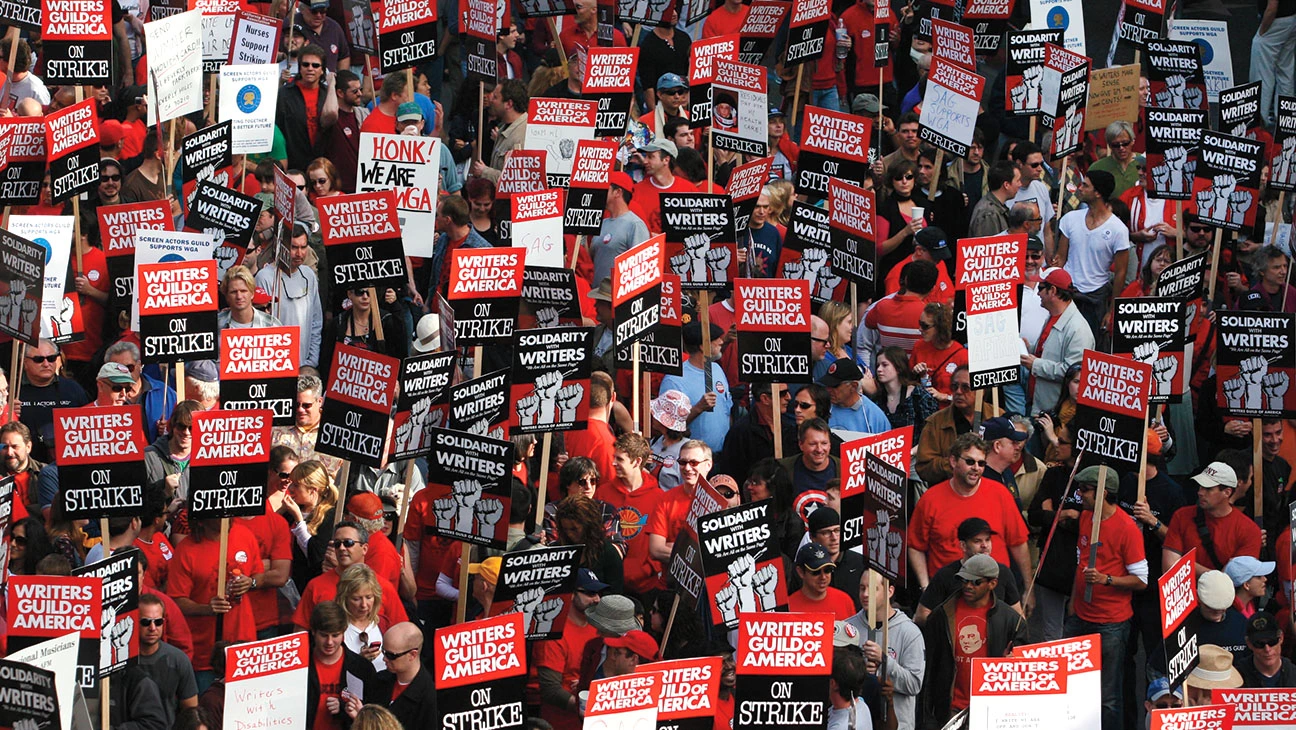
              As scribes barricade themselves with placards demanding fair compensation and creative autonomy, the echoes of the past resound, stirring up unresolved tensions between the Writers Guild of America labor union and the Alliance of Motion Picture and Television Producers.

              This article looks back at the infamous writers strike 2007 and explores how it’s relevant to the writing community and media consumers today.

              The Writers Strike: The 2007 Revolution That Changed Hollywood History

              The 2007 Writers Guild of America Strike

              On November 5 2007, screenwriters from the Writers Guild of America (WGA), a collective union of American writers, took to the streets of Los Angeles to protest against television corporations, including: 

              • CBS
              • MGM
              • Lionsgate
              • The Weinstein Company
              • The Walt Disney Company
              • NBC Universal
              • Starz
              • Sony Pictures 
              • Paramount Pictures
              • Warner Bros 
              • News Corporation

              But why? 

              For decades before the strike, WGA had been protesting against a recurring issue with the distribution of money in the business. 

              In 1985, writers went on strike over the home video market, where distribution companies argued that the delivery and manufacturing of these home videos were expensive, meaning writers were left short changed for their work. 

              The pattern continued as new forms of media were released, which led to the 100-day Hollywood Writers Strike 2007. 

              The strike sought to increase the funding for writers, which was proven to be significantly lower than the profits of these large studios. Screenwriters felt as if their work was seen as inferior in the grand scheme of production, though the effects on TV shows and movies during this protest was yet to prove otherwise! 

              What Happened During the Two Month Strike? 

              Writers across America conducted a powerful walkout, which proved to shake the entertainment industry more than anyone expected. With over 60 television shows shutting down and millions of dollars lost for the networks, the local economy certainly took a hit. 

              During the strike, consumers and television lovers everywhere had to go without their favorite shows, while networks aired back-to-back reruns. 

              Writers continued protesting for a larger share of the profits being made from distribution networks. Some notable faces amongst the protest crowds included, Ben Stiller, Lisa Kudrow, Matthew Perry, plus many actors from the cast of Grey’s Anatomy and CSI. 

              “The [writers’] deal is ridiculously unfair and anything that anybody can do to call attention to that is good at this stage. It’s miraculously unfair what’s going on, so it’s a no-brainer, you just come out and support it.”

              Matthew Perry in 2007

              As the strike persisted, popular late night shows like Saturday Night Live were paused for months. As a result, unscripted reality shows emerged because producers weren’t able to get their hands on scripts by professional writers. 

              It’s evident how significant of a role writers played in the overall production, engagement, and distribution of the shows and films that were driving the Los Angeles entertainment economy. Without them, the industry lost millions, hugely-sponsored award ceremonies went downhill, blockbusters were delayed, and new shows didn’t make it past their first season. 

              How was the Writers Strike 2007 Resolved?

              While it felt like the entertainment industry was a fire that couldn’t be put out at this point, on February 12 2008, the members of the WGA eventually voted by a margin of more than 90% go back to work. 

              What did they achieve?

              The WGA earned a larger piece of the digital revenues from the productions they scripted. 

              What were the Long-Term Effects of the Writers Strike 2007? 

              Although this proves how needed and how successful the strike turned out in terms of giving writers their residual payment terms, they had to return to industries that were inevitably changed. 

              Reality TV Shows Gained Momentum

              By the time writers had made their way back to work, reality shows like Deal or No Deal were having their moment and topping the ratings each week.

              This meant that scripted TV shows were drying out because of the lack of new episodes throughout the duration of the strike. 

              Death of the Newbie Writers

              While you may think that the lack of scriptwriters would create opportunities to younger, less-experienced writers looking to get their foot in the door, it was actually the opposite that took place. 

              Writers who had moved up the ranks in the entertainment sector were being brought back down a level to fill the shoes of the writers on strike. Although they had to take a pay cut, producers were more keen to keep “seasoned” writers in the business, meaning the pathway for newbies was cut off. 

              There were a few writers who jumped at the chance to squeeze their way in through the gaps, including the likes of Nick Bernadone who worked alongside Tina Fey and on numerous hit Netflix shows.

              The Birth of Streaming Services

              Do you know what else happened in 2007? The Netflix uproar. 

              One of the effects of the strike was it being somewhat of a base for the massive growth we were about to see in streaming services, such as Hulu and Netflix. 

              It became clear to the industry that a power shift was about to take place when the WGA refused to sign a contract that didn’t include “new media residuals.” This meant that writers wanted to be paid from the shows they scripted that ended up on platforms like Netflix, even though they weren’t originally made for Netflix. 

              How I Met Your Mother is a great example of this. The scriptwriters of this popular show were compensated for the work they did even once it started streaming on Netflix, which skyrocketed its views. 

              While it may have initially seemed like reality TV was about to blow every other show out of the water, the growth of streaming services turned this all around, giving writers their moment back.

              Are We Still Seeing These Issues in the Industry?

              Although the 100 day strike has passed us by over 15 years ago, are these issues still a dark cloud over Hollywood? 

              At the end of 2022, reports of a writers strike occurring began to loom across the Internet as members of the WGA spoke about their dissatisfaction with current contracts. 

              While we move away from the original forms of distribution from 2007, like DVD residuals, writers are now reflecting on their “next to nothing” pay rates for shows on streaming services. 

              The rules are a little different for streaming platforms than traditional cable. Viewers are turning to mini-series with hour-long episodes, which require less writers from the beginning and leaving little room for new writers to make their mark. 

              So, the question is, are we back in the same boat as we were in 2007? 

              In terms of reality TV shows and blockbuster films, not so much. In regards to the influx of viral series on Netflix that seem to be marginalizing (or completely cutting out) dozens of writers, most likely. 

              Overall, there needs to be a significant change in pre-episode compensation for writers to shorten the gap between working and earning and to allow them to pay their bills and make a sustainable living from what they love most—being a writer! 

              Want more writing advice?

              Subscribe to get our latest content by email.

                We won’t send you spam. Unsubscribe at any time.