Tag: writing a book

  • Learn How to Use Scrivener: Free Webinar With Joseph Michael

    Learn How to Use Scrivener: Free Webinar With Joseph Michael

    Ever considered using Scrivener to organize your writing? Or maybe you’ve tried the tool, but want to learn to better use all its bells and whistles?

    We’re here to help! We’ve asked Joseph Michael, also known as the Scrivener Coach, to teach The Write Life community how to use Scrivener to get the most out of every writing session.

    He agreed to partner with us on a webinar called, How to Use Scrivener to Effortlessly Write, Organize & Export Your Book Into Various Formats for Printing, Editing, Publishing & More.

    Yes, you can really do all of that and more with this writing tool! And Joseph is going to show us how.

    How to sign up for our free Scrivener webinar

    When: 8 p.m. EDT on Thursday, June 18th

    Cost: Free

    How to register: Click here

    There’s only one catch: seats fill up quickly for this type of free training, and there are a limited number of seats available on the live chat. That means if you want in, you should sign up now!

    What you’ll learn during this webinar

    Here’s what Joseph will share with us during this free training:

    • How to set up Scrivener quickly, so you can get a lot out of the tool
    • Tips for navigating that complicated Scrivener window so you know what you need to use and when you should use it (and what to forget about so you don’t waste time)
    • The best way to customize your toolbar and turn yourself into a writing machine… whether you have a million ideas or just one.
    • How to master the Scrivener corkboard, so you can turn it into your own writing lab and never lose track of anything, forget your notes or lose your spot
    • When to use the outliner to organize massive projects, complete them, and feel completely in control of your writing process
    • How to master the art of the rewrite and save every version of your work, so you never have to worry again about losing your drafts
    • The easiest ways to print, compile, share and export your work
    • And much more!

    A bonus for attending the webinar

    This is a free training, no strings attached.

    As a thank you for attending, Joseph will offer a bonus at the end of his presentation: a 20 percent discount on his course, Learn Scrivener Fast. You’re under no obligation to buy, but the offer is there if it’s a good fit for you!

    And as an additional bonus, if you do purchase his Master or Ninja Package, we’ll also send you a free copy of The Write Life’s new ebook, 71 Ways to Make Money as a Freelance Writer, which retails for $19.

    We hope you join us for this special live event! Click here to save your spot. See you there!

  • Become a Ghostwriter: Here’s How to Write in Someone Else’s Voice

    Become a Ghostwriter: Here’s How to Write in Someone Else’s Voice

    “A ghostwriter.”

    “So, do y—”

    “No, I don’t write about ghosts. And I don’t wear a sheet with holes cut out for eyes while I write.”

    “That’s not what …”

    “Yes it is, and you know it.”

    “OK. You got me. So what do you actually do then?”

    “I write books for other people. Their ideas, my words.”

    “Isn’t that cheating?”

    “No. My clients have great ideas. They just don’t have the time or the know-how to finish writing a book. It’s a win-win.”

    “But how do you write it so it seems like they wrote it?”

    “I’m a ghost. It’s what I do.”

    I’m a nascent ghostwriter, with just one title to my resume and two more nearing completion, but I want to do more. Consequently, I’ve been marketing myself as a ghostwriter. Because of that, I’ve had some variant of the conversation above more times than I can remember.

    When I talk with other writers, they often want to know about two specific issues: how to break into ghostwriting and how to write in another person’s voice. The first issue requires equal parts hard work and luck, but the second can be learned — although it tends to require a significant amount of trial and error.

    I learned the significance of finding the right voice after one of my clients pitched his half-written book to an agent. The agent replied that it was too academic in tone to reach a popular audience, which the author wanted to do. After I was hired to rewrite and expand his initial book, we focused on “popularizing” his book without leaving behind the important information he wanted to convey.

    Through this process, I learned a number of methods on how to write in another person’s voice. (In fact, with proper modification, these methods can be used to find a company’s voice for marketing and to discover characters’ voices in novels.)

    1. Listen

    The simplest and most effective way to write in someone else’s voice is to listen to that person’s voice.

    For instance, this client had 10 hours of video from a conference he’d led using information that would ultimately be in the book. He sent me the video and I transcribed every word. Painstaking? Yes. Worthwhile? Quite.

    In being forced to listen to the way he spoke about his book’s topic, I discovered his voice hiding in plain sight. He wasn’t academic; he was understandable. He wasn’t dull; he was funny. His spoken-word, real-life delivery was much more engaging than what he’d written.

    But you don’t have to rely on your author speaking about his or her topic (though, of course, that’s ideal). You can glean their voice from the conversations you have with them. With their consent, record your conversations, then jot down a few notes after the fact about what struck you: Did he use large words? Did she seem confident in what she was saying? Did he pause for long periods of time? Did she often quote others? What did his body language convey?

    In asking other ghostwriters about how they listen to learn an author’s voice, they offered a number of excellent suggestions for instances when a meeting may not be possible:

    • “Read everything you can from that person: books, speeches, even emails, and any notes-to-self that they’ll share.” — Jennifer Harshman
    • “Write out physically something the author has written. Do it over and over until you get a feel for how things are worded. Talking like that person out loud can help too.” — Jim Woods
    • “Watch videos they may have. Record your calls. Skype if possible so you can also learn their body language. Visualize them speaking, then pretend to be that person as you write.” — Alice Sullivan
    • “Try to never do a ghostwriting project without an in-person meeting. Also, if the client is a speaker, discuss the difference between spoken and written word.” — Mike Loomis

    Essentially, you’re searching for the ways in which they best engage an audience. If you can capture that aspect of your author’s personality in writing, you’ve accomplished much of what’s required of a ghostwriter.

    2. Write

    Robert Frost wrote, “I can see no way out but through.”

    Once you start hearing your author’s voice in your head at night, that’s just about the right time to begin ghostwriting on their behalf. If you never begin writing, you’ll have no idea whether your idea of their voice will translate well to the written page. You must go through to get out, and it will be a laborious process of questioning every word choice, every transition and every edit.

    With the best clients (and I’ve been fortunate to work with all “best clients” so far), you can write and submit a chapter, then receive feedback within an agreed-upon timeframe. This has vacillated between a day and a week with my clients.

    Remember, these are busy professionals who hired me precisely because they’re so busy. Consequently, I have to be flexible with their timeframes, though they still have to be responsive to my needs so that their respective books can be finished on deadline.

    Mike Loomis offers two superb tips for the writing phase: “Ping-pong one chapter until it feels right to everyone” and, “Try to get feedback from a spouse (or someone close to the author) when possible.”

    Feedback is when you’ll really learn whether or not you’ve captured the author’s voice.

    And that moment right before opening your author’s first email reply after you’ve sent the first draft? It’s enough to make any writer want to hide under a sheet.

    3. Bow

    Lastly, be humble when you receive feedback. Though it is your book, it’s not really your book.

    As the client paying you to write a book on her behalf and in her voice, if the author says, “I wouldn’t use that word,” you must delete all instances of that word without hesitation. In fact, the more you can discover about the particular words and turns of phrase the author prefers, the more you’ll be aligned with her voice.

    Quick tip: To prevent yourself from inadvertently using a word the author wouldn’t choose, use a text expansion app like aText (or one of these Windows options) to essentially autocorrect any unintentional word usage.

    Ultimately, you must realize what’s supposed to be on display isn’t your talent — it’s your author’s voice. Like a ghost, the best writers for other people disappear behind the author’s needs.

    If you’re a ghostwriter, what practices and strategies do you use to get inside your author’s mind? If you haven’t tried ghostwriting, will you?

    If you’re exploring other writing careers, check out this article, where you’ll find more options to get paid as a writer.

    Perhaps this quiz can help you decide.

  • What’s Your Book Marketing Plan? 6 Crucial Steps to Include

    What’s Your Book Marketing Plan? 6 Crucial Steps to Include

    Every publisher and literary agent will tell you that responsibility for the success of your book rests heavily upon you, its author. Although traditional media campaigns still play an important role in the marketing plans for new books, they are no longer enough. To maximize — or perhaps even replace — a traditional publicity campaign, you need to reach out to your audience directly by building and nurturing a strong online author platform.

    Before founding a publishing company, I was a longtime arts and lifestyle newspaper editor. Over my 15 years in media, I saw our book coverage capacity plummet as reporting staff was relentlessly cut back and the newspapers themselves shrunk in size. I was dismayed to have to turn down highly appealing pitches from authors and their publicists every day, despite my interest in their books, simply because we no longer had the resources to cover them.

    Every media outlet in the world is facing a similar crisis today. That’s why as a publisher, I now counsel all of our authors to build a relationship directly with their readers. I’ve seen first-hand that a strong grounding in online book marketing makes a decisive difference to any book’s ability to succeed in the market.

    This is true for traditionally published authors as well as those who are self-publishing. Traditional publishers are far more likely to take a chance on an author when they know that he comes with an engaged following. If you’re planning to self-publish, a strong online platform is even more critical because you are entirely dependent upon your own ability to promote and distribute your work.

    [twl_reusable_block post_id=41455]

    Here’s how to market your book to make it a winner.

    1. Start early

    It’s never too soon to begin raising awareness of your book, and of you as an author. If you’re starting from scratch with very little presence online, you should ideally begin your platform-building efforts even while you are writing.

    It takes a while to gain traction and build a following. And by sharing updates or asking for feedback on your book while you write, you stimulate curiosity and a sense of personal investment in your audience.

    2. Build your website around yourself

    You need to have a website, and it needs to be built around you, not around your business or your book. It’s surprising how many authors still overlook this critical piece of advice, relying on Facebook or their publisher’s website to act as their main online home.

    But think about it. Your website will forever be under your control, and will never become obsolete. Instead, its power and relevance will only grow stronger as your career develops.

    Your site doesn’t need to be fancy — in fact, it’s better not to pack it full of unnecessary features and distracting design elements. Aside from a page dedicated to your book and an “About me” page, the most critical element of your site will be a blog. By maintaining a regular blog you can build a following even while you write, and when your book is ready for publication, your readers will feel they already know you.

    3. Focus on growing an email list

    Email is the most effective marketing tool available today, and if you’re serious about selling your book, you must use it.

    Offer a flagship piece of content on your website such as a mini ebook as an incentive to join your list, then send out a monthly or even weekly newsletter to stay top-of-mind with your followers. To keep their interest high, your newsletter ought to contain more than just “news” about you. By offering something useful, insightful or entertaining, you’ll gradually build an engaged audience who looks forward to hearing from you.

    Choose the nature of your newsletter content based on the type of reader you’re courting, and the nature of the relationship you want to cultivate with those readers. This could be as simple as a stripped-down, letter-style email filled with links to top news from your industry, perhaps embellished with your own analysis. Or if your target readership is highly visual, you might choose to create a monthly mini-magazine filled with your own inspiring graphics, articles from your blog, embedded videos, quizzes and more.

    4. Be generous

    Marketing has changed in the digital age. Intrusive and coercive advertising has given way to permission marketing, in which book-buyers (and consumers of all types) follow their own pathways to find the things they care about. To bring them to your door, you’re going to have to drop some breadcrumbs — plenty of them.

    Show the world what you know by blogging and guest posting. Draw people to your site by offering tools and resources for free. Above all, if your publishing arrangement permits it, consider making a free ebook or PDF version of your book. It’s possible that you might cannibalize a few sales this way, but you’re more likely to win others simply by spreading the word.

    5. Use social media strategically

    Social media quality is much better than quantity: you don’t have to be on every social network, and when you’re just starting out, you really shouldn’t try. It’s much better to do a few things really well than to take a scattershot approach that has no focus and no goals.

    Determine where your target readership is most likely to be concentrated, and start by building a strong presence on that network.

    6. Seed early reviews

    I can’t overstate the importance of those first few weeks after release. To improve your book’s discoverability on Amazon, it’s critical to have a handful of solid reviews — aim for 10, at a minimum. It’s ok for some of these to come from family and friends, but it’s even better for those to come from top Amazon reviewers and verified buyers.

    How do you get them? Start by asking, of course. Offering a free copy of your book to the right people in exchange for a review can give an enormous boost to your sales. Go to Amazon’s list of top reviewers and look for reviewers who have reviewed books similar to yours. You can also simply look up reviewers whose reviews you have enjoyed!

    Each reviewer has a profile with an email address. Reach out to them with a non-pushy personal note, and a copy of your ebook or PDF version. Be gracious, be grateful and respect their opinion if they don’t love your book. Sour grapes will sour your reputation, but being a good sport demonstrates the professionalism you want to be known for as a career author.

    What marketing strategies have helped you spread the word about your book?

  • Silence Your Inner Critic: How to Defeat Your Writing Demons

    Silence Your Inner Critic: How to Defeat Your Writing Demons

    Everyone has their own personal writing demon — and some writers have several of them.

    Maybe yours is a lack of confidence. Or it might be that you battle resistance. Perhaps you fight against an inner critic; more than a few writers struggle with the nagging voice of someone from their past who told them they’d never succeed.

    No matter which demon you have to battle, no writer escapes the black dog of doom that creeps close and growls when they sit down at the keyboard.

    Having a writing demon is so universal that it’s become a trope. Cue the story of the angst-filled creative who can’t get past his blocks… until some unexpected event or person changes everything and unlocks his creative genius.

    Wouldn’t it be great to have a miracle like that happen to you? Well, you could sit around waiting for that moment to happen. It’s what most writers do.

    Or, you could just take matters into your own hands and slay your personal writing demon from the comfort of home.

    How to defeat writing demons

    In the movies, defeating a demon requires the dramatic. Common approaches include finding a magical artifact that’s been hidden for eons, or taking a harrowing trip to a fiery chasm. Some massive battle of wills or strength takes place, and at the last minute, all that seemed lost is saved.

    Defeating demons in real life is far easier.

    You don’t need a magical artifact. No fiery chasm is required. Your writing demon is simply a bully — and as with all bullies, all it takes to come out on top is to stand up tall and not back down.

    Here are a few time-tested ideas that always do the trick.

    Decide how much power you’re going to give away

    The reason a personal demon has power over you in the first place is because you’re consistently giving it over.

    The demon didn’t always have power — in fact, it didn’t have any until you started giving it control. Mentally, you created a hierarchy in which you began to believe the demon had all the power… and you didn’t have any. Now you’re at its mercy, letting it dictate your options.

    It’s the same psychological phenomenon that keeps people stuck in unhealthy, abusive relationships.

    Whenever you encounter your demon, you need to decide whether you’re going to believe what it says or follow its advice. That’s your decision to make — only you have control over that.

    You can choose to believe you have no options. You can choose to believe your demon has taken them all away.

    Or you can choose to believe in your own free will and ability to act.

    You can decide to stop giving your demon the power of an authority figure. You can refute its message. You can refuse to be controlled. Instead, you can start treating it like some random bozo on the street. One who doesn’t know you, and who can’t tell you what to do.

    You don’t have to listen to your demon. How much power you relinquish to it is your decision, and yours alone.

    Find the easiest way to chip away at its power

    Your demon has been around for a long time. It’s conditioned you to hold beliefs that don’t necessarily go away just because you want them to. It affects your confidence that you can be creative, productive and successful.

    It affects your ability to write.

    You might think that you have to engage in some epic battle against these beliefs to break free. That approach might work, but to be honest, it’s prone to fail.

    Your beliefs have strong foundations. They’re not easily toppled. But they are easy to chip away. Instead of using brute force to topple a belief, undermine it by taking small actions that run counter to the idea.

    Your writing demon wins because it has you believing global statements like, “I just can’t write” or “My writing isn’t any good.” The universal nature of these beliefs gives them their power.

    This is what you can chip away.

    For example, the next time you think, “I just can’t write,” chip away at that universal belief. Sit down and write for five minutes. You could write a mere 100 words. You could write on a completely unnecessary topic — anything to get reactivated.

    This small step won’t magically turn your writing life around, of course, but it does create a reference point that immediately works to undermine your global belief, and it helps your brain to re-engage. You’ll come to realize that sometimes it’s more difficult to write, and most times, it’s not difficult at all.

    And when you think, “I just can’t write!” you’ll begin to realize that statement isn’t true. The voice of your demon begins to lose credibility. Eventually, it becomes a fleeting whisper until the day you don’t hear it anymore at all.

    Will it take time? Of course it will. But if your writing has been stalled because of your demon, gradual improvement is better than the zero you have now.

    Assign a talisman to remind you of your power

    The beliefs you currently have are the result of long-term conditioning. They’re going to be your default pattern for a while. That’s why it’s a good idea to have something at your disposal to remind you that you can break that pattern any time you choose.

    In legends, a talisman is an object that protects you from harm. In real life, you can have one, too.

    You might choose a “lucky pen” you keep on your desk to remind you that if you just write for 10 minutes, you’ll warm up to the task. It could be a sticky note on your monitor that says, “Everybody starts somewhere.” It could even be a picture of a loved one that you can look at and think, “This person believes in me, and I’m going to believe in me, too.”

    Be creative. Have fun with this. Choose a talisman that makes you feel good, that makes you feel confident, capable and strong. Just pick an object that you associate with your new, more empowered belief, and keep it handy.

    The psychological term for this is anchoring; you anchor a particular thought, state of mind or emotion to the sight or feel of an object. It’s a smart thing to do, because it can help you break from your rut when you’re feeling trapped.

    Can defeating your writing demon really be so simple?

    Yes.

    It’s likely that on your search for the miracle cure that’ll save you from your demons, you’ve encountered all sorts of other writers talking about their difficult struggles and sharing “helpful” advice suggesting a long, daunting road of recovery back to writing health.

    Sometimes the simplest advice is best. And even better, not only is this advice simple, but it’s easy to implement.

    No matter how long your demon has held power over you, that power is fragile. It was never the demon’s power to begin with — the power was, and always will be, yours.

    So the next time your writing demon starts whispering in your ear, use these three simple steps to get the power back in your hands… where it belongs.
    Have you battled a writing demon? What strategies or tools did you use?

  • Writing a Book? 3 Reasons to Work in a Noisy Place

    Writing a Book? 3 Reasons to Work in a Noisy Place

    Most writers find it necessary to work in quiet places where they can concentrate in silence. Jonathan Franzen has been known to write in a room with no electronics, no WiFi, nothing but a chair and a table. On occasion, he’s even blindfolded himself and plugged up his ears.

    Maybe that’s your style — being cut off from the world. But don’t dismiss the possible advantages of writing in a noisy environment. Crafting prose in silence and serenity has its benefits, but it might be time to take your laptop and wrap yourself in racket.

    An unintentional experiment with writing amid noise

    The other day, I locked myself out of my house. I was in a hurry, trying to get the dog to poop, taking out trash, stacking laundry from the washer. While I waited for my wonderful girlfriend to drive over and let me in, I wrote in a nearby coffee shop.

    Espresso machines whirring, clinking and clanking of silverware and mugs, laughter, talking, chatter — the constant din of a caffeine club wasn’t my typical writing environment. But I wrote, I thrived, I fed off all of the noise.

    If you generally write in silence, this situation might sound awful. But here are three reasons why you might want to experiment with writing in a noisy place.

    1. Conversations inspire authentic dialogue

    Listen to the conversations going on around you. What are people saying? How does each one turn a phrase? What kind of voices do the speakers have — gravely, sweet, annoying? And most importantly, how does the conversation unfold?

    Dialogue is hard to write with authenticity. Listen to how people really talk, and let it evolve into your writing. If you’re writing a scene about a conversation in a coffee shop, go to a coffee shop and listen to the voices.

    2. Noise offers depth and color

    Your parents always told you to do your homework in a quiet place, and yes, research says studying or working in silence, in a place where distractions are low, is a good thing.

    But that was homework; now you’re writing and creating. Instead of letting noise disturb you, allow it to inform your work. The music you hear inside a tavern can add mood, police sirens from the street outside can add to plot, and an overheard argument at the table next to you can add depth to a character. Use what you hear to enhance scene and story.

    Next, go deeper and explore the ambient noise, the less obvious sounds. What do you really hear? Go beyond the people talking at the next table and the music coming from the speakers. What about the squeak of a chair, the clang of a closing door, the food grilling in the restaurant’s kitchen?

    Let each one settle in and listen closely. Consider how they manifest and how people react to these sounds. You might think the audio coming out of a television in a bar would be distracting, but the content of that sound or someone’s response to it might lead you to a new creative idea.

    3. Science suggests noise might lead to inspiration

    If you need to be creative, you might be better off in a moderately noisy place than a quiet one. Researchers at the University of Illinois at Urbana-Champaign found noise at about 70 decibels — the equivalent of a busy coffee shop — distracted participants just enough to help them think more creatively.

    Inspired by this research, a website called Coffitivity offers a soundtrack of ambient coffee shop sounds. If you want to try writing at a noisy coffee shop before actually going to one, give it a try to see whether a little clatter gets your creative juices flowing.

    Will you try writing in a noisy place?

    Although this noisy world can sometimes wear on our senses, commotion and clatter just might take our writing to wonderfully imaginative places.

    Life happens in the noise, so writing right in the middle of it is a great example of embedded reporting. It might take extra concentration at first, and your usual writing discipline or routine might need some adjustments, but shaking things up could have a great effect on your work.

    Do you enjoy writing in noisy places? Or do you prefer to work in silence?

  • How One Author Earns $450,000 a Year Self-Publishing on Amazon

    How One Author Earns $450,000 a Year Self-Publishing on Amazon

    Self-publishing success stories are all around us… but it’s not often we get a glimpse into how, exactly, these authors manage to sell so many books on Amazon.

    That’s why we love this piece from Forbes on how one author earns $450,000 a year self-publishing on Amazon.

    The UK-based author, Mark Dawson, writes thrillers and crime novels, and has sold 300,000 copies of his thriller series about a British assassin named John Milton. The Forbes piece says Dawson earned six figures last year, but never quite explains the math behind the $450,000 total it says Amazon has paid to the author.

    Of course, any measure of six figures is impressive when you’re just starting out in the Amazon self-publishing world, and the tactics Dawson shares in this piece offer a number of takeaways for up-and-coming authors.

    Here are some practical tips for succeeding as a self-published author based on what worked for Dawson:

    1. Give away your book for free

    It sounds counterintuitive, but many self-published authors who manage to gain traction on Amazon give their books away through Amazon’s KDP Select program.

    KDP Select allows you to offer the book for free for five days or discount it for up to seven days using what’s called a Countdown Deal. If you offer the book for free, it can rank on Amazon’s Top 100 Free list if it does well, while discounted books are included on the Top 100 Paid list. Once your book makes one of these lists, even within a subcategory, other readers are more likely to see and download it. And if your book does well on the free list, some of that clout will carry over into its sales rank once your book goes back to its regular price.

    Dawson tried this strategy when he released his first self-published book, The Black Mile, and readers grabbed 50,000 copies in one weekend. He also now gives away free books in return for signing up for his email list; you can’t miss this offer at the top of his website.

    Of course, giving your book away or selling it for cheap doesn’t put much money in your pocket. But this strategy can give a much-needed boost to a new release. And if you can capitalize on that success and use it to build your community so they’re excited about your next book launch, you will likely be able to sell more books the next time around.

    2. Learn how to promote your books

    For many writers, marketing is the most difficult part, either because they don’t have the skills to pull it off or simply don’t want to. But the truth is, if you want to make a living as a writer, you have to be more than a writer. Figuring out how to promote your books is the only way you’ll sell copies.

    Dawson follows many of the best practices for growing a loyal community online: he has grown an email list so he can communicate with readers about upcoming releases, engages with his community on Facebook and offers seminars to other writers who want to self-publish as well.

    His email list is 15,000 strong, Forbes reports, a figure that may sound huge to a newbie but is  relatively small compared to most successful online entrepreneurs. It goes to show you don’t need a massive list to earn a living; you simply need an engaged, loyal one.

    3. Use Facebook ads to spread the word

    Many successful entrepreneurs use Facebook ads to reach their target market, and it can be an effective tactic, so long as you learn how to do it effectively. The trick is to earn more than you spend, and once you do, don’t be afraid to pour money into the Facebook machine.

    How do you earn money through Facebook ads? Use the Facebook ads manager to select a target audience that’s a good fit for your book, then experiment with small spends (as low as $10 or $20 each) to see which of your messages and target audiences converts.

    If you spend $10 to run a campaign, and 30 people buy your book because of it, you’ve likely made money, depending on the price point of your book and how much you have to hand over to Amazon. Use the analytics in Facebook’s ad manager to track metrics closely, so you can make good decisions about how to spend.

    Dawson spends $370 a day on Facebook ads, according to Forbes, and earns double that in book buys.

    4. Make time for your writing

    Next to marketing, this tends to be one of the biggest challenges for writers, especially those who are trying to break into a career as a writer while holding down a day job or raising a family. How do you make time for writing during a busy day?

    Dawson, too, holds a day job; he works in the London film industry, according to his website. And he has a young family. His job requires something most of us would complain about: a two-hour commute to and from London each day. Guess how he uses those hours? He writes thousands of words each day, Forbes reports.

    5. Don’t give up

    Stories like Dawson’s seem like overnight success stories, but if you look a little closer, almost every author and entrepreneur failed before succeeding.

    Dawson released a book through a traditional publisher before transitioning to self-publishing… and it flopped. And you’ve probably heard of most of these famous authors whose work was rejected before it was published.

    The trick is to avoid comparing your beginning to someone else’s middle. Everyone’s a beginner at some point. Don’t be afraid of failure, for you need to push past it to do your best work.

    Want more details about Dawson’s story? Read the full story on Forbes.

  • Fighting Writer’s Block? This Strategy Will Get Your Creativity Flowing

    Fighting Writer’s Block? This Strategy Will Get Your Creativity Flowing

    Every writer experiences this situation at some point.

    You sit down at the computer, ready to hammer out words, but absolutely nothing comes out. Not a single word.

    It’s just you and the blank page, with its blinking cursor quietly taunting you. Eventually you force a few clunky words and then…

    Backspace, backspace, backspace.

    It’s like someone ran a super-magnet over your brain’s hard drive and wiped it hopelessly clean of whatever inspiration and imagination had been inside when you first sat down.

    What should you do when the creativity won’t flow? Prolific artists like Pablo Picasso and Austin Kleon, author of Steal Like an Artist, offered this answer: When you’re running low on inspiration, steal it from others.

    A point of clarification

    There’s a difference between finding inspiration in others’ work and plagiarizing it. Don’t plagiarize, ever.

    Become a student of others’ work, but do it to pinpoint the style that resonates with you and then make your point in your unique voice.

    Build a swipe file

    Staying creatively prolific requires smart tools, and the swipe file is one that should be in every writer’s bag of tricks to beat writer’s block.

    Marketing pros have used swipe files for years because they’re always looking for a hundred different ways to say something. Starting from scratch every time they need to pitch a product is both difficult and unnecessary, so they’ve learned how to engineer inspiration into the process by making it a ritual.

    They’re always paying attention, studying other marketers and collecting ideas. When a smart turn of phrase grabs them, or a competitor’s ad is a runaway success, these experts add it to their swipe files. When it’s time to develop a new concept, they use the swiped ideas to spark their own creative processes.

    When I began writing fiction seriously 10 years ago, I borrowed that approach to build an inspiration reservoir, and it transformed my writing.

    It all starts with reading

    To be a good writer, you must first be a prolific reader. As you expose yourself to ideas and stories, your brain subconsciously absorbs and files source material that will inform your work.

    If you don’t think you have time to read, that’s an indication that you need to make time and foster curiosity. Reading both broadly and specifically in your chosen genre will teach you what good (and bad) writing looks like. You’ll develop a palate for language and intuition for good ideas.

    More importantly, each idea and word that you experience is like a dot on the page of your subconscious. Creativity is little more than connecting dots, so the more dots you have, the better. When comes time to write, the well will be full.

    But reading isn’t enough. You have to steal along the way.

    Steal like an artist: How to use a swipe file

    We’ve all had times when we’ve had a great idea, or were inspired by something we saw, and didn’t take the time to capture it in the moment. “I’ll write it down later,” we say, but later never comes. The moment is lost, and the idea along with it.

    This is where the swipe file comes in. You need one place to conveniently and consistently chronicle the dots as you bump against them.

    I use a combination of Evernote and Pocket as my swipe file. Both are free and can be used on a mobile device and laptop, so I can capture text, images and audio notes for later reference.

    For those times when I purposely unplug from digital things, I use a pocket-sized Moleskine notebook, though several writerly folks I know use Field Notes.

    As I come across things I want to capture, I curate them in my Evernote swipe file or jot them down in my notebook until I can add them to Evernote.

    A peek inside my swipe file

    My Swipe Book is divided into a few separate sections:

    SIPs (Stories in progress)

    At any given time, I have dozens of ideas in various stages of development. Stories need space to grow and time to age before they’re ready to be written.

    I often have “What if… “ scenarios that cross my mind, and this is the folder they go in until I can more fully develop them.

    Story starters

    Reality is sometimes stranger and more fascinating than fiction. I keep a folder specifically to capture those things that I think carry some story DNA. Often, bits of story starters end up in my work in unexpected way.

    Stolen Words

    To be a wordsmith, you should study wordsmiths. As I’m reading during the week, I come across turns of phrase that I love and wish I had written. I’ll capture those in my “stolen words” folder and study them to deconstruct why I love them.

    I also flip through this folder when I’m stuck with own manuscript and need inspiration to see things from a different angle.

    Putting it all together

    It all breaks down to this process:

    • Create a swipe file to easily capture ideas for later.
    • Explore other people’s ideas and be hyper-aware of what resonates with you.
    • Capture great ideas in the moment and curate them in your swipe file.
    • Once a week, review your swipe file and see what happens.

    Developing a bottomless reservoir of ideas is truly as simple as it sounds. Be curious about the world around you and then document everything that sticks with you. Soon you’ll have more ideas than you can possibly develop, and your imagination will never stall again.

    Do you keep a swipe file? How has it helped you as a writer?

  • Feeling Stuck? 7 Tools for Developing Fresh Story Ideas

    Feeling Stuck? 7 Tools for Developing Fresh Story Ideas

    As writers, we have a number of jobs. Putting words down on a page is only half of what goes on behind the scenes, right? There’s also the editing, the research, the continuous coffee making and, of course, coming up with ideas.

    This last task is one of the most important parts of the writing process because without ideas you have, well, not a lot. If you write regularly, whether that means blog posts, short stories or copy, you know that coming up with consistently brilliant ideas isn’t always easy.

    It’s true. While most writers are naturally creative and innovative, we sometimes run out of steam. Tapping away at a keyboard for hours at a time can leave your brain mushy and your ideas lacking a certain luster. Once you’ve finished writing for the day, you have to plan out your ideas for tomorrow (cue head hitting desk), leaving you feeling unmotivated and, at worst, like a bad writer.

    Luckily, there are plenty of places you can tap into for writing inspiration when you’re running low on ideas.

    1. Buzzsumo

    Buzzsumo is great for creating instant “lightbulb” moments for blog posts and articles.

    It’s extremely user-friendly — all you have to do is type in a few words about the topic you’re researching. Buzzsumo’s algorithm uses social shares to measure how readers engage with certain topics, pulling in the best-shared posts relating to the keywords you choose.

    The downside? Buzzsumo isn’t free. You can use it on a limited basis without paying anything, but if you want to see more than 10 results, you have to cough up $99 a month or more. However, I often find that the initial 10 results are enough to get the cogs moving, so I’ve stuck with the free option.

    I used Buzzsumo to come up with an article for The Huffington Post about things you shouldn’t do as a freelancer. After typing in “freelance tips,” I saw top articles like “10 Tips for Surviving as a Freelance Artist,” “Things I Learned the Hard Way,” and “Freelancer Tips for Success.” Since these posts focused on things you should do as a freelancer, I flipped the idea on its head and came up with “69 Things You Should NOT do as a Freelancer”.

    2. Quora

    While Quora used to be full of weird and random questions, it’s now a great source of inspiration and writing ideas. The site is full of people asking interesting questions that you just might be able to answer!

    Quora is free, and is great for finding out what readers really want. Just type in a few keywords and you’ll find yourself inundated with questions you can answer.

    I’ve found lots of inspiration on Quora for travel pieces, since there are hundreds of people looking for tips, hacks and itinerary inspiration. I’ve even been inspired by other people’s answers on Quora.

    For example, one user responded to a question about working remotely while traveling by saying that most people he knew who quit their jobs to live such a life were outgoing and confident. Now, I quit my job to travel the world, but I’m definitely not confident or outgoing, so I wrote a post highlighting how you don’t have to be confident to travel.

    3. Pinterest

    Pinterest is no longer just a place to browse through pretty pictures (though I can definitely spend a few hours doing that!). It’s also filled with great articles and tons of article ideas.

    Give it a try: Type “writing” into the search bar and check out the results that come back. Narrow them down by using the bar across the top to apply filters like “tips,” “inspiration,” “examples,” etc.

    If I click on “tips,” I can see loads of pretty pins with text over images. I see one that offers “Advice for New Writers,” so I might alter this slightly and create a post called “Advice for Shy Writers” based on my experience.

    I mainly use Pinterest for short story inspiration, using the highly visual layout to create settings and scenes for my characters. It’s perfect if you’re writing a novel or need to describe a destination for a travel piece, because you’ll find hundreds of examples that inspire your descriptions.

    4. Feedly

    I’m a big Feedly fan. Every morning I check my feed for new posts from my favourite sites.

    The great thing about this tool, besides the fact that it’s free, is that you can personalise your feed to include any topics and blogs you want, and you can separate them out into manageable lists. Writing for a cooking blog? Add a load of foodie sites to your feed. Need some travel article ideas? You know what to do!

    To get the most out of Feedly, bring up the search bar in your browser and type in a keyword. You’ll then see other blog posts on that topic all in one place. Handpick your favorite ones, and add those blogs to your feed to stay up-to-date on their new posts — which sets you up for future inspiration.

    I have a lot of large travel publications on my Feedly and I noticed that a lot of them were posting articles about “X Free Things to do in” a given city. The destinations they were featuring were fairly generic and well-covered — Lisbon, Barcelona — so I racked my brain to come up with less-commonly-written-about places where readers could benefit from having a selection of free things to do.

    I came up with “Free Things to do in Copenhagen.” It’s a notoriously expensive city, plus I already had a post on costs in Copenhagen that does particularly well on Google, so I knew this new post would be a hit.

    5. Bloglovin

    Like Feedly, Bloglovin is a free RSS reader that allows you to personalise your feed with blogs and sites that interest you. The great thing about this tool is that you can save articles for later, explore new blogs in different diagonals, and follow other users who like the same things as you, which gives you lots of different avenues to go down in search of inspiration.

    I follow mostly travel and lifestyle bloggers who post about their daily lives and what goes on behind the scenes of their blogs. I used to post solely about travel, offering tips and narratives about places I’d been.

    However, after seeing that some of the most popular posts on Bloglovin were ones that delved into the blogger’s life and turned the spotlight on them, I decided to shake things up. I now have a series on my blog about my life as a freelancer, and these posts are some of the most engaged with on my site.

    6. Google Alerts

    If you haven’t already set up Google Alerts, stop reading now and go and sign up — it’s free!

    Set as many alerts as you like with different keyword variations and topic ideas, like your name or “how to beat writer’s block.” I’d recommend receiving updates once a day; otherwise they can clog up your inbox.

    Google Alerts are perfect if you’re writing news articles and blog posts on trending topics. Each day, you’ll have a fresh set of blog posts, articles and news reports featuring the keywords you’re researching waiting patiently in your inbox.

    One of my blogs focuses on art around the world, highlighting artists, exhibitions and creative cities. I use Google Alerts to spark recent, relevant ideas as the art world changes so often. For example, the other day my alerts included a news article about “Sofia, Eastern Europe’s Unknown City of Art”, which has inspired me to write a post about some of Europe’s lesser-known arty hotspots.

    7. HARO (Help a Reporter Out)

    I only signed up for HARO this week after hearing that another blogger I follow tapped into it for inspiration. It’s free, and you get daily emails from reporters and journalists who are looking for sources for articles. The queries are divided into categories, so you can choose which alerts you receive (I’ve signed up for the travel and lifestyle segments).

    As I’m a new user of HARO, I haven’t incorporated any of its ideas into my writing yet. However, I can see the huge potential. For example, yesterday there was a call for “Restaurants Not Reachable By Car”, which could become “10 Quirky Hotels in the Middle of Nowhere,” or “5 Mediterranean Beaches Only Accessible by Car”.

    Not all of these tools will work for you. Find the ones that work best for your needs and experiment — mix and match ideas from different platforms and follow a selection of different publications. Most of all, have fun opening up new verticals of inspiration at the click of a button!

    What’s your favorite tool for writing inspiration? Where do you turn when you need to come up with new ideas?

  • Your Last Chance: The Writer’s Bundle Disappears Tonight

    Your Last Chance: The Writer’s Bundle Disappears Tonight

    Wow — We’ve been blown away by all the excitement around The Writer’s Bundle. It’s great to see so many of you taking advantage of this deal, and talking about it on Facebook and Twitter!

    Still on the fence? If you want to get your hands on this fabulous package of nine ebooks and courses, you’ll need to act quickly: The Writer’s Bundle disappears at 11:59 p.m. ET tonight.

    That’s right: This is your LAST CHANCE. Don’t say we didn’t warn you!

    These resources will help you write and self-publish a book, build a freelance writing business and supercharge your marketing efforts. If you bought them all separately, they’d cost nearly $1,100 — but you can get your hands on them today for $99 ONLY.

    Click here to get The Writer’s Bundle

    Questions? Check our FAQ. If your question isn’t answered there, feel free to get in touch at team@thewritelife.com.

    And if you’ve already downloaded The Writer’s Bundle, we can’t wait to hear what you learn through these resources!

  • An Unbelievable Offer for Writers: The Writer’s Bundle

    An Unbelievable Offer for Writers: The Writer’s Bundle

    Remember that amazing bundle sale we ran last year?

    Guess what… It’s BACK! And completely different from last year. We’ve packed it full of nine new resources that will help you make a living as a writer.

    Click here for more details on The Writer’s Bundle

    If you’ve been thinking about investing in a course or ebook to help you build your freelance business or self-publish your book, now’s your chance.

    We’ve bundled together nine ebooks and courses for writers into one impressive package. If you bought each of these tools separately, it would cost you nearly $1,100.

    But through The Writer’s Bundle, you can get them for only $99.

    Curious about making the most of Scrivener to write and format your book? Learn from the Scrivener Coach himself, Joseph Michael, in Learn Scrivener Fast.

    Want to give your ebook the best chance of success? Check out the step-by-step guidelines in Nick Loper’s Kindle Launch Plan.

    Querying agents and editors? You’ll definitely want Joel Friedlander’s Book Proposal and Manuscript Templates.

    The catch? The Writer’s Bundle 2015 is available for three days only.

    After 11:59 p.m. ET on Wednesday, March 11, 2015, it will be gone forever — so if you want to get your hands on this deal, you’d better act quickly!

    Click here for more details

    Resources for writers: The Writer's Bundle

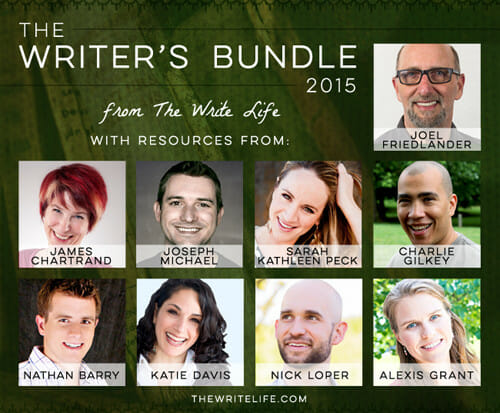
    Here’s what’s in The Writer’s Bundle:

    • Kindle Launch Plan: $1,400 in 30 Days & an Amazon Bestseller, from Nick Loper (Course; retails for $99)
    • Content Strategy for Thought Leaders, from Sarah Peck (Course; retails for $300)
    • Book Proposal & Manuscript Template, from Joel Friedlander (Tools and ebook; retails for $27)
    • Learn Scrivener Fast, from Joseph Michael (Course; retails for $197)
    • Video Idiot Boot Camp, from Katie Davis (Course; retails for $297)
    • The Momentum Kickstarter Kit, from Charlie Gilkey (Tools and ebooks; retails for $47)
    • Authority, from Nathan Barry (Ebook; retails for $39)
    • Write for the Web, from James Chartrand (Ebook; retails for $23)
    • Turn Your Side Hustle Into a Full-Time Business, from Alexis Grant (Ebook; retails for $47)

    Interested? Grab your bundle before it’s too late!