Tag: writing life

  • The 17 Best Writer Websites to Inspire Your Portfolio

    The 17 Best Writer Websites to Inspire Your Portfolio

    Your online portfolio is the portal through which both clients and readers learn about you and your work — and one of the best ways to land writing jobs.

    That means that, for many of us, creating a writer website is hugely intimidating. I put off creating a writer website for months simply because I didn’t know how I wanted to put it together.

    Luckily, you have options. There are as many types of writer websites as there are writers, and you don’t have to make your writer website fit any kind of preconceived template or mold.

    Instead, use your online portfolio to reflect what makes you unique as a writer, and what you have to share with clients, readers and fans.

    [sps_reusable_block post_id=43047]

    Need inspiration? Check out these online portfolio examples

    Don’t make the mistake of thinking that creating your online portfolio has to be a massive project. We’ve showcased lots of portfolio websites that make it easy for you.

    But before you build your own, we’ve got some inspiration to get you started! We found some solid writer websites to share, each with a unique focus and design.

    Here are 17 online portfolio examples.

    1. Elna Cain

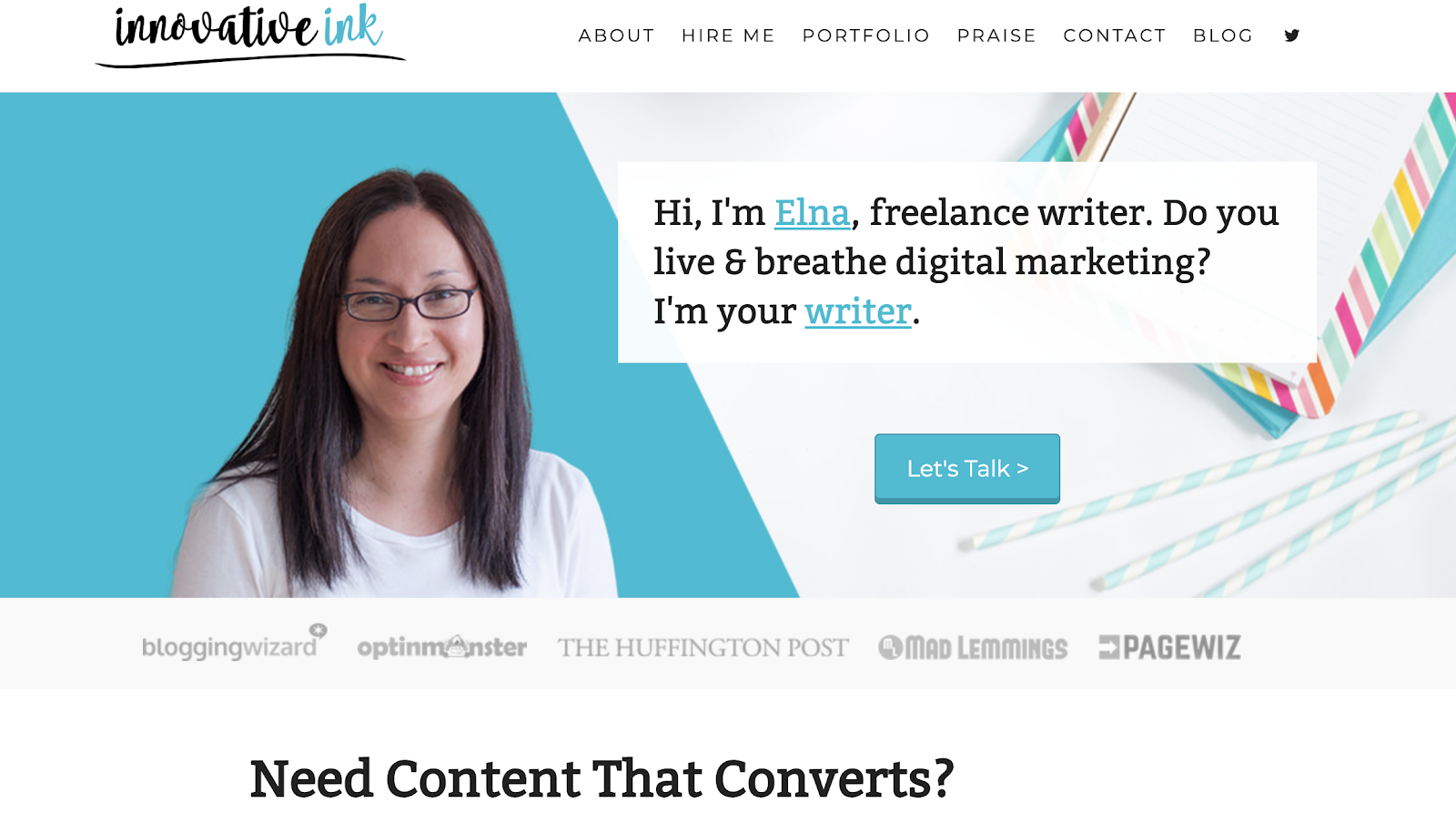
    Elna Cain’s writer website is bold, partly because she blatantly tells you she’s the freelance writer your business or project needs. To further convince you, a row of prominent publications are listed right above her introduction — that’s where she confidently states the problem clients have and how her skills can it. Then, the page ends with glowing client remarks. 

    Elna’s online portfolio shares a variety of ways to get in touch with her for business opportunities and how to keep up with her work online. To assert her expertise in the field, Elna also links her popular blog that’s filled with tips on how to make money with writing. 

    2. Manjula Martin

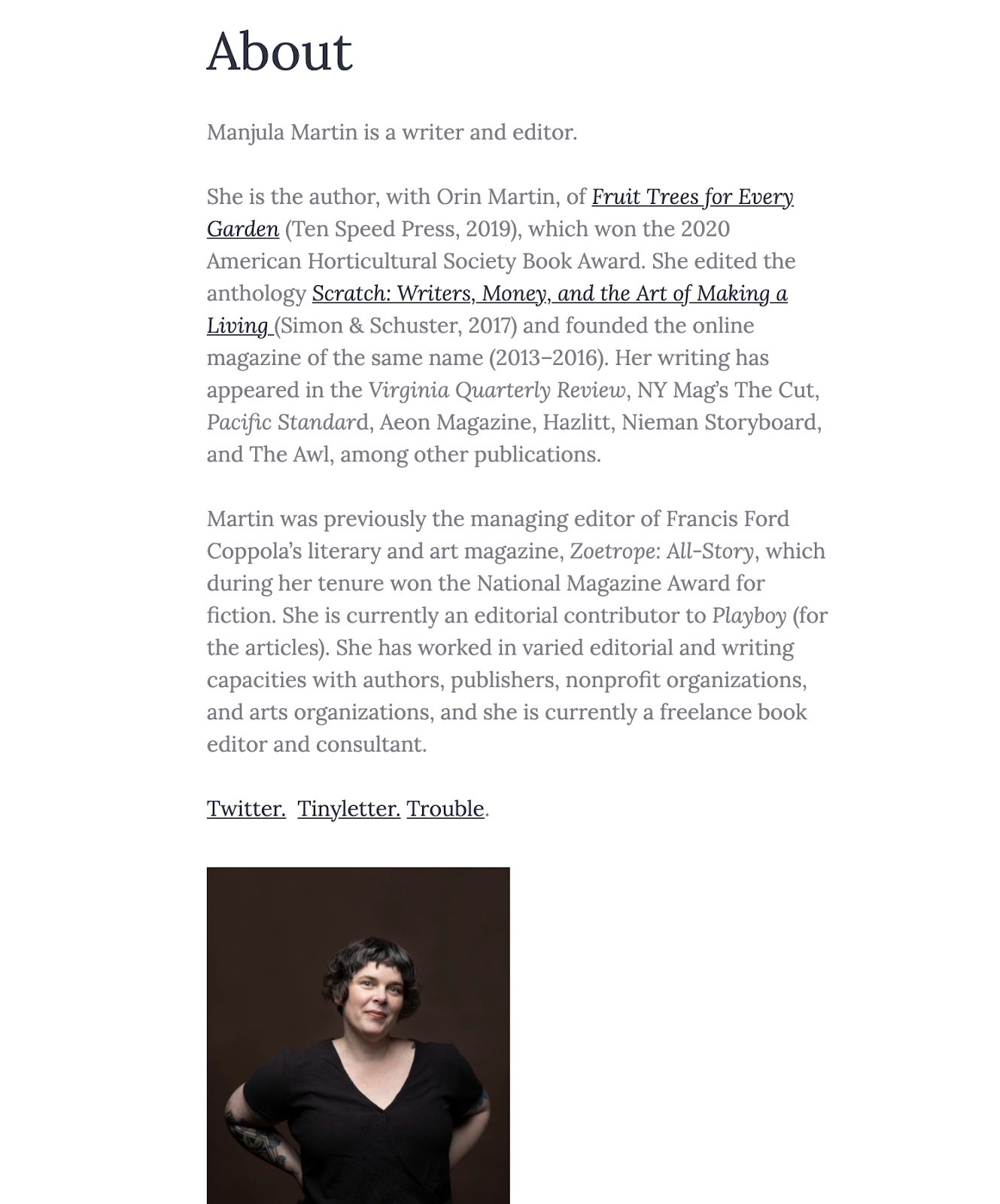
    Manjula Martin’s site is a great example of a basic, straightforward online portfolio: a brief introduction with her resume highlights front-and-center, and lots of links to connect people who want to learn more. She built it on WordPress.

    Manjula’s website works because you learn everything you need to know about her credentials and writing style at a single glance. It’s easy to follow the links and read her clips, and she also gives you many ways to contact her with writing or consulting opportunities.

    3. Ann Friedman

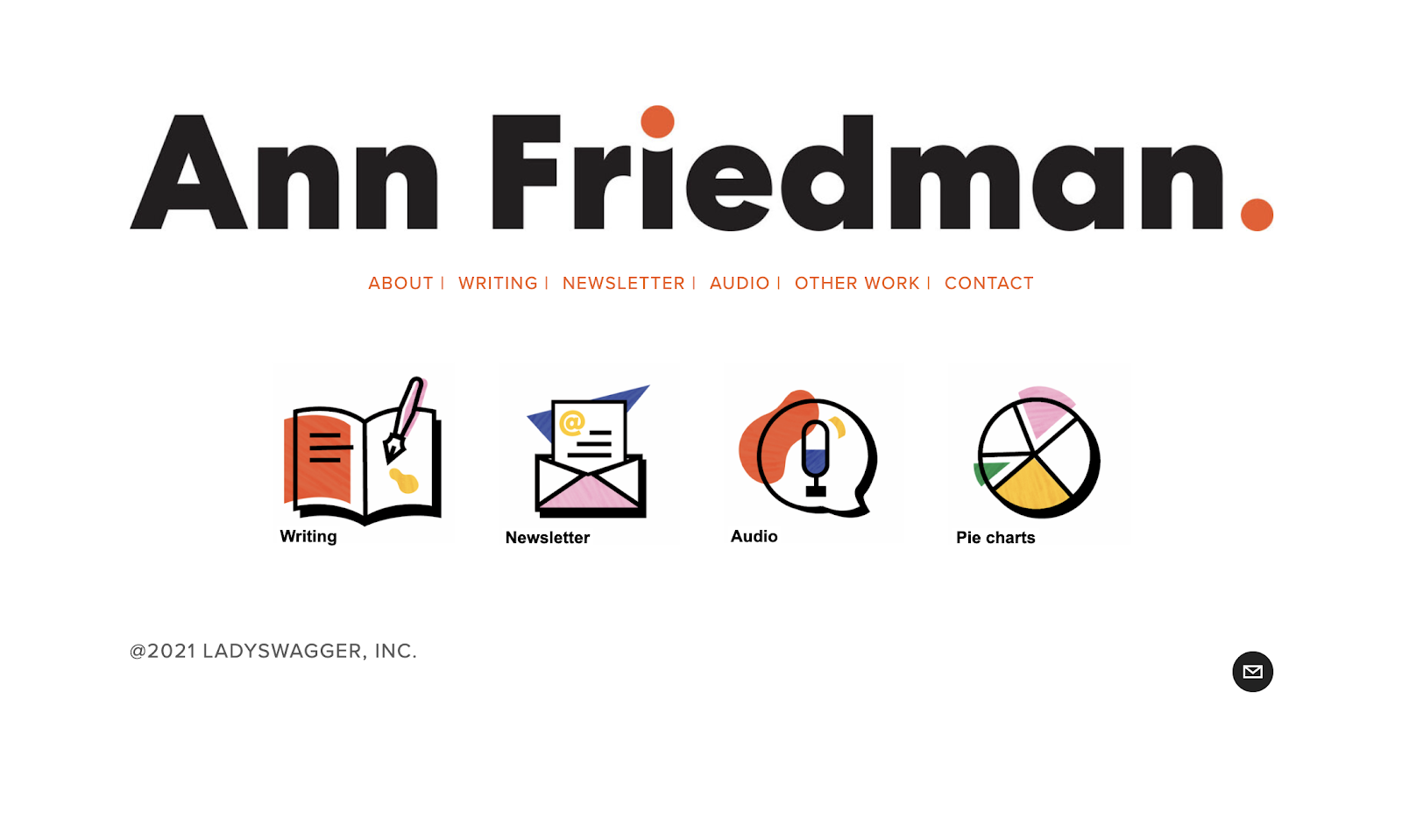
    The first thing you notice on Ann Friedman’s website is how it brightly displays her logo, followed by a row of links to her completed work, newsletter and contact information. Talk about a simple and beautiful landing page! 

    The rest of this writer website contains plenty of unique touches: a general FAQ plus one for her newsletter; a page of various creators, content and organizations she recommends; a thorough contact page; and creatively-titled side work that highlights even more skills beyond her stellar portfolio of work for tons of household brands. There’s no question about who Anne is, the service she provides and how to reach her — this is the goal for all writer websites. 

    4. Nozlee Samadzadeh

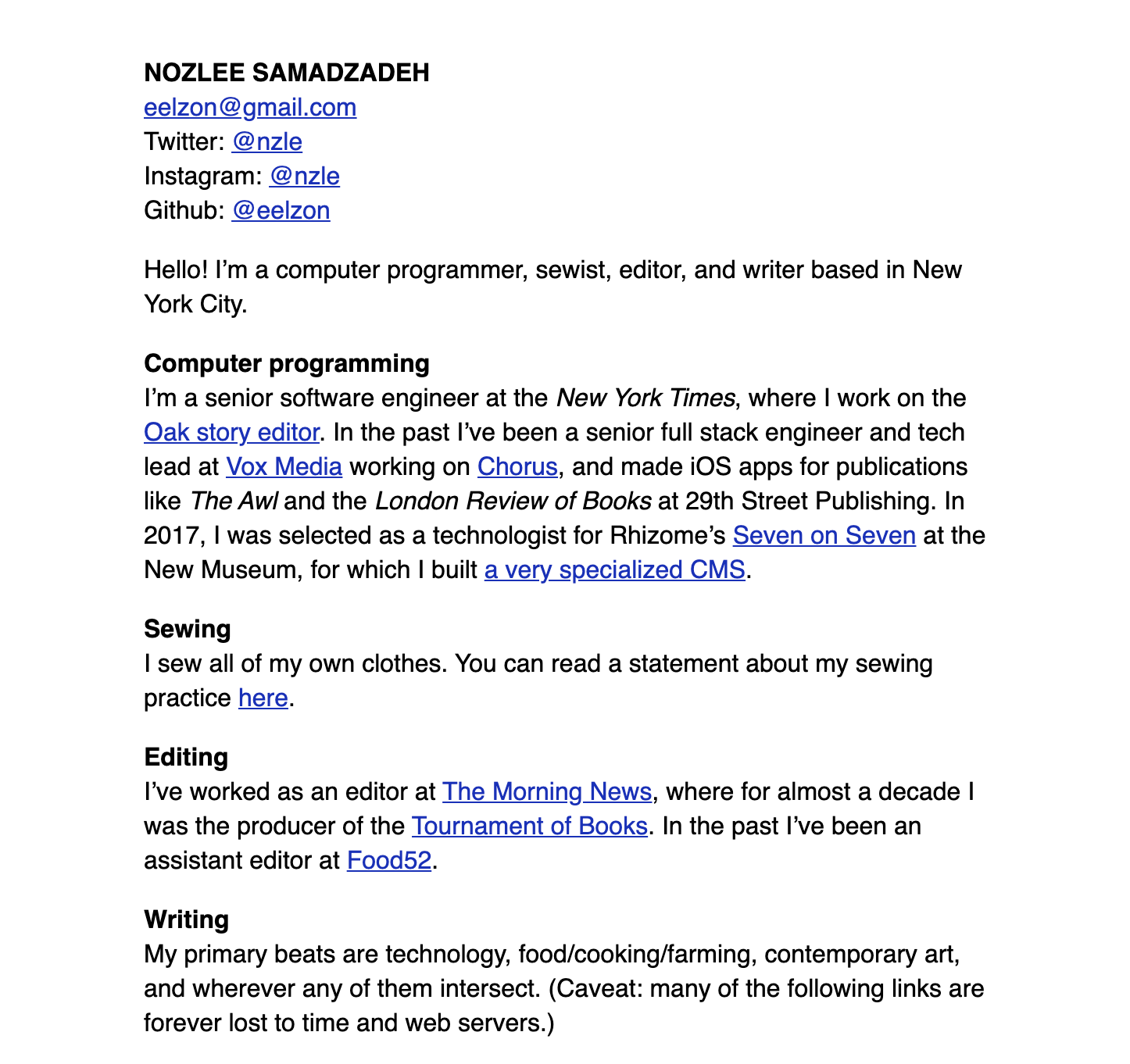
    It’s possible to create an extremely compelling writer website without a single photo, logo, or image. Nozlee Samadzadeh’s site lists her contact information, concise explanations for her professional experience, and links to her publications, all on a single page.

    Nozlee’s site also includes a short statement of her “primary beats,” which is key info for anyone looking to hire her for a writing job.

    5. Seanan McGuire

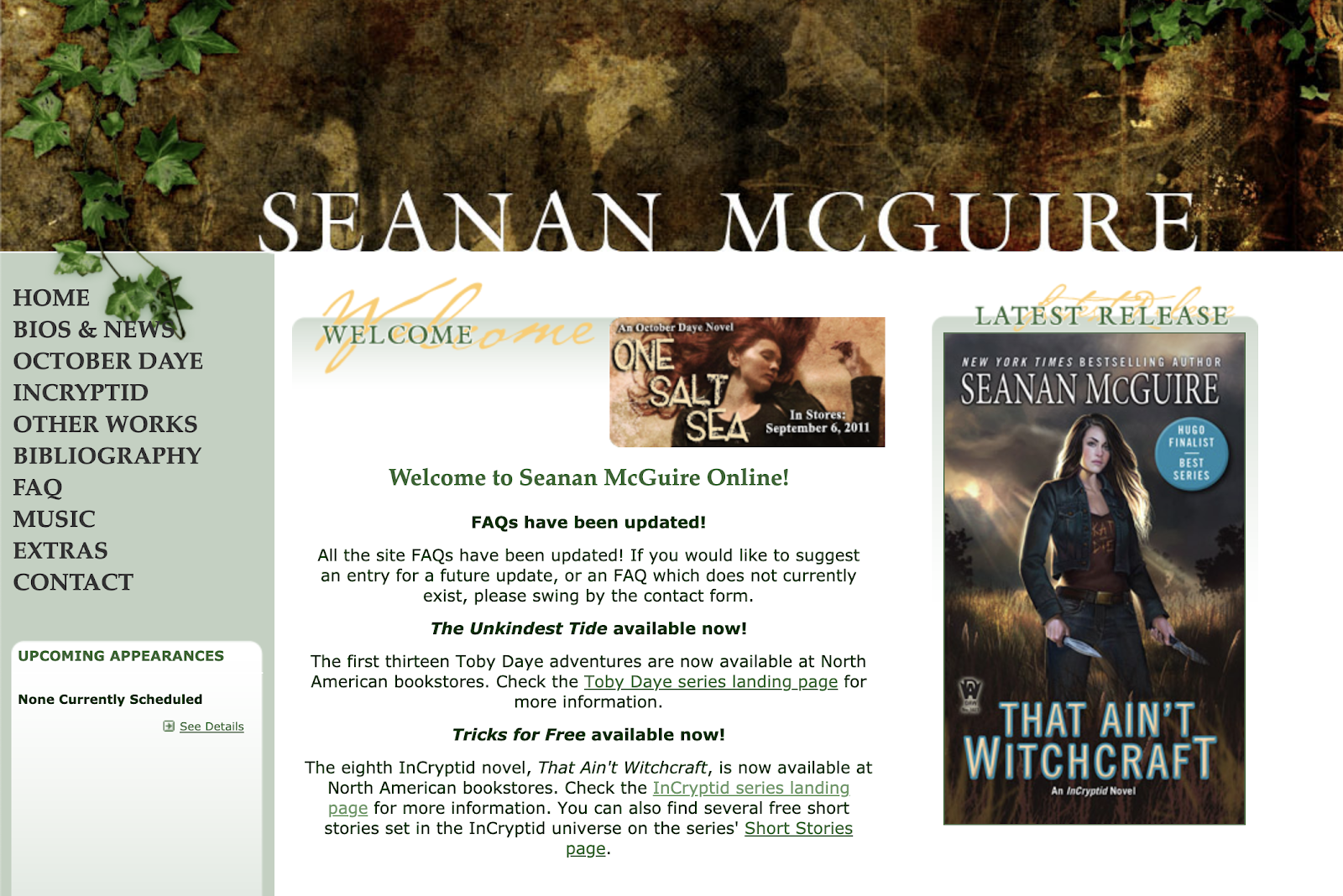
    Seanan McGuire’s writer website instantly immerses you into her urban fantasy world. Her latest release is prominently featured, and the header image and colors help establish her genre to new visitors. The left-hand navigational column provides easy access to important information.

    If you write fiction, especially genre fiction, let your writer website reflect your fictional worlds. Open the door to your fiction by giving readers the chance to see what might be hidden within the pages.

    6. Francesca Nicasio

    Copywriter Francesca Nicasio’s writer website aptly showcases her expertise in writing B2B content around retail, eCommerce, technology, and more. The entire website is structured around one goal: informing readers about her capabilities the very moment they get to her site. 

    What’s the goal of your writer website? Are your skills and services clearly explained?  When users visit your site, do they know what to do if they want to work with you? With her email address displayed largely on the front page, Francesca makes it easy for clients to get in touch with her. Your writer website should do the same.

    [sps_reusable_block post_id=43047]

    7. Kayla Hollatz

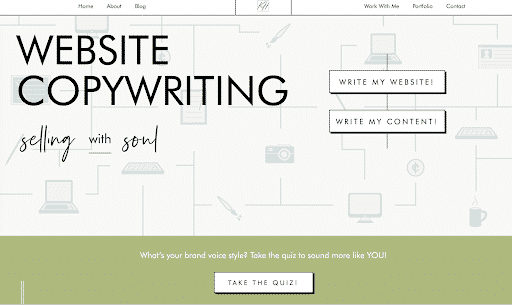
    “Inviting” is the best way to describe Kayla Hollatz’s writer website. The big, bold words that immediately greet you are enticing enough to make you want to keep exploring her trendy online portfolio. And without needing to scroll too far, Kayla’s concise and effective introduction appears, placed evenly below a prompt to take her brand style quiz. 

    Wherever you go, Kayla’s writer website accomplishes one major thing: She pulls you in by subtly emphasizing her savviness. From spelling out the details of how you’ll work together to sharing impressive client success rates, it’s evident  this writer knows her stuff — and she wants you to learn it, too, hence her quiz and email course. 

    8. Brittany Berger

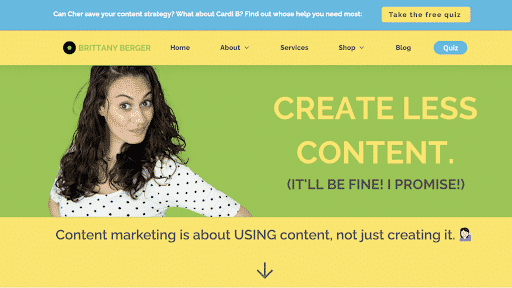
    How often are you intrigued by an unpopular opinion? Probably almost always, because, well, you just have to find out how you could possibly be on the wrong side of the truth. That’s what’s awesome about Brittany Berger’s approach to her writer website — she offers a solution most companies think is the problem. 

    Her conversational tone guides you into understanding her logic, and she offers a number of valuable resources to help you learn about being mindful about content creation, and how to be more productive as you do. 

    She created her website on WordPress.

    9. Sarah Turner

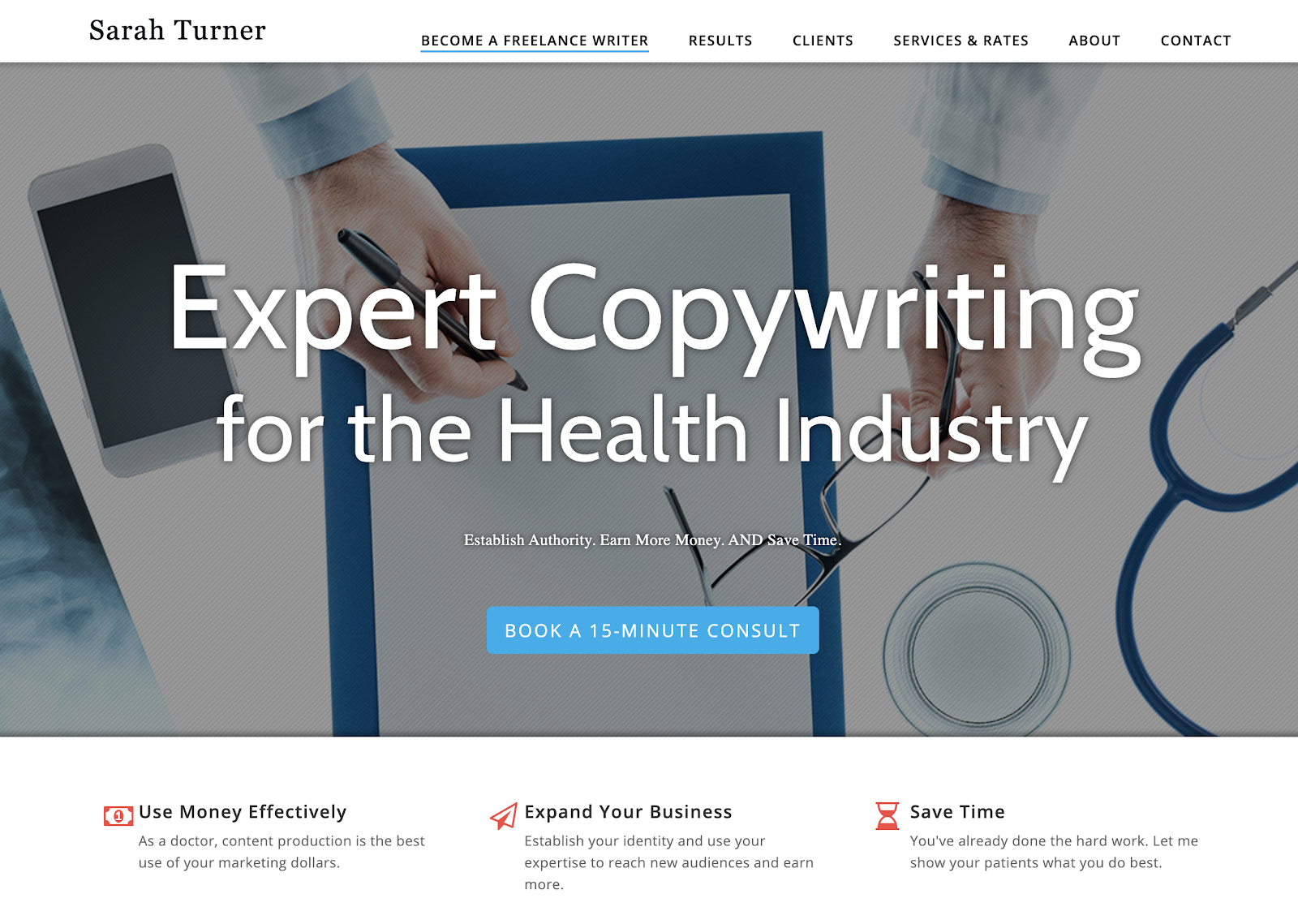
    Sarah Turner’s writer website is one of those slick, beautifully designed sites that intimidate the rest of us. It’s the type of site that looks like it requires the assistance of a web designer, which means it’s aspirational for a lot of us, especially those of us who are just getting started as freelancers. In actuality, Sarah’s website was created with the help of WordPress and Themely. 

    However, design isn’t the only aspect that makes Sarah’s writer website great. Her opening sentence clearly highlights her writing niche, how she can use her skills to improve your business in the health industry — the key goal of any resume or website — and includes a direct call to action. 

    You can include a similar paragraph and call to action on your own writer website; no design firm required.

    10. Kat Boogaard

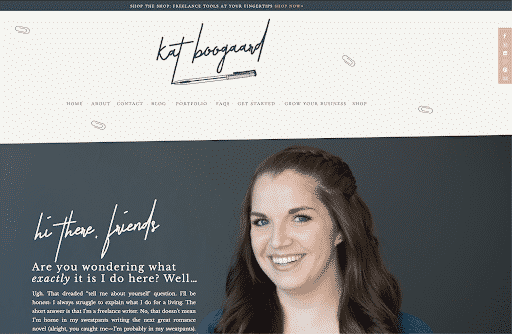
    Freelance writer Kat Boogaard leads with an authentic and friendly voice on her writer website — one that makes you feel like you’ll hit it off with her right away. Amid a fresh and sleek design filled with calming neutral colors, she shares brief paragraphs about who she is, what she writes for clients and how she can help freelance writers grow their businesses.

    Kat’s conveniently-placed menu at the top and bottom of her website is easy to navigate, but one thing I love about her website is how you can find your way around her site without it. As you scroll through the homepage, you’ll find that she takes you from one valuable resource to the next, all without making you feel bombarded. 

    11. Helen Gebre

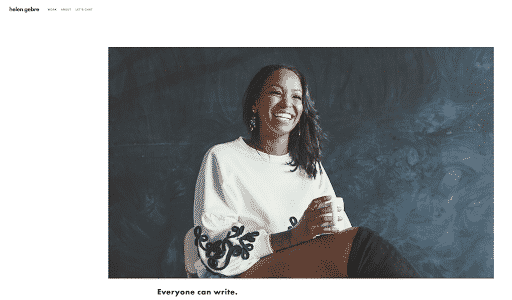
    This writer website gets one important thing down pat: You can feel how much Helen Gebre loves the art of writing. She also does this very simply, through an introduction and biography that gives you a glimpse into her personal life, her career and why she does this work. 

    Helen’s website design is simple, likely because she has a diverse portfolio featuring big and bold copywriting decks that span across print and digital writing, social media, video scripts and more. Besides a contact page, she also cleverly set up her phone number as the footer on each page — that way, clients viewing her page know how to reach her immediately. 

    12. Chidinma Nnamani

    Clients visiting B2B writer Chidinma Nnamani’s page learn right away what her expertise is. Throughout her writer website that she designed with WordPress and Elementor, she clearly articulates her skill and experience with B2B writing for the tech, food and digital marketing industries. 

    Besides a clean website design that reflects Chidinma’s design aptitude, her inclusion of a robust services page and a page that details her four-step process for working relationships provide a peek into her professionalism and organizational skills. One more thing to note from this writer website? The frequent “Ready to hire me?” prompts displayed throughout the site! 

    13. Sarah Asp Olson

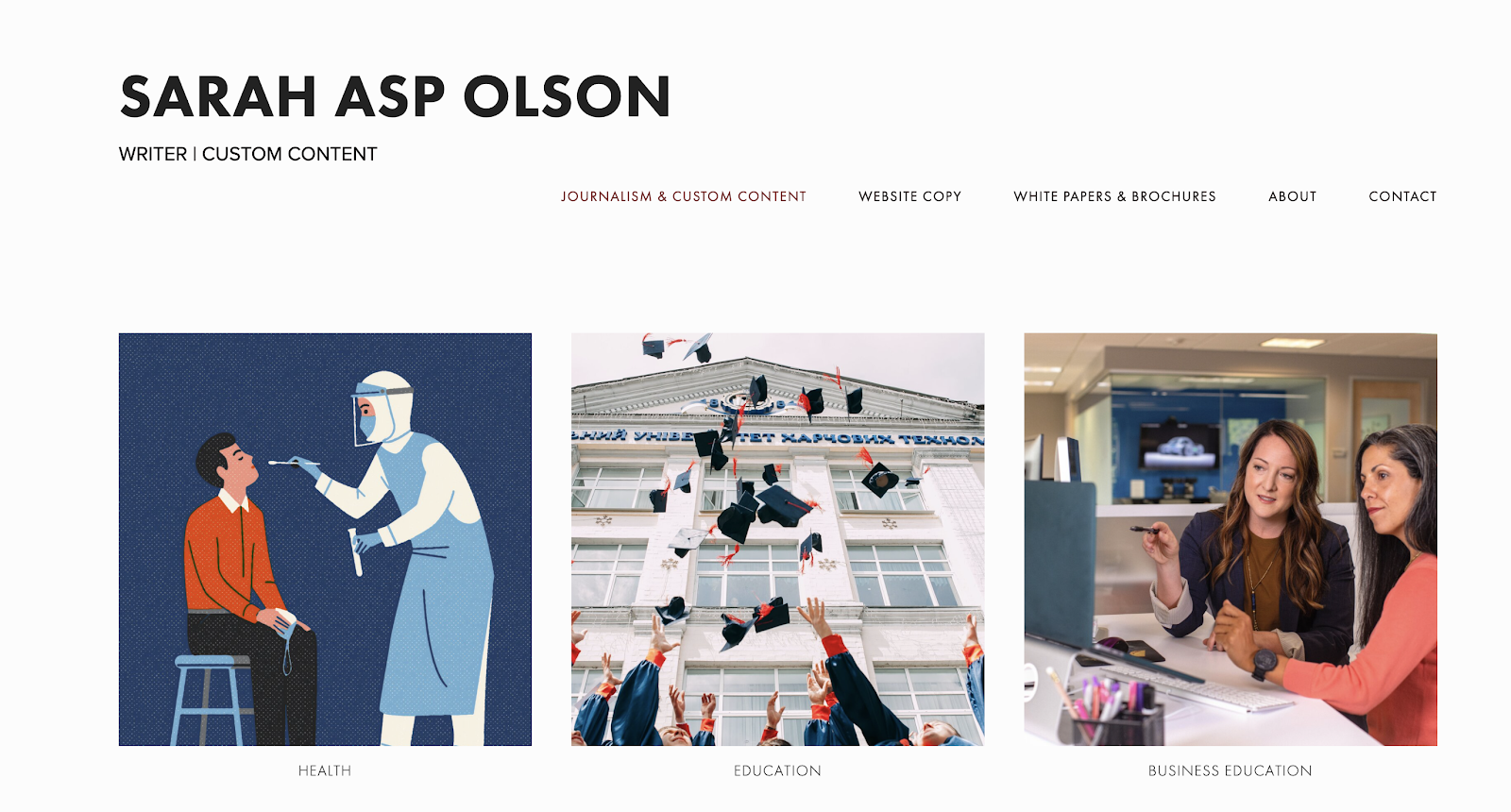
    Before you learn about this writer, you first take a tour of her impressive writing clips, which progressively leads you to where you can learn more about and reach out to her. 

    One of the best parts of designing your writer website is all the creative ways you can display your work. Each website on our list brings their own flair to their portfolio, and Sarah Asp Olson is no exception in the way her site only features the content she’s created. Like she does, you can use bright, colorful images that capture the eye to separate the industries you write for. Then, display your samples in bulleted lists, or in rows of hyperlinked thumbnails.

    Remember there are no rules to how you organize your work — just ensure it’s clear, and easy to navigate.

    14. Samar Owais

    What should people learn about you as soon as they visit your writer website? For writer Samar Owais, potential clients find out immediately she can increase conversions and boost sales — and her speedy acknowledgement of these skills and her niche can make a difference in how quickly visitors leave her site. 

    Throughout her writer website, Samar features client testimonials and a valuable email marketing quiz. Additionally, she makes her expertise clear through brief, compelling descriptions that outline how she solves conversion issues as an email conversion strategist and SaaS copywriter. And if anyone wonders why they should work with her, she makes convincing arguments for that, too. 

    15. Muriel Vega

    Don’t you just want to click those icons? That’s the power of color and fun design animation! Atlanta-based writer and editor Muriel Vega’s writer website has a simple design layout, but that doesn’t stop the sense of her personality from seeping through as you learn about her through projects and writing samples. 

    This site is a great reminder that you don’t have to overwhelm your writer website to make an impact — consider who you want to attract, and incorporate engaging design elements that reflect your creativity.

    16. Tyler Koenig

    Copywriting expert Tyler Koenig has a writer website that feels extremely confident and laid-back. Within a well-designed website that tastefully centers the color orange (maybe for basketball?), Tyler provides heaps of value through his email list, webinars, courses and free tips through his blog. 

    “Become your own most trusted copywriter,” he writes on the landing page of his self-paced copywriting courses, which successfully expresses his earnest desire to share his passion to help others grow. Besides that, providing free and paid resources truly highlights your expertise to prospects.

    17. Nicole Dieker (yes, that’s me!)

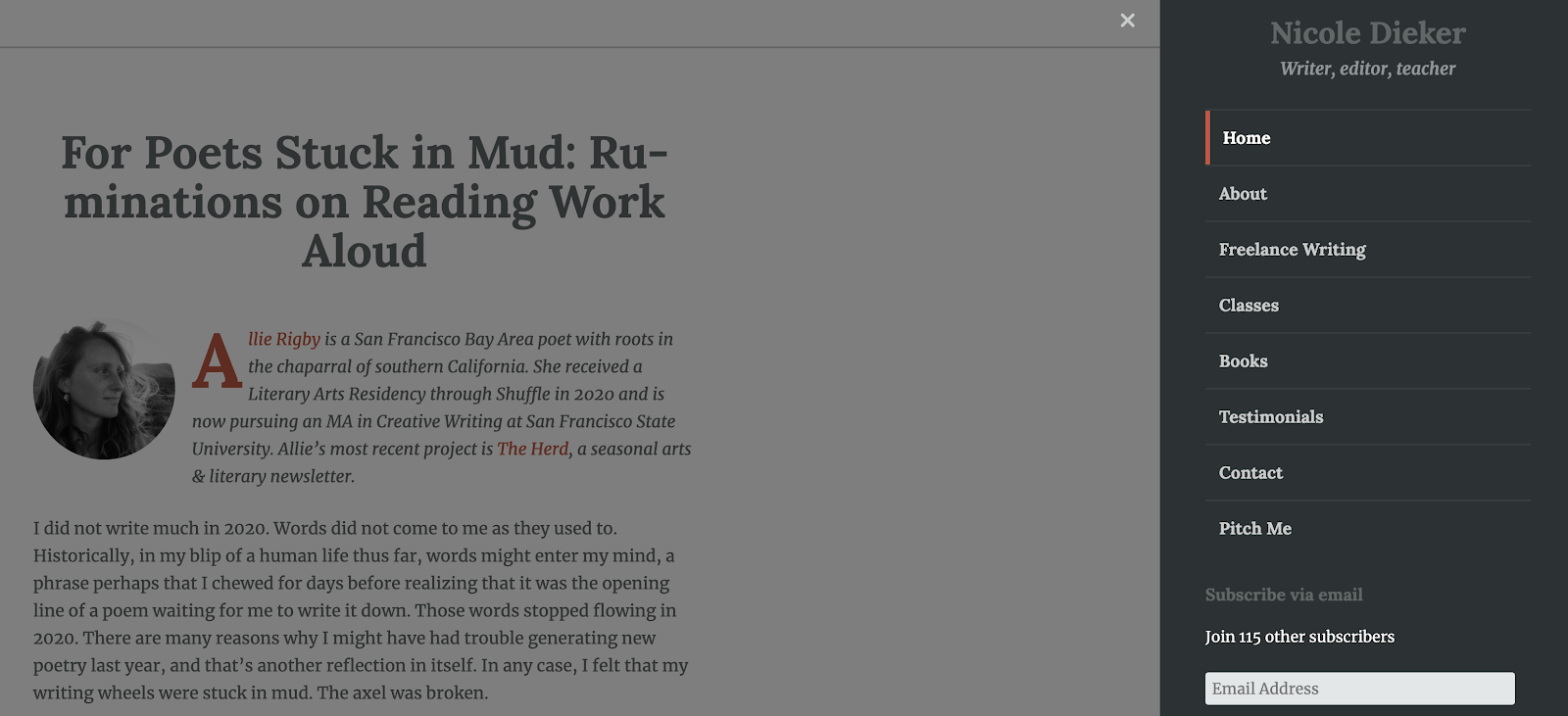
    My writer website serves two purposes: It’s a place where people can learn more about my freelance and teaching work, and it’s also a blog that focuses on the art and finances of a creative career. I include “where I got published this week” roundups every Friday and finance roundups on the first of every month, along with daily insights on work-life balance, how to earn money for your creative work, the process of writing a novel and more. I also pay writers for guest posts, so pitch me!

    I set up my site through WordPress using a pre-designed template.

    Do you have a writer website you’re proud of, or are you working on one now? Share your experience with us in the comments!

    This is an updated version of a story that was previously published. We update our posts as often as possible to ensure they’re useful for our readers.

    Photo via Zofot/ Shutterstock 

    [sps_reusable_block post_id=43047]

  • Write Your First Novel: 8 Strategies for Creating Great Fiction

    Write Your First Novel: 8 Strategies for Creating Great Fiction

    As writers, we know that the process of writing is composed of work and worry. The work is a grind of word counts and applied methodology, but the worry — a mix of fear, doubt, stress and resistance to the process — can be more difficult to navigate.

    During the four long years I spent writing my first novel, A Propper Man, I learned the importance of craft and routine in managing both the work and the worry.

    If you’re wondering how to start writing a book, these strategies could help you meet your goals with less stress and fewer struggles. The thoughts on craft help form a plan of attack for completing your daily work, while those focused on the routine and ruminations about the writing life help you put that plan into practice and find the will to finish.

    Craft tips for writing your first novel

    Although the idea of craft can seem like a witch’s brew when applied to fiction, it’s no magical thing.

    Sure, there are elements of fiction that are useful weapons for your arsenal, as well as tried and true storytelling methods that are helpful to know about. Mostly, though, the craft of fiction is composed of relentless practice and process: the stumbling, mealy-mouthed verbosity of beginning and ending and revising that you must apply repeatedly, ad-infinitum.

    As a writing professor once explained on the first day of class, “I’m going to dump out my toolbox here on the floor. Take everything you need — but know you might not need everything.” Below are a few to consider.

    1. Have a roadmap

    The word “outline” is a polarizing one for fiction writers. We all know about this structure, but depending on our experience and mindset, we either love or loathe it.

    Whatever opinion you have about outlines, it does help to have some sort of map or outline for where you’re going, even if you only know the approximate route and have a few key landmarks scribbled on a bar napkin. As E.L. Doctorow famously said, “Writing a novel is like driving at night in the fog. You can see only as far as your headlights, but you can make the whole trip that way.”

    I experimented with four different outline systems before abandoning them altogether in favor of building my own. I used notecards that each held a simple statement about the action that occurred in each scene, then taped each card in chronological order to a whiteboard in front of my desk. If I needed to replace a scene, add one, or move a few around, it took seconds. And when I lost my way, I only had to look up to my roadmap. From there, I moved to a more detailed scene-level outline that helped me to structure the cause and effect that advanced each scene and the story as a whole.

    It took time to find an approach that worked. I prefer analog, but you might feel more comfortable with a digital tool like Scrivener.

    Experiment to find what works for you and then modify it to align with your approach to storybuilding. But have a map — even at night, you may need to pull over and refer to it now and again.

    2. Consider the importance of conflict and stakes

    Among Kurt Vonnegut’s eight tips on how to write a great story is this gem: “Every character should want something, even if it is only a glass of water.”

    What makes a story truly compelling is how that character goes about getting it. What stands in his way, and how will he overcome those impediments? One of your tasks as a storyteller is to manipulate your character in such a way that the journey feels worthwhile for the reader — even if all that character wants is a glass of water. Fundamental to this reader buy-in are the elements of conflict and stakes.

    In literature, conflict is an inherent incompatibility between the objectives of two or more characters or forces. Conflict creates tension and interest in a story by adding doubt as to the outcome.

    Be clear about your conflict: how the setting, other characters, or even local and global events slam into your character’s desire to get what he wants. When conflict is clear, you help the reader better understand what drives your character’s motivation.

    Stakes show the reader what happens if your character doesn’t get what he wants after the altercation with conflict. Have some fun raising the stakes to force your character to take action that might be abnormally, even fantastically, out of character.

    Consider this scenario: A man sits on the highway twenty-five cars back from a slow-moving roadblock on the interstate, thirty minutes from his home. He could be stuck there an hour, maybe longer. With low stakes, he’s annoyed because he might miss the first quarter of Monday Night Football. So he flips on the radio, checks his smartphone and ekes along in line.

    Now, what happens if the man receives a message that his young son is mortally wounded, and he’s the only one who can reach him in time to save his life? Suddenly, he’s offroading into the median, blowing past the roadblock and racing toward his house at 100 mph with police cruisers in hot pursuit.

    High stakes change motivation and put your characters in interesting situations you didn’t initially imagine, which results in compelling, page-turning fiction.

    3. Maintain measured scene beats: Your novel’s heartbeats

    Scene beats, or micro-tension, make up the dramatic action that propels a story forward. In his Wonderbook, Jeff Vandermeer calls them “micro-cycles of ebb and flow, progress and setback playing out within a scene.”

    I wrote four versions of my novel before I finally pegged its current course. The challenge? I wrote a collection of disparate and at times tangentially-related scenes. In a vacuum, these scenes were fine, but when woven into a tapestry of scenes and chapters, many of them fell flat. The setting, the dialogue and the characters didn’t exhibit enough micro-tension to move the story forward.

    While most readers won’t identify that your scene is missing a beat, they’ll likely feel it in the way their minds drift as they consider turning another page or picking up their smartphones to check the latest Buzzfeed list.

    Be sure to analyze the beats — the cause and effect — to maintain a measured progression of the scene’s shifts in emotional tone. Make sure they build upon one another. The character enters the room thinking one thing is going to happen, only to find something else. As he realizes this, it’s a beat. Or, the character is investigating a mystery, and discovers something shocking that changes the purpose of her quest. How she feels about that discovery, in that moment, is another beat.

    If you’re struggling with a scene and you can’t quite figure out what’s wrong, lay out the beats on the page. After each beat is a decision: open the door or pretend you’re not home; get in the car or call a cab; take the blue pill or grab the red pill. What does your character choose, and how does that choice affect her? Once on the beats are laid out, you’ll be able to see where the scene is lagging — likely, where it lacks stark emotional shifts.

    4. Approach the revision process with passes, not drafts

    Drafts are hulking, beastly things. They sit in the corner and sulk as you plod through, page by page, trying to do everything at once to reach the Second Draft.

    Instead of looking at your revision process in terms of drafts or versions, think of passes. Passes are lighter, more jovial folks. They allow you the freedom to consider elements of revision and to move more quickly through the process, like a painter adding layers of color to a painting that is not fully realized.

    One pass might be for research, another few for character development and continuity; perhaps you add one pass each for setting, tone, and consistency of speech. Editing and re-editing the same copy repeatedly can seem Sisyphean and eventually leads to unproductive tinkering.

    Identifying the passes necessary to finish your project, then remaining disciplined as you move through each pass, makes the revision process seem less arduous.

    Routine: It’s essential to writing your first novel

    Once you have the right tools and you know what you’re going to build, how do you go about doing it? That’s where a sound personal approach to the psychology and routine of fiction becomes crucial.

    You first build a novel in your head, so it’s important to ensure it’s a safe and productive place to work.

    5. Recognize and overcome resistance

    In his fabulous book The War of Art, Steven Pressfield focuses on resistance as a primary culprit in avoiding creation. The forms of resistance are myriad and highly personal.

    For me, the usual suspects were errands, cleaning and looking for “legitimate” jobs online. I ate up hours, even entire days, resisting the process of putting words on the page, until I was honest with myself about how I resisted writing. I kept a list and acknowledged my modes of resistance each time they popped up.

    What modes of resistance do you fall victim to on those days when writing doesn’t feel fun? Write them down on big piece of paper and hang it over your desk. In time and with practice, when you recognize resistance, you’ll stop what you’re doing and return to work. Your ability to overcome resistance is fundamental to establishing a routine.

    Maintaining that routine is often the only thing that will help you through the pits of despair in the middle of your novel, when the fun has drained from your writing and you’re left with the ditch-digging required to finish the project.

    6. Write to a word count

    Time and writing are strange bedfellows. Who is to say how long it should take to finish a story? But we all face a simple truth: You can’t write a novel if you don’t put words down on the page.

    Writing 100,000 words takes time, discipline and some semblance of an organized routine. Each writer approaches this process in their own way, but my routine involves a commitment to a daily word count rather than a time block. Writing to a word count rids me of the pressure of feeling constantly short on time.

    Some days, a thousand words takes me forty-five minutes. On others, I might stretch three writing sessions out across several hours: at the coffee shop, at home while making dinner and waiting for the rice to cook, and sitting up in bed for a few minutes after I finish reading. Looking back, I won’t remember the amount of time each session required, only that I hit my word mark.

    Set your own word count and make it achievable. Is five hundred words all you can manage? Great! Shoot for that mark and hit it. Then stop. Don’t edit, don’t ponder, just go and when your hand or fingers need a break, tally up the words. My guess is you’ll find you have written more than your daily target.

    If you’re inspired to write more words, do so. But give yourself the opportunity to stop. And when you stop, think for a moment about what you’ve accomplished, and how it felt. Learn to finish. Now do it every day, forever… until you need a cheat day.

    While we’re on the subject, check out our guide to the ideal word counts for novels and other books.

    7. Have a cheat day

    Dieting is a dirty word, but I love the concept of a cheat day: the one day each week when you eat anything you want and refuse to feel guilty about it.

    Sure, we all want to be perfect adherents to the dogma that writing every day is the only way to improve, but sometimes life just gets in the way. And that’s okay. You may have kids, or kids and a crazy job — or all the above, plus a house with a yard. If you can make time for writing, great, but if you can’t, allow yourself one day where you don’t judge your perceived lack of productivity.

    Heisenberg’s Uncertainty Principle posits that the mere act of observing something ultimately changes that which is being observed. So stop focusing on the days you don’t write. Look away. In time, you may find removing guilt from the process, focusing your attention elsewhere, makes it easier to commit to a routine. Funny how that happens.

    8. Learn to separate fact from fiction when dealing with fear and doubt

    Fear and doubt are perhaps the most damaging forms of resistance; they’ve likely prevented more art from reaching humanity than any other form of artistic oppression.

    When you’re experiencing fear and doubt, take a moment to separate fact from fiction. Break apart those things you know as fact; “writing is hard,” “finishing a novel requires that I write a lot of words,” “publishing is complicated,” from the fiction: “no one will ever read about what I write,” “writing is a waste of time and effort,” and “I have no talent.”

    This is a key practice of mindfulness and it merely requires that we actively recognize and compartmentalize thoughts. We all tell ourselves various fictions about creating art. The key difference between those who persevere and those who quit is the ability to recognize the fallacy of subjective thought, and power on through despite it. To paraphrase Seth Godin: the question is not how to get rid of fear, it’s how to dance with fear.

    Putting this all into practice

    The truth of the matter is that there isn’t any one recipe for creating great fiction. If it works, it works. The old saying about methods and madness is true: no matter how crazy or esoteric an artist’s routine, there is almost always a method present. Building your own is crucial.

    If you’re like me, you find little joy in finishing a novel; you want to finish a great novel. You also want the next novel to be even better. Crucial to this process is understanding yourself: your your innate abilities, and those that require more work and practice.

    Listen to and record what you learn from your writing projects. Take from your writing the lessons that teach you as much about yourself as they do about your craft. In time, and with hard work and faith, this discipline will help you finish the personal masterwork you’ve always dreamed of creating. You will build the method behind the perceived madness of your creative process, and the work emanating from it.

    Have you written a novel or other fiction project? Do any of these lessons resonate with you?

    This is an updated version of a story that was previously published. We update our posts as often as possible to ensure they’re useful for our readers.

    Photo via franz12 / Shutterstock 

  • Do You Need an MFA? 3 Important Elements You Can Replicate On Your Own

    Do You Need an MFA? 3 Important Elements You Can Replicate On Your Own

    [twl_reusable_block post_id=41455]

    If you’re like me, you spent most of your childhood in school. That’s where you learned how to learn, and you’ve probably come to associate improvement with school. So, when it comes to improving your writing, it’s natural that you would consider a Master of Arts (MA) or a Master of Fine Arts (MFA) degree. After all, what better way to give yourself time to write and a structured place to do it?

    But MFAs are time consuming and expensive, and it’s certainly possible to significantly improve as a writer without them. How do you know if an MFA is right for you? And can you reproduce the benefits of an MFA without enrolling in a program?

    My take on the MFA debate

    Full disclosure: I have both a BA and an MA in writing. It’s hard for me to regret those years; they were a lot of fun and I gained an enormous amount of experience. I also met my husband, so I can’t say my MA was useless. However, I think I could have taken another path, perhaps one that didn’t require so much of my time, money and inner calm.

    Based on my experience, I don’t think having an MA or MFA is necessary to become a great writer. This should be obvious to anyone who knows anything about literary history: Many famous and influential writers did not begin in academia.

    Instead, to become a better writer without a set path, replicate important aspects of the MFA. Basically, the money you spend for your MFA (and it’s a lot of money) insists upon discipline and buys a few elements crucial to the writing process. Recreate these elements on your own to strengthen your writing skills without enrolling in an MFA.

    1. Read across genres

    Great writers need to read; there’s no way around this one. Language has to start in your brain to end up on the page, and the best way to get it there is to read. (Or listen to audiobooks on tape, whatever works for you).

    Expose yourself to past developments in your genre, as well as what’s happening now. This is where you acquire the tools you’ll use, as well as improve on, later.

    While reading may seem like a simple task, it’s not. With hundreds of millions of books in the world, it can be impossible to know where to start. An MFA program will not only give you an organized, vetted list of these books, but it will also force you to read them and analyze them thoughtfully. The program will expose you to new styles and authors you may never have come across otherwise, expanding your toolset and allowing you to contextualize your own work.

    You can discover new works and authors without an MFA, of course, and you should continue to do it after one. Read everything — not only in your genre, but in completely new ones. Step outside your comfort zone. Read extensively and often. Listen to books on your way to work, and always have something new to read.

    [bctt tweet=”Read everything — not only in your genre, but in completely new ones, says @inkhat”]

    Don’t know where to start? Published authors often give examples of their favorite works in interviews. Look up one or two of your favorite writers, and try a few of their recommendations.

    2. Meet word count requirements

    Writing is craft, and craft requires time and effort. Carving out this time can be difficult. Unless you’re the incarnation of discipline, you’re going to have trouble hitting your word count goal every day.

    An MFA program will insist on that word count. It requires you to produce, and to produce at a fast pace, something that is necessary to learn your craft.

    This pace also helps you develop the ability to stop thinking of every sentence as precious, let go of your inner editor and move on — which can be harder than it seems. The less you’ve written, the more valuable each word becomes, and the more difficult it is to edit them. As you keep writing, you’ll realize that your ideas, no matter how poetic, aren’t perfect. Editing and writing become easier the more you do the work of hitting that word count goal.

    Of course, you can achieve daily writing goals without an MFA, but the process involves a great deal of discipline and focus. You have to push yourself to meet daily, weekly or monthly word counts. It’s hard to do this alone, which is where the final element comes into play.

    3. Find a group of supportive, committed people

    You need to foster a group of peers with whom you can discuss and trade writing. These should be people whose writing and opinions you respect, and who aren’t afraid to offer constructive criticism. If you find yourself in a group that only praises your writing, leave. It’s not going to help you at all.

    An MFA will give you this group gift-wrapped and ready to go. You start with a critique group on day one, writers vetted and approved by the same people who selected you. It’s likely that these relationships, both as friends and colleagues, will continue long after you’ve left the program.

    Again, a writing critique group is something you can create on your own, but it can be challenging. Writing is a solitary art, and many writers tend to be independent by nature. Finding a group means fostering professional relationships, and that can take time and effort.

    Look online for local groups, or attend local conventions and conferences in your genre. Go to signings and readings. Chances are you’ll find intelligent, like-minded people who can help you learn to write, and vice versa.

    Do you need an MFA?

    If you’re having trouble with these elements, or the discipline of writing itself, an MFA might be the right choice for you.

    Enrolling in a program also buys you dedicated time to write, which is often difficult to find when you’re working a full-time job. It’s also a socially acceptable time to write, which translates fairly seamlessly into a resume when you leave. It may not land you a job, but it’s an easy story to explain. A program also exposes you to research tools and professional pathways you might not otherwise be able to access.

    On the other hand, pursuing an MFA is a serious undertaking that requires a great deal of time and money. Now that you know what you’re looking for, you may be able to recreate the most important elements on your own. Then you can focus on the fun part: writing!

    If you’ve pursued an MFA, what elements most helped you evolve as a writer? If you’ve chosen not to enroll in a program, how have you developed your skills?

    This is an updated version of a story that was previously published. We update our posts as often as possible to ensure they’re useful for our readers.

    This post contains affiliate links. That means if you purchase through our links, you’re supporting The Write Life — and we thank you for that!

    Photo via LStockStudio / Shutterstock 

  • The 100 Best Websites for Writers in 2019

    The 100 Best Websites for Writers in 2019

    Editor’s note: Looking for our most updated list of best writing websites? Here’s our list for 2021.

    Endless definitions of “writer” exist in the world. And they’re only growing with the proliferation of blogging and digital publishing.

    Whether you’re a novelist, journalist, Ph.D. candidate, entrepreneurial blogger, self-help guru writing a book or some combination of creativity at the intersection of multiple ambitions, you call yourself “a writer.” Whatever kind of writer you are, a blog or online community probably exists to help you succeed.

    Each year, The Write Life celebrates these vast resources available by releasing a list of the 100 Best Websites for Writers, and we’re excited to do it for the sixth year in a row.

    Curating our list of go-to writing websites

    Thanks to your suggestions over the years, we’ve been able to curate hundreds of websites to bring you the best of the best. Many are tried-and-true favorites featured in our previous lists, and this year we’re thrilled to feature several newcomers you recommended, along with two new categories: writing tools and inspiration.

    Each website featured in this list meets the following criteria:

    • It was recommended by readers of The Write Life. More than 400 of you nominated sites this year — thank you!
    • It publishes content helpful to writers.
    • It has been updated recently and regularly.

    We’ve broken our 2019 list into 10 categories: freelancing, inspiration, writing tools, blogging, creativity and craft, editing, podcasts, marketing and platform building, writing communities and publishing. All sites are listed in alphabetical order within their categories, with numbers for ease of reading (not ranking).

    And if you want to start your own website or blog, here’s our step-by-step guide on how to start a blog. Your website could be next on our list!

    Here’s our list of best writing websites in 2019.

    1. A Selfish Poet

    For poets and creative writers seeking publication, writer Trish Hopkinson shares writing tips and no-fee calls for submissions. Articles from Hopkinson and guest bloggers will help you become a savvier submitter and keep you abreast of the latest opportunities for writing contests, journals and other publications that pay.

    Post you’ll like: Just Keep Writing: 3 Forms to Re-energize Your Poetry

    2. Creative Revolt

    At Creative Revolt, Jorden Roper is leading a revolution to help freelance writers and bloggers make serious money. Don’t miss her free class on how to make your first $1,000 freelance writing in 45 days.

    Post you’ll like: How to Become a Freelance Writer with No Experience, Degree or Money

    3. Elna Cain

    Elna Cain has helped thousands of writers find their first freelance writing job and go on to make a living from writing. On her blog, she shares tips and strategies to help new freelance writers succeed.

    Post you’ll like: How to Write an About Page as a Brand New Freelance Writer

    4. Freelance to Freedom

    You love to write. But to be a successful freelancer, you need to work those business muscles. That’s where Freelance to Freedom comes in. Founder Leah Kalamakis offers articles, newsletters and a free Freelancer’s Toolkit to teach everything from client management to setting up your business website.

    Post you’ll like: How to Build a Side Hustle While Still Working a Full-Time Job

    5. Freelance to Win

    At Freelance to Win, Danny Margulies believes you should get to do work you actually enjoy doing — rather than just working for a paycheck and waiting for the weekend to arrive. Danny is an expert at landing gigs on Upwork, and his blog shares all the latest tips on how to use this platform for ultimate success.

    Post you’ll like: Can Attitude Beat Skills in Freelancing?

    6. Freelancer FAQs

    You have questions, they have answers. Team members and guest contributors at Freelancer FAQs address all the things you’ve ever wanted to know about freelance life, including writing, marketing, running your business, money management and more.

    Post you’ll like: How Can I Find Profitable Niches to Make More Money as a Freelancer?

    7. FundsforWriters

    Where other websites provide guidance on how to write, FundsforWriters offers direction on funding streams, focusing on markets, competitions, awards, grants, publishers, agents, and jobs. Her free weekly newsletter reaches more than 35,000 writers, and includes semi-pro or higher paying markets and contests as well as grants, crowdfunding, contests, publishers, agents and employers.

    Post you’ll like: Beyond The Writer’s Market: Seven Ways to Find New Magazines

    8. LittleZotz Writing

    Lauren Tharp has found a way to write as a freelancer full time and is dedicated to helping other writers do the same. In 2018, she opened the site up to guest submissions, so if you have knowledge to share about writing, you’ll want to send Lauren a pitch!

    Post you’ll like: What to Do When You Lose Your Best Client

    9. Make a Living Writing

    At Make a Living Writing, Carol Tice helps writers move up from low-paying markets and earn more from their work. Whether you’re a new writer, mid-career writer or just thinking about becoming a writer, her blog, ebooks and paid community offer solid advice, support and resources to grow in your career.

    Post you’ll like: How to Become a Freelance Writer: The Ultimate Answer Sheet

    10. Pen & Pro$per

    You’re in the “write” place when you visit Pen & Pro$per where Jennifer Brown Bank shares more than 15 years of professional writing experience to help others reach financial success with their writing. The site is devoted to supporting and advancing its community along their creative journey.

    Post you’ll like: How to Onboard New Clients (And Why You Should)

    11. Sagan Morrow

    Recommended by readers, romance novelist and business-book author Sagan Morrow teaches solopreneurs how to build businesses. Her articles offer practical tips and step-by-step guidance for anyone who wants to make a living as a writer.

    Post you’ll love: Identifying Your Ideal Client: Step-by-Step Guide

    12. The Freelancer’s Year

    In 2016, Lindy Alexander took on the challenge of taking her freelance writing career full time. The Freelancer’s Year documents the lessons she’s learned and features interviews with seasoned freelancers.

    Post you’ll like: Are You Ready to Become a Full-Time Freelance Writer?

    13. Goins, Writer

    Best-selling author of five books, Jeff Goins believes you don’t have to starve to share your best work. He created his site to inspire others to awaken to their creative gifts and develop their true voices. Through his blog posts, podcasts and newsletters you’ll get an inside peek into the life of a successful creative professional, as well as practical advice for pursuing your own art.

    Post you’ll like: Why the Story of the Starving Artist Needs to Die

    14. Positive Writer

    Bryan Hutchinson overcame writer’s doubt, and he knows you can too. In the pursuit of creating work that matters, all writers get stuck from time to time. Positive Writer offers motivating blog posts to help you move beyond writing paralysis and finish the work you set out to create.

    Post you’ll like: Keep Writing Even When You Absolutely Hate It

    15. The Write Practice

    Here’s a little secret about writing: It takes practice! At The Write Practice, Joe Bunting and his team help you develop your writing rhythm and grow into your voice and identity as a writer through prompts, exercises and more.

    Post you’ll like: Writing Deadlines: The Unlikely Secret to Creative Freedom

    16. Write or Die

    Writers can’t do it alone! Community is everything over at Write or Die. Wallace’s blog documents the writing lessons she’s learned and offers practical guides and tools for upgrading your own writing.

    Post you’ll like: So What Exactly Is MBTI? The 5-Minute Breakdown for Writers

    17. Writers Helping Writers

    Authors Angela Ackerman and Becca Puglisi are dedicated to empowering writers everywhere. Their books and blog posts focus on helping writers, editors and teachers become better storytellers.

    Post you’ll like: Beginnings and Backstory

    18. Duotrope

    This resource for writers helps you find agents and publishers for your work. Browse up-to-date market listings, track your submissions and deadlines, and get valuable insight into the publications you’re pitching. Duotrope costs $5 per month or $50 per year, and you’ll start with a seven-day free trial. Users say the cost is worth it.

    “You get pretty amazing statistics,” literary magazine editor Jerrod Schwarz told The Penny Hoarder, “that are as specific as percentage of people they publish, percentage of people they reject, how many people they publish per issue. Sometimes contact information.”

    Try out the tool here

    19. Journalist’s Resource

    Run by the Harvard Kennedy School’s Shorenstein Center, Journalist’s Resource offers write-ups on the latest scholarly studies, reports and data. This is a great place to find reliable research as well as inspiration for your next freelance article.

    Browse the latest research here

    20. One Stop for WritersIt’s here! Did your favorite site make The Write Life’s list of best writing websites?

    One Stop for Writers by Writers Helping Writers is a “storehouse of creative information.” Grab free resources to help you write and plan your story or upgrade to to one of their subscription offerings for even more support.

    Browse the resources here

    21. ProWritingAid

    Tons of our readers recommended this site last year! ProWritingAid offers manuscript editing software to help you analyze and self-edit your writing. You can sign up with an email address to use the free tool to analyze 500 words of text for style, grammar, overused words, readability and more. You can pay for a membership to get desktop software and eliminate the word-count limit.

    Try the editing tool here

    22. Where to Pitch

    Created by freelance writer Susan Shain, this awesome resource helps you decide where to pitch your articles, based on a topic or publication. The free Where to Pitch newsletter offers monthly freelance writing tips and resources.

    Try out the tool here

    23. Who Pays Writers?

    “Who Pays Writers?” is a crowd-sourced list of publications that pay freelance writers and how much they pay. Just search for a publication in the tool, and you’ll see an average pay per word, a list of assignment descriptions and how long writers waited to be paid.

    Try out the tool here

    24. Writers Boon

    A one-stop destination for everything a writer needs, Writers Boon is a book publishing and marketing directory where you can connect with other authors, publishing and marketing experts and resources for authors. Membership is $89/year, but you can follow the Writers Boon Blog for ongoing free advice and news.

    Sign up here

    25. Be a Better Blogger

    Blogger Kevin Duncan created Be a Better Blogger in 2014 to help you — you guessed it — become a better blogger. His articles show bloggers how to get better engagement, increase traffic and choose the best tools to run your blog.

    Post you’ll like: 6 Simple Steps for Creating Remarkable Content

    26. Be a Freelance Blogger

    Sophie Lizard and her team at Be a Freelance Blogger shows you how to increase your income, build an expert reputation, and regain your freedom by blogging for hire. Through her blog posts, job board and Facebook group, you’ll increase your blogging income and become an expert in your niche.

    Post you’ll like: 6 Get-It-Done Tips for a Fairytale Freelance Blogging Career

    27. Copyblogger

    Since 2006, Copyblogger has been teaching people how to create killer online content. They’ve been around the block a time or two! Take your content marketing and copywriting skills to the next level with Copyblogger’s free membership, including an online-marketing e-course, free ebooks, forums and more. It’s a leading resource for professional blogging and digital marketing.

    Post you’ll like: A 10-Minute “Hack” That Makes You a More Confident and Effective Writer

    28. Craft Your Content

    This editorial agency founded by Elisa Doucette offers proofreading, editing and coaching services for entrepreneurial writers. Its free email course and articles motivate and educate writers to create better content.

    The Write Life readers say, “Elisa and Craft Your Content are one of the best kept secrets on the internet.”

    Post you’ll like: Responding to Edits as a Professional Writer

    29. How to Blog a Book

    In 2010, author Nina Amir developed the challenge to “write a blog post a day and a book a year” by blogging your nonfiction book from beginning to end. Now her site shares tips for blogging in general, including “booking blogs” — repurposing your blog content into books.

    Post you’ll like: How to Become a Prolific Author by Blogging Books

    30. ProBlogger

    Founder Darren Rowse and the ProBlogger team bring you the latest news and tips to build a better blog. This site, which has been around since 2004 (!), offers extensive resources on how to monetize your blog, as well as a robust job board constantly updated with new blogging opportunities.

    Post you’ll like: 3 Ways to Give Your Readers a Fresh Take on a Well-Worn Idea

    31. See Jane Write

    A website and community for women who write, See Jane Write, founder Javacia Harris Bowser seeks to empower women to be “authors of their own lives” and “live a life worth writing about.” Consistently recommended by many of our readers, See Jane Write is a great place for women who want to dive into the worlds of writing, blogging and entrepreneurship.

    Post you’ll like: Rediscovering the Joy of Blogging

    32. The Blogsmith

    Sales and marketing pro Maddy Osman shares SEO writing advice and content marketing expertise to help writers get more eyeballs on their sites.

    The Write Life readers say, “I always go to The Blogsmith when I need the most up to date information on industry changes that impacts writers.”

    Post you’ll like: How to Get Backlinks (Without Being Annoying)

    33. Aliventures

    Master the art, craft and business of writing with Ali Luke. Her blog provides practical and motivational advice on writing books, blogging and building a business around your writing. Check out her Writer’s Huddle Self-Study Packs to learn more about time management, self-publishing, freelancing and more.

    Post you’ll like: Three Things to Do Before You Start Freelance Writing… and Three Things Not to Bother With

    34. Almost an Author

    Almost an Author offers a deep archive of useful content focused on helping writers at any level. Blog posts, interviews and resources help writers learn the craft and launch their careers.

    Post you’ll like: Microblogging for Authors and Writers

    35. Ann Kroeker

    Ann Kroeker, an author and writing coach, helps established and emerging writers be more curious, creative and productive so they can overcome hurdles and reach their writing goals.Her website is home to numerous blog posts, podcasts and resources for writers.

    Podcast episode you’ll like: 4 Simple Ways to Put Your Own Writing First

    36. Bang2Write

    Calling all screenwriters (and novelists)! Bang2Write is for you. This site offers tons of advice on how to develop great stories and pitch your scripts, along with best practices for writing research.

    Post you’ll like: 22 Industry Pros Share Their Advice On What They DON’T Want

    37. C.S. Lakin’s Live Write Thrive

    Novelist, copyeditor and writing coach C.S. Lakin loves writing, teaching and helping writers. At Live Write Thrive, she writes about proper scene structure, character development, editing and crafting a fantastic story.

    Post you’ll like: How Writers Can Spot Those Pesky Flaws in Their Fiction

    38. DIY MFA

    According to the folks at DIY MFA, the typical MFA (Master of Fine Arts) boils down to one simple formula: Writing + Reading + Community. And you can do that yourself, accessing the benefits of a Master of Fine Arts degree without having to go the traditional (expensive) route.

    Post you’ll like: Using Fiction Writing Techniques to Enhance Your Creative Nonfiction

    39. Elizabeth Spann Craig

    Mystery author Elizabeth Spann Craig blogs about all things relevant to a writer’s life, including public speaking, productivity, gaining visibility and connecting with the wider author community. Her weekly “Twitterific” roundup of writing articles is a reader favorite.

    Post you’ll like: Pushing Ourselves in 2019

    40. Eva Deverell

    Eva Deverell offers tons of resources for readers, writers, poets and people who just love learning. With worksheets, blog posts, writing prompts and ebooks, this site offers practical ways to deepen your craft. Don’t forget to grab your free novel outline!

    Post you’ll like: How to Write Fast

    41. Fiction University

    There’s no “right” way to write. So instead of giving advice on what writers should do, Janice Hardy explains how to make industry rules work for you. Take your writing to the next level with new articles and guest columns published regularly on Fiction University. You’ll gain valuable insight into the book-writing and publishing process.

    Post you’ll like: An Easy Tip for Tightening Your Novel’s Plot

    42. How to Write a Book Now

    Author Glen C. Strathy shares tips on everything about the writing and book publishing process, from where to start, to story model analysis, to creating compelling characters. At How to Write a Book Now, readers can also submit their questions about writing.

    Post you’ll like: Plotters vs. Pantsers: How to Make Sure Writer’s Block Doesn’t Kill Your Dream

    43. Inky Girl

    Inky Girl is the place for children’s book writers and illustrators. Debbie Ridpath Ohi shares original comics, interviews with industry experts, and advice on telling unique stories.

    Post you’ll like: My Biggest Piece of Creativity Advice for Writers & Illustrators (All Ages): Make Time to PLAY

    44. Lauren Carter

    A writer and creativity coach, Lauren Carter offers one-on-one coaching and online courses to help writers focus and build a writing practice. Her blog posts turn life lessons into writing inspiration and motivation.

    Post you’ll like: Doubt

    45. Nicole Bianchi

    Writer, editor and web designer Nicole Bianchi shares practical and personal advice about writing, copywriting, and marketing strategies Her tips help writers boost their productivity, improve their writing skills and build their online presence.

    Post You’ll Like: Use this Strategy to Craft Captivating Blog Post Introductions

    46. PsychWriter

    Pyschology and writing have a lot in common. Over at PsychWriter, Tamar Sloan explores the intersection of psychology and writing, specifically as it pertains to character development and reader engagement. This blog covers the art of making your characters and story believable.

    Post you’ll like: 5 Free Motivational Posters for Writers

    47. Re:Fiction

    Re:Fiction believes the great writers of tomorrow are out there even now, honing their skills and polishing their yet untold stories. This online magazine, filled with useful resources, is devoted to helping fiction writers thrive.

    Post you’ll like: How to Start Writing When You’re Stuck

    48. The Craft of Writing

    Creative writer Anne Skyvington blogs on the craft of writing and her life as a writer in Sydney, Australia. Her articles distill the research she does for her own creative writing and explore the fundamentals of writing and publishing.

    Post you’ll love: To Plot or Not to Plot?

    49. Tweetspeak Poetry

    The team behind Tweetspeak Poetry are committed to helping people become who they really are. Here, readers and writers alike can indulge in beautiful poetry, writing workshops, book clubs and more. This is also a great place to find resources for teaching poetry.

    Post you’ll like: What Hemingway Can Teach You About Professional Loneliness

    50. Write to Done

    Write to Done is all about learning to write better. Founder and chief editor Mary Jaksch brings the age-old advice to keep writing to a whole new level, noting that it’s not practice that makes you a better writer — it’s practice directed in a positive way.

    The Write Life readers say, “It’s practical and covers all topics.”

    Post you’ll like: How to Create an Easy Habit of Daily Writing Without Willpower

    51. Writer Unboxed

    Writer Unboxed is dedicated to publishing empowering, positive, and provocative ideas about the craft and business of fiction. Founded in 2006 by Kathleen Bolton and current editorial director Therese Walsh, the site featured many guest voices and is well known robust comment section, where the conversation further evolves with the input of community members.

    Post you’ll like: The Different Types of Editing Explained

    52. Writerology

    At Writerology, Faye Kirwin combines her expertise in writing and psychology to help you hone your craft, understand people and write amazing stories. She believes that to write a spellbinding book, you need a handle on more than just storytelling technique. You need to understand something that saturates every part of the writing process: people.

    Post you’ll like: How to Get Into ‘The Zone’ (When The Words Aren’t Flowing)

    53. Writers Write

    The motto at Writers Write is ‘Write to communicate.’ This site offers a vast archive of informational and inspirational articles on creative writing, blogging and business writing.

    Post you’ll like: 7 Really Good Reasons to Write a Memoir
    It’s here! Did your favorite site make The Write Life’s list of best writing websites?

    54. Grammar Girl

    The English language can be quite a mystery. Grammar Girl is the go-to guide for all things “grammar, punctuation, usage and fun developments in the English language.” She has a popular podcast, too.

    Post you’ll like: How ‘Trolloping’ Became a Word

    55. Kathy Steinemann

    If anyone loves words, it’s author Kathy Steinemann. On her blog, she shares master lists of adjectives and offers tips for avoiding overused words and being more descriptive and original in your writing.  

    Post you’ll like: 600+ Ways to Describe Breath & Breathing: A Word List for Writers

    56. Scribendi

    Scribendi is focused on the art of editing and proofreading. Their resources for writers cover everything from grammar to finding inspiration to the mechanics of writing.

    Post you’ll like: How to Use Social Media to Improve Your English

    57. Writership

    Allow your writing to shine. The Writership “Captain’s Blog” is run by a team of editors with Executive Editor Leslie Watts at the helm. Through the blog and podcast of the same name, they offer self-editing tips for fiction writers.

    Post you’ll like: Figuring Out Why Your Scene Doesn’t Work: Scene Values

    58. Create If Writing

    Want to build an online platform without feeling smarmy? That’s where the Create If Writing podcast comes in. Host Kirsten Oliphant shares tips and tools on how to build an authentic platform for your creative brand.

    Episode you’ll like: How to Brand Your Writing Voice

    59. Self Publishing Formula

    Featuring interviews with million-selling indie authors, breakout stars from traditional publishing, industry insiders and tech geniuses, author Mark Dawson and James Blatch hosts this weekly podcast. Listen for tips on writing, publishing, marketing and more.

    Episode you’ll like: Hitting the Right Notes With Non-Fiction

    60. Story Grid

    On the Story Grid podcast, author Shawn Coyne and “struggling” writer Tim Grahl discuss the ins and outs of what makes a story great. There’s a blueprint for great novels — and these co-hosts seek to crack the code.

    Episode you’ll like: How to Spreadsheet Your Novel

    61. Writing Class Radio

    It’s all about stories on Writing Class Radio. Writing Class Radio is for people who love stories, who get inspired by hearing other people tell their stories and who wants to learn a little bit about how to write their own stories.

    Episode you’ll like: From Writing Prompt to Published Story

    62. Writing Excuses

    Writing Excuses is a fast-paced, educational podcast for writers, by writers. With weekly episodes, usually less than 20 minutes long, get quick tips and advice from experts who want to help you write better.

    Episode you’ll like: What Writers Get Wrong

    63. Bakerview Consulting

    Helping authors, one at at a time. That’s consultant and book blogger Barb Drozdowich’s motto! On her blog, she tutors authors in the technology they need to build a platform through social media.

    Post you’ll like: The Perfect Guide for Effective Social Media Automation

    64. Enchanting Marketing

    Want to become a more confident business writer? You’re in the right place. In 2012, writer Henneke left the corporate world and grew a freelance copywriting business. Don’t miss her free 16-part writing course!

    Post you’ll like: How to Start (and Finish) Your Dream Writing Project: 5 Battle-Tested Tips

    65. Kikolani

    If it’s something the modern day entrepreneur might need to know, chances are, it’s on the popular Kikolani blog. Best of all? You can contribute!

    Post you’ll like: What is a Blog?

    66. Shelley Hitz

    Everyone has a message. At least that’s what Shelley Hitz believes, and she’s on a mission to help you reach your target audience and build your author platform. With her blog posts, podcast and Author Audience Academy, you’ll find tons of content on book writing, publishing and marketing.

    Post you’ll like: Is Your Book Launch the End or Just the Beginning?

    67. Terribleminds

    New York Times–bestselling author Chuck Wendig shares writing craft tips, inspiration, motivation, and just plain rambling entertainment for readers and writers at his popular blog.

    The Write Life readers say, “Chuck Wendig is the perfect blend of write-craft mastery and rabid fruitbat.”

    Post you’ll love: 25 Reasons to Keep Making Stuff

    68. The Creative Penn

    Bestselling author, publisher, speaker, entrepreneur. Joanna Penn wears many hats! Her site, The Creative Penn, offers information and inspiration on writing, self-publishing, book marketing and how to make a living with your writing through articles, podcast episodes, video, books and courses.

    Post you’ll like: Trends for Authors and Creative Goal Setting

    69. A Writer’s Path

    Author Ryan Lanz started this writing community to help authors find book reviewers and publishing services, and offer free resources, critiques and coaching. For $1 a month, you’ll get access, plus exclusive discounts on services and other freebies.

    Join the Writer’s Path community

    70. Alessandra Torre Ink

    Writers touted this community by New York Times-bestselling author Alessandra Torre. She teaches courses in writing and publishing and offers a space for you to connect with more than 6,000 fellow novelists.

    Join the community of Alessandra Torre Inkers

    71. Chronicles

    Chronicles is a thriving community and forum for science fiction and fantasy writers. Community members gather to discuss favorite books, authors and common themes in science fiction and fantasy writing.

    Join the Chronicles community

    72. Critique Circle

    Want to get your work critiqued? You’re in the right place. Members of the Critique Circle community have given more than 600,000 critiques since the site’s founding. Getting critiqued isn’t always easy though, so be prepared for constructive feedback. As one member of The Write Life’s Facebook community suggests, “Get your armor on.”

    Join the Critique Circle community

    73. Fiction Writing

    With more than 82,000 members, the Fiction Writing Facebook group allows writers to post their work for critique or reviews. This robust group has regular threads for sharing social media accounts, poetry and more, too.

    Join the Fiction Writing community

    74. Inked Voices

    Want to get feedback on your WIP? Inked Voices is a platform for small workshopping groups. Connect with other writers in your genre, share work in a private workspace and exchange feedback and critiques. Cost is $32/quarter or $85 annually.

    Join the Inked Voices community

    75. Insecure Writer’s Support Group

    From unpublished aspiring authors to bestsellers, the Insecure Writer’s Support Group is for writers at every stage of the game. The robust community is designed to help you overcome whatever doubts and insecurities might keep you from creating your best work.

    Join Insecure Writer’s Support Group

    76. NaNoWriMo

    Yes, this is the annual event all the writers you know participate in every November — National Novel Writing Month. You can visit the NaNoWriMo site for tons of resources to help you win, along with finding other writers taking on the challenge.

    Join the NaNoWriMo community

    77. Now Novel

    Endorsed by Oprah Magazine, the Now Novel program offers a structured, straightforward way to get your book done. With a step-by-step process that takes the guessing out of what to do next, personalized mentorship and community groups for even more support, you’ll be an author in no time.

    Join the Now Novel community

    78. Scribophile

    Looking for a beta reader or feedback on your latest work? A respectful online writing workshop and writer’s community, Scribophile invites writers of all skill levels to join to improve each other’s work with thoughtful critiques and by sharing their writing experience.

    Join the Scribophile community

    79. She Writes

    More than 30,000 writers of all levels of expertise have joined this buzzing community, founded by author Kamy Wicoff. At She Writes, you can create your own profile, build your network and join any of the more than 300 groups with topics spanning from women who write about trauma to location-based groups to get to know writers in your area.

    Join the She Writes community

    80. Storywrite

    This community for short-story writers has more than 50,000 active members. Share your writing with the whole community, or in private forums to connect with smaller critique groups.

    Join the Storywrite community

    81. The Masters Review

    The Masters Review is an online and in print publication celebrating new and emerging writers. They publish works from writers who don’t have published novels and haven’t been featured on larger platforms yet.

    Join the Masters Review community

    82. The Writing Cooperative

    The Writing Cooperative is a community of writers helping each other write better. You can reader (and contribute!) free articles through Medium or reader paywalled articles as a Medium member; paid articles let contributing writers get paid for their contributions.

    You can also join the community through Slack or Patreon and join frequent writing challenges for prizes.

    Join The Writing Cooperative

    83. Two Drops of Ink

    The team behind Two Drops of Ink believe strongly in the power of collaboration. This literary blog accepts submissions from writers of almost any genre. The editors also post book reviews and blog posts about writing and the publishing industry.

    Join the Two Drops of Ink community

    84. WritersCafe.org

    This writing community lets you post your work for feedback and reviews, and connect with other writers by joining a group or even starting your own. If you find writing you enjoy, you can save it to build your own library of up-and-coming authors!

    Join the WritersCafe.org community

    85. Writing.com

    This social network for writers has been around since 2000, and it’s free to join. Join for peer-to-peer reviews or just to make writerly friends. You can even create a portfolio of your work, sharing up to 10 pieces of writing.

    Join the Writing.com community

    86. YeahWrite

    YeahWrite started in 2011 as a community for “writers who blog and bloggers who write.” It offers free weekly writing challenges for fiction and nonfiction writers, plus resources, writing contests and workshops to help writers connect and work on their craft.

    The Write Life readers say: “Free content, fun challenges, amazing editors, and a great writing community, with paid options for classes and editing at reasonable prices.”

    Join the YeahWrite community

    87. Anne R. Allen

    Publishing veterans Anne R. Allen and Ruth Harris want to help writers avoid the pitfalls of the ever-more complex publishing world. Whether you’re an indie author or looking to land a traditional publishing deal, check out their archives and resources.

    Post you’ll like: Stupid Writing Rules: Why to Avoid One-Size-Fits-All Writing Advice

    88. Authorstech

    Bestselling self-publishing author Brian Berni created Authorstech to share news, advice and resources for writers at all steps in the author’s journey.

    Post you’ll like: Types of Editing: Which Is Best for Your Masterpiece?

    89. Cooks & Books

    Cookbook literary agent Maria writes this blog about books, food, life and writing. Cooks & Books is a community of book lovers, writers, and creatives who can’t stop stop talking about what they’re reading, what they’re working on, and where they want to go next.

    Post you’ll like: Introverted? Here’s How to Promote Your Book

    90. Helping Writers Become Authors

    Consider award-winning author K.M. Weiland your writing and publishing mentor. With hundreds of blog posts, instructional ebooks, vlogs and a podcast, her website is the perfect place to find the answers to all your questions.

    Post you’ll like: 4 Steps for How to Turn an Idea Into a Story That Rocks

    91. Inkitt

    Inkitt’s mission is to discover talented writers and turn them into globally successful authors. They’re the world’s first reader-powered book publisher, offering an online community for talented authors and book lovers. Plus, you can enter cool contests and win money!

    Post you’ll like: Marketing Your Book in 2019

    92. Jane Friedman

    Jane Friedman knows a thing or two about the business of being a writer — she even wrote a book about it! With 20 years in the publishing industry, Friedman knows her stuff — and her blog is a wealth of information on how to embrace the ever-evolving industry.

    The Write Life readers say: “Comprehensive, all encompassing, information, guidance and help for authors at all stages of their career.”

    Post you’ll like: 10 Ways to Build Traffic to Your Author Website or Blog

    93. Nail Your Novel

    At Nail Your Novel, bestselling author and editor Roz Morris shares her best traditional and self-publishing tips as well as musings on the writing process.

    Post you’ll like: I’ve Finished my Manuscript! What Now? 16 Ultimate Resources to Make Good Decisions About Your Book

    94. Novel Publicity

    The team at Novel Publicity believes every story deserves to be told, and every story deserves its very own base of readers who will love and cherish it. With that core belief in mind, the growing team, led by president Melissa Storm, it provides guidance on writing, marketing and publishing.

    Post you’ll like: Classic Novelists vs. Modern Novelists: What Can We Learn from the Greats?

    95. Publish a Profitable Book

    Writer and coach Elizabeth Lyons is a bestselling self-published author who shares her secrets with aspiring authors through her blog and flagship course of the same name. Her blog offers motivation and education in writing, publishing and self-promotion.

    Post you’ll like: Email Templates for Authors

    96. Self-Publishing School

    Self-Publishing School is an online education company geared toward aspiring authors, and those that are already self-published. They help you save 100’s of hours in the process, save $1,000s of dollars on key investments for success, publish a book you’re proud of, and sell 1,000+ more copies in the first year. All while allowing you to maintain control of your book–and its royalties.

    Post you’ll like: How to Finish Writing a Book: 8 Actionable Steps to Finish Your First Draft

    97. Standout Books

    You’ve written your book. Now what? This dynamic, family-run company prides itself in providing exceptional services to ambitious authors and publishing companies worldwide. Check out their tons of articles, templates, tools and resource recommendations for getting your book published and marketed to the max.

    Post you’ll like: What You Need to Know About Publishing With a Small Press

    98. The Book Designer

    At The Book Designer, Joel Friedlander uses his background in book design, advertising, graphic design to create an impressive collection of over 700 articles meant to help guide you through the publishing process. Along with his extensive blog archive, check out his book design templates and Book Launch Toolkit.

    Post you’ll like: 12 SEO Tips to Drive Traffic and Sell Books

    99. Well-Storied

    It took Kristen Kieffer two and a half years to finish her first draft — then she realized she had made every mistake in the book. With free resources, workbooks, tutorials and a podcast, Kieffer’s site wants to help you avoid those mistakes — and make your writing dreams a reality.

    Post you’ll like: How to Work Through Writing Doubts

    100. Writer’s Relief

    Helping authors reach their publishing goals since 1994, Writer’s Relief has helped creatives successfully submit their writing to literary journals, book publishers, agents and more. The staff’s blog is full of publishing tips, and a paid-subscriber-only classifieds section lists contests, conferences and residences.

    Post you’ll like: 19 Ways To Discover Your Hidden Talent And Strength As A Writer

    Congratulations to the 100 websites on this year’s list! Which writing sites, communities and podcasts would you add to this list? Let us know on Twitter. 

    This post contains affiliate links. That means if you purchase through our links, you’re supporting The Write Life — and we thank you for that!

    Photo via Pexels

  • It’s Time to Nominate the Best Writing Websites for 2019!

    It’s Time to Nominate the Best Writing Websites for 2019!

    Attention, writers! We’d love a minute of your time. 

    We need your help.

    You’ve seen our list of the best websites for writers for the past five years. We love showcasing these amazing resources and sharing the tools you need to become a better writer.

    We look forward to continuing the tradition with a new edition of 100 Best Websites for Writers in 2019.

    We want to make sure we include valuable resources for everyone, so we need your input.

    Which blogs do you visit for inspiration, information or writing-related entertainment? Which sites have earned space on your bookmarks bar? Who do you want to nominate for our list?

    Tell us: What’s your favorite writing website?

    Let us know your favorite sites here

    We’re looking forward to sharing the list with you in January!

  • The 100 Best Websites for Writers in 2018

    The 100 Best Websites for Writers in 2018

    Editor’s note: Looking for our most updated list of best writing websites? Here’s our list for 2021.

    The world offers a lot of ways to become a writer.

    You can go to school for journalism or creative writing, get a Ph.D. and publish in journals, start a blog and turn it into a business, write a book and become famous…The paths are innumerable.

    Whatever kind of writer you want to be, you can probably find a blog or online community to help you get there.

    Each year, The Write Life celebrates these vast resources available to us online by releasing a list of the 100 Best Websites for Writers, and we’re excited to do it for the fifth year in a row.

    Thanks to your suggestions, you’ve helped us curate hundreds of websites to bring you the best of the best.

    Many are tried-and-true favorites previously featured in our 2014, 2015, 2016 and 2017 lists, and this year we’re thrilled to feature 25 newcomers, including 10 new writing communities you recommended.

    Each website featured in this list meets the following criteria:

    • It was recommended by readers of The Write Life
    • It publishes content helpful to writers
    • It has been updated recently and regularly

    We’ve broken our 2018 list into nine categories: Blogging, creativity and craft, editing, freelancing, marketing and platform building, podcasts, publishing, writing communities and teens and kids. All sites are listed in alphabetical order within their categories, with numbers for ease of reading (not ranking).

    And if you want to start your own website or blog, here’s our step-by-step guide. Your website could be next on our list!

    1. Be a Freelance Blogger

    Sophie Lizard teaches you how to take your freelance blogging skills to pro level. Through her blog posts, free community and job board, you’ll increase your blogging income and become an expert in your niche.

    Post you’ll like: Plans B, C, D, and Beyond to Keep Sane and Prolific as a Freelance Blogger

    2. Copyblogger

    Take your content marketing, SEO and community-building skills to the next level with Copyblogger’s library of free ebooks, blog posts, forums and more. It’s a leading resource for professional blogging from the creators of the Rainmaker Platform for digital marketing.

    Post you’ll like: Marketing Doesn’t Have to Be Sleazy: 5 Real-World Examples

    3. ProBlogger

    Founder Darren Rowse and the ProBlogger team bring you the latest news and tips to build a better blog. This site offers extensive resources on how to monetize your blog, as well as a job board constantly updated with new blogging opportunities.

    Post you’ll like: Why You’re Not in the Content Business (and Why That’s a Good Thing)

    4. See Jane Write

    At See Jane Write, founder Javacia Harris Bowser seeks to empower women to be “authors of their own lives” and “live a life worth writing about.” Consistently recommended by many of our readers, See Jane Write is a great place for bloggers who are looking to grow their platforms and turn their blogs into businesses.

    Post you’ll like: How to Blog Consistently Even When Life Sucks

    5. Aliventures

    Ali Luke provides both practical and motivational advice on writing books, blogging and building a business around your writing. Check out her Writer’s Huddle community and ebooks on blogging.

    Post you’ll like: Is Your Writing Just an Expensive Hobby (and So What if It Is?)

    6. Almost an Author

    Almost an Author offers a deep archive of content focused on helping writers at any level. Blog posts, interviews and resources help writers learn the craft and launch their careers.

    Post you’ll like: I Almost Quit Yesterday — Again

    7. Ann Kroeker

    Author and writing coach Ann Kroeker is on a mission to help writers reach their goals by maximizing curiosity, creativity and productivity. Her website is home to numerous blog posts, podcasts and resources for writers.

    Post you’ll like: Your Writing Platform – Do People Expect Writers to Be Speakers?

    8. Australian Writers’ Centre

    No matter what type of writing you enjoy, the Australian Writers’ Centre has a course for you. Along with a full blog archive, this site offers dozens of online and in-person courses on freelance writing, creativity, novel writing, business writing, blogging and more. Courses start at $97.

    Post you’ll like: Why You Should Write Your Memoir Now, From Patti Miller

    9. Bang2Write

    If you’re a screenwriter, Bang2Write is for you. This site offers tons of advice on how to develop great stories and pitch your scripts, along with best practices for writing research.

    Post you’ll like: Everything You Need to Know About Character Archetypes

    10. C.S. Lakin’s Live Write Thrive

    Author, editor and writing coach C.S. Lakin loves helping writers get their manuscripts ready for publication. At Live Write Thrive, she writes about proper scene structure, character development, editing and crafting a fantastic story.

    Post you’ll like: 3 Keys to Writing Effective Action Scenes

    11. DIY MFA

    The folks at DIY MFA believe you can access the benefits of a Master in Fine Arts without having to go the traditional (expensive) route. It all comes down to a simple but powerful combination: Writing with focus, reading with purpose and building your community.

    Post you’ll like: Writing Friends and Where to Find Them

    12. Elizabeth Spann Craig

    Prolific mystery author Elizabeth Spann Craig blogs about all things relevant to a writer’s life, including public speaking, productivity, gaining visibility and connecting with the wider author community. Her weekly roundup of writing articles is a reader favorite.

    Post you’ll like: Tracking Our Recurring Storylines

    13. Eva Deverell

    A passionate writer and creative writing teacher, Eva Deverell offers tons of resources for readers, writers, poets and people who just love learning. With worksheets, blog posts, writing prompts and ebooks, this site offers practical ways to deepen your craft.

    Post you’ll like: How to Write a Novella

    14. Fiction University

    Janice Hardy understands there’s no “right” way to write. So instead of giving advice on what writers should do, she explains how to make industry rules work for you. With new articles and guest columns every day, you’ll gain valuable insight into the book-writing and publishing process.

    Post you’ll like: Raising the Stakes: Revising to Keep Readers Reading

    15. How to Write a Book Now

    At How to Write a Book Now, author Glen C. Strathy shares tips on everything about the writing and book publishing process, from where to start, to story model analysis, to creating compelling characters. Readers can also submit their questions about writing.

    Post you’ll like: Novel Writing Ideas: How to Get Them

    16. Goins, Writer

    Best-selling author Jeff Goins created his site to inspire others to awaken to their creative gifts and develop their true voices. Through his blog posts, podcasts and newsletters you’ll get an inside peek into the life of a successful creative professional, as well as practical advice for pursuing your own art.

    Post you’ll like: The Secret to Effortless Writing

    17. Inky Girl

    Inky Girl is the place for children’s book writers and illustrators. Debbie Ridpath Ohi shares original comics, interviews with industry experts, and advice on telling unique stories. Her series on writing picture books is a reader favorite.

    Post you’ll like: What Are 10 Ways That Twitter Can Help Writers?

    18. Journalist’s Resource

    Run by the Harvard Kennedy School’s Shorenstein Center, Journalist’s Resource offers write-ups on the latest scholarly studies, reports and data. This is a great place to find reliable research as well as inspiration for your next freelance article.

    Browse the latest research here.

    19. Lauren Carter

    Lauren Carter is a writer and creativity coach who offers one-on-one coaching and online courses to help writers focus and build a writing practice. Her blog posts turn life lessons into writing inspiration and motivation.

    Post you’ll like: Lucky

    best websites for writers20. Nicole Bianchi

    Writer, editor and web designer Nicole Bianchi shares practical and personal advice for writers at all stages of their careers. Her tips help writers boost their productivity, improve their writing skills and build their online presence.

    Post You’ll Like: How to Start Building Your Email List: 3 of the Best Email Marketing Services for Writers

    21. One Stop for Writers

    One Stop for Writers by Writers Helping Writers is a “storehouse of creative information.” Grab free resources to help you write and plan your story, from an Emotion Thesaurus to a variety of Story Maps.

    Browse the resources here.

    22. Positive Writer

    In the pursuit of creating work that matters, all writers get stuck from time to time. Doubts can creep in, and it’s sometimes hard to get back on track. Bryan Hutchinson offers motivating blog posts to help you move beyond writing paralysis and finish the work you set out to create.

    Post you’ll like: The Audacity to Be a Writer

    23. Pro Writing Aid

    Tons of our readers recommended this site this year! ProWritingAid offers manuscript editing software to help you analyze and self-edit your writing. You can sign up with an email address to use the free tool to analyze 500 words of text for style, grammar, overused words, readability and more. You can pay for a membership to get desktop software and eliminate the word-count limit.

    Try the free editing tool here.

    24. PsychWriter

    At PsychWriter, Tamar Sloan explores the intersection of psychology and writing, specifically as it pertains to character development and reader engagement. This blog covers the art of making your characters and story believable.

    Post you’ll like: Why Readers Read: What every writer needs to know

    25. Re:Fiction

    No matter what kind of fiction you write, Re:Fiction welcomes you. This site offers resources to help you at all stages, from getting better at writing to publishing to marketing and building your platform. It also offers multiple scholarships for professional editing and critiques each month on manuscripts of up to 5,000 words.

    Post you’ll like: 6 Tricks to Make You Better at Self-Editing

    26. The Write Practice

    What do all successful writers have in common? Practice. At The Write Practice, Joe Bunting and his team help you develop your writing rhythm and grow into your voice and identity as a writer.

    Post you’ll like: 10 Secrets to Write Better Stories

    27. Tweetspeak Poetry

    Tweetspeak Poetry is the go-to site for “the best in poetry and poetic things.” Here, readers and writers alike can indulge in beautiful poetry, writing workshops, book clubs and more. This is also a great place to find resources for teaching poetry.

    Post you’ll like: What Hemingway Can Teach You About Professional Loneliness

    28. Write or Die

    Writer Mandy Wallace believes you can’t wait to become inspired or for luck to strike. Just “Show up, shut up and write,” and sooner or later it will all come together. Wallace’s blog documents the writing lessons she’s learned and offers practical guides for upgrading your own writing.

    Post you’ll like: How to Survive Blogger Paralysis

    29. Writerology

    The one constant when it comes to writing? It all comes down to the people: You as a writer, your characters and their development and the audience you seek to connect with. At Writerology, Faye Kirwin combines her expertise in writing and psychology to help you hone your craft, understand people and write amazing stories.

    Post you’ll like: False Memories In Fiction: How Emotional Scenes Can Create Unreliable Narrators

    30. Writers Helping Writers

    Authors Angela Ackerman and Becca Puglisi are dedicated to creating one-of-a-kind resources that writers will actually use. Their books and blog posts focus on helping writers become better storytellers.

    Post you’ll like: 3 Tips to Creating A Time Bomb Plot Device

    31. Writers In The Storm

    Just like their characters during perilous times, writers must weather the storm of their profession — and shifting industry tides. Run by a group of authors, the Writers In The Storm blog provides inspiration and tips for writers during all stages of the process.

    Post you’ll like: Honey, I Broke the Writing Process

    32. Writer Unboxed

    Frustrated their analytical articles about books and movies were rejected, founders Therese Walsh and Kathleen Bolton decided to create Writer Unboxed in 2006 so they could freely publish their observations. It has since grown into a thriving community where writers of all levels can contribute their thoughts on the craft of writing.

    Post you’ll like: The Sell-Out or the Purist?

    33. Writers Write

    This site offers a vast archive of informational and inspirational articles on creative writing, blogging and business writing.

    Post you’ll like: 7 Completely Mad Plot Methods You Never Thought Of Before

    34. Write to Done

    Write to Done is all about learning to write well. Founder Mary Jaksch brings the age-old advice to keep writing to a whole new level, noting that it’s not practice that makes you a better writer — it’s practice directed in a positive way.

    Post you’ll like: 201 Ways to Arouse Your Creativity  

    35. Grammar Girl

    You may speak English fluently, but the language can still be quite a mystery. Grammar Girl is the go-to guide for all things “grammar, punctuation, usage and fun developments in the English language.” She has a popular podcast, too.

    Post you’ll like: 9 Books to Give Your Favorite Language Lover

    36. Kathy Steinemann

    Kathy Steinemann loves words. On her blog, she shares master lists of adjectives and offers tips for avoiding overused words and being more descriptive and original in your writing.  

    Post you’ll like: Over 400 Redundant Words to Avoid In Writing

    37. Writership

    The Writership “Captain’s Blog” is run by a team of editors with Executive Editor Leslie Watts at the helm. Through the blog and podcast of the same name, they offer self-editing tips for fiction writers.

    Post you’ll like: The Trouble With Self-Editing

    38. Scribendi

    Scribendi is focused on the art of editing and proofreading. Their resources for writers cover everything from grammar to finding inspiration to the mechanics of writing.

    Post you’ll like: How to Use Social Media to Improve Your English

    39. Comps & Calls

    On the first of each month, Cathy Bryant posts an extensive list of competitions, contests and calls for submission. She notes whether they’re paid or not, for quick skimming. This site is a great one-stop shop for all recent writing opportunities.

    Post you’ll like: Comps and Calls for December 2017

    40. Elna Cain

    Elna Cain believes you don’t need experience to be a successful freelance writer — you just need a passion for writing. On her blog, she shares tips and strategies to help new freelance writers succeed.

    Post you’ll like: How to Be a Freelance Writer (Without Leveraging Your Experience or Contacts)

    41. Freelancer FAQs

    You have questions, they have answers. Team members and guest contributors at Freelancer FAQs address all the things you’ve ever wanted to know about freelance life, including marketing, getting started, recommended resources, money management and more.

    Post you’ll like: How Do You Become a Six-Figure Freelance Writer?

    42. Freelance to Freedom

    You love to write. But to be a successful freelancer, you need to work those business muscles. That’s where Freelance to Freedom comes in. Founder Leah Kalamakis offers articles and ebooks that teach everything from client management to setting up your business website.

    Post you’ll like: 6 Reasons your Website is Costing you your Freelance Writing Clients (and how to fix it)

    43. Freelance to Win

    At Freelance to Win, Danny Margulies wants you to stop compromising and start living a life of freedom — all by building a freelance career. Danny is an expert at landing gigs on Upwork, and his blog shares all the latest tips on how to use this platform for ultimate success.

    Post you’ll like: 7 Surprising Upwork Proposal Mistakes I See Every Day

    44. Freelance Writing

    It’s been around since 1997 and is still going strong: Freelance Writing has an extensive archive of articles, tutorials, media and resources all geared to helping you build a successful career. Its jobs listings are updated daily, so you’re always in the know about new opportunities.

    Post you’ll like: 6 Freelance Writing Niches That Are Often Overlooked

    45. The Freelancer’s Year

    In 2016, Lindy Alexander took on the challenge of taking her freelance writing career full time. The Freelancer’s Year documents the lessons she’s learned and features interviews with seasoned freelancers.

    Post you’ll like: Are You Ready to Become a Full-Time Freelance Writer?

    46. FundsforWriters

    C. Hope Clark believes writing can be a realistic career for all writers. Her weekly newsletter lists the best competitions, grants and other well-paying markets, and her platform has grown to include a blog and a bi-weekly paid newsletter with even more high-paying opportunities per issue.

    Post you’ll like: Raise Money to Publish Your Books

    47. LittleZotz Writing

    Lauren Tharp has found a way to write as a freelancer full time and is dedicated to helping other writers do the same. With bi-monthly newsletters, a blog and a podcast, LittleZotz is a great source of practical tips for your freelance life.

    Post you’ll like: What to Do When You Lose Your Best Client

    48. Make a Living Writing

    At Make a Living Writing, Carol Tice helps writers move up from low-paying markets and earn more from their work. With her blog, e-books and paid community, you’ll find awesome advice, support and resources to grow as a freelance writer.

    Post you’ll like: The Journey From Bottom-Feeder Content Mills to Six-Figure Freelancing

    49. Pen & Pro$per

    At Pen & Pro$per, Jennifer Brown Bank shares more than 15 years of professional writing experience to help others reach financial success with their writing. As one The Write Life reader said, “With an outstanding array of diverse topics, tips and tricks of the writing profession, this is a blog well worth bookmarking!”

    Post you’ll like: How to Become More Savvy About Client Selection

    50. Writers Weekly

    Around since 1997, Writers Weekly is a tried-and-true resource for freelance writers. It offers regular updates on paying markets, as well as expert interviews and success stories.

    Post you’ll like: How To Be A Paid Freelance Writer While Attending School

    51. Writing Revolt

    At Writing Revolt, Jorden Roper is leading a revolution to help freelance writers and bloggers make serious money. Her site is filled with actionable articles, courses and resources that will help you become better at writing, pitching and landing great clients.

    Post you’ll like: 7 Reasons Why No One Reads or Shares Your Blog Posts (+How to Fix It!)

    52. Where to Pitch

    This simple tool, created by freelance writer Susan Shain, helps you decide (you guessed it) where to pitch your articles, based on a topic or publication. The Where to Pitch newsletter offers monthly freelance writing tips and resources.

    Try out the tool here.

    53. Bakerview Consulting

    Consultant and book blogger Barb Drozdowich tutors authors in the technology they need to build a platform through social media.

    Post you’ll like: A Beginner’s Guide to SEO (Infographic)

    54. Enchanting Marketing

    In 2012, writer Henneke left the corporate world and grew a freelance copywriting business. Now she writes this blog and coaches other writers full-time, helping them market themselves through engaging copy and a fun blog.

    Post you’ll like: 9 Simple Tips for Writing Persuasive Web Copy

    55. HubSpot

    For business, sales and marketing-focused writers, HubSpot is a great place to stay on top of the latest research, insights and strategies for connecting with your audience and making them fall in love with your brand.

    Post you’ll like: How to Validate Your Blog Post Topics: A 3-Step Process

    56. Kikolani

    Founder Kristi Hines brings you the latest strategies, trends and how-tos in digital marketing. Kikolani is a must-have resource for business and professional bloggers who want to make their brands stand out.

    Post you’ll like: How to Develop Your Blog While Stealing Content From Others

    57. Seth Godin

    Seth Godin’s blog might not be specifically about writing, but his daily bits of wisdom on business, marketing and life will help you approach your work in new ways. His posts never fail to inspire an energy to “Go, make something happen.”

    Post you’ll like: Pumpkin Seeds

    58. Shelley Hitz

    Shelley Hitz believes everyone has a message, and she’s on a mission to help you reach your target audience and build your author platform. With her blog posts, podcast and Author Audience Academy, you’ll find tons of content on book writing, publishing and marketing.

    Post you’ll like: How to Set Up Your Goodreads Author Profile (And Why You Should!)

    59. The Creative Penn

    Author Joanna Penn has built a best-selling writing career, and she wants to help you do it, too. Her site offers a wealth of resources on self-publishing and platform-building — from her articles and ebooks to her popular podcast library of author interviews.

    Post you’ll like: How To Leverage The Power of LinkedIn To Market Your Non-Fiction Book

    60. Writers Boon

    Writers Boon is a book publishing and marketing directory where you can connect with other authors, publishing and marketing experts and resources for authors. Sign up is free, and you can follow the Writers Boon Blog for ongoing advice and news.

    Sign up here.

    61. Create If Writing

    We all love writing, but sometimes platform building and promotion don’t feel as natural. That’s where Create If Writing comes in. Host Kirsten Oliphant shares tips and tools on how to build an authentic platform for your creative brand.

    Episode you’ll like: How to Increase Your Sales Rank on Amazon

    62. Self Publishing Formula

    Author Mark Dawson hosts this podcast, which features interviews with some of the biggest names in the self-publishing game. Listen for tips on writing, publishing, marketing and more.

    Episode you’ll like: Dealing With Criticism from Editors and Readers with Dr. Debra Holland

    63. Story Grid

    On the Story Grid podcast, author Shawn Coyne and “struggling” writer Tim Grahl discuss the art and science of writing a story that resonates. There’s a blueprint for great novels — and these co-hosts seek to crack the code.

    Episode you’ll like: How to Write a Great Love Story

    64. Writing Class Radio

    This show brings you inside an actual writing class, where you can hear other people tell their stories, witness breakthroughs and hear the ins and outs of learning to write well.

    Episode you’ll like: How to Hit Your Editors in the Heart

    65. Writing Excuses

    In these weekly 15-minute episodes, writers Brandon Sanderson, Mary Robinette Kowal, Howard Tayler and Dan Wells talk about all things writing. They often have season-long themes — check out season 12 for a masterclass in story structure.

    Episode you’ll like: Structuring a Series

    66. Anne R. Allen

    Publishing veterans Anne R. Allen and Ruth Harris created this online space to offer wisdom and tips for navigating the increasingly complex (and sometimes predatory) publishing world. Whether you’re an indie author or looking to land a traditional publishing deal, check out their archives and resources.

    Post you’ll like: Dreaming of a Writing Career? 6 Things New Writers Can do NOW

    67. Cooks & Books

    Literary agent Maria writes this blog about books, food, life and writing. You can sign up for free with an email for access to articles on writing and blogging, but recipes and articles for book lovers are public.

    Post you’ll like: 4 Common Mistakes Bloggers Make That Hurt Traffic and Engagement

    68. Helping Writers Become Authors

    Consider K.M. Weiland your writing and publishing mentor. With hundreds of blog posts, instructional ebooks and an exclusive e-letter, her website is the perfect place to find the answers to all your questions. She also responds to every email she receives (really!) about writing, publishing and marketing fiction.

    Post you’ll like: My Writing Process: How I Use Scrivener to Outline My Novels

    69. Jane Friedman

    Former publisher Jane Friedman explores the intersection of publishing, authorship and the digital age. With more than 15 years in the industry, Friedman knows her stuff — and her blog is a wealth of information on how to embrace “the future of authorship.”

    Post you’ll like: 5 Things I’m Not Doing to Launch My Book — Plus, What I’m Doing Instead

    70. Janet Reid, Literary Agent

    New York literary agent Janet Reid shares tons of insight into the life of a literary agent and — what every writer craves — what she loves and hates to see in a query. Her advice is fun to read and helpful whether you want to query her or any other agent.

    Post you’ll like: For the love of all things holymoly, please send me what I ask for

    71. My Story Doctor

    At My Story Doctor, author David Farland offers tips and workshops on how to write your story and get it published. He offers strategic advice on the business of writing, covering topics like how to get great deals and make the most of your publishing opportunities.

    Post you’ll like: Make the Bookstores Your Partners

    72. Nail Your Novel

    At Nail Your Novel, bestselling ghostwriter and book doctor Roz Morris shares her best traditional and self-publishing tips as well as musings on the writing process. Be sure to check out her radio show “So You Want to Be a Writer?”

    Post you’ll like: The real schedule of a self-published book

    73. Novel Publicity

    The team at Novel Publicity believes every story should be told, and have its own platform and loyal fans. With that core belief in mind, it provides guidance on writing, marketing and publishing. Posts cover everything from social media strategy and book design to finances and author blogging.

    Post you’ll like: Money, Money, Money: The Finances of Publishing

    74. Publish a Profitable Book

    Writer and coach Elizabeth Lyons self-published her first bestseller in 2003, all about her first year raising twins. Her second book garnered attention from literary agents, so she decided to share her secrets through a series of online courses and programs. Her blog shares tips on everything from overcoming writer’s block to launching and marketing.

    Post you’ll like: Necessary Book Marketing Tools

    75. Well-Storied

    It took Kristen Kieffer two and a half years to finish her first draft — then she realized she had made every mistake in the book. She vowed not to let these personal lessons go to waste, so she created Well-Storied (formerly She’s Novel), a blog and resource hub that helps writers more-easily navigate the journey of crafting brilliant novels.

    Post you’ll like: How to Find Your Character’s Motivation

    76. Standout Books

    You’ve written your book. Now what? Standoutbooks has tons of articles, templates, tools and resource recommendations for getting your book published and marketed to the max. While you’re there, grab your free Book Marketing Plan and Press Release templates.

    Post you’ll like: Understanding Cultural Trends Can Help You Write a Bestseller

    77. The Book Designer

    At The Book Designer, Joel Friedlander uses his experience in book design, advertising and graphic design to help writers “build better books” and get published. Along with his extensive blog archive, check out his book design templates and Book Launch Toolkit.

    Post you’ll like: 5 Favorite Free Fonts for Interior Book Design

    78. The Steve Laube Agency

    What better way to get book publishing advice than from an agent himself? From resource recommendations to nearly a decade’s worth of blog archives, The Steve Laube Agency website is full of advice for writers who are taking their first steps into the world of publishing.

    Post you’ll like: Who Decides to Publish Your Book?

    79. Writer’s Digest Editor Blogs

    Writer’s Digest is home to many resources, competitions, and communities. The Guide to Literary Agents and There Are No Rules blogs give you an inside look into the publishing industry, Robert Lee Brewer’s Poetic Asides is for poet’s, and Jess Zafarris’ The Writer’s Dig covers all things writing.

    Post you’ll like: How I Got My Agent: Julia Walton

    80. Writer’s Relief

    For more than 20 years, Writer’s Relief has helped creatives successfully submit their writing to literary journals, book publishers, agents and more. The staff’s blog is full of publishing tips, and a paid-subscriber-only classifieds section lists contests, conferences and residences.

    Post you’ll like: 11 Questions to Ask Before Submitting Your Writing to Literary Journals

    81. A Writer’s Path

    Author Ryan Lanz started this writing community to help authors find book reviewers and publishing services, and offer free resources, critiques and coaching. For $8,95 a year, you’ll get access, plus exclusive discounts on services and other freebies.

    Join the Writer’s Path community

    82. Alessandra Torre Ink

    Writers touted this community by New York Times-bestselling author Alessandra Torre. She teaches courses in writing and publishing and offers a space for you to connect with nearly 3,000 other writers.

    Join the community of Alessandra Torre Inkers

    83. Booksie

    Booksie lets you publish your writing — from articles to novels — for readers to review or just enjoy for free. You can also read and comment on others’ work to support them. The community is for writers 13 years or older, so it doesn’t allow adult content.

    Join the Booksie community

    84. Chronicles

    Chronicles is a thriving community for science fiction and fantasy writers. Community members gather to discuss favorite books, authors and common themes in science fiction and fantasy writing.

    Join the Chronicles community

    85. Fiction Writing

    The Fiction Writing Facebook group is a community of nearly 10,000 writers. Here, you can post your writing for critique or reviews, and veteran members can announce details about upcoming book releases and published pieces.

    Join the Fiction Writing community

    86. Free Writing Events

    This site is a rich resource of scholarships and writing contests, plus Twitter chats to help you connect with other writers in almost any genre.

    Join the online writing community

    87. Inked Voices

    Inked Voices is a platform for small workshopping groups. Connect with other writers in your genre, share work in a private workspace and exchange feedback and critiques. Cost is $10 a month or $75 a year.

    Join the Inked Voices community

    88. Insecure Writer’s Support Group

    Whether you’re just beginning to write or a best-selling pro, the Insecure Writer’s Support Group is here to help you overcome whatever doubts and insecurities might keep you from being your best.

    Join Insecure Writer’s Support Group

    89. Literature and Poetry

    This community is for writers and readers “who believe in good, old-fashioned family values.” You can post your writing for community feedback and offer feedback to other writers.

    Join the Literature and Poetry community

    90. NaNoWriMo

    Yes, this is the event all the writers you know participate in every November — National Novel Writing Month. Did you know you can visit the NaNoWriMo site for tons of resources to help you win? You can also chat with other writers through the online forum and find NaNo groups in your area.

    Join the NaNoWriMo community

    91. Now Novel

    The Now Novel program offers a structured, straightforward way to get your book done. With a step-by-step process that takes the guessing out of what to do next, personalized mentorship and community groups for even more support, you’ll be an author in no time.

    Join the Now Novel community

    92. She Writes

    More than 30,000 writers of all levels of expertise have joined this buzzing community, founded by author Kamy Wicoff. At She Writes, you can create your own profile, build your network, share your work, get expert advice and feedback and discuss all types of topics in the forum.

    Join the She Writes community

    93. Storywrite

    This community for short-story writers has more than 50,000 active members. Share your writing with the whole community, or in private forums to connect with smaller critique groups.

    Join the Storywrite community

    94. Talentville

    Talentville is the online destination for screenwriters and storytellers. This community focuses on bringing together people across the industry — from novice script writers to top agents and producers — so high-quality work can be easily discovered.

    Join the Talentville community

    95. The Masters Review

    This community is focused on supporting emerging writers. They publish works from writers who don’t have published novels and haven’t been featured on larger platforms yet. Be on the lookout for their annual anthology, which features the 10 best emerging writers in the country.

    Join the Masters Review community

    96. Two Drops of Ink

    Two Drops of ink is a literary blog accepting submissions from writers of almost any genre. The editors also post book reviews and blog posts about writing and the publishing industry.

    Join the Two Drops of Ink community

    97. WritersCafe.org

    This writing community lets you post your work for feedback and reviews, and connect with other writers. If you find writing you enjoy, you can save it to build your own library of up-and-coming authors!

    Join the WritersCafe.org community

    98. Writing.com

    This social network for writers has been around since 2000, and it’s free to join. Join for peer-to-peer reviews or just to make writerly friends. Users have the option to use pseudonyms and remain anonymous.

    Join the Writing.com community

    99. Barely Hare Books

    Rae Elliott of Barely Hare Books believes teens can write fandom-worthy fiction. Blog posts, a podcast and several ebooks offer advice for anyone who wants to embark on self-publishing adventure, but the site is geared mainly towards writerly teens.

    Post you’ll like: Podcasting: The Affordable Way to Boost Your Book’s Discoverability

    100. Go Teen Writers

    Stephanie Morrill knows a love of writing often starts at a young age. That’s why she created Go Teen Writers: to provide encouragement, community and wisdom to aspiring teen writers who want to learn more about how to finish a novel and get it published.

    Post you’ll like: What Teen Writers Should Know About Pitching Their Book

    Which writing sites, communities and podcasts would you add to this list? Let us know in the comments below!

    This post contains affiliate links. That means if you purchase through our links, you’re supporting The Write Life — and we thank you for that!

  • It’s Time to Nominate the Best Writing Websites for 2018!

    It’s Time to Nominate the Best Writing Websites for 2018!

    Attention, writers! We’d love a minute of your time. Drop your pencils, CTRL-save your latest article or — let’s be honest with ourselves — look up from your next brilliant tweet.

    We need your help.

    You’ve seen our list of the best websites for writers for the past four years. We love showcasing these amazing resources and sharing the tools you need to become a better writer.

    We look forward to continuing the tradition with a new edition of 100 Best Websites for Writers in 2018.

    Whether your goal for 2018 is to land a book deal, become a full-time freelancer, up your guest posting game or find a writing buddy, this list has you covered. We want to make sure we include valuable resources for everyone, so we need your input.

    What’s your favorite writing website?

    Which blogs do you visit for inspiration, information or writing-related entertainment? Which sites have earned space on your bookmarks bar? Who do you want to nominate for our list?

    Let us know your favorite sites in the comments. We’re looking forward to sharing the list with you in January!

  • The 100 Best Websites for Writers in 2017

    The 100 Best Websites for Writers in 2017

    Editor’s note: Looking for our most updated list of best writing websites? Here’s our list for 2021.

    What do you picture when you imagine yourself writing?

    Are you quietly tapping away on your office desktop computer in the early morning hours? Maybe you’re scribbling new ideas and observations amidst the hustle and bustle of a coffee shop.

    It’s likely that you imagined yourself alone. And that’s not surprising, because when it comes down to actually doing the work, you — the writer — are the one who has to put pen to paper.

    But here’s the thing about great writing: it takes a village.

    They may be your words, but the words you write are a culmination of years of practice, learning from mentors, emulating your favorite authors, workshopping with peers and supporting fellow writers.

    Each year, The Write Life celebrates this “village” by releasing a list of the 100 Best Websites for Writers, and we’re excited to do so again this year.

    Thanks to your suggestions, you’ve helped us curate hundreds of websites to bring you the best of the best.

    Many are tried-and-true favorites previously featured in our 2014, 2015, and 2016 lists, and this year we’re thrilled to feature more than 50 newcomers. 

    Each website featured in this list meets the following criteria:

    • It was recommended by readers of The Write Life
    • It publishes content helpful to writers
    • It has been updated recently and regularly

    We’ve broken our 2017 list into eight categories: Blogging, creativity and craft, editing, freelancing, marketing and platform building, podcasts, publishing and writing communities. For the first time, we are excited to include a category for podcasts, which have proven to be a powerful and growing resource for writers. All sites are listed in alphabetical order within their categories, with numbers for ease of reading (not ranking).

    No matter what your writing goals are, there’s something here for everyone.

    And if you want to start your own website or blog, here’s our step-by-step guide. Your website could be next on our list!

    blogging

    1. Be a Freelance Blogger

    Sophie Lizard teaches you how to take your freelance blogging skills to pro level. Through her blog posts, free community and jobs board, you’ll increase your blogging income and become an expert in your niche.

    Post you’ll like: The Batman vs. Superman Guide to Freelance Blogging

    2. Beyond Your Blog

    Are you working to grow your blog audience? Beyond Your Blog provides practical tips and resources for getting published on other blogs and and in digital publications, so you can tap into new groups of engaged fans.

    Post you’ll like:  8 Things to Avoid When Pitching a Website or Print Publication

    3. Copyblogger

    Take your content marketing, SEO and community building skills to the next level with Copyblogger’s library of free ebooks, blog posts, forums and more. It’s a leading resource for professional blogging from the creators of the Rainmaker Platform for digital marketing.

    Post you’ll like: 10 Content Marketing Goals Worth Pursuing

    4. ProBlogger

    Founder Darren Rowse and the ProBlogger team bring you the latest news and tips to build a better blog. This site offers extensive resources on how to monetize your blog, as well as a job board constantly updated with new blogging opportunities.

    Post you’ll like: 10 Simple Hacks That Will Increase Your Blog Traffic

    5. See Jane Write

    At See Jane Write, founder Javacia Harris Bowser seeks to empower women to be “authors of their own lives and live a life worth writing about.” Consistently recommended by many of our readers, See Jane Write is a great place for bloggers who are looking to grow their platforms and turn their blogs into businesses.

    Post you’ll like: How to Blog Consistently Even When Life Sucks

    6. Aliventures

    Ali Luke provides both practical and motivational advice on writing books, blogging and building a business around your writing. Check out her Writer’s Huddle community and ebooks on blogging.

    Post you’ll like: Should You Be More Business-Like About Your Writing?

    7. Ann Kroeker

    Author and writing coach Ann Kroeker is on a mission to help writers reach their goals by maximizing curiosity, creativity and productivity. Her website is home to numerous blog posts, podcasts and resources for writers.
    Post you’ll like: Write in the Middle of Traveling

    8. Australian Writers’ Centre

    No matter what type of writing you enjoy, the Australian Writers’ Centre has a course for you. Along with a full blog archive, this site offers dozens of online and in-person courses on freelance writing, creativity, novel writing, business writing, blogging and more. Courses start at $97.

    Post you’ll like: Why You Should Write Your Memoir Now, From Patti Miller

    9. Bang2Write

    If you’re a screenwriter, Bang2Write is for you. This site offers tons of advice on how to develop great stories and pitch your scripts, along with best practices for writing research.

    Post you’ll like: 9 Steps To Get Your Spec TV Pilot Written, Edited & Sent Out

    10. Barely Hare Books

    You are the hero of your own novel-writing adventure, and Rae Elliott of Barely Hare Books is here to help you defeat the monster keeping you from writing that fandom-worthy story. With blog posts, a podcast and several ebooks, this site has lots to explore.

    Post you’ll like: 5 Lessons Writers Learn from The Office About Crafting a (Genuinely) Funny Character

    100 best websites for writers 2017

    11. C. S. Lakin’s Live Write Thrive

    Author, editor and writing coach C. S. Lakin loves helping writers get their manuscripts ready for publication. At Live Write Thrive, she writes about proper scene structure, character development, editing and crafting a fantastic story.

    Post you’ll like: 3 Things You Must Have in Your Novel’s First Paragraph

    12. DIY MFA

    The folks at DIY MFA believe you can access the benefits of an Master in Fine Arts without having to go the traditional (expensive) route. It all comes down to a simple but powerful combination: writing with focus, reading with purpose and building your community.

    Post you’ll like: Writing Friends and Where to Find Them

    13. Elizabeth Spann Craig

    Prolific mystery author Elizabeth Spann Craig blogs about all things relevant to a writer’s life, including public speaking, productivity, gaining visibility and connecting with the wider author community. Her weekly roundup of writing articles is a reader favorite.

    Post you’ll like: Tracking Our Recurring Storylines

    14. Eva Deverell

    A passionate writer and creative writing teacher, Eva Deverell offers tons of resources for readers, writers, poets and people who just love learning. With worksheets, blog posts, writing prompts and ebooks, this site offers practical ways to deepen your craft.

    Post you’ll like: How to Write a Novella

    15. Every Writer

    At Every Writer, owner and editor Richard Edwards covers everything you can imagine about writing, including writing tools, website building, and how to overcome writer’s block. He even shares tips on starting a literary magazine. Check out his poetry and writing contests, too.

    Post you’ll like: Grow as a Writer: Critique Your Own Work

    16. Fiction University

    Janice Hardy understands there’s no “right” way to write. So instead of giving advice on what writers should do, she explains how to make industry rules work for you. With new articles and guest columns every day, you’ll gain valuable insight into the book-writing and publishing process.

    Post you’ll like: Why We Should Do Bad Things To Our Characters

    17. How to Write a Book Now

    At How to Write a Book Now, author Glen C. Strathy shares tips on everything about the writing and book publishing process, from where to start, to story model analysis, to creating compelling characters. Readers can also submit their questions about writing.

    Post you’ll like: Novel Writing Ideas: How to Get Them

    18. Inky Girl

    Inky Girl is the place for children’s book writers and illustrators. Debbie Ridpath Ohi shares original comics, interviews with industry experts, and advice on telling unique stories. Her series on writing picture books is a reader favorite.

    Post you’ll like: Why Picture Books Are Important

    19. Journalist’s Resource

    Run by the Harvard Kennedy School’s Shorenstein Center, Journalist’s Resource offers write-ups on the latest scholarly studies, reports and data. This is a great place to find reliable research as well as inspiration for your next freelance article.

    Browse the latest research here.

    20. Knockin’ Books

    The editors at Knockin’ Books are self-described “addicted” to reading, so they’ve created this site to help connect readers and authors. Whether you’re a reader looking for your next favorite book, or a writer looking for a beautiful cover design, you’ll find it at Knockin’ Books.

    Post you’ll like: Ways to sell your self-published book

    21. Lucy Flint and the Lionhearted Writing Life

    After eight years of a love/hate relationship with writing, Lucy Flint went on a mission to explore how writing can be more enjoyable, easy and fulfilling. In her blog posts, she shares tips on how to be more courageous in your writing, stop being stuck and more. Her site is a mini dance party for your writing life.

    Post you’ll like: Three Simple Steps Toward A Yummier, Happier, And Much More Sustainable Writing Life

    22. Market Meditations

    At Market Meditations, Charles Chu documents the experiments and lessons he’s learned in the pursuit of being more productive, successful and effective at the work he does. This is a great blog to follow if you’re looking to raise your potential at work.

    Post you’ll like: Why 95% of Blogs Fail

    23. Positive Writer

    In the pursuit of creating work that matters, all writers get stuck from time to time. Doubts can creep in, and it’s sometimes hard to get back on track. Bryan Hutchinson offers motivating blog posts to help you move beyond writing paralysis and finish the work you set out to create.

    Post you’ll like: The Audacity to Be a Writer

    24. PsychWriter

    At PsychWriter, Tamar Sloan explores the intersection of psychology and writing, specifically as it pertains to character development and reader engagement. This blog covers the art of making your characters and story believable.

    Post you’ll like: Why Readers Read: What every writer needs to know

    25. Re:Fiction

    No matter what kind of fiction writer you are, Re:Fiction welcomes you. This site offers resources to help you at all stages, from getting better at writing, to publishing, to marketing and building your platform. It also offers multiple scholarships for professional editing and critiques each month, on manuscripts of up to 5,000 words.

    Post you’ll like: 6 Tricks to Make You Better at Self-Editing

    26. The Write Practice

    What do all successful writers have in common? Practice. At The Write Practice, Joe Bunting and his team help you develop your writing rhythm and grow into your voice and identity as a writer.

    Post you’ll like: 10 Secrets to Write Better Stories

    27. The Writing Kylie

    Kylie Day’s blog is a great place for those who are in the midst of writing a novel. With tips on outlining and story structure, and a dose of inspirational posts about the writing life, this blog will help you on your path from story idea to complete manuscript.

    Post you’ll like: The Ultimate Guide to Outlining Your Story

    28. Tweetspeak Poetry

    Tweetspeak Poetry is the go-to site for “the best in poetry and poetic things.” Here, readers and writers alike can indulge in beautiful poetry, writing workshops, book clubs and more. This is also a great place to find resources for teaching poetry.

    Post you’ll like: Infographic: How to Write a Ballad

    29. Write or Die

    Writer Mandy Wallace believes that when it comes to writing, you can’t wait to become inspired or for luck to strike. Just “Show up, shut up, and write,” and sooner or later it will all come together. Wallace’s blog documents the writing lessons she’s learned and offers practical guides for upgrading your own writing.

    Post you’ll like: Where to Find Story Ideas So Good, They Practically Write Themselves

    30. Writerology

    The one constant when it comes to writing? It all comes down to the people: you as a writer, your characters and their development, and the audience you seek to connect with. At Writerology, Faye Kirwin combines her expertise in writing and psychology to help you hone your craft, understand people, and write amazing stories.

    Post you’ll like: False Memories In Fiction: How Emotional Scenes Can Create Unreliable Narrators

    31. Writers Helping Writers

    Authors Angela Ackerman and Becca Puglisi are dedicated to creating one-of-a-kind resources that writers will actually use. Their books and blog posts focus on helping writers become better storytellers, and their One Stop For Writers library is teeming with tools for planning, researching and writing your book.

    Post you’ll like: The Subtle Knife: Writing Characters Readers Trust But Shouldn’t

    32. Writers In The Storm

    Just like their characters during perilous times, writers must weather the storm of their profession — and shifting industry tides. Run by a group of authors, the Writers In The Storm blog provides inspiration and tips for writers during all stages of the process.

    Post you’ll like: Honey, I Broke the Writing Process

    33. Writer Unboxed

    Frustrated their analytical articles about books and movies were rejected, founders Therese Walsh and Kathleen Bolton decided to create Writer Unboxed in 2006 so they could freely publish their observations. It has since grown into a thriving community where writers of all levels can contribute their thoughts on the craft of writing.

    Post you’ll like: Creative Work is Performance. Assess Your Creative Health Now.

    34. Write to Done

    Write to Done is all about learning to write well. Founder Mary Jaksch brings the age-old advice to keep writing to a whole new level, noting that it’s not practice that makes you a better writer — it’s practice directed in a positive way.

    Post you’ll like: 201 Ways to Arouse Your Creativity  

    35. Grammar Girl

    You may speak English fluently, but the language can still be quite a mystery. Grammar Girl is the go-to guide for all things “grammar, punctuation, usage, and fun developments in the English language.” She has a popular podcast, too.

    Post you’ll like: 9 Books to Give Your Favorite Language Lover

    36. Kathy Steinemann

    Kathy Steinemann loves words. On her blog, she shares master lists of adjectives and offers tips for avoiding overused words and being more descriptive and original in your writing.  

    Post you’ll like: Over 400 Redundant Words to Avoid In Writing

    37. Scribendi

    Scribendi is focused on the art of editing and proofreading. Their resources for writers cover everything from grammar, to finding inspiration, to the mechanics of writing.

    Post you’ll like: How to Use Social Media to Improve Your English

    38. Comps & Calls

    On the first of each month, Cathy Bryant posts an extensive list of competitions, contests and calls for submission. She notes whether they’re paid or not, for quick skimming. This site is a great one-stop shop for all recent writing opportunities.

    Post you’ll like: Comps and Calls for January 2017  

    39. Elna Cain

    Elna Cain believes you don’t need experience to be a successful freelance writer — you just need a passion for writing. On her blog, she shares tips and strategies to help new freelance writers succeed.

    Post you’ll like: How to Be a Freelance Writer (Without Leveraging Your Experience or Contacts)

    40. Freelancer FAQs

    You have questions, they have answers. Team members and guest contributors at Freelancer FAQs address all the things you’ve ever wanted to know about freelance life, including marketing, getting started, recommended resources, money management and more.

    Post you’ll like: How Does a Freelance Writer Stay Organized When They’re Too Busy?

    41. Freelance to Freedom

    You love to write. But in order to be a successful freelancer, you need to work those business muscles. That’s where Freelance to Freedom comes in. Founder Leah Kalamakis offers articles and e-books that teach everything from client management to setting up your business website.

    Post you’ll like: 6 Reasons your Website is Costing you your Freelance Writing Clients (and how to fix it)

    42. Freelance to Win

    At Freelance to Win, Danny Margulies wants you to stop compromising and start living a life of freedom — all by building a freelance career. Danny is an expert at landing gigs on Upwork, and his blog shares all the latest tips on how to use this platform for ultimate success.

    Post you’ll like: 7 Surprising Upwork Proposal Mistakes I See Every Day

    43. Freelance Writing

    It’s been around since 1997 and is still going strong: Freelance Writing has an extensive archive of articles, tutorials, media and resources all geared to helping you build a successful career. Its jobs listings get updated daily, so you’re always in the know about new opportunities.

    Post you’ll like: 6 Freelance Writing Niches That Are Often Overlooked

    44. FundsforWriters

    Hope Clark believes writing can be a realistic career for all writers. Her weekly newsletter lists the best competitions, grants and other well-paying markets, and her platform has grown to include a blog and a bi-weekly paid newsletter with even more high-paying opportunities per issue.

    Post you’ll like: No Room for Snark

    45. Horkey Handbook

    Within six months of starting her freelance writing career, Gina Horkey was earning $4,000 a month. Now, she wants to help others achieve their dreams of making a real living off freelance writing.

    46. LittleZotz Writing

    Lauren Tharp has found a way to write as a freelancer full time and is dedicated to helping other writers do the same. With bi-monthly newsletters, a blog, and a podcast, LittleZotz is a great source of practical tips for your freelance life.

    Post you’ll like: 12 Common Freelance Writer Mistakes

    47. Make a Living Writing

    At Make a Living Writing, Carol Tice helps writers move up from low-paying markets and earn more from their work. With her blog, e-books and paid community, you’ll find awesome advice, support and resources to grow as a freelance writer.

    Post you’ll like: How I Made 6 Figures as a Freelance Writer

    48. Pen & Pro$per

    At Pen & Pro$per, Jennifer Brown Bank shares more than 15 years of professional writing experience to help others reach financial success with their writing. As one The Write Life reader said, “With an outstanding array of diverse topics, tips and tricks of the writing profession, this is a blog well worth bookmarking!”

    Post you’ll like: The Definitive Guide to When to Write for Free

    49. Untamed Writing

    “Your life is YOUR life. You should be able to do whatever you want with it.” So says Karen Marston, founder of Untamed Writing, her internet home for helping people build a freelance writing career they love without sacrificing their freedom. You’ll find a full archive of blog posts, resources and courses to develop your writing skills, fearlessly approach clients, and maintain a successful career.

    best websites for writers

    50. Writers in Charge

    With over 600 posts in its archives, Writers in Charge is filled with resources and leads for freelance writers who are looking to be well-compensated for their work. Don’t miss founder Bamidele Onibalusi’s master list of 110 websites that pay writers.

    Post you’ll like: The Ultimate List of Magazines that Pay Writers

    51. Writers Weekly

    Around since 1997, Writers Weekly is a tried-and-true resource for freelance writers. It offers regular updates on paying markets, as well as expert interviews and success stories.

    Post you’ll like: How To Be A Paid Freelance Writer While Attending School

    52. Writing Revolt

    At Writing Revolt, Jorden Roper is leading a revolution to help freelance writers and bloggers make serious money. Her site is filled with actionable articles, courses and resources that will help you become better at writing, pitching and landing great clients.

    Post you’ll like: How I Built a $5,000/mo Freelance Writing Business in 4 Months

    53. HubSpot

    For business, sales and marketing-focused writers, HubSpot is a great place to stay on top of the latest research, insights, and strategies for connecting with your audience and making them fall in love with your brand.

    Post you’ll love: How to Validate Your Blog Post Topics: A 3-Step Process

    54. Kikolani

    Founder Kristi Hines brings you the latest strategies, trends and how-tos in digital marketing. Kikolani is a must-have resource for business and professional bloggers who want to make their brands stand out.

    Post you’ll like: How to Develop Your Blog While Stealing Content From Others

    55. MarketingProfs

    If you’re looking to grow your expertise in marketing communications, MarketingProfs is the place to go. It offers articles, podcasts, training events and more, so you can learn to use strategic, data-driven marketing.

    Post you’ll like: Five Steps to Integrating Your Blog, Social Media, and Email Marketing

    56. Seth Godin

    Seth Godin’s blog might not be specifically about writing, but his daily bits of wisdom on business, marketing and life will help you approach your work in new ways. His posts never fail to inspire an energy to “Go, make something happen.”

    Post you’ll like: Pumpkin Seeds

    57. Shelley Hitz

    Shelley Hitz believes everyone has a message, and she’s on a mission to help you reach your target audience and build your author platform. With her blog posts, podcast and Author Audience Academy, you’ll find tons of content on book writing, publishing and marketing.

    Post you’ll like: How to Set Up Your Goodreads Author Profile (And Why You Should!)

    58. The Creative Penn

    Author Joanna Penn has built a best-selling writing career, and she wants to help you do it, too. Her site offers a wealth of resources on self-publishing and platform-building — from her articles and ebooks to her popular podcast library of author interviews.

    Post you’ll like: Social Media Tips for Writers with Frances Caballo

    59. Beautiful Writers Podcast

    On the Beautiful Writers Podcast, host Linda Sivertsen features authors and thought leaders about their writing, business and publishing adventures. With a touch of spirituality, these conversations are great listens for those interested in creative contemplation.

    Episode you’ll like: Brené Brown: Daring to Create Greatly

    60. Create If Writing

    We all love writing, but sometimes platform building and promotion don’t feel as natural. That’s where Create If Writing comes in; host Kirsten Oliphant shares tips and tools on how to build an authentic platform for your creative brand.

    Episode you’ll like: How NOT to Be Smarmy in Facebook Groups

    61. I Should Be Writing

    With author interviews and a huge archive, I Should Be Writing chronicles the journey to becoming a professional author. Conversations focus primarily on speculative fiction and traditional publishing.

    Episode you’ll like: Crippling Fear

    62. Rocking Self Publishing

    Looking to be a published indie author? This podcast is for you. Each week host Simon Whistler interviews some of the top names in self-publishing, so you can create success for yourself.

    63. Science Fiction & Fantasy Marketing Podcast

    On the Science Fiction & Fantasy Marketing Podcast, the hosts interview successful authors, engage in group discussions and dive deep into specific writing genres and niches. This is a smart listening option for those looking for solid discussion around the science fiction and fantasy markets.

    Episode you’ll like: Succeeding in the Super Hero Genre

    64. Self Publishing Formula

    Hosted by a writer who’s just starting out and another who is a best-selling author, the Self Publishing Formula podcast features interviews with some of the biggest names in the self-publishing game. Listen for tips on writing, publishing, marketing and more.

    Episode you’ll like: Dealing With Criticism from Editors and Readers with Dr. Debra Holland

    65. Story Geometry

    Ben Hess is an award-winning producer, director and screenwriter. After hitting a creative wall, he decided to start Story Geometry, where he interviews esteemed writers on their craft.

    Episode you’ll like: The Deep End

    66. Story Grid

    On the Story Grid podcast, author Shawn Coyne and “struggling” writer Tim Grahl discuss the art and science of writing a story that resonates. There’s a blueprint for great novels — and these co-hosts seek to crack the code.

    Episode you’ll like: How to Write a Great Love Story

    67. The Dead Robots’ Society

    Throughout the nearly 400 episodes in its archive, the many hosts of The Dead Robots’ Society gather to discuss their writing journeys and offer tips on the writing process. They also  occasionally invite guests on the show.

    Episode you’ll like: Being a Career Writer

    68. The Worried Writer

    On The Worried Writer podcast, Sarah Painter investigates how authors overcome anxiety, distractions and worried feelings on their way to publishing success. Listen to this podcast if you’re looking for practical advice on managing self doubt.

    Episode you’ll like: Siobhan Curham: ‘Keep Your Life Interesting

    69. The Writer Files

    On The Writer Files, host Kelton Reid uncovers the secrets of productivity and creativity of some of the most well-known writers. If you find yourself stuck, plagued with writer’s block or just need to get those writing gears turning again, this podcast is for you.

    Episode you’ll like: How Wired Magazine’s Senior Maverick Kevin Kelly Writes

    70. Writer 2.0

    On Writer 2.0, A. C. Fuller sits down with bestselling authors and publishing experts like literary agents and book marketers. This show offers great content around both traditional and self-publishing, as well as the writing journey.

    Episode you’ll like: The NY Publishing Scene with Susan Shapiro

    71. Writing Class Radio

    This show brings you inside an actual writing class, where you can hear other people tell their stories, witness breakthroughs, and hear the ins and outs of learning to write well.

    72. Writing Excuses

    In these weekly 15-minute episodes, writers Brandon Sanderson, Mary Robinette Kowal, Howard Tayler, and Dan Wells talk about all things writing. They often have season-long themes — check out season 10 for a masterclass-type season on creating a story.

    Episode you’ll like: Seriously, Where Do You Get Your Ideas?

    73. Your Creative Life

    On the Your Creative Life podcast, co-hosts Vanessa Carnevale and Kimberley Foster help writers connect to their creativity. With discussions on publishing, platform building and different genres of writing, this is a choice place to find inspiration.

    74. Anne R. Allen

    Publishing veterans Anne R. Allen and Ruth Harris created this online space to offer wisdom and tips for navigating the increasingly complex (and sometimes predatory) publishing world. Whether you’re an indie author or looking to land a traditional publishing deal, check out their archives and resources.

    Post you’ll like: Dreaming of a Writing Career? 6 Things New Writers Can do NOW

    75. Better Novel Project

    Christine Frazier takes a scientific approach to writing a best-selling novel. She deconstructs popular books to pinpoint the common elements they share. These findings are then incorporated into the “master outline” for a better, research-backed novel. Follow along for insights on plot, word counts and character development.

    Post you’ll like: How to Create a Remarkable Villain (Beyond the Cliches!)

    76. Go Teen Writers

    Stephanie Morrill knows a love of writing often starts at a young age. That’s why she created Go Teen Writers: to provide encouragement, community and wisdom to aspiring teen writers who want to learn more about how to finish a novel and get it published.

    Post you’ll like: What Teen Writers Should Know About Pitching Their Book

    77. Helping Writers Become Authors

    Consider K. M. Weiland your writing and publishing mentor. With hundreds of blog posts, instructional ebooks, and an exclusive e-letter, her website is the perfect place to find the answers to all your questions. She also responds to every email she receives (really!) about writing, publishing and marketing fiction.

    Post you’ll like: My Writing Process: How I Use Scrivener to Outline My Novels

    78. Jane Friedman

    Former publisher Jane Friedman explores the intersection of publishing, authorship and the digital age. With more than 15 years in the industry, Friedman knows her stuff — and her blog is a wealth of information on how to embrace “the future of authorship.”

    Post you’ll like: 5 Observations on the Evolution of Author Business Models

    79. Jenny Bravo Books

    Author Jenny Bravo offers personal anecdotes and guidance for writers who want to take a leap into the publishing world. From her blog full of tips to her “Blots and Plots Party” Facebook group, to her Busy Writers Starter Kit, Jenny is here to help you realize your dream of writing a book.

    Post you’ll like: 5 Ways to Create Your Own Writing Space

    80. My Story Doctor

    At My Story Doctor, author David Farland offers tips and workshops on how to write your story and get it published. He offers strategic advice on the business of writing, covering topics like how to get great deals and make the most of your publishing opportunities.

    Post you’ll like: Make the Bookstores Your Partners

    81. Nail Your Novel

    At Nail Your Novel, bestselling ghostwriter and book doctor Roz Morris shares her best traditional and self-publishing tips as well as musings on the writing process. Be sure to check out her radio show “So You Want to Be a Writer?”

    Post you’ll like: 5 Things That Established Authors Would Tell New Writers

    82. Novel Publicity

    The team at Novel Publicity believes every story should be told, and have its own platform and loyal fans. With that core belief in mind, it provides guidance on writing, marketing and publishing. Posts cover everything from social media strategy and book design to finances and author blogging.
    Post you’ll like: Money, Money, Money: The Finances of Publishing

    83. Self-Publishing School

    Chandler Bolt believes everyone has a book inside them. With proven systems and strategies, the Self-Publishing School blog will walk you through writing and publishing your book, even if you don’t even know what you want to write about yet!

    Post you’ll like: Find a Book Idea That Sells: 3 Things You Must Check Before You Write Your Book

    84. She’s Novel

    It took Kristen Kieffer two and a half years to finish her first draft — then she realized she had made every mistake in the book. She vowed not to let these personal lessons go to waste, so she created She’s Novel, a blog and resource hub that helps writers more-easily navigate the journey of crafting brilliant novels.

    Post you’ll like: How to Write a Book Series

    85. Standoutbooks

    You’ve written your book. Now what? Standoutbooks has tons of articles, templates, tools and resource recommendations for getting your book published and marketed to the max. While you’re there, grab your free Book Marketing Plan and Press Release templates.

    Post you’ll like: Understanding Cultural Trends Can Help You Write a Bestseller

    86. The Book Designer

    At The Book Designer, Joel Friedlander uses his experience in book design, advertising and graphic design to help writers “build better books” and get published. Along with his extensive blog archive, check out his book design templates and Book Launch Toolkit.

    Post you’ll like: 5 Favorite Free Fonts for Interior Book Design

    87. The Steve Laube Agency

    What better way to get book publishing advice than from an agent himself? From resource recommendations to eight years (and counting!) of blog archives, The Steve Laube Agency website is full of advice for writers who are taking their first steps into the world of publishing.

    Post you’ll like: Who Decides to Publish Your Book?

    88. Writer’s Digest Editor Blogs

    Writer’s Digest is home to many resources, competitions, and communities. Their editor columns are quite popular, and we particularly like The Write Life contributor Chuck Sambuchino’s Guide to Literary Agents, featuring all types of information on finding literary agents, sending query letters, building an author platform and marketing your book.

    Post you’ll like: 5 Things I Learned on Deadline

    89. Writer’s Relief

    For more than 20 years, Writer’s Relief has helped creatives successfully submit their writing to literary journals, book publishers, agents and more. The staff’s blog is full of publishing tips, and they also have a paid-subscriber-only classifieds section listing contests, conferences and residences.

    Post you’ll like: Top Ten Ways To Annoy Literary Agents

    90. Chronicles

    Chronicles is a thriving community for science fiction and fantasy writers. Community members gather to discuss favorite books, authors and common themes in science fiction and fantasy writing.

    Join the Chronicles community

    91. Fiction Writing

    The Fiction Writing Facebook group is a community of nearly 10,000 writers. Here, you can post your writing for critique or reviews, and veteran members can announce details about upcoming book releases and published pieces.

    Join Fiction Writing here

    92. Inkitt

    Inkitt is a data-driven book publisher and community where writers can share their work and find an audience for free, even if their novel is not yet finished. Inkitt’s algorithm analyzes reading behaviors to understand whether a novel has a strong potential to become a big success. If readers love your work, Inkitt will offer you a publishing deal.

    Check out Inkitt’s community groups

    93. Insecure Writer’s Support Group

    Whether you’re just beginning to write or a best-selling pro, the Insecure Writer’s Support Group is here to help you overcome whatever doubts and insecurities might keep you from being your best.

    Join Insecure Writer’s Support Group

    94. Now Novel

    The Now Novel program offers a structured, straightforward way to get your book done. With a step-by-step process that takes the guessing out of what to do next, personalized mentorship and community groups for even more support, you’ll be an author in no time.

    Join Now Novel

    95. Prose

    Prose is a social network platform for writers who want to focus on the work — not the superficiality of social media. This is a great place to publish your work, connect with other authors, and participate in writing challenges.

    Join Prose

    96. She Writes

    Over 27,000 writers of all levels of expertise have joined this buzzing community, founded by author Kamy Wicoff. At She Writes, you can create your own profile, build your network, share your work, get expert advice and feedback and discuss all types of topics in the forum.

    Post you’ll like: 5 Tips for Turning Your Career into a Novel

    97. Talentville

    Talentville is the online destination for screenwriters and storytellers. This community focuses on bringing together people across the industry — from novice script writers to top agents and producers — so high-quality work can be easily discovered.

    Join Talentville

    98. The Masters Review

    This community is focused on supporting emerging writers. They publish works from writers who don’t have published novels and haven’t been featured on larger platforms yet. Be on the lookout for their annual anthology, which features the 10 best emerging writers in the country.

    Post you’ll like: Submission Strategies

    99. Two Drops of Ink

    Two Drops of ink is a literary blog accepting submissions from writers of almost any genre. The editors also post book reviews and blog posts about writing and the publishing industry.

    Post you’ll like: Memory Lane: Memoir and Reverse Writing

    100. Wattpad

    At Wattpad, “Stories are made social.” Hailed as the world’s largest community of writers and readers, members are free to post and read original stories and engage in conversation with each other. This is a great platform to build buzz around your writing.

    Join the community here

    What writing sites would you add to this list? Let us know in the comments below!

    This post contains affiliate links. That means if you purchase through our links, you’re supporting The Write Life — and we thank you for that!
    links
    no
    1
    links
    no
    1

  • Tell Us: What Are Your Favorite Writing Websites?

    Tell Us: What Are Your Favorite Writing Websites?

    Okay writers, pencils down! Just for a minute, step away from your NaNoWriMo novels and control-save that magazine article.

    We need your help.

    You’ve seen our list of the best writer resources for 2014, 2015 and 2016.

    We look forward to continuing the tradition with a new edition of 100 Best Websites for Writers in 2017.

    Whether your goal for 2017 is to land a book deal, become a full-time freelancer, up your guest posting game or find a writing partner-in-crime, we’ve got you covered with this list of websites for writers. We want to make sure we include valuable resources, and to do that, we need your input.

    What’s your favorite writing website? Which blogs do you visit for inspiration, information or writing-related entertainment? Which sites have earned bookmark status on your toolbar? Who do you want to nominate for our list?

    Let us know your favorite sites in the comments. We’re looking forward to sharing the list with you in January!

  • 5 Reasons Writing is the Worst Job Ever (And Why We Do it Anyway)

    5 Reasons Writing is the Worst Job Ever (And Why We Do it Anyway)

    “I’m a writer.”

    Ah, the romance of the title. You declare your ownership of the pen, and suddenly whoever asked you what you “do” certainly pictures you sitting in a coffee shop, demurely sipping your cappuccino behind your fabulous (if a little weather-worn) horn-rimmed glasses, tapping away at your Macbook Pro.

    Masterpieces filled with earth-shaking insights flow easily from your fingertips, soon to be delivered straight into the brainspace of the world at large via magazines like The New Yorker and The Atlantic and Vogue.

    You carry around a little notebook filled with non-chicken-scratch lines of brilliance, and no one thinks it’s eccentric when you flip it open to jot down those sudden, perfect sentences, which you’ll definitely return to as leisure allows.

    Nope.

    Writing is a terrible profession. Perhaps even the worst ever.

    If you’ve been writing professionally for any length of time, this fact is probably self-evident.

    But for those of you aspiring to the page — or those of you with pen in hand, looking for a way to procrastinate (that’s right, I know your tricks, and don’t try to convince yourself it’s “craft work” instead of procrastination just because this is a blog about writing) — here are five reasons writing is the actual worst.

    1. It’s so flipping hard

    And it never gets easy. I mean, it gets easier with practice, but “easier” still means “nearly impossible” when you’re talking about writing.

    If you’re anything like me, you’ll face down every single new piece of writing without a clue on earth how you’ll ever be able to do it.  

    2. It takes all your energy

    Think doctors and lawyers take their work home with them?

    Try walking away from your keyboard while you’re thinking through a piece — and spending a whole day worrying about whether or not those two paragraphs need to be switched. Watch yourself end up cleaning your home within an inch of its life because you can’t quite get that pesky sentence right.

    Try putting an essay firmly into the digital trash can, only to drag it back out after you spend a whole day out with friends, totally disengaged in everything you were doing, thinking, “UGH MAYBE I CAN MAKE THAT ESSAY WORK AFTER ALL IF I SINK 17 MORE HOURS INTO IT.”

    Try pulling over to the side of a busy highway to text yourself that all-too-perfect line before you lose it.

    If you’re a writer, you’re writing. All the time. Get used to it.

    3. Your very best writing is probably unflattering

    Pitch eight essays and I guarantee you, the embarrassing one is the one that’s gonna get snatched up. Or the one about how selfish you are.

    Here’s the thing: Your writing voice is probably strongest when you’re being brutally honest with yourself.  And yeah, it’s great that writing allows us to be our true selves and relate to one another through the distancing action of words on the page.

    But also there’s my headshot attached to that digital page, and my mom wants to read everything I write.

    And obviously I had to write about my ill-advised love affair with a stranger in a foreign country, incredibly dangerous motorcycle ride included.

    Sorry, mom.

    4. Pitching is possibly even worse than writing

    Once you’ve somehow managed to create a deeply beautiful, personal piece of work, you’ve only just begun.

    Now you get to jump through a thousand hoops to figure out what outlet it even belongs in, let alone which editor to contact.

    And maybe her email address isn’t listed on the website, so you should probably spend some time digi-stalking her and end up reading back 10 pages of her Twitter, and oh when you do send the email can you please make your 1,500-word essay look sexy and publishable in two paragraphs or less? We’re all very busy.

    Do all that, spend even longer on the pitch than on the article itself, and then sit. And wait. And maybe just don’t ever hear back.

    There is an upside, though. You’re gonna be better at dealing with rejection than any of your friends, since about 80 percent of your job is composed of running headlong into it.

    5. Money? LOL

    Wait, you want to get paid for your writing? Can’t you just be happy with a byline? Hell, we’ll be super generous and give you a link back to your portfolio — as if people can’t easily Google your name and find that website you spent money you didn’t have to set up for the reward of three viewers a day.

    Or maybe you do find a paid gig, making $0.15 per 100 words, and dig deep into the fascinating world of automobile instruction manuals. Oh, are you OK with ghostwriting, where don’t even get credit, in lieu of a living wage, for your brilliance?

    Writing is hard… but we do it anyway

    Why do we put ourselves through this crazy profession that asks everything from us and sometimes gives so little in return?

    Because putting what’s in my brain into your brain through black squiggles on a page is the best kind of magic we have as people.

    Because it helps us find each other and ourselves. Because at its best, writing reminds us that we are never alone, and that we’re all driven by the same hopes, dreams, desires and needs.

    And because, well, you just had to major in English, didn’t you?