Tag: writing a book

  • Write Every Day: How to Meet Your Daily Writing Goals

    Write Every Day: How to Meet Your Daily Writing Goals

    If you still have doubts about whether you should be writing every day, it’s time to kick them to the curb.

    Writer after established writer gives the same advice: to build your writing skills, you need to stretch them on a daily basis.

    Stephen King says you should write every day until you meet a predetermined word count. Of course, it doesn’t have to be 2,000 words, but you have to start somewhere.

    Author Bill O’Hanlon recommends starting by writing for 15 minutes a day. And this doesn’t mean spending 15 minutes staring at a blank screen or rewriting that first sentence for the 15th time. It means making a genuine effort to write, whether it’s starting the next chapter of your novel or simply freewriting.

    Whether you write to a particular word count goal or choose a time limit, you need to find a strategy that works for you. Just remember: it doesn’t matter which method you pick as long as you use it.

    Create a habit of writing every day

    While “just sit down and write” is common advice, creating a habit of writing every day can be challenging for different reasons. Some writers struggle to find time to write creatively between unpredictable schedules, full-time jobs or families.

    First, acknowledge your time or energy constraints — the size of your canvas, as James Clear calls it. Then, work within them to train yourself to write, using strategies like freewriting, creative rituals and eliminating all distractions.

    Make tomorrow’s first step simple

    Starting to write each day can be the hardest part, but you can set yourself up for success with a little preparation at the end of each day.

    One strategy is to stop writing mid-sentence at the end of every day. This way, the next day you won’t spend hours trying to figure out where to start; you simply finish that sentence and keep going.

    Take it a step further by copying that last sentence into a separate document at the end of each day. Spend some time writing out a few possible directions or a brief outline for tomorrow’s writing.

    The next day, work only from that new document. This way, you won’t be distracted by the possibility of editing yesterday’s work — you’ll be focused on creating today’s.

    Use technology to help you

    Blogger Buster Benson suggests writing 750 words each day. To help himself and others meet this goal, he built 750 Words.

    [bctt tweet=”Use technology to help you write daily. @Buster suggests writing 750 words each day. “]

    This simple tool provides a distraction-free writing environment and lets you know once you reach your daily goal. The writing you produce is totally private, and a subscription is $5 a month after a free 30-day trial.

    Sticking to a tighter budget? Try some of the many free apps and programs available to help your concentration and productivity.

    Try Seinfeld’s calendar system

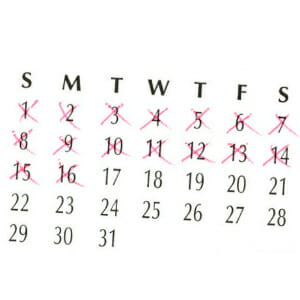
    Someone once asked Jerry Seinfeld for advice on becoming a great comedian. His reply was simple: buy a big wall calendar and hang it somewhere you’ll see it often.

    Every day you meet your writing goal, mark a big X in red marker over that day on the calendar.

    “After a few days you will have a chain. Just keep at it and the chain will grow longer every day. You’ll like seeing that chain, especially when you get a few weeks under your belt. Your only job is to not break the chain.”

    Easy, right? Just don’t break the chain.

    Use this technique to meet specific writing goals. For instance, if you’d like to write a ebook, track your writing specific to that project on your giant calendar — if it’s in addition other writing, just use another color of marker.

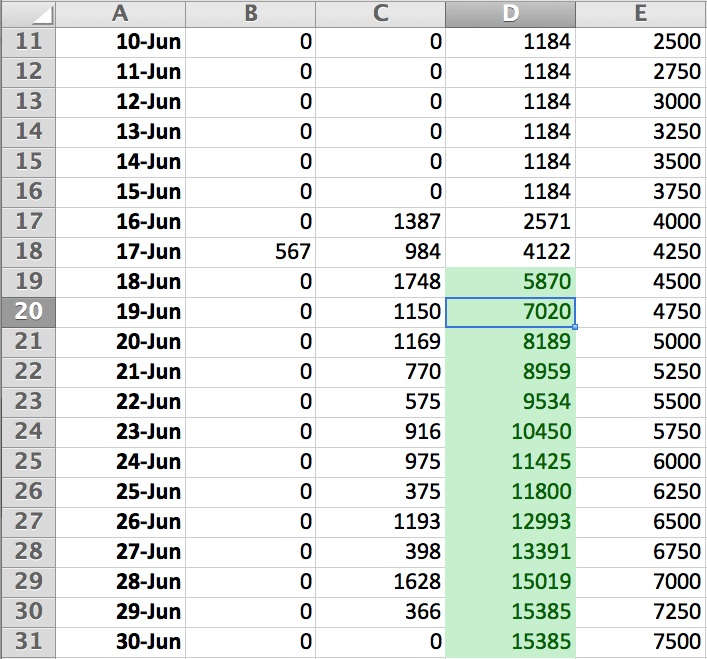
    Don’t have (or want to buy) a calendar? Writer Nora Bailey created an Excel spreadsheet formatted as calendar, with number of words written under specific days. When she meets her writing goal each day, the “total words” field automatically turns green.

    Image: Writing Calendar in Excel

    It’s deceptively simple to negotiate with yourself that you won’t be doing any writing today. You can say it’s late, you don’t feel like it or simply deny that you ever really wanted to start writing. The trick is in putting those excuses aside and putting pen to paper, fingers to keyboard.

    There’s no one strategy that helps all writers write every day. Experiment to find one that works well for you!

    Do you write every day? How do you make it a priority and maintain the habit?
    links
    no
    1

  • Writing a Novel? 6 Visual Storytelling Techniques to Borrow From Film and TV

    Writing a Novel? 6 Visual Storytelling Techniques to Borrow From Film and TV

    Many of us were raised watching thousands of movies and television shows. The style, technique and methods used in film and TV are so familiar to us, we process them comfortably. To some degree, we now expect these elements to appear in the novels we read — if not consciously, then subconsciously.

    We know what makes a great, riveting scene in a movie, and what makes a boring one — at least viscerally. And though our tastes differ, certainly, for the most part we agree when a scene “works” or doesn’t. It either accomplishes what the writer or director has set out to do, or it flops.

    As writers, we can learn from this visual storytelling; what makes a great movie can also strengthen a novel or short story. Much of the technique filmmakers use can be adapted to fiction writing.

    Break up your scenes into segments

    Just as your novel comprises a string of scenes that flow together to tell your story, so do movies and television shows.

    However, as a novelist, you lay out your scenes much differently from the way a screenwriter or director does. Whereas you might see each of your scenes as integrated, encapsulated moments of time, a movie director sees each scene as a compilation of a number of segments or piecesa collection of camera shots that are subsequently edited and fit together to create that seamless “moment of time.” By thinking in terms of segments in creating each scene, writers can create a dynamic, visually powerful story.

    So how can novelists structure scenes with cinematic technique in a way that will supercharge their writing? Here are six steps that will help you structure your novel as if you were a filmmaker:

    1. Identify key moments

    Think through your scene and try to break it up into a number of key moments. First, you have the opening shot that establishes the scene and setting. Then, identify some key moments in which something important happens, like a complication or twist, then jot those down.

    Then write down the key moment in the scene  — the “high moment” — that reveals something important about the plot or characters. That should come right at or very near the end. You may have an additional moment following that is the reaction or repercussion of the high moment.

    2. Consider your POV

    Now you have a list of “camera shots.” Think of each segment on your list, then imagine where your “camera” needs to be to film this segment.

    Remember, you are in a character’s POV — either a first-person narrator telling and experiencing the story or a third-person character in that role. So consider where that character is physically as he sees and reacts to the key moments happening in your scene. You now have your “direction” so that you can write this scene dynamically. Come in close to see important details. Pull back to show a wider perspective and a greater consequence to an event.

    3. Add background noise

    Consider what sounds are important in this scene. They could be ordinary sounds that give ambiance for the setting, but also think of some sound or two that you can insert into the scene that will stand out and deepen the meaning for your character.

    Church bells ringing could remind a character of her wedding day as she heads to the courthouse to file divorce papers. Birds chirping happily in a tree next to a grieving character can sound like mocking and deepen the grief.

    4. Color your scenes

    Colors can be used for powerful effect. Different colors have strong psychological meaning, and filmmakers often use color very deliberately. Red implies power; pink, weakness. You can “tinge” your scenes with color and increase the visual power. Color can also add symbolism to an object or be a motif.

    Want to learn more? A great book to read is Patti Bellantoni’s If It’s Purple, Someone’s Gonna Die.

    5. Think about camera angles

    The angle of a “shot” also has powerful psychological effect. A camera looking up at a character implies he is important or arrogant or powerful or superior. A camera looking down implies someone who is weak or inferior or oppressed or unimportant.

    If your character is in a scene with others and feels superior, you might have him elevated or being seen from below to emphasize this. A woman being fired might be sitting in a chair with the boss standing over her. These little touches add visual power.

    6. Include texture and detail

    Consider adding texture. Too often, novelists put their characters in boring settings, without saying where they are, what time of year it is, or what the weather is like. We exist in a physical world, and movies showcase setting and scenery in great detail.

    Add texture to your scene by infusing it with weather and sensual details of the surrounding area. The feeling of the air in late fall in the middle of the night in Vermont as two characters walk through a park is texture the reader will “feel” if you bring it to life in your scene.

    Novelists who think like filmmakers can create stunningly visual stories that will linger long after the last page is read. Spend some time using a filmmaker’s eye to take your scenes to the next level, giving them dynamic imagery and sensory details as well as deliberately placing characters, colors and sounds in your scenes for targeted psychological effect.

    If we want to move readers emotionally by our stories, the best way is to bring our novel to life by using cinematic techniques.

    Have you tried using these cinematic techniques to bring your story to life? Can you think of a novel you’ve read that used colors or sounds in a significant symbolic way? Share in the comments!

  • Writing Fiction: 3 Ways to Build a Stronger Story

    Writing Fiction: 3 Ways to Build a Stronger Story

    Authors face a great many challenges as we put together our manuscripts. Primary among them is working to erase our tracks on the page, creating a seamless connection between readers and our fictional world.

    In this, Kevin Spacey’s quote from The Usual Suspects (originally from Charles Baudelaire’s The Generous Gambler and paraphrased in C.S. Lewis’ The Screwtape Letters) is remarkably apt:

    “The greatest trick the devil ever pulled was convincing the world he didn’t exist.”

    So how do all we author-devils go about convincing our readers we don’t exist?

    After analyzing all 71 individual scenes in the latest draft of my novel, I discovered one common problem: my authorial presence on the page created barriers between the action and the reader. I needed to get out of the way.

    Narrowing in revealed three main areas where my footprints on the page depressed the action. I had created a protagonist I really liked, but who was onedimensional; I was filtering the action in my descriptions; and I was oversharing irrelevant setting and description details.

    Developing solutions to each challenge tightened my scenes and helped build a closer connection to the conflict playing out across the narrative. Here’s how I did it:

    1. Issue: A one-dimensional, likable protagonist

    When I’m reading a novel and I encounter a one-dimensional protagonist, it’s like I’ve sat down in a poorly made chair. I immediately wonder, “Who made this?” If a reader asks that question of a story, the author may not have done enough work to create a character independent of themselves and let the reader experience the tale without wondering how it was made.

    Great stories seem organic, as though the author channeled them, rather than created them. The writing can be brilliant, and the reader will notice the beauty in the construction of sentences and paragraphs, but what they absolutely shouldn’t notice are clunky story mechanics, including poorly realized characters. These reveal a sort of clumsiness — and clumsiness draws the author out into the open.

    [bctt tweet=”Great stories seem organic, as though the author channeled them, rather than created them. “]

    It’s tough to give your hero faults and flaws: vanity, an ego, even dark, criminal impulses. If you do, how can he or she possibly remain a good protagonist? Aren’t all our heroes free of vice?

    The most believable heroes are people not too different from us, with all the complexities and challenges we face each and every day. A great story, in which your protagonist achieves great things, is all the more satisfying when that character reaches her goal despite the challenges of her situation and setbacks that real or perceived imperfections cause. As David Corbett says in his epic The Art of Character:

    “Its far more important that we empathize with a character than like her, which is just as true of villains as heroes. And empathy is created by a well-drawn character taking on a convincing dramatic problem, in which compelling wants are at stake in the face of potentially overwhelming opposition. We feel for such a character, even if she is imperfect, for we all understand that necessity compels us to act as we must, not as we should.”

    Our characters acting as they must — and not as they should — is a hallmark of separation from the author. It is the antithesis of contrivance because, as protagonists become believable individuals — with warts and all — they tend to make decisions that reflect their many varied facets.

    Solution: Give your protagonist flaws

    Learn to cultivate flaws in your protagonists. Collect and log them. If you don’t know where to begin, gather inspiration on key character flaws, and learn why your character needs them. We like flaws because they make our characters vulnerable and allow us to empathize with them — precisely because they are not perfect, because they are like us.

    My protagonist, Duncan, had many likeable qualities in my first draft. He was well-intentioned, moral and without vice; a victim but rarely a predator. And, over the course of the book, while he dealt with certain troublesome episodes, nothing forced him to change. His flaws were in no way tied to the obstacles blocking him from achieving his goals. He was without reproach; in other words, boring.

    In my rewrite, I peppered Duncan with flaws. I wrote about what might shame or embarrass him. I flung at him snobbery, pedantry and annoying idiosyncrasies. I applied these flaws to specific scenes to see how they would change his decisions — and noticed an immediate and remarkable positive effect.

    Suddenly, Duncan was making his own choices, rather than me making them for him. He began acting as he must, not as he should — and in doing so gained an important separation from my undue influence.

    2. Issue: Filtering the action and description

    Certain words filter the action from the point-of-view character to the reader. They disrupt your story’s flow by creating distance between the reader and the action on the page.

    These filter words riddled my first pass with such interruptions. In fact, here are just a few from my finished first draft, in order of their egregiousness:

    to look: 300

    to think:  111

    to see: 91

    to hear: 66

    to feel (or feel like):  51

    to seem: 50

    to realize:  13

    to wonder:  9

    to watch: 8

    to decide: 8

    to touch:  5

    Solution: Ruthlessly remove filter words

    At first, it’s tough to spot these filter words. Here are a few of my favorite resources on reducing filters and eliminating telling words. Author Jami Gold has an impressive list for creating specific Word Macros that help you find filter words during your revision phase.

    Below are three examples of where I found and removed filters:

    Filter: “Nonsense,” Duncan said, feeling the letters N and S crash against the numb shores of this front teeth prior to completing the sounds.

    No Filter: “Nonsense,” Duncan said — the letters N and S crashed against the numb shores of his front teeth.

    Filter: “I advise you to pay thanks to the general for bestowing this honor upon you, rather than question the method of payment. You and I both know what this order will do for . . .” he looked around at the dirt pens, the long grass and the crumbling house, muddied, with hay tipping over onto the roof, “this business.”

    No Filter: “I advise you to pay thanks to the general for bestowing this honor upon you, rather than question the method of payment,” the soldier said. The heat was sweltering in the crumbling  pens. Muddied, matted hay hung from the roof. He drew his sleeve to his nose. “You and I both know what word of our order will do for . . . this business.”

    Filter: “Sure, sure,” she said. “Does he know he’s meeting you . . . Duncan?” She looked down over her empty pad toward his name, scribbled in eyeliner pencil.

    No Filter: “Sure, sure,” Sheila said. “Does he know he’s meeting you . . . Duncan?” She drew her painted fingernail down over the empty pad and toward where his name was scribbled in eyeliner pencil.

    As with many writing rules, consider it a suggestion more than a fundamental requirement. You may find mere awareness of filters helps you to write tighter, more vivid descriptions.

    3. Issue: Oversharing setting and description details

    Writers know more about their story’s setting and their characters’ thoughts than anyone else. The problem is, we often share more than is necessary, leading to large chunks of description and internal monologue that break a scene’s momentum.

    We all know the rule: show more and tell less. But it’s become a cliche because it can be interpreted about a million different ways — so what the heck does it mean in practice?

    When we write scenes, we present an isolated viewpoint on a moment of conflict to advance the story for the reader. In a moment of conflict, people rarely notice what’s happening around them. They don’t take in exhaustive setting details or spend time trying to analyze their surroundings. They are in the action — where every move, every word, every detail either helps them get what they want, or pushes it further away.

    Imagine being in the front row of a play. To access the moment of conflict on stage, you need to be close to the action as it occurs. If a narrator is standing between you and the actors, they depress the intimacy of the action. So, showing is largely about getting out of the way of the action — drawing out into plain view only those items that advance the scene.

    Subtext is important here — the ability to tease out items that add meaning to a scene without drawing too much attention to them. For example, consider Big Jim Rennie’s golden baseball in Stephen King’s Under the Dome. To Rennie, the baseball at first represents power and prestige, until it becomes a literal manifestation of those delusions. When the violent drama finally plays out on the page, the baseball’s established subtext enriches the scene without impeding the action.

    Solution: Visualize your telling

    In a pass during your rewrite, visualize where you tell more than show. In each scene, create two different highlights — yellow for setting and pink for internal monologue. Highlight the blocks, then print out the scene and look at where your interjections slow the action of that scene. What details are unnecessary to the subtext of that isolated moment?

    Of course, telling can be useful for summary scenes to help the reader understand the aftermath of several intense scenes of conflict. In many plays, narrators come on stage at the beginning, in between scenes, and maybe at the end to recap the action. Such pacing mechanisms give the reader time to take a breath before plunging back into the action. But in most cases, scenes benefit from cutting down — or eliminating altogether — those interjections that slow action and impede the story.

    Have you found it challenging to remove yourself from a story? How do you take yourself out of your fiction writing?
  • Children’s Book Authors: Have You Tried Amazon’s New Tool?

    Children’s Book Authors: Have You Tried Amazon’s New Tool?

    Publishing children’s books on Kindle just became a little easier.        

    While authors have long been able to post illustrated books through Amazon’s Kindle Direct Publishing, the books were simply text and images. However, you can now add a little interactivity to your book in the form of pop-up text, thanks to the Kindle Kids’ Book Creator (KKBC), the newest addition to Amazon’s arsenal of publishing tools.

    While you can publish an illustrated book on Kindle without using KKBC*, the new program offers two cool opportunities to make your book more fun and accessible for young readers.

    Here’s a quick illustrated guide to the new features.

    Getting started with KKBC

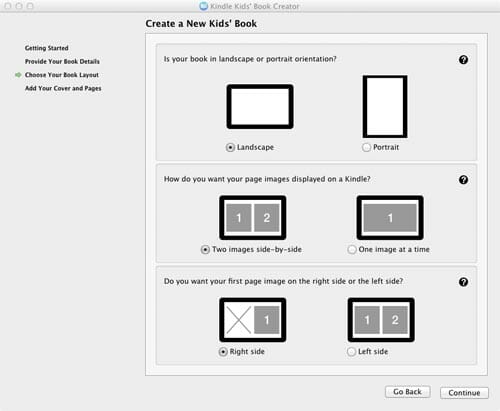
    Once you download KKBC for free from Amazon, your first task is to set up the book. Enter the title, author, destination folder on your computer (which must be empty), page orientation and other details.

    Kindle Kid’s Book Creator

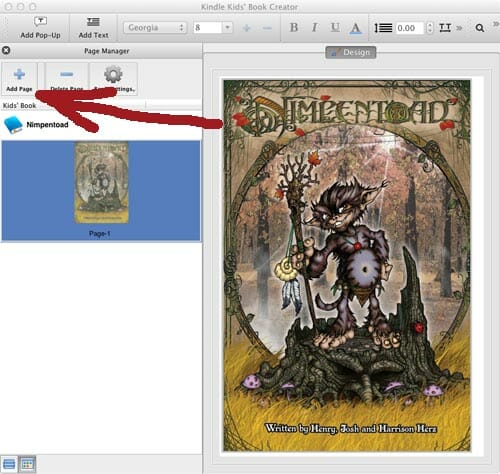
    Next, import your book cover as a PDF, JPG, TIF or PNG, followed by your page images. This can be done en masse using a multiple-page PDF — which I recommend, as it’s easier — or as individual images.

    If you opt to upload individual images, the files must be at least 400 by 400 pixels. To keep them in the correct order, make sure you’ve numbered your image file names, because KKBC adds them alphabetically. In the example below, I have added a single interior page image using the Add Page button.

    Kindle Kid’s Book Creator

    Using pop-up text to improve legibility

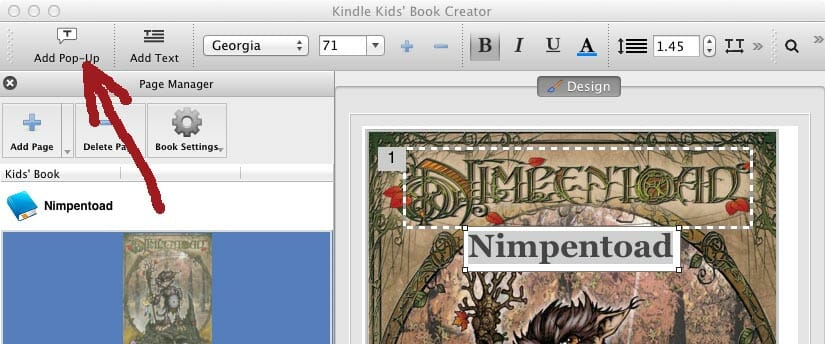
    Suppose I feel that the ornate font at the top of this image might be illegible for young readers. I click on the Add Pop-Up button, and a rectangular text box appears on the image. I can type in whatever text I choose, then resize and reposition the box and control its font, size and color.

    Kindle Kid’s Book Creator

    Add your story’s text

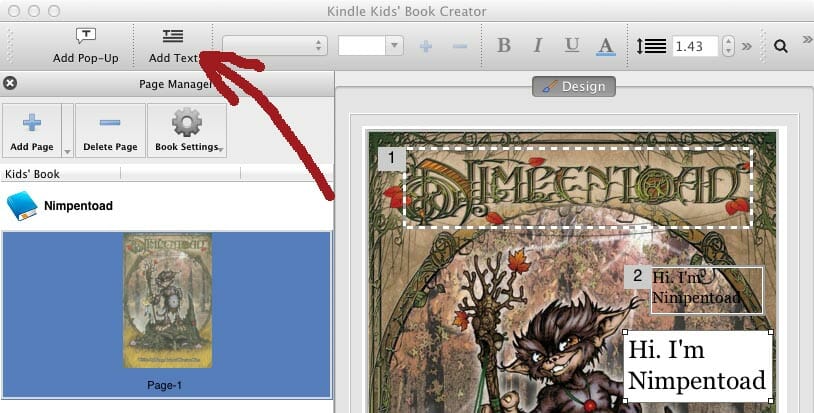
    The Add Text feature will, not surprisingly, insert text anywhere you’d like on the page. This might be where you add the text of your story to the correct area of each page.

    When a reader double-taps this text on his Kindle, he’ll trigger a pop-up, which is useful — while older readers might be able to decipher text within an illustration, younger ones might need larger text or a white background. Note that any “tappable” zones you create cannot overlap.

    Kindle Kid’s Book Creator

    Use pop-up text in creative ways

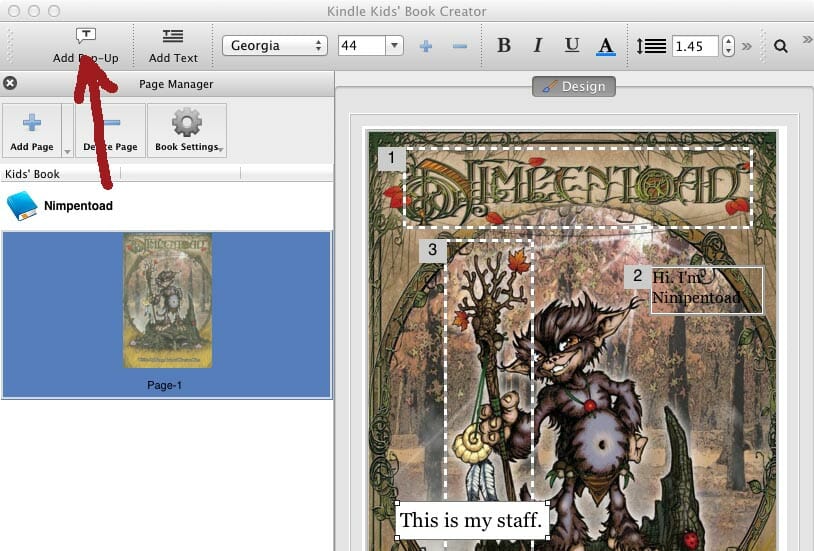
    You can use the Add Pop-Up feature anywhere on the page, not just on text. Perhaps you want to make regions of the image clickable to teach vocabulary to young readers, or to hide plot clues. The sky’s the limit!

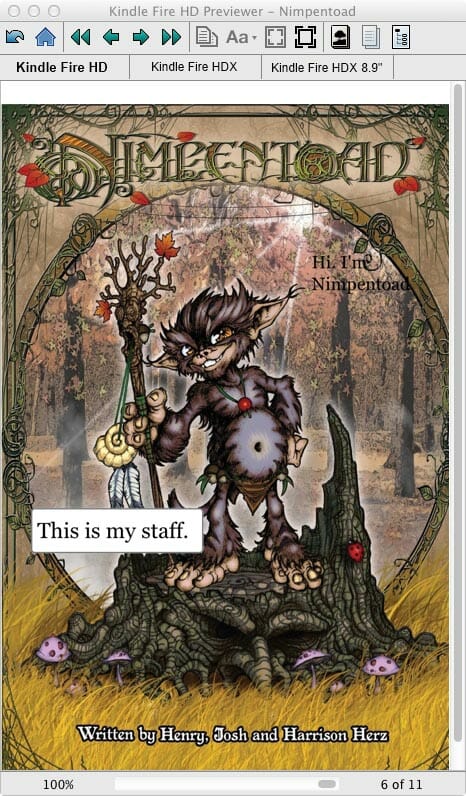
    For example, I can highlight the staff in this image so that when a reader double-taps it, they see a pop-up with the words “This is my staff.”

    Kindle Kid’s Book Creator

    Test your pop-ups in the Kindle Previewer

    When you’re done adding pop-ups, save the file. Click on View Preview to launch the separate Kindle Previewer application, which emulates how your book will appear on different Kindle devices.

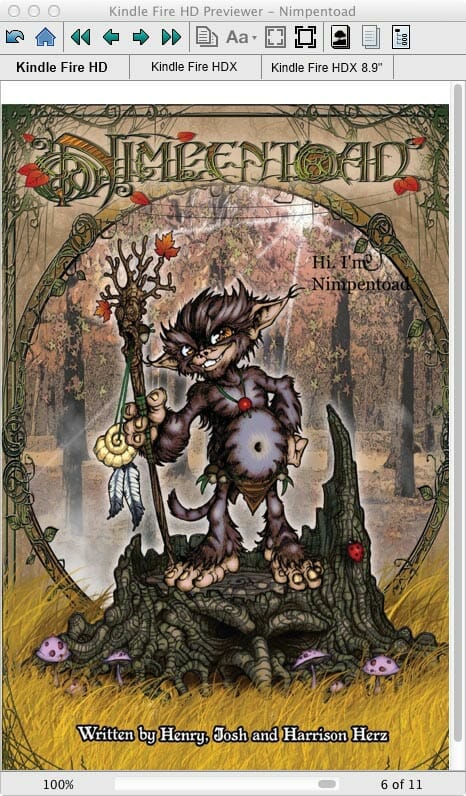
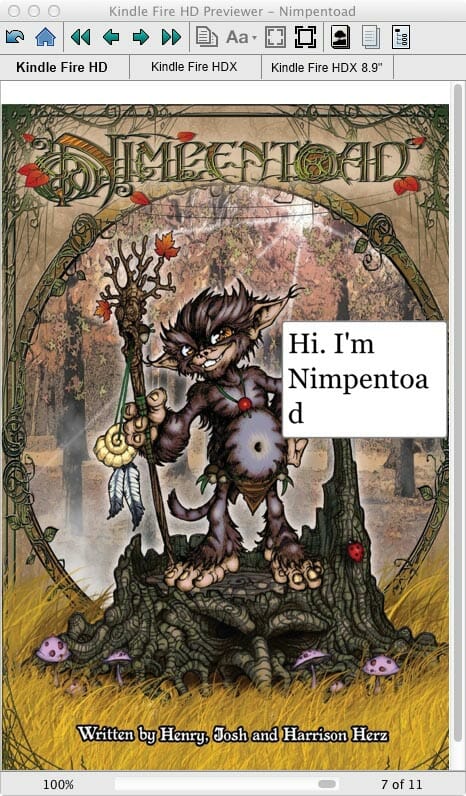
    Here’s how my book would look on a Kindle Fire HD. Note the “Hi. I’m Nimpentoad” text we added with the Add Text button.

    Kindle Kid’s Book Creator

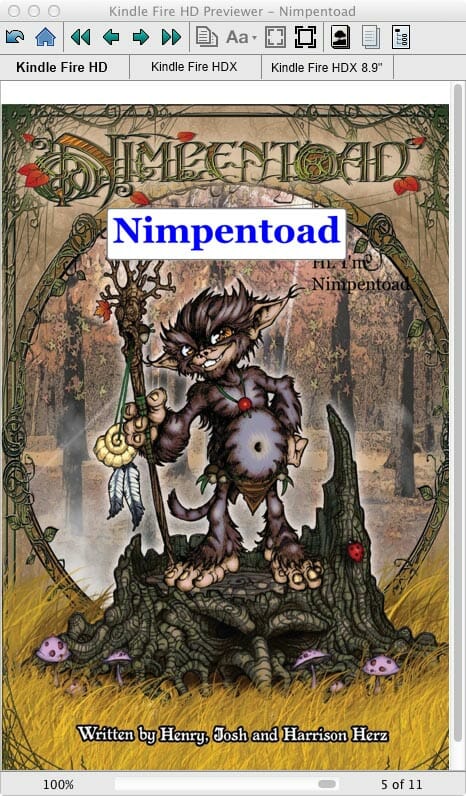
    Double-tapping on the ornate text at the top triggers a more legible pop-up.

    Kindle Kid’s Book Creator

    Double-tapping on the “Hi. I’m Nimpentoad” text triggers a pop-up that’s easier to read. Note the wrapping text, which highlights the importance of testing your book on all devices in the Previewer to ensure it displays properly. In this case, I’d have to go back in and edit the font size for a better fit.

    Kindle Kid’s Book Creator

    Finally, if the reader double-taps the staff, they would trigger the associated pop-up.

    Kindle Kid’s Book Creator

    Adding pop-up text helps you improve your reader’s experience of your book, and adds some interesting interactivity. Enjoy playing with Kindle Kids’ Book Creator!

    *Want to publish illustrated books on Kindle without using this program? Simply save your Microsoft Word document as HTML, then run it through the free KindleGen application to create a .mobi format file. Don’t want to deal with conversion? Simply upload your Word or HTML files to Kindle and the platform will take care of the rest — though you’ll want to check the formatting.

    Have you used Kindle Kids’ Book Creator yet? What do you think of the idea?

    Looking for a quick introduction to publishing picture books on Kindle? Check out this free mini e-course from Children’s Book Insider.

  • 7 Smart Ways to Earn Multiple Streams of Income from a Single Manuscript

    7 Smart Ways to Earn Multiple Streams of Income from a Single Manuscript

    Joanna’s new book Business for Authors: How to be an Author Entrepreneur is out now in ebook, print and audio.

    Your manuscript starts as just one document.

    Because of this, authors generally think in terms of one book — and they don’t realize that multiple streams of income can flow from this small beginning.

    Six years ago, I started out with one book — just like everyone else! At the time, ebooks weren’t mainstream and I didn’t know how to publish internationally. I had one print product in one country, but I had the writing bug! Now, my 12 books provide a full-time income, selling globally in several formats and languages, and I left my day job three years ago to become a full time author-entrepreneur.

    So yes, it starts off as just one manuscript, but you can turn that one book into multiple products. Here’s how.

    1. Understand scalability

    Scalability is a key concept for creatives, and it’s pretty exciting for authors. It means that you create something once and then sell it multiple times.

    A book is the perfect example of a scalable product. You write it once, and it can earn you money for the rest of your life and, thanks to copyright law, 70 years after your death. It’s scalable because you put in the effort once, and the returns just keep coming. That’s the magic of publishing in a digital age!

    2. Publish an ebook in all its varieties

    An ebook is not a single entity anymore — you can have multiple ebook products. The main file types are mobi (for Kindle), ePub (for most other devices and platforms) and PDF (which most bloggers use to sell direct). You can create these yourself using tools like Scrivener or pay for conversion services.

    Once you’ve created these files, you can sell them on multiple devices: Kindle, Kobo, Nook, Apple devices, smartphones (through apps), as well as online through your website. These ebook versions alone can give you multiple income streams, as the indie author is paid from each store and distributor separately as well as receiving individual sales from customers.

    Use Amazon’s KDP, Kobo Writing Life, iTunes Connect and NookPress to publish directly, or use services like Smashwords, Draft2Digital or BookBaby to distribute for you.

    3. Publish a print book

    Print-on-demand technology means you don’t have to pay upfront or store and ship physical products anymore. When a customer orders your book, one copy is printed and sent directly to them, and you receive whatever profit margin you set up.

    Use services like Createspace or Ingram Spark to upload formatted files and have your print books available for sale online through Amazon, Barnes & Noble and many other online bookstores.

    4. Publish your book in audio format

    With many people commuting for hours every day, and the ease of using digital audio files, audiobooks are an expanding market. Sell your books in audio format through Audible, iTunes, Amazon and other services, as well as selling directly from your site.

    For indie authors in the U.S. and U.K., ACX.com is a great way to get your books into audio, and hopefully this will be expanding to other markets over time. You can also record your own work and sell direct using Selz, e-Junkie, Gumroad or other services.

    So that’s already one manuscript into multiple products … but it gets better!

    5. Go global with all formats

    Through online book retailers, you can now reach multiple territories yourself as they distribute to 170 countries. The Kobo Writing Life platform even has a fantastic world map so you can see where people have purchased your books. I’ve now sold books in 58 countries, including such diverse places as Ecuador, Burkina Faso, Nepal and Iceland. For a travel junkie like me, that’s exciting!

    Most of those country sales are small right now, but that’s because the online book sales markets are only just beginning. Fast forward a few years and I think you’ll see how different things will be. The story in the last few years has been about the maturing U.S./U.K./Canadian digital market, but over the next few years, the focus will be on the rest of the world.

    6. Collaborate on translations

    Germany has a population of 80 million, and Germans are big readers. There are also German speakers in Austria, Switzerland and, of course, the rest of the world. Ebook adoption is increasing and Germany is the third-largest ebook market after the U.S. and U.K.

    Spanish is the second most commonly spoken language in the world after Mandarin, with more than 400 million native speakers. For the ebook market specifically, Spanish is the second most commonly spoken language in the U.S., which is the most mature ebook market.

    Those are just two examples of opportunities for expanding your work into other languages and reaching new readers. The sales may be small initially, but with a longer-term view, it’s likely to only get better.

    [bctt tweet=”Consider opportunities to expand your work into other languages and reach new readers.”]

    You can work with an agent to find foreign rights deals for you, or you can use IPR License or  PubMatch to sell your own foreign rights. Indie authors are also now doing joint venture deals directly with translators — I have books out in German, Spanish and Italian that I produced in partnership with translators. You can also use a site like BabelCube, which works as an intermediary and publisher in these types of deals.

    7. Collaborate on other creative projects

    I firmly believe that creative collaboration is the next big thing in the writing community. It’s already established in other creative industries, like music, dance, film and other media, but authors have often worked alone and used intermediaries like agents.

    However, in the last year we’ve seen the rise of multi-author box-sets, which have propelled some onto the New York Times and USA Today bestseller lists. Authors have collaborated on new stories together — and not just anthologies, but graphic novels, digital products, and even film and TV with their books.

    Anything is possible in this new creative world, so take your one manuscript and turn it into multiple streams of income — and then do it again. Happy creating!

    Do you earn multiple streams of income from a single manuscript?

  • Writing Spaces: Where 9 Famous Creatives Do Their Best Work

    Writing Spaces: Where 9 Famous Creatives Do Their Best Work

    Where’s your favorite place to write?

    Does your writing space help you be productive and stay organized?

    If you need some inspiration, check out the writing spaces and environments of these famous artists, writers and storytellers.

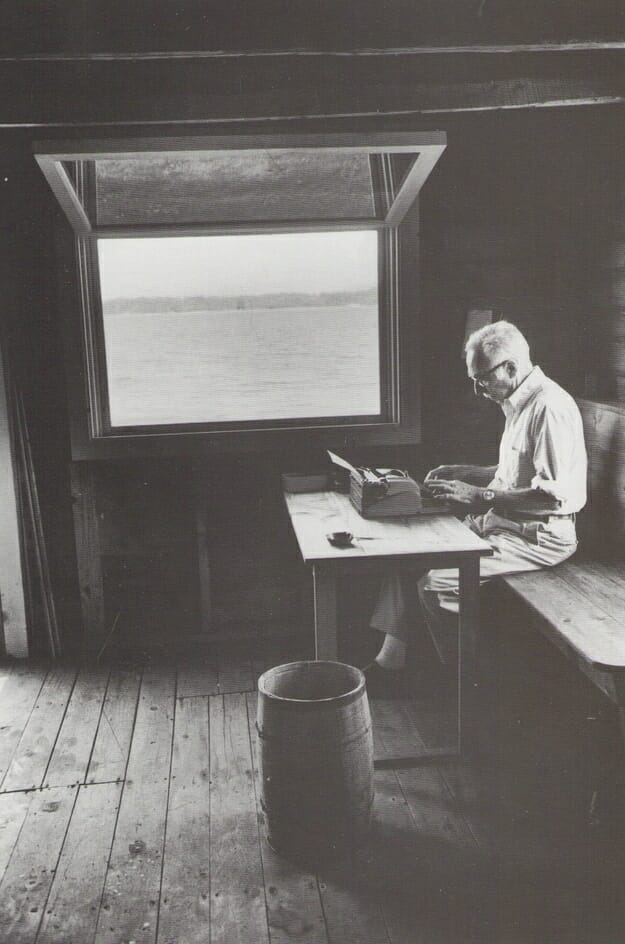
    1. E.B. White, author

    Sometimes all you need is a comfortable desk with a view of the outdoors for inspiration. (Ideally, near a farm with plenty of interesting animals, including a few spiders.)

    Image: e.b. White

    Image credit

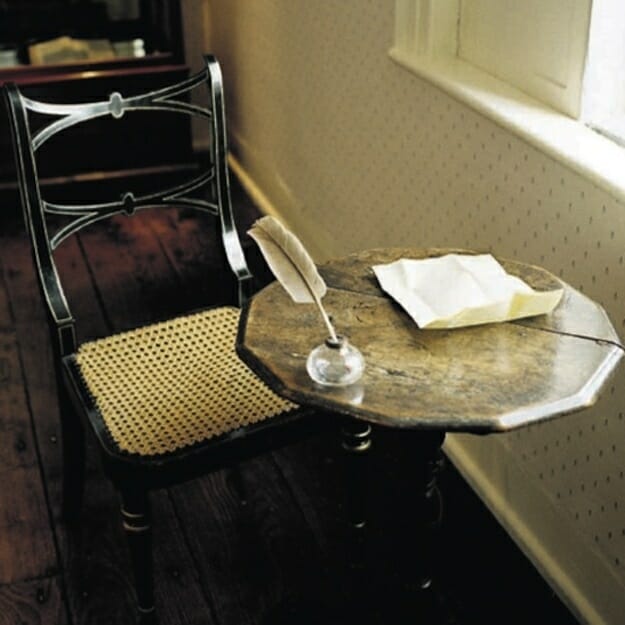
    2. Jane Austen, author

    This table may be tiny, but it supported the creation of her later works, including Emma, Persuasion, and a revision of Pride and Prejudice.

    Image: Jane Austen

    Image credit

    3. Mark Twain, author

    When you’re struggling to write, sometimes taking a break can help get your creative juices flowing. Perhaps a game of pool would inspire some ideas?

    Image: Mark Twain

    famouscreatives

    4. Nigella Lawson, chef and food writer

    When you’re looking for inspiration, having all your favorite books within arm’s reach certainly can’t hurt.

    Image: Nigella Lawson

    5. Steve Jobs, inventor

    Jobs was well-known minimalist. He described one home by saying, “All you needed was a cup of tea, a light, and your stereo.”

    Image: Steve Jobs

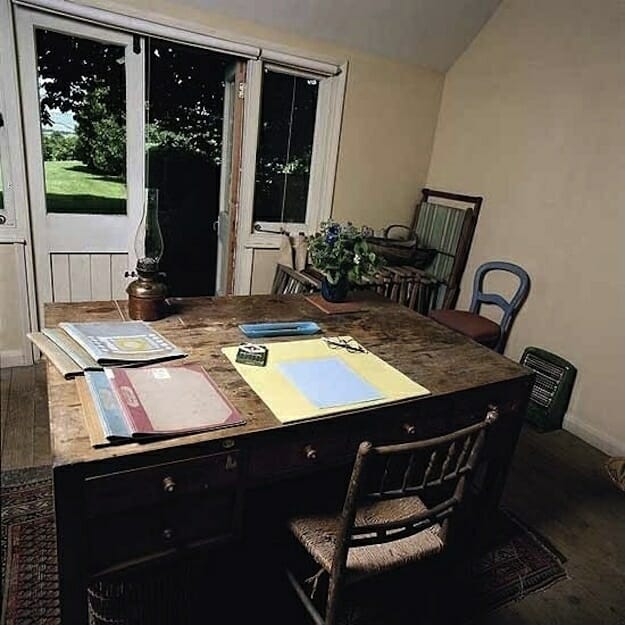
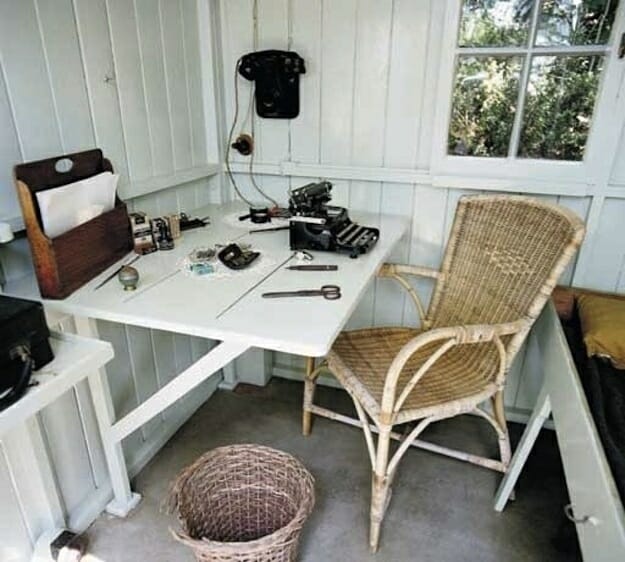
    6. Virginia Woolf, author

    This simple desk and chair overlooking the outdoors were ideal for writing, at least in the summer. Woolf noted that this converted toolshed was so cold in the winter that she couldn’t hold a pen!

    Image: Virgina Woolf's Desk

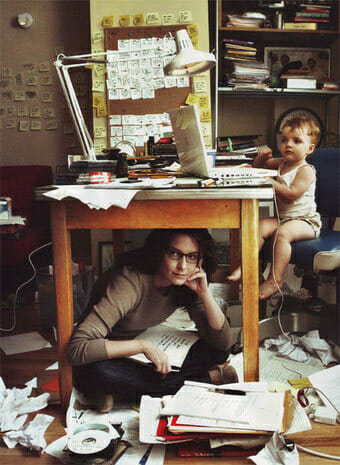
    7. Tina Fey, author and comedian

    Were you wondering about the workspace that may have inspired 30 Rock, Mean Girls or Bossypants?

    Image: Tina Fey

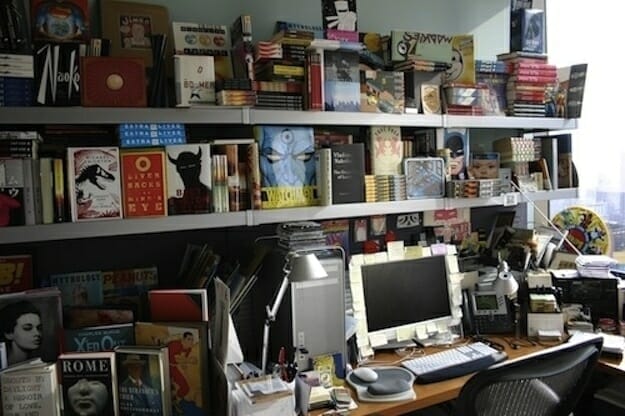
    8. Chip Kidd, book cover designer

    Many artists find their creative inspiration in other books, authors and stories.

    Image: Chip Kidd

    9. George Bernard Shaw, playwright

    Keep it simple with a typewriter, a clean white desk and a small window in a private place. That last one was key for Shaw, who once confessed, “People bother me. I came here to hide from them.”

    Image: George Bernard Shaw

    What’s your favorite place to write?

  • Publishing Traditionally? 4 Tricks for Maximizing Your Profit

    Publishing Traditionally? 4 Tricks for Maximizing Your Profit

    You’ve probably read a few articles on how to market your book, and selling more copies is important.

    But what if you could also make an extra $0.50 on each sale? If you sold four thousand copies this year, that would add up to an extra $2,000 in your pocket — which might make it worth spending an hour or two setting up the processes.

    Here are four ways you can squeeze more profit out of each sale. One strategy will even help boost your book in Amazon’s ranking’s! Let’s get started.

    1. Get paid a commission on top of a royalty

    When my book, 101 Weird Ways to Make Money, was published, I promoted it to my mailing lists and on my websites. At first, I just linked to the sales page on Barnes and Noble. They had preordered several thousand copies for their physical stores, and my editor at Wiley (rightly) suggested that we should reward them.

    Then I noticed that the link my editor gave me had Wiley’s affiliate code in it — my publisher was selling the books to Barnes and Noble, but also making a commission on each sale to buyers I referred. Why couldn’t that be my affiliate code? I changed it the next day. I later did the same for my Amazon links.

    Here’s how it works with Amazon’s Associates Program (Barnes and Noble’s program is similar): I refer newsletter subscribers and website visitors to the sales pages through links that contain my affiliate code. I then get a 4 to 8.5 percent commission, depending on that month’s sales volume. At the moment they sell the book for about $14.00, so my affiliate commission is at least 56 cents — on top of the $1.50 royalty from my publisher.

    Amazon says it’s also okay to do this with books you’ve published on Kindle. On my Kindle titles that I’ve self-published, I start with a 70% royalty (unheard of with print books), and then make a commission. On a $5.99 sale I refer, I earn a $4.19 royalty and another 4% from the Associates Program, or about 24 cents. That brings my total to $4.43 on a book that sells for just $5.99. That’s 74% — not a bad profit margin for a book!

    Here’s another little secret about those affiliate programs: when people use the link on your blog or Facebook page to buy your book, you’ll also make a commission on anything else they buy during that visit. When I looked closely at my affiliate sales report, I noticed that I was making money for music downloads, kitchen gadgets and other items, none of which I promoted. People who go to get my book apparently buy other things at the same time, and I get paid. Every little bit helps.

    Note: Amazon does not accept affiliates in certain states, in which case you can use Barnes and Noble’s Affiliate Program and make 6% on sales of your own books, on top of your royalties.

    2. Sell more by yourself

    It’s nice to have bookstores selling your book even while you sleep, but you might get a dollar or less on each sale as your royalty. If you buy your books wholesale from your publisher and sell them on your own, you can make as much as $10 on a book with a $19.95 cover price.

    [bctt tweet=”Buy your books wholesale from your publisher & sell them on your own to make a profit.”]

    Some authors find it very profitable to sell their books at speaking engagements and other public functions. Despite being a very social person, I don’t like being in the spotlight. But if you’re out there doing presentations and promoting your book, bring plenty of copies to sell.

    You can also ship books yourself. Once in a while, someone wants to buy a book from me directly, so I tell them to send a check. You could choose to do this even when selling your books through social media or by other means. Even if you pay the shipping charges, you make more than your usual royalty by buying wholesale and selling at full retail.

    3. Make self-published books smaller

    A traditional publisher pays you a set percentage as a royalty. On the other hand, if you use a publish-on-demand (POD) company to do it yourself, your profit is whatever is left over after your cost-per-book is deducted from the wholesale price book vendors pay for it. And there’s a reasonable limit to what you can ask for a book. That’s why smaller books make sense.

    For example, if your book retails for $14.95, and book sellers pay $7.47 for it, and your cost is $7.37, you’ll make all of ten cents per sale. But if you cut the size of the book down so your cost is just $5.47, you’ll be making $2.00 per copy — twenty times as much!

    I’ve self-published two books for $9.95 that each make more profit per sale than a book I sell for $14.95. That one was too big, and I’ve learned from my mistake.

    Sometimes it’s hard to reduce that word count, but keep the cost of production in mind as you write. Nonfiction can always be more concise. If it is fiction, consider breaking a good story into two books in a series instead of one long one.

    4. Cut costs on traditionally published books

    With Wiley, I had negotiated away the clause in the contract that required me to buy some copies. Authors typically pay their publisher 50% of the cover price, and to buy 100 copies, as Wiley wanted me to do, would have eaten up a sizeable chunk of my advance.

    Of course, I still needed to buy some copies for friends, family and promotional giveaways in my newsletters, so I went to Amazon and discovered two very interesting facts.

    First, I found that, unlike books bought wholesale through your publisher, an author’s retail purchases are part of various book industry sales statistics, like those used to put together best-sellers lists. Apparently buying your own books is a controversial marketing practice, but it isn’t illegal.

    Even if buying copies of your book doesn’t push it onto any top-10 list other than some obscure sub-category on Amazon, the numbers matter. Libraries, for example, try to stock popular titles, and your purchases might push your book one copy past whatever threshold they use to determine what’s popular.

    The second thing I discovered is that it can be cheaper to buy from Amazon than from my publisher. With shipping, I would have paid over $10 each to get my books from Wiley, and I wouldn’t earn royalties on these wholesale purchases (I asked, of course). But when new books are released, Amazon tries to have the lowest price online, and you can use that to your advantage.

    For a while, Amazon sold my book for $11.30, which is quite a discount from the $19.95 cover price. I bought enough copies to get free shipping, and I made a royalty of $1.50 on each one. That brought my total net cost down to $9.80 per book, 50 cents less than the per-book cost of $10.30 or so I would have paid (with shipping) to get them from my publisher.

    You have to do this shortly after publication, because that’s when Amazon will have their lowest price. Buy as many books as you think you will need all at once too, to get free shipping and to boost that sales ranking.

    Alas, it is against Amazon’s rules to use your own affiliate link to buy from them, or I would have gotten another 45 cents back on each book.

    Yes, oddly, you can buy at retail for less than wholesale, and also get statistical credit for these sales. Keep that trick in mind, especially if you need a few hundred copies of your book for speaking engagements. The less you pay, the more money you make.

    How do you maximize your profit from each book you sell?


  • How to Write Better: 7 Simple Ways to Declutter Your Writing

    How to Write Better: 7 Simple Ways to Declutter Your Writing

    You know that feeling when you open up your closet and it’s so stuffed with clothes you don’t wear that you can’t find the ones you really like?

    Or maybe your desk is piled with papers that need filing, and you waste all kinds of time looking for that one you need? Clutter adds stress and sucks up valuable time.

    The same situation applies to writing. Unnecessary words and redundancies in a page or paragraph obscure its core meaning and interrupt its flow. The essence of your message is buried under all those excess words.

    Once you’ve written the first draft of your novel or short story, it’s time to go back and look for cluttered sentences and paragraphs.

    Ferret out words that don’t add to the meaning or imagery and are just hampering the fluid flow of ideas. Look for instances of overwriting or beating a point to death. Say it once — or twice, max — then move on. Otherwise you risk annoying your readers.

    Ready to search out the clutter in your story?

    1. Avoid little-word pile-ups and eliminate redundancies

    Reveal the essence of your message by streamlining your words. Instead of “in spite of the fact that,” just say “although.” Instead of “in the vicinity of,” say “near.”

    Replace “in the direction of,” with “to” or “toward.” Instead of “came in contact with,” say “met.” Instead of “during the time that,” say “while.” No need to say “located at” – just say “at.”

    Before:

    On their cross-country trip, they slept each night in the cheap motels located less than a mile’s drive from the interstate.

    After:

    On their cross-country trip, they slept each night in cheap motels just off the interstate.

    Before:

    The car drove slowly through the large complex heading in the direction of a secluded building at the back of the facility. It was located on the shore of the Mississippi River. The vehicle came to a stop next to the entrance to the building.

    After:

    The car drove slowly through the large complex toward a secluded building on the shore of the Mississippi River. It stopped next to the entrance.

    Before:

    He was shooting off his mouth in the bar last night telling everybody that he was going to find the bastard that ratted on him.

    After:

    He was shooting off his mouth in the bar last night about finding the bastard that ratted on him.

    Before:

    He moved his mouse pointer over to the other email that he had received.

    After:

    He clicked on the second email.

    2. Don’t drown your readers in details

    Leave out those tiny details that just serve to distract the reader, who wonders for an instant why they’re there and if they’re significant.

    Before:

    He had arrived at the vending machine and was punching the buttons on its front with an outstretched index finger when a voice from behind him broke him away from his thoughts.

    After:

    He was punching the buttons on the vending machine when a voice behind him broke into his thoughts.

    In the first example, we have way too much detail. What else would he be punching the buttons with besides his finger? We also don’t need to know which finger he’s using or that it’s outstretched, since everybody does it pretty much the same. Minute details like these just clutter up your prose.

    Before:

    An angular snarl stuck to his face, the officer indicated with a hand gesture a door that was behind and off to the right of Jason. He swung his head around to look in the direction the officer was pointing.

    After:

    Snarling, the officer gestured to a door behind Jason. He turned to look behind him.

    3. Take out empty, “filler” words

    Words like “it was” and “there were” simply get in the way of your story without adding anything useful.

    Before:

    I headed down a rickety set of wooden steps to the basement. There was a dim light ahead in the hallway. To the right there were cardboard boxes stacked high. To the left, there was a closed door with a padlock. Suddenly, I heard muffled sounds. There was someone upstairs.

    After:

    I headed down a rickety set of wooden steps to the dimly lit basement. To the right, cardboard boxes were stacked high. To the left, I saw a closed door with a padlock. Suddenly, I heard muffled sounds. Someone was upstairs.

    I could play around with this some more, but you get the picture.

    4. Take out the word “that” wherever it’s not needed

    Read the sentence out loud, and if it still makes sense without the “that,” remove it. This change smoothes out the sentence so it’s less clunky and flows better.

    Before:

    She said that you thought that it was too expensive and that you wanted to shop around.

    After:

    She said you thought it was too expensive and you wanted to shop around.

    5. Delete words or phrases that unnecessarily reinforce what’s already been said

    Cluttering your sentences with too many unnecessary words can get in the way of clear communication and confuse and subliminally irritate the reader. Go through your manuscript and see where you’ve cluttered up sentences and paragraphs with little words and phrases that aren’t needed and just impede the natural flow of ideas.

    The phrases in italics are redundant here:

    We passed an abandoned house that nobody lived in on a deserted street with no one around. The house was large in size and gray in color.

    At this point in time, the truth is that complaints are increasing in number, but I don’t see that as a problem to be solved.

    6. Don’t tell after you’ve shown

    For example:

    She moped around the house, unable to concentrate on anything. She felt sad.

    He paced nervously around the room, muttering to himself. He was agitated.

    In both instances, the second sentence can and should be deleted.

    7. Condense any long-winded dialogue

    In real life, people don’t usually speak in lengthy, complete sentences or uninterrupted monologues. Read your dialogue out loud to make sure it sounds natural, not like a rehearsed speech.

    [bctt tweet=””Read your dialogue out loud to make sure it sounds natural,” says @JodieRennerEd“]

    Break up any blocks of one person speaking at length by rewriting them in questions and answers or a lively debate, with plenty of tension and attitude. Try using lots of incomplete sentences and one- or two-word answers, or even silences.

    How would your characters actually speak in real life? Think about their personalities and character traits. For example, men, especially blue-collar men, tend to be terser and more to-the-point than women.

    Looking for more ways to declutter your writing? In my editor’s guide to writing compelling stories, Fire up Your Fiction, I offer lots of concrete tips with examples for streamlining your writing for a smoother flow and pacing. Also, check out the post on tightening your copy.

    How do you streamline your writing?

  • How to Turn Your Blog Into a Book (2024 Guide)

    How to Turn Your Blog Into a Book (2024 Guide)

    The idea of writing a whole book can be pretty daunting. Even if you’re a fairly experienced writer, you might think it’s beyond you.

    But if you’ve been blogging for a few months or years, you may have already written enough to fill a book. Turning your blog into a book is an increasingly popular option. (If you’re using WordPress, the Word Stats plugin is a simple way to check your cumulative word count.)

    Creating a book is straightforward and not especially expensive, with e-publishing and print-on-demand technology. Here are three reasons why bloggers do it — and why you might want to give it a try:

    1. Books reach a different audience

    Not everyone reads blogs. Maybe they’re not especially comfortable with technology, or they only have internet access while at work, or they simply prefer to read in other formats.

    And those who do read blogs might never have come across your personal corner of the busy blogosphere.

    Books can reach a different audience — potentially becoming a tool for promoting your blog, or even your writing services.

    2. Books have a certain credibility

    While it’s true that, today, anyone can publish a book (just as anyone can start a blog), books have a certain credibility.

    Being able to tell your audience that you’ve written a book, or including your book in your bio when you’re guest posting or speaking, can give you instant “expert” status in their eyes.

    Of course, if you’re going to look credible, it’s important to have a well-edited and well-produced book … which we’ll be getting to in a moment.

    3. Books give your content a new life

    If your blog’s been running for a while, there’s a good chance that most of your current readers missed out on your early content.

    While your archives, categories and search box can all help them find your earlier writing, you almost certainly have some brilliant posts going unread in your blog’s archives.

    By pulling together your blog content into a book, you can give it new life. Instead of skimming through your latest post in their inbox, your readers can curl up with their ereader or a hardcopy of your book and dig in.

    Is the blog-to-book journey starting to sound like one you want to take?

    I’ve bought quite a few books and ebooks in my time that started life as blog posts, and I’ve also been going through the blog-to-book process with my client and friend Barry Demp. He’s just published his new book The Quotable Coach: Daily Nuggets of Practical Wisdom — a compilation of posts from the past two years of his blog, The Quotable Coach.

    If you feel ready to self-publish, here are the three major steps that we recommend you follow:

    1. Compile and edit past blog posts

    Before your blog can become a book, you need to get all your posts into one place — probably a document on your computer, whether you choose to use Microsoft Word, Scrivener, Google Docs or another tool.

    You’ll need to go through and format your post titles in Heading 2, so that when you convert your document to an ebook, these can become chapter headings.

    You’ll almost certainly also want to do some editing: perhaps updating out-of-date references, fixing typos, or even adding or removing whole paragraphs.

    You may also find that you need to remove some posts. This could be posts that:

    • Were specific to a particular time, such as the 2012 Olympics or your New Year’s Resolutions for 2013.
    • Are much shorter than average — perhaps a post for a special promotion of your book.
    • Don’t match up to your usual standards; we found ourselves deleting several early posts that were written before we’d quite found our stride.

    2. Line up beta readers and reviewers

    However strong your editing skills are, you’ll want to have some extra eyes on your finished book. Ideally, this means hiring a paid editor — but if that’s not affordable, ask friends, family or colleagues to help out.

    These beta readers (like beta testers in the software world) could read just part of your book and let you know about any problems they spot — from typos and missing words to structural issues. Do try to give them as much advance notice as possible, and at least a couple of weeks to get feedback to you.

    Beta readers may well also be willing to review your book (though you’ll probably want to approach other individuals for reviews too). Reviews or testimonials are a hugely important selling tool, especially as you’re publishing your book yourself rather than with a major publisher.

    Again, give reviewers plenty of time, and stay in touch as your launch date approaches. Once your book is online and ready for reviews, send them the link (and brief instructions) so they can easily leave a review.

    3. Get a professional cover design

    If you’re going to invest in just one thing for your book, go for a great cover design. Like it or not, we all judge books by their covers — and if yours screams “amateur,” your book is unlikely to get a second glance.

    We went with 99designs to get a range of different options from many different designers at a great price. You might instead choose to work with an individual designer (especially if they’ve already done some work on, say, your website or logo). You may even be able to barter design for writing with an artistically-minded friend.

    If you really have no option but to create the cover yourself, keep it simple and classy: think “minimalist.” Use large fonts that can be easily read at thumbnail size, and stick with just one key image.

    So … how about it? Have you ever read a book that started life as a blog, and would you turn your blog into a book?

  • Andrew Fitzgerald on Adventures in Twitter Fiction: TED Talks for Writers

    Andrew Fitzgerald on Adventures in Twitter Fiction: TED Talks for Writers

    Looking for some writing inspiration? One fantastic source is TED.com, home of “Ideas Worth Spreading.” This series of posts features notable TED talks related to writing, storytelling and creativity. Enjoy!

    Ready to change the way you look at Twitter?

    In this TED talk, Andrew Fitzgerald, a writer and editor who works for Twitter, explores new ways to use the platform for storytelling. Rather than thinking of the social network simply as a means of connecting with others and promoting your work, what if you were to use the medium for inspiration or even distribution?

    Fitzgerald draws parallels to the advent of serial radio shows in the 1930s, saying that “radio is a great example of how a new medium defines new formats which then define new stories.” He explains how this real-time storytelling blurs the lines between fact and fiction and provides opportunities for writers to play with different identities and anonymity while building new and creative stories.

    He references several well-known examples, including Hugh Howey’s self-published short story “Wool” that spawned a succession of sequels; Jennifer Egan’s “Black Box,” a short story tweeted line by line by The New Yorker’s fiction account; and parody stories that build on real-life events, such as the @MayorEmanuel account that documented the events of the Chicago mayoral election with a science fiction twist.

    Find the transcript and audio download on TED.com.

    What do you think of Fitzgerald’s ideas about Twitter storytelling?