Tag: blogging tips

  • Is ClickBank Legit? (2024 Review)

    Is ClickBank Legit? (2024 Review)

    Anyone who runs a blog and gets a decent amount of traffic is probably wondering how to start to make money with their site.

    When you start to look around the internet for ways to monetize your blog, you will most likely come across Clickbank as an option.

    You might wonder if it is a good platform to use to either sell your own products or sell the products of other people.

    If you have wondered is clickbank legit, how it works, how much you can make, and all the other basics you will need to know, this article will cover it all from top to bottom.

    [sps_reusable_block post_id=43047]

    What Is Clickbank?

    Clickbank is an affiliate marketplace and an e-commerce platform for people to sell their digital products. They let some physical products be sold as well, but double check if yours are allowed before you jump on there and sign up.

    Instead of having to go out and hunt for your own affiliate marketing programs, applying for each one, and keeping track of them all, clickbank brings it all into one central location.

    Clickbank offers thousands of unique products (at the time of writing this, over 4,000 products) and programs so you can find the right fit for your blog and for your audience.

    If you sell your own digital products, Clickbank is also a great option for you to sell more of them since other people can go on there and sell your products for you.

    How To Monetize With Clickbank

    If you are ready to monetize your work, you first need to sign up for Clickbank.

    Clickbank is also free to join as an affiliate and there is no screening process so you can simply sign up and get started making money right away. If you want to sell your own products, you will need to pay $49.95 to start offering your goods and services.

    When you pick a product on Clickbank to sell to your audience, you can make between 1% and 75% commission.

    The seller is the one to set their own affiliate rate, and often they will offer a good deal to start to attract affiliates.

    There is also another option to make money with Clickbank and that is for you to create and list your own offerings. Then, people who also use the platform can sell your producs (while earning their own affiliate income, as well).

    Both options are a great way for you to start making money online, which is all done easily through Clickbank.

    Types of Products on ClickBank

    On Clickbank, there are a ton of products in a wide variety of niches.

    Some of them include:

    • Education
    • Health and Fitness
    • Cooking
    • Traveling
    • Sports and competitive games
    • Beauty
    • Entertainment
    • Financial
    • Legal
    • Survival
    • Weight loss and diets
    • Investing
    • Real estate

    That is just the tip of the iceberg when it comes to the variety of products on there. You will be able to find a product for almost any niche you are in.

    Of course, you will want to find products that are related to your niche or else your audience might not be interested in them.

    Selling Clickbank products

    If you want to start making money with Clickbank as an affiliate, the first thing you will need to do is figure out which platform you want to sell through.

    If you already have an audience on a certain platform, that can help a lot. That will often be the first place you will want to start to offer this affiliate product.

    You should take some time to figure out why your audience would love this product, because that will help you craft a message that can help you sell more of them.

    The last thing you want to do is just pitch them some generic product without giving them a reason to buy the product or building any desire to do so.

    You could sell products through:

    • Your email list
    • Your YouTube channel
    • Your social media channels
    • On your website
    • In your blogs

    Selling Your Own Clickbank Digital Product

    If you are taking the time to put your own product up on Clickbank, you will want to spend a little time sprucing up your copywriting skills.

    When customers come to your landing page, you want to make sure it is up to date and ready to show them why they should buy your product.

    A big problem for bloggers who sell digital products is getting leads to their website, which is something that Clickbank can also help with. Even for the people who do not buy your product, you might be able to convince them to sign up for your newsletter, giving you a chance to sell to them again down the line.

    Is Clickbank Legit?

    Overall, yes. Clickbank is a legitimate site to help bloggers make money.

    Now, what it does not do is magically create those sales for you. You will still be in charge of getting eyeballs to your offerings and making sure your potential customers can find it.

    Clickbank simply offers the framework for you to succeed as long as you can make the sales on your own.

    One thing you will need to do, though, is check out the people who have products you are offering to your audience.

    Clickbank does not personally go through and vet every single product on their platform. Yes, they take down spam or fake products, but outside of that it is up to you to do your due diligence.

    Check out the product, check out the company offering the product, take a look through their website and social media profiles, and so on.

    No matter how good the commission rate is, you will want to do your homework so you can happily offer a product. Otherwise, you can destroy the trust between you and your audience you have worked so hard to build.

    Why You Should Join Clickbank

    If you sell products, using Clickbank is a helpful platform in order for you to sell more of them without as much effort on your end.

    Because people can log in and see your product as an offer, they can sell it for you (while getting a cut, of course). It is one of the better options when it comes to making money with your work, since you are not paying these people upfront to promote your product.

    If you are on the opposite end, it makes sense to join Clickbank because you can sell other people’s products to your audience.

    This can save you time from how long it can take to create your own product and instead just start selling other people’s hard work while you earn a cut.

    If you already have an audience, it can make sense to offer them more products that would help them and are already in your niche. Overall, it is a win-win for everyone.

    [sps_reusable_block post_id=43047]

    Ready To Make Money With Your Writing?

    If you are great at writing, and are looking for ways to make more money, being a freelance writer might be a perfect fit for you.

    Inside the Freelance Writers Den, you will learn all of the tips and tricks to boost your writing career and start making money without having to rely on affiliate sales.

    Want To Make More Money With Your Writing Skills?

    While it is great to be an affiliate and make money that way, if you are a good writer, you can make money in a wide variety of ways

    The Freelance Writers Den will help you succeed as a freelancer and give you all the tools you need to start getting clients.

  • How To Create A Blog Post Template (+ 5 Popular Templates)

    How To Create A Blog Post Template (+ 5 Popular Templates)

    If you are a blogger, you know how much time and sanity you can save by having a blog post template ready to go.

    Depending on the type of blogs and articles you create, you might have a wide variety of templates and designs, or you might just have a handful you cycle through. Either way, the sooner you can put them together, the better.

    For anyone who has writers on staff or even accepts guest posts, having templates ready to go to send people can save you so much time later on for formatting and editing the posts to fit into your website’s style.

    In this post, we’ll be going over some of the main types of blogs that people create and give you some tips for making a blog post template for each one of them.

    Why Create Blog Post Templates

    Having blog post templates on hand and ready to go can save you so much time as a blogger. They can also help make sure you don’t forget any part of a blog and you simply follow the template all the way until the blog is done.

    Blog post templates can also help you keep your blog brand consistent because all of your posts will be formatted and written in a cohesive way.

    If you end up outsourcing or hiring writers for your website, you will find so much time saved for everyone if you have blog post templates. That way, everyone can stay on the same page with how each blog is expected to look and flow together.

    Whether or not you have a team or it is just you writing them, you cannot go wrong with using a template to have on hand.

    What To Include In A Blog Template

    Naturally, it will depend on the type of template you are creating, but there are some fundamentals you will want to consider.

    Some things you might want to include:

    • Introduction formatting or rules. You might want to have it only be a certain amount of sentences or to include the main keyword.
    • Main keyword rules for each post. How often should they be included? Do you want to put them in a header? Do you have any other SEO needs?
    • Formatting rules throughout the post. You might want to include rules like inserting a call to action after the table of contents
    • Content rules. Depending on the type of content you are writing (we will dive into examples of different blog posts below), you might want to have different rules for how the information is structured and put together.

    Blog Post Template

    When it comes to blog post templates, you will want to make some basic ones based on what you want and write the most often.

    Although there are a lot of different kinds of blogs out there, lets cover five different options that are some of the most common so you can start to create your templates.

    #1 – Listicle Blog Template

    If you do not know, listicle blogs are exactly what they sound like: they are a general blog that has a whole list.

    It might be something like Top 10 products in your niche, 25 best books to read, 13 best coffee makers, and so on. You get the idea. They typically bring in a lot of traffic because people love lists and they rank well in Google.

    For this blog post, you will need to decide the heading size for each list. You’ll also need to decide how the numbers are outlined and if things like bullet points will be used.

    You should also explain why you put this list together. Maybe it’s to save the reader time or to give them tips that can help them level up a skill. No matter what it is, you should be incredibly clear on what they will receive by reading the list.

    For example, each item in the list could be labeled as 1., 2., and each of the titles will be Heading 2 sized.

    #2 – How-To Blog Template

    How-to blogs are where you take the time to explain a topic and give a deeper tutorial on the topic.

    You will first need to analyze the level of the person you are writing this article for. You might be aiming it at total beginners or it might be a blog post for experts.

    Determining that ahead of time will help you figure out the language you need to use in your blog post.

    Generally, you will want to start by introducing the topic and explaining to the reader what they’re going to learn by the end of the post.

    From there, you will want to go step by step through what you are explaining to make sure it flows in a cohesive way.

    #3 – Review Blog Template

    Whether you choose to review a single product, or compare a lot of different products together at the same time, you will still need some basic outlines of this post.

    Review posts are what they sound like: You spend the time reviewing a product or service and giving your feedback to the reader.

    You have most likely come across review posts when you are looking to buy something yourself and you want to make sure it is worth the money or meets the quality you want.

    In review blog post templates, you will want to start with an overview of what the review is about. From there, you can dive into the product itself and discuss each part of the product or service to give an overview of what people need to know.

    Once you go through all of the features and explain your thoughts, you will want to end it with a conclusion of some kind.

    #4 – Case Study Blog Template

    If you do not already publish case studies, you should. Depending on your blog topic, this is a great way to stand out and start to put your expertise together in a professional way.

    There is some overlap between how-to blog posts and case studies, but case studies provide an exactly real example.

    For example, if you were a copywriter, you could show exactly the before and after steps you did to help a client increase the email subscribers on their list.

    With case studies, it helps to get as detailed as possible with every single step you take along the way. This will require you to keep detailed records of everything you did so you can document it.

    For these templates, first you will want to start with what the case study is about. What were your thoughts, what were your ideas to solve it, how long did it take, and what will the reader understand by the end of the case study?

    From there, you will want to dive into the specific steps you took along the way and explain why you chose them.

    #5 – News

    This one is often pretty basic. You will want to follow journalist writing principles and include the main point of the news in the beginning of the blog post.

    However, you might want to set your own rules for word counts, the types of images to be used, and any other date-specific formatting rules since news is typically time based and not evergreen.

    What To Do Next

    Ready to send some pitches and grow your website?

  • 7 Blogging Tips from a PR Expert Turned Blogger

    7 Blogging Tips from a PR Expert Turned Blogger

    You might not have heard of Ellen Yin (yet), but trust me: She’s a force of nature.

    The woman successfully created a work-from-home dream internship that didn’t exist, then did it so well it became her full-time position. She also paid off almost $20,000 of student loans before graduation day…even though she only started actively working down her debt  junior year.

    (Have I mentioned that she’s crazy nice and totally gorgeous to boot? Ugh, Ellen, can you not?)

    So when I heard she was taking on the blogging world, I had no question she’d do it well.

    I did have other questions, however.

    Because although I’m not new to blogging and I’ve pretty much always been a writer, my people skills are a little…well. Let’s just say I’m an introvert and leave it at that.

    Yin, on the other hand, just spent two years doing public relations.

    And I knew she’d have some great writing secrets from the PR world to help us bloggers put our well-crafted words to work.

    7 Blogging Tips from a Public Relations Expert

    Although she’s not planning on making her blog her full-time job (yet), Yin’s marketing experience has given her a host of valuable information that any blogger can apply — even if the word “networking” makes you cringe.

    So whether you’re hoping to increase your revenue, embiggen your audience or just have a better-looking blog, here are Yin’s seven tips for bloggers, straight from the mysterious world of people-ing professionally.

    1. Create a blog slogan

    Understanding your audience is the first rule of any writing — and creating a slogan is a handy way to encapsulate your blog’s mission. It’ll help you get clear about “who the blog is for, and what people can expect to find in your posts,” says Yin.

    Take Yin’s slogan for example: A fitness and lifestyle blog for the everyday girl.

    “New visitors immediately know that my blog is a destination for fitness and lifestyle tips and resources,” Yin says, “and that the information is relatable to the average woman, not just athletes or fitness competitors.”

    That’s a lot of work for fewer than 10 words!

    2. Keep your posts as organic as possible — even if you’re being paid

    When I asked Yin what brought her to blogging, her first answer wasn’t about her personal brand or marketing or even cash. What she said instead sounded familiar:

    “I’ve always loved writing.”

    Yin started her blog because she wanted a creative outlet for sharing what she’s learned — and actually helping others. And if she ends up making money off it at some point, even better.

    At the end of the day, though, the writing itself is the purpose of blogging. And if you stay true to your voice, your vision and your readership, everything else is a lot more likely to fall into place.

    3. Always offer a clean call to action at the end of your piece

    It might be a set of relevant links, a newsletter subscription button or just a simple question.

    But by prompting your reader to take action at the end of your post, you’ll keep them around longer, make them care more and ultimately get more of your words seen!

    4. Engage with your audience

    Don’t let that comment box be a moot point.

    “Ask questions,” suggests Yin. “Reply to every comment, if possible.”

    Leave comments on other blogs, too! By participating in meaningful conversations and providing good feedback, you’ll naturally pique your readers’ interest…

    … to say nothing of the fact that you might make a friend or two.

    5. Don’t neglect your email subscription list!

    Yes, you’ve heard it before, but it bears repeating: Your email subscription list is the most tangible, specific, permanent audience you’ll ever get.

    And if you do it right, it can also become a great source of revenue down the road.

    “Your product is your blog post, but your distribution channel is your email list,” says Yin. Get started building it as soon as possible. There are tons of easy-to-use tools, like MailChimp, to help.

    6. Write guests posts

    Want more readers? Write more — and elsewhere.

    “This is a great way to cross-promote and build your audience within your niche,” says Yin. Plus, writing guest posts does double duty: Not only do you get more eyes on your work, you grow your professional network, as well.

    “When you pitch another blogger on this idea, focus on how you can contribute to and help grow their blog. Give, give, give before ever asking for something in return.”

    6. Buy your domain name

    OK, this one’s not about writing, per se.

    But if you’re serious about creating a freelance business and establishing an online presence, it’s crucial.

    Yin’s PR position mostly revolved around Instagram for marketing and promotion. But when you build audience and engagement on social media, you’re taking a risk. If the platform shuts down, poof: There goes your content with it.

    When you buy your domain name, “your blog is your own,” Yin says. It’s a “permanent hub” for building your brand and your audience — and expressing your creativity. “It’s something that’s yours to control.”

    If you want to see whether a specific domain is available, try this domain checker:

    And I don’t know about you, but for this writer, control sounds nice — it can be a little hard to come by.

    How to Become a Successful Blogger

    Whether you’re still getting your blog set up for the first time or are steadily expanding a loyal readership (kudos!), the best-kept secret to becoming a successful blogger is one you probably already know.

    Love what you’re doing, and keep doing it. Focus on great writing first, and engage with the community you’re connecting to and creating.

    Turns out “networking” isn’t such a scary word, after all.

    How do you increase your blog’s readership?

    This post contains affiliate links. That means if you purchase through our links, you’re supporting The Write Life — and we thank you for that!

  • Blogging Tips: 5 Resolutions to Make for Your Blog This Year

    Blogging Tips: 5 Resolutions to Make for Your Blog This Year

    The world of blogging moves fast. From social media trends to SEO algorithm changes, bloggers have to keep up.

    That’s why it’s smart to re-evaluate your blog at least once a year.

    Take a look at where you’ve been, where you’d like to be and how you’re going to get there.

    Don’t forget to take into account ever-changing factors in the blogging world, from website design to blog topic trends.

    Start by considering these five New Year’s resolutions for your blog in 2018.

    1. Get visual

    More and more content marketers are moving from text-only content to visual content.

    Convince and Convert predicts that businesses and bloggers will become more creative with their content in 2018. Not only do people love visual content, but search engines are becoming better at analyzing images and using them to determine what your site’s about.

    For you, this means using more images, gifs and cinemagraphs on your blog and on social media.

    This year, it’s also predicted that site owners will move away from the stock photo in favor of custom photography to stand out from the crowd. A great goal to start with is using custom photos for each blog post, with each one designed for social sharing.

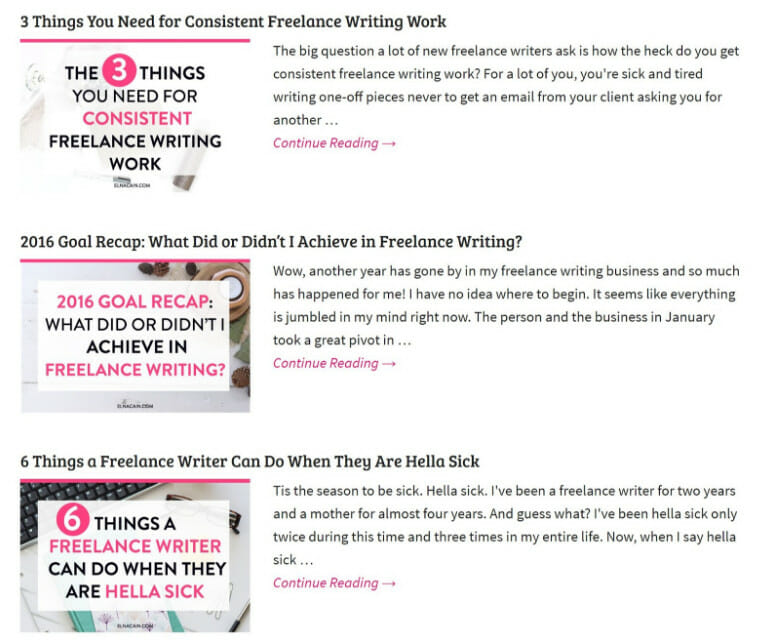
    Freelance writer Elna Cain’s blog is the perfect example of how to design images for social sharing. (Notice how the design is consistent with her branding, too!)

    2. Start a video series

    As long as you’re moving to a more visual blog, you might consider starting a scheduled video series. Video is hot.

    According to the statistics:

    • Facebook sees 8 billion video views per day.
    • Compared to text and images combined, social video gets 1,200 percent more shares.
    • Marketers who use video grow their revenue 49 percent faster than those who don’t.
    • By 2018, 79 percent of all internet traffic will come from video.

    Does that mean you have to swap your blog out for a vlog? Of course not.

    But seeing as Google favors videos (since they own YouTube) and it can improve SEO, incorporating video into your blogging strategy can help grow your traffic and engagement.

    If you don’t have one already, consider starting a YouTube channel and posting on relevant topics at least once a month. Another idea is to begin scheduling Facebook Live videos to engage your current fans.

    3. Write more niche content

    With a flood of online content hitting readers daily, it doesn’t pay to rehash old topics.

    To get noticed, you have to dig deep and write to a niche audience.

    blogging tips

    We’ve all read generic posts on beating writer’s block, haven’t we? Instead of writing about “Top 10 Ways to Beat Writer’s Block,” dig into one technique or tool. Talk about how to use yoga to beat writer’s block or how to teach yourself to lucid dream so you can brainstorm in your sleep.

    Be specific.

    Here are some ideas to help you come up with niche-focused ideas:

    • Look through lists you’ve written before. Recycle old ideas by focusing on a single list item.
    • Write about how a specific tool, app or technique can help solve a certain problem.
    • Tell true stories or highlight unique case studies.
    • Write timely pieces focusing on current news, trends, or developments in your industry.

    Be sure to keep a running list of ideas in Trello, on your phone or in a good old-fashioned notebook.

    4. Improve engagement

    Every blogger wants more followers, more comments, more newsletter subscribers, etc.

    Increasing engagement should be an ongoing goal of yours to grow your blog and increase profit (assuming you monetize your blog or want to in the future).

    The difference this year is that you’ll want to start measuring engagement if you aren’t doing so already. Things you can measure include:

    • Comments
    • Social shares
    • Social followers
    • Newsletter subscribers
    • Inbound links

    This year, measure it! If you want more comments on your blog, take a look at how many you’re averaging per post. Consider how much you want to average, when you’d like to achieve that goal, and how you’ll get there. For example, you might include questions at the end of every post and make a point to respond to every comment personally.

    Also think about how these smaller goals play into the overall goal of your blog. Are those comments turning people into leads and then into customers and boosting your profits?

    5. Set a work schedule

    As a blogger, it’s easy to get wrapped up in being online 24/7, but you have to take care of yourself as well as your blog. If you don’t, your blog will suffer.

    Make it a point to set boundaries this year so you can achieve work-life balance.

    That means setting a time that you’ll shut down your computer every night. It means taking a lunch break instead of eating in front of the computer. It means giving yourself permission to step away from the internet on the weekends and spend time with your family.

    This year, outline a work schedule, whether you blog full-time or are a hobby blogger. This will keep you from burning out so you’re more productive when you’re blogging.

    Remember when setting goals that they should be SMART: specific, measureable, achievable, realistic, and timely.

    It helps to write down your goals and share them with someone, whether it’s with a writing partner or your blog followers. Stay accountable by sharing your milestones and achievements with those same people.

    Start by sharing your 2018 blogging goals with us. Comment below with a specific goal you’d like to achieve by the end of 2018.

  • 10 Time-Wasting Blogging Mistakes That Hurt Your Reputation

    10 Time-Wasting Blogging Mistakes That Hurt Your Reputation

    You’ve been blogging for a while.

    You’re putting in the hours and trying to make sure every post is valuable to your readers. In short, you’re working harder than you’ve ever worked before.

    Yet, for some reason, things aren’t going as planned. You have the content, but you’re not getting any engagement. No comments, a couple of shares…and traffic is down.

    It’s easy to get frustrated in these situations. When you’re genuinely working hard and not getting the return on investment, sometimes it’s a sign you’re not channeling your energy the right way.

    Want to hear the good news? It’s never too late to change your strategy.

    Here is a list of blogging mistakes you could be making — and how you can change them!

    1. You think you need X amount of subscribers before selling

    Vanity metrics are everywhere. From Twitter followers to share counts on articles, we are very much used to numbers dictating our work’s worth.

    But there’s no rule stating you need X amount of subscribers or traffic before selling your services.

    When you start making money, you can invest more time and energy into running a website that looks professional and attracts more people. This will allow you to outsource and delegate responsibilities to people who know the ins and outs of web design.

    This doesn’t mean that your blog has to become a sales pitch. Offer your services without overdoing it!

    2. You think you need to be on every social network

    This is an easy trap to fall into.

    In fact, there are multi-million dollar companies that still make this mistake. While a social media presence is necessary, you need to understand that social media requires a lot of time and attention.

    Making social media work effectively means that you have to invest time and energy into the networks that your audience actively uses. Why spend time on Pinterest if they’re using Instagram?

    Choose a maximum of three channels you can dedicate a reasonable amount of time to. Focus on building relationships with people, share their work as well as your own and set aside time to reply to people’s requests.

    Don’t bite off more than you can chew. It’s better to be amazing on three networks than mediocre across six.

    3. You try too hard to be clever or funny

    Above everything, your content must be understandable.

    Using big 10-letter words does not make you exceptionally clever. Forcing humor into every paragraph doesn’t make you funny.

    Focus on clarity.

    Put it this way: If a reader has to pause to think about what you’re trying to say, they’ll get bored and leave. No matter how valuable your advice may be, when the internet is full of articles that get to the point quickly and easily, your reader will just go running to them.

    Don’t turn people away by intimidating them with complicated language or using painfully cliche humor.

    Keep it simple and clear, and drop in some funnies when you can!

    4. You overpromise and underdeliver

    “10 of the best tips from industry professionals.”

    “Double your blog traffic in a day.”

    “Go from 9-5 to freelancer in an instant.”

    You’ve given them the bait by nailing the headline. But is your content actually delivering the promise that you’ve made?

    Understand that blogging is its own form of relationship building.

    Constantly disappointing readers will only hurt your reputation in the long run. Instead of being a reliable source of information, you’ll be known as a person who offers clickbait.

    If you’re getting traffic and not seeing a steady increase in subscribers, consider whether you’re providing the value your audience seeks.

    5. You think blogging is easy

    People often consider blogging as something that can simply be done in their free time. They think it doesn’t require a great deal of energy or attention.

    Writing articles people want to read is hard work.

    You don’t have a management team to turn to if you’re feeling unmotivated and want some support. You don’t have IT on site to run to when there’s a technical difficulty. You don’t have a brand name to rely on.

    Blogging means you have to grind, hustle and push through obstacles by yourself.

    When you make mistakes, you’ve got to pick yourself back up again. Blogging is a lot of things, but easy is not one of them.

    6. You didn’t consider whether you would enjoy writing when it came with a deadline

    Many people consider blogging as a hobby. This means that you have the option to write at your own pace, have no one to answer to when you make a typo and can hit the publish button… well, whenever!

    If you want to monetize your work, blogging is not a side project. You have to produce high quality, creative work on tight deadlines.

    Not in the mood to write 500 words?

    There’s no time to wait it out when your readers are expecting your posts to be published every week. Spend some time creating a sense of structure for yourself.

    You don’t have to create an annual content calendar! Just set deadlines that are within your means and measurable. That way, when the work-load does begin to increase, you’re able to manage it.

    7. You don’t have goals or aren’t measuring them

    Do you want to have contributing writers? Have you planned on guest posting? If so, where?

    How many of your contacts have found you via search, social media, or referrals?

    If you want to turn blogging into a source of income, you have to know your what channels produce the greatest returns. Before you even start thinking about that, set up some objectives to give yourself a sense of direction.

    8. You think you know what great content is

    You’ve spent hours toiling over a single article, hit publish and expect the likes, comments and shares to come rolling in.

    But instead you get this:

    via GIPHY

    This isn’t always easy to accept, but you don’t define what great content is. Your readers do.

    Try to understand your readers, what emotions they relate to, the humor they appreciate and the advice that they need right now.

    Listen. Pay attention to the content that does grab people’s attention and start producing more of it!

    9. You don’t make an effort to network or build a personal brand

    With over 42.6 million WordPress blogs published every month, you need more than a few well-written articles to stand out.

    Knowing people helps. A lot.

    Knowing the right people is a blessing, but that takes time.

    Networking isn’t always easy, but it’s necessary for any business.

    The more people you get to know and actively make an effort to stay in contact with, the more exposure you’re likely to get.

    Don’t forget, referrals are also a significant factor in reputation management. If other people recommend your services, send them a thank you note or offer them a freebie.

    10. You don’t have a way to tackle blogger’s block

    We all have moments where our creativity (momentarily) runs dry.

    And there is absolutely nothing wrong with getting blogger’s block. It’s all part and parcel with the work. But you have to know how to tackle it straight away and rekindle your flame.

    If you want to start turning your blog into a source of income, you can’t afford to go off the grid for weeks at a time. Create a plan that allows you to take a short break, but soon get back to writing. Get into the habit of keeping yourself motivated and staying productive, even when you don’t feel like it.

    The only way to truly learn is to do. Mistakes are all a part of the learning curve and you the ability to get better.

    Mistakes are just evidence that you’re trying more than most. Don’t let any small faults go to your heart.

    Keep going. Because the end result will be worth it.

    Which of these blogging mistakes have you made? How did you recover?

  • Think Rules are Made to be Broken? Ignore These Popular Blogging Tips

    Think Rules are Made to be Broken? Ignore These Popular Blogging Tips

    Rules? Yeah, they’re made to be broken.

    In the world of writing, blogging and online marketing, there are a lot of rules and best practices shared by experts and novices alike.

    It can be confusing as a new or even seasoned writer to determine which rules are worth following and which rules might be beneficial to break.

    Finding success online as a writer is certainly not a one-size-fits-all equation. Sometimes it’s smart and strategic to ignore popular advice and go with your gut. There are many different approaches, strategies and tactics to pave a path as a writer.

    Be a rebel! Here are some popular online writing rules worth breaking and stories from successful bloggers who broke them.

    Rule #1: You must select a niche

    This is hands-down the single most popular piece of advice I hear bloggers wax poetic about: Find a niche to build an audience and grow your blog, rather than keeping your content more general.

    After years of niche blogging (one lifestyle blog, one travel blog and one book review blog) I decided “the hell with it!” I’m a multi-passionate person with many interests and I wanted my blog to reflect me as a person. I wanted to build a brand around my name and personality, not a specific interest or area of expertise.

    So, I did. My blog’s general umbrella topic is stepping outside of your comfort zone to reach your goals, but tons of different subjects fit nicely under that more generic concept. And for nearly four years, this approach has worked for me, building a community more than 1,000 strong that allowed me to eventually quit my job to work for myself.

    Instead of cornering yourself into a tiny niche that you may lose interest in, write about the subjects you’re passionate about. Your readers will connect with you more when it’s clear you’re excited about your topic of choice.

    Rule #2: Don’t build your house (or blog) on rented land

    Licensed therapist, coach and writer Melody Wilding has spent the majority of her career rebelling against the traditional way of doing things. That same mindset applies to her blog strategy.

    “I’ve bucked the rule that says ‘don’t build your house on rented land’ or in a nutshell…the prevailing marketing advice that encourages people to build their own blog readership from scratch.”

    As Melody explained, many online marketers encourage newbies to spend the majority of time and effort building their own website, blog and platform, keeping your best content permanently on your online home. Instead, Melody grew her following by leveraging other people’s platforms, audiences and authority to grow her own.

    “Through strategic guest writing and becoming a contributor for major sites when I was first starting out, I 10x’d my audience in a fraction of the time it would have taken me to do on my own,” she explained. “Then, I also had some big names behind me that I could further leverage to grow my audience and subscribers.”

    Fun fact: Melody didn’t even have a blog on her website during her first two years in business, but was still able to successfully grow a following through guest blogging and building an email list.

    Rule #3: It’s all about SEO

    Another popular piece of blogging advice is to make your post as SEO-friendly as possible to ensure the maximum amount of people can find your content when they search on Google. Your headline matters and your post should be scannable with bullets, lists or sections, they say.

    Yes, SEO is important, but when you try to fit your content into a pretty little SEO-happy box, you sometimes leave little room for creativity and personality.

    Many popular blogs recommend crafting post headlines that are quick, to the point and simply explain what the post is about, rather than using a catchy or emotion-driven headline.

    Meanwhile, Mary Catherine Starr of StarrStruck Blog says that she often breaks this rule by writing posts with headlines that her readers will like and understand, but may not necessarily be SEO-worthy.

    Bloggers also recommend writing short, succinct and easily scannable posts by using bullets, sections or creating a list-based post. Mary Catherine says she is proud of her longer, more personal posts that aren’t necessarily formatted as a list or with bullets.

    “Catchy, trendy posts aren’t my style and while they may be a great way to get lots of new visitors or eyes on my blog, I’d rather stay true to what feels authentic to me, even if it won’t make me as popular,” she said.

    Rule #4: Long-form content is where it’s at

    Long-form content is very trendy right now. It makes sense; as this KissMetrics post suggests, “long-form content gets you more of what you want.”

    However, there are definitely times shorter posts can come in handy and be just as useful to your audience as a 4,000 word ebook.

    “When the topic’s right, I’m big on breaking the ‘longer is better’ rule that’s oh-so popular right now,” explains Brittany Berger of Blog Bolder. “Sometimes the topic I’m writing about can be explained clearly in less than ‘the magic 1.5K.’ Continuing to write for the sake of SEO and shares when I’ve already given the reader what they need feels like putting my wants and needs above theirs.”

    Not every blog post you write needs to be an epic, all-encompassing guide or tell-all. If you can get your point across succinctly, do that.

    Rule #5: Monetize your blog as quickly as possible

    A lot of bloggers get in the game because they think they will be able to make a lot of money through their blog or website. Making money online is a great long-term goal to set, but goals like creating awesome content and developing a loyal community should come first.

    Geekadelphia editor-in-chief Mikey Ilagan said, “We’ve been around for nine years and have given a voice to things people might not have heard about otherwise. We actually rejected monetization for the longest time. Now, our Patreon sustains our servers, but building the blog and community was never a financial venture.”

    Instead of chasing the money, chase your community. Build a community that loves you, your content and your brand first and then consider adding monetization into the mix.

    Rule #6: Don’t get too personal on your blog

    You want to be seen as a professional, right? Then, don’t get too personal on your blog. At least, according to some experts.

    Right now, lots of bloggers are talking about the importance of delivering value to your readers. While I don’t disagree with offering your audience value, what about simply sharing good stories that help readers to connect?

    This is the approach The Write Life contributor Marian Schembari has taken with great success, even leading to new clients.

    “The fact that I post about my personal life has been positive,” she shared. “For a long time I worried that posting about my marriage or about money or travel would ruin the brand I’d created as a writer. But really, new clients love sharing stories too, just like normal humans. Now I’m known as a “storyteller” and have had a few new client requests come through from people who want me to share their stories.”

    Rules? Yeah, they’re definitely made to be broken.

    The only rule that always has and always will apply — and we think you should follow this one! — is to be yourself and do you.

    When you’re true to yourself online, your authenticity shines through and your readership will take note, allowing you to grow genuinely and organically.

    Have you broken any popular blogging or writing rules? Tell us all about it in the comments!

    bloggingmyths