Tag: how to pitch

  • 5 Simple Steps to Write a Headline Your Editor Will Love

    5 Simple Steps to Write a Headline Your Editor Will Love

    Are you sending off query letters to magazine or blog editors, but never hearing a peep back?

    It’s a common problem. Often, the problem has to do with your headline.

    And, if you’re sending pitches that don’t mention a proposed headline, this might be your first problem — editors tend to skim through queries, looking for the headline. If they see none, they might assume your idea hasn’t quite gelled yet, and move on.

    Now that you know you need to include a headline in your pitch, how can you make it one your editor will love? 

    I’ve pitched both popular blogs and national magazines with success, and run a guest-post program for my own blog, so I’ve been on both sides of the fence here. Over the years, I’ve learned there are some basic things to do to build a fascinating headline that gets you hired.

    What are they? Here are five simple steps to make your headline irresistible to editors.

    1. Bring the style

    Your starting point for creating a great headline is always to study the headline style of your target publication. Study, study, study.

    How long are their headlines? Are they businesslike, snide, sassy or hip? 

    Skim until you have a sense of their headline conventions and tone. Then, emulate their style in your headline.

    Research is key because headline conventions vary a lot. With blog post headlines, you’re usually looking for a snappy, 8-10 word headline. For instance, here’s one I did for my Forbes blog that ended up pulling huge traffic:

    “Meet the 8 Hottest Publicly Traded Marijuana Companies”

    By contrast, magazine article headline style can be a very short headline, followed by what editors call a ‘dek,’ a longer line that fleshes out the idea. For instance, here’s the headline of a piece for Delta Airlines’ in-flight magazine, Delta Sky:

    “The Do’s and Don’ts of Franchising: What potential franchisees need to consider about timing, industry choice, finances and more before they decide to take the plunge”

    Know and use the style of your target publication, and your editor will be able to envision your article appearing in their pages. 

    That’s the first step to getting a ‘yes.’

    2. Include keywords

    You might think search engine optimization (SEO) would only matter for online blogs and publications — but you’d be wrong. Increasingly, print magazines are also posting their content online. 

    That means they care about using phrases their audience might search for the topics they cover. They’re looking to have each headline help them attract more readers.

    When I wrote pieces for Forbes magazine that they also posted online, my editor had me write a different headline for the online version — one with better keywords. If you know your magazine swings both ways, suggesting two headline styles can be a pro move.

    There are plenty of free keyword search tools online – AnswerthePublic and Neil Patel’s UberSuggest are two popular ones I like. Pick your favorite tool, think like a reader and take a stab at using relevant keywords.
    3. Hook ‘em

    If you want your headline to really get your editor excited, it’ll need to have a news hook.

    What’s a news hook? It’s something new that makes your idea need to be published now. It signals you have fresh information that we haven’t already seen 100 times online. 

    The news hook gets your editor thinking, “This must run in the next issue!” instead of “Well, maybe this could work sometime.”

    To interest an editor, you’ve got to move beyond generic headlines like: “5 Reasons Eating Vegan Will Improve Your Health.” We’ve read that story already. A lot.

    Find a fresh spin. Is there a new study about vegans’ health? A new celebrity going vegan? Gotta give that editor a new angle on this popular topic. 

    A news hook might be one new fact that’s emerged in an ongoing story — the coroner’s report was released, or a new candidate has entered the race. It could be an anniversary of a major event. A year (or a decade) after the big earthquake, fire or flood. As I write this, there are lots of “Amazon turns 25” stories, for instance.

    Getting a news hook into your headline is an easy way to get your editor excited.

    4. Narrow the focus

    Another quick way to show you ‘get’ the publication is to narrow your topic by weaving the audience into the headline. 

    So it’s not “5 Reasons Eating Vegan Will Improve Your Health”, but “3 New Studies on Vegan Diets That Parents Need to See.”

    Now, we’ve zeroed in on who this publication’s readers are. Showing that in your headline lets the editor know you really get their audience — and makes them more likely to assign you a story.

    5. Be fresh

    The final step in creating a headline that gets editors interested is to get creative, especially if you want to cover a popular topic. What can you add that makes the headline fascinating to readers? How can you signal, right in the headline, that you have information not found elsewhere? 

    For instance, after Fiverr bought rival freelance intermediary platform ClearVoice, there were loads of stories about it. I wanted to cover it on my own blog, but how to be different? The answer was to interview their CEO. 

    Then, I built a headline that spotlighted my unique coverage of this business news: 

    “Fiverr Buys ClearVoice: Their CEO on the Future of Online Writing”

    Conducting interviews for your article is something magazine editors will expect – so start thinking about sources. Practice with a friend, if you have interview jitters! 

    Writing great headlines takes practice. Allow time to experiment with your headline and perfect it, and it’ll pay off with more assignments.

    This post contains affiliate links. That means if you purchase through our links, you’re supporting The Write Life — and we thank you for that!

    Photo via Pressmaster/ Shutterstock 

  • How to Write a Pitch That Will Make Editors Say YES

    How to Write a Pitch That Will Make Editors Say YES

    If you don’t ask for the work you want, you’ll never get it.

    Let’s look at how to improve the way you ask for that work.

    We’re going to focus on pitching articles, blog posts and stories. Pitching isn’t the only way freelancers get gigs — I’ve gotten jobs by submitting a resume and clips, as well as by completing a sample assignment — but it’s one of the most common.

    If a job wants you to submit a resume and clips, it’ll say so in the application guidelines. For everything else, including the majority of the blogs and online publications out there, you’re going to need to get really, really good at pitching.

    [sps_reusable_block post_id=43047]

    So how do you write a good pitch?

    If you’re pitching a publication with a set of submission guidelines, start there. A lot of publications tell you exactly what they want.

    Be aware that the submission guidelines are sometimes hidden under “Contact” or “FAQ,” and it never hurts to search “[PUBLICATION] submission guidelines” if you can’t find anything on the outlet’s website.

    Sometimes editors write blog posts or tweets describing what they want in a pitch. If you’re interested in working with a specific editor, it doesn’t hurt to search their name plus words like “submission,” “submission guidelines” and “pitch me.”

    Get clear on the story you want to tell

    Once you’ve figured out what submission guidelines to follow, the next step is to get really clear on your story.

    One of the most common mistakes people make is failing to state the story they want to tell.

    What do I mean?

    Well, writers often say they want to write about something. “I want to write about Famous Person X.” “I want to write about gender in the workplace.” That’s an idea, not a story.

    By the time you pitch, you should have enough background research to be able to pull the story out of your idea, as follows:

    Hit Musical Hamilton Is Great — But Is It Addictive? Just about everyone I know is obsessed with Lin-Manuel Miranda’s new musical Hamilton, to the point that we’re listening to the 2-hour 22-minute cast recording nearly once a day. What makes music like this feel addictive, to the point where the first thing we want to do after finishing the album is start it at the beginning again? I’d reach out to a musicologist and a psychologist for their thoughts on the nature of addictive music.

    That’s a real pitch I sent to Popular Science, which they accepted. Notice how my pitch included not only the story, but also the method by which I plan to research the story?

    Writers often skip this step, but adding a sentence or two describing your methodology shows an editor that you’re serious about your idea. It also lets an editor know that you have a plan of action, and that your finished draft will be backed up with both sources and substance.

    Not all stories require research, of course. Personal essays, for example, don’t necessarily need a methodology statement. But too many writers pitch stories as if they were personal essays: “My thoughts on why Hamilton is addictive,” for example.

    No editor cares about my thoughts on Hamilton. They care about a music expert’s thoughts on Hamilton, crafted into an eye-catching story that promises a reader an answer to a question they’ve probably asked themselves: Why can’t I stop listening to this album?

    That bit about promising the reader an answer to a question they’ve probably asked themselves? That’s the pitch’s benefit. Whenever you craft a pitch, think about how it will benefit the publication’s audience.

    Will it give them the answer to a question? Will it prompt a discussion in the comments? Will it ask them to think differently about a common experience?

    You don’t need to state your benefit directly in the pitch — in fact, please don’t write “this story will prompt a discussion in the comments” — but it’s important to consider the benefit as you put your pitch together.

    After all, publications aren’t interested in what you want to write. They’re interested in what their readers want to read.

    Lastly, my Hamilton pitch was only a paragraph long because I had already built a relationship with one of Popular Science’s editors. If you’re pitching a publication for the first time, put a short bio at the end with links to a few relevant clips that — you guessed it — establish expertise in your beat.

    Here’s a sample pitch

    Here’s a sample pitch to review, so you can see exactly what a solid pitch looks like.

    Writing a sample pitch email is tricky because every publication has slightly different guidelines. With that in mind, here’s what a good pitch email might contain:

    SUBJECT LINE: Check the publication for guidelines. I often write “PITCH: [HEADLINE]” in the subject, e.g. “PITCH: Are Dogs Better Pets Than Cats?”

    SALUTATION: You can go with the formal “Dear [EDITOR]” here, although I often just start my emails with “Hi!”

    INTRO PARAGRAPH WITH HEADLINE: Introduce your relationship to the publication, if relevant, and your pitch’s suggested headline. (I got the “always add a suggested headline” advice from Carol Tice.)

    STORY AND METHODOLOGY PARAGRAPH: Briefly explain your story and the methodology by which you will tell it.

    BIO PARAGRAPH: Share a bit about yourself and link to relevant clips.

    NAME AND CONTACT INFO: Thank the editor and “sign” the email with your name and contact info.

    Hi! I’m a huge fan of Dogs and Cats Daily — I comment as DogFan27 — and I wanted to pitch a story that I haven’t seen on the site but I think your readers will appreciate: Are dogs better pets than cats?

    This story will look closely at three different families, each of whom have dogs and cats in the home. I’ll interview each family, asking them to share stories about their pets’ behavior and comment on which pets they enjoy interacting with most. I’ll also interview a veterinarian and a pet psychologist to learn more about animal behavior and discuss whether dogs or cats make better pets for certain personality types.

    I’ve previously been published in Dogs Are Great Monthly and I Love Cats Magazine. My clips include: “10 Things You Didn’t Know About Puppies,” “Cats Are Purrfect,” and “Do Dogs or Cats Save More Lives?”

    Thanks for considering my pitch!

    Goldie Retriever

    GoldieRetriever.com

    @DogFan27

    Pitching can be tricky, but it doesn’t have to be such a daunting task. Do your homework and follow this simple email pitch formula and you’ll be well on your way to getting an editor to say “yes” to your idea.

    [sps_reusable_block post_id=43047]

    Photo via Rawpixel.com / Shutterstock 

  • 5 Useful Pitching Tips for Targeting a New Publication

    5 Useful Pitching Tips for Targeting a New Publication

    Even if you have plenty of great clients, you probably have your eye on at least another publication or two where you’d like to see your byline.

    Whether it’s a new publication, a dream publication, or just one you think might be a good fit, you’ll want to do your research and tailor your pitch for the best chance of success breaking into a new market.

    When I recently found a new-to-me publication I wanted to write for, I took specific steps to pitch, and eventually placed an article. Here’s what I recommend.

    1. Learn about the publication

    Whether you see the publication on your local newsstand or hear about it online, it’s useful to find out as much as you can before pitching.

    When I heard about an intriguing publication through a connection, I decided to do a little research to see if it was a good fit. I took a peek at the publication and I also asked around to see what types of experiences other freelance writers had with that publication.

    When I heard positive feedback from people who had worked with the publication, I decided to forge ahead.

    Sometimes other writers may warn you about a negative experience they’ve had with a publication or editor and, while it’s always up to you, it’s often useful to at least consider what you’ve heard from other writers. It’s amazing what you can learn by simply talking to colleagues.

    [twl_reusable_block post_id=41455]

    2. Do your homework

    Before I pitched the publication, I spent some time looking through its website. I wanted to see what kind of articles they usually ran and how they approached different topics.

    You will also want to study the publication enough to demonstrate that you are familiar with what they cover. If there’s a particular department or section that you think your idea would be a good fit for, be sure to mention that in your pitch. Editors like to know you’ve done your homework.

    It also pays off to see if the publication has covered your idea recently.

    If they have, unless you have a unique and timely perspective on the same topic, you might be better off pitching that idea elsewhere.

    pitching tips 3. Hone your angle

    My first pitch included three potential angles on an event happening in my region.

    When pitching a publication for the first time, it’s often helpful to use your specialized knowledge, whether that’s a certain niche or the area where you live, to demonstrate that you are the best writer to cover that particular story.

    While any writer could cover a more generalized story, you want to show the editor that you are the best person to cover this particular story because of your unique qualifications.

    4. Find your editor

    Now that you know what publication you’d like to pitch and what you’d like to write about, it’s time to figure out who to present your idea to.

    There are a number of ways to find the right editor, but it often involves a bit of trial and error.

    If you can reach out to your network to see if anyone knows a specific editor to refer you to, that’s great. If you can find out who edits that beat or section, pitch that person.

    I didn’t know which editor to pitch, so I scanned the masthead. Publications have a variety of different titles for their editors including managing editor, senior editor, editor in chief, associate editor and assistant editor.

    I couldn’t find specific guidelines on who to pitch, so I picked a mid-level editor and prepared my pitch.

    If you’re not sure you have the right editor, some writers find it helpful to include a line along the lines of “I’d love if you could help me direct this pitch to the appropriate editor.” While busy editors may not always have time to respond with this information, you’ll gain very valuable information if they do.

    5. Present it right

    Once I found the editor I wanted to contact, I composed an email with a quick note of introduction including a few relevant clips and a link to my website. Then, I pitched my ideas in a few short paragraphs.

    Be sure to check the publication’s writers guidelines for instructions before sending your pitch. There might be an email address just for submissions, or it might mention important pitching guidelines to keep in mind.

    I heard back quickly. The editor liked my idea and was able to assign me a short article in an upcoming issue.

    But the catch was the deadline was coming up fast and my copy was due the following day. I shuffled around a few things in my schedule and was able to turn the story around quickly and land my first article in the publication.

    With any publication, it pays to do your homework, but with a new publication, it’s especially important. You want to make the right first impression, so make sure your pitch reflects your top-notch writing skills.

    Sometimes it just comes down to a bit of luck and good timing. If I had pitched my idea a couple days later, there’s a good chance it would have been too late for the publication since it was a timely topic.

    If your first idea isn’t accepted, don’t give up—keep pitching.

    Have you ever pitched a new market? Tell us about your approach in the comments.

  • The 3 Biggest Pitch Mistakes This Editor Sees Every Day

    The 3 Biggest Pitch Mistakes This Editor Sees Every Day

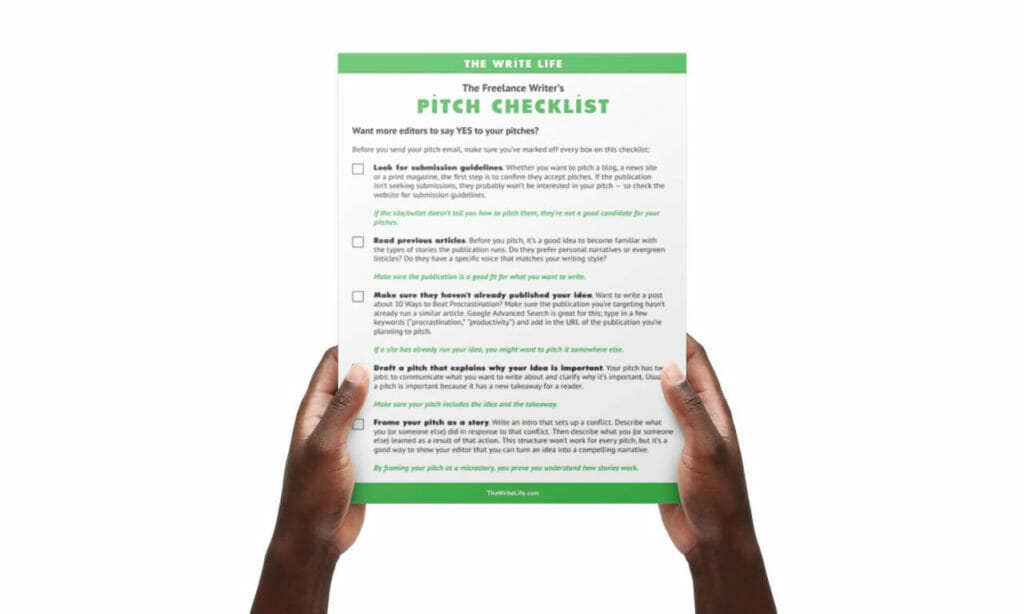
    The Write Life wants to help you get better at pitching! Grab our freelance writer’s pitch checklist. 

    As an editor, I read a lot of pitches.

    Some of them are really easy to say yes to — they’re the pitches that outline a strong, clear narrative with a takeaway for the reader. Other pitches are easy to say no to — they’re either poorly written, irrelevant to the publication or (as is often the case), both.

    It’s the ones in between that are hard.

    Every day I see writers pitch ideas or topics that could be great stories if they’d done a little more work or written a slightly better pitch. Sometimes I ask them to rework their pitch.

    Sometimes I take a chance and hope there’s a good story in there. But often, I say no. After all, I have plenty of better pitches in my inbox.

    Pitch mistakes even good writers tend to make

    If you’re a writer who’s sending out pitches but not getting a lot of assignments, maybe you’re writing those in-between types of pitches, the kind that could be really good with a little improvement.

    Here are three of the most common pitch mistakes I see every day, along with how to fix them.

    1. Do your “exploring” before you pitch

    If there’s one word I hate to see in a pitch, it’s “explore.”

    A writer who wants to explore an idea is a writer who doesn’t know what they want to write yet.

    These are the kinds of pitches that sit in my inbox for days because the writer usually wants to explore something interesting — but I don’t know if that exploration will result in a good story.

    I understand you don’t want to do a lot of work before pitching an article that might never get picked up. But instead of writing this:

    Now that the Ringling Bros. and Barnum & Bailey circuses have officially closed, I’d like to explore what happens to the animals after the circus shuts down.

    Try this:

    What does retirement look like for a circus elephant? Can an unemployed hoop-jumping dog get a job in Hollywood? The Ringling Bros. and Barnum & Bailey circuses ended their 146-year run this summer, and this piece will look at what the future might hold for the big top’s animal employees.

    In both cases, the writer hasn’t yet done the research required to answer the question. But the second pitch proves that the writer has thought about a few possibilities and has moved past the exploration stage.

    If you’d like to learn more about how to pitch a piece that requires research, including when and how to list sources, check out our Pitch Checklist

    2. If you’re pitching a personal narrative, put the narrative into the pitch

    When I see a pitch like this:

    I’d like to pitch a story about the summer I interned at the circus.

    My immediate response is: okay, pitch me that story.

    If you’re pitching a personal narrative, make sure your pitch includes the narrative. The beginning, the middle and the end.

    Ever since I was a kid, it was my dream to run away and join the circus. So, when I was in college, I did the next best thing: I signed up for an internship. I knew that circuses took a lot of work, but I didn’t realize that I’d be balancing three rings of retail, company management and customer service all at once. And, like the elephants, I was getting paid peanuts.

    Did I learn a lot that summer? Yes — including the fact that the circus life was not for me. But I still use the skills I learned while ringing up T-shirts and cleaning up empty cotton candy bags, and I’ll never forget the nights I spent under the big top.

    Notice that this second pitch also uses the type of language I’d expect to see in a finished piece. Metaphor, imagery, even a bit of humor. Don’t be afraid to let your writing style show — after all, editors are evaluating both what you pitch and how you pitch it.

    For more tips on pitching a personal narrative, read check out our Pitch Checklist.

    3. Don’t stop your pitch where your story begins

    Here’s one more common pitch mistake that I see almost every day.

    Writers send in detailed, well-written pitches that end right before the story begins:

    When I was six, the circus came to town. I spent the next week playing circus with my stuffed animals and trying to get my dog to jump through my hula hoop. Some kids would move on to another interest, but not me — I remained circus-obsessed for my entire childhood. By the time I was a teenager I could name the ringmasters of all the major circuses, and knew the history and symbolism of the different types of clown makeup.

    When I went to college, I knew I wanted to run my own circus someday. So, during my junior year, I got an internship with a local circus. That’s when I learned that although the circus had made everything seem effortless, running a circus took a lot of work.

    I’d like to write a 1,500 word essay about my internship and what I learned. I’ve previously been published at […]

    pitch mistakesSee how that pitch ends right when the actual story starts? The hula hoop anecdote and the clown makeup detail are exposition — and while it’s useful to know the backstory, I want to know why the internship is important, not why this writer fell in love with the circus.
    The personal narrative example, above, is a better way to pitch this piece. You could even frame the central conflict at the beginning of your pitch: “What happens when you achieve your childhood dream — and discover that you no longer want it?” That lets an editor know exactly what your story is going to be about, and whether it’s going to be a good fit for the publication.

    Here are a few more good pitching resources:

    How to Sell a Story That Relies on a News Peg

    Take This Scientific Approach For Your Next Freelance Writing Pitch

    Pitching Long-Form Journalism? Don’t Forget Your Goal

    The more you know about what editors are looking for when they go through the pitch inbox, the more likely your pitch will go from “maybe” to “yes” — and that’s good for both you and your editor, because you’ll get a new gig and your editor will get a great story.

    Writers: are you making any of these common pitch mistakes? Editors: any other pitching advice to share?