Category: Craft

  • How Writers Can Use Meditation to Build Focus and Productivity

    How Writers Can Use Meditation to Build Focus and Productivity

    When you think of meditation, what comes to mind? A yoga studio? Cheesy new age music?

    How about increased productivity and better writing?

    It’s true: meditation is scientifically proven to improve concentration, which can help you keep writing.

    Willpower: your secret weapon

    You sit down at your desk, ready to start writing. Perhaps you’ve even armed yourself with some fancy new apps to help you concentrate or keep you organized. Nothing can stop you now!

    Or can it? You blocked Facebook on your computer, but can you cheat with your smart phone? Perhaps you should grab a snack before you start writing or brew another cup of coffee. Before you know it, you’ve lost an hour of your day. Again.

    While tools and apps are helpful, in the end, willpower is what matters — and it’s the very thing many of us seem to lack.

    That’s because willpower is a finite resource. The more you spend keeping your hand out of the candy dish or staying calm on the phone with the cable company, the less you have left over to help you hit your writing goals, says Dr. Kelly McGonigal. The Stanford University psychologist released a book, The Willpower Instinct, based on her popular course “The Science of Willpower.”

    But can you actually increase your baseline supply of willpower? The answer is yes, and meditation is one of the best and easiest ways to do it.

    Meet your prefrontal cortex: home of the willpower you need to be productive

    The prefrontal cortex is the part of your brain right behind your forehead — the area you smack when you do something silly. As it turns out, there may be a good reason for this: the prefrontal cortex controls executive function, otherwise known as the power to connect your actions with their future consequences. That includes resisting temptation and working toward a previously-defined goal — like finishing that first draft.

    In short, the prefrontal cortex makes sure you’re doing the right thing, even when the right thing is hard to do.

    How does meditation fit into all this? Here’s the thing: meditation actually increases the gray matter in your prefrontal cortex. That’s right, meditation will strengthen your self-control, just like regular exercise will strengthen your heart.

    Think you’re “bad” at meditation because your mind always wanders? That’s okay. In fact, it’s more than okay. As Dr. Kelly McGonigal writes, “being ‘bad’ at meditation is exactly what makes the practice effective.” The act of reining your focus back in gives your prefrontal cortex the workout it needs.

    Here’s a challenge worth accepting: take just five minutes each day to meditate before you start writing. Record your progress toward your writing goals over the course of a week, including how many times you succumbed to tiny distractions like checking email or Facebook.

    New to meditation? Here are five easy steps to get you started:

    1.   Get comfortable. Find a position you can maintain for five minutes without getting sore or losing circulation.

    2.   Set a timer for five minutes and close your eyes.

    3.   Bring your attention to your breath. Say the words “inhale” and “exhale” in your mind as you take each breath.

    4.   As other thoughts begin to invade (and they will), calmly return to thinking about your breath. The key is to remain objective as you notice the distraction and refocus.

    5.   If you get tired of saying “inhale” and “exhale” to yourself over and over, try focusing on your breathing through what yogis call the three-part breath: first, fill your belly and lower abdomen with air. Then, on the next breath, fill your chest as well. Focus on the sensation of your ribs expanding. Finally, feel your collarbone and shoulders lift as your whole torso fills with the third breath. Repeat to your heart’s content.

    Ready to try a longer practice? Try the guided meditation exercise available as an mp3 on McGonigal’s website.

    You may feel discouraged if — or, more realistically, when — you still find yourself distracted and off-task despite your daily meditation. Try to take the long view. After all, you wouldn’t expect overnight success if you decided to lose 10 pounds and train for a 5k after not having exercised all winter. Your brain, like the rest of your body, needs time to get into shape.

    Daily meditation won’t work miracles, but it will hone your focus and willpower, which is exactly what you need to hit your word count goals.

    Do you meditate? How do you find it affects your writing?

  • Featured Writer’s Residency: The Mesa Refuge, A Writer’s Retreat on the Bluffs of Tomales Bay

    Featured Writer’s Residency: The Mesa Refuge, A Writer’s Retreat on the Bluffs of Tomales Bay

    This is part of our series on writer’s residencies, co-produced with the Alliance of Artists Communities. We feature residencies around the world, so you can learn about opportunities that might be a good fit for you! To search, compare and read about hundreds of residency opportunities, use the Alliance’s free online Residency Directory

    On the misty bluffs of Tomales Bay sits a residency unlike any other. The Mesa Refuge is a place for “writing at the edge,” one of few retreats in the world that focuses on writing about nature, economics and social equity. The breathtaking scenery, inspired spaces and supportive staff create an ideal setting for creative breakthroughs and productive work.

    Three writers are awarded no-cost residencies for each two-week session during the fall and summer. Writers are given private rooms, as well as the use of a shared kitchen, a library and a deck overlooking the bay. Since 1998, Mesa Refuge has hosted over 500 writers including Michael Pollan, Terry Tempest Williams, Frances Moore Lappé and Rebecca Solnit.

    Image: The Mesa Refuge

    Details

    Where: Point Reyes Station, California; overlooking Tomales Bay about one hour north of San Francisco.

    Who: The Refuge invites writers across disciplines to apply: essayists, journalists, economists, naturalists, screenwriters and authors of memoirs. Nonfiction projects are generally preferred.

    Size: Three writers are invited each session.

    Facilities: Each resident enjoys a private bedroom in a spacious shared house. There’s a shared printer but residents must bring their own computers and writing supplies. Dial-up internet access is available for a fee.

    Image: The Mesa Refuge

    Time frame: Two week sessions offered in the fall and spring.

    Cost: There is no cost to residents, though donations are accepted.

    Food: Most dinners are provided and residents can access the shared kitchen.

    Application deadline: June 2, 2014 for September to November residencies.

    Application requirements: Project statement, bio, resume, references and work samples, plus a $25 application fee. Here’s where to apply.

    Image: The Mesa Refuge

    What residents have said: “The landscape of sky, marsh, and bay flowing to the sea helped concentrate my mind. I loved the quiet. I loved the wild garden overlooking the wetlands below and the hundreds of birds circling above. It is rare and wonderful to feel so quietly cared for — so completely supported and encouraged.”

    Plus: Residents can take advantage of the spectacular setting with opportunities for hiking, kayaking, beachcombing, bicycling, bird watching, yoga, gardening, tennis and table tennis.

    Would you consider applying to The Mesa Refuge?

    All photos are courtesy of The Mesa Refuge and were taken by Sarah Hadley.

  • The Weird Strategy Dr. Seuss Used to Create His Greatest Work (And Why You Should Use It Too)

    The Weird Strategy Dr. Seuss Used to Create His Greatest Work (And Why You Should Use It Too)

    In 1960, two men made a bet.

    There was only $50 on the line, but millions of people would feel the impact of this little wager.

    The first man, Bennett Cerf, was the founder of the publishing firm, Random House. The second man was named Theo Geisel, but you probably know him as Dr. Seuss. Cerf proposed the bet and challenged that Dr. Seuss would not be able to write an entertaining children’s book using only 50 different words.

    Dr. Seuss took the bet and won. The result was a little book called Green Eggs and Ham. Since publication, Green Eggs and Ham has sold more than 200 million copies, making it the most popular of Seuss’s works and one of the best-selling children’s books in history.

    At first glance, you might think this was a lucky fluke. A talented author plays a fun game with 50 words and ends up producing a hit. But there is actually more to this story and the lessons in it can help us become more creative and stick to better habits over the long-run.

    Here’s what we can learn from Dr. Seuss…

    The power of constraints

    What Dr. Seuss discovered through this little bet was the power of setting constraints.

    Setting limits for yourself — whether that involves the time you have to work out, the money you have to start a business, or the number of words you can use in a book — often delivers better results than “keeping your options open.”

    In fact, Dr. Seuss found that setting some limits to work within was so useful that he employed this strategy for other books as well. For example, The Cat in the Hat was written using only a first-grade vocabulary list.

    In my experience, I’ve seen that constraints can also provide benefits in health, business, and life in general. I’ve noticed two reasons why this occurs.

    1. Constraints inspire your creativity

    If you’re five foot five inches tall and you’re playing basketball, you figure out more creative ways to score than the six foot five inch guy.

    If you have a one-year-old child that takes up almost every minute of your day, you figure out more creative ways to get some exercise.

    If you’re a photographer and you show up to a shoot with just one lens, then you figure out more creative ways to capture the beauty of your subject than you would with all of your gear available.

    Limitations drive you to figure out solutions. Your constraints inspire your creativity.

    2. Constraints force you to get something done

    Time constraints have forced me to produce some of my best work. This is especially true with my writing. Every Monday and Thursday, I write a new article — even if it’s inconvenient.

    This constraint has led me to produce some of my most popular work in unlikely places. When I was sitting in the passenger seat on a road trip through West Virginia, I wrote an article. When I was visiting family for the 4th of July, I wrote an article. When I spent all day flying in and out of airports, I wrote an article.

    Without my schedule (the constraint), I would have pushed those articles to a different day. Or never got around to them at all. Constraints force you to get something done and don’t allow you to procrastinate. This is why I believe that professionals set a schedule for their production while amateurs wait until they feel motivated.

    What constraints are you setting for yourself? What type of schedule do you have for your goals?

    Related note: Sticking to your schedule doesn’t have to be grand or impressive. Just commit to a process you can sustain. And if you have to, reduce the scope.

    Constraints are not the enemy

    So often we spend time complaining about the things that are withheld from us.

    • “I don’t have enough time to work out.”

    • “I don’t have enough money to start a business.”

    • “I can’t eat this food on my diet.”

    But constraints are not the enemy. Every artist has a limited set of tools to work with. Every athlete has a limited set of skills to train with. Every entrepreneur has a limited amount of resources to build with. Once you know your constraints, you can start figuring out how to work with them. (Click to tweet this idea.)

    The size of your canvas

    Dr. Seuss was given 50 words. That was the size of his canvas. His job was to see what kind of picture he could paint with those words.

    You and I are given similar constraints in our lives.

    You only have 30 minutes to fit a workout into your day? So be it. That’s the size of your canvas. Your job is to see if you can make those 30 minutes a work of art.

    You can only spare 15 minutes each day to write? That’s the size of your canvas. Your job is to make each paragraph a work of art.

    You only have $100 to start your business? Great. That’s the size of your canvas. Your job is to make each sales call a work of art.

    You can only eat whole foods on your diet? That’s the size of your canvas. Your job is to take those ingredients and make each meal a work of art.

    There are a lot of authors who would complain about writing a book with only 50 words. But there was one author who decided to take the tools he had available and make a work of art instead.

    We all have constraints in our lives. The limitations just determine the size of the canvas you have to work with. What you paint on it is up to you.

    Have you tried adding constraints to your writing process?

    This article was originally published on JamesClear.com.

  • Want to Join a Writing Group? 8 Places to Look

    Want to Join a Writing Group? 8 Places to Look

    Finding a helpful writing group can sometimes feel as difficult as navigating the messy middle of your writing project. But the rewards for finding a group are numerous.

    A writing group can help point out inconsistencies in your work, provide encouragement, ask questions and hold you accountable to your writing goals. When we belong to a supportive community, we are able to accomplish more.

    How to find a writing group that’s right for you

    So where do you find these people?

    Here are a few ideas for where to look for a writing group.

    1. Local writing centers and communities

    Usually a quick Internet search with your city and “writing groups” will yield some results. Attend the group, meeting, or class and see if the group feels like a good fit.

    2. Conferences

    Sharing your contact information with other writing conference attendees is a great way to expand your writing community. I was invited to join my current writing group after meeting a member at a writing retreat.

    3. Bulletin boards

    There is still a lot to be said for this old school method of finding people! Post a sign at your favorite coffee shop, outside the writing department at your local college, or even on Craigslist. Create a process for vetting individuals or groups to determine if they are a good fit for your writing style – or not.

    4. Writing associations

    Professional associations such as Romance Writers of America and Mystery Writers of America have chapters throughout the country. Check their sites for directories to find other members in your local area.

    5. People you already know

    Many people want to write a book. Eowyn Ivey, shortlisted for the 2013 Pulitzer Prize with her first novel, The Snow Child, exchanged work on a weekly basis with her mother, Julie Hungiville Lemay, an accomplished poet.

    Most of us don’t come from writer families, but this doesn’t matter; the key is establishing a routine for a regular exchange of work. It can often be easier with someone with whom you have weak ties. Consider coworkers, neighbors, or acquaintances.

    6. Meetup.com

    This online service connects local people with similar interests ranging from Spanish literature to Scrabble. If there isn’t a writing group in your city, start your own – or hold virtual meetings and exchange work via email.

    7. Online critique groups

    Multiple online services are available and are often set up as an exchange: you must critique others’ work to have your own critiqued. Though they are often free, you may need to pay for for full access or an unlimited number of critiques. Some groups to check out: Critique Circle, Review Fuse, Scribophile and Ladies Who Critique.

    One thing to keep in mind is that the readers in each group may or may not be your target audience. While I was pleased with my experience on Scribophile, there was a higher proportion of men than women and a higher ratio of fantasy writers compared to other genres.

    8. Social media

    Social media is a great way to connect with like-minded individuals and find potential writing group members. Try these: LinkedIn Groups for Writers, Facebook Groups for Writers, Goodreads Writing Groups and Twitter Lists for Writers.

    Or you can just put out a call on your own social networks that you’re starting a writing group. You might be surprised who responds!

    9. Create your own

    If none of these ideas work for you, consider creating your own group! Here’s how to start a writing group.

    Finding a writing group takes time but it is well worth it to have the support, feedback and encouragement a group provides. Once you find your people, consider these guidelines to make sure the group is effective for all of you.

    Do you belong to a writing group? If you’re looking for a writing partner, leave a comment to connect with other readers!

  • How the Ups and Downs of Writing Can Improve Your Craft

    How the Ups and Downs of Writing Can Improve Your Craft

    “There is no rule on how to write. Sometimes it comes easily and perfectly; sometimes it’s like drilling rock and then blasting it out with charges.”  

    – Ernest Hemingway

    As a writer, you know all about the highs and lows.

    When the words spill off your fingertips as quickly as you can type them, when you’re full of confidence and certain of impending success – it’s probably safe to say you’re experiencing a high. These highs can last weeks, months or, sadly, minutes.

    They’re often followed by days clouded in panic and uncertainty. Suddenly, the challenge is too overwhelming. You doubt the same scenes you wrote so proudly only yesterday. Your word flow slows or dries up altogether, and you begin to question what the point of it all is.

    Writers experience both highs and lows

    Author Jodi Hedlund describes her descent into a low in a guest post on literary agent Rachelle Gardner’s blog:

    “In a matter of a few seconds, I plummeted off the high peak I’d been standing upon. And I crash-landed into a deep cavern. Darkness swept away the bright joy I’d felt only moments earlier… My experience is fairly typical, isn’t it? We’ve all had those really high moments where we’re feeling on top of the world. Then something happens that topples us into the pit.”

    I empathize with Jodi; a positive review or an acceptance letter can catapult me into the euphoric state of a high. The future is positive! My writing makes perfect sense! I believe! Yet a rejection letter can just as quickly strip away that confidence, plunging me into a dark state of doubt and instability.

    This is a natural part of any writer’s life… and here’s the secret: The lows are just as important as the highs. The two moods complement one another, and you can exploit each of them to improve your writing and further your career. (Like this idea? Click to tweet it.)Here’s how.

    Your highs are…

    • Productive: they enable you to increase your word count and make progress on your project. This is a time to write freely and without judgment.

    • Social: Use this confident period to make connections. Submit articles for publication or propose a guest post to a well-known blog site. You’ll represent yourself best when you believe in your writing.

    • Fun: Enjoy the process of writing and your positive state of mind. Allow yourself to dream. Dreams encourage ambition.

    Your lows…

    • Bring you down to earth: Don’t panic – the lows are your leveler, your dose of reality. Question what you’ve written: how can you improve it? Be your best critic.

    • Enable you to be realistic: Use these periods to identify your challenges. How can you overcome them? Set some goals and make a plan.

    • Make you determined: When you’re at rock bottom, there’s only one direction available to you – upward. Identify what’s making you feel down and do something about it.

    Use your highs and lows to your advantage

    If you understand the two moods, you have no reason to fear them. Instead, recognize their importance in furthering your career and improving your craft.

    If you’re on a constant high, you may have an overinflated opinion of your work. On the other hand, if all you experience are the lows, where’s the pleasure? The secret is to have a healthy mix of both and to adjust your strategy accordingly.

    How do you use your highs and lows in your writing?

  • How Passion Can Make or Break Your Writing Career

    How Passion Can Make or Break Your Writing Career

    If you’re a regular reader of this blog, you likely fall into one of these two categories:

    1. You’re passionate about writing and want to learn as much as you can about the industry

    2. You think writing sounds like a great way to make easy money from home, and you want in on the riches

    People from one of these groups are likely to build solid writing careers, while those from the other group are inevitably going to crash and burn. Pretty obvious, isn’t it?

    Using passion is crucial to fuel your writing career. If you’re 100 percent committed to writing for a living, you stand a better chance of succeeding than if you’re just in it for the money.

    If you’re not sure whether you love writing enough to make a serious go at it, it’s time for a gut check.

    Why passion is important

    Passion is the driving force to success.

    In a technology forum at BYU, Mark Zuckerberg said:

    “I think it’s important if you’re going to take on any big challenge, that you just love and really have faith in what you’re doing. That I think is the most important advice I would say, more than any specific technical thing about how to build a company.”

    Billionaire Warren Buffett also said, “You have to love something to do well at it.”

    And what about Steve Jobs? He said, “People with passion can change the world for the better.”

    These insanely successful people have one thing in common: they all believed in themselves and had a passion for what they did.

    Here’s why passion will help you succeed:

    • You’ll put in the hours to learn the craft.

    • You’ll be energized to work towards your big writing dreams.

    • You’ll keep writing even when you don’t see results.

    To use your passion to your biggest advantage, make sure you do these two things:

    Continue learning. No writer’s talents ever peak. Keep learning and keep improving.

    Share your passion with the world. Publish a blog post. Self-publish a poetry collection. Submit your novel to publishers. Whatever project it is, share it with others.

    How to find your writing passion

    Simply being passionate about writing doesn’t always guarantee success; you also have to have a passion for what you’re writing about.

    Explore your passions and you’ll be driving yourself toward success:

    • Look at your current passions and hobbies. Can you write about those?

    • Test drive different subjects and decide which ones you enjoy writing about.

    • Create meaningful goals to help you on your journey.

    • Try different types of writing (poetry, fiction, blogging, etc.) to get a better idea of what type of writing you enjoy.

    • Write for 15 minutes a day about anything. You’ll begin gravitating toward the things you love most.

    • Step away from your computer and start trying new things.

    For a more in-depth exploration of your writing passion, check out Barrie Davenport’s post on “6 Key Steps to Finding Your Passion as a Writer” at Write to Done.

    How has passion helped you succeed as a writer?

  • How Fast Can You Read? New App Makes Speed-Reading Easier

    How Fast Can You Read? New App Makes Speed-Reading Easier

    Ever wished you could read faster? While you may not want to rush through your favorite novel, most of us would be happy to speed-read the morning news or breeze through an explanation that helps us learn a new skill.

    Spritz, a new app from a Boston-based startup of the same name, is “reimagining reading” by making it possible to read up to 1,000 words per minute (wpm), when the average adult reads about 300 wpm.

    How the heck does Spritz work?

    Spritz makes reading easier by focusing on the “Optimal Recognition Point” (ORP), or the part of the word you look at while your brain processes the meaning of the group of letters.

    Moving your eyes from word to word to find the next ORP accounts for about 80 percent of the time it takes to read conventionally-written words. To cut down on this wasted time, Spritz presents each word exactly where your brain wants it to be: in the same space on the screen and lined up by ORP.

    The result? Your eye doesn’t have to search for the next ORP. And that means your brain can process content more efficiently — to, for example, whip through that longform article in a fraction of the time — which is the big appeal of this technology.

    Image: ORP alignment in Spritz and a traditional speed-reading technique
    A comparison of ORP alignment in Spritz and Rapid Serial Visual Presentation (RSVP), a common speed-reading technique.

    Spritz is also ideal for smartphone and other small screens. Since the human eye can focus on about 13 characters at a time, Spritz only shows 13 or fewer characters at once.

    To give Spritz a try, head to the app’s homepage. Choose your language and speed, then click the white display for a demonstration. Elite Daily also includes a helpful demonstration in their article about Spritz.

    What do you think of this idea? Would you use an app like this to read faster?

  • Featured Writer’s Residency: The Hambidge Center, a Secluded Getaway in the Georgia Mountains

    Featured Writer’s Residency: The Hambidge Center, a Secluded Getaway in the Georgia Mountains

    This is part of our series on writer’s residencies. We feature residencies around the world, so you can learn about opportunities that might be a good fit for you!

    The Hambidge Center is a creative oasis in the woods of north Georgia. Artists of all types take refuge in cottages scattered around the 600-acre property, working in solitude for weeks at a time. Residents rave about vegetarian dinners cooked by the on-site chef and nature trails that zigzag around the property. Only nine creatives are in residence at any given time, which fosters an intimate and productive experience.

    Details

    Where: Rabun Gap, Georgia; in the Blue Ridge Mountains about two hours north of Atlanta.

    Who: All artists are welcome at Hambidge, including writers of fiction, poetry, journalism, literary nonfiction, cookbooks, playwriting, screenwriting and storytelling.

    Size: Maximum of nine residents at any given time.

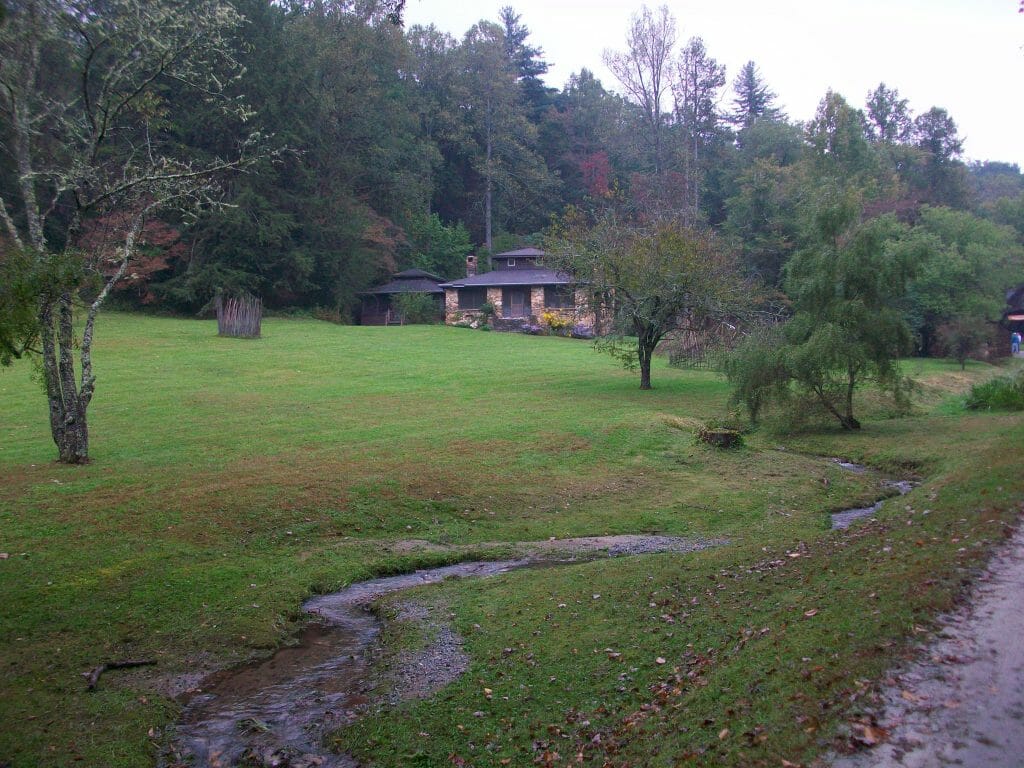
    Facilities: Each resident enjoys a private cottage for both sleeping and working. There’s also a communal kitchen, dining and lounging area known as the Rock House.

    Image: The Rock House at Hambidge

    Time frame: From two to eight weeks, depending on the time of year. Applicants can specify how many weeks they’d like to stay.

    Cost: $200/week. More than 25 scholarships are available for first-time residents.

    Food: Partly included. A chef prepares dinner for all residents several times each week. Residents are welcome to enjoy the chef’s many leftovers throughout the week but are otherwise responsible for the rest of their meals.

    Application deadlines: Jan 15 (for May-August residencies); April 15 (for Sept.-Dec.); Sept. 15 (for Feb.-April)

    Application requirements: Applicant statement, bio, resume and work samples, plus a $30 application fee. Here’s where to apply.

    Plus: The cottages do not have the distraction of Internet access, but residents can use wifi in the Rock House.

    Image: Mellinger Studio at Hambidge

    Alexis Grant is managing editor of The Write Life. She has completed three residencies at The Hambidge Center and took all photos in this post.

  • Write Better Stories By Asking These Questions

    Write Better Stories By Asking These Questions

    Novel writing is tricky; there are countless essential components that all need to mesh cohesively to produce a great result. The key to reaching that goal is to ask a lot of questions.

    Starting a novel is asking a question. What if …? What would someone do if …? What if the world was like this and this happened …? Those initial questions lead to more questions, which shape and bring life to characters and story. Questions are the key to story.

    Over thousands of hours critiquing and editing manuscripts, I’ve noticed that there are some questions I seem to ask a lot, which tells me there are some general gaps that many writers have in common in their novel-constructing processes. As you work on your next fiction project, keep these questions in mind.

    Where is this scene taking place?

    A reader shouldn’t have to ask this question, right? The writer is thinking, Isn’t it obvious? I know where this scene is taking place.

    Unfortunately, readers can’t read your mind. The biggest problem I see in novel scenes is the lack of sufficient information to help the reader “get” where a scene is taking place. Just a hint of setting, shown from the character’s point of view, can do wonders. And what’s usually missing is not just the locale but the smells and sounds, a sense of the time of day and year, and exactly where in the world it is.

    How much time has passed?

    So many scenes dive into dialogue or action without letting the reader know how much time has passed since the last scene. Scenes needs to flow and string together in cohesive time. It’s important to know if five minutes or five months have passed, and it only takes a few words to make that clear. Don’t leave your reader confused.

    What is your character feeling right now?

    This is a biggie. It alternates with “How does your character react to this?” I often read bits of action or dialogue that should produce a reaction from the POV character, but the scene just zooms ahead without an indication of what the character is feeling or thinking.

    For every important moment, your character needs to react. First viscerally, then emotionally, physically and finally intellectually. If you get hit by a car, you aren’t going to first think logically about what happened and what you need to do next. First, you scream or your body slams against the sidewalk or you feel pain streaking through your back.

    Keep this adage in mind: for every action, there should be an appropriate, immediate reaction. That’s how you reveal character. (Click to tweet this idea.)

    What is the point of this scene?

    This is a scary question. Not for the editor — for the author. Because if there’s no point to a scene, it shouldn’t be in your novel. Really.

    Every scene has to have a point: to reveal character or plot. And it should have a “high moment” that the scene builds to.

    What is your protagonist’s goal?

    If she doesn’t have a goal, you don’t really have a story. The reader wants to know your premise as soon as possible, and that involves your main character having a need to get something, go somewhere, do something or find something.

    That goal should drive the story and be the underlayment for all your scenes. That goal is the glue that holds a novel together. It may not be a huge goal, and in the end, your character may fail to reach that goal — you’re the writer; you decide. But have a goal.

    There are, of course, a whole lot more questions than these, and many are just as important to crafting a powerful novel. If you can get in the habit of continually asking questions as you delve into your novel, you may find they will lead you to the heart of your story.

    What questions help you develop your stories?

  • 4 Ways to Become a Better Writer, Even If You’re Low on Time

    4 Ways to Become a Better Writer, Even If You’re Low on Time

    Freelancing takes many forms, and although you may consider yourself a writer, there’s a slew of related work that comes with it: researching, editing, conference calls, invoicing. Let’s face it, being a writer involves a lot of not-writing — and all that not-writing takes time.

    Even when you are writing, you might find that your daily gig of expressing a brand’s mission in 140 characters or less, or keeping a blog post to 300 words, can be stifling.

    When you have a million and one tasks to accomplish and work guidelines to respect, what’s a busy writer to do?

    Try these exercises to stay sharp and stretch your writer’s limbs — all while moving through your daily tasks.

    Challenge yourself with a “banned” words list

    You can improve your writing skills even if you’re just keeping up with emails. Keep a list of three to five “banned” words and hit that backspace key each time you see one crop up in your daily tasks.

    For example, I’m striving to ban “awesome” as a go-to adjective. If I spy a sentence in an email that starts with “so,” I revise immediately. Pat yourself on the back when you catch a correction before you hit “send.”

    Set a mental timer

    How quickly can you respond to those daily emails? Can your project update notes be more concise? Challenge yourself to complete emails and other updates in record time — while still excelling in grammar, clarity, and authenticity.

    Take note of when you feel comfortable breezing through these tasks, and consider working this strategy into your daily routine. Maybe you cruise through emails before breakfast but only after that first cup of coffee. Know thyself, writer.

    Go back to basics with a notebook

    Our tech tools have plenty of perks, but consider the simplicity of pen and paper. A notebook can thrive despite drained phone batteries, bad reception, and device sharing. I keep one next to my bed for capturing bits of dialogue or ideas that float to the surface during those pre-alarm moments.

    Read, even if you have no time to read

    When you’re busy, it’s hard to fit in any extracurricular activities, let alone “reading for pleasure.” Make it happen, though: squeeze in a newspaper article, short story, or even a blog post whenever you can. Use a tool like Pocket to save longer reads to your phone for when you’re eating lunch or waiting for a train.

    Writers notice others’ writing. The best way to stay sharp is to keep a steady stream of content flowing.

    What’s your favorite way to sneak writing practice into your day?