Tag: getting paid

  • Hello Bonsai Review: A Task-Management Tool Keeping Freelance Writers Organized

    Hello Bonsai Review: A Task-Management Tool Keeping Freelance Writers Organized

    I fancy myself a pretty organized person. But when it comes to freelance writing, it’s easy for me to lose track of things.

    Did I save that contract in Microsoft Word or Google Docs? Am I on invoice number 1038 or 1039? I thought I was happy with the rate my client is paying me, but I’ve been working on this project for who knows how long — is it even worth it?

    When we’re our own boss, we have a lot of balls to juggle. If you were working in a traditional office, you might have a system for categorizing files or an accounting team to track work-related expenses. But since you’re on your own, how are you supposed to track everything?

    In swoops Bonsai. In this Bonsai Review post, we’ll break down what it is, how to use it, how much it costs, and more. Ready?

    What is Bonsai?

    Bonsai is an online platform that aims to help freelancers streamline their numerous daily tasks. 

    When you create an account, go to the dashboard to access things like your contracts, invoices, proposals and client information. By keeping everything in one place, you can stay organized and hopefully accomplish tasks more efficiently.

    Bonsai’s goal is to provide you with everything you need for a freelance project, from start to finish (or proposal to payment). You’ll receive a 14-day free trial when you sign up, which should give you time to get a feel for how Bonsai can influence your daily life.

    What can you do with Bonsai?

    Here’s what you can do with Bonsai.

    Keep track of clients, projects and tasks

    From your dashboard, you have a section for clients, where you can store information like clients’ contact information and social media profiles, and even how much money they owe you. 

    For example, let’s say I enter information for my three main clients, Finance Company, Travel Blog and Beverage Website.

    Then you can create projects for each client. Under Finance Company, I may add projects for credit card pieces, student loan pieces and equity pieces. For Travel Blog, the projects could be January blog posts, February blog posts, etc.
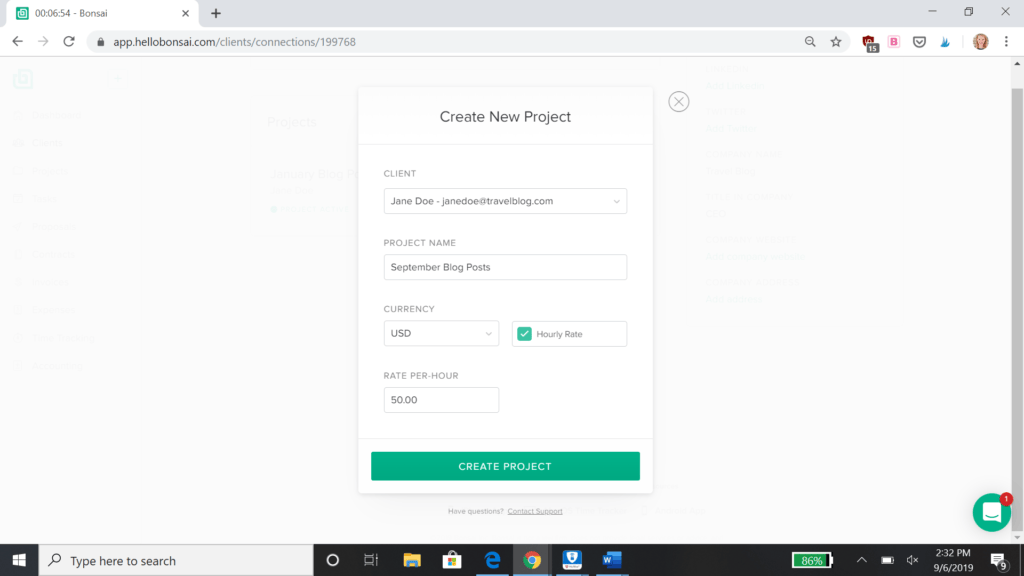
    Finally, you can create specific tasks under each project. For instance, under January blog posts, I might add each individual blog post as a task, assuming I write more than one blog post per month.

    This is essentially a digital version of a binder filled with folders and color-coded tabs. Monica Geller from Friends and Amy Santiago from Brooklyn Nine-Nine would have a field day with Bonsai if they were freelance writers.

    Time yourself

    In the top right corner, you’ll see “Start Timer.” When you click this, you can choose a specific project and even a task to time. You can also add notes, like “research” so you know you spent that time researching, not writing.

    The timer is especially helpful if you charge clients by the hour. I don’t charge hourly, but I still prefer to use the timer. If I charge $100 for a piece but realize it required 10 hours of work, I might think twice before taking on a similar assignment.

    Before signing up for Bonsai, I used a time tracker called Time Doctor. The program experienced several glitches over the months I used it, which was annoying because I was charging by the hour back then. So far, Bonsai’s timer has been more reliable and accurate.

    Create invoices

    Kim T., a writer who has been using Bonsai for two years, says the invoicing software might be her favorite part of the platform. “Bonsai is great for effortless invoicing and payment,” she explains.

    “Effortless” really is the appropriate word. You can create an invoice, then link it to the timer so that the amount of time you spend on a project automatically shows up in the invoice. This can save you time plugging in numbers if you charge hourly.
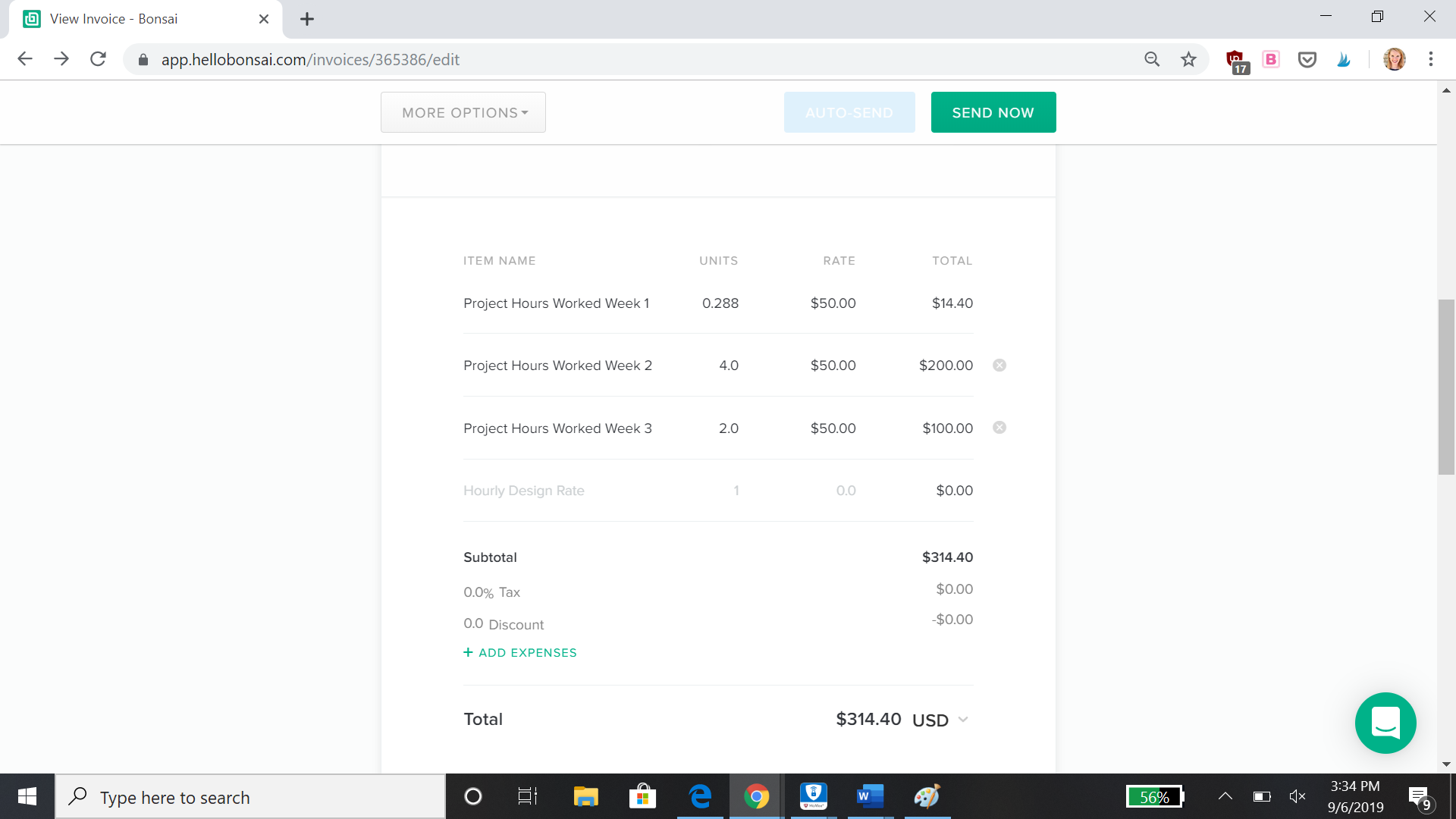
    Or you may choose to create invoices manually. Bonsai provides you with invoice templates, so you don’t have to start from scratch.

    I despise creating invoices in Microsoft Word, even with Word’s templates, so I have to agree with Kim — Bonsai’s invoices are a huge plus.

    Write proposals and contracts

    Time to pitch a big project? You might need to write a proposal.

    Bonsai provides several proposal templates depending on what type of work you’re proposing. There’s one for writing projects that divides the proposal into Context & Objectives, Timeline and Why Me. 

    There are also templates for other types of work, like Design or Consulting. (Because we all know at least one writer who has expertise in more than one field!)

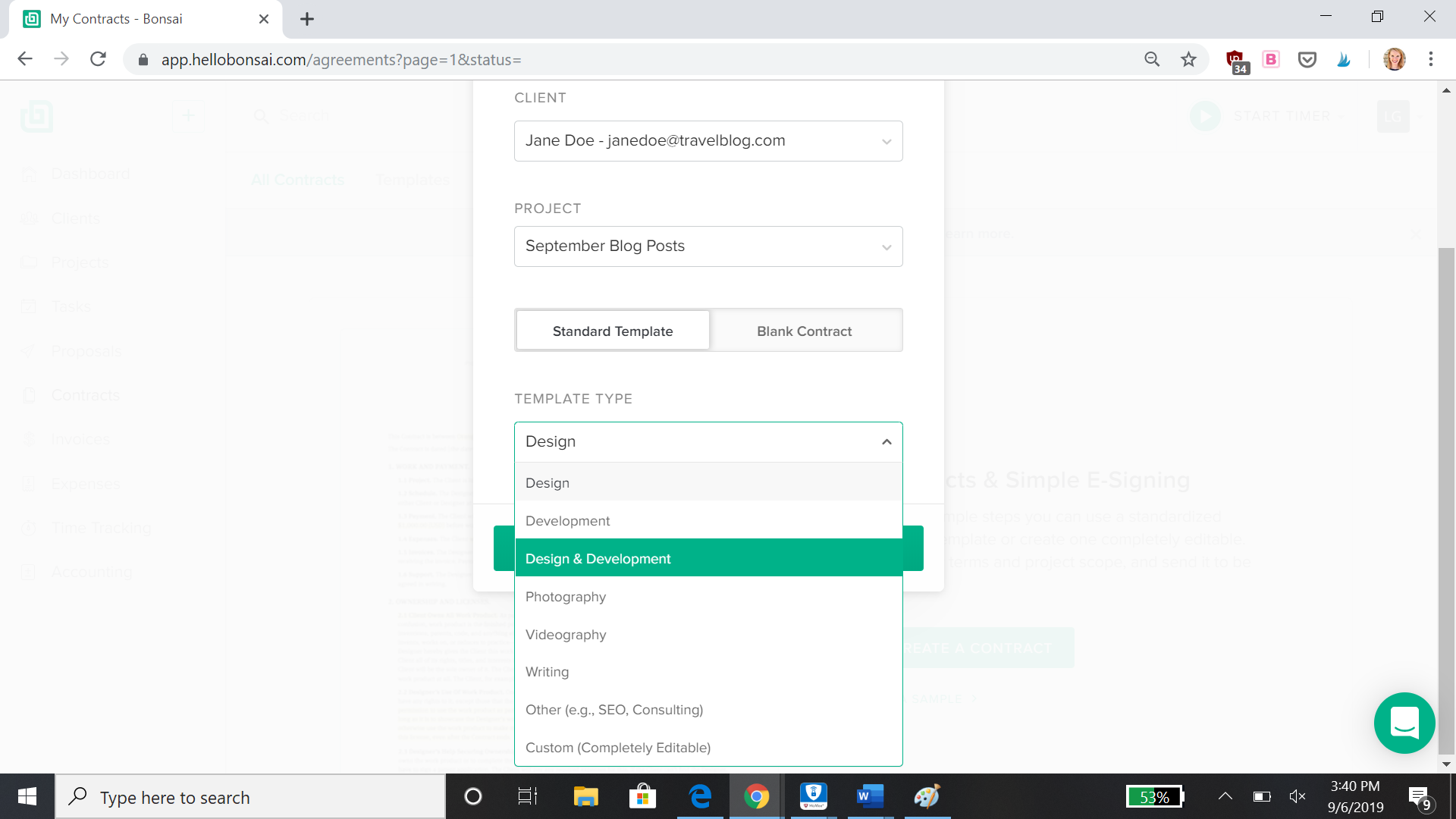
    Once a client accepts your proposal, you can write up a contract. Bonsai’s contracts are even more customizable than its proposals, and it’s the customizability that Kim says makes Bonsai stand out from other platforms. There are numerous contract template options, including a “custom” option that helps you create a contract from scratch.
    Record business expenses

    The Expenses section is where you’ll keep track of items like Uber and Lyft rides, airplane flights, business meals — anything a client might reimburse you for. You can subdivide expenses into categories like Advertising, Office Expenses and Supplies. Bonsai will track which billable expenses you have been reimbursed for and which ones you’re waiting to be reimbursed for.

    You can also track non-billable expenses, which can be useful when tax season rolls around and you’re thinking, “Oh, what business expenses can I write off?”

    Be your own accountant

    The more clients you have and the more diverse your freelancing work is, the more likely you are to benefit from an accountant. But if you’re already paying for a subscription to Bonsai, why bother hiring an accountant? Use the platform to act as your own accountant!

    You can link the Accounting section to your Expenses and Invoicing sections to track your business budget. The layout is useful for tracking both billable and non-billable expenses so you can see how much you’re spending on your writing career versus how much you’re bringing in. 

    What could improve about Bonsai?

    The invoicing may be convenient, but the system isn’t flawless. 

    You can only customize invoices to a point. The sections are “Item name,” “units,” “rate” and “total.” But for one of my clients, I need to have a separate section for “item code,” and I don’t need a “units” column. 

    It would be great if I could just replace “units” with “item code,” but unfortunately this isn’t an option.

    When you set up an invoice, you choose a payment method, and a few of these methods involve fees. I always request direct deposit when I can, but Bonsai charges a $5 fee for direct deposit. I’d rather just create an invoice through Microsoft Word and pocket the $5. They do offer instant payouts as a type of alternative though, and the fee is 1.5% of the total invoice to have it deposited into your account immediately.

    Kim has been using Bonsai for much longer than I have, and although she’s a fan overall, she finds herself wishing she could use the platform for more complex tasks. 

    “It’d be wonderful if I could take a client/project and run a report that tells me the total amount billed as it relates to the total hours spent,” she says.

    We can only hope Bonsai continues to develop each section so that freelancers can do even more with the program.

    Bottom line: Should you give Bonsai a try?

    If you’re a freelance writer with multiple clients and/or projects, it’s certainly worth setting up a Bonsai account. Storing all my information in one place has made me feel less frazzled.

    Your ability to access certain features depends on which plan you select. Here are your options:

    • Bonsai Starter ($24 per month): Ability to create invoices, proposals and contracts, track expenses, access a basic CRM, and use chat support.
    • Bonsai Professional ($39 per month): All the features you can access with a Starter membership, as well as the ability to subcontract through Bonsai and white-label (or legally replace a brand’s logo with your own). You can also add multiple users to your account and integrate with Zapier, Calendly, and Quickbooks.

    If you’re looking for a more affordable deal and are open to long-term commitment, you can sign up for annual billing. You’ll receive the equivalent of two months free, which comes to only $17 per month for Bonsai Starter and $32 per month for Professional.

    You might give the two-week trial a go and see if you want to sign up for Bonsai Plus. However, I don’t see much use for Premium unless you either have some very specific, advanced needs, or you employ other people and want to add them to your account.

    This post contains affiliate links. That means if you purchase through our links, you’re supporting The Write Life — and we thank you for that!

    Photo via JKstock/ Shutterstock 

  • How to Respond When a Client Says Your Rate is Too High

    How to Respond When a Client Says Your Rate is Too High

    In the freelance writing industry, it’s easy to undervalue yourself and your skill.

    Just take a quick look at some of the Upwork job postings. Ten cents for 100 words?

    Write it yourself, bro.

    Plenty of articles review how to set your rates as a freelance writer. But it’s more challenging to find advice on how to handle a client who makes an insultingly low offer or tries to argue your rates are unreasonable.

    Here’s what to say when a client balks at your rate

    This conversation will happen at some point. It probably won’t be fun. And when you’re feeling insulted or threatened or embarrassed, it’s not always easy to exit the situation gracefully.

    I’ve been there! Here are some tips on how to respond when a client says your rate is too high.

    1. Be warm and respectful

    Warmth will get you everywhere in (almost) every situation.

    I’m not suggesting you let someone walk all over you — that’s not warmth, that’s cowardice. You can be warm towards someone while still strongly asserting your value.

    I used the word “warm” instead of “polite” because being polite just isn’t enough. Especially in the freelance writing industry, where we often communicate with clients via email and the phone, being polite is the absolute minimum expectation in all communication. You always have to be polite.

    When you’re rejecting a client’s lowball offer, you have to up your game from polite to warm. At the same time, you want to be respectful, both to the client and to yourself.

    It’s sort of a “kill ‘em with kindness” approach. You’re delivering rough news to this client: “You’re completely out of your mind if you think a person with any skill will do this job for that amount.”

    Try to deliver that message not only with tact, but also with warmth. Instead of “Thanks anyway,” say something like, “I totally understand my services aren’t within your budget right now. I’m disappointed because I was so excited about this project! Hopefully we can work together in the future. Best of luck to you!”

    If nothing else, you’ll be able to look back on this exchange and know you took the high road and treated another human with respect.

    2. Don’t preach

    This is not the time to get on your soap box.

    I’m sure we could all write a four-page essay on how unfair it is that clients expect high-quality content for pennies. It’s offensive! It’s criminal! It’s an outrage!

    The person who wants to pay you pennies does not care.

    The only outcome you’ll achieve by stepping on your soap box and trying to teach that person a lesson is a burned bridge.

    They’ll get offended, because no one likes being told they’re wrong. Then, they’ll spread the word to anyone who will listen that you’re a bad-tempered, overpriced freelancer who everyone should avoid.

    Is this fair? No.

    Is this real life? Yes.

    Operate on the assumption that people who offer you insultingly low rates can’t be reasoned with…Because they’re unreasonable. Your reputation is more important than the nagging need to preach.

    3. Prepare to make your case

    If you feel the need to negotiate with a client (though I don’t recommend it if you balked at the original rate they’ve suggested), don’t walk into that negotiation without knowing your minimum writing rate. This figure is imperative because it prevents you from getting swept up in negotiation and accepting a job that’s not worth your time.

    The closer you come to accepting that rate, the more wary of this client you should become, because they’re trying to squeeze you for all that you’re worth. Those people generally aren’t fun to work with, unless you have to (and we’ve all been there, so no judgement).

    Don’t ever let a potential client convince you to accept less than your minimum rate. Being underpaid is far worse than working for free (here’s an eloquent explanation of why).

    Remember, this client rarely, if ever, has your best interest at heart. Anyone who lowballs you is looking for the cheapest content they can get and their respect for the craft of writing is probably limited.

    Let’s role play: Examples of how to respond to a lowball offer

    Here are few scripts that demonstrate these tips in action.

    Hypothetical client #1: The sob story

    I can’t afford that rate. I’m a small-family-owned-non-profit-start-up for starving children and abused puppies and I just need someone to write for me.

    This client is playing to your emotions. It’s your prerogative to donate your skills, but don’t let this person manipulate you.

    Potential response: It sounds like your work is meaningful. I appreciate that my rate is outside of your budget, but I can’t go any lower than my original offer.”

    “I’d be willing to offer [insert a perk here that won’t break the bank for you, like some social media promotion for the post you’re writing] free of charge, if that makes your decision any easier. If not, I’d love to work with your company in the future if your circumstances change. Thank you for the opportunity, and best of luck finding the perfect person for the job!”

    Hypothetical client #2: Shocked and appalled

    That rate is obscenely high. I’ve shopped around and everyone is offering to do the same work for far less than you. I can’t believe you’d expect me to pay that. You seem capable, so I’d be willing to give you the job for my rate of [insert insultingly low number here].

    If you’re a good writer and you’re charging what you’re actually worth, you’re probably going to encounter this person at some point or another. In my head, this person wears a suit and gels their hair and sits at a mahogany desk overseeing his minions, and he (or she) thinks business savvy is far more valuable than any other skill, especially writing (said with a tone of condescending disgust). But that’s just in my head.

    Potential response: Thank you for the offer. I’ve provided you with a number I feel is fair for the nature of this project. While I’m disappointed you don’t agree, I appreciate that you have other freelancers to choose from who might be more suitable for your budget. Thank you for the opportunity and best of luck in your search!”

    Accept the loss and move on

    You win some, you lose some. It’s the name of the game. Don’t spend a single minute mourning a client who doesn’t want to pay what you’re worth.

    Remember: there are good clients out there. There are clients who will appreciate you, celebrate you, and pay you well. I promise!

    Don’t get discouraged by a few sour apples. Every industry has them. As a freelance writer, you have the power to shape your work environment by choosing your clients. Choose wisely!

    This is an updated version of a story that was previously published. We update our posts as often as possible to ensure they’re useful for our readers.

    Photo via Andrey_Popov / Shutterstock 

  • Getting Paid By the Pageview: Good or Bad for Freelance Writers?

    Getting Paid By the Pageview: Good or Bad for Freelance Writers?

    So you’re in the process of landing a new freelance writing gig, and during the discussion of duties and compensation, the editor mentions that the publication offers pageview bonuses.

    The more views your article gets, the more money you’ll receive.

    It’s an increasingly common scenario. But is this type of compensation good for writers? Does it motivate writers to do their best work, or encourage us to write solely for pageviews?

    Most importantly, is it a fair method of payment?

    While some pageview bonus programs do benefit writers, others try to substitute bonus money for a fair upfront rate.

    I’ve written for pageview bonuses, but since every program is different, I wanted to know more about how they work and which red flags to watch out for. So I asked freelance writers Laura Shin, Kelly Clay and Kelly Gurnett to share what writers should look for in a pageview bonus plan, how to write for high pageviews, and what you can do to track engagement if your clients offer pageview bonuses but don’t share those metrics.

    How website traffic bonus plans work

    Every publication’s pageview bonus program is a bit different, and publications may change and adjust their bonus programs over time. But we’ve got a few examples to help you understand how pageview bonus plans generally work.

    Some programs pay writers a flat fee upfront, then layer bonuses on top when posts perform well. Performance can be measured with a variety of metrics: pageviews, unique visitors, social shares or whatever the publication considers its main goal.

    The Penny Hoarder, for example, offers a tiered bonus plan: when a piece hits 50,000 pageviews, the writer receives a $100 bonus; the writer receives another $200 when the post hits 100,000 pageviews and another $500 at 250,000 pageviews. Those bonuses are paid in addition to the flat rate writers are paid for posts.

    Forbes offered bonuses for both new visitors and repeat visitors when Clay wrote for them in 2014, on top of a per-post rate. “Every month I’d receive .005 cents for a new visitor and .10 cents for a repeat visitor,” Clay said. “This meant the more a single person viewed my blog per month, the more money I’d make. This number was reset to 0 every month.” Forbes now uses a different traffic bonus program, but they wouldn’t reveal details.

    This bonus system turned out to be profitable for Clay, who wrote about two articles a week for Forbes. “I’ve earned anywhere from $1,000-$4,000 a month. It really depended on how many pageviews I got that month (such as if I wrote an extremely viral piece) and how long I had been writing,” she said. “The longer an article that ranked highly on Google gathered new visitors, the more money I made every month.”

    The lesson: If you have the opportunity to write for a publication that allows you to earn significant bonus money for good work, it can be worth your while.

    Hearst’s contributor network The Mix — a program we’ve written about that invites writers to contribute personal essays on spec for the opportunity to have their stories published in major outlets like Cosmopolitan or Seventeen — also offers traffic bonuses. If your story gets selected, you receive a base payment as well as $.0025 for every pageview over 40,000 views. (At least, the last we heard. We emailed The Mix with a fact-checking request, but they didn’t get back to us.)

    That means if your story sees 50,000 views, you’d earn an additional $25. If it gets 100,000 views, you’d earn an additional $150. The Mix’s pageview incentive system might be great if your story lands on a high-traffic site like Good Housekeeping, but that’s not going to happen for every post you write.

    So what should you look for in a traffic bonus plan, and how should you determine whether it’s worth writing for that outlet?

    Let’s let the writers explain what you should look for before signing on to a publication that offers this kind of compensation.

    What to look for in a website traffic bonus plan

    First, make sure the publication offers base pay. As Shin put it: “Even if your story gets zero views, you still get something.”

    Base pay is important because although you can use certain techniques to help improve your article’s pageview performance — and we’ll look at those in a minute — you can’t control how many views your article gets, and you still deserve to be paid for your work.

    Gurnett explained, “Since I never know how much I’ll be getting each quarter, I can’t rely on [pageview bonuses] as part of my regular income. I count them solely as a bonus.”

    I treat pageview bonuses the same way; I’m happy when I receive a bonus, but I don’t factor potential pageview bonuses into my monthly freelance income goals.

    You also need to look at whether the publication already has an audience.

    Why is this important? Shin listed the reasons: “For both platforms for which I’ve been paid by pageviews, they already had audiences and weren’t using me to build their own. That meant that they promoted my stories on their sites and on social media, and so as long as I did a good job with my stories, [they would get lots of views and] I could make good money.”

    Also beware of the publication that asks you to bring in your own following, Shin said. Most of us have our own fans who follow us on social media and read our articles, but a few thousand social media followers isn’t enough to get significant pageviews — and it definitely isn’t enough to get those bonuses.

    How to write for high pageviews

    Once you’ve started working with a publication that offers a pageview incentive plan, how can you write stories that will earn bonuses? Here are a few tips to keep in mind:

    “Some stories take off because they’re riding a newswave,” Shin said. “If you see something in your beat that you think is going to be hot on Google News, then you jump on it.” Keeping track of news and current events and bringing an interesting perspective to those stories is a great way to rack up pageviews.

    When J.Crew announced layoffs this June, for example, I did some research and wrote “How a Single Sweater Lead to J.Crew Layoffs” for The Billfold. That article is still at the top of Google search results for “J.Crew layoffs,” probably because it provides a quirky, human-interest perspective on what would otherwise be an ordinary hiring-and-firing story.

    “With Forbes, the bonus encouraged me to write time-sensitive articles,” Clay explained. “My top posts were always about a company trending that day — a post about GoDaddy, written the day a scandal broke out about its CEO, is still one of my top posts.” If you write for a site that allows you to draft and publish articles quickly, it’s to your benefit to follow news trends and write timely pieces that attract attention to a breaking story.

    What about evergreen pieces? These types of posts get pageviews when they’re published, but also get traffic over time as people continue to search for that topic or question and use your story to learn more about the answer.

    To come up with evergreen ideas, start with topics you find interesting, Shin suggested. What types of stories would you like to read, and what types of evergreen questions are still unanswered? Shin notes that you should always check your competition: “Is there a good story out there, or is this something that people would be searching for?”

    Then there’s trying to go viral. “This is what most people think about when they think about writing for pageviews,” Shin said, “but you have to be careful with this category.”

    If you write stories with clickbait headlines and no substance, you might get an initial spike in pageviews, but your reputation — and your publication’s reputation — will likely slowly erode over time.

    How to track performance metrics for your posts

    So do most writers know how many pageviews they bring in?

    That depends. While some outlets do allow you to log into a dashboard to see your stats, none of my clients give me that option. I do track social shares through my Contently profile, which tallies shares of individual pieces and also provides an aggregate total. My articles have been liked over 84,000 times on Facebook, for example.

    Gurnett has a similar experience. “I can see the number of social shares as well as how many comments each post has received, but that’s it,” she said. “I wish I could see pageviews but I’d probably be checking them obsessively if I could!”

    Some of Shin’s clients have provided pageview information not only for her articles, but also for other writers’ work. She likes this method because “we could see what does well on the site, and we could learn from that.”

    I’ve worked with clients who regularly share the week’s top performing articles, which also helps me understand what does well on the site, but these performance roundups don’t include pageview numbers.

    If your client does not offer pageview numbers, tracking social shares is one way of understanding how your articles perform with readers. If your article receives a lot of likes and tweets, chances are it also receives a lot of pageviews.

    Likewise, if you notice certain topics or types of pieces perform better socially, you can structure future pieces in the hopes of receiving similar engagement.

    Are pageview bonuses good for writers?

    So what’s the verdict?

    When pageview bonuses are administered fairly, they can be lucrative for writers — so long as it’s not the only compensation.

    I have a client who offers a pageview bonus system, and I’m happy with it. I receive a competitive base pay and occasional bonus money if my articles perform exceptionally well.

    And a pageview bonus plan that’s good for writers can be good for publications, too, Gurnett said. “If Client A (who does give me a bonus) has a project for me the same week as Client B (who doesn’t), and I only have time to work on one of their projects, I’m going to go with Client A, all other things being equal, because of the potential for the bonus.”

    Yet the biggest reason pageview bonuses can be good for writers doesn’t have anything to do with money, Shin said — it’s about the insight they provide. “You can see how well your stories are resonating with readers.”

    In the publishing world, writing stories that readers enjoy and share is the most important part of your job. After all, publications don’t just want pageviews; they want a loyal audience who keeps coming back.

    And writers don’t just want pageviews; you want to know your work is being read and appreciated. A good pageview bonus will provide that gratification — and throw in a little extra cash as a reward.

    Do you work for clients who offer pageview bonuses? Do you think the pageview bonus system is effective? Does it affect the types of pieces you pitch and write?

  • The Smarter Way to Set Freelance Writing Rates: Avoid Hourly Work

    The Smarter Way to Set Freelance Writing Rates: Avoid Hourly Work

    The following is an excerpt from Breaking the Time Barrier: How to Unlock Your True Earning Potential, a free ebook offered by our friends at Freshbooks.

    In the ebook, Freshbooks co-founder, CEO and co-author Mike McDerment makes the case for independent workers earning what you deserve for your hard work.

    It’s a great resource for freelancers, and it’s also an easy read — no one’s throwing numbers or numbers or worksheets at you. Instead of textbook-style lessons, Breaking the Time Barrier shares a conversation between Steve and Karen, who talk through Steve’s hangups about how to price his web-design services.

    Whether you’re writing white papers, blog posts, or tweets, you know how long it takes to craft the written word. Are you getting paid enough?

    Read on to find out how changing your freelance writing rates from hourly to project-based rates can help you maximize your earning potential — and then get your own copy of Breaking the Time Barrier!


    Breaking the Time Barrier
    On Friday, Steve stepped into Karen’s café, a cozy spot with leather chairs and shelves lined with old books. He looked around, taking in the aroma of fresh coffee, then made his way to a back table, where Karen was waiting for him.

    After Karen greeted him warmly he settled into his chair, thanking her for meeting with him. “I’m happy to help,” she said before a server came and took their order.

    Then Karen invited Steve to sketch out his solopreneur journey, which he did over the clatter of coffee cups that surrounded them. When Steve was done she gave him a one-word verdict: “Pricing.”

    “Pricing?” he asked.

    She nodded as their coffees arrived. “Well…pricing and positioning. From what you’ve told me, it sounds like the way you think about pricing is holding you back.”

    “In what way?”

    “If someone wanted to know what exactly you sell to your clients, what would you tell them?”

    “My services. Web design.”

    “How do you charge for your services?”

    “I charge them a fee based on my hourly rate.”

    “Then aren’t you really selling hours?” Karen asked.

    “But I use those hours to design websites.”

    “Do those websites have any positive impact on your clients?”

    “Sure,” Steve said.

    “Do you think it would make more sense to charge a fixed fee that represents the value of the impact your websites have on your clients?”

    “Well, I do mostly charge fixed fees—”

    “But those fees are based on a multiple of your hours, right?”

    “Right,” he said.

    “I’m talking about fixed fees based on value, not time.”

    “I guess I’m not sure what you mean by value.”

    “The value of what I do,” Karen said, “is based on the impact I can have on my client’s business. Impact is how they value my services. So I look at pricing from their point of view. They don’t hire me to design a website for the sake of designing a website. They hire me to design a website that’s going to help them grow their business.

    “I find when I look at it like that — from their perspective — it’s clear I’m not selling time. Instead, I’m selling a solution that is going to make an impact for my client and achieve some business objective.”

    “So, how do you set your prices then?” Steve asked.

    “Let me give you an example. A couple of months ago I sat down with a client to talk about their website. I asked them to tell me why they thought they needed a website. When we drilled down into their reasons, they said they believed a website could generate an additional $100,000 of profit annually for their business.

    “So I asked them to make an investment of $20,000 in the website. Based on your hourly pricing model, you’d probably charge in the area of $2,000 to $2,500.”

    “Did they agree to your price?”

    “Yes. Wouldn’t you invest $20,000 to generate $100,000?”

    Steve agreed and he was excited about what Karen was telling him, but lots of questions were flooding his brain.

    “I get your math,” he said, “but doesn’t it come down to time in the end anyway? I mean, you spend a certain amount of time on the project. You could theoretically work out your hourly rate and so could your client. You’re probably effectively charging $400 an hour, or something like that. What if your client thinks that’s too high?”

    “Your math may be right, but I’m not a collection of hours,” Karen said. “I’m the accumulation of all my skills and talents. I’m wisdom and creativity. I’ve stopped seeing myself as a punch card. My clients don’t see me that way either.

    “Yes, sometimes, I’ve had to change my client’s mindset,” she continued. “But it starts with me, first, just as it starts with you. You have to forget selling time. The best thing you could do for yourself is to get the concept of time out of your head.”

    “Don’t I need an hourly rate for some stuff? Everyone I know has one.”

    “You know me now, and I don’t have an hourly rate.”

    “So I should never charge by the hour?”

    “To be honest, when I started out I charged an hourly rate and I think hourly rates make sense for someone just starting out, someone with little experience and limited skill. But over time I established myself and my credibility, which led to great references. When that happens, you begin to outgrow the cost-plus pricing model of charging by the hour. So if you stay with that pricing model, you’ll find it very limiting.

    “For example,” Karen continued, “since there are only so many hours in a year, it puts a cap on how much revenue you can collect in a year, and it means that the only way to make more money is to work more hours. These are limits… and the truth is, they are false limitations that lead to bad behaviors, like burning yourself out by working around the clock in an effort to earn more.”

    “That’s me,” Steve said.

    “Me too, when I first went out on my own, until I learned that a value-based approach to pricing your services is a powerful way to break through the time barrier and avoid the bad behaviors.

    “But like a lot of people, I didn’t start from scratch, and neither did you. You started your business after many years of design experience. You already had the ability to create value for your clients. And now, after being in business for a while, you’ve got references you can build on. You’ve also had the chance to see the impact your projects have had. I’m sure it’s far greater than you expected.

    “Think of the value you created for your clients. That’s an impressive story that you can use to move away from charging based on time to charging based on value.”

    Are you on board with Karen’s advice? Have you tried value-based pricing rather than charging hourly rates?