
Tag: how to write a pitch

  • Checklist: How to Write a Pitch That Doesn’t Suck

    Checklist: How to Write a Pitch That Doesn’t Suck

    Are your pitches the reason you’re not getting freelancing work?

    Pitches or query letters are often the scariest part of freelancing for both new and experienced freelance writers.

    But master the art of the pitch, and your freelancing life suddenly gets a whole lot simpler.

    One of the best ways to do it is to stop thinking of your pitches as a creativity showcase and start thinking of them as sales tools instead.

    How?

    Every time you finish writing a query letter or pitch, run it through this quick checklist to make sure all your i’s are dotted and t’s crossed.

    1. The basics

    Since this is a checklist, after all, let’s get the basics out of the way first to make sure you’re not making obvious mistakes.

    • Is the editor’s name spelled correctly?
    • If you’ve mentioned the name of the publication, is it accurate?
    • Did you check spelling and grammar?
    • Does your signature have your website URL in it?

    2. Call to action

    Yes, your query letter is a showcase of your skill and your ideas, but in the end, it’s also a piece of marketing. Most writers will forget that and focus far too much on the story idea and the actual writing in the query letter.

    Remember, all good marketing ends with a call to action.

    That doesn’t mean that you have to reach out to an editor at The New York Times with an email that says, “Buy now!”

    But I do recommend closing with something that requires the editor to respond to you.

    “I’d love to chat over the phone; let me know if that’s something you’d be open to,” is a sentence I’ve used in my pitches.

    “Would you like to see some clips?” is another one that can get you an immediate response.

    If you prefer to keep it simple, “please let me know at your earliest convenience,” is a good way to close, too.

    3. Subject line

    Increasingly, a good subject line can be the difference between whether your email gets opened and read right away or delegated to that “later” folder that never gets looked at.

    It used to be that if you were writing for the web you had to focus a lot on headlines, but if you were writing for traditional media (or their websites), you could get away without much effort. That doesn’t work any more.

    New media, old media, run by a corporation or a solopreneur, we’re all competing for the same attention spans. No matter who you’re pitching, it’s almost imperative you look at the way they handle their headlines so you can package your own story idea cleverly in a format that will fit into that publication’s lineup.

    One way to do this is with a double-whammy headline — using a two-part headline to grab a busy editor’s attention and tell them right away why you must write this article.

    The good news is if you write interesting headlines, you almost guarantee yourself quick responses to your pitches. So it’s definitely worth putting some thought and effort into them.

    For fantastic examples of subject lines (and headlines) that work for news and feature stories, I recommend visiting Mother Jones to see how they tackle some serious issues with clever headlines.

    4. Your first sentence

    Here’s where journalists win out over bloggers every time: Journalists have it stamped on their brains that the first sentence of their story has to lay out pretty much everything. We live for that perfect sentence and — no exaggeration — will spend hours getting it right.

    But in the end, it comes down to this: Does your opening line captivate me? Does it make me smile? Does it make me want to read on?

    That’s a lot of pressure to put on one little sentence, so I typically give students who take my 30 Days, 30 Queries course a bit of leeway. Start with one interesting paragraph. Does it make the editor want to read the next one?

    Here’s an example from one of my own query letters:

    Over her husband’s funeral pyre six years ago, Heena Patel, then 21, was informed by her in-laws that he had died of AIDS.

    Don’t you want to know what happened next? That’s what an effective first line should make you want to do.

    Here are nine of my query letters that sold to top publications, including TIME and The New York Times. Notice how I start each one?

    5. Your bio

    If you’re like most writers I know, you have a catch-all bio that you copy and paste into an email every time someone asks you for one. Don’t make this mistake.

    When you’re pitching, you need to highlight your strengths and minimize your weaknesses in regards to the particular publication or editor.

    So if, for instance, you’re pitching a technology website, you would highlight your degree in information technology — and perhaps not mention that you quit your tech job after two months because you hated the industry, instead starting your own small business.

    But if you were pitching an entrepreneurship blog, that’s exactly the story you’d want to highlight.

    Do away with those generic bios that you’ve been cutting and pasting into everything and start personalizing them for each pitch. It can be the difference between the editor thinking you’re perfect for the job, or wondering if you’ve got the credentials to report on the topic.

    6. Timeliness

    One of the easiest ways to make sure your pitches get quicker responses is to make them timely.

    Editors are notorious for sitting on ideas for months on end, so make your pitches time-sensitive by giving editors a reason they need to publish your work now.

    You can do this by tying your pitch into a current event, an anniversary or a promotion. It won’t work for everything you write, but a time-sensitive angle can fast-track your query process.

    7. Clarity

    Have you made sure your story idea is sound, sliced thinly, and can be expressed in a single sentence?

    The one thing missing in most pitches, and probably the top reason most queries get rejected, is clarity. If you don’t clearly know the angle, the purpose, and the gist of your story, how do you expect the editor to get it?

    The clarity in your pitch has to be both about the idea and the execution of that idea. Or simply, what do you want to say — and how are you going to say it? You need to be able to answer both those questions in a single sentence each.

    For instance, for my first story for The New York Times, I pitched a story on how plastic roads in India were solving the problem of both the battered and damaged roads, as well as improperly disposed waste plastic. That quick summary tells you pretty much everything you need to know about that story. (Read the pitch and the resultant article here.)

    New writers who have trouble selling ideas have often overburdened one poor article to do too many things. You need to able to define your story idea in one single (short!) sentence. Coming up with a good headline, as discussed above, can help you achieve this clarity.

    Remember, querying is not creative writing. In trying so hard to write well, we forget that in essence a query letter is as much about showing off your writing prowess as it is about making a sale.

    Your queries, basically, are sales tools. They’re a means for marketing.

    And with the checklist above, you’ll be well on your way to making that sale.

    If you’d like some help perfecting the craft and joining the hundreds of students I’ve helped break into top publications, including The New York Times, TIME, CNN, ABC News, National Geographic, Vice, Marie Claire, O, the Oprah magazine, and so many more, check out my course 30 Days, 30 Queries. See you there!

    This post contains affiliate links. That means if you purchase through our links, you’re supporting The Write Life — and we thank you for that!

    This is an updated version of a story that was previously published. We update our posts as often as possible to ensure they’re useful for our readers.

  • The 3 Biggest Pitch Mistakes This Editor Sees Every Day

    The 3 Biggest Pitch Mistakes This Editor Sees Every Day

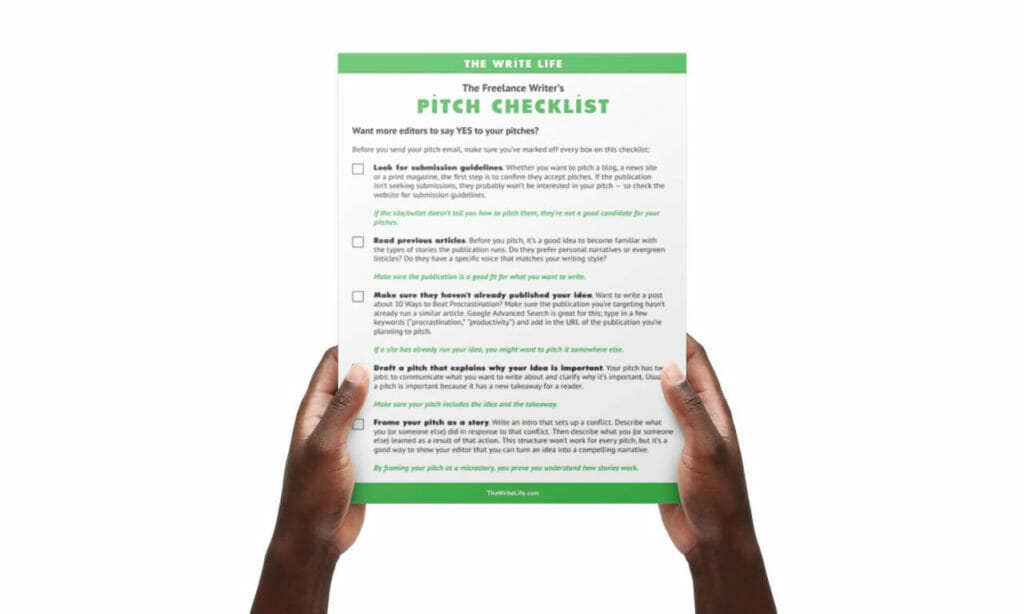
    The Write Life wants to help you get better at pitching! Grab our freelance writer’s pitch checklist. 

    As an editor, I read a lot of pitches.

    Some of them are really easy to say yes to — they’re the pitches that outline a strong, clear narrative with a takeaway for the reader. Other pitches are easy to say no to — they’re either poorly written, irrelevant to the publication or (as is often the case), both.

    It’s the ones in between that are hard.

    Every day I see writers pitch ideas or topics that could be great stories if they’d done a little more work or written a slightly better pitch. Sometimes I ask them to rework their pitch.

    Sometimes I take a chance and hope there’s a good story in there. But often, I say no. After all, I have plenty of better pitches in my inbox.

    Pitch mistakes even good writers tend to make

    If you’re a writer who’s sending out pitches but not getting a lot of assignments, maybe you’re writing those in-between types of pitches, the kind that could be really good with a little improvement.

    Here are three of the most common pitch mistakes I see every day, along with how to fix them.

    1. Do your “exploring” before you pitch

    If there’s one word I hate to see in a pitch, it’s “explore.”

    A writer who wants to explore an idea is a writer who doesn’t know what they want to write yet.

    These are the kinds of pitches that sit in my inbox for days because the writer usually wants to explore something interesting — but I don’t know if that exploration will result in a good story.

    I understand you don’t want to do a lot of work before pitching an article that might never get picked up. But instead of writing this:

    Now that the Ringling Bros. and Barnum & Bailey circuses have officially closed, I’d like to explore what happens to the animals after the circus shuts down.

    Try this:

    What does retirement look like for a circus elephant? Can an unemployed hoop-jumping dog get a job in Hollywood? The Ringling Bros. and Barnum & Bailey circuses ended their 146-year run this summer, and this piece will look at what the future might hold for the big top’s animal employees.

    In both cases, the writer hasn’t yet done the research required to answer the question. But the second pitch proves that the writer has thought about a few possibilities and has moved past the exploration stage.

    If you’d like to learn more about how to pitch a piece that requires research, including when and how to list sources, check out our Pitch Checklist

    2. If you’re pitching a personal narrative, put the narrative into the pitch

    When I see a pitch like this:

    I’d like to pitch a story about the summer I interned at the circus.

    My immediate response is: okay, pitch me that story.

    If you’re pitching a personal narrative, make sure your pitch includes the narrative. The beginning, the middle and the end.

    Ever since I was a kid, it was my dream to run away and join the circus. So, when I was in college, I did the next best thing: I signed up for an internship. I knew that circuses took a lot of work, but I didn’t realize that I’d be balancing three rings of retail, company management and customer service all at once. And, like the elephants, I was getting paid peanuts.

    Did I learn a lot that summer? Yes — including the fact that the circus life was not for me. But I still use the skills I learned while ringing up T-shirts and cleaning up empty cotton candy bags, and I’ll never forget the nights I spent under the big top.

    Notice that this second pitch also uses the type of language I’d expect to see in a finished piece. Metaphor, imagery, even a bit of humor. Don’t be afraid to let your writing style show — after all, editors are evaluating both what you pitch and how you pitch it.

    For more tips on pitching a personal narrative, read check out our Pitch Checklist.

    3. Don’t stop your pitch where your story begins

    Here’s one more common pitch mistake that I see almost every day.

    Writers send in detailed, well-written pitches that end right before the story begins:

    When I was six, the circus came to town. I spent the next week playing circus with my stuffed animals and trying to get my dog to jump through my hula hoop. Some kids would move on to another interest, but not me — I remained circus-obsessed for my entire childhood. By the time I was a teenager I could name the ringmasters of all the major circuses, and knew the history and symbolism of the different types of clown makeup.

    When I went to college, I knew I wanted to run my own circus someday. So, during my junior year, I got an internship with a local circus. That’s when I learned that although the circus had made everything seem effortless, running a circus took a lot of work.

    I’d like to write a 1,500 word essay about my internship and what I learned. I’ve previously been published at […]

    pitch mistakesSee how that pitch ends right when the actual story starts? The hula hoop anecdote and the clown makeup detail are exposition — and while it’s useful to know the backstory, I want to know why the internship is important, not why this writer fell in love with the circus.

    The personal narrative example, above, is a better way to pitch this piece. You could even frame the central conflict at the beginning of your pitch: “What happens when you achieve your childhood dream — and discover that you no longer want it?” That lets an editor know exactly what your story is going to be about, and whether it’s going to be a good fit for the publication.

    Here are a few more good pitching resources:

    How to Sell a Story That Relies on a News Peg

    Take This Scientific Approach For Your Next Freelance Writing Pitch

    Pitching Long-Form Journalism? Don’t Forget Your Goal

    The more you know about what editors are looking for when they go through the pitch inbox, the more likely your pitch will go from “maybe” to “yes” — and that’s good for both you and your editor, because you’ll get a new gig and your editor will get a great story.

    Writers: are you making any of these common pitch mistakes? Editors: any other pitching advice to share?

  • Take This Scientific Approach For Your Next Freelance-Writing Pitch

    Take This Scientific Approach For Your Next Freelance-Writing Pitch

    Editors are busier than ever, and it’s rare to get detailed feedback on a pitch.

    But this spring, I got lucky.

    While at a writing conference, I attended a panel where several editors described how they work with freelance writers.

    I knew one of the editors on the panel: I speed-pitched her at an event the previous fall, followed up afterward and got the assignment.

    When her turn came to talk about what makes a good pitch, she told the audience she would describe two recent pitches she received, and why they worked.

    She started to describe the first example. “I liked this pitch because the writer answered a question I hadn’t even thought about asking,” she said.

    And then she told the audience about my article.

    She had no idea I was sitting in the front row until she saw me fist-pump in triumph. There was no collusion at work here, pinky swear.

    Why my pitch about sandwiches worked

    I’ve been thinking a lot about that panel, not because I’m narcissistic but rather because I’ve been in a pitching rut. So I dug the original pitch out of the depths of my Google Docs to see if it really did work as well as my editor’s memory served.

    Let’s take a look:

    Why is There So Much Philly Food in Central Florida?

    The Tampa – St. Petersburg, Florida area has a ton of Philadelphia-style food.

    Philly Phlava, a sub shop specializing in Philly-style cheesesteaks and hoagies, has three locations in the Tampa area. Rita’s Italian Ice? The Philly-born dessert franchise? Three locations on the St. Pete peninsula alone. Wawa skips from Virginia right down to Florida, where the Mid-Atlantic staple is opening 17 deli-meets-coffee-haven stores with gas stations — and it already has three within a stone’s throw of downtown St. Pete. The Philly Pretzel Factory has stores scattered east of the Mississippi, but has two near the Gulf Coast of Florida.  

    What’s the deal? My best guess is that Philadelphians who flock to Clearwater, Florida, each February and March for Phillies spring-training baseball want to stick with their hyperlocal junk-food diets wherever they are. A friend of mine recently made her own, broader conclusion: “Maybe it’s just for all the old people.” #FloridaProblems.

    In this CityEats post, I’ll figure out why the heck there’s so much Philly food in the Tampa area. I’m from Philadelphia and I’m moving in St. Pete in November. My mom’s worried about me adjusting to the southern coastal scene, but it already feels a little like home.

    Although I originally pitched this piece in person, I had printed out the above text and my contact information to leave with the editor.

    A few features stand out:

    1. I proposed a headline. The final headline on the web? “Why Is There So Much Philly Food in Florida?” It made up for every time an editor chose a headline I wasn’t thrilled about.
    2. I asked one clear question. I knew this piece wouldn’t be long, so I had to narrow my focus.
    3. I did my research. I planned to reach out to all the businesses I mentioned in my pitch for their comments.
    4. I proposed two possible answers to the question, showing the general direction in which I would take my research.
    5. I noted where on the website I thought my piece would fit, which shows I’ve done some reading.

    Was this the most beautifully written pitch? Nope. But it got the job done.

    Approach your next pitch like a scientist

    Thinking about a freelance-writing pitch as a place for a question and a possible answer, I thought back — way back — to high school biology.

    Weekly lab reports always used the same format and the same section headings. Each time I wrote one of these reports, I had to present a question, my hypothesis for the answer, a detailed explanation of the steps I took to determine the answer and a conclusion where I wrapped up my findings.

    I hated doing it, but knowing I could come back to the same format every week helped me get the task done with a little less foot-dragging.

    A good pitch can benefit from the same approach.

    Here’s a quick checklist for your next pitch (and mine, too):

    1. Did I suggest an attention-grabbing headline that I could imagine this publication using?
    2. Did I present a specific question I want to answer, instead of a broad topic or subject area?
    3. Did I provide my hypothesis for the question I presented?
    4. Did I propose a few sources I plan to interview or consult?
    5. Did I show I’m paying attention by directing my pitch to the ideal editor or department, referencing similar work in the same publication, or suggesting a section for my piece?

    If the answer to all five is “yes,” you’re well on your way to a “yes” from your editor.