Tag: nanowrimo

  • 5 Easy Steps to Succeeding at NaNoWriMo this November

    5 Easy Steps to Succeeding at NaNoWriMo this November

    Wondering if there’s a method to succeeding at NaNoWriMo (National Novel Writing Month)?

    Yes, there is. And it’s not nearly as overwhelming as you may think.

    The goal NaNoWriMo is to write a 50,000 word novel in 30 days. But NaNoWriMo doesn’t have to be just for novelists. After all, who says fiction writers get to have all the fun? Who says bloggers can’t use the momentum and hype of NaNoWriMo to give themselves a break when things get a bit topsy-turvy?

    Let’s break this annual challenge down for bloggers. A typical blog post is anywhere from 500 to 2,000 words, and around 300 words if you’re into microblogging. Therefore, 50,000 words translates to 50 to 100 blog posts—or roughly 160 micro blog posts.

    Now, in the realm of the Internet where content is king, it’s safe to assume that the queen behind such a throne is Lady Consistency. For those of you looking to create an empire of followers, you not only have to write content people want to read but you also have to produce content on a regular basis. Sounds easy enough, right? Well, no not really.

    [sps_reusable_block post_id=43050]

    We’ve all had upsets in the writing schedule. Maybe you had to step away from the keyboard because Little Timmy fell down the well again. Maybe you forgot about your Aunt’s five-year anniversary for Mr. Whiskers and you had to run out to purchase enough catnip to redefine the word “catatonic” as an apology. Maybe you found yourself stranded with a flat tire wishing you at least had a horse with no name. The point is, due to health, nearly forgotten prior commitments to loved ones and YouTube Shorts our dear friend Murphy can make consistency anything but a breeze.

    However, imagine if you were prepared for such whoopsie-daisies. Imagine if you had at least 40 articles in your back pocket to choose from on any given day. Imagine all the things you could do guilt-free.

    Say yes to friends and family. Say yes to that vacation you’re eyeing. Say yes to mental health days. Say yes to generating more money as a freelance writer because you can finally afford the time to expand your cyber territory now that your personal blog is taken care of.

    Just don’t say yes quite yet, we still have a bit of quick planning to do before November if we are going to pull this off. No really, it will be quick, only five steps to succeeding at NaNoWriMo.

    5 Steps to Succeeding at NanoWriMo as a Blogger

    Step 1: Generate Ideas

    To write 50,000 words in 30 days, you need to have somewhere around 50 ideas to write about, and the best way to do this is to implement an Idea Journal. An Idea Journal is exactly what it sounds like. It’s a journal that you keep with you (a physical notebook or electronic device) and use to jot down any and all ideas that come to mind.

    Please know that there are no dumb ideas, bad ideas or ideas that are off limits to the Idea Journal. Like a rough draft, nobody but you has to know what’s in it. Besides, it is important that you provide positive reinforcement to your subconscious every time it tosses a spark of creativity out. It keeps writer’s block away.

    Step 2: Plan Your Research

    Once you have roughly 50 ideas to play with it’s time to dig into SEO and figure out what research links you will need at the ready to write your articles.

    Knowing what you want to delve into and where you plan to dig up your information is crucial to churning out content quickly. The less time you spend hunting around Google and Google Analytics when it is time to write, the better chance you have of succeeding at NaNoWriMo. Have at least two or three links for research reference, the links you wish to anchor to your article, and any keywords you plan on using.

    Step 3: Get Organized

    With your article ideas and research mapped out it is time to get organized using your favorite e-calendar. One way to go about this and maintain your sanity is to write two articles a day, Monday to Friday (excluding American Thanksgiving and Black Friday).

    If each article is roughly 1,200 words long then that is 2,400 words a day for 20 days, which is equal to 40 articles or 48,000 words for the month of November. 

    Step 4: Find Your Motivation

    What rewards will you give yourself for completing your writing goal each day? Let’s face it, sometimes telling yourself you did a good job isn’t enough to motivate you to do it again the next day.

    I know for me it isn’t, and I also know that being a writer with ADHD, the things that I rather do outside of writing varies from day to day. So, to motivate myself I figure out what it is I’d rather be doing, and then I tell myself that I can do that activity as soon as I finish my word count.

    However, sometimes we need something extra to keep ourselves in line. What is a price you can pay, but are not willing to pay if a reward isn’t enough? One of my coworkers struggles to get up early in the morning so she made an arrangement with me, a morning person. The deal is that if she doesn’t call me to let me know she is up by 7 a.m., then she has to pay me $50.

    I never thought I would say this, but I have yet to receive $50 from her. Not that I’m disappointed, as I have grown rather fond of her cheerful voice every morning telling me thank you and to have a great day.

    Step 5: Accountabili-buddies

    Writing doesn’t have to be a lonely process, and the fact that NaNoWriMo understands the community is part of what has made it a success since it first began in 1999.

    Every year, NaNoWriMo brings writers together with one common goal: write 50,000 words.

    Each writer is then allowed to run  their own race to completion while surrounding themselves with a supportive network of people who are going through the same ordeal as them.

    So, don’t go it alone. Find someone who can keep you accountable, just like my coworker did with me for getting up in the morning. You can motivate each other when things get tough, remind each other of the rewards you will reap once the hard word is done.

    And hey, maybe one of you will make $50 if the other one decides to slack off and not show up.

    If you’re American, let Thanksgiving be the day you give thanks to yourself and to anyone else who wishes to join you. November can be the most rewarding month of the year!

    Besides, it’s about time someone dethroned December. And to think,  all it takes is 20 days of butt in the seat, fingers at the keyboard and petal to the medal for a worry free blog in the upcoming year.

    What are you waiting for? This is the formula to succeeding at NaNoWriMo as a blogger!

    [sps_reusable_block post_id=43050]
  • Camp NaNoWriMo – Guide For Writers

    Camp NaNoWriMo – Guide For Writers

    If you’ve spent any amount of time in online writing circles, you’ve probably already heard of NaNoWriMo, an annual contest which challenges its participants to write fifty-thousand words during the month of November. The contest is designed specifically for novelists, but it attracts writers from all corners of the web looking to push their word count to its limit.

    But NaNoWriMo isn’t the only writing contest the organization runs. Have you heard of Camp NaNoWriMo?

    In this article, we’re going to talk about what Camp NaNoWriMo is, why you might be interested, how to enter, and what you can do to make the most of your Camp NaNoWriMo experience.

    What Is Camp NaNoWriMo?

    Camp NaNoWriMo is a writing event which takes place during the months of April and July. Like NaNoWriMo, the event lasts for the entire month. Unlike NaNoWriMo, the event does not involve writing fifty-thousand words! Also, as the name implies, Camp NaNo is more of an event than a contest—you can still win, but there isn’t as much of a competitive edge.

    Let’s break down the rules for Camp NaNoWriMo:

    1. The event begins at the start of the month (either April or July) and ends at the end of the month.

    2. Participants can set their own word goal. This can be fifty-thousand words, but it could also be literally any other number.

    3.  Participants are invited to write anything. Where NaNoWriMo asks its participants to put fifty-thousand words towards, specifically, a fiction novel, Camp NaNo does not. Nonfiction, fan-fiction, memoir, poetry, grocery lists, and break-up texts are all fair game.

    And that’s really all there is to it! This event is more lax compared to NaNoWriMo, and to me, that’s what makes it feel less competitive. Of course, you can technically write whatever you want for NaNoWriMo itself, and there’s no one forcing you to personally decide to write fifty-thousand words (NaNoWriMo is a self-challenge, which means you’re holding yourself accountable for meeting the goal or not).

    However, the lowered expectations around Camp NaNoWriMo create a more relaxed atmosphere. It feels more like a camp, where everyone’s taking a break from their regular stuff to hang out and talk about their projects, meet other writers, and hear from published authors. Camp NaNoWriMo also boasts a host of resources for writers to learn from as they work on their projects.

    Why do Camp NaNoWriMo?

    Maybe you hated NaNoWriMo, and the thought of voluntarily subjecting yourself to another month of similar torture sounds asinine. First, that’s a little dramatic, but second, I think Camp NaNo is worth a shot even if NaNoWriMo didn’t work out for you. Here’s a brief list of reasons why.

    1. It’s easy to participate… and to win

    We’ve already talked about Camp NaNo’s comparatively lax criteria to NaNoWriMo and how that lax criteria gives the whole event a calmer feel, but I’d like to elaborate a little bit here.

    First, even though participants technically can do whatever they want for NaNoWriMo, Camp NaNo means you can set your own goals without feeling left out or anything like that. There’s literally no ideal word count, and that means it’s pretty hard to rib yourself for not getting fifty-thousand words, even if you told yourself you couldn’t.

    Second, participants get two different chances to participate in Camp NaNo—April and July—and that makes it more likely that you’ll be able to do it. November is a busy time of year, especially for students and teachers, and especially with the holiday season right around the corner, so it’s not always possible to drop everything and commit to a project at that time.

    2. Camp NaNoWriMo’s resources can be helpful

    Camp NaNo also boasts resources for writers to take advantage of while they’re working on their projects. Let’s go over two of the biggest features as listed on Camp NaNo’s website.

    First, NaNoWriMo (the organization which hosts both National Novel Writing Month and Camp NaNo—don’t be confused!) hosts regular local writing events like write-ins, author q+a’s, and workshops around specific topics. Check what they’ve got going on in your area, not just during Camp NaNo, but year-round!

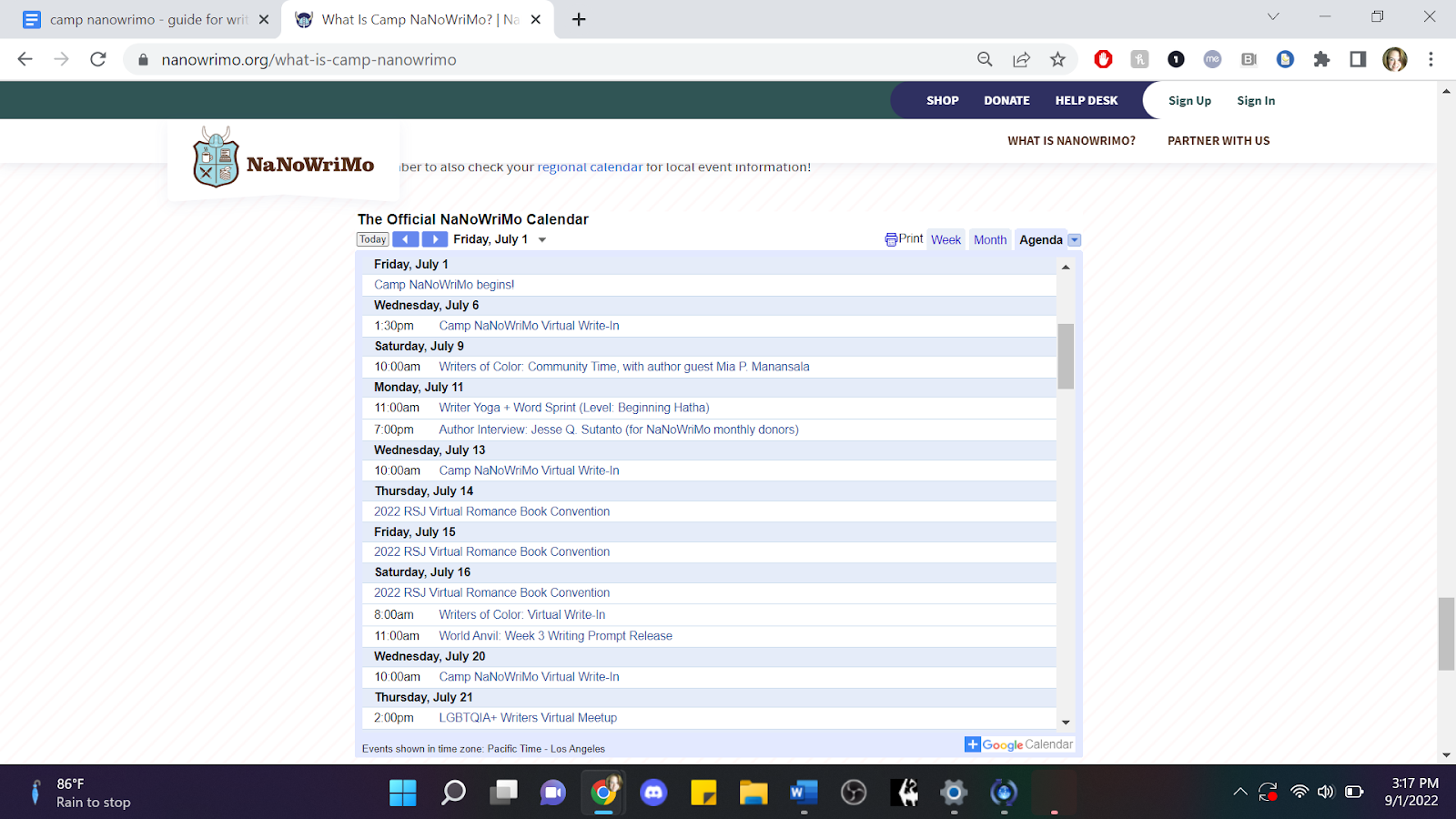
    Here’s the Google Calendar for NaNoWriMo’s events in July, for reference:

    And here’s that same month in agenda form, so you can see the specific events a little more clearly:

    In addition to these local events, Camp NaNo also has Camp Counselors—these are published authors who offer support, advice, and guidance throughout the month. This was the Camp Counselor lineup for July:

    3. Camp NaNoWriMo offers community

    The resources that Camp NaNo has to offer are great for keeping you grounded and supported throughout the process. It’s great to feel like someone’s rooting for you, and it’s awesome to have professionals to turn to for mentorship!

    It’s also great to have a community surrounding your writing and the writing of other authors in your area. You might not know any other writers in your day-to-day life—this is pretty normal! It’s an oft-isolating industry, usually done alone, and usually not involving a ton of connection to other people.

    And if you don’t love the idea of in-person events, guess what? Camp NaNo also has a ton of chances for online connection—their forums allow you to get in touch with local writers online and support one another as you work. You might even make some lifelong friends!

    How to Make the Most of Camp NaNoWriMo

    Now that you know what Camp NaNoWriMo is and why you should definitely try it out, let’s talk about how to make the most of your experience. Even if you prefer not to connect with other writers and instead do Camp NaNo totally solo, some of these tips will help you out!

    1. Pick a project you’re excited about

    Ultimately, you can choose to work on anything, but in my opinion, these kinds of events are best when you’re working on something that excites you. If you’ve got an idea for a book, but you just haven’t found the time to get started, guess what? The time is now! If you’ve got a weird idea for a poetry collection, bam—Camp NaNo material.

    You can also use Camp NaNo to knock out a project that’s been stewing on the back burner for a while. Maybe there’s work to be done, maybe there are essays for college to be written—if it’s not something that you’re super stoked about, at least pick something that you’ll be glad you worked on.

    Is there anything you shouldn’t bring to Camp NaNo, you might ask?

    This is absolutely one-hundred-percent just my opinion, but I don’t like to bring established, deep-in-the-works projects to events like this. Usually I’ve already got a clear idea of where I want to go with the project, so I’m not looking for a ton of feedback, and it’s usually developed enough that there’s not a lot of exciting new stuff happening with it. I’m talking about novels that I’ve already drafted a few times, short stories that just need polishing—stuff like that.

    Camp NaNo creates a ton of energy, and in that way, at least to me, it’s like rocket fuel. Some of your projects or ideas might need rocket fuel to take off and get going—some of your projects might not. You’ll be the best judge of that.

    2. Use Camp NaNoWriMo to establish good writing habits

    Unless you’re already writing for a living, you probably don’t write super regularly. Events like Camp NaNo might be the only months out of the year that you’re consistently returning to the keyboard for regular writing time. And that’s completely fine!

    However, if you want to be a pro, you’re going to have to develop discipline. This doesn’t mean drafting everyday (in fact, it definitely does not mean drafting every day), but it does mean coming to your keyboard as consistently as you can to keep your skills honed and your story fresh.

    Try finding a consistent time to work on your Camp NaNo project. You might find that you work better in the evening, or that you prefer outlining by hand, or that you prefer ten-minute writing sprints to twenty-minute writing sprints. Maybe you envisioned writing during your lunch break, but it turns out the break room at work is way too distracting—that’s good to know! Take note of what works and what doesn’t and bring that knowledge with you beyond Camp NaNo.

    3. Try getting involved with the community around Camp NaNoWriMo

    Of course, the option to do Camp NaNo solo is available to you. It’s a self-challenge, and as such, you’re free to keep to yourself, work on your project, and pat yourself on the back at the end of the month when you’ve completed your goals.

    However, consider this: Camp NaNo is putting you in touch with other writers. Likely, some of these other writers are also readers who might be interested in reading your book when it’s published. And to be clear, I am not saying you should get close to people under the guise of friendship with the ultimate intent of selling them something—in fact, don’t.

    What I am saying is that if you are self-publishing, you’re going to want to build a platform. Platforms require readers, yes, but they also require connections to other authors. Who else is publishing in your genre? What kind of stuff are they writing? Connecting to these other authors means building up your platform a little bit, and that’s going to be absolutely vital when it comes time to publish.

    Additionally, working with other self-published authors is a great opportunity to compare resources. Someone might know a great editor for your genre, and someone else might have already tried the cover designer you have in mind. You can combine knowledge in this way to save yourself some time and make the best decisions possible for yourself and your work.

    4. Have some fun

    Here’s the thing: ultimately, Camp NaNo is meant to be fun. Going in with some kind of plan will help you optimize your experience, but if you don’t have one, I absolutely encourage you to log in on July or April 1st, set up an account, and announce a project, even if you literally just thought of it on the spot. In fact, that might be the most wholesome way to participate.

    However you choose to play, have fun out there!

    Have you ever done Camp NaNo? How did it compare to NaNoWriMo? Let us know in the comments! 

    TWL. CTA. Book Outline Template
  • How Do You Win NaNoWriMo?

    How Do You Win NaNoWriMo?

    In book-writing circles, November is National Novel Writing Month, otherwise known as NaNoWriMo. If you haven’t heard of this annual event, or you’re ready to join the challenge for the first time, this will be a great primer. Here is a brief overview of the rules, along with guidelines to help you win NaNoWriMo.

    How do you win NaNoWriMo?

    “Winning” NaNoWriMo is both simple and hard.

    If you can write 50,000 words between November 1 and November 30 then you win!

    However, actually getting to that word count will take some discipline and strategy. Most people break this big number into a smaller, daily word count of 1,667 to make it feel more achievable. For many, this number is still overwhelming, which is one reason NaNoWriMo is such an exciting challenge. Simple, but not easy.

    Winners receive digital banners and certificates to use on their website or social media and T-shirts are also available for purchase. Sponsors provide other winner goodies, including discounts to writing software and publishing services. The catch? In order to win, you need to register your project on the NaNoWriMo website and log your word count between November 1 and November 30.

    Digital badges and Scrivener discounts aside, the real prize is writing 50,000 words and having a first draft completed in 30 days.

    What are the NaNoWriMo rules?

    While the goal is writing 50,000 words in the month of November, how you get there is flexible. Here is a breakdown of the NaNoWriMo rules to help you stay on track.

    • On November 1, the challenge begins as the clock strikes midnight, local time
    • On November 30, the challenge ends at precisely 11:59:59 p.m. local time
    • For the official challenge, no, you cannot start early or end late. However, you can plan ahead, take notes, create character sketches, etc. before November 1
    • In order to win, your novel must reach minimum 50,000 new and/or rewritten words by the end of the challenge—but your novel doesn’t have to be complete

    That said, “rebelling” is allowed and encouraged, since this is a self-challenge. If your project isn’t a perfect fit and you still want to participate, then do it. For more information on the rules of NaNoWriMo, both official and unofficial, check out this article.

    Additional resources to help you prepare for NaNoWriMo from The Write Life

    These three articles and resources will help you go further with NaNoWriMo specifically. The first is a free tool to help you outline your book before you start writing. The second will help you prepare for NaNoWriMo more fully. The third will help you in your goal-setting so you can actually win the challenge!

    This next set of articles and resources will help you with your novel more holistically. The first will help you get ready to write your novel, but chances are you’re already past that if you’re prepping for NaNoWriMo. The second gives you prompts to get the juices flowing. The third will help you set up routines to write consistently. The fourth is for when you finish writing your rough draft and are ready to self-edit.

    Side note: A lot of people have asked us, “When did NaNoWriMo start? How long has it been a thing?”

    National Novel Writing Month began in 1999 as a challenge between writing friends and has since grown into a global marathon event attracting hundreds of thousands of participants each year. To date, there are nearly 800,000 active novelists and more than 350,000 completed novels as a result of this annual tradition.

    We look forward to seeing you there this November!

  • NaNoWriMo and Beyond: 9 Writing Challenges for Novelists, Poets and More

    NaNoWriMo and Beyond: 9 Writing Challenges for Novelists, Poets and More

    Do you have trouble making time to write? Do you wish you had a community to help you work towards your writing goals, including staying on time and finishing your work?

    Many writers sign up for writing challenges to help them solve these problems and write a large body of work in a short amount of time — or even to build their practice and discipline of writing consistently.

    Besides completing work you can be proud of, participating in writing challenges is amazing because you get to work alongside a group of other writers who all share the same goal: finish that novel, finish that picture book, or write those short stories and poems. You support each other and hold each other accountable.

    Writing challenges that will push you forward

    If you’re up to the task, we’ve come up with some writing challenges to try, whether you’re a novelist, poet, picture-book writer or something in between.

    Here are nine writing challenges to explore.

    1. NaNoWriMo

    Genre: Novel

    This is the one you’ve probably heard of: NaNoWriMo, which stands for National Novel Writing Month, has been an annual November tradition since 1999. During NaNoWriMo, writers around the world challenge themselves to write a 50,000-word novel in 30 days.

    What’s special about 50,000 words? As NaNoWriMo’s organizers explain: “Our experiences since 1999 show that 50,000 is a difficult but doable goal, even for people with full-time jobs and children. The length makes it a short novel (about the length of The Great Gatsby).”

    You’ll need to write about 1,667 words every day to hit this target novel word count, but you won’t be alone; the online NaNoWriMo community helps you track and share your progress while awarding badges for hard work and providing inspiration through interviews with well-known writers and other motivational tools.

    Several writers have published novels they initially drafted during NaNoWriMo, including Sara Gruen’s Water for Elephants and Erin Morgenstern’s The Night Circus. To have the best chance of following in their footsteps, have a through understanding of the rules of NaNoWriMo as well as precisely what you want to get from the experience

    If you’re looking for a similar option, check out Camp NaNoWriMo to experience a writing adventure that offers more flexibility. Hosted annually in April and July, you can set your own writing goal and work on any writing project, novel or not.

    2. NaPoWriMo

    Genre: Poetry

    If NaNoWriMo is National Novel Writing Month, I bet you can guess what NaPoWriMo stands for.

    National Poetry Writing Month takes place every April, and challenges writers to pen 30 poems in 30 days. You’ll have access to daily prompts to help your creative juices flow, but you’re welcome to ignore ‘em, too.

    Independently organized, NaPoWriMo is much smaller than NaNoWriMo, so don’t expect your local library to organize NaPoWriMo nights — unless, of course, you want to organize one on your own!

    Some writers share their NaPoWriMo poems on their websites or via social media, and help spread their love of poetry while showing off their ability to complete the challenge.

    3. StoryADay

    Genre: Short stories

    So we’ve got novel-writing in November and poetry in April. What about short stories? That’s in May and/or September (or whenever you want!), and it’s called StoryADay.

    StoryADay is a little different from NaNoWriMo and NaPoWriMo in that it focuses on completing a short story every day, rather than ending the month with a certain number of stories or a specific word count. But there are rules:

    1. If you miss a day or don’t finish a story, move on. You still have every other day of the month (of your life) which is a new day, on which a new story can be told.
    2. Don’t go back and try to finish yesterday’s story. Leave it. Wash your hands of it. Move on.
    3. As long as you keep writing, you’re not failing.

    Starting — and finishing — a new short story everyday sounds like a much harder challenge than writing a 50,000-word novel in a month; but “sometimes you need a big, hairy audacious goal, to scare your Inner Critic into letting you write.”

    4. 12 x 12

    Genre: Picture books

    If you write picture books, you might want to consider signing up for the 12 x 12 writing challenge created by Julie Hedlund, author of My Love For You Is the Sun. The challenge: write 12 picture books in 12 months!

    Unlike other writing challenges, 12 x 12 comes with a membership fee. The basic package costs $177 and grants you access to writers’ forums, the member Facebook group, feedback from traditionally-published authors and much more. If you choose the higher level membership — which are only available to people who have already participated in at least one year of 12 x 12 — you get to submit your work directly to participating agents.

    Do 12 x 12 writers get published? Absolutely. Check out their list of published writers to get inspired.

    While 12 x 12 is open 24 hours a day, 365 days a year, registration is closed for 2020 and will resume in 2021.

    5. ChaBooCha

    Genre: Young adult

    Young adult writers can use NaNoWriMo to write their books, but there’s also a writing challenge just for them: ChaBooCha, or the Chapter Book Challenge.

    Hosted by writer Rebecca Fyfe, ChaBooCha runs every March and challenges you to “Write one completed first draft of an early reader, chapter book, middle-grade book or YA novel,” from the 1st to the 31st of March. 

    Your results could be anywhere between 1,000 and 80,000 words, depending on whether you’re putting together an early reader or writing the next book in your YA series. Either way, ChaBooCha is there to help you get the job done, with motivational blog posts from authors, agents and publishers — as well as prizes.

    ChaBooCha is open to writers under 17, too! 

    6. YeahWrite

    Genre: Nonfiction, fiction, poetry, microstories

    After reading about all of these programs that challenge you to write 50,000 words or 31 new short stories in a month, are you ready for a writing challenge that’s designed to fit your schedule?

    It’s time to check out YeahWrite, a writing site that issues one writing challenge each week for each of three genres: nonfiction, fiction/poetry and microstories.

    This writing challenge differs from the others on this list because every week, community members vote on a challenge winner. You’re not only participating in a writing challenge, you’re also getting reviewed by other writers — and you might write well enough to win the week!

    YeahWrite is all about community, so it’s free to join. But a paid membership helps keep the site running and gets you access to editorial consultations with YeahWrite editors. There are two membership packages that cost either $25 or $50 per year; each gives you access to editorial evaluations, discounts and more, so check them out!

    7. NaNonFiWriMo

    Genre: Nonfiction 

    The Write Nonfiction in November Challenge (WNFIN) was created by Nina Amir, a coach who inspires writers and bloggers to create published products and careers as authors. Unlike NaNoWriMo, this informal challenge comes with only one rule: You have to commit to starting and finishing a work of nonfiction in a month.

    No one counts how many words you write during the month or even checks what you write. You can write any type of nonfiction, such as a magazine article, blog posts, a white paper, or a book.” And your WNFIN project can even be as short or as long as you like.

    To help you along with the challenge, you can join the WNFIN Facebook page, and the Remote Writing Room provides you with a virtual group of writers you can chat and write twice per week. Plus, check out Nina’s blog for more inspiration and tips to improve your nonfiction writing process.

    Stay tuned for 2020 WNFIN details!

    8. 365 Writing Challenge

    Genre: All genres are welcome

    The benefits of discipline and daily practice can’t be underestimated, and that’s what the 365 Writing Challenge wants to help you develop. Created by Jessica White and her group the 10 Minute Novelists, this challenge has helped hundreds of writers over the past five years write more than 100 million words. To be able to participate, you must be a member of the 10 Minute Novelists Facebook Group.

    All you have to do is set aside 10 minutes every day to write, which is about 100 words a day. You can also use that time to reflect on the writing process, set weekly writing goals, or even flesh out a setting or a character. 

    Upon choosing a membership tier, you’ll be provided a Google Sheet to help you keep track of your daily word count, and at the beginning of each month, Jessica awards badges for the prior month’s achievements.

    It doesn’t matter if you spend 10 minutes or 4 hours a day writing — “the key is consistency so you can grow as a writer and finish your projects.” Look out for 2021 registration details later this year.

    9. The Writer’s Games

    Genre: Short stories and poetry

    The Writer’s Games is a free competition designed to help each individual writer improve his or her craft at an accelerated rate. ​This free six-week, multi-challenge writing competition comes with feedback for every entry, opportunities for publication throughout the competition, and the ability to use judge feedback on previous entries to improve them. 

    Here’s how it works: Each week starting in May and September, a surprise Event is announced and writers have 72 hours to create a short story or poem that fits the Event requirements. Every entry received before the deadline is judged and critiqued by a team and winners are published in a charitable anthology.

    And don’t worry about being eliminated — every registered writer is encouraged to try each of the six Events, even if one of their previous stories was disqualified, which is rare.

    Registration opens April 1 and August 1 for two separate portions, and keep in mind that space is limited.

    So, are you ready to take on one of these writing challenges?

    This is an updated version of a story that was previously published. We update our posts as often as possible to ensure they’re useful for our readers.

    Photo via G-Stock Studio / Shutterstock 

  • 5 Ways This First-Timer Prepared for National Novel Writing Month

    5 Ways This First-Timer Prepared for National Novel Writing Month

    Editor’s Note: Each year, nearly 500,000 writers all over the world dedicate themselves to completing NaNoWriMo, a month-long sprint to write 50,000 words. This year, author and first-time participant Lou Paduano will document his experience. This is the first installment of his journey.

    National Novel Writing Month or NaNoWriMo, around since 1999, now hosts millions of projects in a month-long sprint to reach a target word count of 50,000.

    As many of you know…that’s a lot of words.

    Despite NaNoWriMo popping up on my radar each year, this is my first time taking on the challenge.

    I’ve never considered NaNoWriMo as an opportunity — and I don’t say that to sound dismissive. For me, writing was always something I did anyway. Write a book in a month? How about write a book EVERY month!

    NaNoWriMo: More than just a challenge

    Despite having the drive to write each and every day, though, this time, I took the leap when NaNoWriMo came around. For me it was more than just the challenge set by the site; it was a challenge to hit a difficult deadline and put writing first for one month.

    Taking on a project of this magnitude always goes a little (okay, a lot) smoother with solid preparation.

    How to prepare yourself to reach your NaNoWriMo goals

    In order to make the most out of the experience, I wanted to hit the ground running.

    To make that happen, here are five things I did to make NaNoWriMo a less stressful and (hopefully) more rewarding experience right from the start:

    1. Outline

    The “pantsers” in the audience are cringing right now. The plotters are cheering my name.

    Each side has merit. But I’m on the side of the plotters, because there is no way to tackle a project this size without some direction.

    Whether your plot notes are single sentenes or whole pages, break down chapters and sketch out dialogue to help stage each scene. Having that spine prior to sitting down to write each piece gives you something to fill in rather than having to pull every detail from the ether.

    Outlining and organizing, of course, isn’t easy — but it’s safe to say it’ll help you stay sane later.

    2. Draw out your character arcs

    Alright, you caught me — this is more outlining.

    But instead of plot, let’s get character centric. After all, focusing on the development of your characters is incredibly important to the overall narrative being told.

    Figuring out the arc of each of the principal and secondary players on both sides of the field is crucial to making this draft a success. Not only does it help you become aware of your characters’ overall motivations throughout the work, but each arc provides an entry point into every scene either as a tension builder, background information or a direct action.

    You can find a more advanced breakdown of developing character arcs in Janice Hardy’s NaNoWriMo prep article.

    3. Make space in your day-to-day

    I am a stay-at -home dad with two beautifully time consuming toddlers…not exactly conducive to my month-long sprint toward draft completion. I have one word for this: BABYSITTERS.

    For me, it’s toddlers. For you, it might be your day job. Or your freelance clients. Or other family obligations. No matter the personal responsibilities, NaNoWriMo will be a heck of a lot harder if you don’t plan to make space around them.

    I spent October planning for what I’d do with said toddlers during November. For each week, I pulled in family for babysitting duties to free up an extra four to six hours of work time (instead of my standard nap-time sprints and late-night adventures).

    Ask for help. Switch up your writing space. Accept that your routine might be disrupted.

    There are a million distractions in our lives. We all need exactly one million less for November, so it’s up to us to do what we can to prepare for them.

    4. Prepare your research

    There are always questions lingering after the outline phase.

    The science or the rationale for certain actions needs to be clarified. Simple facts need to be double checked.

    Setting up a system to track your questions, then figuring out some, if not all, of the answers leads to less time spent bombing around the Google machine when it comes time for drafting.

    5. Choose your entry point

    Do a final read-through of everything you have so far: Outline. Character arcs. Research.

    Then, figure out where to start.

    Getting started tends to be the hardest part — so take the path of least resistance. For me, that’s never chapter one. Look for a chapter that is screaming to get written. It could be the last chapter.

    Whatever chapter has been hiding behind your eyelids every night for weeks, that is where you want to start first thing November 1.

    Snag a quick victory amid a mountain of challenges for yourself. It’s what will keep you going.

    What I’m working on for NaNoWriMo

    During this particular NaNoWriMo challenge, I’ll be drafting The Medusa Coin, the sequel to my first novel, Signs of Portents. 50,000 words won’t be enough to cover the tale being told so I’m shooting for 85,000 as my goal for NaNoWriMo.

    Go big or go home, right?

    You’ll be able to follow along with my progress here (week one is below), as I chronicle my word counts, the mid-month challenges, the bribery I’m using (yeah, I said it) and more.

    Week one results

    Thanks to preparation based on the steps above, here’s what I was able to accomplish in week one of my first NaNoWriMo challenge.

    November 1

    • Word Count – 4,154
    • Notes – Hit the ground running ACHIEVED. Definitely a smart idea to have a babysitter in place for opening day.

    November 2

    • Word Count – 2,021
    • Notes – Really thought I could squeeze an extra chapter in during nap time. It’s like the kids know I have work to do!

    November 3

    • Word Count – 2,067
    • Notes – Figured out a character’s motivation halfway through the day. Thought I had this all mapped and plotted but definitely like a surprise every now and then, especially if it makes the rest of the draft easier.

    November 4

    • Word Count – 4,701
    • Notes – BABYSITTER DAY. Cranked out an extra chapter and planned out the weekend so I have a starting point first thing Saturday morning. Also achieved my first reward for the month – a NIGHT OFF.

    November 5

    • Word Count – 6,218
    • Notes – It was Double-Up Day at NaNoWriMo where authors are encouraged to double their word count. I wasn’t looking to participate, but I opened the day with a much longer than expected chapter and the day rolled on from there. I doubt I’ll be seeing this number again this month but, man, it felt GREAT.

    November 6

    • Word Count – 5,306
    • Notes – Big day today. Not the word count, but a chapter I decided to draft. One of my cast didn’t make it out alive. There were tears involved. Mostly mine. Always rough to lose a friend, even if only imaginary.

    November 7

    • Word Count – 2,038
    • Notes – The work week returns! I knew I’d lose some momentum but, holy hell, is it difficult to crank out a chapter during nap time. Especially now that the lighter side of things are out of the way and I’m into the more involved, more detailed chapters of the draft. Work days are going to be rough.

    Are you climbing this mountain with me? Let me know in the comments below. I’ll see you at the top.

  • NaNoWriMo is Coming: 5 Tips for Preparing to Write Your Novel

    NaNoWriMo is Coming: 5 Tips for Preparing to Write Your Novel

    November is National Novel Writing Month, or NaNoWriMo: a frantic month of writing with the goal of drafting a 50,000 word novel.

    Want to give it a shot? NaNoWriMo season will be here before you know it. But here is a little-known fact that you may not know: most writers who actually accomplish their goals during NaNoWriMo don’t start with a blank page on November 1.

    Does this mean writers cheat and start halfway into their book? No. But an experienced novel writer knows that it takes time to flesh out a story.

    In addition to having a general idea of what your novel will be all about, you should follow these five tips to get your novel done before the end of the month.

    1. Set up your work area

    You need a quiet place to write. Having your writing desk in the middle of the kids’ playroom is obviously not a good idea. However, if you need to keep an eye on a toddler while you’re writing, it’s fine to move your laptop or tablet around the house with you as needed.

    Your work area doesn’t have to be anything fancy. In fact, some writers work inside a closet. It’s a good idea to have a decent chair to sit on, a big-enough computer screen to read the words you type, and a safe place to put your choice cup of caffeinated beverage.

    2. Start writing now

    Have you thought about how many words you’re going to have to write every day in order to write more than 50,000 words in one month? If you don’t take a single day off, then you “only” have to write 1667 words every day.

    *Gasp*

    Does that sound like an incredibly large number? It’s really not. In fact, this article is almost half that amount. Unfortunately, if you’re not used to writing a lot, then chances are, you’re not going to write enough during November, either.

    In order to work your way up to 1667 words a day, you might need to start slowly. Start writing something every day now so you’ll be ready to write a novel in November.

    3. Take advantage of progress-tracking tools

    There are a lot of different tools available for novel writing. Many of them allow you to keep track of your progress and will even send you encouragements and reminders. It doesn’t really matter which of these tools you use as long as you keep track.

    Fortunately, keeping track of word count is easy. Almost every writing program will do it for you, and you can even track your word count through the official NaNoWriMo website.   

    If all else fails, you can put the number of words you write each day on a sticky note on your fridge. You can also share it through social media — maybe you can get your friends to cheer you on!

    4. Write while you wait

    Writing doesn’t have to take up all your spare time, although that wouldn’t be a bad thing for many authors. When you’re in a time crunch where you really have to get a project done, it’s a good idea to work on your novel every spare minute of your time.

    Do you spend a lot of time waiting? Whether you’re on the bus, riding the subway, in line to eat at a restaurant, waiting for a date, or waiting for your turn at the doctor’s office, you should be working on your novel instead of staring off into space.

    Fortunately, there are online novel-writing programs that allow you to write on any device as long as you have internet access. Yes, you could even write your entire novel on your cell phone. But even if you don’t currently own a smartphone or iPad, you can bring along an old-fashioned notebook and type your notes up later.  

    5. Finish the novel before you edit

    National Novel Writing Month is not about getting a novel ready to publish. Instead, you’re only expected to write the first draft of your novel. As much as many authors really hate the editing process, it can be tempting to stop writing and start editing too soon.

    Does that mean you don’t have to edit your novel? No. But it means you should wait until you’ve finished it to edit. That’ll give you something to do in December.  

    Are you ready for NaNoWriMo? What are you going to do to ensure that you finish your novel on time?

    TWL. CTA. Book Outline Template