
Tag: writing inspiration

  • Need Story Ideas? This 5-Step Process Works Every Time

    Need Story Ideas? This 5-Step Process Works Every Time

    It happens. You’re sitting in front of a blank page, you dip into your well of inspiration, and you come up with nothing.

    Nada. Zilch.

    At most the moldy remains of an idea you had in seventh grade.

    I’ve been there time and again, until by chance I attended a panel led by Orson Scott Card.

    A strategy for developing good story ideas

    In that panel, he opened my eyes to what a good story idea looks like, and how to generate story ideas without any effort.

    With time, I’ve included my own little twist on his method. The result? A five-element story idea generator that will rarely fail you.

    Here’s how to come up with good story ideas.

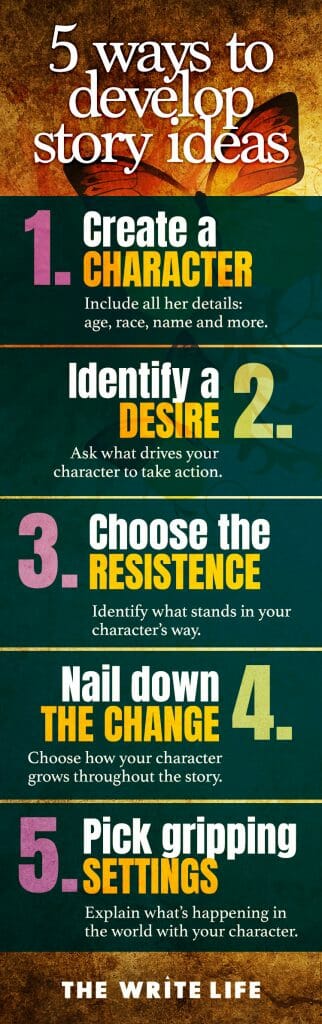
    The First Element: Character

    A story cannot take place without creating complex characters. The character might be a chair (I wrote one like that!), but it has to be there.

    If you don’t have a specific idea for a character, make one up randomly. Choose the following:

    • Race (e.g. human, alien, salt shaker)
    • Gender (if applicable–and isn’t that a story idea in itself!)
    • Age (from toddler to elder and even eternal)
    • Marital status (single, married, divorced, three-year marriage contract…)
    • Family status (parents, brothers, pets, etc. but also nationality and ethnicity)
    • Circumstances (profession, work)
    • And, of course, creative character names.

    Interesting combinations make for richer stories, so keep that in mind as you fill out your character’s background.

    The Second Element: Desire

    Your character must have some desires in life. What drives her? What makes her get out of bed in the morning?

    It can be an active desire, like running a marathon or getting a promotion. It can be a less active desire, like wanting to be left alone.

    But it has to be a specific, attainable desire that will move your character throughout your story.

    Can’t think of a good desire? Re-read your character’s background, try to get into that person’s shoes and think of what you would have wanted in her stead.
    infographic on how to develop story ideas

    The Third Element: Resistance

    If your character wanted something and got it right off the bat, you wouldn’t have a story, would you?

    So the next critical element is the roadblock that stands in your character’s way.

    It can be physical, emotional, spiritual or cultural. It can be another person or a group of people.

    It can be a question of legality or consensus. It can be the very elements of nature.

    Whatever it is, make sure the resistance matches the character. If you have a strong character, you will need a powerful obstacle to stand in her way — otherwise, the reader won’t be convinced that the struggle is real and desperate.

    With these three elements, Orson Scott Card claimed at that panel, you have a solid story idea that can be developed into any media and length.

    I like to add two more elements to the mix.

    The Fourth Element: Change

    A story is all about the character’s journey, and that journey is all about change. If the protagonist is the same at the end as she’d been in the beginning, something is missing.

    For short stories, the change can be as simple as a single trait:

    • A shy man overcomes his shyness in order to pursue true love.
    • A skeptic woman must learn to believe before she can attain the career of her dreams.
    • A haughty salt shaker must learn humility in order to find peace in its life.

    And so on. The longer the story, the more scope you have to mold your character in new ways.

    The Fifth Element: Settings

    The settings of a story are more than a backdrop. It is often a character in and of itself. It impacts the way your protagonist thinks, feels, and behaves.

    Choose an interesting backdrop that will really challenge your protagonist or highlight her journey.

    For example, if your protagonist is on a journey of inner and outer peace, why not paint her story against a background of war, strife, or unrest?

    Character, desire, resistance, change and settings. Pick them deliberately or randomize them completely; either way, you’re sure to get some interesting story ideas.

    How’s that for your very own story idea generator? Now go make up some good story ideas and write!

    This is an updated version of a story that was previously published. We update our posts as often as possible to ensure they’re useful for our readers.

  • 4 Everyday Events That Inspired Famous Authors

    4 Everyday Events That Inspired Famous Authors

    If you’re struggling with writer’s block, you’re not alone.

    We all experience writer’s block from time to time, but one major cause is failing to see the rich possibilities for material in your own backyard. Some writers fear their lives are too boring, giving them little fodder for stories.

    In truth, most people (and writers in particular) lead rather simple, boring lives, but the small details of our lives can lead to great inspiration.

    Fortunately, you don’t have to backpack across Spain or attend a pricey workshop to be inspired to write.

    Read these stories of famous authors who found inspiration in small aspects of their everyday lives.

    1. Watching a baseball game

    Haruki Murakami, author of best-selling books like The Wind-Up Bird Chronicle and 1Q84, writes about men obsessed with boring stuff like cats, making spaghetti and listening to jazz, who suddenly get thrown into surreal situations. For example, they discover a well or a closet or a flash of light that causes them to fall into a crazy dream world.

    This juxtaposition of realistic and zany makes Murakami as relatable as he is fun.

    Unlike some novelists who began writing as preteens, Murakami opened a jazz bar after school. It wasn’t until he was indulging in one of his favorite pastimes (a game by a local baseball team) that he saw a player hit a double. Not even a home run – just a double. The baseball player’s achievement suddenly inspired him.

    For the first time in his life, he decided he could write a novel. Murakami says the idea never occurred to him before.

    writing inspiration2. Making a bet with J.R.R. Tolkien…and winning
    Aside from his nonfiction, C.S. Lewis is probably most famous for his Narnia books, which are full of curious kids, cute talking animals and serious villains. He wrote another series of books, this time for adults, called The Space Trilogy, and it was inspired by a bet with a friend.

    Lewis and his friend J.R.R. Tolkien (of Lord of the Rings fame) were having a discussion about writing when they decided to make a bet where one of them (Lewis) had to write a space travel story, and the other (Tolkien) had to write a time-travel story.

    Lewis finished his story, though Tolkien (who took 12 years to write Lord of the Rings) did not.

    3. A first date

    One of the most praised, and perhaps least read, famous novels of the 20th century Is James Joyce’s Ulysses, a story of one day in the life of a couple of guys named Stephen Daedalus and Leopold Bloom — and that day was, specifically, June 10, 1904.

    The anniversary is celebrated every year in Dublin (and elsewhere) as Bloomsday — which is a good excuse to have a beer even if you’ve never read the book.

    Rumor has it that this was the night of June 10, 1904 that he met his future wife, Nora Barnacle.

    In the novel, Leopold Bloom’s wife is also supposedly based on Nora.

    First dates, whether sublime or terrible, have the potential redeeming quality of being writing inspiration.

    4. Watching a rotor-cutting machine at GE

    According to an interview with the great Kurt Vonnegut, his tech-oriented writing job helped increase his desire to write about science fiction.

    Vonnegut worked in public relations for GE before he began writing novels, but instead of disregarding his surroundings as a bunch of boring machines, he listened to the scientists he worked with. Out of the minor details, he developed a strong interest in the fact that tiny boxes were going to take over the world by doing everything for us.

    Cutting rotors was only the beginning!

    Vonnegut said that this realization led to his first novel, Player Piano, which was in part about the dangers of machines. Vonnegut stuck with sci-fi, twisting and playing with the genre as he wrote his many other novels.

    If these writers could find inspiration in a sports game, a friend, date and a boring day job, then so can you.

    Be more mindful as you go about your day, and listen to the people around you. Inspiration could be lurking anywhere, from the dog park to a Facebook post to the evening news to a trip to the store.

    So go out (or stay in!), notice how fascinating your life really is, and keep writing.

    Has a mundane event ever inspired your writing? Share in the comments below.

  • Need Writing Inspiration? Try This Cool Brainstorming Technique

    Need Writing Inspiration? Try This Cool Brainstorming Technique

    Sometimes, it’s hard to find things to write about.

    But, if you examine your day-to-day life closely, you can find dozens or even hundreds of story ideas in a single day.

    People always say you should write what you know. What could be more familiar than your own daily life and routine? Make some time each day to soak in the world around you and examine what you see closely in order to come up with fresh topics and ideas.

    Find inspiration in your daily routine

    At first, it might seem like eating cereal and buying light bulbs are just part of the tedium of life, and things no one would ever want to read about. But many people share these daily experiences, and shifting your perception can help you come up with a constant stream of fascinating story ideas.

    Of course, it’s all a matter of how you present things.

    An article about being bored waiting in line at the grocery store might not draw in readers (unless it’s a humor piece), but you might be able to place a story about things to do while you’re bored and waiting in line.

    Are there any simple exercises you can do without attracting a ton of attention? Ways to organize your day or reinvigorate yourself with a few idle minutes? Great games to play on your phone? Consider writing stories that can help people navigate their day with “hacks” or tips to help improve their routine.

    Search each day for story ideas

    Let’s look at a sample daily routine and mine the day for story ideas.

    Early in the morning, your alarm clock goes off, or perhaps you wake up naturally. You could write about the best ways to wake up (naturally vs. different types of alarm clocks) for a health and wellness publication. You could examine alarm clocks and how they work, new models, or review an upcoming alarm clock launch for a tech publication. Are there alarm clock apps you could write about?

    If you delve into a topic, you’ll find dozens of possibilities for story ideas.

    Are your pets scratching at the door ready to go outside? Pet publications are always looking for insightful ideas. Consider writing about how to get a new pet into a daily routine, the best pet-related products, toy trends, healthy food options, popular breeds and more.

    Next, you start getting ready for the morning. Do you hop in the shower right away? What types of products do you use? You could write about people’s hygiene habits or dermatologist recommendations on how often to shower and which products to use for healthy skin.

    Take a look at your beauty and hygiene products. Could you write about them for a health and wellness magazine and help people select the best products for their needs? Could you examine how the products are made or perhaps the environmental impacts of various products? How about an article on how to perfect your eyeliner or new makeup trends?

    Now, it’s breakfast time. You can carefully examine your eating habits to come up with a wide variety of ideas. Do doctors have specific recommendations about the best times to eat? What are the best foods to eat? Are there new breakfast trends? Is there a new breakfast restaurant nearby to write about (perhaps with a fascinating owner)? Do you have great breakfast recipes?

    Where does your food come from? Do you get your eggs from a local farmer? Consider farming magazines focusing on a profile of the owner, best practices for your climate, or the challenges and rewards of being a small family farmer. Consider local publications, farming, food, health and wellness, natural living, parenting, and trade magazines.

    Do you have kids to get ready? Parent-focused publications could use content on tips to get kids ready on time, motivate sleepy teenagers, master homework routines, not forget things when running out the door, the best bedtime habits for happy mornings and healthy breakfasts, just to name a few.

    Do you exercise in the morning? Whether you jog, practice yoga or enjoy another fitness routine, you can find plenty of ideas to pitch to health and wellness publications. And be sure to think broadly. If you practice yoga, consider writing about a local yoga teacher, a controversy in the yoga community, a new type of mat, how to find the best style of practice, how to introduce kids to yoga or even a story on pet yoga.

    How does your work day begin? Do you head into an office or work from home? Consider pitching stories on commuting, workplace fashion, business, entrepreneurship, working from home and freelancing. How do you get to work? Do you drive? If so, consider pitching automotive publications about new navigation technology or upcoming vehicle improvements. If you bike or walk, consider pitching health and wellness, sports, women’s or men’s interest publications. Use public transit? Write about some of your experiences or local characters you meet along the way for local publications.

    If you try this technique throughout your whole day, you can find dozens of story ideas each hour — if you think broadly enough!

    Look for ideas online

    Your search for inspiration and story ideas isn’t limited to your own experiences each day. Look online for even more ideas.

    Sign up for email listservs and newsletters to get the latest releases in whatever fields you write about most often. Read the newsletters and emails you receive and spend time on social media and news sites.

    See what people are talking about, and use these trends to develop story ideas. Is there a news development you’d like to write an op-ed about? An issue you’d like to examine more closely?

    Sign up for Google Alerts to receive notification of topics and keywords that you select. This is a great way to track developments in certain fields, keep an eye on companies, and even search for your own name or business.

    With these ideas, you can turn even the most mundane day into dozens or even hundreds of ideas.

    Can you draw writing inspiration from your day? We’d love to hear your ideas in the comments below.

  • Writing Inspiration for Days: 10 Instagram Feeds to Follow Right Now

    Writing Inspiration for Days: 10 Instagram Feeds to Follow Right Now

    Instagram is well known for providing inspiration for travel, cooking, artwork, design, and plenty of other niches.

    But it also offers lots of writing inspiration. From epic bookshelves, cats and dogs snuggling up to a good book, insightful literary quotes, or even just enticing images of a cup of coffee and a good book, every writer can find something to adore in their Instagram feed.

    Check out these 10 sites for a dose of writing inspiration no matter your genre.

    1. Elizabeth Gilbert (@elizabeth_gilbert_writer)

    https://instagram.com/p/8D5h9qxyIv/?taken-by=elizabeth_gilbert_writer


    The author of
    Eat, Pray, Love and recent release Big Magic is relatable not just through her soul-bearing writing, but also through the inspiration she dishes out on her Instagram account.

    Subscribe to Gilbert’s feed to enjoy artsy designs, a variety of sayings and quotes, and updates on her upcoming book projects.

    2. Cheryl Strayed (@cherylstrayed)

    https://instagram.com/p/7q7q2ty-dX/


    Dubbing herself “Writer, mother, light-seeker,” Cheryl Strayed’s Instagram feed offers up selfies, images of her at speaking events, snaps of her books, images of her kitties, and even an opportunity to walk down memory lane with her.

    She sometimes shares photos of her hiking the Pacific Crest Trail, which she later depicted in Wild.

    3. Jon Krakauer (@krakauernotwriting)

    https://instagram.com/p/68C779Raa5/?taken-by=krakauernotwriting
    Outdoor-focused lit lovers will revel in Jon Krakauer’s Instagram stream, which will make you want to run outside and play. From images of people climbing a 130-foot icicle to gorgeous sunsets, mountain shots, and travel images, his stream will leave any outdoor writer inspired.

    He notes as his tagline, “I write books for a living. Been toiling in the writing factory for more than 30 years. Not writing is way more fun.”

    4. Jeff Goins (@jeffgoins)

    https://instagram.com/p/8ESreDDl1b/?taken-by=jeffgoins


    If you’re seeking inspiration for both work and your overall life, check out Jeff Goins’s Instagram account. The best-selling author of
    The Art of Work tells inspirational tale after tale with quotes, sayings, and words of encouragement for any endeavor.

    5. Cat Book Club (@catbookclub)

    https://instagram.com/p/8bp67Po27z/?taken-by=catbookclub


    Instagram is no different from any other corner of the Internet: cats rule. And, as much as you like to read, cats like to read even more — if you to believe the photos on Cat Book Club’s feed.

    If you love furry felines, it’s a great way to watch them cuddle up with a good book (and in some cases yawn or fall asleep on the book). This account will make you want to do nothing more than grab your cat and a novel and sit down for a spell.

    6. Dog Book Club (@dogbookclub)

    https://instagram.com/p/70N-2kkXCx/?taken-by=dogbookclub


    You didn’t think we’d leave out dog fans, did you? After all, who can resist a photo of a cuddly pup snuggling up with a good book?

    This feed contains images of dogs doing everything from reading by lamplight with a glass of wine nearby, to concentrating hard on reading the big words, to scanning an e-reader. These images will make the dog and book lover in all of us smile.

    7. Last Night’s Reading (@lastnightsreading)

    https://instagram.com/p/8dPOoXKo5b/?taken-by=lastnightsreading


    Kate Gavino creates drawings to illustrate quotes from New York City book readings. She draws the author, a quote, and the date of the reading together for a poignant package to encourage writers.

    8. Ernest Hemingway Foundation (@ehfop)

    https://instagram.com/p/y5Fh7wrIxO/?taken-by=ehfop


    The Ernest Hemingway Foundation maintains this Instagram feed full of favorite quotes and notable facts about the literary icon. You can also spot images of vintage copies of some of his works, along with short video clips about some of his stories.

    9. NaNoWriMo (@nanowrimo)

    https://instagram.com/p/29Ev4El76E/?taken-by=nanowrimo


    By now, everyone’s heard of National Novel Writing Month (
    NaNoWriMo). Following along with the organization’s official feed is a sure way to remind yourself that there are plenty of other writers also cranking along on their projects in November — and throughout the year, too!

    10. Jackie Johansen (@wordselectric)

    https://instagram.com/p/3Wp4m5AIoh/?taken-by=finallywriting


    This account has everything from travel photos to mugs of coffee and notebooks at the ready, to inspirational quotes, pets, passports and fun travel pictures. Jackie Johansen offers a world of inspiration for creative copywriters and beyond!

    What Instagram accounts inspire you? Tell us about them in the comments!

    This post contains affiliate links. That means if you purchase through our links, you’re supporting The Write Life — and we thank you for that!