Blog

  • Best Grammar Checker Tools: These 9 Will Make Your Writing Super Clean

    Best Grammar Checker Tools: These 9 Will Make Your Writing Super Clean

    Have you ever wanted a magical editing wand?

    Just imagine: A flick of the wrist is all that would stand between you and the end of editing your writing. No frustration. Minimal time investment. An amazing manuscript or blog post.

    Alas, no such magic wand exists.

    But we do have grammar checker tools, which are the next-best things.

    Just remember grammar checkers are designed to make editing easier, not to eliminate the work completely.

    [sps_reusable_block post_id=43061]

    Putting the best grammar checker tools to the test

    During self-edits on my latest manuscript, I experimented with editing tools, both free and paid, to determine which could be most beneficial to The Write Life’s audience. Besides being an author, I’m an editor, so I also weighed each tool against what I’d look for when editing.

    Since editing has a broad definition — basically anything that improves your writing — it’s not surprising that the tools I tried had different functions, from checking grammar and style to eliminating unnecessary words, to identifying areas for improvement.

    What you want in a grammar checker or editing tool will influence which one(s) you choose. No one tool can do it all — nor can one of these tools wave away the work and critical thinking necessary for a well-edited blog post, magazine article or book.

    A grammar checker doesn’t replace a human editor. Because language rules and elements of a good story can be so flexible, human eyes will always be superior to the rigidity of automatic tools.

    Here are 9 of the best grammar checker tools.

    1. ProWritingAid

    What It Does:  ProWritingAid is a web editor and plugin that will clean up your writing by detecting grammar and spelling mistakes, plagiarism and contextual errors. It also analyzes your writing and produces reports on writing style, sentence length, grammar, and repeated words and phrases.

    Price: There’s a limited free version. If you upgrade to the premium membership, you can edit in Google Docs or Microsoft Word, access a desktop app and Chrome add-ins, and — best of all — lose the word-count cap.

    A monthly membership is $20, a year’s membership is $120,  or go the whole hog and buy a lifetime membership for $399.

    Who It’s For: Anyone, including students, authors, freelancers or ESL writers.

    How It Works: Click on “Try the editing tool,” create a free account, then paste in your text.

    The Best Part: ProWritingAid has a premium option, but most of the areas you’ll want checked are available for free.

    What Would Make It Better: Though ProWritingAid checks grammar, I slipped in a your/you’re mistake without getting flagged. I wasn’t overly fond of the tool’s inability to work offline, but its overall functionality is hard to argue with.

    Our Recommendation: Use ProWritingAid in the self-editing stage to guide your edits. 

    More Details: For an in-depth explainer of ProwritingAid’s free and premium versions, check out our full ProwritingAid review.

    2. AutoCrit

    What It Does: AutoCrit analyzes your manuscript to identify areas for improvement, including pacing and momentum, dialogue, strong writing, word choice and repetition. Depending on what plan you choose, you can also compare your writing to that of popular authors like Danielle Steel or James Patterson.

    Price: Three different plans are available: the “Free Forever” plan, which is free; the “Professional” for $30, or the “Annual Professional” for $297 per year. The latter offers a built-in discount of two months free every year. 

    Who It’s For: Fiction and non-fiction writers.

    How It Works: Paste your text into the online dashboard or upload a document and click on AutoCrit’s tabs to see its analysis. This tool uses data from various genres and more than a million books to provide a word-by-word level analysis of your writing and shows easy ways to improve the readability of your work.

    The Best Part: I spent the most time in the “Compare to Fiction” tab, which provides a comprehensive look at common issues. It highlighted my tendency to start sentences with “and” and “but,” and identified my most repeated words. I felt like I learned something about my writing, and that’s something I don’t think I could say about some other tools.

    What Would Make It Better: A more accurate definition of passive voice. It highlights any use of the “be” and “had” verbs, neither of which fully capture passive voice (you need a past participle in addition to a “be” verb), and many active voice constructions were falsely labeled as passive.

    Our Recommendation: AutoCrit is great to guide your edits in the self-editing stage. It’s best used for developmental edits, rewrites and avoiding common writing no-nos.

    More Details: For an in-depth explainer of Autocrit’s Free Forever and paid versions, check out our full Autocrit review.

    3. Grammarly

    What It Does: Grammarly is a grammar checker and proofreader.

    Price: A limited version is available for free, and Grammarly also offers a number of other free services such as a wordiness checker and tone detection. The business plan starts at $25 per member per month. For the most up-to-date info on Grammarly pricing, see their website. 

    Who It’s For: Anyone, including writers, business people and academics.

    How It Works: Copy and paste or upload your text into the online dashboard and let Grammarly work its magic. It flags potential errors, gives suggestions and provides an explanation so you can learn why it suggests the change. There’s also a free Grammarly Add-in available for Microsoft Word and a Grammarly for Chrome extension that’s also compatible with Google Docs.

    The Best Part: Grammarly is easy to use and pointed out a vocabulary issue or two that none of the other tools did. It’s superior to Microsoft Word’s grammar checker. Its synonym suggestion feature is pretty nifty, too.

    What Would Make It Better: As an editor, I work with many styles of writing, so it’d be helpful if Grammarly provided the option to switch between a few to ensure writers receive fitting suggestions to improve their work. For example, if you don’t use the Oxford comma, the editor will prompt you to do so, which isn’t right for all writing styles. 

    Our Recommendation: Grammarly is best for the final proofreading stage, or for people who want to learn more about the technical aspects of grammar. If you’re an editor or strong writer, you might find yourself ignoring more flagged items than you fix.

    More Details: For an in-depth explainer of Grammarly’s free and premium versions, check out our full Grammarly review. You can dig deeper into Grammarly features and benefits here.

    4. Hemingway Editor

    What It Does: Hemingway Editor is like a spellchecker, but for style. It provides a readability score — the lowest grade level someone would need to understand your text — and analyzes your writing to identify areas for improvement. Because it doesn’t require an internet connection, you can use it anywhere.

    Price: Free online, and a one-time payment of $19.99 for the desktop version, which is available for both Mac and PC.

    Who It’s For: Anyone

    How It Works: Paste your text into the dashboard and scan for highlighted sections of text. The highlighted text is color coded depending on your area of improvement, whether it’s hard-to-read sentences, the presence of adverbs, or passive voice.

    The Best Part: In addition to providing examples on how to fix passive voice or complex phrases, Hemingway Editor also identifies how many “-ly” adverbs and passive voice constructions you’ve used and suggests a maximum number based on your word count.

    In my prologue, for example, I had one use of passive voice, and Hemingway Editor suggested aiming for six uses or fewer — which I nailed. These recommendations reinforce the idea that not all adverbs or passive voice constructions are bad, and that’s something other tools miss.

    What Would Make It Better: Hemingway Editor was the cleanest and easiest to use of the free editing tools, but it’s not a true grammar checker or proofreader. Even though it’s not meant to catch grammar and spelling mistakes, any editing application that catches those mistakes is instantly more attractive.

    Our Recommendation: Use Hemingway Editor to increase the readability of your writing and identify problem sentences during the copyediting stage, but supplement your efforts with a grammar and spell checker.

    5. WordRake

    What It Does: WordRake cuts out the unnecessary words or phrases that creep into your writing. It works with Microsoft Word and Outlook, depending on which license you purchase. I tested the Microsoft Word version.

    Price: The Microsoft Word version is available for Mac or Windows, and you’ll pay $129 for a year or $259 for three years. The Microsoft Word and Outlook package version is only available for Windows, and it costs $199 for a year or $399 for three.

    Who It’s For: Bloggers, authors and editors using Microsoft Word or Outlook.

    How It Works: WordRake is an add-in for Microsoft products and requires you to install the program before using it, though it’s as easy as following the instructions. Select the text you want to edit, then use the WordRake add-in. It uses Track Changes to suggest edits, which you can accept or reject.

    The Best Part: WordRake is as close as you can get to an automatic editor. It appealed to me more as an editor than a writer, but it’s great at eliminating unnecessary phrases and words that bog down your writing.

    What Would Make It Better: I threw a your/you’re mistake in to see if WordRake would catch it. It didn’t, even though Microsoft Word flagged it. If WordRake could catch common writing mistakes like your/you’re or their/they’re/there in addition to unnecessary words, it’d be a hard tool to beat.

    Our Recommendation: WordRake is a great tool for the copyediting stage. Verbose writers, authors wanting to cut down on editing costs or editors looking to speed up their editing process will most benefit from WordRake. Watch out if you’re running Word on a slow computer: WordRake could increase your load time.

    6. Ginger Software

    What It Does: This AI-powered writing assistant and grammar and spelling checker works to improve your style and speed, plus boost your creativity. It also scans full, complex sentences and suggests context-based corrections. 

    Price: Ginger offers a free (but very limited) plan, so you’ll find it to be more effective through its premium offerings: $13.99 per month, $89.88 per year or $167.76 for two years. Heads up: It’s currently running a 30% off promo for all plans, so these prices may increase at any time. For most up-to-date pricing, check this page.

    Who It’s For: Anyone.

    How It Works: Whether you choose to download Ginger to your Chrome browser, as a desktop app or otherwise, all you have to do to get started is follow the setup instructions to install it. As an add-on or app, Ginger will highlight spelling, grammar and punctuation errors, and it’ll even help you rephrase sentences by giving you tons of alternative options.

    The Best Part: One word: cross-compatibility. Writers can download Ginger as a desktop app for Mac or Windows or directly into Google Chrome or Safari, and it works seamlessly with programs like Outlook, Microsoft Word and PowerPoint — you can even download it as a keyboard or app for Android phones and an app for Apple phones. 

    What Would Make It Better: Most grammar checkers offer a plagiarism detector, but Ginger doesn’t. Even if it only added it to premium plans, this would be a helpful feature to include. 

    Our Recommendation: Download Ginger If you have a good grasp of grammar and punctuation, and you need a grammar editor to back up your knowledge. 

    7. Scribens

    What It Does: Scribens is a free grammar checker that corrects more than 250 types of grammar, spelling and stylistic mistakes including nouns, verbs, prepositions, pronouns, homonyms, typography and punctuation.

    Price: Free for everyone.

    Who It’s For: Anyone, including writers, editors and authors of any genre, business people and academics.

    How It Works: Choose which extension(s) where you want to install Scribens, then download it and begin writing. To test it first, click ‘Grammar Check,’ then paste your text or import a file into the editor. Through color-coded suggestions, it’ll check your style, vocabulary, grammar and spelling, it detects patterns in your writing, and it grades readability. 

    The Best Part: You can download the Scribens extension in just about any place you’d need to write — i.e., social networks, websites with text zones (WordPress or forums), email platforms and more. Writers will be sure to enjoy this flexibility and the assurance that they can edit their writing right from any website or application. 

    What Would Make It Better: For a free grammar checker, Scribens offers more than the average free tool, but it’s not as intuitive as others on this list. I tested a simple their/they’re mistake and it didn’t flag it. It’s helpful that it notes bigger grammar errors like compound predicates, but as a grammar corrector, it should also be able to avoid smaller ones from slipping through the cracks.

    Our Recommendation: Use Scribens in the final stages of your copyediting. With minor issues out of the way, you can focus on addressing readability, syntax errors and stylistic elements with Scribens deeper analysis of your work.  

    8. WhiteSmoke

    What It Does: WhiteSmoke is a grammar checker and proofreading software that corrects spelling, word choice, grammar, punctuation and style mistakes. It also offers a translator and dictionary that supports more than 50 languages. 

    Price: WhiteSmoke offers three plans that include a web plan for $5.99 per month, which is compatible with all browsers. Its premium option is $6.66 per month. Its business option is $11.50 per month. For updates on pricing, check this page.

    Who It’s For: Students, professional writers and bloggers, business executives and employees and English learners.

    How It Works: After you register, choose a package and install this grammar checker, WhiteSmoke’s all-in-one English tool will provide grammar, spelling, punctuation and style checks when you click on highlighted text from any application or browser. 

    The Best Part: If you’re unsure about grammar rules during your writing process, check out WhiteSmoke’s handy video tutorials that focus on common writing problems and how to avoid them. Plus, if you need a template, it has more than 100 document and letter templates you can access.

    What Would Make It Better: Unfortunately, this grammar editor isn’t the most intuitive tool on this list, plus it has a limit of 10,000 characters at a time, where each letter, punctuation mark and space counts. (For reference, you can check 150,000 words on Grammarly!) If you write long-form pieces, this may not be the best tool to use to check your work. 

    Our Recommendation: WhiteSmoke offers many innovative features, but it shouldn’t be your main squeeze. Although it uses Natural Language Processing technology to enhance your writing, WhiteSmoke openly warns it won’t catch every grammar mistake, so supplement this checker with another one. 

    9. LanguageTool

    What It Does: A multilingual grammar, style and spell-checking software, LanguageTool is an Open Source application that checks your spelling, grammar, tone and writing style and instantly generates context-aware suggestions for more than 30 languages.

    Price: Besides the free plan that allows basic grammar checks of up to 10,000 words, LanguageTool also offers monthly or yearly plans for individual users. You can expect to pay $4.99 per month or $60 per year. For updates on pricing, check this page.

    Who It’s For: Anyone, including students, authors, freelancers, ESL writers and business people.

    How It Works: Try the grammar checker on the website’s homepage or download it as a Google Docs add-on or a Microsoft Word add-in. Write or paste your text into the editor, and it’ll underline your errors in red, yellow or blue to indicate whether you need to correct your spelling, grammar or style. 

    The Best Part: Similar to Hemingway Editor, you can take advantage of the web-based platform of this grammar corrector without the need to install anything. And because it’s multilingual, it offers a premium feature that detects gender while proofreading, which is super helpful when you’re unsure of how another language structures gender in writing. 

    What Would Make It Better: While they offer fun features like detection of incorrect numbers and of incorrect names and titles in emails, LanguageTool’s premium plans limit you to 60,000 characters per text field. It’s an improvement from the 10,000-character limit in its free plan but still a pain point for long works.

    Our Recommendation: LanguageTool grammar checker is a worthy writing assistant to consider if you write in or for other languages regularly, especially for its value. 

    This post contains affiliate links. That means if you purchase through our links, you’re supporting The Write Life — and we thank you for that!

    This is an updated version of a story that was previously published. We update our posts as often as possible to ensure they’re useful for our readers.

    [sps_reusable_block post_id=43061]

    Photo via rCarner/ Shutterstock 
  • How to Pitch a Story: 9 Insider Tips for Contacting the Right Editor

    How to Pitch a Story: 9 Insider Tips for Contacting the Right Editor

    You’ve got a fantastic idea for a story. You even know which publication or website it’s perfect for.

    The only problem? You have no idea who you should pitch — or how to get in touch with them.

    Figuring out which editor to contact — and finding that editor’s email address — can be a frustratingly time-consuming aspect of freelance writing. But it’s oh-so-necessary if you want to see that story published.

    How to pitch a story to an editor

    Don’t despair; there are a few tricks for making the process easier. All it takes is some sleuthing — after a while, you may even find the process fun! (I’m not the only one who does a little victory dance when I finally get in touch with the right editor, am I?)

    In this post we’ll review both how to figure out which editor to pitch, and then tricks for finding that person’s email address, so you can place and get paid for more pieces.

    To kick us off, here are some ideas for how to identify which editor to pitch.

    1. Get as specific as possible

    Unless it’s a really small publication, avoid pitching the editor-in-chief; she’ll probably just delete your email.

    Instead, try to find the editor who oversees your story’s beat. If you’re writing about an up-and-coming clothing designer, for example, look for the fashion or style editor. The easiest way to determine this is to Google “Real Simple fashion editor,” or “Real Simple masthead” and then search for “fashion” or “style.”

    If you can’t find that information, “Go for a senior, deputy, or associate editor,” says freelance writing expert Linda Formichelli. “If that editor isn’t the right one, she’ll often send your query along to the correct editor.”

    She says not to bother with contributing editors or copyeditors, as they’re not responsible for assigning stories.

    2. Call the publication

    This may sound old-fashioned, but it works. If your target publication has a phone number listed, call and ask to be connected to the relevant department. Once you have someone on the line, ask, “Who should I contact with a pitch about travel to Greece?” Easy peasy.

    “I sound like a broken record…‘Pick up the phone! Pick up the phone!’” says Formichelli. “Many of my students are pleasantly surprised that they get a quick answer.”

    3. Ask your contacts

    If you’re a member of any online writing groups, ask your fellow members if they have a contact at your target publication. If they’re familiar with your work, they may even be willing to introduce you over email—bonus points!

    “Be sure to supply your email address on the forum or invite direct messages so respondents won’t have to share the info with the whole group,” suggests Formichelli.

    4. Search Twitter

    Smaller websites and publications may not publish a masthead. One of the best ways to find otherwise-unlisted editors is through Twitter, since users often list their place of employment in their bios. In Twitter’s search tool, type in the word “editor” plus the @handle of the publication you’re targeting.

    Some editors even prefer to be pitched on Twitter before moving the conversation to email, so it doesn’t hurt to send a direct message.

    If you’re really keen to make a connection, you might even create what The Write Life founder Alexis Grant calls a Notice-Me List, then strategically interact with editors you want to write for.

    5. Join Freelance Writers Den

    Yes, you’ll have to pay for a monthly membership, but for serious freelance writers, it’s worth it. You’ll get access to courses, ebooks, podcasts, and trainings to help you know who to pitch, how to pitch them, and how to uplevel your rates as a freelance writer. Ultimately, you’ll learn how to grow your freelance writing income and you’ll be surrounded by a community of freelancers who can inspire, encourage, and give advice along the way.

    And don’t forget, this is self-education, which means the fee is tax-deductible in many countries!

    Advertisement for the Freelance Writers Den, a writing community with more than 300 hour of training for one affordable monthly price

    Next up: Tips for finding that editor’s email

    Once you’ve figured out which editor to pitch your story to, you’re well on your way! But how the heck do you find that person’s email address?

    Here are a few tips for getting your hands on the editor’s email.

    Don’t skip this step just because it seems too easy.

    Search “Jane Doe email address,” and it could pop right up. You could also try searching “janedoe@publication.com” to see if you get any hits.

    And remember, while most of us stick to the search box on Google’s homepage, the search engine offers many more ways to find what you’re looking for. If you really want to milk Google for all it’s worth, try these advanced tips for using Google search from Lifehacker.

    7. Try Sales Navigator for Gmail

    This used to be called Rapportive before it was acquired by LinkedIn. Now there’s both a free and premium version. The Gmail extension shows the social media profiles of whoever you’re emailing right in the sidebar of your Gmail account, which is useful for brand building and general networking — and pure gold for finding email addresses.

    When searching for an editor’s email address, start typing different name combinations into the “To” field, like jane@publication.com, janedoe@publication.com, jane.doe@publication.com, and jdoe@publication.com. If she uses her work email for her LinkedIn profile, her name and photo will pop up when you’ve hit the jackpot.

    8. Look on LinkedIn

    Do more than just glance at their profile. Dig a little. It’s becoming more common for LinkedIn users to include their email address either in their contact information section or at the bottom of their introduction note. Look deep in their profile and you might find an email address.

    LinkedIn also has a direct message feature, but chances are you’ll have to upgrade to premium to send a message to someone who’s not your connection.

    While you’re there, look to see if anyone you know is connected with this editor. Maybe they’ll make an introduction for you!

    9. Find the editor’s colleagues

    If you’re still coming up short, try to find an email address for a colleague at the same publication. In a post for The Muse, Grant calls this one of her “absolute favorite hacks.”

    She shares this example: “Say you found one of Joe Schmo’s colleagues, Mary King, and her email is mking@starbucks.com. Knowing that, you can easily guess what Joe Schmo’s email might be: jschmo@starbucks.com.”

    Next step? Pop it into your Gmail extension to see if you’ve got a match. (Note that just because it doesn’t appear doesn’t mean it’s a no-go; some editors may use their personal email addresses for their LinkedIn profile.)

    You can also simply try sending your pitch and see if the email goes through. You never know, you might get lucky!

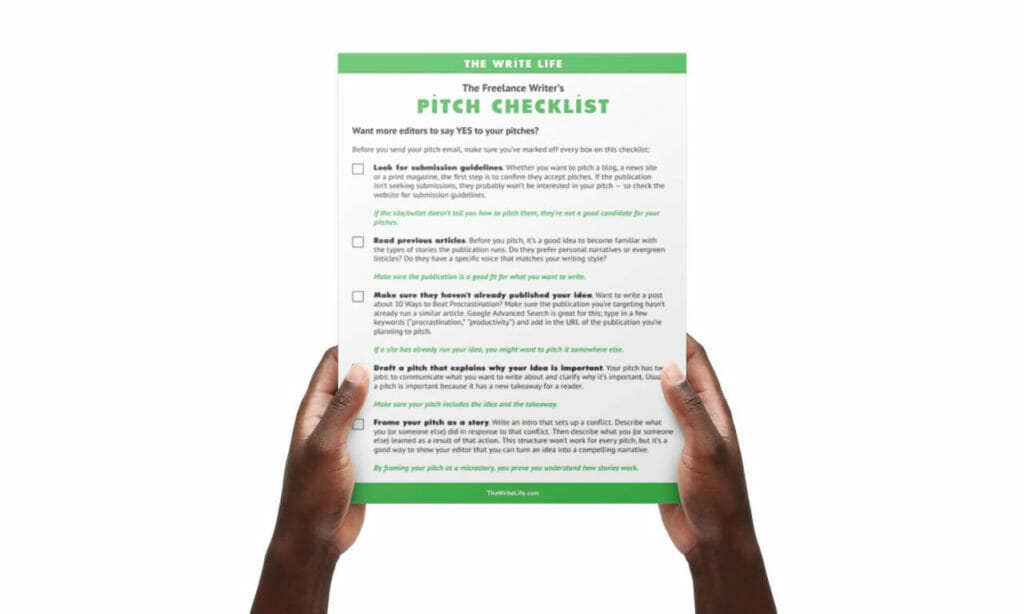
    Freelance Writer’s Pitch Checklist
    Grab it for free 👇

    Convince more editors to say YES to your pitches!

      We’ll also send you our weekly newsletter, which offers helpful advice for freelancing and publishing. You can unsubscribe at any time.

      The Write Life regularly updates and republishes posts so they are more useful and relevant for our readers. We updated this post in 2022.

    • Top 9 Best Romance Books 

      Top 9 Best Romance Books 

      Whatever season you find yourself in, settling down with a romance book can take you places you never dreamed of. 

      There are an eclectic array of romance novels and they are loved in a variety of ways. Whether you prefer the westerns, the historical romance, present-day slow burns, or a mix of each, romance is a story trend that never goes out of style.

      From the original folk tale of Cinderella to, the bestselling novels on the New York Times list, romance is in.

      In this article, we cover nine of the best romance books, part of why they are loved, and what sets them apart. Spoilers ahead, so consider this fair warning! 

      #1 – The Longest Ride

      There are many tremendous books on the craft of writing, but sometimes it helps to see the rules applied, and broken, through fiction. Nicholas Sparks’ novel, The Longest Ride, intertwines two love stories into one novel. What could be better?

      Sparks’ novel includes the time period of WW II and present-day, North Carolina. A New York Times bestseller, The Longest Ride tells the story of two couples who must overcome difficulties. 

      A cowboy, a stranded elderly man, and a college senior lead this story from the first page to last. A great summer read or book to pick up when winter seems like it won’t end. 

      #2 – The Mountain Between Us

      The captivating book, now a major motion picture starring Kate Winslet, begins in Salt Lake City, Utah. Focused on the story of a surgeon named Ben and a writer named Ashley, The Mountain Between Us shares their journey through the wilderness in winter. 

      With nothing but pain, secrets, and love to keep them going, the two form a bond. However, tragedy is known to bring people together—but will it last? 

      The story of Ben and Ashley will keep you on the edge of your seat as you join them from freezing altitudes in a charter plane to the icy cold of a frozen lake. Reading this one at the beach may be a good offset to the spine-chilling, heart warming story that is Charles Martin’s The Mountain Between Us

      #3 – The Nightingale 

      Written by Kristen Hannah, The Nightingale is a number one New York Times bestseller, Wall Street Journal Best Book of the Year, and praised by People as “Powerful…an unforgettable portrait of love and war.”

      This historical fiction follows the romance and hardship of two sisters, Vianne and Isabelle. Set in France in 1939 in the village of Carriveau, it may not seem like the setting for a romance. However, when the Nazis invade France trucks and tanks fill the streets and planes fill the once blue sky, both love and war invade Carriveau. Vianne and Isabelle could not be more different, and each perspective presents a different point of view that adds depth and beauty to the story.

      #4 – Submerged  

      The first novel in Dani Pettrey’s Alaskan Courage series is set in the quiet town of Yancey. However, when two deep-sea divers turn up dead, a sabatoged plane enters the story, protagonist Bailey Craig realizes she didn’t return home for only one funeral. 

      With a murderer in her hometown, a place Bailey vowed never to return to, she discovers her past walking back into her life—Cole McKenna. With Cole helping the police on the murder case and her own past blurring her vision, Bailey has to choose what to see and decide if Cole could be part of her future. 

      #5 – The Four Winds

      Also by Kristen Hannah, The Four Winds is a riveting romance set during the drought of the Great Plains and the Texas Gold Rush. Elsa Wolcott marries Rafe Martinelli—hardly more than a stranger. 

      Fighting against her own choices, struggling through her marriage, and desperate to beat nature in the battle for her children’s lives, Elsa faces a perilous future. Caught in a dilemma, she must choose between her farm and her future, decide what will define her family, and if she will ever be able to love herself. 

      #6 – Pride and Prejudice

      Jane Austen’s classic is a must-have on this list! The Bennett’s are a family with five daughters—one must bear the weight of marrying rich in order to support the family. But when wealth takes the form of a bad first impression, pride enters society and prejudice fights for control, Elizabeth Bennett is left with a difficult choice. 

      A beloved novel and a case study on character, Pride and Prejudice will take you on a journey through the English countryside, to elegant balls, and through the highs and lows that are so prevalent when marriage is tied to the safety of a family. 

      #7 – The Guernsey Literary and Potato Peel Pie Society 

      Both a Netlfix film and a New York Times bestseller, this heartwarming novel whisks you off to the island of Guernsey. With scenes set during the German Occupation tied together with Juliet Ashton’s new book project, this touching story will make you forget you’re reading. 

      The characters are as close to human as language can make them, a book club stars as a type of protagonist in the novel, and heartbreak and new love both make an appearance. The Guernsey Literary and Potato Peel Pie Society is a novel for all seasons. 

      #8 – Crazy Rich Asians

      Now an acclaimed major motion picture, Crazy Rich Asians is the story of New Yorker Rachel Chu. Her boyfriend Nicholas invites her Singapore to meet his family, she does not realize what she’s getting into. 

      In fact, rather than a relaxing vacation with her boyfriend, Rachel’s summer turns into a holiday of roadblocks between old money, new money, Nicholas’s relatives, and the social climbers she engages with. 

      Why? Well with the invitation, Rachel’s boyfriend didn’t quite explain he’s the wanted boyfriend of the country and his childhood home is more of a childhood castle. Forced to evaluate her priorities and her love, Rachel’s story is warm, hilarious, and will keep you turning pages.

      #9 – Truly, Madly, Deeply

      In love for the first time, a son’s decisions about the future divide his family in this fearless and This New York Times bestseller is the story of Tommy Baxter falling in love for the very first time. Set on becoming a police officer and in love with his girlfriend, everything should be going well for Tommy…but it’s not. 

      His girlfriend enters a life and death fight, and secrets turn Tommy’s world upside down. Now more than ever determined to fight injustice, Tommy’s story is one of romance, drama, and intrigue. 

      Your Turn: Did we miss one of the best romance books?

      These nine stories barely dent the pile of loved romance stories. What are your favorite romances and why do they hold such a special place in your heart? Articulating the answers to these questions can help you not only enjoy your reading more but bump your writing to the next level. 

      Add these nine to your reading list, or make your own. Whatever you do, don’t forget to read like a writer and learn from authors a little further down the road! 

    • Writing Sample Examples: How To Make Each One Count

      Writing Sample Examples: How To Make Each One Count

      Regardless of what type of writer you are, you are bound to come across times you will need to submit relevant writing sample examples. Whether you need a writing sample to include with a book proposal to a publisher, you are crafting a writing sample to apply for a job, or you are sending writing sample examples for a graduate school application, it is an art to be able to write the perfect piece when it counts.

      So what distinguishes the great writing sample examples from mediocre ones that get passed over? And what are some easy-to-use tips specific to these different types of writing sample examples?

      Writing Sample Examples Fundamentals: Do’s and Don’ts

      DO

      • Do… read prompts thoroughly. While this is may seem obvious, many people glaze over the instructions and just start writing, potentially missing key elements of the prompt. Look for any information about the tone, the subject matter, and the word length. 
      • Do… write for your audience. The prompt you get may or may not be very detailed. Keep in mind you are not only writing to show your knowledge on a topic, but also to show you can write for the appropriate audience.
      • Do…proofread thoroughly. Any typos or grammatical errors will only detract from your finished work. We highly recommend you use a grammar checker, like ProWritingAid or Grammarly.

      DON’T…

      • Don’t write too little or too much. If you are given a word count, there is a reason for that word count. A 1,200-1,500 word article will require more detail and organization than a 500-word article. Make sure you outline and prepare your article and research to fit the word count. The Article Outline Template can help with this.
      • Don’t use an article you wrote for something else if you are asked to write an original piece. This is an example for you to show how your writing fits the qualifications. 
      • Don’t forget what your goal is. Keep your desired outcome front and center when you are crafting these writing sample examples. Your goal is to write a piece that fits the goal and delights the reader. 

      Writing Sample Examples: For Job Applications

      When a potential employer is asking for writing sample examples, they are trying to gauge not only your style of writing, but also trying to pick up on key details about who you will be as an employee.

      Potential employers are generally interested in your attention to detail, your ability to follow directions and meet deadlines, your willingness to go above and beyond, and also your understanding of the company and their audience. 

      Checklist for Writing Sample Examples for Job Applications:

      • Read the instructions thoroughly. First, read for the basic idea of the prompt and then read a second time to take notes of everything you need to do to complete the prompt successfully. 
      • Research the company. Find their mission statement, their “about us” section, and understand not only what they do but also what their values are. Take a few minutes to read how they write on their blog, how they represent themselves on social media, and who they are on their website. 
      • Understand not only their brand but also look at who their audience is. Depending on what type of writing you are asked to do, make sure you take what you know about the company into consideration when you write and write for the appropriate audience. 
      • Proofread more than you normally would. That means not only proofread as you go, but read your writing sample examples several times both in your head and aloud so you can correct typos and catch any issues with phrasing or tone.

      Writing Sample Examples: For Freelance Writing Gigs

      Unlike the writing sample examples you’d write for job applications, the types of writing sample examples you include might be a bit different if you are trying to specifically land freelance writing gigs. 

      The editor might give you a prompt and ask you to write a piece for their audience to gauge how you will write for their site. The editor might also ask for recent examples of work you’ve published for other sites. Make sure you clearly understand what they are looking for and include any relevant information. 

      • For writing examples that have been published, include the link to the site. 
      • If you know any details of positive reactions to the article feel free to include that. 
      • Include writing examples that resonate with the same audience as the writing gig you are interested in. For example, if you are looking to write legal research pieces, include a similarly research-heavy piece you’ve written as opposed to a blog you wrote for a parenting website. 

      If you are crafting new writing examples for their blog as a trial article, 

      • make sure you clearly understand the blog and the assignment. 
      • Ask for any guides on their voice, tone, and other publication guidelines. 
      • Format your article for SEO as much as you are able. Remember to organize your subsections using H2 and H3, include your keywords in your headers and throughout the body, and space out your article to make it easier to read online. 
      • If you need more help with your SEO basics – check out our article SEO Writing Explained. There is also a course available from one of our partners at the SEO Content Institute. You can find more info by clicking the image below.

      Writing Sample Examples: For a Book Proposal

      When writing a book proposal to an agent or a book publisher, you do not usually send the manuscript in its entirety. 

      Instead, you will need to include in your proposal a lot of information. You will need to share a little about who you are as an author, who are your readers, a summary of the book, an outline of the book and also writing sample examples from the book itself.

      Checklist for writing sample examples from your book for book proposals:

      • Follow the submission guidelines for the agent or publisher. If you don’t have any submission guidelines, feel free to reach out and ask how they would like to receive your book proposal. For example, some agents and publishers have strong preferences over receiving submissions electronically versus in the mail. 
      • Include a self-addressed envelope if they ask for it and you are expecting to receive the proposal back. However, many publishers receive too many submissions to return proposals. 
      • Include at least two chapters of your book. If your chapters are short, consider adding a third. You should include enough of the book that the reader understands the flow of the book, gets a taste of the characters, and wants to read more. 
      • Proofread your chapters thoroughly. Even if your book has not reached the final stages of the editing process, you should not have any glaring grammar or punctuation errors. While you might still be refining the content, the chapters should be edited thoroughly. Don’t let anything detract from the chapters you submit.
      • Generally don’t include the introduction, first chapter or final chapter. These chapters can feel too introductory or else too final. Instead, include chapters that are compelling, feature memorable scenes, and draw you immediately to the heart of the action. 

      For more help writing book proposals, check out these great resources:

      Writing Sample Examples: For Graduate School Applications

      Graduate school applications include a variety of information, some that you control and some that you can’t by the time you are applying. Even with less than stellar grades, you can still win over a potential school by including stellar writing sample examples. 

      So what is important to include in these applications?

      Checklist for Writing Sample Examples for graduate school applications:

      • Follow the writing prompts. This seems too simple of a direction, but truly one of the keys to writing well is to read the details and write to the prompt. Stay within the guidelines you are given for word length and formatting.
      • Remember your audience. Writing for a college application is different than blog or website copy. If you are not currently in school and writing in an academic style, spend time reading other successful writing sample examples to get in that mode. 
      • Choose a topic that gets you excited. Universities are looking for not only people that are an asset to the university academically but also someone that enriches the student body. Feel free to let yourself shine and include your passions, your goals, and anything else that adds to who you are and will be as a student. 
      • Proofread. At this point, proofreading should be second nature, but don’t get caught up in the details of the application and forget to proofread. Have a trusted friend or advisor read your writing sample examples for a second opinion. 

      That’s a Wrap

      Remember that with careful attention to detail, research and proofreading, you can create writing sample examples that help open doors and get you to where you want to go in life. 

    • How to Write a Book Proposal: A 19-Step Guide for Nonfiction Writers

      How to Write a Book Proposal: A 19-Step Guide for Nonfiction Writers

      how to write a book proposal

      As a literary agent at Trident Media Group, a plethora of nonfiction book ideas come across my desk.

      So many people think they have a book in them, but it takes more than merely being audacious to see a book through to publication.

      What’s unique about nonfiction is it can be sold on a proposal-basis to book publishers. That’s because it’s idea-driven, as opposed to fiction, which needs to be sold on a fully-written and polished manuscript.

      How to write a book proposal for nonfiction

      Want to write your own nonfiction book proposal? Use these guidelines as your template, with each section on their own page(s).

      Here’s what you should include when you write a book proposal.

      1. Title page

      This is simple enough. Add the title and/or subtitle (separated by a colon or on a new line) and “A Proposal by” followed by your name.

      2. Contents

      As with a book’s table of contents (TOC) listing the chapters, a nonfiction book proposal will have a TOC page listing the individual sections and page numbers of the proposal.

      Look at most any TOC inside a book to get a sense of what this page will look like.

      3. Proposed title(s)

      Slightly different from the Title Page section of the book proposal, this is where alternative titles and subtitles can be proposed in a list format.

      4. Author(s)

      The author(s) name(s) of the book proposal will be listed here. Titles and suffixes can be excluded.

      5. One-sentence description

      In a one-sentence tagline/hook sort of fashion, capture what the book is about in its entirety.

      This can be a stressful practice for authors as storytellers by nature, but it’s good to learn to speak about your book concisely.

      6. Categories

      Categories and subcategories the book will fall into are listed here.

      For example: motivational self-help, personal transformation/growth, philosophy, positive psychology, etc. You can find a more indepth guide on keywords and categories, or purchase a tool like Publisher Rocket.

      7. Quotes

      This is a section for inspirational or framing quotes that one would see in the opening pages of a book.

      In a business book, a writer might want to quote Warren Buffet, or in a technology book, Steve Jobs. A poem or short passage from a book could even go there.

      Limiting this section to a few quotes is ideal.

      8. Audience

      In a paragraph or two, add the target demographic(s) for the book.

      A testament of the public’s powerful desire and current trends around the topic could also be listed here.

      9. Purpose and need

      On a much deeper level, this section tells us why we as readers need to read this book, and why now? In a simple way, the reader has a problem or a yearning, and this book fulfills that need with its purpose.

      It’s OK to take a page or so to explain.

      10. Unique angles

      Explain how the book will carve out its place in a busy marketplace of similar books. Some of the takeaways that can only be experienced from this very book should be shared here, perhaps in bulleted format.

      11. Reader benefits

      What will the reader gain from reading this book? This section answers that question with a number of benefits to the reader.

      Will the reader experience joy? Will they feel a part of something bigger than themselves? Tell us here in this section along a short list.

      12. Potential endorsers

      This section is devoted to people of note who could provide advance praise/blurbs for the forthcoming book.

      They might even be people of note who would be willing to write an introduction or forward to the book. Not only names should be listed here, but titles and why these are important endorsements.

      13. Book structure overview

      List the format, eventual word count (preferably within normal or appropriate range), page count, and deadline by which a finished manuscript could be turned into the publisher (should you get a contract).

      14. About the author(s)

      Can you guess what you do here? Write a little something about yourself!

      It can be as simple as one paragraph or a couple of pages. Relevant writing experience, credentials, awards/accolades, previous publications, fun facts, links to author sites and social media pages (as well as the number of social media followers, if impressive), fun personal facts, and contact info can be listed here.

      For nonfiction, it’s not enough to have a good idea to write about. The author must be an authority on the subject matter. In other words, author platform is key. (This is different than fiction, which is less reliant on author platform.)

      15. Sales history of previous books

      For authors with previously published books, this is a list of titles, along with publisher name and publication date.

      Below that should be the total sales numbers on the book, from publication-to-date.

      If a book from this list was translated into other languages, had a film/TV adaptation, or was turned into an audiobook, that can be mentioned here, too.

      16. Chapter outlines

      Provide a sparse outline that breaks down each chapter by name and number into a one or two-sentence description, followed by bulleted chapter contents and/or very short description.

      17. Bonus content

      Have ideas for any fun bonuses, such as activities or interactive/online content having to do with the book? Add those here.

      18. Marketing plan

      The sky’s the limit!

      Share what you and/or the publisher might do as marketing and publicity behind the book’s publication. For a full book marketing plan, check out this article.

      19. Sample chapters

      Include 3-5 fully-written and polished sample chapters from the forthcoming manuscript.

      How long should the book proposal be?

      With all of this information, you’ll likely end up with a book proposal that’s dozens of pages long.

      Nonfiction book proposals can top out around 50-75 pages, not including sample chapters. Add in those samples, and you’ll have a complete proposal ready to be considered by a literary agent!

      Need guidance for how to write a book proposal?

      This course on Book Proposals from Chad Allen is one we recommend for authors. We have found it extremely helpful.

      This is an updated version of a story that was previously published. We update our posts as often as possible to ensure they’re useful for our readers.

    • How to Shorten Your Sentences: 6 Easy Tips

      How to Shorten Your Sentences: 6 Easy Tips

      When it comes to writing, oftentimes less is better. Learning how to shorten your sentences can give your writing the flow it needs to hook readers.

      Even if your writing style is long, flowing sentences, you might want to challenge yourself to see if you can say the same thing but cut out all the unnecessary words.

      Hemingway was famous for a minimalistic-style of writing that focused on short sentences that got right to the point. If you ever read his books, you’ll see it as a constant style throughout.

      It’s not everyone’s personal writing style, but if you want to shorten your sentences, this article will walk you through how to shorten them, some tips and tricks to make it easier, and then show you some examples.

      Why You Should Shorten Your Sentences

      Short sentences can also be a way to deliver more of a “punch” to your writing or hammer home a point you’re trying to make.

      Bloggers and online writers know how important it is to keep sentences short and to the point. Shorter paragraphs help readers move through the text in a faster way than other kinds of sentences.

      It’s why you’ll often see blog posts have not only short sentences, but short paragraphs as well. It helps move the eye along and can help readers skim through to find the parts they want to read.

      You don’t want to lose readers in long, overcrowded sentences and paragraphs.

      Of course, there are a few writers famous for their long, flowing sentences, but it never hurts to learn how to write shorter sentences. Even if you choose to use both in your writing, it can be a good tool for you to convey different meanings.

      Sometimes, short sentences can pack more of a “punch” than other sentences. They’re so direct that they can catch attention and deliver a strong message.

      Keep in mind, you don’t want your sentences to be so short that you completely lose every single detail in your writing. You want to find a good balance of giving readers enough but not so much they lose interest.

      How to Shorten Your Sentences — Tips and Tricks

      Now that you’ve decided you want to start shortening your sentences, the next thing you need to know is how to actually do it. You’ll need to develop a strong eye for editing your writing. Check out our guide here on 25 tips to do so!

      Let’s go over a few ways you can start to tell if your sentences are getting too long.

      1. Look for commas

      Once you start to have a ton of commas, that’s a sign that your sentences are getting long. Commas are often used to string together multiple ideas, which you could easily break up into separate sentences with a period instead.

      2. Look for conjunctions

      If you start to see a lot of “and, or, but” conjunctions in your sentences, you might be able to make that two separate sentences. Try taking them out and see if the sentence works as two different sentences.

      3. Measure by word count

      It depends on the context, but over 100 words usually means the sentence is too long.

      4. Remove redundant words

      This one might take some practice, but you’ll need to practice going through your sentences and seeing which words you can take out without losing your meaning.

      A helpful exercise: think of the main point you’re trying to get across to readers. Hack everything down until you are just at that point and see if that still works.

      5. Use tools

      There are many online editing tools that can help you hack your sentences down to the bare minimum. One of the most famous tools for this is the Hemingway editor. This tool is named after Hemingway who was famous for his short and right-to-the-point sentences.

      Other tools like ProWritingAid and Grammarly can also help with this.

      6. Use the active voice

      It’s not always the case, but using the active voice can help you write shorter sentences. Why? Because you’re focused on describing the person and their actions.

      How to Shorten Your Sentences — Examples

      One of the most famous examples of a short sentence was when Hemingway was challenged to write a short story only using 6 words. He wrote: “For sale: baby shoes, never worn.”

      On the flip side, one of the longest sentences ever written is the 36 page, 3,687 words monologue by Molly Bloom in Ulysses by James Joyce.

      Now, I would never dare to say that I could write better than some of the author examples we’re going to use, but they’re famously long sentences that we’re going to work on shortening.

      Keep in mind, some of these sentences will arguably lose some of their details and flair.

      First example: Northanger Abbey by Jane Austen

      The original text:

      “Her plan for the morning thus settled, she sat quietly down to her book after breakfast, resolving to remain in the same place and the same employment till the clock struck one; and from habitude very little incommoded by the remarks and ejaculations of Mrs. Allen, whose vacancy of mind and incapacity for thinking were such, that as she never talked a great deal, so she could never be entirely silent; and, therefore, while she sat at her work, if she lost her needle or broke her thread, if she heard a carriage in the street, or saw a speck upon her gown, she must observe it aloud, whether there were anyone at leisure to answer her or not.”

      The rewrite:

      Her plan for the morning was settled. She decided to stay in the same place until the clock struck one and would discuss out loud what she observed that day.

      Second example: The Jazz Age by F. Scott Fitzgerald

      The original text:

      “Sometimes, though, there is a ghostly rumble among the drums, an asthmatic whisper in the trombones that swings me back into the early twenties when we drank wood alcohol and every day in every way grew better and better, and there was a first abortive shortening of the skirts, and girls all looked alike in sweater dresses, and people you didn’t want to know said ‘Yes, we have no bananas’, and it seemed only a question of a few years before the older people would step aside and let the world be run by those who saw things as they were and it all seems rosy and romantic to us who were young then, because we will never feel quite so intensely about our surroundings any more.”

      The rewrite:

      There is a ghostly rumble among the drums that swing me back into the early twenties when we drank wood alcohol. It seemed only a question of a few years before the older people would step aside and let the world be run by those who saw things as they were. It all seems rosy and romantic to us who were young then, because we will never feel quite so intensely about our surroundings any more.

      Third example: Rabbit, Run by John Updike

      The original:

      “But then they were married (she felt awful about being pregnant before but Harry had been talking about marriage for a while and anyway laughed when she told him in early February about missing her period and said Great she was terribly frightened and he said Great and lifted her put his arms around under her bottom and lifted her like you would a child he could be so wonderful when you didn’t expect it in a way it seemed important that you didn’t expect it there was so much nice in him she couldn’t explain to anybody she had been so frightened about being pregnant and he made her be proud) they were married after her missing her second period in March and she was still little clumsy dark-complected Janice Springer and her husband was a conceited lunk who wasn’t good for anything in the world Daddy said and the feeling of being alone would melt a little with a little drink.”

      The rewrite:

      By then, they were married. She felt awful about being pregnant before, but Harry had been talking about marriage for a while and was excited when she told him.

      With every kind of writing, it’s essential you decide as the author what is truly important to keep in.

      Looking for more resources?

      If you’re looking for more tips and resources to improve your writing, these can help.

      • On Writing Well – William Zinsser (book)
      • On Writing: A Memoir of the Craft – Stephen King (book)
      • Elements of Style – William Strunk Jr. and E.B. White (book)
      • ProWritingAid (grammar software tool)
      • Grammarly (grammar software tool)
      How to Shorten Your Sentences
    • 11 Online Writing Courses, Including Freelance Writing Classes

      11 Online Writing Courses, Including Freelance Writing Classes

      You used to have to attend a university to learn from a smart professor. And pay a lot of money. And get dressed and go to class. Now you can access all sorts of experts from the comfort of your couch — at a fraction of the price. No need to Google “writing courses near me” and drive across town. Instead, sign up for an online writing course you can take on your own schedule.

      [sps_reusable_block post_id=43047]

      We recommend these online writing courses

      When it comes to online writing courses, there are so many options to choose from! You can really drill down into the niche you’re interested in, whether that’s proofreading, fiction, memoir, freelancing, or blogging.

      Take a course on how to make a living as a freelance writer. Or add to your skillset with a transcription or proofreading course. Or learn all the grammar rules you should’ve learned in school, so your writing will be squeaky clean. Or get really good at writing compelling essays so you can finally get published in your dream publication.

      If you’re ready to invest in becoming a better writer, we’re prepared to help. We’ve vetted each of the online writing courses on this list. We trust each instructor and the experience they bring, and we’ve reviewed the lessons and supplemental materials to ensure they’re high quality. We feel confident that if you put time and energy into one of these courses, you’ll come out a better writer.

      Here are some online writing classes we recommend (these also make great gifts for writers!).

      Online courses on freelance writing

      1 – Freelance Writers Den

      Focus: Freelance writing

      What you’ll learn: The “Den” isn’t billed as a freelance writing course, but it pretty much functions like one. When you join the membership site, you get access to nearly two dozen courses (they call them “bootcamps” and most are designed to be studied over the span of 4 weeks) that cover all aspects of building a freelance writing business, including how to find clients, how to make more money writing, how to market your business, and niche topics, like SEO and more. 

      Membership also includes a resource library with 300+ hours of webinars and podcasts, direct job referrals, and a very active forum. With 1,200+ members and hundreds of threads, you can get answers to anything and everything related to freelance writing. It’s a great place to get support and advice from seasoned pros while also networking and possibly landing more gigs. 

      Instructor: “Den Mother” Carol Tice has been working as a freelance writer for more than 15 years. In addition to earning a six-figure income from her trade, she also has a lot of experience teaching others; she launched the Den in 2011. She plays an active role in the forum, so you’ll have direct access to her there.

      Schedule: Enrollment only opens a few times each year, but if you get on the waitlist, you’ll be notified when there’s an opportunity to join.

      Cost: $40/month

      Our full review: The Freelance Writer’s Den

      2 – Come Write With Us

      Focus: Freelancing

      What you’ll learn: This course teaches you how to make a full-time salary as a freelance writer. It was created for people who dream of being a writer but lack confidence, knowledge or skills. Come Write With Us touches on everything from choosing a niche and launching a website to setting rates and pitching. 

      Over nine modules, you’ll learn to build your writing habit, create a personal brand for your writing and approach editors and publications.

      Instructors: Full-time writers Kristin Wong and Alex Webb bring their diverse experiences in writing, publishing and freelancing. Wong has written for the New York Times and published her first book, Get Money, in 2018. Webb has contributed to books published by National Geographic, the Financial Times and Skyhorse.

      Schedule: This course is available on-demand, so you can enroll and take the course anytime.

      Cost: $197

      3 – Freelance University

      Focus: Freelancing

      What you’ll learn: This is way more than one course; instead, you’ll get access to 80+ courses. They’ll help you with all aspects of running a freelance writing business, and if you want to expand your skills, you can also learn about social media management, content management, web design, digital media and more.

      Instructor: Freelance University was created by Craig and Kelly Cannings, a married couple who have background in freelancing and virtual assistant work. Some of the courses, including those about the business side of freelancing, are taught by Craig, while other classes are taught by instructors who specialize in those topics. They’ve helped 14,000 students through this program over the last decade.

      Schedule: Enrollment opens three times each year. It’s closed now, but you can get on the waitlist so you get an alert the next time enrollment opens.

      Cost: Join on a monthly basis for $59/month, or commit to 12 months of training at a significant discount: $597/year, which works out to roughly getting two months free.

      Our full review: Finally! A School for Freelancers

      4 – 38 Expert Tips for Writers on Medium

      Focus: Writing (and making money) on Medium

      What you’ll learn: Dave Schools says Medium was the best thing that ever happened to him. His course shows you how to use Medium’s Partner Program and what types of content tend to resonate on Medium. You’ll also hear stories of writers who have been successful on the platform and what worked for them. As a bonus, every purchase includes an audio version of the course, so you can learn during your commute or while you clean the kitchen after dinner.

      Instructor: Dave Schools is a writer who has contributed to CNBC Make It and Smashing Magazine. He also founded a top-50 Medium publication called Entrepreneur’s Handbook and earned a six-figure income writing for the platform — so when it comes to Medium, he has walked the walk.

      Schedule: This course is available on demand, so you can enroll and begin whenever you’d like.

      Our full review: We haven’t written a review of this course (yet). We have, however, vetted the course and were impressed with Schools’ instruction. To get a feel for his expertise, read this (free) post on how to make money with the Medium Partner Program.

      Cost: $49. Also offers upgrades for coaching or consulting.

      5 – Creative Class

      Focus: Freelancing

      What you’ll learn: This class covers the business side of freelancing, so you can make a living from your writing. It was built for creators who need guidance on how to land and service clients, how to use value-based pricing (instead of hourly) to earn more, and how to set up systems to make running a business easier.

      You’ll get access to more than a dozen video lessons, plus templates and an online forum.

      Instructors: Successful freelancers Paul Jarvis and Kaleigh Moore, who together bring 25 years of freelancing experience lead Creative Class. Jarvis has a popular blog and is the author of “Company of One: Why Staying Small is the Next Big Thing for Business.” 

      Schedule: Readers of The Write Life can join anytime and get access to all the course materials at once. Public enrollment only opens a few times each year, so be sure to use this link to join.

      Cost: $274

      Special offer: $30 OFF, which brings the cost to $244. Use discount code THEWRITELIFE. 

      Online Writing Courses.TWL

      Online writing classes: Transcription and proofreading

      6 – Transcribe Anywhere

      Focus: Transcription

      What you’ll learn: This course teaches the ins and outs of transcription, so you can land a transcription job. Most of these positions allow you to work from home on your own schedule, so they’re a good income option for writers who want flexibility.

      You’ll also learn what equipment you need to succeed, tips for increasing your transcription speed and accuracy, and how to find transcription jobs.

      Instructor: Janet Shaughnessy has served clients through her transcription business for more than a decade. She teaches general, medical and legal transcription, and she’s passionate about turning typists into transcriptionists.

      Cost: $597

      Special offer: Try your hand at transcription with their free transcription mini-course.

      Our full review: We haven’t written a full review for Transcribe Anywhere yet. However, we have vetted the course, and you can read about how one student used the course to launch a freelance transcription career in this post about transcription jobs.

      7 – Proofread Anywhere

      Focus: Proofreading

      What you’ll learn: This course covers everything you need to make money as a proofreader. Not only will you learn the nuts and bolts of proofreading, but you’ll also walk away prepared to find freelance work in this field.

      Instructor: Caitlin Pyle started proofreading academic papers while in college and turned it into her main money-maker through court transcript editing in 2012. Now she teaches others to turn their love of reading and grammar into a freelance income.

      Schedule: Available on-demand, so you can start whenever you want.

      Cost: $497. Before you invest, take advantage of their free 76-minute workshop to see if it’s truly a fit.

      Our full review: One of our editors reviewed this course, and she said it made her want to start a proofreading business! Here’s our Proofread Anywhere review.

      Creative writing courses

      8 – Personal Essay Writing Course

      Focus: Personal essays, creative non-fiction

      What you’ll learn: This course covers both how to write a compelling personal narrative and how to pitch editors to get your essay published. It includes writing and revision prompts, practice integrating vulnerability and dialogue, and examining examples of hard-hitting essays. 

      As a parting gift, students get contact information for 130+ editors who accept personal essays. We nearly fell over when we heard that! Quite frankly, this list in itself is worth the cost of the course.

      Instructor: Amy Paturel is a journalist who writes widely in the health and nutrition spaces; her essays have been featured in outlets like The New York Times and Parents. She has taught this writing course for about a decade and helped many of her students land impressive bylines.

      Schedule: The course is six weeks long and available on-demand, so you can enroll whenever is best for you. 

      Cost: $325. Paturel also offers an upgrade for students who want a personalized critique.

      Our full review: Write better personal essays

      9 – Masterclass: Variety of Options

      Focus: None

      What you’ll learn: You can learn about how to write screenplays, youth fiction, novels, thrillers, and more.

      Instructor: Varies based on course. For a list of writing courses, see this page.

      Schedule: Join at any time. Go at your own pace while you have access.

      Cost: $15 per month, cancel any time

      Our full review: We haven’t written one yet, but it does have incredible instructors who have “been there, done that.”

      Online courses on writing well and grammar

      10 – Grammar Lion’s Grammar Refresher Course

      Focus: Grammar

      What you’ll learn: Writing well starts with good grammar, and this course will give you the foundation every writer (and editor!) needs. It covers commonly misused words, contractions and possessives, punctuation, run-on sentences and so much more.

      Instructor: Editor Ellen Feld has been teaching this course for years, serving 43,000 students. Your tuition includes access to Ellen for questions as you work through the material.

      Schedule: Go at your own pace during your 12 weeks of course access.

      Cost: $67 

      Our full review: We haven’t written one yet, but we did join the course and the Facebook group to check for quality. While this course could use a design refresh, the information included is excellent.

      Bonus: A Free Book on Self-Publishing

      11 – Published.: The Proven Path From Blank Page To Published Author (Ebook)

      Focus: Self-Publishing

      What you’ll learn: Are you tired of trying time and time again to successfully, write, market, and publish a book and not being successful? Are you looking for a map that will take you from blank page to published author as quickly as possible? In this conversational and action-oriented book, Chandler Bolt presents a simple solution to the writing, marketing, and publishing process through a tried, tested, and proven book launch formula: The SPS 90-Day Way

      Cost: $23 Now Free. Download by filling this form below!


      Ready to enroll in some writing courses online?

      No need to commute to the closest college or give up all your weekends to take a writing class. 

      These online writing courses with knowledgeable instructors provide the training you need, and in many instances, a community of students to connect with as well.

      If you know of other online writing courses we should add to this list, let us know!

      This post contains affiliate links. That means if you purchase through our links, you’re supporting The Write Life — and we thank you for that!

      This is an updated version of a story that was previously published. We update our posts as often as possible to ensure they’re useful for our readers.

      Photo via Oleksii Didok / Shutterstock 

    • Author Platform: Here’s What All the Fuss Is About

      Author Platform: Here’s What All the Fuss Is About

      If you’re an aspiring author who doesn’t know what an author platform is, you might be the very definition of ignorant bliss.

      I say this with love, maybe even a little envy, because author platform has taken on an astoundingly important role when it comes to whether or not a writer will get a traditional publishing contract — and it’s equally important to self-published authors who are serious about their writing careers.

      The rise of the author platform as an industry obsession is a relatively new phenomenon. While industry folks may argue that platform has always mattered, today it’s more important than ever before.

      A huge shift has transpired in the past decade when it comes to what agents and editors weigh when deciding what projects to represent or publish — and in some cases an author’s star quality matters more than his or her actual book.

      I acquired nonfiction women’s books for Seal Press over the course of eight years during the height of this shift. In 2004, when I started, author platform was barely on our radar; by the time I left in 2012, it was the most important factor in determining whether or not we’d make an offer on a project. Now, post-2020, it is more important than ever! And simultaneously, it’s easier than ever to build a platform.

      What is author platform?

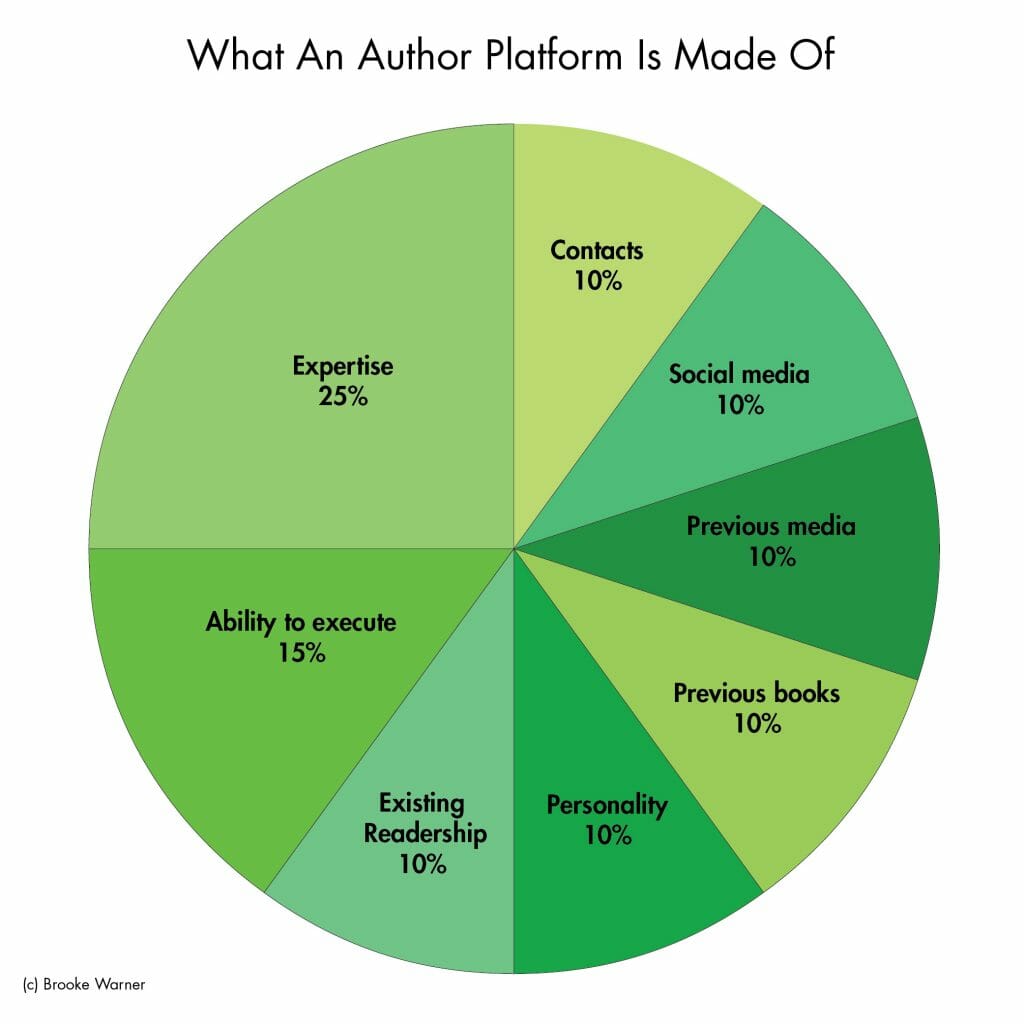
      Many aspiring authors believe that platform is all about social media. They’re partially correct. Twitter, Facebook, Instagram, and Pinterest followings are important, but they are not the only piece of the author platform pie.

      Here’s what I was looking for as an editor and what I now try to help authors hit in their book proposals:

      Image: Author Platform Breakdown

      Some of these factors, like personality and ability to execute, are difficult to gauge. But these very factors are why authors with popular blogs and established fan bases get book deals: because they’ve proven that they have a cult of personality, and they follow-through.

      These important yet intangible factors also highlight one of the ways in which literary agents are valuable to editors. If an agent and an editor have a strong working relationship, oftentimes the agent serves as someone who’s vetting an author’s personality and follow-through.

      Differentiating yourself is crucial

      Even though personality is only 10% of the pie, differentiating yourself is underlying the whole thing.

      Investing time and effort in your personal brand is crucial to your success as an author. If you’re asking, “What’s in it for me?” you should know the most important element of a personal brand is that it helps you stand out from the crowd and carve out your niche.

      After all, there is no competition for you. Knowing how you want to differentiate yourself will save you time too, because you won’t try to be all things to all people.

      Branding is about how you are perceived in the market, and today you have control over that perception. Personal brand management is about collecting and presenting the pieces that tell your story.

      You can shape this perception by running all the content you create through a filter, asking: Is this congruent and true to my brand?

      Two examples of strong author platform

      Both of these authors garnered large advances on the strength of their platforms (which were not specifically strong on social media) while I worked with them.

      1. Andrea Robinson, author of Toss the Gloss

      Andrea had almost no social media presence, no previous books, and not much by way of previous coverage. She couldn’t showcase that she had a strong existing readership, either. So how was Andrea differentiated from the next person?

      • What she had was a well-known agent I had bought books from in the past (personal referral) and whom I trusted when she told me Andrea would execute.
      • Her contacts were stellar — including Ralph Lauren, who ultimately gave her a blurb and threw her launch party. How many people can say they know Ralph Lauren personally and that he would throw a party for them?!
      • She was also clearly an expert on her topic, maybe even an industry leader, having worked in the beauty industry for decades. Seal made a strong offer for the rights to publish her book.

      2. Mark Nepo, author of The Book of Awakening

      In 2010, Oprah chose Mark’s The Book of Awakening (originally published in 2000) as one of her ultimate favorite things, shooting it to the New York Times bestseller list and changing the course of his career.

      When Mark got picked up by Simon & Schuster for his next book following his meteoric rise to fame, he had a negligible social media presence and little previous media. He had a new fan in Oprah, though (contacts!), a huge existing readership, expertise in spades and a whole library of previous books to his credit.

      In Mark’s case, the Oprah touch made a big difference (when doesn’t it?), but he’d sold a book to a traditional publisher just a few months before being “discovered” by Oprah, so while his advances are bigger now than they were, he’s an example of an author who was already getting publishing deals based on expertise, an existing readership, and previous books.

      Author platform isn’t just for nonfiction writers

      In case any fiction writers are reading this and wondering whether any of this matters to you, the answer is yes. Just listen to this podcast from bestselling fiction author, Ramy Vance.

      If you look at the pie chart above, you may feel that your area of expertise matters little to the novel you’re writing, but is that really true? For instance, one of my clients works in the medical transplant field, and she’s writing a thriller whose central focus is about an illegally obtained organ. Her expertise matters a lot — as do her contacts in the medical world.

      Fiction authors are scrutinized for the other aspects of platform as well: contacts, previous books, previous media, social media, readership, ability to execute. It may take getting a book or two under your belt to grow a readership (which is why there’s a case for novelists to kick off their own careers through indie publishing), but no, you’re not off the hook.

      Focus on what works

      Track your efforts and focus on what works. This will help you see your progress along the way. And it will also help inform future decisions on what to try next.

      Rather than feeling lost and unsure of what to try next, you can look at what has worked and what hasn’t and adjust your course. You’ll have a record of what you’ve done that you can check against blog traffic, newsletter sign-ups, followers per platform, or content downloads.

      For example, if you keep track of podcast downloads after sharing each episode on social media, you’ll be able to see if there is a direct correlation. Is one effort feeding another?

      Time is what it all boils down to: writers, perhaps working at another job or taking care of family, have very limited time, and marketing can easily eat up most of it, leaving little for you to actually write. The goal is to find what works, then 80/20 it. Do the 20% of things that bring you 80% of the results.

      Whatever system you use to plan your marketing, make it work for you.

      Building your author platform is a process

      If you’re a writer who wants to publish in any capacity, author platform can be a difficult thing to wrap your mind around. What’s expected of you can feel overwhelming, if not insurmountable.

      In addition to teaching and writing about platform, I’m growing my own, so I empathize with the glazed-over looks I sometimes get from authors who ask me questions like, “Do I really have to do all of this if I want to be a published author?”

      The key is to take it slow. For writers who are just beginning, it can feel like you’re coming really late to a party that’s been going on for years — and that’s in essence exactly what’s happening. If you look at someone who has thousands upon thousands of Twitter followers, it’s likely they were an early adopter.

      Remember that what you bring to the table already — just by being you — comprises a large part of the pie: expertise, personality, and ability to execute.

      With this you at least have a foundation, and possibly, with the right project, enough to land a deal. But most authors need to start to layer on the rest of the components in order to prove to a publishing house that they’re worth a bet. No matter how good they think your book might be, if an editorial board can’t justify its sales potential, they simply won’t offer you a contract.

      Remember this sometimes hard-to-swallow fact: getting rejections is often not about how good your book is, or whether it deserves to be published.

      It’s about editorial boards weighing whether they think they can sell thousands of copies of your book — a tall order for any author. Your platform is an engine working for you to meet that goal, and all you can do is to keep growing it, a day at a time.

      At the end of the day, none of this is science.

      Some authors receive many rejections before self-publishing bestsellers (Still Alice, by Lisa Genova); some authors get deals based solely on their social media presence (Sh*t My Dad Says, by Justin Halpern); and some authors have no platform but manage to land book deals anyway. (Don’t look to the outliers to make a case for not attending to your platform, though.)

      Platform-building is a fine balance between being authentic and pushing yourself outside your comfort zone as much as you can — but not to the point where you’re overwhelmed and paralyzed.

      Take it a day at a time, and don’t be hard on yourself if you feel behind.

      Next Steps

      Building your platform is a marathon, not a sprint. You will get there, but it takes time.

      Earlier in the article, I said that social media isn’t the only piece of the author platform pie. But when you look at the chart again and do the math, a powerful social media standing can account for:

      • 10% Social Media
      • 10% Contacts
      • 10% Personality

      And if your social media accounts prove your ability to execute over the years and show your expertise on your topic, you’re suddenly filling 70% of the pie.

      That’s why it pays to take social media and platform building seriously.

      **Editor’s Note** We’ve teamed up with Self-Publishing School to offer this free training on How to Explode Your Book Launch. If you’re ready to take your social media and author platform to the next level, this is the best way to do it.

      This is an updated version of a story that was previously published. We update our posts as often as possible to ensure they’re useful for our readers.

      Photo via Dean Drobot / Shutterstock 

    • What is Context in Writing? [6 Context Types Included]

      What is Context in Writing? [6 Context Types Included]

      While it’s essential to have a good story, giving context in your writing is key to giving the story meaning.

      Imagine you’re in a bookstore and you pick up a book with an intriguing title. You open it to start to read the first chapter and it’s dialogue between a few characters.

      Imagine reading it for a few pages but there’s no hint to who the characters are or what is going on. There are a lot of emotions but there’s no context or understanding of what is happening in the story. You would get frustrated and most likely put the book back down.

      This is exactly why context in writing is so important. It gives your readers a full understanding of the setting, what is happening between characters, and gives meaning behind all of the events happening.

      Imagine reading something like Harry Potter but with no context that they’re in a world where magic exists. Or reading a Jane Austen novel without knowing the family dynamic or the social dynamics.

      When you provide the reader with context, they can comfortably follow the story because they know what’s happening and why certain characters do what they do.

      This post covers what context in writing is, the types of context you can give readers, and how to integrate it in your overall writing.

      [sps_reusable_block post_id=43045]

      What is context in writing and why does it matter?

      Context explains the situation your characters are in; or, it gives the reader a deeper understanding of why they act the way they do. It brings clarity to the writing and explains intentions.

      Basically, context in writing helps give your writing meaning.

      Have you ever had something in your life taken out of context? You sat back and thought, “That’s not what I meant!”

      The exact same thing can happen to your writing, which is why you need to include it in your writing.

      Most of the books you’ve read give you context behind what you’re reading. Let’s go through some examples. (Potential book spoilers ahead!)

      If you had to read The Great Gatsby in high school, you most likely remember the New York setting in the famous Jazz Age. Knowing the context of Gatsby being in love with Daisy gives the entire story meaning and helps you understand why Gatsby does what he does.

      In the classic story Dracula, it’s essential to know it takes place in the late 1800s and takes place in both Transylvania and England. This sets the overall mood of the location and the customs at the time.

      Then, take something such as Lord of the Rings. To read the book, you’d need to understand all of the wars that have gone on, what this fictional world is like, and who all of the major characters are to even begin to read it all.

      Of course, there are deeper levels of context as well.

      In the famous story of Uncle Tom’s Cabin, it’s important to know it was written before the Civil War and had a tremendous impact on the abolitionist cause in the 1850s.

      There are many layers to a story, the era of when it was written, and also the author’s life story that influences the overall angle of the book. Of course, this won’t matter as much as when you’re writing the story, but you need to remember these elements if you’re pulling inspiration from other writers.

      Types of context in writing

      There are various forms of context you might need to include to give your readers an accurate understanding of the story. This might not include every single type of context you would need for your story, but it will give you a great place to start. You can find other storytelling tips here.

      All of these help either explain the situation your characters are in or it gives the reader a deeper understanding of why they act the way they do.

      Location context

      This can range anywhere from the physical location in the world to a whole new world that you’re creating and giving them context. If you’re writing about characters in space that will form a different context than characters on the open ocean.

      Keep in mind, if you’re creating a whole new world that does not exist in our real one, you will need to give a lot of context to build the world in the readers’ mind. Some examples of this include Lord of the Rings or Star Wars.

      Historical context

      Giving the historical context of a place can help readers understand what’s going on. For example, you might need to include wars, the history of the landscape or town, what the area is known for, or anything else you might need to include.

      Knowing the timeframe of a story can also help readers understand things such as what type of technology might have been created already or if there are certain economic conditions happening.

      Situational context

      You might need to include other storylines to give the reader context into what is happening. Some examples might include a recent divorce between characters, an upcoming court case that’s pending, if a character just got out of prison, and so on.

      This one is particularly key to understanding why characters are feeling or acting a certain kind of way.

      Emotional context

      Providing your readers with emotional context can help explain why some dialogue happens in a particular way. For example, if a simple conversation about coffee creamer turns explosive, it is a good idea to inform the reader that this is happening because both of these characters have tension due to fighting over a family’s inheritance.

      Cultural context

      The type of culture your story takes place in will change a lot of the context. Keep in mind the type of audience you’re writing to as well because that will change how much or how little explanation you’ll need to include.

      Readers who did not grow up in a certain culture might need more thorough explanation than people who are native to an area. You might consider including certain types of foods or rituals from different parts of the world.

      Cultural context can also include the social and political undertones that are taking place throughout your story, too.

      Linguistic context

      How people talked in the past and in different parts of the world can have a huge impact on your overall dialogue. For example, how characters speak in Shakespeare’s stories and how Millennials talk is worlds apart.

      If you’re going to include slang and other shorthand words, you may or may not need to include an understanding of what those words mean or you might decide that it’s not important to include.

      How to give context in writing

      Now that you know what context in writing is, we’ll go over how to include it in your writing.

      If you are writing a book, the single biggest factor you need to include is all of the context someone would need to get interested in your story.

      If you give too much context, you might give your reader too much information at once and lose them while you explain everything they need to know. However, if you give too little context, they won’t understand what’s happening.

      You’ll need to find a delicate balance between your context and your story. You don’t want them to feel like they’re reading a history book instead of a story.

      To start, you’ll want to go through the categories from the last section and figure out what parts you’ll need to include in your story.

      Depending on the story and your overall writing style, you might also need to think about what you want to keep a mystery or not. Not everything has to be explained, especially if it’s going to end up spoiling the story.

      Know your intended audience

      You’ll need to know your intended market / audience before you start to write anything. That will give you an idea of what to include or not include. For example, if you’re writing a book for business executives, you don’t need to include explanations for basic business things they already know.

      Keep in mind, you might have readers who are not your intended audience find and read your writing. You will need to decide what to include or not include in case this happens.

      Use characters to give context

      One fun way to include context in your story is to have your characters tell stories and include the context. That can prevent you having to give a long exposition to get them up to speed. Inside of dialogue and discussions you can include the history between characters or give readers an understanding of what is happening and how they’re feeling about it.

      Get feedback when you can

      You’ll want to get feedback when you can. That will help you figure out what is missing in the context of your story. It’s hard to judge what is missing from your story when you are the one writing it and you know it all so well.

      Conclusion

      Context in storytelling is essential to making sure you’re telling a good story. You’ll want to find a good balance between giving them enough information but not too much information. To learn more about the craft of writing Fiction, check out this free training we have in conjunction with Self-Publishing School.


      [sps_reusable_block post_id=43045]

    • Funny Book Titles: 4 Ways to Make It Work [Examples Included]

      Funny Book Titles: 4 Ways to Make It Work [Examples Included]

      The title of your book is maybe one of the most important things about it, aside from the cover. 

      It’s got a lot of work to do: the title needs to be memorable, it needs to fit in with other books like yours, it needs to catch your reader’s eye, and it needs to represent the book as a whole. It seems unfair that one single title should represent tens of thousands of words, but such is the job of an author. 

      Writers use tons of different gimmicks to make their titles catchy or trendy. You may already know about the “blank of blank and blank” trend in fantasy, especially YA fantasy, which some readers criticize because it makes the titles all sound the same. This is one example of writers using a specific trend to slot their book in with their contemporaries, focusing on unique nouns to add a creative twist. 

      Another way writers might make their book title stand out is by making it funny. 

      In this article, we’re going to talk about funny book titles, why you might use one, when you should avoid using one, which types of books use funny titles, and we’ll give you some examples of funny book titles in different genres. 

      What is a funny book title?

      Humor is subjective, so it’s difficult to say with absolute certainty which book titles qualify as ‘funny’ book titles. But that doesn’t mean we can’t take a stab at defining funny book titles. 

      A book title that tries to make a joke, advertises a funny story, or generally is worded in a way that tries to evoke laughter from the reader is considered a funny book title. It might not make you laugh, but you can tell it’s supposed to. 

      These titles are often a little wordier than your standard title, and they usually include a play on words of some sort. They might have a subtitle with a more serious explanation about what the book is about, or they might have a subtitle with an additional joke—it depends on the book. 

      There are also book titles that are funny without meaning to be funny. For the sake of this article, I’ll refer to these as ‘embarrassing’ book titles. Unlike a funny book title, an embarrassing book title isn’t trying to be funny. The reaction it gets isn’t what the author likely intended. 

      In this article, we’re talking about writing a book and title that is funny on purpose. And I understand that sometimes it’s tricky to tell—again, humor is subjective. But we’ll walk you through a few examples in a minute to give you a better idea of the difference. 

      Why use a funny title for a book?

      There are plenty of reasons why an author might use a funny title for their book, even if it doesn’t seem like an obvious choice at first. 

      You’re writing a comedy 

      Most obviously, funny titles are perfect for comedies! If you’re writing a comedy, why not prove to your reader before they’ve even opened the book that they’re in for a laugh? 

      This also lets you give the reader a sense of what kind of comedy they’re in for. If it’s a dark comedy, maybe the title reflects that, for example. 

      If you want your reader to also have a sense of what the book will actually be about, you can use subtitles to explain further. This gives you more space to crack jokes and advertise your book. “Oops, Dropped It: Things You Don’t Want to Hear From Your Surgeon,” (a title I made up) both tells us what the book will be about and gives us an example of the kind of comedy we can expect moving forward. 

      You want to hook the reader 

      Jokes make for a fantastic hook because they’re memorable. Think about all of the Netflix specials that have been memed to death—people quote and remember these snippets because they made them laugh. 

      Humor is also a great way to invite a reader into your story. People are generally attracted to content they find funny, and if your title catches their attention, they’re more likely to want to read the rest of the book. 

      To maximize the effectiveness of a funny title as a hook, keep it short, punchy, and catchy. 

      You’re writing with a comedic tone 

      Maybe you’re not writing a comedy, exactly, but you are writing something with a lot of humor in it. This might be a memoir about your life told in a light-hearted way, or it might be a fun action-adventure romp full of quips. 

      Basically, it doesn’t have to be a comedy to have a funny title. If you’re writing something that involves a lot of humor, you’ll want to reflect that in the title. Making the title funny is an effective way of doing that—it lets the reader know what kind of tone they can expect for the rest of the book.

      You want to be relatable or casual 

      Jokes are also a powerful tool when it comes to relatability. Comedy is a fantastic tool for bridging different communities for exactly this reason—jokes just make people feel comfortable, and they make people understand one another better. 

      If one of the goals in your book is a relatable, casual tone, you’ve probably got a fair amount of humor in there. It’s hard to maintain that kind of tone without it. And a funny, catchy title will help advertise that relatability to your reader. 

      When you should avoid using a funny title 

      While there are more chances than you might think to try a funny title, there are also still plenty of times you should avoid it and opt for a more serious one instead. 

      It doesn’t match the tone of your book 

      Most importantly: you don’t want a funny title if the book itself isn’t comedic or casual in tone. 

      If you’re writing dark fantasy, for example, featuring lots of beheadings and very few bouts of laughter, having a joke title won’t work. It’s false advertising, and not only does that mean a reader might be upset when the book doesn’t live up to the title’s promise, but it also means readers looking for a dark fantasy might pass up your book because it looks too light-hearted and silly. 

      Most adult fiction books don’t benefit from having a funny title—we’ll talk more about this in a little bit. 

      It’s corny or too overdone 

      There are also times when you could use a funny title, but probably shouldn’t. 

      This is where we get into subjective territory again. A joke that I think is corny or overdone might be funny to you, and vice versa. We could talk all day long about what makes a joke unfunny, but instead, I’ll leave you with a few guidelines. 

      Dated jokes, like memes or contemporary slang, generally don’t age well. The title should be funny to people in your target audience—adults might not think Captain Underpants: Attack of the Talking Toilets is funny, but for most little kids, it’s a knee-slapper (and they’re right). A funny title that looks like every other quirky self-help title probably won’t age well and will probably be forgettable.

      Basically, you want to avoid dated phrases if at all possible.  

      Use a book title generator and brainstorm your own list. You can also take a look at other contemporary titles in your genre to gain some inspiration. Then, run your title by some people in your target audience.

      Types of books that use funny titles

      There are a few different categories of books that might use funny titles—let’s look at a few. 

      Comedies 

      First and most obviously, comedies might have funny titles. Like I said earlier, this makes sense: what better way to advertise a funny book than to give it a funny title? 

      Memoir 

      Memoirs might also have funny titles. This is usually to signal that the memoir will be relatable and laid-back. Comedians might also use funny titles because, well, they’re comedians, and the book to come is going to be full of their humor. 

      Kidlit and Middle-Grade Novels 

      Children’s books also use funny titles. They might do this because, again, the book to come is a comedy (like Captain Underpants or Diary of a Wimpy Kid), and they might also use them for relatability. Kids respond really well to humor, and they want to have fun, so a funny book title is often a promise that they’re about to have a blast. 

      Self-Help and Motivational Books 

      Self-help books and motivational books use funny titles to get their tone across to the reader. Usually, a self-help book with a funny title is trying to tell the reader that this is going to be a no-nonsense, no-B.S. approach to dealing with a given problem or circumstance. 

      In other words, the funny title is meant to be relatable. Someone might see that title and think to themselves, “haha, yeah! Finally, someone who gets it. This isn’t going to be like those condescending, boring self-help books—this person understands what it’s like for real people to go through these real issues.” 

      And once they think that, they’re infinitely more likely to pick up the book and hear the author out on whatever ideas they’ve got. 

      Examples of funny book titles in different genres

      Let’s take a look at some funny book titles across different genres. 

      funnybooktitle.diary-wimpy-kid

      Not only is this title genius for its use of ‘diary,’ which promises a personal, secretive experience (kind of like putting ‘don’t read this’ on the cover—it’s foolproof in getting kids to read it), but it also describes the narrator as a wimpy kid. This is self-deprecating humor done flawlessly. 

      funnybooktitle.captain-underpants

      For starters, ‘Captain Underpants’ is a genius idea for a superhero. Additionally, each subsequent Captain Underpants book has a different and stellar title. I gave you the Attack of the Talking Toilets example earlier—they’re all great. 

      funnybooktitle.is-everyone-hanging-out

      Here’s an example of a funny title used for a memoir. Here, Kaling uses a relatable situation to hook the reader. Who hasn’t wondered if their friends were hanging out without them? The parenthetical adds a punch of humor, and the entire thing makes Kaling, a celebrity, seem more approachable and relatable. 

      funnybooktitle.hitchhikers-guide-to

      This title is a great example of having a title that matches the tone of your story. This title perfectly mirrors the funny, unusual prose to come, and it’s incredibly catchy, which makes it memorable. 

      funnybooktitle.will-my-cat-eat

      This is a nonfiction book wherein Doughty discusses death and its surrounding processes. But this punchy title promises us that despite the heavy subject matter, this isn’t going to be a super heavy reading experience—for one, we know she’s talking to children, and for another, we know she’s funny. 

      funnybooktitle.on-the-john

      This title is a great play on words, right? A devotional on the Gospel of John that, once you look at the cover, you realize has some toilet humor built-in. It’s something new, something fresh, something that’s honestly a bit out there. Who has ever thought of mixing Bible commentary with dad jokes and toilet humor? But alas, dads are loving it.

      Next Steps

      Grab a copy of one of these books and you’ll learn how authors use humor in innovative ways! And if you have a favorite humor book, post it in the comments and let us know.

      Working on a funny book yourself? Check out this free training.

      Webinar.TWL