Tag: freelancing

  • What is A Writing Sample? 7 Simple Steps to Create Yours

    What is A Writing Sample? 7 Simple Steps to Create Yours

    There are a lot of reasons a writer will need to create a writing sample. You might be applying for a job, trying to land a freelance client, or simply creating a portfolio to showcase your skills.

    A good writing sample can help you stand out in a crowded marketplace and give you a real shot. It’s not something you want to treat lightly and you’ll want to make sure you put your best foot forward every time you put one together.

    No matter what kind of writing you choose to do with your career, you’ll always need to be able to showcase your work and show your talent.

    We’ll go over what writing samples are, why you might need to craft one, and the best ways to go about writing one.

    What is a writing sample?

    For the most part, you will see requests for writing samples for jobs where you will be writing often such as blog writing, journalism, internships, public relations, or research positions. It gives employers a good idea of your writing skills and overall tone.

    Writing samples can be anywhere from a few sentences to a few pages, depending on what is required. Sometimes writing samples are paid but often they’re not.

    While they can be time-consuming, a successful writing sample can make you stand out from other applicants.

    Freelance Writer’s Pitch Checklist
    Grab it for free 👇

    Convince more editors to say YES to your pitches!

      We’ll also send you our weekly newsletter, which offers helpful advice for freelancing and publishing. You can unsubscribe at any time.

      Why do you need a writing sample?

      You’ll often see writing samples with specific writing requirements, formatting, and topics for job applications. You will see them in both traditional jobs and also for freelance writing jobs.

      Sometimes, you’ll need to craft a writing sample from scratch with set guidelines or you might be able to send in previous things you’ve written.

      Writing samples can sometimes also be interchangeable with your writing portfolio as well. Not every job application will require a unique writing sample, sometimes they just simply want to see your past work.

      In that case, you’ll want to pick the most relevant samples from your portfolio to represent your writing.

      Once they see your writing style, they will be able to see if you’re a good fit for the position.

      However, they may choose to have you create a new writing sample from scratch, and let’s go over what you need to keep in mind before writing one.

      writing sample

      What others are looking for in your writing sample

      No matter what you’re using a writing sample for, you must make sure it is as error-free as possible.

      The top thing that will disqualify you as an applicant is having a writing sample with a ton of grammatical errors, typos, or ignoring the guidelines they gave you.

      Potential employers or clients want to see that you know what you’re doing and leaving in errors shows that you don’t pay attention to the small details. With any submission you make, you need to take the time to go through it and check all of your sentences to make sure there aren’t any issues.

      Not only do you need to make sure there aren’t errors in your writing, but you also need to make sure that you’re following every single instruction in the guidelines.

      Your writing sample will also show your overall writing style and if you can match the tone or voice they need.

      Clients or employers will often give you some information about their target audience, but if not, you can search their website or social media for a general idea on the tone they want from their publication.

      How to craft a writing sample

      If you’re putting together a unique writing sample for a specific job, or you’re putting together some general samples for your portfolio, this will guide you through the steps from start to finish.

      #1 – Know your guidelines

      If there are specific requirements for the sample, such as word count or formatting options, you’ll need to follow them exactly.

      However, if you’re just creating some general writing samples, you’ll want to make your own guidelines. Some examples could be a specific type of writing, such as blog writing, and in a certain industry. 

      Rarely will employers or anyone else want to see random writing samples from your personal journals, unless you’re trying to sell something such as a memoir. Keep your samples focused and relevant.

      #2 – Have a clear idea for success

      Once you know your guidelines, you need to know what the ultimate goal of your writing sample is. It might be to showcase your writing style, depth of research, or convince someone to pick you.

      For example, if you’re simply creating writing pieces for your portfolio, you should know what industry and type of writing you want to do. That way, you know that your pieces need to reflect those skills to the best of your current ability.

      If you’re creating a writing sample for a potential new position, you also need to know what success looks like in your sample. What would make you feel confident that you’re giving them everything they’re looking for?

      If you don’t know what success looks like with your writing samples, you can always look through content that the company already published. That will give you an idea of what they look for and approve of on their team.

      #3 – Know your intended audience

      When it comes to writing your writing sample, you’ll want to keep your audience in mind while you craft your submission.

      Knowing who you are writing to, whether it’s for blog posts or B2B marketing, you need to make sure you’re using language that is targeted toward that audience. The last thing you want to do is write to the wrong audience with your writing sample and disqualify yourself as a writer.

      You want to always make sure you’re using the same language as your intended audience. If they use technical language, you’ll want to include some. If it’s on the simple side, you’ll want to make sure your writing isn’t too complex.

      #4 – Look at other samples online

      If you get stuck during your writing process, it might help to do more research and see what other people are creating in the industry you’re writing about.

      This can help you understand what you need to publish and can help guide your tone or choice of words. You will be able to tell if your writing blends in with other work in this industry or not.

      #5 – Edit your work

      As mentioned above, you’ll want to make sure your writing sample doesn’t have any errors. You will want to check it for grammar issues, typos, or any parts that don’t flow well.

      We recommend ProWritingAid and Grammarly.

      If you submit a piece with tons of spelling errors, there is a good chance your application will be immediately discarded. Making sure your sample doesn’t have any errors is far more important than making it have the perfect tone.

      Tone and voice are things that can be refined with time, but basic grammar errors are often something they won’t take the time to teach you. They expect you to know those rules already.

      Editing your writing sample also means going through the guidelines one more time to make sure you didn’t miss any required parts.

      #6 – Stand out from the other applications

      One thing you might consider doing with your sample is to include a few sentences explaining why you wrote your sample the way you did.

      Instead of just a simple sample, you’re giving them a deeper understanding of how you approach writing. You can explain what you did for research and why you used the words you did.

      #7 – Submit your writing sample

      You will need to know the exact type of format you need to submit your writing sample. Some places are fine with newer options such as Google Docs, but more traditional places may want Microsoft Word or even printed versions of your writing samples.

      What to do next

      Download the Pitch Checklist and start submitting your writing samples.

      Freelance Writer’s Pitch Checklist
      Grab it for free 👇

      Convince more editors to say YES to your pitches!

        We’ll also send you our weekly newsletter, which offers helpful advice for freelancing and publishing. You can unsubscribe at any time.

      • 8 Lucrative Tips for Selling Articles to Magazines and Websites

        8 Lucrative Tips for Selling Articles to Magazines and Websites

        This column is excerpted from Create Your Writer Platform, from Writer’s Digest Books.

        Article writing can be great for your career as a writer: nothing bad can come from writers trying to sell content to magazines, newspapers and websites. Think about it. Selling articles ups your credentials and credibility; it gives you something awesome to talk about in the Bio section of your query letters; it generates nice paychecks; it puts you in touch with media members who can help you later; it builds your writer platform and visibility, and more.

        If you want to make more money writing and expand your writing horizons, think about penning short nonfiction pieces for outlets seeking good work. It’s a simple way to do some good for your writing career.

        [sps_reusable_block post_id=43047]

        Here are 8 tips for selling articles to magazines and websites

        1. Seek out the publication’s writers’ guidelines

        All publications have guidelines, which, simply put, are an explanation of how writers should contact the publication in consideration of writing for them. Writers’ guidelines usually address three key things:

        1. What kind of pieces the publication is looking for (including length, tone, and subject matter)
        2. How to submit your work for consideration (details on formatting and whether they accept email or snail mail submissions)
        3. When and how they will respond to your request

        2. You do not have to write full articles before you sell them

        Selling a nonfiction article is exactly like selling a nonfiction book—you sell the item based on the concept and a “business plan” for it. Here’s how it works: You compose a one-page query letter (typically submitted via email) that details what the article/column will be about, as well as your credentials as an article writer. From that point, the publication, if interested, will contract you to write the article—and only at that point will you write it.

        Writing an article when no one has agreed to buy it is called writing on speculation (“on spec”). You can do this if you feel you need to, but you risk losing time on a project that may never see a financial return.

        3. Consider what the gig has to offer

        Remember that in your case, the goal is platform. The goal is getting your name and work and bio in front of people who will buy your book and become followers. If an editor asks you to write a long piece for little money, that’s not good.

        But are there benefits? Will you get more assignments in the future—and therefore more platform? Are you doing the editor a favor he will remember? Will writing the article put you in touch with key people you’d like to know?

        4. Keep an eye out for new publications

        New publications are actively seeking content to fill pages and are willing to work with newer and untested writers. I would suggest signing up to the Writer Gazette and Writer’s Market newsletters (both free) to get notices of any new publications or paying websites that pop up.

        5. Write for local publications

        Besides the fact that you’re befriending local media pros who can help you later, you should know that local publications have a natural affinity for local writers. People always say “write what you know” — and you know your hometown and community better than anyone else. (Click to tweet this idea).

        6. Feel free to aim high, but expect to start small

        You’ll have an easier time getting things published if you pitch shorter pieces and aim for small to mid-sized outlets. The goal is to break in, and then use your success and accomplishments to get bigger, better assignments. That’s not to say you can’t at least aim for Real Simple or The Huffington Post—just don’t be surprised if they say no because you lack the experience. (But hey, it never hurts to ask.)

        7. You can recycle ideas and get multiple paying jobs

        One of the best parts about being a freelancer is your ability to recycle and reuse ideas. For example, I pitched Ohio Magazine a series that would profile historic theaters around the state that were still in operation today. After the magazine said no, I made a few changes to my query and sent it off to Pennsylvania Magazine. This time, I got a yes, and I received fourteen articles and paychecks out of it.

        8. Read the publications you’re pitching

        Get familiar with several target markets and read back content, either online, with a subscription, or through issues at your local library. Note the tone of the articles, the sections of the magazines, and the general feel of the magazine and its advertisers. From there, you will be better off pitching the best article ideas—and you will also find out if the idea you want to share has been used recently.

        You never know where a writing opportunity or assignment will lead you, so challenge yourself and stick your toe in different waters. In my case, writing that series for Pennsylvania Magazine was what drew a literary agent to sign me. From there, we’ve been able to sell six books together. If I hadn’t dived into article writing and kept querying until I found some success, who knows if my writing journey would resemble what it does today.

        Other TWL Guest Posts by Chuck Sambuchino:

        This is an updated version of a story that was previously published. We update our posts as often as possible to ensure they’re useful for our readers.

      • How to Write an Invoice in 11 Steps, Plus an Invoice Example

        How to Write an Invoice in 11 Steps, Plus an Invoice Example

        [lwptoc]

        For any type of business to succeed, you have to get paid.

        Whether you do one freelance gig a month or run a full-time writing business, you need to figure out how much your clients owe you and send them a bill. Many companies don’t even think about paying a freelancer until they have an invoice in hand.

        That means you need to know how to write an invoice.

        But where do you start? How do you create a professional-looking bill? How and when do you send it to your client?

        In this post, we’ll explain all the basics behind how to write an invoice. We’ll start off by showing you an invoice example, so you can visualize how all the elements come together. Then we’ll dig into those components, explaining what to include in your invoice. Finally, we’ll discuss how and when to send your invoice.

        If you plan to invoice clients regularly, it’s smart to invest in an invoice generator, so we’ll review your options for those, too.

        Let’s get started with our invoice example.

        How to write an invoice — An example

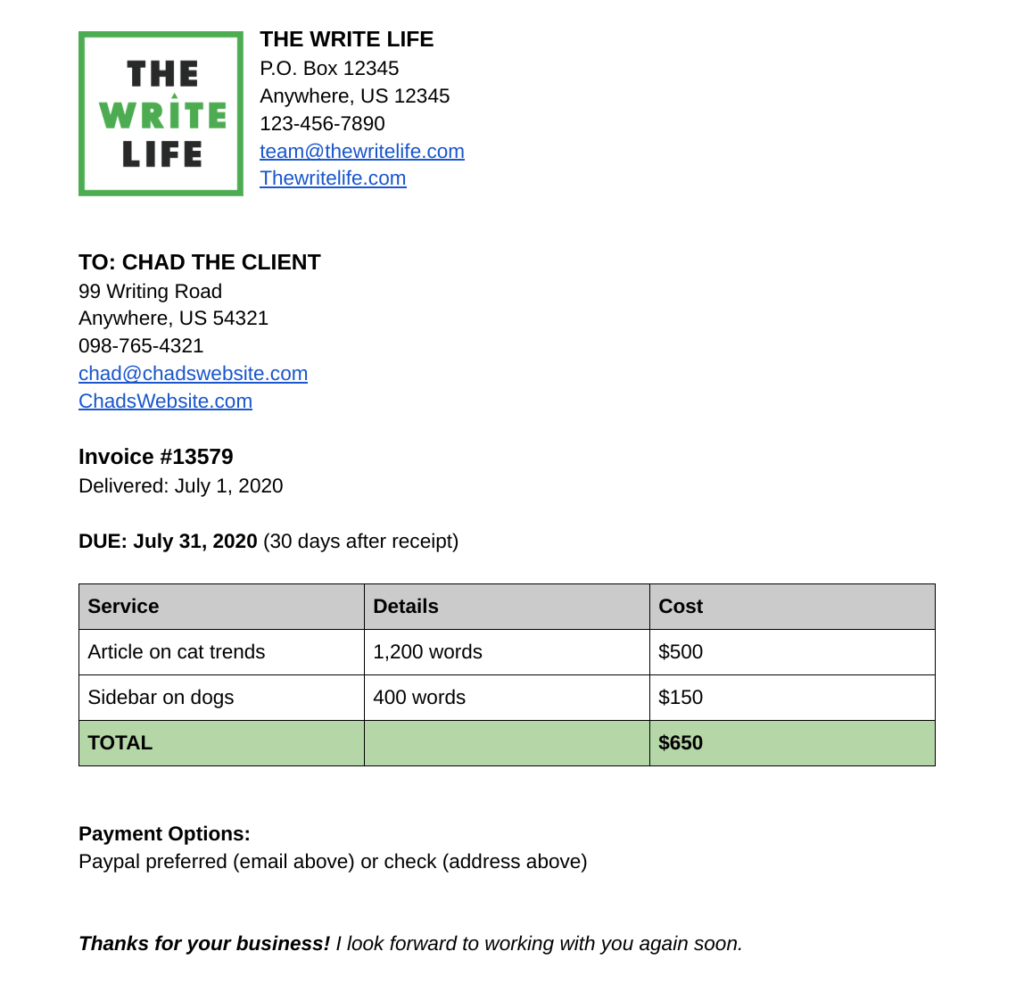
        Here’s a sample invoice that includes all of the elements we’ll detail throughout this post.

        For a downloadable PDF to use as an example, just click on the image.

        We made this sample invoice simple on purpose. You don’t need a fancy invoice, you just need to include all the right information!

        how to write an invoice

        How to make an invoice: Here’s what it should include

        Look, we know it can be daunting to send your first invoice, especially when you want to look professional.

        But you’ve already done the work for your client, and that’s the hardest part! If you’re at the point where you’re creating an invoice, you’ve already figured out how to become a freelance writer.

        Plus, as we saw above with the invoice sample, your invoice doesn’t have to be fancy. It just has to be professional-looking and do the job.

        When you’re learning how to write an invoice, here’s what to include.

        1. A professional header

        The first item on your freelance invoice should be your business name or your full name, in professional and easy-to-read font.

        If you have a logo for your business, include that as part of the header. But don’t worry, you don’t need a logo; you can also just write your name in text. Whether you use a logo or text, the font size of your name or business should be a little bigger than the rest of the text on the invoice, and bolded for emphasis.

        2. Your contact information

        Next you’ll want to include your contact information.

        At the very least, this includes your mailing address, phone number, email address and website, right underneath your business name. To make it easier to read, consider typing the info on several lines like this:

        The Write Life
        P.O. Box 12345
        Anywhere, US 12345
        team@thewritelife.com
        123-456-7890
        thewritelife.com

        You can include your contact information on the top left or right of the invoice. We’ve seen it done both ways.

        3. The client’s contact information

        Next in creating your invoice, you’ll want to specify the recipient, or who the invoice is for. Include the recipient’s name, address, phone number, email address, website and any other information. You might look back at this section later if you need to track down payment, so it helps you to include all the client’s contact information there.

        Some freelancers put their contact information on the opposite side from the client’s contact information, and some freelancers left-align it all. Do what feels right to you!

        4. Invoice number

        Then, on the left of your invoice under all the contact information, add your invoice number.

        What’s an invoice number? It’s simply an identifier that helps you keep track of your invoices. It doesn’t matter what kind of numbering system you use, just make sure it’s in sequential order so you don’t get confused.

        For example, if this is your first invoice, you might start with #1001. Then your next invoice would be #1002, even if it’s for a different client. Each invoice gets a number, so you can easily track who has and hasn’t paid.

        This placement makes it easy to keep track of vital information — for both you and the recipient.

        5. Date prepared

        Add a date that shows when you submitted the invoice to the client.

        The “date prepared” line is important because you’ll need to refer to it if a client takes a long time to pay you. We’ll go into that shortly, under payment terms.

        6. Due date

        Specify when, exactly, the payment is due. The due date is entirely up to you, but most freelancers (and invoicing systems) use a 30-day, 45-day or 60-day timeline. You can also make the invoice “Due upon receipt,” so the recipient is required to pay the invoice promptly.

        This shouldn’t be the first time your client has heard about the due date. When you agreed to do the work — and hopefully signed a contract, or at least agreed to terms via email — you should have set expectations with the client for payment terms.

        If the client doesn’t pay on time, you can refer back to this due date, as well as the prepared date if necessary.

        7. Payment options

        It’s typically helpful to the client if you specify your payment options: whether you prefer to be paid with cash, a check, a credit card or a service like PayPal.

        (If PayPal is your preferred payment method, it’s smart to add your PayPal email address to the invoice, so they send the payment to the right place.)

        Some companies offer direct deposit if you work for them on a regular basis, but more than likely you’ll have to send an invoice to request payment every time you complete a project.

        8. Payment terms

        Along with the required timeline for payment, you might want to specify whether you charge a late fee for invoices that are paid past their due date. Some freelancers use this strategy to enforce getting paid on time. A typical late fee is 20 percent of the invoice fee.

        If you decide to utilize a late fee, we recommend reminding the client at least once or twice that the invoice is overdue, and giving them a chance to pay it without a fee.

        While it’s obviously important that you get paid, you also want to maintain the client relationship, with the goal of being invited to work with the client again in the future.

        9. Breakdown of services

        Finally, add a breakdown of the services rendered so the client knows exactly what they’re paying for.

        If the client hired you for a number of services, add each one to a new line so it’s easy to digest.

        10. Amount due

        Of course, don’t forget to add how much the client owes you!

        If your breakdown of services includes a number of items, show what each of those items cost. This could be a cost per service, or it might be the number of hours you worked at your agreed-upon rate.

        Finally, tally up all those line items to show the full amount due. Bold this amount for emphasis, so it’s easy to see on the invoice when the client needs to figure out how much to pay.

        11. Thank you

        Why not add a personal touch to help maintain the client relationship?

        Below the total, add a thank you note. Or, if you need to include any additional information or reminders, this is a good place to add that as well.

        How to send an invoice

        If you write your invoice by hand, export it as a PDF so the recipient can’t alter it. Then send the invoice PDF to your client as an attachment via email.

        One tip if you invoice by email is to write the invoice number and amount in the subject line of the email. That way it will be easy for you and your client to find, which increases the chances that you’ll get paid on time.

        When to send the invoice

        When you agree with the client on the terms of your work and sign a contract, you should list out how often you plan to invoice and when you should get paid. For instance, for recurring work, you might agree to bill on the first of each month, or bi-weekly so you get paid every other Friday.

        For one-off assignments, the most common practice is to invoice after the work is complete. However, if you’re unsure, you might simply ask your client, “Is our work complete? Shall I send an invoice your way?”

        For big freelance jobs, such as assignments where you and your client have agreed upon a fee of $1,000 or more, you might invoice several times throughout the project. For example, you might invoice for half the fee at the beginning, then half when the project is complete. Or you and your client might agree to milestones that warrant payment, such as finishing an outline for a long project, or completing a draft of the work.

        When to invoice is really up to you; just make sure you and your client agree on this before you start the work.

        Whatever the case, invoice your clients consistently. You’re more likely to get paid on time when your client receives invoices regularly, rather than getting them sporadically.

        Use an invoicing system to simplify this process

        While you can create an invoice on your own or use a free Google Docs invoice template, it’s often easier to use an invoice generator. These systems typically include other features as well that are useful to freelancers, such as time-tracking.

        Invoicing software creates the invoice for you. You add the information, and it lays it out in a way that looks professional.

        It also stores that information, so if you send another invoice to the same client, you don’t have to enter it again. Having all your invoices in one place can also be helpful, and most invoicing software will show you which ones have already been paid and which ones are awaiting payment or overdue.

        There are lots of tools to choose from, and we’ve outlined some of our favorites, including HelloBonsai, Harvest, Freshbooks and ZoHo, in this post on invoice generator options. Many of them offer a free option or at least a free trial.

        Using HelloBonsai

        One software that might help streamline your process is HelloBonsai. It’s an all-in-one product that helps streamline your invoicing, which makes the whole process even easier. It’s also a dream for tax time when you need to have all of your essential documents and financial information in one place.

        The original version of this story was written by Carrie Smith. We updated the post so it’s more useful for our readers.

        Photo via  Andrey_Popov/ Shutterstock 

      • How to Break Into the Lucrative World of Grant Writing

        How to Break Into the Lucrative World of Grant Writing

        As a freelance writer, you’re likely constantly searching for well-paying, recurring gigs. But often the pickings are slim. You might feel stuck with one-off assignments that pay only meager returns.

        That’s where grant writing offers a huge opportunity.

        I started grant writing as a college intern, then for a small after-school nonprofit program, and never looked back. Now, 13 years later, I run a seven-person team at Professional Grant Writers, and we work with organizations around the world to develop and maintain robust grant writing programs.

        [sps_reusable_block post_id=43047]

        Why you should consider writing grants

        Grant writers are in high demand for nonprofits hoping to raise money for operations, capital expenses, events and programs. 

        This type of work can be incredibly rewarding. You could have the opportunity to work with a nonprofit that is impacting the world, affecting change on a local, regional or even worldwide basis. You can work for causes that speak to your values, and perhaps have opportunities to learn more about certain social issues and meet amazing agents of change. 

        Even better, as a grant writer, you’ll help fund that important work, making it possible for these changemakers to continue or even expand their efforts.

        Do grant writers make good money?

        Yes! This work pays well: as a freelance grant writer, you can start out charging about $25 an hour and work your way up to $100 an hour, though this varies depending on the organization you’re working for. 

        Even better? Nonprofits often look to enter into long-term contracts with a reliable grant writer. They may have a large volume of grants due every month, so you can earn good, steady income – all while working from home.

        If you dip your toes into this arena and want to turn it into a full-time career, a typical grant writer salary is about $49,825/year according to Payscale, and $67,399/year according to Glassdoor.

        Here’s something to watch out for, though: while some nonprofits may ask to pay a grant writer a commission, or a percentage of the grant award, this is considered an unethical practice. Instead, look to earn an hourly or project rate for your work. 

        What is grant writing?

        Before we get into the details of how to write a grant, let’s take a step back and review some of the basics.

        Grant writing is the process of filling out a grant application for funding from an entity like a foundation, corporation or government body. The process can be straightforward, involving simply writing a few sections of text and disclosing some basic financial information, or it can be complex, with lengthy guidelines that require nuanced, well-crafted responses. 

        Grant writers need to have a keen eye for detail, a love of research, and a working knowledge of nonprofits, finances, sociology, politics and more. It’s a trade that requires a wide-ranging skill set  and a sense of curiosity. With all of these components, grant writers can craft reasoned, compelling applications that help their clients win crucial funding.

        How to become a grant writer

        Keen to launch your grant-writing career? Here are a few tips for getting started.

        Consider a grant-writing certification

        If you’ve never written a grant before, consider taking a grant-writing course and even earning your grant-writing certification.

        Introductory grant writing classes are usually available at community colleges and universities, or you can find online training that will cover the basics over the course of just a few weeks. Nonprofitready.org offers several free courses on grant writing, and GrantSpace and the Grant Training Center offer instruction, too.

        From there, you may want to pursue a more strenuous course through the Grant Professionals Certification Institute. Lots of grant-writing certification programs exist, but this one is the most extensive and well respected.

        I decided not to get certified because I had significant experience in grant writing before launching my business, but if you’re just starting out, certification can help you gain credibility and overcome a limited background.

        Person filling out a grant application -- grant writing

        Connect with organizations that rely on grants

        One way to get started is volunteering at a nonprofit, even if your tasks are nowhere near grant writing. Assist at fundraising auctions, help an office with data entry, join a board, work a phone bank, solicit event sponsorships — any of these options will help you get a foot in the door with a nonprofit and learn about the organization’s needs.

        If they host any conferences, you’ll want to attend and start to meet people face to face.

        Contributing your time to administrative and fundraising initiatives will help you see the inner workings of this type of organization, more so than direct-service volunteering. You’ll build connections as you build your business.

        Nonprofits often form a small, tight-knit community, so your volunteering will help get your name out there — and maybe even turn into a paying gig. It might even be worth it to spend some time doing nonprofit research in similar fields.

        Finally, consider volunteering your grant writing services to a local nonprofit as you’re starting out. While I wouldn’t recommend doing this for long, it will help you build a solid portfolio. Having a few grants under your belt and a nonprofit or two to vouch for you will help you sell your services as a paid grant writer when you’re ready.

        [sps_reusable_block post_id=43047]

        Build your network in the fundraising community

        In addition to lending a hand at a specific nonprofit, join your regional professional fundraisers organization or local nonprofit employee organization. Any professional organization along those lines that meets regularly is a good place for you to meet other people in the industry and eventually shop your services.

        Other professional groups can be helpful, too. Maybe there’s a young professionals group that meets for cocktails and networking, or something similar. These won’t be as directly helpful as shaking hands directly with nonprofit professionals and other fundraisers, but it can’t hurt to get your name out there.

        Make business cards, build a website, and add your grant writing work to your email signature; these are all great ways to create a legitimate business and to market your services effectively. And when you attend networking events, hand out as many business cards as you can.

        I find that even though grant writing is a growing profession — especially among freelance writers — there’s still lots of room for more writers.

        How to write a grant proposal

        How do you write a grant proposal? Each grant proposal is its own beast. A grantmaker like the Gates Foundation, for example, does things differently than the small family foundation based in rural Kansas. Each has its own worldview, and its own process of vetting potential grantees.

        Most grant applications do have some similarities, though. The application will likely ask for an organization’s mission statement, vision, and program details. It will also ask how much money the applicant is requesting, and you’ll need to include a detailed budget that shows how the funds will be put to use.

        The most challenging — and important — parts of any grant proposal are the outcomes section and the accomplishments section. Here, grantmakers want to know: What are you planning to accomplish with our money? What exactly is going to change in society as a result of your work? And, have you done this work before? If so, prove to us that your organization has a long and impressive track record of moving the needle for a specific population or in addressing a specific problem. 

        The grantmaker wants to see detailed, well developed statistics that the applicant organization is capable of making changes in the world, in accordance with its mission and vision. Most grant funders receive piles and piles of grant applications, so those with proof of their efficacy are the most likely to be funded time and again. It’s your job as a grant writer to lay out all of this proof and argue that your client deserves the money. 

        Want more ideas? We write frequently about the various aspects of grant writing and offer tips and best practices on our Professional Grant Writers website.

        Looking to take your writing to the next level? Join the Freelance Writers Den!

        This is an updated version of a story that was previously published. We update our posts as often as possible to ensure they’re useful for our readers.

        Photo via Tero Vesalainen/ Shutterstock 

      • How to Become a Technical Writer: Tips for Lucrative Work

        How to Become a Technical Writer: Tips for Lucrative Work

        The growing field of technical writing — the work of creating user guides for new products, capturing how a business brings aboard a new customer, directing a user step by step through installing new software and thousands of other tasks — is a lucrative one.

        I made the switch to in 2019 and wish I had known about the option far earlier.

        I came to technical writing after working as a newspaper reporter and copy editor. Leaving the profession I’d loved for decades wasn’t easy, but I became even more grateful for my new career when the pandemic started and I became the sole breadwinner for our family of six. Back in March, my husband lost his job and finding a new one in the Covid-ravaged landscape took six months. I don’t like to think how our household would have fared if I’d stayed in journalism. 

        Money isn’t the sole reason to consider a job in technical writing, but it’s no small consideration either.

        My work on a team handling information technology documents for a federal government contractor outside D.C. pays $70,000 — almost twice what I earned at my last newspaper job.

        Want to make the leap into technical writing? Let’s break down what technical writing is and how you can get started in this niche.

        [sps_reusable_block post_id=43047]

        What does a technical writer do? 

        A technical writer puts things simply — translating complex information into a message that allows the intended audience, whether that’s a consumer or a software engineer, to take the desired action. Tech writers must decide the structure for best presenting the information to boost understanding for the end user.

        Tech writers typically churn out standard operating procedure (SOP) documents, technical proposals, online help sections, installation guides, quick reference guides, white papers and more.

        Technical communication is not only about writing, but editing (your own work and the work of others) and keeping terminology usage and other word choices consistent throughout a document and across multiple documents. 

        While the written word remains the focus for most tech writers, their documents increasingly aren’t printed on paper, but rather read online. And tech writers no longer rely on words alone to get their message across but turn to interactive technologies to deliver a blend of text, illustrations, photographs, screenshots, custom graphics, animation, audio and video.

        Tech writers tend to cluster in information technology (IT) fields, with many working in the federal government or for federal contractors. Other popular fields include healthcare, pharmaceuticals, finance, research, engineering and green energy. Some tech writers create documents used solely “in house” while others focus on writing for consumers or the public at large.

        Writers who live in high-tech corridors may have an easier time landing work though one of the silver linings of the pandemic has been an uptick in work-from-home jobs in the field.

        How much can you earn as a technical writer?

        The median salary for a tech writer was $72,850 in May of 2019, according to the Occupational Outlook Handbook put out by the U.S. Bureau of Labor Statistics. 

        That’s more than what comparable media professionals such as editors, writers, authors and public relations specialists make (their median salaries are in the low $60,000s) and significantly more than what reporters, correspondents and broadcast news analysts (with median pay of $46,270 earn.

        There’s also demand for tech writers. In contrast to journalism, where layoffs and even shuttered newsrooms have become the norm, the number of tech writing jobs will grow in the coming decades. 

        Thanks to the ongoing boom in scientific and technical products overall, the U.S. will add 4,300 tech communication jobs between 2019 and 2029, according to the Occupational Outlook Handbook. (The forecast for the reporters category for that same period calls for 5,800 fewer positions, an 11 percent drop.)

        What kind of skills does a tech writer need?

        Mention “technical writing” and many people think of dense documents overflowing with acronyms, abstract concepts and jargon. In other words, not exactly pleasure reading. But the latest trend in tech writing substitutes hard-to-read gobbledygook for text that’s accessible to all. 

        This push, part of what’s known as the plain language movement, aims to make it easier for the public to read, understand and put into use all kinds of important info (everything from legal contracts to the steps involved in asking for a new Social Security card).

        A good tech writer also has a knack for structuring information, laying out the key points in the logical sequence so the end user can zero in on what’s needed without reading every single word. Users can find what they need to know just when they need to know it.

        Other building blocks that help a tech writer transition into the field include:

        • The ability to write clearly, concisely and in a neutral style
        • Curiosity
        • An analytical mind
        • An ease in interacting with busy scientists, engineers, illustrators, researchers, security analysts and various SMEs

        Who should become a technical writer? 

        Most tech comm professionals have at least a bachelor’s degree, often in English, journalism or some other communications specialty. Some tech writers come to the field after careers in academia, elementary education, business or as foreign language translators.

        Recovering journalists are also naturals for making the move to tech writing. Anyone who’s worked in a newsroom is likely an expert in conducting interviews with subject matter experts (SME), including being respectful of the SME’s time but also willing to ask follow up questions or even “dumb” questions if some essentials remain murky.  They know how important it is to aim for perfection — from grammar and punctuation to all the technical details — but still turn in the work on time.

        Being tech savvy in any specialty field is a plus (no tech writer has ever gotten turned down for a job for knowing too much) and being passionate about technology is a given. A person who writes clearly who also has a degree in engineering, computer science or another technical field probably won’t have trouble landing work as a tech writer.

        Whatever your degree or previous professional experience, you’ll want a portfolio to highlight your best work. One way to get some strong samples: Find an entity in need of tech writing and show off what you can do pro bono. Maybe a small business in your neighborhood could use written instructions for a task or a how-to guide to operating a piece of equipment. 

        How to break into technical writing 

        Anyone mulling a tech comm career might want to connect with the Society for Technical Communication. Dating to the early 1950s, it’s the largest organization for tech writers. The STC offers certificates in tech writing and a slew of other resources. It also has local chapters that offer helpful blogs and newsletters along with conferences and networking events. Virtual seminars have become an STC mainstay during the pandemic.

        Other strategies for training to move into tech writing include:

        • Completing free online classes from Ugur Akinci’s Technical Communication Center or another reputable source 
        • Enrolling in a college or university that offers tech writing classes or even degrees. The University of Maryland Global Campus is one good online option.
        • Checking out Techwhirl, an online resource with information helpful to experienced tech comm veterans as well as students and aspiring professionals.
        • Connecting with working professionals through LinkedIn’s tech writers group, Technical Writers United and other groups on Facebook
        • Creating a resume just for tech writing jobs.

        You’ll want to read up on tech writing too. Tom Johnson, a California-based tech writer who started his I’d Rather Be Writing blog more than a decade ago, put together a list of resources he calls 40 Foundational Books for Technical Writing. He includes “Technical Writing Process” by Kieran Morgan and other guides to getting started in tech comm as well as two classics perfect for writers of all stripes: William Zinsser’s “On Writing Well” and Strunk and White’s “Elements of Style.”

        So what’s it really like to be a technical writer? 

        The shorthand on technical writing: It’s a little dull. 

        Maybe that characterization comes from all the onetime journalists working in tech, those diehards who know nothing compares to getting the scoop on election night, snagging an interview with the celebrity visiting town, chasing down the latest twist in a political scandal.

        But tech writing delivers its own quiet satisfaction. The job is not as routine as it might seem at first glance. One day a tech writer is updating an SOP to include newly implemented cybersecurity measures, the next calls for talking with an SME to add another question and answer to a website FAQ page. 

        So while tech writing lacks the buzz that drew me to writing originally, my new gig lets me draw on many of the skills I honed in journalism — but without the late nights, weekend work and Christmas Eves and other holidays stuck in the office. 

        It feels great to know my skills are in demand and that I earn enough to pay my bills and plan for the future.

        If you’re exploring various writing careers, check out this article, where you’ll find even more options to get paid as a writer.

        Perhaps this quiz can help you decide.

        [sps_reusable_block post_id=43047]

        Photo via Dean Drobot / Shutterstock 

      • How to Become a Freelance Writer: 8 Great Steps to Start

        How to Become a Freelance Writer: 8 Great Steps to Start

        “Trying to make it as a freelance writer is scary AF.”

        With a subject line that bold (and accurate), I wasted no time in opening the email. It was from a young woman who’d recently graduated with a dual degree in English and journalism, asking me how, how, how to become a freelance writer?

        It wasn’t the first time I’d received an email to this effect, which feels patently insane. If you’d told me just a few years ago I’d be earning my keep as a full-time freelancer — let alone giving advice on the subject — I’d likely have laughed in your face.

        Even when I was working a staff writing gig, I had never so much as drafted a pitch to an outside publication.

        I only got brave enough to start submitting ideas after lots of encouragement from my good friend (and fellow TWL writer!) Susan Shain. Thanks again, Susan.

        Now, I’ve got almost three years of working for myself under my belt — and in the first year, I actually earned more than I had as a staffer. I enjoy location independence and a workday uniform of yoga pants and t-shirts, so it’s no surprise that fielding the “how do you do it?” question has become a common conversation.

        But it’s never easy to answer.

        [sps_reusable_block post_id=43047]

        So really though — how do you become a full-time freelance writer?

        Here’s the thing.

        There’s no guaranteed, step-by-step process that will land you the freelance writing career of your dreams. Ask 10 different writers, and you’ll get 10 different how-I-made-it stories — or, more accurately, how-I’m-making-it-up-as-I-go-along stories.

        The actual mechanics of how to get started freelance writing are pretty simple, though not easy: Have good ideas, be good at explicating them clearly, and spend lots of time and energy on the Sisyphean footwork of finding publications that will pay you to publish them. (And convincing them to do so.)

        As you’ve likely already discovered, this blog is a great resource for figuring out these logistics and improving your skills at each level. We also offer an ebook dedicated to freelance writing jobs for beginners.

        The honest truth about how to become a freelance writer

        As far as stringing it into a full-time living, though, I’ll be honest with you: A *lot* of it is luck, and also getting very cozy with rejection. If I get a positive response for just 10-15% of my pitches, I count that as a huge win.

        But if you have your heart set on making it as a freelance writer, there are some actionable steps you can take to make it happen.

        Here’s my best advice for how to start freelance writing.

        1. Seek out education or training

        Don’t worry; you don’t have to have a formal degree to be a freelance writer. But if you’re starting from scratch, you’ll likely want to educate yourself in some way, so you can produce quality work from the get-go.

        If you don’t have the money or time to get a degree from a university, look for an online writing course. They’re typically more affordable than formal degrees, and you can work your way through them from home (and in the evenings or on weekends if you’ve got a day job).

        If you’re planning to go to college or are in the process of earning your degree, you may want to consider formal studies that will help you achieve your goal.

        Contrary to popular opinion, English major jobs can be profitable, and the same is true of other writing-intensive majors like creative writing, communications and journalism.

        Studying humanities flexes your rhetorical muscles, which will make you a much better writer and pitcher. Plus, these programs lend you the soft skills employers look for — which is good, since you’ll likely need a day job while you’re finding a way to make the whole yoga-pants-forever thing work.

        If college is already in the rear view, you might also consider grad school, or more specifically, an MFA. But be careful. The additional expense won’t guarantee you work down the line, and if you’re already dealing with student loans, you could just be digging the hole deeper.

        In the case of freelancing, it’s more about experience and practice than the fancy pedigree.

        Fortunately, if you’re aching to go back to school, you don’t have to go broke to do it. Many MA, MFA and PhD programs come with tuition waivers, provided you teach, or assist in teaching, a number of undergrad classes while you study.

        You can also find fellowships, scholarships and other forms of loan-free financial aid if you’re diligent.

        If you’re looking for a group to help you get the ball rolling on your freelance writing career, the Freelance Writers Den might be exactly what you need. It’s a group of like-minded writers who are all looking to take their writing skills seriously and start to grow their careers.

        2. Consider starting with a staff job

        Yes, I know: Finding an editorial position — or any job, really — is easier said than done.

        But websites and publications do hire writers, and getting a full-time position will give you two amazing, irreplaceable benefits: an instant stack of clips and a world of hands-on education you just can’t get any other way.

        Working closely with editors and other creatives every day will make you a better writer, period; if you work for a digital publication (likely), you’re bound to get some SEO training and other know-how in the bargain.

        I know for a fact I owe my success to my tenure at The Penny Hoarder, whose managing editor — Alexis Grant, who also started this website — essentially handed me a writing career whole cloth in hiring me.

        3. Get out there and start pitching

        “This is how you do it: you sit down at the keyboard and you put one word after another until it’s done. It’s that easy, and that hard.” – Neil Gaiman

        At the end of the day, the only way to become a freelance writer is…to start writing.

        That means taking a pretty scary leap: You’ve got to start pitching publications and applying for gigs even if you don’t have many clips. Hey, everyone’s a beginner at the beginning.

        Of course, even if you’ve never published professional work, there are other ways to showcase your writing prowess. Got a killer short story that hasn’t found a home quite yet? Maybe even a particularly well-wrought essay from college?

        I applied for The Penny Hoarder with a short memoir I wrote in grad school and — I kid you not — wine-tasting notes. Most employers and clients are more concerned with whether you’ve got the goods than where you’ve managed to land them.

        Not sure where to start when it comes to finding paid writing gigs? Check out these online gold mines for finding freelance writing jobs.

        Curious about how to become a freelance writer? This successful freelancer shares a step-by-step guide to making a living writing.

        4. Showcase your work online

        Your pitches will be far more effective if you link to an online writing portfolio where editors can check out your work.

        This doesn’t have to be anything fancy! A static website will do, even one created with a template.

        As far as a portfolio is concerned, I recommend Contently. Not only is it a clean, easy-to-use digital showcase, but it can also land you valuable work: the platform matches editors with writers and other content creators based on specific beats and skill sets. I’ve earned literally thousands of dollars simply because I chose to use it.

        If you want to take this a step further, consider starting a blog. Writing regularly is a great way to practice your craft, and you might even grow a following for your work.

        A blog also gives editors more samples to review when they click over to your site from your pitch; every blog post is an example of the kind of work you do. That doesn’t mean they have to be perfect, but know that if you have a blog, editors will look to that for insight on your skill and creativity.

        Finally, having a website will make you feel way more legitimate. (Impostor Syndrome is totally a thing in this business, so get ready!)

        Oh, and while you’re at it, make sure your social media accounts reflect well on you, too. Any good editor will explore those to learn more about you.

        5. Networking: Yup, it’s a thing for writers, too

        As a serious-business introvert, “networking” has always felt like a four-letter word to me. In fact, I was drawn to freelancing in large part because it got me away from the noisy, crowded office environment.

        Nevertheless, my first major client — the one that made quitting my day job possible, and whose work still makes up a sizable percentage of my income — was an opportunity I landed in part because of a shared connection.

        I’ve also written web copy for gym acquaintances, friends and family members, which were gainful projects both financially and in broadening my experience.

        The Write Life’s managing editor Jessica Lawlor blogs about how she landed her first freelance client, as well as the ones she found thereafter. From sorority sisters to Twitter friends to existing professional connections, nearly every single story involves networking.

        Case in point: Don’t overlook any of your current social spheres when it comes to writing opportunities, and get ready to actively work to increase them. Everyone needs the written word sometimes!

        Inside of the Freelance Writers Den, you can learn how to use LinkedIn to your advantage when it comes to networking. Instead of cold pitching, there are ways you can simply adjust your profile and settings and connect with a ton of potential clients.

        6. Figure out how to get paid

        This sounds obvious, but it can be a hurdle when you’re just getting started. Once you’ve found a client and produced the work you promised, you need a way to get money from their bank account into yours.

        Many freelancers have given up on paper checks and rely primarily on online payments. If you’re just testing the waters as a freelancer, keep it simple by creating a PDF invoice and emailing it to your client, then asking for payment via an easy-to-use system like PayPal.

        Not sure what to include in your first invoice? We’ve got you covered! Here’s how to write an invoice, plus an invoice example.

        Once you feel confident you’re sticking with freelance writing, it makes sense to move to a software that will create the invoice for you and help you track payments. We’ve got a list of some of the best invoice generator tools for freelancers.

        7. Know this: the work isn’t always glamorous

        When I tell people I’m a freelance writer, they often think I’m publishing exclusively in glossy magazines with chic, single-word titles. The closest I’ve come to that, so far, is Yahoo! — a byline I’m very happy with, but whose trademarked exclamation point does not exactly bespeak elegance or sophistication.

        The bulk of my paying work is far less illustrious, but critical for rounding out my bank account. Website copy, SEO work and listicle-style blog posts aren’t what anyone dreams of when they feel the pull of the pen, but they’re some of the most reliable ways for freelance writers to pay the bills.

        Many businesses can provide a steady stream of this kind of work, becoming the anchor clients by which you build a semi-reliable paycheck.

        The idea is to pick up as much of this bread-and-butter work as you need to survive, and then use the rest of your time to pitch those dreamy projects you can’t wait to work on.

        It can be a hard balance to strike, but even un-fun writing counts as valuable practice. You’ll hone your craft and earn your keep all while amassing more clips — and better chops — to show off when you’re pitching the big boys. Then, you can slowly scale up to working exclusively on better-paid, more interesting content.

        8. Expect the unexpected

        Fickle income, weird hours, totally unmitigated refrigerator access — working for yourself is a strange and sometimes dangerous world.

        At the very least, you’ll want to prepare yourself financially for things like managing income flow and expenses, paying your own taxes, buying your own health care and funding your own retirement.

        And for even the best writers, clients come and go, so be sure to build up a significant cushion for those inevitable dry periods.

        It’s also a good idea to impose rules to lend your otherwise-loosey-goosey day structure — like deciding you’ll only write at your desk as opposed to your couch, for instance, or making yourself put on real pants for the duration of your work day. (Or maybe not. Let’s not get crazy.) This is especially true during times like the holiday season when you’ll need to be extra disciplined to get your work done.

        If I had to summarize it all in brief, I’d say this: Becoming a freelance writer requires equal parts semi-pathological levels of type-A dedication, boundless curiosity, and total insensitivity to rejection.

        Oh, and luck. A lot of luck.

        But like all of the best things in life, even though it’s not an easy journey, the road to the write life is definitely one worth taking — and one we’re excited to help you travel.

        Ready to take the next step?

        You’ll want to check out the Freelance Writers Den if you’re looking to succeed as a freelance writer. It gives you all the tips and tools you could possibly need to succeed.

        This is an updated version of a story that was previously published. We update our posts as often as possible to ensure they’re useful for our readers.

        [sps_reusable_block post_id=43047]

      • How to Become a Ghostwriter, So You Can Land Ghostwriting Jobs

        How to Become a Ghostwriter, So You Can Land Ghostwriting Jobs

        Thomas Jefferson might as well have been describing how to break into ghostwriting when he wrote, “I’m a great believer in luck, and I find the harder I work the more I have of it.”

        In the summer of 2014, I quit my job to pursue full-time self-employment as an author and editor. Knowing that a majority of my income would likely not come from my books, I focused on seeking editing work.

        In less than a year, I shifted my focus to ghostwriting, a professional avenue I thought would be forever closed to me because I simply didn’t have the connections. I knew no celebrities, political figures or rich business types, but I did have three key assets: experience, patience and luck.

        This isn’t just my story either. In taking an informal poll of online connections who also ghostwrite books, common threads of experience, patience and luck wove through every story of how they first got paid to help other people tell their stories.

        Why you should consider ghostwriting jobs

        Before I cover the practical aspects of how to become a ghostwriter, let’s consider why you should add “Ghostwriter” to your writing services:

        • You’ll get paid upfront. No more waiting on royalties like you would for writing your own books!
        • It’s lucrative. With the right clients, you can earn substantially more than other writing services you provide.
        • No need for marketing. Because your name isn’t on the book, you don’t have to do any marketing to sell the book, which means you can proceed to the next project ASAP. Authors who don’t enjoy marketing often see this as even more beneficial than how much they earn from ghostwriting projects. (Unfortunately, you will still have to market yourself to get clients, but that’s content for another post.)
        • You can keep emotional distance. Because the book is not your own child, you’ll be able to see its strengths and weaknesses clearly, bringing a helpful perspective to the client.
        • The subject matter is fascinating. When you choose the right clients, you learn as you write: about other people’s lives, their professions and industries you otherwise might not come across.
        • It will help you write better. Ghostwriting consistently challenges your writing skills. If you’ve ever had trouble meeting your daily word count goals, try ghostwriting a book for a client who has already paid you!

        With those considerations in mind, it’s little wonder that writers want to know how to break into ghostwriting, but the process isn’t easy or fast. Becoming a ghostwriter is equal parts patience, determination, experience, confidence, marketing, and, well, luck.

        It’s that last part that most aspiring ghostwriters don’t want to hear, but it’s true — and we’ll get to why luck is a necessary ingredient in a moment.

        How to become a ghostwriter

        So how do you get started in this lucrative profession?

        Here are some tips for how to become a ghostwriter.

        1. Gain experience

        Journal. Blog. Guest post. Write for publications like The Write Life. Send letters to the editor. Make insightful comments on websites. Self-publish a book (properly edited, of course). Create a family email newsletter. In whatever ways you can, write, write, and write some more.

        And don’t forget to read. “If you don’t have time to read, you don’t have the time (or the tools) to write,” Stephen King wrote. “Simple as that.”

        Read high-brow, low-brow, classics, and today’s popular books. Alternate between fiction and nonfiction — nonfiction authors must know how to tell a compelling story. Read the best books on writing and storytelling, like King’s On Writing and McKee’s Story.

        Put in your 10,000 hours of reading and writing. Earn the right to write for others.

        2. Be patient

        Ten thousand hours is 1.14 years, but that means you’d have to be doing that one single thing every hour of every day. Let’s say that five days a week you read for an hour per day and write for two hours per day, a generous assumption for most writers with full-time responsibilities outside of writing. At that rate, it will take you 12.8 years to become an expert writer.

        My story witnesses to this Gladwellian opinion. I began to take my writing seriously as a freshman in college at the age of 18. Every one of my post-college jobs was related to reading or writing, but I also suffered serious doubts about my abilities and so let the blinking cursor blink for long stretches at a time. Sixteen years later, I was offered my first ghostwriting gig.

        By no means do I believe myself an expert. Hemingway, who one could argue was an expert, said it well: “We are all apprentices in a craft where no one ever becomes a master.”

        Patience doesn’t mean biding your time until the right person contacts you. Patience means constant practice until you’re ready for the right person to contact you.

        ghostwriter

        3. Prove yourself…and then get lucky

        Of the six online ghostwriters who responded to my question about how they broke into ghostwriting, every single one said they’d been working on smaller writing projects before “getting lucky” and breaking into ghostwriting:

        • Mike Loomis started in multimedia curriculum development and book and product marketing before realizing he could help authors through offering ghostwriting services.
        • Pat Springle wrote for two organizations who loved what he produced and helped others finish their manuscripts before launching into a successful 20-year career as a ghostwriter.
        • Alice Sullivan wrote web and magazine copy for Country Music Television (CMT) during an internship before being asked by a major publisher to ghostwrite two books.

        In my case, I proofread bills and laws for the Texas Senate, directed communications for a large church, wrote copy for a law firm, edited a content marketing website, and became a self-employed editor before breaking into ghostwriting through a fortuitous referral. At the time, I thought I was lucky to have earned the opportunity to write for someone else and be paid for it.

        That job has led to two more direct referrals, which makes me feel even luckier to have been granted that first step into the world of ghostwriting.

        But before getting lucky, I gained experience and practiced patience. The luck would never have been achieved without them.

        Looking for other writing work? Check out this article, where you’ll find more options to get paid as a writer.

        Perhaps this quiz can help you decide.

        This is an updated version of a story that was previously published. We update our posts as often as possible to ensure they’re useful for our readers.

        Photo via GuadiLab / Shutterstock 

      • Get Paid to Write What You Want, Skip Boring Writing Jobs

        Get Paid to Write What You Want, Skip Boring Writing Jobs

        It’s been said that a good writer can write about anything.

        That might be true, but it’s usually mentioned as a subtle jab when you’re resisting an assignment. And it completely ignores whether you want to write about some tedious topic just to make a buck.

        I was once paid $25 per hour to ghostwrite articles on overt and covert pre-employment testing. I did hours of research on topics like how to use these tests to identify drug users or to screen out employees who are more likely to file worker’s compensation claims. It was interesting for a while, and then it wasn’t anymore. Despite having a satisfied client, I had to quit after writing a few articles.

        I’m not suggesting you never write about subjects that bore you. We all have to pay the bills, and good writers can write about most subjects with a little research. Hey, I spent a hundred hours writing for my website about carpet stains. It wasn’t fun, but I’ve earned more than $59,000 from the site, so I guess it was worth it.

        However, writing for my website about ultralight backpacking was much more interesting, and you know what? That site has generated $56,000 of income over the years.

        How to get paid to write what you want

        What can you learn from my story?

        Figure out ways to get paid to write what you want to write.

        Before you say it’s impossible, here are five options to try.

        1. Create a website or blog

        First, a warning: It’s tough to make money with a website or blog.

        For many years my wife and I wrote about anything that interested us, put it on our websites, and made money from Google AdSense ads. At one point we made more than $10,000 per month, but alas, that revenue is now down to about $900 per month and it continues to fall due to changes in the search engine algorithms.

        So it’s no longer that easy to make money from a website. In fact, to succeed now you need a decent niche based on keyword research, search engine optimization skills (if you don’t pay for help) and a solid marketing plan.

        On the plus side, there are many ways to make money from a blog besides Google AdSense. Create and sell ebooks, or dive into affiliate marketing. And for a freelance writer, the most obvious might be to use it as a way to connect with clients.

        Since you can start a blog for less than your weekly coffee budget and write about whatever you want, it might be worth a shot, right?

        2. Approach clients you want to work with

        Freelancing has some limitations, but subject matter isn’t necessarily one of them. Just choose the right clients.

        OK, if you get a particularly lucrative contract to write about the historical spread between short and long-term interest rates, go for it (remember those bills).

        But why not also seek out the owners and editors of businesses and websites you love and send out a few proposals and queries?

        Writing in a niche you enjoy makes the work go much quicker — plus, it’s fun to get paid to write about experiences or subjects you love.

        3. Write first, sell later

        In a previous post I suggested writing an article before pitching it, but I forgot to include what may be the biggest advantage of that strategy: You can write exactly what you want.

        Yes, an editor may want changes, but at least you get to write what you want about a subject you enjoy.

        I wrote this article because I wanted to. You’re reading it because I wrote it first, then proposed it to The Write Life. If they hadn’t wanted to run it, I would have tried selling it elsewhere, or maybe I would have put it on one of my websites to make something from ads on the page.

        When you write an article just because you love the topic, you can have a particular client in mind, or you can look for a buyer once the piece is finished. All sorts of websites pay for content — there are even websites that pay for personal essays — so why not write a few pieces you really want to write? You might sell some of them.

        4. Write a book and get it published

        It isn’t easy to publish a book traditionally, and even if you succeed and then use all the tricks for maximizing your book profits, you may not make much. While selling books can be a challenge, there are many major success stories. Consider the iconic example of J.K. Rowling becoming a billionaire from her Harry Potter series. You never know!

        Here’s my more modest example: I wrote 101 Weird Ways to Make Money because an editor at Wiley discovered my website and my 5,000-subscriber newsletter on that subject. (Keep that in mind; publishers love to see that you already have an author platform.) He called me and asked me to write the book.

        I had the website and newsletter because I’ve always been fascinated by ways to make money, and I love writing about them. So I spent six weeks writing a book on one of my favorite subjects. In four years, I’ve made only $19,000 in royalties because I’m a slouch when it comes to marketing my book. But I enjoyed writing the book and I got paid.

        So write the book you want to write, and then see if you can get it published. It’s worth trying at least once. If you don’t find a publisher, consider the next option…

        5. Self-publish your book

        When you self-publish, you can write whatever you want. You don’t need to send query letters, make unwanted changes or get approval from anyone for anything. I’m not saying you should ignore good advice or skip hiring an editor, but it is nice to have more control over your work.

        Of course, publishing in printed form can get expensive. Authors who share what it costs to self-publish their books report a wide variety of experiences, but I spent less than $900 each of the two times I’ve self-published print books. I may have lost $100 on one book — the one I most-enjoyed writing (sigh). I made about a $3,000 profit on the other, and it took me a month to write it.

        Rather than publish in print, I prefer to self-publish on ebook platforms like Amazon Kindle. I’ve made thousands of dollars from the books I’ve published there, and the most I have ever spent was $15 each for a few cover designs. With royalties of up to 70%, you don’t need huge sales number to make decent money with Kindle books, so write what you want and throw it out there to see if it will sell. Here are some more useful tips on how to self publish a book.

        Of course, spending time and money on marketing could have helped my sales, but I just wanted to write. I’m not suggesting you emulate my apathy toward marketing. It’s far more important to your success than your writing skills if you hope to make much money from your work. But I was content to take what should have been marketing time and spend it writing yet another ebook, hoping that too would sell a few copies.

        Just write what you want

        At some point, I’ll probably have to write again about employment tests or something equally boring (to me) just to pay the bills.

        But for now, I’m going to finish this article and work on a short story about a disease that stops people from killing each other. Who knows if I’ll ever get paid for that (not likely), but sometimes you just have to write what you want to write.

        How often are you able to make money from your most enjoyable and creative work — the stuff you want to write?

        This is an updated version of a story that was previously published. We update our posts as often as possible to ensure they’re useful for our readers.

        Photo via  Igisheva Maria/ Shutterstock 

      • Conduct Better Phone Interviews: 5 Strategies for Freelance Writers

        Conduct Better Phone Interviews: 5 Strategies for Freelance Writers

        For freelance writers who work with magazines or online publications, completing phone interviews is a way of life.

        Technology, social media and email have certainly made it easier to connect with sources, but when it comes to writing a feature story, phone interviews beat email every time.

        Why? As a writer, when you speak with a source on the phone, you’re able to:

        • Build rapport and a comfortable dialogue with a source.
        • Put an interviewee at ease, making them more likely to share compelling information.
        • Ask provocative questions that build off of previous questions and answers.
        • Hear and feel the person’s emotions as he shares his story, giving you a better understanding of the given topic.
        • Find new angles or hidden gems that might not have been shared if the interview had been completed via email.
        • Save the interviewee the work and time of having to type her answers out in an email.

        Strategies for conducting an effective phone interview

        After completing phone interviews with sources and experts for magazine feature stories, I’ve found a few strategies can lead to better, more insightful conversations.

        Here are five phone interview tips that will help you write better stories.

        1. Be prepared for the interview

        There’s nothing worse than jumping on a call with a source with little to no background information.

        Do your homework and research the person before your interview. Ask your editor for as much information as possible about the source ahead of time, and come to the call with a list of pre-written questions to get the conversation going. Not only will you appear more prepared, you’ll put the source at ease with your level of professionalism.

        Plus, when you prepare well beforehand, you can often complete an interview much more quickly than if you hadn’t done your homework. I like to schedule phone interviews for 30-minute blocks. With the right amount of pre-work, I’m able to stick to that timeframe, helping me complete interviews more efficiently, and feel confident I’ve collected all the information I need.

        2. Start with a softball to break the ice

        To get the best interview possible, you need your interviewee to feel comfortable. When a source feels relaxed and at ease, you’re in a better place to find the most compelling angle and capture quotes that will enhance your story.

        Start the phone interview with general pleasantries and small talk. I find this strategy often helps the source feel more comfortable speaking with me because he recognizes that I’m a real person, just like him.

        To ease into my list of interview questions, I like to ask this one first: Tell me a little bit about who you are and how you got to where you are today.”

        This question helps the interviewee open up, gives you some much-needed background information and lays the groundwork for the questions that will come later in the interview. Also, this open-ended question gives you the chance to learn something new that might help the story and trigger other interview questions.

        3. Listen (and resist the urge to talk)

        Depending on if writing is your full-time gig or a side hustle, listening carefully may prove difficult.

        In my role as the founder and CEO of a content management agency, I’m usually the one talking, consulting and teaching my clients. Being quiet and truly tuning in to a source can be challenging. I find myself wanting to have a two-way conversation, and while it’s great to build rapport with the person you’re interviewing, you’ll get a better story when you keep your mouth shut and let the other person do the talking.

        On some calls, I don’t speak for 10 minutes — I’m busy furiously listening and taking notes. I don’t record my interviews, so taking clear, concise and accurate notes is of utmost importance, making listening carefully even more crucial.

        And these calls where I don’t speak for 10 minutes at a time often give me the best information.

        Resist the urge to interrupt with further questions or comments while a source is telling her story. Instead, write down your comments or questions and wait for the interviewee to finish speaking before you jump in and move the conversation forward.

        4. Embrace the silence

        Silence can feel uncomfortable, but in the case of phone interviews, it can be pure gold. Sources often share crucial bits of information if you let the silence linger just a little bit.

        Because of the feeling of discomfort or awkwardness, the person you’re interviewing will generally jump to fill the silence…and he’ll often fill it with great information you may not otherwise have been able to pull out of him.

        Plus, when you leave room for a little silence, the interviewee has a moment to reflect, gather his thoughts and perhaps share information in a different and more quotable way than before. Don’t fear the silence; practice embracing it and you will soon be reaping the benefits.

        5. End interviews with this question 

        Here’s the best question you could ask at the end of an interview: “Is there anything else I should know?”

        As the writer, you’ve come to the interview with a list of questions. You have an idea of the information you need from a source to complete your story. However, the interviewee is usually a wealth of knowledge… and there may be an important question you haven’t asked.

        To make sure I get all the information I need before hanging up the phone, I end all my interviews by asking the source if there’s something she hasn’t had the opportunity to share but feels would benefit the story. Usually there is a question I haven’t asked, and some information the source is dying to share.

        It’s usually a hidden gem that I only discover in asking that last open-ended question.

        Or, sometimes the interviewee doesn’t offer new information, but summarizes everything you’ve talked about with a quote that’s the perfect addition to your story.

        You’re a writer, yes. But you can make your job a whole lot easier — and do that job better — if you ask good questions.

        This is an updated version of a story that was previously published. We update our posts as often as possible to ensure they’re useful for our readers.

        Photo via GuadiLab / Shutterstock 

      • The Beginner’s Guide to Freshbooks: How to Create an Invoice

        The Beginner’s Guide to Freshbooks: How to Create an Invoice

        Cha-Ching! You just got your first paid freelance writing assignment. Edits go smoothly, the publication date is set, and there’s just one last thing to do.

        “Shoot me over an invoice and I’ll submit it to accounting,” your editor says.

        That’s when the frantic Googling commences. Because you’ve never created an invoice before. And you’re not sure where to start.

        I’ve been exactly in this position. So I checked the first invoicing software my freelancer friends recommended. Freshbooks made it so easy for me to create my first invoice that I was instantly sold. It’s now my go-to invoicing tool — and it helps me with other business tasks, too.

        Here’s everything you need to know to open a free Freshbook account, create your first invoice and get paid.

        1. Create your Freshbooks account

        Good news: Since you’re new to invoicing and Freshbooks, you need not pay for anything (yet). Freshbooks offers an honest-to-goodness truly free 30-day trial. You don’t even need to put in your credit card.

        So simply head to the Freshbooks homepage and get started by entering your name and email.

        What happens when your free trial ends? You have to choose one of their paid plans. The most affordable Freshbooks plan is called Lite, which gives you a maximum of five clients at $15 per month.

        2. Add your first client

        Adding your first client is the next step. The only required information is the name of the company you’re invoicing and an email address. Your editor might want to receive the invoice, or they may want you to send it straight to their invoicing department instead. So check to make sure you’re dropping in the right email address here.

        You can add other information in this step such as the company’s mailing address. But if you don’t have this info and your client doesn’t require it, then don’t worry. Hit save, and you’re ready for the next step.

        3. Create your invoice

        Once you hit save, you’ll have a few options. Some of these may come in handy later, but for now click the arrow next to the “Create New” button and select “Invoice.” 

        You’ll see that your invoice number and date of issue are pre-filled. You can change these if you like, or just leave them as-is.

        Then you’ll need to enter a few details:

        Item: Add a new line and write the item or service you are billing for. The item name cannot be more than 50 characters long. Then add a description just below the item name with detail about the work you’re invoicing for. For example, it could be a blog post, online article or editing services. If you create more invoices down the line, you can reuse these items or create new ones.

        Rate and hours: If you’re paid hourly, enter your rate and hours in these two columns. If you’ve agreed to a flat fee per project — for example $75 for one blog post — then enter your project total in rate and bill for one hour. If you’re billing for multiple assignments (go you!) then add a line and repeat the above steps.

        Logo: If you have a business logo, insert the file directly into the invoice by dragging and dropping or uploading from your computer. This creates a more polished-looking invoice when the client receives it.

        Time tracking: You can also generate an invoice directly from your billable hours that you have tracked under the “Time Tracking” section. Simply click “Generate Invoice” and select the appropriate hours listed for that client.

        4. Add terms and notes

        You aren’t required to add anything to these terms and notes boxes. But should you? It’s always a good idea to agree on terms with a client beforehand, so this is a great place to add a reminder. You can use the notes box to send along a friendly note to your client to let them know you enjoyed working together and look forward to your next assignment.

        According to Freshbooks, you’ll get paid five percent faster if you add a dash of politeness to your invoice. A simple “Please pay your invoice within 30 days” in your terms and “Thank you for your business!” in the notes can go a long way.

        5. Hit send

        Once you’ve double-checked the details, you’re ready to send! When you click send by email, you’ll receive a pop-up to review the email subject and body your client will see. You can edit both of these to further personalize your invoice.

        If your client doesn’t use email, there is also the option to copy a shareable link for the invoice. This gives you and your client a little flexibility.

        6. Get paid

        Now all you have to do is wait to get paid! There are a few things you can do to ensure payment and remind clients in case they forget to pay.

        • Be sure to set payment terms, and include those at the bottom of your invoice; for example, a 15 percent late fee after 30 days. While editing an invoice, you can set up an automatic late fee of either a percentage or a flat rate if the client does not pay on time.
        • Log into Freshbooks at any time to see if the client has viewed your invoice. If they haven’t, you can easily resend it.
        • Automatically send late payment reminders. Go to edit invoice > send reminders > automatically send payment reminders. You can set up to three reminders that auto-send if your client doesn’t pay within a certain time frame.

        Ready to create your first invoice? Try a trial run first by sending an invoice to yourself. Make a new client (yourself) and follow the above steps. Then you can review your invoice, see what it looks like from the client’s perspective and make sure you’ve got the process down.

        Sounds easy, right? Head on over to Freshbooks to give it a whirl! Happy invoicing!

        The original version of this story was written by Betsy Mikel. We updated the post so it’s more useful for our readers.

        This post contains affiliate links. That means if you purchase through our links, you’re supporting The Write Life — and we thank you for that!