Tag: writing a book

  • How to Write a Novel: A Simple Process for Beating Writer’s Block

    How to Write a Novel: A Simple Process for Beating Writer’s Block

    It’s not easy to write a fiction book, especially if you’re trying for the first or second time.

    When I first started writing fiction, even with years of blogging, copywriting and more under my belt, I still struggled to get the story that was in my head to look good in words on the screen. There were so many moving parts — plot, setting, story, theme, character, description, grammar — it was hard to keep track of everything needed to create a solid, readable story.

    Sometimes I could read something I’d written and tell it wasn’t communicating what I needed it to, but I had no idea what was wrong. Other times, I read it and knew what was wrong, but didn’t know how to fix it.

    This led to frustration, which led to procrastination, which led to writer’s block. It was a vicious cycle that often resulted in months of zero fiction writing. Not good!

    Over the years, I’ve honed on a simple process that has helped me combat all those fears, worries and blocks while writing the first draft: Start with something very, very easy (a sentence or two about your chapter) and build on that little by little.

    I originally wrote about this process as a side note in my article about writing 3,500+ words per hour on a consistent basis, but some writers wanted to dig deeper into the concept. So here it is: my foolproof way to get rid of writer’s block forever (and have a ton of fun writing your novel in the process!).

    [twl_reusable_block post_id=41455]

    Step 1: Outline your chapters

    Most authors outline already in some way or another. Everyone has their own process and any process will work well with these steps.

    The way I outline is simple: I make a list of my chapters and their basic conflicts. It looks like this:

    Chapter 1: Harry Potter (sort of) defeats He-Who-Must-Not-Be-Named as a baby. In order to protect him, Dumbledore must take him to his muggle relatives, where he’ll be raised outside the magical world.

    Chapter 2: Harry’s muggle relatives treat him terribly and he is an outcast in the non-magical world. He accidentally sends a boa constrictor after them. They think he’s a freak!

    … and so on.

    I tend to have a scene per chapter, but I know many authors who write multiple scenes in a single chapter. In that case, I recommend writing a sentence or two about the conflict in each scene.

    That’s all you have to do to complete your outline!

    Step 2: Create your beats

    The beats step is the one I see most authors skip. This unfortunately often leads to major head-banging down the line. I do not recommend skipping beats.

    Your beats are essentially more detail about each chapter. You’re going to turn two sentences into a few paragraphs. This seems like a lot of work, but it is very, very worthwhile and saves you dozens of hours later.

    What do you write in your paragraphs? Basically, explain what happens in each scene, as if you’re describing your book to a friend. (You could actually describe each scene to your friend if it helps you complete this section.) As you describe your scene, your friend (or you, if you’re doing this alone) is going to ask questions.

    You: Harry Potter (sort of) defeats He-Who-Must-Not-Be-Named as a baby.

    Friend: Wait, who are these people?

    You: Harry Potter is a baby born to these two wizards, and HWMNBN is this all-powerful, but psycho wizard who wants all the other wizards to fear him.

    Friend: Sort of defeats him? Intriguing. How? How exactly does a baby defeat an all-powerful wizard? (Wait a minute…)

    You: Well, it’s a secret for now, but there’s this weird scar on his forehead as a result. MAJOR HINT. Also, “defeated” is a strong word. HWMNBN isn’t quite dead, I wouldn’t say…

    Friend: So how do we know he defeated him?

    You: Well, Dumbledore, this other amazing wizard, is telling several of his wizard friends, this huge one named Hagrid, and Professor Mcgonagall, who appears as a cat at first —

    Friend: Umm…

    You: It’s all explained in Book 4! Anyway…

    You get the picture. Each sentence in your outline can be expanded to 1-2 paragraphs of explanation. You need to decide what specific information/action is going to go in your scene and also how this information is dispensed, how much the reader knows, what the reader and/or the characters actually see and experience, and so on. Those are your beats.

    Your beats save you time in several ways. First, you’re going to tell a better story from the get-go. Your friend is going to give you feedback about what does and doesn’t make sense in real-time, which means that you can fix it before you even start your draft. This means fewer rewrites, less editing, not having to toss huge chunks of work and so on. I call this Nailing Your Outline.

    You’re also not going to suffer from blank page syndrome. Have you ever written a chapter outline that looks like:

    “Harry Potter and Voldemort battle each other and one of them wins.”

    ???

    Yes, that’s technically what happens, but it’s an extremely unhelpful sentence when you finally go to draft. You are going to spend many hours (and plenty of head-banging) trying to write that scene with just that information.

    When you beat this out, though, you’re going to come up with all the little details about why it happens, how it happens, what specifically happens to each character and more. Harry has X weapons and Y friends who help him in the following ways. Voldemort is weak from A, B and C, but he has secret weapon D in his back pocket.” And so on.

    The bad thing about beats is if you do them right, they will be completely unusable as text in your draft. You are writing narrative summary — the “tell” of “show vs. tell.”

    But the great thing about beats, and the reason I recommend them, is because you will create a useful blueprint for your novel that touches on characters, plot, theme, setting and more. This will help your drafting go smoothly, which will save you a ton of time in the long run. Power on!

    Step 3: Get to work on your sketches

    Surely it’s time to draft now, right? Hmm, not so much. Here’s what I’ve learned about aspiring writers, especially ones with day jobs — they don’t exactly have a ton of time to sit down and crank out those words.

    What they have instead is little pockets of time — 25 minutes here, an hour there — where they can write a small bit of their book, if only they could focus. Instead of tackling The Draft, I recommend trying sketches. A sketch is basically a bite-sized draft at half-mast.

    When I beat my scenes, I focus on three “types” of content:

    • Dialogue: a conversation between two or more people
    • Monologue: an internal conversation one is having with their thoughts
    • Action: something that is happening

    Each beat more or less ends up being one of these three types. During the sketch, I write the bare bones or the skeleton of each of these types.

    So if I had a section that was a conversation between two people, I would write:

    “Hi, Ginny,” Harry said.

    “Why are you talking to her?” Ron asked.

    Harry shrugged. “She looked like she wanted to talk to us. Do you want to play, Ginny?”

    Ginny stared at them blankly.

    “Ginny?” Hermione said. “Are you okay? Your cheeks are turning red!”

    Ron sighed. “Well, now you’ve done it. Ginny’s run off and all she left was this very odd looking notebook with the name ‘Ginny Potter’ scrawled about a hundred –” Ron looked up at Harry. “Hey, wait a minute!”

    “Give me that!” Hermione said, snatching the notebook from Ron. She put it behind her back. “This is private. You shouldn’t be touching your sister’s belongings.”

    Ron glared at Harry. “What are you doing in her diary? Are you snogging my sister?!”

    Harry grinned. “Your sister is just one of my groupies. Remember? I’m the boy who lived, which is the magical equivalent of being Harry Styles. She can’t help but fall for this hella-good hair.”

    Basic dialogue sketch, right? No information about where they are or what they’re doing. I’ll add in all of that later, if the sketch makes it into the scene to begin with (it might fit better in another scene, or not at all). But for now, I’m just sketching.

    Think of sketching as drawing a very light line on the page for where you think you might want to go with the scene. You aren’t writing in ink. You aren’t adding any color. Don’t over-think this part. Don’t second-guess yourself. Just have fun and let the words flow.

    The most important thing about a sketch is it’s flexible. I could add in details to this scene and put them at the Weasley bungalow, or I could put them in Potions class, or I could put them on the Hogwarts Express with just a few simple tweaks to the dialogue. This flexibility makes it easy for me to “see” my story being told, but still move it around, reorder it and make it work as needed.

    The other great thing? This little section of dialogue took me less than five minutes to create and jot down. I was lightning fast not because I’m a genius writer, but because I removed a ton of decisions from the sketch. The fewer decisions you have to make while writing, the better your flow will be. Simple!

    That is sketching. It may or may not work for you, depending on the type of writer you are, but if you are a big-picture type like me, this is a simple way to finish your draft quickly in the in-between moments of your daily life.

    Do a few sketches per day and soon you will have a ton of chapters ready to go into draft mode. Finally!

    Step 4: Start writing a draft

    At this point, I can’t imagine you will have much trouble writing your draft. You’ve done a lot of the work already!

    During the draft, I add in the following “types” of content:

    • Description: the scene setting, what the characters are wearing and even description of what they are doing within a conversation — Ginny is tilting her head, Ron is tapping his foot, etc.
    • Narrative Transitions: characters move around and sometimes you have to show that they were in the Great Hall eating dinner, and now they are in the Gryffindor Common room playing chess. Movement that doesn’t have a direct impact on the story is quite boring, so this usually only needs a sentence or two; however, leave it out and your readers will be seriously confused as their minds magically transport through time and space (though, to be fair, this is Harry Potter).
    • Color: I smooth out the wrinkles in the writing and add a bit of personality to styling  the sentences themselves. Mostly, this means making the draft funnier or more clever. Sometimes, it means describing different types of Bertie Bott’s Every Flavour jellybeans. You know that extra pizazz you need to add to your story to bring out its magic — now’s the time.

    When I was studying computer programming, my professors always had a rule that the first step of writing any program was to get it to compile. That meant that the computer could actually read the code it was receiving. It didn’t mean that the code did what it was supposed to do, or that it was efficient or stylish — it just meant that the computer could comprehend it.

    To me, the draft is the “compile” step. You want to take all the fragments of content you have and string them together into something that a human can actually read. It doesn’t mean the writing does what it’s supposed to do, or that it’s efficient or stylish — it just means that a human can understand it.

    Once you’re done with your first draft, you can go on to revising, editing, and so on — but I hope you’ll be pleased with how much faster these processes go. Using these four steps isn’t only going to make you a stronger storyteller and better writer in the long run; it’s also going to help you tell this story well the first time. Which means you’ll be able to write the first draft faster and spend less time editing (and head-banging) later on!

    Follow these four steps and I’m confident that you will not only finish your first draft quickly, but you will never have that awful, debilitating writer’s block on your novel again — and you might even learn a lot more about how you like to tell a story. Good luck!

    What’s your writing process like — do you use outlines, beats and sketches to help you draft?

    Don’t forget to comment to be in the running to win one of 10 copies of Write Better, Faster: How To Triple Your Writing Speed and Write More Every Day(Update: All winners have been contacted.)

  • Amazon Earnings for Self-Published Authors are Growing, Report Says

    Amazon Earnings for Self-Published Authors are Growing, Report Says

    Over the past few years, some people have said the ebook market is taking a turn for the worse. A few major industry reports — like this one from BookStats — have even suggested ebook sales are flattening out or even declining.

    It’s not great news for aspiring ebook authors.

    But the January 2015 Author Earnings Report paints a different picture, suggesting self-published books are not only alive and well, but a smart choice for many writers. Some authors prefer the term “indie” to distinguish their professionally edited work from the stigma of low-quality self-published books, but the report uses the terms interchangeably.

    The team behind Author Earnings, writer Hugh Howey and his anonymous partner Data Guy, have collected a lot of raw information — and we sorted through it so you don’t have to. These two findings struck us as particularly relevant for today’s writers:

    1. Thirty percent of ebooks purchased in the U.S. do not use ISBN numbers

    Sounds like an innocuous statistic, right? In reality, this matters for ebook authors, and here’s why.

    When it comes to traditional industry information about books, International Standard Book Numbers (ISBNs for short) are key.

    That’s because large industry surveys — like those done by BookStats, StatShot and PubTrack — rely on ISBN numbers to track books. If a book doesn’t have an ISBN number, it’s not included.

    BookStats, StatShot and PubTrack all publically acknowledge that they don’t track books without ISBNs, which means independently published books may be underrepresented in their data. However, all three companies also seem pretty confident they aren’t missing substantial numbers of books by not including those without ISBNs.

    But the Author Earnings data challenges this assumption: if almost one-third of ebooks don’t have an ISBN, that’s a lot of books flying under the radar.

    So what does this all mean for authors?

    If you include the 30 percent of ebooks without ISBNs, ebook sales may very well be growing, rather than plateauing or plummeting.

    Author Earnings suggests “what [we] are actually observing is a progressive shift of ebook market share away from the traditionally-published ‘visible’ portion of the industry that uses ISBNs… and toward the invisible ‘shadow industry’ of ISBN-less self-published ebooks.”

    “A lot of indie authors thought there was some vast official conspiracy of silence in publishing to ignore the vast indie market share,” Data Guy writes in the report. “Turns out the answer was much simpler — and far more believable: bad data industry-wide, because of one bad assumption about ISBN usage.”

    2. Forty percent of all dollars earned by authors from ebooks on Amazon.com, with or without ISBNs, are from sales of independently published ebooks

    Under conventional wisdom, authors with the Big Five traditional publishing houses — that’s Penguin Random House, HarperCollins, Hachette, Macmillan, and Simon & Schuster — are bringing home the most earnings from their ebooks.

    But according to the AuthorEarnings report, sometime between May and July of last year:

    “Indie-published authors as a cohort began taking home the lion’s share of all ebook author earnings generated on Amazon.com, while authors published by all of the Big Five publishers combined slipped into second place.”

    … Making 2014 a landmark year for indie ebook authors.

    Based on this data, it looks like self-published ebook earnings are growing — a good sign for indie authors everywhere.

    Here’s the crucial distinction: We’re not talking about gross sales revenue from ebooks, but about the amount of money authors are earning. That’s why indie authors are coming out ahead: They earn a larger royalty from each self-published ebook they sell on Amazon (70%) than traditionally published authors earn from their Big Five-published books (25%, according to the report).

    It’s also important to note that while indie authors may be taking home a larger percentage of dollars earned than traditionally published ebook authors, that doesn’t mean indie ebook writers are individually making more money than traditionally published authors. There likely are a lot more indie authors sharing their pie.

    In fact, indie authors earn a median annual writing income of between $500 and $999, well below the $3,000 to $4,999 reported for traditionally published authors, according to a recent Digital Book World survey. (In an interesting twist, the survey also discovered that independent authors were most satisfied with their publishing experience, even when they earned less.)

    Regardless, the fact that 40 percent of author earnings from ebooks on Amazon.com come from indie ebooks does suggest that self-publishing is as viable or more so than it was a year ago.

    How reliable is this good news?

    Author Earning’s January 2015 report is just one of several studies released over the past year by Hugh Howey and Data Guy. The reports, which all share the same methodology, have garnered both praise and blowback in the publishing community.

    Many indie writers have welcomed the report — expressing that it lines up with their personal experiences and provides a sense of validation.

    “The data … gives me a sense of empowerment,” writer John Brown told Econtent magazine in response to a previous report. “It’s not the only source for this feeling, but the data helps me feel like I’m part of a group. I’m on the map. Indie isn’t just some back alley choice.

    “Seeing the numbers also gives me hope because it isn’t just a handful of indie authors doing well. I know the odds are still exceedingly long, but they’re not as long as I thought.”

    At the other end of the spectrum, some criticisms have been extreme — publishing veteran Mike Shatzkin wrote the first Author Earnings report was “toxic to consume.” However, most critiques are less harsh.

    For example, one issue with the Author Earnings data is it’s all from Amazon.com. Amazon was chosen because it’s the largest book retailer in the world, but it’s still only a piece of the ebook pie. AuthorEarnings recognizes that drawback, stating that their report is “limited in that it’s looking only at Amazon…but we acknowledge and state this limitation, and we plan on releasing broader reports in the future.”

    The potential biases of the reports’ authors have also been questioned.

    Hugh Howey is an independent publishing advocate and best-selling author behind the stratospherically successful sci-fi series Wool. Independent publishing has worked exceedingly well for him and it’s a central part of his brand.

    Data Guy is also a writer who does data analysis in the video game industry. Why remain anonymous? He says it’s because when he first began working on these reports, “one of the top mystery/thriller imprints was making unsolicited offers to re-publish my debut novel, so it made sense to be anonymous then.”

    Some critics have expressed concern that his anonymity makes him a less reliable source. Data Guy has a different take: “It keeps the discussion focused on the data itself, and encourages authors to think for themselves and fact check, instead of believing me because I’m a proven ‘expert,’” he explains. “Blindly believing what ‘publishing experts’ say is a big part of the reason authors have traditionally ended up with so little recompense for the fruit of their labors.”

    True to Data Guy’s word, Author Earnings has been 100 percent transparent around their information: all their raw data is available for free download, so you can crunch the numbers for yourself.

    What do you think? In light of this new data, would you consider self-publishing?

  • How to Write a Novel, 15 Minutes at a Time

    How to Write a Novel, 15 Minutes at a Time

    “What do you mean, you wrote this in 15 minutes?”

    The woman seated across from me at a writer’s group was waving my novel around like a flag. I’d just been discussing the 15-Minute Writing Method to the group who’d invited me to speak about my second novel, Dark Circle, and what my writing process was like.

    “Just that. I write in 15-minute chunks, most days of the week. And then,” I waved my own hand toward the book she was holding, “voila!”

    Of course, as I explained, it’s not quite that simple.

    What’s the 15-Minute Writing Method?

    The 15-Minute Writing Method is something I came up with while working on my first novel. I’d tried (and failed) quite a few times to complete a manuscript for a full-length work.

    I would start out all shimmery and starburst, trying to replicate the writing process of famous, bestselling authors who write thousands of words or many hours a day. Hugh Howey, for instance, writes for four to five hours every day. Charles Hamilton, an English author, was said to have written 20 full-length pages each day.

    However, an hour or two into my writing time, the glitter would fade. I’d get bored and set the novel aside. I always intended to pull it back out at some point, but I never did. Instead, weeks or months later, I’d dream up a new idea for a new novel. And then I’d start the process all over again.

    Frustrated with myself after yet another failed attempt, I decided to try something new.

    Writers with short attention spans — or those struggling to fit writing around a full-time job, a family or other commitments  — this is for you.

    Here’s the plan: Write for 15 minutes, most days of the week.

    That’s it?

    While there is obviously a bit more involved, the basic premise is this: break down what can look like a huge, overwhelming task into tiny, bite-sized pieces.

    Look at marathon runners: they don’t begin their training by trying to run 26.2 miles. Instead, they run many shorter distances to build stamina, and slowly increase the mileage as they get stronger. Why would you start writing a book by trying to write the entire book?

    Here are five tips that will help you make the most of the 15-Minute Rule:

    1. Look at writing a novel as simply forming a new habit

    This perspective makes the task so much less intimidating! Have you ever trained yourself to floss your teeth? Eat healthier foods? Stop swearing? These are all habits, just like writing.

    I highly recommend reading The Compound Effect by Darren Hardy, which describes how small, seemingly inconsequential changes add up over time. It’s up to us to decide if these little tweaks are positive or negative in nature.

    Try to work with your natural tendencies, not against them. If you are most creative in the morning, squeeze in your 15 minutes of writing as soon as you wake up or before you leave for your day job. More of a night owl? Make your daily writing a before-bed habit, right after you brush your teeth.

    2. Remember, it’s only 15 minutes

    When I first started exercising as a teenager, I never dreamed I’d be able to run three miles (or even one). I was an overweight kid and adolescent, and the thought of doing really big things athletically was outside of my thought process.

    But I could walk for five minutes, so that’s where I started.

    You can do just about anything for just 15 minutes (or 10, or five), so start there. Think you don’t have even a few minutes to focus on your writing? Try giving up something that you don’t need, like watching TV (even the news), or setting strict limits on social media time.

    3. Set a big goal and break it into pieces

    Set a date to complete your first draft and mark it on your calendar. Make sure it’s reasonable, given that you’ll be writing in shorter chunks rather than marathon sessions. While writing my first novel, Epidemic, I was working full time. I wrote in 15-minute chunks before leaving in the morning, and completed a first draft (ugly, yes, but complete) in approximately five months.

    Next, look at your calendar and work backwards, setting up mini-goals like “get to 15,000 words”  or “complete chapter nine.” Add in some fun rewards for these smaller goals. Nothing says “yay” to me like a bouquet of fresh flowers or some pretty new office supplies.

    4. Avoid editing

    While of course you want to produce a polished, well-edited final draft, there is a time and place for editing — and it’s not while you’re in the process of getting that icky first draft out.

    Minimize the urge to edit by not re-reading what you’ve written. If you need to reorient yourself in the story at the start of a writing session, go back and read the last paragraph or two of yesterday’s work, but don’t allow yourself to look at any more than that.

    5. Don’t beat yourself up

    If you miss a day, or several, it’s ok — just jump right back into your process. Allowing that critical inner voice free rein here does no good and a lot of harm. Start fresh the next day, and keep going. Over time, it will feel strange not to have your 15-minute writing session!

    Let the process of writing your novel be as messy and ugly as it needs to be. But don’t make it harder than it is by setting huge and overwhelming goals for your writing time or word count. Ease yourself into your new habit by working on your manuscript for just 15 minutes a day. You’ll be amazed at what you can accomplish.

    Have you tried breaking your writing sessions into short, daily chunks? How did it work for you?

  • Dana Sitar’s Write Your Manifesto: Review

    Dana Sitar’s Write Your Manifesto: Review

    We review ebooks, courses and tools for writers, so you can make good decisions about how to invest in your writing career.

    Course: Write Your Manifesto

    About the creator: Dana Sitar is an author, blogger and e-publishing coach. She blogs at A Writer’s Bucket List and co-hosts the This Is Temporary podcast.

    Price: $45. The course comes with lifetime access and a 30-day money-back guarantee.

    Who It’s For: Anyone who wants to write a nonfiction, message-driven ebook (or, as Sitar calls it, a manifesto). It’s a perfect fit for people who know they want to write an ebook, but aren’t sure what they want to say or how to get started.

    What It Will Help You Do: This course will walk you through each step of writing your ebook — everything from carving out the time to write to defining your audience and finding your voice.

    What’s Included: An online course with 10 modules:

    1. Commit to Your Writing Routine: How can you fit writing into your life?
    2. Clarify Your Message: What do you want to be known for? What do you have to offer?
    3. Define Your Audience: Who are you writing for?
    4. Describe Your Offer: How are you going to solve problems for your readers?
    5. Determine Your Action Steps: What actions do you want your readers to take?
    6. Create Your Outline: What is your book going to say?
    7. Know Your Unique Voice: What is your genuine voice?
    8. Consider the FAQs: What questions will your readers have?
    9. Write!: Finish your first draft!
    10. Review What You’ve Written: Who can you ask for feedback?

    Each module is further segmented into information and tips, writing prompts, worksheets and assignments. Some modules have an “additional resources” section with helpful links for further reading.

    The Best Part: This course breaks down the monumental task of writing an ebook into bite-sized chunks. The truth is that you probably don’t need help with the writing itself; you need help figuring out what to write, who to write it for and how to manage your time.

    That’s where this course comes in. Sitar helps you determine your message and your offer through helpful writing prompts, questions and exercises. As shown above, you don’t even start writing an outline until Module 6 — and you don’t start drafting until Module 9. To top it off, she even includes an ebook publishing timeline for spreading your message to the world.

    What Would Make It Even Better: There’s a private Google+ group for people taking the course, but it isn’t active. As evidenced by events like #NaNoWriMo, writers thrive when they have a support network, so a lively Google+ community would give this course a huge boost. Almost all of the assignments are “community challenges” that encourage you to post in the group, but without anyone else posting there, it’s a bit intimidating.

    Our Recommendation: The hardest part of writing is starting, which is why this course is worth the money. It guides you through every step of the creation process, making completing an ebook much more manageable. If you take this course, you’ll have zero excuses for not starting — or finishing — your project.

    This post contains affiliate links. That means if you purchase through our links, you’re supporting The Write Life — and we thank you for that!

    Are you planning to write an ebook in 2015?

  • Don’t Wait for Inspiration: 3 Surefire Ways to Beat Writer’s Block

    Don’t Wait for Inspiration: 3 Surefire Ways to Beat Writer’s Block

    Inspiration. It’s an attractive concept for writers, but there’s a big problem with waiting for the muse.

    What would happen if a professional sprinter stopped training for a competition because she was tired of her sport? If she made a habit of it, she’d lose her next event.

    What would happen if an engineer stopped working on a construction project because he didn’t feel excited about plans for the project? He’d lose his job.

    What happens to the writer who waits for inspiration to arrive? She might not write today, or tomorrow, or the day after that.

    Professional writers can’t afford to skip several days because they don’t have a good idea. They know writing is a demanding craft, and they go to great lengths to prevent having nothing to write about.

    Here are three ways you can avoid having to wait on inspiration and trick yourself into making major writing progress.

    1. Build a swipe file

    A swipe file is a great tool for writers. It’s a place for recording facts, figures, sentences and ideas about your work. If this information isn’t relevant to your current writing project, it will help you the next time you’re devoid of ideas. All you have to do is review your swipe file, pull out your notes and use them as a jumping off point into the unknown.

    If you’re a copywriter, clip the headlines, words and sales hooks of other, more talented copywriters into your file.

    If you’re a nonfiction writer, store articles and notes about your research in your file.

    If you’re a blogger, clip the most popular articles by bloggers in your niche and review these before you write your next post.

    If you’re a fiction writer, keep reflections about stories you read and ideas for future work in your swipe file.

    I use Evernote for my swipe file. Other digital options include OneNote and Simplenote, both of which are multi-platform tools. However, you don’t need a digital tool to keep a swipe file. Author Ryan Holiday, for example, uses a paper-based system for his research. In the end, the tool is less important than the process.

    2. Practice writing by keeping a journal

    Writing a journal will foster your creativity and give you space to develop ideas that you don’t have room for elsewhere. Journaling can help you turn thoughts and feelings into words and ideas.

    Because it’s private, you’re less likely to censor yourself. This brutal honesty will expand the boundaries of your writing and if you keep a journal for several years, older journal entries serve as markers for your progress.

    Virginia Woolf was fastidious about keeping a journal or diary. In an entry from 1924 in A Writer’s Diary, she describes how journal writing gave her more ideas for fiction and nonfiction.

    Why not write about it? Truthfully? As I think, the diary writing has greatly helped my style; loosened the ligatures.

    My life isn’t much like Woolf’s, but I learned a lot about the art of journal writing from her. Keeping a journal doesn’t mean recording a daily summary of one’s life. Rather, it’s a way to expose your thoughts and feelings. This self-reflective writing will help you dig deeper into your thought processes.

    At the very least, journal writing is another form of practice, and disciplined practice is essential if you want to become a better writer.

    3. Record your experiences in a sense diary

    Keeping a sense diary is a useful practice for creative writers. In it, record one sensual experience per day, like how a meal tasted or what a person’s voice sounded like. Take notice of the stickiness of sweet tea, the coarseness of an unvarnished floor and the pain behind your eyes when you’re tired.

    The world is your source material.

    Now, see if you can remix your sense diary to describe how a smell tastes or what a sound looks like. No matter what type of writer you are, invoking at least one of the five senses will add character and authenticity to your work.

    It’s common practice for creative writers to remix and play on our perceptions of the five senses. In 1962, Vladimir Nabokov, author of Lolita, told the BBC he could hear colors in different languages. He explained how he used this ability to great effect in his writing:

    The long ‘a’ of the English alphabet has for me the tint of weathered wood, but a French ‘a’ evokes polished ebony.

    Keep a sense diary in a paper notebook, in a password-protected file on your computer or by using one of the many journal apps available for smartphones. Day One for iOS is particularly popular, and it supports multimedia content, which is useful for adding context to your descriptions.

    Creative writers who get into the habit of keeping a sense diary will find it’s more natural to describe the clack of an old keyboard or the spot of blue ink on the inside of their index fingers if they’re in the habit of recording these observations anyway.

    Nonfiction writers can use a sense diary too. Legendary copywriter and ad-man David Ogilvy regularly drew on the five senses, and he famously wrote about the Rolls-Royce: “At 60 miles an hour, the loudest noise in this new Rolls-Royce comes from the electric clock.”

    Still feeling stuck?

    The American short story writer and author John Updike wasn’t one for waiting around for inspiration. Updike published his first work, a collection of poetry called The Carpentered Hen, in 1958. Throughout his life, he wrote for several hours day, and he published a book almost every year. He said:

    I’ve never believed that one should wait until one is inspired, because I think that the pleasures of not writing are so great that if you ever start indulging them, you’ll never write again.

    The pleasures of not writing are great; don’t succumb to them. Force yourself into the chair and update your swipe file, your journal or your sense diary. On difficult days, these methods will serve as prompts that help you write. And on good days, they will support your best work.

    [bctt tweet=”The pleasures of not writing are great; don’t succumb to them, says @BryanJCollins”]

    Somedays I consider it enough to simply write in a journal or make observations in my swipe file, while on other days I concentrate on reaching a target word count or finishing a project. If you’re unsure, remember this simple rule:

    Do the work.

    The first few sentences may not make much sense but, several sentences in, you’ll realize you’re not as tired or devoid of ideas as you thought; you were just procrastinating.

    Do you rely on moments of inspiration? What tricks do you use to overcome writer’s block?

  • Write Better and Faster: 6 Smart Ways to Increase Productivity and Creativity

    Write Better and Faster: 6 Smart Ways to Increase Productivity and Creativity

    We all get the same number of hours in the day, but some people seem to accomplish a superhuman number of goals in that time. What’s their secret?

    About a year and a half ago, I became obsessed with productivity. What made some people so productive and successful — especially in creative fields — and what was the actual science behind it?

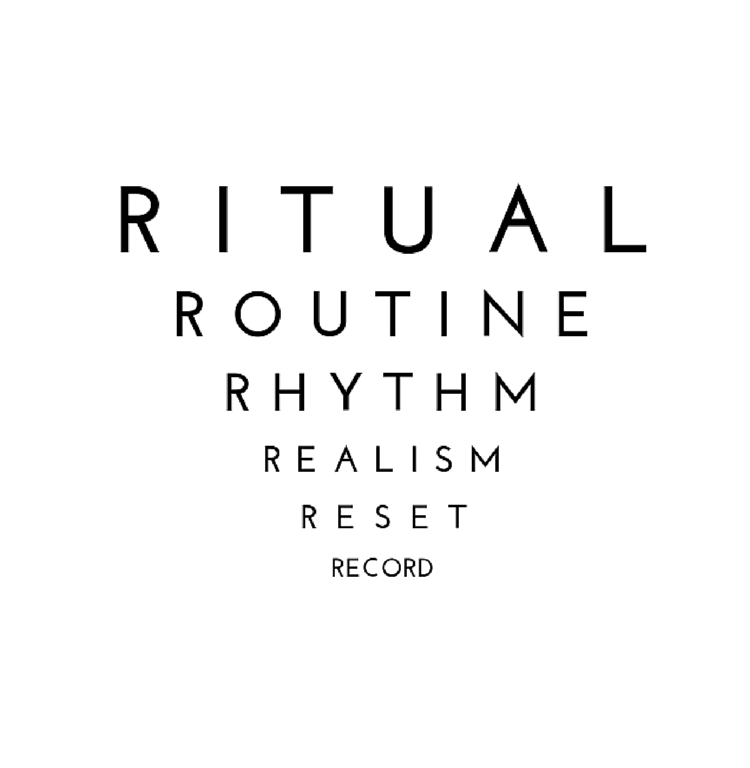
    After reading books on habit, willpower, rituals, routines and anything else that might increase my writing output, I set up what I like to call the Productivity Pyramid (though yes, I realize it’s really a triangle). It’s made up of six crucial elements.

    Increase productivity as a writer

    1. Ritual

    The top of our Pyramid is the most important. Rituals are habits that begin with a behavioral cue — a sort of trigger that tells the brain “Now it’s time to work!” Some authors have quite elaborate cues (such as reading the same poem before writing) and others have more simple ones (such as making a cup of tea). Either way, having a ritual helps the brain slip into its creative flow automatically.

    I cultivated my ritual years ago as a student who didn’t want to pay attention in class: writing in a spiral-bound notebook. Just sitting down with the lined paper and a pen tells my brain, “Oh! We’re writing stories now!” and I can use this ritual whenever I need to!

    Stuck in line at the DMV? No problem — out comes the notebook. Waiting for my order to finish at the coffee shop? Awesome — I can pull out my notebook and instantly get to work. Figure out what triggers you to prepare for creative work, and create your own ritual.

    2. Routine

    Routine is almost as important as ritual because, like ritual, it trains your brain to create on autopilot. This doesn’t mean your creative times are boring or redundant. Rather your brain gets used to drafting at X-hour everyday, and when that hour arrives, your imagination is ready to go!

    The other powerful component of routine is that it reduces the number of decisions you make in a day. You see, willpower is finite; the more we use, the less we have. Decisions deplete willpower, so if we can reduce the number of decisions we have to make in a day — if we can routinize certain aspects of our life — then we can save our decision-making for our writing.

    3. Rhythm

    Our creative energy shifts and changes throughout the day, just like our circadian rhythms. Figuring out at what point in the day you’re the most productive creatively — when your brain is really “on” — can dramatically improve your creative output.

    My whole life, I’ve thought of myself as an afternoon worker, since that was when I seemed to sit in the chair with my hands on the keyboard. I thought my creative energy was best a few hours after lunch.

    However, after using a productivity heat map, I discovered that I was actually a morning person! I sink into creative flow the deepest and for the longest time immediately after I roll out of bed in the morning. To make the most of my natural rhythm, I’ve set up a routine that starts with me awakening at 5 AM and writing for a few hours straight.

    Do you know your most productive times of day? Check out your own rhythm with these strategies.

    4. Realism

    This is a pretty straightforward step on the Pyramid, but if you really tap into it, it can be transformative. Why? Because many people set unrealistic goals, get frustrated when they don’t meet them, and then give up. (I am SO guilty of this!)

    One good day of writing doesn’t mean we’ll have that same amazing word count every day! However, if you set a truly achievable goal — especially a daily one — hitting it will help your confidence grow.

    I set a daily goal of 1000 words when I’m drafting a new novel. This goal is not only attainable, but it’s easily attainable. It doesn’t intimidate me or set me up for immediate failure. Yet, 1000 words a day leaves me an entire novel in just a few months. What’s your achievable, realistic daily goal?

    5. Reset

    It’s unavoidable: Our bodies need regular rest periods. Creatively speaking, our brains can only produce at peak performance for a certain amount of time — and then we have to reset.

    Both on a daily scale and on a more long-term weekly or monthly scale, breaks can be your new creative best friend. Have you ever noticed that some of the best aha! moments come when you’re not working?

    For example, I have my biggest creative breakthroughs while I’m driving on the highway or cooking dinner or walking my dogs — when I’m not actively thinking about my story, yet the ideas are still knocking around in my subconscious. I know other people who use meditation or binge read or take long hikes.

    Find a reset strategy that works for you, and enjoy your renewed energy and creativity when you return to your work.

    6. Record

    Creative endeavors (like novels) can be HUGE. “Write a book” is a daunting undertaking (and such a vague goal), so seeing daily progress can help keep you motivated to continue.

    To keep myself on track, I use a spreadsheet to note how many words I’ve written each day as well as record any other work I’ve done (e.g. revised two scenes or wrote a blog post). Then I tally up the total word count each day so that I can see how much my project is growing! The visual interpretation of my progress helps keep me motivated.

    Your tracking method can be as simple and private as an Excel spreadsheet, or you can make it a group endeavor by sharing a Google spreadsheet with a few fellow writers.

    The Productivity Pyramid has helped me write and revise to the maximum of my creative abilities while also traveling for author events, promoting my books and maintaining my writing blog and newsletter. I hope it can help you do the same!

    How do you increase your creative productivity?

  • Horror Authors: How to Scare the Heck Out of Your Readers

    Horror Authors: How to Scare the Heck Out of Your Readers

    If you’re writing horror, dark fantasy, thrillers or anything else that requires suspense, a good jump-scare or anything that might terrorize your readers, you’ve probably already know that the written word can fill you with dread, and even startle you. Those feelings aren’t reserved for the movies.

    But how much study have you put into how your favorite horror authors have gone about scaring you with the written word?

    Movies rely on editing, music cues, performance, special visual and makeup effects . . . a whole parade of cinematic tools. But in prose all we have to work with are words, and our readers’ imaginations. The good news is that those are powerful tools.

    Though you may not have much control over any individual reader’s imagination, or his interpretation of your work, the ways you arrange words into sentences and sentences into paragraphs can activate your readers’ psyches in ways you may not have thought possible.

    It all comes down to breathing

    Even when reading silently, we tend to breathe along with what we’re reading as if we were reading it aloud. It’s impossible for us to turn certain parts of our brain off and when something causes us to start breathing differently, that forces us into different states. When you’re in a blind panic you tend to hyperventilate, breathing in quick, shallow gasps. When you’re nervous or anxious about something (the feeling of suspense), you tend to hold your breath, and breathe more slowly.

    The good news for horror and thriller authors is that these processes also work in reverse. If you can force that breathing state (or, more accurately, some smaller, less physically traumatic version of that state) in your readers, you’ll bring on the requisite psychological response.

    Evoking suspense and anxiety

    When you’re building suspense, evoking a feeling of impending doom or the terrifying fear of the unknown, get your reader to hold her breath. Stop her from taking her next breath for longer than normal. And though it may seem impossible to do this with words on a page, remember what I said about how we unconsciously breathe as though we’re reading aloud even when we aren’t.

    One of the reasons that sentences are finite is that the period at the end allows us a breath. Paragraphs give us a chance to take a deeper breath. So if you want your reader to slow her breathing and start feeling nervous, anxious or fearful, keep your sentences long, and your paragraphs even longer.

    Very near the beginning of Shirley Jackson’s classic The Haunting of Hill House, the protagonist, Eleanor, is on her way to meet her fellow paranormal investigators at a house that’s known to be haunted. Though excited about being a part of something potentially important, and getting away from her dreary life in the city, Eleanor is terrified of what she’ll find there, not just from ghosts but as a result of what we’d now refer to as social anxiety. The closer she gets to the house, the more anxious she is.

    Jackson conveys this anxiety with a single paragraph wherein Eleanor makes a stop in a small town along the way and has a cup of coffee. It’s an innocuous scene, but told in a tight POV, it’s incredibly nerve-wracking. This single paragraph consists of ten sentences. The first of those sentences is the shortest at 28 words. The last is the longest at 52 words.

    Think about the last time you read, much less wrote, a sentence that’s 52 words long.

    By the end of that monster paragraph, Shirley Jackson left her readers gasping for air, and helped solidify The Haunting of Hill House as one of the undisputed classics of the genre.

    Eliciting horror and panic

    On the flip side, eventually the monster, serial killer or villain finally reveals himself and the terror (a generalized, creepy dread) turns to horror (the visceral reaction to a traumatic event in progress).

    Now you want to do just the opposite: Force your readers to breathe too often. Get them hyperventilating. Do this with short sentences. Even shorter paragraphs.

    One-sentence paragraphs.

    In another classic haunted house tale, Hell House, author Richard Matheson evokes this feeling of panic in one scene of nine paragraphs, each with no more than two short sentences. Readers have been trained to take a full breath after each paragraph, so breaths are coming fast and furious through:

    She stopped with a gasp and looked at the Spanish table.

    The telephone was ringing.

    It can’t, she thought. It hasn’t worked in more than thirty years.

    She wouldn’t answer it. She knew who it was.

    It kept on ringing, the shrill sounds stabbing at her eardrums, at her brain.

    She mustn’t answer it. She wouldn’t.

    The telephone kept ringing.

    “No,” she said.

    Ringing. Ringing. Ringing. Ringing.

    I know — technically, that last paragraph has four sentences, but let’s consider that staccato stacking of “Ringing”s as one sentence with partial breaths between each word.

    Instead of a single ten-sentence-long paragraph, we have paragraphs of one or two sentences, with the longest sentence/paragraph clocking in at 14 words, or precisely half the length of Shirley Jackson’s shortest sentence.

    Following this scene, there are a couple of slightly longer paragraphs as the protagonist tries to take charge of the situation, but this is quickly dismissed by more staccato attacks on the senses. And, like The Haunting of Hill House, the ongoing success of Hell House is proof of its effectiveness.

    Putting this technique into practice

    This idea of controlling your readers’ breathing is not the be-all-end-all of “writing scary,” but with some practice it will work for you.

    And being aware of when to best use this strategy will also prevent you from overusing it, and move the majority of your prose somewhere into the readable, accessible, and comfortable center — until you want things to start getting scary again.

    Do you “write scary”? Have you tried this technique to control your reader’s breathing?

  • Should You Self-Publish or Go Traditional? [Infographic]

    Should You Self-Publish or Go Traditional? [Infographic]

    You might be ready to publish your book, but how do you decide whether to self-publish or pursue traditional publishing?

    It’s not necessarily an easy choice for authors to make.

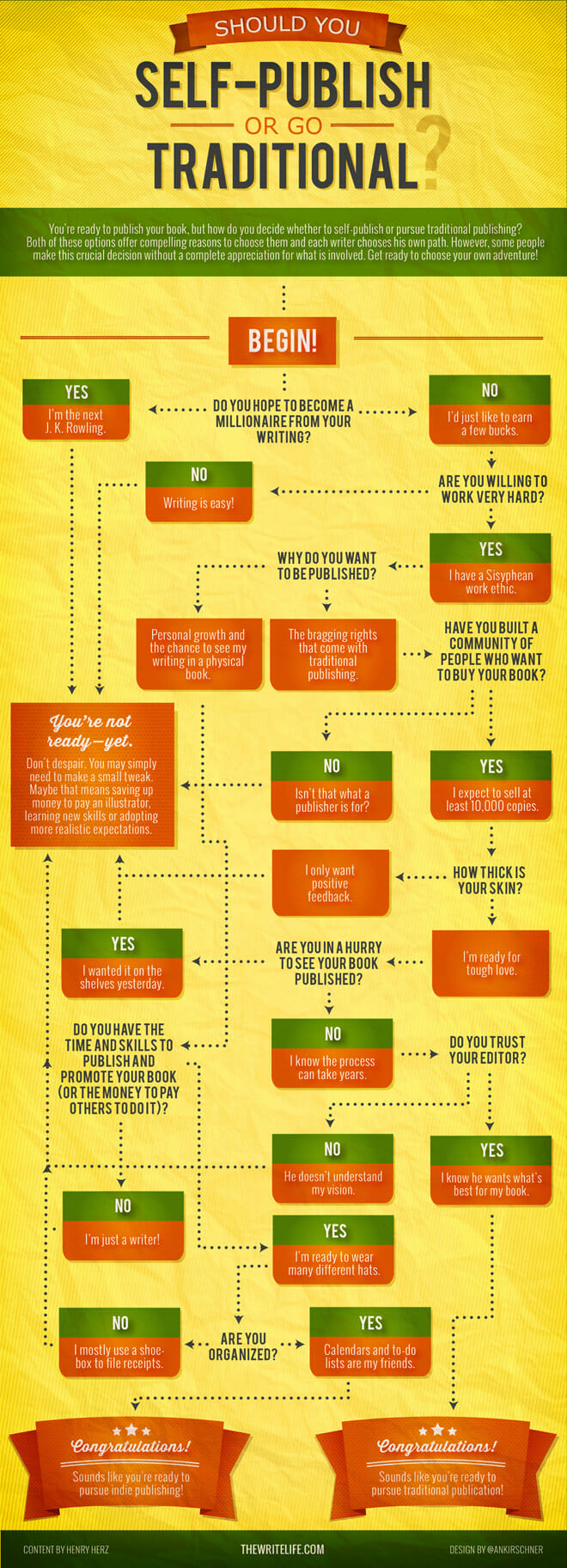
    To help you decide which path is right for you and your book, I created a “choose-your-own-adventure” questionnaire that breaks down the crucial elements of each option. The Write Life turned it into this infographic:

    Self-Publish or Traditional?


    Want to embed the flow chart on your own site? Copy and paste the code below:


    Looking for a more detailed explanation of each point? Here’s the full questionnaire.

    1. Do you hope to become a millionaire from your writing?

    If so, consider that for every J. K. Rowling, there are a million Henry Herzs. Who’s Henry Herz? Exactly. Go to 10.

    If not, very good. You have realistic expectations. Go to 2.

    2. Are you willing to work hard? Very hard?

    If not, you’ll need to change your attitude. Honing one’s writing craft and becoming traditionally published take a Sisyphusean work ethic. Go to 10.

    If so, very good. You have realistic expectations. Go to 3.

    3. Why do you want to be published?

    If you’re seeking the sense of accomplishment and bragging rights that accompany traditional publishing, good for you. Go to 4.

    If you’re seeking personal growth, career development, speaking opportunities or want to see your writing in a physical book, good for you. Go to 8.

    4. Have you built a community of people who want to buy your book?

    Before you publish your book, make sure there’s a market for it and start building your author platform. Is selling 10,000 or more copies a realistic prospect? If so, fantastic. Go to 5.

    If not, you should recognize that publishing is a business. Publishers won’t accept a project if they can’t reasonably expect to make a profit. Go to 10.

    5. Is your skin too thin to withstand a hail of criticism and a deluge of rejections?

    Does your critique group consist of your mom and your spouse because you only want to hear that your manuscript is fabulous? If so, go to 10.

    If not, you appreciate that it is precisely the tough love offered by critique groups, beta readers, agents and editors that strengthens a manuscript and sharpens yourwriting. Go to 6.

    6. Are you in a hurry to see your book traditionally published?

    By “hurry”, I mean less than 18 to 24 months — a common timeline for publication. If so, you may not be aware of all the steps performed by traditional publishers in preparing, printing, and promoting a book. Go to 10.

    If not, you have enough patience to be traditionally published. Go to 7.

    7. Are you willing to follow publishing industry standards and the guidance of a professional editor?

    If not, you must recognize editors have standards because they know from experience what works and what doesn’t. Your 3″ by 3″ 200-page dystopian picture book concept may be unique, but it probably won’t sell. Go to 10.

    If so, you trust editors’ professionalism. Congratulations — you’re ready to pursue traditional publication! Go to 11.

    8. Do you have the time and skills to publish, promote your book, fulfill orders and run a business?

    Or do you have the money to pay others to do so? If not, perhaps you didn’t realize that the indie publishing path means you must have both writing and publishing skills. In addition to your role as an author, you must be an illustrator, an editor, an art director, a salesperson and a businessperson. Go to 10.

    If so, impressive! Go to 9.

    9. Are you well-organized?

    Do you use calendars, spreadsheets, to-do lists and other tools to plan and keep track of your tasks, expenditures, sales and revenue?

    If not, please recognize that running a business by using a shoebox to file your receipts is a recipe for disaster. Go to 10.

    If so, you understand the benefits of being organized. Congratulations — you’re ready to indie publish! Go to 11.

    10. You’re not ready — yet

    If you’ve landed here, it means you’ve realized that you’re not yet ready for publication.

    Don’t despair — while you may not be ready now, you may simply need to make a small tweak. Maybe that means saving up money to pay an illustrator, learning new skills or adopting more realistic expectations.

    11. Indie versus traditional publishing

    Let’s wrap up with a quick comparison of the benefits of each path.

    The benefits of indie publishing include:

    • Publication is guaranteed: You know you’ll be published, since you’re the one making it happen.
    • Move at your own pace: Publish as quickly or as slowly as you’d like.
    • Full transparency and control: You make all decisions about creating, publishing and promoting your book, so you know what’s going on with every aspect of your project.
    • Set your own standards: You decide what your book will look like.

    The benefits of traditional publishing include:

    • The publisher pays expenses: Someone else picks up all the costs.
    • Your team brings expertise: Your editor and agent know their jobs well and make your book as strong as possible.
    • You’re only responsible for writing: The publisher doesn’t expect you to be a copy editor, art director or marketing guru.
    • Wider potential audience: The resources and connections of a traditional publisher often lead to wider exposure.

    The lesson? Your publishing decision should not be taken lightly.

    While self-publishing gives you all the control and all the profits, it also means you’re responsible for all the expenses and all the work.

    If you’ve published a book, how did you decide between self-publishing and traditional publishing? If you haven’t published yet, what are you considering?

  • 3 Common Writing Myths and How One Writer Challenged Them

    3 Common Writing Myths and How One Writer Challenged Them

    I was a child writer. As early as first or second grade, I spent most of my free time filling up notebooks with story ideas and character sketches. Somewhere in my closet are several picture book manuscripts I wrote during grade school. On my hard drive is a 160,000-word epic of adolescent angst from my last year of high school. I’ve got dozens of scripts and short stories left over from college.

    Fortunately, none of them were published — but it was a close call. During most of that time, I was actively sending out query letters to agents and publishers. I didn’t want to be a published writer when I grew up. I wanted to be one now.

    Looking back, I’m glad it didn’t work out. I’m much more savvy about the publishing industry these days, and I’d rather build up my career slowly than have to distance myself from my embarrassing early work. Besides, a lot of what I believed about writing was just plain wrong.

    The advice I read in how-to guides and on my favorite authors’ blogs wasn’t always what I needed to hear. Here are three false assumptions I’ve had to work hard to overcome:

    1. Writing requires a lot of time

    As a kid, I had the false impression that to be a “real” writer meant writing all the time. One of the reasons I wanted to be published while I was young was so that I wouldn’t be stuck in a day job, trying to finish up a manuscript after a full day’s work.

    Many of the writing guides I read suggested that the average book takes a year to write. But was that a year of full-time writing, or part-time? Would I have to get up at 5 a.m. to squeeze in my writing between other commitments? I squandered my college years, thinking that I couldn’t possibly be a full-time writer and a full-time student. I procrastinated on many of my manuscripts because I wanted to set aside a whole year to write them.

    I couldn’t have been more wrong. Not only was I unlikely to “find the time” all at once, but it flew in the face of how writing actually works for me. Even if I have a full day set aside to write, the most I’m likely to work on a given manuscript is a few hours. Having other commitments and responsibilities — even other writing gigs — can actually increase my productivity, because I can switch between multiple projects.

    Lesson 1: Writing isn’t a zero-sum game; you can fit it in between other gigs. Even full-time writers take on other projects to keep themselves busy.

    2. Creative writing classes are worthless

    As a kid, I remember hearing the same advice from several authors I respected: that you “can’t teach writing”, and the only way to be a better writer is to write. For some reason, that left me with the notion that studying writing wouldn’t get me anywhere — that it wouldn’t be worthwhile to take creative writing classes in college.

    I’d heard that writing seminars were particularly rough on fantasy/sci-fi writers, and that MFA programs were best suited to “literary” fiction. So instead of attending college as a creative writing major, I studied film and signed up for a few writing workshops on the side.

    What I failed to realize was that even if you can’t teach good writing, you can learn a lot from group critiques and by reading your work in front of others. The years when I had deadlines to meet for my fiction classes were the years I was most productive as a writer.

    Not only that, but writing classes and conferences can be key to networking with other writers and keeping tabs on the publishing industry. That’s how you’ll find out which magazines to submit to, which writers’ groups to join and which grants or residencies to apply for.

    Lesson 2: Writing workshops aren’t just about teaching people how to write. They’re also about feedback, deadlines, and making connections.

    3. Self-publishing is bad

    I grew up long before print-on-demand publishing, when “vanity presses” were the latest scam. I’d heard stories about writers who’d paid thousands of dollars to print copies of books that were now sitting unsold in their basements. As far as I was concerned, there was one simple rule: never pay to get published.

    That idea was pretty well-ingrained in my head by the time ebooks came along, and for a while I strongly resisted the urge to self-publish. The few success stories I read about seemed like outliers, and I wouldn’t feel like a “real” writer unless I got a traditional book deal.

    But soon it became obvious that the industry was changing, and an old-school publishing contract was no guarantee of success. Even if I did get one, I’d be expected to do most of the marketing myself, and I’d probably have to pay for a book tour out-of-pocket!

    By choosing the self-publishing route, I can release my books on my own terms, with very little up-front cost. Even if my first books don’t sell, I’ll be learning the process: how to format books for Kindle or print-on-demand; host Goodreads giveaways; run a crowdfunding campaign and more. Why not start learning while I have the chance?

    Lesson 3: Don’t let the stigma of self-publishing scare you off. Getting your books out into the world may be better than letting your manuscripts collect dust.

    What ideas about writing and publishing did you have growing up that may not be true any more? How did you learn to get past your early assumptions about writing?

  • About to Respond to a Negative Review of Your Book? Read This First

    About to Respond to a Negative Review of Your Book? Read This First

    Have you heard of Stephan J. Harper’s interactive iBook Venice Under Glass?

    If you have, it’s likely that you’ve heard more about the author than the book itself. After a not-so-stellar review of his book at TidBITS, an Apple news website, Harper went on a commenting rampage, picking apart the reviewer’s opinions piece by piece and rebutting nearly every other commenter on the review. It’s a rant of epic proportions.

    After reading through his comments, I can’t tell if he’s serious or if it’s a publicity stunt. Then again, considering the amount of time and effort he’s put into defending his work, it’s likely legitimate, although emotionally charged.

    The entire affair is an extreme example of the absolutely worst way to respond to a book review.

    The only way to respond to a bad book review

    Before publishing my book last year, a wise friend of mine who’s an experienced, published author gave me the best advice about bad reviews: never respond.

    I know how difficult this can be, especially for first-time authors.

    My first Amazon review included two stars and the words “very disappointing.” The reader had expected a different kind of book, so the review seemed unfair to me, as if the book wasn’t being judged on its own merit but on the reader’s desire for something else. One of my “favorite” GoodReads reviews of my book simply states, “Wasn’t great writing, but I really enjoyed the content.” And yet it was granted four stars.

    No writer ever wants to read those kinds of words, and sites like Amazon and GoodReads don’t make it any easier for our egos since they allow authors to reply to their own reviews.

    The one time I replied to a review — and a good review at that — was to correct a factual assumption I thought the reviewer had made. To me, the reviewer seemed to say that I had personally conducted interviews for the book. I simply responded that I’d only done research and quoted from already available interviews.

    The next day, the reviewer had deleted their review! I learned a hard lesson that day, and I hadn’t even responded to a bad review. While those less-than-stellar reviews still haunt me on some days (I’m writing about them here, after all), I know now what every successful writer understands: you can’t please everybody.

    [bctt tweet=”As a writer, you can’t please everybody, says @batwood”]

    Plus, trying to change someone’s mind who’s already decided against your perspective on life, or who despises your writing style, or who just doesn’t like the fact that you’re a fan of the Oxford comma, is like George Bernard Shaw’s famous illustration: “I learned long ago, never to wrestle with a pig. You get dirty, and besides, the pig likes it.”

    A majority of reviewers don’t understand the kind of inner devastation they cause an author when they quickly type and publish two lines of a poor review. What you’ve labored for months on, they’ve minimized in two minutes. From that perspective, it’s enough to make any author’s blood boil.

    And an angry author set loose online can be a dangerous thing. This is exactly why an author has to prevent their inner vitriol from spilling over.

    7 non-career-destroying ways to deal with bad book reviews

    1. Don’t read your reviews

    Yes, there are some authors who follow this rule, though I’d hazard a guess that it’s a hard one to stick to for first-time authors. Don’t worry, though — it’s only the first suggestion.

    2. Print out your bad reviews, then burn them

    It’s a symbolic gesture that releases your inner ire. Alternative disposal methods could include a paper shredder, compost for your garden or turning them into origami.

    3. Respond to your bad reviews . . . in a document that’s never made public

    You’re a writer, so you’re bound to write. Go ahead and give in to every last cutting remark you’d like to make, but ultimately keep those words to yourself.

    4. Talk about it with other writers

    Find a writer’s group, whether in real life or online. Every writer gets a bad review from time to time. When you share your bad reviews with other writers and hear their just-as-bad reviews, laughter inevitably erupts.

    5. Re-read your good reviews

    So long as you keep working at your craft, good reviews will come. Don’t allow one bad review to occupy your mind 90 percent of the time, while letting nine good reviews occupy the remaining 10 percent. (Also, don’t think about your reviews 100 percent of the time).

    6. Realize that writing is a journey, not a destination

    I know I just went cliché on you, but it’s true. Bad reviews bring growth to authors, and if you’re serious about a career in writing, you’ll work through and past any bad review. Don’t allow a bad review to stop you from taking another step.

    7. Start writing your next book

    The best way to get over a bad review is to start your next book. Sure, it may garner a bad review as well, but I’m willing to bet that it’ll be better than your last work. Plus, now you know how to better handle bad reviews.

    How do you deal with bad reviews? If you’re feeling brave, share your worst book review in the comments.