Tag: book promotion

  • How to Use BookBub to Sell Books — And Get on Amazon’s Bestsellers List

    How to Use BookBub to Sell Books — And Get on Amazon’s Bestsellers List

    In January, 2023, I gave away 60,301 books on Amazon, Apple, Barnes & Noble and Kobo combined. And that’s just for one title.

    I nearly died of excitement. Not only did it mean 60,000 people were willing to take a chance on my book, but it meant exposure, sales and several other big wins for a tiny little author like me.

    How’d I do it? It took blood, sweat, tears and a little luck.

    A look into my book marketing strategy

    To understand my marketing strategy, we have to rewind about a year.

    Around March 2022, I decided to make the first book in my series, Fire in Frost, permafree.

    Permafree is a term that simply means the book is always free or “permanently free.”

    Though I don’t make any money on downloads of this book, the idea is to capture readers’ attention so they’ll hopefully buy the next books in my series. When I made this decision, I had already self-published the first and second books, and the third was almost ready.

    Fast-forward to December 2022. I submitted my free book to BookBub for consideration — for the tenth time. You can only apply once per month, and I was determined to keep trying.

    I couldn’t believe it when I got the email saying they’d accepted my book for a feature and were planning to run my ad on January 4, 2023.

    What is BookBub? And how does BookBub work?

    If you’re not familiar with BookBub, it’s the holy grail of book marketing for fiction authors.

    BookBub is what made all the difference in this promotion. If you hang out with other writers long enough, you’ll discover that BookBub is THE place to advertise your books if you can.

    But you can read tons of BookBub reviews on the web, and I’d rather go a step further and help you use the tool.

    So here’s how BookBub works. The company sends out newsletters to thousands of readers each day. You pay to get your book featured in their newsletters. The price varies depending on the price point of your book and which newsletter you want to be featured in.

    They’re willing to consider permanently free books, but in general, they’re looking for book deals that are deeply discounted.

    BookBub for authors: How to get a BookBub feature

    While BookBub is incredibly effective for authors, it is extremely hard to get your book accepted.

    I tried 10 times with my free book before finally getting accepted. I recently had another author friend say she tried 18 times before getting accepted.

    With that in mind, there are a couple of things you can do to increase your odds that BookBub will feature your book.

    Here are my suggestions for getting your book featured in BookBub:

    1. Make it the best deal you can.

    BookBub wants to give their readers the best deals, so try to offer your book free (if it’s the first in the series) or for $0.99. They usually won’t feature anything above $2.99, and they’re unlikely to feature your book at that price point if it’s always priced there.

    2. Try with the first book in a series.

    BookBub seems to like first in the series because (as I understand it) they will make money off affiliate sales of your other books if their readers buy the rest of the series.

    3. Make your book available on all platforms and in all territories.

    BookBub wants deals that appeal to all their readers. Although they sometimes feature books that are exclusive to Amazon, you typically have a better chance if your book is available on all platforms (Amazon, Apple, Barnes & Noble, Kobo, and Google Play) and if the deal is available in all territories (US, UK, Australia, India, and Canada).

    4. Have an amazing cover.

    Believe it or not, readers really do judge books by their covers, and so do the people over at BookBub. If you have a cover that’s not eye-catching, it’s worth considering a redesign, not just for BookBub but because it will help in all your book promotions.

    5. Finish your series.

    BookBub finally accepted my deal once the entire series was available for sale on all platforms. This isn’t a guarantee that they’ll accept your book, but it helps because readers don’t want to wait around for the next one. Offering a complete series makes your deal more appealing.

    6. Gather reviews.

    BookBub doesn’t require a minimum amount of reviews, but more reviews give the impression that your book is more popular. It also gives BookBub’s editors an idea of how readers will respond to your book. You can gather reviews by including a call to action at the end of your book, giving away free copies, or encouraging reviews from people who’ve already read the book.

    7. Talk up your book.

    BookBub features a comment section when you submit your deal. Use it to talk up your book. Mention if it’s won any awards or what editorial reviewers or big-name authors have said about it. I mentioned that my series had over 200 5-star reviews on Goodreads (at the time), and I think that helped me land a feature on BookBub.

    8. Be flexible.

    BookBub is in such high demand that if you need a certain date, it might already be full.

    Instead, consider planning your promotion around them. They’ll ask you if your date is flexible or not. Be open to anything, and it will increase your chances of getting a feature.

    9. Keep submitting.

    Submit as often as you can (once a month), and don’t give up!

    How to leverage a BookBub ad

    After paying for the ad (see cost details below), I knew I needed to devise a game plan.

    I wanted to make the most out of this feature. I applied to multiple other ad sites and newsletter services and got accepted to most of them. I planned to run ads that whole week to boost my Amazon rankings.

    Most of the ads ended up running on Monday or Tuesday, and the BookBub feature ran on Wednesday. Here’s how my investment broke down:

    • BookBub: $115*
    • EBook Soda: $15
    • Book Goodies: $17.50
    • The Fussy Librarian: $5
    • Reading Deals: Free
    • ReadFree.ly: Free
    • EReader News Today: $35
    • Many Books: $25

    *BookBub ad prices vary depending on your category and price point. I ran my ad for a free book in the Teen & Young Adult category.

    I also increased my Amazon ad spending to $10 per day and ended up spending $39.68 during the week of the promo. Plus, I ran Facebook ads for $10 per day and spent $43.69 during the week of the promo. For other free promos, some friends agreed to share the book in their newsletters, and I also shared the freebie with mine.

    My goal was to reach as many people as possible with my book promotion. When all was said and done, I spent $295.87 to promote my freebie.

    The result? These promos catapulted my free book from around #2,000 in the free Amazon Kindle store to #7 in the entire store. I hit #1 of all free teen books on Kindle.

    Here’s what that looked like (see #7):

    That high Amazon ranking further increased my exposure and kept the series selling well the entire month, and for months afterward.

    Overall in January, I had 33,485 downloads on the Amazon U.S. site, 8,491 downloads on Amazon’s international sites, and 18,325 downloads between Apple, Barnes & Noble, and Kobo.

    What did I get out of my BookBub promotion?

    Here’s how I benefited from this book promotion:

    I made a profit off my books

    You might be wondering why I would do all this just for a free book. After all, I’m not making any money off it, right?

    Well, that’d be the case if I only had the one book. By reaching readers with the first book, sales of the second, third, and fourth books also spiked.

    By the end of the promo week, I’d already made my money back and more from sales of my other books.

    I got lots of positive reviews

    After running the promo, my reviews spiked. I’ve received well over 50 more reviews on book one on Amazon, and I’ve now exceeded over 1,000 reviews of the series on Goodreads. All this translates into even more exposure.

    I achieved bestseller status on Amazon

    Toward the end of the month, I decided to run a quick $0.99 sale on books two, three, and four.

    Since the sales boost from this promo had already increased my ranking, this extra sale helped push my books to #1 in their Amazon categories. I also made the top 100 author list for teens.

    Granted, it’s no New York Times bestseller, and I won’t be bragging about being an Amazon bestseller on my book covers or anything, but it was a personal goal of mine that I was happy to hit.

    [twl_reusable_block post_id=41455]

  • Building an Email List for Your Book: 2 Effective Tactics to Try Now

    Building an Email List for Your Book: 2 Effective Tactics to Try Now

    As an author, your email list is your most valuable asset. We talked about this a bit last month.

    Your email list is your best direct line to your biggest fans, which no publisher, book store or giant drone conglomerate has any control over. But this also means it’s completely up to you to find those new readers and convince them you’re worth a slot in their inbox.

    This is no small task!

    At first, it can be easy to get new subscribers on your list, because you’re new to everybody. But once you exhaust your immediate social network, how do you continue expanding your reach and finding new readers?

    As far as I’ve seen, there are two major approaches used by authors to find new readers: cross-promotion giveaways and targeted social media ads.

    Which is better? I tried them both to do a side-by-side comparison and find out.

    1. Cross-promotion giveaways

    Services like Instafreebie and BookFunnel are an easy way to automate the delivery of your reader magnet. But one of their most popular features is the ability to connect with other authors in your genre to offer group giveaways. (This is fairly new for BookFunnel, as they try to keep up with Instafreebie.)

    How does it work? In short, you submit your book to the giveaway, and then all authors included (often between 20 and 100 of them) blast the giveaway out to their email lists and social media feeds to promote it over a short period of time, such as a week.

    The idea behind this approach is that readers love to find new authors and new great stories, and that by partnering with authors in the same genre, you can get in front of the readers most likely to be interested in your work.

    For this purpose, both services function well, and they certainly deliver on new subscriber activity (specific results depend on the giveaway size and reach of the authors involved).

    Overall both services are great, but I prefer BookFunnel. It’s actually not even because BookFunnel costs half as much for the same services. It’s because while Instrafreebie adds every new subscriber you get to their own book promo list too, BookFunnel’s policy is that your readers are yours not theirs.

    If you’re looking to grow your list quickly for overall subscriber quantity, or to simply get quick exposure for a new promo work, fire away. This approach will get the job done.

    But, I have to add the caveat that I have seen engagement on my list go down as my subscriber numbers grew from these giveaways.

    With this approach, I worry about lack of focus on readers beyond a genre label, and also about how many new readers you’re really getting exposed to over the long haul, if the same authors keep participating in the giveaways over and over. I’m also not a fan of blasting my readers with promo announcements all the time.

    But for $10-20 a month, this is a very reasonable and sustainable investment for what you get.

    2. Social media ads

    Some self published authors swear that listbuilding with a reader magnet and targeted social media ads propelled them to the bestseller list.

    And just like the cross-promotion giveaways, this can be done on a very small monthly budget.

    Social media sites like Facebook and Twitter allow users to access advertising at low budgets to reach an audience beyond their existing followers. All you need is some teaser content, a good image of your book and an idea of who will want to read it.

    Don’t let the extensive targeting options intimidate you — just use your common sense and imagination to focus on the people most likely to enjoy your book.

    The setup for a social media ad is a bit more extensive, and to get the best results you should test updating the ad’s elements regularly.

    You won’t see the rapid growth you would with a cross-promotion through these ads, but even $20 a month will give you a steady, healthy growth rate. And, because the approach is more targeted, this approach results in a much higher engagement rate, for me.

    Which approach is better?

    If you’ve got to choose one approach, my opinion is that a highly engaged email list is better than a rapidly growing one — so go with the social media ads.

    However, I do think there is a place for both, if your budget allows for it. I was surprised at just how much I got from my first giveaway promo — several hundred new subscribers in just a couple weeks. Call me superficial, but I think there is some value to having a decent number of overall subscribers, even if it’s simply to help you demonstrate your platform size to an agent or editor.

    Ultimately, the key is to never lose sight of what your email list is for. Like all author marketing, it’s about building relationships. When reaching out to new readers, and engaging your existing subscribers, always remember to consider what will motivate them to read more.

    How do you get in front of new readers?

  • Her Debut Novel Just Turned 1. Which Marketing Tactics Worked?

    Her Debut Novel Just Turned 1. Which Marketing Tactics Worked?

    It’s a good idea for any type of book marketing outreach to have a plan.

    Even better idea when you’re just a single author, and not a major corporation – time and budget are both so much more precious…and the results so much more personal.

    The start of a new year is a good time to pause and assess before forging on ahead.

    Let’s take a hard look at what I’ve done with my first year as a published author, considering what’s worked, what hasn’t and where to go from here.

    Looking back at 2016

    It’s been a heck of a year. On the most basic level, for me as an author, it’s been a very successful one.

    I got published!

    And by a traditional publisher!

    And then that novel — the first I’ve ever written — won Florida Writers Association’s top honor as Book of the Year. Pardon me if my pride is showing for a moment.

    Beyond that, I attended my first author event, participated in my first panel, had my first radio interview, presented to my first writers groups — there were a lot of author-ly firsts involved.

    Along with that, I had to figure out my author brand and establish a presence for my pen name—and then grow it! That includes a website, social media, e-newsletter, event signage and other support materials.

    Just getting through it all has been an intense, hands-on crash course in book marketing.

    Key to this experience, I believe, is that I said yes to as much as possible, tried a ton of different things, learned as much as I could through experiments and watching others and took swift action based on those lessons.

    What worked?

    The good news is, a lot of my efforts to grow my platform worked really well. They didn’t all work perfectly at the start, but with some experimentation, I was able to learn how to get the most from them.

    These successes include:

    • Reader events. This has been the best way to sell books consistently, even if it’s often  just five-to-ten books per event day. Beyond that, I always get to talk to readers, build up name recognition and get a lot of new subscribers to my email list, which introduces them to my writing with a free novella.
    • Networking. And by networking I mean, very simply, talking to the people around me at these reader events—not just readers, but the other authors. This has let to a number of additional opportunities.
    • Awards. The award I won in October has been a wonderful impetus for new promotional opportunities, like talking to writers groups, and has built more credibility for the quality of my writing in general—major for a small press author!
    • Facebook ads. This is the primary way I expand my reach to new readers online right now, helping my list to grow from 21 followers at its start last February to over 800 today. The best hook has proven to be a free novella offer.
    • E-newsletter. Despite the rapid growth, engagement has remained high for my newsletter, and unsubscribes low. I believe this has to do with focusing on keeping content short, fun, and valuable to my science fiction/fantasy reader base.
    • Focusing on alternate metrics of success. Being a debut novelist is never easy, but this is especially true for indie and small press authors. Using my book as a tool for platform-building instead of a product for sales, I’ve been able to make valuable progress on markers of more long-term success, like email subscribers and speaking opportunities.

    What didn’t work?

    You have to be willing to fail sometimes with your marketing in order to learn more about what works and what doesn’t. I definitely had my share of those in 2016, but I feel good about the lessons I’ve taken from those failures.

    These included:

    • Online sales. Post-launch, sales for my book slowly dwindled to almost nothing. Heartbreaking! I quickly learned to invest time elsewhere (events) to make sales.
    • Email automation funnel. I created an email automation series, with the goal of delivering my free novella to new readers and turning those readers into novel sales. It hasn’t worked so far.
    • Being a single-novel author. With just one novel, you either draw a reader in, or you don’t. And your opportunities for discoverability are much smaller than those of an author with, say, 20 books.
    • Getting reviews. Despite several indicators that readers enjoy my writing, reviews have been slow to accumulate, even with a direct ask in my email automation.  

    What’s next?

    Looking ahead into 2017, there is a lot I can do to run with these lessons learned in 2016.

    I’ve got some big plans ahead…in fact, I expect the hardest thing about this will be simply to pace myself, and not become overwhelmed.

    My action plan includes:

    • One event a month. I’ve become more discriminating about what events I invest in, and what kind of readership those events draw.
    • Refine email automation. I am in the process of researching and re-crafting my email automation series from scratch, restructuring each email’s message and timing to better optimize reader relationships, book sales and reviews.
    • Writing faster. To reduce the hardships of being a single-book author, I’m going to stop being one. The second book in my series is already with my editor, and I’m going to get at least two more novels out this year, one in the series, another totally separate.
    • Street team. I’m going to develop a street team this year to get more reviews for each book, extend my online marketing outreach and foster a stronger connection with my most enthusiastic readers.

    It’s tough being a debut author, especially when you’re indie or small press. It also comes with a very steep learning curve.

    But don’t let the challenges discourage you. No effort is wasted if you learn from it and continuously apply those lessons to what you do next.

    We can’t all be the prodigy who lucks out and becomes the first-time bestseller. But we can all adapt and iterate and grow with every new effort and grow that readership over time.

    Do this over and over again, and you’re sure to continually reach new heights of success. Happy 2017, writers, and best wishes for success this coming year.

    What book marketing lessons did you learn in 2016? What are you doing differently in 2017?

  • How to Promote Your Book at Your Local Library

    How to Promote Your Book at Your Local Library

    Your book is finally out in the world, either in print, ebook format or both.

    The challenge now is book promotion and getting it in the hands of readers. There are many ways to do this of course, but libraries can offer a few ways to spread the word that are less costly than the lone table at the local bookstore.

    Not everyone is aware of the resources libraries can offer published authors, or the challenges involved. Here are a few roadblocks, as well as methods authors (and librarians) can use to get around them.

    Challenges for librarians

    When it comes to library programs, the main challenge is ensuring the library gets a return on its investment.

    It’s hard to justify keeping and maintaining programs that get little/no attendance or keep taking away from the library budget without giving back.

    Unfortunately, author visits can fall into this category, especially if they are only a one-time thing.

    If the author isn’t overly well-known, attendance can be an issue. Libraries keep active tallies of program attendance to determine how they use their resources throughout the year, and if author programs tend to demonstrate that the community doesn’t have an active interest despite advertising efforts, the library then has to determine how to better use its finite resources.

    Another issue librarians have to contend with is space. Public community rooms are often booked, sometimes as early as several months in advance.

    Group rooms that aren’t designated specifically for an event or program can often have time limits. Some libraries are so small that they don’t have community rooms at all — and then it falls on the libraries to figure out a viable venue for visiting authors.

    Challenges for authors

    Conversely, the idea of library and school visits can seem daunting to authors, especially for the more introverted among us.

    Like libraries, authors have limited budgets to work with, whether it’s money to book travel and hotel, or receiving compensation for their time.

    This gets even stickier for ebook-only authors, since libraries often cannot gift ebooks to patrons. It’s also challenging because ebooks are often accessed through a platform called Overdrive, which not all libraries have access to.

    So what are some solutions to these issues?

    Authors and librarians are coming up with some creative ways to bridge the gaps in ways that benefit everyone involved.

    Ways libraries reach out to authors

    Many libraries have made important strides in reaching out to authors.

    For example, San Diego Public Library’s Local Author Program has helped a lot of local authors feature their books within the Local Author Exhibit, the program’s centerpiece.

    According to Rachel Esguerra, library clerk and head of the program, the Local Author Program was built around the spirit of writing and building a community. Since its inception, the program has featured writers in a variety of different age groups, including kids and teens.

    Other libraries are following in these footsteps too — including Berkeley Public Library, which will be having its 15th Annual Author Dinner in February, and the Author Events program through the Philadelphia Public Library system. And, as part of its annual Summer Reading Program, the Sacramento Public Library has a system-wide lock-in event for teens, where authors can Skype in and join the fun.

    Author events not only help local communities feature creativity, it encourages patrons to read more books, which is definitely a huge incentive for librarians.

    Some events even take place on a larger, scale, such as National Library Week.

    Ways authors can reach out to librarians

    First and foremost, authors should plan long-term if they plan to collaborate with the local library  — and it’s usually easier to capitalize on events that already exist.

    It’s also helpful to find out who in the library is in charge of room scheduling, and figure out how to make available spaces work for everyone involved.

    “Public libraries are servants to the public,” Esguerra said. “You can speak with branch manager about things you’ve noticed about the library. Most people are open to ideas, and are more than willing to provide community and writer resources. And, smaller libraries that might not have the same kind of programming budget can still provide spaces to meet other writers.”

    Another option is to join Friends of the Library — a committee that most libraries have to ensure funding for various programs and resources. It’s not only a way to help the library further connect with the community at large, but also to find out where the library’s resources are being used and why.

    One author who’s done this is Zoe Ghahremani, who became involved in San Diego’s Local Author Program after her book, The Sky of Red Poppies was selected for One Book, One San Diego. She’s not only been a keynote speaker, but has also advocated for a larger room and space for the program. And, as a part of the library’s Friends, she’s involved in finding ways the library can get funding for the program and others like it.

    She does this work because she wants to give back to the community organizations that have helped her as an author.

    “I believe in karma,” she said. “Libraries are worthy of our support in so many ways. It is important for the butterfly to remember that it was once a worm. Some authors, when they gain success, sometimes forget that just being in the library building can offer a way to discover new stories.”

    And of course, authors can benefit from libraries too. After all, being an event speaker definitely trumps that lonely meet-and-greet table at the bookstore.

    Ultimately, the hope is that more librarians and authors will work together, that these collaborations will expand community involvement, and further ensure more good books get into the hands of readers that need them.

    Then, everyone wins.

    What else do you think we can do to convince librarians of ways author events can benefit communities as a whole?

  • What’s Your Post-Launch Book-Marketing Plan? (You Have One, Right?)

    What’s Your Post-Launch Book-Marketing Plan? (You Have One, Right?)

    I finally got a report from my publisher detailing my book sales from January, February and March.

    As I touched on last month — yes, that did take a while. There was a delay of two months, to be exact.

    This type of delay between the close of a sales quarter and a report of those sales is fairly normal in publishing, from everything I’ve learned from other writers and information available online.

    So let’s take a look at how my novel is doing. Then, we’ll look at what efforts I have put into getting those sales.

    Drum roll, please?

    In the first quarter of 2016, I sold 197 books. These were all purchases from Amazon, Apple, Kobo, and CreateSpace.

    Add to that the seven books I sold in the last quarter of 2015 (very early pre-sales — probably my mom), and as of the end of March, there were 204 copies of my book out in the world.

    Assessing the data

    In case anyone isn’t clear, those are not bestseller numbers.

    However, the average book sells only 250 copies in its entire first year.

    That’s not new authors. That’s an average.

    It includes everyone from that guy who posted his book on Kindle Direct Publishing (KDP) and did nothing else at all, all the way up to J. K. Rowling’s latest hit release.

    In addition to this, my book was on soft-launch pre-sales for most of this period — it didn’t actually release with real promotion behind it until March 15. So most of those sales are likely from the last two weeks of the quarter.

    I have another two weeks of launch promotions still to come in my second quarter data.

    So I’m not popping champagne over here, but I’m not slamming my head against the wall, either. I’m not overwhelmed. I’m not underwhelmed.

    Can you ever just be whelmed? I’m feeling pretty evenly whelmed.

    The post-launch dip

    This is a perfectly solid start. But following a book’s launch period, it’s extremely common for sales to take a dramatic dip.

    But I’m nowhere near my goal of selling 1000 copies of my book within the first year. In fact, I’m starting out a little behind.

    This means it’s time to step up those marketing efforts. Big time.

    First-quarter marketing

    Thanks to my marketing and PR background, I was prepared to take steps to establish a strong foundation for my book marketing prior to my book release.

    I have a website I’m happy with, I got some great professional headshots, and I have a pretty good blog and social media presence.

    But if I’m going to reach my 1,000-sale goal, I’m going to need to step it up.

    I’ve been studying some of my author peers, and when I can, I ask them about their marketing successes. I’ve also been researching online and doing my own brainstorming.

    As a result, I’ve got some next steps in mind:

    Hone my sales funnel

    I activated Mailchimp automation so that I can engage new subscribers with a short series of emails that introduce them to my work, ask them what they’re reading, and then prompt them to buy my book with a small discount.

    As the data comes in, I’ll tweak it to maximize the results.

    Get more social

    I learned from talking to other writers that some things I generally consider best practices in social media are in fact holding me back. I’m shifting my focus away from sharing sci-fi/fantasy news and more toward interacting with individual followers.

    I’m also making a point to share promotional posts about my book a few times a week. This goes against everything I’ve learned about social media, but it’s working for others, so it’s worth experimenting with.

    Beat the pavement

    Promoting my book online is comfortable for me because I don’t have to directly engage with anyone. But an author friend has been having a ton of success with in-person book events in her community, so I’m making myself get out there and give it a try.

    I can handle a few hours of social discomfort, if it means more exposure for my book.

    Time to step it up

    My book sales so far are fine. Not outstanding, not terrible.

    But with the inevitable post-launch sales dip coming, this is the time to step up my efforts.

    Thanks to some research, creativity and insights from other authors, I’ve got big plans ahead.

    Stay tuned—you can bet I’ll keep sharing what I learn along the way.

    Authors, what’s your preferred way to promote your work? Online interaction, or in-person events?

  • This Free Social Media Tool is Perfect for Your Next Book Launch

    This Free Social Media Tool is Perfect for Your Next Book Launch

    You’ve probably heard of crowdfunding before, but what about crowdspeaking?

    Enter Thunderclap, an exciting platform authors, entrepreneurs, activists, consumer brands and nonprofits are using to amplify their messages.

    Here’s how Thunderclap describes itself:

    A tool that lets a message be heard when you and your friends say it together. Think of it as an “online flash mob.” Join a Thunderclap, and you and others will share the same message at the same time, spreading an idea through Facebook, Twitter, and Tumblr that cannot be ignored.”

    Thunderclap allows users to create a campaign by writing a message, gather “supporters” to agree to share the message by a certain deadline; on that specified date, the message is blasted out on Facebook, Twitter and Tumblr, leading to massive social reach and amplification.

    Best of all? It’s free.

    As a communications consultant, I’m always looking for new ways to help my clients share key messages with their desired audiences. When my client and debut author Cara Bradley introduced me to Thunderclap, I jumped at the chance to experiment with using the platform to promote her book.

    “As a new author, I know how important it is for me to spread the word about my book, but I’m also very aware and conscious of coming across as overly self-promotional,” Bradley explained. “I was excited to try Thunderclap because it provided an easy and free way for my friends and community to support me and my book launch.”

    Want to launch a Thunderclap campaign? Here’s a step-by-step breakdown of how we did it.

    Cara Thunderclap campaign 3

    1. Create the campaign

    Creating a campaign is easy and intuitive. Create a login and select “Start a Thunderclap.”

    You’ll need to fill out information in the following fields:

    • Who are you?: Include a short bio here. Thunderclap recommends biographies be one or two sentences, but we copy and pasted Bradley’s 100-word bio with no problem.

    • Name your Thunderclap campaign: Be creative! This is what shows up at the very top of your campaign. For Bradley’s, we went with “Ready to Live On The Verge?”

    • Category: Choose from a dropdown list of campaign categories. Ours fell under “book” but yours might fall under crowdfunding, cause, film, health, or product and politics, among several others.

    • Message: This is the single most important field in the entire campaign, so take your time to think this through. Your message is what supporters agree to share when they back your campaign. Your message can only be 116 characters (not including a link).

      Important to note: you cannot include Twitter handles in your message, but hashtags are allowed.
    • Link: This is the link people will click when your message is amplified. Be sure to link to exactly where you want people to land. Links should not be shortened; Thunderclap will shorten the link for you.

    • Choose an end date: Campaigns only last for a specific amount of time. Thunderclap recommends two-to-three weeks, as a shorter timeframe generally creates a sense of urgency, rather than something that drags out for weeks and weeks. Our campaign lasted 17 days, but Bradley reached her goal well before the deadline.

    • Supporter goal: Thunderclap allows three different options for a supporter goal: Small (100 supporters), medium (250 supporters) and large (500 supporters) Thunderclap encourages users to be realistic; if you don’t reach your campaign goal, your message will not be shared. We decided to play it safe and aimed for 100 supporters.

    • Campaign photo: The campaign photo appears toward the middle of the campaign page. For this book campaign, we used a graphic that included a photo of the book, the title and a brief description.

    • Edit your story: Here’s your chance to go a little wild. Tell your story in as many characters as you’d like! Our approach to the story field was to describe the book, as well as share key testimonials for the book from other authors and influencers in Bradley’s industry.

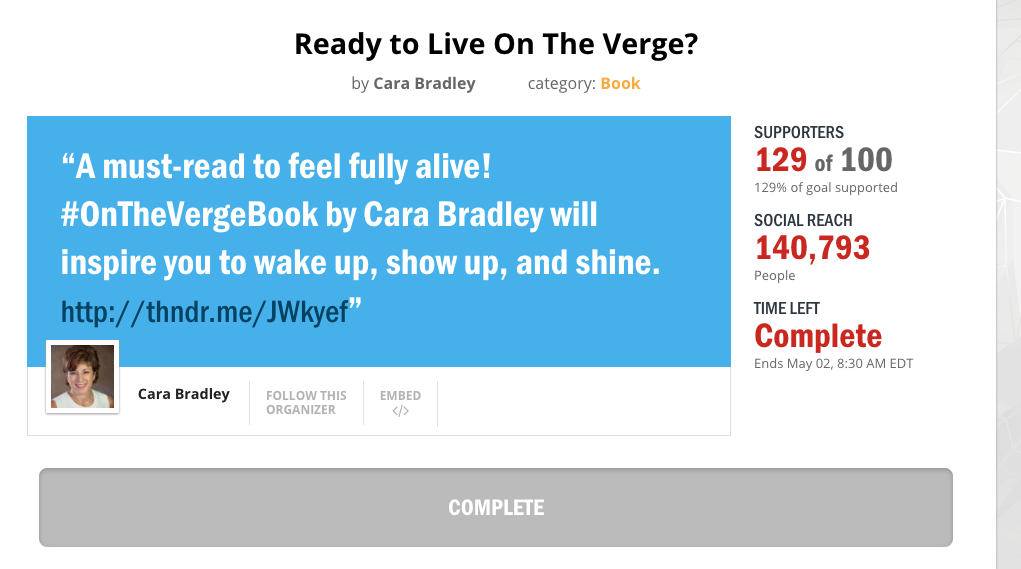
    This is what the complete campaign looked like.

    Thunderclap campaign 2

    Once you finish creating your campaign, you must submit it to Thunderclap for review. They say it takes two or three days, but our campaign was approved almost immediately.

    Be ready to take action once your campaign is live!

    2. Promote your campaign

    Once your campaign is live, you have a limited amount of time to spread the word, so it’s time to get to work.

    Here are some of the tactics we used to promote Bradley’s Thunderclap:

    Social media:

    Naturally, we turned to social media — primarily Facebook and Twitter — to promote the Thunderclap campaign.

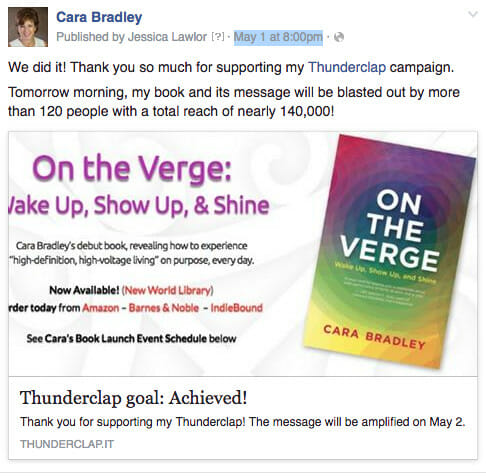
    On Facebook, we announced the Thunderclap campaign, shared an update on the campaign midway through and published a wrap-up thank you post after the campaign was complete.

    Cara Thunderclap FB

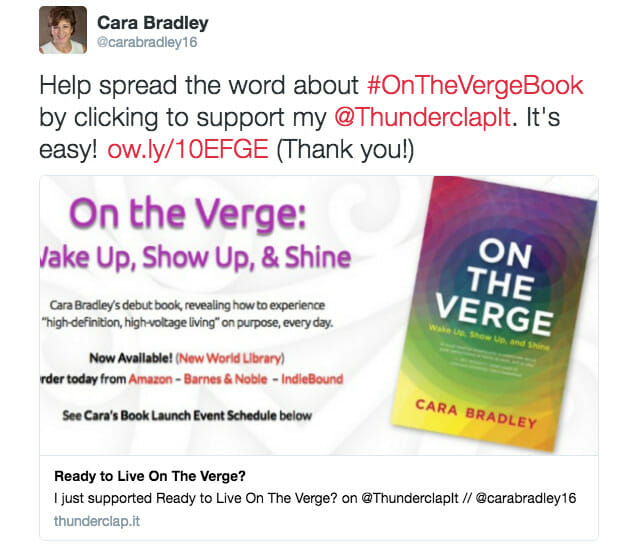
    On Twitter, we scheduled several tweets from the launch of the campaign until the very end to keep up the momentum.

    Cara Thunderclap tweet

    Personal email:

    Bradley sent a personal email to her friends, family and book launch team. In the email, she explained what Thunderclap is, talked about her campaign and asked for their support.

    Here’s sample text you can use in your own campaign:

    I’m writing today to ask one more favor and promise, this task takes less than one minute to complete. It’s to help me spread the word about my Thunderclap to promote the book.

    Thunderclap is a really neat social crowd-speaking platform that helps people be heard by saying something together. It allows a single message to be mass-shared, flash mob-style, so it rises above the noise of your social networks. By boosting the signal at the same time, Thunderclap helps a single person create action and change like never before.

    My goal is to get 100 people to agree to share the below message about my book by X DATE (we’re at Y so far). When I hit 100, on X DATE, that message will be blasted out to all those who agreed to share, spreading my message even farther and wider than I could ever imagine.

    It’s SUPER easy to participate- click THIS LINK and then click “support with Facebook” or “support with Twitter” and voila! That’s it.

    It was most crucial for us to stress how easy supporting Bradley’s Thunderclap would be. We made sure to tell her community it would take less than one minute to complete.

    This email was the single most important promotion tactic we used; your close friends, family and network are the most likely group to want to share their support, so leverage those relationships and don’t be afraid to ask for their help with the campaign.

    Email newsletter:

    Bradley’s been building her email list for quite some time, so when it came time to promote the Thunderclap campaign, we turned to her email community for support.

    Thunderclap was included as a message in two of Bradley’s weekly emails in April.

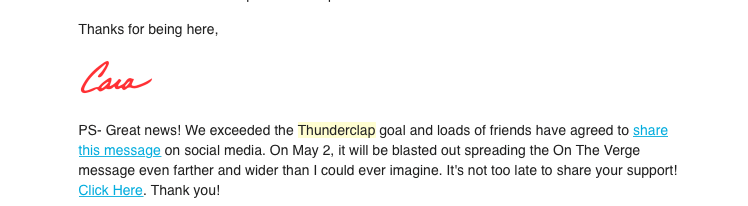
    In the first email, we created a section to explain Thunderclap, similar to the above messaging. In the second email, Bradley had already reached her goal on Thunderclap, but we still wanted to grow her reach, so we included messaging in the “P.S.” section of her email to thank people for adding their support and to give an update on the campaign.

    Cara Thunderclap email newsletter

    3. Prepare website for campaign launch day

    Because the Thunderclap campaign linked back to Bradley’s book landing page, we expected an increase in traffic to her site on the morning the campaign launched.

    To leverage the new eyes visiting the website, we made it a priority to do a quick review to make sure:

    • The book was prominently featured on the homepage of the website
    • The book landing page was up-to-date, clean and easy to navigate
    • It was easy to find links to purchase the book
    • Calls-to-action to join her email list were clear

    Results

    Bradley’s campaign ended on May 2 with 129 out of the target 100 supports — and a total social reach of 140,793. Goal exceeded!

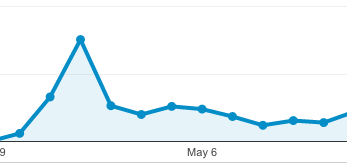
    Cara Thunderclap GA

    Website traffic tripled on May 2 with 68 percent of traffic that day coming from social (i.e. social shares from Thunderclap). Fifty percent of pageviews that day were to the book landing page and Bradley welcomed a handful of new email subscribers that day, as well.

    Most importantly, the message of Bradley’s book was blasted out by more than 120 people with a total reach of more than 140,000. Those who are active on social media know that the long game is more important than short-term wins, and Bradley’s name and book being shared by so many on Facebook, Twitter and Tumbler helps introduce her message to a brand new audience.

    Overall, creating, launching and promoting a Thunderclap campaign took less than three hours, yet created massive buzz and increased interest in Cara and her book.

    What do you think of this method of attracting social momentum? Would you try it for your own book or product release?