Tag: crowdfunding

  • Crowdfunding a Book: The Good, the Bad, and the Awkward

    Crowdfunding a Book: The Good, the Bad, and the Awkward

    What would it be like to fund your first novel with a crowdfunding platform like Kickstarter?

    A blog post on author Josh Fruhlinger’s site has the scoop.

    Kickstarting a debut novel

    Fruhlinger’s debut novel, The Enthusiast, came out in late 2015. It has more than 80 ratings and 20+ reviews on Goodreads. It’s available in hardcover, paperback and as an ebook… and it was funded by a very successful Kickstarter campaign.

    Fruhlinger’s blog post says it all: “I Kickstarted my first novel, sold 1,319 books and made $4,369.14 (so far) — and so can you (maybe) (under fairly specific circumstances).”

    His initial goal was to pay himself for his time writing the novel, since it would, in theory, eat into his potential freelance-writing earnings time. He was more than successful in this endeavor, and his goal of $6,666 was met – and far exceeded, totalling more than $20,000. Fruhlinger was able to put this extra cash toward tasks like printing costs, editorial assistance, design and promotion.

    Dealing with unexpected emotions from crowdfunding

    However, this influx of cash from patrons almost immediately led to some major guilt.

    “The actual process of writing the novel took a lot longer than I thought,” wrote Fruhlinger. “This was very stressful to me; I felt like I was letting all my backers down, and with the very, very large amount of money I raised being very, very public, I worried that people would think I had scammed everyone out of an awful lot of cash.”

    Still, he finished his book, and is happy with the final product.

    In his post, he offered some learned lessons to those who might be interested in trying their own campaign to fund their novel.

    Lessons learned from Kickstarting a book

    • The secret to a successful Kickstarter doesn’t start with Kickstarter. A large number of his backers were already fans of his work and his site. Tap into your audience! If you don’t have an audience, build one.
    • Write your book first. Fruhlinger noted that this would have drastically cut down on his anxiety.
    • Do your best to estimate costs in advance and be conservative. Printing costs turned out to be more than Fruhlinger expected.
    • Professional services aren’t cheap!
    • Don’t bet on big sales if you don’t need to. Fruhlinger noted he’s been left with more leftover stock than he would have liked. Consider print-on-demand.
    • Offer your backers big-ticket items. “People who are backing you are likely to be invested in you and want you to succeed, so a personal touch like that is something they’ll enjoy and appreciate,” he said.

    After reading about Fruhlinger’s experience, it’s easy to see the appeal of crowdsourcing.

    I’ve used Indiegogo before to fund a creative project, and while my campaign was successful, there’s still some complicated feelings that can come from asking for, and being given, financial support. Strings can feel attached, even when they truly aren’t. I have built a good base of loyal readers, but I still don’t think I would feel comfortable asking them to pay for the creation of my first book.

    What do you think — would you do a crowdfunding campaign for your novel?

  • Tracking Freelance Earnings: August Income Report From Nicole Dieker

    Tracking Freelance Earnings: August Income Report From Nicole Dieker

    How often do you ask for what you want from clients, whether it’s an extra assignment or a rate increase?

    This month, asking for extra work helped take my income to $6,500, my highest ever.

    Here’s the roundup for August. This month, it’s impressive:

    Completed Pieces: 70

    Work Billed: $6,513.00

    Earnings Received: $6,649.30

    I wrote just over 54,000 words, with an average per-piece earning of $93.

    That’s significantly higher than July’s per-piece earning of $69, and a lot of it came from the two highest-paying pieces I wrote this month: one that brought in $1,039, and one that paid $953.

    That second piece, the $953 one, was the one I asked for.

    Ask and ye shall receive

    Remember how last month I worried that I wasn’t going to earn much over $5,000?

    I was planning to take a week to visit my sister and her husband and be a featured guest at Intervention, and — as I wrote in this very space a month ago — “Traveling always means taking an income hit, even if you work on the plane.”

    But I asked myself: what if it didn’t have to be that way? What if I asked my best-paying client for a second assignment, to cover the income gap that came from taking a few days off? The worst possible scenario would be a polite “No, we have enough pieces for this month,” so I asked — and my client said yes.

    It’s great for two reasons. First, it added $953 to my monthly income total, and second, it set a precedent. Now my client and I both know that I can complete two pieces in a month, which means I am going to pitch two pieces this month. Next month, I might pitch three.

    Sometimes I forget that I can ask my clients if they want more work from me. This month, I’m glad I remembered.

    The power of the pageview bonus

    The $953 piece took me from $5,000 to $6,000 last month.

    What pushed me over $6,500? A $500 bonus for an article on The Penny Hoarder about getting paid for junk mail. This article received more than 250,000 pageviews, which meant I earned an extra $500. This is the second time I’ve received a bonus on this piece, which I wrote in January 2015. I’m delighted that it still resonates with so many readers.

    I love pageview bonuses, because I get paid without having to do any extra work. I always do my part to increase pageviews by sharing my articles on social media (and responding to Facebook comments and Twitter replies), but that doesn’t feel like “extra” work. I’m not able to track my own pageviews with this client, so I don’t know when I am getting close to a bonus, but I am always glad when I get one.

    This type of pageview bonus is also great for me because it comes on top of a competitive base pay. Some publications prefer to offer low base pay and structure more of their compensation through bonuses. I prefer high base pay and the occasional bonus — after all, I can’t really control how many people view my articles!

    One of my other clients gives writers bonuses for being active in the comments section, which I also appreciate. Any time a client offers me a low-effort way to make a little extra money, I know that client values its writers and the work we do.

    Crowdfunding still doesn’t beat client work

    Last month, I announced that I’m writing a novel titled The Biographies of Ordinary People and crowdfunding the process through Patreon.

    I’ve been posting two chapters of my novel every week, and have received a lot of amazing feedback from readers, including a reader who tweeted, “This is maybe the most beautiful book I’ve read in a long time — thanks!”

    However, the crowdfunding initiative has not grown to the point where I can consider dropping — or even seriously cutting back on — any of my current freelancing clients.

    As of this writing, my Patreon brings me $350 per month in crowdsourced pledges. That’s more than many of Patreon’s featured writers bring in, so I feel like my project is successful, but it’s not enough to make a significant difference in my freelancing life aside from the fact that I’m developing a community of readers who are invested in this novel.

    That community of readers makes the whole Patreon project worth it. But crowdfunding still doesn’t beat client work financially, at least not for me. I like knowing roughly how much income I’ll earn every month, and I also like knowing I can increase my client income just by asking.

    When was the last time you asked a regular client for extra work? Did they say yes?

  • How One Writer Used Crowdfunding to Raise $12,775 in 30 Days

    How One Writer Used Crowdfunding to Raise $12,775 in 30 Days

    Jon Yongfook didn’t even intend to write a book at first. But the growth-hacking expert and software entrepreneur decided to give it a shot when Guy Vincent, founder of crowdfunding platform Publishizer, dropped him a note and suggested he throw his hat in the game.

    “I was in a sassy mood,” writes Yongfook on his website, “so I replied ‘ok.’” And then he raised $12,775 in 30 days.

    While crowdfunding has long been a popular way for musicians, inventors and artists to raise money and develop interest in their work, it’s becoming a more common option for authors as well.

    Crowdfunding a book basically involves taking pre-orders. If there’s enough interest to hit a preset funding goal, the author will write and publish the book. This fundraising method offers several benefits for authors, depending on which site you choose, such as a guaranteed payout if you meet your minimum fundraising goal, and no obligation to write a book if you don’t find enough of a market.

    If you’re considering crowdfunding your next book, studying Yongfook’s campaign for Growth Hacking Handbook could help you achieve similar success. Here’s his best advice for aspiring crowdfunders.

    Build your audience first

    Yongfook’s buyers didn’t appear out of thin air; he already had a network in place, including his Twitter and Facebook followers as well as a mailing list.

    “I think anyone launching a crowdfunding campaign needs to have some assets or network built in,” he said. “It’s almost impossible to do it without it.” Before you decide to create a crowdfunding campaign around your brilliant idea for a novel, make sure you’ve put some work into building an author platform.

    “My advice would be to keep blogging about the subject you want to write a book about, build that community, build that mailing list and use it when it’s time to crowdfund that pet project!”

    Spread the word

    Since Yongfook’s foray into publishing was unexpected, starting with the note he received from Vincent, he didn’t have a lot of time to plan a marketing strategy. He did find and pitch some of his media contacts, but he found most were not interested in covering his crowdfunded book launch.

    Instead, he focused on social media and guest posts. He used his personal social media accounts, including Facebook (and a promoted post) and Twitter, and sought out retweets from influencers. He wrote a guest post for The Next Web and volunteered for an “Ask Me Anything” with Tech In Asia.

    Be ready to work hard

    “During the campaign, it was almost like a full-time job keeping up the momentum and the marketing activities,” Yongfook said. He didn’t anticipate marketing would require quite so much footwork.

    “I guess I did naively think it would be a ‘set and forget affair’ though,” Yongfook said. “Like I would just click ‘upload’, sit back and enjoy a whiskey, and then a few weeks later, I’d have the funding for my book. In reality, it was a day-to-day hustle and the campaign needed constant maintenance to keep the momentum going.

    However, he was always confident he would reach his goal, and he believes that self-assurance is key to a successful campaign. “I was quite confident,” he said. “I think as long as you are very determined and have a good idea for a book that the market (and more importantly, the network around you) wants, then you’ll meet your goals.”

    Stay positive

    We asked him what he found to be the most challenging part of the campaign. “The most difficult is the ‘dip’ or the ‘lull,’” he said. “Statistically, most of your crowdfunding activity is going to come at the start and the end of the campaign. Between those two points, the backings can trickle in quite slowly and it can be hard to keep motivated.”

    “There was a point in the middle of my campaign where I was quite shocked as it looked like it might not make it, and my confidence went down. You have to power on through that — there will be more activity towards the end.”

    Consider the lasting impact

    “[Crowdfunding] is just a win-win situation all round,” Yongfook said. “The backers get a book they are interested in, I get to write a book with no huge undertaking of risk.”

    When the campaign finished and Yongfook was still receiving emails from people who wanted to buy the book, he created an email list to notify them when it launched.

    “After I launched the book and sent the copies to the original backers, I then emailed that mailing list that the book had launched, and instantly had another $2k in book sales (in one day!). So I guess my point is, the positive effects of a successful crowdfunding campaign go far beyond just the campaign itself!”

    How to launch your own crowdfunding campaign

    While Kickstarter is likely the most popular crowdfunding platform, a few sites specifically focus on writers and their needs. Here are a few of the options to consider:

    Publishizer

    This is the platform Yongfook used for his campaign. To begin, simply submit a 1,000-word proposal for approval, then choose your campaign’s length (one to 45 days) and funding goal.

    If your campaign is successful, Publishizer collects a 5 percent fee on pre-orders, plus 2.9 percent and $0.30 per transaction for Stripe. You retain all rights to your book.

    Pubslush

    Pubslush’s mission is “to give authors the opportunity to get out of the slush pile.” They do this by helping authors create crowdfunding and pre-order campaigns for their books, 30 to 60 days before their release dates.

    The site charges a 4 percent commission and third-party processing fees after the campaign concludes. You keep all rights to your work.

    Unbound

    Unbound works similarly to the other sites, though they focus on U.K.-based authors. Authors do the bulk of their fundraising until they hit the 70 percent mark, and then Unbound jumps in with marketing and promotion assistance to help them reach their target.

    However, Unbound does take 50 percent of profits (after costs) and keeps the rights to your book. For more details, check out the site’s FAQ.

    Have you crowdfunded a book? Would you consider it? We’d love to hear about your experience in the comments!

  • Inkshares is a Kickstarter for Books: Q&A With the Founder

    Inkshares is a Kickstarter for Books: Q&A With the Founder

    Publishing a book can be an intimidating journey. But what if you had a supportive audience on board already? What if your readers were so eager for a taste of your work, they backed it with their hard-earned cash in exchange for a peek inside the writing process?

    Such is the premise behind new crowd-driven publisher Inkshares. In a sort of mashup of crowdfunding, editing and marketing, Inkshares created a new way to publish books — books an audience has already shown they want to read.

    Curious about this new player in the publishing industry, The Write Life Editor Heather spoke with Inkshares co-founder and Chief Legal Officer Adam Gomolin to learn more.

    You’ve described Inkshares as “crowdfunding meets publishing.” How does it work? How does it differ from other crowd-driven publishing companies?

    Great question. We are a “value-added” crowdfunder — we hear people refer to us as “Kickstarter meets Random House.”

    If you are successfully crowdfunded, we handle the rest: editorial through distribution. We pair you with a top editor or editorial team, and handle design, production, and distribution — including into actual brick-and-mortar stores. In that sense, we’re really a full-service publisher, just like any of the Big Five or indie publishers.

    And yes, there are other crowd-driven publishers: Unbound, Pubslush, Beacon, FG Press, Contributoria and Pentian, to name a few. There are a lot of interesting dynamics at work, and I contrasted Inkshares and Contributoria in a post on the Inkshares blog.

    Some are focused on specific types of content; Beacon is all about investigatory journalism, for instance. We don’t have a niche, because we think that one of the most important things is to build a neutral platform for literary crowdfunding. Many authors move across different genres and readers (i.e. backers) do as well. They may write (or we may read) longform on one day, a book on another.

    There are a lot of great companies in this space, with a lot of important differences between us. But I think that authors are a heterogeneous bunch, so ultimately they’ll match up with the right “new” or “crowd-driven” publishers.

    Say I’m an author with a manuscript I’d like to publish. What makes Inkshares my best option? How does it fit with my other options for self-publishing?

    I think you need to focus on what you want out of the process. The traditional publishing process is defined by its obstacles. The “slush pile” is a barrier few can get over, and getting an agent is equally difficult — and more costly in terms of time. That is really what so many new publishers are trying to provide an alternative to.

    Inkshares provides an editorial and production experience equivalent to that of legacy publishing. Daniel Wallace, bestselling author of Big Fish, is crowdfunding a children’s book titled The Cat’s Pajamas. We paired Daniel with Carol Goldenberg, a top children’s book designer who has won six Caldecotts, and Kim Keller, a top children’s book editor formerly of Houghton. So if that’s something an author wants — editorial, design, production, distribution — we’re a great fit. If you want to go it alone at a self-publisher like CreateSpace, more power to you.

    Crowdfunding is also a major component of Inkshares — you need to be willing to get out there and promote your work. There are reverberative effects (i.e. backers creating other backers) and virality that can drive runaway successes, but ultimately you can’t expect to put a proposal up, walk away, and have it magically fund.
    Image: Inkshares model

    What kinds of writing projects are published through Inkshares?

    We’re an omnivore — absent a dilemma. We focus on individual projects and authors. As we mature, there is the prospect of more of an imprint-style experience that would allow for backers to browse across a genre.

    Our users thus far are varied, and that diversity is important. Samuél Barrantes and Kris Calvin are great examples of aspiring debut authors who chose to go with us, rather than slugging it out in the traditional system. Leigh Cowart and David Forbes are young journalists, both immensely talented, and we’re in a great place to help them raise thousands of dollars to fund their endeavors. For Daniel Wallace, it’s different — he’s an established bestseller who went with us because this project didn’t fit with his traditional publisher.

    How does the funding process work?

    Crowdfunding for books is similar to “general” crowdfunding in the sense of a typical series of phases: you need to activate your primary social network (friends and family) to get to a critical mass, say 30 percent. There is a corresponding activation of your secondary social network that pushes you toward, and hopefully past, 50 percent. But I think the projects that succeed are the ones that connect with people: they go viral because people care about them and want them to succeed.

    Some of the backers who don’t know you personally get into your project because they want to be part of the social movement — some people really want to help get Samuél’s first novel off the ground, which is why we’ve seen $50, $100 and $200 donations. Others simply want to order it the way that they would pre-order it on Amazon. But in both those cases, it’s more about the backer’s interest (I want to be part of helping create this book, or I want to read this book) than their desire to support a friend or family member.

    What percentage of projects are completely funded? What strategies are writers using to promote their work and reach their funding goals?

    We have only had one project fail to meet its goal so far. It’s probably too early to assert trends, except to say that hard work pays off and people are excited to be in on the beginning of a work.

    It’s really a game of getting interested eyeballs on your work. One way is by targeting interested blogs, which David Forbes did well. Another is by getting high-powered retweets from major tweeters. But we’re also focused on reaching out to libraries and bookstores — dragging commerce to the crowdfunding stage.

    What happens if a project isn’t 100 percent funded — or if one is funded over 100 percent?

    We’re all or nothing. Projects that don’t get there don’t get funded. It’s important that we deliver the best copy of a work — that requires resources — not a diluted version that disappoints.

    If a project is funded over 100 percent, those funds go toward more copies of the work. We refer to it as “surplus.” Conceivably it could also go back to the author — a welcome quandary that we hope to be able to explore.
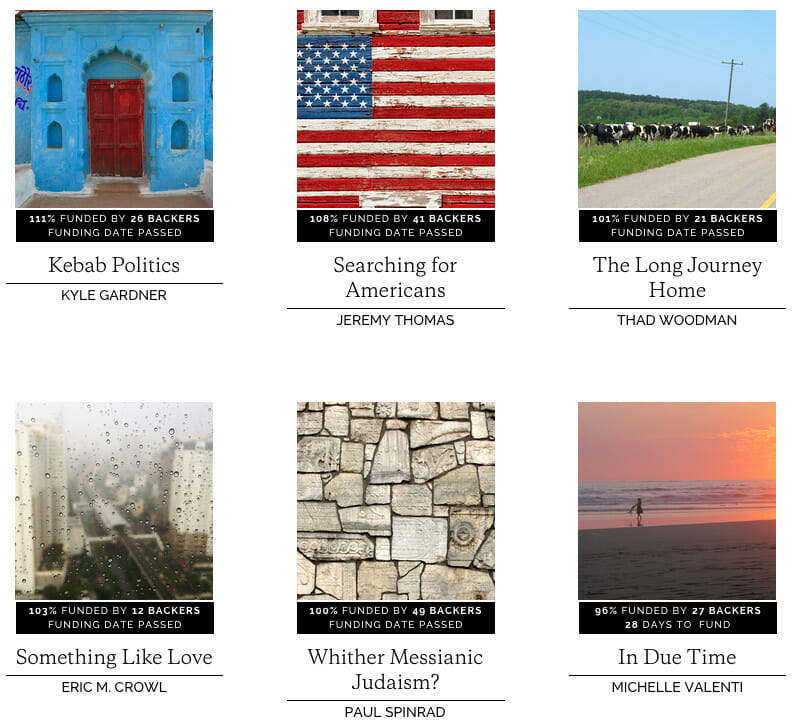
    Image: Inkshares Projects

    How do you match authors with editors and designers?

    We do it in a high-touch way. Matching the right editor with the right author is a really organic and important piece.

    Sometimes that will mean using our talented, in-house editorial crew (to which we are consistently making additions). But sometimes there is a niche topic we can’t cover as well as someone else, in which case we will use our network to contact and contract the best person.

    You’ve mentioned that Inkshares would like to offer backers equity in the books they support, giving them a share of any potential revenue. How would this work?

    Right now, you can’t go give out equity in a company — you can’t say, “I’ll share x amount of royalties in exchange for y amount of dollars.” Title III of the JOBS Act, which is presently being implemented by the SEC, is changing that.

    Once the SEC says we can do it, we’ll be exploring that idea more fully. It’s not for every book, but it is a great incentive to offer backers in certain circumstances.

    Where do you see Inkshares going in the next few years? What are your goals for the company?

    I’d like to see us put books on a couple different bestseller lists in the next year, sending a clear signal that we can create quality work on par with any publisher and across multiple genres. I’d also like to see a lot of pre-orders from bookstores and libraries — an indication that we can drag all that commercial activity upstream to the crowdfunding stage.

    And I’d like to see more people saying I want to “Inkshare” my book. We see that happening on Twitter already, but it would nice to be a verb. Maybe we’ll crowdfund a dictionary and put “Inkshares” in there. (Kidding.)

    Thanks for taking the time to share your thoughts, Adam!

    What do you think of Inkshares’ model? Would you publish your work through the platform, or back a work-in-progress there?