Tag: freelance writer

  • Entry Level Writing Jobs | What You Need to Know and Where to Find the Best Ones

    Entry Level Writing Jobs | What You Need to Know and Where to Find the Best Ones

    If you’re trying to break into the industry, entry level writing jobs can be a good way to get your foot in the door. And yes, contrary to popular belief, you can actually make money from entry-level positions (cue gasps of shock).

    gif of a kitten gasping in response to learning you can make money from entry level writing jobs

    We’re in our digital era—where content is king and screen time is on an Olympic sprint. And despite the low-key threat of artificial intelligence and other tech innovations, the demand for skilled writers is needed now more than ever. Businesses need captivating content (whether it’s binge-worthy blog posts or compelling product descriptions) and are always looking for fresh voices. 

    And that’s where you, the budding freelancer, come into play.

    But of course, knowing there’s a need isn’t much help unless you know where to show up so you can fill the gap. And how do you stand out with all of the other aspiring wordsmith’s out there? That’s what we come in.

    Buckle up and prepare to embark on a whirlwind tour of all things entry level writing jobs—where to find them, how to snag them, and what opportunities they could unlock for your career.  

    Do I Need Formal Qualifications to Secure Entry Level Writing Jobs? 

    Short answer? Not at all. 

    Certifications and degrees are helpful, and certain markets will require advanced education (such as medical writing, which requires expertise in that niche) but they don’t guarantee entry in writing world. In general, having strong writing skills is much more important than academic education.

    There are many different kinds of writing (e.g. business writing, personal essays, travel writing, food writing, etc.), so as long as you understand the assignment then you’re in good shape. Your writing skills are the essential ingredients but in order to secure the ongoing paycheck, you’ll want to know how to make successful pitches too! 

    How Much Do Entry Level Writing Jobs Pay?

    As you grasp the value of your work, learn to tailor your pieces to your target publications, and gain experience, you’ll find your negotiating power—and rates—moving upwards.

    Freelance writers who publish in newspapers or magazine often are paid by the word. If this is the case for you, then your income is a balance between how fast you work and how long your commissioned pieces are.

    If you write for businesses or online sites, then you may find yourself negotiating project rates. In this case, you’re looking for a win-win between their budget and your desired income.

    In either case, the outlet or organization may set the rate, but that doesn’t mean you can’t negotiate. Have a good idea of what you want/need to bring in so you only take on work that aligns with your business plan and values.

    When you’re just getting started as a freelance writer you may not know how long a piece will take you or what it should be valued at, so it will be difficult to set rates. It will take some trial and error to figure out what type of writing best suits you, what you most enjoy, and what price point will help you reach your income goals.

    Don’t worry too much if you end up taking a job where you realize later you’ve undercharged. Take it as a learning experience and raise your rates the next time this type of job comes up.

    Wondering what writers are currently earning? Check out this post from Make a Living Writing

    Where to Find Entry Level Writing Jobs

    It’s one thing to have the desire to break into freelance writing. It’s a whole other thing to actually find quality writing jobs as a beginner! The good news is there are many ways to find and secure well-paid writing jobs, even if you’re just getting started. Here are a few suggestions to try out.

    1. Look for Websites In Need of Updating

    Have you ever strolled around your local digital neighborhood and noticed the small businesses whose websites seem stuck in the 90s? Or perhaps, you’ve stumbled upon those big businesses with blog sections that look about as lively as a tumbleweed town.

    It’s like spotting a cute fixer-upper house and you’re inspired to breathe life into the outdated landing pages or blog posts. 

    You’d be amazed at how many companies have unoptimized About Pages or are missing testimonials or company stories. It’s probably on their to-do list, but it can be difficult to get to these details!

    So here’s a thought: Why not inquire about it? Ask if they could use a freelance writer to update their website a bit. Include a few of your writing pieces that are similar to their industry if you can, it will give them confidence that you’re up to the task. If you don’t have relevant samples then you could mock up some examples to showcase your skills and how you can help. 

    You never know, they might be waiting for someone like you to revitalize their website. 

    2. Utilize Freelance Writing Sites

    There is a lot of debate about platforms such as Upwork or Fiverr. It’s not for everyone. However, it can be a good starting point to get experience and build your writing portfolio.

    Here are the pros: You can establish your profile and highlight your specialties. You can offer an array of services at different rates. Sites like these allow clients to reach out and for freelancers to bid on jobs. You won’t get everything you go for, but since sites like these are largely a numbers game, if you pitch enough eventually you’re bound to get something.

    However, these platforms charge a service fee on each project, and they prefer if you keep communication within the platform rather than taking it private. Working with clients from these platforms may require time and perseverance to secure those big projects that offer a generous paycheck.

    We recommend considering these types of platforms as stepping stones.

    3. Work with Marketing Agencies

    Agencies can be lucrative for writers, and they work especially well if you’d rather not deal directly with clients or find jobs yourself. Marketing agencies handle the administration and account management (for the most part) and pass the writing work to you as it comes in.

    By searching online for marketing agencies within your niche, you may be surprised at how many work with freelancers and are looking for help in the near future. Agency work can be inconsistent but you’ll also likely gain a lot of experience on many different types of writing projects in a short amount of time. 

    4. Network with Other Freelance Writers

    It’s not about what you know but who you know, right? Established freelance writers will tell you most of their high-paying work is generated from referrals and networking

    Whether it’s in person or on social media, be as proactive as possible in reaching out to freelance writers to gain fresh, new opportunities. 

    5. Use Reliable Job Boards

    While pitching can often secure you higher-paying jobs, it can be intimidating and overwhelming. You may choose to apply to postings on job boards instead, which is a bit more passive. 

    The advantage with job boards is it puts you in control when it comes to filtering the type of writing job you want and the kind of company you’d love to work for. Some businesses will offer full-time positions while others will be seeking out freelancers so you can search, sort, and filter down to exactly what you want. 

    Tips to Kickstart Your Writing Career as a Beginner

    So now that we know where to find your first writing jobs and you have a bit of an idea for how much you can expect to be paid, here are some additional tips to help you land that job. 

    Create a Writing Portfolio

    Most clients will want to see some writing samples ahead of time. You’re probably thinking, “I’m new! I have nothing published!”

    Fear not, there are other ways to showcase your skills, even if you’re just showing samples or mock-ups that haven’t actually been published.

    Putting together a writing or social media portfolio shows the prospective client what you’re capable of and demonstrates your competence to do the job well. 

    We recommend creating your portfolio online and sending a link to specific relevant pieces rather than to the entire package. This will help them see you as a professional. 

    Dedicate Yourself to Continual Improvement 

    Just because you’ve secured a writing job doesn’t mean the learning comes to an end. There are always things to learn, ways to improve, and techniques to try.

    You may begin in blogging and realize you could earn more if you also add in search engine optimization (SEO) to your offer. And once you learn SEO, then you see how copywriting can make you even more valuable to clients. As you grow and gain experience with one type of writing, you’ll see even more stepping stones to keep improving. 

    Personalize your Pitches

    If you’re reaching out to clients via email or LinkedIn, then it will benefit you to find ways to stand out in a busy inbox. 

    Here’s a pitch checklist to get you started

    We’d recommend keeping your opening paragraph as concise as possible (you have something like seven to keep someone reading). 

    Also, do your homework so you can mention things in your pitch that resonate with the recipient. Who doesn’t love an email where the sender actually has some idea of who they’re messaging? It will make a much bigger impact than sending a copy-paste generic cold pitch, trust us. Of course you don’t want to cross the line and come off as creepy—keep it professional, yet personable.

    We won’t leave you hanging, of course. Fill in the form below and we’ll send you our pitch checklist, free! 

    Freelance Writer’s Pitch Checklist
    Grab it for free 👇

    Convince more editors to say YES to your pitches!

      We’ll also send you our weekly newsletter, which offers helpful advice for freelancing and publishing. You can unsubscribe at any time.

      Summary

      It’s an incredible feeling when you get that first paying writing job but here’s something even more exciting: Entry level writing jobs aren’t the end of the road for writers, they’re only the beginning.

      This is your springboards for getting into the industry and opening up doors to MORE—more opportunities, more connections, more experiences, and more money. 

      So, here’s to finding jobs that fit your skills, learning how to value your writing, how to negotiate, and how to grow your portfolio one sample at a time.

      Keep writing, keep learning, and remember—every master was once a beginner. 

    • 4 Ways To Avoid Using Filler Words In Your Writing

      4 Ways To Avoid Using Filler Words In Your Writing

      While most of think of filler words as using “um” or “uh” in speeches, there are lots of other extras we put in our writing.

      These extras can distract from your main message and make your writing come off as less serious.

      Keep in mind, the type of writing you do changes what words are appropriate, and what are considered extra.

      For example, academic essays will have a more elevated writing style than most social media posts. However, there’s almost always something you can cut.

      This article reviews basics of filler words: what they are, why they don’t work, and how to avoid them.

      What are filler words?

      Filler words are words in speech or written text that could be eliminated and are there to take up space.

      In speech this sounds like:

      • Um
      • Uh
      • Er
      • Ah
      • Like
      • OK
      • Yeah
      • Right
      • You know

      Writers often use filler words when they are unsure of what they have to say or want to hit a certain word count.

      Most of us don’t realize how often we use filler words. I’ve been writing for years and I’m certain there are many in this article! It’s a hard habit to break, especially when you have a lot of writing to do and not a lot of extra time.

      Depending on your writing style, some filler words make sense to keep. But more often, you can self-edit to make your writing stronger. At first it may be difficult to identify what is style and what is filler, but if you aim to cut the fluff, you’ll be on the right track.

      What’s the difference between filler words in writing and in speech?

      For the most part, filler words are the same in both writing and speech. It’s more common to use filler words in creative writing and casual speech.

      If you are creating a proposal or a formal presentation, you will want to make sure you focus on cutting unnecessary words so your piece looks and sounds professional.

      Why avoid using extra words in your writing?

      Filler words are bad because they confuse readers and dilute your writing. If you have too much filler people may think your writing is padded and not enjoy the reading experience.

      In particular, if you are doing any kind of persuasive writing, it’s important to avoid fluffy or flowery language because it can bury your message.

      There is an argument for using filler words in creative writing or poetry, but for most types of writing, it communicates best when it’s clear, concise, and direct.

      Hot take: some creative writers could benefit from learning how to shorten their sentences!

      Examples of filler words

      This is a brief overview of filler word examples. Keep in mind that each example below is not guaranteed to be a filler word—it depends on the sentence itself and what is being said. This is especially true for character dialogue.

      One way to test if a word is filler is if you can remove it and the sentence still holds the same meaning.

      Filler Words

      • Really
      • Very
      • Highly
      • Just
      • Like
      • As you know
      • However
      • Finally
      • In conclusion
      • You know
      • You see
      • Right
      • In my opinion
      • I guess
      • I mean
      • Seriously
      • Literally
      • Totally
      • However
      • As mentioned

      Filler words take up space and make sentences wordy.

      4 ways to improve your writing

      Here are four ways to avoid using filler words to improve your writing.

      1. Start with a brain dump

      Before you worry too much about filler words, start by freewriting until everything in your head is on the page.

      Write, then edit. (You can’t edit a blank page!)

      Your first draft should be judgement-free so you can let your ideas flow. That way you have something to work with when it is time to edit.

      2. Cut every sentence in half

      This is a guideline rather than a rule. Sometimes cutting won’t make sense.

      Pushing yourself to remove unnecessary words is a good and challenging practice. You might be surprised at how clear your writing becomes when you remove what’s extra.

      3. Decide what’s filler and what’s essential

      Some words like “in addition” or “however” can be important transition words. Every sentence is unique and sometimes what’s filler in one is essential in the other. If you’re not sure, try reading your sentence aloud with and without the word in question. Your ears will know what’s best!

      4. Use an editing tool

      Using writing and editing tools such as Hemingway app can help you decide how to cut your writing without losing its essence.

      There are a lot of tools available, out there, but that one is a popular one for writers since it edits work based on the short sentence style of Ernest Hemingway.

      Advertisement for the Freelance Writers Den, a writing community with more than 300 hour of training for one affordable monthly price
    • 7 Great Gifts for Aspiring Writers

      7 Great Gifts for Aspiring Writers

      If you’re a writer, you might find yourself completely at a loss when someone asks you what you want for a gift. Writers can be difficult to shop for and it can be hard to find gifts for aspiring writers.

      There are a few obvious choices (and we’ll talk about those), but when it comes to writing, there’s really not a whole lot of material required—you need a pen and paper. Maybe a computer, if typing is your jam. Maybe a keyboard, if you want to be fancy about it.

      Gifts for aspiring writers

      If you want to show your love to an aspiring writer with a stellar gift that signals your support—that can be tricky. Especially because so much of writing is deeply personal, and so much of the specifics can vary when it comes to genre.

      So, what do you get for the aspiring writer in your life? Or if you are the writer in someone’s life, what do you ask for?

      Here are a few ideas to get the gift-giving wheels turning.

      Writing software

      While it’s possible to make do with a notebook or free software like Google Docs, there are many other software options available for writers looking to optimize the experience of writing itself.

      These writing softwares help keep work organized by providing places to categorize information.

      Writing software will also make it easy for to format, whether it’s a novel, a book proposal, or some other type of complex document.

      Here are a few software options that aspiring writers will love:

      Here are a few more suggestions for writing software options for aspiring writers

      Journals—seriously

      It might seem too obvious to get a writer a journal, but writers can never have enough notebooks.

      Here are a few options to consider:

      • Spiral-bound single-subject college-ruled notebooks | You don’t have to spend a ton of money to get a writer a good notebook. A few simple college-ruled notebooks like this will definitely be useful, and you can find them almost anywhere. These are great to add to a writer bundle along with a scented candle or tea sampler!
      • Leuchtturm1917 Ruled Notebook | For a more luxurious writing experience, you can’t go wrong with a hardcover notebook like this. The ruled option is great, but if your aspiring writer has big handwriting or generally prefers to have more creative freedom with their work, the dotted version of this notebook might be better for them
      • Rediform Chemistry Lab Notebook | These simple college-ruled notebooks have numbered pages, which is perfect for an organized writer. They’re conveniently sized and perfect for jotting down whatever comes to mind—these are perfect to carry around all day
      • Leonard Notebook from Bull & Stash | If you’re looking for something more high-end that your writer can use forever, opt for a notebook with a quality cover and refillable pages. The refills mean that writers can order fresh paper (which is much less expensive than replacing the entire journal) and keep using the original cover

      You may also like: 5 Types of Journalling Writing to Keep You Creative

      Books about writing

      Aspiring writers are often hungry for writing guidance, and they’re often (obviously) huge fans of reading. So what could be better than a book about how to write?

      Here are some great options for early writers.

      You may also like: Stephen King’s 23 Best Writing Tips

      Hot drink supplies

      Writers are famously fussy, as much as they might try to deny it, and you’d be hard-pressed to find many writers who don’t have rituals surrounding their work. And central to many writers’ process is a cozy beverage—this might be a cocktail, a cup of something warm, or a can of their favorite soda.

      If you want to help out the writer in your life and you want to get them something writing adjacent, here are some suggestions:

      • DIY Hot Cocoa Mix | You can get your writer a big tin of delicious hot cocoa mix from the store and it will be warmly, gratefully received. But if you want to go the extra mile, try making a hot cocoa mix from scratch! I recommend including this in that bundle idea I mentioned earlier—put this in a basket with a scented candle and a nice notebook and you’ve got a writer kit!
      • Tea Sampler and Infuser | Does your aspiring writer love tea? Many of them do. If you don’t know what kind of tea they love, you can’t go wrong with a sampler (and, of course, a cute infuser to keep them company while they’re working on their next masterpiece)
      • Awesome Coffee Club | You’d be hard-pressed to find a writer who doesn’t have a mild-to-severe caffeine problem, or at least a deep love of coffee. The Awesome Coffee Club, founded by the Green brothers, offers delicious coffee that’s ethically sourced. Here’s the quote from their site: “Sourcing partners work directly with small farmers’ collectives to ensure that your coffee is not only good for the growers but also farmed with a focus on regenerative agriculture.” If your aspiring writer is a nerdfighter or person who generally cares about ethical consumption of delicious coffee, send a bag of coffee to them for Christmas

      Writing utensils

      Like notebooks, this might seem like a no-brainer, but again, writers do require endless writing supplies. If you’re lucky enough to know what your writer’s favorite kind of pen or pencil is for everyday use, order them a big box so they never run dry. If you’re not sure, don’t worry, there are options.

      • Sharpie S-Gel Retractable Gel Pen | For an affordable, everyday pen, you can’t go wrong with the S-Gel. I use these all the time and don’t personally notice a lot of bleeding like I do with other gel pens. The writing is incredibly smooth, the pen is comfortable to hold—you can’t go wrong
      • Parker Jotter Stainless Steel CT Pen | At $20, this is your perfect mid-range pen. You can get ballpoint and gel versions of it, and the all-metal classic design makes it look just as luxurious as it feels to write with
      • rOtring 600 Ballpoint Pen or Mechanical Pencil | Another great budget option is this ballpoint pen, lauded for its durability, smooth design, and, of course, smooth writing. If your writer prefers pencils to pens, try the rOtring mechanical pencil for an upgraded writing experience. Reviewers say that the color wears off, revealing the brass underneath, and this lends it sort of a worn-in, personal detail

      If the writer in your life is experiencing calluses on their hands from overusing a writing utensil, here’s what to do about it.

      Local book store gift card

      Most writers are readers and if you know enough about their taste in books to pick up a specific book from your local bookstore, that’s great! If not, there’s no need to fret—you can still give them the gift of a wonderful new book.

      Check out your local bookstore and get them a gift card. You can also get them an Amazon gift card if your city doesn’t have a local bookstore, but local bookstores have that personal, special touch that writers love. Not only are you giving them the chance to buy whatever book they want, but you’re giving them the chance to wander through a bookstore for an afternoon.

      This is a great gift on its own, or make it a bundle with some cocoa mix, a journal, and new pens.

      Online writing courses

      Books about writing and online content about writing are great places for writers to get information about guidance on their craft, but the fact is, many writers are desperate for personalized feedback. Even if you’re one of the lucky few writers who has a loved one willing to read your work, the chances of that loved one having professional-grade feedback are slim to none.

      Writing courses offer writers the chance to actually get professional feedback on their work. They can be a total game-changer, and the advice they get in these courses can help them for the rest of their lives.

      No big deal!

      Here’s a few online courses for beginning writers. Check out the Coursera descriptions linked below for more information about pricing, time to complete, and information about for whom the classes are intended.

      Want more suggestions? Check out these 59 gift ideas for writers

      Want more writing advice?

      Subscribe to get our latest content by email.

        We won’t send you spam. Unsubscribe at any time.

      • 12 Places to Find Online Transcription Jobs From Home

        12 Places to Find Online Transcription Jobs From Home

        I love typing, but I have zero creative writing ability. ZERO. I’ve blogged before, but it usually means sitting for hours at my computer with a few clumsy sentences written and no ideas for how to proceed. 

        When I got pregnant with my first child, I wanted to take something I knew I was really good at—typing, grammar and punctuation—and turn it into an income-generating side gig I could do at home. 


        Ready to make more money from your freelance writing in any economy?

        Recession-Proof-Freelancer-ebook-freelance-writers
        Download The Recession-Proof Freelancer ebook, your ultimate resources for becoming an unstoppable force in the world of freelancing!

        Here’s how I found my first few transcription jobs

        I found a course, Transcribe Anywhere, and quickly knew I had found something that was going to work for me and help me find transcription jobs that bring in extra income. (Here’s The Write Life’s review of the Transcribe Anywhere course if you want details.)

        Typing exactly what I hear from audio requires no creativity, unless you count the creative punctuation required to break up someone’s looooong run-on sentence into smaller chunks. 

        What it does require is all of the things I already knew I was good at, and the course taught me how to use those skills to build a business. 

        Now two years later, I have three kids (yep… a two-year-old, a one-year-old, and a newborn. No, we don’t get much sleep). I’m still doing transcription jobs from home, and even though my family is growing and keeping me busier than ever, I’m also making more money from transcription than ever before as I get better at my work and find great clients. 

        I work part-time working as a remote transcriptionist, about 20 hours a week, and I’m consistently able to bring in around $2,000 per month for my family. 

        Where to look for transcription jobs

        If you’re looking to get into the world of transcription, I’ve put together a list of companies where you should consider looking for work, including several options for legal transcription jobs. 

        They’re loosely ordered according to how much experience you need to work there and how much you can expect to earn through those jobs. So if you’re aiming for online transcription jobs for beginners, the first few items on this list are the best place to start.

        Keep in mind that most of these companies pay on a per audio minute rate, which does not translate to how long it takes to transcribe it. 

        The general standard in the transcription industry is a 4:1 ratio, meaning it usually takes around four minutes to transcribe one minute of audio. 

        Here’s where to look for online transcription jobs.

        1. Rev

        One of the biggest and most well-known transcription companies, Rev always seems to be hiring new applicants. It has tests that you have to complete before you’re hired—the Rev transcription test and grammar quiz—but it seems to always have work available. 

        Typically, you can choose your own schedule and do as much or as little work as you want. 

        Rev has a reputation for low pay, about 30 cents to $1.10 per audio or video minute. But if you want to get started and have a completely flexible schedule while you’re learning and building your skills, this might be a good fit. It’s also a way to try out online transcription jobs and earn some money to see if you enjoy it before you invest in training.

        No experience is required, although you do have to pass a test. Rev also has options for video captioning work, which pays at 54 cents to $1.10 per audio or video minute, and if you know a foreign language, subtitle work for $1.50 to $3 per audio or video minute.

        My friend and colleague Kristie Cooley started out working for Rev and says: “I enjoyed being able to log on at any time of the day to pick work. Its system is also super user friendly!” On the flip side, however, she also reported that the people who grade your completed transcripts can be inconsistent and give different instructions or feedback. 

        2. TranscribeMe

        TranscribeMe is another good option if you’re looking for online transcription jobs for beginners. 

        The company only pays 25 cents per audio minute, but they break all of their work up into smaller chunks of two to four minutes. That makes this company a nice choice if you have only a limited amount of time to spend on transcription or if you want to gain experience with a large variety of audio materials. 

        3. SyncScript 

        SyncScript’s pay rate still isn’t impressive, but it’s higher than the first two options on this list, starting at 57 cents or 63 cents per audio minute based on the assignment type. This is another company to consider if you’re looking to get your feet wet in the transcription industry. 

        SyncScript is almost always running ads to hire new transcriptionists. The company requires a typing speed of 70+ words per minute and 98 percent accuracy. It also requires new candidates to transcribe a seven-minute test audio and pass a grammar test. Once you’re on the team, they ask you to be available to transcribe a minimum of three audio hours per week. 

        Cooley says about working for SyncScript: “Their communication is awesome! Every single one of the files that I’ve gotten are super clear audio.” 

        4. Focus Forward 

        Focus Forward is another transcription company that lets you work as much or as little as you choose. It does all kinds of transcription, from focus groups, meetings, and TV logging. The company pays 40 cents per audio minute, paid biweekly via PayPal, with opportunities to participate in higher-paying assignments the longer you’re with the company. It, too, requires applicants to pass a transcription test to quality.

        5. Daily Transcription

        Daily Transcription frequently advertises for new transcriptionists to join their team, and it pays a higher rate than some of the companies described above, about 75 cents to 85 cents per audio minute. 

        It provides training so you can learn as you go, and it pays weekly via check. Its work tends to focus on video and television transcription, but you’ll also find some legal and academic work. 

        Daily Transcription requires a skills assessment test and a transcription test to get started, and you need to have typing skills of at least 50 words per minute.

        6. Ubiqus

        I spent some time working for Ubiqus (now Acolad) when I first got started, so I can confirm this is a good company to work for. The company offers general, legal, and medical transcription jobs.

        Their pay structure is a little different than most other companies; it pays per word instead of per audio minute. The rate of pay varies depending on the content of the audio. 

        It’s hard to compare a per-word rate with a per-minute rate, and there are a lot of variables such as how quickly or slowly someone talks, but it roughly averages out to around $1 per audio minute, give or take. I personally prefer a per-minute rate, because then you know exactly how much a job will pay you before you start it. With a per-word rate, you really have no idea how much you’ll make on a job until you’ve already completed it. 

        7. Allegis

        Allegis specializes in all sorts of industries, including insurance and legal transcription (so this company would be a good fit if you decide to take the legal version of the Transcribe Anywhere course, where I did my training). 

        The company sometimes posts openings for novices with no transcription experience. You just have to keep an eye on their job postings. 

        Rates are proportional to the client contract, so Allegis doesn’t provide pay rates on its website. Plus, the amount you earn for transcription jobs depends on how fast (and accurately) you can complete the assignment.

        However, Glassdoor reports that hourly pay ranges from $2 to $36 for transcribing jobs, while one Reddit user says you can expect to make $15 to $20 per hour if you type 100 or more words per minute. 

        It’s challenging to compare a per-hour or per-page rate with a per-audio-minute rate, but generally you have more earning power as a legal transcriptionist than a general transcriptionist because it is a specialized field. Legal transcription jobs are typically formatted very precisely, with specific margins, a set number of lines per page, and a specific number of characters per line, so each page is the same amount of typing. 

        I haven’t worked with Allegis personally, but transcriptionist friends of mine say it requires a weekly quota from transcriptionists, so you don’t have quite the same degree of flexibility. It also has periods of time with less work available, so it’s not always consistent. 

        8. Deposition Services, Inc.

        This is another option for finding legal transcription jobs. Deposition Services, Inc. (now eScribers) provides a two-week online training program for its legal transcription work. It specializes in transcribing depositions, hearings, conferences, and seminars. 

        It pays a per-page rate, but it doesn’t specify publicly what that rate is, only that it equals out to about $15 to $20 per hour. 

        9. Audio Transcription Center

        The Audio Transcription Center has a higher pay rate than many of the previously listed companies for its freelance transcription jobs: $1 per audio minute.

        Its transcription test is challenging, and you’ll likely need a decent amount of experience — especially with focus groups involving multiple speakers—to pass it.

        Much of its work focuses on oral history interviews and focus groups. It has an online application and requires a resume and cover letter as well. It also requires a screenshot of a typing test showing a performance of 75 words per minute or more with at least 98% accuracy. 

        10. TranscriptionServices.com

        Another company that reports its always hiring remote transcriptionists is TranscriptionServices.com.

        It requires that you pass a 10-minute test in order to join the team, and it mentions that it includes pretty challenging audio. Based on the difficulty of its test, this company sounds best suited to those who already have some experience with online transcription jobs under their belts.

        Transcriptionists who work with this company have complete flexibility to set their own schedule with no production commitments. Though the current pay rate is unclear, the website says it pays competitively for transcription work. However, it used to start at $25 per audio hour for very clear audio up to $50 per audio hour for the most challenging audio.

        One noteworthy fact about this company is what it calls its social mission: “For every order, we provide a month’s worth of hearing aid batteries to a recipient in a developing country.”

        11. GMR Transcripts

        GMR Transcription works with universities, government and medical institutions, non-profit organizations and more, so you can expect legal, academic and medical online transcription jobs if you work with this company. 

        Although it doesn’t list pay rates on its website, the company says, “Our transcriptionists/translators typically earn between $1,000 to $3,000 per month, depending on their skills and the kind of work they take.” 

        If you’re willing to take on more difficult assignments or complete assignments with quick turnaround times, you’re likely to earn much more. Plus, although no experience is required for this transcription job, the more you have, the better. 

        To apply, submit a resume and take a short transcription test. Like many others on our list, GMR Transcripts lets you work when you want and as often as you want. And all you need to start is a computer with high-speed internet, Microsoft Office, a foot pedal and over-the-ear headphones. 

        12. Scribie

        Scribie offers general transcription jobs you can do from home, providing freelancers short audio clips of 10-minutes or less that you get to choose yourself—that means you’re not obligated to work on any assignment you’re not interested in. 

        Before you apply and take its certification test, you can practice with tons of its practice tests to ensure your skills are up to par. Because beyond a good typist, the company always wants transcribers who can correct manual and automated transcripts. 

        Once hired, transcription jobs with this company pay $5 to $25 per audio hour. Rather than receive a weekly or monthly payout, your earnings accrue daily in your Scribie account, and you can transfer them to your connected PayPal account at anytime. 

        A bonus: Here’s how to get the best transcription jobs

        I’ve shared lots of companies that are solid options when you’re just getting started as a transcriptionist. But I’ve had the most success—and definitely made the best money—finding my own clients to work for. 

        This can include so many different people and professions: pastors, public speakers, podcasters, lawyers, doctors, writers, journalists, research companies. 

        Marketing yourself and looking for clients is a time-consuming process, but once you find the right ones, your earning potential is much higher working for yourself rather than as a subcontractor for someone else.

        For example, Rev charges their clients $1 per minute for transcription, and they pay their subcontractors about half of those earnings. If you have your own clients and charge them the same rate, you’d keep that entire $1/minute to yourself. 

        When I calculate my hourly rate for transcription jobs, I typically make between $30 to 45 per hour. It’s a broad range because some audios take much longer to do than others, depending on the content and the quality. I’ve increased my hourly rate by having high standards about the type of audio material I accept and using tricks to increase my speed, such as having a multitude of autocorrects. 

        Just keep in mind that when you work for yourself, you’re responsible for all of the go-between with your clients and all of the business management aspects of the job, whereas as a subcontractor, all you really have to focus on is the actual transcription work.

        A few places to look for your own clients include LinkedIn, Facebook groups, and even Craigslist—I found my very best client there, as well as many smaller one-off jobs. You might want to share information about your services on your own website as well, like I do for my company, Q Transcription.

        A final note of encouragement

        As you start out, remember it’s OK to start small.

        I began as a subcontractor for a couple of big transcription companies, and initially, I was thrilled to make around $200 a month. As I got faster and more skillful doing transcription jobs from home, I was able to earn more. 

        After a few months, I knew my abilities were worth more, and I started looking for clients of my own so I could charge a higher rate. 

        I currently have four clients who keep me extremely busy, and I no longer work for any of the companies I started out with. I’m able to make a good income each month while staying home with my children, which is exactly why I got into transcription in the first place. 

        If this sounds totally overwhelming, the Transcribe Anywhere course, where I did my training, includes a module on marketing and building your business. 

        Pro tip: Start with its free transcription mini-course to see if this industry is a good fit for you.

        [sps_reusable_block post_id=43043]

        An original version of this story previously appeared on this page. We updated the post so it’s more useful and accurate for our readers. 

      • Freelance or Full Time: Which Journalism Career Path is Right for You?

        Freelance or Full Time: Which Journalism Career Path is Right for You?

        Want to start your journalism career by working in the media industry as a writer? You generally have two options: You can seek employment as a staff member of a publication, or look for freelance writing opportunities.

        How to Successfully Break Into Journalism in 2024 Free Webinar

        As the number of full-time journalism jobs continues to decline and major corporations continue to lay off their editorial staff in droves, many aspiring writers feel there’s more stability in freelancing.

        There are pros and cons to each option—but if you’re new to the world of professional writing jobs, how do you know which is right for you?

        If you’re new to the industry and trying to decide which path is right for you, here’s what you need to know about being a freelancer versus a staff journalist.

        I’ve been on both sides of the equation, and now as an editor who manages both staff writers and a freelance team, I have an even greater appreciation for the roles and responsibilities of each group.

        Staff reporter or freelance journalist? Which journalism career path is right for you?

        Freelance reporting

        As freelance writer Danielle Corcione wrote on Muck Rack (sorry, the link is no longer live), freelance writers often maintain full editorial control of their projects: They can generally choose their own assignments, whether it’s something they pitched an editor or something they elected to write based on an editor’s request.

        Freelance reporters also aren’t typically bound by non-compete agreements, meaning they can write for and get published by a wide range of publications. This kind of variety and freedom is highly appealing to writers who want to try working with different topics, writing styles and editors.

        There are a couple of key advantages to starting off your journalism career as a freelancer.

        There’s a very low entry barrier and you don’t need a journalism degree to do it, so you can start freelancing while you’re still in school like I did, and start building up a portfolio for when (or if) you decide to look for a full-time writing job. If you’re not sure where to start looking for gigs, you can check out these 20 websites.

        The downside, of course, is that you lose much of the stability that comes with traditional employment. You’re responsible for securing your own benefits and budgeting for your income and self-employment taxes (since those won’t automatically be deducted as they would when you’re on payroll).

        It’s also a lot easier for an editor to drop a freelancer than a staffer: A change in the budget or turning in a few bad assignments could mean that your income stream from that publication abruptly ends, so you’ll always need to be planning your next move.

        If you’re considering the freelance path, it’s a good idea to get comfortable pitching editors at a variety of publications and coming up with useful, relevant story ideas for them. When you do pitch, proofread your message for spelling, grammar and punctuation, as well as thoroughly researching the publication and its typical content and style.

        Staff reporting

        Although some might argue traditional journalism is dead (along with the jobs that came with it), there are still full-time jobs to be had in the media industry. They just might look a little bit different than the newspaper reporter jobs of decades past.

        While straight print reporting jobs do still exist, most journalism positions today include a digital component.

        Many staff writers are expected to understand search and social media trends to help inform their story ideas, and knowing how to create and leverage visual assets (e.g. infographics and video content) is a huge plus. These skills are also valued in freelancers, but writers who can offer the complete package stand to go far in the industry.

        As mentioned above, a staff writing job also comes with certain employment benefits and, in many cases, a more predictable schedule that make it more appealing than freelancing. On the flip side, you may end up trading some of your creative and editorial freedom: Tight deadlines, editor demands and last-minute changes of direction are common in newsrooms, and you may find yourself somewhat at the mercy of your company’s leadership and executive teams.

        However, like freelancers, staff writers are often encouraged to pitch their editors, especially as they move up the ranks. You’ll need to be able to come up with well-informed, well-researched pitchesbut unlike freelancers, your income won’t depend on whether your pitch gets accepted or not.

        Because full-time reporters are typically dedicated to a single publication (many media companies have policies against freelancing for direct competitors), they’re able to immerse themselves in the specific beats and audience of that outlet. Therefore, it may be easier for you to come up with “good” pitches as a staffer.

        Still not sure which path to take? Try freelance writing as a side hustle while you work as a staff journalist, just to see which you prefer (or you may decide you can successfully juggle both).

        Either way, it’s important to understand what your responsibilities might entail and make an informed decision about your writing career.

        How to Successfully Break Into Journalism in 2024 Free Webinar

        If you’re wondering what opportunities exist for freelance writers in 2024 (hint: there are plenty!) then make sure to register for the free webinar called How to Successfully Break Into Journalism in 2024! You’ll learn about the different types of journalism and what you may best be suited for, and the top skills successful journalists need and what it can lead to.

      • Citizen Journalism: What Is It and 3 Ways to Get Started

        Citizen Journalism: What Is It and 3 Ways to Get Started

        Citizen journalism, also referred to as collaborative media or grassroots journalism, is a form of journalism where citizens are involved in the collection, reporting, analyzation (and so on) of news.

        With so many people accessing information from smartphones, on social media, or the Internet, people have more ways than ever to instantly share their local stories and experience.

        Technology has changed the landscape when it comes to journalism and how people stay on top of their local news.

        How to Successfully Break Into Journalism in 2024 Free Webinar

        What is citizen journalism?

        Citizen journalism is a type of journalism where the general public is involved in telling the news.

        Journalists cannot be everywhere at once, so having local people report on stories and breaking news can make a huge difference.

        Citizen journalism has always been a channel of journalism, but with smartphones and social media so easily accessible, everyone can now become a reporter.

        CNN even had a great article (you can read it here) on why citizen journalism matters and helps the world know what’s going on.

        Why citizen journalism matters

        Citizen journalism is incredibly important for a society to keep reporting accurate and in real time.

        It also helps people in a community feel like they have a voice and can share their concerns. This form of journalism also includes public debates, submitting their expert opinion to local papers, or sharing their thoughts online.

        It gives citizens the rights to be involved in how news is created and shared, which gives power back to people to be involved in news.

        Many people feel that the big media companies should not have all the say on which stories are told and what information is included, so citizen journalism gives people the power to be deeply involved.

        When citizens can be involved in their own news, it also gives them a reason to care more about what is going on around them and in their world.

        There are also times where journalists and the media cannot get to a location in time and real-time reporting on the ground must be done. That is when citizen journalism becomes critical.

        How to get into citizen journalism

        If you are interested in the news and sharing information, you might have considered becoming a journalist at one point or another.

        However, the traditional journalism path is not for everyone, which is why some people choose to get into citizen journalism. They want to share news and work in media, but they are not looking to go back to school or do internships to get their foot in the door.

        You will still need to study the principles and rules around journalism to make sure you are sharing news that is factual, correct, and within the correct guidelines of news.

        For the most part, you are have to accept that you are going to be fact-checking and on the ground to get information.

        Decide your core issues

        First, you will need to take the time to think about the topics you want to cover.

        Do you want to report on your local neighborhood? Get involved in a topic you are passionate about, such as sports or the environment?

        For the most part, journalists pick a topic they care about deeply to keep reporting on and can stay involved with.

        You might also want to become a news curator, where you share news from a certain topic, go through it all, and share the most important stories in a certain area. This is technically outside traditional “citizen journalism,” but it is something for you to keep in mind when you explore career options in this industry.

        Decide how you will get involved

        Once you know the topics you want to stay involved with and want to care about, you should outline how you want to get involved and what works for you to be able to do so.

        Keep in mind, a lot of citizens are naturally brought into journalism as they can be sources or people who share their expertise and experiences, without becoming completely involved in citizen journalism.

        You can be involved in multiple ways, if that fits your schedule and your desire to be involved deeply in issues. Since you are taking matters into your own hands, you can do it in any way that fits.

        Get involved

        Now that you know what kind of issues you want to stay involved in and know how you want to take action, it is time to put some boots on the ground and get active.

        Whether that means actually taking photos and talking to people to gather the news, reaching out and staying in touch with reporters, or being involved in groups and websites online, you will need to play an active role.

        It may take a while to get the ball rolling in this new option for you, but once you get started and figure out what works for you, it will become easier.

        Whether or not you choose to pursue journalism full time, you will be involved in issues you care about and will know more about what is going on in your community, which is always a good thing.

        Examples of citizen journalism

        Here are some real-world examples of citizen journalism so you can see how it works.

        Keep in mind these are famous moments that changed discourse as we know it. Not all stories will have this level of impact! However, they are prime examples of how citizens can report on the news.

        Abraham Zapruder John F. Kennedy assassination footage

        This is one of the more famous cases of citizen journalism, since Abraham Zapruder was one of the people to film a home movie that captured the assassination of President John F. Kennedy.

        While there were a lot of cameras and photographers that day, his was one of the most clear videos of it happening and it was a video that sent shockwaves around the world. He had no idea just filming that day would be such an important matter.

        George Holliday footage of the Rodney King beating

        George Holliday was a Los Angeles plumber who happened to film the Rodney King beating in 1991. He was a concerned citizen who saw what was happening, filmed it, and sent it to a local news station.

        What to do next

        Are you looking to become a professional writer? Not sure of the various career paths that are available to you?

        How to Successfully Break Into Journalism in 2024 Free Webinar

        If you’re wondering what opportunities exist for freelance writers in 2024 (hint: there are plenty!) then make sure to register for the free webinar called How to Successfully Break Into Journalism in 2024! You’ll learn about the different types of journalism and what you may best be suited for, and the top skills successful journalists need and what it can lead to.

      • IAPWE Review: Should I Join? How Much Does it Cost? Is it a Scam?

        IAPWE Review: Should I Join? How Much Does it Cost? Is it a Scam?

        If you’ve been looking for a IAPWE review, you’ve come to the right place. But first things first, what is IAPWE? This stands for the International Association of Professional Writers and Editors and their stated mission is to “bring legitimate opportunities to professional writers and editors.”

        Sounds great, right?

        Before we get too far in, if you’re looking for a quick review here’s what you need to know: IAPWE is more of a job board than an actual program that hires writers. This distinction is quite unclear on their website, which is the main takeaway from this review. We won’t go so far as to call the organization a scam, but there are a few red flags to pay attention to.

        [sps_reusable_block post_id=43043]

        When you Google “International Association of Professional Writers and Editors” or “IAPWE” and look at the “people also ask” area you see questions like,

        • Is the IAPWE or International Association of Professional Writers and Editors legit?
        • How much does the International Association of Professional Writers and Editors pay?
        • Are paid online writing jobs legit?

        So as you can see, other people have questions too.

        We’ll do our best to narrow in on what IAPWE offers, how they accept writers (and what that means exactly), and talk about a few other people’s experiences with the IAPWE program. But first…

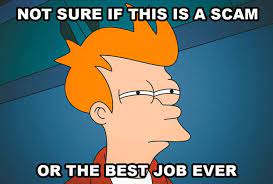
        Meme of Futurama character Phillip J. Fry making a suspicious face. The text says "Not sure if this is a scam or the best job ever." This is to illustrate the article IAPWE Review

        Is IAPWE a Scam?

        IAPWE is not BBB accredited and currently has a BBB rating of B.

        Reading through the IAPWE review posts shows quite a few unhappy people, mostly when it comes to canceling their memberships. From the reviews, it sounds like when you’re ready to cancel your annual membership you’ll have to jump through a few hoops.

        IAPWE might post legitimate opportunities in their job board, but one huge problem is they don’t mention how the job board works on their website. It also doesn’t indicate how long it will take to get approved, that you’re not working directly with the company, or that there’s a monthly fee for this service.

        Another confusing aspect of the website is there’s a listed rate, but it’s actually a job board. Does that mean they only post jobs that fit within those rates? Unclear.

        Professional writers and editors are generally happy to pay for membership in a freelancing group or mentorship/networking program, as long as the cost is worth it. However, because the fees seem to be hidden, and reviews indicate the actual writing jobs weren’t worth the cost, that’s a red flag.

        With this in mind, it might not be fair to say IAPWE is a scam, but there are some deceptive tactics. Whether that’s intentional or just poor website design and copywriting…well, we’ll leave that up to you to decide.

        Another note is they don’t post too much on their social media. This on its own doesn’t mean much, but I thought it worth mentioning.

        While I wouldn’t go so far as to call IAPWE a scam, since no one said the jobs themselves are actually fake, the true value the organization brings to freelance writers and editors is unclear.

        IAPWE Reviews (What Others Have to Say)

        I hunted around the Internet to see what people had to say about their firsthand experience with IAPWE. Here are a few less-than-positive ones to check out:

        For a positive review, I found this comment in a Reddit thread,

        I actually know quite a few people that have secured writing gigs via IAPWE. They’re not a “known scam,” they just need a lot of effort to utilize their resources, which can be tedious. I think many people want a quick, easy, high-paying assignment, with little to no effort. As IAPWE is not a get-rich-quick site, it leads to many negative reviews. The moral is: it’s not for everyone. Just because something doesn’t work for you, does not mean it won’t work for others.

        Reddit—PSA: The International Association of Professional Writers and Editors (IAPWE) is apparently not a legit organization.

        What is the International Association of Professional Writers and Editors (IAPWE)?

        IAPWE says it’s an organization that helps writers and editors succeed. Their website has articles and other resources for professionals to help them break into the industry and start their careers. They’re most popular for their job board, which lists a variety of jobs for both writers and editors.

        The questions we’re wondering are: are the jobs good quality and is the organization worth joining?

        How Much Does an IAPWE Membership Cost?

        Once you’re accepted into IAPWE, it seems as though you then need to upgrade your account to be able to access the job opportunities.

        There are conflicting numbers out there, but it seems to currently cost between $6 and $15 per month to access to the job board. This works out to between $72 and $180 per year, and you can write this type of expense off on your taxes in most countries.

        How to Work with IAPWE

        Most reviewers have mentioned coming across IAPWE hiring posts on Craigslist or job boards separate from the IAPWE job board.

        On the IAPWE website, it’s not easy to see how to apply to be a member. I had to search for the page on Google to find the application page!

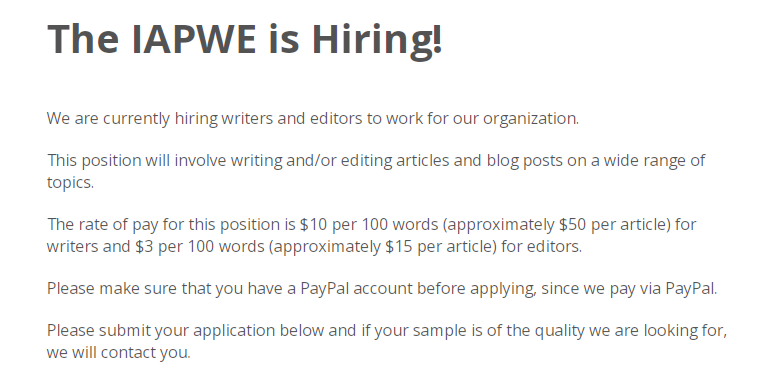
        Below is a screenshot of the application page from 2022, at the time of this articles first writing (it has since been updated).

        This is a screenshot of an application page from IAPWE as part of an IAPWE review. It was taken in 2022

        If you have images turned off, here’s the short version of the screenshot: the IAPWE pay rate is $10 per 100 words and each article is approximately 500 words. For editors, their rate is $3 per 100 words.

        However, on this job post board for IAPWE, the rate is different. It lists $20 per 100 words.

        It also mentions on that site that 17,357 people have applied to this job. It says the salary is $40,000-$50,000 and that applicants must, “Work well as a team member with the rest of our content management and editorial staff.”

        We’ll also point out this information was gathered in 2022 when the article was originally written and it still states this is 2023 when we reviewed the links again.

        Here are the topics they currently offer writers and editors:

        • Health and Beauty
        • Fitness
        • Home Décor
        • Fashion
        • Sports
        • Do It Yourself (DIY)
        • Finance
        • Legal
        • Medical
        • Family/Parenting
        • Relationships
        • Real Estate
        • Restaurants
        • Contracting (Plumbing, Pool Building, Remodeling, etc.)

        Depending on your current rates as a freelance writer or editor, this might seem like a decent amount. But it also might not seem like enough. These rates are better than a lot content mills that pay closer to $0.02 per word instead of $0.10 per word.

        According to online reviews for IAPWE, once you’re approved and accepted as a member, you have access to the job board. You’re not given a position in the company and jobs aren’t a given.

        The organization pulls from 100 different companies—but they claim to only post legitimate freelance jobs. While I did not personally apply for IAPWE, some reviewers said it can take a month or more to hear back from them once you apply.

        Why Writers Should Double-Check Any Program Before Joining

        So many people dream of being able to write and work from home, and scammers know this. You should keep in mind that any program that says it’s an easy to industry to get into in just a few hours should raise some red flags.

        That’s not about this specific program, this should be a rule for any program or organization you want to join going forward.

        If you want to become a freelance writer, just know that there are as many legitimate programs and organizations out there as there are scams. For this reason, it’s always a good idea to do your due diligence and make sure it’s legitimate before you sign up. (Just like you’re doing now!)

        While no program is guaranteed to work and make you rich, you at least need to make sure it’s legitimate and can get you results if you put the work in.

        The Pros and Cons to Wrap Up This IAPWE Review

        You’ve made it to the end of the post! Well done! Here’s a quick review of what we talked about.

        Pros to Joining IAPWE

        • You’ll get access to resources about becoming a professional writer or editor
        • You have access to legitimate jobs all in one place

        Cons to Joining IAPWE

        • You have to pay a monthly fee to access the job board
        • It can be difficult to cancel your membership
        • It’s unclear if the posted jobs are worth the monthly fee

        Here’s an Alternative!

        If you’re just getting started as a freelancer, then we recommend the Freelance Writers Den. They have an incredible community and a wealth of helpful resources to help you grow your income as a freelance writer, editor, proofreader, and more. There is also a monthly fee for this membership program, so once again—make sure it’s right for you before joining!

        For a full review on the program, check out this article.

        [sps_reusable_block post_id=43043]

      • What Is A Good Typing Speed? + 5 Tools To Improve Yours

        What Is A Good Typing Speed? + 5 Tools To Improve Yours

        Have you ever wondered what is a good typing speed? And are there ways to improve your overall typing skills?

        Keep reading to learn what makes a good typing speed, things that influence typing speed, and how you can measure and improve your personal typing speed.

        Why Typing Speed Matters

        If you can type with speed and accuracy, you will also often be productive. Depending on the type of work you do, having a fast typing speed will benefit your career.

        Whether or not you can type fast is not always a reason you will succeed or fail as a freelance writer.

        However, it can change how fast you can work and help you get your work done at a steady rate. If you can type faster and write at a quick pace, you can get more words done per hour so you can make more money.

        Sure, not every job as a freelance writer is based on how many words you can write per hour or how fast you can type, but being able to be proficient at what you do can save you a ton of time in the long run.

        If you are able to write more throughout the day, then you can take on more work at any given moment. Or, you can knock out things like busy work faster than you could otherwise.

        Being able to type fast can also help you do other things such as answer emails faster or do school assignments so you can work through your tasks faster in a day.

        Typing speed might also be something potential employers consider in order to hire you. It will show them that you can complete your work in a reasonable amount of time.

        What Is a Good Typing Speed?

        For the most part, you are going to have your words measured by a metric called wpm, which stands for words per minute. You might also see CPM, which stands for characters per minute.

        Most people will use a typing speed test to get an idea of how fast they are typing. That way, they can know if they are improving or not because when you can measure your speed, you can track your improvements over time.

        If you wanted to know actual numbers, here are some for you to use to measure your skills.

        Average typing speed

        • 40 wpm and over
        • 200 cpm and over

        Above average typing speed

        • 50 wpm and over
        • 250 cpm and over

        Productive typing speed

        • 60 wpm and over
        • 300 cpm and over

        High typing speed

        • 70 wpm and over
        • 350 cpm and over

        Competitive speed

        • 120 wpm and over
        • 600 cpm and over

        Keep in mind, there are some factors, such as the age of the person typing, that you might have to research or consider when it comes to measuring a good typing speed.

        What Influences Typing Speed?

        More than anything, learning how to properly type will help improve your typing speed.

        Some people only use their forefingers in order to type and that is not the most efficient way to type, even though a lot of people do it. You will want to practice using all of your fingers to type because it can help increase the amount of keys you can type in short intervals.

        There are also a wide variety of keyboard types out there that might be a better fit for you and how you prefer to

        Being sure to practice a lot and in an intentional way can also help you improve your typing speed. Challenge yourself to type faster or use different types of tools and tests to measure where you currently are and how to get better.

        Tools to Measure Typing Speed and Improve Your Skills

        While there are a ton of tools out there (and some free ones) to measure typing speed, we are going to focus on just a few of the popular ones so you can pick one that works best for you.

        We will also go over which ones of them offer you the ability to improve your typing speed as well.

        1. Typing.com

        Typing is a great resource that give you access to free timed tests. You can take various timed test (1 minute, 3 minutes, 5 minutes) or page tests (1 page, 2 pages, 3 pages) to get an overall idea at your typing speed.

        It is also a great site if you want to sign up for an account and start to improve your typing skills. Typing has a friendly user interface, making it a option for any age group to use.

        2. Ratatype

        Ratatype is another option that can help measure your typing speed to get an idea of where you are with your current skill set.

        There are some free typing lessons for you to use on their site as well, so you can actively try and improve your typing speed.

        They also offer options for teachers, corporate offices, and group settings, depending on what you need. There are also different game modes to make learning typing even more fun.

        3. Typing Trainer

        Typing Trainer is a free program that gives you different games, races, and challenges in order to help you improve your typing skills. With built-in lessons, you can go at a pace that works best for you.

        According to their website, in just four hours you can master the basics of typing so you can improve your typing speed. On top of the four basic hours, there are five hours of extra work for you to master even more things.

        4. GoodTyping

        GoodTyping offers 27 guided lessons to teach you the basics of typing. It is all web-based, as most of them are, but that keeps you from having to download anything extra or some additional software in order to get your lessons done.

        For extra fun, there are other typing courses in different languages. That can help if you need to type in multiple languages and need to improve your skills in that area as well. As you complete the courses, you can also get a typing certificate to certify your skills and speed.

        5. Typing Cat

        Typing Cat has the goal of improving your typing skills in a matter of 10 minutes a day. This is one that is not free, but it has more advanced features than you see on some of the other typing programs out there.

        It offers custom courses once it learns how you type and you also will have access to courses that were created by other users.

        What to Do Next

        Want to practice your typing? Use these prompts to get started!

        101 Creative Writing Prompts
        That Will Get You Excited to Write

        Grab it for free 👇

          We’ll also send you our newsletter, which offers advice on freelancing and publishing.
          You can unsubscribe at any time.

        • How To Use ChatGPT As A Freelancer: 3 Pros To Leverage, 2 Cons To Avoid

          How To Use ChatGPT As A Freelancer: 3 Pros To Leverage, 2 Cons To Avoid

          ChatGPT was released in November 2022, so by now you may wonder how to use ChatGPT as a freelancer.

          If you write for a living, hope to take your freelance side hustle to the next level, or are interested in simply learning a bit more about AI, then keep reading.

          You may have questions such as:

          Like all forms of artificial intelligence, with ChatGPT comes benefits and uses, and also a number of things to avoid.  

          [sps_reusable_block post_id=43047]

          What Is ChatGPT?

          ChatGPT is a large language model with chat functionality. A form of artificial intelligence, it uses its name to explain its function: The first part, chat, references that it is a chatbot. GPT represents its functionality—Generative Pre-trained Transformer

          “ChatGPT is a sibling model to InstructGPT, which is trained to follow an instruction in a prompt and provide a detailed response.”

          OpenAI

          Due to its chatbot capabilities, OpenAI states that you can expect ChatGPT to:

          • Answer follow-up questions
          • Admit its mistakes
          • Challenge incorrect premises
          • Reject inappropriate requests

          Now that you have a brief overview of what it is, it’s time to dive into its benefits. If you can’t articulate the positives of using ChatGPT, it will be difficult to discover how to use ChatGPT as a freelancer. 

          The Benefits of ChatGPT 

          If you’ve ever used chat boxes for simple tasks like making a return or trying to find an answer to a question, you may have grown frustrated with the lack of capabilities in some chat systems. This is where the benefits of ChatGPT come in. 

          During its design process, it was tested with humans and created to provide conversational answers to normal, every day communication styles. The more touchpoints it has, the more efficient it becomes.

          Think of it like trying out speech-to-text software. At first, you may have to go through and edit copious amounts of words. But, as the software learns how you speak, it picks up on your words that much better. ChatGPT is similar in that the more it is used, the better it becomes. If you’re wondering how to use ChatGPT as a freelancer, you may want to simply give it some time. 

          Additionally, rather than ask a chatbot a question and have to choose from a few predetermined answers, ChatGPT was designed to respond to natural, written conversation. This makes using ChatGPT that much simpler, streamlined, and natural. 

          Various Uses

          Depending on your goals, ChatGPT has a variety of capabilities. While not limited to the following, below is a brief list to get you started.

          Use ChatGPT as a Search Engine 

          The phrase “Google it” is basically a verb, and now ChatGPT provides its own search engine functions. While Google will present you with a variety of websites to find your answer on, ChatGPT gives you the answer itself. 

          Let ChatGPT Draft Your Articles 

          In addition to providing you with answers to your search engine queries, this large language model also has the capacity to draft content for you. Notice the keyword draft content. While it may feel like using ChatGPT is an efficient way to write your long-form articles, it’s unlikely to be as effective as your own writing. 

          Update Your Resume or CV

          Choosing how to use ChatGPT as a freelancer may start with letting it create your next resume or even cover letter. This feature is argued as one of its most useful functions. Rather than stare at the blinking cursor and wonder how to start, ChatGPT can create your first draft. 

          How To Use ChatGPT As A Freelancer | Things To Avoid 

          While there are many helpful functions of ChatGPT, particularly when it comes to how to use ChatGPT as a freelancer, there are specific aspects you should be wary of, and perhaps avoid altogether. In a technical feature article, Ben Lutkevich describes language modeling as the following: 

          “The use of various statistical and probabilistic techniques to determine the probability of a given sequence of words occurring in a sentence. Language models analyze bodies of text data to provide a basis for their word predictions.”

          Ben Lutkevich

          Let’s break this thought down into a few key takeaways.

          “Determine the probability of a given sequence of words…”

          ChatGPT relies on determining the probability of verbiage from the previously established rules based on the contexts it knows. For instance, the word you often follows the word thank. This sequence, thank you, is an established rule.

          But what if you want to create unique verbiage or provide information that is dissimilar to what is already established? When deciding how to use ChatGPT as a freelancer, it’s crucial to note that it determines “the probability of a given sequence of words” (emphasis added). 

          Avoid relying solely on ChatGPT for facts, grammar, and always remember it has a limited context. 

          “Analyze bodies of text data to provide a basis for their word predictions…” 

          In addition, if you want to know how to use ChatGPT as a freelancer in a way that helps, rather than hinders, your credibility, understanding where it draws its information from is a must. 

          Unlike heading down to your local library, the bodies of text that ChatGPT indexes are restricted to copy previously published on the Internet. It’s common knowledge that not everything you read online is fact, and this applies to ChatGPT just as it does other platforms, softwares, and general Internet usage.

          When deciding how to use ChatGPT as a freelancer, one of your first choices should be to always double check your facts. But more than just fact checking, creating original content can be difficult using ChatGPT. 

          Yes, depending on how you phrase your requests or prompts, your answers will likely look somewhat different than the responses others receive. However, all users draw from the same body of text data. Every answer comes from the same pool.

          If you’re looking for original work with a unique foundation, you may want to draft your own copy. 

          Next Steps: How To Use ChatGPT As A Freelancer, Positively

          Never underestimate the power of being forthright when it comes to your freelance work. If you want to use ChatGPT to create a long-form article for a client, or they hired you to write their cover letter and resume, you will likely want to mention your intentions. 

          ChatGPT is a great place to brainstorm content, create outlines, and sometimes, use it as a base for your rough drafts. That said, if a client hires you to create original content for their company, if you decide to use AI, it’s crucial to proceed with caution. 

          • Recognize that ChatGPT pulls data from previously published sources
          • Understand that ChatGPT needs fact-checked  
          • Always, always, always edit 

          As you move forward with how to use ChatGPT as a freelancer, don’t be afraid of using this resource to help create content more efficiently. At the same time, do be wary of its effectiveness. 


          If you’re a freelancer, you write for human readers who desire quality content that is fact-checked, original, and thoughtfully created. If ChatGPT can be a stepping stone in helping you get there, you’ve just added another tool to your freelancer toolkit!

        • Testimonials for Writers: 3 Ways They Help and Why They’re so Powerful

          Testimonials for Writers: 3 Ways They Help and Why They’re so Powerful

          Testimonials for writers are a crucial factor in creating a word of mouth buzz that can boost your book sales or service referrals.

          Whether you want to put more books into the hands of readers or offer writing services, great testimonials can be a positive influence on your goals. 

          While you’ve likely heard of endorsements, and maybe even have some, testimonials are a bit different.

          In this article, we’ll talk about the different facets of testimonials for writers. If you’re ready for a career boost, read on!

          What Are Testimonials for Writers?

          Testimonials for writers are a third-party review of you and your work. While they’re often shared through a written statement, testimonials can take various forms such as:

          • Short video statements 
          • Quotes posted on website
          • Social media posts 
          • Interviews

          How Testimonials Help Writers

          Whether you ask clients to write up a brief endorsement, share about their experience on social media, or engage in an interview, testimonials are foundational for building credibility. 

          If testimonials for writers are such a crucial factor, how do they actually contribute to your ongoing success? There are many ways testimonials help, but below are the top three reasons you should start collecting them today.

          Personalize Your Audience

          Consider the following situation: You launched your book a year ago and have some traction. You wish you had more reviews, but you’re happy with your growing platform and newfound traffic to your author website. 

          What if when potential readers come to your site, testimonials greeted them on your home page? As soon as your site loads, they see real readers who love your book and want to share how much they enjoyed it. In this way, testimonials personalize your audience.


          Create Authentic Hype

          With so many marketing resources today, almost anyone can create a good deal of buzz around their product or service. However, testimonials for writers take this buzz to an authentic level. Yes, people have used the word authentic so much that it’s a buzz word all on it’s own, but this is because individuals appreciate authentic reviews. 

          The more testimonials you have from readers with names and lives, the more authentic your hype will be. What usually makes you want to purchase a new book more: The author tweeting how awesome their book is, or a reader telling you they couldn’t put it down?

          Provide Resources

          Particularly if you offer paid services such as editing or marketing, potential clients want to know you’ve been vetted and are worth the price point. Testimonials, for writers in particular, are a helpful way to provide the credibility future clients need.

          If individuals can see a list of clients you’ve helped, look them up, and perhaps even reach out to them for a referral, they will feel much safer hiring you.

          How To Get Testimonials

          If testimonials for writers are this important, the next question to answer is how to get them. Your first testimonials will likely be the most difficult, but don’t worry. With a few well-crafted sentences you’ll be well on your way. 

          Offer the possibility to current clients 

          Many clients are focused on their project and getting it done well. Leaving testimonials for writers is simply not top of mind. When I’ve asked for testimonials, I’ve found offering the possibility to a client is all they need to write a review. Most clients are happy to help but don’t realize how much power their few sentences wield. 

          Ask for testimonials from previous clients 

          If you have worked for clients in the past but didn’t realize the value in testimonials for writers, a simple email can help you. Write up a brief template thanking the client for working with you. Ask them to write a sentence or two of review if they enjoyed the collaboration and are comfortable. 

          Write a draft to send to clients 

          If you work with bigger name clients who may not have time to craft their own testimonial, you can treat testimonials similarly to blurbs. Write a sentence or two describing how you imagine the client felt about their experience working with you. 

          Then follow a few steps: Email them asking for a testimonial. Include that you wrote an outline to make it easier for them. Allow them to edit as they see fit.

          Tip: You can legitimize testimonials by including first and last names if possible, or first name and last initial. Asking for clients to include where they work or what they are known for is also a helpful way to add detail that builds rapport. 

          Examples from Real Writer Websites

          What about writers who have done this well? Let’s start with the bestselling author of Atomic Habits, James Clear. When you visit the book page on his website you immediately see a sentence or two of testimonials from other professionals.

          Clear highlights Mark Manson’s testimonial, another bestselling author. He also includes one from Arianna Huffington, Founder of Huffington Post and Thrive Global. 

          Elizabeth Gilbert’s Big Magic has inspired creatives in innumerable ways. Despite the massive success of her book, she too includes a testimonial on her book page. 

          If you’re not a bestselling author yet or offer services, testimonials are still tremendously helpful in your success. The freelancer behind Hear Ye Writing includes numerous testimonials on her website.  

          Testimonials For Writers: Parting Tips 

          While there is no right or wrong way to include testimonials, there are a few steps you can take to help them stand out. Testimonials that include the following will help legitimate both your testimonials and your product or service: 

          • First and last name of client
          • The client’s credibility 
          • Where they work 

          Consider the following testimonial examples: 

          Example one: “I loved working with Jane Smith. Her turnaround time was impeccable and her quality was just what I was looking for.” 

          Example two: “I loved working with Jane. Her turnaround time was impeccable and her quality was just what I was looking for.” —John Smith, CEO of Fake Business Name and author of Book Title

          Do you see how adding these three small factors levels up the testimonial? Always be sure to ask clients if they are comfortable for you to include their name and credentials prior to posting. 

          Additionally, if you write a template testimonial for past clients, receive the okay before publishing it live on your website. 

          For Those Starting From Scratch 

          If you’re just getting started and haven’t worked with clients before, there is still a place for you. Testimonials for writers can apply to unpaid coaching services, feedback, beta reading, and more. When posting these type of testimonials, be clear about what you offered. 

          For instance, if someone from your writing community asks you to beta read their book, consider asking for a testimonial. Use the template below to inspire your request: 

          “I’m a new writer and asked [your name] to beta read my book. He was more than happy to provide great feedback. I’m thankful for his insight on my manuscript!”  

          It can feel intimidating to start out, but take your first step boldly. The first request is usually the most difficult. It only gets easier! 

          Want more writing advice?

          Subscribe to get our latest content by email.

            We won’t send you spam. Unsubscribe at any time.