Tag: freelance writers

  • 22 Publications on Religion and Spirituality That Pay Freelance Writers

    22 Publications on Religion and Spirituality That Pay Freelance Writers

    Do you view the world through a spiritual lens? Are you fascinated by the intersection of religion and politics?

    Religious and spiritual writing runs a wide gamut from hard news reporting to lifestyle pieces for particular faith-based demographics.

    Whether you’re interested in writing specifically on religious topics, looking for Christian writing jobs or simply want an audience who understands where you’re coming from, these 23 publications are a good place to start.

    Our list includes websites, literary journals and magazines from a variety of spiritual perspectives. And best of all? They pay their writers.

    New to freelancing? Make sure you know the basics about who and how to pitch before you reach out to a publication.

    [sps_reusable_block post_id=43047]

    Add these 22 publications, including Christian magazines, to your pitching list

    Here are 22 publications on religion and spirituality that pay freelance writers.

    1. First Things

    Published by The Institute of Religion and Public Life, First Things is a conservative and heady publication that offers predominantly Christian and Jewish perspectives. It accepts opinion pieces, featured articles and book reviews in print and online. 

    Pay: According to the submission guidelines, it offers an honorarium for writers, though the amount is not specified.

    2. The Jewish Forward

    The Jewish Forward offers political and cultural coverage for topics relevant to the American Jewish community. It’s been around since 1897.

    Pay: While The Forward hasn’t confirmed its rates, it states that compensation “will be highly competitive for the right pitch.”

    3. America Magazine

    This is a Jesuit-run publication with a Roman Catholic audience. It publishes reported pieces, personal essays and poetry on politics, faith, arts and culture with a religious or moral angle.

    Pay: While the exact rate is unpublished, per Who Pays Writers, it’s paid up to 38 cents per word.

    4. Guideposts

    Guideposts is most known for its inspirational personal stories hope and inspiration. The magazine also offers lifestyle posts, on anything from recipes to parenting tips.

    Pay: While Guideposts hasn’t confirmed how much it pays, it does say in its writer guidelines that it pays for “full-length stories” (which it defines as 1,500 words) when the story is accepted for publication.

    5. U.S. Catholic

    U.S. Catholic is a monthly magazine for an American Catholic audience which focuses on social justice and pop culture. 

    Pay: The publication offers “financial compensation for both commissioned and on spec content.” 

    6. Woman Alive

    Woman Alive is a UK-based Christian lifestyle magazine for women.

    Pay: Its contributor guidelines notes articles typically run 700 to 1,800 words, and “payment is by arrangement.”

    7. Spirituality & Health Magazine

    This bimonthly multi-faith print magazine goes out of its way to avoid being “new age-y” and offers intelligent pieces on a variety of topics at the intersection of spirituality and health. 

    Pay: Although rates are no longer listed in its writers’ guidelines, it was previously recorded from $200 to $500, depending on the word count and type of piece.

    8. Tablet Magazine

    Tablet is a daily online magazine of Jewish news, ideas and culture. It welcomes submissions from freelance writers but does not accept opinion or editorial (op-ed) pieces.

    Pay: Pay varies. According to Who Pays Writers, the average rate is $0.25 per word.

    9. Sojourners

    This ecumenical magazine covers the intersections of politics, faith and culture. 

    Pay: It pays “for reported pieces, based on depth of reporting, and for strongly researched analysis pieces.”  

    10. Religion Dispatches

    Religion Dispatches (RD) offers current events and timely coverage of religion in American culture and politics. It specifically seeks “reporting, analysis, commentary, and film/book/TV reviews, by scholars, journalists, writers, and activists.”

    Pay: Pay varies.

    11. Geez Magazine

    A quarterly magazine with the tagline “contemplative cultural resistance,” Geez Magazine centers around social-justice issues and is usually theme-based. Geez is Christian-leaning, but not strictly so. 

    Pay: Writers are paid a “modest honorarium.”

    12. Christianity Today

    An evangelical magazine founded by Bill Graham, Christianity Today is probably the most widely read evangelical Christian publication. 

    Pay: Who Pays Writers has reports of writers being paid between 2 and 17 cents per word.

    13. Religion & Politics

    Run by the John C. Danforth Center on Religion and Politics at Washington University in St. Louis, this website offers political opinions from multiple faith traditions.

    Pay: One writer reports earning 26 cents per word on Who Pays Writers.

    14. Horizons

    A magazine for Presbyterian women, Horizons seeks articles, stories and poems of varying topics. 

    Pay: It offers an honorarium of no less than $50 per page printed in the magazine, though this amount will vary.

    15. St. Anthony Messenger

    St. Anthony Messenger is a monthly Catholic family magazine which aims to help its readers lead more fully human and Christian lives. It pays for opinion pieces, feature articles, fiction and poetry. 

    Pay: Pays 20 cents per word or $2 per line for poetry.

    16. Converge Media

    Converge media “exists at the intersection of faith and culture.” Some categories of writing it seeks include confessions, reviews, interviews and commentaries. 

    Pay: Unpublished.

    17. The Living Church Foundation

    The Living Church Foundation is part of the Episcopal Church and Anglican Communion. It publishes a magazine and hosts a weblog community. 

    Pay: Living Church told TWL that it does pay its writers, though “rates vary with length and experience.”

    18. Busted Halo

    Busted Halo is a Catholic-based publication that aims to “to share the Catholic faith in a fun and interactive way and provide creative resources for Catholics to use when sharing the faith with others.” Pitches are preferred, but they do accept unpublished submissions.

    Pay: Busted Halo told The Write Life that it pays $75 per article at typically 500-600 words per article.

    19. Christ and Pop Culture

    This online magazine “exists to acknowledge, appreciate, and think rightly about the common knowledge of our age.”

    Pay: Although web articles are unpaid, it does pay for feature articles for its magazine. These typically run 1,500 to 3,000 words. Keep an eye out for its call for pitches.

    20. LDSLiving

    LDSLiving is a bimonthly magazine looking for informative and inspiring articles about home and family, education and service, destinations, making a difference, discovery and at home.

    Pay: Varies.

    21. Christian Science Monitor

    The Christian Science Monitor is a popular international news organization built for “anyone who cares about the progress of the human endeavor around the world and seeks news reported with compassion, intelligence, and an essentially constructive lens.” It has both a religious and nonreligious audience.

    Generally, the publication accepts work from new writers on spec.

    Pay: If commissioned to write a piece and you fulfill the requirements, you’ll be paid the “basic rate” whether the story is published or not.

    22. Jewish Currents

    Jewish Currents is a print and digital magazine “committed to the rich tradition of thought, activism, and culture of the Jewish left.” It’s looking for timely, reported articles on topics featured on the site.

    Pay: Unpublished, but Who Pays Writers reports 13 cents per word.

    As well as submitting your work to these publications, why not consider compiling your writing into a draft book and reaching out to some of the top Christian publishers? It’s a great way to reach even more people with your writing!

    This is an updated version of a story that was previously published. We update our posts as often as possible to ensure they’re useful for our readers.

    [sps_reusable_block post_id=43047]

  • 6 Ways Freelance Writers Can Prepare for Tax Season Right Now

    6 Ways Freelance Writers Can Prepare for Tax Season Right Now

    You won’t have to file your taxes for a while, but why not take advantage of the year-end freelancing slowdown to get ahead on the upcoming tax season?

    Use this time to get organized and prepared before tax season rolls around, and also to get ready for next year’s bookkeeping. Spending a little time getting everything in order now can save a lot of hassle later.

    If you have any questions about how to prepare for the upcoming tax season, be sure to ask your tax preparer.

    1. Follow up on invoices

    Now is a good time to go through your records from this year and see who still owes you money.

    Like many freelancers, there’s a good chance you still have an outstanding invoice or two.

    Check the terms of your contracts to see when each outstanding payment is due and, if they’re late, reach out to those clients. Sometimes it takes a little time to track down your money, so it’s a good idea to start soon.

    prepare for tax season2. Find your receipts

    What do you do with your receipts for tax-deductible expenses?

    Do you carefully file them away the day you make a purchase? Or do you cram them in your junk drawer, wallet, purse, or car and figure you’ll just deal with them later?

    Now is the perfect time to gather all those receipts and sort them out for tax time. Check with your tax preparer if you’re not sure what you can and cannot deduct.

    Take a few minutes and go through your credit card and bank statements for the year to make sure you’re not missing anything.

    Don’t forget about digital receipts. Sort through your emails and maybe even take a quick look at your order history with your favorite online retailers to make sure you don’t miss anything.

    3. Organize your tax deductions

    Once you have all your tax-deductible receipts gathered in one place, go ahead and start sorting them out.

    It is usually helpful to organize them by deduction category. Look at your taxes from last year and, if you have similar types of expenses this year, you’ll see what categories of deductions you may have.

    Then sort the receipts out. File folders are often helpful. Paper clips also work. Avoid staples or anything that may damage the receipts or make them difficult to separate. Some people also like to scan their receipts to have a backup digital copy.

    Next, make a spreadsheet for your expenses and organize it by category. This will help you have everything ready for your tax preparer. Include information like the date of purchase, vendor, business reason for purchase, cost, method of payment and anything else that might be helpful.

    4. Prepare to receive 1099s

    At the end of the year, while you’re preparing for your end of year review, you’ll want to know how much money you earned this year. It makes sense to tally up how much you received from each client so you can evaluate each one, but also so you can prepare to receive your 1099s in the new year.

    Throughout the year, be sure to keep records of all your income. Keep your paystubs or photocopy checks if you don’t receive a pay stub.

    Be sure to go through bank statements and note any direct deposits. Look at PayPal and other payment systems and check these records. You’ll likely want to print these all out for your tax preparer (or provide a digital copy).

    Once you have all your income records together, make a spreadsheet recording the payments you received from each client.

    You can use this information to double-check your 1099s when you receive them and to be able to file your income accurately if you do not receive a 1099. If your records and the 1099 you receive do not match up, double-check your records and contact the client for a corrected 1099 if the one they initially sent is inaccurate.

    5. Start next year’s folders and spreadsheets

    Pretty soon, the new year will roll around and you will start receiving checks, contracts and other important information for the new year. Be sure to prepare your organizing and filing system ahead of time so you’re ready to go as soon as January arrives.

    Make the physical folders you’ll need and set up your digital ones as well. Create next year’s assignment and income spreadsheets and be ready to hit the ground running in the new year.

    6. Ask questions

    If you have questions for your tax preparer or accountant, take advantage of the slow season to ask them or set up a meeting.

    As soon as January arrives, people will kick into high gear and they will likely be quite busy, but it might be easier to ask a few questions when things are slow.

    The end of the year is a great time to get organized, catch up and get ahead on accounting for the new year. So when January rolls around, you’ll be ready to focus on your writing.

    How do you prepare for the end of the tax year?

  • Q3 Check-In: Saying ‘No’ in Order to Grow Your Freelance-Writing Career

    Q3 Check-In: Saying ‘No’ in Order to Grow Your Freelance-Writing Career

    How has 2017 gone for you so far? Has it been anything like you expected?

    Now that we’re beginning the last quarter of the year, it’s time to start thinking about where we want our careers to go in 2018 — and doing the work that will help us get there.

    It’s time for our third quarter check-in.

    1. How much money did I earn this quarter?

    Between July 1 and September 30, I earned $18,700 in freelance income and received $21,097.37 in freelance payments. (As you might remember from my Q2 check-in, I ended the second quarter with some money owed me.)

    I also received $657.80 in ebook and paperback sales for my self-published debut novel, The Biographies of Ordinary People. I’ve made $1,214.65 in total sales, but the payments don’t arrive right away.

    My total freelance income for 2017 (not counting book sales) is $50,241.12. I’m a little over $5,000 ahead of my $5K monthly income goal, and that’s before you factor in what I’m earning from my novel.

    2. What was the best thing I did for my freelance career this quarter?

    I wanted to spend the summer earning as much money as I could, and I did.

    In Q2, I started writing for Lifehacker and was invited to take on some new responsibilities at The Billfold, where I’m currently a Senior Editor.

    This additional work meant that I was earning more money, but I was also putting in more than 40 hours of work each week. That’s okay for a short-term sprint, but I didn’t want it to become a full-time workload — so I knew I would have to make some changes in the fall.

    freelance writing3. What was my biggest mistake (or, what am I going to do differently next quarter)?

    After earning more money in Q3, I had planned to spend Q4 cutting back on the number of assignments I accepted so I could focus on a few core clients, earn my monthly $5K and spend the rest of my time revising my second novel.

    However, I’m already finding out that Q4 will be a little different than anticipated. Which brings me to the next question:

    4. What do I want to achieve as a freelancer next quarter?

    Like many freelancers who are at this stage of their career, my answer is “launch a project  I can’t talk about yet.” Right now I am working with people on a long-term project that, if it is successful, will help both my career and my income. If that sounds really vague, I’m sorry — trust me, I’ll tell you all about it if/when it happens.

    I can say that I am not undertaking this project alone; nor is it designed to just benefit me.

    Although “freelancer” is often synonymous with “solopreneur,” I’m lucky to be in the position where I get to work with other talented people towards a shared goal. It’s one of the benefits of having five years of experience working in the freelance and publication industry.

    I’m also revising my second novel with the goal of self-publishing it in May 2018. So… this quarter is going to be pretty busy!

    5. What steps am I taking to get there?

    Remember that post I wrote about time-blocking? I’ve blocked off time for my clients, time for my projects and time for my novel revisions.

    Yes, this means I’ve had to say no to some other opportunities. I am well aware that I could be making a little extra money each month that I am turning down in order to pursue these bigger goals — and to keep my workload as close to a 40-hour week as possible.

    Part of me feel anxious about saying no to paying gigs, because up to this point my freelance career has been about earning as much money as I can, every month. But I’m hoping that my work this quarter will help me achieve something that’s better for my career than a $200 article — and will help me earn even more money in the long run.

    We still have three months until the end of the year, but I’m already thinking about 2018 — what I might be working on, how much I might be earning and how I can continue to grow as a freelancer and an author.

    2017 has been an unpredictable year in many aspects; I barely hit my earnings goal in Q1, got a bunch of new responsibilities in Q2 and hustled for more money in Q3. Now it’s time to spend Q4 building what might come next — and, of course, keeping up with my daily freelance and editing work!

    So I’ll turn it over to you: ask yourself these same five check-in questions and, if you feel comfortable, share your answers in the comments. How has Q3 gone, and what are you looking forward to in Q4?

  • How to Build a Personal Brand While Staying Authentic to Your Craft

    How to Build a Personal Brand While Staying Authentic to Your Craft

    You’re a writer, a change-maker, someone who influences culture — not a boring old corporate brand. You roll your eyes when it comes time to talk about working on your personal brand.

    I get it; It goes against your anarchist, artist nature.

    A few years ago after nearly two decades as an entrepreneur, I came back to my love: Writing.

    About a year into my time at the UCLA Extension Writers’ Program, a classmate and I attended an all-day marketing for writers seminar. Somewhere around the second or third presenter, I was totally overwhelmed. I thought the hardest work I’d do as a writer would be the writing. I had no idea just how much the publishing industry had tightened its belt, and how much promotion was now in writer’s hands.

    I wanted to create art, not be a one-woman marketing show.

    The van Gogh effect

    Writers are often overwhelmed or even repulsed by the idea of self-promotion and having a personal brand. Heck, a lot of us don’t even know what that really means. We’ve been conditioned to think it means buying into a commercial system rigged to churn out saleable wears, but not true art.

    Vincent van Gogh is often brought up as the poster child of this ideology. He’s the ultimate artist martyr. He eschewed commercial pursuits and is widely accepted as a true artist.

    I wonder though, isn’t it possible to have both?

    In her bestselling book, You’re a Badass at Making Money, Jen Sincero says, “Your gifts, talents and desires were given to you because you are meant to thrive and share your youness with the world as only you can.”

    The ability to create true art and have a successful career do not have to be mutually exclusive ideals.

    Celebritizing artists

    One of the ways we’ve painted ourselves into a corner is evident in our cultural obsession with celebrity. Wildly successful writers are held up high while we admire and think, I’m not outgoing like that, or I don’t have that talent, or I don’t have those connections. In each of those comparisons we doom ourselves to mediocrity or even obscurity. Success seems impossible or random.

    We forget that there is so much room in the chasm between starving artist and mega-bestseller.

    Meanwhile our society is starved for authentic connection, which is key to a successful personal brand.

    Think about the last time a book, article, podcast or TV show moved you. Chances are there was something genuine about it that grabbed ahold of you.

    I believe the most artistically contrarian thing you can do nowadays is to be totally rooted in exactly who you are.

    build a personal brand Stop waiting to be chosen

    There’s virtue in writing for writing’s sake. Don’t get me wrong, but most of us still need to make a living.

    The writing world is one of the few industries built on a precedent where people are expected to work for years on a project in the hopes that someone will buy and promote it.

    As our industry changes now there’s a massive opportunity, if we shift our mindsets.

    Imagine if we started treating ourselves like the valuable brands we actually are, looking at our work not as just art, but as valuable assets. We might just create better ways to make a living while preserving the quality of our art.

    Instead of waiting for someone to choose us, it’s time to buy in to our own value and build our own audience.

    It may take some mental reprogramming to effectively switch from the legacy we’ve been taught. Like me, you may have been told to shut up, sit down, or fall in line or that you’d never make it as an artist.

    It’s time to let that all go. If we as writers don’t understand what value or beauty we bring to the world, no one else will.

    More than ever, we need truth tellers and artistic leaders who can give us the insights into humanity and culture that just isn’t present in mass-produced pop culture.

    Crafting your personal brand is not selling out. It is about getting clear and buying in to who you truly are. Amid the increasing cacophony of messages, we must not only have a strong voice, but one that comes from being deeply rooted in who we are.

    Start being your own advocate

    Six months after van Gogh’s death, his brother’s widow, Jo van Gogh-Bonger inherited his huge collection of paintings, drawings and letters. Understanding the intrinsic value of his work, she made it her mission to promote it by telling his life’s story through the art and letters he’d left behind.

    Imagine if she had thrown his paintings out, or sold them just to earn some quick money for her and her son. Instead, she gifted the world with an irreplaceable artist’s work.

    I wonder how many times the world has missed out on important art because it followed the artist to the grave, simply because they didn’t have an advocate like Jo.

    The world needs your voice and it’s time to become your own advocate.

    Begin here

    Take a few minutes and grab a notebook or open a blank Word doc.

    Think about what you really want. Give yourself permission to imagine a life and a career unbound by old ideologies.

    What makes you feel most alive? Do some stream of consciousness writing; let whatever comes to mind flow without judgment.

    Next, write down five characteristics that make your creative work unique and valuable. If you need help, ask some friends to tell you why they love your work.

    If you ground yourself in what’s possible rather than shackling yourself to a set of outmoded beliefs, you may begin to see opportunities you were once blind to.

    Our personal brand exists whether you are consciously creating it or not.

    Go ahead and be an anarchist, but understand why your version of anarchy is so valuable. And position yourself in a way that those who will appreciate it can find you.

  • 7 Social Media Tips For Writers Who Want to Get Noticed

    7 Social Media Tips For Writers Who Want to Get Noticed

    Social media is woven into our lives.

    We don’t even think before reaching for our phones to check Facebook and Instagram. We catch ourselves scrolling through our feed or drafting the next clever tweet in our head.

    In a world so entrenched with social media, are we as writers living up to our full social potential? Or do we believe that we somehow can rise above social media and be successful without it?

    Freelance writers often miss key ways they can use social media to their benefit.

    Social media is a gold mine of unlocked potential to build a following, showcase your writing ability and gain exposure. If you are a writer looking to get noticed or inspired, here are seven creative ways you can use social media to do so!

    1. LinkedIn Pulse

    Pulse is LinkedIn’s native article publishing platform.

    This platform gives writers the chance to get original content noticed on LinkedIn by professionals.

    If you publish blog posts or articles, think along the same lines for Pulse. Articles can range from 500-word targeted posts to epic, 2,000+ word pieces.

    The good news? Republishing content from your blog in Pulse is not considered duplicate content by Google. However, I’d still recommend changing a few lines to speak directly to your LinkedIn audience.

    2. Instagram quotes

    Instagram is an untapped gold mine for writers.

    Do you have a book? An ebook? Even a blog? If you’re a writer, you likely have at least one.

    Try using Instagram to showcase quotes from your written work. You can snag quotes and create simple, but beautiful, images. One of my favorite tools to create graphics is Canva. There are hundreds of beautiful templates and layouts you can use to make your quotes stand out!

    Be sure to think hard about your captions! Although Instagram is a visually-dominated social media platform, writers can make great use of the captions.

    Reel those casual scrollers in with a beautiful image, and keep them there with your caption.

    3. Your Instagram bio

    As obvious as it sounds, every author, blogger, and writer needs a snappy Instagram bio to attract potential opportunities.

    This is the #1 area of failure I see on Instagram.

    Who are you? What are you interested in? What do you do? What do you like to do? You want to make your first impression for readers landing on your profile a positive one.

    A stellar bio includes your real name, a brief rundown of your skills, and your website link. Make sure you use your creative flair to set yourself apart. (This is why I love emojis!)

    social media tips

    4. Twitter chats

    Twitter, contrary to popular belief, is one of the most literary social media platforms today.

    You have 140 characters to make your point. What could be more literary than that?

    Twitter Chats are a great way to network, influence and contribute. Many writing chats feature guest influencers and experts, giving you access to some big names to network with.

    Topics range from book discussions (check out the popular #LitChat) to fiction writing support (I recommend #ScribeChat on Thursdays) to the benefits journaling (#JournalChat, also on Thursdays).

    Twitter chats are a creative way writers can use social media to connect with other writers, expand their sphere of influence, and share their knowledge.

    5. Facebook writing groups

    Facebook groups are yet another creative way writers can use social media to get noticed and inspired.

    Joining a Facebook group aimed at writers is a fantastic way to meet and collaborate with other writers. You might even find your next writing gig!

    Facebook writing groups range from small and intimate, to enormous and robust. Topics and focus vary, but the main benefit remains the same: comradery with other writers.

    The Write Life even has its own Facebook group, filled with inspiring writers.

    6. Facebook Instant Articles

    Although Instant Articles isn’t quite what publishers hoped it would be, the platform still holds promise for writers.

    Facebook Instant Articles receive 20 percent more clicks and 30 percent more shares than other articles, according to a statistic from 2016..

    Like Pulse, you can republish content on Facebook’s native platform without it being flagged as duplicate content.

    Yet, unlike Pulse, Facebook has created several integrations that make publishing easy for writers. These integrations with content and blogging systems means there’s no need to recreate articles within Facebook.

    7. Facebook “mini blog”

    We all know that writers can use their Facebook pages or profiles to share blog posts.

    But, what about “blogging” right on your Facebook newsfeed? Authors such as Elizabeth Gilbert do exactly this.

    You can use Facebook not only to share content from other places, but to express your opinions about those pieces. Share your creative edge, your wit, your life. Your sphere of influence will expand simply from being transparent and generous with your writing!

    With these seven creative ways to use social media, let’s stop fighting social media and instead, embrace it. Let’s find more opportunities to get noticed and gain exposure for our work!

    For more helpful articles on how to use social media well, check out these articles:

    This is an updated version of a story that was previously published. We update our posts as often as possible to ensure they’re useful for our readers.

  • Plan Ahead! 4 Tips for Taking Sick Days as a Freelance Writer

    Plan Ahead! 4 Tips for Taking Sick Days as a Freelance Writer

    It happens to every freelancer at some point.

    You get sick.

    Maybe it’s a stuffy head and a streaming nose, or a stomach bug or a bout of depression.

    Whatever your exact symptoms are, it’s a safe bet that if you were working for an employer, you’d call in sick.

    But you work for a demanding (and sometimes unreasonable) boss: yourself.

    If you’ve got deadlines to meet, or if you’re simply the sort of person who wants to crush your Most Important Tasks before breakfast…you might be tempted to grab some DayQuil and power through.

    That’s rarely a good move.

    You’ll probably drag out your recovery much longer than if you just stayed in bed for a day. Plus, you’re never going to be doing your best work when you feel like death.

    With a little bit of forward planning, though, you can take sick days — and recover faster.

    1. Recognize that you will need sick days

    Even if you rarely get ill, a family member might. (My two-year-old came down with chickenpox yesterday, scuppering my hopes of ploughing through a pile of work today!)

    If you have an existing health condition (like ME/CFS, or depression) then it’s particularly crucial to plan ahead. Even if you can’t predict ahead of time exactly when you’ll be unwell, you might want to only allow for, say, three weeks worth of work each month so you can take a week off if necessary — without falling behind.

    There might be times when you can predict and plan for a fairly significant length of time away from work (or a period of time when you’ll want a seriously reduced workload) — if you’re going to be having a baby and taking maternity leave, for instance.

    2. Allow some slack in your schedule

    This is good practice whether or not you get sick: if your schedule has little or no wiggle room, even a relatively minor problem can throw you off.

    Don’t fill every hour of your day, or every day of the week, with freelancing commitments.

    Leave some gaps — even if that means telling a client they’ll have to wait for you to become available.

    Personally, I try to keep Fridays clear for “catch up”, and when I put deadlines into my planner, I aim to get my freelance posts done a couple of days ahead of time. This means I’ve got some margin for things going wrong…and I’ve never had an editor object when I’ve sent in posts early!

    3. Build up a network of contacts

    Again, this is something you’re hopefully doing anyway. As a freelancer, you’re not a lone wolf — you’re part of a pack. Get to know other writers and editors: if you end up sick and need someone else to help you out with your commitments, you’ll have people to turn to.

    While it may not be possible or desirable to outsource your freelancing altogether, you might be able to call in help with:

    • Guest posts to keep your blog active while you’re out of action.
    • Researching, planning or drafting your freelance pieces — you’ll probably need to do final revisions and edits to make sure it’s in line with your usual style.
    • Social media shares to help sell any products you have (e.g. ebooks / ecourses), so you can keep bringing in money while you’re unwell.

    In some cases, people may be glad to help for free (e.g. with a guest post and social media shares); other times, it would be reasonable and expected to pay them (e.g. for help putting together a piece for one of your clients).

    4. Contact clients early if you can’t meet a deadline

    Sometimes, however much you’ve tried to plan ahead and allow space in your schedule for emergencies, you simply can’t meet your commitments.

    If you aren’t going to be able to meet a deadline, tell your client as soon as that becomes obvious. The more warning you can give, the better. Most clients will be kind and understanding: people get sick, after all!

    If you’ve missed a deadline — maybe you were too ill to even glance at your diary and send an email — then contact the client as soon as possible. Apologize for missing the deadline, explain you’ve been unwell and let them know when you’ll have the work to them.

    But if you do need to work…

    Hopefully, you’re able to take a day off and recover when you’re unwell. If you really can’t afford to miss a deadline, though, or if you’re in the middle of something critical like a product launch, here’s what to do:

    • Cancel or postpone anything non-essential. Your blog readers won’t riot if you skip posting this week. Your newsletter readers won’t suddenly unsubscribe if you don’t email for a few days. Clearing your inbox can wait.
    • Work in short bursts. It’s hard to focus when you’re ill, so set a timer for 20 – 30 minutes and do as much as you can in that length of time. Then take a break.
    • Look after yourself physically. I’m probably going to sound like your mom here — but drink plenty of fluids, take a nap, try to eat something plain, and stay wrapped up warm if needed.

    We all get sick…and sometimes, illness seems to strike at the worst possible moment! Plan for it, allow room in your schedule for it, and you’ll be able to take some time off without worrying about everything crashing down around you.

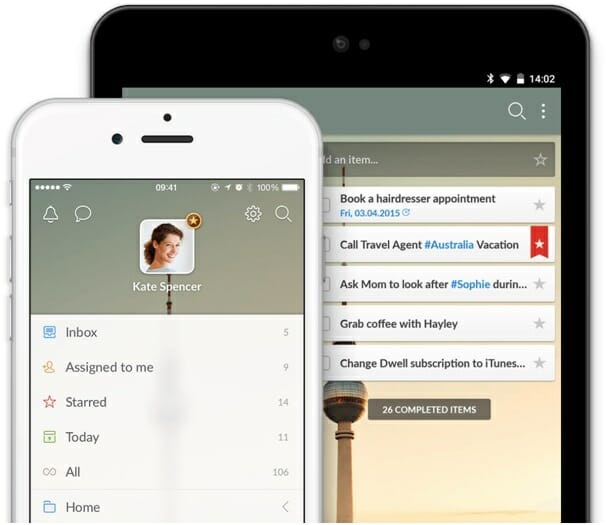
  • These 4 To-Do List Apps are Perfect for Freelance Writers

    These 4 To-Do List Apps are Perfect for Freelance Writers

    Planning on paper suits some freelancers very well…but if it’s not for you, you’ll want to find an app that’s easy to use.

    Apps, rather than paper planners, suit freelancers who:

    • Like to work on the go — physical planners can be fairly heavy to tote around
    • Need to assign tasks to other people — perhaps a virtual assistant or a partner
    • Want to add notes or attachments to a task — not easy on paper!
    • Have a lot of recurring tasks — apps can make it effortless to track these

    Here are four apps you might like to try out.The first three can all be used on mobile devices (smartphone/tablet), on the web or through downloaded software on your computer. The fourth is computer-only and can be installed on a USB pen if that suits your way of working.

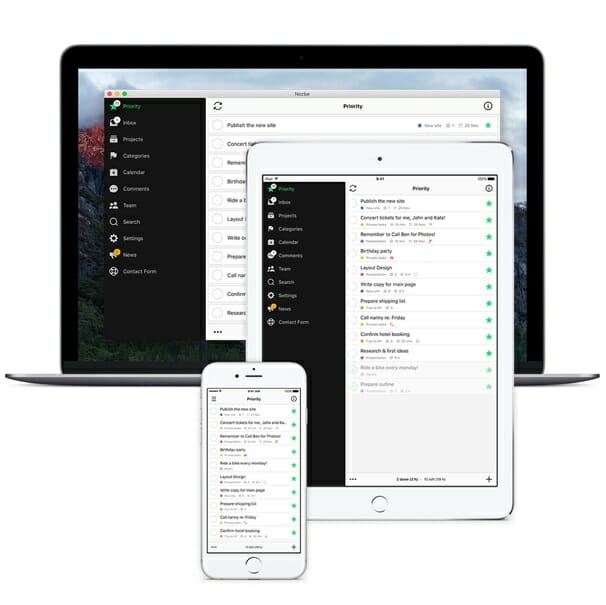
    1. Nozbe [$10/month]

    I used Nozbe for a couple of years, and only recently transitioned to paper planning instead.

    Nozbe’s “Pro” plan ($10/month, or $8/month if you want to pay for a whole year up-front) allows for two users, making this a great app if you want to share tasks with a virtual assistant or your spouse.

    Although you don’t need to follow David Allen’s Getting Things Done (GTD) methodology to use Nozbe, it is designed with GTD in mind – so you can easily see a list of your “priority” tasks (“next actions”, in GTD’s lingo). Unsorted tasks go into your “inbox”, and from there, you can assign them to a project and (optionally) give them a “category” (like GTD’s “contexts”).

    You can add comments and attachments to your tasks, so it’s easy to keep all the information you need in one place.

    Nozbe incorporates a calendar, which will show all your tasks that have a due date. You can easily drag and drop tasks to different days on the calendar in this view.

    2. Trello [free, or $9.99/month for more features]

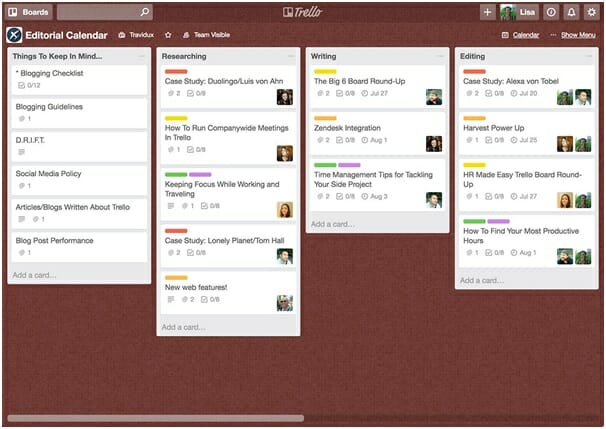
    (Image from www.trello.com)

    Trello takes a very visual approach to task management, using boards, lists and cards.

    You can easily drag a “card” (which may represent a task or a project like a whole blog post) from one list to another.

    For instance, you might set up a board for “freelancing assignments”, with lists representing the different stages of each assignment – e.g. “pitch”, “draft”, “final draft”, “published”.

    You can assign tasks to different people, if you’re working as a part of a team – and like with Nozbe, you can add comments and attachments to tasks.

    There’s a calendar view in Trello, though you need to use a “Power-Up” to enable it before you can use it. (On the free plan, you’re limited to one Power-Up per board.)

    Again, it works in a similar way to Nozbe: you can drag tasks onto different days to reschedule them.

    3. Wunderlist [free; $4.99/month for more features]

    Wunderlist is a streamlined to-do list app that organizes by “tasks” and “sub-tasks.” It’s designed for individuals rather than teams (unlike Nozbe and Trello, which let you easily collaborate).

    You can share whole lists with friends/family, but you can’t assign individual items on a list.

    While you can set due dates and reminders for your tasks, Wunderlist doesn’t have a built-in calendar view, so if you want to put your tasks on a calendar, you’ll need to use Google Calendar, iCal, Outlook or another calendar that supports the iCalendar format.

    If Nozbe and Trello seem too complex and you just want to track a few to-do lists, Wunderlist might be the best option for you.

    4. The Journal [$64.95 one-time payment]

    (Image from www.davidrm.com)

    The Journal is a much older (though regularly updated) piece of software than the three apps above: the first version was launched in 1996. It’s designed for offline use.

    I used The Journal for several years when I started freelancing; I installed it on a USB pen and carried it around when I was moving between different computers. If you don’t have a smartphone (or don’t want to use it for task tracking) and need to or prefer to work offline, The Journal might be a good solution for you.

    As you might guess from the name, The Journal has a journaling focus! You can create dated entries (either for journal entries or as a daily calendar).

    You can also create your own custom templates to use in your entries. I found the template feature useful when I wanted to have a specific list of tasks on a Monday, a different list for a Tuesday, and so on: I just made a template for each day of the week.

    There’s also an undated “notebook” section of The Journal, which you can use as an Evernote alternative. You can use The Journal to post to your blog, so it could work well if you want something that allows you to have a calendar and daily to-do list in the same place as all your actual writing.

    There are dozens of apps out there that work in similar ways to the four listed here – and it’s easy to get stuck trying to make a decision.

    I’d definitely recommend  you pick something that seems a good fit for you, get it set up as soon as possible and try it for at least three weeks. No app will work for you if you don’t actually use it.

    All four tools I’ve included here have either a free version or offer a free trial, so you can give them a go before deciding whether or not to stick with them.

    Have you used any of these apps…or is there a different one that you love? Or do you prefer to use a paper planner? Let us know in the comments.

  • Q2 Check-In: Consistency and Career Development for Freelance Writers

    Q2 Check-In: Consistency and Career Development for Freelance Writers

    We’re halfway through the year, which means it’s time for another Quarterly Check-In.

    (Did you all pay your quarterly estimated taxes last month?)

    I’m going to ask myself the same five questions I asked last quarter — and I hope you’ll take the time to answer these questions as well.

    1. How much money did I earn this quarter?

    Between April 1 and June 30, I earned $16,386.34 in freelance income and received $11,799.83 in freelance payments. Yes, that means I have a little over $4,500 owed me, and most of it will hit my bank account in July.

    I also earned $684.42 in book sales. My debut novel, The Biographies of Ordinary People: Volume 1: 1989–2000, published on May 23. I haven’t received any of the book income yet, but that will start paying out in July as well.

    So far, my total 2017 freelance income (not counting book sales) is $31,541.12. That puts me $1,541.12 above my $5,000/monthly income goal. I’m going to continue to earn above my monthly income goal during the third quarter of 2017; right now, my total anticipated income for July, August and September is just over $20,000.

    In my last Quarterly Check-In, I wrote that I wanted to earn more money during Q2 2017 — and I did. A small percentage of that income came from pitching to new clients. A larger percentage of that income came from a new client inviting me to write for them. The largest percentage of that income, however, came from a current client offering me more responsibilities and a pay raise.

    2. What was the best thing I did for my freelance career this quarter?

    Arguably, the best thing I did for my freelance career this quarter was maintain my reputation.

    “Maintenance” sounds like a passive action, and it is, but it derives from consistently delivering high-quality work on time and being available to clients and editors. (Also, although it goes without saying, remaining pleasant and positive during work interactions.)

    When Lifehacker reached out to me and asked if I’d like to start writing for them, it was because I had already established myself as the kind of person who could do the work they needed. (If you read my Write Life article about time blocking, you know that I’m all about lifehacks.)

    When The Billfold asked if I’d like to take on additional editorial responsibilities, it was because I had already spent three years writing for them, moving up the ranks from freelancer to contributor to senior editor.

    The other important thing I did this quarter was expand my reputation — or, if you’d prefer, my brand.

    By adding “debut author” to my list of accomplishments, I now have another way to earn money, build an audience and grow my career. I don’t plan to stop freelancing any time soon, but I do plan to continue writing and publishing fiction. Over the next few years, I’d like my novels to become as well-known — and well-read — as my freelance byline.

    3. What was my biggest mistake (or, what am I going to do differently next quarter)?

    I’m actually thinking two quarters ahead right now, since I am more than fully booked for July and August and will likely be fully booked for September. In addition to the new responsibilities I’ve picked up at Lifehacker and The Billfold, I’m going to be completing a few one-off client projects — including one for The Write Life — that will push my workload past my ideal 40 hours/week goal.

    So I’m hoping I can work a lot of hours this summer, including doing publicity for The Biographies of Ordinary People, and then scale back to 40 hours/week in the fall.

    In terms of mistakes I made last quarter, most of them involve my book launch, which wasn’t as streamlined or cost-effective as it could have been. I’ve been taking notes on where I’ve been wasting both money and energy, and plan to make some adjustments when I self-publish and launch The Biographies of Ordinary People: Volume 2: 2004–2016 in 2018.

    4. What do I want to achieve as a freelancer next quarter?

    I want to complete all of my assigned projects on time, earn that $20,000 and continue to promote my novel. I’m not planning on seeking out any new clients or opportunities; as noted above, my schedule is fully booked and I’ll more than achieve my income goal.

    By Q4 2017, I’ll have finished my one-off projects and will be mostly done with book publicity. I should be ready to go back to my usual 40 hour/week workload while still earning my monthly income goal.

    But, as we know with freelancing, anything could happen. I’ve been in this business for five years, and I still can’t predict who my next big client will be or which publications might invite me to take on additional work. I just have to keep doing the best work I can, building my reputation as a freelancer and hoping that my writing attracts both clients and readers.

    Now it’s your turn. Ask yourself these same five questions and, if you feel comfortable, share your answers in the comments. Where do you want to be at the end of the third quarter of 2017 — or at the end of the year? How are you going to get there?

  • 6 Cheap(er) Cities Where It’s Great to be a Freelance Writer

    6 Cheap(er) Cities Where It’s Great to be a Freelance Writer

    One of the great perks of being a freelance writer is the possibility of taking your work with you, wherever you go.

    But a few conditions make certain cities more conducive to a productive freelance life than others.

    Good internet, a creative and innovative atmosphere, plenty of co-working spaces or other good places to eliminate distractions and write, and a low cost of living are essential elements for many freelancers considering leaving their home bases and starting somewhere new.

    From North America to Europe, Latin America and Asia, here are some suggestions for cheap places to live that are great for the freelance lifestyle.

    1. Medellin, Colombia

    Although once called the most dangerous city in the world, the situation has changed in Medellin. Colombia’s second-largest city has more recently been called the world’s most innovative city.

    Lisa Imogen Eldridge, a British travel writer, lived in Medellin and raves about it.

    She says you can share an apartment with views, a pool, sauna and security for around £200 (US$257) a month, and have an organic food delivery for £20 (US$25) per month. The WiFi connection is fast, and there are lots of great cafes for working in and meeting people during working hours.

    2. Chiang Mai, Thailand

    This city in northern Thailand is a favorite among travel bloggers and digital nomads.

    While this means you won’t be the only foreigner in town, it does mean there is plenty of support for the freelance lifestyle. Plus, it’s pretty, has a good climate and is cheap!

    Forbes Magazine cites rents in Chiang Mai as starting at just $100 per month. Food is also extremely cheap, and there is a large network of entrepreneurs in the city with whom to bounce ideas off. Meet-ups and conferences in different industry niches are frequent.

    3. Berlin, Germany

    While cities in Western Europe may never be as affordable as some in Asia or Latin America, for freelancers who want or need to be in Europe, the German capital is an excellent choice.

    Rent prices in Berlin are extremely affordable — cost of living index Numbeo lists a one bedroom apartment in central Berlin as costing around US$625 per month, as opposed to $2000 per month in a nearby European capital, London.

    And of course, if you have a European Union passport, there are no restrictions on living and working in Germany (although citizens of the UK may need to act fast if they want to make the most of this undeniable benefit of being part of the EU).

    cities to be a writer

    4. Portland, Oregon

    Portland is one of the best cities in the USA to embark on a freelance career, for many reasons. A large proportion of its inhabitants surely agree, as 16 percent of the city freelances for a living.

    Aside from the great outdoor and leisure pursuits nearby, the city has a low average cost of rent ($960 per month).

    5. Tel Aviv, Israel

    The Mediterranean city of Tel Aviv is known as one of the hippest cities in the Middle East, even being called “the essence of cool” by Forbes Magazine.

    While some areas of the city are cheaper to live in than others, American expat Jaclyn Mishal points out that Tel Aviv is known as one of the best start-up hubs in the world for good reason.

    The city is full of cafes and co-working spaces, and South Tel Aviv is the perfect place for freelancers on a budget. Health insurance is free, or nearly free (up to $50 a month for tourist insurance), which may be a massive draw for U.S. freelancers.

    It would be difficult for non-Jewish people to live in Israel permanently, but working there for a shorter period is not so hard, according to Jaclyn.

    6. Lisbon, Portugal

    A 2017 survey by Dutch freelance platform Hoofdkraan ranks the Portuguese capital as the best city in the world for freelancers.

    While such statistical surveys should always be taken with a necessary pinch of salt (one freelancer’s heaven may be another’s hell), is seems  Lisbon does have a lot going for it.

    It is cheap, the internet is fast and the environment is attractive.

    If Lisbon doesn’t appeal for some reason, the Portuguese city of Porto also featured on Hoofdkraan’s list, at number 10.

    It’s worth keeping in mind that depending on your passport, it may not be possible to stay in some of these destinations long-term. But that might be ideal if you just need a temporary change of pace, or if you need to reduce your cost of living while transitioning into a full-time freelance career.

    Bon voyage!

  • Guess What, Freelance Writer? You’re Also a Salesperson

    Guess What, Freelance Writer? You’re Also a Salesperson

    It’s not difficult to see the correlation between freelance writers and salespeople.

    In both professions, success depends on a person’s ability find prospects and develop relationships with new clients.

    Yet somehow, most freelance writers don’t recognize the need to familiarize themselves with best practices for selling. Taking the time to learn and put sales skills into practice can result in more clients, higher pay and other satisfying career goal realizations.

    Here’s a look at how freelance writers are more like salespeople than they may initially think.

    1. We both seek out and document leads

    Whether a handwritten ledger, Evernote entry, Google calendar reminder or spreadsheet, successful freelance writers are constantly seeking out new leads, and keeping track of their conversations (and next steps).

    The average salesperson takes this to the next level with a number of systems designed to make sure they never lose an opportunity.

    They use customer relationship management (CRM) software like Salesforce to keep track of prospects and where they’re at in the sales process.

    2. We both aggressively pitch prospects, hoping to get a foot in the door

    Salespeople call them sales calls. Freelance writers call them pitches.

    But each of these tactics exists to help their user get a foot in the door with a decision maker that can ultimately determine whether or not they get the business.

    And as good salespeople know, oftentimes it takes (many) more than one touch like a call or email to close a prospect.

    3. We both know how to waste time

    For freelance writers, it’s easy to waste time when writer’s block hits, or getting distracted by just about anything when working at home.

    For salespeople, it’s easy to get caught up in research and preparation for sales calls, often because they just aren’t feeling up to making the actual call.

    In either case, freelance writers and salespeople can easily waste a day that could be spent chipping away at tasks.

    It’s important to be able to recognize time-wasting activities so that you can learn to fight them!

    4. But we also both know how to work with strict deadlines

    For salespeople, it’s hitting quota by the end of the month.

    For freelance writers, it’s delivering a high-quality assignment in what’s usually a very short amount of time.

    For both parties, operating under the pressure and stress of a deadline doesn’t kill, but makes them stronger.

    5. We operate with specific metrics in mind

    For salespeople, this might look like time spent on the phone. For freelance writers, it may be making sure we’re hitting word count without sacrificing quality.

    For both salespeople and freelance writers, we’re driven by the number of contacts we make, and resulting leads for realistic prospects.

    6. We both make money directly proportionate to what we sell

    Salespeople call it commission.

    Freelance writers call it income.

    In either case, the amount of money you make completely depends on your sales activities — targeting prospects, preparing pitches and following up on opportunities.

    Both parties might call these tactics by different names, but the idea is the same. If you’re not hustling, you’re not making money.

    The point?

    Everybody sells something.

    Whether they’re salespeople, freelance writers, HR managers or janitors. We all employ sales tactics to get what we want, as simple as gaining agreement for a certain opinion to negotiating a new position or raise, to more life-changing situations like closing the deal on a major client.

    Though everybody sells in different ways, it’s especially easy to draw parallels between salespeople and freelance writers.

    What kind of questions or struggles do you have around growing your business? Leave your thoughts in the comments below.