
Tag: get published

  • This Course Will Help You Write Better Personal Essays — And Get Them Published

    This Course Will Help You Write Better Personal Essays — And Get Them Published

    It’s clockwork-level predictable: I say I’m a writer, and the first question I get back is, “Ooh, so you write novels?”

    And while I’m definitely not knocking you fiction folks, I straight up can’t do it. Every time I try, I just end up with thinly-veiled autobiography.

    Luckily for me — and other writers like me — the personal essay is a thing. In fact, it’s even a thing you can get paid for.

    But it’s definitely a competitive market out there. If you want your work to stand out from the crowd, or just find its way to the right editor in the first place, it helps to learn from a writer who has done this successfully.

    Which is exactly where Amy Paturel’s online personal essay writing course, Essay Writing: How to Find the Story in You — and Sell It” comes in.

    Learn how to write (and sell) personal essays

    We get it: Heading off to an MFA program for a degree in creative nonfiction isn’t in the cards for everybody. But what if you could have an affordable, professional personal essay workshop delivered directly to your email inbox? 

    That’s exactly what Paturel offers with her online personal essay writing course: Essay Writing: How to Find the Story in You — and Sell It.  Bonus points for being able to complete the entire thing in the comfort of your pajamas. (Well, mostly. There is one prompt that involves hitting a bookstore…but who hasn’t visited a Barnes and Noble in sweatpants?)

    Writing and revision prompts are just one part of this six-week course, which offers brilliant craft advice as well as granular details, like where to submit personal essays so you can get them published.

    And Amy Paturel is the perfect person to guide you through the process of learning how to write a personal essay. A journalist who writes widely in the health and nutrition spaces, she’s had her own essays featured in outlets like The New York Times and Parents

    Not only is she an accomplished writer in her own right, but she’s also an accomplished instructor: she’s done seminar-style sessions in person and also offers one-on-one online coaching, and she’s been teaching a version of this very essay course for about a decade.

    Can you actually sell personal essays? 

    Right from the get-go, Paturel keeps it 100: she doesn’t waste time compounding your pipedreams or setting you up for disappointment.

    “You should know going into this class that unless you’re David Sedaris, Lena Dunham or Joan Didion, you’re not going to become rich on essays alone,” she says in the first lesson.

    But that doesn’t mean essay-writing isn’t worthwhile. As she goes on to explain, it’s some of the most rewarding work a writer can do — and yes, it can also be saleable. 

    Although markets are limited and competition is high, Paturel’s guidance stacks the odds in your favor…especially since she includes a killer essay market database complete with specific editor contact information for 130+ publications.

    While Amy doesn’t promise it, plenty of her students end up with big-time bylines that are well worth envying.

    Even if you don’t end up selling the pieces you workshop over the six-week course, you’ll definitely walk away a stronger writer: one unafraid to “put your whole self into it—your biggest hopes, greatest fears and deepest regrets.” 

    After all, most of us didn’t start writing in the first place because we were promised a hefty payday. (If anything, we may have thought we were resigning ourselves to a lifetime of working as a barista.)

    What we like about Paturel’s personal essay writing course

    After checking out the course for ourselves, we can honestly say there’s a whole lot to like about it.

    • Paturel includes real-life personal narrative examples of hard-hitting essays published in outlets like Newsweek and The Boston Globe — by both herself and other writers.
    • The course is comprehensive: Paturel covers the important components of a well-written piece, like vulnerability, personality and honesty, and more technical craftwork like word count, sensory details and dialogue. But she also goes beyond the drafting stage, offering ideas for how to deal with constructive criticism, rewriting for a specific outlet, and figuring out where and how to pitch or “query,” all with professional expertise and an injection of humor.
    • Paturel’s course offers specificity, including real-world examples of query letters and insider tips on how to do the investigative footwork to find editor contact information. (This is often the hardest part, in my opinion, or at least the most thankless. You’ve already put so much work into writing the dang thing…now you’ve got to become a private eye just to figure out who to sell it to?)
    • The course includes tons of actionable exercises that are easy to follow along and incorporate into your wider writing life. For example, Paturel dives deeply into the importance of journaling and teaches you how to hone your existing journaling practice to nurture budding essay ideas. She also offers weekly writing and revision assignments that are accessible but constructive — and fun. By the end of the course, you’ll have at least one polished, revised essay draft ready to submit!
    • The course is accessible — dripped out in digestible, weekly emails over a six-week period, it keeps you actively writing without leaving you feeling overwhelmed. And as mentioned above, it’s way more affordable than grad school…and you won’t have to attend even one stuffy faculty party.

    The one drawback we see: unlike a traditional workshop (or even some webinars), Paturel’s course doesn’t offer student interaction or instructor feedback. She does offer one-on-one coaching and one-off critiques, but if that’s something you’re interested in, you’ll need to purchase it separately. 

    You could also enlist the help of an accountability partner or your local writers group for feedback — and either way, you’ll get out of it what you put into it.

    But wait…Here’s the most valuable part

    Last but certainly not least, Paturel’s course includes access to her personal essay market database. We mentioned this above, but it’s worth diving deeper because this is truly an invaluable tool that will save you tons of time and even more headaches. 

    While the course arms you with what you need to conduct a thorough masthead investigation, this document takes out all the footwork for 130+ publications, including direct points of contact, notes on what kind of content they publish, and even pay rate information in some cases. And they’re definitely outlets you want to be published in: LA Times, Lenny Letter, Buzzfeed, etc. 

    It’s not a stretch to say that the database itself is worth the cost of the course, which is $325.

    If personal essays are your thing — or you want them to be — join Amy Paturel’s course on personal essays

    Once you land a few bylines, we hope you’ll let us know!

    Looking for other good trainings? Check out our guide to the best online writing classes.

    Photo via GuadiLab/ Shutterstock 

    This post contains affiliate links. That means if you purchase through our links, you’re supporting The Write Life — and we thank you for that!

  • The 3 Biggest Pitch Mistakes This Editor Sees Every Day

    The 3 Biggest Pitch Mistakes This Editor Sees Every Day

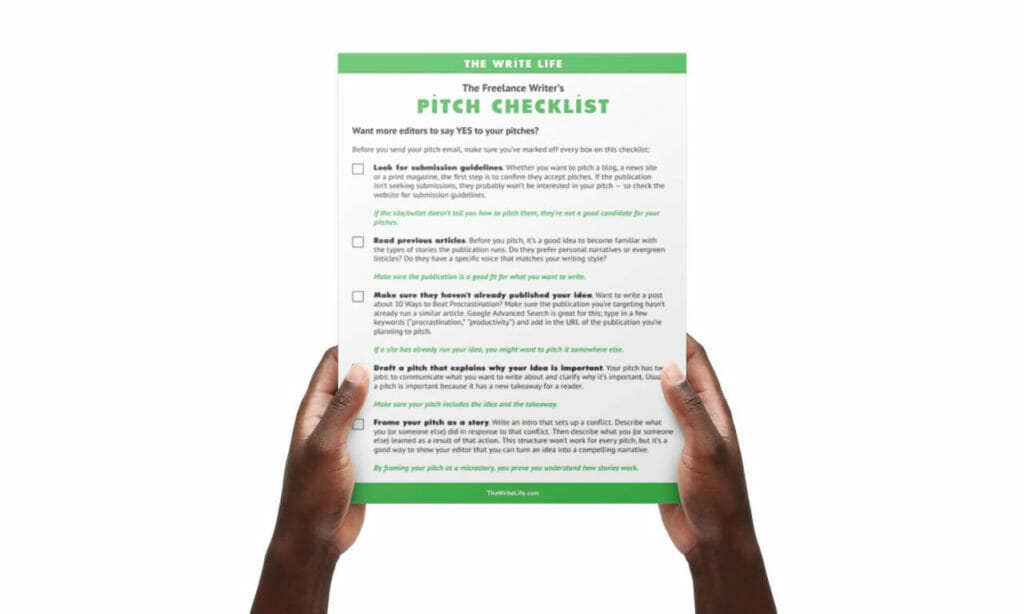
    The Write Life wants to help you get better at pitching! Grab our freelance writer’s pitch checklist. 

    As an editor, I read a lot of pitches.

    Some of them are really easy to say yes to — they’re the pitches that outline a strong, clear narrative with a takeaway for the reader. Other pitches are easy to say no to — they’re either poorly written, irrelevant to the publication or (as is often the case), both.

    It’s the ones in between that are hard.

    Every day I see writers pitch ideas or topics that could be great stories if they’d done a little more work or written a slightly better pitch. Sometimes I ask them to rework their pitch.

    Sometimes I take a chance and hope there’s a good story in there. But often, I say no. After all, I have plenty of better pitches in my inbox.

    Pitch mistakes even good writers tend to make

    If you’re a writer who’s sending out pitches but not getting a lot of assignments, maybe you’re writing those in-between types of pitches, the kind that could be really good with a little improvement.

    Here are three of the most common pitch mistakes I see every day, along with how to fix them.

    1. Do your “exploring” before you pitch

    If there’s one word I hate to see in a pitch, it’s “explore.”

    A writer who wants to explore an idea is a writer who doesn’t know what they want to write yet.

    These are the kinds of pitches that sit in my inbox for days because the writer usually wants to explore something interesting — but I don’t know if that exploration will result in a good story.

    I understand you don’t want to do a lot of work before pitching an article that might never get picked up. But instead of writing this:

    Now that the Ringling Bros. and Barnum & Bailey circuses have officially closed, I’d like to explore what happens to the animals after the circus shuts down.

    Try this:

    What does retirement look like for a circus elephant? Can an unemployed hoop-jumping dog get a job in Hollywood? The Ringling Bros. and Barnum & Bailey circuses ended their 146-year run this summer, and this piece will look at what the future might hold for the big top’s animal employees.

    In both cases, the writer hasn’t yet done the research required to answer the question. But the second pitch proves that the writer has thought about a few possibilities and has moved past the exploration stage.

    If you’d like to learn more about how to pitch a piece that requires research, including when and how to list sources, check out our Pitch Checklist

    2. If you’re pitching a personal narrative, put the narrative into the pitch

    When I see a pitch like this:

    I’d like to pitch a story about the summer I interned at the circus.

    My immediate response is: okay, pitch me that story.

    If you’re pitching a personal narrative, make sure your pitch includes the narrative. The beginning, the middle and the end.

    Ever since I was a kid, it was my dream to run away and join the circus. So, when I was in college, I did the next best thing: I signed up for an internship. I knew that circuses took a lot of work, but I didn’t realize that I’d be balancing three rings of retail, company management and customer service all at once. And, like the elephants, I was getting paid peanuts.

    Did I learn a lot that summer? Yes — including the fact that the circus life was not for me. But I still use the skills I learned while ringing up T-shirts and cleaning up empty cotton candy bags, and I’ll never forget the nights I spent under the big top.

    Notice that this second pitch also uses the type of language I’d expect to see in a finished piece. Metaphor, imagery, even a bit of humor. Don’t be afraid to let your writing style show — after all, editors are evaluating both what you pitch and how you pitch it.

    For more tips on pitching a personal narrative, read check out our Pitch Checklist.

    3. Don’t stop your pitch where your story begins

    Here’s one more common pitch mistake that I see almost every day.

    Writers send in detailed, well-written pitches that end right before the story begins:

    When I was six, the circus came to town. I spent the next week playing circus with my stuffed animals and trying to get my dog to jump through my hula hoop. Some kids would move on to another interest, but not me — I remained circus-obsessed for my entire childhood. By the time I was a teenager I could name the ringmasters of all the major circuses, and knew the history and symbolism of the different types of clown makeup.

    When I went to college, I knew I wanted to run my own circus someday. So, during my junior year, I got an internship with a local circus. That’s when I learned that although the circus had made everything seem effortless, running a circus took a lot of work.

    I’d like to write a 1,500 word essay about my internship and what I learned. I’ve previously been published at […]

    pitch mistakesSee how that pitch ends right when the actual story starts? The hula hoop anecdote and the clown makeup detail are exposition — and while it’s useful to know the backstory, I want to know why the internship is important, not why this writer fell in love with the circus.

    The personal narrative example, above, is a better way to pitch this piece. You could even frame the central conflict at the beginning of your pitch: “What happens when you achieve your childhood dream — and discover that you no longer want it?” That lets an editor know exactly what your story is going to be about, and whether it’s going to be a good fit for the publication.

    Here are a few more good pitching resources:

    How to Sell a Story That Relies on a News Peg

    Take This Scientific Approach For Your Next Freelance Writing Pitch

    Pitching Long-Form Journalism? Don’t Forget Your Goal

    The more you know about what editors are looking for when they go through the pitch inbox, the more likely your pitch will go from “maybe” to “yes” — and that’s good for both you and your editor, because you’ll get a new gig and your editor will get a great story.

    Writers: are you making any of these common pitch mistakes? Editors: any other pitching advice to share?

  • How to Stay Positive on Your Path to Getting a Book Published

    How to Stay Positive on Your Path to Getting a Book Published

    Flashback to me, four years ago: a freshly-completed novel saved in my computer, an organized spreadsheet of agents to query, a vision of multiple offers, of my name on a book cover, of tours and sequels and foreign rights, and yes, even a movie deal.

    Skip to the present, and my writing career is nowhere close to that highly successful point I thought I would reach.

    Since my first bumbling attempts at querying agents, I’ve completed three more manuscripts. I queried two of them. And, you guessed it, I received emails upon emails of rejections.

    I’m too scared to count how many, but it’s safe to say they number somewhere in the hundreds.

    But last month, I typed the opening chapter of yet another novel manuscript. Sure, there are days when I curl up on the sofa, bingewatch some Netflix and nurse my bruised ego back to health. But most days I write.

    So how do I keep going? What do I do to pick myself back up after agent number five jillion says thanks, but no thanks?

    Here are few ways I’ve learned to cope with the growing folder of rejections.

    1. Change your definition of success

    You can probably see from the opening paragraph where it all went wrong, huh?

    I thought agents were going to be battling for my “genius work”, and I’d be an instant bestselling author.

    Instead of aiming for that nearly-impossible shot, you can adjust your target.

    Let your success become completing a manuscript, editing a scene or putting words on the page. Any time spent writing and honing your craft counts as a victory.

    If you re-frame your definition, any step toward your larger goal of publication is a step in the right direction. Yes, even that latest form rejection counts. You’re putting your work out there.

    Bullseye.

    2. Write every day…sort of

    Some espouse the benefits of writing each day, no matter what. Others have said that every writer’s way of working is different, and you should do what works for you.

    If you’re like me and you work in spurts, then measuring your progress based on a daily word count increase tends to make you feel unproductive.

    So even though you might not be writing seven days a week, other activities which aid your writing can count as daily writing time.

    Reading a book on craft, research for your next story, brainstorming ideas, and reading all count as writing time in my book.

    3. Stay connected with writer friends

    I can safely say that I wouldn’t have made it this long in the writing game without the support of other writers.

    They get it.

    They deeply understand how devastating it can be when the agent of your dreams doesn’t even answer your query email. They know the agony of re-working the structure of an entire novel. They have an empathy that non-writers just can’t, because they’ve traversed those same query trenches.

    You can find your own circle of writer friends through Twitter, Facebook writing groups and online writing contests.

    Sometimes you need to shoot off a quick message, to vent your frustrations with outlining or to bounce an idea around, and those awesome writers are right there with you.

    4. Get out of a fiction rut

    Sometimes that story just isn’t working. Sometimes that character just won’t do what you need them to do, or the logic that worked in an outline suddenly seems full of holes while you’re drafting, and you just can’t see a way out of it.

    Sometimes you don’t even have a story to fill that glaring white page.

    That’s when you can change things up.

    Go back and read passages you wrote that you really love. Or read a few pieces of short fiction and let those inspire your own brief experiments that no one else sees. Anything to get your brain gearing up in a different direction, to shake those clogs loose and get things running again.

    Try something new. Step, or even leap, out of your comfort zone. You might surprise yourself.

    5. Step away from the computer

    And if you still find yourself blocked, that’s when you know you need a break.

    Your creative mind can only output so much before it requires more input. So let your starving mind have a meal. Exercise. Go for a run. Or go to a museum. Hang out with family or friends. Meditate.

    My favorite place to go is an isolated trail along the river, and I let myself not think about writing.

    Do whatever you need to do to allow your brain some rest. Your body needs sleep to grow. So do your ideas. I used to feel like a failure if I wasn’t spending every minute writing. But personal care is just as important as productivity.

    And usually, once I’ve had some time away, I can’t wait to get back to writing.

  • 5 Ways Small Press Publishers Offer Opportunities for New Authors

    5 Ways Small Press Publishers Offer Opportunities for New Authors

    When I queried my first novel, I was looking for an agent, with the intent of pitching the “Big Five” publishers, and maybe some of the bigger small presses, if necessary.

    I got some bites for partial and full manuscripts, as well as some encouraging comments, but no contracts.

    Then, a small press approached me through #Adpit–a Twitter event where authors try to entice agents and editors with 140-character pitches. My first thought was that if this small press wanted me, surely they were no good. (Or as Groucho Marx said, “I refuse to be part of any club that would have me as a member.”)

    What can I say, I’m cynical by nature.

    There are plenty of horror stories out there to justify my cynicism. So many small presses turn out to be scams or vanity presses in disguise, with business models based on profiting off authors instead of readers. Others’ simply fail and disappear into a black hole, taking authors’ story rights with them.

    But I didn’t want to miss out on a legitimate opportunity, either. So I took two weeks and vetted the small press — hard.

    Ultimately, I decided I’d rather fail by action than by inaction, and I took the plunge.

    A year later, I’m so glad I took the risk. My small press has been an incredible partner in this whole publication journey. In fact, I think working with a small press for my first release was better for me than working with a Big Five publisher.

    Why? Five big reasons.

    1. They give me generous attention and support

    As a newbie to publishing, this was major.

    My publisher was very understanding of my questions and nerves, and especially helpful when I had questions. In fact, I feel welcome to shoot an email to the chief marketing officer and the chief operating officer (the co-founders) any time a question pops up — and of course, my editor too. They don’t just tolerate this; they have been supportive and excited for me every step of the way, and have tipped me off to some opportunities I would not have found on my own.

    When my book launched, I received a detailed calendar of ads and promotions that my book would be marketed through, and the book got a number of reviews — and all were positive, save one who was just clearly not my target audience.

    2. I’m getting an education in the publishing business

    I expected to be excited when my book was released, but I was not prepared for what it would actually do to me.

    I completely lost my mind. For a full month. Seriously.

    My first book was going out into the world, and as it turned out, I absolutely could not be cool about it. I worked around the clock, could not sleep, and forgot where I put everything from my pen to my wallet.

    I even forgot to celebrate.

    When I finally I recovered, I realized there were a lot of aspects of writing as a business that I hadn’t thought about before, like promotion opportunities, sales funnels and pitching events.

    But because I’m with a small press, I’ve been able to experiment, test and learn on-the-fly what works for me and what doesn’t, without the pressure of a major publisher hovering over my sales metrics. It’s been a real education.

    3. They’re open to innovation

    One of the most commonly cited benefits of small presses is that they are more agile and willing to take risks than bigger publishers. This has been true, in my experience.

    One promotion technique I wanted to try was a reader magnet, a free piece of content you give away to email subscribers. I had a story in mind for a great novella that would tie right into my developing series and reward readers who read both with little surprise connections.

    Only problem was, my publisher has first right of refusal on anything related to my series.

    I asked them about it, hoping to get lucky and have them waive their right to the material. What I got was even better: Not only were they supportive of the tactic, but they also offered to treat my perma-free novella like any other release, with pro design and editing services.

    Would a Penguin or HarperCollins be up for giving away a book for free? For a debut author? I can’t be sure because I’ve never worked with one, but I really, really doubt it.

    4. I’m part of a community of like-minded authors

    When I joined my small press at the Romantic Times Booklovers’ Convention last year, I got to meet some of the authors they publish, and it was an immediate sisterhood. Since then, we’ve read each others’ books, shared promotion successes and failures, traded guest posts, and cheered each other on.

    We all have the attitude that what’s good for one of us is good for all of us.

    My publisher set up a private Facebook group specifically for its authors, with none of the editors or publishers in it, just so we could build these kinds of connections. I am confident these women (and some men now, too) will be part of my writing community for many years to come.

    5. Someone’s looking out for me

    My publisher is looking out for my best interest every step of the way. I know this because I have seen it play out time and again.

    For example: At any publisher, authors get a certain number of copies of their book for free, but then must pay a discounted price for any books beyond that number (if an author got unlimited copies, at some point, the business model wouldn’t work). The discount I am entitled to is in my contract.

    However, when I placed a large order in preparation for a number of upcoming events, my publisher went to bat and got me a significantly steeper discount, and passed the savings on to me. She could have just kept the extra profit for herself if she wanted to, and I would never have known.

    Even more recently, my editor invited me to be part of a panel she is pitching for an upcoming convention.

    A first step for a long career

    Signing with my small press was a gamble: I might find success, or maybe I’d get ripped off.

    But one year later, I’ve had incredible, invaluable experiences that have improved my writing, set me up for long-term success, and have found an incredible community of authors and publishing pros. My first novel is even a finalist for a state-wide award that will be announced in October.  

    While I hope to grow my author career by adding an agent, major publishers, and even some self-publishing into the mix, I would definitely publish with a small press again, too — particularly, the one I’m with now.

    Have you ever worked with a publisher, big or small? What was your experience?