Tag: improve writing

  • Why Is Writing So Difficult? Here Are 3 Reasons Why

    Why Is Writing So Difficult? Here Are 3 Reasons Why

    Writing is hard. Even the best writers think so.

    Hemingway once said “There is nothing to writing. All you do is sit down at a typewriter and bleed.” Anything that requires bloodshed is not easy — trust me, I’ve had children!

    I’m the type of writer who agonizes over word choice. I read and reread my writing until the words lose meaning. I edit pieces a dozen times before I’m ready to publish.

    My husband, who is also a writer, can craft a thoughtful piece in about 30 minutes. He may make a few errors, but he doesn’t sweat them.

    My writing process is a teeth-gnashing-and-wailing situation while his is a Sunday drive.

    It makes me wonder — why is writing so much harder for some of us?

    Here are the three main reasons why writing is more difficult for some writers.

    1. Crippling perfectionism

    Try telling a perfectionist “done is better than perfect.”

    They’ll say nothing’s better than perfect, that’s why it’s perfect!

    The problem is, it’s nearly impossible to produce anything perfectly. Trying to do so will usually result in one perfect sentence in a piece no one will ever read.

    Perfectionism is exhausting. Even when you try to make things perfect, they don’t end up that way. You just wind up annoyed and overwhelmed by the process. Sometimes you can be too burnt out to even start because you know that it will end in tears. That’s the worst thing about perfectionism — it can stop artists from creating anything at all.

    There is no cure for perfectionism that I’ve found. The only way to get through is to slowly desensitize yourself. Allow your work to see the light of day regardless of whether it’s perfect or not. Show it to a trusted friend who you know will be supportive before releasing it to the masses. Put a limit on your edits or a timer on your revisions and make yourself stop once time’s up. Get comfortable being uncomfortable with your finished work.

    One piece of advice that helps me is to tell myself I can always release a second version and there are no completely finished works. Keeping this in mind allows me to publish things while calming my inner panicked perfectionist.
    No matter who you are, writing is hard. But could you be the source of the majority of your writing problems?

    2. Inconsistent writing schedule and being out of practice

    Those of us who wait for our muse often get stood up.

    Muses are notoriously fickle, flaky, and uninterested in inspiring us mortals to finish our projects. Waiting on the perfect time, the right mood, or the retrograde to end may lead to not writing as much as we’d like. Or at all.

    We end up thinking about writing, wanting to be writing, dreaming about writing, but not actually putting pen to paper or hands to keyboard very often. Days, or even weeks, may pass between writing sessions.

    Being out of practice or inconsistent with your writing schedule is a big reason for writing feeling difficult. When I wrote for 30 minutes each day, one of the biggest benefits I found was that writing got a lot easier. During the first week or two, thirty minutes would result in a few paragraphs. Near the end of the 30 day experiment, I was writing almost 1000 words during my half hour sessions.

    Think about this: When you were a kid regularly playing on the playground, you could fly across the monkey bars with ease. Go to playground and try the monkey bars now as an adult. It’s insanely difficult! Your grown up body isn’t used to moving that way so it takes time for your muscles to remember what to do. You may not have the strength to make it past a few bars.

    The same goes for writing. If you don’t use it, you lose it. The only way to keep your writing muscle strong is by actually exercising it. Doing so makes the whole process feel easier.

    Set a goal of writing each day, for any amount of time, and see how much progress you can make.

    3. Lack of confidence and fear of failure

    It can be hard to stand behind your work.

    What if people don’t like it? What if they call you the two most dreaded words a scribe can hear — a bad writer?

    You’ll get over it, I promise. The thing about opinions is that everyone has one and they aren’t always true or helpful.

    Some of the world’s most beloved writers were considered bad because they didn’t follow traditional grammar rules or couldn’t spell like Faulkner and Fitzgerald. Some of today’s most popular writers have been roasted by critics for “bad writing” like Stephanie Meyer. Even if you write something terrific like JK Rowling’s Harry Potter series, you still can’t please everyone. Her work was rejected at least 12 times!

    Did it hurt these writers feelings that others didn’t like their work? Sure, I imagine it did. But they didn’t let criticisms or lack of confidence stop them from creating.

    Good writing matters, but not as much as you might think. If you can make people feel things with your writing, it doesn’t matter if it’s technically perfect.

    People are imperfect judges of everything. One person’s masterpiece is another person’s meh-sterpiece. Don’t let potential haters get you down. If you write for yourself first, you’ll always have at least one fan.

    One of my writing mottos is “feel the fear and do it anyway.” I’m always scared to share my work, but no matter the reaction I’m always glad I did. And, as a bonus, every time I put myself out there, it gets easier to do it again.

    You’re not alone

    Writing is not for the faint of heart. Creating anything takes courage and optimism. If writing is hard for you, remember it’s hard for a lot of us. The important thing is to show up, sit down, and try.

    You don’t have to reach any milestones to become a writer — as soon as you start writing, you are one.

  • 3 Ways Scrivener Makes Self-Publishing a Breeze

    3 Ways Scrivener Makes Self-Publishing a Breeze

    Professional creators should use professional tools.

    After all, how would you feel if you went to a restaurant and noticed the food was being cooked in cheap microwaves by chefs using low-quality equipment? You would probably rightly assume the output from substandard tools would be a substandard meal.

    Writers are no different.

    To produce the best work possible, it’s vital to find the right tools for the job.

    How many writers do you know who still use a standard word processor app like Microsoft Word? Perhaps you even do yourself. Why? It’s often due to a lack of knowledge about what else is out there.

    I still remember the day I found something better and tried it out for the first time.

    That something better was a writing tool named Scrivener.

    Here’s how this tool has made a major difference to my writing process.

    1. Better research and planning

    The self-publishing marketplace is more crowded and competitive than ever before.

    In the past, it was possible to release a hastily written book containing the minimum of research, and still experience success. Those days are gone. Success in the current climate requires careful and conscious research.

    Research isn’t easy. We live in an era of unprecedented information and ideas.

    Curating the best and most suitable concepts for your book is no easy task. Yet so many writers make it even tougher than it needs to be by taking a scattergun approach to the collection and storage of information.

    Before I discovered Scrivener, my research process typically involved a mess of folders, files and illogically named documents. Even worse, leaving my writing software and accessing my research disrupted my creative flow and led to procrastination and distraction.

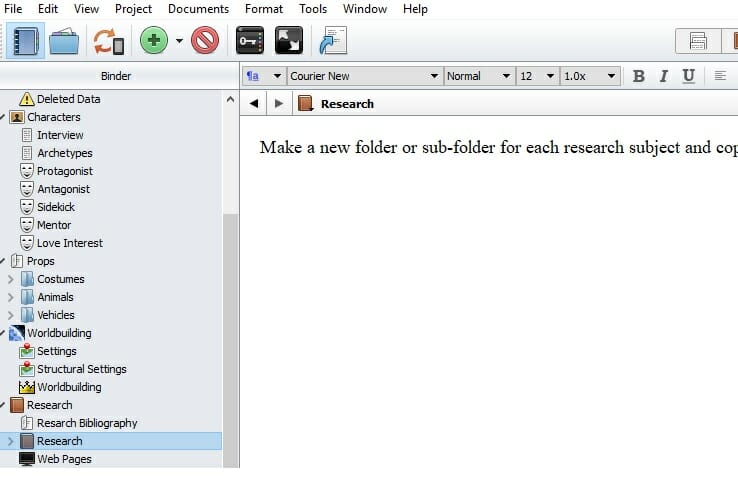
    Scrivener helped me to collect, organize and access my research in a way I never even knew was possible. Within Scrivener, you have all of your research directly available, next to the actual writing environment itself, as seen below.

    Being able to see all of your research without having to leave your writing software is an incredible time-saver and productivity-booster. You never have to run the risk of forgetting about a useful piece of research while in the throes of creation.

    Scrivener painlessly integrates text, visual and online research. It also syncs up with Evernote, making Scrivener a superb choice for Evernote fans.

    Some of the best research and planning features of Scrivener for fiction writers include the ability to create, store and access detailed character notes, create a detailed and useful outline of your story, and to store images and ideas related to setting and location.

    Professional writers need professional tools. Improve your writing process from start to finish with Scrivener.

    2. Writing well

    Any specialist writing software worth your time and money needs to offer functionality and benefit when it comes to the actual activity of writing itself.

    While research and planning are important, the core activity for writers will always be, unsurprisingly, writing itself. Thankfully, Scrivener does not disappoint in this area.

    Some of my favorite aspects of writing while using Scrivener include –

    • The ability to write in a distraction-free fullscreen mode
    • The option to use a template created by another writer to structure my work in a tried and tested way
    • Setting quantified writing targets and visually monitoring my progress towards them in real time
    • Being able to quickly and easily rearrange chapters and scenes as I write

    Write without distraction

    If you’ve ever struggled with the problem of being able to zone in on your writing and get things done, you will appreciate the full-screen composition mode offered by Scrivener. It’s a way of digitally tuning out the distractions of the world and zoning in on the vital process of stringing sentences together.

    As you can see from the above image, Scrivener blocks out everything but the words you are writing. If you combine this with a time period where you turn off your internet and cellphone, you will truly be able to focus on your writing. The full screen mode shown above displays a plain background, but you can also customize the image seen. Views of nature are a popular choice.

    Use templates for successful structures

    One of the toughest challenges for me was knowing the proper structure to use when setting out to write a book. This is another area where Scrivener excels.

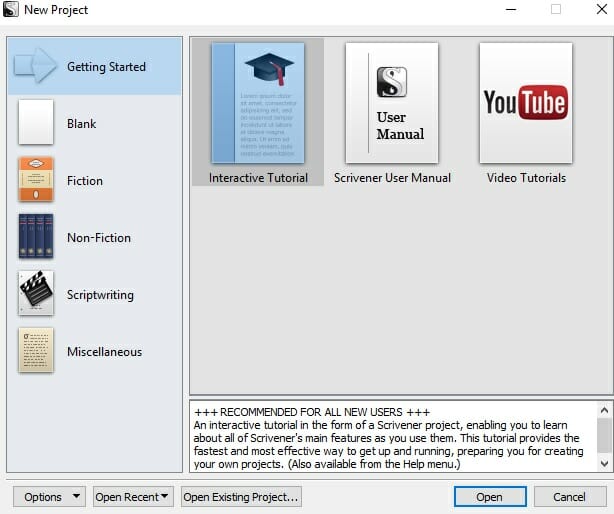
    You can easily download, import and modify Scrivener templates. This gives you a predefined structure for your manuscript and research which allows you to focus on the act of actually creating.

    Using templates in Scrivener can also give you the confidence to try out a style or method of writing you may not have experience with. For example, if you’ve wanted to write a screenplay, but haven’t known exactly how, a template can be your best friend.

    The above image shows the template selection available when loading up Scrivener. You can always add and modify templates depending on your personal requirements.

    Set targets and monitor progress

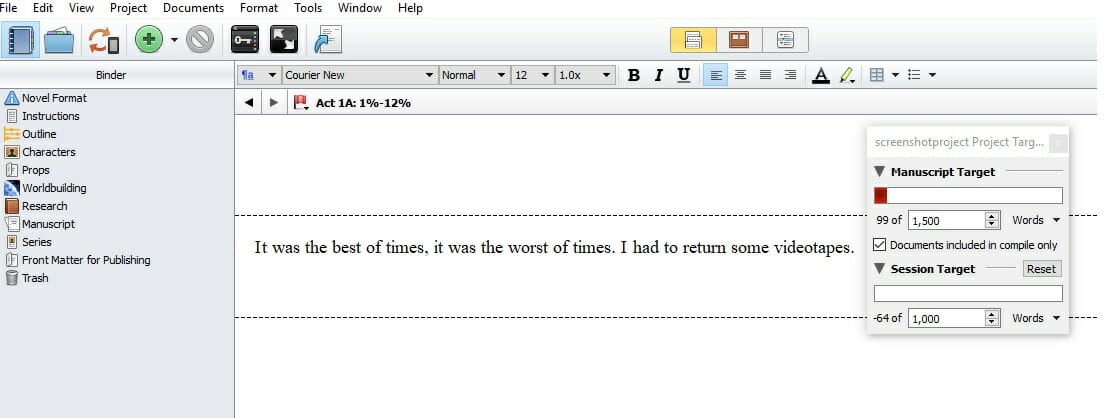
    Almost every writer has a unique approach to measuring progress and monitoring projects. If you like to set targets for your writing, and ensure you stay on track, Scrivener makes it easy. You can easily set writing targets for an individual writing session, or an entire project, and quickly monitor your progress towards them, as seen below.

    You can see that the progress box floats over your writing and shows both your overall and session targets.

    Scrivener also allows you to quickly combine, separate and rearrange the individual pieces of a writing project. If you are rewriting nonfiction, and aren’t exactly sure of the order you want your chapters to be in, it’s easy to switch up the sequence, as seen below.

    3. Formatting and sharing

    Have you ever experienced the joy of seemingly finishing a writing project, only to experience unexpected frustration when finding the right format for your work, and exporting it, becomes a nightmare?

    This is especially true when writing in software like Microsoft Word. It can be tricky to impossible to find a way of easily converting your work into the right file format. Even if you do manage to export to the file type you need, there’s often no guarantee that your work will look the way you wanted in its final form.

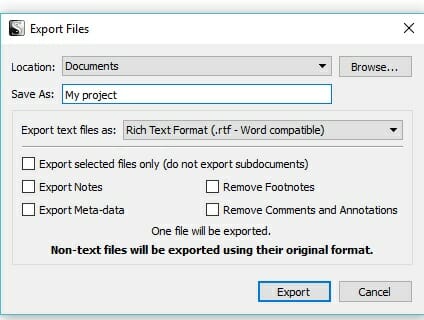
    In Scrivener, you can ensure that your writing project will look exactly as you intended after you export it. Some of the options for doing this can be seen below.

    Scrivener also supports a wealth of export file formats, which are suited to different types of writing.

    Some of the file format supported by Scrivener include –

    * .epub (used for Google, iBookstore, Nook and Kobo)

    * .mobi (used for the Kindle store)

    * .html (used for webpages)

    * .PDF (used for Adobe Reader)

    * .doc (compatible with MS Word and Google Docs)

    This powerful export capability can save both time and money. Exporting with Scrivener can save on the need to hire a freelance worker to carry out the format process for your book. It also can help you to avoid having to invest in a separate piece of software to get the file format you want.

    As well as being great for full ebooks, this file format versatility is well-suited to blogging. Bestselling author Michael Hyatt decided to switch to Scrivener for all his writing projects, not just his books. While you may not decide to go this far yourself, it’s good to know that Scrivener is suitable for whatever type of writing project you decide to engage in.

    Better Books With Scrivener

    Writing a book is a demanding endeavour requiring software that is up to scratch. Scrivener not only produces a better final product, but also makes each and every stage of the writing process easier along the way.

    If you have any questions about Scrivener, feel free to comment and I’ll be happy to respond. I’d also love to know about any awesome Scrivener benefits you’ve discovered that I haven’t mentioned here.

    This post contains affiliate links. That means if you purchase through our links, you’re supporting The Write Life — and we thank you for that!
    links

  • 12 Traits Bad Writers and Toddlers Have in Common

    12 Traits Bad Writers and Toddlers Have in Common

    So, I have a two-year-old daughter.

    (Are you also a busy parent? Check out these tips for making time to write.)

    I absolutely adore her. Don’t get me wrong.

    But sometimes she drives me so bonkers that I just want to scream, “Why God, why?” while eating raw cookie dough in a closet.

    Ahem.

    After one such episode, I got to thinking about the things that toddlers and bad writers have in common.

    It’s not that much of a stretch, really.

    Toddler = not yet a fully-formed human.

    Bad writer = not yet a fully-developed writer.

    Here are 12 traits shared by 2-year-olds and immature writers.

    1. Both are completely self-absorbed

    Toddlers: I want ice cream NOW! (while waking up entire household at 6 a.m.)

    Bad writers: I write for myself, not for my readers.

    I don’t bother to provide entertainment or value to my readers.

    It’s all about me.

    2. Toddlers and bad writers have a limited worldview

    Toddlers: I don’t like that kind.

    I only like this kind.

    I don’t want it.

    Yuck!

    Bad writers: I assume everyone shares my opinions and experiences.

    I don’t consider other cultures or perspectives when I write.

    If they don’t like it, they don’t have to read it.

    3. They insist on immediate gratification

    Toddlers: Me want to go swimming at the waterpark! (In the dead of winter, of course)

    Bad writers: I want a perfect manuscript without the need to edit, a six-figure publishing deal for my first novel and a byline in The New York Times, even though I just graduated from journalism school.

    Practice makes perfect? What a joke.

    4. Neither can handle constructive criticism

    Toddlers: On hearing that clothing might help keep their body warm, run screaming and naked through the house.

    Bad writers: There is no such thing as constructive criticism, only haters.

    I know my writing best.

    artists and toddlers5. Babies and bad writers make messes that they expect others to clean up

    Toddlers: (Purposely empties boots full of sand in the car)

    Mommy, there is sand in the car!

    Get it out!

    Bad writers: (Leaves their copy riddled with mistakes)

    Ehh, my editor will spruce it up.

    It doesn’t need to be perfect.

    6. No matter the age, they just won’t listen

    Toddlers: Sings “Let it Go” at the top of his lungs while dad tries to ask if he needs to go potty.

    Bad writers: I’m an artist, okay?

    They wouldn’t understand.

    I’ll just keep doing me.

    7. They throw a fit at the drop of a hat

    Toddlers: I said I want “Moana” radio not “Beauty and the Beast” radio!

    Wahhhhhhh!

    Bad writers: My life is over! Woe is me! I am a broken man!

    (After receiving just one negative book review, online comment or rejection email)

    8. Immature writers and toddlers aren’t careful what they wish for

    Toddlers: I want goldfish.

    No, I don’t want goldfish!

    Get it away!

    No goldfish!

    Bad writers: Man, if only I had more time to write, more freelance work and more social media followers.

    (All of this comes true)

    Oh, no! I am soooooo busy. I wish I had less on my plate.

    9. Ummm…focus? What focus?

    Toddlers: Look, a butterfly!

    Mommy, I’m hungry.

    Where is my blanket?

    Bad writers: I only write when I feel inspired.

    I jump around from project to project.

    There’s no need to finish anything.

    All in good time.

    10. Both resist changes like the plague

    Toddlers: Dad to toddler: would you like a different color crayon?

    Noooooooo!

    I only want this blue crayon!

    Bad writers: Whoever said, ‘change is good’ was seriously delusional.

    I abhor change.

    New technology, clients, writing style, editorial guidelines, whatever it may be: I fight it tooth and keyboard.

    11. Neither do what they’re supposed to do

    Toddlers: Throws clothes down the stairs after being asked to get dressed.

    Bad writers: So what if I occasionally skip deadlines, ignore emails and don’t follow through?

    Nobody will notice, anyway.

    12. They never say “thank you”

    Toddlers: They just never say it.

    No matter how many millions of times you politely encourage it.

    Bad writers: Okay, so I’ve had a little help in my writing journey.

    But my mentors don’t really need to be acknowledged, do they?

    They live for this stuff.

    I guess we all may have some growing up to do, eh? A writer’s work is never done.

    Are you guilty of any of these “baby writer” tendencies? Leave a comment and fess up!

  • What Classic Children’s Literature Taught Me About Writing

    What Classic Children’s Literature Taught Me About Writing

    There’s a scene in Maud Hart Lovelace’s Betsy and Tacy Go Downtown where Betsy’s mother helps ten-year-old Betsy turn an old trunk into a writing desk.

    Naturally, I asked my mother to do the same thing.

    If I remember correctly, she let me use an old suitcase. I put my pens and papers inside it, carried it up to the top of the bunkbed I shared with my sister, and pretended I was Betsy Ray for an afternoon.

    I didn’t keep using the suitcase, though, because I didn’t need it. I wrote everywhere, filling notebooks and diaries and the backsides of printer paper with stories. It wasn’t the desk that made me a writer.

    But it didn’t hurt to have a model like Betsy. She taught me to pay attention to the color of apple blossoms and to get a good night’s sleep before tackling a challenging writing project.

    She also taught me that once your writing is out in the world, other people can share and spread it far beyond its original intended readership. Both Betsy Ray and Laura Ingalls, as you might remember, wrote song parodies making fun of peers or teachers. In both cases, the parodies “went viral,” with disastrous consequences.

    Describing what I saw

    Laura was another childhood role model; even though she doesn’t spend much time writing in the Little House books — possibly because a slate pencil cost a half-penny — any young reader who pays attention to the book’s covers can figure out who Laura Ingalls grew up to become.

    Laura taught me to describe the world so it could be understood by someone else.

    We see Laura do this literally in By the Shores of Silver Lake, when she describes the train and its passengers to her older sister Mary, who lost her eyesight to scarlet fever. But we also see Laura Ingalls Wilder (along with Rose Wilder Lane) do this throughout the Little House series, describing butter churning and dime sociables and what it felt like to drink lemonade for the first time: the first sip sweet; the second one sour.

    I tried to replicate that discovery every time I drank a cup of powdered lemonade — which, of course, was not the same thing.

    children's literatureCombining imagination and craft

    I also tried to replicate Marilla Cuthbert’s famous raspberry cordial, working with my mom to carefully follow the recipe in The Anne of Green Gables Cookbook. I remember it tasting sticky, and I think we poured most of it down the drain. Like Anne Shirley, I was — and still am — an enthusiastic if not particularly talented cook.

    But Anne taught me to use my imagination; to see what a tree or a dress or a potted geranium might become if it were renamed or rewritten. Her shadow-sister Emily (of New Moon) taught me to be assiduous about craft. I love that L.M. Montgomery gave us both of these young writers as models: Anne with her Story Club, sharing their first drafts; Emily, in her attic, cutting out every sentence she’s no longer proud of.

    Selling my work and expanding my career

    Unlike Anne and her brush with the Rollings Reliable Baking Powder Company, I’ve never had a problem writing advertorials. I’m much more like Jo March in that aspect; if a publication is willing to pay, then I’m willing to write for them.

    Like Jo, I’ve become more discerning about the work I take on as my freelance career has progressed. I also recently published a novel that I describe as a “Millennial Little Women.”

    Because that’s what Jo — or, more accurately, Louisa May Alcott — taught me. How to take the emotions you felt growing up and write them into scenarios you might not have personally experienced. How to write characters inspired by people you love. How to go from a girl scribbling plays and stories to share with her family to a woman earning money from her writing.

    It’s no coincidence that many of the books I loved as a child featured girls who grew up to be writers. I read widely, Goosebumps and Sweet Valley High and everything the library had to offer, but these were the books I kept returning to before opening my notebook and starting another story. When I was ten years old, I pretended to be Betsy or Laura; when I was older, I asked myself what Jo or Emily or Anne might do.

    And when I need guidance — even as an adult — I still return to these stories.

    Who are your writing role models? Did you also read books about writers when you were a child, and did they shape the type of writer you became?

    This post contains affiliate links. That means if you purchase through our links, you’re supporting The Write Life — and we thank you for that!
    nolinks

  • Playing The Sims Could Help You Beat Writer’s Block — Here’s How

    Playing The Sims Could Help You Beat Writer’s Block — Here’s How

    As a writer, I have two extreme moods.

    One is that I’m feeling incredibly inspired, where it’s difficult to just write down every single idea I have, and even more difficult to actively pursue them all. The second mood is one all writers know too well: Writer’s block.

    I’ve been writing for over a decade, so I’m not new to the uninspiring feeling of staring at a blank Word document for hours without having anything to say.

    But, I do have a unique solution: Whenever I felt a particular lack of creative energy, I turn to video games: specifically, The Sims.

    Video games can provide inspiration when you feel like all hope is lost. Here’s how they can help you conquer writer’s block.

    1. They teach you about plot

    Science fiction and fantasy writer Benjanun Sriduangkaew has most recently been inspired by Masquerada, NieR: Automata, and Transistor as well as older games Silent Hill 2 and 3.

    “I was absolutely obsessed with [Automata] for at least a month after completing the game, and a lot of the story beats, themes and imagery have stayed with me,” she explained. “I like to say that writers can learn a lot from its opening, where protagonist 2B contemplates the ‘spiral of life and death’ and her speculation on whether she will have a chance to kill the god that created her one day. It sets the theme and, fitting with 2B’s musing that everything that lives is designed to end, we see her entire squad quickly slaughtered with 2B as the lone survivor.”

    Different plots will expose you to different storylines, whether they’re complex or simple, entertaining or boring, and good or bad. Either way, there’s something to be learned from all of them.

    2. They tell you how not to write

    Comic illustrator and writer Victoria Chu turned to Japanese role playing games, such as the Final Fantasy Tale of- series, to learn how to “flesh out” narratives and tell a detailed storyline.

    However, oftentimes, she noticed the plots were often extremely complicated and convoluted, which encouraged her to shy away from that type of narrative arc.

    With Final Fantasy, the original art style helped me shape what kind of aesthetic I want in my stories/ worlds,” she explains. “The narrative I find is recycling the typical one true hero archetype so I tend to not use those games for examples in writing.

    3. They help you sort through emotions

    “The last time a game helped me was when I played Persona 5 and SMT4 Apocalypse,” Chu added. “Having to deal with dark feelings was refreshing because it was making me uncomfortable in a good way.”

    While the content wasn’t emotionally triggering, the plots allowed her to understand the weight of a story conflict in a much deeper way. She learned that dark narrative themes don’t always have to equivocate distressing content.

    Additionally, when I played the Sims, it was the first time I emotionally processed what it was like to have siblings. I grew up as an only child and never had to share any of my belongings or spaces in my household, so when my characters had big families, it helped me gain a little insight — but admittedly not that much — in how I’d write about siblings. For instance, when there was only one computer in the household and a child was playing on it, I saw the other child’s fun level go down.

    4. They make you pay attention to details

    While video games haven’t completely helped Sriduangkaew out of writer’s block, she mentions that playing video games help her pay attention to small details, such as lighting.

    “I was stuck in a military science fiction story,” she explains. “Something in XCOM 2 nudged me with a little detail that let me finish writing an atmospheric description. I think it was something as random as the lighting in a mission.”

    Oftentimes, a video game’s minor details and touches can help us spark the small touches to add to our own stories, whether it’s lightning bolts in the background–or the Simlish language, the fake language Sim characters speak.

    5. They have stellar soundtracks

    If you’re like me, you can easily find yourself consumed and distracted by music when you’re supposed to be working. (Since I work from home, I don’t have any colleagues to disrupt when I burst out into song.)

    Fortunately, many video game soundtracks are instrumental.

    “Many games have music that’s intrinsically linked to individual scenes or moments,” Sriduangkaew explains. “They’re much better than most at putting me in specific moods.

    Plus, you don’t even have to play video games to listen to their soundtracks.

    To help you get in the zone, pop up your preferred music streaming app of your choice, search for a popular video game soundtrack, and get your pen and paper ready.

    The next time you’re feeling stuck, pick up a video game and allow yourself to get lost. You may soon find yourself inspired by the game’s storyline.

    Do you have a go-to game you play to foster creative energy?

    This post contains affiliate links. That means if you purchase through our links, you’re supporting The Write Life — and we thank you for that!