Editors read for a living. They read all day long.
Some writing lands on their desk in excellent form, but a lot of it requires serious work with the red pen. Generally, editors are happy to help their writers to develop strong narrative arcs, believable characters, and well-organized structures.
The most annoying thing, though, is when their writers fall at the most basic technical writing hurdles. They should not spend their time replacing adverbs with strong verbs or changing from passive to active voice. These changes can and should be completed by the writer when they do their own first edit.
Editors have limited time to spend on your drafts, and that time is expensive. Taking a little time for self-editing can impress your editor and help prove your writing skills.
Here are six common problems to fix before your editor gets out the red pen.
6 Self-Editing Practices to Strengthen Your Writing
1. Replace adverbs with strong verbs
When you write your first draft, it’s more important to get the story out than to get every word right. Spending too much time wrestling over every word can make you lose momentum.
So, if you need to write, “Mike drove quickly back to headquarters” while you’re pouring out a scene, then go for it. Your first edit is your chance to figure out how to make it stronger: “The tires screamed on Mike’s beat-up Honda as he raced back toward headquarters.”
In your first major edit, go back and reassess any adverbs you find. Sometimes an adverb will work perfectly, but more often than not, you will come up with a stronger way to get your idea across when you go back and look again.
2. Fix repetitive use of initial pronouns
This used to make my professor crazy. As a master’s student, I had a terrible habit of starting nearly every sentence with a pronoun. He did this. She did that. It is correct. Boring!
Aim to have fewer than 30 percent of your sentences begin with a pronoun. Vary your sentence structure as much as you can; it keeps your readers’ attention and makes your writing more engaging.
3. Get rid of cliches
Editors despise nothing more than unoriginality. Cliches, by their very definition, are unoriginal phrases. When writing fiction, try to come up with your own unique way to describe people or situations.
George Orwell said in his rules for writing, “Never use a metaphor, simile, or other figure of speech which you are used to seeing in print.”
Cliches are often the result of lack of imagination or laziness, and as Orwell says, are often “merely used because they save people the trouble of inventing phrases for themselves.” Replace any cliches with your own unique phrasing to touch your reader’s imagination in a whole new way.
4. Declutter your writing by cutting redundancies
Redundancies create clutter in your writing by adding more words, but not more meaning. Every word should be there for a reason. If it’s not needed, delete it.
Some redundancies are so common we don’t even realize it. How often have you heard someone talk about a “free gift”? As opposed to what — the kind of gift you have to pay for? The word “free” is redundant in this case; cut it.
Or those organizations that undertake a “joint collaboration.” Unlike all those individual collaborations? The word “collaboration” means people working jointly. Cut out the clutter so your editor doesn’t have to.
5. Eliminate your passive voice
Overuse of passive voice is one of those things that can jump off the page to an editor as a marker of inexperience. Like adverbs and initial pronouns, sometimes you can use passive voice for a specific purpose and it will be perfect, but overuse will almost always weaken your writing.
Let’s look at an example:
Active voice: Dave kicked in the door. He jumped behind the sofa, shouted a warning and then ran through to the kitchen.
Passive voice: The door was kicked in by Dave. The sofa was jumped on, a warning was shouted and then the kitchen was run through by him.
In the first example, Dave is the subject and in the second example the door, sofa, warning and kitchen are the subjects. The second example is not grammatically incorrect, but it doesn’t sound right. Your verbs should refer to the doer rather than to the thing having something done to it.
6. Get rid of sticky sentences
Sticky sentences are full to the brim with glue words — the 200 or so most common words in the English language — like: is, as, the, that, etc.
Glue words are the empty spaces in your writing that your readers have to pass through to get to the meaning. Reducing the frequency of glue words increases the clarity of your writing, which makes your editor happy.
Here’s an example:
Original: Erica needed to get the key to the car and so she asked for the contact number of the person who was in charge of that department. (Seventeen glue words in a 27-word sentence. Glue index: 63 percent.)
Edit: Erica contacted the department head to borrow the car key. (Three glue words in a 10-word sentence. Glue index: 30 percent.)
The first sentence wobbles around searching for the point, whereas the second sentence is concise and clear in fewer than half the words. Learn to recognize sticky sentences and rewrite them before your editor sees them.
It doesn’t matter which genre you specialize in, you’re surely wondered how to become a better writer. I’ll tell all of you the same thing: Writing short stories can improve your writing craft.
For those of you who are wary to spend your time writing short stories, let’s be clear: Writing short stories is not a waste of time.
It doesn’t matter if you publish your stories or not because either way, you’ll get something great out of it— becoming a better writer!
Here’s how short stories can help you become a better writer.
5 Ways Writing Short Stories Helps You Become a Better Writer
\
1. Don’t Worry About Length
Short stories get you writing.
Before I wrote my first novella in 2013, I was honestly scared of writing fiction because I didn’t think I had what it took to write a full-length novel. I’d started and stopped so many stories when I was a kid because I was always aiming for something huge. When I stopped worrying about the word count, my first finished novella came in at 30,000 words.
That’s still a little long for a short story, but the point is this: If you’re worried about length like I was, good stories are going to go left untold.
Take it one small step at a time. I wish I would have written more short stories years ago so I could have honed my craft early on. When you’re writing, your creative juices are flowing, and you need that to help you become a better writer.
Am I saying short stories are only for beginners or aspiring novelists? Of course not, but it definitely does help those who are crippled with fear over length.
2. Focus on Scenes
One thing I’ve noticed in my writing is that when I write long-form fiction, I get focused on reaching the destination and making sure each scene is going to take me there. But when doing that, it’s easy to forget about the scene itself.
Short story writing is a little different.
While you should care about the destination, there are fewer scenes to focus on, allowing you to treat each one with special care.
3. Improve Your Word Choice
The benefit to short stories is that they’re more focused. Sub-plots are minimal, and you typically don’t need to work in as much backstory as in long-form fiction.
Does that mean you should ignore dialogue and description in long-form fiction? Of course not.
But short stories help you exercise your talents to improve your word choice skills and help you learn how to paint vivid pictures for your readers.
4. Tell Backstories
A great exercise is to use short stories to tell stories that don’t make it into your longer form fiction. Dig into your characters’ backstories, or write short stories about secondary characters.
Even if it doesn’t make it into your novel or an anthology, it helps strengthen your other books by giving you deeper insight into your characters and bringing their experiences to life.
Plus, you can always use these short stories as reader magnets, in your newsletter or in anthologies meant to build your readership.
5. Work on Your Self-Editing
Some people might argue with me, but I feel that self-editing a short story is easier than self-editing a novel.
In my experience, you’re less likely to have major plot holes, and when you can read your story in one sitting, it gives you a better comprehensive view on your story.
With fewer scenes and subplots to focus on, you can focus more energy on each scene, your dialogue and word choice. All of this helps you become better at catching inconsistencies, grammar mistakes and other story elements.
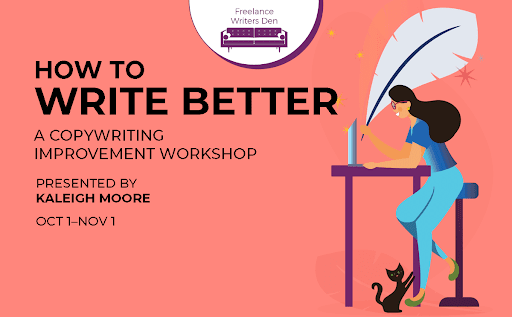
One of our sister sites, the Freelance Writer’s Den, is running a bootcamp in the month of October focused entirely on improving your writing skills. Click the banner below or click here for more info.
Writing short stories can be tough. I find them more difficult than writing novels because there’s less room to elaborate on backstory or work in “clues” to the final resolution.
It’s not about cramming a novel into a shorter word count.
While you should still follow a story arc, it doesn’t mean your scenes are fast-paced. It just means there are fewer scenes that get you to the destination, and that gives you the chance to really hone your skills when it comes to dialogue, description, setting, and pace.
If you’re struggling to write short stories, a great tip is to listen to the real-life stories people tell you. These stories almost always follow a story arc with a beginning, middle and end, so it gives you a good place to start to come up with ideas that will suit the “short story” category.
Short stories are not just exercises to help you with long-form fiction. However, they can act that way when you want to improve your writing skills.
Have fun writing, and let us know in the comments below how your latest short story has helped shape your writing.
As every good writer knows, writing compelling content is essential to being a great writer. But that is really only half of your job description—the rest of your time is spent managing deadlines, keeping track of client invoicing, and brainstorming and researching topic ideas so you are ready to be efficient with your actual writing time. Without good organization for these essential and less-than-glamorous tasks, it can be difficult to make a living as a writer.
To make life a little easier, we compiled a list of some of our favorite resources and writing tools to help our fellow creatives become more organized and manage the background tasks better.
Implement a few (or all of these) so you can spend more time on what you love to do, writing and less time on everything else.
Tool #1: Asana — Manage Deadlines and Client Communication
No matter what type of content you are creating, if you are not using a project management tool to communicate and plan your project like Asana, you are missing out on an opportunity to be much more organized.
We love using Asana specifically as a client project management tool because you can easily add your clients to your project board and communicate within the board quickly.
You can plan and track tasks, add notes specific to certain tasks, stay up-to-date on deadlines, and respond to questions within the board. It is a great tool to keep everyone up to date without clogging up valuable email inbox space.
Asana can also be useful if you are managing multiple moving parts on your own writing projects. Keep track of deadlines for book submissions to editors, printing and design work, or just writing goals for yourself to keep on task.
Tool #2: Grammarly — Make the Most of Your Writing Time
Get a second set of eyes to review all of your work before you send it to your client. Grammarly has a free tool that instantly checks for both spelling and grammar mistakes, which is extremely helpful for quick proofreading on your text. Don’t send in another document that has common usage errors such as mistaking their, there, or they’re on them again.
We love how easy it is to link Grammarly to your web browser, so you can receive edits and suggestions in real time. Because why add more steps to your editing process if you don’t have to?
Tool #3: Paper Calendar — Keep Track of Your Goals
Keep a weekly calendar to plan out the tasks you need to get done each week, but for your day to day tasks we love spending 5 minutes at the start of your day to jot down only your biggest, attainable goals for the day.
These Ugmonk analog cards are perfect for setting up your week and also prioritizing your must-dos for the day so it can be both manageable and successful. If you can get those done you know your day was a success and you can either take a much-needed break or get moving to a new set of tasks for the week!
Tool #4: Freshbooks — Invoice Efficiently
Whether you are writing as a freelancer full-time, or just doing a few writing projects here and there, having an easy-to-use invoicing and payments platform can help ensure you get paid timely for your work. Freshbooks is one of our favorite tools because it is geared toward small businesses and is extremely user-friendly.
Freshbooks makes it easy to create professional-quality invoices with their premade templates, it allows your clients to pay instantly in their preferred method, and it also makes it easy to collect and log business expenses throughout the year.
As any freelancer knows (or will come to know) invoicing is only one step of the process to get paid. Following up and reminding clients of deadlines can be one of your more tedious, yet necessary tasks.
Freshbooks makes it easier with client payment reminders, the option for upfront payments, and also an easy-to-use retainer system that can help streamline payments from monthly ongoing projects so you can focus more on your work and less on collecting payments.
Plus, your accountant will be thankful for how organized your business finances have been maintained when you are ready for tax time with Freshbooks’ easy-to-access reports.
We love the Freshbooks time-tracking app since it is easy to use, editable, and built into the rest of the software. It is so easy to under (or over) estimate the amount of time you spend working on a project, so keeping track of your time with an app is important. Even if you are not billing by the hour, you should know the time you have dedicated to a project so you can set proper expectations with yourself and your clients and even adjust your pricing structure if you need to.
Tool #6: Moleskine — Organize Your Ideas
While using a pen and notebook may seem like you are going backward in your productivity, there are few ways that can inspire creativity and jumpstart project brainstorming like pulling out a quality pen and notebook and jotting down notes by hand. Skip out on those cheap spiral ring notebooks that you associate with being in middle school, but instead invest in quality notebooks with quality paper. We love the feel and look of a Moleskine notebook and prefer pens that are pleasant to write with, but don’t bleed through your paper.
Tool #7: Spotify — Have Your Playlists Ready
Are you inspired by classical music while writing or are you more of a coffee-house-mix type of person? Listening to soothing music can increase concentration, reduce distraction, and have a calming effect, which is a perfect combination for writing.
Instead of choosing new music each time, save a couple of go-to mixes that you can turn on when you sit down to write. Look for music that is soothing, doesn’t cause you to stop and sing, but upbeat enough to inspire you to focus on your writing.
As a writer you may not go to an office every day, but that doesn’t mean you can’t benefit from having a high quality work bag to keep you and your writing materials organized. Choose a bag that is easy to carry, fits your style, and big enough that you can easily fit your laptop, notebook, a small bag for pencils, pens and highlighters, and a snack and water bottle.
Only use your bag for writing materials, so you are always ready to get to work whether that is from a designated home office, the kitchen table, or a local coffee shop. One of our favorite benefits of having a bag is when you need a little creative inspiration and want to switch up your scenery, you are ready to go without a second thought.
For a classic and rugged leather look that comes with an adjustable carrying strap, we’d suggest this messenger bag from Fossil. For a sleek and sustainable bag, take a look at this Rothy’s essential tote.
Start getting more organized by adding just one of these tools to your writing routine.
If you are excited to get more organized as a writer, try adding in one new organizational tool to start and master before adding in more.
Building effective routines that help manage your writing can take time, but it is worth it so you can make more time for writing engaging content for yourself and your clients.Think about where you are struggling and start there.
Welcome to a brand new monthly feature in which I highlight this month’s best new book releases that are especially beneficial for writers. Some fiction, some non-fiction, some craft-focused — all will be of interest to the writer who needs some more reading material. (Okay, I know all of our TBRs are way too long as it is, but new and shiny books always capture my attention!)
September is fiction-heavy, but that won’t be the case every month. I already know that October is heavy on author bios. Anyways, here we go!
Books about book are my favorite kinds of books. Publisher description:
A brilliant scholar imparts the lessons bequeathed by the Black community and its remarkable artists and thinkers.
Farah Jasmine Griffin has taken to her heart the phrase “read until you understand,” a line her father, who died when she was nine, wrote in a note to her. She has made it central to this book about love of the majestic power of words and love of the magnificence of Black life. . . .
Here, she shares a lifetime of discoveries: the ideas that inspired the stunning oratory of Frederick Douglass and Malcolm X, the soulful music of Marvin Gaye and Stevie Wonder, the daring literature of Phillis Wheatley and Toni Morrison, the inventive artistry of Romare Bearden, and many more. Exploring these works through such themes as justice, rage, self-determination, beauty, joy, and mercy allows her to move from her aunt’s love of yellow roses to Gil Scott-Heron’s “Winter in America.”
Griffin entwines memoir, history, and art while she keeps her finger on the pulse of the present, asking us to grapple with the continuing struggle for Black freedom and the ongoing project that is American democracy. She challenges us to reckon with our commitment to all the nation’s inhabitants and our responsibilities to all humanity.
New works by brilliant Pulitzer winners are always of interest to writers (or at least they are to me!). Enjoy the story; learn from the craft. Publisher description:
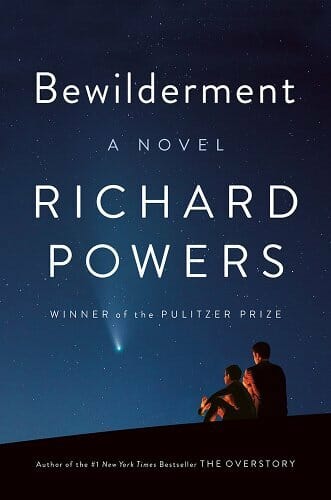
The astrobiologist Theo Byrne searches for life throughout the cosmos while single-handedly raising his unusual nine-year-old, Robin, following the death of his wife. Robin is a warm, kind boy who spends hours painting elaborate pictures of endangered animals. He’s also about to be expelled from third grade for smashing his friend in the face. As his son grows more troubled, Theo hopes to keep him off psychoactive drugs. He learns of an experimental neurofeedback treatment to bolster Robin’s emotional control, one that involves training the boy on the recorded patterns of his mother’s brain…
With its soaring descriptions of the natural world, its tantalizing vision of life beyond, and its account of a father and son’s ferocious love, Bewilderment marks Richard Powers’s most intimate and moving novel. At its heart lies the question: How can we tell our children the truth about this beautiful, imperiled planet?
Writerly memoirs are always a joy; this blend of genres promises to deliver big-time. Publisher description:
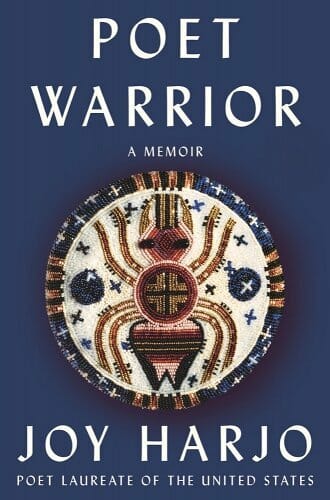
Joy Harjo, the first Native American to serve as U.S. poet laureate, invites us to travel along the heartaches, losses, and humble realizations of her poet-warrior road. A musical, kaleidoscopic, and wise follow-up to Crazy Brave, Poet Warrior reveals how Harjo came to write poetry of compassion and healing, poetry with the power to unearth the truth and demand justice.
Harjo listens to stories of ancestors and family, the poetry and music that she first encountered as a child, and the messengers of a changing earth—owls heralding grief, resilient desert plants, and a smooth green snake curled up in surprise. She celebrates the influences that shaped her poetry, among them Audre Lorde, N. Scott Momaday, Walt Whitman, Muscogee stomp dance call-and-response, Navajo horse songs, rain, and sunrise. In absorbing, incantatory prose, Harjo grieves at the loss of her mother, reckons with the theft of her ancestral homeland, and sheds light on the rituals that nourish her as an artist, mother, wife, and community member.
See my note re: Bewilderment. Publisher description:
From the two-time Pulitzer Prize-winning author of The Underground Railroad and The Nickel Boys, a gloriously entertaining novel of heists, shakedowns, and rip-offs set in Harlem in the 1960s.
Ray Carney was only slightly bent when it came to being crooked. To his customers and neighbors on 125th street, Carney is an upstanding salesman of reasonably priced furniture, making a decent life for himself and his family. . . . Few people know he descends from a line of uptown hoods and crooks, and that his façade of normalcy has more than a few cracks in it. Cracks that are getting bigger all the time. . . . Harlem Shuffle’s ingenious story plays out in a beautifully recreated New York City of the early 1960s. It’s a family saga masquerading as a crime novel, a hilarious morality play, a social novel about race and power, and ultimately a love letter to Harlem. But mostly, it’s a joy to read, another dazzling novel from the Pulitzer Prize and National Book Award-winning Colson Whitehead.
Simone de Beauvoir wrote across nearly all genres. Writers like that are especially interesting to me; how do they manage to write well in fiction, philosophy, memoir, etc.? This new novel from the late feminist is well worth studying, for the craft as much as for the story. Publisher description:
A never-before-published novel by the iconic Simone de Beauvoir of an intense and vivid girlhood friendship
From the moment Sylvie and Andrée meet in their Parisian day school, they see in each other an accomplice with whom to confront the mysteries of girlhood. For the next ten years, the two are the closest of friends and confidantes as they explore life in a post-World War One France, and as Andrée becomes increasingly reckless and rebellious, edging closer to peril. . . .
Deemed too intimate to publish during Simone de Beauvoir’s life, Inseparable offers fresh insight into the groundbreaking feminist’s own coming-of-age; her transformative, tragic friendship with her childhood friend Zaza Lacoin; and how her youthful relationships shaped her philosophy. Sandra Smith’s vibrant translation of the novel will be long cherished by de Beauvoir devotees and first-time readers alike.
The title alone makes me want to read this one. Any writer can relate, yeah (even if you aren’t an “author”). Publisher description:
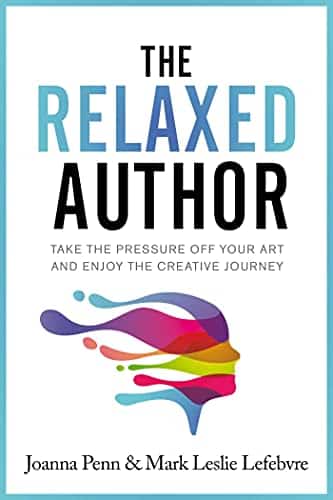
There are plenty of books and tips on writing faster, learning more marketing tactics and strategies, trying to maximize your ranking, hitting the top of the charts, juicing the algorithms, and hacking different ad platforms. While these are all important things — which the authors themselves regularly write and talk about — it’s also important to recognize that your author journey is a marathon, and not a sprint.
Joanna Penn and Mark Leslie Lefebvre have been in the business long enough to see authors burning out and leaving the writing life because they turned what they love into a hamster wheel of ever more production and marketing tasks they hate. It doesn’t have to be this way.
This book is a collection of tips on how to be a more relaxed author — and return to the love that brought you to writing in the first place.
About a month ago I promised that we were working on some new resources for you. We’ve been chugging along behind the scenes and I’m happy to say that today we’re launching our book outline template.
If you’re writing a book, the importance of an outline can’t be denied. The benefits are just too numerous to ignore: you’ll improve your book’s continuity, you won’t have to fight writer’s block as much (because your next chapter is mapped out!), the writing will almost inevitably be faster, and it frees you up to actually spend time on the craft versus the what of the book.
Not all outlines are created equally, though. Today, we’re releasing our non-fiction template. We also have a fiction template available.
It’s all set up in Google Docs for you. Click the button above, fill out the short form, and you’ll be emailed a link to a view-only Google Doc. (We ask for your phone number only for our internal records; we will not sell it to a junk call/text company.)
You’ll copy/paste the template into your own Docs and get working. What I love about this outline is that it includes the front and end matter that’s often so annoying to put together — introduction, acknowledgements, notes, etc.
This book outline template also helps you map out nearly every paragraph of the important stuff — your content! Use as much or as little outlining as you like, but you should definitely, at the very least, have an idea of the main thrust of each chapter and how to get there.
Give it a shot. Even if you’ve only been noodling with the idea of writing a book, this tool can help crystallize your idea and catalyze your motivation. If you’ve been writing for ages and don’t seem to be making headway, an outline can give you the push you need to finally finish.
Either way, I hope it’s a great help for your writing process.
I’ve been writing for a long time – for a living and for pleasure. Looking back into the recesses of time I can just about pinpoint the first pen pal letters I wrote. A teacher at my primary school had been approached by another at a different school and asked if anyone would volunteer to be a pen pal. My hand shot up. As it did when Jeremy asked his Twitter followers if anyone would like to write an essay on how pen pal letters help craft writing skills. My first thought was that any writing does – emails, social media posts, reports, formal letters. They’re all a way of honing our skills. But the intimacy of writing to pen pals gives you much more freedom of expression — one of the fundamentals of good writing.
A Few Early Experiences With Pen Pals
After that early introduction to pen pal writing, it was a few years before another opportunity arose. I’d done a personal assistant’s course at a local tech college and one of the students was Malaysian – Chooi-Ping. Forgive me if I’ve spelt her name wrong after all these years, but we conversed for some time; her airmail envelopes, with their foreign stamps always gave me a thrill of anticipation when they landed on the door mat. I learnt a lot about a different culture through the letters and, also, that people have fundamental similarities. The same fears, hopes, and pleasures.
A few years later I started up a correspondence with a Bulgarian called Maya who’d been my translator on a journalism assignment. The letters eventually petered out, as they often do, but a connection was made – and she recently contacted me on social media.
Those early experiences were a good exercise in formal, restrained correspondence – you rarely open up completely to people you haven’t shared life experiences with. But the letters certainly contributed to my writing skills; I had to choose what words and expressions to use when writing to a friend who had English as a second language. And, of course, I learnt a huge amount about different countries and the associated styles of writing.
Current Pen Pals, and How My Writing Has Benefitted
That said, one of the most rewarding forms of pen pal writing is when you can let rip. I have been blessed with several exceptional pen pals over the years – two good friends who moved away and the third someone who you could categorise as a pure pen pal. I’d never met her “in the real.”
I am still writing via email, text, and FB messaging to two of these people, one for nearly 40 years! Let’s start with Ben – as I will call him, to spare his blushes if he happens to read this article.
Ben is one of the funniest men I’ve had the pleasure of knowing and his letters would have me in stitches. I’ve kept some of his beautifully hand-written letters in my special tin suitcase (yes, I am that soppy) and his inventiveness and wit undoubtedly inspired me to write better. Most of our correspondence was light and entertaining, but occasionally it would touch on some matter or other that was concerning either one of us and the tone would change, the words and sentence structure reflecting this.
These are skills that all writers need and the beauty of writing to a pen pal is that you can write with little fear of recrimination or judgement. You can write about the weather, or the places you’ve visited, themselves fantastic exercises in description and observation, and then you can reveal those other experiences, the ones that search your soul and enrich your life and writing.
My other great pen pal is a woman I’ll call Vicky. I can only describe her as the ultimate pen pal. First off, we started writing to each other without ever meeting – in true pen pal fashion. We had been part of an online writers’ community and I only knew her by her pen name. However, the site was a hotbed of cracking writers and characters and her personality, like many others, shone through her online contributions. She was fun and competitive – the site had a unique competition structure, and she was always in there with an entry jostling for the top story/poem spot of the day. When the site shut down after a few years Vicky sought me out via Facebook and our relationship flourished. We exchanged lengthy messages, covering many key aspects of our lives. I learnt about her family, and she mine. Our children were of similar ages, so we wrote about the travails of education. We went through a truly difficult period together, with our mothers both ailing and dying at the same time. I also went through a difficult separation and, years later, ventured onto the dating scene – sharing the experiences was cathartic and a wonderful way to express powerful emotions in words. On a practical level, Vicky advised me and encouraged me with my writing. She read chapters of my new book, Fairest Creatures, and made helpful suggestions.
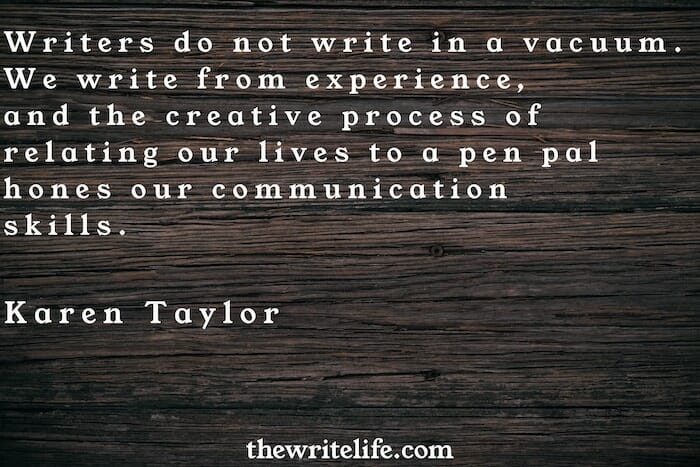
Writers do not write in a vacuum. we write from experience and the creative process of relating our lives to a pen pal hones our communication skills.
There has never been a more pleasurable interactive writing experience. It can be spontaneous and stress-free – no one is going to edit those gems. You might even decide to store some away for that future novel. Never forget, you are writing to a pal. Someone who wants to hear from you and loves to respond and encourage. Like all good conversations, listen and learn, as well as relate and emote. Express yourself and be entertained, take advice and give it if asked and don’t be afraid to be moved by your confidences. This is part and parcel of great literature.
Let me end with a spooky thing about my pen pals – often when I think it’s time to contact them, or something significant happens in my life, they make contact. It used to be a welcome plop on the door mat; now it’s more likely to be a ping on my phone. Pen pal lines of communication can be downright magical.
Karen Taylor is an author and journalist. Her serial killer thriller Fairest Creatures is being published by Leamington Books on October 15. Available on Amazon and in Waterstones in paperback and digital.
Freelance writers are always looking for ways to streamline the drudgery we often don’t get paid for — things like finding new gigs, doing background research, and keeping tabs on pitches.
Of all the writing tools online, these 10 are the most useful to help you cut back on administrative work, so you can spend more time being creative.
Grammarly is an incredibly powerful grammar checker that identifies hundreds of types of writing mistakes.
Unlike Microsoft Word, Grammarly finds correctly spelled words used in the wrong context, like “affect” vs. “effect.” It also highlights long, clunky sentences and suggests improvements.
Grammarly is available as a free extension for Google Chrome, Firefox, and Safari. It works anywhere on the Web, so you can use it for your Gmail messages, social media posts, Web forms, and blog posts.
It’s easy for a phrase you saw elsewhere to percolate into your brain. That’s where Copyscape comes in.
Copyscape Premium lets you checks your content against what’s on the web before you submit it.
If you’re a blogger or editor, you can also use Copyscape to scan the Web for duplications of your online content, and find out how to get them removed.
Sonar is a submission tracking tool for Windows. You can enter details about specific works and markets, including submission dates, status, notes and editorial contacts.
Keep in mind that Sonar is very basic. There’s no reporting functionality, and it doesn’t display simultaneous submissions of the same work.
Still, it gets the job done, and unlike other submission tracking tools, it’s completely free.
No list would be complete without the Writer’s Market, which lists details and writer’s guidelines for thousands of publishing outlets.
While there are a few similar databases you can use for free, the Writer’s Market is by far the most comprehensive resource for identifying newspapers, magazines, book publishers, and online publications in your field.
Going with a subscription instead of the print version means that you’ll always have the most current information.
UpWork is the leading online job board for the gig economy.
While it’s true that hoards of clients offer rock-bottom rates, there are enough serious companies to make UpWork a decent place to find new projects.
Freelancers with expertise in technical writing, marketing and similar fields will have the easiest time scoring jobs that pay well. It’s also helpful to research what successful freelancers do and look at their profiles.
ZonePDF offers tools for splitting and combining PDFs.
You can convert JPG, PPT, Word, and Excel files to PDFs, for example, then merge them together.
It’s useful for technical writers who need to integrate various screenshots, spreadsheets, and pages extracted from existing PDFs into a report. You can also split a client’s background document and repackage a single page in a new file.
This online note-taking software is perfect for collecting and organizing your background research.
Much like your desk drawer, you can basically throw anything into Evernote, including images, PDFs, text, audio recordings and more. Just forward your emails to a personalized Evernote address to add them to your account.
All of these items are “notes,” which Evernote organizes into notebooks. You can also create new, text-based notes directly in Evernote, and upload file attachments to them. Tags and OCR search capability make it easy to find the note you need.
Try creating a notebook for your next piece, and putting everything you need in it, including:
Images
Screen captures of your web research
Writer’s guidelines
Relevant emails
Your to-do list for that piece
A recorded interview
It’s the easiest way to store many different types of information in a single, searchable location you can access from anywhere.
Evernote is also the quickest way to snag and save copies of your work as it appears on the Web. That way you’ll always have a copy for your portfolio, even if a link goes dead a year or two down the road.
If you have a personal blog or website, there’s a good chance you’re using WordPress.
Originally a blogging platform, WordPress has become a full-fledged web content management system in its own right.
Countless businesses now use WordPress for their blogs and websites, so more writing gigs require familiarity with it. If you don’t know how to use WordPress, you may be losing out on jobs you’re a perfect fit for otherwise.
Freelance writers are masters of multitasking, but we put a lot of time and effort into making it happen. Spending a few minutes to explore these tools will help you minimize the mundane going forward, so you can focus on your craft.
Take a moment, close your eyes, and recall a story that truly engaged you as a reader — one whose world and characters became completely real for you. Got one?
Now, take off your reader hat and don your analytical writer hat to think about what makes that story so captivating. Which writing techniques did the author use to bring the story to life? Was it the wrenching appeal to your emotions, the vivid and brutal action scenes, or the high stakes facing a character? Mastering these and other storytelling methods is the key to writing your own engaging tale.
Just as a lion is the product of all the zebras it has eaten, a writer is the product of all the books he or she has read. Reading the works of skilled writers is a fabulous way to hone your craft and learn how to effectively employ the writing tactics that help you create your own captivating story.
Here are five great examples of writing techniques that bring the story to life for readers, as demonstrated by five accomplished writers.
[sps_reusable_block post_id=43045]
1. Invoke multiple senses
With any experience, you pick up more than just its sights. By describing sounds, scents, tastes and sensations, you’ll immerse readers in your story’s world.
The following scene from Saladin Ahmed’s “Hooves and the Hovel of Abdel Jameela” does a wonderful job of pulling the reader into the story by using senses other than sight.
Her voice is more beautiful than any woman’s. And there is the powerful smell of jasmine and clove. A nightingale sings perfumed words at me while my mind’s eye burns with horrors that would make the Almighty turn away.
If fear did not hold your tongue, you would ask what I am. Men have called my people by many names—ghoul, demon. Does a word matter so very much? What I am, learned one, is Abdel Jameela’s wife.
For long moments I don’t speak. If I don’t speak, this nightmare will end. I will wake in Baghdad, or Beit Zujaaj. But I don’t wake.
She speaks again, and I cover my ears, though the sound is beauty itself.
The words you hear come not from my mouth, and you do not hear them with your ears. I ask you to listen with your mind and your heart. We will die, my husband and I, if you will not lend us your skill. Have you, learned one, never needed to be something other that what you are?
Cinnamon scent and the sound of an oasis wind come to me.
2. Create intriguing, complex characters
Readers want characters with whom they can sympathize (Harry Potter) or revile (Tywin Lannister) — or both. They want to get to know the characters and learn more about their experiences in the story.
In the following excerpt from “The Children of the Shark God,” Peter S. Beagle introduces us to the protagonist quickly, but in a way that makes us care about what happens to her.
Mirali’s parents were already aging when she was born, and had long since given up the hope of ever having a child — indeed, her name meant “the long-desired one.” Her father had been crippled when the mast of his boat snapped during a storm and crushed his leg, falling on him, and if it had not been for their daughter the old couple’s lives would have been hard indeed. Mirali could not go out with the fishing fleet herself, of course — as she greatly wished to do, having loved the sea from her earliest memory — but she did every kind of work for any number of island families, whether cleaning houses, marketing, minding young children, or even assisting the midwife when a birthing was difficult or there were simply too many babies coming at the same time. She was equally known as a seamstress, and also as a cook for special feasts; nor was there anyone who could mend a pandanus-leaf thatching as quickly as she, though this is generally man’s work. No drop of rain ever penetrated any pandanus roof that came under Mirali’s hands.
Nor did she complain of her labors, for she was very proud of being able to care for her mother and father as a son would have done. Because of this, she was much admired and respected in the village, and young men came courting just as though she were a great beauty. Which she was not, being small and somewhat square-made, with straight brows — considered unlucky by most — and hips that gave no promise of a large family. But she had kind eyes, deep-set under those regrettable brows, and hair as black and thick as that of any woman on the island. Many, indeed, envied her; but of that Mirali knew nothing. She had no time for envy herself, nor for young men, either.
As authors, we must give readers insight into what makes our protagonists tick. What motivates them? What are their aspirations? In this passage, we learn that Mirali, while not conventionally beautiful, is a kind soul who works hard for her parents and is appreciated by her community. And the key? We quickly start to become invested in what happens to her.
3. Evoke strong emotions
In this scene from Frost Child by Gillian Philip, it takes the reader a moment to realize what the child witch is feeding her newly-tamed water horse — and that moment allows the strong emotion of horror to set in.
“He’s very beautiful,” I smiled. “Make sure he’s fully tame before you bring him near the dun.”
“Of course I will. Thank you, Griogair!” She bent her head to the kelpie again, crooning, and reached for her pouch, drawing out a small chunk of meat. The creature shifted its head to take it delicately from her hand, gulping it down before taking her second offering. She stroked it as she fed it, caressing its cheekbone, its neck, its gills.
I don’t know why the first shiver of cold certainty rippled across my skin; perhaps it was her contentment, the utter obliteration of her grief; perhaps it was the realisation that she and her little bow had graduated to bigger game. The chunks of flesh she fed it were torn from something far larger than a pigeon, and as the kelpie nickered, peeling back its upper lip to sniff for more treats, I saw tiny threads of woven fabric caught on its canine teeth.
By revealing a previously undetected detail that helps readers understand the implications, the author causes them to wince and recoil — and wonder what happens next. Of course, we have many emotion-evoking arrows in our writing quivers — humor, love, determination, anger, and so on. These strong emotions keep the reader engrossed in the story and curious about the characters’ futures.
4. Use rich character voice
The voice chosen by the author has a profound impact in how readers interpret the story and view the characters. In the following excerpt from “The Adventures of Lightning Merriemouse-Jones” by Nancy and Belle Holder, the voice and sentence length quickly convey the time period and lighter tone of this comic horror story.
To begin at the beginning:
That would be instructive, but rather dull; and so we will tell you, Gentle Reader, that the intrepid Miss Merriemouse-Jones was born in 1880, a wee pup to parents who had no idea that she was destined for greatness. Protective and loving, they encouraged her to find her happiness in the environs of home — running the squeaky wheel in the nursery cage, gnawing upon whatever might sharpen her pearlescent teeth, and wrinkling her tiny pink nose most adorably when vexed.
During her girlhood, Lightning was seldom vexed. She lived agreeably in her parents’ well-appointed and fashionable abode, a hole in the wall located in the chamber of the human daughter of the house, one Maria Louisa Summerfield, whose mother was a tempestuous Spanish painter of some repute, and whose father owned a bank.
The longer sentences, combined with the choice of words like “environs,” “pearlescent,” “vexed,” “abode,” and “repute,” place the reader in a Victorian setting even without the reference to 1880. The narrator’s voice also clearly sets a tone of felicity and humor.
Just as the narrator has a distinct voice, characters should have their own unique voices to help readers distinguish one from another and to convey aspects of their personalities.V oice is a terrific tool to help readers get to know and appreciate your characters.
5. Pull the reader into the action
Of course, interesting characters and engaging dialog are important, but writing gripping action scenes is a skill all its own. Jim Butcher has mastered this skill, as shown in this excerpt from “Even Hand”:
The fomor’s creatures exploded into the hallway on a storm of frenzied roars. I couldn’t make out many details. They seemed to have been put together on the chassis of a gorilla. Their heads were squashed, ugly-looking things, with wide-gaping mouths full of shark-like teeth. The sounds they made were deep, with a frenzied edge of madness, and they piled into the corridor in a wave of massive muscle.
“Steady,” I murmured.
The creatures lurched as they moved, like cheap toys that had not been assembled properly, but they were fast, for all of that. More and more of them flooded into the hallway, and their charge was gaining mass and momentum.
“Steady,” I murmured.
Hendricks grunted. There were no words in it, but he meant, I know.
The wave of fomorian beings got close enough that I could see the patches of mold clumping their fur, and tendrils of mildew growing upon their exposed skin.
“Fire,” I said.
Hendricks and I opened up.
The new military AA-12 automatic shotguns are not the hunting weapons I first handled in my patriotically delusional youth. They are fully automatic weapons with large circular drums that rather resembled the old Tommy guns made iconic by my business predecessors in Chicago.
One pulls the trigger and shell after shell slams through the weapon. A steel target hit by bursts from an AA-12 very rapidly comes to resemble a screen door.
And we had two of them.
The slaughter was indescribable. It swept like a great broom down that hallway, tearing and shredding flesh, splattering blood on the walls and painting them most of the way to the ceiling. Behind me, Gard stood ready with a heavy-caliber big-game rifle, calmly gunning down any creature that seemed to be reluctant to die before it could reach our defensive point. We piled the bodies so deep that the corpses formed a barrier to our weapons.
A well-written action scene thrusts the reader smack into the middle of the story. It’s another way to evoke emotion and empathy for characters.
Though the protagonist in this story is actually a crime lord — not a character many of us would normally root for — you’re on his side, aren’t you? The writer’s skillful action writing technique has you imagining yourself behind the defensive barrier, wielding a shotgun, and praying the torrent of lead will prevent the demonic onslaught from reaching you.
Readers want to be taken on a journey to another place and time, with characters they care about and whose company they enjoy. Help your readers feel like they have a stake in your story’s outcome by using these writing techniques to bring your characters and settings to life.
As a writer, which books or authors do you read specifically to learn from their techniques and writing skills?
Let’s talk about when to use affect versus effect. It’s a common query and the two words are very easy to confuse, even for seasoned writers.
You may be wondering why the effect versus affect usage even really matters, since most people can work out what you’re saying even if you use “effect” when the correct word is “affect.” Here’s why: words matter. Choosing the right words helps you communicate clearly and ensures your readers understand your meaning without having to work for it.
As a writer, you know the power of your words. When we string together individual ideas, presenting them in a beautiful, coherent thought, we help readers understand the world around them. Words can change a heart, convince a mind, and even alter the course of history. So knowing the meaning of words and using them in the correct, precise way could make all the difference to your readers.
Let’s briefly look at not only the specific definition of these words, but also affect vs effect examples, as well as a helpful acronym to keep the proper usage top of mind.
[sps_reusable_block post_id=43047]
Affect vs Effect Examples and Definition
Affect is a verb (usually). Use this word when you want to impact or change a noun (person, place, or thing).
Example of “affect” in a sentence: Missing school could negatively affect your grades.
In this sentence, “missing school” has an impact on on the noun “grades,” so the correct term is “affect.”
Effect is a noun (usually). You use this word when you want to demonstrate the result of an impact or change.
Example of “effect” in a sentence: The effect of missing school was a failing grade.
In this sentence, “a failing grade” is the result of “missing school,” so the correct term is “effect.”
A Helpful Acronym for When to Use Affect vs Effect
The simple memory trick to keep this straight is R-A-V-E-N.
RAVEN stands for:
Remember
Affect
Verb
Effect
Noun
Remember, “affect” is a verb and “effect” is a noun. In most cases, this is how you determine when to use affect vs effect.
Affect vs Effect Exceptions
Of course, it wouldn’t be the English language if there weren’t times when “affect” is a noun and “effect” is a verb. Thankfully, this doesn’t happen often!
When using “affect” as a noun, it’s to describe an emotion or a feeling. This usage isn’t common and can be confusing even when used correctly.
Example of “affect” as a noun: I noticed my friend’s sad affect after the movie and was concerned.
In this sentence, “the movie” made my friend sad, thus my friend’s “sad affect.”
A simpler way of phrasing could be: The movie made my friend sad, which concerned me.
When using “effect” as a verb, it means “to bring about.” It’s an old usage of the word that doesn’t come up much because it makes sentences a bit clunky.
Example of “effect” as a verb: Our words have the power to effect change.
In this sentence, “our words” can bring about “change,” so we use the word “effect” as a verb.
A less confusing sentence with the same meaning could be: Our words can lead to change.
When in doubt of whether to use affect vs effect, stick to RAVEN. You’ll be correct 99% of the time.
Conclusion
Since these two terms have similar meanings and sounds, it’s easy to understand why so many writers get them mixed up. Things can affect you, but they can also have an effect on you. Both are true! Do your best, and then run your piece through a grammar checker or editing tool to make sure you’re using terms properly. These tools and resources are created to help catch those pesky errors so you can communicate your message with clarity and conviction.
I studied public relations and journalism back in college (shoutout to Drake U!). As you can imagine, there was a lot of writing involved: press releases, newspaper articles, client pitches, etc., etc. We were writing nearly every day. And yet, I never really thought of writing as a career. Sure, the skill would come in handy, but it would certainly never be a primary job function.
At the time, journalism seemed like a dying industry. Public relations seemed more about marketing and business than writing. Writing and publishing books seemed so far out of the realm of possibility that I never even considered it.
But here I am, a dozen years later, doing what I love to do. The possibilities when it comes to writing are so much greater than we tend to think. Whether you want a career in wordsmithing or simply want to gain mastery over your favorite hobby, this field has so much to offer.
Here at The Write Life, as we enter a new season, the team wants to know what this site means to you. What sort of content are you looking for when you venture to thewritelife.com or open one of our emails? What does your ideal writing life look like?
We are here to serve our readers, so the more we know about your writing goals, hopes, challenges, hobbies, and career aspirations, the better we can do that.
Whether it’s one of these, all of these, or a dream not listed, let us know in the comments! Next week, we’ll feature your responses in order to provide motivation, inspiration, and hope for all of us writers out there—myself included.