Blog

  • Poets and Writers Magazine – Is It Worth Subscribing?

    Poets and Writers Magazine – Is It Worth Subscribing?

    If you want to become a poet or a writer, you have most likely come across the Poets and Writers Magazine.

    It’s a magazine that condenses a lot of helpful information writers need to succeed in their careers. With so much being available online, you might be wondering if it’s worth the subscription or how to use their website to find what you need.

    Poets and Writers Magazine currently has 100,000 readers, so there must be something to it. While it’s not helpful for all kinds of writing, if you’re specializing in poetry or creative writing, it’s one of the go-to resources in the industry.

    We’ll be going over what you need to know, if you should subscribe, the history of the magazine, and how you can get the most out of it.

    Poets and Writers Magazine

    Since starting in 1987, Poets and Writers Magazine focused on helping condense all the issues writers care about into one place.

    At the time, there weren’t too many publications bringing writers together to support them in their careers. So knowing who to pitch to or how to grow your career was not as clear cut.

    Having it all in one place showed people that making a creative career was possible and a worthwhile endeavor.

    While mainly focused around poetry and fiction writing, Poets and Writers Magazine also provides guidance for anyone pursuing writing careers of any kind. There are profiles of writers, tips, publication submission information, grants, and more.

    You might not need to subscribe if you’re in a different writing field, but it might be worth it to scroll through their tips and apply it in your own way.

    It is one of the largest nonprofits and literary organizations in the United States.
    poets and writers magazine

    What else to know and their workshops

    Poets and Writers Magazine publishes a bi-monthly magazine, which brings you information all in one place. It publishes information on literary grants and awards, publishing deadlines, profiles of writers, and tips to succeed as a writer.

    They have both digital and print editions, depending on what you prefer. They also have an option to hear the magazine through the phone if you have trouble reading.

    They also offer workshops for writers so you can get your pieces finished and ready for publication. You can also find them at community events or hosting live readings. Some of the events were hosted virtually due to the pandemic.

    One of the popular workshops is the one called Mapping the Maze. It’s a workshop for poets and literary prose writers to navigate the world of publishing. If you already have your work written but you want to start querying literary agents, this is the workshop for you.

    If you want to pitch directly to the magazine, you can check out their submission guidelines. That might be a good way for you to get your ideas published in a legitimate magazine.

    Benefits of signing up for the Poets and Writers Magazine

    One of the most obvious benefits of signing up is that these are currently professionals in their field. You’re not reading some post from some blogger on a website, where you have no idea what their credentials are.

    This magazine is written by people who are successful in the industry or have been in it long enough to help you navigate your way through.

    If you want to cut through the noise out there and get simple, practical advice, this might be a much-needed resource for you and your career.

    Even if you don’t sign up for the magazine (which is pretty cheap, considering), their website has a ton of information to help you.

    The only reason you might not want to sign up is if you’re in a different writing field. For example, if you want to be a screenwriter, this might not necessarily be a good fit for you.

    Editorial sections in Poets and Writers Magazine

    Poets and Writers Magazines has four major publishing sections. We’ll also include word count if you are interested in pitching an article or story to them in the future.

    News and trends

    These articles are 500 to 1,200 words that summarize the most important news in the publishing and writing industries.

    The Literary Life

    These articles are 1,500 to 2,000 words and are more about what it’s like to live life as a writer.

    The Practical Writer

    These articles are 1,500 to 2,000 words and cover all the business aspects of creative writing. They might be tips, tricks, or pitching information.

    Feature articles

    These are interviews and profile that can range anywhere from 2,000 to 3,000 words. Sometimes they will also include in-depth looks at other subjects such as writers conferences and residencies.

    The Poets and Writers Magazine Website

    Whether or not you choose to subscribe to the magazine, the website itself has a ton to offer.

    Here are just some of the things that are available on their site:

    • Writing contests
    • National literary events calendar
    • Directory of poets and writers
    • MFA programs
    • Select content from the magazine
    • List of literary magazines
    • Literary agents
    • List of book review outlets
    • Ways to market your writing
    • Resources for how to pitch your work and grow your career

    Here’s some deeper information on some of these tabs.

    Writing contests – These include details about creative writing contests. Some of them include poetry contests, short story competitions, essay competitions, awards for novels, and more.

    Literary magazines – This is a master database of editorial policies, submissions guidelines, and contact information for different places.

    Small presses database – This is where you can find information on potential publishers, submission guidelines to various publications, and the contact information of various editors.

    Literary agents – This is information about agents who represent fiction writers, poets, creative nonfiction writers, and anyone else who is in a similar writing category. You can see deeper information on the agents and the types of books they want to represent. You can also see what books they currently represent to get a feel for what they currently look for in writers.

    Poets and Writers Magazine Subscription

    If you do choose to subscribe to the Poets and Writers Magazine, let’s take a look at how much it costs.

    Note: These are for the United States subscription. If you’re in Canada or international, you will want to check their subscriptions to get the most accurate and current price.

    Print

    • 2 years (12 issues) – $26.00
    • 1 year (6 issues) – $15.00

    Print and Digital

    • 2 years (12 issues) – $32.00
    • 1 year (6 issues) – $18.00

    Digital only

    • 2 years (12 issues) – $20.00
    • 1 year (6 issues) – $12.00

    The Poets and Writers book

    The Poets & Writers Complete Guide to Being a Writer is a book by the same company. It is a how-to guide when it comes to becoming a writer and turning it into a whole career.

    The book has excellent reviews and is a great resource for anyone looking to turn their writing into a lifelong career.

    It not only has writing tips but it also includes business tips to manage the writing industry as a whole.

    Some things it also includes:

    • How to pick the right MFA program
    • How to market yourself
    • How to find a literary agent
    • How to find writing contests

    TWL. CTA. Book Outline Template
  • Get Into Freelance Business Writing in 6 Easy Steps

    Get Into Freelance Business Writing in 6 Easy Steps

    When it comes to freelance writing, lots of writers want to get into freelance business writing.

    However, it’s somewhat of a vague term and you might not be sure what the actual workload entails.

    We’ll go over what business writing is, what kind of assignments you can expect, how you can get into this field, and how much you can expect to make.

    What is business writing?

    Every business out there needs clear communication and hiring a writer is the easiest way to make that happen. Whether they use the writing for their own internal discussions or to communicate with people outside their business, it’s something that is always needed.

    Most business owners don’t have the same passion for writing that you might, so they love to outsource this work to someone else when they can. As a professional, you can put together written material that is not only clear, but you can often do it in a fraction of the time, saving time of the people working for the business.

    Compared to fiction writing or other creative types of writing, business writing is much more clear-cut and direct. You’ll often be pushed to remove any and all “fluff” from your writing.

    You might also choose to go a different route and become a writer who only chooses to focus on writing about businesses. Many publications out there (think: Forbes and similar publications) keep up on businesses and what’s happening in various industries.

    However, for the most part, business writing is what the next part of this article covers.


    What do you do as a freelance business writer?

    As you get into freelance business writing, you might find you’ll be brought on for all kinds of different projects.

    It will be up to you if you choose to specialize as you try out different assignments or if you want to stay as more of a generalist.

    If you choose to stay general with your writing, you might be given a wide variety of projects, depending on what the business needs at that time.

    Some kinds of writing you might be brought on to do:

    • Email writing
    • Press releases
    • Proposals
    • Training materials
    • Memos
    • Internal documentation
    • SOPs (standard operating procedures)
    • Advertisements or social media posts
    • Articles
    • Emails
    • Storytelling
    • Copywriting
    • Editing

    It doesn’t mean you’ll need to know how to do every single one of them, but you should at least pick a few to learn about and practice before you pitch any companies.

    Qualifications needed to get into freelance business writing

    Often, you’ll need a writing or business degree to become a freelance business writer.

    However, this isn’t always the case. You could gain experience by taking on smaller projects and gaining the trust of clients.

    There are also some business writing certifications you can choose to get instead of a traditional education.

    More than anything else, you’ll need clear and direct writing to succeed as a freelance business writer. It’s often not creative writing, so you’ll need to make sure your writing samples match that type of style.

    You won’t want to send in poetry and journal-style writing to convince a business to hire you as a freelancer.

    For example, you’ll want to pick simple words instead of long, complicated words or sentences. You’ll need to assume that the person reading your writing doesn’t always have the same industry knowledge as others. You might need to take complicated ideas and make them as simple as possible.

    You’ll need to define acronyms or insider information so they understand what you mean. It sounds easy, but this can be a hard skill to develop.

    On top of all of these qualifications, you’ll need to be someone who is on top of their deadlines. The business world takes deadlines seriously so you’ll need to make sure you can manage your own workload.

    How to get into freelance business writing

    So now that you know what types of writing you’ll need to learn and what you’ll need to start, let’s dive into the practical tips to get your foot in the door.

    #1 – Pick an industry (or don’t)

    Sometimes it can be easier to grow your career if you choose to specialize in either a certain type of industry or a particular kind of writing. It’s not required, but it can help you narrow down the specific businesses you want to pitch to and the work you do.

    For example, you might only choose to do press releases for technology businesses.

    #2 – Start working on a portfolio

    If you don’t have any writing samples, you’re going to have to put some together.

    Not every piece in your portfolio has to be a piece you’ve been paid to write, you can create spec pieces on your own to demonstrate your skills.

    Depending on what you chose to do for the first step (industry and type of writing), that will guide the samples you’re going to create.

    For example, if you choose to focus on SAAS companies to write for, you’ll want to create samples that are under that niche and are something that potential clients would want to pay for.

    #3 – Spend time learning about the options

    Even if you choose to specialize as a writer, you might be asked to do different types of writing for a business. It wouldn’t hurt to spend just a little time per week deep-diving into the different types of writing.

    Plus, you never know if you’ll end up passionate about a whole new type of writing unless you try it out.

    #4 – Start networking

    Once you’ve done all of the steps above, it’s time to get out there and start meeting potential clients.

    All the networking steps and tips could take a whole article to explain, but the main thing you need to think about is where are the business people you want to target?

    You’ll want to start following businesses you would like to write for and see what they do online. When it makes sense, you can reach out and send them some information about your skills. Depending on the industries you’re targeting, it might be worth it to also attend networking events.

    #5 – Focus on the business and their needs

    Above all, business writing is much more about what you can do for the business and what their needs are versus your particular writing style or how creative you are.

    If you’re coming from a world of creative writing, this might be a huge shift in how you approach your work.

    You’ll need to think deeply about the business and what they’re looking for before you begin to pitch any of them.

    #6 – Stay on top of trends

    When you choose to get into freelance business writing, that means you’ll need to stay on top of any business trends. Clients expect you to know what’s happening in any given industry when you can and also have creative ideas to bring to the table.

    You’ll want to spend some time subscribing to people, newsletters, and events to stay current on the trends in your industry.

    How much can you make doing freelance business writing?

    For the most part, the answer to this question depends on what kind of business writing you choose to do.

    Let’s first take a look at what salaried business writers make. According to Zippia, the average business writer salary is $77,617, or $37.32 an hour.

    Of course, these are with salaried positions. As a freelancer, you will most likely be charging by the hour or by the project. Your rate might vary greatly depending on the industries you write for and the type of writing you do.

    Check out this article to figure out what exactly you should charge.

    Next Steps

    Let’s get your freelance business started!

  • 7 Ways to Write Beautiful Prose

    7 Ways to Write Beautiful Prose

    Writing beautiful prose isn’t something every writer nails in the beginning. It usually takes tons of intentional practice!

    Strong prose often reads like poetry. The term “purple prose” refers to writing that might be a bit too flowery. That’s not always a bad thing—lots of readers and writers love flowery prose. It’s up to the author to decide the balance between beauty and readability in their own work.

    So how do we balance beautiful writing with intentional, purposeful writing?

    If you want your writing to be more beautiful, artistic, or unique, here are 7 ways to write beautiful prose.

    1. Avoid or reimagine cliché phrases

    Clichés aren’t always bad. In fact, they can be poignant, impactful phrases with slight reimagining.

    There’s a reason new writers default to using clichés—they’re easy! Clichés are phrases and terms that have been in general public use for so long that they’re easily understandable for most people.

    Examples of cliché phrases:

    • Gilded cage
    • Head over heels
    • Only time will tell
    • The calm before the storm
    • Kiss and makeup 
    • Low-hanging fruit
    • I stopped dead in my tracks
    • Put out feelers
    • Rain on my parade
    • Stabbed him in the back
    • Fire in my blood
    • Blood ran cold
    • Digging yourself into a hole
    • Get your toes wet
    • Stealing candy from a baby
    • Right up your alley
    • Play your cards right
    • All bets are off
    • All in due time
    • Batten down the hatches
    • Pot calling the kettle black
    • On thin ice

    Clichés are a shortcut to slice right to the meaning of something without having to come up with your own words for it. That’s why using clichés can make a writer look lazy. They’re just reusing something that someone else wrote.

    But that doesn’t mean you should never use them! Intentional writers can take a cliché and turn it on its head to bring new life to an old adage.

    Look at this advice from Self-Editing for Fiction Writers:

    “…before going with the cliché, give some thought to the possibility of “turning” it, altering it slightly to render the phrasing less familiar. In a celebrated novel we edited, the writer used the phrase “they vanished into thin air” to avoid a lengthy, complicated explanation. We suggested a change to “they vanished into thick air,” which fit the poetic, steamy atmosphere of the European city in which the scene was set.”

    The swap-up doesn’t have to be big! The tiny edit of switching “thick” for “thin” was enough to doctor up that cliché and make it fresh.

    Changing a word, the order of words, or adding words to a cliché are easy ways to give them a new spin.

    “She’s opening a can of worms,” could become, “she’s opening a can of worms and eating them.”

    “We’ll cross that bridge when we get to it” can be combined with, “burning bridges,” to become, “We’ll burn that bridge when we get to it.”

    “Time flies,” could become, “time flies until the engine burns out.”

    “Diamond in the rough” can be changed with just one additional word: “Blood diamond in the rough.”

    Don’t be afraid of using clichés—just be cool about it.

    2. Get specific

    When tapping into the emotional side of prose, specificity is often a writer’s best friend. Anyone can make vague, sweeping statements to try and convince a reader they’re feeling something, but a skilled writer can zoom into emotional details to tap into those emotions naturally.

    Like Richard Price said— “The bigger the issue, the smaller you write. Remember that. You don’t write about the horrors of war. No. You write about a kid’s burnt socks lying in the road. You pick the smallest manageable part of the big thing, and you work off the resonance.”

    Focusing on the small details is often where you’ll find the emotion of a scene, which will give you more room to write it beautifully.

    3. Unexpected turns of phrase

    Don’t always go for the most obvious thing! Diverting the expectations of how a sentence will end can really wake up your reader.

    This obviously counts for repurposing clichés, like we talked about earlier, but it can also apply to any sentence that might be more predictable than you’d like it to be.

    As an extreme example: “I woke up that morning, got dressed, ate breakfast, walked the dog, and tripped over the severed arm of my next door neighbor.”

    This concept can also be as simple as swapping a single expected word for something else. I try to do this in my own writing—for example, this sentence from Mother:

    “A child was raised on stories of crows—dark creatures with black intentions.”

    The expected phrasing would be “black creatures with dark intentions,” but a slight reshuffling of those two words makes it a fresher sentence.

    Using unexpected phrasing can shake your reader’s attention and keep them engaged with the story and prose.

    4. Be accurate and concise

    Heavy-handed prose isn’t going to make your imagery more effective. Often, less is more.

    Use however many words you need to convey your point, but try to trim back on superfluous prose and really nail down the meat of the sentence.

    Writing beautiful prose is similar to writing poetry. You want every word and image to carry its weight.

    Many poets will write a first draft of a poem, then pick one or two very strong lines from that draft to write a new poem around. Repeat until every word and line of the poem is as strong as it can be.

    Authors who write beautiful prose consider every word and image, weigh their effect, and make adjustments.

    5. Rhythm

    Writing beautiful prose isn’t just about word usage and imagery—the rhythm of a piece is just as important.

    Several factors can influence the rhythm of a bit of writing, including sentence length, syllable balance, internal rhymes, assonance, alliteration…

    Sentence length and syllables

    The sentence length and syllable count can affect the way a reader paces the scene in their head. Long, flowy sentences can give a feeling of calmness. Long, choppy sentences can make a reader fly through it, giving a sense of speed and urgency.

    Shorter sentences might give a feeling of hesitation or confusion.

    Lots of medium-length sentences can make it seem like time is moving slower.

    Within different sentence lengths, your word choice and length can determine how the pacing and mood come across.

    Reading your work out loud is very helpful in gauging how the pacing is affected.

    Example:

    “I inhaled. The concrete pricked my bare feet. I grabbed the ladder rung and steeled myself. Swallowed. The crowd quieted as I took my spot on the diving board.”

    “I inhaled and focused on the concrete picking at my bare feet before gripping the ladder rung and hoisting myself onto the diving board.”

    The same event is happening in both of those examples, but they have drastically different pacing. What do you feel is the mood of each sentence?

    Rhymes, assonance, alliteration

    While outright rhyming in regular fiction prose would probably stand out as odd and distracting, utilizing literary elements like internal rhymes, assonance, and alliteration in certain bits of prose can make it musical and poetic.

    So depending on your goals and vibe, doing a little bit of poetry in your prose might be nice! Don’t be afraid to play around with sounds in your writing.

    6. Ending words/sentences

    The last word of a sentence carries a lot of weight. It’s the last thing a reader sees of the sentence, image, or thought, so writers should consider the clause and/or word their sentence leaves on.

    Similarly, the last sentence or image of a paragraph, chapter, etc., is important for the same reason.

    Excuse me for using my own writing as another example (it’s the only book on my desk right now), but here’s a sentence from Sliced that describes a character covered in blood: “His shirt is crusted brown, layered beneath fresh red.”

    That sentence could have been something like: “Fresh red and crusted brown layer his shirt.”

    “Shirt” isn’t a very scary or interesting word. Ending the sentence with “fresh red” makes the overall image of that sentence the blood, rather than focusing on his shirt.

    Give careful consideration to how you end sentences and paragraphs, because the ending is often what sits with your reader.

    7. Consider perspective

    Anyone can describe a scene. The things you choose to describe and the way you frame them can lead your readers to feeling the way you’d like them to feel.

    One of my favorite quotes on writing is from Kait Rokowski:

    “Nothing ever ends poetically. It ends and we turn it into poetry. All that blood was never once beautiful. It was just red.”

    Writing is more than just a description of a thing. It’s the way the thing is described. When choosing details and framing to focus on in a bit of prose, consider what you want your reader to feel with that description. If you’re writing through a character’s POV, consider how they feel about the thing they’re looking at.

    Audience and character perspectives can shift the meaning of anything, so ask yourself what your goal is with each image.

    How to write beautiful prose

    Writing strong, beautiful prose likely isn’t something that will come easy or quick. It takes practice, intentionality, and staying present with your work.

    Intentionally using cliché phrases, specificity, surprises, conciseness, rhythm, endings, and perspective will give you a strong start to creating beautiful writing.

    The real writing happens in the edit, so keep hacking at those revisions!

    Happy writing.

    TWL. CTA. Book Outline Template
  • 6 Gratitude Books You Should Read

    6 Gratitude Books You Should Read

    The art of expressing genuine gratitude is more than learning to say please and thank you as a child. Gratitude is a mindset that translates into a lifestyle, and this type of living can completely transform your perspective on life. Gratitude books can help remind us of these lessons.

    Countless authors have come before us, paving the way to a life of gratitude by sharing their own stories, ups and downs, and what has helped them realize the importance of gratitude in their own lives.

    In this article, we discuss lessons learned from various writers and how we can live in gratitude more deeply through our own lives.

    Writing is a long journey with highs and lows, and gratitude for each day can help keep us going when the road feels long. No matter where you are in your process, drafting your first book, publishing your third novel, or just now getting an interest in writing, let’s pave the way with gratitude.

    With the power of gratitude in mind, let’s define exactly what a gratitude book is, and then get into some standout examples. 

    What Is A Gratitude Book?

    A gratitude book can take many different directions, but at its core it is a book written around the theme of gratitude. Books that focus on gratitude can still include other topics and encompass a variety of subgenres. 

    For instance, you could write a gratitude book but include life stories that contribute to this theme, making it a type of memoir. 

    You could also write a gratitude book but make it a type of daily reading, as you’ll see an example of below. The main variable to remember is that a gratitude book is centered around thankfulness. 

    When you read through the following examples, take note of the various ways these authors use gratitude books to communicate to their readers and notice the variety of ways this theme takes shape.

    TWL. CTA. Book Outline Template

    Gratitude, Oliver Sacks

    Oliver Sacks, a famous psychologist, combined philosophical thinking with his wisdom and research. As he neared the end of his life, with just months to live, he chose to use his time writing.

    Rather than write his memoir or even his autobiography, Oliver Sacks decided to write about feelings: The feeling of thankfulness for the successes he had experienced and the meaning he had found in life.

    Instead of spending his last weeks regretting the failures he may have felt, he meditated on what he felt gratitude for. This type of focus takes decisiveness, but its result impacted many. 

    365 Thank Yous, John Kralik

    John Kralik’s book is a memoir focused on the theme of gratitude. At 53 years old, John found himself at an all time low. His close, interpersonal relationships were failing, as was his work, and to top it all off, so was his health. 

    Rather than focus on what was falling apart around him, he chose to focus on what he had. John then decided to write 365 thank-you notes the following year. Instead of sitting down and typing out thank-you templates, John hand wrote his thank-yous to the many individuals who had impacted his life. 

    Over his year-long process, his life took a turn for the better. This memoir is an extraordinary example of how ordinary people can create far-reaching, positive outcomes with simple choices.

    Choosing Gratitude: Your Journey To Joy, Nancy DeMoss Wolgemuth

    If the opposite of happiness is sadness, the opposite of gratitude is ingratitude. Author Nancy DeMoss Wolgemuth speaks on this topic through her book, encouraging readers to live their lives based on gratitude. 

    She says, “Gratitude is a choice. By intentionally thanking God and others, bitterness and entitlement are replaced with joy and the humble realization of just how undeserving we really are.” Choosing gratitude is a choice that leads to a lifestyle that results in joy. 

    Thanks!: How The New Science Of Gratitude Can Make You Happier, Robert A. Emmons

    Robert A. Emmons wrote this study on the positive influence people experience when they choose to focus on gratitude. Written with a bent toward psychology, this gratitude book explains how habitual gratitude can impact people’s ability to handle stress, experience better interpersonal relationships, and more. 

    For a deeper study on the topic of gratitude, this book will pique your interest, open your eyes to a field of study in gratitude, and equip you to see a new way gratitude can influence your life. Robert explains how thinking through this mindset contributes to the following many areas of life, both short-term and long-term. 

    The Gifts of Imperfection, Brené Brown

    Brené Brown is well-known for her TEDx Talk on vulnerability, but in this book, she shows readers how vulnerability is actually a gift to express gratitude for. Imperfections allow us to connect with others at a deeper level, override the negatives of perfectionistic mindsets, and encourage more connection with those we encounter. 

    Noticing our flaws and accepting them as part of the unique mix that makes us interesting can powerfully reframe a perfectionist mindset.” Speaker, writer, and podcaster Brené Brown shares her knowledge yet again in her book. 

    Thanks a Thousand: A Gratitude Journey, A.J. Jacobs

    New York Times bestselling author, A.J. Jacobs, is a coffee drinker, likely just like you are. Rather than walk into his local coffee shop, purchase his cup of joe, and move on, he decided to look into the entire process involved in making his single cup of coffee.

    In fact, he did this in order to thank every single person involved in the behind-the-scenes process of making his coffee, all the way up to the barista who handed it to him. 

    This process took him on a journey around the world, changed his life, and taught him the secrets of gratitude. A.J. learned that there are countless individuals involved in our daily habits:

    • Farmers
    • Chemists
    • Artists
    • Presidents
    • Truckers
    • Mechanics
    • Biologists
    • Miners
    • Smugglers
    • Goatherds

    This gratitude book is his journey to expressing his thanks, face to face. 

    Start Your Gratitude Journey Today

    Reading through these examples may feel like a long-shot, full of days off to travel, money spent on plane tickets, or hours researching. The good news is, you don’t need to be the next Brené Brown to commit to gratitude today. 

    If you don’t find yourself with a year of travel time to spare thanking everyone involved in the process of creating your favorite drink, that’s okay. 

    You can purchase these journeys for the price of a few cups of coffee, but you can also start your own journey today. Begin simple so that you can stick with the process:

    • Start a gratitude journal in a favorite notebook, or on your phone or computer
    • Thank those you encounter at coffee shops, bus stops, and grocery stores 
    • Write fifty words every weekday, expressing what you’re grateful for
    • Place sticky notes around your office, articulating your thankfulness 

    Pick one of the above and try it out for a week or two. You’ll likely be surprised how quickly your mindset shifts!

    Next Steps

    Looking to start writing your own gratitude book? You’ll need a book outline template!

    Check out this one to get started:

    TWL. CTA. Book Outline Template
  • Writers Work Review

    Writers Work Review

    If your dream is to be a working writer, chances are you have spent some time looking for online writing work. Usually it takes at least a few months to go from a blank page to published book, and while you work on marketing your masterpiece, sometimes it helps to have some side gigs.  

    Creating a versatile portfolio of writing work is a great way to build your writing brand, get your name out there, and of course, bring in income through your passion. Writing takes many different forms, and so do your options for making money as a writer. 

    The online writing platform we review today is Writers Work, self-described as the all-in-one platform for launching your dream job.

    But is Writers Work worth it? In this article, we discuss:

    At the end of this Writers Work review article you should feel more equipped to make the decision that’s best for you to move toward your writing goals. Many writers write, but to actually get paid for doing what you love is a privilege not to take lightly. 

    Let’s dive into Writers Work and if you should consider making it your next writing investment to further your career as a full-time writer!

    [sps_reusable_block post_id=43047]

    Writers Work Review: What Is It?

    Writers Work is a subscription-based writing platform that helps you find writing jobs so you can grow your career and increase your income. With one plan and two ways to pay (once or monthly), Writers Work takes you through a sign-up process in order to get started.

    This platform focuses on helping writers kickstart their writing career and conducts some of the upfront work for you, allowing you to spend more time doing what you love—writing. 

    So, if you want help getting off the ground in your freelance writing career, Writers Work could be the next step for you. Before making your decision, it’s important to consider both the pros and cons so you can make an informed decision. 

    We’ll start with the positive, because there is quite a bit to say about the pros of Writers Work. 

    The Positive Aspects 

    More than just sending jobs your way, Writers Work helps you understand the business side of a writing career. 

    #1 – They provide modules of training that includes guidance on:

    • How to find clients
    • How much to charge 
    • How to get your start
    • How to do your taxes 

    #2 – In addition to training you, they have what they call the Magical Job Finder:

    • Writers Work looks through the web and finds jobs for you
    • These jobs are sent to your dashboard 
    • You save time and can sift through jobs you actually are interested in
    • This way your next job is a click away 

    #3 – Their Instant Submission Finder helps you get published and get paid by:

    But once you find a job, you need to focus on getting the work done, right? Writers Work thought this through as well. They provide writing tools to help you find your deep focus, and stay there, eliminating distractions so you can get your work done in a timely manner. 

    #4 – But wait, there’s more! Downright Obsessive Grammar Help is a built-in grammar checker that:

    • Helps you correct typos
    • Finds dangling modifiers
    • Aids you in writing copy free of errors 
    • Enables you to impress your clients with standout writing 

    If you struggle to complete tasks on time, even if you find that deep focus, you’re in the right place. Writers Work not only helps writers get work and polish their writing, but submit their writing on time. 

    #5 – Enter, Project Organization which:

    • Connects documents to a project
    • Allows you to create sub tasks
    • Helps you track time
    • Alerts you when a deadline approaches 

    If the above pros still don’t impress you, Writers Work also comes with two other bonuses. 

    #6 – These two are help you meet your goals and show off your work:

    • Habit Builder to help you meet your writing goals. 
    • To show others just how great your writing is, you can also make use of the Online Portfolio and not even have to worry about creating a website to showcase your work. 

    Before you sign up right now, let’s cover a few of the negative aspects so you have a well-rounded perspective. 

    The Negative Side

    According to one user, Writers Work has a controversial reputation, based on how it advertises. Home Working Club lists the following negatives to consider: 

    • The site does not directly hire you for jobs
    • You must obtain gigs yourself 
    • Jobs are third-party 
    • Upon signing up, Writers Work attempts to upsell you with arguably necessary/unnecessary extras 

    It’s important to consider these negatives before diving into this platform. While there are pros and cons to all jobs, before signing up for a service and investing money in the process, take some time to think through your own pros and cons. 

    How To Grow Your Writing Jobs

    If you decide to try Writers Work, give it your best for a set duration of time and see what kind of jobs you can get, what they pay, and what your average hourly income turns out to be. 

    Even if you don’t choose to go with this platform, you can grow your writing career now that you have a list of factors to look out for as you start freelancing. 

    Take the next few minutes to consider the list below: 

    • Do you need training on:
      • How to find clients?
      • How much to charge? 
      • How to get your start?
      • How to do your taxes? 
    • Would it be helpful to have a go-to platform to find jobs?
    • Should you brush up on your grammar? 
    • Are you type A or do you need to organize a bit better? 
    • How can you ensure you meet your goals? 
    • What’s the best place to create a portfolio of your work? 

    While Writers Work answers these questions for you, try to answer them first for yourself. Then, if you do sign up to use this platform, compare your findings with their guidance. It’s helpful to have two sources to draw from. 

    Simply finding the answers to the above questions will help you grow your writing capabilities, increase your confidence, and ideally, grow your freelance career. 

    [sps_reusable_block post_id=43047]

    Don’t Forget Execution

    Just like when it comes to researching for your next book project, it’s easy to get lost online or in the stack of books you are consulting.

    The same is true for your freelance career. If you want to make it as a writer it’s vital to put into practice what you learned and go after those jobs. Whatever platform you choose to use, or not use, make sure you put your all into finding those jobs and giving your clients your best work. 

    This will help you increase your word-of-mouth marketing, networking opportunities, and build you a name in the writing community. A great reputation as a writer is the best platform you can find. Best wishes out there!

  • 5 Tips for Writing Horror (+3 Things to Avoid)

    5 Tips for Writing Horror (+3 Things to Avoid)

    The Castle of Otranto by Horace Walpole, published in 1764, is widely considered to be the first official horror novel. But horror stories, or at least ghost stories, go back as far as people do—scary folklore, folklore around death and the afterlife, and myths about horrible beasts, curses, and so on have been part of human storytelling from the start.

    That doesn’t necessarily mean it’s gotten any easier to write, though. Horror, in particular, can be extremely difficult to get just right. It’s often a fine line between scary and corny, and even if you’ve nailed it for one reader, you might have crossed it for others. How do you craft a story that’s guaranteed to be scary without making it cheesy? How do you make a horror story scary while keeping it believable?

    How do you write good horror?

    In this article, we’ll give you five tips for writing horror. We’re going to talk about what horror is, cover some subgenres of horror, talk about what to avoid when you’re writing horror, and give you some tools you can use to make your next horror story great.

    [sps_reusable_block post_id=43056]

    What is Horror?

    Before we can really dig into writing horror, we need to understand what it is and how it functions as a genre. So what is horror, exactly?

    Wikipedia aptly sums horror up as “a genre of fiction which is intended to frighten, scare, or disgust.” It is “often divided into the subgenres of psychological horror and supernatural horror,” with the latter subgenre falling under the ‘speculative fiction’ umbrella.

    You may have a story that includes elements of horror, like suspense or supernatural happenings—take Twilight, for example. But these elements on their own don’t necessarily make a story horror if the story isn’t intended to scare the reader. Horror makes you (or is meant to make you) feel uneasy, disgusted, repulsed, and generally bad.

    Because horror draws on fear, which is a very primal human emotion, it can be a fascinating place to explore people’s opinions. You can learn a lot about a certain society or facet of society based on what they were publishing as horror at any given time.

    Dracula of Bram Stoker’s Dracula, for example, was actually inspired by criminal anthropologists—he was meant to “look like” a criminal since they thought they could create a physical profile of common criminals. This tells us a lot about the society Dracula came out of, what they thought of crime, and how they approached solving it.

    Horror Subgenres

    When you set out to write horror, it’s important to know what subgenre you’re working in. Not only will this give you a place to start reading other horror novels (which you should definitely be doing—that’s the first unofficial tip), but it’ll give you a sense of what kinds of tropes and plot points readers will expect when they’re reading your work. Seeking out different subgenres will also help you find the perfect niche in which to work. This list isn’t exhaustive, but it covers the basics:

    1. Gothic fiction

    Gothic fiction is kind of the foundation for much of what we know as horror. This covers Edgar Allen Poe, Mary Shelley, and, of course, Bram Stoker. Gothic fiction includes many elements from romantic literature, so you’ll see a lot of people venturing into the foggy mist and happening upon something awful. Nature is meant to be a revealing force which makes people confront themselves—gothic literature is also generally very focused on the plights of the individual.

    2. Psychological horror

    Psychological horror is one of the two big subgenres we listed earlier. It doesn’t include supernatural elements, and it aims to uncover the disturbing depths of the human psyche. You’ll often see things like unreliable narrators in a psychological horror—an unreliable narrator is meant to make you question the events you’re witnessing, which puts you in an inherently uncomfortable and untrusting headspace where reality is constantly questioned.

    3. Supernatural/paranormal horror

    Supernatural/paranormal horror was the second big subgenre of horror, and, as you may have guessed, it’s horror that uses supernatural elements. Anything with ghosts, monsters, demons, magic, cryptids, or spirits is going to fall under this umbrella.

    4. Body horror

    BookRiot describes body horror as a subgenre focused on the mutilation or violation of the human body—you’ll see this combined with slashers, monster stories, zombie stories, and things of that sort. Frankenstein is a classic example.

    5. Splatterpunk

    Splatterpunk is a horror genre focused on extreme depictions of extreme violence. There’s often a ton of abuse, sexual violence, and things of that nature—nothing is off limits, and everything is intended to be as horrifically violent and gruesome as possible.

    6. Erotic horror

    Erotic horror is exactly what it sounds like. Where most horror aims to scare you, erotic horror also aims to, you know, excite the reader. Most erotica will do these through pretty conventional means, but erotic horror uses elements of horror combined with the regular stuff to get its readers going.

    What to Avoid When Writing Horror

    Now that we have a baseline understanding of what horror is and what kinds of horror there are to work with, let’s cover some general “don’ts” when it comes to writing horror.

    1. Violence for violence’s sake

    New horror writers sometimes have a tendency to confuse ‘intense’ with ‘scary.’ When writing in a subgenre like splatterpunk, you can definitely expect to see more taboo acts of violence written in more graphic detail than you might see elsewhere—unless you’re working in splatterpunk, though, you don’t necessarily always want to reach for the most disgusting thing to happen at all possible times.

    This isn’t for prudish reasons, either. It’s because while you want to scare your reader, you still want to tell a good story. If you’re trying to be as edgy as possible without thinking about what motivates these plot points, you’re probably losing track of your story, and that’s going to be frustrating for your reader. If the reader isn’t following along with the story, they’re not settled enough to be scared by your extreme violence—they’re probably just frustrated and trying to figure out how it fits into the narrative.

    2. Bad pacing

    Similarly, you want to avoid keeping your scariness level at a constant eleven out of ten. Again, intense doesn’t mean scary, and you can’t maintain a super high level of tension for very long without hitting the ceiling. You definitely want to keep the suspense at a constant simmer, but you also want dramatic contrast in your stories. Failing to provide this contrast will often mess with a reader’s suspension of disbelief, and instead of being stressed out, they’ll be bored.

    3. Lawless paranormal activity

    If there are paranormal elements in the story, you want to avoid having them be completely random and overpowered. If a ghost can do anything at any time with seemingly no limitations or motives, it might feel cheap to the reader. Similarly, if random paranormal events are happening without a clear motive other than ‘wouldn’t this be crazy/scary,’ readers might get confused or, again, bored, because they’re unclear what’s driving the action in the story.

    Tips for Writing Horror

    If you’ve found yourself doing some of the things we just talked about, don’t worry! We’re going to talk about how to correct these issues (and give a few extra tips for good measure).

    Be intentional with scary moments

    Instead of having scary things happen out of nowhere, or just because it seems shocking, ask yourself what’s motivating these moments. If you want to have your character stumble upon a dead body, that’s all well and good, but there should be some kind of reason for it. That dead body should matter to the story as a whole—nothing in a novel should happen once and then never matter at all for the rest of the read.

    Ask yourself these questions: how do your characters arrive at this moment? How do they deal with it? How does this moment affect the rest of the plot, or how does it set the characters up for their next move?

    Have rules for paranormal happenings

    You don’t need to explain the paranormal activity in your book to the reader, but you should understand how it works. Are there places a ghost can’t or won’t go? Why or why not? How do werewolves work in your book? Having these paranormal creatures act in a consistent way will make it easier to build suspense—it’s hard to get worried about your characters if it seems like they’re in the same amount of trouble all the time, and if there’s no way to tell what a ghost or monster is capable of, that trouble is hard to gauge.

    Use suspense

    Speaking of which!

    Suspense is your absolute best friend when you’re writing horror. Using it correctly means letting the reader know enough that they’re afraid, but not so much that they can tell what’s going to happen. It also means smart readers will probably be able to put it together before you want them to, but ideally, you’ll have written it so well that they don’t care if they can guess what happens next.

    Have rules for what everyone can do and set them up. Let’s say you’ve got a ghost who can walk through walls, and let’s say you’ve got a climax where the main characters are barricaded in a basement, thinking themselves safe at last. If you haven’t shown us that the ghost can walk through walls before now, it’ll kind of feel like it’s coming out of nowhere. It might still be scary, but it won’t feel earned.

    If, however, you’ve shown us early on that the ghost can walk through walls, the reader will be nervous the whole time those characters are in the basement. When is the ghost going to show up? We don’t know! This adds an immediate layer of tension.

    Use your characters

    Remember how I said that scary moments should be motivated? In most stories, characters drive the plot, not the other way around. Your characters, their specific fears, and their specific personalities should be at the center of your novel. Even if you have a horror story about an average guy dealing with a horrible situation, their averageness should matter. You also want the events of the story to be particularly frightening for your characters—it should draw on their fears.

    Ask yourself these questions when developing your characters: how would this specific character deal with this situation? How is this particularly scary for this particular character? What does this character learn about themselves as a result of this plot point?

    Don’t forget atmosphere and sensory detail

    Last, but certainly not least, don’t skip out on the setting. Horror relies on not just uncomfortable happenings, but an uncomfortable atmosphere—even in the lulls, we shouldn’t feel safe. Lean into this by describing the setting. Put your characters in crowded environments, smelly basements, dank corridors, etc. Describe these things using sense details that make the reader feel like they’re in it, too. This will amp up the overall sense of discomfort, and it’ll prime your reader to be startled by the next big scare you’ve got in store for them.

    Next step

    Now that you know what to do to write a good horror story (and you know what to avoid), it’s time to start writing your horror book.

    [sps_reusable_block post_id=43056]

  • 8 Best Fall Drinks For Writers

    8 Best Fall Drinks For Writers

    Is there any season better than the fall season? The cooler weather, the sweaters, the pumpkins… To celebrate the season, we’re putting together a list of the best fall drinks for writers.

    For most of us writers, we spend a lot of time at our desks writing. It’s fun to enjoy the new season and dive into celebrating it.

    That’s why it’s a perfect time to switch up your usual drink of choice to celebrate the change of seasons.

    Whether you decide to buy a new flavor or brew something up at home, we have a whole list for you to dive into and see what sounds interesting.

    Best fall drinks for writers

    Now, when it comes to fall drinks there are quite a lot to choose from. You have coffees, teas, boozy drinks, brews, and so on.

    This article will try and cover a few options, but just know that there are thousands of options if you search around a site like Pinterest.

    Between fall and winter drinks, you’re bound to find something that adds a delicious option to your list.

    Non-alcoholic fall drink options

    If you’re not a fan of alcohol, or it’s simply too early in the day and you’re not built like Ernest Hemingway, let’s dive into some fantastic non-alcoholic fall drink options.

    Pumpkin Spiced Latte

    Listen, I know this is the most basic drink of all time. With that being said, it’s popular for a reason: it’s a perfect fall drink.

    The great thing is that while Starbucks is most known for their version of it, there are a ton of ways you can make it and it’s easy to make at home.

    (Of course, you could just run out and grab one from your local Starbucks, but let’s assume you want to switch it up this year.)

    Here’s how to quickly and easily make one at home:

    • Brew your regular coffee
    • Once your coffee is ready, combine it with pumpkin puree, cinnamon, nutmeg ground cloves, maple syrup, and vanilla extract
    • In another pot, heat up your preferred milk. Don’t let it boil, just warm.
    • Pour the milk into the coffee. You can also froth the milk if you have the tools for that, but just mixing it in is perfectly fine otherwise
    • Option: Top it all off with whipped cream and enjoy

    Fall specialty coffees

    If you shop for coffee online or head into any local coffee shop, you’re bound to find a ton of fall flavors.

    A fun one you might want to add to your list is the pumpkin chai coffee from Death Wish Coffee Co.

    It’s a unique roast that give you extra fall vibes, along with a strong kick of caffeine. It has a nice blend of cinnamon, cardamom, and nutmeg to give a taste of chai.

    Otherwise, a great way to spice up your coffee is to add in some cinnamon and nutmeg to your regular brew. It would just take a few seconds to add them to your coffee and have a whole new fall drink while you write.

    Related:

    Fall specialty teas

    When it comes to teas, the world is truly your oyster. There are thousands upon thousands to test out.

    With tea, you can either buy a specialty fall tea that’s already made or you can make your own.

    There are pumpkin-flavored teas, which are a ton of fun as an option.

    However, I’d personally recommend an apple tea. My personal favorite is Caramel Apple Dream from the company Celestial. It has a smooth flavor and even seems to win other people who are not big on tea.

    I also mention that brand because you can find it at most mainstream grocery stores. That company also has flavors such as Gingerbread Spice and Sweet Harvest Pumpkin which are both equally amazing as well.

    Outside of that, just like the coffees, you can add your own fall-themed spices such as nutmeg and cinnamon to your favorite teas to give it a fall flavor.

    Alcoholic fall drink options

    Now let’s dive into some fun options for people who do consume alcohol. However, keep in mind, I did find a few options online for companies that offer fall non-alcoholic drinks (especially beers).

    If you have a local brewery, you might want to swing in and ask what they have available.

    ACE fall ciders

    No list would be complete without ACE ciders. This is a personal favorite of mine that I cannot get enough of every year.

    It’s a favorite for me in pretty much every season, but the ACE pumpkin flavor is one I make sure I get every single year. They also have a regular apple flavor if that’s more up your alley for the fall.

    There are also hundreds of cider companies. If you want them extra fall-flavored, you can even heat some up slightly to give you that warmth on a cool day.

    Thompson Island Brewing Company Boooo Pumpkin Ale

    For beer lovers, this beer from Thompson Island Brewing Company is rated to be one of the best releases lately. It is for people who love a more sour beer, but it has a fun flavor if you’re looking to mix up your regular brews.

    Most companies make some kind of fall beers, so that’s why it’s a perfect time to attend your local Oktoberfest, if you have one in your town, to test out all the new flavors and options.

    Mulled wine

    You can’t have a fall drink list without mentioning making mulled wine.

    It’s incredibly easy to make and if you are hosting a party it’s bound to be a hit.

    Here’s how you make mulled wine:

    • Get a bottle of red wine and pour it into a big pot or a slow cooker
    • Mix in some honey (or any other sweetener), brandy, fresh oranges, and your favorite fall spices (preferably cinnamon, cloves, and star anise, but you can also find packets of “mulling spices”)
    • Let simmer for at least 10 minutes, but is fine up to three hours

    That’s it! Most of these ingredients people have on hand so that’s why it’s such a favorite. It’s also quick to throw together if you’re having people over.

    Hot Toddy

    Most people have heard of a hot toddy as a drink but have never actually made one. The best part is, it’s another easy one to make that you probably already have the ingredients for in your house.

    It’s a warm drink so it’s perfect for those days where you’re snowed in at home. There’s a rumor that it also helps cure the common cold, but test that theory at your own risk.

    To make your own, you’ll need:

    • Liquor of your choice between bourbon, whiskey, rye, or scotch (a shot or 2 oz)
    • 1/4 ounce of lemon juice
    • Sugar (preferably brown sugar)
    • Cloves
    • Lemon peel
    • Hot water

    You can heat it all at once or boil the water first, add in the spices to let them absorb into the water and then add the liquor at the end.

    Pumpkin Spice Martini

    Martini’s aren’t everyone’s cup of tea, but if you love these old classics, you’ll love this version with a fall twist.

    Here’s how to make this fun fall drink:

    • Fill a cocktail shaker with ice
    • Fill it with one shot Bailey’s Pumpkin Spice, 1.2 ounce of pumpkin pie syrup, ground pumpkin spice, 1/2 ounce of either half and half or a milk of your choice, and two shots of vodka
    • Mix and pour

    For extra spice, you can sugar the rim with some of the traditional fall spices.

    Next steps

    Have your fall drink all set and ready to start writing your book?

    TWL. CTA. Book Outline Template
  • How to Get Paid to Read Books: 4 Exciting Options

    How to Get Paid to Read Books: 4 Exciting Options

    If you’re an avid reader, you might be wondering how to get paid to read books. There are multiple ways you can make money on the side, or even a full-time income, reading books.

    For the most part, there are two main ways to get paid to do so: you either are involved in the book editing process or you’re involved in promoting or reviewing the book after publication.

    Both options have their strengths and weaknesses, which we’ll dive into.

    You can also choose to do it just on the side and make a little income here and there, or if you truly love it, you can go all-in and make this your full-time income and career.

    how to get paid to read books
    Image: https://negativespace.co/reading-book-morning/

    Getting involved in the book industry

    When it comes to getting paid to read books, there are multiple routes you can take. You can try out multiple, do them on the side of your full-time job, or turn it into your career.

    Some of the main options for how to get paid to read books include:

    To get your foot in the door for each of the options, you might need to build a portfolio or freelance on the side to get some experience. Even something as simple as reviewing the books you’re currently reading on Goodreads could be a first step.

    It also wouldn’t hurt to spend some time in your day-to-day schedule networking with people who could hire you later on. You might want to spend your time chatting with authors, editors, book bloggers, and anyone else who might help you get your official start.

    Few key things to keep in mind

    Now, if you want to learn how to get paid to read books, there are a few things you’ll need to keep in mind.

    First, you’ll need to decide if you want to be a part of the editing process before the book is published or do you want to part of the process after the book is published.

    If you have a desire to get involved before the book is published, you will most likely need editing, grammar, or similar skills.

    Otherwise, you’ll most likely be more involved in the promotion or reviewing side of book publishing.

    You might also need to work your way up in the beginning. For example, you might need to do a good handful of your reviews for free or for payment of an advanced copy of the book before you’re able to start charging for it.

    Just consider it a learning curve and know that eventually the work will pay off, especially if you keep networking and writing.

    Experience needed

    Depending on how you want to get involved in the industry, you might need certain experience or connections to get your official start.

    Keep in mind, you don’t always have to have traditional experience, such as a college degree. If you’re simply passionate about books, there is a way for you to get involved in the book industry as you build your reputation and skills.

    If you want to get a traditional job in the book world, you might need to get a few different traditional qualifications, but you can also spend time freelancing or doing an internship.

    However, if you choose to go down a different path, you might want to simply focus on publishing your reviews online to gain experience that way.

    How to get paid to read books — the options

    When it comes to figuring out how to get paid to read books, you might approach it in a few various ways.

    This will outline all of the clear-cut options for you to pursue, but also know that many people rotate between all of the options or create their own completely unique paths.

    Proofreader

    As a proofreader, your job will be to make sure the book is free of spelling and grammatical errors before it is published. You’ll need an intimate knowledge of grammar and formatting rules.

    If you’re someone with a sharp eye for small mistakes, this might be a great way to get paid to read books.

    To get your foot in the door, either for a job or as a freelancer, you’ll need to be able to showcase your editing skills. You can start to build these even through freelancing or joining groups to edit people’s work.

    The average salary for a proofreader is $53,800.

    Editor

    Becoming a book editor will take a little more work than some of the other paths, but it’s certainly not impossible to get into.

    Many people who eventually become book editors start as book reviewers.

    Editors are important because not only are you often catching things like typos or grammatical errors, but you are also often tasked with helping steer the direction of the book.

    You will need to be able to see how various chapters weave together, how they overlap, and what needs to be added or removed. It’s much more involved than proofreading, so know that it can be a much bigger time commitment. However, it can be exciting to know that you’re involved in how a story comes together.

    If you’re someone who often thinks, “This chapter didn’t even make sense” or see how there are missing key plot holes in stories, this might be a perfect career for you.

    The average salary of a book editor is $63,946.

    Early reviewer

    Becoming an early reviewer is an exciting prospect as you’ll get advanced copies of books before anyone else gets to read them.

    If you’re truly making a name for yourself in the industry as a reviewer, some publishers will even pay you for your time to deeply review the book and give your feedback.

    When it comes to payments as an early reviewer, keep in mind that payments range anywhere from a few bucks to hundreds of dollars. The various amounts usually are dependent on your reputation, the site you’re submitting your reviews to, and the length of the review.

    Goodreads is one of the biggest platforms for book reviews, so if you’re just dipping your toes in you might at least want to start building a portfolio and reputation there.

    Some sites that pay for actual reviews include Kirkus Media, Online Book Club, Booklist, and more.

    If you choose to go more of a traditional route, most major publications also have a book review section. If you choose to go this route, you will want to start building your portfolio sooner than later, which you can do on almost any of the major book review sites.

    Book blogger or brand

    If you choose to go down your own path, you can start up a blog and start writing about books. You can cover books you’ve read, books you’re looking forward to, pick a particular type of book niche, or cover anything else about books you want to.

    Building up a blog can be a labor of love in the beginning, but tons of book bloggers are sent advanced copies of books or are even paid to review books on their own blogs.

    If you were truly ambitious, you could also create related social media profiles, podcasts, YouTube channels, or anything else you wanted so you could build a brand in the book world.

    For example, book discussions on TikTok are (at the time of writing this article) one of the most popular ways reviews are spreading across the internet. They’re so popular, even Barnes and Noble is dedicating an entire section of their website and stores to books currently popular on the platform.

    Next step

    If you’re ready to get paid to read books, choose your path based on the advice listed above. Luck favors those who take action.

    And if you’re ready to build a full freelancing career around one of these paths, check out the Freelance Writers Den.

  • Camp NaNoWriMo – Guide For Writers

    Camp NaNoWriMo – Guide For Writers

    If you’ve spent any amount of time in online writing circles, you’ve probably already heard of NaNoWriMo, an annual contest which challenges its participants to write fifty-thousand words during the month of November. The contest is designed specifically for novelists, but it attracts writers from all corners of the web looking to push their word count to its limit.

    But NaNoWriMo isn’t the only writing contest the organization runs. Have you heard of Camp NaNoWriMo?

    In this article, we’re going to talk about what Camp NaNoWriMo is, why you might be interested, how to enter, and what you can do to make the most of your Camp NaNoWriMo experience.

    What Is Camp NaNoWriMo?

    Camp NaNoWriMo is a writing event which takes place during the months of April and July. Like NaNoWriMo, the event lasts for the entire month. Unlike NaNoWriMo, the event does not involve writing fifty-thousand words! Also, as the name implies, Camp NaNo is more of an event than a contest—you can still win, but there isn’t as much of a competitive edge.

    Let’s break down the rules for Camp NaNoWriMo:

    1. The event begins at the start of the month (either April or July) and ends at the end of the month.

    2. Participants can set their own word goal. This can be fifty-thousand words, but it could also be literally any other number.

    3.  Participants are invited to write anything. Where NaNoWriMo asks its participants to put fifty-thousand words towards, specifically, a fiction novel, Camp NaNo does not. Nonfiction, fan-fiction, memoir, poetry, grocery lists, and break-up texts are all fair game.

    And that’s really all there is to it! This event is more lax compared to NaNoWriMo, and to me, that’s what makes it feel less competitive. Of course, you can technically write whatever you want for NaNoWriMo itself, and there’s no one forcing you to personally decide to write fifty-thousand words (NaNoWriMo is a self-challenge, which means you’re holding yourself accountable for meeting the goal or not).

    However, the lowered expectations around Camp NaNoWriMo create a more relaxed atmosphere. It feels more like a camp, where everyone’s taking a break from their regular stuff to hang out and talk about their projects, meet other writers, and hear from published authors. Camp NaNoWriMo also boasts a host of resources for writers to learn from as they work on their projects.

    Why do Camp NaNoWriMo?

    Maybe you hated NaNoWriMo, and the thought of voluntarily subjecting yourself to another month of similar torture sounds asinine. First, that’s a little dramatic, but second, I think Camp NaNo is worth a shot even if NaNoWriMo didn’t work out for you. Here’s a brief list of reasons why.

    1. It’s easy to participate… and to win

    We’ve already talked about Camp NaNo’s comparatively lax criteria to NaNoWriMo and how that lax criteria gives the whole event a calmer feel, but I’d like to elaborate a little bit here.

    First, even though participants technically can do whatever they want for NaNoWriMo, Camp NaNo means you can set your own goals without feeling left out or anything like that. There’s literally no ideal word count, and that means it’s pretty hard to rib yourself for not getting fifty-thousand words, even if you told yourself you couldn’t.

    Second, participants get two different chances to participate in Camp NaNo—April and July—and that makes it more likely that you’ll be able to do it. November is a busy time of year, especially for students and teachers, and especially with the holiday season right around the corner, so it’s not always possible to drop everything and commit to a project at that time.

    2. Camp NaNoWriMo’s resources can be helpful

    Camp NaNo also boasts resources for writers to take advantage of while they’re working on their projects. Let’s go over two of the biggest features as listed on Camp NaNo’s website.

    First, NaNoWriMo (the organization which hosts both National Novel Writing Month and Camp NaNo—don’t be confused!) hosts regular local writing events like write-ins, author q+a’s, and workshops around specific topics. Check what they’ve got going on in your area, not just during Camp NaNo, but year-round!

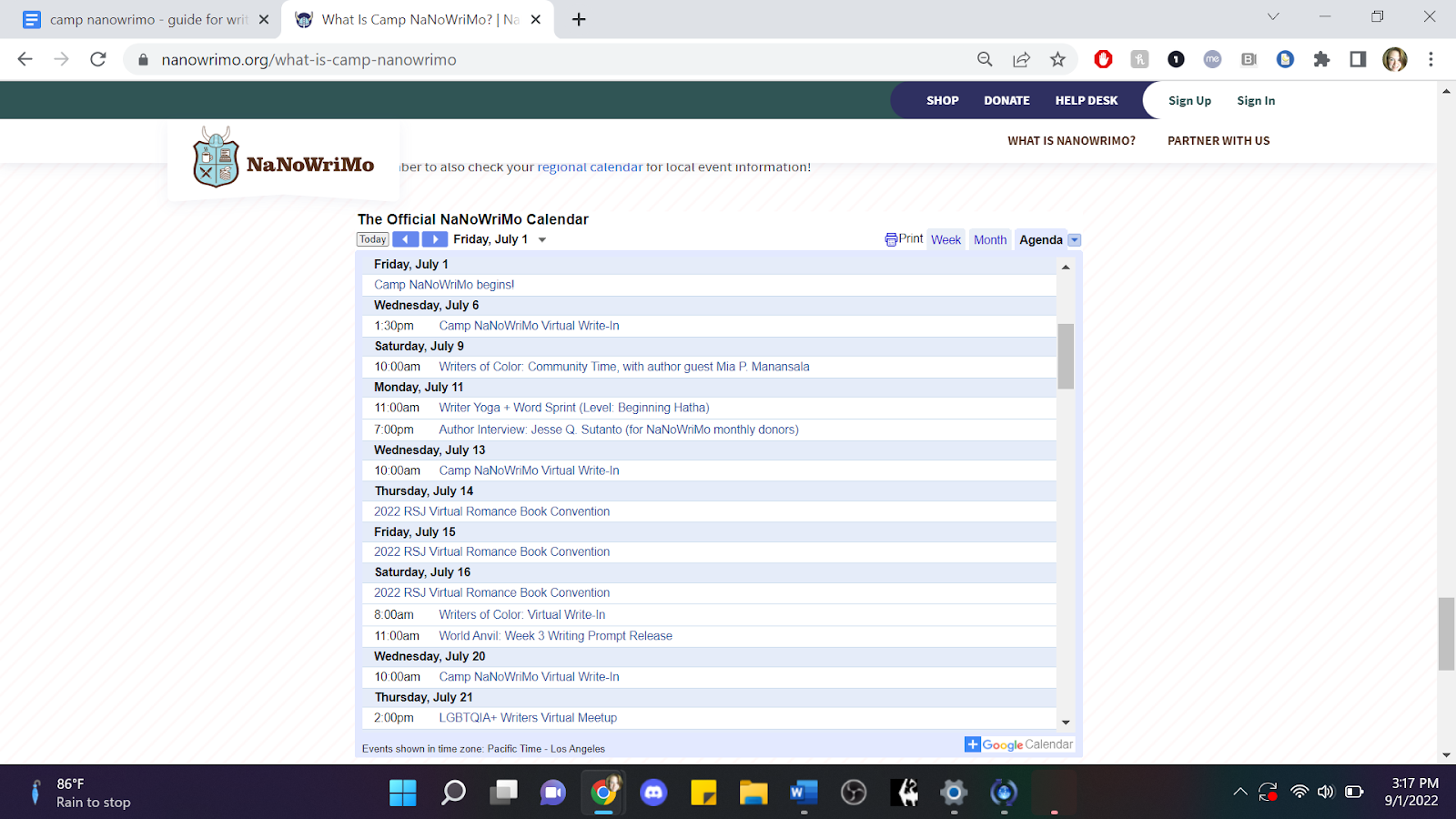
    Here’s the Google Calendar for NaNoWriMo’s events in July, for reference:

    And here’s that same month in agenda form, so you can see the specific events a little more clearly:

    In addition to these local events, Camp NaNo also has Camp Counselors—these are published authors who offer support, advice, and guidance throughout the month. This was the Camp Counselor lineup for July:

    3. Camp NaNoWriMo offers community

    The resources that Camp NaNo has to offer are great for keeping you grounded and supported throughout the process. It’s great to feel like someone’s rooting for you, and it’s awesome to have professionals to turn to for mentorship!

    It’s also great to have a community surrounding your writing and the writing of other authors in your area. You might not know any other writers in your day-to-day life—this is pretty normal! It’s an oft-isolating industry, usually done alone, and usually not involving a ton of connection to other people.

    And if you don’t love the idea of in-person events, guess what? Camp NaNo also has a ton of chances for online connection—their forums allow you to get in touch with local writers online and support one another as you work. You might even make some lifelong friends!

    How to Make the Most of Camp NaNoWriMo

    Now that you know what Camp NaNoWriMo is and why you should definitely try it out, let’s talk about how to make the most of your experience. Even if you prefer not to connect with other writers and instead do Camp NaNo totally solo, some of these tips will help you out!

    1. Pick a project you’re excited about

    Ultimately, you can choose to work on anything, but in my opinion, these kinds of events are best when you’re working on something that excites you. If you’ve got an idea for a book, but you just haven’t found the time to get started, guess what? The time is now! If you’ve got a weird idea for a poetry collection, bam—Camp NaNo material.

    You can also use Camp NaNo to knock out a project that’s been stewing on the back burner for a while. Maybe there’s work to be done, maybe there are essays for college to be written—if it’s not something that you’re super stoked about, at least pick something that you’ll be glad you worked on.

    Is there anything you shouldn’t bring to Camp NaNo, you might ask?

    This is absolutely one-hundred-percent just my opinion, but I don’t like to bring established, deep-in-the-works projects to events like this. Usually I’ve already got a clear idea of where I want to go with the project, so I’m not looking for a ton of feedback, and it’s usually developed enough that there’s not a lot of exciting new stuff happening with it. I’m talking about novels that I’ve already drafted a few times, short stories that just need polishing—stuff like that.

    Camp NaNo creates a ton of energy, and in that way, at least to me, it’s like rocket fuel. Some of your projects or ideas might need rocket fuel to take off and get going—some of your projects might not. You’ll be the best judge of that.

    2. Use Camp NaNoWriMo to establish good writing habits

    Unless you’re already writing for a living, you probably don’t write super regularly. Events like Camp NaNo might be the only months out of the year that you’re consistently returning to the keyboard for regular writing time. And that’s completely fine!

    However, if you want to be a pro, you’re going to have to develop discipline. This doesn’t mean drafting everyday (in fact, it definitely does not mean drafting every day), but it does mean coming to your keyboard as consistently as you can to keep your skills honed and your story fresh.

    Try finding a consistent time to work on your Camp NaNo project. You might find that you work better in the evening, or that you prefer outlining by hand, or that you prefer ten-minute writing sprints to twenty-minute writing sprints. Maybe you envisioned writing during your lunch break, but it turns out the break room at work is way too distracting—that’s good to know! Take note of what works and what doesn’t and bring that knowledge with you beyond Camp NaNo.

    3. Try getting involved with the community around Camp NaNoWriMo

    Of course, the option to do Camp NaNo solo is available to you. It’s a self-challenge, and as such, you’re free to keep to yourself, work on your project, and pat yourself on the back at the end of the month when you’ve completed your goals.

    However, consider this: Camp NaNo is putting you in touch with other writers. Likely, some of these other writers are also readers who might be interested in reading your book when it’s published. And to be clear, I am not saying you should get close to people under the guise of friendship with the ultimate intent of selling them something—in fact, don’t.

    What I am saying is that if you are self-publishing, you’re going to want to build a platform. Platforms require readers, yes, but they also require connections to other authors. Who else is publishing in your genre? What kind of stuff are they writing? Connecting to these other authors means building up your platform a little bit, and that’s going to be absolutely vital when it comes time to publish.

    Additionally, working with other self-published authors is a great opportunity to compare resources. Someone might know a great editor for your genre, and someone else might have already tried the cover designer you have in mind. You can combine knowledge in this way to save yourself some time and make the best decisions possible for yourself and your work.

    4. Have some fun

    Here’s the thing: ultimately, Camp NaNo is meant to be fun. Going in with some kind of plan will help you optimize your experience, but if you don’t have one, I absolutely encourage you to log in on July or April 1st, set up an account, and announce a project, even if you literally just thought of it on the spot. In fact, that might be the most wholesome way to participate.

    However you choose to play, have fun out there!

    Have you ever done Camp NaNo? How did it compare to NaNoWriMo? Let us know in the comments! 

    TWL. CTA. Book Outline Template
  • How Do You Win NaNoWriMo?

    How Do You Win NaNoWriMo?

    In book-writing circles, November is National Novel Writing Month, otherwise known as NaNoWriMo. If you haven’t heard of this annual event, or you’re ready to join the challenge for the first time, this will be a great primer. Here is a brief overview of the rules, along with guidelines to help you win NaNoWriMo.

    How do you win NaNoWriMo?

    “Winning” NaNoWriMo is both simple and hard.

    If you can write 50,000 words between November 1 and November 30 then you win!

    However, actually getting to that word count will take some discipline and strategy. Most people break this big number into a smaller, daily word count of 1,667 to make it feel more achievable. For many, this number is still overwhelming, which is one reason NaNoWriMo is such an exciting challenge. Simple, but not easy.

    Winners receive digital banners and certificates to use on their website or social media and T-shirts are also available for purchase. Sponsors provide other winner goodies, including discounts to writing software and publishing services. The catch? In order to win, you need to register your project on the NaNoWriMo website and log your word count between November 1 and November 30.

    Digital badges and Scrivener discounts aside, the real prize is writing 50,000 words and having a first draft completed in 30 days.

    What are the NaNoWriMo rules?

    While the goal is writing 50,000 words in the month of November, how you get there is flexible. Here is a breakdown of the NaNoWriMo rules to help you stay on track.

    • On November 1, the challenge begins as the clock strikes midnight, local time
    • On November 30, the challenge ends at precisely 11:59:59 p.m. local time
    • For the official challenge, no, you cannot start early or end late. However, you can plan ahead, take notes, create character sketches, etc. before November 1
    • In order to win, your novel must reach minimum 50,000 new and/or rewritten words by the end of the challenge—but your novel doesn’t have to be complete

    That said, “rebelling” is allowed and encouraged, since this is a self-challenge. If your project isn’t a perfect fit and you still want to participate, then do it. For more information on the rules of NaNoWriMo, both official and unofficial, check out this article.

    Additional resources to help you prepare for NaNoWriMo from The Write Life

    These three articles and resources will help you go further with NaNoWriMo specifically. The first is a free tool to help you outline your book before you start writing. The second will help you prepare for NaNoWriMo more fully. The third will help you in your goal-setting so you can actually win the challenge!

    This next set of articles and resources will help you with your novel more holistically. The first will help you get ready to write your novel, but chances are you’re already past that if you’re prepping for NaNoWriMo. The second gives you prompts to get the juices flowing. The third will help you set up routines to write consistently. The fourth is for when you finish writing your rough draft and are ready to self-edit.

    Side note: A lot of people have asked us, “When did NaNoWriMo start? How long has it been a thing?”

    National Novel Writing Month began in 1999 as a challenge between writing friends and has since grown into a global marathon event attracting hundreds of thousands of participants each year. To date, there are nearly 800,000 active novelists and more than 350,000 completed novels as a result of this annual tradition.

    We look forward to seeing you there this November!