Blog

  • Freelancing is a Real Job: Tips for Responding to Critics and Skeptics

    Freelancing is a Real Job: Tips for Responding to Critics and Skeptics

    Freelance writers, have you had this conversation before?

    “What do you do for a living?”

    “I’m a freelance writer.”

    “Oh.” Oh, you’re between jobs. Oh, you can’t find another one. Oh, you work from home.

    Oh is a subtle judgment, isn’t it? This response usually comes from people with “real” careers who make assumptions about freelancing careers. It’s not because these people don’t support you — they’re likely close friends, partners or parents — they just don’t understand freelancing.

    Technically, all of these beliefs could be true; freelancers are often in-between jobs, looking for more work, and more frequently than not, working from home. But it’s still frustrating to have to explain to people that freelancing is not the latest hipster, Boomerang generation development. It’s the future.

    About one in three American workers — 42 million people — are freelancers, and their numbers will swell to make up half of the American workforce by 2020, according to Forbes. Freelancing is real, full-time meaningful employment.

    [bctt tweet=”Freelancing is real, full-time meaningful employment.“]

    Here’s how to explain to the skeptics what you do for a living.

    Freelancing is a legitimate business model

    Convincing people that freelancing is a viable career option is all about how you frame it.

    While “freelancing” can have negative connotations, “running your own small business” has positive ones. Compare freelancing to running a small business, with you as the CEO, CFO, account manager, marketing department, office manager and intern — in addition to being the writer. You pay taxes, you negotiate with clients, you sign contracts: you run a real business.

    Establish your professionalism

    Once you’ve explained that you run your own business, you’ll want to erase the lingering negative feelings (or jealousy?) about you working from home in your pajamas.

    Stress how you much you work — whether you’re a full-time freelancer or building a part-time writing business around other commitments, you’re likely working more than 40 hours a week.

    Explain where you work, whether it’s in a home office, at your kitchen table, at a cafe or a public library. (Maybe don’t mention those times you do a little work from your couch.) You want to convey that while freelance writing lets you work from anywhere, you’re still working.

    Stress your expertise and your understanding of your field

    Be prepared for people to ask you about what’s next. “Where’s your promotion? Where do you go from here?” are common questions, especially from concerned friends or relatives unfamiliar with freelancing.

    If you have an answer that works for you, give it (and please share it in the comments!). If not, prove your expertise in your field. You know your market’s demands and pay attention to new trends. Move the conversation to a place where you can show off your knowledge and skills — perhaps talking about a recent acceptance or publication, or a developing opportunity.

    If you’re comfortable, share your hourly or per-word rate to demonstrate that your business is viable. You could also point to pay information such as the Editorial Freelancers Association’s rate guide, Who Pays Writers or The Freelancer’s upcoming rate guide.

    If all else fails, use your sense of humor

    If these strategies don’t satisfy the skeptics — you know the ones who are least likely to understand your career — you might try responding with some good, old-fashioned sass. For example:

    • Q: But what do you do all day?
    • A: Run a business. My business.
    • Q: When will you get an office job?
    • A: I have one. It’s just working from my house — a home office.
    • Q: How do you take time off?
    • A: (What time off?) The flexibility of freelancing allows great travel opportunities; I can work from anywhere. Also, many people who get to take time off don’t.
    • Q: Is it lonely?
    • A: No, I get to work with my dog all day!

    Show off your legit-ness to friends with a top-notch Freelancer Website!


    Freelancers, how do you explain your career choice to people who don’t understand?

  • Writing Fiction: 3 Ways to Build a Stronger Story

    Writing Fiction: 3 Ways to Build a Stronger Story

    Authors face a great many challenges as we put together our manuscripts. Primary among them is working to erase our tracks on the page, creating a seamless connection between readers and our fictional world.

    In this, Kevin Spacey’s quote from The Usual Suspects (originally from Charles Baudelaire’s The Generous Gambler and paraphrased in C.S. Lewis’ The Screwtape Letters) is remarkably apt:

    “The greatest trick the devil ever pulled was convincing the world he didn’t exist.”

    So how do all we author-devils go about convincing our readers we don’t exist?

    After analyzing all 71 individual scenes in the latest draft of my novel, I discovered one common problem: my authorial presence on the page created barriers between the action and the reader. I needed to get out of the way.

    Narrowing in revealed three main areas where my footprints on the page depressed the action. I had created a protagonist I really liked, but who was onedimensional; I was filtering the action in my descriptions; and I was oversharing irrelevant setting and description details.

    Developing solutions to each challenge tightened my scenes and helped build a closer connection to the conflict playing out across the narrative. Here’s how I did it:

    1. Issue: A one-dimensional, likable protagonist

    When I’m reading a novel and I encounter a one-dimensional protagonist, it’s like I’ve sat down in a poorly made chair. I immediately wonder, “Who made this?” If a reader asks that question of a story, the author may not have done enough work to create a character independent of themselves and let the reader experience the tale without wondering how it was made.

    Great stories seem organic, as though the author channeled them, rather than created them. The writing can be brilliant, and the reader will notice the beauty in the construction of sentences and paragraphs, but what they absolutely shouldn’t notice are clunky story mechanics, including poorly realized characters. These reveal a sort of clumsiness — and clumsiness draws the author out into the open.

    [bctt tweet=”Great stories seem organic, as though the author channeled them, rather than created them. “]

    It’s tough to give your hero faults and flaws: vanity, an ego, even dark, criminal impulses. If you do, how can he or she possibly remain a good protagonist? Aren’t all our heroes free of vice?

    The most believable heroes are people not too different from us, with all the complexities and challenges we face each and every day. A great story, in which your protagonist achieves great things, is all the more satisfying when that character reaches her goal despite the challenges of her situation and setbacks that real or perceived imperfections cause. As David Corbett says in his epic The Art of Character:

    “Its far more important that we empathize with a character than like her, which is just as true of villains as heroes. And empathy is created by a well-drawn character taking on a convincing dramatic problem, in which compelling wants are at stake in the face of potentially overwhelming opposition. We feel for such a character, even if she is imperfect, for we all understand that necessity compels us to act as we must, not as we should.”

    Our characters acting as they must — and not as they should — is a hallmark of separation from the author. It is the antithesis of contrivance because, as protagonists become believable individuals — with warts and all — they tend to make decisions that reflect their many varied facets.

    Solution: Give your protagonist flaws

    Learn to cultivate flaws in your protagonists. Collect and log them. If you don’t know where to begin, gather inspiration on key character flaws, and learn why your character needs them. We like flaws because they make our characters vulnerable and allow us to empathize with them — precisely because they are not perfect, because they are like us.

    My protagonist, Duncan, had many likeable qualities in my first draft. He was well-intentioned, moral and without vice; a victim but rarely a predator. And, over the course of the book, while he dealt with certain troublesome episodes, nothing forced him to change. His flaws were in no way tied to the obstacles blocking him from achieving his goals. He was without reproach; in other words, boring.

    In my rewrite, I peppered Duncan with flaws. I wrote about what might shame or embarrass him. I flung at him snobbery, pedantry and annoying idiosyncrasies. I applied these flaws to specific scenes to see how they would change his decisions — and noticed an immediate and remarkable positive effect.

    Suddenly, Duncan was making his own choices, rather than me making them for him. He began acting as he must, not as he should — and in doing so gained an important separation from my undue influence.

    2. Issue: Filtering the action and description

    Certain words filter the action from the point-of-view character to the reader. They disrupt your story’s flow by creating distance between the reader and the action on the page.

    These filter words riddled my first pass with such interruptions. In fact, here are just a few from my finished first draft, in order of their egregiousness:

    to look: 300

    to think:  111

    to see: 91

    to hear: 66

    to feel (or feel like):  51

    to seem: 50

    to realize:  13

    to wonder:  9

    to watch: 8

    to decide: 8

    to touch:  5

    Solution: Ruthlessly remove filter words

    At first, it’s tough to spot these filter words. Here are a few of my favorite resources on reducing filters and eliminating telling words. Author Jami Gold has an impressive list for creating specific Word Macros that help you find filter words during your revision phase.

    Below are three examples of where I found and removed filters:

    Filter: “Nonsense,” Duncan said, feeling the letters N and S crash against the numb shores of this front teeth prior to completing the sounds.

    No Filter: “Nonsense,” Duncan said — the letters N and S crashed against the numb shores of his front teeth.

    Filter: “I advise you to pay thanks to the general for bestowing this honor upon you, rather than question the method of payment. You and I both know what this order will do for . . .” he looked around at the dirt pens, the long grass and the crumbling house, muddied, with hay tipping over onto the roof, “this business.”

    No Filter: “I advise you to pay thanks to the general for bestowing this honor upon you, rather than question the method of payment,” the soldier said. The heat was sweltering in the crumbling  pens. Muddied, matted hay hung from the roof. He drew his sleeve to his nose. “You and I both know what word of our order will do for . . . this business.”

    Filter: “Sure, sure,” she said. “Does he know he’s meeting you . . . Duncan?” She looked down over her empty pad toward his name, scribbled in eyeliner pencil.

    No Filter: “Sure, sure,” Sheila said. “Does he know he’s meeting you . . . Duncan?” She drew her painted fingernail down over the empty pad and toward where his name was scribbled in eyeliner pencil.

    As with many writing rules, consider it a suggestion more than a fundamental requirement. You may find mere awareness of filters helps you to write tighter, more vivid descriptions.

    3. Issue: Oversharing setting and description details

    Writers know more about their story’s setting and their characters’ thoughts than anyone else. The problem is, we often share more than is necessary, leading to large chunks of description and internal monologue that break a scene’s momentum.

    We all know the rule: show more and tell less. But it’s become a cliche because it can be interpreted about a million different ways — so what the heck does it mean in practice?

    When we write scenes, we present an isolated viewpoint on a moment of conflict to advance the story for the reader. In a moment of conflict, people rarely notice what’s happening around them. They don’t take in exhaustive setting details or spend time trying to analyze their surroundings. They are in the action — where every move, every word, every detail either helps them get what they want, or pushes it further away.

    Imagine being in the front row of a play. To access the moment of conflict on stage, you need to be close to the action as it occurs. If a narrator is standing between you and the actors, they depress the intimacy of the action. So, showing is largely about getting out of the way of the action — drawing out into plain view only those items that advance the scene.

    Subtext is important here — the ability to tease out items that add meaning to a scene without drawing too much attention to them. For example, consider Big Jim Rennie’s golden baseball in Stephen King’s Under the Dome. To Rennie, the baseball at first represents power and prestige, until it becomes a literal manifestation of those delusions. When the violent drama finally plays out on the page, the baseball’s established subtext enriches the scene without impeding the action.

    Solution: Visualize your telling

    In a pass during your rewrite, visualize where you tell more than show. In each scene, create two different highlights — yellow for setting and pink for internal monologue. Highlight the blocks, then print out the scene and look at where your interjections slow the action of that scene. What details are unnecessary to the subtext of that isolated moment?

    Of course, telling can be useful for summary scenes to help the reader understand the aftermath of several intense scenes of conflict. In many plays, narrators come on stage at the beginning, in between scenes, and maybe at the end to recap the action. Such pacing mechanisms give the reader time to take a breath before plunging back into the action. But in most cases, scenes benefit from cutting down — or eliminating altogether — those interjections that slow action and impede the story.

    Have you found it challenging to remove yourself from a story? How do you take yourself out of your fiction writing?


  • What is a Chargeback? What You Need to Know to Protect Your Freelance Business

    What is a Chargeback? What You Need to Know to Protect Your Freelance Business

    Launching a freelance writing career can be difficult.

    If you’re just getting started, there’s a lot to learn. How much should you charge? How do you find clients? When should you go full time?

    While these are all major elements of your business, sometimes the smaller details can prove just as challenging — and costly. Read on to learn about one such little-known business obstacle: the chargeback.

    I learned about chargebacks the hard way, but you shouldn’t have to. Here’s what you need to know.

    One freelancer’s introduction to chargebacks

    Dear Freelance Guru,

    I just recently landed a new client. WooHoo! He hired me to write five articles for a grand total of $125. I finished the assignment in the allotted time frame and emailed him the articles. He acknowledged the submission, thanked me for my efforts and paid the full amount with his credit card.

    Today, I got some bad news. The client filed a chargeback! The $125 has been removed from my account and I’ve been charged a $20 fee! Before today, I didn’t even know what a chargeback was!

    What irks me the most is that he has my content on his site. The chargeback obviously wasn’t filed because of poor quality. Not only did he thank me for my efforts, he posted the articles. If they were good enough to post, they were good enough to pay for!

    Help! What can I do?!

    Sincerely,

    Financially Distressed

    Dear Financially Distressed,

    Welcome to the world of business, my friend. Life isn’t fair, and there will always be people out there who try to take advantage of any situation. I’m sorry you had to learn that lesson.

    What is a chargeback?

    Even now that you have experienced a chargeback, there is a good chance you don’t know everything there is to know about them. Let’s take a moment to get caught up on essentials. To learn more about the technicalities of the chargeback process, read this. If you choose to continue life as a freelancer, you’ll need to know the specifics.

    A chargeback is basically a credit card refund, invented to protect cardholders in case something goes amiss with their transaction. All a cardholder has to do is file a chargeback and their funds will be returned. Meanwhile, you’re left footing the bill for the administrative fees and are out the profits.

    If you sustain in a certain number of chargebacks in a given period of time, usually a month, you could lose your processor (the bank willing to process your credit card transactions). If you lose your account with the bank, it will be difficult — or even impossible — to get another.

    This also holds true for PayPal, which many entry-level freelancers use. Well, PayPal is a merchant processor and susceptible to chargebacks too.

    What does a chargeback mean for you?

    While the cardholder’s assets are covered, the merchant (you!) is woefully unprotected. Any time a business owner (or freelancer) experiences a chargeback, he or she bears the burden of proof. To fight the chargeback and reclaim your funds, you must have written proof that the transaction was authorized and the goods or services were successfully transferred to the cardholder.

    Now, in your situation, there is some good news. You have an email from the client saying the services were rendered in a satisfactory way. That will help you, should you choose to fight the chargeback. Any other documentation you have regarding the writing assignment should help too.

    Because you are a freelance writer and your “services” are already out there for the world to see, you have an advantage that few other business owners have. If you are unable to successfully reverse the chargeback, you can at least make the website owner “pay” for his poor behavior.

    Technically, you own the copyright for those articles until the website owner pays for them. If he hasn’t paid you and is still using your content, he is in violation of copyright laws.

    [bctt tweet=”If a client hasn’t paid and is using your content, he is violating copyright laws.”]

    You can do a search and find his website’s host. Most hosts have a page dedicated to DMCA (Digital Millennium Copyright Act). After answering a few simple questions, the host company will go to bat for you. If the site owner doesn’t pay you for the articles or take them down in the specified time frame, his site could be shut down.

    How can you protect yourself from chargebacks?

    Dealing with the situation at hand is only part of the battle; what you really need to worry about is taking care of your business in the long run.

    Chargebacks are traditionally filed for one of two reasons: fraud (unauthorized transactions) or poor customer service.

    Fraud is difficult to detect and prevent, but these steps are not impossible to implement. Here’s how to reduce the risk of fraudulent chargebacks when dealing with new clients:

    • Verify the client is a real person, operating a valid business or website. For example, if you accept a job via Craigslist, consider insisting on a telephone or Skype conversation rather than communicating solely through email. If you are working for a local brick-and-mortar business, drop by during business hours to check the place out.
    • Get everything in writing. Draw up a contract and have both parties review and agree to the terms. Make sure you and the client both have a signed copy.
    • Consider an extra precaution. Some writers request a copy of a photo ID and the front of the credit card. They compare this to the signature on the contract.

    While providing good client/customer service can help you with referrals and repeat business, it can also help protect you from potential chargebacks. While you probably use these strategies already, knowing you’re safeguarding your earnings is a little extra incentive to stay on top of everything.

    • Abide by all deadlines. If there’s a chance you’ll miss one, let the client know in advance and give as much warning as possible.
    • Don’t take on more projects than you can handle. When you spread yourself too thin, the quality of your writing will suffer. When you submit sub-par content, you open yourself up to chargebacks based on quality issues.
    • Reply to emails and calls promptly.
    • Follow all writing and submission guidelines to a T.
    • Send a detailed invoice as soon as the work has been completed.

    Again, I’m sorry you had to experience this unfortunate financial setback. Hopefully, you can learn from the process and take the necessary steps to protect yourself in the future.

    Sincerely,

    Freelancing Guru

    Have you ever experienced a chargeback? What did you do?

  • Children’s Book Authors: Have You Tried Amazon’s New Tool?

    Children’s Book Authors: Have You Tried Amazon’s New Tool?

    Publishing children’s books on Kindle just became a little easier.        

    While authors have long been able to post illustrated books through Amazon’s Kindle Direct Publishing, the books were simply text and images. However, you can now add a little interactivity to your book in the form of pop-up text, thanks to the Kindle Kids’ Book Creator (KKBC), the newest addition to Amazon’s arsenal of publishing tools.

    While you can publish an illustrated book on Kindle without using KKBC*, the new program offers two cool opportunities to make your book more fun and accessible for young readers.

    Here’s a quick illustrated guide to the new features.

    Getting started with KKBC

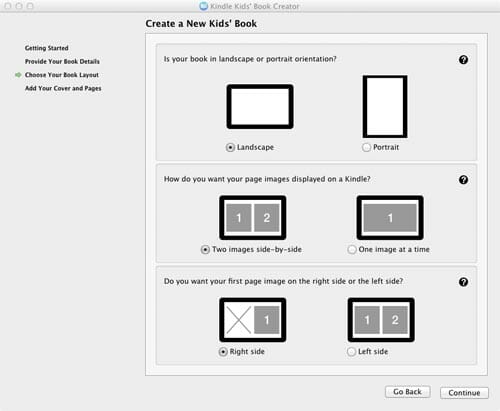
    Once you download KKBC for free from Amazon, your first task is to set up the book. Enter the title, author, destination folder on your computer (which must be empty), page orientation and other details.

    Kindle Kid’s Book Creator

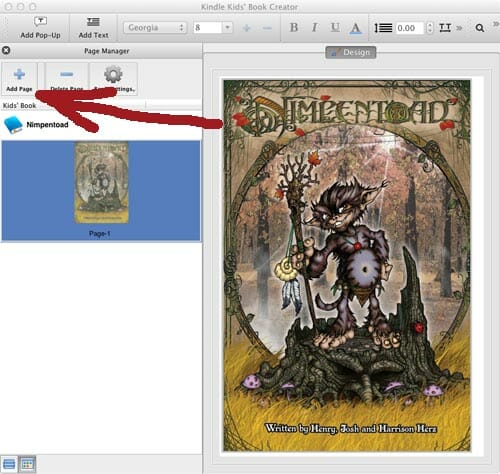
    Next, import your book cover as a PDF, JPG, TIF or PNG, followed by your page images. This can be done en masse using a multiple-page PDF — which I recommend, as it’s easier — or as individual images.

    If you opt to upload individual images, the files must be at least 400 by 400 pixels. To keep them in the correct order, make sure you’ve numbered your image file names, because KKBC adds them alphabetically. In the example below, I have added a single interior page image using the Add Page button.

    Kindle Kid’s Book Creator

    Using pop-up text to improve legibility

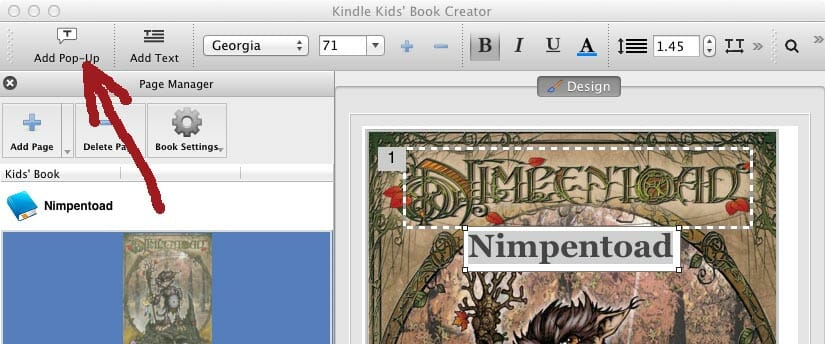
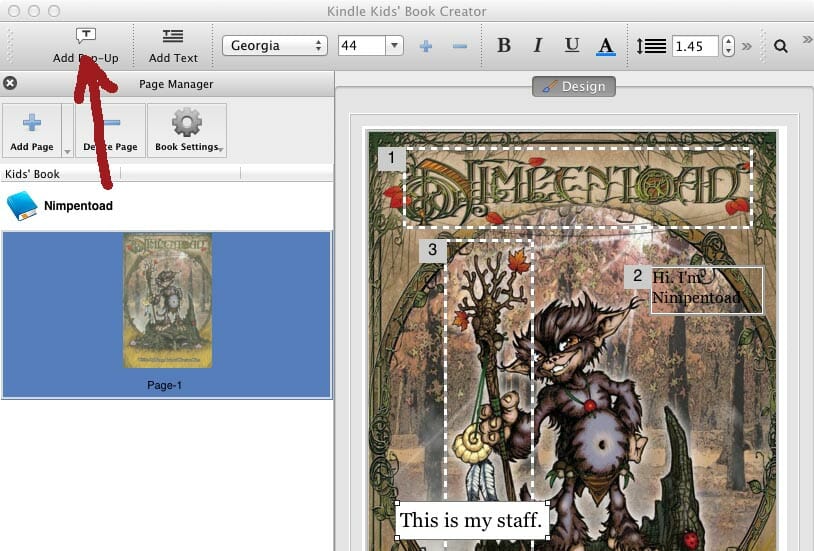
    Suppose I feel that the ornate font at the top of this image might be illegible for young readers. I click on the Add Pop-Up button, and a rectangular text box appears on the image. I can type in whatever text I choose, then resize and reposition the box and control its font, size and color.

    Kindle Kid’s Book Creator

    Add your story’s text

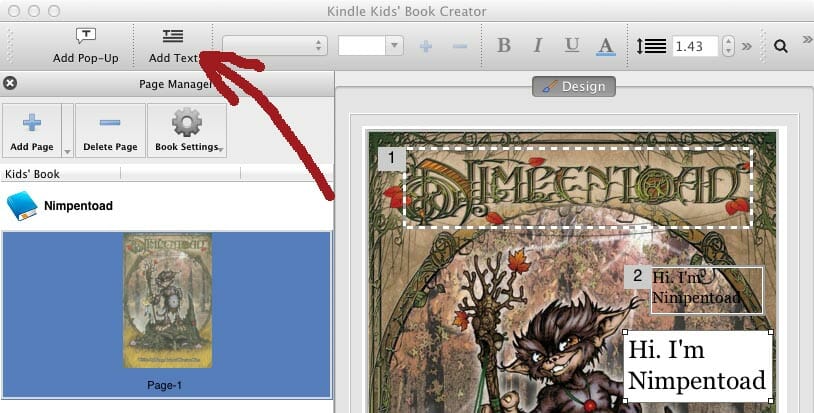
    The Add Text feature will, not surprisingly, insert text anywhere you’d like on the page. This might be where you add the text of your story to the correct area of each page.

    When a reader double-taps this text on his Kindle, he’ll trigger a pop-up, which is useful — while older readers might be able to decipher text within an illustration, younger ones might need larger text or a white background. Note that any “tappable” zones you create cannot overlap.

    Kindle Kid’s Book Creator

    Use pop-up text in creative ways

    You can use the Add Pop-Up feature anywhere on the page, not just on text. Perhaps you want to make regions of the image clickable to teach vocabulary to young readers, or to hide plot clues. The sky’s the limit!

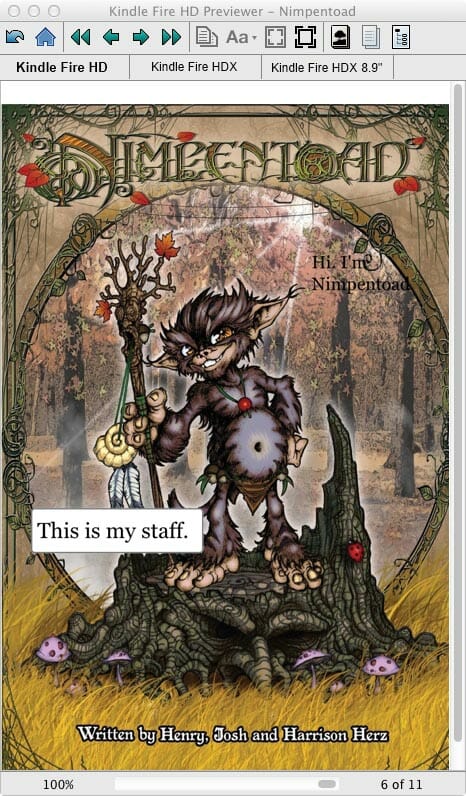
    For example, I can highlight the staff in this image so that when a reader double-taps it, they see a pop-up with the words “This is my staff.”

    Kindle Kid’s Book Creator

    Test your pop-ups in the Kindle Previewer

    When you’re done adding pop-ups, save the file. Click on View Preview to launch the separate Kindle Previewer application, which emulates how your book will appear on different Kindle devices.

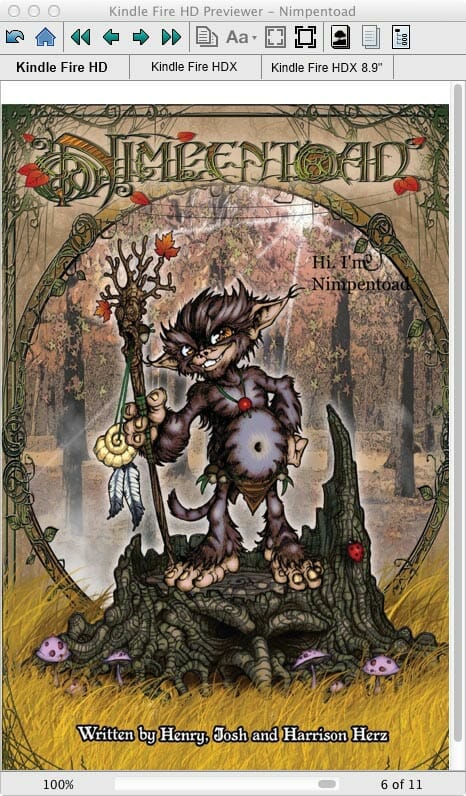
    Here’s how my book would look on a Kindle Fire HD. Note the “Hi. I’m Nimpentoad” text we added with the Add Text button.

    Kindle Kid’s Book Creator

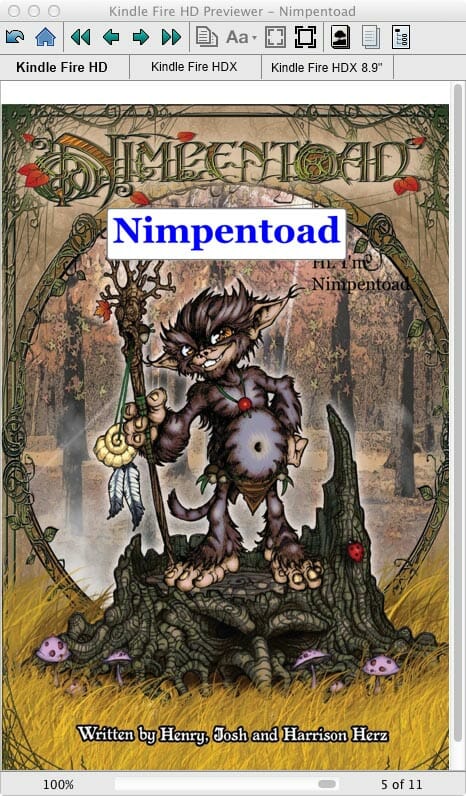
    Double-tapping on the ornate text at the top triggers a more legible pop-up.

    Kindle Kid’s Book Creator

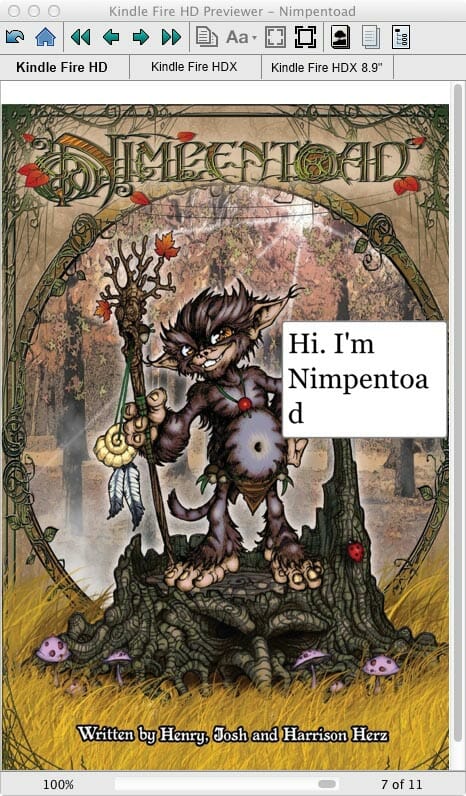
    Double-tapping on the “Hi. I’m Nimpentoad” text triggers a pop-up that’s easier to read. Note the wrapping text, which highlights the importance of testing your book on all devices in the Previewer to ensure it displays properly. In this case, I’d have to go back in and edit the font size for a better fit.

    Kindle Kid’s Book Creator

    Finally, if the reader double-taps the staff, they would trigger the associated pop-up.

    Kindle Kid’s Book Creator

    Adding pop-up text helps you improve your reader’s experience of your book, and adds some interesting interactivity. Enjoy playing with Kindle Kids’ Book Creator!

    *Want to publish illustrated books on Kindle without using this program? Simply save your Microsoft Word document as HTML, then run it through the free KindleGen application to create a .mobi format file. Don’t want to deal with conversion? Simply upload your Word or HTML files to Kindle and the platform will take care of the rest — though you’ll want to check the formatting.

    Have you used Kindle Kids’ Book Creator yet? What do you think of the idea?

    Looking for a quick introduction to publishing picture books on Kindle? Check out this free mini e-course from Children’s Book Insider.

  • Your Messy Desk is Hurting Your Writing Career. Here’s How to Declutter

    Your Messy Desk is Hurting Your Writing Career. Here’s How to Declutter

    Do you have a messy desk? It may be affecting your writing career!

    You want to write, but you can’t. It’s not writer’s block, a lack of ideas or a blank wall. Instead, it’s information overload with myriad to-dos fighting for precedence in your mind.

    You start to make a list, but your desk is a mess, with piles of papers (all important), post-it reminders (even more important) and books (most important of all) haphazardly stacked on every inch of space. How can you begin to work in this environment?

    Got a messy desk? What does your #writespace look like? Share a photo on Facebook, Twitter or Pinterest with the hashtag #writespace and tag us @thewritelife!

    Clutter’s effect on creativity and productivity

    Clutter makes it difficult to focus on one task or object, according to researchers at Princeton University’s Neuroscience Institute. Your brain has a limited ability to process information, so a disorganized work environment pulls your attention in different directions—and away from your writing.

    And it’s not just physical clutter; a digital build-up of emails and social media notifications can be just as bad for us, according to Mark Hurst in Bit Literacy: Productivity in the Age of Information and E-mail Overload.

    What does that mean for writers? Dividing your attention between several stimuli—like your novel’s plot hole, your messy desk and your Twitter feed—often results in increased stress and decreased creativity and productivity.

    Try these strategies to take control of the clutter and manage your writing space, both external and internal.

    Messy desk? Declutter your physical space

    Clearing the detritus from your workspace allows you to start fresh. Plus, getting up from your desk and moving around is a great break from work; who knows what new ideas you might inspire by getting your blood flowing?

    1. Clear your desk

    Here’s a quick way to clear your messy desk. Set a timer for five minutes. Take everything off your desk and from your drawers (except your computer or notebook and pen, of course). Put every other item in a box, out of sight. As you work for the next three days, if you need an item, bring it back to your desk.

    2. Organize your less-necessary items

    Anything left in the box after three days isn’t crucial. Go through it and sort the items into two piles: file or discard. Save the items you need, like receipts and invoices, but be tough on yourself. Do you really need those to-do lists from two months ago?

    3. Improve your storage system

    Where you keep your go-to objects is important, but only the ones you use the most should make it to your workspace.

    Place your most used items within reach for easy access, like in the top drawers of your desk or on a nearby shelf. Less-important tools should be out of sight and filed away. While your computer might live on top of your desk, your thesaurus might only come out during rewrites.

    4. Set yourself up for success each day

    Before you quit working at the end of the day, take a few minutes to set everything back in its place. This way, the next time you sit down in your clean, uncluttered space, you’ll be able to get right to work.

    Declutter your mental space

    Even the most spotless desk won’t help a busy, distracted or disorganized mind from focusing on writing. Try one of these strategies to clear your mind and help you get back to work.

    5. Journal

    It’s a popular option for a reason: journaling about what’s bothering you helps reorganize your thoughts. Whether it’s your novel’s plot, your personal life or the challenges of freelance life, writing your problem out will help make space for new approaches and solutions.

    6. Make a to-do list to clean up your messy desk

    Trying to remember everything you need to do in the next day or week isn’t conducive to doing quality work. Instead, follow productivity guru David Allen’s advice and write everything down.

    Create a system to manage your tasks and schedules so you stay organized—and can get back to work. Need help? Try one of these free tools and apps.

    7. Make a to-do-later list

    Don’t stop your writing session to research a quick fact for your story or find that link you want to include in your blog post. Instead, keep a running list of small tasks that come to mind while you’re working, but don’t interrupt your writing. You can always look up a tiny detail, like the price of the first iPhone, once you’ve written the rest of your article or chapter.

    7. Turn off notifications

    Anything that makes a noise or pops up is distracting. Turn off all notification signals while you write: put your phone on silent or Do Not Disturb mode, turn off email notifications and close or silence social media sites.

    8. Clear your inbox

    While you might not want to pursue Inbox Zero, purging your inbox of unread newsletters and messages helps restore a sense of control. Take 30 minutes to scan your emails and delete unnecessary ones.

    Maintain this change by unsubscribing from newsletter that are no longer relevant, or use a service like Unroll.me to bundle them into one scannable message.

    Enjoy your uncluttered writing space

    Putting these strategies to work doesn’t mean you’ll need to become Sam or Susie Spotless, magically organized and perfectly calm; as Mikael Cho points out in a post on Lifehacker, you want the space to feel like it’s yours.

    While clutter has been shown to negatively affect your performance, it is your perception of clutter that matters, not someone else’s. If having a notebook, pen, or a photo of your significant other on your desk, doesn’t feel like clutter to you, then it’s not.

    The key is simply to create more space, both external and internal, in your writing life—helping inspire new ideas, more creativity and better productivity.

    How does cleaning up your messy desk and decluttering your writing space help you? Share your thoughts and photos with the #writespace hashtag on Facebook, Twitter and Pinterest, and tag us @thewritelife!

  • 7 Smart Ways to Earn Multiple Streams of Income from a Single Manuscript

    7 Smart Ways to Earn Multiple Streams of Income from a Single Manuscript

    Joanna’s new book Business for Authors: How to be an Author Entrepreneur is out now in ebook, print and audio.

    Your manuscript starts as just one document.

    Because of this, authors generally think in terms of one book — and they don’t realize that multiple streams of income can flow from this small beginning.

    Six years ago, I started out with one book — just like everyone else! At the time, ebooks weren’t mainstream and I didn’t know how to publish internationally. I had one print product in one country, but I had the writing bug! Now, my 12 books provide a full-time income, selling globally in several formats and languages, and I left my day job three years ago to become a full time author-entrepreneur.

    So yes, it starts off as just one manuscript, but you can turn that one book into multiple products. Here’s how.

    1. Understand scalability

    Scalability is a key concept for creatives, and it’s pretty exciting for authors. It means that you create something once and then sell it multiple times.

    A book is the perfect example of a scalable product. You write it once, and it can earn you money for the rest of your life and, thanks to copyright law, 70 years after your death. It’s scalable because you put in the effort once, and the returns just keep coming. That’s the magic of publishing in a digital age!

    2. Publish an ebook in all its varieties

    An ebook is not a single entity anymore — you can have multiple ebook products. The main file types are mobi (for Kindle), ePub (for most other devices and platforms) and PDF (which most bloggers use to sell direct). You can create these yourself using tools like Scrivener or pay for conversion services.

    Once you’ve created these files, you can sell them on multiple devices: Kindle, Kobo, Nook, Apple devices, smartphones (through apps), as well as online through your website. These ebook versions alone can give you multiple income streams, as the indie author is paid from each store and distributor separately as well as receiving individual sales from customers.

    Use Amazon’s KDP, Kobo Writing Life, iTunes Connect and NookPress to publish directly, or use services like Smashwords, Draft2Digital or BookBaby to distribute for you.

    3. Publish a print book

    Print-on-demand technology means you don’t have to pay upfront or store and ship physical products anymore. When a customer orders your book, one copy is printed and sent directly to them, and you receive whatever profit margin you set up.

    Use services like Createspace or Ingram Spark to upload formatted files and have your print books available for sale online through Amazon, Barnes & Noble and many other online bookstores.

    4. Publish your book in audio format

    With many people commuting for hours every day, and the ease of using digital audio files, audiobooks are an expanding market. Sell your books in audio format through Audible, iTunes, Amazon and other services, as well as selling directly from your site.

    For indie authors in the U.S. and U.K., ACX.com is a great way to get your books into audio, and hopefully this will be expanding to other markets over time. You can also record your own work and sell direct using Selz, e-Junkie, Gumroad or other services.

    So that’s already one manuscript into multiple products … but it gets better!

    5. Go global with all formats

    Through online book retailers, you can now reach multiple territories yourself as they distribute to 170 countries. The Kobo Writing Life platform even has a fantastic world map so you can see where people have purchased your books. I’ve now sold books in 58 countries, including such diverse places as Ecuador, Burkina Faso, Nepal and Iceland. For a travel junkie like me, that’s exciting!

    Most of those country sales are small right now, but that’s because the online book sales markets are only just beginning. Fast forward a few years and I think you’ll see how different things will be. The story in the last few years has been about the maturing U.S./U.K./Canadian digital market, but over the next few years, the focus will be on the rest of the world.

    6. Collaborate on translations

    Germany has a population of 80 million, and Germans are big readers. There are also German speakers in Austria, Switzerland and, of course, the rest of the world. Ebook adoption is increasing and Germany is the third-largest ebook market after the U.S. and U.K.

    Spanish is the second most commonly spoken language in the world after Mandarin, with more than 400 million native speakers. For the ebook market specifically, Spanish is the second most commonly spoken language in the U.S., which is the most mature ebook market.

    Those are just two examples of opportunities for expanding your work into other languages and reaching new readers. The sales may be small initially, but with a longer-term view, it’s likely to only get better.

    [bctt tweet=”Consider opportunities to expand your work into other languages and reach new readers.”]

    You can work with an agent to find foreign rights deals for you, or you can use IPR License or  PubMatch to sell your own foreign rights. Indie authors are also now doing joint venture deals directly with translators — I have books out in German, Spanish and Italian that I produced in partnership with translators. You can also use a site like BabelCube, which works as an intermediary and publisher in these types of deals.

    7. Collaborate on other creative projects

    I firmly believe that creative collaboration is the next big thing in the writing community. It’s already established in other creative industries, like music, dance, film and other media, but authors have often worked alone and used intermediaries like agents.

    However, in the last year we’ve seen the rise of multi-author box-sets, which have propelled some onto the New York Times and USA Today bestseller lists. Authors have collaborated on new stories together — and not just anthologies, but graphic novels, digital products, and even film and TV with their books.

    Anything is possible in this new creative world, so take your one manuscript and turn it into multiple streams of income — and then do it again. Happy creating!

    Do you earn multiple streams of income from a single manuscript?

  • How to Stay Sane While Building Your Writing Career Part Time

    How to Stay Sane While Building Your Writing Career Part Time

    Do you have all day, every day, to write?

    Nope?

    Me neither.

    In fact, pretty much every professional writer — whether they’re a novelist, freelancer, nonfiction author or blogger — has to start building their career around an already-busy life.

    Maybe you’re working full time in a 9 to 5 role. Maybe you’ve got young kids. Maybe your life is packed with volunteering, caring or other commitments.

    Or maybe you’re unwell or have a disability, and that means you can only write for an hour or two each day.

    It can be really frustrating trying build your career when you can only work part time.

    But it can be done … and you don’t need to drive yourself (and your loved ones) insane while doing it. Here’s how.

    Don’t compare yourself with full-timers

    It’s all too easy to look at what other writers are doing and feel bad that you can’t match up.

    But if you’re comparing yourself with someone who’s working full time (or close to) and who’s established in his career, you’re setting yourself up for disappointment.

    Sure, Joe Blogger can turn out five great posts a week when he’s making a full-time living from his blog and doesn’t have to work another job.

    Sure, Ann Author can put out a whole trilogy of novels every year — but she has all day, every day to work on them because she has a backlist of nine novels providing her with an income.

    You don’t know what life was like when they started out. Perhaps Joe Blogger struggled for two years before he had enough of a blog audience to make even $100 a month. Perhaps Ann Author took 10 years to write her first novel, because she was working around her kids.

    If you must make comparisons, compare yourself today with yourself a month ago (or three months ago, or a year ago). How have you improved since then? What have you learned? What have you accomplished?

    Focus on one core area

    In the early days of your career, it’s tempting to cast a wide net: to try out lots of different types of writing and lots of different marketing methods, hoping that something will pay off.

    Spreading your attention too thin, though, means you’ll struggle to make headway in any area — especially as your time is limited.

    Instead, choose one core area to focus on. Don’t try to get your blog underway and write a novel at the same time. Don’t offer every writing service possible to your clients. Pick one speciality, and stick with it.

    You’ll learn faster, you’ll build up your experience and expertise quickly, and you’ll make encouraging progress that helps keep you motivated.

    Find your best (available) time of day to write

    Are you a morning lark or a night owl? Different people work best at different times of day — here’s a fascinating visual look at the routines of some famous creative people.

    I’ve always been a morning person, though these days I find I can write well in the afternoons too. Evenings are my biggest “slump” time — I find it hard to focus and be creative then.

    Chances are, you already have a reasonable idea of when you’re at your best, but it’s worth experimenting to see if a different time of day could suit you better (especially if your day job or other commitment takes up your best writing hours).

    Think about:

    • Getting up 30 minutes earlier to write before the rest of the family is awake. Leave everything set up to write the night before (e.g. your laptop ready on the kitchen table).
    • Writing during your lunch hour — can you get out of the office to a coffee shop or library, so colleagues don’t disturb you?
    • Using your best hours on the weekends — maybe you’d love to write between 9am and 11am, and you can’t do that during the week.

    Move toward cutting or quitting other work

    This might seem a long way off right now, but if you plan for it, you might be able to cut down your hours at your day job sooner than you think.

    If you currently have a full-time job, could you work four days a week instead of five, giving you one full day to write? That might mean saving up an emergency fund, cutting your spending or ensuring you have some regular writing income.

    If you do need to work your full-time hours, could you work them in a condensed way across four or four-and-a-half days?

    If your life is full of voluntary commitments, can you cut back on some of these? You’re not being selfish if you make time for your writing career — it’s important and worthwhile.

    If you have young children, can you pay for some childcare or arrange an informal childcare swap with a friend?

    Rearranging the elements of your life takes time. Getting clear about what you want and working out what steps you need to take to get there helps you make real progress. Simply carrying on and hoping things change won’t get you far.

    Create systems to make writing easier

    Whatever sort of writing you do, there’s a good chance you carry out the same sorts of tasks over and over again.

    That could be answering emails, writing blog posts, posting updates on social media, carrying out work for clients or almost anything else.

    Every task, however complex, can be broken down into a process of steps. Creating a checklist or a template could save you a huge amount of time.

    [bctt tweet=”Creating a checklist or a template could save you a huge amount of time in your writing.“]

    For instance, if you find yourself spending hours responding to prospective client‘s enquiries, you could create an “FAQ” page on your site that addresses some of the most common ones.

    Even something like “write next novel chapter” could be turned into a process — perhaps you’ll spend five minutes brainstorming ideas for the chapter, then five minutes deciding on the order of events, before jumping into the writing itself.

    Systems will:

    • Save you time: it’s quicker to add a couple of personalising lines to a standard template email than to write the whole thing from scratch every time you reply to a client inquiry.
    • Save you brainpower: it’s much easier to run through a checklist than to have everything in your head (worrying constantly that you’ll forget a crucial step).
    • Make it easier for you to hand work over: at some stage, your business won’t be able to grow any further without you hiring help.

    I have every sympathy for writers building a career while juggling other commitments too. I started out writing around my full-time day job, and now have a toddler daughter (and another baby on the way).

    The truth, though, is that pretty much every writer has to fit their writing around everything else when they first start out. You want to make this phase as easy as possible, and you also want to give yourself a good chance of exiting it quickly — so you can write full time (or as near to full time as you want).

    Do you have a particular problem or struggle that’s holding you back as a part-time writer? Or have you successfully made the part-time-to-full-time transition?

  • Writing Spaces: Where 9 Famous Creatives Do Their Best Work

    Writing Spaces: Where 9 Famous Creatives Do Their Best Work

    Where’s your favorite place to write?

    Does your writing space help you be productive and stay organized?

    If you need some inspiration, check out the writing spaces and environments of these famous artists, writers and storytellers.

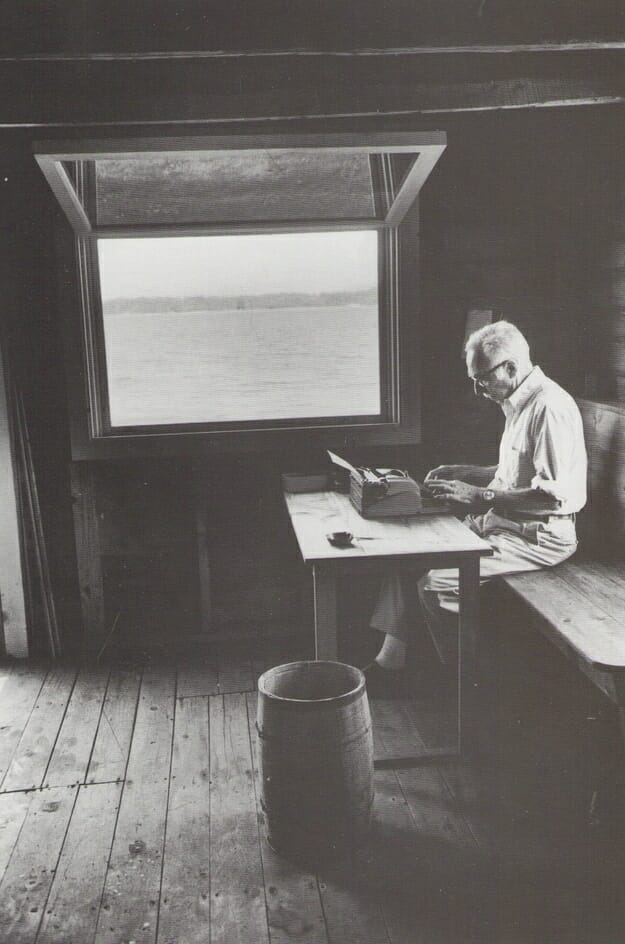
    1. E.B. White, author

    Sometimes all you need is a comfortable desk with a view of the outdoors for inspiration. (Ideally, near a farm with plenty of interesting animals, including a few spiders.)

    Image: e.b. White

    Image credit

    2. Jane Austen, author

    This table may be tiny, but it supported the creation of her later works, including Emma, Persuasion, and a revision of Pride and Prejudice.

    Image: Jane Austen

    Image credit

    3. Mark Twain, author

    When you’re struggling to write, sometimes taking a break can help get your creative juices flowing. Perhaps a game of pool would inspire some ideas?

    Image: Mark Twain

    famouscreatives

    4. Nigella Lawson, chef and food writer

    When you’re looking for inspiration, having all your favorite books within arm’s reach certainly can’t hurt.

    Image: Nigella Lawson

    5. Steve Jobs, inventor

    Jobs was well-known minimalist. He described one home by saying, “All you needed was a cup of tea, a light, and your stereo.”

    Image: Steve Jobs

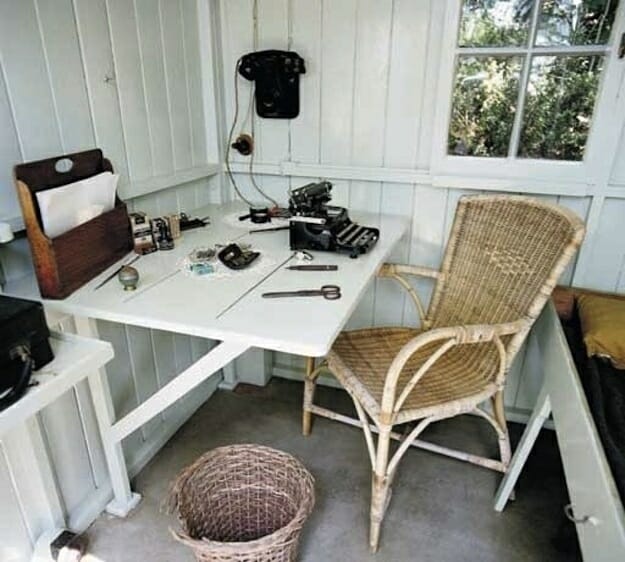
    6. Virginia Woolf, author

    This simple desk and chair overlooking the outdoors were ideal for writing, at least in the summer. Woolf noted that this converted toolshed was so cold in the winter that she couldn’t hold a pen!

    Image: Virgina Woolf's Desk

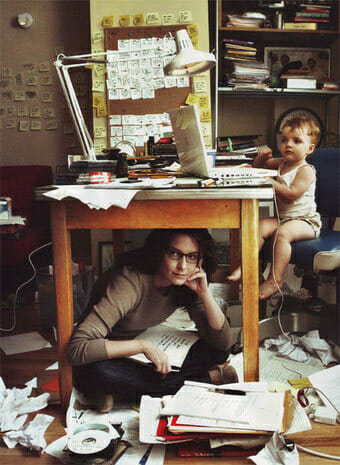
    7. Tina Fey, author and comedian

    Were you wondering about the workspace that may have inspired 30 Rock, Mean Girls or Bossypants?

    Image: Tina Fey

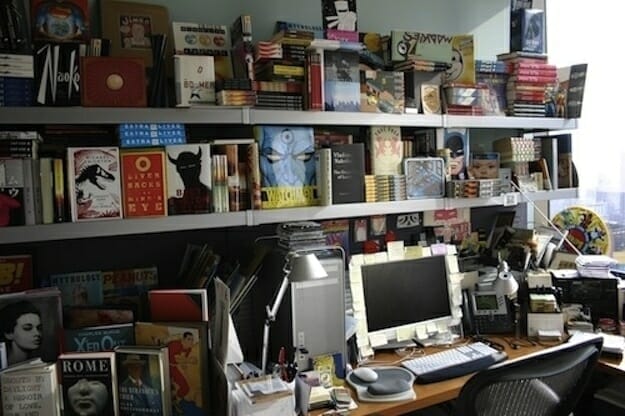
    8. Chip Kidd, book cover designer

    Many artists find their creative inspiration in other books, authors and stories.

    Image: Chip Kidd

    9. George Bernard Shaw, playwright

    Keep it simple with a typewriter, a clean white desk and a small window in a private place. That last one was key for Shaw, who once confessed, “People bother me. I came here to hide from them.”

    Image: George Bernard Shaw

    What’s your favorite place to write?

  • 10 Money-Making Tasks Successful Freelance Writers Do Every Day

    10 Money-Making Tasks Successful Freelance Writers Do Every Day

    As a freelance blogger, it’s all too easy to get bogged down with unimportant tasks.

    You know the feeling, when you’re “busy being busy” with all of those tasks that don’t actually lead to more income. For examples:

    • Browsing your social media accounts
    • Reading blog posts
    • Checking your email (again)
    • Tweaking your website design
    • Researching unrelated side projects
    • General web browsing

    While the above tasks have their place — they can be a great break or inspire new ideas — don’t make the mistake of thinking that they’re crucial to your business. Reading blog posts will not make you more money; only taking action will!

    With many other demands on your time, you need to make the most of the precious hours you carve out for blogging. Here are the most important tasks to focus on.

    1. Write a blog post

    As a freelance blogger, you get paid to write blog posts. This is your offering, your craft, your lifeblood. So it makes sense to spend the majority of your time writing posts.

    If you don’t have many clients yet, write posts for your own blog, or better yet, write a guest post (more on that in the next point). The key here is to keep writing. The more you write, the better you will become and the more clients you will sign.

    [bctt tweet=”The more you write, the better you will become and the more clients you will sign.”]

    How much time are you spending writing blog posts?

    2. Outline a pitch for a guest post

    By now, you know the value of guest posting. It gets you in front of new audiences, drives traffic to your website, builds your email list and strengthens your authority and profile.

    What do those benefits have in common? They can all help you earn more money.

    Guest posting has been one of my main lead generation strategies. I target large blogs in my niche and typically get between 10 and 50 new subscribers and one to two new clients per post.

    I feel so strongly about guest posting that I suggest you stop reading this post right now and create a hit list of blogs where you’d like to guest post, craft the perfect pitch and start sending emails.

    How many guest post pitches have you sent in the last two weeks?

    3. Write a newsletter

    You’ve spent all of this time pitching and writing articles so you can build your email list. Then all of your hard work is undone because you don’t take the time to build a relationship with your readers.

    Rather than rushing your newsletter content because you haven’t sent your list anything in weeks, spend time every day writing newsletters for the future.

    Tell personal, relatable stories. Share resources or interesting articles. Ask your readers what they’re struggling with in your niche. Occasionally, throw in a plug for your products or services.

    If you don’t take the time to build a relationship with your readers, you’re wasting an opportunity to connect with lots of prospective clients. They may not have bought your services right away, but they might in the future.

    4. Email prospective clients

    In the sales world, your prospective client list is known as a pipeline. This is where all of your “now” business is.

    What is a prospective client? Someone who inquires about your freelance writing services, but has not yet signed up, for any of these reasons:

    • They’re comparing you with other freelancers
    • They’re still assessing the value of your services
    • They’re just not ready to make a decision

    However, if they’re taking the time to inquire, they likely need your services. They might need time to make a decision, but there’s no harm in following up.

    How? Don’t email them every day asking if they’re ready to start! Rather, focus on providing value, whether that’s recommending them to someone you know in another field, or sending them a link to a useful article. Following up and providing value demonstrates your professionalism and increases your chances of winning the business when your prospective client is ready to make a decision.

    Do you have a list of prospects in this “limbo” stage? What are you doing to get them across the line?

    5. Email your current clients

    Another important money-making task is client communication. When dealing with clients, it’s actually quite hard to over-communicate. Keeping clients informed of your progress — without them having to ask — will increase your reputation and perceived value (and will make it easier to get referrals).

    Never make your client email you to find out where things stand. Make it part of your service standard to keep them up to speed on all projects. Even the most talented writer can lose clients because they weren’t communicative or responsive enough.

    6. Email your former clients

    Finding and landing clients is hard work, so it makes your life much easier if you can encourage repeat business and referral opportunities through your past clients. They know what it’s like working with you, and if you’ve done a good job, are often happy to share their experience with others.

    However, sometimes they need a friendly reminder that you still exist and a straightforward request for referrals.

    When you contact your former clients, don’t make the mistake of emailing them out of the blue and asking for a referral. Instead, provide something of value — then ask.

    Here’s an email I sent to one of my former clients:

    Hi Erin,

    I hope business is going well! I came across this great resource and thought of you:

    https://ecommerce.shopify.com/guides/content-marketing

    I only had a chance to watch a few videos this afternoon, but I plan to set aside some time to get into it tonight. I think a solid content marketing strategy will drastically increase your online presence and your sales.

    Also, the Shopify blog is a great resource for product creators selling online so it might be worth bookmarking, if you haven’t already.

    Let me know what you think.

    See how the email is all about providing value to Erin? Nowhere did I mention that I wanted referrals. Former clients often reply to this kind of email thanking me for the information and asking how business is going — or they mention they know someone who could use my services.

    It’s at this point that I talk more about my business and how I can help them or anyone they know. If there isn’t a fit this time, I make a note to contact them with another valuable resource in a month.

    7. Email your personal network

    Your personal network is anyone who has a positive impact on your business, whether it’s an accountability group, a mentor, or a group of freelancers who can promote your work.

    I use a social contact management system called Nimble to organise all of my contacts, clients and former clients. I love Nimble because it tracks all of my social media interactions with my network in addition to tracking direct email correspondence.

    Like your former and current clients, make sure your communication with your network is about adding value — and every now and then, you can ask them for a favor.

    8. Prospective client meeting

    If you want to dramatically increase your chances of winning business, I suggest you try to get face to face with your prospective clients — or if you’re not local, on a Skype call or Google Hangout.

    Having a meeting gives you a chance to build rapport, talk about your work and showcase your skills in ways that you can’t achieve via email.

    Make sure you know what you want to get out of each prospective client meeting. You want the client to feel like they need your services to help grow their business, so talk about the importance of quality content and what it means for their work. If you can show that you know what their business is about and that you sincerely care about their future growth, it would be hard to say no to you.

    9. Client meeting

    Have you ever felt like you weren’t on the same page as your client? Or maybe you have some new ideas to help their business? Often, a quick meeting helps you get back on track or build a new project.

    Even five minutes of speaking face-to-face (or virtually) lets you get through the equivalent of 10 email replies. Plus, it gives you a chance to build rapport and deepen your business relationship — and a stronger relationship can lead to more opportunities in the future.

    10. Networking meeting

    In addition to emailing your personal network, take the relationship a step further and schedule a call with one of your contacts. It’s similar to having a coffee with a potential referral partner, but much quicker.

    Once again, make sure you have a purpose. Discuss ways you can help one another, educate them on your offerings and showcase your work. Make it as easy as possible for your contact to refer your services to others in his network.

    Did you get 10 out of 10?

    If not, you know what you need to do: take action.

    If so, nice work! You’re building a solid foundation for your business.

    The next challenge is to assess your workflow to ensure you’re spending the majority of your time doing these crucial tasks — ideally, 80%. Using tools, apps and systems will help you maximize your productivity.

    How many of these crucial tasks do you do on a regular basis? Which do you find the most challenging to fit in?

  • Publishing Traditionally? 4 Tricks for Maximizing Your Profit

    Publishing Traditionally? 4 Tricks for Maximizing Your Profit

    You’ve probably read a few articles on how to market your book, and selling more copies is important.

    But what if you could also make an extra $0.50 on each sale? If you sold four thousand copies this year, that would add up to an extra $2,000 in your pocket — which might make it worth spending an hour or two setting up the processes.

    Here are four ways you can squeeze more profit out of each sale. One strategy will even help boost your book in Amazon’s ranking’s! Let’s get started.

    1. Get paid a commission on top of a royalty

    When my book, 101 Weird Ways to Make Money, was published, I promoted it to my mailing lists and on my websites. At first, I just linked to the sales page on Barnes and Noble. They had preordered several thousand copies for their physical stores, and my editor at Wiley (rightly) suggested that we should reward them.

    Then I noticed that the link my editor gave me had Wiley’s affiliate code in it — my publisher was selling the books to Barnes and Noble, but also making a commission on each sale to buyers I referred. Why couldn’t that be my affiliate code? I changed it the next day. I later did the same for my Amazon links.

    Here’s how it works with Amazon’s Associates Program (Barnes and Noble’s program is similar): I refer newsletter subscribers and website visitors to the sales pages through links that contain my affiliate code. I then get a 4 to 8.5 percent commission, depending on that month’s sales volume. At the moment they sell the book for about $14.00, so my affiliate commission is at least 56 cents — on top of the $1.50 royalty from my publisher.

    Amazon says it’s also okay to do this with books you’ve published on Kindle. On my Kindle titles that I’ve self-published, I start with a 70% royalty (unheard of with print books), and then make a commission. On a $5.99 sale I refer, I earn a $4.19 royalty and another 4% from the Associates Program, or about 24 cents. That brings my total to $4.43 on a book that sells for just $5.99. That’s 74% — not a bad profit margin for a book!

    Here’s another little secret about those affiliate programs: when people use the link on your blog or Facebook page to buy your book, you’ll also make a commission on anything else they buy during that visit. When I looked closely at my affiliate sales report, I noticed that I was making money for music downloads, kitchen gadgets and other items, none of which I promoted. People who go to get my book apparently buy other things at the same time, and I get paid. Every little bit helps.

    Note: Amazon does not accept affiliates in certain states, in which case you can use Barnes and Noble’s Affiliate Program and make 6% on sales of your own books, on top of your royalties.

    2. Sell more by yourself

    It’s nice to have bookstores selling your book even while you sleep, but you might get a dollar or less on each sale as your royalty. If you buy your books wholesale from your publisher and sell them on your own, you can make as much as $10 on a book with a $19.95 cover price.

    [bctt tweet=”Buy your books wholesale from your publisher & sell them on your own to make a profit.”]

    Some authors find it very profitable to sell their books at speaking engagements and other public functions. Despite being a very social person, I don’t like being in the spotlight. But if you’re out there doing presentations and promoting your book, bring plenty of copies to sell.

    You can also ship books yourself. Once in a while, someone wants to buy a book from me directly, so I tell them to send a check. You could choose to do this even when selling your books through social media or by other means. Even if you pay the shipping charges, you make more than your usual royalty by buying wholesale and selling at full retail.

    3. Make self-published books smaller

    A traditional publisher pays you a set percentage as a royalty. On the other hand, if you use a publish-on-demand (POD) company to do it yourself, your profit is whatever is left over after your cost-per-book is deducted from the wholesale price book vendors pay for it. And there’s a reasonable limit to what you can ask for a book. That’s why smaller books make sense.

    For example, if your book retails for $14.95, and book sellers pay $7.47 for it, and your cost is $7.37, you’ll make all of ten cents per sale. But if you cut the size of the book down so your cost is just $5.47, you’ll be making $2.00 per copy — twenty times as much!

    I’ve self-published two books for $9.95 that each make more profit per sale than a book I sell for $14.95. That one was too big, and I’ve learned from my mistake.

    Sometimes it’s hard to reduce that word count, but keep the cost of production in mind as you write. Nonfiction can always be more concise. If it is fiction, consider breaking a good story into two books in a series instead of one long one.

    4. Cut costs on traditionally published books

    With Wiley, I had negotiated away the clause in the contract that required me to buy some copies. Authors typically pay their publisher 50% of the cover price, and to buy 100 copies, as Wiley wanted me to do, would have eaten up a sizeable chunk of my advance.

    Of course, I still needed to buy some copies for friends, family and promotional giveaways in my newsletters, so I went to Amazon and discovered two very interesting facts.

    First, I found that, unlike books bought wholesale through your publisher, an author’s retail purchases are part of various book industry sales statistics, like those used to put together best-sellers lists. Apparently buying your own books is a controversial marketing practice, but it isn’t illegal.

    Even if buying copies of your book doesn’t push it onto any top-10 list other than some obscure sub-category on Amazon, the numbers matter. Libraries, for example, try to stock popular titles, and your purchases might push your book one copy past whatever threshold they use to determine what’s popular.

    The second thing I discovered is that it can be cheaper to buy from Amazon than from my publisher. With shipping, I would have paid over $10 each to get my books from Wiley, and I wouldn’t earn royalties on these wholesale purchases (I asked, of course). But when new books are released, Amazon tries to have the lowest price online, and you can use that to your advantage.

    For a while, Amazon sold my book for $11.30, which is quite a discount from the $19.95 cover price. I bought enough copies to get free shipping, and I made a royalty of $1.50 on each one. That brought my total net cost down to $9.80 per book, 50 cents less than the per-book cost of $10.30 or so I would have paid (with shipping) to get them from my publisher.

    You have to do this shortly after publication, because that’s when Amazon will have their lowest price. Buy as many books as you think you will need all at once too, to get free shipping and to boost that sales ranking.

    Alas, it is against Amazon’s rules to use your own affiliate link to buy from them, or I would have gotten another 45 cents back on each book.

    Yes, oddly, you can buy at retail for less than wholesale, and also get statistical credit for these sales. Keep that trick in mind, especially if you need a few hundred copies of your book for speaking engagements. The less you pay, the more money you make.

    How do you maximize your profit from each book you sell?