Blog

  • The 17 Best Writer Websites to Inspire Your Portfolio

    The 17 Best Writer Websites to Inspire Your Portfolio

    Your online portfolio is the portal through which both clients and readers learn about you and your work — and one of the best ways to land writing jobs.

    That means that, for many of us, creating a writer website is hugely intimidating. I put off creating a writer website for months simply because I didn’t know how I wanted to put it together.

    Luckily, you have options. There are as many types of writer websites as there are writers, and you don’t have to make your writer website fit any kind of preconceived template or mold.

    Instead, use your online portfolio to reflect what makes you unique as a writer, and what you have to share with clients, readers and fans.

    [sps_reusable_block post_id=43047]

    Need inspiration? Check out these online portfolio examples

    Don’t make the mistake of thinking that creating your online portfolio has to be a massive project. We’ve showcased lots of portfolio websites that make it easy for you.

    But before you build your own, we’ve got some inspiration to get you started! We found some solid writer websites to share, each with a unique focus and design.

    Here are 17 online portfolio examples.

    1. Elna Cain
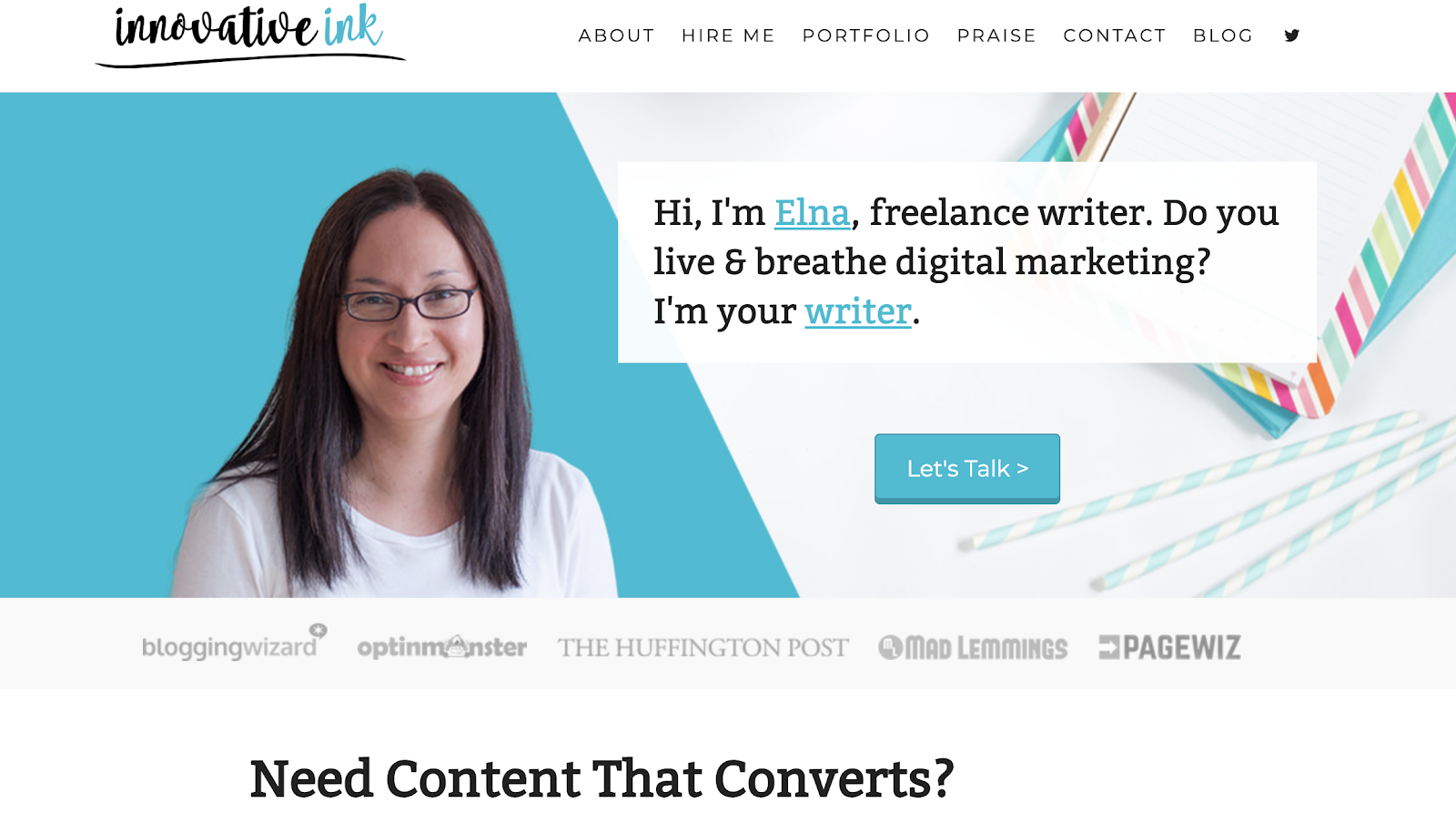
    Elna Cain’s writer website is bold, partly because she blatantly tells you she’s the freelance writer your business or project needs. To further convince you, a row of prominent publications are listed right above her introduction — that’s where she confidently states the problem clients have and how her skills can it. Then, the page ends with glowing client remarks. 

    Elna’s online portfolio shares a variety of ways to get in touch with her for business opportunities and how to keep up with her work online. To assert her expertise in the field, Elna also links her popular blog that’s filled with tips on how to make money with writing. 

    2. Manjula Martin
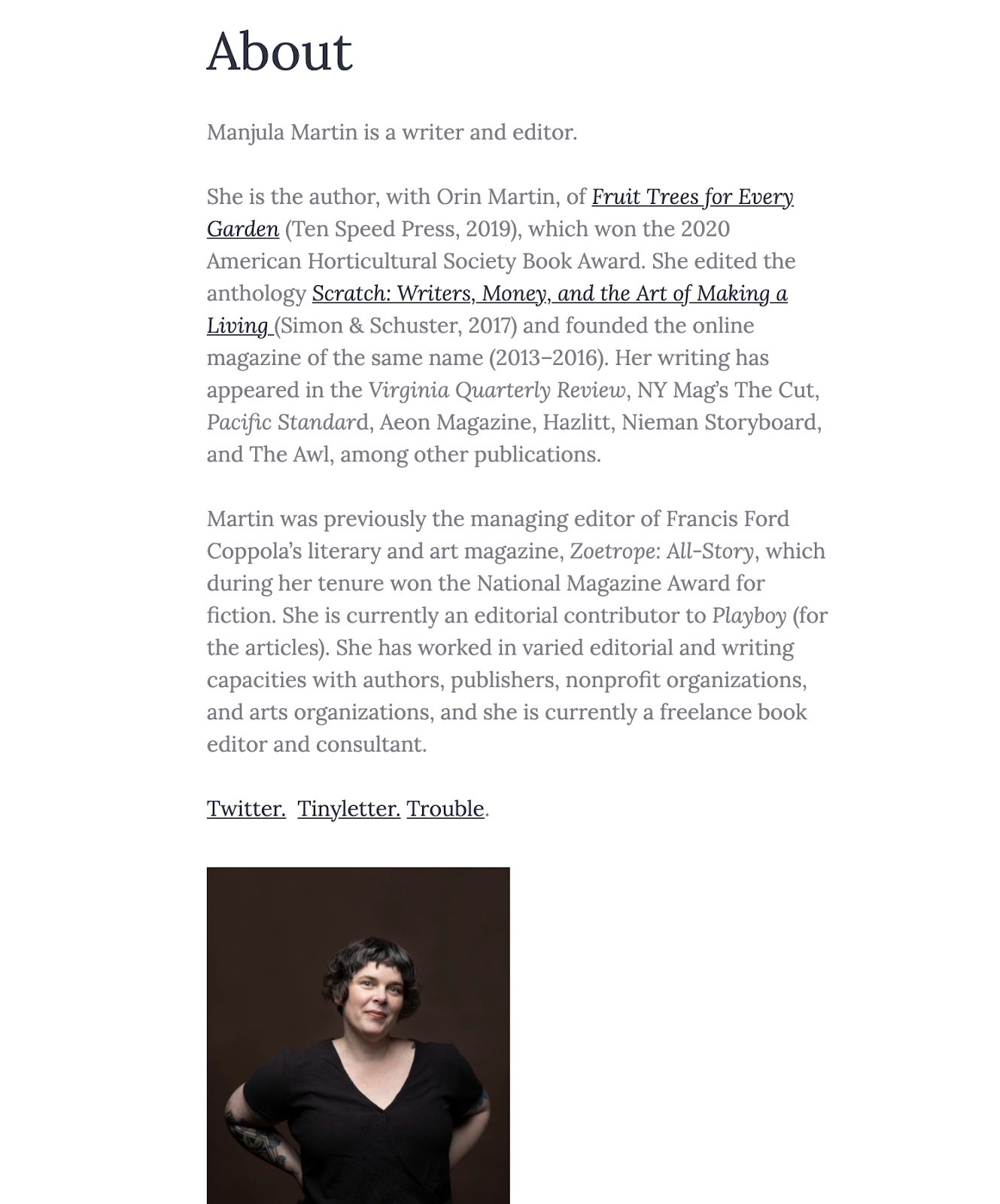
    Manjula Martin’s site is a great example of a basic, straightforward online portfolio: a brief introduction with her resume highlights front-and-center, and lots of links to connect people who want to learn more. She built it on WordPress.

    Manjula’s website works because you learn everything you need to know about her credentials and writing style at a single glance. It’s easy to follow the links and read her clips, and she also gives you many ways to contact her with writing or consulting opportunities.

    3. Ann Friedman
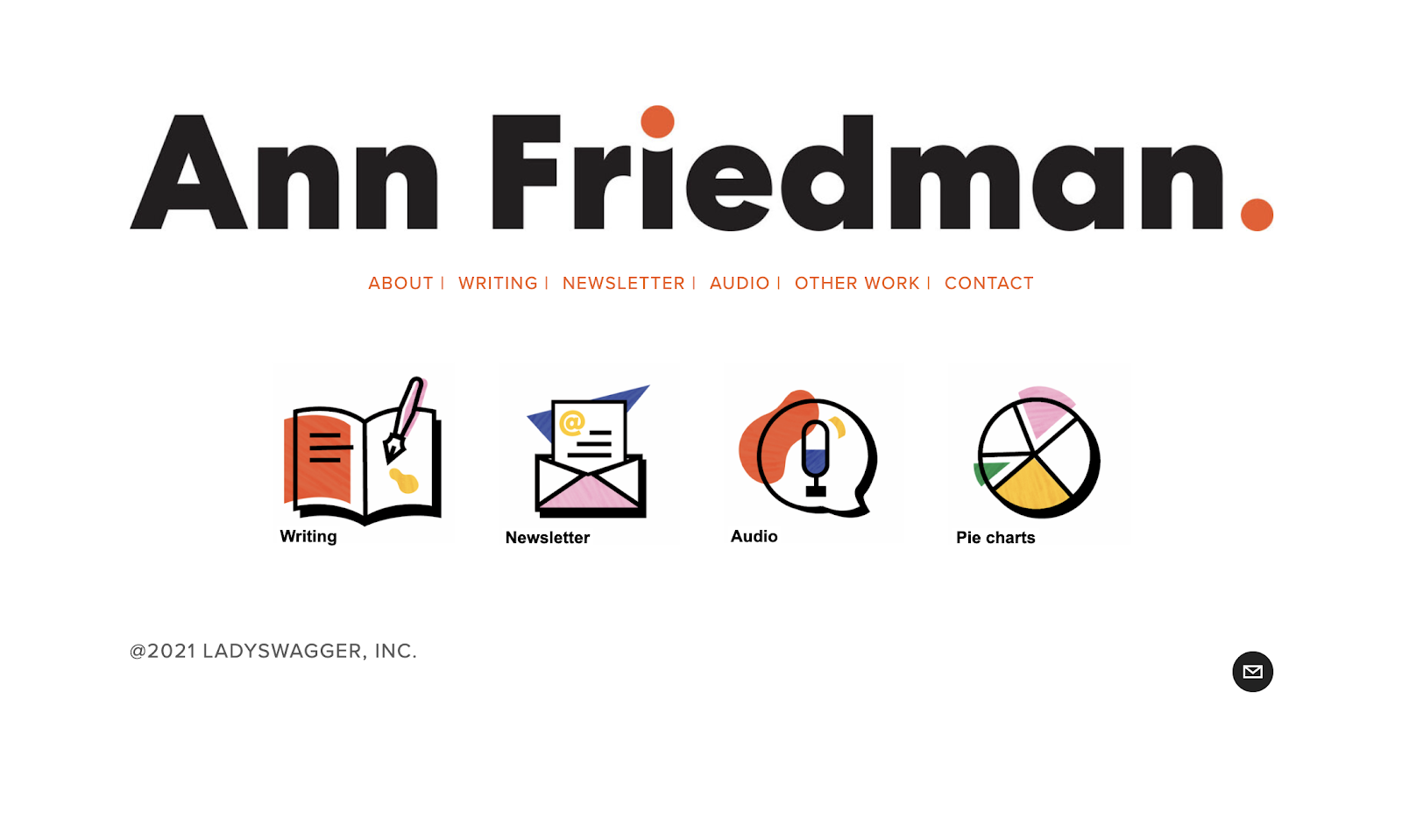
    The first thing you notice on Ann Friedman’s website is how it brightly displays her logo, followed by a row of links to her completed work, newsletter and contact information. Talk about a simple and beautiful landing page! 

    The rest of this writer website contains plenty of unique touches: a general FAQ plus one for her newsletter; a page of various creators, content and organizations she recommends; a thorough contact page; and creatively-titled side work that highlights even more skills beyond her stellar portfolio of work for tons of household brands. There’s no question about who Anne is, the service she provides and how to reach her — this is the goal for all writer websites. 

    4. Nozlee Samadzadeh
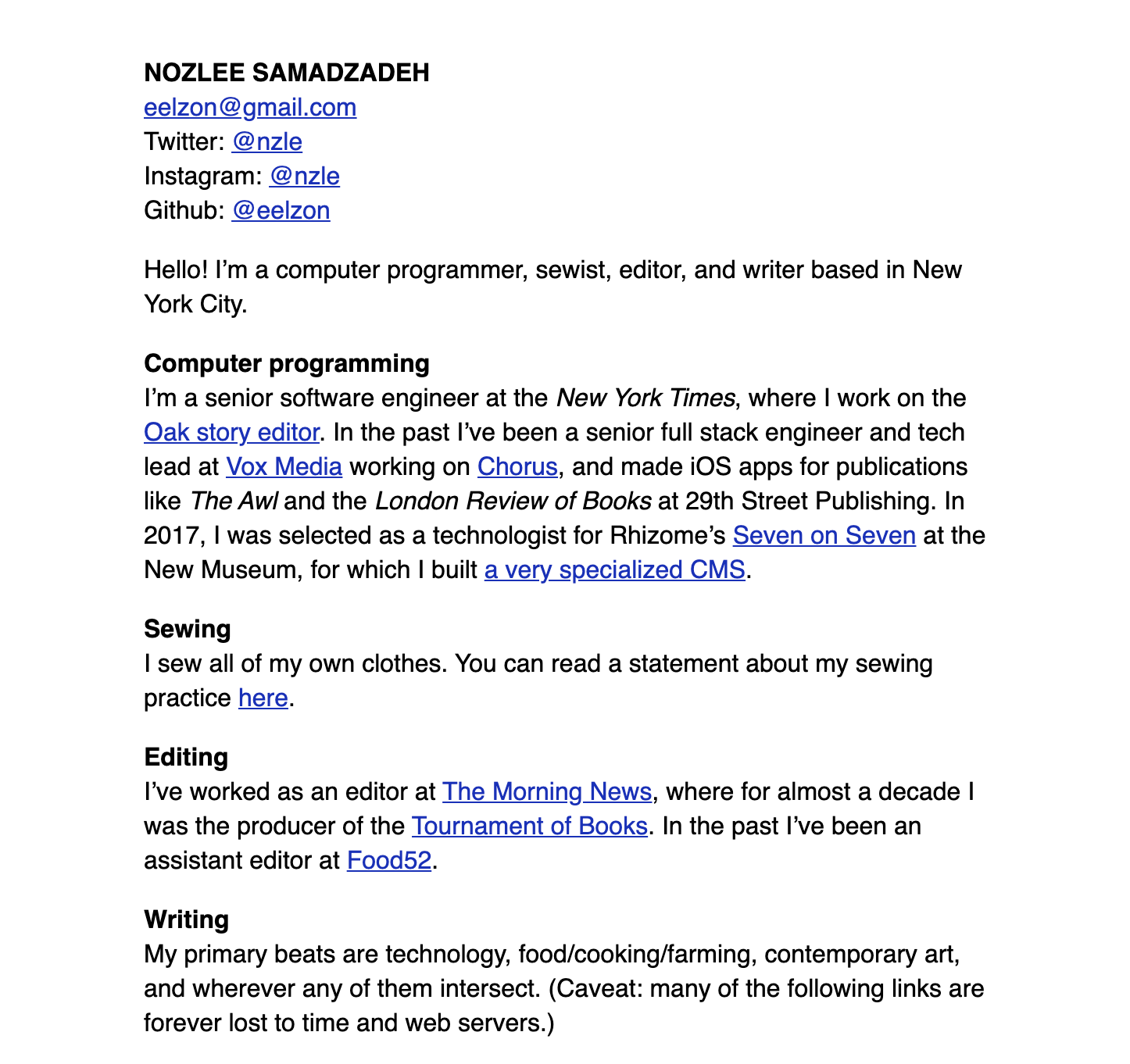
    It’s possible to create an extremely compelling writer website without a single photo, logo, or image. Nozlee Samadzadeh’s site lists her contact information, concise explanations for her professional experience, and links to her publications, all on a single page.

    Nozlee’s site also includes a short statement of her “primary beats,” which is key info for anyone looking to hire her for a writing job.

    5. Seanan McGuire
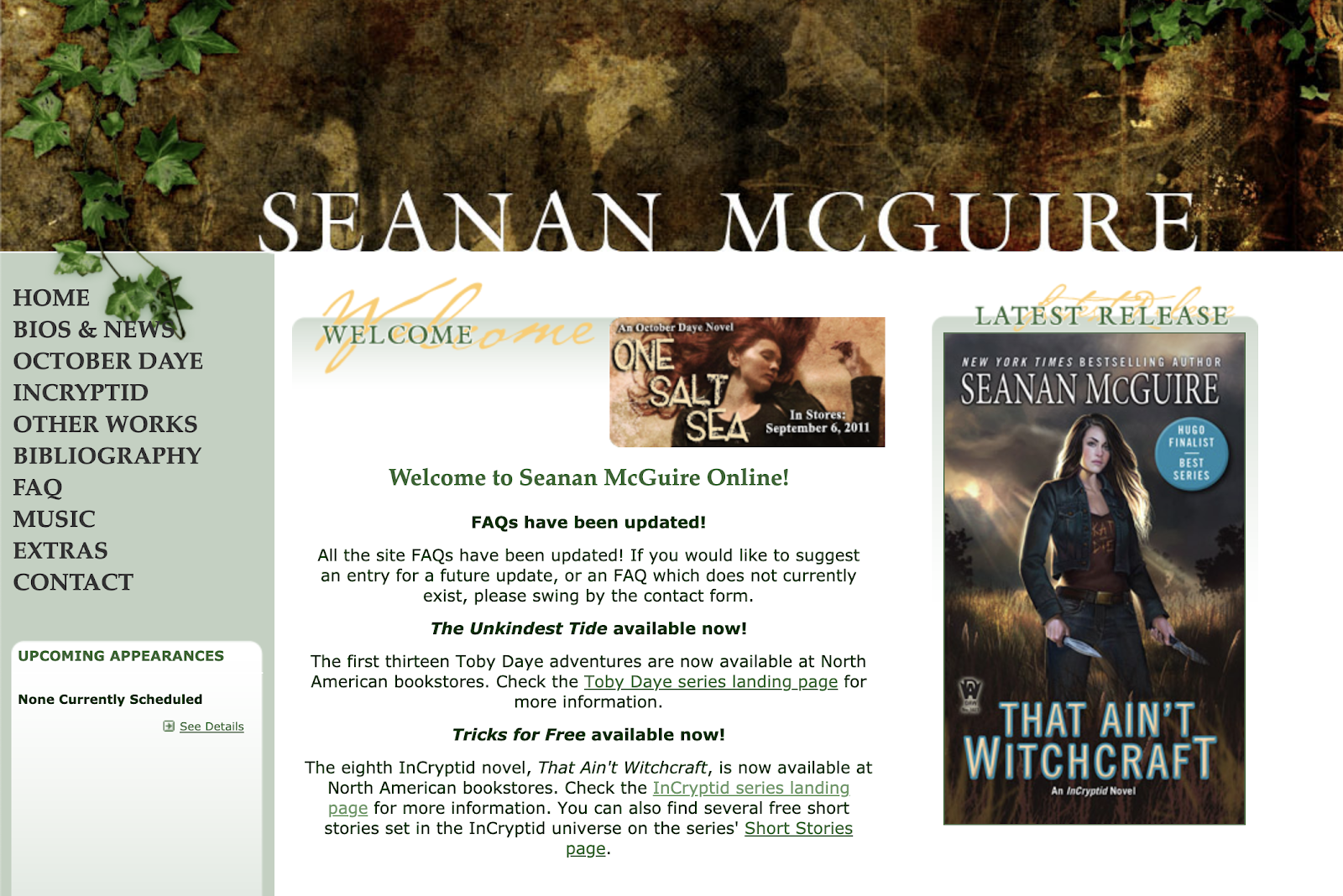
    Seanan McGuire’s writer website instantly immerses you into her urban fantasy world. Her latest release is prominently featured, and the header image and colors help establish her genre to new visitors. The left-hand navigational column provides easy access to important information.

    If you write fiction, especially genre fiction, let your writer website reflect your fictional worlds. Open the door to your fiction by giving readers the chance to see what might be hidden within the pages.

    6. Francesca Nicasio

    Copywriter Francesca Nicasio’s writer website aptly showcases her expertise in writing B2B content around retail, eCommerce, technology, and more. The entire website is structured around one goal: informing readers about her capabilities the very moment they get to her site. 

    What’s the goal of your writer website? Are your skills and services clearly explained?  When users visit your site, do they know what to do if they want to work with you? With her email address displayed largely on the front page, Francesca makes it easy for clients to get in touch with her. Your writer website should do the same.

    [sps_reusable_block post_id=43047]

    7. Kayla Hollatz
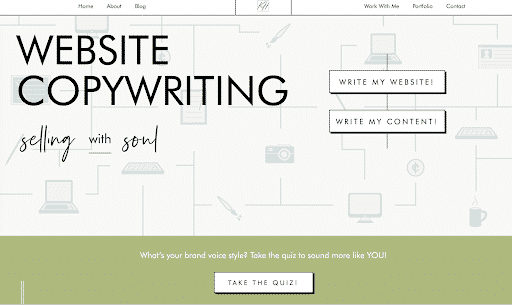
    “Inviting” is the best way to describe Kayla Hollatz’s writer website. The big, bold words that immediately greet you are enticing enough to make you want to keep exploring her trendy online portfolio. And without needing to scroll too far, Kayla’s concise and effective introduction appears, placed evenly below a prompt to take her brand style quiz. 

    Wherever you go, Kayla’s writer website accomplishes one major thing: She pulls you in by subtly emphasizing her savviness. From spelling out the details of how you’ll work together to sharing impressive client success rates, it’s evident  this writer knows her stuff — and she wants you to learn it, too, hence her quiz and email course. 

    8. Brittany Berger
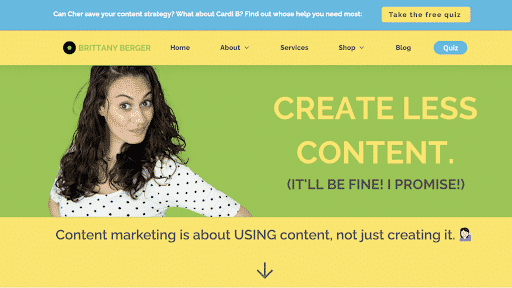
    How often are you intrigued by an unpopular opinion? Probably almost always, because, well, you just have to find out how you could possibly be on the wrong side of the truth. That’s what’s awesome about Brittany Berger’s approach to her writer website — she offers a solution most companies think is the problem. 

    Her conversational tone guides you into understanding her logic, and she offers a number of valuable resources to help you learn about being mindful about content creation, and how to be more productive as you do. 

    She created her website on WordPress.

    9. Sarah Turner
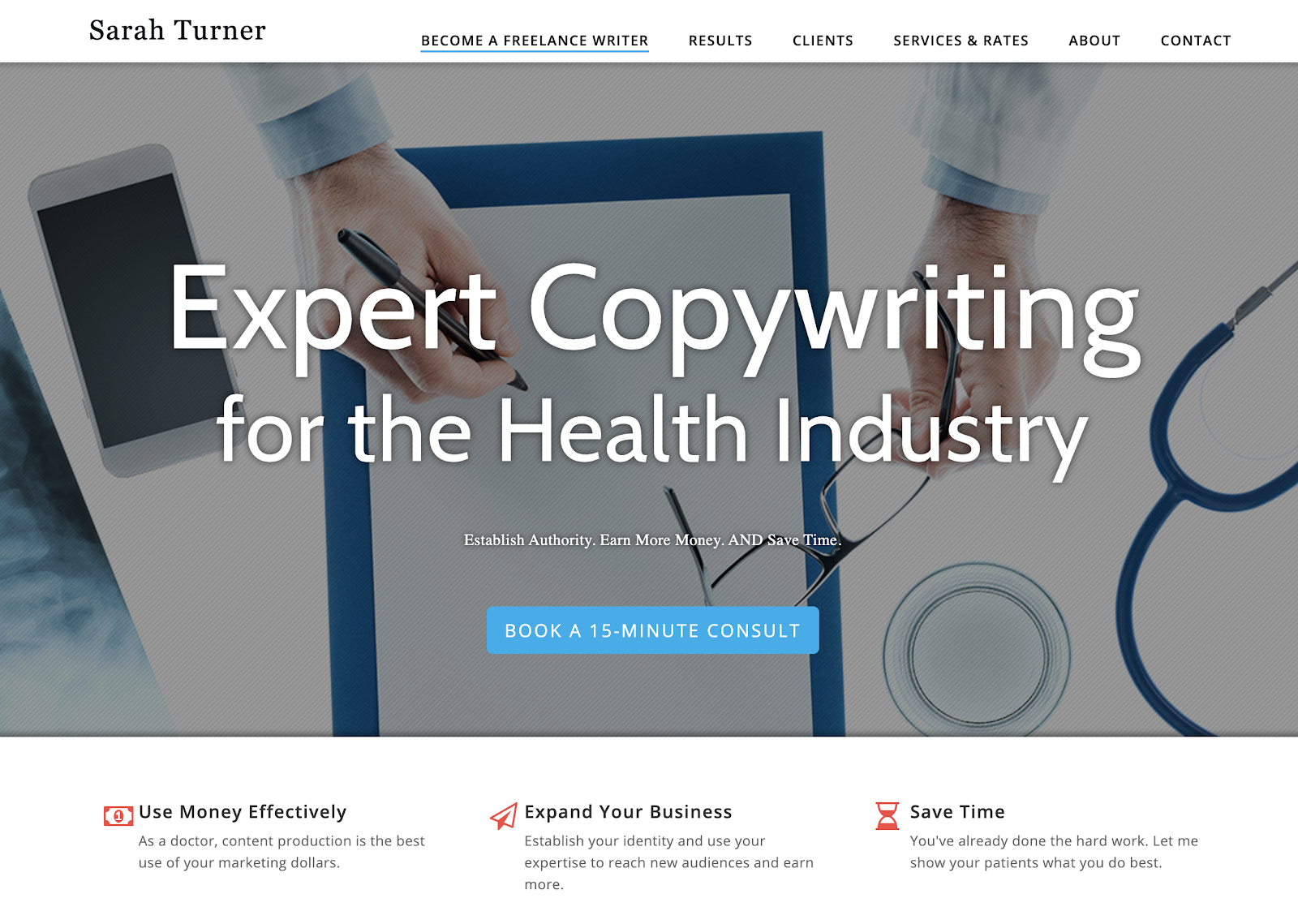
    Sarah Turner’s writer website is one of those slick, beautifully designed sites that intimidate the rest of us. It’s the type of site that looks like it requires the assistance of a web designer, which means it’s aspirational for a lot of us, especially those of us who are just getting started as freelancers. In actuality, Sarah’s website was created with the help of WordPress and Themely. 

    However, design isn’t the only aspect that makes Sarah’s writer website great. Her opening sentence clearly highlights her writing niche, how she can use her skills to improve your business in the health industry — the key goal of any resume or website — and includes a direct call to action. 

    You can include a similar paragraph and call to action on your own writer website; no design firm required.

    10. Kat Boogaard
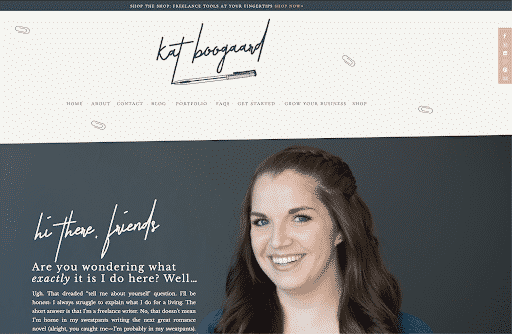
    Freelance writer Kat Boogaard leads with an authentic and friendly voice on her writer website — one that makes you feel like you’ll hit it off with her right away. Amid a fresh and sleek design filled with calming neutral colors, she shares brief paragraphs about who she is, what she writes for clients and how she can help freelance writers grow their businesses.

    Kat’s conveniently-placed menu at the top and bottom of her website is easy to navigate, but one thing I love about her website is how you can find your way around her site without it. As you scroll through the homepage, you’ll find that she takes you from one valuable resource to the next, all without making you feel bombarded. 

    11. Helen Gebre
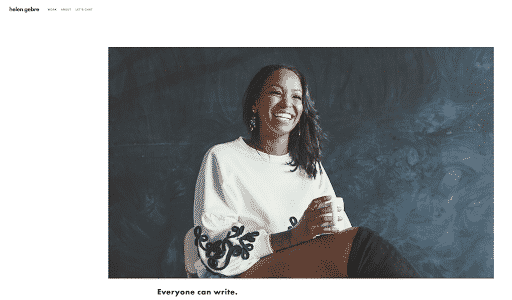
    This writer website gets one important thing down pat: You can feel how much Helen Gebre loves the art of writing. She also does this very simply, through an introduction and biography that gives you a glimpse into her personal life, her career and why she does this work. 

    Helen’s website design is simple, likely because she has a diverse portfolio featuring big and bold copywriting decks that span across print and digital writing, social media, video scripts and more. Besides a contact page, she also cleverly set up her phone number as the footer on each page — that way, clients viewing her page know how to reach her immediately. 

    12. Chidinma Nnamani

    Clients visiting B2B writer Chidinma Nnamani’s page learn right away what her expertise is. Throughout her writer website that she designed with WordPress and Elementor, she clearly articulates her skill and experience with B2B writing for the tech, food and digital marketing industries. 

    Besides a clean website design that reflects Chidinma’s design aptitude, her inclusion of a robust services page and a page that details her four-step process for working relationships provide a peek into her professionalism and organizational skills. One more thing to note from this writer website? The frequent “Ready to hire me?” prompts displayed throughout the site! 

    13. Sarah Asp Olson
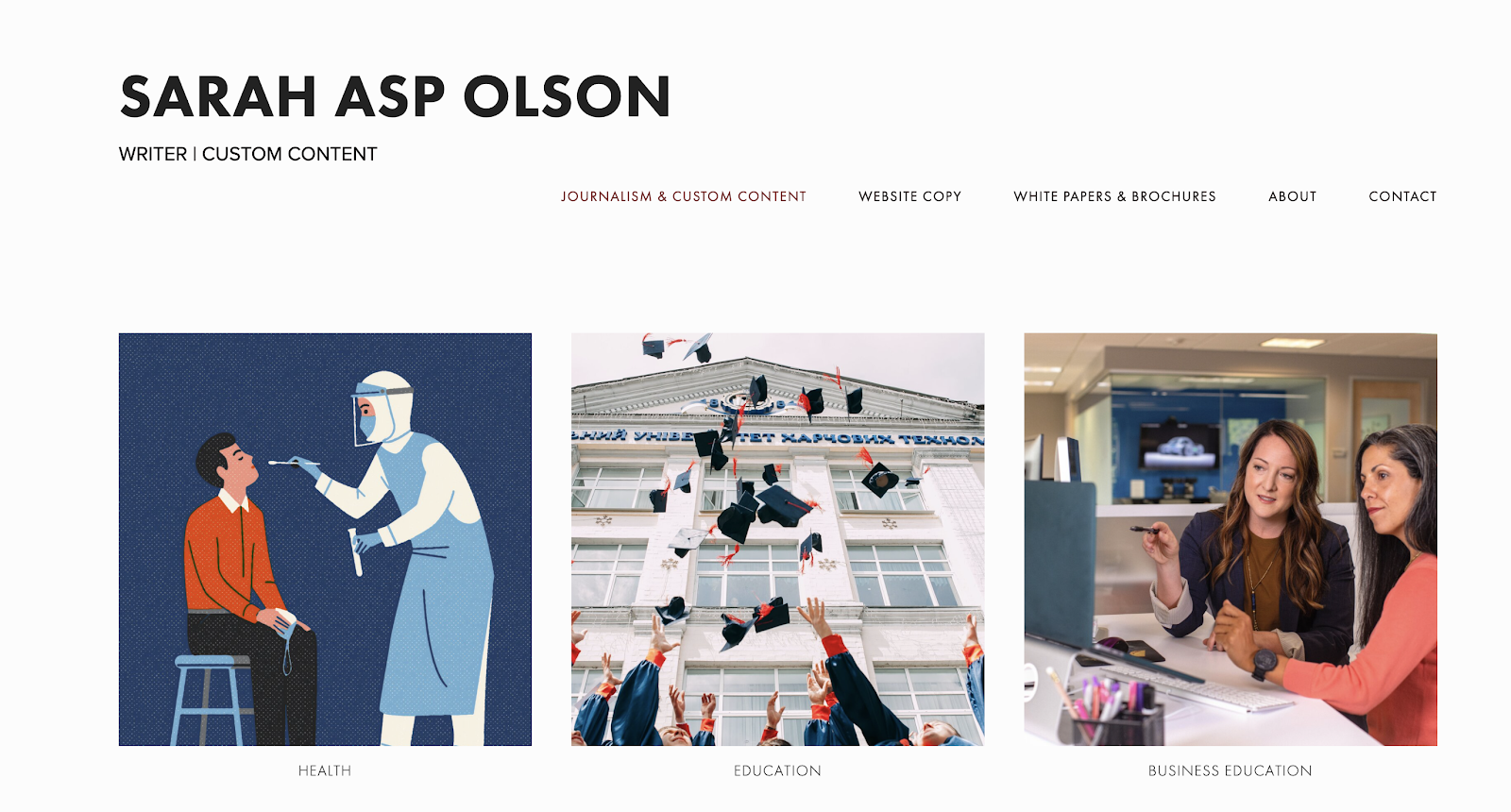
    Before you learn about this writer, you first take a tour of her impressive writing clips, which progressively leads you to where you can learn more about and reach out to her. 

    One of the best parts of designing your writer website is all the creative ways you can display your work. Each website on our list brings their own flair to their portfolio, and Sarah Asp Olson is no exception in the way her site only features the content she’s created. Like she does, you can use bright, colorful images that capture the eye to separate the industries you write for. Then, display your samples in bulleted lists, or in rows of hyperlinked thumbnails.

    Remember there are no rules to how you organize your work — just ensure it’s clear, and easy to navigate.

    14. Samar Owais

    What should people learn about you as soon as they visit your writer website? For writer Samar Owais, potential clients find out immediately she can increase conversions and boost sales — and her speedy acknowledgement of these skills and her niche can make a difference in how quickly visitors leave her site. 

    Throughout her writer website, Samar features client testimonials and a valuable email marketing quiz. Additionally, she makes her expertise clear through brief, compelling descriptions that outline how she solves conversion issues as an email conversion strategist and SaaS copywriter. And if anyone wonders why they should work with her, she makes convincing arguments for that, too. 

    15. Muriel Vega

    Don’t you just want to click those icons? That’s the power of color and fun design animation! Atlanta-based writer and editor Muriel Vega’s writer website has a simple design layout, but that doesn’t stop the sense of her personality from seeping through as you learn about her through projects and writing samples. 

    This site is a great reminder that you don’t have to overwhelm your writer website to make an impact — consider who you want to attract, and incorporate engaging design elements that reflect your creativity.

    16. Tyler Koenig
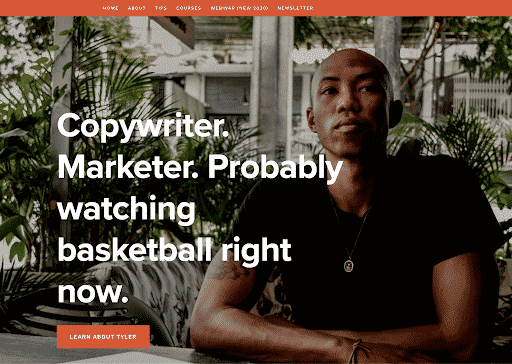
    Copywriting expert Tyler Koenig has a writer website that feels extremely confident and laid-back. Within a well-designed website that tastefully centers the color orange (maybe for basketball?), Tyler provides heaps of value through his email list, webinars, courses and free tips through his blog. 

    “Become your own most trusted copywriter,” he writes on the landing page of his self-paced copywriting courses, which successfully expresses his earnest desire to share his passion to help others grow. Besides that, providing free and paid resources truly highlights your expertise to prospects.

    17. Nicole Dieker (yes, that’s me!)
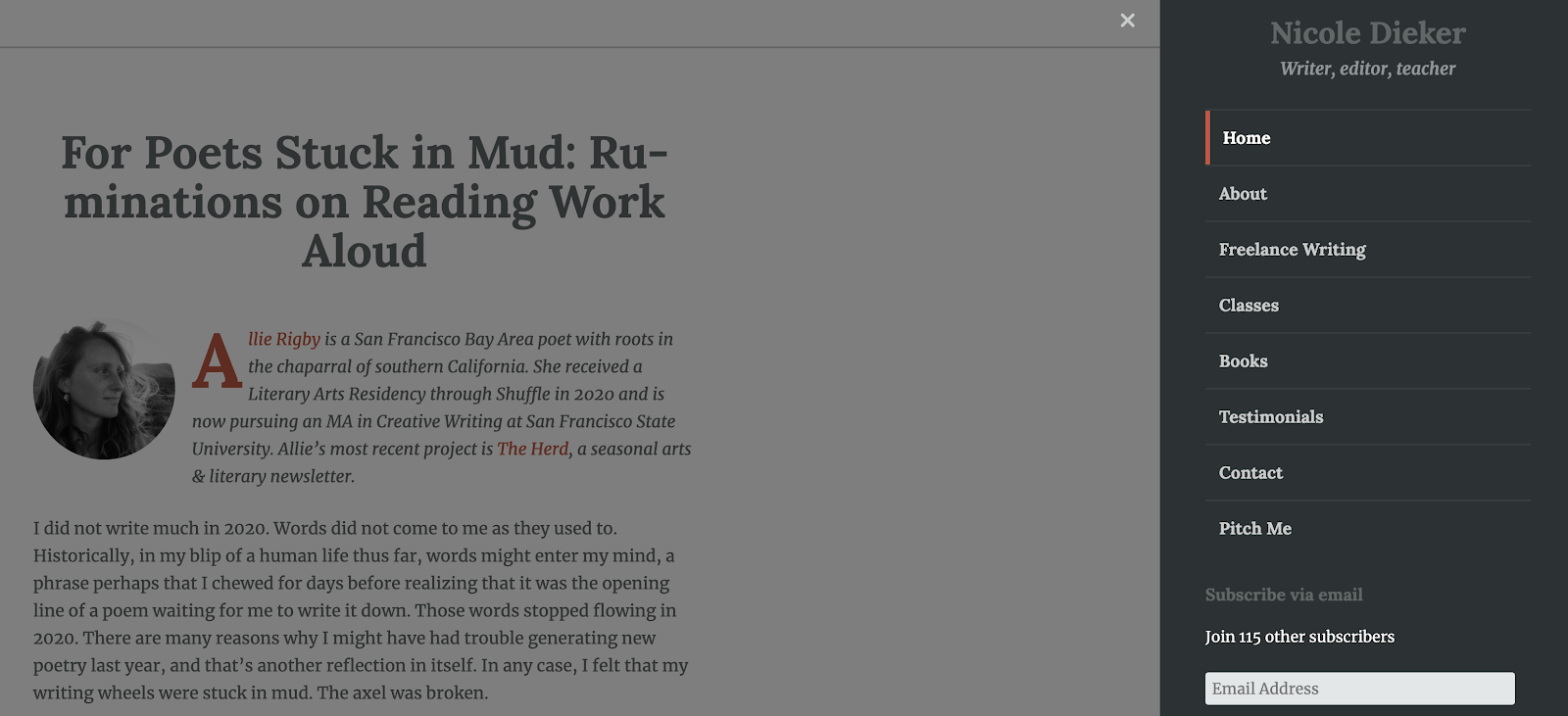
    My writer website serves two purposes: It’s a place where people can learn more about my freelance and teaching work, and it’s also a blog that focuses on the art and finances of a creative career. I include “where I got published this week” roundups every Friday and finance roundups on the first of every month, along with daily insights on work-life balance, how to earn money for your creative work, the process of writing a novel and more. I also pay writers for guest posts, so pitch me!

    I set up my site through WordPress using a pre-designed template.

    Do you have a writer website you’re proud of, or are you working on one now? Share your experience with us in the comments!

    This is an updated version of a story that was previously published. We update our posts as often as possible to ensure they’re useful for our readers.

    Photo via Zofot/ Shutterstock 

    [sps_reusable_block post_id=43047]

  • How to Use An Ellipsis: A Breakdown of Those Three Little Dots

    How to Use An Ellipsis: A Breakdown of Those Three Little Dots

    The ellipsis is an important punctuation mark. Sure, those three dots seem so tiny, so straightforward, and yet …

    Some editors may view the ellipsis as lazy — a writer’s way out of completing a sentence or connecting two thoughts. They can certainly become an overused crutch and weaken your copy, but in some cases, the ellipsis is quite important, especially when it comes to quoting.

    In this guide to the ellipsis, we’ll break down the basics then dive into using ellipses in your writing.

    [sps_reusable_block post_id=43045]

    What are ellipses (and addressing ellipsis vs. ellipses)

    Sometimes informally referred to as “those three dots,” Merriam-Webster officially defines ellipses as “marks or a mark (such as … ) indicating an omission (as of words) or a pause.”

    In Latin and Greek, “ellipsis” means to fall short or leave out — an omission. At its core, that’s exactly how it’s used in grammar, to indicate words have been omitted or left out.

    Now, there’s some confusion around ellipsis vs. ellipses, so let’s clear that up: Ellipses is simply the plural of ellipsis.

    Example: The paragraph contains too many ellipses, but you do need an ellipsis in that quote.

    The ellipsis is made up of three periods. But the way you format these will ultimately depend on the writing style guide or you’re following.

    For instance the Associated Press (AP) style is three dots without any spaces ( … ), but The Chicago Manual of Style (CMS) and Modern Language Association (MLA) both put spaces between each period ( . . . ). When in doubt, consult the appropriate style guide.

    How to use ellipses in quotations correctly

    Have you ever wanted to use a quote from an interview, speech or text that’s just entirely too lengthy or rambling? Don’t worry: You’ve got the ellipsis.

    With an ellipsis, you can omit words, phrases or sentences when you’re quoting. Note: You never want to omit words, phrases or sentences that will change the context or facts of a quote.

    Additionally, as mentioned above, the intricacies of ellipses will vary by style guide and even publication. Here, we’ll be referring to the AP Stylebook.

    For the following examples, we’ll refer to this Jane Goodall quote, pulled from her interview with Dax Shepard on a podcast episode of Armchair Expert:

    “I know that if we all get together — we’ve got a window of time — we can start slowing down climate change, we can start healing some of the harm we’ve done. Nature is very resilient. We’re coming up with our intellect with, you know, more and more ways for clean, green energy, renewable energy. But the thing is, we don’t have that much time, so how do we get people involved? That’s why I work so hard on Roots & Shoots, and I’m so thrilled because so many children are changing their parents.”

    This is a lovely passage from the podcast, but if we were writing an article recapping the interview or a story on Roots & Shoots, we likely wouldn’t want to include this entire quote — it’s a bit long. Instead, we could shorten the quote and indicate omissions with ellipses.

    Below are a few examples of what that looks like.

    1. Omit unnecessary words

    When quoting someone from an interview, it’s rare you’ll encounter quotes without unnecessary words. That’s just how we speak. 

    Here, we pulled three sentences from the larger quote, and we indicated an omission with the ellipsis.

    “We’re coming up with more and more ways for clean, green energy, renewable energy,” Goodall says. “But the thing is, we don’t have that much time, so how do we get people involved? That’s why I work so hard on Roots & Shoots, and I’m so thrilled because so many children are changing their parents.”

    The words omitted don’t add any context or important information to the sentence, so they’re OK to cut to keep the quote more focused and easier to read.

    Note: In many cases, it’s acceptable to go ahead and omit “um,” “like” and other common filler words from quotes without using an ellipsis. This is pretty standard practice.

    Per the AP Stylebook’s entry on quotations in the news: “Casual minor tongue slips may be removed by using ellipses but even that should be done with extreme caution.” So, basically, if you’re a journalist, be extra diligent with your quotes.

    2. Omit unnecessary sentences

    As humans, we have a way of winding around a topic, sometimes completing a thought and sometimes circling back to it. If you’re quoting someone from an interview, it’s likely you’ll run into quotes you want to use but that have some extra, unnecessary phrases or sentences.

    So let’s say you want to cut an entire sentence from a quote. As long as you’re not changing the context of the quote or deleting important information, this is perfectly fine to do with an ellipsis. 

    Take a look:

    “I know that if we all get together — we’ve got a window of time — we can start slowing down climate change, we can start healing some of the harm we’ve done. But the thing is, we don’t have that much time, so how do we get people involved? That’s why I work so hard on Roots & Shoots, and I’m so thrilled because so many children are changing their parents.”

    Note there’s a period at the end of the second sentence, then a space and then the ellipsis. That’s because you’re adding the ellipsis at the end of a grammatically complete sentence, so you must conclude it with a period, then indicate your omission with an ellipsis, per the AP Stylebook.

    If the sentence ends with a different punctuation mark, like an exclamation mark, you’d follow the same sequence: exclamation mark, space, ellipsis.

    It’s also worth noting the AP Style gods are OK replacing the ellipsis with an attribution, as such:

    “I know that if we all get together — we’ve got a window of time — we can start slowing down climate change, we can start healing some of the harm we’ve done,” Goodall said. “But the thing is, we don’t have that much time, so how do we get people involved? That’s why I work so hard on Roots & Shoots, and I’m so thrilled because so many children are changing their parents.”

    3. Omit unnecessary words and sentences

    Putting the first two instances together, you can use an ellipsis to omit unnecessary words and sentences at the same time. Take a look:

    “I know that if we all get together — we’ve got a window of time — we can start slowing down climate change But the thing is, we don’t have that much time, so how do we get people involved? That’s why I work so hard on Roots & Shoots, and I’m so thrilled because so many children are changing their parents.”

    Because the ellipsis doesn’t come at the end of a complete sentence, there’s no need for a period and space after “change.”

    If you have more specific questions about using an ellipsis in quotations, remember to consult a style guide or have a conversation with your editor. (They’ll likely love nerding out over this with you.)

    So, how many ellipsis are you permitted to use per quote? It depends on what you’re writing and the publication, but we suggest not using more than one. Alternatives to the ellipsis include paraphrasing or using partial quotes.

    Other instances to use ellipses

    Like we mentioned, it’s easy to fall into the trap of using too many ellipses, so here are a few other instances when using ellipses in writing is appropriate.

    To signify an incomplete thought

    You can use an ellipsis to signify an incomplete thought, i.e. the writer or speaker trails off or moves to another topic without completing their thought.

    Here’s an example:

    “Everyone says it’s all about the journey, but these days, I don’t know. It just … Well, I guess my mom did always say everything happens for a reason, so …”

    However, per AP style, you should substitute an em dash for this if you’re already using an ellipsis to omit words. In the example above, the speaker is simply trailing off and not completing their thought, so, in this case, the ellipses are appropriate.

    To indicate a pause

    Similar to the above point, an ellipsis is a great piece of punctuation to indicate a pause. It might look something like this:

    “I’m not really sure exactly what I was thinking … It had been a long night, and I just needed some sleep.”

    A final recap of the ellipsis

    Although using ellipses can become a bad habit, there are many times they’re necessary.

    When it comes to using an ellipsis in quotes, we’ll say it again: Never use the ellipsis to cut important information or details that might change the context of a quote.

    If you’re using an ellipsis outside of a quote, ask yourself if you’re using it to indicate a pause or incomplete thought. Otherwise, you might be better off using a different piece of punctuation, like a period.

    [sps_reusable_block post_id=43045]

    Photo by Cytonn Photography on Unsplash

  • 22 Publications on Religion and Spirituality That Pay Freelance Writers

    22 Publications on Religion and Spirituality That Pay Freelance Writers

    Do you view the world through a spiritual lens? Are you fascinated by the intersection of religion and politics?

    Religious and spiritual writing runs a wide gamut from hard news reporting to lifestyle pieces for particular faith-based demographics.

    Whether you’re interested in writing specifically on religious topics, looking for Christian writing jobs or simply want an audience who understands where you’re coming from, these 23 publications are a good place to start.

    Our list includes websites, literary journals and magazines from a variety of spiritual perspectives. And best of all? They pay their writers.

    New to freelancing? Make sure you know the basics about who and how to pitch before you reach out to a publication.

    [sps_reusable_block post_id=43047]
    Add these 22 publications, including Christian magazines, to your pitching list

    Here are 22 publications on religion and spirituality that pay freelance writers.

    1. First Things

    Published by The Institute of Religion and Public Life, First Things is a conservative and heady publication that offers predominantly Christian and Jewish perspectives. It accepts opinion pieces, featured articles and book reviews in print and online. 

    Pay: According to the submission guidelines, it offers an honorarium for writers, though the amount is not specified.

    2. The Jewish Forward

    The Jewish Forward offers political and cultural coverage for topics relevant to the American Jewish community. It’s been around since 1897.

    Pay: While The Forward hasn’t confirmed its rates, it states that compensation “will be highly competitive for the right pitch.”

    3. America Magazine

    This is a Jesuit-run publication with a Roman Catholic audience. It publishes reported pieces, personal essays and poetry on politics, faith, arts and culture with a religious or moral angle.

    Pay: While the exact rate is unpublished, per Who Pays Writers, it’s paid up to 38 cents per word.

    4. Guideposts

    Guideposts is most known for its inspirational personal stories hope and inspiration. The magazine also offers lifestyle posts, on anything from recipes to parenting tips.

    Pay: While Guideposts hasn’t confirmed how much it pays, it does say in its writer guidelines that it pays for “full-length stories” (which it defines as 1,500 words) when the story is accepted for publication.

    5. U.S. Catholic

    U.S. Catholic is a monthly magazine for an American Catholic audience which focuses on social justice and pop culture. 

    Pay: The publication offers “financial compensation for both commissioned and on spec content.” 

    6. Woman Alive

    Woman Alive is a UK-based Christian lifestyle magazine for women.

    Pay: Its contributor guidelines notes articles typically run 700 to 1,800 words, and “payment is by arrangement.”

    7. Spirituality & Health Magazine

    This bimonthly multi-faith print magazine goes out of its way to avoid being “new age-y” and offers intelligent pieces on a variety of topics at the intersection of spirituality and health. 

    Pay: Although rates are no longer listed in its writers’ guidelines, it was previously recorded from $200 to $500, depending on the word count and type of piece.

    8. Tablet Magazine

    Tablet is a daily online magazine of Jewish news, ideas and culture. It welcomes submissions from freelance writers but does not accept opinion or editorial (op-ed) pieces.

    Pay: Pay varies. According to Who Pays Writers, the average rate is $0.25 per word.

    9. Sojourners

    This ecumenical magazine covers the intersections of politics, faith and culture. 

    Pay: It pays “for reported pieces, based on depth of reporting, and for strongly researched analysis pieces.”  

    10. Religion Dispatches

    Religion Dispatches (RD) offers current events and timely coverage of religion in American culture and politics. It specifically seeks “reporting, analysis, commentary, and film/book/TV reviews, by scholars, journalists, writers, and activists.”

    Pay: Pay varies.

    11. Geez Magazine

    A quarterly magazine with the tagline “contemplative cultural resistance,” Geez Magazine centers around social-justice issues and is usually theme-based. Geez is Christian-leaning, but not strictly so. 

    Pay: Writers are paid a “modest honorarium.”

    12. Christianity Today

    An evangelical magazine founded by Bill Graham, Christianity Today is probably the most widely read evangelical Christian publication. 

    Pay: Who Pays Writers has reports of writers being paid between 2 and 17 cents per word.

    13. Religion & Politics

    Run by the John C. Danforth Center on Religion and Politics at Washington University in St. Louis, this website offers political opinions from multiple faith traditions.

    Pay: One writer reports earning 26 cents per word on Who Pays Writers.

    14. Horizons

    A magazine for Presbyterian women, Horizons seeks articles, stories and poems of varying topics. 

    Pay: It offers an honorarium of no less than $50 per page printed in the magazine, though this amount will vary.

    15. St. Anthony Messenger

    St. Anthony Messenger is a monthly Catholic family magazine which aims to help its readers lead more fully human and Christian lives. It pays for opinion pieces, feature articles, fiction and poetry. 

    Pay: Pays 20 cents per word or $2 per line for poetry.

    16. Converge Media

    Converge media “exists at the intersection of faith and culture.” Some categories of writing it seeks include confessions, reviews, interviews and commentaries. 

    Pay: Unpublished.

    17. The Living Church Foundation

    The Living Church Foundation is part of the Episcopal Church and Anglican Communion. It publishes a magazine and hosts a weblog community. 

    Pay: Living Church told TWL that it does pay its writers, though “rates vary with length and experience.”

    18. Busted Halo

    Busted Halo is a Catholic-based publication that aims to “to share the Catholic faith in a fun and interactive way and provide creative resources for Catholics to use when sharing the faith with others.” Pitches are preferred, but they do accept unpublished submissions.

    Pay: Busted Halo told The Write Life that it pays $75 per article at typically 500-600 words per article.

    19. Christ and Pop Culture

    This online magazine “exists to acknowledge, appreciate, and think rightly about the common knowledge of our age.”

    Pay: Although web articles are unpaid, it does pay for feature articles for its magazine. These typically run 1,500 to 3,000 words. Keep an eye out for its call for pitches.

    20. LDSLiving

    LDSLiving is a bimonthly magazine looking for informative and inspiring articles about home and family, education and service, destinations, making a difference, discovery and at home.

    Pay: Varies.

    21. Christian Science Monitor

    The Christian Science Monitor is a popular international news organization built for “anyone who cares about the progress of the human endeavor around the world and seeks news reported with compassion, intelligence, and an essentially constructive lens.” It has both a religious and nonreligious audience.

    Generally, the publication accepts work from new writers on spec.

    Pay: If commissioned to write a piece and you fulfill the requirements, you’ll be paid the “basic rate” whether the story is published or not.

    22. Jewish Currents

    Jewish Currents is a print and digital magazine “committed to the rich tradition of thought, activism, and culture of the Jewish left.” It’s looking for timely, reported articles on topics featured on the site.

    Pay: Unpublished, but Who Pays Writers reports 13 cents per word.

    As well as submitting your work to these publications, why not consider compiling your writing into a draft book and reaching out to some of the top Christian publishers? It’s a great way to reach even more people with your writing!

    This is an updated version of a story that was previously published. We update our posts as often as possible to ensure they’re useful for our readers.

    [sps_reusable_block post_id=43047]
  • This Author Sold The Movie Rights to Her Novel. Here’s How She Did It

    This Author Sold The Movie Rights to Her Novel. Here’s How She Did It

    Have you ever daydreamed about selling the film rights to something you’ve written? Would you like to learn a surefire way to make that happen? That’s what I’m here to share with you today.

    OK, let’s get real. If you’re skeptical of that claim you should be, because when it comes to getting published we’ve all heard an agent or another author say something like, “be prepared to work very hard, submit widely, and face a great deal of rejection along the way. Getting a book deal with a traditional publisher isn’t easy, and getting a movie deal is practically impossible.”

    I continue to believe that this is generally good advice. But occasionally, very occasionally, stars align in unexpected ways. The story of how my first novel,My Hands Came Away Red, was published and how I went on to sell the movie rights to Wayfarer Studio is one of those crazy tales of weird and wonderful happenstance, and that is what I’m here to share with you today.

    Don’t get me wrong. I did work very hard on that book, so let’s start there. 

    “My Hands Came Away Red” is the story of a group of teens who travel to Indonesia on a short-term mission trip, only to become caught up in a civil war and stranded in a mountainous jungle. Their struggle to get home threatens their lives and reshapes their worldview. I began writing this story when I was 18 years old and finally finished a complete draft 11 years later. It was then that things got weird. 

    I had no agent, so I chose three publishing companies I thought may be interested and sent them unsolicited queries. Two of them were interested, and within two months I’d sold the book. 

    After a year of edits (during which I developed an abiding appreciation and respect for talented editors) the novel was published. Then it was nominated for a major award and—through a series of wildly improbable events—its publication led me to the man who would become my husband

    A decade later I sold the movie rights.

    How I met the person who would buy the movie rights

    The year the novel was published I was living in Los Angeles. After years of sharing accommodation I’d just moved into my own apartment and—being somewhat lacking in both furniture and money—I bought a second-hand TV cabinet off Craigslist. 

    Unbeknownst to me, the person selling that TV cabinet was an actor named Justin Baldoni whose career was just beginning to take off. 

    When I arrived at his house, he was just as personable as he was attractive. He was friendly, he asked me questions about myself, and he showed a genuine interest in the novel I’d just published.

    I had a box of books in the back of my car that hadn’t yet made it into my apartment. Before we parted ways that day, I’d bought his TV cabinet and he’d bought a copy of my book. 

    Shortly after that, Justin got in touch. He’d read it. He loved it. He wanted to buy the movie rights. 

    Why the publishing company initially said no

    When the novel was published, I signed a fairly standard contract. As per that contract, it was the publishing company, not me, who retained control over any film or television rights. 

    As such, it was the publishing company who had the right to make a decision, and when Justin and I approached them with Justin’s request to acquire the rights, they said no. 

    The company that had published my novel was well-known for publishing Christian content. Justin followed the Baha’i faith. Although the publishing company didn’t fully explain their reasoning, I knew it was a reputational risk for them to sell the film rights to one of their popular novels to someone hailing from a different faith tradition. 

    I didn’t have any power in the situation and I barely knew Justin, so I was slightly disappointed by this outcome, but moved on.

    Ten years later…

    Ten years later I was married to a career humanitarian worker and living in Vanuatu on a small island in the South Pacific. Justin was still in Los Angeles, going from strength to strength as an actor, and as a director and producer. He was busy wrapping up filming on the hit series “Jane The Virgin” and directing the movies “Five Feet Apart” and “Clouds. 

    We had been connected on Facebook ever since Justin’s initial interest in my book, and one day I left a comment on one of his posts about an upcoming project. He replied and let me know he still wanted to buy the rights to my book. 

    “Sure,” I said. “Let’s see if we can make that happen.”

    I still didn’t know Justin well, but I’d caught many glimpses of his life and his thoughts via social media during the previous decade. From what I could see, Justin was a question-asker and a deep-thinker who had a genuine passion for sharing stories that helped people wrestle with important ideas related to purpose and meaning. 

    I had originally written “My Hands Came Away Red” to explore how unexpected trauma forces us to deeply question our ideas about God and people, right and wrong, faith and meaning. Justin, I thought, seemed to be well equipped to serve the heart of this story. 

    How I regained the rights to my novel

    When I approached the publishing company again about selling the film rights they initially appeared more open. Justin and I met via video conferencing with the executive team and they signaled their willingness to collaborate. Less than a week later, however, they contacted me and let me know that they had reconsidered.

    This could have been the end of the story. The publishing company was within their legal rights to decline to release the movie rights for reasons far less compelling than “the degree of polarisation evident in the US political and religious landscape means that a creative collaboration across faith traditions is highly likely to alienate a large chunk of our core customer base.” However, it was not the end of the story. 

    In a move that was both gracious and unexpected, the publishing company offered to return all rights to the novel to me and step out of the picture so that I could make my own decision on the matter.   

    Negotiating the contract

    Once the publishing company returned all rights to me I re-released the novel with a new cover and sold the film rights to Justin Baldoni’s film production company, Wayfarer Entertainment, for $1.

    “Hang on,” you may be thinking. “You went to all that trouble to practically give the rights away?”

    Not so fast. There were two main drivers behind this decision. 

    First, this particular book has never been about money for me. In fact, when it was published I gave away all my royalties to charities working on human rights issues in Indonesia. (This is not to say that writers shouldn’t care about money. To the contrary, you must be strategic about how you make writing pay if you aim to make a living from it, and there have been other writing projects I’ve undertaken where commerce really mattered, just not this one.) Because of this, and because I trusted what I knew of Justin, selling the movie rights was also never about what I could earn on an option. 

    Secondarily, however, selling the movie rights for $1 was a strategic choice. Anytime those rights are renewed beyond the initial 2-year period I earn more than that initial amount. The contract is fair and industry-standard with regards to anything I will earn from the project if and when the movie actually gets made, and I took that business aspect of this seriously. I hired a reputable entertainment lawyer to review the contract and advise me, and had constructive discussions with the Wayfarer team before the contract was finally signed. 

    What’s next?

    The short answer to this is, “I don’t know.” 

    When I last talked with the Wayfarer Team they seemed enthusiastic. They had identified a scriptwriter and it all appeared to be picking up momentum. They told me they were committed to bringing this tale to life in a way that’s relevant to today. 

    However, that was during the early days of the COVID-19 pandemic (so, approximately 4.5 lifetimes ago). I don’t exactly know where Justin’s creative passions and interests are leading him during this time of exceptional upheaval, challenge and grief. If they continue to lead him towards a movie based on my novel, that will be wonderful and fun. If not, I’m sure that whatever he does sink his energies into will prove worthwhile, and I’ll enjoy watching it. 

    How to sell the movie rights to your first novel in just 21 years

    Many of the posts on this site serve up a great “how to” list towards the end of the post. I had a good long think about what how-to list I could extract from this strange tale and here’s what I came up with… a surefire recipe for how to sell the movie rights to your first novel in just 21 short years:

    1. Spend 11 years writing your book.
    2. Submit your unsolicited manuscript directly to only three publishers.
    3. Sign a contract with the first publisher you queried.
    4. Get nominated for a major award the year the book comes out.
    5. Buy a random piece of furniture off Craigslist from an up-and-coming actor who both has an authentic interest in other people who are not remotely famous AND wants to eventually produce/direct their own films.
    6. Tell them “no” the first time they try to buy the rights to your novel. 
    7. Become this actor’s friend on facebook.
    8. Wait ten years.
    9. THEN sell them the movie rights to your book for $1 when they express interest again. 

    In all seriousness though, if there’s one piece of advice I do want to offer off the back of this strange tale it’s this: Spend at least some of your time making the art your heart keeps tugging you towards. Do it for you — because you feel you can and you should. Because it’s your responsibility and your privilege, your gifting and your gift. Do this, accepting that you cannot fully predict or control where it may lead.

    So all the best, my fellow creatives, with your own work. May at least some of that work lie close to your heart, and may it lead you interesting and wonderful places.

    Photo by Jakob Owens on Unsplash

  • Breaking Into UX Writing: A Guide to One of Tech’s Fastest-Growing Writing Jobs

    Breaking Into UX Writing: A Guide to One of Tech’s Fastest-Growing Writing Jobs

    You can now order groceries, join a virtual meeting and deposit checks from your phone. What do all have in common? On-screen words guide you through how to complete those tasks. 

    You might not even notice the words — good UX writing can be nearly invisible when it’s working well.

    UX writing, or user experience writing, is a relatively new discipline that’s growing fast. From young tech startups hiring their first UX writer to legacy software companies expanding their teams, there’s an increasing need to hire skilled writers to craft content for software and apps.

    A few years ago, I made the transition to a full-time UX content role. With a background in journalism, a few years under my belt as a copywriter for tech startups and five years running my own content strategy consultancy, I found a happy home on the user experience team for the Firefox browser. I knew from my own experience that the path to landing a UX writing job is rarely straightforward. So last year, I became a mentor for UX Coffee Hours, where I offer virtual coffee chats with anyone who’s interested in becoming a UX writer. What follows are answers to some of the most common questions I receive from mentees about breaking into this field.

    What is UX writing?

    A UX writer crafts the words that appear within software interfaces. The purpose of UX writing is to help people use the product in front of them, with minimal frustration. The words themselves are often referred to as microcopy because the copy is short: error messages, form fields and navigation labels. 

    Anyone who works as a UX writer will tell you that the job entails so much more than writing short copy. It requires being strategic and relentlessly inquisitive. UX writers own the content strategy, development and delivery for an entire end-to-end experience. They collaborate closely with other disciplines like design, research, engineering and product management. 

    To do this job well, a UX writer must be able to:

    • Gather requirements from stakeholders to understand business goals
    • Work collaboratively with user experience designers and researchers
    • Develop a technical understanding of how a product works
    • Use data and research to inform their writing (and run relevant research themselves)
    • Develop documentation and rationale for decisions
    • Finalize copy with partners in localization and legal
    • Create and maintain content guidelines 

    How long has UX writing been around?

    Though someone was always writing the words on interfaces, UX writing has emerged as a dedicated role in the last five to seven years. As a young discipline, the job titles themselves are actively evolving. You’ll find postings for “UX writer,” “content designer,” “product writer” and “UX content strategist.” 

    Because the role is relatively new, UX writers have different duties depending on how their company defines their responsibilities. Some UX writers may also pitch in on marketing copy, internal communications or help center content. 

    What’s the difference between copywriting and UX writing?

    UX writing is easily confused with digital copywriting. While both require strong communication skills and a deep passion for the craft of writing, the jobs themselves are quite different.

    Copywriting serves a sales or marketing function. The goal of a copywriter is to bring people in the door. Their end game might be to entice someone to download an app, create an account or sign up for a service. A marketing copywriter may prioritize clever, punchy writing to capture someone’s attention and pique their interest.

    UX writers act as guides once people start engaging with a product. This is where the “user” comes in. We start with what they are trying to do. Our role is not to convince or sell.

    UX writers help people use the product in the most efficient way possible — all while providing a consistent voice and the appropriate tone for the context. Marketing and user experience writers should work together as much as possible to align their content guidelines so the end experience is as cohesive as possible.

    What skills do you need to be a UX writer?

    The most effective UX writers have a unique blend of hard and soft skills.

    A background in communications, journalism or copywriting can be a helpful base, though not required. You’ll also find many UX writers who studied poetry, literature or theater. 

    Strong writing skills

    You must be a word nerd at heart who has solid writing chops. While we are sticklers for grammar and consistency, a UX writer also knows when to bend the rules in service of clarity.

    Similar to technical writers, UX writers are well-versed in translating complex concepts into plain language.

    Systems thinking

    UX writers need to think high-level and holistically.

    While you may write a specific error message or button label, similar types of copy surface in other areas of the software product. You need to think about the connections and interdependence betweens all types of interface copy.

    Design thinking

    To guide people through an experience, you’ll need an understanding of how visuals and copy work together.

    Sometimes the best UX writing involves removing words and recommending a change to the design instead. Words don’t exist in a vacuum in UX writing. 

    Proactive problem solving

    UX writers operate in ambiguous environments, often with imperfect information.

    Being naturally curious and proactive helps. You need to seek out answers from a wide range of other functions in the organization, including technical-minded engineers, business-oriented product managers and visual designers.

    Internal communication

    UX writers excel at over-communication.

    Your job might not be well understood by other people at your company. Knowing that, you’ll need to champion your own work and make the unseen work you do as visible as you can. This includes everything from creating documentation that helps align your team to evangelizing your work to those outside your team. 

    Collaboration and relationship building

    Even if you’re the lone UX writer at a company, you rarely work alone.

    You often pair with a UX designer to develop the content and design together. Other partners in your process may include legal, localization and customer support. You should also expect to receive input from stakeholders and product owners.

    You’ll need to be comfortable accepting feedback and advocating for your decisions. 

    How much do UX writers make?

    UX writer salaries depend largely on your level of experience, the market and the company you work for. Salaries at new tech startups are lower than large, established companies. 

    Associate-level positions can begin around $60,000 and range upwards of $150,000 for senior-level roles.

    UX writers working in high cost-of-living markets such as San Francisco and New York can command more, as can those who earn lucrative positions at tech giants such as Facebook and Google.

    Some companies also offer stock or equity as part of their compensation package. 

    How do I become a UX writer?

    You’ll need to build a portfolio to apply to UX writing jobs. 

    Always focus on quality over quantity — hiring managers would rather see a few in-depth case studies than several surface-level ones.

    Be sure to include before and after images of your work, as well as how you arrived at your final copy decisions. Hiring managers want to understand your thought process and rationale. They especially want to know any data or research you incorporated along the way. 

    That begs the question: How do I build a portfolio? You can do this in a variety of ways:

    • Partner with students enrolled in UX design bootcamps to co-create your portfolio. They’ll need to design sample case studies. Usually they have to write the copy themselves. You can lead the copy development while they do the design.
    • Pay close attention to the UX writing you see every day. You can build a case study by improving something you already use. Take screenshots of an end-to-end workflow, such as verifying your account or resetting your password. Every step of the way, identify what you would write differently to improve it and why. 
    • Volunteer to write the copy for a bootstrapped startup. Many new apps begin with just one or two developers. They’re great at writing code, but not always so great at writing UX copy. Get involved in your local technology scene to see if you can find someone who could use your help. You can then use this work in your portfolio. 
    • If you’re in a communications role, look for opportunities to do UX writing at your current job, even if they are minimal. If you raise your hand to write error messages, believe me, the engineering team will love you. 

    Great places to start learning more about UX writing include The Writers of Silicon Valley podcast; the Working in Content resources section; the UX writers conference, Button; and the Content + UX Slack community

    Lastly, start learning more about user experience design and research. You’ll find countless books, blog posts, meetups, book clubs and local communities.

    Developing your understanding of the user experience discipline at large will make you a stronger candidate when you’re ready to apply for UX writing jobs.

    Photo by freestocks.org from Pexels

  • 6 Old Grammar Rules That Are Finally Going Out of Style

    6 Old Grammar Rules That Are Finally Going Out of Style

    The internet loves a good argument.

    See: the 400+ comments on my piece on the Oxford comma debate, which devolved into everything from political jabs to commentary on the fairness of overtime laws.

    Amid the many readers continuing to rail against my adoption of AP style on a blog I specifically say uses AP style, I found one observation in particular that made me pause. Some readers pointed out my use of a dangling modifier. And I confess: You caught me.

    I also confess: I don’t feel terribly bad about it.

    Which lead me me down the rabbit hole of a whole ’nother debate: When does a grammar rule pass into obsolescence?

    Grammar rules we should just forget about already

    At what point is non-standard sentence construction widely accepted as standard? Can we as writers loosen up on certain rules when general usage renders an “incorrect” syntax perfectly understandable to the average reader?

    Hold onto your outrage, Internet. Tell your grammar checker tool to buzz off.

    Here are six English grammar rules that are going out of style.

    1. Never end a sentence with a preposition

    Attempting to follow this rule can result in some painfully stilted sentences, like this gem attributed to Winston Churchill: “This is the sort of arrant pedantry up with which I will not put.” (Sadly, this attribution is only anecdotal, but it’s still a gem.)

    This rule stems from Latin, English’s ancient ancestor, in which sentence-ending prepositions simply can’t be done.

    In modern English usage, however, there’s no reason to cling to this rule, unless you want your writing to sound more formal (or your characters to come across as pompous know-it-alls).

    So the next time you wonder, can you end a sentence with a preposition? The answer should be, hell yes!

    2. Never start a sentence with a conjunction

    You know what kills me about this one? There’s no real basis for this rule except teacherly bias and a misplaced fear of sentence fragments.

    According to David Crystal in The Story of English in 100 Words, teachers in the 19th century were annoyed with their students’ overuse of conjunctions as sentences starters. Rather than working to correct this tendency, they created a hard-and-fast rule against it, no doubt making their lives easier, but causing quite a headache for writers for centuries to come.

    The truth is, there are different types of conjunctions. Subordinating conjunctions (like if, because and when) join a dependent clause with a standalone one. Break apart “If you build it, they will come,” and you have an independent clause that could be its own sentence (“They will come.”) and a fragment that doesn’t make sense by itself (“If you build it…”). That’s why it’s perfectly fine to start a sentence with “because.”

    Coordinating conjunctions (like and, but and or) join two independent clauses together: “I was looking forward to the beach, but it rained all day.” Separate the clauses in these cases, and you still have standalone sentences, each with a noun and a verb: “I was looking forward to the beach. But it rained all day.”

    While you don’t want all your sentences to be this abrupt, it’s OK to pepper some in for flavor.

    3. Don’t use sentence fragments

    Beginning a sentence with a conjunction will result in some sentence fragments.

    As with any other “rule” on this list, this is a no-no for formal writing (i.e., articles in traditional publications, cover letters) but allowable for informal (i.e., blog posts, fiction).

    One goal of informal writing is to sound more conversational, and like it or not, we use plenty of sentence fragments in everyday conversation. 

    So. Add them in! Lean into it! Your writing will be more engaging because of it.

    4. Never split infinitives

    This one’s another holdover from Latin sentence construction. In Latin, an infinitive is a single word; it literally cannot be split. But English’s two-word infinitives can, so why shouldn’t they be?

    Opponents argue the split infinitive is inelegant.

    An infinitive is a two-word unit that expresses one thought, they hold, and splitting it up makes a sentence less readable.

    But there are plenty of times when avoiding a split infinitive can lead to linguistic contortions that make a sentence clumsy or ambiguous. It can also change the impact. “To boldly go where no man has gone before” just doesn’t have the same ring as, “To go boldly where no man has gone before.”

    Whether or not you split an infinitive is largely a matter of preference; it if makes a sentence smoother or more powerful, go for it.

    Use as needed — without feeling bad about it.

    5. Never use “who” when you should use “whom”

    As Megan Garber argues in an Atlantic article titled “For Whom The Bell Tolls,” grammar rules are intended to clarify language to avoid confusion. And in many cases, “whom simply costs language users more than it benefits them.”

    “Whom” has been falling out of practice for some time now. As a result, the majority of people don’t know how to use it, resulting in plenty of second-guessing, incorrect usage and less-than-smooth sentences. (Admit it, “Whom You Gonna Call?” hardly makes for a catchy song lyric.)

    If you find yourself wrestling over “who” vs. “whom” in a sentence, your best bet is to rephrase the sentence to avoid the issue altogether. A reader may trip over, “With whom did you meet?”; a simple rewrite to, “Which person met with you?” solves the problem.

    6. “They” is not a pronoun

    Yes, using “he” as a default pronoun sounds sexist. But flipping between “he” and “she” in the same piece can be awkward, and using “he/she” brings the flow of a sentence to a grinding halt. Unless you want to use “it” as a gender-neutral pronoun — which seems insensitive, if not psychotic — that leaves you with “they.”

    I get why this makes grammarians cringe. “They” is a plural noun, and we’ve twisted it into a faux singular noun in an attempt to be PC. It’s an imperfect solution, but until a widely recognized alternative comes along, we seem to be stuck.

    What’s a writer to do?

    Grammar, like language itself, is a constantly evolving creature.

    Practices frowned upon in the past make their way into general acceptance as they become widely recognized. Contractions were once considered uncouth, but no one questions them now.

    Just like spoken language, written language has dialects, and the adept user knows how to switch between them. An academic paper calls for a vastly different style than an article in a fashion mag.

    The best rule of thumb when it comes to deciding whether to follow a seemingly antiquated grammar rule is to know your medium and audience.

    Know the rules…so you can make an informed decision to ignore them.

    That’s what being a pro is all about.

    This is an updated version of a story that was previously published. We update our posts as often as possible to ensure they’re useful for our readers.

    Photo via  Charles-Edouard Cote/ Shutterstock 

  • How to Become an Editor, Plus Where to Look for Editing Jobs

    How to Become an Editor, Plus Where to Look for Editing Jobs

    Despite some similarities, writing and editing are not the same job. 

    Yet editing is often a natural progression for writers within an organization, and it’s a way for freelancers to broaden their work prospects.

    In this post, I’ll share everything I know about how to become an editor, based on my experience transitioning from writer to editor, in both freelancer and staff roles.

    We’ll cover what an editor does, whether you can be an editor and a writer, types of editors, how much money editors make, and where to look for editing jobs.

    [sps_reusable_block post_id=43061]

    How to become an editor and broaden your career horizon

    Like a lot of professional writers, I’ve always had friends who reached out for editing help on projects. Working on these hobby projects (for free, because I had no actual editing skills) helped me see how much I enjoyed working with others’ writing. 

    Over time, I realized my editing skills even outshine my writing skills; I’m more adept at perfecting existing content than producing something of my own from scratch. (Holy creativity, fiction writers! Kudos.)

    Early on, my freelance editing work was sparse and low-paying, because, no skills. And I was thinking like a writer.

    At one point, I applied for a staff editor position with a blogger I knew well. After an editing test, I didn’t get a call back, even though I thought I’d done well. In retrospect, I realize I was missing a huge skill: the ability to ask the right questions to guide a writer to improve the piece. Instead — laugh with me — I made a few copy edits and submitted the test with a note to the hiring manager that the piece was pretty much unfixable. Not a great coaching moment.

    (Hint: They make the writing in editing tests really bad on purpose. They want to know how you deal with it.)

    In 2015, I started as a staff writer with The Penny Hoarder. In that role, I took on additional tasks, including coordinating syndicated blog posts and working with our social media team on graphics. Work like this gave me experience working with other people’s writing, a good stepping stone to becoming an editor.

    My editing career truly began when I applied for an open editing position at The Penny Hoarder and passed the editing test with a couple years’ more knowledge of the process. Once I was doing the work daily, finding freelance editing gigs was easier. I knew what kind of gigs to look for, and I had the experience to back it up. I’d learned to think like an editor.

    Before you delve into editing, think about what it takes to be a good editor. Who are your favorite editors? Observe how they work with you: What kinds of conversations do you have? What kinds of comments do they make on your work? What tactics do you like and dislike?

    What does an editor do?

    Contrary to what your non-writer friends who constantly ask you to look over their writing believe, an editor is far more than a typo catcher. (Oh. My. Goodness. Stop with this myth.)

    Editors are advocates — for good writing, for an audience, for the goal of a piece and for the author. Our job is to ensure a piece of writing shines, that the audience will understand it, that it achieves its purpose and that the author always comes out on top.

    A tiny piece of that is catching typos.

    Your more writerly friends probably understand that editing also means helping a writer mold content into its best form, including its organization, formatting, word choice, sentence structure, fact-checking, and our beloved grammar, punctuation and style.

    We’re also often coaches or managers. An editor job description could easily include helping writers brainstorm ideas and reshape pitches, guiding them through common mistakes and helping them lean into their creative strengths, assigning and managing content, supervising staffers or freelancers and contributing to business goals.

    How much any of these tasks are included in a job depends on the organization, client or project’s needs. Discuss these with your client or boss upfront to understand what’s expected of your role.

    Is editing right for you?

    You are a writer now, and most editors begin with an interest in writing — few people at a young age fall in love with the written word and believe their destiny is to polish someone else’s.

    Some people are great writers because they’re great storytellers or they have a compelling message to share. These people probably aren’t great editors.

    Some people are great writers because they know how to manipulate words so any story sounds great and any message is compelling. If you’re that kind of writer, you might consider becoming an editor; you can transfer that strength to others’ work.

    If you’re not sure whether editing is the right move for you, ask these questions:

    • Do you enjoy developing and shaping content?
    • Can you work with multiple voices?
    • Are you a natural problem solver?
    • Are you comfortable delivering constructive feedback?

    Do you have to give up writing to become an editor?

    I still both write and edit. Plenty of writers transition to editing and realize the latter is a better fit, so eventually stop writing. And some editing jobs don’t include any writing. But you don’t have to be one or the other. 

    With newsroom budgets tightening and online businesses running lean, a lot of editor job descriptions include as much writing as editing. And as a freelancer, you can take on any kind of work you want! My full-time editor job doesn’t involve writing, but most of my freelance work does.

    However, editing is not writing. When you edit someone else’s work, don your editor cap, and set aside the writer cap. An editor’s job is to make the writing the best — that includes keeping a writer’s voice intact and fulfilling a publication’s purpose.

    If you can’t resist the urge to make your mark on a piece, consider that you are not an editor, and work to grow in your writing career without moving into editing.

    Or consider ghostwriting. Ghostwriting — composing work that will be published under someone else’s name — isn’t editing, but the services could go hand in hand. Determine what kind of work you’re willing to take on, and set clear boundaries with clients before accepting jobs.

    Types of editors

    Because “editing” encompasses so many different types of work, editing jobs vary a ton, too. You could work at all levels of an organization, on any medium or at any point in a project, depending on your skill and experience level, and what kind of work you prefer.

    Everyone defines and labels the levels of editing differently, but they generally mean the same thing: levels of editing denote the point at which the editor enters the production process. 

    I use Stacy Ennis’s definitions from “The Editor’s Eye” to delineate types of editors:

    Developmental editor

    This editor helps a writer plan and shape a piece of writing, usually a book or long-form content. You might get involved before they’ve done any writing, or you might look at a rough draft to make recommendations about overarching elements, like storyline and characters.

    Substantive editor

    This work is focused on macro edits, or suggestions for the organization of a piece. You’ll help the writer cut or add information and reorder content to best convey a story or message to the audience.

    Line editor

    Here you’ll move into micro edits, or corrections to grammar and suggestions to strengthen and tighten copy. (This role is often called “copy editor” across industries, but I’ll go with “line editor” for this piece to distinguish from the specific newsroom title of copy editor, defined below.)

    Proofreader

    This is the last line of defense between reader and error. You’ll catch errors in grammar and punctuation, as well as inconsistencies: incorrect page numbers, mismatched table of contents, font styles, character names or use of terms. Learn more about how to become a proofreader here.

    Common areas of editing

    You can provide these levels of editing on pretty much anything written. A lot of editors focus on particular media to more easily find clients and stick with work they enjoy. 

    Here are some common examples of areas of editing:

    Book editor 

    Edit book-length manuscripts. Editors usually specialize in either fiction or nonfiction. You’ll need to understand how to organize information and ensure continuity across several chapters over something like 80,000 words.

    Blog or web editor

    Edit blog posts and copy for website pages, newsletters, social media and other online content. You’ll need to know web-specific skills, such as search engine optimization (SEO), catchy headline writing and blog post formatting.

    News editor

    Edit for newspapers, websites, broadcast media or magazines. You’ll need to be familiar with the style of news writing and the nuances of journalism, such as working with sources, ethical standards and the pace of the news cycle.

    Academic editor

    Edit essays, research papers, theses and dissertations. You’ll need to be familiar with academic stylebooks per field, and scholars often prefer an editor with a relevant degree, especially an advanced degree.

    Multimedia editor

    This isn’t a field but a set of skills you could apply anywhere. The ability to edit and proofread copy off the page — in graphics, video or other visuals — could increase your value as an editor. Even better if you can make visual recommendations or work with visual editing software yourself.

    Known by many names — other editor titles you might encounter

    People with the “editor” title also often take on duties beyond working with copy, such as staff, project and content management.

    This is common in newsrooms and companies that have adopted the newsroom structure, such as content marketing agencies or blogs. Some editor titles you might encounter:

    Copy editor

    This role is focused on copy. They’re usually the last to look at content before it’s published, performing line edits, fact-checking and proofreading, as well as writing headlines and meta data. Supervisory roles, such as slot or copy chief (both almost exclusively in traditional newsrooms) perform copy editing duties and manage other copy editors.

    Assignment editor

    In a newsroom, this editor is responsible for a specific section of the paper. In a less traditional environment, they might simply oversee an editorial team. Writers might report directly to an assignment editor, and the editor assigns pieces and works with writers on developmental and substantive editing before sending content to the copy desk.

    [sps_reusable_block post_id=43061]

    Managing editor

    This editor oversees newsroom operation and is usually not directly involved in content production. They manage people, ensure content quality and are involved in content strategy. 

    Editor in chief or executive editor

    This is a business role, even though it has “editor” in the name. They manage an organization’s operations, including budgets and staffing, as well as guiding content strategy and setting the standard for content quality.

    Are you a staff editor or freelance editor?

    These job titles are based on traditional newsrooms. You’ll encounter these duties or combinations of them under various titles, depending on industry.

    Regardless of any of these job titles, however, one of the most impactful distinctions on your work is whether you are a staffer a freelancer. This is the difference between working for someone else and working for yourself, but it can also affect the type of work. 

    Staff editor

    Within a company, you’re more likely to have the opportunity (or expectation) to become a manager, and help shape writers’ skills and careers. Staying focused on actual editing could mean hitting a ceiling, because the assumed career progression generally leads to management.

    Freelance editor

    Freelance work is more likely focused on content. With a long-term client, you might work on content strategy, and handle communication and administrative duties with contributors, but you’re not as likely as on a staff to become deeply involved with employee or organizational development.

    How much do editors make?

    Defining a typical editor salary is tough. How much an editor makes depends on the above job duties, the industry, the location and — often, especially in freelancing — how much you ask for and how much someone is willing to pay.

    To set your salary or rates, research typical pay for the work. Here are some useful resources:

    Editorial Freelancers Association: This organization’s rate table is a go-to for freelance editors, probably because it’s so comprehensive. It’s a good start for understanding how to charge for your work, but I caution sticking to it strictly — not least of all because it doesn’t site any source for what it calls “common editorial rates,” and too many variables exist to call any rate “common.”

    Salary-comparison sites, including Glassdoor, LinkedIn and Payscale, plus job-search sites including Indeed and ZipRecruiter, let you search by job title and location to learn a pay range based on crowd-sourced salaries.

    What clients expect to pay: Look at the other side of the equation. When a writer hires an editor, for example, how much are they expecting to pay?

    Other editors: Research your competition. What rates do similar editors list on their websites? You might even reach out to friendly colleagues and ask directly, but with caution, considering any differences between your situations.

    Friends and family rates

    Freelancers often set discounted rates for friends and family. Mine is about 40%, but that’s arbitrary, so decide what works for you. 

    The F&F rate can be a way to remain professional while softening the awkwardness of telling those expectant acquaintances they cannot use your services for free. Setting it along with your other rates makes the negotiation easy — either they’ll pay the rate or not.

    Specialization pays more

    If you have specialized knowledge that qualifies you in a particular field, such as academia, science or law, you’ll command a higher rate. It’s harder to find editors who are both well-versed in grammar and style, and knowledgeable enough about, say, corporate law or environmental science to catch mistakes and shape copy for a relevant audience.

    How to get editing jobs

    Searching for editing jobs, whether as a contractor or employee, looks similar to searching for writing jobs (minus the pitches). 

    Try these resources to find freelance editing jobs and staff editor jobs:

    Freelance brokers: Gig sites such as Upwork, Toptal and Freelancer help you connect with people who need freelance services. These can help you dip your toe into the business or fill in gaps during slow months. I don’t recommend them to sustain your business, because clients are often choosing services based on the lowest price, not the best quality.

    Job-search sites: You can find both freelance and full-time editing jobs through sites like Indeed, ZipRecruiter and LinkedIn.

    Journalism and media sites: Search for news editing jobs through Media Bistro, JournalismJobs.com or Mediagazer.

    Publishing firms: Contracting with a company that helps authors publish books (or other content) can help you get a steady stream and variety of freelance editing work without chasing clients yourself. Check out Elite Editing and Scribe Media.

    ACES: The Society for Editing: A $75 annual membership to this organization for editors across industries comes with a number of perks, including access to a job bank of high-quality jobs and projects as well as a listing in the ACES Editors for Hire directory.

    Your website: Don’t forget to hang out your shingle yourself! Add editing services to your freelance writer website to attract queries. Optimize your site by creating content that will attract the kinds of clients you want: tips on how to write a book, how to grow a blog or how to write an academic essay, for example.

    What do clients look for in freelance editors?

    Many writers and business owners don’t know what editors do, so your first hurdle as a freelancer is often explaining the types of editing you offer and helping potential clients understand what they need. It’s usually more than the proofreading they think they’re hiring you for.

    In my experience, clients don’t often dig deeply into your experience for one-off projects. Whether fiction authors or PR pros, they’re often bound by a budget and want to find affordable editing. That works in your favor; just don’t sell yourself short out of desperation for work.

    For an ongoing gig, clients might want you to take an editing test or at least check out your resume and talk through your editing experience. Familiarize yourself with their industry, audience and the appropriate style guide for their work (e.g. AP, MLA or Chicago).

    What do employers look for when hiring editors?

    Like any job, the process to get hired as a staff editor with a company is more extensive than that to get a freelance gig. Here are some things employers look for in editors:

    You’re familiar with their industry. Some companies, especially those in highly technical industries like health care or technology, prefer specialized editors. More often, though, companies want to know you can work in their type of environment — a fast-paced newsroom, a government agency or corporate communications, for example. Experience as a writer in these environments might be sufficient.

    You can work with freelancers. A lot of companies work with freelance writers for at least some of their content, and many editor job listings look for experience working with freelancers, which requires an organization and finesse in communication that differs from working with staff writers.

    You have hard skills beyond editing. Different from freelance projects, most staff editors do more than edit copy. Employers want to know you understand SEO, headline writing (including for the web), content management systems such as WordPress; and working with multimedia, including editing graphics, selecting photos and inserting meta data in media and web pages. Doing any of these for your own blog might be enough to showcase your know-how.

    You can edit for an online audience. Everyone wants digital experience, and surprisingly few experienced editors have it to the degree they need. Show that you can write a headline that’ll catch attention on Facebook and choose strong anchor text, in addition to cutting an extraneous em dash, and you’re in.

    Do you want to be an editor?

    Each spring, hundreds of editors gather somewhere in the U.S. for the annual ACES conference, three full days of talking about words and how we use them. It’s my favorite thing all year, way above Christmas or even the Feb. 15 candy sales.

    I love being surrounded by people who care that the “Associated Press Style Guide” decided in a 2019 update that the percent symbol is OK and we don’t need hyphens in every compound modifier. I love having discussions about the history of words and the way we write, because the way we write shapes who we are as a society.

    If that doesn’t fire you up, editing probably isn’t for you.

    If it does, consider adding editing to your repertoire to add a layer to your relationship with writing and expand your career opportunities.

    Exploring other writing careers? Check out this article, where you’ll find more options to get paid as a writer.

    Perhaps this quiz can help you decide.

    [sps_reusable_block post_id=43061]

    This is an updated version of a story that was previously published. We update our posts as often as possible to ensure they’re useful for our readers.

    Photo via GuadiLab / Shutterstock 

  • This Writer Called Copywriting Academy ‘The Most Comprehensive Copywriting Course I’ve Ever Seen’

    This Writer Called Copywriting Academy ‘The Most Comprehensive Copywriting Course I’ve Ever Seen’

    Many writers dream of publishing a book or having bylines in top publications, but there’s another viable path for a career in writing: copywriting.

    A common conversation in writer’s circles is how we’re woefully underpaid for our craft. However, copywriters are an exception — this kind of writer is both paid well and in high demand.

    Industry veteran Nicki Krawczyk still remembers how painful it was to figure everything out when she was getting into copywriting. She created Comprehensive Copywriting Academy, part of her brand Filthy Rich Writer, to take the guesswork out of breaking into the business. For more than 15 years, Nicki has been writing copy and working with top-tier clients including Hasbro, TripAdvisor, T.J.Maxx and Keurig. Impressive, right?

    If you have the drive and desire to make a living from your writing, and you want to be a copywriter and are ready to do the work, then Comprehensive Copywriting Academy will be your guiding light.

    What is copywriting?

    In a nutshell, copywriting persuades or convinces people to take some sort of action. This could be making a purchase, signing up for a service or clicking on a link.

    This writing is called “copy,” and it includes everything from emails, sales pages and banner ads to direct mail, advertisements, brochures and more. Copywriting is a careful combination of art and science — with some specific rules to write by.

    This course covers two types of copywriting: direct response copywriting and branding copywriting.

    1. Direct response copywriting is the “hard sell” and seeks an immediate action from the audience.
    2. Branding copywriting is a “soft sell,” with the goal of affecting the way people think about a product or company and provoking an emotion.

    In Comprehensive Copywriting Academy, Nicki teaches strategies that work for either copywriting style, explaining they have the same principles with different results.

    Comprehensive Copywriting Academy course details

    In this online self-paced course, Nicki teaches students how to turn writing talent into recurring income. 

    By following the step-by-step plans over six modules, you’ll learn how to write effective copy and how to build a successful copywriting career. 

    There are several options for finding work as a copywriter. Whether you’re looking for a full-time staff job, a part-time side hustle or a freelance position, the training you’ll receive in Comprehensive Copywriting Academy offers the foundation you need.

    The lessons build on each other, starting with learning “the success mindset” in the first module and ending with discovering different ways to structure your career in the final module. 

    You’ll learn how to lead with the benefits to the consumer, work within specific parameters, and build your business.

    The course also includes action sheets, in-depth bonus content and a Facebook Group filled with other students who you can turn to for support.

    Video-based lessons on how to become a copywriter

    While the course includes a few written slides, most of the lessons are video presentations with audio instructions. 

    Here’s a preview of what you’ll learn in the 20+ hours of foundational training:

    • Get started: This module teaches three states of mind that are important for copywriters to embrace, how to plan for success, tactics for mastery and ways to fight internal resistance — and win.
    • Copywriting fundamentals: Well-written copy is essential to selling, but it also needs to resonate with people. This module teaches the essential rules when crafting effective copy.
    • Copywriting tactics: You’ll learn common terms, shady techniques to avoid, what makes copy work, how to be a strong self-editor and how to create drafts and copy docs.
    • The project lifecycle: When you’re just getting started, running projects can seem overwhelming. This module reviews everything from the project kick-off to working with a designer to the creative review and more.
    • Interactive/digital copywriting: This module is a practical look at copywriting for various digital media such as websites, emails and mobile. It also covers content writing and how to work content into a copywriting strategy.
    • Print copywriting: While the fundamentals between digital and print copywriting are the same, the tactics are different. In this module, you’ll learn how to write newspaper and magazine ads, direct mail, sales letters and corporate pieces.
    • Building your business: Once you learn how to be a top copywriter and have experience under your belt, it’s time to build your business. This module focuses on important basics like creating your portfolio, setting your prices and administration.

    These modules are packed with valuable teaching and contain action sheets and examples for deeper self-study. To get the most out of this course, you’ll need to set aside time both for the videos and to complete the assignments.

    Bonus material in this copywriting course

    For those who want additional help or support, Nicki offers live, monthly coaching calls. Students can ask questions about copywriting, building a career and portfolio, finding clients and more. For those who can’t attend live, a recording is posted in the student portal along with years of archived calls.

    Comprehensive Copywriting Academy also includes bonuses for no additional cost:

    • Access to the student-only Facebook group
    • Several surprise bonus courses

    You’ll need internet access to watch the videos, but you can download the action sheets to print out and complete offline.

    What does it take to be successful as a copywriter?

    While having a natural ability for writing is an asset, launching a copywriting career still takes training and a plan.

    Comprehensive Copywriting Academy provides a roadmap outlining the skills and experience you’ll need to build your portfolio and find clients.

    Traits you’ll develop:

    • How to work within limitations and constraints
    • Humility (you’re writing for your client or boss, not for yourself)
    • How to work on a team
    • The ability to “kill your darlings”
    • Conciseness
    • The ability not to take things personally

    Skills you’ll learn:

    • The rules and tactics for creating on-brand and effective copy
    • How to navigate the project process with clients, managers and designers
    • How to write copy for interactive and print media
    • Finding work and negotiating rates
    • How to build your experience and portfolio

    A chance to learn from industry veteran Nicki Krawczyk

    In addition to writing copy for clients such as Marshalls, Harlequin, adidas and Reebok over the past 15 years, Nicki is also a copy coach. She believes there is plenty of work to go around and teaches people who love to write how to launch their own copywriting careers. 

    With experience working for agencies, as an in-house copywriter and as a freelancer, Nicki has the real-life skills and know-how to guide writers in the ways of copywriting. 

    She founded Filthy Rich Writer and created Comprehensive Copywriting Academy because she believes it doesn’t need to be hard to break into copywriting, it just takes training, practice and some guidance.

    Comprehensive Copywriting Academy review

    For more than a decade, I worked at a nonprofit as an in-house writer. Although my title was never “copywriter,” many of my tasks and responsibilities fit this category. While I knew I needed specialized skills and training to improve my copywriting, I hadn’t found a dedicated course until Comprehensive Copywriting Academy.

    When I first logged into my account, I was amazed to see an entire section on print copywriting. While I have worked with print for a long time, I have never found training on it. Most courses focus on digital media, treating print as passe. Seeing this module gave me a lot of confidence in both the course and in Nicki as the instructor.

    After taking a look around the site and making mental notes to come back to certain bonus courses that caught my interest, I began in Module 0, mindset. After a few videos, I became overwhelmed with how much there was to go through.

    There’s a lesson counter on the right-hand sidebar of the site that said I had watched 0 of 125 lessons and I thought, I will never get through all of this material! There is so much to unpack and process, the “comprehensive” in Comprehensive Copywriting Academy is definitely the right word choice.

    I realized I needed a plan to consume the training, so I created a schedule and set aside dedicated time to review the material. Once I was organized, I was able to continue with the course, taking slow, methodical steps forward.

    The most comprehensive copywriting course I’ve ever seen

    Each video has a goal and premise, outlines the outcomes and offers insight and action steps. The teaching is clear and gives a reasonable and realistic look at what launching a copywriting career will take.

    What I love about the course as a whole is how all-encompassing it is. It covers every aspect of what a copywriter will experience in their career and gives you skills for anticipating and navigating challenges and opportunities.

    For example, there’s an entire video on learning how to work with a designer. Understanding how important the partnership between copywriters and designers is to bring a project to life is key to having a successful project. If I had this training before I started collaborating with designers, I think it would have gone a lot smoother in the beginning! 

    This course is aimed at people who already know how to write, but may not have the skills required to earn a living as a copywriter. Although it teaches some basic business skills, the training is intended to help students launch copywriting careers rather than strictly businesses. 

    Nicki also encourages students to try all types of copywriting gigs, in-house agency work, part-time contracts and freelancing. Not only will it give you experience and insight, but you’ll become a more versatile writer.

    There’s a lot of information to get through in this course, and the price point might deter those who are not serious about becoming copywriters. And the truth is, if you’re looking for a quick win or a business in a box, this is not the course for you. 

    But if you’re looking for a road map to help you build a sustainable career, Comprehensive Copywriting Academy is a solid resource to invest in.

    How much does Comprehensive Copywriting Academy cost?

    There are a few different price points and payment options, but you can get access for under $700, which is incredibly well-priced for the amount of content and attention you get. (Which also makes a great gift for writers you might know.)

    We should add that there’s a free training, “How to Land Freelance Copywriting Work without Wasting Time on Frustrating Job Bidding Sites or Cold-Calling Strangers”, which is a worthwhile one-hour video that offers great training as well as a thorough overview of what’s inside Comprehensive Copywriting Academy from Nicki herself.  

    Here’s what’s included in the course:

    • The Foundations Course — the Comprehensive Copywriting Academy Core Training
    • 30+ video tutorials with companion action sheets
    • Live monthly coaching calls
    • Access to the student-only Facebook group
    • Bonus courses, client calls bonus and surprise bonuses

    Comprehensive Copywriting Academy is available on demand and is self-paced, so you can enroll and take the course whenever it works best for you. 

    Once you enroll, you’ll have access to the entire Comprehensive Copywriting Academy training library including deep dives into topics like how to create spec ads, how to write for solopreneurs and landing agency work.

    The foundation coursework itself will take you about 20 hours to watch from beginning to end. 

    Copywriting takes skills, knowledge and practice, but with the right guidance, it’s absolutely possible to carve out a career in copywriting. If this course helps you do that, we’d love to hear from you in the comments!

    Looking for other classes? Check out our guide to the best online writing courses.

    This post contains affiliate links. That means if you purchase through our links, you’re supporting The Write Life — and we thank you for that!

    Photo by Anthony Shkraba from Pexels

  • When to Use a Semicolon: An Easy Guide With Examples

    When to Use a Semicolon: An Easy Guide With Examples

    It’s not quite a comma and it’s not quite a period. 

    And in spite of its appearance, it works quite differently than its neighbor, the colon. 

    But for those who take the time to learn its quirks, the semicolon is a punctuation mark unparalleled in versatility; properly employed, it can make your prose sound more professional (if slightly pontificating).

    Okay, enough of that. But seriously: how do you use a semicolon (;), anyway? And when should you definitely NOT use one?

    [sps_reusable_block post_id=43045]

    Read on to learn the ins and outs of this unique little piece of grammatical nuance and explore a few semicolon examples:

    1. How to use a semicolon
    2. Colon vs. semicolon
    3. When not to use a semicolon
    4. Why use a semicolon?

    How to use a semicolon, once and for all

    Semicolons can be used in four cases. We’ll review each of them and provide examples.

    Here’s when to use a semicolon:

    1. To link closely-related independent clauses
    2. To separate two independent clauses that are connected by a transitional phrase or conjunctive adverb
    3. To separate two independent clauses that are connected by a coordinating conjunction if those clauses are very long or already punctuated with commas
    4. To separate items in a serial list that already contains commas

    In the majority of cases, a semicolon is used to link two closely-related independent clauses. 

    That is, the two statements on either side of the semicolon could totally be sentences all their own, but the semicolon indicates that they’re essentially part of the same idea. The first three semicolon use cases are really just variations on this method, which treats the semicolon as a kind of intermediary punctuation mark, between the period and the comma.

    In the last use case, the semicolon is used to separate items in a list because those items have already been strewn with commas, which could lead to a lack of clarity without the employment of another punctuation mark.

    To illustrate these use cases, I’ll devise some semicolon examples that relate to one of my favorite topics on earth: cheese. Here’s how sentences should look when you use semicolons properly.

    1. Linking closely-related independent clauses

    Jamie really likes cheese; it may be her favorite food on Earth.

    As you can see, these two statements could easily stand on their own with a period in between them. But by using a semicolon, the closeness between the two ideas is reinforced. After all, they’re essentially saying the exact same thing.

    2. Linking independent clauses separated by a transitional phrase or conjunctive adverb

    Jamie really likes cheese; in fact, it may be her favorite food on Earth.

    The transitional phrase “in fact” has been added to the second independent clause, but the two statements can still be joined by a semicolon.

    3. Linking independent clauses connected by a coordinating conjunction for clarity or brevity

    Jamie really likes cheeses of all sorts, including both soft-ripened Bries and firm cheddars; but other cheese lovers sometimes stick to a single variety.

    The first independent clause in this set already has a comma, which would make using a second comma to separate the clauses a little less clear. 

    By using a semicolon, the sentence achieves clarity and also gives the reader a bit of a brain break — the semicolon provides a firmer stop than a comma would, so your reader can take in the whole idea without getting overwhelmed.

    4. Separating items in a serial list

    Jamie’s list of favorite cheeses spans a wide variety: soft, gooey Bries; firm, sharp cheddars; and all sorts of intermediary options like goat’s milk Gouda.

    In this sentence, the serial list includes items that already have commas (“soft, gooey Bries” and “firm, sharp cheddars”). Thus, a semicolon is employed to make the separate list items more distinct.

    There’s also, however, a colon (:) in this sentence — which leads us to another important point.

    Colon vs. semicolon: What’s the difference?

    Many writers get the semicolon confused with its similar-looking, but very differently employed, cousin, the colon. 

    Whereas the semicolon has a comma on the bottom, the colon has two vertically aligned dots, and is most commonly used to introduce a list. (That’s what it’s doing in the cheesy example sentence above.)

    However, colons can also be used between independent clauses, which can lead to some confusion. But here’s the big difference: when you use a colon before the second independent clause, it needs to explain or introduce the first independent clause… exactly as it does in this sentence.

    When not to use a semicolon

    One good time not to use a semicolon: when you need a colon instead. (See what I did there? Okay, I’ll stop. Maybe.)

    Yet another common error has to do not with overusing the semicolon, but underusing it. All too often, writers who are just learning how to make edits will employ a comma when they actually need the full weight of a semicolon. 

    For example, if you’re trying to link two independent clauses without employing a conjunction, you need a semicolon. To link them with a comma instead is a common error known as a comma splice, which is exemplified below:

    INCORRECT (comma splice): The cheese is tasty, it is also rich in calcium.

    CORRECT: The cheese is tasty; it is also rich in calcium.

    However, it’s also possible to use a semicolon in place of a comma to separate a dependent clause from an independent one. An example:

    INCORRECT: Since cheese is delicious and nutritious; you might as well eat it.

    CORRECT: Since cheese is delicious and nutritious, you might as well eat it.

    The first clause is dependent on the second, which means a semicolon provides too much of a pause in between the two ideas.

    Why use a semicolon?

    Well, for starters, if you’re a grammar nerd like many of us writer types who cares about grammar rules and grammar tools, it’s just plain old fun to add something new into the mix, not to mention making for some much-needed variety when you’re working on a longer piece. 

    Proper semicolon use can make your work sound more sophisticated and give you the opportunity to play with new sentence structures and clause lengths.

    But really, if you’re reading this blog post, you probably don’t need much convincing. When it comes to having another tool to master and add to your writing workbox, the real question is: why not? 😉

    And yes, the winking emoji is a proper use of the semicolon, too — at least in our book.

    This post contains affiliate links. That means if you purchase through our links, you’re supporting The Write Life — and we thank you for that!

    This is an updated version of a story that was previously published. We update our posts as often as possible to ensure they’re useful for our readers.

    [sps_reusable_block post_id=43045]

    Photo via AnnaStills / Shutterstock 

  • How to Write an Invoice in 11 Steps, Plus an Invoice Example

    How to Write an Invoice in 11 Steps, Plus an Invoice Example

    [lwptoc]

    For any type of business to succeed, you have to get paid.

    Whether you do one freelance gig a month or run a full-time writing business, you need to figure out how much your clients owe you and send them a bill. Many companies don’t even think about paying a freelancer until they have an invoice in hand.

    That means you need to know how to write an invoice.

    But where do you start? How do you create a professional-looking bill? How and when do you send it to your client?

    In this post, we’ll explain all the basics behind how to write an invoice. We’ll start off by showing you an invoice example, so you can visualize how all the elements come together. Then we’ll dig into those components, explaining what to include in your invoice. Finally, we’ll discuss how and when to send your invoice.

    If you plan to invoice clients regularly, it’s smart to invest in an invoice generator, so we’ll review your options for those, too.

    Let’s get started with our invoice example.

    How to write an invoice — An example

    Here’s a sample invoice that includes all of the elements we’ll detail throughout this post.

    For a downloadable PDF to use as an example, just click on the image.

    We made this sample invoice simple on purpose. You don’t need a fancy invoice, you just need to include all the right information!

    how to write an invoice

    How to make an invoice: Here’s what it should include

    Look, we know it can be daunting to send your first invoice, especially when you want to look professional.

    But you’ve already done the work for your client, and that’s the hardest part! If you’re at the point where you’re creating an invoice, you’ve already figured out how to become a freelance writer.

    Plus, as we saw above with the invoice sample, your invoice doesn’t have to be fancy. It just has to be professional-looking and do the job.

    When you’re learning how to write an invoice, here’s what to include.

    1. A professional header

    The first item on your freelance invoice should be your business name or your full name, in professional and easy-to-read font.

    If you have a logo for your business, include that as part of the header. But don’t worry, you don’t need a logo; you can also just write your name in text. Whether you use a logo or text, the font size of your name or business should be a little bigger than the rest of the text on the invoice, and bolded for emphasis.

    2. Your contact information

    Next you’ll want to include your contact information.

    At the very least, this includes your mailing address, phone number, email address and website, right underneath your business name. To make it easier to read, consider typing the info on several lines like this:

    The Write Life
    P.O. Box 12345
    Anywhere, US 12345
    team@thewritelife.com
    123-456-7890
    thewritelife.com

    You can include your contact information on the top left or right of the invoice. We’ve seen it done both ways.

    3. The client’s contact information

    Next in creating your invoice, you’ll want to specify the recipient, or who the invoice is for. Include the recipient’s name, address, phone number, email address, website and any other information. You might look back at this section later if you need to track down payment, so it helps you to include all the client’s contact information there.

    Some freelancers put their contact information on the opposite side from the client’s contact information, and some freelancers left-align it all. Do what feels right to you!

    4. Invoice number

    Then, on the left of your invoice under all the contact information, add your invoice number.

    What’s an invoice number? It’s simply an identifier that helps you keep track of your invoices. It doesn’t matter what kind of numbering system you use, just make sure it’s in sequential order so you don’t get confused.

    For example, if this is your first invoice, you might start with #1001. Then your next invoice would be #1002, even if it’s for a different client. Each invoice gets a number, so you can easily track who has and hasn’t paid.

    This placement makes it easy to keep track of vital information — for both you and the recipient.

    5. Date prepared

    Add a date that shows when you submitted the invoice to the client.

    The “date prepared” line is important because you’ll need to refer to it if a client takes a long time to pay you. We’ll go into that shortly, under payment terms.

    6. Due date

    Specify when, exactly, the payment is due. The due date is entirely up to you, but most freelancers (and invoicing systems) use a 30-day, 45-day or 60-day timeline. You can also make the invoice “Due upon receipt,” so the recipient is required to pay the invoice promptly.

    This shouldn’t be the first time your client has heard about the due date. When you agreed to do the work — and hopefully signed a contract, or at least agreed to terms via email — you should have set expectations with the client for payment terms.

    If the client doesn’t pay on time, you can refer back to this due date, as well as the prepared date if necessary.

    7. Payment options

    It’s typically helpful to the client if you specify your payment options: whether you prefer to be paid with cash, a check, a credit card or a service like PayPal.

    (If PayPal is your preferred payment method, it’s smart to add your PayPal email address to the invoice, so they send the payment to the right place.)

    Some companies offer direct deposit if you work for them on a regular basis, but more than likely you’ll have to send an invoice to request payment every time you complete a project.

    8. Payment terms

    Along with the required timeline for payment, you might want to specify whether you charge a late fee for invoices that are paid past their due date. Some freelancers use this strategy to enforce getting paid on time. A typical late fee is 20 percent of the invoice fee.

    If you decide to utilize a late fee, we recommend reminding the client at least once or twice that the invoice is overdue, and giving them a chance to pay it without a fee.

    While it’s obviously important that you get paid, you also want to maintain the client relationship, with the goal of being invited to work with the client again in the future.

    9. Breakdown of services

    Finally, add a breakdown of the services rendered so the client knows exactly what they’re paying for.

    If the client hired you for a number of services, add each one to a new line so it’s easy to digest.

    10. Amount due

    Of course, don’t forget to add how much the client owes you!

    If your breakdown of services includes a number of items, show what each of those items cost. This could be a cost per service, or it might be the number of hours you worked at your agreed-upon rate.

    Finally, tally up all those line items to show the full amount due. Bold this amount for emphasis, so it’s easy to see on the invoice when the client needs to figure out how much to pay.

    11. Thank you

    Why not add a personal touch to help maintain the client relationship?

    Below the total, add a thank you note. Or, if you need to include any additional information or reminders, this is a good place to add that as well.

    How to send an invoice

    If you write your invoice by hand, export it as a PDF so the recipient can’t alter it. Then send the invoice PDF to your client as an attachment via email.

    One tip if you invoice by email is to write the invoice number and amount in the subject line of the email. That way it will be easy for you and your client to find, which increases the chances that you’ll get paid on time.

    When to send the invoice

    When you agree with the client on the terms of your work and sign a contract, you should list out how often you plan to invoice and when you should get paid. For instance, for recurring work, you might agree to bill on the first of each month, or bi-weekly so you get paid every other Friday.

    For one-off assignments, the most common practice is to invoice after the work is complete. However, if you’re unsure, you might simply ask your client, “Is our work complete? Shall I send an invoice your way?”

    For big freelance jobs, such as assignments where you and your client have agreed upon a fee of $1,000 or more, you might invoice several times throughout the project. For example, you might invoice for half the fee at the beginning, then half when the project is complete. Or you and your client might agree to milestones that warrant payment, such as finishing an outline for a long project, or completing a draft of the work.

    When to invoice is really up to you; just make sure you and your client agree on this before you start the work.

    Whatever the case, invoice your clients consistently. You’re more likely to get paid on time when your client receives invoices regularly, rather than getting them sporadically.

    Use an invoicing system to simplify this process

    While you can create an invoice on your own or use a free Google Docs invoice template, it’s often easier to use an invoice generator. These systems typically include other features as well that are useful to freelancers, such as time-tracking.

    Invoicing software creates the invoice for you. You add the information, and it lays it out in a way that looks professional.

    It also stores that information, so if you send another invoice to the same client, you don’t have to enter it again. Having all your invoices in one place can also be helpful, and most invoicing software will show you which ones have already been paid and which ones are awaiting payment or overdue.

    There are lots of tools to choose from, and we’ve outlined some of our favorites, including HelloBonsai, Harvest, Freshbooks and ZoHo, in this post on invoice generator options. Many of them offer a free option or at least a free trial.

    Using HelloBonsai

    One software that might help streamline your process is HelloBonsai. It’s an all-in-one product that helps streamline your invoicing, which makes the whole process even easier. It’s also a dream for tax time when you need to have all of your essential documents and financial information in one place.

    The original version of this story was written by Carrie Smith. We updated the post so it’s more useful for our readers.

    Photo via  Andrey_Popov/ Shutterstock