Category: Marketing

  • How To Deal When You Experience Low Book Sales

    How To Deal When You Experience Low Book Sales

    Today, we’re taking a look at the numbers again. I finally got my Q3 sales report; that’s for the months of July, August and September.

    To be honest, my book sales numbers are pretty terrible this quarter. I’m really embarrassed by them, to the point where I considered not even providing specific numbers in this post.

    But that is not what we agreed to, and it would not be in line with the frank, no-holds-barred look at publishing for the debut author that I promised you.

    So here goes. Please have mercy on me.

    Over the three months of Q3, I sold 40 copies of my novel.

    low book sales

    Thank you, Buffy. My thoughts exactly.

    What the heck happened?

    These months were decidedly my most sluggish ones, which resulted in some low book sales.

    In July, I had no promotion activities planned, as I was still naïve enough to think I could make a go of sales from online outreach alone.

    Nope. Don’t do that.

    I was also still in the throes of drafting the novella that I am now giving away for free to build my email list, so I did not even have the strongest weapon in my online arsenal yet.

    Goodness, July feels like a lifetime ago—I can’t believe I was so inactive for an entire month. It’s been a sharp learning curve this year!

    In August, I at least got myself to the Writer’s Digest Conference, but that offered little in the way of sales opportunities. Perhaps another writers’ conference might have offered more help? (The Write Life has a list of best writer conferences.)

    Thankfully, by September I had wised up quite a bit. I organized a panel of writers for my local comic con, and was able to negotiate free vendor tables for all the participating writers in trade.

    So I got some extra book sales out of it, and a lot of new email subscribers.

    I also met some great authors, which led to more opportunities in later months.

    Also at the end of September, I finally released my free novella to create a sales funnel for my email list. Since then, I’ve had 205 novella downloads and 321 new email subscribers.

    On top of a pretty measly sales effort on my part, I had completely lost the momentum from my launch at this point, and my publisher did not offer any marketing support at this stage.

    What I’m doing now to address low book sales

    Because of the delay in these reports, I am happy to be able to say that I have learned a lot in time since the months reflected in this report.

    A few other good things have happened that have helped improve my situation, too, like winning a big award.

    All the same, this quarterly report was a real kick in the pants to keep working at getting better.

    Events have served me well, and I have a number lined up for 2017, but there are only so many places I can be.

    For long-term growth, I need a stronger online sales funnel.

    So I’ve got some big plans in the works to reach some goals. Among them:

    • Identify and reach out to top Amazon reviewers to get my reviews to 50+
    • Start a street team that can extend my reach
    • Give a deals website a try, such as eReader News
    • Experiment with my new subscriber email automation to improve book purchases
    • Write more books (two more in 2017, to be exact)

    [twl_reusable_block post_id=41455]

    Book sales ebb and flow

    Book sales are not something that chug along at a steady, predictable pace.

    They come with ebbs and flows that are inevitable to the sales cycle. When you hit the ebbs, hang in there.

    These ebbs are also a great time to reassess. There is a lot you can do to building momentum and keep sales from getting too sad.

    My best advice on this is to watch what other authors are doing, and experiment constantly to see what gains traction. Then, just look ahead to that next sales report or performance assessment.

    Check out this article from Self-Publishing School on how they recommend addressing low book sales.

    How do you prevent book sales from dropping?

    howtowriteanaboutme1
  • How to Promote Your Book at Your Local Library

    How to Promote Your Book at Your Local Library

    Your book is finally out in the world, either in print, ebook format or both.

    The challenge now is book promotion and getting it in the hands of readers. There are many ways to do this of course, but libraries can offer a few ways to spread the word that are less costly than the lone table at the local bookstore.

    Not everyone is aware of the resources libraries can offer published authors, or the challenges involved. Here are a few roadblocks, as well as methods authors (and librarians) can use to get around them.

    Challenges for librarians

    When it comes to library programs, the main challenge is ensuring the library gets a return on its investment.

    It’s hard to justify keeping and maintaining programs that get little/no attendance or keep taking away from the library budget without giving back.

    Unfortunately, author visits can fall into this category, especially if they are only a one-time thing.

    If the author isn’t overly well-known, attendance can be an issue. Libraries keep active tallies of program attendance to determine how they use their resources throughout the year, and if author programs tend to demonstrate that the community doesn’t have an active interest despite advertising efforts, the library then has to determine how to better use its finite resources.

    Another issue librarians have to contend with is space. Public community rooms are often booked, sometimes as early as several months in advance.

    Group rooms that aren’t designated specifically for an event or program can often have time limits. Some libraries are so small that they don’t have community rooms at all — and then it falls on the libraries to figure out a viable venue for visiting authors.

    Challenges for authors

    Conversely, the idea of library and school visits can seem daunting to authors, especially for the more introverted among us.

    Like libraries, authors have limited budgets to work with, whether it’s money to book travel and hotel, or receiving compensation for their time.

    This gets even stickier for ebook-only authors, since libraries often cannot gift ebooks to patrons. It’s also challenging because ebooks are often accessed through a platform called Overdrive, which not all libraries have access to.

    So what are some solutions to these issues?

    Authors and librarians are coming up with some creative ways to bridge the gaps in ways that benefit everyone involved.

    Ways libraries reach out to authors

    Many libraries have made important strides in reaching out to authors.

    For example, San Diego Public Library’s Local Author Program has helped a lot of local authors feature their books within the Local Author Exhibit, the program’s centerpiece.

    According to Rachel Esguerra, library clerk and head of the program, the Local Author Program was built around the spirit of writing and building a community. Since its inception, the program has featured writers in a variety of different age groups, including kids and teens.

    Other libraries are following in these footsteps too — including Berkeley Public Library, which will be having its 15th Annual Author Dinner in February, and the Author Events program through the Philadelphia Public Library system. And, as part of its annual Summer Reading Program, the Sacramento Public Library has a system-wide lock-in event for teens, where authors can Skype in and join the fun.

    Author events not only help local communities feature creativity, it encourages patrons to read more books, which is definitely a huge incentive for librarians.

    Some events even take place on a larger, scale, such as National Library Week.

    Ways authors can reach out to librarians

    First and foremost, authors should plan long-term if they plan to collaborate with the local library  — and it’s usually easier to capitalize on events that already exist.

    It’s also helpful to find out who in the library is in charge of room scheduling, and figure out how to make available spaces work for everyone involved.

    “Public libraries are servants to the public,” Esguerra said. “You can speak with branch manager about things you’ve noticed about the library. Most people are open to ideas, and are more than willing to provide community and writer resources. And, smaller libraries that might not have the same kind of programming budget can still provide spaces to meet other writers.”

    Another option is to join Friends of the Library — a committee that most libraries have to ensure funding for various programs and resources. It’s not only a way to help the library further connect with the community at large, but also to find out where the library’s resources are being used and why.

    One author who’s done this is Zoe Ghahremani, who became involved in San Diego’s Local Author Program after her book, The Sky of Red Poppies was selected for One Book, One San Diego. She’s not only been a keynote speaker, but has also advocated for a larger room and space for the program. And, as a part of the library’s Friends, she’s involved in finding ways the library can get funding for the program and others like it.

    She does this work because she wants to give back to the community organizations that have helped her as an author.

    “I believe in karma,” she said. “Libraries are worthy of our support in so many ways. It is important for the butterfly to remember that it was once a worm. Some authors, when they gain success, sometimes forget that just being in the library building can offer a way to discover new stories.”

    And of course, authors can benefit from libraries too. After all, being an event speaker definitely trumps that lonely meet-and-greet table at the bookstore.

    Ultimately, the hope is that more librarians and authors will work together, that these collaborations will expand community involvement, and further ensure more good books get into the hands of readers that need them.

    Then, everyone wins.

    What else do you think we can do to convince librarians of ways author events can benefit communities as a whole?

  • Should You Enter Writing Contests? This Author Says Yes

    Should You Enter Writing Contests? This Author Says Yes

    Last spring, I entered my novel into a writing contest on a whim, with my state’s writing association.

    I felt my odds of winning something seemed decent enough it was worth the $40 entry fee, and at minimum, I’d receive the judges’ feedback, which would be extremely helpful for honing my craft.

    Who can resist an opportunity to see how you measure up to your peers?

    In early summer I got news that I was a semifinalist. Then in August, that I was a finalist. It started to get exciting. I could really, actually place!  But I tried not to think about it too hard, to avoid too much disappointment later.

    Well friends, I not only placed, I got first place for the published fantasy category.

    And then in a completely unexpected twist, my novel received the organization’s top honor as 2016 Book of the Year.

    Hooray!

    I was completely floored. Winning an award is a really nice pat on the back—you’re doing something right, and those high-starred reviews on Amazon are not just out of politeness.

    Held up to high standards of objective judging, you made the cut.

    But beyond fueling a writer’s ego, what can an award do for your author career? Why exactly should you enter writing contests?

    “Award-winning”

    As soon as you are declared a winner in a contest, you get to slap “award-winning” in front of your byline any time you want.

    And you should definitely want to. The external affirmation of an award can help new readers consider you worth a risk. Over time, this is a credential that pays off.

    Speaking opportunities

    This new tag next to your name should be able to help you get a few more speaking gigs, too.

    My award came with one opportunity built in: I’ll be the “person of renown” at next year’s conference, and will deliver an address the first day. Which is terrifying, but at least I have a year to prepare for it.

    While at the conference, I got invited to address a writer’s group, and I’ve already started sending out queries to see what else I drum up—post-award is no time to kick back and relax … it’s time to jump into high gear!

    “But I’m a writer, not a speaker!”

    No, I am sorry, but you are both.

    Being prepared to take on speaking gigs is a powerful way to expand your platform. I know it’s awful—when I step on a stage my hands visibly shake.

    But the more you do it, the easier it gets. Start small in your own community and work your way up. If it helps, round up a panel to work with. But don’t let a fear of public speaking hold your beloved book back from success.

    Media buzz

    Any time you earn recognition for your work, be sure to send out a press release to any reporters in your area who cover books, or arts and culture in general (just one per media outlet please, so do your research to find the best contact first).

    Your returns on a press release may vary, but odds are you’ll get at least a hit or two, and every mention can help readers discover and remember you.

    Copies in hands

    This result was immediate: As soon as the awards ceremony concluded, people were stopping me to say they couldn’t wait to purchase my book in the conference book store the next day.

    At a winners’ signing in the morning, I sold 20 books in about 90 minutes—and got as many new subscribers to my email list. For comparison, I sold fewer books than that over a three-day local comic con.

    I saw a jump in my Amazon ranking over the following week, too.

    Putting it all to work

    So how do you find the right contest for your book? Chasing the Man Booker or the Pulitzer on your first shot is probably not going to pay off. But, winning an award that lacks credibility won’t help you much, either.

    A few tips:

    • Look to your local and state organizations. These often offer competitions that draw in a smaller pool since they’re not national, but most writing associations are still respected influencers in their region.
    • Research the judging process. I’ve seen contests before where books are nominated by readers, and then voted upon online—this is less a judge of writing quality than a popularity contest.

      The contest I entered had a meticulous process including objective scoring thresholds to reach semifinalist and finalist status—so even being named a finalist was a true accomplishment. Another thoughtful feature this contest used was that to account for varying tastes in writing, the judge whose score was farthest away from the others was tossed (whether it was higher or lowers than the others).Look for contests with high standards and a clear, thoughtful judging process.
    • Assess your work honestly. Do you genuinely feel that your manuscript holds up to the competition? What do critique partners tell you? Online reviews? Submitting a work you don’t feel is your best is just throwing your money away.
    • Genre considerations. Look at the competition’s past results. How does your genre fare? Are there specific categories for your genre in this competition?

      Don’t submit your hot romance novel for a literary prize—you may have written the most wonderful romance ever, but genre fiction is not what that competition is looking for! Find a romance competition instead.
    • Fringe benefits. Make sure you gain a benefit from the contest even if you don’t win—most commonly, you should receive the judges’ comments on why they scored your manuscript the way they did.

    A time to seize opportunities

    This was a great mid-year jumpstart to bring my book sales back to life a bit, and reaffirmed my efforts after a mid-year sales slump.

    But taking full advantage of the opportunities is taking a ton of work, so be prepared. I’m reaching out to libraries, book stores, media outlets, and whatever else I can think of to seize opportunities.

    Quite frankly, winning an award is some awful hard work. No sooner did I receive this unexpected honor than my heart started to race with all the new to-dos on my list. But it’s the good kind of work to have, so it’s hard to complain.

    Want to create this situation for yourself? Don’t be afraid to get out there and submit!

    Do you submit your work to writing contests? Why or why not?

  • How to Sell Books: Get Offline and Meet Your Readers IRL

    How to Sell Books: Get Offline and Meet Your Readers IRL

    When I first started promoting my novel, I went in with the assumption that my promotional efforts would take place online, and only online.

    After all, social media promotion is something I already know a lot about from my professional life. And where could I possibly have access to a larger audience?

    In addition, like many authors, I am profoundly introverted, and I don’t love the feeling of being a sales rep for anything, particularly my own art.

    But then, I made an unexpected discovery: There is a limit to what you can do, even on the internet.  

    Connections over quantity

    As my sales flatlined post-launch, I pulled my head out of the sand and took a look around.

    To my shock, some of my peers were having great success with in-person events, which forced me to face a terrible reality: An effective platform is about making meaningful connections, not just fleeting touchpoints in front of as many eyes as possible.

    Online promotion is great, and it definitely has its place, but nothing can replace the meaningful connection of talking to readers in person.

    To sell my books, I was going to have to do more in-person events, too.

    Getting started

    I like to quantify my outreach efforts to help me measure whether I am moving forward or not– otherwise, outreach just becomes a giant black hole.

    I decided to start with a goal of participating in one author event per month, or 12 over the first year. This seemed like a good balance between maintaining forward momentum and respecting how much energy events take from me.

    I started in August, and have secured events to meet this goal through February along with an additional three booked for later in the year.

    But the hard part isn’t the scheduling. It’s the events themselves.

    I did not realize until I got started just how much strategizing and thought goes into how authors present their work for hand-to-hand sales.

    But by asking some authors and other publishing pros I know, and by observing what works for other authors at events I have attended, I’ve picked up a number of methods to improve my sales.

    Tips to Sell Books at Events

    • Let go of shyness. It’s common to feel intimidated when pitching your work to strangers, but you really just have to snap yourself out of it. There are no short cuts for this. The more you do it, the better you’ll get at it.
    • Stand up. Standing behind your table instead of sitting tells people you are paying attention. It will also help you talk more easily with passers-by. Wear comfortable shoes!
    • Smile. Because we are humans.
    • Make eye contact. Again, like a human. Don’t be a creep about this by staring at each person who walks by with killer laser eyes, waiting for them to glance over so you can latch on. But do keep your head up and look around as people pass to create the opportunity to connect. (Put the phone away — no texting!)
    • Ask a question. When you do make eye contact, or if someone slows to look at your books, have a question ready to start a conversation. An open-ended question is best.

      I like to ask, “What do you like to read?” because I can use what they say in response to make a connection to why they might enjoy my book.
    • Have a hook and spiel ready to pitch your book. A hook is that five-second teaser that generates interest in your book. Once curiosity is whetted, the spiel is a longer follow-up to give the reader more information about the plot.
    • Have a display. Signs, tablecloths, tchotchkes, this really comes down to personal taste, but do something to visually reinforce your brand and make your space inviting.
    • Put your book in their hands. I noticed other authors doing this at a recent event, and it blew my mind. I started doing it myself, and guys, it works. My theory is, putting a book in someone’s hands triggers a sense of familiarity and ownership over the item. And no one likes to have something that is theirs taken away from them.
    • Give something away. If someone stops to chat, don’t let them leave your table without something in their hands. If they don’t buy immediately, you want something to remind them to do it later, with all of your website, book and social media information on it for easy reference. I use bookmarks and quote cards.
    • Have a goal. One author I talked to considers an event a success if she sells an average of one book per hour. Since I’ve decided to focus on building a platform rather than selling for now, I set a goal of about 20 new addresses for my email list per event day (depending on the event size).

    The Multi-Book Difference

    At one event I attended, I was stationed with three authors who were miles ahead of me in their writing careers. They each had at least six books to sell, compared to my one. Unsurprisingly, this led them to make a proportionally larger number of sales at the event.

    The key was, they knew the differences between their books’ selling points. Not a horror fan? The tamer, no-violence thriller you will enjoy is over here. More into sci-fi than fantasy? Try this, not that. Knowing these differences, and how to relate them to different reader preferences, was a key aspect of their sales tactics.

    This reaffirmed my penchant to write broadly within my genre, speculative fiction. Hopefully I can use this tactic to my advantage in the not-too-distant future.

    Go make some connections!

    Once I hit my stride, talking to readers in person at events is actually a lot of fun, even if it does steal my energy away. I always make sure to plan recovery time into my schedule after an event, and that helps make frequent events more manageable.

    Getting in front of readers one on one creates a personal connection nothing else can replace. Don’t you care more about a creator you have met in person? So do other readers.

    Don’t be afraid to get out there! Take a chance and try it out for yourself.

    What do you do to connect with readers at events?

  • Crowdfunding a Book: The Good, the Bad, and the Awkward

    Crowdfunding a Book: The Good, the Bad, and the Awkward

    What would it be like to fund your first novel with a crowdfunding platform like Kickstarter?

    A blog post on author Josh Fruhlinger’s site has the scoop.

    Kickstarting a debut novel

    Fruhlinger’s debut novel, The Enthusiast, came out in late 2015. It has more than 80 ratings and 20+ reviews on Goodreads. It’s available in hardcover, paperback and as an ebook… and it was funded by a very successful Kickstarter campaign.

    Fruhlinger’s blog post says it all: “I Kickstarted my first novel, sold 1,319 books and made $4,369.14 (so far) — and so can you (maybe) (under fairly specific circumstances).”

    His initial goal was to pay himself for his time writing the novel, since it would, in theory, eat into his potential freelance-writing earnings time. He was more than successful in this endeavor, and his goal of $6,666 was met – and far exceeded, totalling more than $20,000. Fruhlinger was able to put this extra cash toward tasks like printing costs, editorial assistance, design and promotion.

    Dealing with unexpected emotions from crowdfunding

    However, this influx of cash from patrons almost immediately led to some major guilt.

    “The actual process of writing the novel took a lot longer than I thought,” wrote Fruhlinger. “This was very stressful to me; I felt like I was letting all my backers down, and with the very, very large amount of money I raised being very, very public, I worried that people would think I had scammed everyone out of an awful lot of cash.”

    Still, he finished his book, and is happy with the final product.

    In his post, he offered some learned lessons to those who might be interested in trying their own campaign to fund their novel.

    Lessons learned from Kickstarting a book

    • The secret to a successful Kickstarter doesn’t start with Kickstarter. A large number of his backers were already fans of his work and his site. Tap into your audience! If you don’t have an audience, build one.
    • Write your book first. Fruhlinger noted that this would have drastically cut down on his anxiety.
    • Do your best to estimate costs in advance and be conservative. Printing costs turned out to be more than Fruhlinger expected.
    • Professional services aren’t cheap!
    • Don’t bet on big sales if you don’t need to. Fruhlinger noted he’s been left with more leftover stock than he would have liked. Consider print-on-demand.
    • Offer your backers big-ticket items. “People who are backing you are likely to be invested in you and want you to succeed, so a personal touch like that is something they’ll enjoy and appreciate,” he said.

    After reading about Fruhlinger’s experience, it’s easy to see the appeal of crowdsourcing.

    I’ve used Indiegogo before to fund a creative project, and while my campaign was successful, there’s still some complicated feelings that can come from asking for, and being given, financial support. Strings can feel attached, even when they truly aren’t. I have built a good base of loyal readers, but I still don’t think I would feel comfortable asking them to pay for the creation of my first book.

    What do you think — would you do a crowdfunding campaign for your novel?

  • Why Sales Numbers Don’t Matter (Much) for Your First Novel

    Why Sales Numbers Don’t Matter (Much) for Your First Novel

    My publisher sent my second quarter sales report at the end of August. As discussed previously, it’s pretty standard for those to come in long after the quarter ends — in my case, two months after.

    Folks, it was not what I hoped.

    Because my book released halfway through March, and based on my Amazon rankings during this period, I believed my initial launch surge of sales would go at last two weeks into Q2, which was about half of that launch surge. Thus, I expected to see Q2 sales about on par with my Q1 sales (which encompassed presales and two weeks of my launch).

    Turns out: Nope.

    Between April and June, I sold a whopping 118 copies of my novel. So, still not a bestseller.

    This made my heart sink, because I now realize that I am not going to make my initial goal of selling 1,000 copies in my first year (which will end in March 2016).

    Not only is this number far below what I’d need to be on pace for my 1000-copy goal, but I’ve only seen my Amazon ranking continue to sink since this period ended, so my sales trend is going in the wrong direction.

    So yeah, it stings.

    Unfortunately, a sales dip is normal, particularly when you only have one book on the market, and particularly when you’re with a small press.

    [twl_reusable_block post_id=41455]

    Demystifying debuts

    The debut novel holds a lot of reverence.

    For writers, it’s a symbolic step that takes them from “aspiring” to “professional.” For readers, it means an exciting new voice to check out, and they can be the first to discover it.

    For a lucky few who manage a major publishing deal for their debut, and who are chosen by that publisher for a large marketing investment, the debut can shoot a writer straight to stardom.

    For the rest of us, this only the first step in a long road ahead.

    • Books in a series tend to hit sales “critical mass” at book three, according to my publisher. Which makes sense, because every true fan is now three potential sales, instead of just one.
    • As a result, there are certain promotional steps my publisher won’t take until the series has three books in it (like run a BookBub promotion). My publisher has strongly discouraged me from spending my own budget on this, too. I have taken this advice, and I find it a wise approach.
    • Many authors report seeing a “tipping point” in their sales trends around book eight to 10 (series or not), where they are discovered by more readers, each reader buys more books, and there is an overall upward shift in sales trends. My own observation of authors at every stage backs this up.

    In other words, if you want a long-term career as a writer, the debut novel is not a sales machine. It’s a first step for growing a readership.

    Platform over profit

    Based on this conclusion, I’ve chosen to approach my debut launch as a tool to grow my platform, rather than a product for immediate profits.

    This means I am prioritizing my investments (time and money) for ways to use my book as a credential to take actions that will support my more long-term goals.

    These are:

    • Get an agent and major publisher for my next book after my current series.
    • Grow a readership who will want to buy my future releases.

    To this end, I am active on social media, I blog, I send out a newsletter.

    I invest in Facebook ads to grow my email list and recently started giving away a free novella as an incentive.

    And I’m pitching to speak at relevant events on panels and on my own.

    Shift your thinking

    I may not make my sales goal for year one, but let’s be real: it was pretty lofty. There’s actually a silver lining in all this, and it’s nothing to sneeze at:

    Just four months into the launch of my first book, I have surpassed the “average” mark for first-year book sales.

    The average book, measuring everyone from that self-pub guy who throws his book on CreateSpace and does nothing else, up to JK Rowling, sells 250 copies a year (and only 2,000 in its lifetime). As of June, I’m at 322.

    Between this fact and all I’ve learned about debuts in general, rather than beat myself up, I am choosing to shift my thinking. Instead of stressing over short-term goals, I am setting myself up for future success.

    How are you investing in your writing future?

  • What New Authors Need to Know About Library Systems

    What New Authors Need to Know About Library Systems

    Imagine this scenario: A librarian is sitting behind a desk, typing away, when an author comes in, book in hand, and asks the librarian if they can buy the book and put it on the shelf.

    (Cue immediate awkward pause.)

    Unfortunately, librarians’ hands are often tied in ways that might not be obvious from the patron’s perspective.

    First, not all people who work on the front lines get a say in what gets bought. Second, librarians are always looking for a return on investment, which in this case translates into number of times books are checked out.

    Thus, the above scenario usually plays out like this:

    The librarian smiles, nods, takes the book, says thank you, and immediately puts it in one of two places: the donation bin or the trash.

    (Cue massive cringing from all of you.)  

    How can self-published authors avoid this and other tenuous scenarios in getting their books onto library shelves?

    In my eight years as a librarian and writer, I’ve gotten a bit of a lens into this, and I hope some of what I’ve gleaned can help you in collaborating with librarians to find a wider variety of readers.

    Selective acquisitions

    The acquisitions department usually consists of one to five selectors, depending on the size of the library and what kind of budget it has. In many libraries, overworked and underpaid selectors (saints!) have to make a lot of decisions in a short amount of time.

    As a result, selectors often choose authors they are familiar with, because they want to ensure the library can get a return on its investment. As I mentioned above, librarians are often concerned with how much use a book gets, and whether it can justify its place on a shelf.

    This is also why libraries, like bookstores, tend to carry more bestsellers than mid-listers (non-bestselling authors who still make enough money to continue publishing). The good news is if a book gets checked out a lot, libraries have to buy titles in multiple formats.

    Librarians often base their selections on review journals, which is one way mid-listers can gain traction. Booklist is a publication that librarians pay attention to a lot, in addition to Library Journal (School Library Journal for titles aimed at the 0-18 crowd), Horn Book, and Kirkus.

    In library land, Publisher’s Weekly is often an afterthought, with selectors choosing starred reviews only.

    Confused categories

    The next stage involves making online records to ensure books can be found within the library’s catalog.

    This can get sticky when it comes to genre, especially if the bulk of the cataloging is done by an off-site vendor.

    In our library, genre stickers had to be included in the online order — which was fine until a genre was marked incorrectly.

    Someone once decided that everything with supernatural elements needed a science fiction sticker, and, as a result, there are still Game of Thrones books in the system with aliens on their spines. This also affects romance stories with science fiction elements, and any other genre blending that goes on. Finding the correct age group can also be an issue.

    If a librarian knows you and your book, you have a better chance of getting correctly categorized. Just keep in mind that they may have their hands tied with existing cataloging procedures, especially if they’re within a multi-branch library system.

    Shelf realities

    Another real-estate factor involves shelf space, and how a library system distributes books between branches. My library system had a “floating” collection, in which instead of distributing the same title to all libraries, I had to select one for the main library, while the other five would “float” to other branches. There was no way for me to know which branches had what, especially since patrons could check a book out from one branch and return it to another.

    Sometimes branches would end up with three copies of the third book in a series without a copy of the first. First books are hardly ever on the shelf, both due to demand and because libraries don’t always have the budget to repair the ones that get damaged.

    One way around this is the patron request. Libraries, by their nature, have a mission of serving their communities, so anything a library user asks for (provided it’s still in print) can usually be purchased.  Many libraries have online patron-request forms for this.

    Another (more elusive) way is to place enough holds on a title. The hold ratio in our system was 1:7 — one title purchased for every seven holds placed by patrons.

    New opportunities

    Despite some of the above institutional limitations, librarians are eager to offer discoverability for new books, and want to ensure lesser known authors can get more opportunities to reach readers.

    One example is Indie Author Day, which makes its debut on October 8, 2016. According to its website, “…Libraries from all across North America will host their own local author events with the support of the Indie Author Day team … featuring Q&A with writers, agents and other industry leaders.”

    Hopefully, with this and other efforts, more collaboration take place, and libraries can continue to offer opportunities for authors to get the support they need.

    Overall tips

    To sum up, here are some overall tips to help ensure your book gets traction within a library system.

    Get to know review journals

    If you can get a positive trade review in Booklist, Library Journal or School Library Journal, it can go a long way toward getting a librarian’s attention.  

    Get to know the patron request system

    See if your local library has a patron request system, and find out how they tally their holds.

    Get to know your local librarian

    When approaching librarians about your books, it’s always good to have something to bring to the table. In addition to mentioning that you are a local author, you can inquire as to whether they have a local-author shelf (many libraries do).

    Author events can be a bit harder to organize, and attendance for an unknown author isn’t always guaranteed. Talk with the librarian about their community needs, and see if there are ways you might help.

    Is your book available at your local library? What did you do to connect with your librarian? Which library systems did you need to know?

  • 7 Ways to Promote Your Book You Probably Haven’t Considered

    7 Ways to Promote Your Book You Probably Haven’t Considered

    After months or years of painstaking work writing, editing, and crafting your book, it’s finally ready for the world. But how do you get people to read it?

    Maybe you’ve approached your local bookstores, posted it for sale online, and even plugged it on Facebook, Twitter, Instagram, and other social media.

    But if you’re looking to reach a broader audience, consider a few of these promotional techniques to expand your reach and get your shiny new book in the hands of new and eager readers.

    1. Promote your book on local radio

    Seek out your local community radio stations and see if they’re up for a Q-and-A session with a local author. Put together a press release about your book, send it out to stations, and use your sleuthing skills (and contacts if you have them) to find the right person at the station.

    If you live in a smaller community, it will likely be easier to get some airtime than if you’re in a big city. However, it’s always worth a try, and community radio stations are often eager to discuss books and authors, especially if they correlate with current hot topics in the news.

    2. Get your book launch on the local news station

    Local news stations are always in need of fresh content, and a local author’s book release can often make for a great story, especially if you’re located in a smaller market.

    Stations, especially smaller ones, are often seeking feel-good local news stories, and your launch can sometimes fit the bill. Local morning news and talk shows are often especially interested in this type of story. Reach out to explain your book and what you can share with viewers.

    It will likely take some persistence get on air, but let them know you’re available as a last minute fill-in in case one of their scheduled guests cancels.

    If you’re in a major metropolitan area, it might be tricky to get a placement, but you can also consider contacting other markets (such as the town you grew up in or the city your book is set in) to increase your odds of getting on the air.

    3. Become a local expert

    Is your book about an unusual topic like deep-sea gold mining or the personal lives of clowns? How about something less esoteric, like parenting?

    Whatever your book is about, authors who have done a ton of research on a subject are great de-facto experts for TV, radio, newspapers, and magazines. Promoting a book for your launch is a great one-time boost, but building a relationship to become a local expert can offer long-range publicity.

    Send press releases to media and work to make contacts and build relationships with media representatives so you’re someone they think of when they need an expert on a topic.

    4. Promote yourself as a national expert

    When reporters are writing a story, they often need to track down experts, and experienced reporters always have a number of tricks up their sleeves to find great sources.

    One of these is Help a Reporter Out, commonly known as “HARO.” This service allows journalists to send out a query to a wide selection of potential experts, who then respond in hopes of being selected for an interview. You can sign up for the service and become one of these experts.

    The downside is that you may receive a lot of emails for other topics, but if you’re willing to wade through the queries and respond quickly for the best shot at being selected for an interview, this is a valuable tool for promoting your book.

    [twl_reusable_block post_id=41455]

    5. Offer free giveaways

    Sometimes giving your book away for free is a great way to build buzz.

    This doesn’t mean you have to offer it as a “permafree” book always available for free download. You can simply give away a certain number of free copies. A popular way to do this is to have people sign up for your newsletter or mailing list and enter them in a competition for a free copy.

    Facebook and Twitter are also good ways to give away your book. You could even have people comment on a post about a giveaway and then use a random number generator to select the commenter that wins the free book (for example, if the generator selects 12, the person with the 12th comment wins). If people are interested enough to enter a competition to win a copy, they just might buy a copy to read or pass along to a friend even if they aren’t the winner.

    6. Donate your book as a charity raffle item

    Nonprofits love receiving prizes they can give away as raffle items or sell at auctions—such as an autographed copy of a local author’s book.

    Reach out to local nonprofits to see if they would like to receive a few copies of your book. Consider especially reaching out to nonprofits with related missions. If your book is about dogs, donate a few copies to a local animal rescue organization. If you wrote a children’s novel, consider donating a few copies to a local kids’ organization or school.

    In addition to getting your book in fresh hands, you’ll also receive free promotion when they announce the prize. You’ll also know you’re helping the community, and potentially even receiving a tax write-off (but check with your accountant or tax preparer to be sure).

    7. Offer free sample chapters

    Ice cream shops know that if you’re not sure about the new caramel sea salt ice cream flavor, offering a free sample is a great way to get people to try it out and fall in love with it.

    The same applies to books. While people may not want to spend money on a book they’re not sure if they’ll like, many are happy to spend some time checking out a free chapter on your website or as a free ebook giveaway.

    If they can’t put your book down, they’ll likely buy the complete book to find out what happens next. It’s hard to put down a page turner!

    Sure, not everyone who reads a free sample chapter will purchase the book, but some will. And these people may just turn into devoted fans eagerly awaiting your next release.

    What methods have helped you promote your book?

  • 6 Big Ways to Say YES to Your Writing Career

    6 Big Ways to Say YES to Your Writing Career

    What would your life be like if you said “yes” more often?

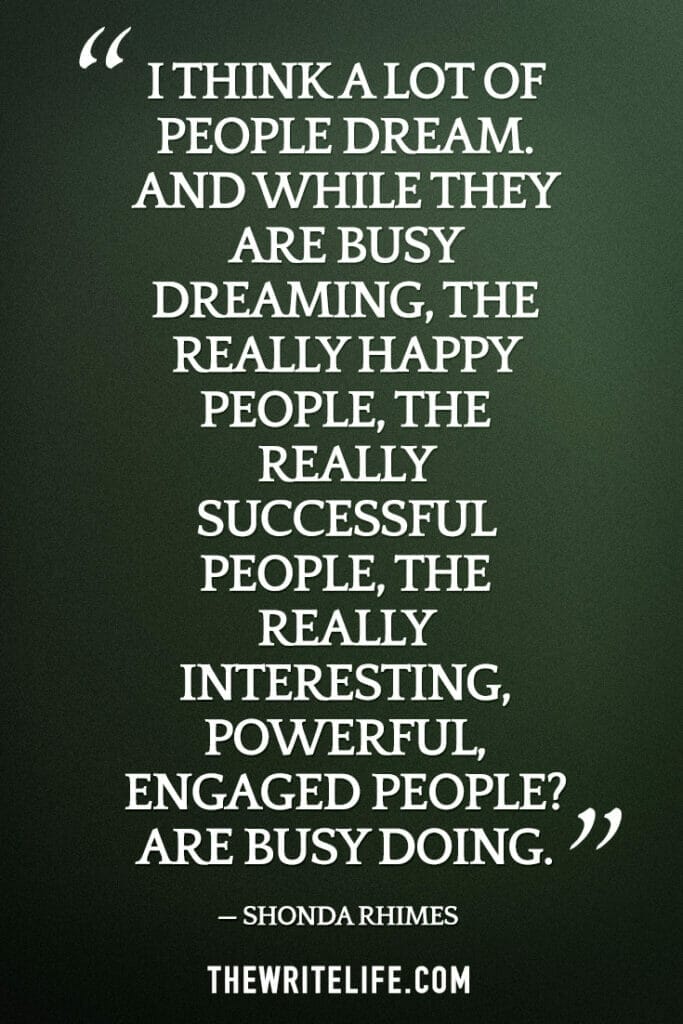
    That’s what powerhouse TV producer Shonda Rhimes wondered after her sister told her, “You never say ‘yes’ to anything.”

    These words shook Rhimes to her core and inspired her to accept her sister’s challenge: Say yes to every opportunity that came her way for one full year. She documented the experience in her best-selling book, Year of Yes: How to Dance It Out, Stand In the Sun and Be Your Own Person.

    While those of us who love writing aren’t necessarily making appearances on Jimmy Kimmel Live or producing Grey’s Anatomy and Scandal, pursuing your dream of being a writer can be equally scary to the activities Rhimes said “yes” to during the year-long experiment.

    When it comes to being a writer, the easy thing to do is to stay tucked away in a writing nook, typing away at a keyboard, keeping your drafts hidden away, never to be seen (until they’re perfect, that is).

    The harder, scarier and much more rewarding thing to do is to step outside your comfort zone and say “yes” to writing opportunities that will help you grow, thrive and share your words with the world.

    Take a note from Shonda Rhimes and say YES to these potentially anxiety-inducing writing activities.

    1. Pitch a guest post to your favorite writing blog

    One of the best ways to gain exposure as a writer and build your personal brand online is through guest posting. When you publish a guest post on a big or popular blog in your industry, your work is shared far wider than your personal network and you begin to establish credibility.

    Pitching a guest post can be scary, but I often encourage writers to consider the worst-case scenario. The very worst thing that can happen is the blog editor declines your post and you pitch it to a different site or publish it on your own blog.

    As writers, we need to learn to deal with rejection, so take any “no” you receive as a chance to practice patience and keep moving forward.

    Ready to pitch your first guest post? Be sure to check out this guide to knock your next guest post out of the park.

    2. Join a writing critique group

    No doubt, sharing your work with others can be a terrifying experience. After all, these words, characters and worlds live inside our hearts, brains and souls.

    However, joining a writer’s critique group either online or in-person can both give you a network to lean on (accountability, people!) and also help strengthen your writing. What makes sense to you because you are so close to your work may not make sense to someone seeing it for the very first time.

    Developing a relationship with a critique partner or group gives you a much-needed outside perspective on your story.

    Still not sure how to find a critique partner or group? We’ve rounded up 40 places to find your perfect match.

    3. Attend a writing conference, retreat or residency

    Physically step out of your comfort zone to take your writing offline and into the real world.

    Consider applying to a writing residency for a set amount of uninterrupted writing time in an often-beautiful and inspiring setting. Similar to a residency, but often shorter and without the need to apply, writer’s retreats are a wonderful way to change up your surroundings to find new inspiration.

    Looking for a more educational experience? Professional development opportunities like attending a writing conference are a great way to hone your skills, meet other writers and walk away with new ideas, tips and tricks.

    4. Find an agent to represent your work

    Dream of being traditionally published? You’ll need to find a literary agent to represent your work and pitch your book to publishing houses.

    To find the agent that’s right for you and your work, check out the acknowledgement pages of the books you love in your genre. This is a great way to see who handles the type of book you’d like to publish. Similarly, research agents online and via social media to determine fit.

    Once you’ve identified a list of agents you’d like to work with, you need to write a query letter to pitch your book and explain why you want to work with that particular individual.

    5. Self-publish your book

    As traditional publishing becomes much harder, more and more writers are turning to self-publishing.

    While self-publishing isn’t the simplest route, it often gives writers more control, freedom and flexibility.

    As author Linda Formichelli explains in this post, “There are no gatekeepers telling you what you can and can’t publish. No one telling you what to charge, and no one taking most of the money and giving you a paltry 15-percent royalty. No ten-month lag time between starting your book and seeing it published.”

    Self-publishing your book is a big step. Consider your decision carefully.

    6. Start a blog

    Get comfortable sharing your writing online by starting your own blog.

    When you blog, you begin to develop your unique voice and style, write more consistently and learn how to market yourself and your writing online. These are all important skills for being a successful writer or author in today’s digitally-charged world.

    Oh, and if you’ve been dreaming of starting a blog, but are still feeling hesitant… don’t let excuses hold you back.

    Staying within your comfort zone is just that; it’s comfortable. However, we all know that the most rewarding things in life are just out of reach — just a few steps outside your comfort zone.

    Be brave. Take a chance on yourself. Say “yes.”

    What writing challenges have you faced recently?

  • How to Negotiate: The Tip No One Tells Writers

    How to Negotiate: The Tip No One Tells Writers


    Hi, my name is Jessie, and I’m a writer.

    I can nail thriller scenes for novels, attention-grabbing article ledes, and persuasive product descriptions.

    Yet one form of writing repeatedly eludes me: business emails.

    Especially emails that involve my nemesis… negotiating.

    Negotiation is an important skill for writers — freelancers dealing with prospective clients, novelists dealing with editors, indie writers hiring cover designers, and anyone who’s ever tried to organize a coffee date with a colleague.  

    It seems like negotiating would be easier via email than in person or over the phone, especially for us writer types. After all, you can take the time to craft every sentence and make sure your point is clear and polite, right?

    And yet it can be devilishly hard.

    Jessie’s Big Deal: a case study

    I recently went through a high-stakes negotiation with a prospect, which involved some of the biggest numbers I’ve ever quoted. In a panic over every word, I read my email drafts out loud to my husband, who works in sales.

    His verdict? My writing sucked.

    In my quest to be polite, he explained, I was weakening my position and opening the door for my prospect to walk all over my quote.

    My first email went something like this:

    Hi Prospect,

    Thanks so much for getting in touch! I’d love to talk with you more about how we might work together. It sounds like what you’re looking for is [Project]. Based on [Variable 1] and [Variable 2] I feel like [My Proposal] might be a good way to proceed. My normal rate for work like that ranges from [$ to $$]. I think I’d need to know more about [Variable 3] before I could narrow that down. I hope that sounds all right to you. If so, let’s chat.

    Cheers!

    Jessie

    “Is that nice enough?” I asked my husband, who was rolling his eyes. “Is it polite? Is it getting my point across? Am I quoting too much?”

    After going back and forth about the wording for about 10 minutes, my husband finally asked if he could just write the email for me.

    My husband’s email read, in a nutshell:

    Prospect,

    Thank you for getting in touch. Based on [Variable 1] and [Variable 2], my rate would be between [$ and $$]. Please let me know how you would like to proceed.

    Jessie

    The polite writer in me was appalled at his directness and lack of flowery ornamentation. But I had to admit, it would be much harder to walk all over my proposal in that email than my original version.

    I touched up his version with a bit of my personality, but the lesson was clear: My tendency to hedge my bets was killing the negotiating power of my emails.

    Minimize “minimizing language” for stronger emails

    To show respect, many writers tend to use language that weakens their position. They aim for deference and end up timid. It’s part politeness, part impostor syndrome — and 100-percent bad for business.

    The good news is that, like in my email above, it all comes down to a few problem phrases that you can learn to recognize and edit out. Business experts call it “minimizing language.”

    It often sounds more polite to avoid direct statements. That’s why we say things like, “I think we need to turn left at the light,” instead of simply telling the driver to turn left.

    Observe how the following deferential statements can be strengthened:

    • It seems like 3 p.m. would be a good time to meet up for me.” —> “Let’s meet at 3 p.m.”
    • I feel like [$$] would be a good rate for that type of work.” —> “My rate is [$$] for that type of work.”
    • I think I’d like to see a second draft by the end of the day.” —> “Please send me a second draft by the end of the day.”

    In my original email, I used phrases like “sounds like” and “I feel like” to soften sentences that should have been direct statements. After all, it didn’t “sound like” my prospect was looking for a certain type of service; he was looking for that service.

    “Do you ‘feel like’ making this proposal, or are you going to make it?” my husband asked. “Do you ‘think’ you need to know more about [Variable 3] before you can make a more accurate quote, or do you need to know it?”

    Phrases like these introduce doubt in the mind of your reader and undermine your authority, but they’re not the only culprits.

    “Just” is another insidious phrase that undermines everything around it. Look at how its inclusion in each of these sentences makes their meaning sound so insignificant:

    • “I just have a few pages to read from my new story collection.”
    • “I just want you to know…”
    • “I’m just calling to check in on…”
    • “My new novel? Oh, it’s just a story about…”
    • “Hi, it’s just me.”

    You should also keep an eye out for reassuring tag lines: phrases that go on the end of a sentence to soften its directness and ask for reassurance. Look out for phrases like:

    • “OK?”
    • “Don’t you think?”
    • “Isn’t it?”
    • “All right?”

    When in doubt, throw out your English degree

    Tana French’s gorgeous prose and Margaret Atwood’s intricate sentence structures make for a wonderful reading experience – but in a business email, simple is better.

    Take a look at my email examples from above again. In the first email, I was hiding my basic message — “here’s my quote, give me a call” — in a whole novel’s worth of subordinate phrases. That kind of email makes it harder for the recipient to know exactly what I’m saying and what I expect in response.

    Clarity is critical whether you’re hoping the response will be “You’re hired” or “Great, I’ll meet you then!”

    Next time you’re writing a business email, swap your writer hat out for your salesperson hat and cut out the fluff.

    I just feel like you’ll probably get better results if you do, don’t you think?

    How have your negotiation skills changed as you’ve gained experience writing?