Category: Craft

  • Accusative Case: 2 Great Ways To Quickly Upgrade Writing

    Accusative Case: 2 Great Ways To Quickly Upgrade Writing

    When you sit down to brainstorm your next book, you may not ponder the accusative case and how it could influence your story. However, the accusative case is a hidden gem for great writing. Who knew English class could help you up your chances at hitting that bestseller list? 

    In this article, we’ll review what accusative case is as well as when you should use it and when you shouldn’t. Examples are included especially for visual learners. 

    What is Accusative Case?

    Accusative case is used to indicate direct receivers of an action. If you were to label the following sentence, ask yourself which word is receiving the action: I wrote a novel

    I is the subject. Wrote is the verb. A novel is the direct object, or the part of the sentence receiving the action.

    A tip for finding direct objects is to ask “what?” after the verb. 

    • I made scones for a snack
    • She ran five miles
    • He studied history.

    Can you find the direct objects? Alright, now that our brief review is over, let’s discuss when to use the accusative case in your writing. 

    When to Use Accusative Case

    Whether you write fiction or nonfiction books, chances are high that you use the accusative case throughout your chapters. In fact, you are bound to include the following in your work-in-progress:

    • Active voice
    • Passive writing
    • Fragments
    • Run-on sentences 
    • Accusative case 
    • Various points of view 

    Each of the above points is an important part of the English language. As students, we learned how to define each part. Now that we are writers, it’s crucial to learn how to apply these foundational principles to our writing.

    When used with purpose, the various elements of the English language (such as the accusative case, can greatly influence your writing). So when should you use it? 

    Let’s say that you want to specify what’s going on in a particular scene of your novel. Consider our tip—asking “what?”—when trying to find the accusative case. 

    Now write your scene. After you finish your first draft, read through it once more. Can you answer the question with clarity? Could your readers? If the answer is yes, you’ve likely used the accusative case just as it’s intended to be! 

    When Not to Use Accusative Case

    What if you write thrillers or are sharing your memoir? Maybe you don’t want to directly answer the question. Perhaps you want to leave your readers hanging just enough so they turn the page to find out for themselves. 

    If you find yourself in this situation, you should pay close attention to the accusative case in your writing. For instance, consider the following sentence: After so long, I truly hoped that… 

    This sentence is a fragment and does not answer the “what” question. This style should be used sparingly, but it does have its place in modern writing. 

    Now that you have a grasp of the accusative case and a few ideas on when to use it versus when not to use it, let’s get into some concrete examples. 

    Examples of Accusative Case: Used and Cut Out

    For these examples, we’ll look at some published works. The originals will be noted and the changes I make for sake of example will also be clear. 

    We Were Liars

    E. Lockhart’s New York Times bestseller includes the following on page one: “It doesn’t matter if one of us is desperately, desperately in love. So much in love that equally desperate measures must be taken. We are Sinclairs. No one is needy. No one is wrong. We live, at least in the summertime, on a private island off the coast of Massachusetts.” 

    This first page includes great scene setting, backstory, and a fantastic set-up to the rest of the story. However, what if I changed it, cutting out:

    • Some of the description 
    • Some of the answers to “why” 
    • Some of the scene-setting

    With my edits in place, look at the following (my version):

    “It doesn’t matter if one of us is desperately, well… We are Sinclairs. No one is needy. No one is wrong. We live, at least in the summertime, on a private island off the coast of—actually, nevermind where we live.” 

    Notice how the tone changes, and the narrator takes on completely different characteristics. Suddenly, whoever is speaking seems a bit secretive, even untrustworthy. Pay attention to how you can cut the accusative case from your writing when you need a certain level of ambiguity. 

    The One Thing

    “After these experiences, I looked back at my success and failures and discovered an interesting pattern. Where I’d had huge success, I had narrowed my concentration to one thing, and where my success varied, my focus had too.” 

    Gary Keller (with Jay Papasan) wrote this Wall Street Journal bestseller. One reason I believe the book did so well, and continues to sell today, is due to Keller’s straightforward answers. 

    Rather than state that he had experiences, discovered a pattern, and then moving on, he shares his secret. He answers the question “what” with precise, researched, simple yet extraordinary results. Let’s break these few sentences down.

    • “After (what?)
    • these experiences, 
    • I looked back at (what?)
    • my success and failures 
    • and discovered (what?)
    • an interesting pattern. 
    • Where I’d had (what?)
    • huge success, 
    • I had narrowed (what?)
    • my concentration to (what?)
    • one thing” 

    Notice just how clear he is in two simple sentences. Six times he answers his readers’ potential questions with a straightforward answer. 

    In today’s age of clickbait and need for views, followers, and likes, it’s easy to walk around the answer or to literally cut the accusative case from our answers. For nonfiction especially, it’s vital to provide your readers with the answers they opened your book looking for. 

    One Parting Tip

    Have you ever clicked a video on YouTube and had to wait for an ad that goes for several minutes? You have the Skip Ahead button, but their opening got you hooked. Oftentimes, these ads target a need of their ideal customer (likely you, a creative writer or freelance writer) and draw you into a narrative. 

    By the end of the video, they’ve stated your need, or pain point, in a variety of ways but they never provided you with the answer. This is frequently because they want you to respond to their call to action at the end. For ads, this is the norm and acceptable.

    In writing, this leaves readers hanging. As a writer, your call to action is to keep readers turning pages. As you tread the line between asking enough questions and providing the sufficient amount of answers, remember the accusative case.

    If your readers can’t answer their questions at different points throughout your story, they will likely close your book. Yes, include setups and leave them hanging, but don’t forget to include payoffs too. And at the end of your book, fiction or nonfiction, include a resounding, satisfying, question-answering ending. 

    This will leave your readers satisfied and eager for more—two factors important for writing success! 

    TWL. CTA. Book Outline Template
  • Satire Examples: 21 Options To Inspire Your Next Writing Session

    Satire Examples: 21 Options To Inspire Your Next Writing Session

    Have you ever laughed at a scene in a book, movie, or play and wondered why it hit you so well? Satire is a unique form of communicating, often via the written word, but it isn’t just about getting laughs.

    While you’ve likely seen comedians use it in their jokes or satire used on talk shows, writers can use this form of writing to prove a point—often at another person’s expense.

    Used well, this is a powerful form of communication. Comedy can break down barriers that otherwise could not be breached. If you want to communicate a truth that may not be easy for your audience to receive, satire may be a great way to approach the situation.

    In this article, I discuss the definition, when to use it, and I provide many examples for your convenience. Ready to get started?

    What Is Satire?

    Satire is a genre unto itself, spanning the visual and performing arts as well as literature. The purpose of satire is often to teach a difficult truth or give constructive criticism, and use humor to do so. If you’ve ever found yourself laughing through a movie but walking away contemplative, you’ve likely experienced the effects of satire.

    Today, the use of sarcasm could be considered a lower form of satire. Oftentimes, there is a bit of truth in every sarcastic comment. Just as we must be careful with our use of sarcasm, satire is a powerful genre that must be wielded with caution.

    So, how do you know when it’s time to use this powerful form of writing? What are some questions to consider before employing satire into your next writing project?

    When To Write With It?

    Grammarly says to “use satire when you feel strongly about a particular situation, especially one you believe is being mishandled.” 

    They go on to say that “since satire makes use of literary devices like humor, hyperbole, and irony, it is read in a less serious way than a formal complaint or manifesto.” Let’s look at the following two instances.

    Use It To Write An Opinion Piece 

    Let’s imagine for a moment that you are a well-known blogger. You have a good following, people respect what you have to say, and you want to share your opinion on a certain aspect of the publishing industry.

    However, you want to present your opinion in a way that is received well. With so many views on publishing, this could be difficult. This is where satire could come in handy. 

    Write a short story presenting your opinion, publish it to your blog, and give subscribers a good laugh while also sharing your opinion.


    Use It To Share Your Perspective  

    A second way to use satire is to share your perspective on a particular topic. While satire is often used to prove a point at the expense of the opposite party, it is possible to write your satire piece in a way that shares your perspective in a funny, yet pointed, manner.

    Never underestimate the power of getting a laugh while also instilling a truth. Used with thoughtfulness, this genre can allow you to share your perspective in a way that can be well received. 

    Examples 

    Here is a list of twenty-one examples of this sub-genre:

    #1 – The Onion

    A newspaper based on satire, The Onion provides both satirical stories and headlines, all with a focus on humor.

    #2 – Hard Times, Charles Dickens

    Known as one of the best of his satirical works, Dickens’ book looks at English society, economy, and social inequality. 

    #3 – Catch-22, Joseph Heller

    If you’ve ever used the phrase “It’s just a catch-22,” you have Joseph Heller to thank. This book takes a look at war, what it takes to serve, and how absurd it is when you look at it through the this genre. 

    #4 – The Catcher In The Rye, J. D. Salinger

    This 1951 work was originally published over the course of a year, and serialized, but later published as a complete novel that addresses the shallowness of society. 

    #5 – The Lorax, Dr. Seuss

    Leave it to a children’s book to discuss topics such as the state of the planet! 

    #6 – War and Peace, Leo Tolstoy

    Also originally published serially, this book takes a satirical look at historical figures. Tolstoy employs satire to help him reveal the faults of others, especially well-known names.

    #7 – A Tale of Two Cities, Charles Dickens

    Leave it to Dickens to take a satirical form to criticizing the justice system. 

    #8 – “Charles,” Shirley Jackson

    If you’re a parent, this one may hit home. It’s easy to overlook our family’s issues and criticize others. Jackson reveals this truth with a satirical art.

    #9 – “The Toxic Donut,” Terry Bisson

    Bisson pulls back the curtain on consumerism, something most of us likely struggle with. Thankfully, the use of humor can help us take in the lesson.

    #10 – “Happy Endings,” Margaret Atwood

    We see you, Atwood. Fallen in love with fairy tales yet? Well, Atwood presents different aspects of life’s reality through satire. 

    #11 – “Partying Is Such Sweet Sorrow,” Lori Romero

    The title itself makes you laugh. Just keep reading!

    #12 – Don Quixote, Miguel de Cervantes

    Seventeenth century Old Spain…add a satirical spin, and you have Don Quixote.

    #13 – The House of God, Samuel Shem

    A great book for medical students just starting out. Dive into the worst of situations with amazing, underlying satire. 

    #14 – Animal Farm, George Orwell

    An “Aesopian masterpiece,” according to Publishers Weekly, and a satirical publishing journey to back it up, this short book is well-known for a reason.

    #15 – Alice in Wonderland, Lewis Carroll 

    It may have been written for kids but look deeper for a satirical take on the political and judicial landscape of Victorian England.

    #16 – “Excerpts from Roughing It,” Mark Twain

    The narrator of this piece takes you through his career choices and why he made them—with some necessary satire! 

    #17 – “The Nose,” Nikolai Gogol

    Gogol’s short story uses satire to reveal others’ vices, which is never an easy task.

    #18 – A Modest Proposal, Jonathan Swift 

    Swift covers the heavy topics of famine and oppression, both experienced by the Irish.

    #19 – “Dragon, Dragon,” John Gardner

    This short story, aimed at middle school students, uses satire to teach the importance of wisdom.

    #20 – “Southpaw,” Judith Viorst

    An ever more ridiculous communication chain between two friends teaches lessons about equality. 

    #21 – “Us and Them,” David Sedaris 

    Have you ever noticed that judgemental people show their worst side? Sedaris teaches this lesson through his essay about neighbors. 

    Satire: The Old, New Communication Tactic 

    Satire has been in existence since around 430 BC. Playwright Aristophanes used his storytelling talent to mock the popular convents, and leaders, of Athens. Satire is now a sub-genre of Aristophanes’ work. 

    This sub-genre is a popular way to teach lessons and communicate opinions without starting arguments. If you want to work satire into your next writing project, take a few hours over the next week to really look through the above examples.

    Learn what you love about satire, what you don’t love, and how to employ what you’ve learned to better communicate to your readers. Enjoy trying your hand at this genre! 

    TWL. CTA. Book Outline Template
  • Passive Voice Misuse: 4 Steps To Fix This Rookie Issue

    Passive Voice Misuse: 4 Steps To Fix This Rookie Issue

    If you’ve ever wondered what exactly qualifies as passive voice misuse you’ve come to the right place. Passive voice is an issue many new writers face. In fact, I didn’t know there was a “right way” to write until I was in college.

    As a new writer, I thought great writing came down to the idea and the adjectives used to describe that idea. Point-of-view, voice, and tense were not major factors in my writing. Thankfully, once I began training in creative writing I quickly learned that I had a lot to study. 

    Passive voice misuse can set writers apart as novices or as experts who know how to wield writing rules with power. In this article, I define what passive voice misuse is, why it’s a no-no for new writers, and give four steps to fix passive voice misuse. Let’s get right into it! 

    [sps_reusable_block post_id=43061]

    Defining Passive Voice Misuse 

    While there is a time and place for this type of voice, passive voice misuse occurs when the subject should be performing the action. 

    Passive voice is simply when the subject of a sentence is acted on by the verb. Can you spot the use of passive voice in the previous sentence? You can make a sentence active by focusing on the subject as the one doing the action. 

    Passive: Passive voice is simply when the subject of a sentence is acted on by the verb.

    Active: Passive voice is simply when the verb acts on the subject of a sentence.

    In this active sentence, the verb is doing the action rather than the subject being acted upon. Many writers unconsciously use passive voice throughout their stories. 

    Why Passive Voice Is A No-No

    The reason writers frown on passive voice is due to its unnecessary wordiness and lack of clarity. For newer writers, writing to just “get the story down” is perfectly acceptable. However, passive voice easily creeps in. Several issues can result: 

    • Protagonists feel reactive 
    • Confusion overrides clarity
    • The writing lacks strength 

    It’s easy to write passively. It takes forethought to write in an active voice. So how do we fix this issue?  

    4 Steps To Fix Your Voice

    One of the best ways to combat passive voice is to simply change your mindset in writing. If the mindset shift doesn’t work, there are some concrete steps you can take to further help. Let’s start with a mindset shift.

    Move Action Forward With Purpose

    At the core of writing lies an advancement of the plot. Consider the classic example of the hero’s journey: The protagonist sets off on a journey (literal or figurative) with an endpoint, or goal, in mind.

    Whether it’s Frodo Baggins taking literal steps toward Mordor or Peter Rabbit hopping out of the garden and toward home just in time, these beloved characters feature a proactive mindset. 

    Personalize this mindset by focusing on the end of your story and proactively, rather than reactively, writing toward it. 

    Simple lines such as the following take on an entirely new meaning. For instance:

    Example 1: Professional figure skating was her dream. The Olympics was a real possibility if she put in the work. 

    Example 2: She dreamed of professional figure skating, and if she put in the work, she could make it to the Olympics.

    In the first example the reader passively takes in information. In the second, there is a sense of urgency. The protagonist is the one proactively dreaming. 

    Create An Active Protagonist 

    Your mindset also plays a role in how you describe your protagonist. Look through the following list and ask yourself how your protagonist would act or speak in the following situations: 

    • Planning a beach day but waking up to rain
    • Responding to a breakup 
    • Getting rear-ended 
    • Pursuing their dream job
    • Spotting a lost child

    In the first three examples, outside circumstances impact the protagonist: Rain, being broken up with, and someone hitting their car. The last two feature the protagonist as proactive, or with the possibility of being proactive. How you write them is imperative:

    • “It’s raining. I’ll go study at a coffee shop” Or, “It’s raining. I’ll have to stay in today.”
    • “He broke up with me. I’ll cancel my plans.” Or, “He broke up with me. I’ll go home and process.”
    • “That child looks lost. I wonder if his parents are around.” Or, “That child looks lost. I’ll go see if I can help.”

    Same situation, similar responses, but one features a passive protagonist and the other a proactive one. 

    Cut Being Verbs

    If the mindset shift isn’t quite doing it for you, try this concrete step: In point number two, look at the subtle difference in how I could write the opening sentence. In the sentence I used, I excluded being verbs. In the second example, I include being verbs.

    Sentence 1: Your mindset also plays a role in how you describe your protagonist. 

    Sentence 2: Your mindset can also be influenced by how you describe your protagonist. 

    In the first sentence, the subject (mindset) leads the sentence actively (plays a role). In the second one, the subject is acted on by the verb. 

    In the same way, if your protagonist must complete a task, how can you shift the focus from their response to circumstances to them impacting circumstances? Frodo makes the active choice to take the ring to Mordor, even though he appears to be the least equipped out of the nine. 

    Imagine Tolkien writing The Lord of the Rings passively. Instead of the iconic line, “I will take the ring. I will take the ring to Mordor!” We could read, “The ring will be carried by me. The ring will be carried by me to Mordor.” This is the difference between writing actively and passively.

    Try Present Tense

    If you’re willing to take action steps even further, I’ve found present tense as a shortcut to learning the power of active voice. In fact, I wrote an entire manuscript in present tense rather than past tense because I felt so stuck in my habit of passive voice misuse. 

    Past tense: I was going home when I was followed by a black car.

    Present tense: On my way home, I notice a black car following me. 

    For some reason, this shift dramatically helped me.

    Caveat: Know The Rules So You Know When To Break Them

    Now that we discussed several cons to passive voice misuse and how to combat it, it’s crucial to remember that there is a time and place to break writing rules. 

    Passive tense is not always, forevermore, and with no excuses, a no. For new writers, studying writing tips and how to write actively will aid their learning curve. However, writing passively is not always bad. 

    Learning how to write in an active voice helps you avoid passive voice misuse while also teaching you when you can use it. 

    Think of a painter: They know the brushes and what they are intended for, but sometimes they may choose a different brush, one that isn’t intended for a specific style, to help present their painting in a more nuanced way. 

    The same is true for tense. Learn the rules, and then enjoy (occasionally) breaking them!

    [sps_reusable_block post_id=43061]

  • Mood Words: 4 Ways They Transform Writing For The Best

    Mood Words: 4 Ways They Transform Writing For The Best

    Mood words are a controversial part of today’s writing. Used well, they can take your prose to an entirely new level. Used poorly, they can put your writing in a time warp and negate your creative credibility. Sound confusing? That’s why, in this article, we break mood words down.

    What exactly are they? Why do they matter? How can you use them as a positive force to better communicate to your readers? It’s crucial to first start with a definition so we are all on the same page.

    Mood Words: What Are They And Why Do They Matter?

    Mood words are words that describe the inner feeling of a character or the outer tone of a scene. For a more textbook answer, these type of words are simply called adjectives. If you pick up a classic work of literature, you will likely see long sentences complete with many adjectives.

    For today’s writers, adjectives are a bit more out of style and strong nouns and verbs are stressed in importance. So how do you tread this line? Let’s dive in.

    What They Are:

    You can use mood words to describe a variety of topics: the weather, a character’s feeling, the tone you want to communicate in a particular scene, etc. Below is a short list of examples.

    • Angry
    • Bitter
    • Confused
    • Dedicated
    • Energetic
    • Flirty
    • Gregarious 
    • Healthy
    • Ingenious 
    • Jaded
    • Kind
    • Loving
    • Mean
    • Nervous
    • Opinionated
    • Polite
    • Quiet
    • Resourceful
    • Silly
    • Timely
    • Unique 
    • Volatile 
    • Wise

    Used in a sentence, these words can be interchanged to set an entirely different mood. For instance, look at the example below where I use mood words in two entirely different ways.

    • The couple seemed flirty, even though they had just had an energetic fight.
    • The wind came in short, flirty gusts, playing with her hair.

    With these examples in mind, let’s discuss a bit more why they matter.

    Why They Matter

    Mood words can quickly set the tone in your writing, but you should use them sparingly. Gone are the days of sitting in a library for hours, reading a novel while waiting for tea. 

    Today’s writing is all about grabbing readers’ attention and keeping their attention with short, punchy sentences.

    While in previous centuries mood words were combined to detail the feelings of characters, today they’re used to quickly set the tone.  Writers don’t have any spare moments when it comes to keeping the reader’s attention.

    At any moment, their reader could get a text, a phone call, or be jerked out of the fictional world with a social media notification. So how do you use mood words in today’s writing?

    How Mood Words Level Up Your Writing

    Because mood words are such a powerful way to communicate, let’s discuss six ways you can use them to take your writing to an entirely new level.

    #1 – Quickly Set The Tone

    With literally seconds to capture your readers, plunging them into the tone of the story is critical for your success. Look at how J.K. Rowling uses mood words to set the tone in her fifth Harry Potter book:

    “October extinguished itself in a rush of howling winds and driving rain and November arrived, cold as frozen iron.” 

    She uses rush to personify October, dragging you into the chill of the tone in just a few words. Instead of dragging on the scene and describing every detail, the word rush quickly sets the tone and allows her to move on.

    #2 – Speed Up The Scene

    If you want to slow a scene down, similar to how videographers use slow motion, you can elongate your sentences: add words, describe details, and so forth. In the same way, if you want to speed up your scene, use short, punchy mood words and sentences. Consider the following:

    Nervous, she dropped her notebook. Energetic wind blew her papers. 
    “Can I help?” The voice was quiet. 
    She looked around. No one. Confused, she stood frozen. 

    While this example uses many mood words such as energetic and frozen to get the point across, quickly. Look at your own writing to see how you can use a word or two to speed up your scene.  

    #3 – Leave Room For The Reader’s Imagination

    Mood words act as succinct descriptors. A room can be chaotic, a person can be bitter, and an ocean can be volatile. Look at the following two examples:

    #1: The waves crashed over the bow of the boat, sending spray over the occupants. They needed to reach land, but the waves continued to pound at the small fishing boat. 

    #2: The occupants clung to the fishing boat, stranded in the midst of the volatile sea.

    While it’s up to you, the writer, to choose how much description to use, never forget to leave room for what is often described as “the theater of the reader’s mind.” If you need to communicate a mood quickly and continue with the story, try using mood words to do so. 

    #4 – Define Characters

    Mood words are a greatly underestimated writing strategy to describe characters in just a word or two. For instance, think of how you could describe someone who is easily angered, has good moments and bad, and is larger than life: He was volatile, always waiting to erupt. 

    What about a timid, soft spoken child who likes to blend into his surroundings? Try the following: He stood against the wall, anything but gregarious. 

    And for one more example, what about a grandmotherly figure who has decades of wisdom and the personality to share it? What about this: She had a healthy wisdom that came out in quiet moments. 

    Mood words are a powerful way to describe a person, place, or even an idea, without going into long sentences of description. 

    Establish The Humanity In Your Writing With Mood

    Oftentimes, the best writing is the most relatable. What is more relatable than humanity itself? After all, regardless of our social status, jobs, who we know, or the goals we strive for, we are all human.

    When you decide to use mood words you open yourself up to taking an even deeper look at the humanity of your characters and the sensory details of your scene. Combine mood words with personification and you take your writing to an entirely new level:

    • The paint chipped away from the door, jaded by how many people had walked out. 
    • The wind chapped her hands, as if bitter she refused to wear gloves. 
    • Flowers pushed through the earth, showing a quiet disregard for the snow still on the ground. 

    Now that you see how powerfully mood words can influence writing, spend the next few weeks noting where writers do so. What fiction or nonfiction books use mood words in the first chapter? Page? Paragraph?

    Which authors use these types of descriptors to quickly portray the personality of their characters? 

    If you take notes in your books, make a practice of circling in pencil every time you spot mood words (you can always erase it later).

    And if you’re feeling really brave, try creating your own examples and leave one or two in the comments to inspire others. We’d love to see what you come up with!

    TWL. CTA. Book Outline Template
  • Your Complete Guide to Expository Writing in 5 Quick Steps

    Your Complete Guide to Expository Writing in 5 Quick Steps

    Depending on what you choose to do during your writing career, you might or might not need to know how expository writing works.

    This article will be your complete guide to expository writing so you can understand the basics and start writing your piece.

    For the most part, if you do any nonfiction writing, you will need to know what expository writing is and will have to practice it every now and then. It is writing that is entirely based on outlining facts. There’s little creativity and persuasion.

    You most likely did a lot of this type of writing throughout your school years, but you might end up doing it as a professional writer as well.

    Let’s dive in.

    article writing template

    What Is Expository Writing?

    The point of expository writing is to be factual and educational. Expository writing is not meant to be persuasive writing or have any type of storytelling elements.

    The goal is always to educate the reader and give them the facts so they can understand a topic.

    It is the difference between reading an academic book and a novel. One is for entertainment and one is for education. Sure, some written pieces can have a cross between the two, but strictly expository writing is only focused on the facts.

    Examples of expository writing include:

    • News articles
    • Instructions
    • Academic textbooks
    • Scientific reports
    • Academic essays
    • Magazine articles
    • Encyclopedia articles
    • Business writing
    • Most kinds of assignments in school

    When you are reading expository writing, you always know what the goal of the piece is and everything is presented in a way that makes sense.

    Every expository writing piece has a goal in mind. While it never has the goal to be persuasive writing, it can have the goal of informing the reader, giving them a timeline of events, filling the reader in on an interesting story they should know, or something else.

    Before you start writing, you will want to think about what you want the reader to walk away from your article now knowing about the subject you are writing about.

    Expository writing is always objective and does not contain anyone’s opinion inside the piece.

    What Is Not Expository Writing

    There are some types of writing that might feel like expository writing but in fact are not.

    Some might include advertisements, opinion pieces in a major magazine, blogs, social media posts, and more.

    Expository writing is not under any of the other writing categories such as persuasive writing, narrative writing, or descriptive writing.

    With every piece of writing, you need to figure out if it is trying to persuade you or not. If it is, it is not expository writing.

    Expository writing should not be persuasive or trying to guide you toward a certain conclusions in any way. It simply lays out the facts as they are and then lets you draw your own conclusions along the way.

    If you see the author include anything about themselves and their opinion, that is automatically a sign that it’s not expository writing.

    Your Complete Guide to Expository Writing And Tips For Success

    Let’s go over some ideas and tips for you to use to put our expository piece together.

    #1 – Pull out your main points and facts

    If you are creating an expository writing piece, you will want to gather your most important facts into one place.

    From there, you need to put them in the logical order to work through for the reader to follow and understand.

    The main goal for expository writing is to inform and educate the reader. With that in mind, you need to deeply think about how you can best do that and present the facts so they have all the information they need to create their own opinions.

    #2 – Double check your facts

    Just like with journalism, it is important to know that the fact you are using are accurate.

    There is a lot of slanted news and “facts” out there that you can come across while doing research for your writing. The best thing you can do is to double-check every single fact and the source you are pulling it from to make sure it is accurate.

    At the very least, deep dive into who did the research or compiled the facts that you are using in your piece. The last thing you want to do is to ruin your own reputation by citing facts that are not true.

    If you creating a piece that has expository writing, you are going to spend more time on the research and the organizing stage than in the writing stage.

    #3 – Decide how you are going to lay out your facts

    Once you have everything together, it is time to start figuring out how you are going to present the facts.

    While it is important that you outline your facts in a logical way, you can still present them in a variety of styles.

    You will need to figure out what your goal is by writing your piece. That will help you find the style you want to present your facts in. You could compare and contrast various facts, show problems and solutions (like you would see in something such as a case study), provide a timeline of events, and so on.

    Even if you are doing something technical like writing out business documentation, you should still have a goal in mind of why you are writing your piece in the first place.

    Who are you writing to? What do you want them to know by the end of reading your piece?

    #4 – Get feedback

    While you might think all of your writing is clear cut and objective, there is still a high chance that you will still have a slight personal slant in your work.

    Getting feedback from someone neutral on the topic can help a lot because they will help point out when you are being persuasive.

    It can help to get the opinion of multiple people on your written piece, but at least one can help a ton. You want to make sure you keep your writing factual and on point.

    #5 – Edit ruthlessly

    One thing that makes expository writing interesting is that it often cuts out the fluff. It is only focused on the essential parts that matter and the rest gets cut off.

    Before you turn in your final draft of your writing, you will want to make sure you go through it and cut out anything that can be cut.

    With each sentence, you should be asking yourself, “Is this essential information? If this was not in the piece, would it change the overall information?”

    Need Help With Your Next Article?

    You do not want to miss out on the article writing template. It walks you through all of the steps you need to take to make your next article a success.

    article writing template
  • What Is Freewriting? 6 Steps to Unlocking Your Creativity

    What Is Freewriting? 6 Steps to Unlocking Your Creativity

    If you have been lacking creativity in your writing and your work, freewriting might be a technique that gets you back on track.

    You might have wondered what is freewriting, how it works, and how you can use it to unlock new levels of creativity in your brain.

    The main idea behind freewriting is that you have all of this creativity hiding behind your conscious brain. Our conscious brains can be a mental bully, telling you that your ideas are silly or that what you have to say is not interesting, so freewriting is a technique that moves your conscious brain out of the way so you can tap into your inner creativity and flow.

    We so often want the writing to be perfect, we never focus on getting started. If you relate to that, freewriting might be perfect for you.

    We will go through all of the above so you can use this helpful practice to bring some creativity back to your writing.

    What is Freewriting?

    Freewriting was made popular by Julia Cameron in her book The Artist’s Way. It is also a great book for writers and creatives, so definitely add it to your reading list. However, many writers have mentioned using freewriting and it has been a popular practice for a long time.

    The idea behind freewriting is that you have all these smart, brilliant ideas and creative thoughts behind your conscious mind that is always getting in the way.

    Your mind can get in the way, stress you out, give you imposter syndrome, or think other self-limiting beliefs.

    When you freewrite, you let your thoughts flow. You tap into your subconscious by letting words flow out of you like a stream-of-consciousness and let whatever comes to you come out through your pen.

    Why Freewriting Helps Creativity

    As opposed to mind maps or brainstorming, where you are trying to format your thoughts into something useable, the point of freewriting is to not focus on structure or form and just let everything flow out of your brain at once.

    You sit down, set a timer, and keep writing no matter what, even if the words don’t make sense.

    For most of us writers, when we are expanding on our thoughts, we are also thinking about sentence structure, grammar, punctuation, and more.

    With freewriting, it might seem counterintuitive, but you want to forget all of the writing rules you know and just let the ideas flow out of you. It doesn’t matter if it’s just one word over and over or full, brilliant thoughts.

    You do not need to stay on a set topic or cover a particular theme, only do so if it feels right.

    Freewriting also helps so much for breaking past writer’s block. Simply putting words on a page again can help you break past whatever you are currently stuck with.

    If you are someone who struggles with not only writer’s block, but being overly self-critical or has anxiety about writing, freewriting can be a way to help you stop censoring yourself and to let the ideas flow.

    How to Freewrite

    The main way to practice freewriting is to start writing and keep writing, no matter what thoughts or ideas come to your mind. You just let them flow out of your mind and through your writing tools.

    Before you get started, you will want to block off at least 30 minutes in your calendar. You will also want to pick your tools of choice, whether it is paper or a computer.

    How to Practice Freewriting

    Let’s go over how you can start freewriting and start using this incredible practice.

    #1 – Pick your writing tools

    It will be up to you if you want to type for your freewriting exercise or if you want to write by hand.

    Writing by hand can be the preferred method because you are creating a kind of mind / body connection to the pen, but not everyone works like that.

    You could try both methods to see which one is better for getting you into a flow state.

    #2 – Start writing

    More than anything, you do not want to start overthinking your writing process. The goal of this is to start writing for a set amount of time and to not stop.

    You want to put pen to paper and start to just write about anything on your mind. Even if it’s “I don’t know what to write” just keep writing that over and over until some kind of different thought comes to you.

    You can even repeat the same word over and over if you can’t think of something to write, but you must not stop. The whole point is to keep letting the ideas flow and flow and flow for the set amount of time.

    #3 – Take a break

    After you write for five straight minutes, you should take a break. Read through everything you’ve written and think about it for a bit.

    Then, repeat the cycle of writing for five minutes and taking a break two more times.

    You might want to try a variety of times to see if some work better for you than others. For example, maybe you write for ten straight minutes instead of five.

    #4 – Do not be upset with that you write

    Keep in mind the first few freewriting sessions might be terrible. They might be frustrating, hard, and you might hate everything you write.

    It will take some time to break past that initial struggle and you can always throw your first few attempts away, but you need to keep going in order to see the benefit.

    #5 – Stick with it

    A lot of what you write at first is going to be logical thinking and “regular” thoughts such as things you have to do or the weather. The real magic comes when you keep going and start to break past those initial thoughts.

    Many people say they can’t see results until they start doing it for a few days or after a few weeks. The most important part is that you keep going and doing the practice.

    It can also help to keep your freewriting exercises because you might see similar themes and ideas when you look back on what you have written.

    Keep in mind, you can choose to burn or throw away your freewriting exercises if you are nervous about someone reading it and want the peace of mind of having it all to yourself. There is generally no right way or wrong way to do these things.

    You will see the best results if you do freewriting every day, but any time you do it is better than not doing it at all.

    #6 – Use freewriting for certain topics

    Once you get the habit and the general idea down, you can use freewriting to focus on certain topics or explore things you feel stuck with.

    If you are writing a book, this might be the time for you to freewrite what could happen in the next chapter.

    Having an idea might also help you get started if you truly get stuck with your freewriting, but do what works best for you.

    Once you get better at freewriting, you will love the freedom that comes with letting their thoughts completely flow without judgment.

    What to do next

    Looking for help when it comes to putting together an article template? You won’t want to miss this done-for-you template:

    article writing template
  • 7 Persuasive Writing Tips To Make Your Writing Stronger

    7 Persuasive Writing Tips To Make Your Writing Stronger

    Persuasive writing is the art of trying to convince others of your point of view using the written word. The goal of it is to persuade someone to do something or think a certain way.

    While it can use elements of creative and expository writing, it is almost in a category all on its own because the goals are different. If you are not trying to persuade someone, then it is not persuasive writing.

    If you have not written any persuasive writing in quite some time, you might be a little rusty on how to write it and what to include.

    Let’s talk about what persuasive writing is, what it is not, and give you seven persuasive writing tips to help you make a strong written piece.

    What Is Persuasive Writing?

    Persuasive writing is writing that tries to convince the reader of something, usually the writer’s opinion.

    It can use a wide variety of writing styles, but it must have the goal of persuading the reader to be considered persuasive writing.

    Persuasive writing can come in many forms, from ads to articles. It will often spend time throughout the piece acknowledging the other side’s arguments and combatting each of the opposing side’s arguments.

    Someone writing a persuasive writing piece should know exactly what they’re talking about. Sure, some types of persuasive writing will use made up facts or arguments that do not work logically.

    It is important to always double-check your facts when you are writing a persuasive writing piece.

    Examples of Persuasive Writing?

    Persuasive writing should be used anytime you need to convince someone of your argument.

    This could be in opinion pieces, on social media, in blogs, in advertisements, or more. It could even be as simple as trying to convince your family why they should go to a city you love for the annual trip.

    When you understand how to use it, you will also be able to see it all around you. It is in ads, movie trailers, on social media, and so on.

    No matter what you are using persuasive writing for, there are some elements you should be using each and every time, which we will dive into down below.

    One example of persuasive writing you can easily imagine is a review of a product. Go on Amazon and look at almost any review of any product. You will see persuasive writing pushing you to either buy or not buy that product.

    7 Persuasive Writing Tips

    Now that you know what persuasive writing is and when you should use it, let’s cover some ways you can make your writing more persuasive.

    #1 – Find your best argument

    The first thing you want to do is to find either your best argument you want to highlight or find the main angle of your writing.

    Lots of people try to be persuasive by bringing in every good point they have in their arsenal. That is the opposite of what you want to do.

    While it helps to have your main facts and supporting facts, throwing a thousand pieces of new information at someone is only going to overwhelm them instead of help your argument.

    It can help to lay out all of your main arguments and highlight your strongest ones that would persuade your reader. Only after you figure those out and present them to your reader can you dive into your supporting points.

    #2 – Know who you are writing to

    You cannot create persuasive writing if you do not know who your audience is.

    When you know who your audience is, you will be able to pick particular words and thoughts that will resonate with that audience.

    Depending on the platform you are using for your persuasive writing, you will need to narrow down who the people are you are writing to (or single person if it is something like a college paper).

    This helps you form your arguments because you understand who the reader is and what they care about.

    #3 – Keep them intrigued

    If you want to keep someone reading your argument, you will need to keep them invested enough to keep reading.

    You will need to meet the reader where they are at with their understanding of your topic. You do not want to start a persuasive writing piece with being mean and aggressive trying to prove your point.

    Instead, you will want to show that you understand their perspective on things, but guide them to understand your perspective and why you believe the things you do.

    It is important to do whatever you can to keep them reading. if you lose the reader and they are no longer interested in what you have to say, you have lost your persuasive writing point.

    #4 – Prove your point

    Now is the time to bring in all of the facts and experiences you can to prove your point.

    You have done enough work to walk them through your thoughts, facts, and perspective, but now is the time to hammer it home and highlight your best points.

    Ideally, you pick only a handful of main points as you do not want to overwhelm them. You want to keep your main points focused and on topic.

    Take the time to deep dive into each point you have and use supporting facts to back up what you are claiming.

    #5 – Overcome their objections

    Once you have laid out your arguments, the reader will often have objections in their mind about why you are not right. Maybe it is not always full-on objections, but they might have reservations at the very least.

    You will need to outline what these are and take a moment to overcome them. You do not need to dance around what they are, you can address them head-on.

    Address them head on and it will only make your writing that much stronger.

    #6 – Bring in emotional elements

    Whether you want to use storytelling or facts, you need to rile their emotions. This does not mean to manipulate or lie to them, but when you bring emotions into it, you are able to connect with them in a different way.

    Of course, you want to use facts to back up your main arguments, but this is not journalism, this is persuasive writing.

    Telling stories and writing ideas that spark their emotions is not always a bad thing. Humans love stories to connect to and understand things better.

    You do not want to go overboard with emotions, because then your writing will not seem grounded, but a few here and there is a good idea.

    #7 – Bring in social proof

    Social proof is essentially making sure that you show how the point you are arguing is working for other people.

    Few things will hammer home your argument quite like showing how other people feel or think about your topic. It is a great way to back up your argument with a real life example.

    This is why things like health supplement companies and gyms use “before and after” photos to showcase what people have done with their product or service.

    The social proof you bring into your argument needs to have that kind of impact.

    What To Do Next

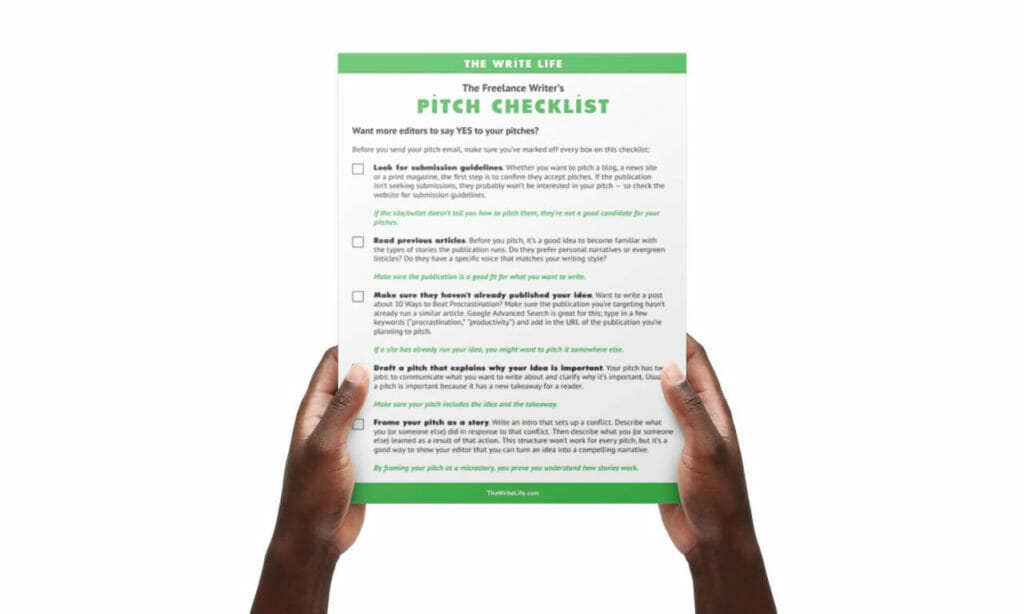
    Ready to put your persuasive writing to the test and start pitching? Get our pitch checklist so yours are a success:

  • How To Write A Screenplay: 3 Best Practices To Help You Write A Compelling Script

    How To Write A Screenplay: 3 Best Practices To Help You Write A Compelling Script

    If you’ve ever watched your favorite book transform into a feature film, you may have wondered how to write a screenplay. What do screen writers keep? How do they know what to cut out? And (perhaps controversial), what do they add that was not in the original story?

    If you grew up in the 90s or early 2000s, maybe you watched Harry Potter go from black words on white pages in the theater of your mind to record-breaking movies on screens around the world. This series was long, so how did Michael Goldenberg and Steve Kloves determine how to write a screenplay for the movies?

    Screenplays are an important aspect of books today. Whether you aspire to be like Delia Owens or Veronica Roth, it’s crucial to familiarize yourself with exactly how to write a screenplay. You never know, your novel may be the next one to hit the big screen! 

    What Is a Screenplay?

    A screenplay is a specific, written format for directors, actors, and crew members and acts as a guide when filming begins. While a novel is most often told in first or third person, dives deep into the senses, description, and specific movements of characters, a screenplay takes a different approach. 

    Screenplays are such a vital part of the filming process that oftentimes, actors are not even allowed a hard copy for their first read-through. Producers often use secure apps (such as Amber or other screenwriting software) to prevent actors for leaking the script. 

    The key aspects of a screenplay are what viewers will see and hear on the big screen, including:

    • Setting and brief description
    • Dialogue 
    • Locations 
    • Specific noises
    • Camera transitions and shots 

    Think of it this way: If you are a director and want an overview of your next big project, you need to know what locations you’ll need to film in, an idea of the shots you’ll take, and the lines of your actors. 

    When actors are requested for a role or want to learn more about a specific, upcoming movie, they need to read the screenplay (or script).

    Some screenplays you can find online and read to get a better understanding of the exact format. In fact, you can even find some (such as Hamilton) at your local Barnes & Noble. However, keep reading for a streamlined version of a screenplay’s format.

    Here’s How to Format a Screenplay

    Formatting a script correctly is imperative. Actors need to be clear on what lines they need to memorize and who says what. Videographers need to be aware of important shots. Directors need a 30,000-foot view of the movie they’re about to make. 

    The Nashville Film Institute (NFI) gives a great breakdown of what to include when wondering how to write a screenplay. Some of their advice is listed below.  

    Fade In

    No matter what movie you film or what book you are going to take from page to screen, your screenplay will begin with a “fade in.” If you have a voice over (V. O.) without visuals, this is where you will insert it.

    Scene Heading

    When writing your scene heading, be sure to use all caps and include the following aspects: General location, specific location, and what time of day the scene takes place. These details are vital for the cast, crew, and of course, the director, to be aware of.

    Action Lines Or Scene Descriptors 

    Your description should include:

    • Character description each time a new character is introduced
    • A brief description of the setting to set the visuals 
    • Important actions taken in the scene (such as “The bear ROARS.”)

    Here is a free version of the screenplay for the 2016 film, Lion

    Dialogue And Parenthetical 

    This is where you center, in all caps, the name of the character speaking, include a brief (parenthetical) description as necessary, and then write their exact dialogue. For example:

    JANE

    (happy)

    I can’t believe you made it.

    WILL

    (evasive)

    Well, here I am.

    Shots

    This step is very uncommon and only included if absolutely necessary. If it is imperative to include a specific shot in order to best communicate the scene, this is where screenwriters do so. 

    A Step-by-Step Guide for How to Write a Screenplay

    When you begin your first script, just like beginning a manuscript, ensuring your format is up to industry standard will help others take your work seriously.

    The NFI outlines a step by step guide on how to do so:

    • Use 12-point Courier Font
    • Left margin should be 1.5 inches
    • 1-inch right margin (between 0.5 inches and 1.25 inches), ragged
    • 1 inch top and bottom margins
    • Around 55 lines per page regardless of paper size. 
    • Dialogue speaker names (in all caps) 
    • Transitions are capitalized
    • Dialogue 1.5 inches from margin

    Now that you have a general idea of how to format your screenplay, it’s time to get writing. This is where you must think as a videographer or movie-goer instead of as a writer only. Ask yourself the following questions as your write your scenes:

    • Are there any crucial shots I need to communicate?
    • How will the story best come across on screen? 
    • What scenes will not add to the film version?
    • Who are my most important characters?
    • Which characters should I cut?
    • How do I best write dialogue?

    TIP: You may want to print these questions out and keep them nearby as you write your first screenplay. 

    The Transition from Writer to Screenwriter

    Don’t worry if writing a script feels awkward or uncomfortable in the beginning. Screenwriters type out every single aspect of what happens in a story. Why? Well, writers do not have the element of sound or visuals at their disposal so they must write in detail everything that their readers should know. 

    How to write a screenplay well is more-or-less dependent on what viewers will see and hear on the screen. Of course, dialogue is paramount to your script’s success, but the transition from writing novels to writing scripts will likely feel less awkward when it comes to dialogue. 

    Some key aspects to keep in mind are as follows: 

    • Include visuals, but leave the details to the crew
    • Include parenthetical tips, but leave the details to the director and actors 
    • Include crucial shots, but leave creative liberties to the director 
    • Include dialogue, and remember it needs to sound even better  verbalized than it does on the page
    • Include the most important scenes only
    • Cut any scene or character who does not add to the film adaptation 

    Learning how to write a screenplay will be a massive mental shift, but can also bring tremendous rewards. Many writers dream of one day seeing their novel on the big screen. Learning how to write a screenplay, and do it well, is one step closer to either making another author’s dreams come true, or even your own. 

    Refuse to let discouragement set in and instead, press on. Learning a new skill is hard but so rewarding! 

    Want more writing advice?

    Subscribe to get our latest content by email.

      We won’t send you spam. Unsubscribe at any time.

    • Book Clubs: 5 Important Benefits To Inspire Your Writing

      Book Clubs: 5 Important Benefits To Inspire Your Writing

      You have probably heard of Reese Witherspoon’s book club at some point over the years. In fact, recently you may have noticed that the mega popular, novel-turned-major-motion-picture, Where The Crawdads Sing, is not only a New York Times bestseller, but stamped with an important sticker: Part of Reese’s Book Club. 

      So what exactly is this type of club? Why do they matter? Are they just for avid readers or can authors take advantage of these clubs as well? In this article, we get into the following:

      • What Is A Book Club?
      • Benefits Of A Book Club
      • List Of Book Clubs

      If you’ve never been part of a club like, or simply want to learn more details about their benefits and how you can take advantage of them as an author, keep right on reading!

      What Is A Book Club?

      A book discussion club is simply a group of individuals who come together for the sole purpose of discussing books. You will commonly find clubs discussing topics such as:

      • What they liked about a book
      • What they disliked 
      • Their opinions
      • Book takeaways 

      While not every club follows the same format, typically, they are laid back with a deep focus on a particular book. Everyone in the club is tasked with reading the same nonfiction or fiction work, and at a specific, recurring time, they all come together for discussion. 

      Think of this form of club as an in-person forum where you can share your thoughts with other readers, hear their insights, and share the commonality of a love for reading. 

      Benefits Of A Book Club

      Joining a club is a great way to engage with fellow readers, gain more insights into plot and characterization, and hear what’s selling well and why. If you are an aspiring author, joining one such club could be the perfect opportunity for you. 

      Not only will a club surround you with fellow-readers but it will enable you to interact with your potential target audience in person. Below is a list of benefits you may find when joining as a writer.

      #1 – Immerse Yourself In Literature 

      While we may all want to read the classics, it can be difficult to find the time and motivation to do so. Depending on what type of book club you join, you may discover that reading a classic with a group is much more fun than you once imagined. Of course, not every book club reads the classics, but knowing famous stories that stood the test of time can help you grow as a writer.

      #2 – Broaden Your Insights

      The more you surround yourself with other writers and readers, the more you will discover about the world of books. It’s easy to get stuck in a one-track mindset and walk away from a story with one set of takeaways. When you join a book club, the opposite happens. Yes, you experience your own insights, but you also get the privilege of hearing what others discover through the story. 

      #3 – Get A Feel For Audiences Across Genres 

      As a writer, your job is to connect with your target audience in such a way that they read your book and desperately want to read your next one. Book clubs study a myriad of genres, and your target audience is bound to exist in one of them. Joining a book club will help you understand your audience at a more personal level, and ultimately, write better books. 

      #4 – Learn From Genres You Don’t Naturally Read

      While writers read, not all writers enjoy genres outside their own. That said, it’s extremely beneficial to open yourself up to new writing opportunities through familiarizing yourself across genres. Imagine how well you could write historical fiction if you immersed yourself for a month or so in biographies of historical figures? 

      #5 – Discover Feedback Without Sharing Your Work

      One of the larger benefits of joining a book club is taking note of what other readers say about genres similar to yours. It can be intimidating to share your work-in-progress with beta readers, let alone your final draft with an audience. Book clubs allow you the inside scoop on what types of plots and characters work well in specific genres, and which ones do not. 

      Now that you know several reasons why you could benefit from joining a book club, let’s discuss some actual book clubs you could join or even submit your own book to. 

      A List To Get You Started

      Check out the below list to help you get started in your search today!

      #1 – Reese’s Book Club

      Popular for a reason, Reese Witherspoon is known for her book-to-screen adaptations. If you want to read up to twenty-four books a year, join Reese’s club! Join 2 million other readers and keep up with both YA and adult reads on social media. 

      #2 – Between Two Books

      Did you read The Goldfinch or love the movie? This book club began in 2012 and was established by fans of Florence Welch. This is an online club with over 100,000 members. A community that always seems to be involved in books somehow (video readings, discussions, etc.) this is a great club to join if you want a more intimate feel. 

      #3 – Silent Book Club

      What if you are an introvert but you want to get out more and interact with other readers? Join one of Silent Book Club’s more than 240 chapters, spread across over 30 countries. This club focuses on readers coming together, not to talk, but to read books in the presence of other readers. 

      Book Club Steps For Authors 

      What if you are an author and want to submit your book to a particular book club? You may want to try looking into the Greenleaf Book Club, which has been in existence since 1997. When pursuing how to submit a book club, a crucial step is to learn all you can about what readers love.

      Unique individuals fill every book club, so while you may want to pitch your book to famous celebrity clubs, it’s crucial to submit your book to the correct audience. 

      A second way to create an in with a book club is simply by engaging as a proactive member. Invest in the other readers, share your thoughts on books you loved, books you want to read, and authors you aspire to be like. 

      The more you engage as a member, the more likely other members will respect what you have to say and want to hear your opinion. Once you establish yourself as a contributing member of a group, consider talking with the person who runs the book club and pitching your book as a potential read. 

      Just as you need to understand your target audience and comparative works when writing your book, these details are vital to getting your book in for a book club as well. Before submitting your work, ask yourself the following questions: 

      • What types of books has this book club read?
      • What books did the members gravitate to?
      • How is my book similar?
      • How does my book stand out?

      Best wishes as you pursue both engaging with a book club as a reader and submitting your own book! 

      TWL. CTA. Book Outline Template
    • 7 Tips From The Office Writers to Improve Your Writing

      7 Tips From The Office Writers to Improve Your Writing

      Few shows took comedy by storm more than The Office. It was a hilarious show that was an American version of The Office from the United Kingdom.

      Even years after it aired, it was still the most streamed TV show in 2020.

      Considering how popular the show was, how many actors became famous from it, and how many seasons there were, there is a lot writers can learn from the writers who worked on this show

      We’ll be going through the different writers in the show, dive into some of the tips from The Office writers, and talk about what writers can learn from them.

      Who Were The Writers for The Office?

      If you look at the writing credits for The Office on IMDB, you can see that there are over 50 writing credits for the series.

      The Office was also known for having some of their actors be involved in the writing process and also vice versa.

      Tips From The Office Writers

      Let’s take a look at some of the tips from the writers from The Office and talk about how you can use them to improve your own writing skills.

      Writing tips from Greg Daniels

      Greg Daniels has had a huge career and is one of the main producers of hit shows such as The Office, Parks and Recreation, and King of the Hill. He hasn’t done a lot of interviews, probably because he’s busy writing smash hits, but this was a good nugget from his Vox interview.

      In this quote, he had just been asked how he came up with ideas for Upload.

      I was walking around midtown Manhattan, past all those electronics stores next to Rockefeller Center. They were all advertising CD players, switching to digital from analog. I was trying think of a comedy sketch, so I was thinking, “What else could you digitize? What other things in life would it be ridiculous to digitize?” And I was like, well, the ultimate would be your own mind — where everybody’s digitizing and living in a hosted computer environment, or something.

      Greg Daniels

      The main takeaway from this quote is to draw inspiration from your day-to-day life. Take the time to explore your area and walk around without being nose-deep in your phone and scrolling.

      Look at your surroundings, question things, think of new angles for different things you observe.

      Most great writing (especially comedy writing) comes from simply observing life and writing about it.

      Another writing from Greg:

      “The show had such a different feel and I wanted it to have such a sincere feel to it. The enemy of that to me is the factory TV process which Hollywood is often guilty of —  and I would definitely say I don’t admire too much — because a lot of times in this factory process, the actors are kept apart from the writers. And they distrust each other. And it leads to a certain type of writing where the writers write actor-proof lines which are very joky. Because they don’t trust the actors to deliver them without a set-up and a punchline in the same speech. To me, what was so wonderful about The Office was that behavior was what was funny.”

      Greg Daniels

      If you’re just writing on your own and for your own blog or book, this quote might not apply to you. However, for writers who work on a team or with other people, it’s essential to bring everyone in to the process together.

      For example, if you’re working on website copy, not talking to other people on the marketing team is a problem.

      Writing tips from Mindy Kaling

      Mindy Kaling first had her rise to stardom through working as a writer, executive producer, director, and most notably, acting as the character Kelly Kapoor in The Office.

      Her advice on looking for a mentor:

      “If you have the opportunity to observe someone at work, you are getting mentoring out of them even if they are unaware or resistant. Make a list of the people you think would make the greatest mentor and try to get close.”

      Mindy Kaling

      Lots of writers like to seek out mentors, and you should start with the ones you admire most. Sure, it might be hard to get in touch with someone like John Grisham, but you can sometimes also learn from your favorite writers through the advice they give and the books they write.

      Mindy also has a checklist for characters that she follows:

      Characters are helpful and kind.

      No one is a moron.

      Characters are polite.

      Conflict should never come from a desire to be cruel or mean.

      Do not fear nuance. Comedy from avoiding conflict, not instigating it.

      Characters don’t have to be maxed out to be funny.

      This is a good idea for writers to have a checklist to follow when it comes to their writing. It helps keep you focused and on track.

      Writing tips from Michael Schur

      Michael Schur was not only a producer and writer for The Office, he also helped bring other great shows to life such as The Good Place, Brooklyn Nine-Nine, Master of None, and more.

      Needless to say, he knows what he’s doing when it comes to writing and bringing a story to life.

      “The visual metaphor that [Greg Daniels] gave us for the show at large was like a paved over, concrete, boring looking office parking lot with one little flower peeking up through a crack in the pavement.” 

      Michael Schur

      The lesson from this is to create a vision for your writing. If you don’t know your ultimate goal or outcome, you are going to make mistakes along the way that might take you off track.

      You always want a north star for what you’re creating to bring it to life.

      In this interview with Tim Ferris, which is worth a listen for anyone who wants to become a writer, he goes over his entire career and lessons he’s learned. Let’s look at another gem.

      “And of the many, many rules of creation or of writing that have been taught to me over the years by a number of very smart people, the best and most trustworthy is write what’s interesting.”

      B.J. Novak

      Now, writing what’s interesting is hard, but that’s the cost of making it as a creative writer. If people aren’t interested in what you’re writing about, you won’t get their attention.

      At the same time, that’s what all writing advice can be boiled down to.

      Writing tips from B.J. Novak

      B.J. Novak became famous for writing, producing, directing, and acting in The Office as the character Ryan Howard.

      “We would start with what we would call a Blue Sky period, which was my favorite part of every year. For two, three, or four weeks sometimes, if we had a long time, every single day in the writers room was just, ‘What if…?’”

      B.J. Novak

      While it’s great to have routines and processes for writing, there has to be time where you set aside to just think, daydream, and get creative.

      You need to take the time to think about your story, your writing, and start to think outside the box. How could you improve your writing and your focus?

      Next Steps

      Want to join a ton of other writers that can give you endless writing advice? You will want to check out The Den!