Tag: freelance writer

  • 3 Skills That Will Help You Get More Freelance Writing Jobs

    3 Skills That Will Help You Get More Freelance Writing Jobs

    While writing ability is a major factor in landing freelance writing gigs, your way with words isn’t the only thing clients and editors look for when hiring writers.

    There are several “non-writing” skills that make you more attractive to potential clients.

    To uncover them, I spoke with people who work with freelancers and asked about what they look for when hiring content creators.

    Here’s what they had to say.

    1. Ability to work independently

    Clients and editors value freelance writers who don’t need a lot of hand-holding.

    “Writers need support and direction, but they should not need hand-holding after writing a few articles,” Owen Larkin, President at SnowPak.com said. “I need people who can do work without requiring a lot of my time.”

    Clients and editors pay you to write, sure. But the underlying reason for them hiring you is to make their lives easier.

    They want someone who can handle their content needs to free up time for them to run their business or publication. If you’re always reaching out with questions or issues, you’re doing the opposite of why they hired you.

    Strive to be more independent when you’re working on an assignment.

    Figure things out by doing your own research instead of asking the client or editor. Got a question about a company? Check their website, read their press releases, or look at their help page. Need more info on an employee? Visit their LinkedIn profile.

    The key is to minimize unnecessary emails or phone calls.

    Another way to avoid too many clarification emails is to scope out the work thoroughly at the beginning of the project. Determine the information or resources required to complete the assignment, then ask relevant questions early on.

    Just be careful not to ask too many. Sending someone a long list of questions can be a turnoff. I usually stick to three to five questions when I scope out an assignment, and I phrase them in such a way makes it easier for my client to answer.

    For instance, instead of asking, “What tone or style would you like me to use for this piece?” I would say, “I noticed most of your content is written in a casual tone. Would you like me to adopt the same voice or style for this post?”

    This way, they can just respond with a “Yes” or “No, and here’s why…”

    Keep this in mind for your next assignment. Rather than bombarding your client or editor with a ton of questions, do your research first. Or better yet, map out the project thoroughly in the beginning, and phrase your questions in such a way so they’re easier to respond to.

    2. Industry knowledge

    All the people I reached out to said domain knowledge or experience is a key factor in their hiring decisions.

    “Between two freelancers with equally good writing skills I’d choose the one who has experience in creating texts on the topic that I need,” said Anastasia Sidko, Content Manager at SEMrush. “It is especially important when it comes to technical or very specific texts — deeper knowledge of the subject would be a significant advantage for the writer.”

    You’re better off covering just a few topics instead of trying to write about anything and everything. Find your niche and own it.

    When you specialize, you become an expert. And clients are willing to pay more for services rendered by an expert or thought leader, rather someone who just dabbled in their industry.

    Being an expert also enables you to earn more per project (or per hour). If someone pays you, say, $400 to write an article, and you know the topic so well it only takes you an hour instead of two to finish the post, then you’re essentially making more per hour.

    3. Nurturing the right connections

    In addition to industry expertise, who you know can also be key to getting hired.

    Poornima Apte, former Editor-in-Chief at Specialty Retail Report and GIFT SHOP Magazine, said that she often prioritized industry knowledge and connections over writing ability. “Editors can always fix poor writing but connections to sources are invaluable.”

    Great content — and great client or editor relationships — can’t exist in a vacuum.

    To take your writing and freelance business to the next level, you need to network and get to know other people outside your comfort zone.

    Get on the radars of industry experts and influencers. Attend events. Connect with people on LinkedIn or Twitter. Take part in Twitter chats, meetups or other social programming in your industry.

    If you’re working on an assignment, find ways to connect with real people instead of just doing research on your own. For example, instead of relying solely on Google, why not find and interview an expert to quote in your piece?

    It takes more than writing talent to become a successful freelance writer.

    If you’re struggling to land gigs, do an assessment of your own “non-writing” abilities and see if there’s anything you need to work on. Perhaps you need to communicate better. Or, maybe it’s a matter of narrowing down your niche. Be honest with yourself, identify your shortcomings, then take steps to improve.

    Can you name other “non-writing” skills that can help freelance writers land gigs? Share them in the comments.


  • What I Did to Earn $5,000 in One Month as a New Freelance Writer

    What I Did to Earn $5,000 in One Month as a New Freelance Writer

    I know why you’re reading this.

    You’re exactly where I was about a year ago: Feeling lost. Wondering how you’ll find success as a freelance writer.

    Ready for some good news?

    You can make serious income from writing work. I’m talking “pay your bills and still have plenty left to support your Whole Foods addiction” money here, people.

    I’m not going to sugarcoat it — I had to hustle like crazy at first to make it happen.

    But once I understood the process, the money started pouring in, and I made more than $5,000 in my fourth month as a full-time freelance writer.

    How, you ask?

    Good question. Here’s what I did:

    1. Set crazy goals and worked hard to achieve them

    Full disclosure: I didn’t exactly choose to become a freelance writer.

    I got fired from my full-time job, and suddenly having no source of income motivated me to make freelance writing work for me.

    I knew it was going to be tough, but I was confident in my ability to succeed. So, I told myself that I’d out-earn my previous salary within four months.

    Deep down, I knew it was a crazy goal. But I set it anyway, told myself that it was achievable, and woke up every day with the drive to make it happen.

    And it did happen. I got fired in April 2015, and four months later, made $5,172 from freelance writing work in August 2015 alone.

    If I’d allowed myself to be held back by a negative mindset, it wouldn’t have happened.

    Set an income goal that seems crazy to you but is still achievable. Having a clear goal to work toward will help you grow your business quickly.

    2. Picked a niche

    I worked as a B2B copywriter for IT companies for a while before I became a freelance writer, so I chose that as my niche.

    And you better believe I plastered “B2B Copywriter for IT Service Providers” all over my freelance writer website and social media profiles.

    Why?

    Because a freelance writer known as an expert in a specific niche usually gets more high-paying clients than one who isn’t.

    Think about it. If you were hiring a writer, would you want to work with one who specialized in your industry or one who wrote all sorts of content?

    You’d want the specialist. Every time.

    Your potential clients feel the same way. So pick a niche, and start marketing yourself as an expert in that niche.

    Keep in mind that you can pick multiple niches if you want — the specialization part is what’s important. And you don’t need a crazy amount of expertise on a topic to make it your niche. As long as you can deliver what clients need, you can learn as you go.

    3. Built a strong freelance writer website

    I had a basic portfolio website for a while, but I knew that wasn’t going to cut it if I wanted to make serious money as a freelance writer.

    So, I learned everything I could about WordPress and built a freelance writing website.

    Seems like common sense, right?

    It is. Lots of writers do have a website.

    The problem?

    They create their website from the perspective of a desperate job-seeker who is writing a resume — not an expert business owner who knows how to get results for clients.

    Those writers might as well give themselves a neck tattoo that says “PLEASE UNDERPAY ME.”

    I know that’s harsh, but it’s true. Clients tend to make assumptions about your value based on your website.

    I don’t want you to make the same mistakes that hold other freelance writers back, so keep these tips in mind when you’re creating your freelance writing website:

    • Write your website copy in a way that brands you and attracts your ideal clients. My website has the word “badass” right in the headline because that’s how I talk. That kind of tone sets me apart, and I’ve found that my audience (B2B business owners and marketers) appreciates the straightforward approach. It might offend some people and drive them away, but it doesn’t matter — those people wouldn’t be the right clients for me anyway.
    • Leave out meaningless adjectives, and speak directly to the client’s needs and pain points. No more wasting valuable space on your site talking about how “disciplined” and “passionate” you are as a writer. Clients don’t care about that  they care about what services you can provide for them.
    • Choose a clean design and make sure your site is user friendly. Avoid cluttering your site with unnecessary images and giant walls of text. Instead, use white space to draw the reader’s eyes to the important points. And if you want to find out what people really think of your website, try a free user testing tool like Peek.

    Put yourself in a potential client’s shoes. What are they really looking for when they hire a freelance writer like you? Use your answer to guide you when you’re creating your website.

    4. Cold-pitched my target audience

    Several years ago, I worked as a door-to-door salesperson.

    That’s right — I had to knock on people’s doors and try to sell them cable and internet services.

    My salary was so low that I depended on commission to pay my bills, so I had to hustle.

    Now, I know what you’re probably thinking:

    No wonder you recommend cold pitching. It must be easy for someone who worked in sales!

    But I’m going to let you in on a little secret: it’s not easy.

    It’s terrifying.

    But is it worth it?

    Totally.

    In fact, cold pitching helped me earn $800 in my first month as a freelance writer.

    Now, I didn’t just send pitches to random businesses. I mostly used LimeLeads, a huge database of leads, to look up B2B/IT businesses in my niche.

    But you don’t have to use LimeLeads — you can find potential clients using social media and Google. Then, send each of them a tailored pitch.

    Here are a few tips that’ll help you write effective cold pitches:

    • Include a link to your freelance writing website in your pitch. Your site should have your niche defined in the headline so that potential clients know immediately that you specialize in their industry.
    • Focus on how you’ll get results for the company you’re pitching. Don’t talk about yourself too much in your email. Instead, talk about how you’ll help the company get more customers, build their audience, etc.
    • Avoid pitching like you’re a desperate job seeker. Instead, write like you’re a confident business owner (because you are!), and you’ll be able to demand respect and higher rates.

    Keep in mind that you’ll get rejected tons of times — that’s just how cold pitching works. Most of the cold emails I sent at the beginning of my career were ignored completely.

    But after a while, I started getting responses. Some of those turned into clients.

    So don’t get discouraged if you don’t see immediate results. If you approach cold emailing correctly, you will be able to get new freelance writing clients from it.

    5. Outsourced strategically

    I’ve got a confession to make. I’ve always hated editing.

    Mostly because I’m a perfectionist, which makes self-editing is a huge time suck for me.

    I realized this early on in my freelance writing career, so I started paying an editor to look over all my work, even though I was a broke newbie.

    Yes, outsourcing costs me money, but it saves me far more money in the long run.

    I think about it like this:

    Editing doesn’t make me any money or help me grow my freelance writing business. When I cut editing out of my workday completely, I open up more time to work on tasks that make my business more profitable, like writing or marketing.

    Figure out what tedious tasks you can outsource to make your freelance writing business more profitable.

    Time is money when you’re a freelance writer, so you need all the time you can get.

    6. Rejected low-paying clients

    When you start out, it’s tempting to take whatever work you can get. And if you don’t have any connections, you may have to settle for some low-paying clients at first so you can pay the bills.

    But you shouldn’t do it for long.

    Why?

    Because filling your schedule up with low-paying writing work takes away the free time you could spend marketing yourself to high-paying clients. And before you know it, you end up caught in a vicious cycle of accepting whatever pay you can get.

    Here’s a better idea based on what I did to grow my income quickly:

    Figure out the bare-minimum amount of money you need to survive every month. Once you’re making that amount from your low-paying clients, stop accepting any new low-paying work and spend all of your free time working on marketing yourself and pitching to high-paying clients.

    That way, you can avoid getting stuck in a rut and start growing your business —and your income.

    7. Built a strong social-media presence

    First of all, realize that you shouldn’t immediately expect a flood of high-paying clients from social media. You’ll have to spend some time building a presence and making connections first.

    Here’s a three-step process I used to land clients through social media:

    • Connect with target clients. For example, if you specialize in writing blog posts about marketing, you might connect with content marketing managers at marketing agencies. They’d be the people most likely to give you work.
    • Start liking and commenting on your target clients’ posts. By doing so, you’ll start building relationships with potential clients and get on their radar.
    • Send a client-focused pitch. If you do this after you’ve built a relationship with the potential client on social media, it works like a charm. Be personable and talk about how you can help their business in your pitch. Even if they don’t hire you right away, there’s a good chance they’ll keep you in mind for later or send you a referral.

    I know it’s tempting to send sales pitches to potential clients the moment you connect with them, but don’t do that. You’ll find those clients much more receptive to working with you if you’ve spent significant time building a relationship with them.

    Which of these tactics will you use to increase your freelance writing income? Let’s talk about it in the comments section!

  • Want to Be a Successful Freelance Writer? Manage Your Money Like This

    Want to Be a Successful Freelance Writer? Manage Your Money Like This

    Feast or famine, folks. The struggle is real.

    If it seems like your bank account is either flush or completely empty, you’re not alone. The freelance financial life can feel like a roller coaster.

    Clients can take months to pay, steady work can dry up suddenly, and unexpected expenses can wipe out your savings. (I’m looking at you, laptop.)

    The main problem with the feast or famine cycle is obvious: It’s nearly impossible to budget. But there’s a more insidious problem with it that specifically affects creative professionals.

    If you’re stressed about money, you may end up making decisions that cause your business and art to suffer.

    You’ll take jobs that aren’t ideal just to weather a dry spell. You’ll put up with awful clients who treat you poorly because you can’t afford to drop them. You’ll be too stressed about rent to concentrate on producing your best work.

    There are a couple ways to get around the feast or famine cycle.

    One, of course, is to have a day job or a partner who brings in a steady cash flow. But the long-term solution is to manage your cash flow in order to smooth out the roller coaster and strengthen the health of your business.

    If you can’t figure out how to roll with the feast or famine cycle, you’re going to have a really hard time making it as a freelance writer.

    But if you’re ready to hop on that roller coaster, make sure you do these three things to help your freelance finances survive and thrive.

    1. Keep your business and personal finances separate

    Even if you’re just starting out and only have one client, you need to start treating your writing business as a business. That means opening a separate checking and savings account to keep your business and personal finances separate. If you use PayPal to collect payments, set up a business version of that, too.

    Not only does this tell the IRS you’re serious about operating as a business, it also keeps your business income and expenses from mucking up your personal cash flow.

    My business checking account is with the same credit union as my partner’s and my joint checking account. Every payment from a client is deposited directly into that account, rather than into our personal account, and every business purchase is made with my business debit card.

    My business account is sacred. I treat it like it’s my boss’ money — because it is! If our personal account is running low and it’s still three days from payday, I wouldn’t just whip out my boss’s company credit card for some sushi. Instead, I make beans and rice and wait for payday.

    2. Pay yourself a set salary

    “Payday?” you might be asking. “But aren’t you a freelancer?”

    One of the biggest complaints I hear from other freelancers is that they miss having a set salary they can depend on.

    I say, why not give yourself one?

    From the beginning of my freelancing career, I made the decision to keep myself on a twice-monthly pay schedule rather than just depositing every check I got into our personal account.

    I have my credit union automatically transfer my “paycheck” from my business account to our personal account on the 1st and 15th of each month, which makes budgeting our personal finances way less of a headache.

    I also put about 35% of every check my business receives into a business savings account, and keep that money for taxes and as a rainy-day fund.

    (Nicole Dieker has a great discussion of how much she saves for taxes in one of her latest Tracking Freelance Earnings post.)

    If I have a really flush month, I may put extra into the savings account. If I have a lean month, I may pull a little bit out in order to make my salary.

    Having a business savings account automatically spread the feast out into the famine.

    If you deposit a huge check into your personal account, it will probably have all disappeared by the next lean month. But if you deposit it into your business account and pay yourself salary from it, it’s spread over the lean times. Even though your next client may be late on a check, you won’t be late on your rent.

    It will take some time to build up a buffer in your business account if you’re just starting out. It took me about a year us a full-time freelancing before I had enough of a buffer to not worry about making my paycheck.

    3. Give yourself a raise

    The trick to building up a financial buffer is, obviously, not to drain your business account every time you pay your salary. Instead, try to strike a balance between what you can afford to pay yourself (after taking out money for savings) and what your personal budget needs.

    When I first started freelancing, that amount was $500. Of course, I was making up the rest of my half of the expenses by waiting tables — but only until I built up enough of a buffer to give myself a raise.

    Every time I notice the number in my business checking account is starting to outpace my salary, I know it’s time to give myself a raise. I added in $100 there, $200 there — and today I pay myself $1500 twice a month.

    Raises don’t always have to come in the form of a salary increase. Once I hit the $1500 mark, our personal finances were dialed in. So instead of contributing more money to our personal account — which we’d just end up spending on sushi — I bumped up the amount I was contributing to my IRA.

    Another way I’ve given myself a raise is by taking on less client work. Doing so let me “raise” the amount of time I had to work on fiction.

    Of course, there are business things you can do to beat the feast or famine cycle, too, like consistently marketing yourself, seeking retainer arrangements, and creating passive income streams.

    But I’ve found getting my financials in order to be one of the biggest creators of stability in my freelance career.

    I’d love to hear from you. How do you deal with the financial uncertainty of making a living as a writer? Leave a comment below!

  • 7 Must-Have Resources for Your First Year as a Freelance Writer

    7 Must-Have Resources for Your First Year as a Freelance Writer

    When I kick-started my freelance writing career last year, I scoured the Internet for resources. I asked every freelancer I knew well enough for their recommendations.

    I didn’t know much about how to make it in this field. I needed every piece of advice I could find!

    Although I’m close to my first anniversary as a paid writer, I’m still constantly searching for these resources.

    I’ve compiled a list of resources that have benefited me professionally for other novice freelance writers looking to improve their skills.

    1. Your dream publication’s website

    This seems obvious, but it’s so-often overlooked.

    Sometimes, publication editors offer specific directions on how to pitch to them, such as Jessica Reed from The Guardian and Rachel Krantz at Bustle. Although these editors can be specific, the basic principles apply to others.

    You might be making some mistakes these editors don’t like, and guess what? If both The Guardian and Bustle don’t like it, chances are other editors won’t, either.

    2. Jessica Reed’s Pitch Clinic

    Every week, Guardian editor Jessica Reed reviews a pitch submitted by a freelancer to Medium. If you want to someday score a byline in the British publication, pay close attention.  Reed breaks down each pitch and provides critical feedback section by section.

    At the end, she’ll grade the pitch from A to F.

    If you’re interested in submitting a pitch you’re working on, you can email her — your query will remain anonymous.

    3. BinderCon

    BinderCon is a professional-development conference for women and gender-nonconforming writers. Its nonprofit, Out of the Binders, holds conferences twice a year in New York City and Los Angeles, offers workshops, and hosts a podcast, The BinderCast.

    At the first BinderCon ever, held at NYU’s campus in Manhattan, I signed up for speed-pitching sessions with prestigious editors at The Atlantic and Guernica. It was my first experience pitching an editor, and it happened to be in person.

    As expected of a newcomer and a college senior, I completely flunked both opportunities. But, I received some critical feedback I likely wouldn’t have gotten over email.

    To better understand BinderCon’s sessions, check out Women Who Pitch: Freelancing In The Digital Age on Medium. It’s a recap of a freelance writing panel from the most BinderCon in Los Angeles in March 2016.

    4. Morning Coffee Freelance Writing Newsletter

    Although this isn’t exactly a pitching resource, it’s an easy way to find and score freelance gigs to supplement your income. If you’re lucky enough to land one of these side jobs, the experience will likely benefit you as a novice freelance writer.

    The newsletter recently experienced an ownership change. Curator Brian Scott, who recently revived Online-Writing-Jobs.com, has passed the torch — and while there are some changes, you can still expect to learn about paid opportunities.

    In between jobs last fall, I responded to a Morning Coffee listing for a fashion blogger.

    Although I already had solid blogging experience, I wasn’t well-versed in fashion. But the site invited me on as a contributor based upon previous writing samples. I’m paid a small fee, and my posts go through very little revision and editing.

    It’s an excellent source to create my own passive income, based upon however many posts I decide to publish.

    5. Poynter Institute

    The Poynter Institute is a journalism education nonprofit located in St. Petersburg, Florida. Its News University offers training, both online and in-person, at varying prices.

    However, there are a ton of free webinars available with a free membership.

    I started listening to free webinars while completing homework in college.

    By day, I work as a copywriter for a real-estate marketing firm. I’m attracted to real estate-based webinars like How to Use Your Housing Data on Your Beat and How to Cover Housing Stories in Your Community. Because of Zillow’s sponsorship, these replays are available free of charge.

    6. Pitching Shark

    A college friend who also happens to be a freelancer shared this email newsletter with me early on in my freelancing career. It’s written by Sulagna Misra once a month.

    Last fall, I reached out to Sulagna about a pitch that was rejected a dozen times: A few months prior, I interviewed a woman tribal activist while studying abroad in India. She provided me a few tips, but it wasn’t until her next newsletter that I found the biggest advice: She introduced The Establishment’s call for pitches.

    Based upon what I had learned from this newsletter and its creator, I honed my pitch and sent it over to an editor at The Establishment. Despite previous rejections, my story found a new home with a warm welcome. It took me ten months to find a home for this one!

    7. The Freelancer by Contently

    Alongside The Write Life, I started following Contently’s blog, The Freelancer, when I started my career. The site’s articles constantly help me improve how I pitch stories.

    I frequently find fellow freelancers covering topics I never considered, such as the best email subject lines and why an editor isn’t responding to my pitch.

    Here of some of my favorites.

    Contently also offers an online portfolio system to compile your writing samples.

    What other resources would you recommend a novice freelance writer?

  • 8 Easy Freelance Writing Tips That Will Keep Your Clients Happy

    8 Easy Freelance Writing Tips That Will Keep Your Clients Happy

    When I started my communications consultancy in 2008, I had more time than I did projects to manage. So writing content was one of the many hats I donned during my workday.

    Our stable of clients has since grown significantly (yay!), and I no longer have the luxury of time to spend crafting great copy.

    We have two full-time staff writers who handle the bulk of the work, but when there’s overflow, we rely on freelancers. We’re in the very fortunate position that we’re busy more than we’re not, but for me it still makes better business sense to contract in based on current workflow.

    Those freelancers play an integral part in our company.

    They’re not just names in a database — these are professionals I know I can rely on to deliver top notch work on (or even ahead of) deadline. And make no mistake, they might not be in the office with us, but they’re still very much a part of the team.

    To date I’ve worked with more than a hundred freelance writers and have learned a lot from my different experiences with them.

    This is my advice to freelance writers who are just starting out (and some who have had their foot in the door for a while now):

    1. Read the brief

    When you get a brief, read it. Then read it again. Heck, read it a third time if necessary, but whatever you do make sure you understand exactly what’s expected of you. The main items you need to determine is the purpose of the piece (why are you writing it?) and the target audience (who are you writing for?).

    Remember, before you put finger to keyboard is the time to ask questions, not when you submit your first draft.

    2. Do some additional research

    One option is to write whatever the brief outlined. If you write well enough and deliver on time, I’ll hire you again. You might not be my first choice, though.

    The fastest way to get on my speed dial is to over-deliver. Do some additional research, and wow me with a few extra nuggets of information that turn the article into one where you read every word rather than scan for the bolded parts.

    The more you take the above-and-beyond approach to your work, the more I’ll hire you and the more I’ll recommend you.

    3. Don’t write about a subject you don’t understand

    There’s a time and place for winging it — say, when you need to come up with a solid explanation for why your kid’s tooth is still under his pillow the next morning.

    When you have to write 1,000 words on a topic you know nothing about, winging it is definitely not the way to go.

    At best you’ll look like you’re obviously new to the subject, at worst you’ll come off like a complete fraud. Either way, the result isn’t going to be good.

    Instead, research and ask questions until it makes sense or rather leave well alone. I’ll have more respect for you if you’re honest and turn a job down than if you try and fudge your way through it.

    4. Familiarize yourself with the website or publication  

    You’ve probably read this advice more times than you can remember.

    The thing about advice that keeps popping up is that it keeps popping up for a reason.

    If you don’t know who you’re writing for, your chances of producing copy that’s on point and in keeping with the publication’s style are slim.

    All you need to do is read some of the articles or copy that’s already been published; I’d say at least 10 posts or pages to get a good feel. Request additional editorial guidelines from your client and go over those thoroughly as well.

    It’ll be a couple of hours of your time, but make no mistake, they’ll have been well spent.

    5. Don’t go off the radar — communicate with us

    I get it, when the creative juices start flowing the world recedes. All I ask is that you touch base once in a while to let me know you’re on track. Likewise, if things aren’t going so well.

    I’d prefer you ask questions or flag potential issues ahead of time so I can avoid a disaster, rather than become intimately acquainted with mitigating one.

    6. Deliver on time (or keep us posted if you can’t)

    It’s all very well producing great work. But if you don’t deliver on time, chances are I won’t hire you again. I’d much rather use a good reliable writer than a great unreliable one.

    That said, I do realize life sometimes happens. When it does the best thing you can do to make yourself stand out in a sea of freelancers is give me fair warning. If I know you’re not going to make your deadline, I can roll out a plan B.

    7. Run spell check

    Run a spell check before you submit your work. It’s a simple click of a button and takes mere seconds to complete. Using spell check doesn’t make you less of a writer. Rather, think of it as a safety net, there to catch the little things you might have missed.

    It’s human to make mistakes and you’re welcome to break the rules on purpose, but if I have to edit typos that could have been picked up in a spell check, it’s not going to reflect well on you.

    8. Get your fees agreed in writing and send your invoice as soon as your work is approved

    Nobody likes administrative tasks, but avoiding them isn’t going to do you (or your bank account) any favors. Once we’ve agreed to work together, send me a contract to sign. This will help us avoid those horribly awkward situations that are generally brought about when we make assumptions.

    I’d also like to pay you as quickly as I can, but that’s not possible if you send me your invoice three months after the work was completed.

    It’s not just about ensuring you can put food on the table; your late invoice messes with our accrual accounting system, which makes my accountant grumpy.

    One last comment on the subject of paperwork and I’ll quit nagging. Please specify on your invoice what the project was and who it was written for. That way we can make sure we bill our client — and put some food on our own table, too.

    Have you learned any of these freelancing lessons the hard way? What tips would you add to the list?

  • Tracking Freelance Earnings: April Income Report From Nicole Dieker

    Tracking Freelance Earnings: April Income Report From Nicole Dieker

    How much freelance work do you complete while you travel? I tried to fit in a full month of work plus a trip to Alaska into April — and ended up spending every possible minute writing.

    First, let’s check in with my freelancing stats. Here are the numbers for April:

    Completed pieces: 60

    Work billed (including prorated work): $5,516.81

    Earnings received: $3,688.86

    As my career has evolved to include more projects that take longer than a month to complete, the way I approach saving and budgeting has to change as well.

    I created my $5,000/month income goal at the beginning of 2015 both because it was an achievable stretch goal for me at the time, and because it was an amount of money that covered all of my major financial needs: Living expenses, business expenses, savings, and debt repayment — with a little “Fun Money” left over.

    In April, I had to take money out of my savings account because my freelance checks didn’t cover all these financial needs. In May, I’m expecting to receive a large number of freelance checks — around $10,000, I hope — but I can’t treat those checks like spending money.

    First, I’ll continue my habit of putting a percentage of each freelance check towards taxes, savings and debt repayment. (I’m putting 22 percent towards taxes, 10 percent towards savings and 20 percent towards debt.)

    Then I’ll pay back the $1,500 I took out of my savings account in April.

    Then I’ll pay my living and business expenses.

    I should have a chunk of money left over, and although I’ll spend a little of that on fun, I’m going to save the rest for the next month I don’t get a lot of freelance checks.

    I’m used to earning about the same amount every month, give or take a few hundred bucks. Now, I’m going to need to get used to big check months and smaller check months — and budget accordingly.

    Setting aside more money for freelance taxes

    April is tax month, and although I did pretty well with my estimated taxes this year, my CPA and I still discovered I had slightly underpaid my 2015 taxes — which meant writing a check instead of getting a refund.

    What happened? Well, after talking with my CPA in 2014 about my probable tax burden, I set aside 20 percent of everything I earned in 2015 and made my four quarterly estimated tax payments. It turns out 20 percent wasn’t enough; my actual 2015 tax burden came out to 22 percent of my 2015 earnings.

    This means I’m now taking 22 percent out of every incoming paycheck and putting it into a special savings account I’ll use for estimated tax payments.

    As a reminder: I live in Washington State where there is no state income tax, so my tax burden is likely to be different from yours. If you want to estimate how much you need to set aside for taxes, my best advice is to talk to a CPA who has experience working with freelance writers.

    Also, let your CPA know if your income changes significantly during the year. Some CPAs will give you estimated tax vouchers (that is, they’ll give you pieces of paper that tell you how much to pay on each of the four quarterly estimated tax dates) based on how much you earned in the previous tax year.

    But if you get a boost or a drop in income, those vouchers may no longer accurately represent your tax burden.

    I’m not a tax adviser, but I can advise you to find a CPA. You don’t have to wait until next April, either; if you haven’t yet had a conversation with a CPA about what you expect to earn as a freelancer and what you should be prepared to set aside for taxes, make that appointment.

    It’ll be a smart business move — and CPA fees are tax-deductible!

    Checking in with my freelance workload

    In last month’s Tracking Freelance Earnings, I wrote about phasing out some of my old freelance metrics, such as per-piece earnings, and focusing on two metrics of success:

    • Did I meet my $5,000 monthly earnings goal?
    • Was my workload manageable?

    I’ve already written about my earnings, so let’s take a look at my workload.

    In March, I did pretty well in terms of manageable workload. In April, however, my workload felt unmanageable — which is to say I worked a lot of evenings and weekends, and in many cases squeezed work into every possible minute.

    I traveled to Alaska in April for Alaska Robotics’ Mini-Con and Artist Camp (and led a panel on making art and making money), and I had so much work I was literally writing articles in the 20 minutes between clearing airport security and needing to board the plane.

    Once I was on the plane, I opened my laptop and kept writing during the 15 minutes between finding my seat and the “please put away your electronic devices” announcement, and re-opened my laptop as soon as we were in the air and it was safe to continue working.

    I think April’s workload would have felt slightly more manageable if I hadn’t also had the trip to Alaska, but I also assumed that I could complete a standard “month of work” even though I was going to spend several workdays on a plane or at an event.

    The truth is, even though I can almost get a regular freelance workday out of a travel day (by writing in the 20 minutes between security and the gate, and so on), it’s twice as exhausting.

    I need to accept that if I’m going to be traveling, even for work-related reasons, I can’t also treat that time as “writing time.”

    Yes, I’m probably going to still look at a three-hour flight as a chance to get a little writing done. But I can’t be the person trying to get out as many words as possible before the flight attendants tell everyone to close their laptops.

    If I’m going to balance writing and travel, I need to find a better balance — and that’s something I’ll need to start thinking about a few months in advance, so I can continue to hit my income goals, meet my clients’ needs and take the trips that help me grow my career.

    How do you balance writing and travel? Also, do you have a CPA? Let’s talk travel and taxes in the comments.

  • 6 Time-Management Tips for Overwhelmed Freelance Writers

    6 Time-Management Tips for Overwhelmed Freelance Writers

    Whether you’re a freelancer, a creative writer, or even both, chances are you’ll have to manage multiple writing projects at once.

    With several different types of projects, or several large ones all requiring a lot of attention, it can be hard to manage the workload among them all.

    Here are some tips for handling several projects at once.

    1. Make a schedule

    The most important thing you can do to stay on top of your projects is to keep track of your deadlines. But when you’re managing multiple projects, keeping track of deadlines isn’t enough.

    Make sure you also set yourself deadlines for each step of the project along the way, like interviews and research, to you ensure you aren’t trying to finish it all the same day a project is due.

    You should also schedule specific work times for each step of the project just like you would a phone call or a meeting. Doing this ensures you work ahead and keep up with all your projects at once, as well as ensures you stay focused without having to think about what you should be doing when.

    Use a calendar app and a to-do list so you’re always up to date, and spend time at the end of each day making a list of what you need to do the next so you can get right to work.

    2. Prioritize

    When you’re working on multiple projects at once you’ll probably find you’ll have to bounce back and forth between projects to get everything done on time. You have to prioritze when each step of each project must be completed before you can move on.

    The best place to start is whatever tasks you have to complete before you can move ahead.

    Many times, this means beginning with what you will need from other people involved with each project. Start with any task that requires other people, such as collaborations, interviews, or anything else because it may take time for others to get back to you.

    This way, they can start working while you do your research or other first steps, you make sure you get the information you need well before your deadline, and you have time to follow up if you haven’t heard back from a contact.

    Then work on projects by due date or the intensity of the project, whichever works best for your schedule and workload. Just be strategic in your planning to stay ahead.

    3. Stay organized

    It’s easy to feel scattered when you have a lot going on, but if you keep your projects organized, you won’t waste time hunting for files or notes. Good organization can go a long way to minimize stress.

    Keep all your files clearly labeled, and use individual folders for each client and project in order to make finding documents easy. If you keep paper files, make sure to clearly label your notes.

    It may take some work up front to organize your system, but it will save a lot of hassle later.

    4. Start early

    Don’t wait until the day before a project is due to start it, especially when you’re managing multiple projects. For starters, you never know what roadblocks you’ll encounter and starting early can ensure surprises don’t sneak up on you the day before a major deadline.

    Another reason you should start projects early is so you can work through your ideas about individual projects while you do other things like driving, cooking, or cleaning.

    By starting early, you can keep working through your plan or actually begin writing articles in your head while you do other things.

    5. Batch your work

    Batching your work can help keep you focused and productive. A lot of the time, it’s wiser to work on specific pieces of projects on the same day, rather than completing whole projects at once.

    For example, if you have to do research at the library, it’s smarter to research everything in one trip rather than making multiple trips.

    If you have to make calls, schedule them in one afternoon so you can do all your calls at once instead of interrupting your writing time later. You can write all your interview questions in one preparation session instead of several.

    Just make sure you understand how your energy cycles in your projects. While you may be able to schedule several interviews in one day, it may be harder to schedule several writing projects in one day, since it will require higher-intensity work.

    6. Focus

    While you may be hopping from project to project to get the work done, make sure the time you dedicate to each project is focused time so you complete quality work.

    This means when you schedule your work or writing time, you only do what you’ve scheduled at that time. Don’t check emails or social media, and don’t think about your other projects. Just focus on the item you have scheduled.

    If you do happen to have a genius idea for another project while you’re working, make a quick note and come back to it later instead of losing your flow and switching projects.

    The first few times you have to balance multiple projects may be tricky, but with practice and a few helpful productivity techniques you can ensure you finish your work on time while maintaining your quality.

    Freelancers, how do you balance multiple writing projects?

  • Pitch Fix: How to Sell a Story That Relies on a News Peg

    Pitch Fix: How to Sell a Story That Relies on a News Peg

    How do you pitch a story based on a current event?

    Pitches tied to news cycles need extra consideration before you send them off; you not only have to prove you can write the story, but also that you can write it before it loses relevance.

    Let’s look at a pitch based on recent political news and see if we can get it nominated for publication.

    Danielle Corcione’s current-events pitch

    Danielle Corcione is both a copywriter and a freelance writer, and their work has been published in Femsplain, The Establishment, The Write Life, and many other publications you might recognize. I accepted two pitches Corcione sent to The Billfold, so I know they know how to send successful pitches.

    But not all pitches land. Corcione sent the following pitch out eleven different times. Sometimes the pitch got rejected, other times it was simply ignored. Take a look at their pitch and see if you can tell why an editor might not immediately respond.

    Hi [editor],

    My name is Danielle Corcione. My work has recently appeared on Upworthy, the Establishment, Motherboard, and more. I’ve been following [publication’s] coverage of House of Cards, and [publication story] inspired me to apply current politics with the show.

    Since Obama announced his support for Merrick Garland, I’ve wondered, “How does Merrick Garland compare to Heather Dunbar?” In House of Cards, Dunbar was a potential SCOTUS nominee. Although they’re both from a Democratic background with twenty years of judicial experience, their socioeconomic upbringings vary. For instance, the Dunbar family owns their own automobile industry while Garland’s mother ran a small business out of his childhood home. I want to further explore their political differences and similarities, in addition to the pros and cons of each nominee.

    Is this fit for the ____ section? I wrote a fairly similar essay for Femsplain where I used 30 Rock to discuss conservative climate in the Midwest.

    Thanks for your time and consideration.

    Pitch Fix: If you’ve got a topical story, pitch it to an editor you know

    Corcione’s idea is great. As a reader, I’d immediately click on a piece comparing Merrick Garland to House of Cards’ Heather Dunbar.

    As an editor, however, I see two big problems with this pitch.

    First, Corcione hasn’t fully researched the story. Corcione lists two similarities and one difference between Garland and Dunbar, then states “I want to further explore their political differences and similarities, in addition to the pros and cons of each nominee.”

    Corcione is pitching this story without knowing what the political differences and similarities are, and without explaining what the audience will learn from reading the piece.

    If this pitch came from a trusted writer I’d worked with for a few months, I might say “OK, start digging and see if you find anything interesting.” But if I hadn’t worked with Corcione before, I wouldn’t know if they would be able to find anything interesting or present it in an interesting way.

    This is a fantastic example of pitching a topic instead of a story — which I listed as one of 10 mistakes that will ruin your freelance career. If Corcione had already done the research and pitched a fully-formed story instead of a topic idea, I would be much more interested in the pitch.

    The other big problem with Corcione’s pitch is that it’s extremely topical. This is the kind of piece you want to run within 24 hours of Obama’s nominee announcement, otherwise it’ll look like your publication is late to the game.

    There’s a little wiggle room here: An editor could accept the piece and hold on running it until the next big development in Garland’s nomination, but it would need a re-edit so it felt fresh and timely, and incorporated the latest news.

    Here’s how I’d fix the pitch. First, I wouldn’t submit it eleven times. (I hope none of those were simultaneous submissions.) I’d pick an editor I knew relatively well, and pitch it based on our previous relationship. In this case, I’m going to rewrite the pitch as if Corcione were pitching me at The Billfold:

    Hi Nicole,

    Would you be interested in a Billfold post comparing Obama’s SCOTUS nominee Merrick Garland with House of Cards’ potential SCOTUS nominee Heather Dunbar?

    Although they’re both from a Democratic background with twenty years of judicial experience, their socioeconomic upbringings vary. For instance, the Dunbar family owns their own automobile industry while Garland’s father ran a small advertising business out of his childhood home. I’d focus the piece on the way money helped both Garland and Dunbar achieve political success — Garland’s Harvard scholarship, Dunbar’s ability to campaign without Super PAC funding — even though they’re working at two different socioeconomic scales.

    What do you think? I know this is a pretty topical piece, so I could get you a draft tomorrow.

    Thanks,

    Danielle

    This pitch includes the story Corcione plans to tell: whether from humble or wealthy beginnings, money helps you achieve political success. It’s directly tailored to The Billfold, and it also addresses the topical issue by promising me a draft tomorrow if I said yes — and I probably would.

    Danielle Corcione’s response

    I asked Corcione how they felt about the Pitch Fix, and this was their response:

    This is solid advice! I was worried how outdated the pitch might be, but you found a way to incorporate it into a previous publication I’ve been published in. In hindsight, I shouldn’t have sent this pitch out to so many people. However, I will take into account more research. That’s definitely something to make it stronger and more worthwhile to cover.

    How do you pitch stories based on breaking news? Do you have additional advice for Corcione?

  • Tracking Freelance Earnings: March Income Report From Nicole Dieker

    Tracking Freelance Earnings: March Income Report From Nicole Dieker

    My career has changed significantly since this time last year — and my tracking systems need to change as well. This month, let’s look at my freelance tracking spreadsheet to see how I’m adjusting it as my career evolves.

    First, the numbers for March:

    Completed pieces: 74

    Work billed: $5,763.08

    Earnings received: $6,307.33

    I wrote a little over 52,000 words in March, with an average per-piece earning of $77. However, I don’t think “average per-piece earning” is a good metric for tracking my work anymore.

    At this point, my earnings are divided into three categories:

    1. Work performed as a writer and editor at The Billfold, which takes about 40 percent of my freelancing time and includes both longer essays and articles as well as a number of short pieces. In March, 65 of my 74 completed pieces were for The Billfold.
    2. Longform research and writing projects that take about 40 percent of my freelancing time. My article The Best Online Personal Loans at The Simple Dollar, for example, took more than 30 hours of research plus writing and revisions.
    3. Shorter pieces (like this one!) for a variety of clients. These take about 10 percent of my freelancing time, with 10 percent of my time left over for admin.

    At this point in my career, my work is so disparate that I can’t compare something like The Best Online Personal Loans to a Billfold Monday Check-In post. So I want to phase out the idea of per-piece earnings as a metric of success, and look instead at two larger metrics:

    • Did I meet my $5,000 monthly earnings goal?
    • Was my workload manageable?

    Here’s how I’m thinking about these metrics going forward.

    Prorating my assignments to accurately track earnings

    As I mentioned in February’s update, I have a number of projects that take longer than a month to complete. What I’ve started doing is prorating these assignments into weekly earnings over the length of the project, so I can keep track of whether I’m on target to meet my $5,000 monthly earnings goal.

    For example: Let’s say a project pays $1,500 and the final draft is scheduled five weeks out. Let’s also say the project starts on Monday, April 11 and the final draft is due on Friday, May 13.

    Here’s what my freelance tracking spreadsheet typically looks like (with the earnings column redacted):

    Dieker-freelance-spreadsheet

    For the next five weeks, I’d add one more line item to the spreadsheet, labeled “Prorated [Project Name].” I’d then add $300 to the “earned” column to represent the prorated amount I earned that week.

    This way, I can accurately track my project earnings over time, even though I won’t be able to bill the entire $1,500 until the project is completed. I can also accurately gauge whether I’m earning $5,000 every month, even if part of those earnings are associated with a project I won’t complete until the following month.

    This prorating method also helps me plan my freelancing schedule. If I have a five-week project, I should complete roughly 20 percent of the work during Week One, and so on.

    Planning project time into my workload

    The spreadsheet example I showed you above is from April of last year, when nearly all of my articles could be started and finished on the same day.

    Now that I’m working on longer projects, I need to schedule fewer short pieces and more uninterrupted project time — and I need to add that project time directly into my freelance-tracking spreadsheet.

    Here’s a mockup of what this April’s spreadsheet looks like:

    Dieker April 2016 Spreadsheet Mockup

    In this example, I need to complete two pieces for The Billfold (that’s what P1 and P2 stand for, and I’ll replace those cells with the pieces’ titles when they’re done) and then I need to WORK on a KlientBoost project. I won’t finish that KlientBoost project on April 7, but blocking off the time ensures I won’t schedule anything else for the afternoon.

    Planning WORK time also helps me keep my workload manageable. Right now, all of April and half of May are completely booked with The Billfold, large projects, and my recurring monthly articles.

    If another client approached me, I could say with confidence that my schedule was full — because I’d already filled in all of the work and I’d confirmed I was earning at least $5,000 a month, prorated over the length of my larger projects.

    In March, I also set aside Monday afternoons as “overflow time.” I could use those afternoons to work on a revision that took longer than expected, do administrative work I’d been putting off, or pick up one quick assignment that was too good to turn down. Scheduling overflow time worked out really well, so I’m keeping it up for April.

    I should warn you: Despite all of this planning work and the overflow afternoons, I still spend about one day a week working on freelance assignments “after hours.” Sometimes it’s because something is unexpectedly added to my workload, but often it’s because I want to spend more time with an essay or a project.

    This means I’m still not blocking enough time off for writing; as my career continues to evolve, I’ll want to schedule even more WORK time so I can give every post and project the attention it needs.

    Still, I am for the most part hitting my metrics: I’m earning $5,000 a month, and I’ve got a manageable workload. It feels like freelance success to me.

    How often do you re-evaluate your metrics and your tracking systems? Has what defines “success” changed since you started freelancing?

  • Feeling Disorganized? How One Freelance Writer Uses Trello to Track Their Ideas

    Feeling Disorganized? How One Freelance Writer Uses Trello to Track Their Ideas

    During college, I wrote for free. I didn’t realize I could be compensated so early on in my writing career.

    Once I graduated last summer, I committed to getting paid for my writing. That’s when I officially started my career as a freelance writer.

    But I gradually noticed I was losing ideas.

    I struggled to follow my pitches as they were accepted by email, and I quickly lost track of any feedback editors offered about my ideas.

    I wrote down tons of ideas in a notebook, but felt uneasy about how quickly they could be forgotten.

    My freelance writing resolution

    As a New Year’s resolution, I vowed to find a better way to keep track of my pitches.

    I searched the web for different ideas and asked dozens of other writers about their techniques: How do you do it? I started with a Google document for pitches, but it eventually got too long and tedious. There was too much information.

    I transferred everything to a Google sheet, but I found myself getting frustrated over columns. I even started a pitch notebook with outlines and potential places I wanted to write for, but I lost myself within the pages.

    Clearly, none of these methods worked for me.

    But the right tools were already in front of me, and I didn’t even know it. At my day job, we use Trello, a web-based application originally created for project management — or as Trello describes itself, “a list of lists filled with cards.” Although my company subscribes to the premium version for a fee, I use a free account for my freelance ideas and assignments.

    Here’s how I use Trello to keep track of my freelance projects.

    Organizing ideas and pitches

    To start, I have two freelance “boards”: Pitches and publications. On the pitches board, I track pitches from beginning to end. On the publications board, I track publications I want to write for and that I’ve written for the in past — but we’ll get to that one later on.

    StarredBoards

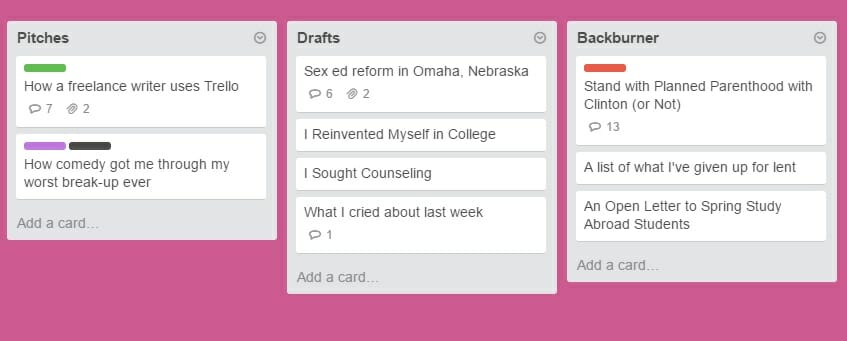
    Whenever I think of an idea to pitch, I quickly add it to my “pitches” board as a single card in the “drafts” category. On the new card, I comment to add a draft pitch, along with potential publications to pitch it to.

    PitchesBoard

    Before pitching the post you’re reading, I used Trello to develop the idea. First, I created a Trello card called “How a freelance writer uses Trello” on my pitches board. On the card’s comments, I drafted a quick outline with a possible publication to pitch. My idea was rejected by my first outlet option before pitching to the Write Life, so in this case, the pitch didn’t develop as much it could have if I had continued to receive rejections or other feedback.

    I also have columns for “drafts” and “back burner.” Drafts include any pitches I want to refine within the next few weeks, and back-burner includes any pitches I don’t intend on going back to for a while.

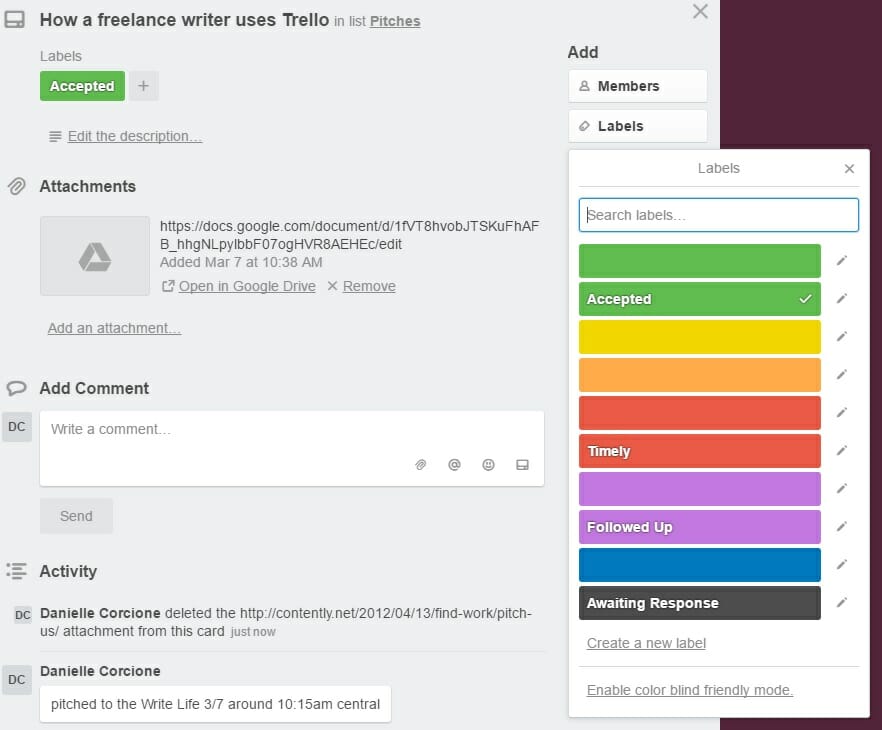
    Additionally, I use labels “accepted,” “followed up,” “awaiting response,” and “timely” on cards. You can see the “How a freelance writer uses Trello” is green, which represents an accepted pitch.

    Colors

    Identifying target and reach publications

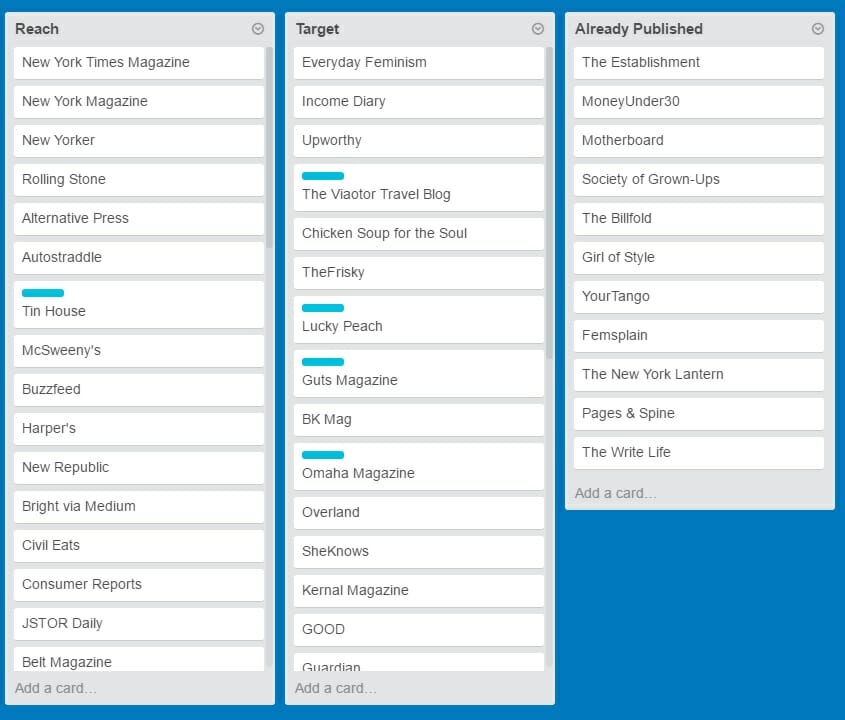
    On another board, I track publications, organizing outlets I’d like to write for by “reach” and “target.” The reach list includes those I want to pitch to someday, but maybe not this year. The target list includes those I want to pitch sometime in the near future.

    The “already published” list includes those I’ve written for already, and feel welcome to work with again. (The reach and target lists are so long, they’ve been cut off from this screenshot.)

    PublicationsBoard

    Although I originally used this method to track pitches, I found it’s rewarding to also identify publications I want to write for in the future. Now, I have a better resource to consult when drafting pitches.

    Before I started using Trello, I’d come across publications and tell myself, “Yeah, I want to write for them,” but would forget about them once I actually worked on a pitch. I never compiled a comprehensive list, especially one differentiated between target and reach publications, in a single place.

    As a freelancer, it’s important to know the market and understand which publications are within your reach right now. I’d also argue my reach publications aren’t really that much of a reach. If I have a spectacular idea, I won’t restrict myself to only target publications.

    Finally, I’ve found a successful way to manage my workflow.

    With Trello, I’m a more-organized freelance writer than ever before. I have a better organization system for tracking pitches from start to finish, and I have a better understanding of which publications I can pitch when I start to develop an idea.

    Have you developed a system to track ideas and pitches? Share it in the comments!