
Tag: become a freelance writer

  • How to Become a Freelance Writer: 8 Great Steps to Start

    How to Become a Freelance Writer: 8 Great Steps to Start

    “Trying to make it as a freelance writer is scary AF.”

    With a subject line that bold (and accurate), I wasted no time in opening the email. It was from a young woman who’d recently graduated with a dual degree in English and journalism, asking me how, how, how to become a freelance writer?

    It wasn’t the first time I’d received an email to this effect, which feels patently insane. If you’d told me just a few years ago I’d be earning my keep as a full-time freelancer — let alone giving advice on the subject — I’d likely have laughed in your face.

    Even when I was working a staff writing gig, I had never so much as drafted a pitch to an outside publication.

    I only got brave enough to start submitting ideas after lots of encouragement from my good friend (and fellow TWL writer!) Susan Shain. Thanks again, Susan.

    Now, I’ve got almost three years of working for myself under my belt — and in the first year, I actually earned more than I had as a staffer. I enjoy location independence and a workday uniform of yoga pants and t-shirts, so it’s no surprise that fielding the “how do you do it?” question has become a common conversation.

    But it’s never easy to answer.

    [sps_reusable_block post_id=43047]

    So really though — how do you become a full-time freelance writer?

    Here’s the thing.

    There’s no guaranteed, step-by-step process that will land you the freelance writing career of your dreams. Ask 10 different writers, and you’ll get 10 different how-I-made-it stories — or, more accurately, how-I’m-making-it-up-as-I-go-along stories.

    The actual mechanics of how to get started freelance writing are pretty simple, though not easy: Have good ideas, be good at explicating them clearly, and spend lots of time and energy on the Sisyphean footwork of finding publications that will pay you to publish them. (And convincing them to do so.)

    As you’ve likely already discovered, this blog is a great resource for figuring out these logistics and improving your skills at each level. We also offer an ebook dedicated to freelance writing jobs for beginners.

    The honest truth about how to become a freelance writer

    As far as stringing it into a full-time living, though, I’ll be honest with you: A *lot* of it is luck, and also getting very cozy with rejection. If I get a positive response for just 10-15% of my pitches, I count that as a huge win.

    But if you have your heart set on making it as a freelance writer, there are some actionable steps you can take to make it happen.

    Here’s my best advice for how to start freelance writing.

    1. Seek out education or training

    Don’t worry; you don’t have to have a formal degree to be a freelance writer. But if you’re starting from scratch, you’ll likely want to educate yourself in some way, so you can produce quality work from the get-go.

    If you don’t have the money or time to get a degree from a university, look for an online writing course. They’re typically more affordable than formal degrees, and you can work your way through them from home (and in the evenings or on weekends if you’ve got a day job).

    If you’re planning to go to college or are in the process of earning your degree, you may want to consider formal studies that will help you achieve your goal.

    Contrary to popular opinion, English major jobs can be profitable, and the same is true of other writing-intensive majors like creative writing, communications and journalism.

    Studying humanities flexes your rhetorical muscles, which will make you a much better writer and pitcher. Plus, these programs lend you the soft skills employers look for — which is good, since you’ll likely need a day job while you’re finding a way to make the whole yoga-pants-forever thing work.

    If college is already in the rear view, you might also consider grad school, or more specifically, an MFA. But be careful. The additional expense won’t guarantee you work down the line, and if you’re already dealing with student loans, you could just be digging the hole deeper.

    In the case of freelancing, it’s more about experience and practice than the fancy pedigree.

    Fortunately, if you’re aching to go back to school, you don’t have to go broke to do it. Many MA, MFA and PhD programs come with tuition waivers, provided you teach, or assist in teaching, a number of undergrad classes while you study.

    You can also find fellowships, scholarships and other forms of loan-free financial aid if you’re diligent.

    If you’re looking for a group to help you get the ball rolling on your freelance writing career, the Freelance Writers Den might be exactly what you need. It’s a group of like-minded writers who are all looking to take their writing skills seriously and start to grow their careers.

    2. Consider starting with a staff job

    Yes, I know: Finding an editorial position — or any job, really — is easier said than done.

    But websites and publications do hire writers, and getting a full-time position will give you two amazing, irreplaceable benefits: an instant stack of clips and a world of hands-on education you just can’t get any other way.

    Working closely with editors and other creatives every day will make you a better writer, period; if you work for a digital publication (likely), you’re bound to get some SEO training and other know-how in the bargain.

    I know for a fact I owe my success to my tenure at The Penny Hoarder, whose managing editor — Alexis Grant, who also started this website — essentially handed me a writing career whole cloth in hiring me.

    3. Get out there and start pitching

    “This is how you do it: you sit down at the keyboard and you put one word after another until it’s done. It’s that easy, and that hard.” – Neil Gaiman

    At the end of the day, the only way to become a freelance writer is…to start writing.

    That means taking a pretty scary leap: You’ve got to start pitching publications and applying for gigs even if you don’t have many clips. Hey, everyone’s a beginner at the beginning.

    Of course, even if you’ve never published professional work, there are other ways to showcase your writing prowess. Got a killer short story that hasn’t found a home quite yet? Maybe even a particularly well-wrought essay from college?

    I applied for The Penny Hoarder with a short memoir I wrote in grad school and — I kid you not — wine-tasting notes. Most employers and clients are more concerned with whether you’ve got the goods than where you’ve managed to land them.

    Not sure where to start when it comes to finding paid writing gigs? Check out these online gold mines for finding freelance writing jobs.

    Curious about how to become a freelance writer? This successful freelancer shares a step-by-step guide to making a living writing.

    4. Showcase your work online

    Your pitches will be far more effective if you link to an online writing portfolio where editors can check out your work.

    This doesn’t have to be anything fancy! A static website will do, even one created with a template.

    As far as a portfolio is concerned, I recommend Contently. Not only is it a clean, easy-to-use digital showcase, but it can also land you valuable work: the platform matches editors with writers and other content creators based on specific beats and skill sets. I’ve earned literally thousands of dollars simply because I chose to use it.

    If you want to take this a step further, consider starting a blog. Writing regularly is a great way to practice your craft, and you might even grow a following for your work.

    A blog also gives editors more samples to review when they click over to your site from your pitch; every blog post is an example of the kind of work you do. That doesn’t mean they have to be perfect, but know that if you have a blog, editors will look to that for insight on your skill and creativity.

    Finally, having a website will make you feel way more legitimate. (Impostor Syndrome is totally a thing in this business, so get ready!)

    Oh, and while you’re at it, make sure your social media accounts reflect well on you, too. Any good editor will explore those to learn more about you.

    5. Networking: Yup, it’s a thing for writers, too

    As a serious-business introvert, “networking” has always felt like a four-letter word to me. In fact, I was drawn to freelancing in large part because it got me away from the noisy, crowded office environment.

    Nevertheless, my first major client — the one that made quitting my day job possible, and whose work still makes up a sizable percentage of my income — was an opportunity I landed in part because of a shared connection.

    I’ve also written web copy for gym acquaintances, friends and family members, which were gainful projects both financially and in broadening my experience.

    The Write Life’s managing editor Jessica Lawlor blogs about how she landed her first freelance client, as well as the ones she found thereafter. From sorority sisters to Twitter friends to existing professional connections, nearly every single story involves networking.

    Case in point: Don’t overlook any of your current social spheres when it comes to writing opportunities, and get ready to actively work to increase them. Everyone needs the written word sometimes!

    Inside of the Freelance Writers Den, you can learn how to use LinkedIn to your advantage when it comes to networking. Instead of cold pitching, there are ways you can simply adjust your profile and settings and connect with a ton of potential clients.

    6. Figure out how to get paid

    This sounds obvious, but it can be a hurdle when you’re just getting started. Once you’ve found a client and produced the work you promised, you need a way to get money from their bank account into yours.

    Many freelancers have given up on paper checks and rely primarily on online payments. If you’re just testing the waters as a freelancer, keep it simple by creating a PDF invoice and emailing it to your client, then asking for payment via an easy-to-use system like PayPal.

    Not sure what to include in your first invoice? We’ve got you covered! Here’s how to write an invoice, plus an invoice example.

    Once you feel confident you’re sticking with freelance writing, it makes sense to move to a software that will create the invoice for you and help you track payments. We’ve got a list of some of the best invoice generator tools for freelancers.

    7. Know this: the work isn’t always glamorous

    When I tell people I’m a freelance writer, they often think I’m publishing exclusively in glossy magazines with chic, single-word titles. The closest I’ve come to that, so far, is Yahoo! — a byline I’m very happy with, but whose trademarked exclamation point does not exactly bespeak elegance or sophistication.

    The bulk of my paying work is far less illustrious, but critical for rounding out my bank account. Website copy, SEO work and listicle-style blog posts aren’t what anyone dreams of when they feel the pull of the pen, but they’re some of the most reliable ways for freelance writers to pay the bills.

    Many businesses can provide a steady stream of this kind of work, becoming the anchor clients by which you build a semi-reliable paycheck.

    The idea is to pick up as much of this bread-and-butter work as you need to survive, and then use the rest of your time to pitch those dreamy projects you can’t wait to work on.

    It can be a hard balance to strike, but even un-fun writing counts as valuable practice. You’ll hone your craft and earn your keep all while amassing more clips — and better chops — to show off when you’re pitching the big boys. Then, you can slowly scale up to working exclusively on better-paid, more interesting content.

    8. Expect the unexpected

    Fickle income, weird hours, totally unmitigated refrigerator access — working for yourself is a strange and sometimes dangerous world.

    At the very least, you’ll want to prepare yourself financially for things like managing income flow and expenses, paying your own taxes, buying your own health care and funding your own retirement.

    And for even the best writers, clients come and go, so be sure to build up a significant cushion for those inevitable dry periods.

    It’s also a good idea to impose rules to lend your otherwise-loosey-goosey day structure — like deciding you’ll only write at your desk as opposed to your couch, for instance, or making yourself put on real pants for the duration of your work day. (Or maybe not. Let’s not get crazy.) This is especially true during times like the holiday season when you’ll need to be extra disciplined to get your work done.

    If I had to summarize it all in brief, I’d say this: Becoming a freelance writer requires equal parts semi-pathological levels of type-A dedication, boundless curiosity, and total insensitivity to rejection.

    Oh, and luck. A lot of luck.

    But like all of the best things in life, even though it’s not an easy journey, the road to the write life is definitely one worth taking — and one we’re excited to help you travel.

    Ready to take the next step?

    You’ll want to check out the Freelance Writers Den if you’re looking to succeed as a freelance writer. It gives you all the tips and tools you could possibly need to succeed.

    This is an updated version of a story that was previously published. We update our posts as often as possible to ensure they’re useful for our readers.

    [sps_reusable_block post_id=43047]

  • This 30-Day Course Will Help You Earn a Living Online as a Freelance Writer

    This 30-Day Course Will Help You Earn a Living Online as a Freelance Writer

    Freelance writers come from all walks of life. Few of us knew as youngsters this is what we’d do for a living.

    That means many of us don’t study anything related to writing or business, or even follow a career path that would naturally lead to freelancing. We usually just have to sort of dive in and figure it out.

    Writer Gina Horkey pivoted from her work with a family-owned financial firm to freelance writing and virtual assistance in 2014.

    She had no formal training or professional experience, but she put up a website, wrote for Huffington Post in the early mornings to build clips and found her first paying client within two months by leaning into her experience in personal finance to quickly carve out a niche.

    She made more than $800 in her first month of paid work. She’s since written for big-name financial firms and publishers, including BMOHarris, Discover and GoBankingRates.

    Now she teaches others how to launch their own freelance writing or VA business through her well-known “30 Days or Less” courses and her blog, Horkey Handbook.

    Through her course 30 Days or Less to Freelance Writing Success (30DOL), Gina promises, “If you give me just 30 days, I’ll give you everything you need to build a high-paying freelance writing business.”

    I’ve been freelancing for nearly 10 years, and I wish I’d found this course at the beginning of my career. I recommend it to any writer who wants to quit their day job and quickly find paid writing work.

    How to find freelance writing success

    Without training or experience, Gina attributes her success to grit. She was unhappy in the job she’d had for 10 years and determined to develop a career she loved as a writer.
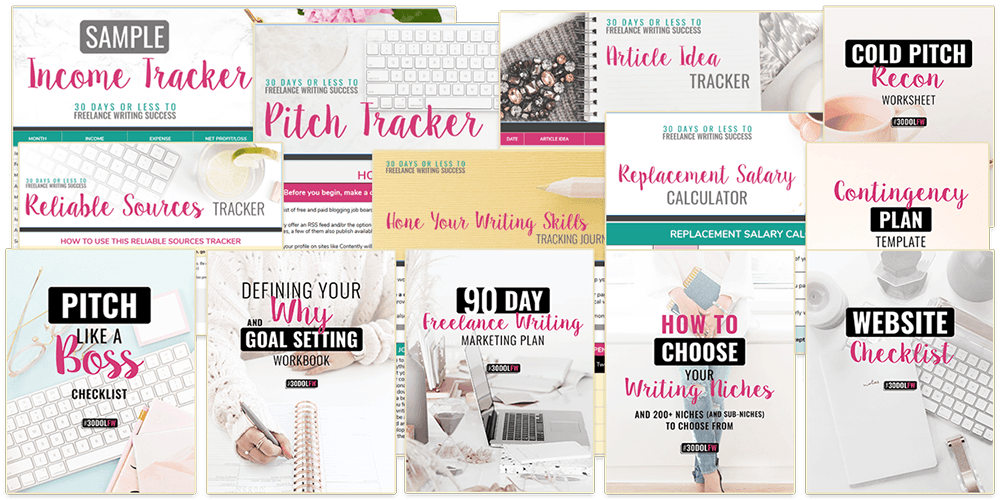


    Gina recommends goal setting and networking to set a foundation for your new career or side hustle as a freelance writer. But the real driver of your success will be how much work you put in.

    Gina got up to write at 4:30 a.m. until she left her day job at the end of 2014. She’s a mother of two, and her new income had to continue to support her kids and husband, who’s a stay-at-home dad.

    Your goals might be different — maybe you define success as a side hustle, extra income that pays off your debt or a hobby that lets you share your talent and explore your creativity.

    Whatever success means to you, you have to commit to doing the work to get there. 30DOL is a great introduction to how that work might look and where to start.

    Who should be a freelance writer?

    As Gina’s story illustrates, anyone can become a freelance writer. The work doesn’t require formal training, and you can start small to build experience that will help you get better clients and make more money.

    You should, at least, enjoy writing. There’s no sense in being self-employed at something you don’t enjoy — finding clients and managing your finances are unnecessary work if you’d be just as happy working for someone else.

    Freelancing is for people who want to carve their own path. Gina left behind her full-time job because she was unhappy there, and she chose freelance writing because she wanted flexibility and autonomy. She developed her writing skills along the way.

    As long as you enjoy it, writing is a learnable skill. Tons of writing websites, communities and courses exist to help you hone the craft, so don’t be intimidated if you’re not a star writer (yet). You can learn with practice and experience.

    30 Days or Less to Freelance Writing Success: Course details

    30DOL is an all-online course that covers the basics of becoming a freelance writer: what kind of writing you can do, how to find clients, how to pitch, business basics, building a website and self-promotion.

    It includes 12 text-based modules and a 90-day pitch challenge. Course participants can also purchase a membership to an exclusive Facebook group for leads and support.

    Text-based modules that cover the basics of freelance writing

    The text-based modules cover:

    • Laying the foundation: Set goals for your freelance business and build a support network of friends, family and colleagues.
    • Types of online writing: Learn the industries, mediums, formats and topics you can specialize in, plus what kind of writing pays best.
    • Where to find paid work: Research your target audience or clients, tap into your existing knowledge and find work through job boards and other sites.
    • Get your pitch on: Learn what makes a good pitch, how to keep track of your pitches and how to get started with a 90-day pitch challenge.
    • Establishing your business: Keep track of your finances, decide whether to create an official business, set your rates, create invoices and contracts, write your bio and polish your LinkedIn profile.
    • Building your writer’s website: Learn what your website needs (and why you need one).
    • Web hosting and WordPress tutorial: Learn the nitty gritty of creating a site, including registering a domain, setting up hosting and how to navigate WordPress. This module also includes video tutorials to show you how to set up pages and other functions in WordPress.
    • Promoting your new business: Build your brand on social media and email, and protect yourself as your profile grows online.
    • Honing your writing skills: Get tips for coming up with ideas, formatting for the web, using images, conducting research, interviewing sources; and writing for various markets, including content marketing, copywriting, SEO writing and B2B writing.
    • Helpful tools: Get an overview of the Google suite, tools and courses to help you write better, and tools to streamline your pitches.

    Each module includes several lessons, a checklist of action items to apply the lesson to your work and a quiz to help you evaluate what you’ve learned.

    Each lesson ends with an action step or several, which I love. They’re filled with useful resources, including Gina’s own worksheets, personalized tools (like the Pitch Tracker) and links to third-party resources.

    90-day pitch challenge

    The course doesn’t present the challenge as a separate component — it’s just part of the pitching module — but I think it’s a section worth pointing out for its unique value. The 90-Day Pitch Challenge encourages you to send 10 pitches per weekday — 600 total by the end of the challenge.

    It sounds like a lot — but that’s the point. Setting the goal to write and send tons of pitches forces you to get into the habit of brainstorming, researching publications and pitching. Plus, you’re bound to get at least a few yeses out of 600!

    The challenge includes a free Pitch Tracker spreadsheet so you can track where and what you’ve pitched, contact information and responses.

    This challenge is a good example of how 30DOL drives participants to action. You get a framework for action and the tools you need to succeed — you just have to commit to the work.

    Optional add-on: Facebook group for leads and support

    30DOL course participants have the option to purchase a $33-per-month membership subscription to the exclusive VA Leads Facebook group, where you can network with other freelancers, get support from Gina and her team and take advantage of shared client leads.

    The benefit of the additional price tag is the group is pretty small for an online community — fewer than 500 members when I checked. And you know everyone there is serious about making their freelance business work. That makes for focused and valuable discussion, and the intimate size gives you better access to career and course support.

    The membership also includes a free Flywheel WordPress hosting account, usually $15 to $30 per month.

    Pros and cons of 30 Days or Less to Freelance Writing Success

    My favorite aspect of 30 Days or Less to Freelance Writing Success is its focus on actionable advice. Every lesson includes explicit action steps, so you know how to apply what you’ve learned to building your freelance business.

    Most importantly, the advice in the course is sound. Gina shares action steps and exercises she used to find success as a writer, and I’ve had success with many of the same tactics throughout my career. It’s safe to say you’ll find freelance writing work by following the steps recommended in the course.

    I also like that the lessons are text-based, because it keeps the course simple and accessible. You can read them on any device. The course platform is easy to use on desktop or mobile, so it’s easy to bounce around among modules and mark them as completed when you want to.

    The biggest drawback to the course is it’s a lot of information to absorb as a new freelancer. It’s everything you need to know to run a freelance business and make it your main source of income. You could become overwhelmed if you try to tackle it all as you start freelancing, especially if you’re writing on the side of a full-time job.

    But the course is a trove of information and resources you’ll find valuable throughout your career. Once you sign up, you’ll have lifetime access to the course, so you could take it slow and revisit things like building your website and promoting your business when you’re further along.

    How much does 30 Days or Less to Freelance Writing Success cost?

    The course costs either a one-time payment of $297 or four monthly installments of $89 ($356 total). Registration gets you instant, lifetime access to all course modules and materials.

    Access to the VA Leads Facebook group (which includes free WordPress hosting) costs an additional $33 per month, and you can make your first payment when you register for the course.

    Is Gina Horkey legit?

    In a nutshell, yes! Gina Horkey is absolutely legit. She has shared her advice with The Write Life readers before, and we’re happy to recommend her course to anyone who wants to kickstart a freelance writing career.

    Gina has been working as a freelance writer, covering personal finance, freelancing and entrepreneurship, since 2014. Throughout the course, she’s transparent about her finances, sharing her early income wins and goals.

    She’s built a strong network around Horkey Handbook courses and resources, and her readers and students share glowing online reviews.

    If you’re not sure whether you’re ready to dive in, check out Gina’s article on becoming a freelance writer, including some worksheets to boost your writing business, to see what she has to offer.

    Bottom line of our 30 Days or Less to Freelance Writing Success review: Gina Horkey knows what it takes to launch a freelancing career from scratch, and she laid out the blueprint in 30DOL. 

    Following the action steps in the course will almost certainly get you freelance writing work. This online writing course might be a bit too comprehensive for side hustlers, but it’s well worth it if you’re ready to make writing your full-time job. It also makes a great gift for writers you might know who are serious about growing their careers.

    This post contains affiliate links. That means if you purchase through our links, you’re supporting The Write Life — and we thank you for that!

    The original version of this story was written by Cruz Santana. We updated the post so it’s more useful for our readers.

    Photo via GuadiLab / Shutterstock 

  • The 15 Worst (And Best) Parts About Becoming a Freelance Writer

    The 15 Worst (And Best) Parts About Becoming a Freelance Writer

    Money isn’t everything. So goes the old adage, and a recent survey suggests many freelancers agree.

    AND CO, creator of a productivity app for independent workers, recently surveyed hundreds of freelancers for their study “The Slash Workers.” Only seven percent of respondents said their main reason for going off on their own was financial. Much more prevalent were the desire for personal growth (40 percent of respondents) and greater flexibility (27 percent).

    Financial stability is hardly a guarantee when you’re a freelancer writer. The vast majority of study respondents said things had not gotten much better for them money-wise since going solo: 34 percent had seen no significant change, while 43 percent were actually worse off.

    That said, freelancers, for the most part, seem happy with their situations: 68 percent reported an increase in “quality of life” since going independent. Clearly there are factors beyond the financial that fulfill freelancers.

    If you’re wondering whether freelancing is right for you, here are some of the biggest trade-offs you can expect to make.

    Say goodbye to:

    1. Stability

    Long-time clients can cut and run without warning. Promising opportunities can peter into nothing. You may have more work than you can handle one month, and next to nothing the following month.

    Getting comfortable with a feast-or-famine cycle is essential, at least until you build up a more reliable client base.

    2. A steady paycheck

    One positive of working for someone else is the ability to collect a regular paycheck every week (or every other week). You know exactly what your monthly income will be, so you can budget, plan ahead and have the security of knowing your hard work will pay off in a predictable fashion.

    When you’re a freelancer, timely payment isn’t a given. Some clients drag their feet after you’ve turned in a project; others need to be chased down.

    It’s critical to build up a savings buffer before going full-time so you can cover the lean months.

    3. Benefits

    Working as an independent contractor means you’re responsible for your own health insurance, 401K plan and other benefits.

    If you don’t factor these extra costs in when determining how much money you’ll need to bring in, you could find yourself facing other unpleasant trade-offs — like whether to save for retirement or buy groceries.

    4. Working on someone else’s schedule

    No set hours means you can work whenever, and wherever, you like.  

    If you’re a night owl, you can plug away until the wee hours of the morning and then sleep in till noon. If you’re sick, you can take a day off or schedule a last-minute doctor’s appointment without anyone tallying up your away time. You can also enjoy activities normally unavailable to 9-to-5 employees, like going to your kid’s afternoon recital or taking a mid-morning yoga class on a whim.

    5. Having a boss

    Your clients are, in a way, your “bosses,” but they don’t get involved in the minutiae of your daily routine. (At least, not if they’re good clients.) You’ll have specific deliverables to meet by a certain deadline, but no one will be peering over your shoulder telling you how to make it happen.

    6. That awful commute

    Never again will you be forced to endure gridlock as half your town’s population heads to and from work at the same arbitrary time. You can also say goodbye to added fuel costs, parking expenses and transit passes.

    7. Being around people on a daily basis

    Freelancing can be a lonely career. Sixty-one percent of survey respondents said they miss “the feeling of community that a traditional workplace offers.” You may not be a huge fan of water cooler chitchat or forced birthday lunches, but spending day after day alone in your PJs isn’t always fun, either.

    8. Clocking out

    The downside of having no set schedule is that the lines between work and home can easily become blurred. When you could be doing work at any time, it can be hard to take time for yourself without feeling guilty about wasting a billable opportunity.

    Say hello to:

    1. Freedom

    Want to take a week’s vacation? As long as you make sure your deadlines are met, that’s your prerogative. Not feeling the new project you’ve been sent? You have every right to only choose the ones you love.

    As your own boss, you make the rules — which can be simultaneously thrilling and paralyzing.

    2. Higher earning potential

    Unlike a regular job, which is capped at a certain salary per year, freelancing offers the possibility to earn as much as your talent and marketing skills allow. That’s not to say freelancers are rolling in the dough; according to AND CO’s study, 43 percent of freelancers interviewed make $24,999 a year or under.

    3. Location independence

    You can travel without worrying about falling behind in your work. You can pick up and move to a whole new city if the spirit grabs you. You can also work from different locations, like a cafe or a park, to keep the inspiration fresh.

    4. Being the boss

    From marketing to tax prep to crisis management, everything is on your shoulders when you’re a business of one. You’ll need to learn to be an entrepreneur — or explore other ways to put your talents to use.

    5. Creative outlet

    From pitching new ideas to covering a wide range of topics, freelancing gives you plenty of scope for the imagination. If creating is essential to your happiness, freelancing is a great way to turn that drive into income.

    6. Work/life balance

    If you’re smart, organized and disciplined enough, freelancing can be a great way to pay the bills and still enjoy the life you have outside of work. With no set schedule to adhere to, you can work with your natural rhythms and make time for the things that are a priority to you.

    7. Variety

    As the name of the study indicates, many freelancers are “slash workers” — taking on a variety of projects in different areas to get the most buck for their bang. With 95 percent of respondents working as slashers, you can look forward to work that continually challenges and interests you.

    As with any career, freelancing has its pros and cons. What’s important is being aware of those pros and cons and determining whether they’ll be the right fit for your personality and personal goals.

    Freelancers: What other tradeoffs have you found you’ve had to make for your career, and do you think they’ve been “worth it”?

    Kelly Gurnett is a freelance blogger, writer and editor; follow her on Twitter @CordeliaCallsIt.

  • Make the Leap to Full-Time Freelance Writing in 5 Essential Steps

    Make the Leap to Full-Time Freelance Writing in 5 Essential Steps

    Cliff-jumping is one of the most extreme, nerve-wracking sports in the world. Choosing to embark on a freelance writing career can seem just as daunting. After all, there’s no net down there to catch you if you don’t leap just right.

    Not to mention, your friends and family are probably looking at you like you’re crazy. How can you make a career change to become a full-time freelance writer without taking unnecessary risks?

    Think of launching your freelance writing business like jumping off that cliff. Here are five rules to live by as you prepare to take this exciting leap.

    1. Do your research

    When you’re throwing yourself from scary heights into the ocean, it’s vital to know every last detail about the spot. How deep is the water? Is your take-off point stable? Which way’s the tide going?

    With freelancing, research is vital. To set yourself up for success, find out as much as possible about your chosen path.

    The good news is you’re already off to a great start: You’re on The Write Life, with an entire section dedicated to freelancing and with a handy list of tools and resources. Way to go! Set aside the time to dive in and see what you can learn.

    At this stage, you should be looking for information for beginners, such as common mistakes new writers make. Get an idea for what’s involved in the freelance writing process, from pitch to publication.

    You’ll also find no shortage of people who have managed to make a living with their writing, such as Gina Horkey, who was earning $4,000 per month within six months. Or Danny Margulies, who makes six figures freelancing. It’s looking good from here!

    2. Consider safety first

    Safety should be the number-one priority for would-be cliff jumpers and freelancers alike. Even a safe jump spot can be dangerous if you’re careless.

    After all the research you’ve done for your new career, it’s easy to get carried away and jump head first.

    Instead, take a step back.

    While some freelancers manage to replicate a full-time income almost immediately, for most of us building up to that level takes time.

    Have you got enough savings to cover those lean months? You’ll feel more confident with a savings cushion that will cover six months worth of expenses, although obviously the bigger, the better.

    Remember that freelancing comes with its own expenses. Taxes, insurance and other benefits your employer took care of before are now your responsibility. Utility costs for working from home will also increase.

    The best step here is to start a budget. If you’re in the U.S., I’ve heard great things about Mint. For budgeting software available worldwide, check out You Need a Budget for resources and free classes.

    If after all that you’re feeling a bit nervous, fear not! Many people, myself included, have opted to fit freelancing around a day job, adding another layer of security.

    3. Start small

    You don’t start with a 5x somersault half twist pike from 27 meters; your first jump might be only a couple of feet high.

    You can do the same with your freelance career. Start small and work your way up.

    Your first client should be yourself. If you want to be a freelance blogger, is your blog top class? If you’re a copywriter, is your website copy flawless?

    After you’ve got yourself sorted, how about friends and family? Do your self-employed loved ones need help with their copy? Do they work for a company that needs new blog posts?

    Not only will you polish your skills and build confidence, you’ll also build up a nice portfolio to prepare you for bigger clients. Everyone wins.

    4. Stick with people who know what they’re doing

    I was blessed with friends who’d made the leap to freelance years earlier and were happy to share their knowledge. Find people who have lots of experience with freelancing, and listen to what they have to say.

    Writing forums can be a fantastic resource for the new freelancer. Look for active and engaged forums, and be sure to follow good etiquette: Be polite, don’t spam and add value where possible. You’ll be rewarded with a community of fellow freelancers who can offer advice and support.

    For bonus points, I highly recommend finding a mentor, either online or offline. Nothing helps more than having an experienced freelancer take a look at your business. Their advice is priceless.

    5. Take the leap

    Yes, freelancing can be scary. But it’s also fun and rewarding. There’s a point when you’re standing at the top of the cliff when you know you’ve done all you can — now you just have to take that step.

    Analysis paralysis may be the biggest danger you’ll face. It’s easy to convince yourself you need to do more research when really, you should be getting on and doing the work.

    Are you ready for a freelance career? Take a deep breath. Now jump.

    Have you taken the leap into freelancing yet? What other steps would you recommend?