Tag: grammar

  • A Win for the Oxford Comma: This Lawsuit Shows Why It’s So Important

    A Win for the Oxford Comma: This Lawsuit Shows Why It’s So Important

    Who cares about the Oxford comma?

    Historically, the answer has been grammar nerds, Strunk & White, and those who follow the infamous Chicago versus AP writing style guide debate.

    And after this lawsuit a few years ago, we added dairy driver to the list.

    That’s because an appellate court ruled in favor of Maine dairy drivers in a labor dispute that hinged on the oft-debated piece of punctuation.

    For anyone who’s ever wondered what all the fuss is about over Oxford commas, the circuit judge’s 2017 opinion says it all:

    “For want of a comma, we have this case.”

    Barron, Circuit Judge

    Let’s get into why the oxford comma can make such a difference

    What is the Oxford Comma or the Serial Comma?

    For those in need of a grammar rules refresh, here’s a quick overview.

    Sometimes called the serial comma, the Oxford comma is a comma placed between the last two items in a series of three or more.

    For example, the Oxford comma falls after “hat” in this sentence:

    “She wore a jacket, hat, and mittens.”

    While some writing style guides do not use this comma, supporters say it’s necessary to avoid potential ambiguity. And if there’s one thing writers can agree on, it’s the importance of clarity. In some cases, an extra comma matters.

    Does AP Style Use the Oxford Comma?

    The short answer: No.

    Many writers, including journalists, live by the Associated Press stylebook. AP style does not use Oxford commas.

    However, Chicago style does require Oxford commas. That’s the Chicago Manual of Style, which is commonly used by book publishers, academics, and trade publications.

    So the decision about whether to use the serial comma relies on what type of writing you’re doing, and which style guide applies to that project.

    If you’re writing for a news site, you probably want to follow AP style and skip the extra punctuation. If you’re writing a novel you plan to submit to publishers, you probably want to follow Chicago style, which does use the Oxford comma.

    An Example to Follow

    Let’s review how the Oxford comma works.

    Here’s an example of a sentence with the Oxford comma:

    “I admire my parents, Gandhi, and Mother Teresa.”

    It’s clear in this example that I admire my parents, as well as Gandhi, and Mother Teresa.

    But remove that serial comma, and the sentence reads, “I admire my parents, Gandhi and Mother Teresa.”

    One could argue that, written this way, the sentence implies that Gandhi and Mother Teresa are my parents. While the average person would know this isn’t likely to be the case, it illustrates how easily a missing comma can change the meaning of a sentence.

    Dictionary.com offers more funny examples

    It was precisely this type of ambiguity that led to the Maine case with the dairy farmers.

    [sps_reusable_block post_id=43049]

    The Oxford Comma Debate, And A $10 Million Comma

    In this class action lawsuit, drivers for Oakhurst Dairy sued the company over its failure to grant them overtime pay.

    Workers in Maine are entitled to 1.5 times their normal pay for hours worked over 40 per week, according to state law. However, there are exemptions to this rule. Specifically, the law states, companies don’t have to pay overtime for the following activities:

    The canning, processing, preserving, freezing, drying, marketing, storing, packing for shipment or distribution of:

    1. Agricultural produce;
    2. Meat and fish product; and
    3. Perishable foods

    Note the end of the opening line, where there is no comma before the “or.”

    Oakhurst Dairy argued its drivers did not qualify for overtime because they engage in distribution, and the spirit of the law intended to list “packing for shipment” and “distribution” as two separate exempt activities.

    However, the drivers argued the letter of the law said no such thing. Without that telltale Oxford comma, the law could be read to exclude only packing—whether it was packing for shipment or packing for distribution. Distribution by itself, in this case, would not be exempt.

    Without that comma, as the judge maintained, this distinction was not clear-cut:

    If that exemption used a serial comma to mark off the last of the activities that it lists, then the exemption would clearly encompass an activity that the drivers perform. And, in that event, the drivers would plainly fall within the exemption and thus outside the overtime law’s protection. But, as it happens, there is no serial comma to be found in the exemption’s list of activities, thus leading to this dispute over whether the drivers fall within the exemption from the overtime law or not.

    Barron, Circuit Judge

    As a result, the court found in favor of the drivers, costing the dairy an estimated $10 million.
    A Win for the Oxford Comma: This Lawsuit Shows Why It's So Important.

    Comma Rules: To Comma, or Not to Comma?

    As a diehard Oxford comma loyalist, this ruling made my day.

    While many of the sites I write for as a freelance blogger follow AP style, which is sans-serial comma, I still sneak one in when it seems needed to avoid confusion. This case backs up that habit as more than just an old-school tic I haven’t yet let go.

    While the debate may still rage on over whether Oxford commas are necessary all the time, this ruling upholds the practice of using them when they’re essential to ward off ambiguity.

    So, who care about the Oxford comma? The answer, according to the courts, is officially: anyone who’s interested in clarity.

    Take that, AP style!

    [sps_reusable_block post_id=43049]

    This is an updated version of a story that was previously published. We update our posts as often as possible to ensure they’re useful for our readers.

    Photo via Lamai Prasitsuwan/ Shutterstock
  • 5 Polysyndeton Examples in Literature (+ How Writers Can Use This Technique)

    5 Polysyndeton Examples in Literature (+ How Writers Can Use This Technique)

    While there are endless literary techniques that writers can use to spice up their writing, polysyndeton is one that you mayor may not have heard of.

    Whether you know it by its name or not, you have certainly come across it in your reading. Maybe you didn’t notice it while you were reading, but once you understand what is is and how it works, you will begin to see it in more places as you continue to read books.

    You might even find that you use it in your day-to-day life. One example might be when you’re describing your day ahead to your spouse, “First I need to go to the post office and then the grocery store and deposit my check while I’m out and then finally pick up the kids from school.”

    Now, it may or may not be a tool you end up using as a writer, but the more tools you have at your disposal, the better.

    In this article, we’ll be going over what polysyndeton is, how to use it, why you should as a writer, and then taking a look at some classic examples throughout literature so you can see how writers use it in their books.

    What is Polysyndeton

    Let’s take a look at the definition of polysyndeton:

    Polysyndeton is the deliberate insertion of conjunctions into a sentence for the purpose of “slow[ing] up the rhythm of the prose” so as to produce “an impressively solemn note.”

    In grammar, a polysyndetic coordination is a coordination in which all conjuncts are linked by coordinating conjunctions (usually andbutornor in English).”

    Even as you’re reading, you might not catch the use of polysyndeton, but if you start to read sentences out loud you certainly will notice them.

    Polysyndeton is a literary technique used to give weight to each action in a sentence. It also provides a little bit of a rhythm to each sentence as you read and can chop up sentences in a unique way.

    The word polysyndeton comes from the Ancient Greeks which essentially means “many bound together with”. You can imagine that means that there are many ideas, thoughts, and actions all strung together in a sentence.

    You’ll see in some examples below how authors have used this technique, but let’s dive into what you need to know before we move on.

    How to Use Polysyndeton

    If you want to use polysyndeton, know that they’re intentional repetition of conjunctions close to each other to create an effect when reading.

    If you want the reader to slow down for a particular part or make sure they’re focusing on each of the actions a character is doing, that’s a good reason to use the polysyndeton technique.

    In school, most of us were taught that run on sentences are “bad” writing, but that is not always the case. Famous authors from Ernest Hemingway to Cormac McCarthy used these techniques in their writing.

    While it’s not the same thing as a run on sentence, just know it can take a while to mentally undo what you were taught in school and start to use advanced literary techniques in your writing.

    If you’re not using it to have more of an effect in your writing, then it is a run on sentence instead of polysyndeton.

    What Writers Need to Know About Polysyndeton

    For the most part, using polysyndeton is a stylistic choice that will be decided by each individual writer and author.

    Some writers love the style and how it works as a literary technique, and some writers thinks it makes sentences far too long and drawn out.

    It should be something you experiment with to see if it enhances your writing and style or if it is something you don’t want to use.

    For example, if one paragraph or scene in your book doesn’t seem to have as much impact as you want it to have, try out this technique and see if it adds more of an impact to each individual action and thought.

    Examples of Polysyndeton in Literature

    Cormac McCarthy, most famous for his book, The Road, was a big user of polysyndeton in his writing. Let’s look at some of his examples:

    Out on the road the pilgrims sank down and fell over and died and the bleak and shrouded earth went trundling past the sun and returned again as trackless and as unremarked as the path of any nameless sisterworld in the ancient dark beyond.

    From his book, The Road

    And another one:

    The horse screamed and reared and the Apache struggled to keep his seat and drew his sword and found himself staring into the black lemniscate that was the paired bores of Glanton’s doublerifle. […] Dust stanched the wet and naked heads of the scalped who with the fringe of hair below their wounds and tonsured to the bone now lay like maimed and naked monks in the bloodslaked dust and everywhere the dying groaned and gibbered and the horses lay screaming. […] The judge wrote on and then he folded the ledger shut and laid it to one side and pressed his hands together and passed them down over his nose and mouth and placed them palm down on his knees. […] He bows to the fiddlers and sashays backwards and throws back his head and laughs deep in his throat and he is a great favorite, the judge. He wafts his hat and the lunar dome of his skull passes palely under the lamps and he swings about and takes possession of one of the fiddles and he pirouettes and makes a pass, two passes, dancing and fiddling at once.

    From his other book, Blood Meridian

    As you read through all of these examples, take the time to read them out loud and see how they read differently or create a rhythm in each of the sentences.

    A shorter example by writer James Joyce:

    “They lived and laughed and loved and left.”

    From his novel, Finnegans Wake

    As you read each part, it feels like each of them are separate thoughts and experiences. They are moments in time that feel longer when they’re put together like that instead of, “They lived, laughed, loved, and left.”

    Ernest Hemingway also used this literary technique to give us perspective into how his character is feeling:

    “I said, ‘Who killed him?’ and he said ‘I don’t know who killed him, but he’s dead all right,’ and it was dark and there was water standing in the street and no lights or windows broke and boats all up in the town and trees blown down and everything all blown and I got a skiff and went out and found my boat where I had her inside Mango Key and she was right only she was full of water.”

    From his book, After the Storm

    Even poets have used polysyndeton in their work. While it’s a shorter example than the others above, it will give you a good idea of the possibilities for even shorter text.

    And soon it lightly dipped, and rose, and sank,

    And dipped again…

    John Keats from his poem Endymion

    As you can see, that’s a short and right to the point example of how you could use polysyndeton in your writing to make a line stand out or create a whole new rhythm.

    What To Do Next

    Ready to step up your writing? You won’t want to miss the essential editing tool that every writer needs:

    ProWriting Aid, an Essential Editing Tool for Writers
  • Purple Prose – What It Is And How to Avoid It

    Purple Prose – What It Is And How to Avoid It

    Although purple prose sounds pretty and like a way you would want your writing described, it’s actually not a good thing to have your writing described this way.

    If someone calls your writing purple prose, essentially they’re calling it flowery. Meaning, they think it’s too wordy, formal or trying too hard to be poetic.

    Although there are some genres and authors who think purple prose is a badge of honor as a writer, we’ll let you decide that for yourself.

    In this article, we’ll dive into what purple prose is, where it comes from in history, take a look at some examples, and ultimately go over how to avoid it as a writer.

    What is Purple Prose?

    Purple prose is writing that is too formal, poetic, or wordy. It’s when too many adjectives, adverbs, and metaphors are used to describe things.

    Generally, there is not a specific rule about what is or is not purple prose, it’s more of a, “You know it when you see it” kind of thing.

    It’s also subjective sometimes and not everyone agrees if some pieces are purple prose or not.

    With that in mind, it can be hard to define exactly what it is, but the novelist and poet Paul West had this to say about it:

    “It takes a certain amount of sass to speak up for prose that’s rich, succulent and full of novelty. Purple is immoral, undemocratic and insincere; at best artsy, at worst the exterminating angel of depravity.”

    Paul West from his article “In Defense of Purple Prose” in the New York Times

    Ultimately, writers don’t want to be too flowery and go on for too long. You’ll want to tighten up your sentences and make sure you keep your readers engaged.

    Where Does the Phrase Purple Prose Come From?

    The Roman poet Horace was the first to coin the phrase purple prose in his poem The Art of Poetry.

    Here is the translated version:

    Your opening shows great promise, and yet flashy purple patches; as when describing a sacred grove, or the altar of Diana, or a stream meandering through fields, or the river Rhine, or a rainbow; but this was not the place for them. If you can realistically render a cypress tree, would you include one when commissioned to paint a sailor in the midst of a shipwreck?

    From The Art of Poetry by Horace

    For context, at the time, purple dye was incredibly expensive and having any purple in your clothes was a sign of wealth. Many people who wanted to portray being wealthy would put purple fabric into their cheaper clothes to appear richer than they were, thus why it started to be thought of as flashy and gaudy.

    That’s why Horace drew a line between the purple fabric in society and the purple prose in writing. People then used it to describe any kind of writing that was simply trying too hard and was turning away readers.

    Purple prose is deeper than write on sentences, and instead it’s writing that’s flashy for the sake of being flashy, without giving meaning or depth to the writing.

    Once again, it’s up to you as the writer to include or exclude all the details you want, but you will want to avoid including so many metaphors you lose what you’re trying to say.

    Examples of Purple Prose

    As you read some of the examples below, see if you can figure out why they are defined as purple prose or not. You might even want to read them out loud for more of an understanding.

    Most of us have heard the line, “It’s was a dark and stormy night…” but not many people know it’s a commonly mocked piece of writing and a perfect example of purple prose.

    It was a dark and stormy night; the rain fell in torrents—except at occasional intervals, when it was checked by a violent gust of wind which swept up the streets (for it is in London that our scene lies), rattling along the housetops, and fiercely agitating the scanty flame of the lamps that struggled against the darkness.

    Edward Bulwer-Lytton’s novel Paul Clifford

    Another example from Jerome K. Jerome. This one might be a little more obvious as you can see it’s a whole sentence on its own as an example. As you read through it, see if it holds your attention or if your eyes start to glaze over at a certain point in the sentences.

    “The river—with the sunlight flashing from its dancing wavelets, gilding gold the grey-green beech-trunks, glinting through the dark, cool wood paths, chasing shadows o’er the shallows, flinging diamonds from the mill-wheels, throwing kisses to the lilies, wantoning with the weirs’ white waters, silvering moss-grown walls and bridges, brightening every tiny townlet, making sweet each lane and meadow, lying tangled in the rushes, peeping, laughing, from each inlet, gleaming gay on many a far sail, making soft the air with glory—is a golden fairy stream.”

    Jerome K. Jerome from Three Men in a Boat

    For a more modern example of purple prose, look to romance novels, particularly ones from the 70s and 80s where graphic scenes were described using metaphors and outlandish metaphors to describe things so their novels wouldn’t be so raunchy.

    How to Avoid Purple Prose

    Keep in mind if you’re just starting out as a writer, you’re bound to have a ton of mistakes. It’s the cost of entry to making it as a professional writer.

    If you’re trying to make your writing creative and poetic, it’s better to overdo it at the start as you learn how to write creatively and say what you want to say.

    With that in mind, you’re bound to create purple prose here and there, but as long as you make sure you’re going back in to edit it out and only keep in the strong parts of your sentences, you should be just fine.

    As always as a writer, you should constantly be editing your work and thinking about any extra parts you want to cut out. If you let too much fluffy language in your writing, it can not only turn off readers, but it can distract them from the main point you’re trying to say at that moment.

    You know how some authors write over people’s heads on purpose? Like they use language that is fancy so they can show off how smart they are? That is generally what you want to avoid as a writer, you always want to write directly to the people you want to read your book.

    One way to test out if your writing is too fluffy is to have test readers who will give you an honest opinion.

    There are also writing tools out there that can help show you where your writing could be stronger or weaker.

    You could also read your writing out loud to see how many breaths you need to take to finish a single sentence, which can be a sign of it being far too long and wordy.

    Get Your Fiction Handbook

    Looking for a guide to writing fiction? One that will give you the actionable step-by-step guide to getting your fiction book out in the world? This guide has everything you need:

  • Why Is Grammar Important? 3 Reasons to Get It Right

    Why Is Grammar Important? 3 Reasons to Get It Right

    This is a guest post from our friends at ProWritingAid.

    Writing is an essential skill regardless of what type of writer you are. A skilled writer is able to compose messages that are coherent and clear. Good writing, however, is made up of little and big parts. One of the big parts is good grammar. Good grammar makes writing understandable because it follows the fundamental rules of sentence construction, punctuation, and spelling.

    The use of appropriate grammar in your writing is an indicator of professionalism and competence. Whether you’re responsible for writing social media captions, a thesis paper, or a fictional novel, using proper grammar shows your readers how serious you are about your content. It’s the foundation for writing a compelling and impactful piece, allowing you to gain respect from your readers.

    Good grammar, however, doesn’t come overnight, simply because of how many rules there are. It’s worth running your work through a grammar checker to catch the issues that you might be unaware of. After all, you want to make an impression on your readers based on the content that you’ve written, not because of poor grammar. We’ll mention a little more about our top grammar checker pick later on.

    You may ask, “what damage could a few mistakes do?”—a lot, actually. Let’s look at some reasons why you should make the effort to avoid grammar mistakes.

    3 Reasons Why Grammar Is Important

    Bad Grammar Is Distracting

    No matter what your writing niche is, reader engagement is the end goal. Careless mistakes and jumbled sentence structures get in the way of this.

    If your reader has to constantly pause to reread what you’ve written because of grammar issues, they’ll get bored and may give up entirely. This is particularly important for fiction writers where reader engagement goes a long way. 

    Good grammar improves the readability of your piece and allows for a better reading experience. No matter what you’re writing, the clearer your writing is, the better you can convey your ideas.

    Ensure Clear Communication At All Times

    Grammar is the foundation of effective and clear communication. When your message is clear, you’re able to get your meaning across better.

    Think of start-up owners who are trying their best to raise capital via pitch decks and presentations. Their success is hinged on how well they can persuade their audience that their products are worth investing in. Can you imagine a presentation that’s filled with misused punctuation marks? Venture capitalists won’t stick around to hear about your awesome product if the message around it isn’t clear. They’ll simply move on to the next business. And that goes for all types of writing. If your reader, or listener, has to make extra effort to understand what you’re trying to convey, they’re going to move on.

    Your ideas deserve to be shared without the possibility of misunderstandings.

    Good Grammar Indicates Credibility

    Your readers are more inclined to believe what you’re talking about if your language is cohesive and grammatically sound. Having good grammar is an indication of a certain level of awareness and competence on the part of the writer which in turn has a number of benefits. 

    For fiction writers, a grasp of good grammar will show your audience how committed you are to your craft. Furthermore, bad grammar prevents your readers from being immersed in your story and may even prevent them from fully understanding it. For job-hunters, it shows professionalism when your cover letter and resume are skillfully crafted. And for business owners, good grammar can help to create a positive first impression with potential customers. Your potential business partners will also view poor grammar skills in a negative light. 

    Great writing with good grammar will help present your business as reliable and trustworthy. What we’re really trying to say is that good grammar is everyone’s business because it makes you sound smart.

    Now that we’ve answered, “Why is grammar important?” let’s turn to our next question:

    What Are the Basics of Good Grammar?

    There are a lot of grammar rules in English. We can’t possibly cover them all in one blog post, but we can certainly go over some of the basics.

    Subject–Verb Agreement

    Every sentence must have a subject and a verb and these two must agree in number. A singular subject needs a singular verb and a plural subject needs a plural verb.

    Example:

    • Incorrect: There is some amazing books being published this week.
    • Correct: There are some amazing books being published this week.

    Subject–verb agreement can be as straightforward as the example above or it can be more complex. In cases where you aren’t sure, don’t leave it up to chance. Use a good grammar checker like ProWritingAid to ensure that you get subject–verb agreement right every time.

    2. Correct Verb Tense

    Verbs come in three tenses: past, present, and future. Verb usage is dependent on its form and tense. The basic consistency rule regarding verbs is that they should remain consistent in tense or form throughout a sentence. Conjugating regular verbs is easy. However, the English language also has irregular verbs which don’t follow standard conjugation rules (such as –ed for past tense). This is where it can be a bit confusing, even for native English speakers.

    3. Avoid Run-On Sentences

    A run-on sentence is one that is not properly punctuated and results in two or more independent clauses (also known as complete sentences) being connected improperly. Correct punctuation usage plays a huge part in correct grammar because punctuation marks are used to emphasize pauses in speech. 

    If you have frequent run-on sentences, your writing can be long-winded and exhausting to read. This leads us to commas, the foundation of correct grammatical structure.

    4. Use Commas Correctly

    Commas are one of the most used and misused punctuation marks. In fact, they are one of the most frustrating grammatical concepts, even for native English speakers. However, they are key to preventing run-on sentences.

    Want to know how important commas are? Some companies have paid dearly for incorrect or missing punctuation. Maine Dairy Company had to pay its drivers $10 million because it forgot to include the Oxford comma in its overtime law. The drivers sued and won.

    Here are some places to always include a comma:

    • Before a coordinating conjunction
    • After a dependent clause at the beginning of a sentence
    • Between items in lists
    • When setting off interjections

    This is by no means an exhaustive list; in fact, it barely touches the surface. You can read ProWritingAid’s list of 26 times to use a comma. Even so, remembering them all is no small feat, but their correct usage can make or break your sentences. 

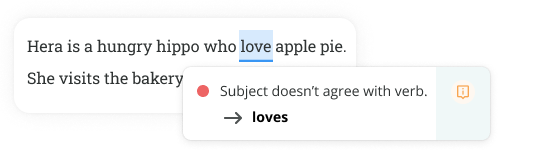
    No one expects you to know all the comma rules. After all, ProWritingAid exists and will highlight where you’ve missed a comma in your writing.

    image.png

    We cannot emphasize this enough—no one expects you to know all the grammar rules. If you’re a non-native English speaker then this is significantly harder. We covered the basics but there is so much more: dangling participles, pronoun–antecedent agreement, sentence fragments, etc.

    Even if you’re an English speaker and/or seasoned writer, there are certain grammar rules that will trip up your writing. So how do you learn the grammar rules and make your writing better? Well, you can start with the basics and work your way up. That’s a bit tedious though and there may be a lot of resources to work through. Plus, you’ll need to know what to apply to your particular type of writing—academic, business, fictional, etc.

    That’s where a good grammar checker like ProWritingAid comes in. When you run your writing through ProWritingAid, you’ll get suggestions related to grammar, spelling, and punctuation. Not only that, the Grammar Report will help take your grammar to the next level. It uses AI algorithms to catch errors that other grammar checkers miss.

    Learning grammar rules can be hard, but ProWritingAid makes it easier. Every suggestion is backed by a brief explanation. These are written in simple language, making it easier for you to implement changes. So really, the more you use it, the more your grammar usage will improve.

    Good grammar is everyone’s business. It is instrumental for conveying ideas with clarity, professionalism, and precision. Admittedly, it’s also a bit complex. However, it is worth learning and applying. 

    Similar to how writing is a skill, good grammar is as well. The more you use it and practice it, the better you’ll become.

    This post includes affiliate links, which means by purchasing ProWritingAid, you are supporting The Write Life as well. Thank you!

  • Self-Editing Practices: 6 Ways to Strengthen Your Writing

    Self-Editing Practices: 6 Ways to Strengthen Your Writing

    Editors read for a living. They read all day long.

    Some writing lands on their desk in excellent form, but a lot of it requires serious work with the red pen. Generally, editors are happy to help their writers to develop strong narrative arcs, believable characters, and well-organized structures.

    The most annoying thing, though, is when their writers fall at the most basic technical writing hurdles. They should not spend their time replacing adverbs with strong verbs or changing from passive to active voice. These changes can and should be completed by the writer when they do their own first edit.

    Editors have limited time to spend on your drafts, and that time is expensive. Taking a little time for self-editing can impress your editor and help prove your writing skills.

    Here are six common problems to fix before your editor gets out the red pen.

    6 Self-Editing Practices to Strengthen Your Writing

    1. Replace adverbs with strong verbs

    When you write your first draft, it’s more important to get the story out than to get every word right. Spending too much time wrestling over every word can make you lose momentum.

    So, if you need to write, “Mike drove quickly back to headquarters” while you’re pouring out a scene, then go for it. Your first edit is your chance to figure out how to make it stronger: “The tires screamed on Mike’s beat-up Honda as he raced back toward headquarters.”

    In your first major edit, go back and reassess any adverbs you find. Sometimes an adverb will work perfectly, but more often than not, you will come up with a stronger way to get your idea across when you go back and look again.

    2. Fix repetitive use of initial pronouns

    This used to make my professor crazy. As a master’s student, I had a terrible habit of starting nearly every sentence with a pronoun. He did this. She did that. It is correct. Boring!

    Aim to have fewer than 30 percent of your sentences begin with a pronoun. Vary your sentence structure as much as you can; it keeps your readers’ attention and makes your writing more engaging.

    3. Get rid of cliches

    Editors despise nothing more than unoriginality. Cliches, by their very definition, are unoriginal phrases. When writing fiction, try to come up with your own unique way to describe people or situations.

    George Orwell said in his rules for writing, “Never use a metaphor, simile, or other figure of speech which you are used to seeing in print.”

    Cliches are often the result of lack of imagination or laziness, and as Orwell says, are often “merely used because they save people the trouble of inventing phrases for themselves.” Replace any cliches with your own unique phrasing to touch your reader’s imagination in a whole new way.

    4. Declutter your writing by cutting redundancies

    Redundancies create clutter in your writing by adding more words, but not more meaning. Every word should be there for a reason. If it’s not needed, delete it.

    Some redundancies are so common we don’t even realize it. How often have you heard someone talk about a “free gift”? As opposed to what — the kind of gift you have to pay for? The word “free” is redundant in this case; cut it.

    Or those organizations that undertake a “joint collaboration.” Unlike all those individual collaborations? The word “collaboration” means people working jointly. Cut out the clutter so your editor doesn’t have to.

    5. Eliminate your passive voice

    Overuse of passive voice is one of those things that can jump off the page to an editor as a marker of inexperience. Like adverbs and initial pronouns, sometimes you can use passive voice for a specific purpose and it will be perfect, but overuse will almost always weaken your writing.

    Let’s look at an example:

    Active voice: Dave kicked in the door. He jumped behind the sofa, shouted a warning and then ran through to the kitchen.

    Passive voice: The door was kicked in by Dave. The sofa was jumped on, a warning was shouted and then the kitchen was run through by him.

    In the first example, Dave is the subject and in the second example the door, sofa, warning and kitchen are the subjects. The second example is not grammatically incorrect, but it doesn’t sound right. Your verbs should refer to the doer rather than to the thing having something done to it.

    6. Get rid of sticky sentences

    Sticky sentences are full to the brim with glue words — the 200 or so most common words in the English language — like: is, as, the, that, etc.

    Glue words are the empty spaces in your writing that your readers have to pass through to get to the meaning. Reducing the frequency of glue words increases the clarity of your writing, which makes your editor happy.

    Here’s an example:

    Original: Erica needed to get the key to the car and so she asked for the contact number of the person who was in charge of that department. (Seventeen glue words in a 27-word sentence. Glue index: 63 percent.)

    Edit: Erica contacted the department head to borrow the car key. (Three glue words in a 10-word sentence. Glue index: 30 percent.)

    The first sentence wobbles around searching for the point, whereas the second sentence is concise and clear in fewer than half the words. Learn to recognize sticky sentences and rewrite them before your editor sees them.

  • 6 Old Grammar Rules That Are Finally Going Out of Style

    6 Old Grammar Rules That Are Finally Going Out of Style

    The internet loves a good argument.

    See: the 400+ comments on my piece on the Oxford comma debate, which devolved into everything from political jabs to commentary on the fairness of overtime laws.

    Amid the many readers continuing to rail against my adoption of AP style on a blog I specifically say uses AP style, I found one observation in particular that made me pause. Some readers pointed out my use of a dangling modifier. And I confess: You caught me.

    I also confess: I don’t feel terribly bad about it.

    Which lead me me down the rabbit hole of a whole ’nother debate: When does a grammar rule pass into obsolescence?

    Grammar rules we should just forget about already

    At what point is non-standard sentence construction widely accepted as standard? Can we as writers loosen up on certain rules when general usage renders an “incorrect” syntax perfectly understandable to the average reader?

    Hold onto your outrage, Internet. Tell your grammar checker tool to buzz off.

    Here are six English grammar rules that are going out of style.

    1. Never end a sentence with a preposition

    Attempting to follow this rule can result in some painfully stilted sentences, like this gem attributed to Winston Churchill: “This is the sort of arrant pedantry up with which I will not put.” (Sadly, this attribution is only anecdotal, but it’s still a gem.)

    This rule stems from Latin, English’s ancient ancestor, in which sentence-ending prepositions simply can’t be done.

    In modern English usage, however, there’s no reason to cling to this rule, unless you want your writing to sound more formal (or your characters to come across as pompous know-it-alls).

    So the next time you wonder, can you end a sentence with a preposition? The answer should be, hell yes!

    2. Never start a sentence with a conjunction

    You know what kills me about this one? There’s no real basis for this rule except teacherly bias and a misplaced fear of sentence fragments.

    According to David Crystal in The Story of English in 100 Words, teachers in the 19th century were annoyed with their students’ overuse of conjunctions as sentences starters. Rather than working to correct this tendency, they created a hard-and-fast rule against it, no doubt making their lives easier, but causing quite a headache for writers for centuries to come.

    The truth is, there are different types of conjunctions. Subordinating conjunctions (like if, because and when) join a dependent clause with a standalone one. Break apart “If you build it, they will come,” and you have an independent clause that could be its own sentence (“They will come.”) and a fragment that doesn’t make sense by itself (“If you build it…”). That’s why it’s perfectly fine to start a sentence with “because.”

    Coordinating conjunctions (like and, but and or) join two independent clauses together: “I was looking forward to the beach, but it rained all day.” Separate the clauses in these cases, and you still have standalone sentences, each with a noun and a verb: “I was looking forward to the beach. But it rained all day.”

    While you don’t want all your sentences to be this abrupt, it’s OK to pepper some in for flavor.

    3. Don’t use sentence fragments

    Beginning a sentence with a conjunction will result in some sentence fragments.

    As with any other “rule” on this list, this is a no-no for formal writing (i.e., articles in traditional publications, cover letters) but allowable for informal (i.e., blog posts, fiction).

    One goal of informal writing is to sound more conversational, and like it or not, we use plenty of sentence fragments in everyday conversation. 

    So. Add them in! Lean into it! Your writing will be more engaging because of it.

    4. Never split infinitives

    This one’s another holdover from Latin sentence construction. In Latin, an infinitive is a single word; it literally cannot be split. But English’s two-word infinitives can, so why shouldn’t they be?

    Opponents argue the split infinitive is inelegant.

    An infinitive is a two-word unit that expresses one thought, they hold, and splitting it up makes a sentence less readable.

    But there are plenty of times when avoiding a split infinitive can lead to linguistic contortions that make a sentence clumsy or ambiguous. It can also change the impact. “To boldly go where no man has gone before” just doesn’t have the same ring as, “To go boldly where no man has gone before.”

    Whether or not you split an infinitive is largely a matter of preference; it if makes a sentence smoother or more powerful, go for it.

    Use as needed — without feeling bad about it.

    5. Never use “who” when you should use “whom”

    As Megan Garber argues in an Atlantic article titled “For Whom The Bell Tolls,” grammar rules are intended to clarify language to avoid confusion. And in many cases, “whom simply costs language users more than it benefits them.”

    “Whom” has been falling out of practice for some time now. As a result, the majority of people don’t know how to use it, resulting in plenty of second-guessing, incorrect usage and less-than-smooth sentences. (Admit it, “Whom You Gonna Call?” hardly makes for a catchy song lyric.)

    If you find yourself wrestling over “who” vs. “whom” in a sentence, your best bet is to rephrase the sentence to avoid the issue altogether. A reader may trip over, “With whom did you meet?”; a simple rewrite to, “Which person met with you?” solves the problem.

    6. “They” is not a pronoun

    Yes, using “he” as a default pronoun sounds sexist. But flipping between “he” and “she” in the same piece can be awkward, and using “he/she” brings the flow of a sentence to a grinding halt. Unless you want to use “it” as a gender-neutral pronoun — which seems insensitive, if not psychotic — that leaves you with “they.”

    I get why this makes grammarians cringe. “They” is a plural noun, and we’ve twisted it into a faux singular noun in an attempt to be PC. It’s an imperfect solution, but until a widely recognized alternative comes along, we seem to be stuck.

    What’s a writer to do?

    Grammar, like language itself, is a constantly evolving creature.

    Practices frowned upon in the past make their way into general acceptance as they become widely recognized. Contractions were once considered uncouth, but no one questions them now.

    Just like spoken language, written language has dialects, and the adept user knows how to switch between them. An academic paper calls for a vastly different style than an article in a fashion mag.

    The best rule of thumb when it comes to deciding whether to follow a seemingly antiquated grammar rule is to know your medium and audience.

    Know the rules…so you can make an informed decision to ignore them.

    That’s what being a pro is all about.

    This is an updated version of a story that was previously published. We update our posts as often as possible to ensure they’re useful for our readers.

    Photo via  Charles-Edouard Cote/ Shutterstock 

  • Parallel Structure: A Beginner’s Guide to Understanding This Writing Technique

    Parallel Structure: A Beginner’s Guide to Understanding This Writing Technique

    Let’s start with a parallel structure example right off the bat. What’s wrong with this sentence?

    To gain more Twitter followers, try to tweet other people’s blog posts, take part in Twitter chats and replying to other people’s tweets.

    To make the problem clearer, we can turn the sentence into bullet points and add some emphasis:

    To gain more Twitter followers, try to:

    • Tweet other people’s blog posts
    • Take part in Twitter chats
    • Replying to other people’s tweets

    Here’s the problem: the third bullet point doesn’t match the introductory phrase.

    All the verbs in this list should follow “try to” … but “try to replying” doesn’t make any sense.

    You may well feel that the mistake is blindingly obvious…but when you’re drafting and re-drafting a piece of writing, errors like this can easily creep in.

    What is parallel structure?

    Parallel structure  — also known as parallel sentence structure or parallelism — means having matching elements of a phrase, sentence or paragraph.

    It can be used for literary effect (as we’ll come see in a moment), but at the most basic level, it simply means ensuring your writing is grammatical.

    Any time you introduce a series of points within a sentence or a bullet-pointed list, it’s important to ensure all the points are parallel. Often, this means starting each one with a verb in the correct tense.

    Sometimes, it’s not grammatically essential to make the points in a list match…but your writing will still read more smoothly if you use parallelism.

    Here’s another parallel structure example

    Since the easiest way to learn is often to review examples, let’s look at another parallel structure example.

    Before editing:

    My favorite three tips for writing faster are:

    • The internet can be a huge distraction: turn off your connection while you write
    • If you haven’t tried it before, give dictation a try
    • Keep writing: the more you write, the faster you’ll get and the easier it will be

    After editing:

    My favorite three tips for writing faster are:

    • Turn off your internet connection: it can be a huge distraction while you’re writing
    • Give dictation a try: many writers report hitting 3000 – 4000 words per hour when speaking rather than typing
    • Keep writing: the more you write, the faster you’ll get and the easier it will be

    The second version reads more smoothly and seems more assured, simply because each bullet point follows the same format. Each one starts with an imperative verb, then the instruction is followed by a colon and an explanation.

    When you edit your work, look out for sentences and paragraphs that could easily be tweaked to bring each part into line with the others.

    Going further with parallel sentence structure

    Where possible (and it almost always is), you should aim to use parallelism for subheadings within a blog post or chapters within a book.

    For instance, here’s how to use parallel sentence structure in a blog post.

    In 4 Ways to Cope When Your Freelance-Writing Pitch Goes Unanswered, Leila Mooney uses the following subheadings (emphasis mine):

    1. Make sure you did your research
    2. Follow up
    3. Recognize a dead end
    4. Get tough

    Each one starts with an imperative verb, creating a polished, coherent effect.

    Let’s look at an example in a book, too. Because parallelism can also be used for literary effect: to create a link between two concepts, or to create an echo within a sentence or paragraph.

    Perhaps one of the most famous examples is the opening of Charles Dickens’ A Tale of Two Cities:

    It was the best of times, it was the worst of times, it was the age of wisdom, it was the age of foolishness, it was the epoch of belief, it was the epoch of incredulity, it was the season of Light, it was the season of Darkness, it was the spring of hope, it was the winter of despair, we had everything before us, we had nothing before us, we were all going direct to Heaven, we were all going direct the other way – in short, the period was so far like the present period, that some of its noisiest authorities insisted on its being received, for good or for evil, in the superlative degree of comparison only.

    Even if you’ve never heard of “parallelism” before, I bet you’re already using this technique as a natural part of your writing. Look out for it next time you write a list. This is a great way to improve your grammar.

    Watch out for parallelism in other writers’ work, too: think about how they’re using it, and how it affects you as a reader.

    Getting this wrong is a sure-fire way to look like a beginner. But if you get it right, your writing will read smoothly, and that’s always a step in the right direction.

  • How Grammar-Savvy Are You? Take This Quiz to Find Out

    How Grammar-Savvy Are You? Take This Quiz to Find Out

    You know you’ve got a knack for words, but being a strong writer doesn’t necessarily mean you’re a strong editor.

    But who really cares if your writing has some mistakes here and there? Isn’t that what editors are for?

    Wrong!

    Poor grammar will stand in the way of your writing career whether you realize it or not. If you want to make a good first impression in your pitches and become a publication’s go-to writer, your writing needs to be nearly flawless.

    It may have been a while since your last English class, so we created a short grammar quiz to put your editing skills to the test. Find out if you’re a grammar pro or if you could use some time brushing up on your editing skills.

    The Write Life’s grammar quiz for writers

    Each of these sentences features one common grammar or punctuation mistake.

    Give it your best shot, then scroll down to see how you did!

    1. Local media is calling for the mayor’s immediate resignation following recent reports of his embezzlement scheme.
    1. It may be counterintuitive, but if your child is struggling with separation anxiety, quickly saying goodbye to them is the best short-term solution.
    1. Without having her address, it was hard to find her house.
    1. No one objects to the library’s closing more than me!
    1. “Have you seen my book? I left it lying on the table last night, but now it’s gone.”
    1. Your sister is still obsessed with Twilight—she showed up to the Halloween party wearing a blood red dress and pointy vampire teeth.
    1. My favorite Chinese restaurant doesn’t deliver, however, the one across town does.
    1. The editor-in-chief is retiring next May, meaning one of the senior editors are going to be up for the job.
    1. My doctor recommended I get the flu shot only in October.
    1. We’d like to publish your article, and pay you $1 per word.

    Answer key

    Feeling confident? Let’s see how you did!

    Each correction appears in bold, followed by a brief explanation.

    1. Local media are calling for the mayor’s immediate resignation following recent reports of his embezzlement scheme.

    “Media” may sound singular, but it’s actually plural! (The singular form is “medium.”) This sentence represents a common error in subject-verb agreement.

    2. It may be counterintuitive, but if your child is struggling with separation anxiety, quickly saying goodbye to her is the best short-term solution.

    This sentence has a problem with pronoun-antecedent agreement. Because “child” is singular, it should take a singular pronoun like “he” or “she.”

    AP has recently accepted the use of “their” as a singular pronoun in limited cases, such as when non-binary people prefer to be referred to with a gender-neutral pronoun, but in most instances, you’ll want to choose a singular pronoun or rephrase your sentence.

    3. Without having her address, I had a hard time finding her house.

    This sentence is a prime example of a dangling modifier. In the original sentence, the phrase “without having her address” is modifying the subject “it.” Except “it” isn’t referring to anything!

    The corrected sentence clarifies who exactly was missing the address and struggling to find the house.

    4. No one objects to the library’s closing more than I.

    I’ll admit this is an ugly sentence that should be rephrased before being published anywhere. Ugly or not, “I” is the correct pronoun here because it’s the subject of the sentence, so it requires the subjective case (rather than the objective “me”).

    Issues with case are some of the most common problems editors come across. The rules are confusing even for professional writers! If you’re having trouble, try flipping the sentence around: “I object to the library’s closing more than anyone.”

    5. “Have you seen my book? I left it laying on the table last night, but now it’s gone.”

    Is there any case of mistaken word identity more prevalent than lay/lie?

    In short, “lie” means to recline, while “lay” means to put or place an object somewhere. To make matters even more confusing, “lie” becomes “lay” in past tense!

    6. Your sister is still obsessed with Twilight—she showed up to the Halloween party wearing a blood-red dress and pointy vampire teeth.

    Hyphens can be tricky little buggers. The general rule is to hyphenate compound modifiers before a noun but not after (“Her dress was blood red”). There are plenty of exceptions, though, so be sure to consult a dictionary and your preferred style guide if you’re in doubt!

    7. My favorite Chinese restaurant doesn’t deliver. However, the one across town does.

    This run-on sentence is trying to slide under your radar by using the word “however” to connect two independent clauses (clauses that could stand on their own as complete sentences). The only words with that power are called coordinating conjunctions: “for,” “and,” “nor,” “but,” “or,” “yet,” and “so.”

    8. The editor-in-chief is retiring next May, meaning one of the senior editors is going to be up for the job.

    Subject-verb agreement strikes again! Don’t let the plural “editors” fool you. “One” is the singular subject here.

    9. My doctor recommended I get the flu shot in October only.

    “Only” is the culprit behind many misplaced modifier errors. There are even more options for this sentence depending on what the writer meant:

    • Only my doctor recommended I get the flu shot in October. (No one else advised this, just your doctor.)
    • My only doctor recommended I get the flu shot in October. (You have one doctor, not many.)
    • My doctor recommended I get only the flu shot in October. (Your doctor recommended you get the flu shot but no other vaccinations during October.)

    Context is everything! When using modifiers like “only” or “just,” you can avoid confusion by placing them as close as possible to the word they’re modifying.

    10. We’d like to publish your article and pay you $1 per word.

    Many writers get in the habit of using commas where they’re not needed with conjunctions like “and” and “but.”

    No comma is necessary if a dependent clause follows the conjunction (in other words, it couldn’t stand on its own as a full sentence).

    Now that you know which tricky grammar errors to watch out for, make your writing even better with these 25 editing tips to tighten your copy!

    How did you do? Let us know your results (and any other common editing errors we didn’t cover) in the comments.

    Photo via panitanphoto / Shutterstock

  • Embrace Your Writing Style: 9 Writing and Grammar Rules Worth Breaking

    Embrace Your Writing Style: 9 Writing and Grammar Rules Worth Breaking

    Rules.

    There are just so many of them.

    I don’t just mean rules in the writing world. I’m talking about rules at home, college, work and even industry rules. It literally feels like everywhere we turn there’s someone waiting to say no.

    Don’t get me wrong, I completely understand that boundaries are necessary, especially in the realm of writing. But, what if people just bent the rules occasionally? Wouldn’t we have more diversity in style, tone and content?

    Sometimes, the desired effect just can’t be reached by sticking to those guidelines.

    So, I’m going against the grain.

    Why not break a few rules? Here are some to start with.

    1. Start a sentence with “And”

    Some people really can’t stand this but, as far as I’m aware, there aren’t any style or grammar guidelines that dictate: never start a sentence with a conjunction. You won’t be banished from the writing world.

    Don’t worry about starting sentences with “and,” “but,” or any other conjunction.

    2. Miss a comma

    I think that commas are one of the most overused punctuation marks out there. While there are rules, people still use them subjectively.

    Some people use commas as an indication of a pause in the sentence. If you’re in doubt about comma placement, remember to read the sentence back to yourself. If it doesn’t sound right, then take the time to consider whether you’ve overused some punctuation marks.

    3. Be biased

    You’re a person with an opinion. If you’ve taken the time to come up with an idea worth sharing with the world, your opinion will be valuable.

    You shouldn’t be forceful, but you can’t always sit on the fence, either. Share your thoughts. Doing so may help someone!

    4. Tell jokes

    Don’t you love it when you stumble across an informative and witty article?

    Having a sense of humor is unlikely to completely alter someone’s perception of you as a writer.

    Having a great sense of humor can also make you more memorable. In fact, if I read an article that can provide me with serious knowledge and make me laugh, consider me a subscriber.

    5. Use cliches

    I’ve always wondered why cliches are considered a bad thing. Consider them a set of universal truths.

    Don’t be afraid to use them if they’re relevant to your writing. After all, good ideas are often recycled.

    6. Throw in a dreaded adverb

    You can’t paint everyone (or in this case, every word) with the same brush. An entire group of words shouldn’t be avoided. Adverbs exist for a reason and should be used when they’re the best option.

    If you want to encourage diversity and creativity in your writing, you occasionally just have to go against the grain.

    7. Say “yes” to incomplete sentences

    This is a style choice. And if you like it…

    Do it.

    You may not want to make it a regular habit, but it doesn’t hurt to try something new once in a while. Incomplete sentences can add a bit of drama to your writing and allow you to emphasise a particular point.

    8. Make it more personal  

    When I say this, I mean don’t be afraid to include yourself in the story. Telling stories enables us to build stronger relationships with one another. You have an opportunity to connect with the audience and become a person that they can relate to.

    Using “you” really can turn content from an article into a conversation; writing in first-person can make your story relatable. Your personal experiences make you a unique writer. Remember to call upon those experiences when they can help you tell the story.

    9. Choose clarity over cleverness

    Writing is all about communication. Using unnecessarily complicated language can create distance between you and the reader. You could completely alienate them or, worse, fail to get your point across. Remember, once you hit the “publish” button, there’s no way to check whether they’ve understood or not.

    The key thing is to make sure that your message is clear — and maybe that’s the one rule you should never break!

    What writing rules do you think are worth breaking?

  • 6 Embarrassing Grammar Mistakes You Simply Don’t Want to Make

    6 Embarrassing Grammar Mistakes You Simply Don’t Want to Make

    Nothing stops a reader in his tracks as quickly as a poorly worded headline, sentence or paragraph. Think about it: if the title or first few lines of a post are awkward or incorrect, do you continue reading or move on to another option?

    Quality writing demonstrates that you take your work seriously and want to be perceived as credible and professional. Even the most valuable content will be dismissed if it’s riddled with errors.

    Brush up on these six common grammar mistakes so you can avoid them and keep your readers’ attention where it belongs: on the information you have to share.

    1. Too many pronouns

    Including an overabundance of pronouns in a single sentence may confuse your readers: Who is doing the action? Who said that? For clarity, begin a paragraph or a sentence with the name of the character you are writing about, then use pronouns to refer back to that person.

    Example: Here’s a sentence that uses too many pronouns, making the meaning unclear: “He went there to do that, but she didn’t know where he was.”

    2. Misused apostrophes

    Generally, an apostrophe is used to indicate possession — not plural — and to mark missing letters in contractions (for example: you are = you’re). Many writers use apostrophes incorrectly when denoting plurals. Take some time to get familiar with the correct use of apostrophes so you don’t fall into this trap.

    Example: A sign at the office should read, “Only managers should use copiers,” not “Only manager’s should use copiers.”

    3. Comma confusion

    Writers often misuse commas. They’re meant to let the reader know to take a pause before moving on. Some writers use too many commas, and some don’t use enough, so do your best to be consistent with your usage.

    As you’re writing, scan your sentences to see if you have two sentences strung together with a comma. Can the sentences stand alone? If so, split them up or use a semi-colon.

    Example: This situation is known as a comma splice: “I went to bed late last night, I couldn’t stop watching a movie on TV.” This could be better said in any of the following ways:

    • “I went to bed late last night. I couldn’t stop watching a movie on TV.”

    • “I went to bed late last night; I couldn’t stop watching a movie on TV.”

    • “I went to bed late last night because I couldn’t stop watching a movie on TV.”

    As you read books and well-edited blogs, take note of comma use. You can learn a lot from reading professional work.

    4. Incorrect capitalization

    Many writers take it upon themselves to capitalize anything they want, and other writers may not capitalize anything at all. This rule is one of the more flexible ones on this list, since capitalization is often used for emphasis. However, according to grammar rules, only capitalize proper nouns such as the name of a person, place or business.

    Example: A business writer creating a sales page might want to write “The Writing Handbook Will Launch on Saturday,” but this is not grammatically correct. Instead, they he should write, “The Writing Handbook will launch on Saturday.”

    5. Fragments

    A fragment is an incomplete sentence, and many writers are unaware they include these sentence fragments in their writing. If you’re writing informally on a personal blog, you may consciously choose to use fragments. However, in more formal writing or on assignment, make sure to replace them with full sentences.

    Example: “Or take it home.” This is not a complete sentence and should be rewritten as, “Keep it here or take it home.”

    6. Wordiness

    Have you ever written an article, then checked the word count and found you’ve fallen short? Perhaps you have to add 200 words in order to meet your goal, so you throw in some fluff.

    Wordiness means including extra words or phrases simply for the sake of word count — or that you’re just long-winded. While not strictly a grammar infraction, wordiness affects the structure and composition of your writing, taking away from its quality. Do your best to keep your writing succinct for clear communication.

    Example: “Due to the fact that access to internet resources are actually at the present time very easy to access in many places, the vast majority of users seek to have those kinds of devices that are most easy to carry around with them wherever they go.” (46 words)

    Here’s how Professor G. Kim Blank suggests making this sentence more concise: “Because the Internet is available most places, users often prefer portable devices.” (12 words)

    What grammar mistakes do you see your fellow writers making?

    Photo by Jason Rosenberg on Flickr under Creative Commons