Tag: literary agents

  • 5 Quick Literary Agent Tips — Where And How to Find One

    5 Quick Literary Agent Tips — Where And How to Find One

    If you want to become an author, you’re going to need to find a literary agent. Agents can help you not only get your book ready to be published, but they can help you get your foot in the door to potential publishers.

    Finding a publishing company on your own versus trying to find one through an agent can be a much different experience. Most agents know people at publishing companies or they have a reputation for finding great books, so you can leverage their reputation to get your book published.

    The question is, how can you find a good agent and get them to represent your book?

    In this article, we’ll be going over literary agent tips. You will learn what they do, how you can find one, what you need to know as a writer, how to pitch one, and more.

    What Does A Literary Agent Do?

    Literary agents are the middle man between you and a publisher. They’re the ones who help get your manuscript in front of publishers who could publish your book.

    Once you find a publisher, they will often be the one to help you go through the process of putting all the publishing details together, such as negotiating contracts, putting together a solid manuscript, and fighting for you to get paid what you’re worth.

    If you feel comfortable pitching and negotiating with publishers, you might not need an agent. However, most writers just want to be creative and write instead of having to do everything else that comes with getting a book published. In that case, you’ll need an agent.

    Plus, agents can save you a ton of time since they know the industry and people in it, so they can get right down to business. If your agent has a good reputation, people in the industry are more likely to talk to them compared to a new author they don’t know.

    How Literary Agents Help You Get Published

    Not only do literary agents help you find a publisher, but they also help you prepare before you even begin the pitching process.

    Good agents will help you prepare your manuscript and make sure it’s ready to impress potential publishers. They will know how to position your book in a way that will intrigue publishers so your book has a better chance of being picked.

    Some of the biggest publishing companies will often only speak to agents and rarely take any individual manuscripts from independent authors.

    Keep in mind, most agents make their money through commissions so they are going to fight to get you the best deal as an author possible. Due to the commissions, some authors choose to self publish because it can be quite a big percentage.

    Generally, agents receive a 15% commission on book deals.

    Literary Agent Tips

    If you’re ready to commit and find a literary agent, let’s go over how you can get in touch with one and prepare to pitch them.

    Above all, you’re going to want to focus on finding an agent that has a good track record and is a good fit for your type of book. You want an agent who understands your style and is ready to promote it on your behalf.

    Otherwise, you could waste a ton of time talking to and trying to pitch agents that won’t help you publish your book.

    Different Types of Literary Agents

    There are different types of agents out there, depending on what kind you need or what kind of book you intend to publish.

    For the most part, you will find an agent that works on their own agenda.

    Some of those include the ones who just want to make a quick buck, the ones who want to help you perfect your art, and the ones who want to work with you long-term.

    They will all offer different things, so it’s important to sit down and ask yourself what you need out of an agent. Do you need more support? Someone tough at negotiating? Someone to help guide you? Someone you want to build a career-long relationship with?

    Answering those questions will help you find a good fit.

    Where to Find Literary Agents

    Let’s dive into where to find an agent that could be a good fit for you.

    Literary agent databases

    There are databases all over the internet with lists of agents you could get in touch with.

    Some sites include:

    Twitter

    Twitter is a popular platform for authors and agents to find each other. You’ll want to join writing groups and keyword search various agents on that platform to connect.

    This can also help you keep up to date with the editors you might want to work with. You can know when they’re looking for new writers, other passions they might have, and stay in contact with them.

    You might find certain hashtags, lists, or Twitter Spaces related to publishing. It might take a bit to find the ones that are a good fit, but it will be worth every second of work if you are able to sell your book.

    Networking events

    There are plenty of literary networking events that you could attend. Meeting someone face to face has such a bigger impact than a faceless email.

    You will want to spend the time to improve your elevator pitch before you attend an event. Having a solid reason why editors should be involved and excited about your book will help you stand out among the other writers out there.

    How to Pitch A Literary Agent

    You will need to make sure you do your research before you start to pitch to an agent. You’ll need to know the basics of who they are, what other types of books and authors they already represent, and why you would be a good addition to their list.

    The last thing you’ll want to do is pitch an agent who isn’t interested in your genre or style, mainly because you’ll just end up spinning your wheels trying to have them pick you.

    Instead, you’ll want to pitch agents where they would already want to pick you based on a certain number of factors.

    If you’re going to do the hard work of reaching out to them, you might as well make sure to stack the odds in your favor.

    Creating Your Query Letter

    While there are a lot of common errors with query letters, there isn’t always a set way to formulate these. However, there are some guidelines you can work within.

    First, you’ll want to make sure it’s no more than two or three paragraphs. You want to grab attention as fast as possible and keep your pitch right to the point.

    Once you know the general length, you’ll want to make sure you cover:

    • Why they should be interested in your book
    • A very quick summary of what your book is about
    • Why you think that agent is a good fit for you
    • Information about who you are (if you’ve won any writing awards, this is the time to mention them)
    • A manuscript (only if requested as some do not accept them without request)

    Be sure to make each of the queries personalized. Too many writers just send the same one over and over and then wonder why they don’t hear back from anyone.

    Related:

    Staying Persistent

    Keep in mind, you will often have to send hundreds of pitches and queries to get a response from an editor, especially if you’re a first-time author.

    Rarely will you hit it out of the park in your first few pitches.

    You should keep building your brand, keep writing, and keep pitching. All you need is one of them to say yes, but you will need to stay persistent.


  • 13 Ways to Convince a Literary Agent to Represent You

    13 Ways to Convince a Literary Agent to Represent You

    You’ve been trying to crack the code for getting a literary agent’s attention, whether in a query or a face-to-face meeting, right? You’ve been searching high and low for the secret to making an agent sit up and say “Wow!”

    Well, since I’m in a good mood, I’m going to risk ostracism from my colleagues by breaking the Agent Code of Secrecy.

    Here you go: 13 surefire ways to impress a literary agent

    1. Make sure your idea feels fresh

    Everybody knows there are very few completely new ideas.  That’s okay — you just have to present your idea from a new angle, with a different spin than what’s already out there, and with a fabulous writing style that’s uniquely YOU.

    Even if your topic is one for which there are already numerous books, make sure it doesn’t feel derivative. Whatever makes your book unique, highlight that in your query, pitch and proposal.

    2. Follow submission guidelines

    This is SO obvious, but you’d be amazed how many people never read them. Virtually all agents have submission guidelines on their websites, letting you know what genres they rep and what kind of materials they want you to send.

    3. Know your audience

    Who are you writing for? Your pitch should demonstrate that you’re aware of what your audience looks for. If you’re writing non-fiction, you clearly address the “felt need” of your intended reader. If you’re writing fiction, be aware of other books your audience may be reading, and know where your book fits in with them. (Click to tweet this idea.)

    4. Have some social media presence…

    …and include concrete stats where appropriate. This means number of followers on major social sites and information about blog traffic and comments. If you’re a novelist, it’s not necessary to have big numbers, but it’s still important to show you’re comfortable interacting online — you’ll need this skill when your book comes out. However, if you’re a non-fiction author, you may want to wait to query until you…

    5. Have an impressive platform

    You might have a strong online presence through blogging, YouTube, Facebook and other social media. Or you may have a real-world platform in which you speak in front of audiences or write for major national publications. Maybe you have a database of 10,000 email addresses you’ve personally collected through networking, or perhaps you’re a credentialed or award-winning expert in your topic.

    Whatever it is, as a non-fiction author, you have the best chance of success when you’ve already built an audience of potential buyers for your book.

    13 Ways to Convince a Literary Agent to Represent You

    6. Include links to videos where the literary agent can see you speaking

    Speaking of YouTube, it’s always nice to have some presence there, particularly for you non-fiction writers. Or you might have some videos in other places online. The point is, it’s to your advantage to show yourself speaking or interacting, since this will eventually be part of promoting your book.

    7. Show some familiarity with today’s marketing requirements for authors

    We’re past the days when you could say, “I’m willing to go on that 12-city book tour the publisher arranges.” It’s to your advantage if you can indicate that you’re prepared to dive in and personally promote your book via your networks and sphere of influence.

    8. Show at least a cursory familiarity with the literary agent you’re pitching

    This doesn’t mean you have to mention their dog or their latest Tweet about Nutella. (I hope I’m not the only agent who does that.) It means you should have some idea of what they represent, who their agency is, and whether they’re one of the many agents who blog. For extra credit…

    9. Visit the literary agent’s blog

    If you’ve commented more than once on an agent’s blog, chances are good they’ll recognize your name when you query or meet them at a conference. A little familiarity is a good thing. You’ll also have a better feel for who the agent is, and whether they might be a good fit for you.

    10. Send chocolate early and often

    10. Take the craft of writing seriously

    An agent wants to see a well-crafted and edited manuscript. Keep in mind that you may not have a realistic view of your writing without getting feedback from someone else, hopefully someone intelligent, relatively objective, and able to tell you the truth.

    11. Know your competition

    Literary agents and publishers are very aware of the wide range of books out there, and they’re also extremely skilled at researching on Amazon. Don’t you dare say, “There are no other books like mine” and leave it at that. You need to be aware of books from the last five years that address the same topic or are similar in theme or subject matter, even if they don’t address your book’s specific niche.

    With non-fiction books, these are “competitive” titles, whereas in fiction I prefer to think of them as “comparable” titles because they don’t directly compete — readers are more likely to buy both, not just one.

    12. Present yourself professionally

    We want you to have a personality — professional doesn’t mean boring. But be aware that we’re looking for authors who are serious about the publishing journey and who are ready to commit themselves to the months and years of hard work ahead.

    13. Have a great book

    Of course.

    Now that you know how writers can impress agents, tell me: how can literary agents impress writers?

    This is an updated version of a story that was previously published. We update our posts as often as possible to ensure they’re useful for our readers.

  • Working With a Literary Agent: 6 Things You Shouldn’t Expect Them To Do

    Working With a Literary Agent: 6 Things You Shouldn’t Expect Them To Do

    There’s a lot of things that agents do: sell books, edit, negotiate, offer advice and consultation. However, there are a lot of things that don’t fall within our purview. We hope to help guide you on your career path and offer suggestions when to consult other experts (lawyers, accountants etc).

    While most agents handle a wide range of support to their clients sometimes writers build up unrealistic expectations for an agent’s range of work. Literary agents aren’t magicians; we hate to admit it, but there are some limitations to what we can do.

    Since we’ve already reviewed what you can expect from your literary agent, here’s what not to expect.

    1. Constant contact

    Yes, in the age of smartphones, we’re never really unplugged. And as an agent, I’m connected in many ways: Twitter, Instagram, and email in the palm of my hand. However, all agents have personal rules about how we communicate with our clients and how often. Just because we tweet at 9 p.m. on a Friday, doesn’t mean we’re going to respond to your email at that time.

    For my clients that have day jobs or live in other time zones, I make myself available during “off” times. However, you can’t expect that treatment every time, from every agent. I do this on a triage system. Most things in publishing can wait until Monday at 9am.

    2. Editorial advice

    Not all agents are expert editors or choose to spend their time as an agent doing rounds of edits. It’s no secret that agents polish client manuscripts, but not all agents call themselves “editorial agents” and work through draft after draft.

    If that’s something you’re looking for, make sure to ask this question when an agent offers you representation.

    When I’m editing with a client I tell them: “My background is an agent, not an editor. I will edit this to the point where I think it is saleable and then we’ll need an editor to take over.” I want every project to be in the best shape possible and I will work through 1-3 rounds with a client to get it there, but I am agent first, always.

    3. That they’ll put up with being micromanaged

    There’s a high level of trust involved in an agent-author relationship — on both sides. Authors have to trust that their agent is doing their best, and agents have to let authors write. Don’t micromanage your agent by telling them how to do their job. Sign with an agent you trust and respect from the start.

    I’ll always consult with my authors on social media best practices, how to engage professionally with their editor, marketing goals, and what to expect from their relationships with their editor, publicist, and other partners in the process. Bring up any issues and we’ll work through them, but the minutia of the job is best left to the expert: the agent—that’s why you hired us.

    I’m always, always here to have conversations about your vision for your career; I want to hear your goals and dreams. However, remember that I will be doing lots of work behind the scenes at all times so just because you don’t hear from me doesn’t mean I’m not working hard for you.

    4. That they will love everything you write

    This is a hard one to swallow: writers can’t expect that agents will love everything they write. Sometimes it’s a concept that isn’t working. Sometimes it’s a whole draft.

    Be prepared that it will be a collaborative relationship. An agent’s job isn’t to pat you on the back and tell you you’re wonderful. An agent’s job is to manage your career to the best of their abilities. We’re on your side and we want what’s best for you in the moment and long term.

    So when we say that a concept or project isn’t working, it’s not to crush your dreams. It’s to help you get to the BIG idea that is going to take flight and make a splash in this crazy, competitive industry.

    5. That they will sell everything you write

    To some this might be a surprise: agents don’t sell everything they pitch to editors. Even the best of the best have to shelve projects sometimes.

    It’s our job to explore all options, share editors’ feedback and consult on what the next steps should be. We don’t always sell debut novels, and we might go back and ask our client to write another one. We’re not magicians and we can’t make every experience a perfect one, but we use our judgment based on years of experience to steer things in the right direction, whatever that direction is: to a deal, or back to the drawing board. We can’t control the industry. We can only control what we represent.

    6. That they’ll help you finish your book

    We can’t make something out of a partial concept — unless it’s a nonfiction project, but that’s a whole other story. Novels have to be complete, and they have to compel us to sign them and get editors excited about them too.

    Many writers think that once they get an agent, life will be easy. Unfortunately, signing with an agent is only one part of the puzzle. We aren’t going to save you, fix your writing or finish your book. We’re here to help professional writers get book deals. Once you get an agent, that’s when the work begins!

    Have you worked with an agent? Was it what you expected?

    This is an updated version of a story that was previously published. We update our posts as often as possible to ensure they’re useful for our readers.

    Photo via Roman Samborskyi / Shutterstock 

  • Before You Pitch Literary Agents, Watch Out For This One Dangerous Trait

    Before You Pitch Literary Agents, Watch Out For This One Dangerous Trait

    As a young undergraduate in Dublin, I once eavesdropped on a barroom conversation among some off-duty prison officers.

    These uniformed men one-upped each other with war stories about the prisoners they were paid to guard or serve. I recall lots of beer-fueled guffaws and anecdotes that skirted or violated privacy laws. Clearly, these men no longer saw the incarcerated as individuals.

    Instead, around that bar stood a pack of male Marie Antoinettes who regarded the people in their care as the faceless peasantry begging to storm the castle gates.

    Recently, I encountered a small-press publisher whose online blog posts about submitting writers instantly reminded me of those tipsy, irritated prison officers.

    I’d love to be able to say that this publisher is an anomaly. But I fear that a “You dumb authors out there” posture is becoming a trend.

    Take for instance a Twitter pitch-a-thon that acted like a virtual open house, during which agents invited new authors to pitch their books. Sounds very gallant and democratic, right?

    Except for the one agent who tweeted his rejections, plus a set of sneering remarks about his submitting authors’ works. Now, in any other industry, using social media to publicly grouse about — or insult — that industry’s customers would instantly get him fired.

    Thinking the two examples I cite here are extreme and rogue? Please tell me this is the case.

    Why checking up on potential agents and editors matters

    In the rest of the world, in other businesses, success and reputation are driven by how we  conduct ourselves in public, online and behind the boardroom doors. Sadly, a handful of practitioners assume that the publishing world is exempt from otherwise standard business practices.

    In and beyond the writing and publishing industry, the way someone uses social media is often a window into that person’s work attitude and style, and a signpost as to how a potential working relationship will evolve.

    Trust me when I tell you that the “You dumb authors” stance is not one you will want to work with for short- or long-term projects.

    Do yourself a favor. As a writer querying your next agent or publisher, watch for those Marie Antoinettes who regard you as yet another dang and dumb author trying to storm the publishing gates.

    This attitude is not always detectable via a Publisher’s Marketplace search or any of the other ways in which we pre-check and vet a target editor or agent, but you can and should do your own due diligence.

    How to spot red flags before you query an agent or editor

    Here are four tips for avoiding unkind or cruel members of the publishing community.

    1. Evaluate public submission requirements

    Read through the list of submission or pitching requirements, to which you should of course strictly adhere. As you review, pay particular attention to the tone and tenor of how the outfit speaks of its authors.

    You’re a writer. Your specialties are tone and word choice. Use these skills to weed out the amateurs.

    2. Scope out social media accounts

    Check the editor or agent’s social media presence and postings, including blogs. Again, pay close attention to what gets said about prospective or rejected authors and how it’s being written.

    Take a pass on anyone who seems to get a thrill — like those prison officers — out of using recently considered authors as Exhibit A in how put-upon and barraged her editorial life is.

    3. Industry blog? Or personal diary?

    There’s nothing more civic and civil than someone who maintains an industry blog with information, statistics, tips and commentary on the industry as a whole. Alan Rinzler’s “The Book Deal” is one gold-standard example, but there are lots more.

    Then there are those that read like a teenage diary rant. These are not industry blogs.

    At best, they speak for one outfit and its editorial preferences. At worst, they’re just digital spew or someone’s after-work rant session.

    4. Listen to your gut

    Search for online interviews or writing conference videos that feature your target agent.

    Watch this person’s delivery and demeanor. Forget how desperate you are to be published. Forget the skewed power dynamic. Forget a so-called downsized publishing world.

    Apply the same standards you use when choosing any other business partner.

    The bottom line: Especially for book-length projects, the road from contract to editing to publication can be a long one — too long to walk with someone who will never treat you as an equal or worthy project partner.

    Have you ever discovered the hard way that a publisher or editor was a terrible fit? How did you react?

  • Here’s What a Literary Agent Looks for in a Query Letter

    Here’s What a Literary Agent Looks for in a Query Letter

    Here’s my confession regarding query letters: I don’t pay much attention to them.

    As a literary agent with Kuhn Projects, I know there are entire how-to book chapters and webinars and conference sessions dedicated to writing “the perfect query” or “the query that will let you skip the slush pile.” And if your plot (in fiction) or central argument (in nonfiction) is exceptionally complicated, yes, by all means, walk me through it in a concise cover letter.

    But I don’t need a sprawling, Mad-Men-worthy pitch, especially if you’ve included the first several pages of your manuscript or proposal, which my agency and many others require you to do. If all I need to do to get to your actual material is scroll down on my computer screen, chances are I’ll do that regardless of the query letter. After all, I’ll eventually be selling your manuscript, not your query.

    This, however, is not to say that I can’t imagine some hypothetical flawless Dream Query floating around out there. So I thought I’d share some key features from that vision, in no particular order.

    Here’s what literary agents like to see in a query letter.

    1. A personalized salutation

    This means using my name in the introduction as opposed to “Dear Agent,” “Dear Sir or Madam,” or simply “Hello.”

    When I see one of these generic openers — especially if it’s paired with the fact that I’ve been bcc’d instead of emailed directly — I immediately doubt that this project is going to be a good fit for me.

    This email has likely been blasted to dozens, or maybe hundreds, of other literary agents, probably without regard to what kind work any of us represent, and odds are good that one of those other agents will be able to jump on this before I can, even if I do end up liking the project.

    2. Why you picked me

    Include one or two lines on why you’re writing to me or Kuhn Projects (if you’re coming through our submissions account).

    How did you find me or us? What made you decide to write to us about your project? Is your novel or nonfiction project similar to one of our authors’?

    3. Your manuscript’s genre

    What genre are you writing in? You might answer this question with specific descriptors like “political thriller” or “self-help,” or you might tell me what other well-known books yours is similar to, like “Malcolm Gladwell’s The Tipping Point” or “Joseph O’Neill’s Netherland.”

    (Though if you compare your book to a very famous one, explain what the two titles have in common. E.g. “Like Netherland, my novel is set in post-9/11 New York and features a disillusioned businessman as its protagonist.”)

    4. Your manuscript’s word count

    If you’re pitching fiction, share the total word count of your novel, which ideally will fall somewhere between 70,000 and 110,000 words.

    5. Zero indication that what you’re sending me is a first draft

    This is as simple as not referring to your manuscript or proposal as “the first draft of my proposal” or “my first complete draft.”

    An agent you’re contacting cold shouldn’t be the first person to read what you’re writing, and even if she is, it’s in your best interest not to tell her that.

    (You’d be surprised by how many query letters say something like “I hope you’ll consider my novel, TK TITLE, the first draft of which is now complete at 90,000 words.”)

    6. Good writing, spelling and grammar

    Give me a sense of your vocabulary and grasp of syntax, or at least show me nothing that makes me think either is a problem.

    A typo in a query letter isn’t a deal-breaker for me, but the use of one word when you clearly meant another (e.g. “once and a while” instead of “once in a while”) or an especially tortuously structured sentence puts my guard up.

    One way to cover this base is to… well… be an excellent writer. Another way is to keep your query brief, simple and straightforward.

    7. A note about any simultaneous submissions

    Include one line about whether your proposal or manuscript is currently on submission to or under the consideration of another agent or agents.

    8. A note about this manuscript’s previous submissions, if any

    Have any editors or anyone else at a publishing house has ever seen any version of this project? Include a line letting me know, though no need to mention this if not.

    9. A note if you’ve self-published this project

    If you’ve already self-published this book or manuscript, tell me. I shouldn’t be left to find this out on my own.

    10. Any relevant background info

    Have you been published before and, if so, where and when? Do you have a website? Do you have a professional (or personal) background that lends credibility to the subject you’re writing about?

    If you’re submitting a novel, do you have a degree in creative writing? From where?

    If the answer to all these questions and any similar ones is no, just let me know this will be your first book and sign off. But if there’s any outside information I should know as I read, this is the time to send that information along.

    Again, the above is a checklist for my ideal query letter. I routinely read submissions whose queries are missing many of these features because, at the end of the day, it’s the material that I’ll actually be working with if the author signs with me.

    But if a query comes through my inbox that checks all of the above boxes, I’ll begin reading with great confidence and enthusiasm. And that confidence and enthusiasm will put the project ahead of many other projects that come my way.

    What other questions do you have about query letters?

  • Which Writers’ Conferences are the Best to Attend?

    Which Writers’ Conferences are the Best to Attend?

    “What writers’ conference would you recommend? Which one is the best to attend?”

    I get this question all the time. I’m guessing that people decide they’re going to “do it right” and hit up a big event — and they are just trying to make sure that they get some serious bang for their buck.

    Now, to answer the question, let’s just acknowledge immediately that there is no definitive answer. It will be different for everyone, so we must examine three things: 1) the different kinds of writers’ conferences, 2) how money plays into a decision, and 3) what you want to get out of the event.

    Different types of events

    1. General writers’ conferences. These are just what you think they are — writers’ conferences that are general in nature and geared toward all categories and levels of writers. There are hundreds of these nationwide every year, and a lot of the biggest fall under this category.

    2. Writers’ conferences with a specialized focus. There are plenty of these, too. These gatherings have a unique focus to them — and that usually means they are all about romance writing, or Christian writing, or children’s/juvenile writing, or screenwriting (& TV), or mystery/thriller writing. Example: Author Advantage Live – for nonfiction and fiction authors.

    3. Writing retreats. A writing retreat is unique in that the focus is about craft and actually sitting down to write. There are usually no literary agents present, because that is not the purpose of the whole thing. You find a serene location somewhere and just try to focus and write. Lots of MFA profs, etc., teach these things, and there are even several overseas.

    Let’s talk money

    Yes, money can and should play into your decision. Obviously, it’s a lot easier to drive 20 miles to a conference and be able to come home each night to tuck the kids in than it is to fly to Alaska for four nights. And let’s face it: A lot of events are expensive — and not every up-and-coming scribe can manage the required dough.

    The first thing I recommend you do is look local. There are tons of events every year, so there’s a good chance a conference may be near you. Try simply using Google and search “writers conference” and “(city)” or “(state)” and see what comes up. Example: Perhaps you live in Virginia? There are sizeable events in Newport News, Hampton Roads, Richmond and Roanoke. Then there’s the regional SCBWI conference that varies locations between Virginia, DC and Maryland. That’s a lot of nearby opportunities!

    Check out the regional chapter sites for the SCBWI (kids’ writers), MWA (mystery writers) and RWA (romance writers). All three large organizations have many regional chapters, plenty of which put on an annual or biannual event.

    If money is an issue, consider just attending part of a conference. A lot of conferences have various options that affect your fee — attending dinners, participating in pitch slams, access to special sessions, etc. Pay attention to any and all pricing options.

    Lastly — and I don’t know why more people don’t take advantage of this — consider combining a conference and a vacation (or work trip). Two birds with one stone. Got a relative in San Diego or Atlanta? See them and hit a conference on the same trip to save travel costs. Plus, you can write off most of your expenses next April.

    [twl_reusable_block post_id=41455]

    What do you want to get out of the experience?

    This question, obviously, is key.

    Perhaps if you want to just sit down and write — maybe finally start that novel — then an intensive writing retreat is just what you need.

    If you’re not sure what you need (perhaps you’re creating a lot of different stories and writing projects), then a general conference sounds like a good bet.

    If you’re actively looking for writing critique partners and beta readers, then aim local, so you can meet other local writers and form a group that will pay off with valuable peer edits down the road.

    If your work is polished and the only thing on your mind is pitching, then you’re looking for an event that has not only a sizeable number of agents and editors attending — but more specifically, a good amount of professionals who seek the genre/category you’re writing. If you attend a large conference and pay $600 to schmooze with 20 agents, it won’t be of much help if only one or two will consider that travel memoir you’ve composed.

    If you want eyes on your work, look for a conference that offers editing of your novel or work. Some even offer a variety of critiques from pros, so you can hear different perspectives and opinions on your work.

    If you want to visit someplace beautiful, you can certainly do that. I will rarely turn down an invitation to instruct in Jackson Hole, WY (gorgeous! hiking!) or Las Vegas, NV (craps! more craps!). Certainly, a particular locale can be enticing for one reason or another.

    If you want to immerse yourself in your category, seek out a specialized conference. The national events for the SCBWI, MWA and RWA are absolutely huge, and are constructed all around the genre(s), so you won’t be short on relevant sessions or agents who will consider your story. Christian writing and screenwriting conferences can also be a good option, as well.

    If your whole goal is “The bigger the better,” I can throw out some of the biggest events in the country. Again, I stress that while big conferences grow large for a reason (they are often awesome), that does not mean they’re the absolute best option for you. Money, location and goals must all be factored in. Plenty of small events are great and have helped attendees have success.

    Choose wisely

    My best guess is that there are approximately 200 writing conferences a year in the United States alone. That’s a lot of options — so take your time, do some research and see what a conference has to offer. If possible, use Google to find testimonials from writers who have been there and done that — and pay attention to what they liked and disliked about an event.

    No matter what conference you choose, I simply urge you to go to conferences. Get out there! I am a huge proponent of events, as they are an incredible opportunity to learn, get critiques, meet professionals, and make writing friends for life. They are, without a doubt, worth the effort to attend. If you had personally had a good experience at an event (and you’re not on the organizing committee for the event), feel free to say so in the comments here and spread some objective praise about a great writers’ conference other people may enjoy, as well.

    I hope to see you at a conference this year!

    Other TWL Guest Posts by Chuck Sambuchino:

    This post originally ran in July 2013. We updated it so it’s more useful and relevant for our readers!

  • What Literary Agents Want to See Before Signing With a Writer

    What Literary Agents Want to See Before Signing With a Writer

    So you’ve written a book. It’s taken you three months or 18 months or seven years. You’ve shared your manuscript with your sister, significant other, office mate and that kind-looking stranger and they all really, really liked it.

    Now what?

    In the best of all possible worlds, the right agent would fall in love with your writing at first glance and guide you through the publishing process. But how do you find your perfect literary match and convince him or her to love your book?

    The New Jersey-based Writers Circle Workshops recently presented a panel discussion with three literary agents: Liza Dawson, founder of Liza Dawson Associates; Tamar Rydzinski, Vice President of the Laura Dail Literary Agency; and Marietta B. Zacker of Nancy Gallt Literary Agency.

    These agents shared what attracts them to a manuscript, what turns them off and how aspiring authors can improve their chances of matchmaking success. Here are some of their best tips from the discussion.

    1. Keep your query concise and professional

    Query letters are intended to pique an agent’s interest in seeing your manuscript. Think of your query letter as a job interview: It should be concise and professional.

    “This is your sales pitch,” Dawson said. “I need you to tell me why I need to read your book.”

    A query should include a brief biography, but agents don’t want to read paragraphs or even pages about your life. “Give us too much information and you just give us a reason to reject you,” Rydzinski said. “Just tell me what your credentials are briefly and what your book’s about.”

    As a children’s book agent, Zacker added, “Don’t tell me your child loved your book or her teacher thought it was like Percy Jackson. Very few children tell their parents their book sucks.”

    But all three agents agreed there’s no “one-size-fits-all” template. “The query letter that tells a [brief] story … works best for me,” Dawson said. “If you can entertain me and keep my attention, I’m more likely to read your submission.”

    Take a look at publishers’ catalogues and review Chuck Sambuchino’s Successful Queries blog series for ideas and advice on crafting your query letter.

    2. Polish your manuscript

    Before you send out your queries, make sure your manuscript looks its best by revising it, getting feedback from beta readers and working with an editor.

    “People forget that getting an agent is not the end. It’s barely the beginning,” Zacker said. “When you send out a query, you should feel that your manuscript could be published tomorrow. It needs to be ready if we ask for it.”

    Zacker also recommended printing out your manuscript when you’re revising. “There’s a difference between seeing text on a screen and reading it in hard copy,”she explained.

    3. Do your homework

    If you send query letters to agents who don’t represent the type of work you’re pitching, you’ll expose yourself as an amateur.

    Every agency has information and submission guidelines on its websites that define the types of books it represents. The websites often also list which genres each specific agent is interested in, or you can use resources such as Publishers Marketplace and MS Wishlist, a compilation of tweets from agents using the hashtag “#MSWL” to call for queries.

    Other places to find this information include the Writer’s Market agent listings and associations representing your genre, such as the Historical Novel Society, Mystery Writers of America or the Society of Children’s Book Writers & Illustrators.

    And, no surprise, writers need to read a lot and know the market. “That’s part of our homework, just as it’s part of yours,” Zacker said.

    While agents and publishers want to find that “unique voice,” they also need to believe there’s a market for your work. Writers need a solid grasp of who and what is being published in their genre and any relevant trends.

    This is also useful information when comparing your book to another author’s work, an important part of any literary pitch. All three agents recommended picking a notable writer in your genre, but not an author who has become a phenomenon — not a J.K Rowling or a Lincoln Childs. Over-reaching is a turn-off, they agreed.

    A corollary to knowing the market: “Don’t write ‘what’s hot,’” Rydzinski warned. Finishing her sentence, Zacker added, “… because you’re already too late.”

    Today’s hot trend consists of books sold to publishers two years ago. Moreover, if the market is saturated with the type of book you’ve invested your heart in, you may have to shelve it for a while or redefine your book’s genre in some manner. Write what you’re passionate about, the agents concurred.

    4. Keep up with social media

    A lot of book marketing is on your shoulders these days, Dawson and Rydzinski confirmed. That means you need to have a solid author platform, including social media.

    The agents agreed it’s important to find a social media platform that makes you comfortable. “There’s nothing worse than opening a Facebook page and seeing a year-old post,” Zacker said. Concise writers might prefer Twitter. Writers of adult works might be better off on Facebook. And children’s authors should try Instagram. Play with each platform, and tweak your online profiles to make them work for you.

    If posting to social media feels too daunting, Rydzinski suggested checking out communities like Wattpad where writers share their writing to get feedback and create buzz.

    Not sure how to get started? Here’s a great guide to building an author platform from scratch.

    Rydzinski advised writers to keep it civil online. “We Google you, just like you Google us,” she said. “I don’t want to represent someone who’s posted really nasty remarks. Why would I want to work with someone like that?”

    But the most important message was: “The book comes first!”

    If you had been at the event, what question would you have asked the agents?

  • Attending a Writers’ Conference? Here’s How to Prepare

    Attending a Writers’ Conference? Here’s How to Prepare

    (This column is excerpted from Chuck’s latest book, Get a Literary Agent.)

    GIVEAWAY: Chuck is giving away a copy of his book, Get a Literary Agent, to a random commenter. Comment within two weeks to enter! (Must live in the United States or Canada to win.) (Update: Lila won!)

    If you’re planning on attending a writers’ conference to learn more about writing as well as pitch your book to agents and editors, make sure you brush up on some etiquette and strategy basics before you go.

    Being prepared and knowing what agents and editors expect could make the difference between a great pitch and a mediocre one.

    I’ve put together this list of do’s and don’ts based on my own experience, but you don’t have to just take my word for it. Keep reading for advice from literary agents themselves on how to make sure you have the best and most productive event experience possible.

    Are you ready for your next writers’ conference?

    What to do at a writers’ conference

    1. Do practice your pitch in advance. You want to be able to converse with an agent without rambling.
    1. Do be able to explain what your book is about in one sentence. (This is called “a log line.”)
    1. Do go to as many educational sessions as possible to learn from authors, agents and editors — and take notes. You’ll get insights that help to perfect your book and your pitch, and you may learn which agents might be good fits for your book.
    1. Do bring business cards in case an agent asks for one.
    1. Do your best to be friendly and open. Smile!
    1. Do dress the part. You don’t need a fancy dress or a three-piece suit, but don’t come looking like you just woke up. Remember that an agent is looking for a business partner.
    1. Do bring some extra cash. In addition to buying some books at the event, you’ll also want to schmooze and make writer friends. Often, that means gathering at a hotel bar with other attendees and ordering something while you get to know one another. Occasionally these social events attract agents, but they’re also great places to meet writers who, over time, can give you referrals.
    1. Do read other writers’ blog posts describing their experiences at conferences before you go, so you can get a better sense of how to best spend your time. Especially seek out writers who’ve met with agents at the conference in previous years.

    What not to do at a writers’ conference

    1. Don’t pass agents or editors any pages during a pitch. Agents can’t carry around sample pages from all the writers they meet. They’d collapse from all that weight, and it would make their suitcases explode.
    1. Don’t come to a meeting with an agent with a long, rambling pitch. Aim to discuss your book and yourself in 90 seconds.
    1. Don’t skimp. Most conferences charge a base fee to attend, and then they charge for add-ons, including pitches to agents, critiques or the fancy dinner with the evening keynote speaker. If you can swing it money-wise, take advantage of all aspects that you believe can help you.
    1. Don’t be afraid to start conversations — whether with industry professionals or fellow scribes. Be bold, but use your best judgment. Don’t pitch an agent in the bathroom or interrupt someone’s conversation to step in and introduce yourself. Creating such an awkward moment will work against you.
    1. Don’t monopolize an agent’s time. If you sit down at a table and an agent joins you and others, know that most if not all of the people next to you will want to chat with the agent. Be respectful and don’t dominate her attention for long periods of time. Hogging an agent’s time doesn’t make a good impression.

    [twl_reusable_block post_id=41455]

    Pitching tips from literary agents

    Relax. We are people, too, and we are there because we want to meet you and find someone to represent.  Some conferences do a better job than others in preparing writers for these things, but just remember to be yourself. Act professionally and remember the more relaxed you can be about things, the better for both parties.”

    — Elisabeth Weed (Weed Literary)

    Make sure I represent your genre to make the best use of your money and time. If you encounter an agent [including me] that dismisses you because they don’t handle your genre, ask if you can practice your pitch or ask their general advice.

    “I suggest every writer take advantage of agents at conferences, even if your work isn’t ready; this is good practice, and an agent may ask to see your work when it’s ready. Many of the writers I have signed I have met at pitch sessions.

    “My best advice is to practice and hone your pitch well before you attend the conference. Practice out loud, in front of people, and practice a shortened version in case we meet in the elevator. A composed, professional-appearing author will live on in my mind. Focusing your pitch on plot, themes and premise will help you communicate it effectively.

    “Lastly, never pitch an agent in the bathroom.”

    — Elizabeth Kracht (Kimberley Cameron & Associates)

    Don’t read from a page in your notebook! If I ask you what your book is about and you can’t tell me the plot in a concise, compelling way without reading word for word from your notebook, then don’t bother.”

    — Jennifer De Chiara (Jennifer De Chiara Literary)

    “I love when someone meets me with a big smile. Always take a deep breath before you approach an agent — and smile. This makes me feel relaxed and in turn will make the author feel relaxed — and that is the only way you are able to really connect and share your story.

    “I’ve had authors sit down with something to prove or even with a bit of anger or defensiveness. This does not work. I spend most of my time trying to deflect this energy and it takes away from the purpose of the meeting. Keep in mind that we are here to meet you and we are hoping to find a match.”

    — J.L. Stermer (N.S. Bienstock)

    “Relax, make it conversational and not too plot-heavy. Try to condense your pitch into the equivalent of a pitch letter or jacket flap copy. Anything longer is unnecessary for the limited time. Leave time to discuss.”

    — Stacey Glick (Dystel & Goderich)

    By the way, if you’re looking for a conference, perhaps one of these below is in your neck of the woods. I’ll be presenting at the following events in 2019:

    What’s your best tip for a writer about to attend his or her first writers’ conference?

  • Publishing Advice: 6 Things to Expect from Your Literary Agent

    Publishing Advice: 6 Things to Expect from Your Literary Agent

    The idea of working with a literary agent is always appealing to debut writers, but what exactly does an agent do?

    And if, after pitching and querying, you do manage to sign with one, what can you expect from this professional relationship?

    As a literary agent, I’d love to demystify this process for the authors out there. Here’s what you can expect from your literary agent.

    1. Honest industry feedback

    An agent’s job is to be the voice of the industry for a writer. We explain what the market looks like for a genre, what editors are looking for, what’s happening on the business side of things with acquisitions and mergers and what all of it means to you, the writer.

    We can’t always tell you what you want to hear, but we’ll tell you the truth, straight from the trenches.

    [bctt tweet=”Literary agents can’t always tell you what you want to hear.”]

    2. Timely responses

    Agents usually have a lot of clients on their rosters at any given time, but you should always expect a timely response. If your request isn’t urgent, they should get back to you within a week or so. If it is urgent, your agent should get back to you within 24-48 hours.

    Each agent has a different communication preference, whether it’s phone or email, so know what that is and work together to connect in a way that’s best for you both.

    3. Contract negotiation

    An established agent is considered a publishing contracts expert. It’s our job to know the ropes about contracts with each publishing house and be able to negotiate them well for the author.

    When you buy a car, you have to know what the deal points are and where you can negotiate, right? Same with books! Agents know exactly what all those deal points are and where we can maximize our clients’ potential for revenue.

    4. Attempt to sell subsidiary rights

    I love talking about subsidiary rights. Sub rights cover audiobooks, translations, adaptations to film and TV, dramatic stage performances, and merchandising like toys. Writers don’t have do much more work to benefit from these other channels of income.

    Agents licence sub rights for our clients as often as we sell domestic print rights. Once a print deal is in place, agents start to reach out to all our sub rights contacts and build excitement in other areas. We aren’t able to get all sub rights for all clients, but we always try.

    5. Royalty vetting

    When royalty statements come in, usually twice a year from traditional publishers, agents read them all very carefully — with a calculator handy — to make sure our clients are getting all the money they are entitled to.

    6. Prompt payments

    It takes seven to 10 days for most checks to clear, and money in the foreign market takes forever to be sent, but as a general rule, once your agent gets the check for your work they should disburse it within 30 days.

    Now that you know what to expect from your agent, stay tuned for the flip side: 6 Things You Shouldn’t Expect From Your Literary Agent.

    Have you worked with an agent before? What else do you expect from your partnership?

  • Literary Agent Tells All: 5 Things You Don’t Know About Book Publishing

    Literary Agent Tells All: 5 Things You Don’t Know About Book Publishing

    So you have a brilliant manuscript and you want to get published. Now what?

    If you want to be published the “traditional” way, savvy TWL readers probably know the next step is finding an agent, but things can get a little murky after that.

    What happens once your agent signs on? What do editors do with your manuscript? Once you have a book deal, what can you expect going forward?

    The publishing process can be mystifying, and sometimes writers are left feeling like they’re on the outside looking in. Creating a book ought to come with a handy user guide, but it doesn’t. And busy agents and editors don’t always remember to inform writers of the steps a project takes on the path from manuscript to finished book, and who the major players are along the way.

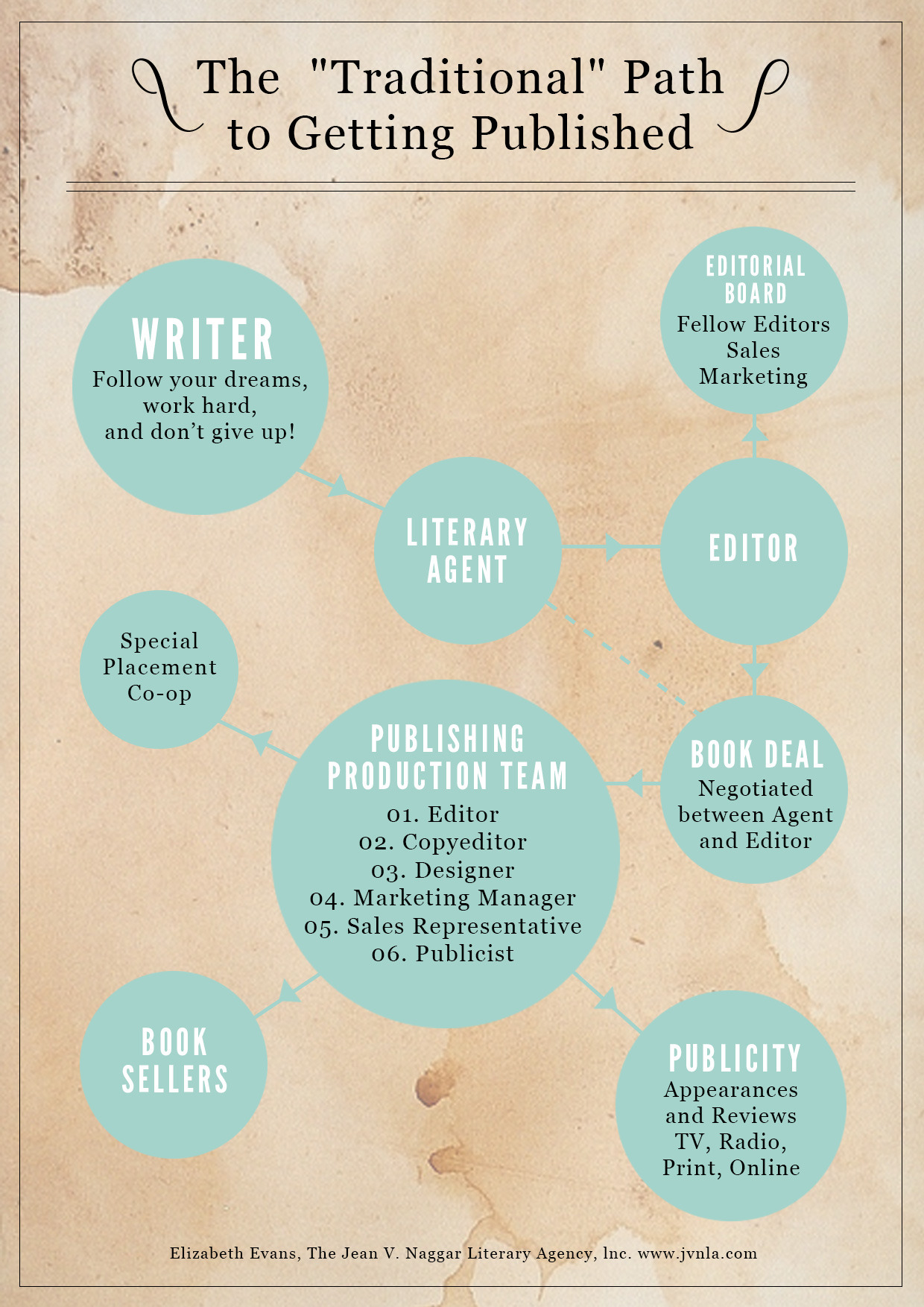
    A writer shouldn’t feel in the dark about what’s happening with her book — heck, you wrote the darn thing! Next time you’re feeling unsure about what’s going on, take a peek at this simple flow-chart and these five tips to understanding what’s going on behind the scenes.

    Traditional Publishing Flowchart

    How long will it take your agent to submit the project to editors?

    Once you sign with an agent, he will then work with you to ready the project for submission to editors. This could mean minor edits or something more involved. Before you agree to work together, ask the agent for an estimate of how much time and work it will take before the project is ready to go.

    Tip #1: Don’t hold your agent to exact dates; things come up. For example, an agent might plan to submit your project on a Monday, but if she suddenly has a lot of editor interest in another project, she may have to shift gears to sell the other book first. Be patient, but if weeks go by with no news, check in.

    [twl_reusable_block post_id=41455]

    How long does it take for an editor to make an offer?

    Depends on the editor, depends on the publisher. If an editor is really enthusiastic about your book, it could take just a couple of days (or even less!). Generally, however, editors need to present the book at their weekly editorial meeting and get their team onboard before they can make an offer. This can take time, sometimes a week or more.

    Editors may reach out to let the agent know they love a project and are “getting reads,” or sharing your project with a few trusted readers at their imprint. Then, when they bring the project up at their meeting, you’ll have a wider base of support in-house. This is a sure sign of interest, but no guarantee an offer is forthcoming.

    Tip #2: Understand the potential hurdles of the ed board meeting. Editors have to present a strong case for your book at ed board meetings, going beyond loving a voice, style or concept.  They need to present “comps,” or competitive and comparative titles that have strong sales figures — indicating that your book will too.

    They may also need to win over the Sales & Marketing Team, convincing them that there’s a strong audience and potential for stores to place large orders of the book. Try to anticipate and address these needs in advance through your proposal or your agent’s submission letter.

    When is it safe to get excited?  Probably not until that offer is on the table. I recommend my clients be “cautiously optimistic” until then.

    I’ve got a book deal! When can I expect to get paid?

    Once your agent and editor agree upon the “deal points,” or the major terms of your deal (these include advance, payout, territory, royalty rates, subrights), the agent waits for the publisher to generate the contract. Depending on the publisher, this can take a few weeks or even a few months. On average, I see a contract come in three weeks to one month after I strike a deal.

    Tip #3: Plan for an additional two months of negotiations after your agent receives the contract. You won’t get paid the first installment of your advance until the contract is fully executed, a back-and-forth process between your agency and the publisher to iron out specific language. This process can experience delays. Contract managers juggle several contracts at once, and it might take time for them to respond to the other party. I would expect an additional two months. Anything faster than this is gravy!

    Who is my point person at the publishing house?

    The editor not only works with you on revisions of your manuscript, he or she oversees the entire process of book production in house. This includes coordinating with different members of your publishing team, including the cover designer, publicist, marketing manager and sales team. Depending on how that publisher works, you may be encouraged to communicate directly with different members of your team, or you may find you only communicate with your editor, who passes your input along to the others.

    Tip #4: Don’t be afraid to ask your editor what to expect once you’ve reached the final manuscript stage. Your editor should be able to give you an overview of the steps your manuscript takes once it goes into production. Ask your editor how many opportunities you’ll have to read the manuscript after it goes through copyediting and page layout. Also ask when you might expect to see a cover design, or hear from your publicist to coordinate a publicity plan. Your agent can assist with this, but it’s best to hear it directly from the editor.

    The manuscript is done!  Now what do I do?

    Most authors experience a lull just after turning in their final manuscript. This is a great achievement, so enjoy a few days of relaxation, then turn your sights to the next steps: marketing and publicity.

    Authors can expect to have direct contact with their publicist, usually starting about six months out from pub date, but they might not have much communication with marketing. Unless you happen to be BFF with the Target Book Club Buyer or the CEO of Anthropologie, there’s usually not too much an author can do on her own to assist with marketing. However, there are two important things you can plan in advance that may directly affect book buy-ins.

    Tip #5: Use your downtime to cultivate a strong presence online and seek support from other authors. When I Google your name, I’d like to see a professional-looking website, either focused around you as an author or around your book, and an active presence on social media sites such as Twitter, Facebook or Instagram. Note: Don’t feel you have to do everything. Go for depth, not breadth.

    An earlier post on The Write Life explained what agents want to see when they Google your name. Well, book buyers are looking for the same thing — a robust presence! This doesn’t happen overnight, but requires consistent attention over a long period of time.

    The best way to build Twitter followers is to be active on Twitter. A lone tweet here and there won’t do much good — in fact it might actually hurt to have an account with just a few followers; you’re better off not having an account at all.

    Consistent attention, including reaching out to other authors and “taste-makers” can help build buzz and a network that may be willing to help you promote your book when it comes out.

    Speaking of building your network, now is a great time to plan ahead for who you’d like to approach for endorsements once bound galleys are ready. Try to determine the best way to reach them. Also, consider which authors writing in your genre have popular blogs. Perhaps there’s opportunity to collaborate on a blog tour down the road.

    Hopefully these tips have provided some insights as to what you can expect from the publishing process. Keep in mind that each publishing house works a little bit differently. For example, some editors might not need the approval of an editorial board to acquire a project, and certain houses don’t hold editorial meetings every week.

    Remember to enlist the help of your agent if you have questions – their experience should help guide the way.

    Have you navigated the traditional publishing process? Share your experience in the comments!