Tag: make money

  • 40 Free Writing Contests: Competitions With Cash Prizes

    40 Free Writing Contests: Competitions With Cash Prizes

    [et_pb_section admin_label=”section”] [et_pb_row admin_label=”row”] [et_pb_column type=”4_4″][et_pb_text admin_label=”Text”]

    Have you ever Googled “writing contests”? Many require reading fees or prizes—like seeing your work in print—that you can only receive if you pay for it.

    Some legitimate contests charge small entry fees, but often a fee can be a red flag for a scam, so those might be the ones you want to stay away from. 

    Besides, there are plenty of free writing contests that encourage and inspire boundless creativity with real cash prizes and career-advancing opportunities! Since it can be hard for a writer to know where to find them, we did the legwork for you.

    We found 40 reputable, well-reviewed, free writing contests for poets, fiction writers, essayists and more

    With thousands of dollars in cash prizes and numerous opportunities to secure a publishing contract, you’re sure to find the right free writing contest for your work.

    If you don’t mind paying a little money to enter, our friends over at Smart Blogger have rounded up some great writing contests that have small entry fees. And if you’re still hungry for more opportunities, we also have posts on writers grants and writing fellowships.

    Fiction and nonfiction writing contests this year

    Ready to share your novel or personal essay with the world? Whether you’re a newbie or more established writer, you’re likely eligible for a few of these contests.

    Here are some fiction and nonfiction writing contests worth considering.

    1. L. Ron Hubbard Writers of the Future Contest

    Whatever your feelings about L. Ron Hubbard’s work and philosophy, the prizes for this regular contest are nothing to sneeze at. Every three months, winners earn $1,000, $750 and $500, plus an additional annual grand prize of $5,000.

    Submissions must be short stories or novelettes (up to 17,000 words) in the genre of science fiction or fantasy, and new and amateur writers are welcome to apply.

    Deadlines: Quarterly on March 31, June 30 and September 30

    Website: Writers of the Future

    2. Inkitt

    This boutique publishing firm offers cash prizes and promotional packages to winning authors. Submit a novel of 10,000 words or more in any fiction genre (no fanfic or poetry).

    Inkitt’s writing contest runs monthly and gives authors the chance to win cash prizes up to $300, exclusive book badges and promotional packages while showcasing their books to Inkitt’s audience of more than 3 million users. Winners are determined by Inkitt’s unique algorithm based on overall reader engagement.

    Deadline: See individual contest pages

    Website: Inkitt

    Disclosure: Inkitt is an advertising partner of The Write Life. We hold our advertisers to high standards and vetted this contest just like others on this list. 

    3. Drue Heinz Literature Prize

    You can win $15,000 and publication by the University of Pittsburgh Press with this prize, awarded for a collection of short fiction.

    You may submit an unpublished manuscript of short stories, two or more novellas or a combination of novellas and short stories. Your total word count should be between 150 and 300 typed pages. You must also have already published a novel or book-length work of fiction “with a reputable publisher,” or no fewer than three short stories or novellas in nationally-recognized journals.

    Deadline: Annual submissions must be postmarked between May 1 through June 30

    Website: University of Pittsburgh Press

    4. Young Lions Fiction Award

    This $10,000 award recognizes “young authors,” which the rules define as any author aged 35 or younger. Submit any novel or collection of short stories published or scheduled to be published in the calendar year. Works must be written for adults; children’s or YA pieces are ineligible.

    Deadline: Submission information is available on the award website

    Website: New York Public Library

    5. Graywolf Press Nonfiction Prizes

    One of the best-loved small presses in the creative writing world, Graywolf Press hosts a variety of contests for both established and up-and-coming writers. Graywolf also offers smaller fiction and nonfiction prizes, with genres rotating by year; 2020 was a nonfiction year, so fiction was up in 2021, then back to nonfiction in 2022, and so on. These awards include a sizable advance—$12,000 in previous years—as well as publication with Graywolf.

    Deadline: Contest is held annually with rotating genres

    Website: Graywolf Press

    6. The Jeff Sharlet Memorial Award for Veterans

    Hosted by the prestigious Iowa Review, the Jeff Sharlet Memorial Award is offered to U.S. military veterans and active-duty members writing in any genre about any subject. Manuscripts of up to 20 pages will be accepted, and the first-prize winner will receive $1,000 and publication in the Review. A second place prize of $750 is also available, as well as three runner-up prizes of $500 each.

    Deadline: Biennially

    Website: The Iowa Review

    7. Ernest J. Gaines Award for Literary Excellence

    For 15 years, this contest has provided visibility for emerging African American fiction writers and enables them to focus on their writing by awarding a $15,000 cash prize. Eligible authors should submit a work of fiction, such as a novel or short story collection, published in the calendar year. (Galleys for publication within the year are also accepted.)

    Deadline: Annually. The entry window closes on December 31

    Website: The Ernest J. Gaines Award for Literary Excellence

    8. PEN/Faulkner Award for Fiction

    Honoring the best work of fiction published by an American author in a single calendar year, this award has been given to the likes of John Updike, Philip Roth and Ann Patchett. Novels, novellas and collections of short stories are all eligible.

    The winner receives a hefty cash prize—up to $15,000 in the past—and an invitation to read at the award ceremony in Washington, D.C. Plus, there are no submission fees or application forms to deal with; just send a PDF of each book (as many as you’d like) to awards@penfaulkner.org.

    Deadline: Submissions will be accepted from July 1 to September 30

    Website: Pen/Faulkner

    9. PEN/Robert J. Dau Short Story Prize for Emerging Writers

    This contest requires you to have already published a short story in a literary magazine or journal or cultural website. But if you’ve made your debut (but gone no further), you may be eligible for the generous cash prize of $2,000, which is annually awarded to 12 emerging writers, whose works are then published together in an anthology.

    Short stories of up to 12,000 words are eligible and must be published in the calendar year preceding the year in which the award is given. Additionally, keep this in mind: Submissions are only eligible if submitted by an editor. Authors may not submit their own work.

    Deadline: Submissions close November 1

    Website: PEN America

    10. Anisfield-Wolf Book Awards

    Fiction and nonfiction writers who have recently published a book that “contribute[s] to our understanding of racism and our appreciation of cultural diversity” are eligible for this award, which offers $10,000 cash as well as media and publicity opportunities. Plus, winners receive their prize at a ceremony in Cleveland.

    Submissions must be published in the prior year (so books published last year are eligible for the award this year).

    Deadline: Annual submission window is September 1 through December 31

    Website: Anisfield-Wolf Book Awards

    Freelance Writer’s Pitch Checklist
    Grab it for free 👇

    Convince more editors to say YES to your pitches!

      We’ll also send you our weekly newsletter, which offers helpful advice for freelancing and publishing. You can unsubscribe at any time.

      11. Marfield Prize (aka National Award for Arts Writing)

      Presented by the Arts Club of Washington, this award seeks to honor nonfiction books that deal with the “visual, literary, media, or performing arts.” The prize is $10,000 and may be awarded to works of criticism, art history, memoirs and biographies, and essays.

      Deadline: Annually in the last quarter of the year. The submission window in 2023 is October 15

      Website: The Marfield Prize

      12. W.Y. Boyd Literary Award for Excellence in Military Fiction

      If you’re a war buff, this competition is for you. It awards $5,000—and a 24-karat-gold-framed citation of achievement—to the best piece of fiction set during a period when the U.S. was at war (war may either be the main plot of the piece or simply provide the setting). Submissions may be adult or YA novels.

      Deadline: Annually on December 31

      Website: American Library Association

      13. Friends of American Writers Chicago Awards

      FAW presents two annual awards: an Adult Literature Award for literary fiction or nonfiction, and a Young People’s Literature Award for a children’s/YA book.

      Authors must reside in the state of Illinois, Indiana, Iowa, Kansas, Michigan, Minnesota, Missouri, North Dakota, Nebraska, Ohio, South Dakota or Wisconsin—or they must set their book in one of those locations. Prize amounts vary from year to year, but you don’t have to bother with an application and all winners are celebrated at the organization’s May luncheon.

      Deadline: Annually in December

      Website: Friends of American Writers Chicago

      14. Hektoen Grand Prix Essay Contest

      Hektoen International, an online journal dedicated to medical humanities, offers two prizes annually for essays of no more than 1,500 words: $5,000 is awarded to the winner and $2,500 to the first runner-up. Eligible topics are broad so long as they have a relation to medicine, and many include art, history, literature, education and more.

      Deadline: Annually; September 15 is usually the deadline

      Website: Hektoen International

      15. Biopage Storytelling Writing Contest

      There’s no denying it: social media is a huge part of our modern-day lives. It’s easy to get used to limiting our communications to 280-character and emoji-strewn snippets, which is why this marketing firm is hosting an essay writing contest to “remind people of the benefits of writing.”

      Essays of up to 5,000 characters (roughly 1,000 words) will be accepted, and right now they’re looking for stories of COVID-19 quarantine life. The grand prize winner will receive $300, and five runners-up will be awarded $100 each.

      The contest is free to enter, but you’ll need to register for a Biopage account to be eligible.

      Deadline: The contest ends January 31 each year

      Website: Biopage

      16. St. Martin’s Minotaur / Mystery Writers of America First Crime Novel Competition

      Writers 18 and older who have never had a novel published (in any genre) are eligible for this prize, awarded to an original book-length manuscript where “murder or another serious crime or crimes is at the heart of the story.” The winner receives a publication contract with Minotaur Books and an advance of $10,000 against future royalties.

      Deadline: December 17 each yea

      Website: Edgar Awards

      17. ServiceScape Short Story Award

      ServiceScape, a platform matching freelance writers, editors and graphic designers with clients (i.e. a great place to look for paid writing work!) offers a yearly Short Story Award of $1,000 to a winning fiction or nonfiction work of 5,000 words or fewer. The winner will also have their story featured on the ServiceScape blog, which sees thousands of readers each month.

      Deadline: November 29 each year

      Website: ServiceScape

      18. Stowe Prize

      This biennial prize of $10,000 honors an American author whose adult fiction or nonfiction work has had an impact on a critical social justice issue (as did Harriet Beecher Stowe’s novel Uncle Tom’s Cabin). The book must be written by a U.S. author and have been published in the United States during the previous three calendar years.

      Deadline: Contact the Harriet Beecher Stowe Center for this year’s deadline.

      Website: Harriet Beecher Stowe Center

      19. The Diana Woods Memorial Award in Creative Nonfiction

      Creative nonfiction essays of no more than 5,000 words on any subject are eligible for consideration for this award, whose winner receives $250 and publication in Lunch Ticket, the literary and art journal produced by the MFA community of Antioch University Los Angeles.

      Works must not have been published elsewhere. Award winners are required to submit a 100-word biography, recent photo and a short note thanking the Woods family for their generosity and support.

      Deadlines: Biannual reading periods are in February for the Summer/Fall issue and in August for the Winter/Spring issue

      Website: Lunch Ticket

      20. The 2023 Brandon Langhjelm Memorial Essay Contest

      Each year, this Canadian organization offers three prizes, ranging from $500 to $1,500, to the essay with the most thoughtful, well-reasoned arguments around a specific human-rights theme. (For example, 2022’s prompt was, “Canadian governments are making Digital ID technologies a precondition of access to essential services and goods. What can Canadians do to protect their Charter rights and freedoms against the dangers of these technologies?)

      The contest is open to Canadian college and university students, and essays should be 2,500 words or less in length.

      Deadline: November 5

      Website: Justice Center for Constitutional Freedoms

      Freelance Writer’s Pitch Checklist
      Grab it for free 👇

      Convince more editors to say YES to your pitches!

        We’ll also send you our weekly newsletter, which offers helpful advice for freelancing and publishing. You can unsubscribe at any time.

        21. Write the World

        For young writers ages 13-18, these cool contests also serve as mini workshops. Recognizing that “a first draft is never perfect,” submissions actually receive peer review by authors, writing teachers and other experts and writers are given the chance to revise their pieces based on this feedback before submitting them for final prize consideration.

        Contests vary each month, but there’s a $100 prize for the winner and $50 for the runner-up (plus $50 for the best peer-reviewer). All three are featured on Write the World’s blog alongside comments from a guest judge. And since each month’s prompt is from a different genre, developing writers get a chance to test out different styles.

        Deadline: Monthly

        Website: Write the World

        22. Prose.

        Stuck with writer’s block and looking for a way to jumpstart your escape? Prose offers weekly challenges meant to spark your creativity; many are just for fun, but look for the weekly numbered challenges posted by Prose (rather than community members or sponsors) for a chance to win money.

        Prizes are typically between $100 to $200 and word counts are low—some as low as under 150, some as high as 500. So even if all you get from the prompt is a chance to flex your brain, it’s not a bad deal.

        Deadline: Weekly and monthly

        Website: Prose.

        23. The Restless Books Prize for New Immigrant Writing

        First-generation immigrants have a chance to win $10,000 and publication by Restless Books for telling their stories (real or imagined). The contest alternates annually between fiction (novel or short story collection) and nonfiction (memoir, essay collection, narrative nonfiction).

        Deadline: Submission window is usually between December and March

        Website: Restless Books

        24. AFSA National High School Essay Contest

        The U.S. Institute of Peace and the American Foreign Service Association sponsor this annual high school essay contest, where the winner receives a $2,500 cash prize, an all-expense paid trip to Washington, D.C., and a full-tuition paid voyage with Semester at Sea upon the student’s enrollment at an accredited university. Essays should be between 1,000 and 1,250 words and have to answer all aspects of the prompt as well as demonstrate an understanding of the Foreign Service.

        Runners-up get a pretty sweet deal too, a $1,250 cash prize and a full scholarship to participate in the International Diplomacy Program of the National Student Leadership Conference.

        Deadline: April each year

        Website: American Foreign Service Association

        25. Science-me a Story

        Born in 2018, the Society of Spanish Researchers invites talented and original writers to write a 100-word blurb for a hypothetical novel. This might sound really easy, but your blurb has to quickly hook readers and make them want to read more. Open to anyone over 18 anywhere in the world, your real or fictional short story for this competition must be either in English or Spanish and “conceived from the objective of scientific dissemination to primary school” to qualify for the cash prizes: £150, £100 and £50. 

        Deadline: April each year

        Website: Society of Spanish Researchers in the United Kingdom

        26. VCU Cabell First Novelist Award

        Virginia Commonwealth University sponsors this award that honors an outstanding debut novel published in the preceding calendar year. While you may have published previous books in a different form, the submission must be your first published book marketed as a novel.

        The award is a $5,000 cash prize, and the winning author must agree to attend the award event, usually scheduled for November.

        Deadline: Annually; the submission window runs from July 1 through December 30

        Website: Virginia Commonwealth University

        27. Daisy Utemorrah Award

        The Daisy Utemorrah Award is for an unpublished manuscript of junior or YA fiction written by Aboriginal and Torres Strait Islander peoples currently living in Australia. Generously supported by the Copyright Agency’s Cultural Fund and the State Government of Western Australia, the winner of the award receives $15,000 and a publishing contract with Magabala Books.

        Deadline: Submission window usually opens at the beginning of each year

        Website: Magabala Books

        28. Short Fiction Prize

        If you’re an undergrad at a college in the U.S. or Canada, this writing competition is for you. (Traditionally, this contest has encouraged applicants with an Asian background, but anyone is invited to apply.) Submissions should be no more than 7,500 words.

        One winner will get a $1,000 prize as well as a scholarship to the next Southampton Writers Conference.

        Deadline: Submission window is usually between March 1- July 14

        Website: Stony Brook University | Lichtenstein Center

        29. Bacopa Literary Review Contest

        The Bacopa Literary Review is an international journal published by the Writers Alliance of Gainesville. Each year, it opens submissions for pieces in four genres: fiction, creative nonfiction, poetry and prose poetry. Find detailed guidelines for each genre on its website. First place gets $300, and the second prize in each of the four genres gets $100.

        Deadline: May 30 each year

        Website: Writers Alliance of Gainesville

        30. Insecure Writer’s Support Group Annual Anthology Contest

        As long as you stick to the guidelines, The Insecure Writer’s Support Group’s annual contest welcomes your 5,000- to 6,000-word (previously unpublished) creative story. But before you send it off, make sure your story is polished and formatted! Plus, the prizes aren’t too shabby—winning stories will be edited and published, authors will receive royalties, and the top story will even get to give the anthology its title. 

        Deadlines: September 1 each year

        Website: Insecure Writer’s Support Group

        31. New Voices Award

        Presented by Lee & Low Books, an award-winning children’s book publisher, this award is given for a previously unpublished children’s picture book manuscript of no more than 1,500 words written by a writer of color or Indigenous/Native writers who’s a resident of the U.S.

        The winner receives $2,000 cash and a standard publication contract, and an additional Honor Award winner will receive a cash prize of $1,000. You may submit up to two manuscripts.

        Deadline: Watch the website for details. 

        Website: Lee & Low Books

        32. St. Francis College Literary Prize

        Since 2009, this biennial literary award has honored mid-career writers who have recently published their third, fourth or fifth work of fiction. The winner receives $50,000 and may be invited to the St. Francis College campus in Brooklyn, New York, to deliver a talk about their work or teach a mini fiction workshop to St. Francis students.

        Deadline: Biennially. The contest was not offered the last three years due to the pandemic and limited campus access

        Website: St. Francis College

        33. Future Scholar Foundation Short Story Competition

        The Future Scholar Foundation is a nonprofit organization started and run by high school students in Redmond, WA. Their mission is to empower young students to develop their self-expression skills through monthly short story competitions. Their efforts have been recognized by the Seattle Times and Northwest Asian Weekly, and their short story competitions have received hundreds of submissions from over 15 US states and five countries.

        Deadline: Monthly on the 28th

        Website: Future Scholar Foundation

        Free poetry contests to enter

        Curious about opportunities for poets? Your stanzas—rhyming or not—could be worth a fair amount of money in these poetry competitions.

        Check out these poetry writing contests.

        34. Black Voices in Children’s Literature Writing Contest

        This contest is open to Black writers who are over the age of 18 and residents of Illinois, Indiana, Iowa, Michigan, Minnesota, Missouri, Nebraska, North Dakota, Ohio, South Dakota or Wisconsin.  It’s hosted by Strive Publishing and Free Spirit Publishing and seeks to fill the need for Black representation in children’s and young adult books. Original board and picture books for children aged 0-4 and picture books for ages 4-8 are eligible, provided they feature contemporary, realistic Black characters and culture and focus on character development, self esteem, community and other aspects of positive childhood development.

        Three prizes, ranging from $250 to $1,000, will be awarded, and the first-place winner will be “seriously considered” for publication, though it’s not guaranteed.

        Deadline: Usually late July, each year

        Website: Free Spirit Publishing 

        35. James Laughlin Award

        If you’re already a published poet, this is the award for you; it’s given for a second book of poetry due to come out in the forthcoming year. The winner receives $5,000 and an all-expenses-paid week-long residency at The Betsy Hotel in Miami Beach, Florida. In addition, copies of the winning book are distributed to 1,000 members of the Academy of American Poets.

        Deadline: Annual submission window is January 1 through May 15

        Website: Academy of American Poets

        36. African Poetry Book Fund Prizes

        The APBF awards three prizes annually for African Poetry. The Luschei Prize for African Poetry gives $1,000 for a book of original African poetry published in the prior year.

        The Sillerman First Book Prize for African Poets gives $1,000 and a publication contract for a book-length collection of poetry by an as-yet-unpublished African author.

        The Brunel International African Poetry Prize is a new prize that grants £3,000 to a poet who was born in Africa, or has African parents, who has not yet had a full-length book of poetry published. (U.S. citizens qualify.) To submit, you’ll need 10 poems.

        Deadlines: See individual prize pages or details

        Website: African Poetry Book Fund

        37. Tufts Poetry Awards

        Claremont Graduate University presents two awards each year to poets they deem to be “outstanding.” The Kate Tufts Poetry Award grants $10,000 for a published first book of poetry that shows promise.

        The Kingsley Tufts Poetry Award grants a mammoth $100,000 for a published book of poetry by an established or mid-career poet.

        Deadline: Submission window is July 1 to June 30 each year

        Website: Claremont Graduate University

        38. Graywolf Press Walt Whitman Award 

        The Walt Whitman Award is a $5,000 prize awarded, along with publication, to an American poet with a winning first book manuscript. He or she also receives an all-expenses-paid six-week residency at the Civitella Ranieri Center in Umbria, Italy.

        Graywolf Press is also one of the publishers of the Cave Canem Poetry Prize, “a first book award dedicated to the discovery of exceptional manuscripts by Black poets.” Winners receive $1,000 and Graywolf publishes every third winner of the prize.

        Deadline: July 1 to September 1 each year

        Website: Poets

        39. Wergle Flomp Humor Poetry Contest

        Now in its 23rd year, this humor contest wants your best published or unpublished work for a grand prize of $2,000; runners-up are awarded $500 and 10 honorable mentions will receive $100 each. Writers of all ages from eligible countries can submit an original, humorous poem with 250 lines or less, and it must be in English.

        Deadline: April 1, each year (and no, this isn’t an April Fools joke)

        Website: Winning Writers

        40. The Alpine Fellowship Writing Prize

        This writing competition is looking for the best piece of unpublished, themed writing. For example, one year, the theme was “Untamed: On Wilderness and Civilization.” Submissions may be prose, poetry or non-academic essays. Maximum word count is 2,500, and this is open to all nationalities and to anyone 18 or older. The winner gets a £10,000 cash prize, second place gets £3,000 and third place gets £2,000.

        Deadline: Applications open at the beginning of each year. Follow the Alpine Fellowship on Instagram for updates

        Website: The Alpine Fellowship

        Where to find more legitimate, free writing contests

        Looking for more opportunities to submit your work? Here are a few great sites to keep an eye on for writing contests.

        Winning Writers

        A number of the contests found on our list came highly recommended by this site, which compiles some of the best free literary contests out there. Along with a wide range of recommended contests for writers of all stripes, Winning Writers also lists some contests and services to avoid, which is just as useful!

        They also offer a handful of contests themselves, including the North Street Book Prize.

        Poets & Writers

        Another fantastic source for legitimate writing contests we consulted when compiling this list, Poets & Writers vets competitions, contests, awards and grants to make sure they’re following legitimate practices and policies. It’s worth checking out regularly as it features both annual and one-time contests.

        Freelance Writer’s Pitch Checklist
        Grab it for free 👇

        Convince more editors to say YES to your pitches!

          We’ll also send you our weekly newsletter, which offers helpful advice for freelancing and publishing. You can unsubscribe at any time.

          This listing contains affiliate links. That means if you purchase through our links, you’re supporting The Write Life—and we thank you for that!

          The original version of this story was written by Kelly Gurnett. We updated the post so it’s more useful for our readers. 

          Photo via Viktoriia Hnatiuk / Shutterstock

          [/et_pb_text][/et_pb_column] [/et_pb_row] [/et_pb_section]

        • 20 Fantastic Writing Grants, Plus Tips for Applying

          20 Fantastic Writing Grants, Plus Tips for Applying

          When when you find yourself with a big, time-consuming writing project to pursue, your love of words alone might not pay the bills. That’s when writing grants can swoop in to save the day (and your budget).

          If you find you enjoy writing grant applications, grant writing for others can be a lucrative niche as well.

          Writing grants for women, poets and more

          Ready to apply for money to fund your writing? Here are 20 great writing grants for creatives based in the United States.

          1. Leeway Foundation Art and Change Grants

          These grants of up to $2,500 are available to women and transgender artists and cultural producers based in Greater Philadelphia, whose work emphasizes social change. That means, “social change must be integral to the ideas, beliefs and goals that are woven throughout your [writing] and your process of creating and sharing your art,” and should positively engage the community.

          Keep in mind that one key to success for this grant is securing a “Change Partner”: an individual, business, or organization that is connected to your work, and who will endorse your project.

          If you are at least 18 years old and live in Bucks, Camden, Chester, Delaware, Montgomery or Philadelphia counties, you are eligible to apply. However, full-time art students are not eligible. All genres are welcome. Applications must be received by the biannual deadlines, and you can only apply once per grant cycle.

          Check out this page for all the details.

          2. Grants for Artist Projects (GAP) Awards 

          If you are a resident of Washington state, 18 years or older and not currently enrolled in a graduate or undergraduate degree program, this is the grant for you.

          The Grants for Artists Project (GAP) awards up to $1,500 annually to 50+ practicing literary and visual artists. Grant money can support the “development, completion or presentation of new work.”

          The organization also connects artists to an array of services, including career development, legal support, residencies and continuing education—just to name a few. Keep your eye out for the details here

          3. Bard College Fiction Prize

          This writer-in-residence award is an amazing opportunity for an emerging writer under the age of 39 to devote a semester to a fiction project.

          The recipient is required to give one public lecture on the campus and to informally meet with Bard students, but the rest of the time is dedicated to their writing project. Besides a sizable $30,000 cash award, the winning writer also gets to be a writer in residence at Bard College for one semester.

          Check this page to learn about upcoming deadlines. The application process is very straightforward; no lengthy FAQ pages here.

          Applicants should have published at least one book, three copies of which must be submitted with a cover letter explaining their next project and their C.V.

          4. Arts Writers Grant Program

          If contemporary visual art is your writing area of expertise, you’re in luck. This writing grant funds writers who are passionate and knowledgeable about contemporary art and whose work will broaden the arts writing audience.

          Both emerging and established writers can apply for a grant ranging from $15,000 to $50,000 in one of three project types: articles, books and short-form writing. Keep your eye out for the application period to reopen in Spring.

          Details are available here.

          5. Arizona Artist Research and Development Grant

          Arizona writers who want to “advance their artistic practice, expand their creative horizons and deepen the impact of their work” may want to try their luck with this grant, which will be awarded to up to 30 artists across all disciplines this year. The grant’s amount goes up to $5,000 depending on funding.

          Applicants whose projects emphasize the “new”—new techniques, new strategies, new ways of engaging communities—are primed for success. Writers should also explicitly state in their applications how their project will impact not just their own artistic practices, but also benefit the larger Arizona community.

          The application has numerous demanding parts, so be sure to give yourself time to delve into the guidelines. Learn more here.

          Close-up photograph of a person holding a pen in their right hand, poised over a stack of papers that look like an application form. This is to illustrate the 20 writing grants described in this blog post.

          6. Kansas City Inspiration Grant

          Kansas City writers in the metropolitan area may be awarded between $1,000 and $2,500 for professional development and other budding projects. The regional arts council notes that the highest priority for the grant is to fund projects that significantly advance career development or an artist’s capacity to complete their work—not to fund “business as usual.”

          A full proposal, which includes up to six samples of work, is only submitted after an applicant passes this initial phase.

          Note that if you request more than $1,500 for your project, matching funds may be required.

          Check out the Inspiration Resources page for more information.

          7. RISCA Project Grant Projects for Individuals

          As with most other state arts council-based grants, this Rhode Island grant is available to writers who ultimately plan to share their work with the public through a reading, performance or another open event. The emphasis on public value is strong with the RI Arts Council, so this grant will best serve socially-minded writing projects.

          Individual applicants can request up to $3,000, but be mindful that grants may be only partially funded. If your request is especially sizeable you might consider providing proof that other organizations or individuals have financially invested in your project.

          Find application details here.

          8. North Carolina Artist Support Grant

          North Carolina writers at any stage in their careers are invited to apply for writing grants to fund new or existing projects, with statewide awards ranging from $300 to $5,000. (Grant amounts vary by region.)

          Application procedures and deadlines vary depending on your county, so make sure you reach out to the office designated on this page for specific regional details. The guidelines are fairly open-ended, which is good news for writers who want to use the funds for a variety of professional development needs.

          9. Awesome Foundation Grant

          This grant is as awesome as it sounds.

          Winners receive $1,000 with “no strings attached” to pursue their incredible projects, and the foundation and its donors have no say in the finished project.

          Chapters of the foundation organized by region or subject review applications and select the grantees. The process is almost unsettlingly simple, but don’t be deterred—this really is a great opportunity.

          Check the website for specific information about the application requirements and deadlines for your chapter.

          10. The Regional Arts Commission’s Artist Support Grant

          This grant, funded by the Regional Arts Commission, provides “direct funds for an individual artist’s projects, needs, or creative opportunities in all artistic disciplines.” The grant ranges from $500 to $3,000 and can be used for project completion, conference fees, rental space, materials, and any other resources that contribute to an artists’ development. 

          You’ll be eligible for this grant if you’re 19 years or older, a resident of St. Louis City or County and have been for at least one year, and if you’ve created and presented or performed original work to the public.

          Learn more here.

          11. PEN/Phyllis Naylor Working Writer Fellowship

          Since 2001, this annual writing grant of $5,000 has been awarded to an author of children’s or YA fiction. “It has been developed to help writers whose work is of high literary caliber and assist a writer at a crucial moment in their career to complete a novel-in-progress.” 

          To ensure total impartiality of the judging process, your submitted novel-in-progress will be judged blindly, so be sure not to put your name anywhere on your manuscript.

          Among other requirements, eligible applicants should have published at least one children’s or YA fiction novel, and it must have been published by a U.S. trade publisher.

          Check out the website for more details.

          12. Karen and Philip Cushman Late Bloomer Award

          If you’re a writer over the age of 50 and your work has yet to be traditionally published in the children’s literature field, this one is all yours.

          Karen and Philip Cushman and the Society of Children’s Book Writers and Illustrators (SCBWI) established this grant for writers in 2013. Cushman considered herself a late bloomer, as her first children’s book wasn’t published until she was 53. This grant is meant to celebrate and encourage writers just like her.

          Recipients receive $500 and free tuition to an SCBWI conference anywhere in the world. Plus, the requirements are a breeze: you must be a member of SCBWI and an unpublished writer of 50 years of age or older. Submissions re-open each year on March 1.

          13. Massachusetts Artist Fellowship 

          Artists in Massachusetts specializing in various disciplines can apply to receive a $1,500 award, funded by the Mass Cultural Council, which considers “the work of individual artists to be an essential part of our vital communities.” 

          The fellowship is only open to artists who are 18 years or older and have been a resident of Massachusetts for at least two years. You must also be prepared to present original work; no interpretations or translations, please. 

          Although the program has a rolling application process, please note all new applications for Cultural District designation are paused until FY26 as program is internally reviewed and redesigned.

          14. C.D. Wright Prize for Poetry

          In honor of C.D. Wright’s legacy, The Arkansas International seeks “to award innovative poetry that ‘lives freely and variously and fully engaged with others and the world.’”

          Any poet writing in English is eligible to submit, so long as they have not yet published a first book. U.S. citizenship is not a restriction of eligibility. The winner receives $1000 and publication in the Arkansas International. Recent judges have included Hanif Abdurraqib and Shane McCrae.

          Submissions open annually at the start of June and close at the end of August.

          15. The George A. and Eliza Gardner Howard Foundation Fellowship

          If you need to set aside some time to focus on your writing, this opportunity might be what you’re looking for.

          Administered by Brown University, this fellowship was created with the intention to “provide artists, scholars, and writers with time to complete their work.” Previous fellowships awarded $35,000 to nine mid-career individuals in the fields of Creative Nonfiction and History.

          You’ll be eligible if you’ve achieved recognition for one major project, and if you can answer “yes” to these questions.

          Check out the website for more information.

          Vertical graphic with watercolor-like brushstrokes and text overlay that says 20 writing grants for women, poets, and more.

          16. The Ernest J. Gaines Award for Literary Excellence

          This award is “nationally recognized in its role of enhancing the visibility of emerging African-American fiction writers while also expanding the audience for this literature.” The $15,000 cash prize will support the writer as he/she focuses on writing. 

          To be eligible, you’ll need to be an African-American U.S. citizen with a published work of fiction, and you should be willing to attend the award ceremony in Baton Rouge, Louisiana. During your stay, participation in community engagement and educational outreach activities are also expected.

          Learn more on the website.

          17. Artists 360

          Designed to elevate greater Northwest Arkansas artists, Artists 360 provides $7,500 grants “to support creative projects, learning opportunities to develop entrepreneurship skills and build sustainable creative practices, and connections to a dynamic regional artist network.” The four artistic disciplines accepted are visual arts, performing arts, literary arts and traditional arts. 

          To be eligible, be an artist with an active and current artistic practice, have specialized training in your field, and show you’ve succeeded in the arts through high-quality work and/or contributions to the field.

          Find more details here

          18. Saratoga Arts Individual Artist Grants

          Writers in the upstate New York State region—Fulton, Montgomery or Saratoga counties, specifically—this grant is for you. Funded by the Saratoga Arts, the Artist Grant focuses on individual artist work to enhance career development, skills and broaden exposure, “while fostering creative, resourceful and inspiring connections between artists and a community.”

          Grants of $2,500 will be awarded to artists to create new work and share their creative process with the community. Funding can support art-related supplies and materials needed for the execution of the program, artist fees and other outreach costs.

          Learn more on the website.

          19. Independently Published Pre-publication Grant

          You must be a current SCBWI member when your work is submitted and when the award is announced.

          Money from the grant must be used to self-publish your book, including but not limited to:

          • Hiring illustrators
          • Hiring content editors, proofreaders, and copyeditors
          • Hiring book designers
          • Book trailers
          • Website development
          • Printing and shipping costs
          • Publishing software

          Grants will be awarded based on:

          • Quality and professionalism of your synopsis
          • Strength of your business plan

          Check out the website for more information.

          20. Work-in-Progress Awards

          To assist children’s book writers and illustrators in the completion of a specific project currently not under contract. Given in the categories of Picture Book Text, Chapter Books/Early Readers, Middle Grade, Young Adult Fiction, Nonfiction, and Underrepresented Fiction or Nonfiction.

          The SCBWI Work-In-Progress (WIP) Award assists children’s book writers and illustrators in the publication of a specific project currently not under contract. One winner per category will be selected. SCBWI reserves the right not to confer this award in any given year.

          Submissions open March 1 through March 31. Learn more here.

          Want more writing advice?

          Subscribe to get our latest content by email.

            We won’t send you spam. Unsubscribe at any time.

            Looking for more great writing grants and funding options? Check out C. Hope Clark’s fantastic list of opportunities at Funds for Writers

            The original version of this story on writing grants was by Kristen Pope. We update this post regularly so it’s more useful for our readers.

            Photo via Tero Vesalainen / Shutterstock 

          • How to Write an Invoice in 11 Steps, Plus an Invoice Example

            How to Write an Invoice in 11 Steps, Plus an Invoice Example

            [lwptoc]

            For any type of business to succeed, you have to get paid.

            Whether you do one freelance gig a month or run a full-time writing business, you need to figure out how much your clients owe you and send them a bill. Many companies don’t even think about paying a freelancer until they have an invoice in hand.

            That means you need to know how to write an invoice.

            But where do you start? How do you create a professional-looking bill? How and when do you send it to your client?

            In this post, we’ll explain all the basics behind how to write an invoice. We’ll start off by showing you an invoice example, so you can visualize how all the elements come together. Then we’ll dig into those components, explaining what to include in your invoice. Finally, we’ll discuss how and when to send your invoice.

            If you plan to invoice clients regularly, it’s smart to invest in an invoice generator, so we’ll review your options for those, too.

            Let’s get started with our invoice example.

            How to write an invoice — An example

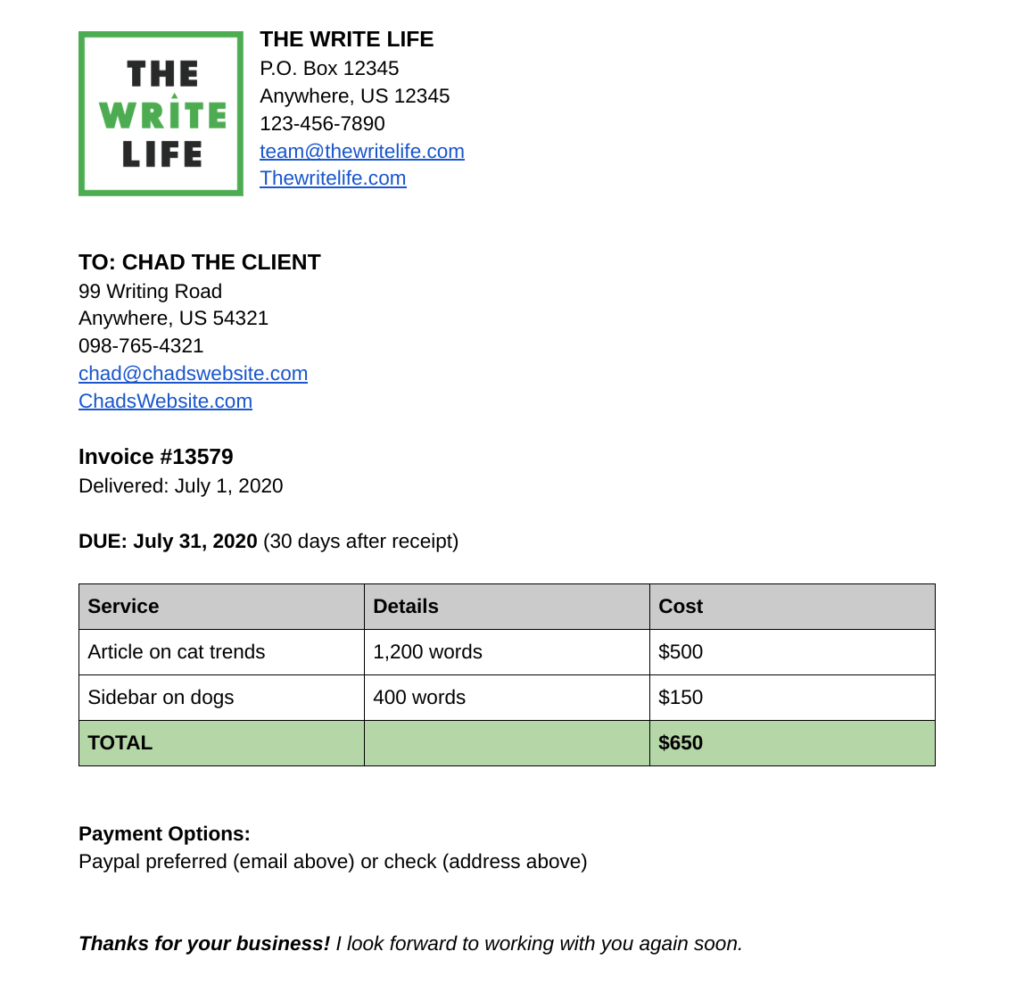
            Here’s a sample invoice that includes all of the elements we’ll detail throughout this post.

            For a downloadable PDF to use as an example, just click on the image.

            We made this sample invoice simple on purpose. You don’t need a fancy invoice, you just need to include all the right information!

            how to write an invoice

            How to make an invoice: Here’s what it should include

            Look, we know it can be daunting to send your first invoice, especially when you want to look professional.

            But you’ve already done the work for your client, and that’s the hardest part! If you’re at the point where you’re creating an invoice, you’ve already figured out how to become a freelance writer.

            Plus, as we saw above with the invoice sample, your invoice doesn’t have to be fancy. It just has to be professional-looking and do the job.

            When you’re learning how to write an invoice, here’s what to include.

            1. A professional header

            The first item on your freelance invoice should be your business name or your full name, in professional and easy-to-read font.

            If you have a logo for your business, include that as part of the header. But don’t worry, you don’t need a logo; you can also just write your name in text. Whether you use a logo or text, the font size of your name or business should be a little bigger than the rest of the text on the invoice, and bolded for emphasis.

            2. Your contact information

            Next you’ll want to include your contact information.

            At the very least, this includes your mailing address, phone number, email address and website, right underneath your business name. To make it easier to read, consider typing the info on several lines like this:

            The Write Life
            P.O. Box 12345
            Anywhere, US 12345
            team@thewritelife.com
            123-456-7890
            thewritelife.com

            You can include your contact information on the top left or right of the invoice. We’ve seen it done both ways.

            3. The client’s contact information

            Next in creating your invoice, you’ll want to specify the recipient, or who the invoice is for. Include the recipient’s name, address, phone number, email address, website and any other information. You might look back at this section later if you need to track down payment, so it helps you to include all the client’s contact information there.

            Some freelancers put their contact information on the opposite side from the client’s contact information, and some freelancers left-align it all. Do what feels right to you!

            4. Invoice number

            Then, on the left of your invoice under all the contact information, add your invoice number.

            What’s an invoice number? It’s simply an identifier that helps you keep track of your invoices. It doesn’t matter what kind of numbering system you use, just make sure it’s in sequential order so you don’t get confused.

            For example, if this is your first invoice, you might start with #1001. Then your next invoice would be #1002, even if it’s for a different client. Each invoice gets a number, so you can easily track who has and hasn’t paid.

            This placement makes it easy to keep track of vital information — for both you and the recipient.

            5. Date prepared

            Add a date that shows when you submitted the invoice to the client.

            The “date prepared” line is important because you’ll need to refer to it if a client takes a long time to pay you. We’ll go into that shortly, under payment terms.

            6. Due date

            Specify when, exactly, the payment is due. The due date is entirely up to you, but most freelancers (and invoicing systems) use a 30-day, 45-day or 60-day timeline. You can also make the invoice “Due upon receipt,” so the recipient is required to pay the invoice promptly.

            This shouldn’t be the first time your client has heard about the due date. When you agreed to do the work — and hopefully signed a contract, or at least agreed to terms via email — you should have set expectations with the client for payment terms.

            If the client doesn’t pay on time, you can refer back to this due date, as well as the prepared date if necessary.

            7. Payment options

            It’s typically helpful to the client if you specify your payment options: whether you prefer to be paid with cash, a check, a credit card or a service like PayPal.

            (If PayPal is your preferred payment method, it’s smart to add your PayPal email address to the invoice, so they send the payment to the right place.)

            Some companies offer direct deposit if you work for them on a regular basis, but more than likely you’ll have to send an invoice to request payment every time you complete a project.

            8. Payment terms

            Along with the required timeline for payment, you might want to specify whether you charge a late fee for invoices that are paid past their due date. Some freelancers use this strategy to enforce getting paid on time. A typical late fee is 20 percent of the invoice fee.

            If you decide to utilize a late fee, we recommend reminding the client at least once or twice that the invoice is overdue, and giving them a chance to pay it without a fee.

            While it’s obviously important that you get paid, you also want to maintain the client relationship, with the goal of being invited to work with the client again in the future.

            9. Breakdown of services

            Finally, add a breakdown of the services rendered so the client knows exactly what they’re paying for.

            If the client hired you for a number of services, add each one to a new line so it’s easy to digest.

            10. Amount due

            Of course, don’t forget to add how much the client owes you!

            If your breakdown of services includes a number of items, show what each of those items cost. This could be a cost per service, or it might be the number of hours you worked at your agreed-upon rate.

            Finally, tally up all those line items to show the full amount due. Bold this amount for emphasis, so it’s easy to see on the invoice when the client needs to figure out how much to pay.

            11. Thank you

            Why not add a personal touch to help maintain the client relationship?

            Below the total, add a thank you note. Or, if you need to include any additional information or reminders, this is a good place to add that as well.

            How to send an invoice

            If you write your invoice by hand, export it as a PDF so the recipient can’t alter it. Then send the invoice PDF to your client as an attachment via email.

            One tip if you invoice by email is to write the invoice number and amount in the subject line of the email. That way it will be easy for you and your client to find, which increases the chances that you’ll get paid on time.

            When to send the invoice

            When you agree with the client on the terms of your work and sign a contract, you should list out how often you plan to invoice and when you should get paid. For instance, for recurring work, you might agree to bill on the first of each month, or bi-weekly so you get paid every other Friday.

            For one-off assignments, the most common practice is to invoice after the work is complete. However, if you’re unsure, you might simply ask your client, “Is our work complete? Shall I send an invoice your way?”

            For big freelance jobs, such as assignments where you and your client have agreed upon a fee of $1,000 or more, you might invoice several times throughout the project. For example, you might invoice for half the fee at the beginning, then half when the project is complete. Or you and your client might agree to milestones that warrant payment, such as finishing an outline for a long project, or completing a draft of the work.

            When to invoice is really up to you; just make sure you and your client agree on this before you start the work.

            Whatever the case, invoice your clients consistently. You’re more likely to get paid on time when your client receives invoices regularly, rather than getting them sporadically.

            Use an invoicing system to simplify this process

            While you can create an invoice on your own or use a free Google Docs invoice template, it’s often easier to use an invoice generator. These systems typically include other features as well that are useful to freelancers, such as time-tracking.

            Invoicing software creates the invoice for you. You add the information, and it lays it out in a way that looks professional.

            It also stores that information, so if you send another invoice to the same client, you don’t have to enter it again. Having all your invoices in one place can also be helpful, and most invoicing software will show you which ones have already been paid and which ones are awaiting payment or overdue.

            There are lots of tools to choose from, and we’ve outlined some of our favorites, including HelloBonsai, Harvest, Freshbooks and ZoHo, in this post on invoice generator options. Many of them offer a free option or at least a free trial.

            Using HelloBonsai

            One software that might help streamline your process is HelloBonsai. It’s an all-in-one product that helps streamline your invoicing, which makes the whole process even easier. It’s also a dream for tax time when you need to have all of your essential documents and financial information in one place.

            The original version of this story was written by Carrie Smith. We updated the post so it’s more useful for our readers.

            Photo via  Andrey_Popov/ Shutterstock 

          • Advice for Bloggers: How to Pitch and Land Brand Partnerships

            Advice for Bloggers: How to Pitch and Land Brand Partnerships

            Anyone who maintains an engaging blog knows it’s no easy feat to gain exposure with the right people. But you may be overlooking one powerful tactic to reach the audience you’re looking for.

            Collaborating with your favorite brands can inspire fresh ideas and introduce your blog to new groups of potential readers. These collaborations offer advantages for both bloggers and companies, and you can use these selling points to land your dream partnerships.

            The advantages of collaborating with a brand

            By working together, bloggers and brands can tap into each other’s networks. You can reach not only fans of the brand, but also other bloggers who have partnered with the brand — expanding your audience and enhancing your network. By targeting brand loyalists who overlap with your audience, you’ll build your following and connect with more readers in your niche.

            At 9th & Elm, we recently collaborated with Kate Heimann from Wear In LA, a popular fashion blog. While we benefited from featuring our products on her blog by scooping up a new, engaged audience, Kate gained new readers and followers when we shared her posts and photos through our social media channels.

            Working with great companies will also help you establish credibility. When you have a positive track record of working with brands, other companies will be more inclined to partner with you in the future, boosting your ability to gain exposure with the audience you crave.

            How to successfully land a partnership with a brand

            You might see your favorite brands as out of reach, but there are plenty of ways to begin building relationships with them.

            Displaying your genuine interest on social media shows you’re in it for the right reason: to promote something you actually love. Liking their Facebook pages, leaving complimentary comments on their Instagram photos, or following them on Pinterest are great starting points.

            After you’ve connected through social media, send a note telling your favorite brands who you are and why you want to work with them. This process is similar to pitching guest posts to editors: You must make sure to grab their attention so your email doesn’t get lost in the sea of other inquiries.

            Most companies have a designated social media manager who handles posts and interactions within the community; this is the person to contact with collaboration ideas. If you can’t find the manager’s email address via a brand’s website, reach out to customer support to be directed to the proper channel or leave a message on the brand’s Facebook page asking for information about brand collaboration.

            When bloggers or social media professionals express interest in working with 9th & Elm, we encourage them to write us an email. Although we reached out to Kate after coming across her on Instagram and identifying with her style, this type of situation is rare.

            In fact, Kate reached out to us later with another collaboration idea, following the traditional model I’ll outline below. What made it easy for us to agree was that we had information about her social reach — I can’t encourage bloggers enough to prepare their numbers and expectations ahead of time to make that “yes” a no-brainer.

            What to include in your pitch email

            To help differentiate your proposal, here are a few important elements you should include:

            • Your reasons for wanting to work with the brand: Detail why you love the brand and how it relates to your blog content to show you’ve done your research.
            • Statistics about your blog and readership: These can include your average monthly views, number of followers, the length of time you’ve been blogging, etc.
            • Details about the potential collaboration process: Would you like to give each other social media shout-outs, feature products on your blog, offer giveaways, or do something else? Let the brand know exactly what you’d like to do. This piece is key — suggest an idea rather than expecting the brand to come up with one.
            • Expected results of the partnership: Explain where you will share the content, how many times you’ll post about the brand, and what that will mean for the company. Be as detailed as possible.

            Bringing up your own expectations is tricky, but it’s information that can make or break your proposal. Blogging is still a new platform for brands to wrap their heads around as a form of marketing that requires compensation. The key in bringing up “the money conversation” is to lay out exactly what kind of work the collaboration will entail (e.g., how many posts, how often, etc.), then set your price.

            Bloggers should approach this conversation with confidence and a strong sense of professionalism that shows they’re in it for a business relationship, not to gain free merchandise.

            Generally, it’s expected that a blogger will request compensation in one of two ways: product or a monetary compensation. While it’s common for well-known bloggers to receive both, it’s best for smaller bloggers to start with one. Once you’ve shown your value, you may propose a change in compensation.

            You have a lot to offer brands, and this proposal is your chance to explain exactly how you can help them.

            Nurture your relationship with a brand

            Like any type of relationship, you need to stay in touch. You could send regular emails notifying them of upcoming projects or new collaboration ideas, or engage with them on social media to stay top of mind.

            Taking an interest in the brand’s other projects, even if you’re not directly related or involved, also shows you value the relationship as more than a one-time business transaction.

            There’s something special about the collaboration between bloggers and the brands they love. Bloggers perceive and speak about a brand in creative ways the brand’s marketing team might not consider, and that can serve as a powerful way to reach new audiences.

            Enjoy the benefits of brand partnerships

            In the case of 9th & Elm, seeing our products through the scope of Kate’s personal style was a joy. We eagerly shared her photos on our social media platforms, and Kate did the same.

            Thanks to those posts, Kate earned 100 new followers. In addition, showcasing our brand as a sponsor helped boost her credibility with others and snagged her collaboration opportunities with several Etsy shop owners.

            On our side, we connected with a valuable media source who provided positive press, showcased new photos of our products, and offered a new avenue for marketing them.

            Partnering with a brand could give your blog the edge and exposure it needs to truly take off. Don’t let the size of brands intimidate you. If the opportunity makes sense, they’ll see the value in working with you.

            Bloggers, have you partnered with a brand? If not, is this something you’d like to try?

          • Talking About Money: Why Writers Need to Be More Honest About How We Earn

            Talking About Money: Why Writers Need to Be More Honest About How We Earn

            We don’t talk about money. For all the social advancements I’ve experienced in my brief lifetime, we still don’t talk about money. It’s our everlasting taboo.

            For the independently employed, that taboo is almost more severe. We juggle clients and assignments and projects, but we only speak in ranges.

            There is something to be said for being polite, yes. But in this new normal of freelance-as-full-time (which often exhibits as piecing-together-enough-part-time-gigs-to-make-it-work), we need to talk about money.

            Sponsorship: For better or for worse

            Ann Bauer’s recent essay on Salon, “Sponsored by My Husband,” finally started the conversation, but the truth was harsh. Some writers, she illustrates through a series of examples, have connections or family ties that allow them to work as a writer even when they don’t earn much money.

            She explains her own path: that she published her first novel at the age of 39. She was a single mother who spent three months under her parents’ roof while she finished her first draft. She fought tooth and nail, and her gratefulness for the marriage she’s in now — a partnership, to be sure — is clear. “I do have a huge advantage over the writer who is living paycheck to paycheck, or lonely and isolated, or dealing with a medical condition, or working a full-time job,” she admits.

            The responses to Bauer’s piece have been varied and at times even heated. Brevity’s social media editor, Allison K. Williams, shared that she tailored her online dating preferences hoping to find a mate who could take care of her financially… and it worked.

            “Not paying my own rent is weird,” she writes. “Letting him hand me money for groceries and taxis is weird. But it’s better than not writing.”

            Bay-Area freelancer Stephanie Lucianovic explores the idea that it takes more than a breadwinning partner to be a successful writer. She shared a string of tweets that she later expanded in a post on Medium, and which I have compiled here:

            My last book was sponsored by my husband. My advance was eaten by the daycare needed to write it in the first place. My next book will be sponsored by my husband, the editing jobs I cram into every nook and cranny, the tears of my children, and my ego.

            My writing has been sponsored by: no vacations in almost six years, on a single family car, and library books only. No glamor. Reality. My last book was also sponsored by my MIL who came out to help during the writing and again when I toured. Tour 100 percent sponsored by my husband.

            All of these conversations bring up something many of us already knew: we’re grasping at straws. In the dark. While wearing mittens.

            Some of us get help, by chance or by choice. Some find other ways to endure the battle to practice our craft. Laura Bogart, who writes for sites like Dame and The Rumpus, offered powerful declaration of independence.

            “I will never be beholden to any man, however loving and supportive he may be,” she writes. “Having a husband as a patron is just as intangible as lighting out for the coast with only moxie and a moleskin. I don’t have a way out; I only have a way though.”

            Her call to action is one that we share here at The Write Life: “We need more stories of women artists finding their way through… Marrying well, or leaving life behind altogether, cannot be the only answer.”

            We need stories from men, too. Because surely some men face the same challenges, making choices around independence and how we cobble together our writing careers. This is more than a conversation about gender. It’s a conversation about craft.

            A new normal for writers

            The stories are starting to appear. But for the most part, they are disheartening at best.

            In these essays by women with two, three or four books under their belts, we find having your name on the shelf doesn’t necessarily make life as a writer easier or even sustainable. In Facebook groups and discussion boards, we hesitate to share what we made for a piece that (after much hand-wringing, usually) landed at a major publication.

            But we are talking about the publications that pay very little. Directories by Scratch magazine and The Freelancer have sprung up to help writers estimate what they might be paid by a variety of publications.

            We have to remember that people pitch and publish their writing for various reasons; some are dead-set on the career track, while others like to dabble, with the occasional financial reward. If we’ve learned anything recently, it’s that it takes a lot of writing for $25 or $50 per piece to build a career and/or nest egg.

            Our own Nicole Dieker is a great example of kicking up the conversation about money. She just brought her freelance income column to The Write Life, where she’s publicly tracking her to-the-penny income each and every month. She also shares how many pieces she writes each month. And that’s where it gets scary.

            Dieker wrote 65 pieces in December (a slow month, she notes). She wrote 102 pieces in November. Sure, some of those pieces were likely short — she’s not writing long-form magazine-style — but that’s more than three pieces every day of the week. All seven days.

            I am convinced that Dieker doesn’t sleep. I don’t know her personally, but I know she’s working hard. So are the rest of the women who have responded to Bauer’s initial piece. It’s time we all follow their lead and admit that the market for freelance writers is terrifying.

            Kelly Sundberg’s response to Bauer’s post on Brevity struck me most. “I don’t have sponsorships,” she writes from her perspective as Brevity’s managing editor, “I have jobs. The only person sponsoring me is me, and for now, I wouldn’t have it any other way.”

            So, let’s talk

            This is our fight as writers, and for most of us, it’s not going to be pretty. With that in mind, I invite you to start your own conversation about money. Do it with your writer friends, or do it in a trusted online circle. Maybe even start with your family. Start talking about why you write, and what sacrifices you’ve had to make to lead this life and this career.

            I, for one, am ready to take off these mittens and turn on the light.

            What do you think about the sponsorship debate?

          • Freelance Writing Rates: 5 Resources for Figuring Out How Much to Charge

            Freelance Writing Rates: 5 Resources for Figuring Out How Much to Charge

            Building your business as a freelance writer often means offering an array of services. Even within a niche like copywriting, for example, you could provide various services, writing About pages, sales pages, product descriptions, even Kickstarter copy.

            The problem is, it’s often difficult to figure out how much to charge for different services. How do you know what rate to set for something like writing a wedding toast, crafting an online dating profile or writing a press release for a corporate client?

            While you’ll find a lot of differing opinions on how to set your rates, it’s also helpful to compare your planned rates to those of other writers. Knowing what other people charge helps you determine whether you’re on the right track and prevents you from undervaluing your skills.

            Researching pay rates can be tricky, but here’s a list of useful resources on rates for different writing gigs, projects and publications.

            1. Writer’s Digest’s Writers’ Market

            While online access to Writer’s Market will set you back $39.99 a year and the book version is $23 on Amazon, Writer’s Digest shares Lynn Wasnak’s “What Should I Charge?”. The chapter’s handy chart lists rates for 150+ writing gigs, including both per-hour and per-project options.

            Where did this information come from? Wasnak compiled the chart from responses to a survey of 23 professional writing and editing organizations, such as American Independent Writers, National Writers Union and Writer’s Guild of America. The survey was conducted in 2010, so rates may have changed slightly since then, but they’re still a great starting point.

            2. Editorial Freelancers Association’s Editorial Rates

            EFA, a non-profit, volunteer-run organization, offers a membership directory, newsletter, job board and online education. Its members have also put together a list of rates for common writing- and editing-related tasks, such as PR writing, ghostwriting and fact-checking.

            The chart includes per-hour, per-page and per-word pay ranges, along with an estimated pace to give writers an idea of how long a project may take. For example, translators usually manage between 300 and 500 words per hour. The rates were last updated in 2012, and as the EFA notes, they “should only be used as a rough guideline.”

            3. Scratch Magazine’s Who Pays Writers

            Looking for an idea of potential payment before you pitch a magazine or online publication?

            Created by writer and Scratch cofounder Manjula Martin, Who Pays Writers is an incredible repository of information about which publications pay writers, how much they pay, and for what kind of work. Anyone can submit a rate, and it’s completely anonymous.

            You’ll likely find conflicting reports of different rates for the same publications; as Martin notes, different writers command different rates based on their levels of experience, relationship with the editor, background and qualifications, etc. Many entries include whether the writer had a contact at the outlet or it was a cold pitch.

            4. Write Jobs

            While Write Jobs is a job board, reviewing its postings can help you establish whether your planned rate is too low, too high or somewhere in the middle. Look for the “With Pay Rates” option in the top menu bar to see only jobs that include pay, then scroll down to review the options.

            Many of the freelance writing jobs are from anonymous companies or Craigslist, so take the rates here with a grain of salt; they’re likely toward the lower end of the spectrum. Definitely don’t price your services lower than these rates, and don’t be afraid to aim higher.

            5. Your favorite search engine

            Am I recommending you simply ask Google, “How much should I charge to write [insert project here]”? Yes!

            Many writers and editors share their rates upfront on their websites; James Chartrand suggests this is one mark of an experienced writer. Not only does this help master writers find their ideal clients — clients who know what they’re getting into and won’t try to negotiate the writer down — but it helps newbies figure out what to charge.

            For example, say you want to start helping authors create and polish query letters to submit to agents. Google serves up several results, including starting rates of $120 to write a query letter, or $25, $30 or $39.99 to critique one.

            This method is a bit more labor-intensive than the others, but it often yields good results. Try wording your search query a bit differently each time, and including words like “rate,” “charge” and “cost.”

            The bottom line

            Researching what other people charge doesn’t tell you exactly how to price your services — you’ll also have to consider your experience, qualifications and financial situation.

            However, it’s a good first step in the process of setting your rates. Knowing what other writers are earning for similar work also helps you identify what sets them apart — a certain skill or certification? A few guest posts on major blogs in your niche? — and include those elements in your business strategy.

            And then, once you’ve gained that experience or earned that recommendation, you can again turn to these resources for information to help you raise your rates.

            What’s your favorite source for freelance writing rate information?

          • What is a Chargeback? What You Need to Know to Protect Your Freelance Business

            What is a Chargeback? What You Need to Know to Protect Your Freelance Business

            Launching a freelance writing career can be difficult.

            If you’re just getting started, there’s a lot to learn. How much should you charge? How do you find clients? When should you go full time?

            While these are all major elements of your business, sometimes the smaller details can prove just as challenging — and costly. Read on to learn about one such little-known business obstacle: the chargeback.

            I learned about chargebacks the hard way, but you shouldn’t have to. Here’s what you need to know.

            One freelancer’s introduction to chargebacks

            Dear Freelance Guru,

            I just recently landed a new client. WooHoo! He hired me to write five articles for a grand total of $125. I finished the assignment in the allotted time frame and emailed him the articles. He acknowledged the submission, thanked me for my efforts and paid the full amount with his credit card.

            Today, I got some bad news. The client filed a chargeback! The $125 has been removed from my account and I’ve been charged a $20 fee! Before today, I didn’t even know what a chargeback was!

            What irks me the most is that he has my content on his site. The chargeback obviously wasn’t filed because of poor quality. Not only did he thank me for my efforts, he posted the articles. If they were good enough to post, they were good enough to pay for!

            Help! What can I do?!

            Sincerely,

            Financially Distressed

            Dear Financially Distressed,

            Welcome to the world of business, my friend. Life isn’t fair, and there will always be people out there who try to take advantage of any situation. I’m sorry you had to learn that lesson.

            What is a chargeback?

            Even now that you have experienced a chargeback, there is a good chance you don’t know everything there is to know about them. Let’s take a moment to get caught up on essentials. To learn more about the technicalities of the chargeback process, read this. If you choose to continue life as a freelancer, you’ll need to know the specifics.

            A chargeback is basically a credit card refund, invented to protect cardholders in case something goes amiss with their transaction. All a cardholder has to do is file a chargeback and their funds will be returned. Meanwhile, you’re left footing the bill for the administrative fees and are out the profits.

            If you sustain in a certain number of chargebacks in a given period of time, usually a month, you could lose your processor (the bank willing to process your credit card transactions). If you lose your account with the bank, it will be difficult — or even impossible — to get another.

            This also holds true for PayPal, which many entry-level freelancers use. Well, PayPal is a merchant processor and susceptible to chargebacks too.

            What does a chargeback mean for you?

            While the cardholder’s assets are covered, the merchant (you!) is woefully unprotected. Any time a business owner (or freelancer) experiences a chargeback, he or she bears the burden of proof. To fight the chargeback and reclaim your funds, you must have written proof that the transaction was authorized and the goods or services were successfully transferred to the cardholder.

            Now, in your situation, there is some good news. You have an email from the client saying the services were rendered in a satisfactory way. That will help you, should you choose to fight the chargeback. Any other documentation you have regarding the writing assignment should help too.

            Because you are a freelance writer and your “services” are already out there for the world to see, you have an advantage that few other business owners have. If you are unable to successfully reverse the chargeback, you can at least make the website owner “pay” for his poor behavior.

            Technically, you own the copyright for those articles until the website owner pays for them. If he hasn’t paid you and is still using your content, he is in violation of copyright laws.

            [bctt tweet=”If a client hasn’t paid and is using your content, he is violating copyright laws.”]

            You can do a search and find his website’s host. Most hosts have a page dedicated to DMCA (Digital Millennium Copyright Act). After answering a few simple questions, the host company will go to bat for you. If the site owner doesn’t pay you for the articles or take them down in the specified time frame, his site could be shut down.

            How can you protect yourself from chargebacks?

            Dealing with the situation at hand is only part of the battle; what you really need to worry about is taking care of your business in the long run.

            Chargebacks are traditionally filed for one of two reasons: fraud (unauthorized transactions) or poor customer service.

            Fraud is difficult to detect and prevent, but these steps are not impossible to implement. Here’s how to reduce the risk of fraudulent chargebacks when dealing with new clients:

            • Verify the client is a real person, operating a valid business or website. For example, if you accept a job via Craigslist, consider insisting on a telephone or Skype conversation rather than communicating solely through email. If you are working for a local brick-and-mortar business, drop by during business hours to check the place out.
            • Get everything in writing. Draw up a contract and have both parties review and agree to the terms. Make sure you and the client both have a signed copy.
            • Consider an extra precaution. Some writers request a copy of a photo ID and the front of the credit card. They compare this to the signature on the contract.

            While providing good client/customer service can help you with referrals and repeat business, it can also help protect you from potential chargebacks. While you probably use these strategies already, knowing you’re safeguarding your earnings is a little extra incentive to stay on top of everything.

            • Abide by all deadlines. If there’s a chance you’ll miss one, let the client know in advance and give as much warning as possible.
            • Don’t take on more projects than you can handle. When you spread yourself too thin, the quality of your writing will suffer. When you submit sub-par content, you open yourself up to chargebacks based on quality issues.
            • Reply to emails and calls promptly.
            • Follow all writing and submission guidelines to a T.
            • Send a detailed invoice as soon as the work has been completed.

            Again, I’m sorry you had to experience this unfortunate financial setback. Hopefully, you can learn from the process and take the necessary steps to protect yourself in the future.

            Sincerely,

            Freelancing Guru

            Have you ever experienced a chargeback? What did you do?

          • 7 Smart Ways to Earn Multiple Streams of Income from a Single Manuscript

            7 Smart Ways to Earn Multiple Streams of Income from a Single Manuscript

            Joanna’s new book Business for Authors: How to be an Author Entrepreneur is out now in ebook, print and audio.

            Your manuscript starts as just one document.

            Because of this, authors generally think in terms of one book — and they don’t realize that multiple streams of income can flow from this small beginning.

            Six years ago, I started out with one book — just like everyone else! At the time, ebooks weren’t mainstream and I didn’t know how to publish internationally. I had one print product in one country, but I had the writing bug! Now, my 12 books provide a full-time income, selling globally in several formats and languages, and I left my day job three years ago to become a full time author-entrepreneur.

            So yes, it starts off as just one manuscript, but you can turn that one book into multiple products. Here’s how.

            1. Understand scalability

            Scalability is a key concept for creatives, and it’s pretty exciting for authors. It means that you create something once and then sell it multiple times.

            A book is the perfect example of a scalable product. You write it once, and it can earn you money for the rest of your life and, thanks to copyright law, 70 years after your death. It’s scalable because you put in the effort once, and the returns just keep coming. That’s the magic of publishing in a digital age!

            2. Publish an ebook in all its varieties

            An ebook is not a single entity anymore — you can have multiple ebook products. The main file types are mobi (for Kindle), ePub (for most other devices and platforms) and PDF (which most bloggers use to sell direct). You can create these yourself using tools like Scrivener or pay for conversion services.

            Once you’ve created these files, you can sell them on multiple devices: Kindle, Kobo, Nook, Apple devices, smartphones (through apps), as well as online through your website. These ebook versions alone can give you multiple income streams, as the indie author is paid from each store and distributor separately as well as receiving individual sales from customers.

            Use Amazon’s KDP, Kobo Writing Life, iTunes Connect and NookPress to publish directly, or use services like Smashwords, Draft2Digital or BookBaby to distribute for you.

            3. Publish a print book

            Print-on-demand technology means you don’t have to pay upfront or store and ship physical products anymore. When a customer orders your book, one copy is printed and sent directly to them, and you receive whatever profit margin you set up.

            Use services like Createspace or Ingram Spark to upload formatted files and have your print books available for sale online through Amazon, Barnes & Noble and many other online bookstores.

            4. Publish your book in audio format

            With many people commuting for hours every day, and the ease of using digital audio files, audiobooks are an expanding market. Sell your books in audio format through Audible, iTunes, Amazon and other services, as well as selling directly from your site.

            For indie authors in the U.S. and U.K., ACX.com is a great way to get your books into audio, and hopefully this will be expanding to other markets over time. You can also record your own work and sell direct using Selz, e-Junkie, Gumroad or other services.

            So that’s already one manuscript into multiple products … but it gets better!

            5. Go global with all formats

            Through online book retailers, you can now reach multiple territories yourself as they distribute to 170 countries. The Kobo Writing Life platform even has a fantastic world map so you can see where people have purchased your books. I’ve now sold books in 58 countries, including such diverse places as Ecuador, Burkina Faso, Nepal and Iceland. For a travel junkie like me, that’s exciting!

            Most of those country sales are small right now, but that’s because the online book sales markets are only just beginning. Fast forward a few years and I think you’ll see how different things will be. The story in the last few years has been about the maturing U.S./U.K./Canadian digital market, but over the next few years, the focus will be on the rest of the world.

            6. Collaborate on translations

            Germany has a population of 80 million, and Germans are big readers. There are also German speakers in Austria, Switzerland and, of course, the rest of the world. Ebook adoption is increasing and Germany is the third-largest ebook market after the U.S. and U.K.

            Spanish is the second most commonly spoken language in the world after Mandarin, with more than 400 million native speakers. For the ebook market specifically, Spanish is the second most commonly spoken language in the U.S., which is the most mature ebook market.

            Those are just two examples of opportunities for expanding your work into other languages and reaching new readers. The sales may be small initially, but with a longer-term view, it’s likely to only get better.

            [bctt tweet=”Consider opportunities to expand your work into other languages and reach new readers.”]

            You can work with an agent to find foreign rights deals for you, or you can use IPR License or  PubMatch to sell your own foreign rights. Indie authors are also now doing joint venture deals directly with translators — I have books out in German, Spanish and Italian that I produced in partnership with translators. You can also use a site like BabelCube, which works as an intermediary and publisher in these types of deals.

            7. Collaborate on other creative projects

            I firmly believe that creative collaboration is the next big thing in the writing community. It’s already established in other creative industries, like music, dance, film and other media, but authors have often worked alone and used intermediaries like agents.

            However, in the last year we’ve seen the rise of multi-author box-sets, which have propelled some onto the New York Times and USA Today bestseller lists. Authors have collaborated on new stories together — and not just anthologies, but graphic novels, digital products, and even film and TV with their books.

            Anything is possible in this new creative world, so take your one manuscript and turn it into multiple streams of income — and then do it again. Happy creating!

            Do you earn multiple streams of income from a single manuscript?

          • 10 Money-Making Tasks Successful Freelance Writers Do Every Day

            10 Money-Making Tasks Successful Freelance Writers Do Every Day

            As a freelance blogger, it’s all too easy to get bogged down with unimportant tasks.

            You know the feeling, when you’re “busy being busy” with all of those tasks that don’t actually lead to more income. For examples:

            • Browsing your social media accounts
            • Reading blog posts
            • Checking your email (again)
            • Tweaking your website design
            • Researching unrelated side projects
            • General web browsing

            While the above tasks have their place — they can be a great break or inspire new ideas — don’t make the mistake of thinking that they’re crucial to your business. Reading blog posts will not make you more money; only taking action will!

            With many other demands on your time, you need to make the most of the precious hours you carve out for blogging. Here are the most important tasks to focus on.

            1. Write a blog post

            As a freelance blogger, you get paid to write blog posts. This is your offering, your craft, your lifeblood. So it makes sense to spend the majority of your time writing posts.

            If you don’t have many clients yet, write posts for your own blog, or better yet, write a guest post (more on that in the next point). The key here is to keep writing. The more you write, the better you will become and the more clients you will sign.

            [bctt tweet=”The more you write, the better you will become and the more clients you will sign.”]

            How much time are you spending writing blog posts?

            2. Outline a pitch for a guest post

            By now, you know the value of guest posting. It gets you in front of new audiences, drives traffic to your website, builds your email list and strengthens your authority and profile.

            What do those benefits have in common? They can all help you earn more money.

            Guest posting has been one of my main lead generation strategies. I target large blogs in my niche and typically get between 10 and 50 new subscribers and one to two new clients per post.

            I feel so strongly about guest posting that I suggest you stop reading this post right now and create a hit list of blogs where you’d like to guest post, craft the perfect pitch and start sending emails.

            How many guest post pitches have you sent in the last two weeks?

            3. Write a newsletter

            You’ve spent all of this time pitching and writing articles so you can build your email list. Then all of your hard work is undone because you don’t take the time to build a relationship with your readers.

            Rather than rushing your newsletter content because you haven’t sent your list anything in weeks, spend time every day writing newsletters for the future.

            Tell personal, relatable stories. Share resources or interesting articles. Ask your readers what they’re struggling with in your niche. Occasionally, throw in a plug for your products or services.

            If you don’t take the time to build a relationship with your readers, you’re wasting an opportunity to connect with lots of prospective clients. They may not have bought your services right away, but they might in the future.

            4. Email prospective clients

            In the sales world, your prospective client list is known as a pipeline. This is where all of your “now” business is.

            What is a prospective client? Someone who inquires about your freelance writing services, but has not yet signed up, for any of these reasons:

            • They’re comparing you with other freelancers
            • They’re still assessing the value of your services
            • They’re just not ready to make a decision

            However, if they’re taking the time to inquire, they likely need your services. They might need time to make a decision, but there’s no harm in following up.

            How? Don’t email them every day asking if they’re ready to start! Rather, focus on providing value, whether that’s recommending them to someone you know in another field, or sending them a link to a useful article. Following up and providing value demonstrates your professionalism and increases your chances of winning the business when your prospective client is ready to make a decision.

            Do you have a list of prospects in this “limbo” stage? What are you doing to get them across the line?

            5. Email your current clients

            Another important money-making task is client communication. When dealing with clients, it’s actually quite hard to over-communicate. Keeping clients informed of your progress — without them having to ask — will increase your reputation and perceived value (and will make it easier to get referrals).

            Never make your client email you to find out where things stand. Make it part of your service standard to keep them up to speed on all projects. Even the most talented writer can lose clients because they weren’t communicative or responsive enough.

            6. Email your former clients

            Finding and landing clients is hard work, so it makes your life much easier if you can encourage repeat business and referral opportunities through your past clients. They know what it’s like working with you, and if you’ve done a good job, are often happy to share their experience with others.

            However, sometimes they need a friendly reminder that you still exist and a straightforward request for referrals.

            When you contact your former clients, don’t make the mistake of emailing them out of the blue and asking for a referral. Instead, provide something of value — then ask.

            Here’s an email I sent to one of my former clients:

            Hi Erin,

            I hope business is going well! I came across this great resource and thought of you:

            https://ecommerce.shopify.com/guides/content-marketing

            I only had a chance to watch a few videos this afternoon, but I plan to set aside some time to get into it tonight. I think a solid content marketing strategy will drastically increase your online presence and your sales.

            Also, the Shopify blog is a great resource for product creators selling online so it might be worth bookmarking, if you haven’t already.

            Let me know what you think.

            See how the email is all about providing value to Erin? Nowhere did I mention that I wanted referrals. Former clients often reply to this kind of email thanking me for the information and asking how business is going — or they mention they know someone who could use my services.

            It’s at this point that I talk more about my business and how I can help them or anyone they know. If there isn’t a fit this time, I make a note to contact them with another valuable resource in a month.

            7. Email your personal network

            Your personal network is anyone who has a positive impact on your business, whether it’s an accountability group, a mentor, or a group of freelancers who can promote your work.

            I use a social contact management system called Nimble to organise all of my contacts, clients and former clients. I love Nimble because it tracks all of my social media interactions with my network in addition to tracking direct email correspondence.

            Like your former and current clients, make sure your communication with your network is about adding value — and every now and then, you can ask them for a favor.

            8. Prospective client meeting

            If you want to dramatically increase your chances of winning business, I suggest you try to get face to face with your prospective clients — or if you’re not local, on a Skype call or Google Hangout.

            Having a meeting gives you a chance to build rapport, talk about your work and showcase your skills in ways that you can’t achieve via email.

            Make sure you know what you want to get out of each prospective client meeting. You want the client to feel like they need your services to help grow their business, so talk about the importance of quality content and what it means for their work. If you can show that you know what their business is about and that you sincerely care about their future growth, it would be hard to say no to you.

            9. Client meeting

            Have you ever felt like you weren’t on the same page as your client? Or maybe you have some new ideas to help their business? Often, a quick meeting helps you get back on track or build a new project.

            Even five minutes of speaking face-to-face (or virtually) lets you get through the equivalent of 10 email replies. Plus, it gives you a chance to build rapport and deepen your business relationship — and a stronger relationship can lead to more opportunities in the future.

            10. Networking meeting

            In addition to emailing your personal network, take the relationship a step further and schedule a call with one of your contacts. It’s similar to having a coffee with a potential referral partner, but much quicker.

            Once again, make sure you have a purpose. Discuss ways you can help one another, educate them on your offerings and showcase your work. Make it as easy as possible for your contact to refer your services to others in his network.

            Did you get 10 out of 10?

            If not, you know what you need to do: take action.

            If so, nice work! You’re building a solid foundation for your business.

            The next challenge is to assess your workflow to ensure you’re spending the majority of your time doing these crucial tasks — ideally, 80%. Using tools, apps and systems will help you maximize your productivity.

            How many of these crucial tasks do you do on a regular basis? Which do you find the most challenging to fit in?

          • Publishing Traditionally? 4 Tricks for Maximizing Your Profit

            Publishing Traditionally? 4 Tricks for Maximizing Your Profit

            You’ve probably read a few articles on how to market your book, and selling more copies is important.

            But what if you could also make an extra $0.50 on each sale? If you sold four thousand copies this year, that would add up to an extra $2,000 in your pocket — which might make it worth spending an hour or two setting up the processes.

            Here are four ways you can squeeze more profit out of each sale. One strategy will even help boost your book in Amazon’s ranking’s! Let’s get started.

            1. Get paid a commission on top of a royalty

            When my book, 101 Weird Ways to Make Money, was published, I promoted it to my mailing lists and on my websites. At first, I just linked to the sales page on Barnes and Noble. They had preordered several thousand copies for their physical stores, and my editor at Wiley (rightly) suggested that we should reward them.

            Then I noticed that the link my editor gave me had Wiley’s affiliate code in it — my publisher was selling the books to Barnes and Noble, but also making a commission on each sale to buyers I referred. Why couldn’t that be my affiliate code? I changed it the next day. I later did the same for my Amazon links.

            Here’s how it works with Amazon’s Associates Program (Barnes and Noble’s program is similar): I refer newsletter subscribers and website visitors to the sales pages through links that contain my affiliate code. I then get a 4 to 8.5 percent commission, depending on that month’s sales volume. At the moment they sell the book for about $14.00, so my affiliate commission is at least 56 cents — on top of the $1.50 royalty from my publisher.

            Amazon says it’s also okay to do this with books you’ve published on Kindle. On my Kindle titles that I’ve self-published, I start with a 70% royalty (unheard of with print books), and then make a commission. On a $5.99 sale I refer, I earn a $4.19 royalty and another 4% from the Associates Program, or about 24 cents. That brings my total to $4.43 on a book that sells for just $5.99. That’s 74% — not a bad profit margin for a book!

            Here’s another little secret about those affiliate programs: when people use the link on your blog or Facebook page to buy your book, you’ll also make a commission on anything else they buy during that visit. When I looked closely at my affiliate sales report, I noticed that I was making money for music downloads, kitchen gadgets and other items, none of which I promoted. People who go to get my book apparently buy other things at the same time, and I get paid. Every little bit helps.

            Note: Amazon does not accept affiliates in certain states, in which case you can use Barnes and Noble’s Affiliate Program and make 6% on sales of your own books, on top of your royalties.

            2. Sell more by yourself

            It’s nice to have bookstores selling your book even while you sleep, but you might get a dollar or less on each sale as your royalty. If you buy your books wholesale from your publisher and sell them on your own, you can make as much as $10 on a book with a $19.95 cover price.

            [bctt tweet=”Buy your books wholesale from your publisher & sell them on your own to make a profit.”]

            Some authors find it very profitable to sell their books at speaking engagements and other public functions. Despite being a very social person, I don’t like being in the spotlight. But if you’re out there doing presentations and promoting your book, bring plenty of copies to sell.

            You can also ship books yourself. Once in a while, someone wants to buy a book from me directly, so I tell them to send a check. You could choose to do this even when selling your books through social media or by other means. Even if you pay the shipping charges, you make more than your usual royalty by buying wholesale and selling at full retail.

            3. Make self-published books smaller

            A traditional publisher pays you a set percentage as a royalty. On the other hand, if you use a publish-on-demand (POD) company to do it yourself, your profit is whatever is left over after your cost-per-book is deducted from the wholesale price book vendors pay for it. And there’s a reasonable limit to what you can ask for a book. That’s why smaller books make sense.

            For example, if your book retails for $14.95, and book sellers pay $7.47 for it, and your cost is $7.37, you’ll make all of ten cents per sale. But if you cut the size of the book down so your cost is just $5.47, you’ll be making $2.00 per copy — twenty times as much!

            I’ve self-published two books for $9.95 that each make more profit per sale than a book I sell for $14.95. That one was too big, and I’ve learned from my mistake.

            Sometimes it’s hard to reduce that word count, but keep the cost of production in mind as you write. Nonfiction can always be more concise. If it is fiction, consider breaking a good story into two books in a series instead of one long one.

            4. Cut costs on traditionally published books

            With Wiley, I had negotiated away the clause in the contract that required me to buy some copies. Authors typically pay their publisher 50% of the cover price, and to buy 100 copies, as Wiley wanted me to do, would have eaten up a sizeable chunk of my advance.

            Of course, I still needed to buy some copies for friends, family and promotional giveaways in my newsletters, so I went to Amazon and discovered two very interesting facts.

            First, I found that, unlike books bought wholesale through your publisher, an author’s retail purchases are part of various book industry sales statistics, like those used to put together best-sellers lists. Apparently buying your own books is a controversial marketing practice, but it isn’t illegal.

            Even if buying copies of your book doesn’t push it onto any top-10 list other than some obscure sub-category on Amazon, the numbers matter. Libraries, for example, try to stock popular titles, and your purchases might push your book one copy past whatever threshold they use to determine what’s popular.

            The second thing I discovered is that it can be cheaper to buy from Amazon than from my publisher. With shipping, I would have paid over $10 each to get my books from Wiley, and I wouldn’t earn royalties on these wholesale purchases (I asked, of course). But when new books are released, Amazon tries to have the lowest price online, and you can use that to your advantage.

            For a while, Amazon sold my book for $11.30, which is quite a discount from the $19.95 cover price. I bought enough copies to get free shipping, and I made a royalty of $1.50 on each one. That brought my total net cost down to $9.80 per book, 50 cents less than the per-book cost of $10.30 or so I would have paid (with shipping) to get them from my publisher.

            You have to do this shortly after publication, because that’s when Amazon will have their lowest price. Buy as many books as you think you will need all at once too, to get free shipping and to boost that sales ranking.

            Alas, it is against Amazon’s rules to use your own affiliate link to buy from them, or I would have gotten another 45 cents back on each book.

            Yes, oddly, you can buy at retail for less than wholesale, and also get statistical credit for these sales. Keep that trick in mind, especially if you need a few hundred copies of your book for speaking engagements. The less you pay, the more money you make.

            How do you maximize your profit from each book you sell?