Tag: writing

  • Worldbuilding: How to Create a Believable World for Your Fiction Characters

    Worldbuilding: How to Create a Believable World for Your Fiction Characters

    A lot goes into creating a fantasy world—or a world for any story, regardless of genre. 

    Every world needs its own distinct feel, whether it’s a microcosm of the one we already know, a distant past, a far-out future or a magical alternate world altogether. From Middle-earth, to Tatooine, to the scandalous world Bridgerton’s Regency London, it’s the author’s job is to make the world feel real and relevant to what’s happening with the characters and plot.

    But what makes a fictional world feel real? There are a lot of different tools and approaches available to authors to help you in this important process.

    What is world building?

    When writing any story, one of the top jobs—and greatest challenges—the author takes on is to create a world that feels realistic and multi-dimensional.

    Much more than a backdrop for the action, the story’s world is a crucial foundation to everything that takes place. What are the values in this world? What’s the structure of daily life look like? Who has privilege, and who’s left behind? What’s the economic system? What’s got value and what doesn’t? 

    Whether it’s directly related to the plot of your story or not, these are the types of big questions that will round out your story’s world. You might be surprised at the ways these important dynamics emerge in subtle but important ways throughout the story.

    How to start world building

    There is no right or wrong way to create a world for your story. In fact, there are a lot of examples of incredible authors, all of whom go about the world building process in very different ways.

    Here are a few examples:

    E. Schwab: The author of “The Invisible Live of Addie LaRue” and other speculative genre fiction famously says she loves to write stories about outsiders — but to know who the outsiders of a fictional world are, one must start by understanding who its insiders are, and why. In this way, Schwab wisely starts to unfold her world from a characters-first perspective, starting with its most central values. To learn more about her process, start with this video. 

    Margaret Atwood: The multi-award-winning author of “The Handmaid’s Tale” has said she starts her world building by thinking about how her character eats breakfast. What type of kitchen does the character have? Do they prepare their own food or does someone else? Where does their food come from? This process offers her a way to start peeking into the world’s economy and social structures, one step at a time. She shares how she builds out her world from this single moment of the day in this Fast Company article.

    Chuck Wendig: Whereas many authors set aside time to map out their worlds before they begin writing, not all do! The author of “Wanderers” prefers to start tackling his stories from the characters and plot, and then revisits the draft to fill out the world building as needed. As he puts it, “the world serves the story, the story doesn’t serve the world.” He offers this and more great world building advice in this blog post.

    Reading about other authors’ methods and talking to them about their process when you have opportunity is a great way to add to your own world building toolbox. But, as they say, your mileage may vary! Just because your favorite author does their world building a certain way, doesn’t mean it’s the right way for you to do it.

    Give different methods a try, then don’t be afraid to stick with what works for you. In the end, all that matters is that the result is a world that brings the story to life for your readers.

    8 tips for creative world building

    If creating an entire world feels like a daunting challenge, here are some steps to get you started.

    1. Study other authors at work in your genre

    It’s important to read widely within the genre you write. As you do so, make a study of the ways other authors bring their worlds to life on the page.

    How can you bring these lessons to your own writing?

    2. Mix and match different worlds

    If you need inspiration to get started, draw inspiration from the worlds you already know—whether those be fictional or real!

    Then, use these elements as building blocks and start making it your own.

    3. Draw a map of your story’s world

    The geography of your world can be as important as the culture—and the two may even inform each other.

    You don’t have to be an artist to develop a quick sketch that can help you navigate how the world comes together.

    4. Consider what kinds of flora and fauna live in your world

    What do the trees and other plants look like? Are some native to certain areas or only grow under certain conditions? What types of creatures exist there?

    For worlds more like our own, this may require some careful research; but for more fantastical worlds, this can be an opportunity to set loose your wildest creativity. 

    5. Outline your world’s background

    How did your world become the way it is at the story’s start?

    What is the government like? What about its financial systems? Are there different cultures intermingling? Are there fads or styles within this society?

    6. Use all your senses

    When we’re out in the real world, we experience it through our senses: sight, sound, smell, touch and taste. Your world will come to life for readers when you let them do the same in your fictional world.

    If your character wanders through a market, what spices and herbs might mingle in the air? If your character is on a spaceship, what does the food taste like? If your character spends her weekends in the local coffee shop, how does her favorite table feel? These kinds of details within a world can help to make it feel more multidimensional and real.

    A lot of writers fall into the trap of relying on just a few of the senses, like sight and touch. But as you revise your manuscript, look for opportunities to round out these details with the other senses, too. You don’t need to touch on all five senses for every aspect of your world (that would get tiresome pretty quickly) but added in at opportune moments, they can take a world that’s fine and turn it into something remarkable and memorable.

    7. Reflect your world’s values

    In the real world, values and bias are embedded so deeply we hardly even think about it in daily life—consider the ways in which the world is built for right-handed people, or, some of the phrases we still use from our history. Then of course, there are the complex consequences of racism, sexism other serious issues that continue to plague our society. For better or for worse, these all have connections to what’s really valued in our world. 

    So what is valued in your fictional world? Who holds power and influence? Who doesn’t? How are these values reinforced? These small touches can demonstrate important things about your story’s world without having to hit pause and explain it all.

    8. Explore thematic elements

    Every story has a theme. Your world building should support a deeper exploration of those elements. Look for opportunities for the greater world of your story to reflect, build, and deepen these big questions.

    For example, in “The Hunger Games,” the story isn’t only about Katniss. It’s also about power dynamics, control and what it takes to survive. As the series goes on, it also wrestles with themes of trauma and the costs of war and freedom. These themes are reinforced by the details of the story’s world from where we start with Katniss in District 12, to the Capitol, to their fight in the rebellion.

    These are only a few examples of ways to explore your world and make it more multidimensional. With these and other exercises, you may surprise yourself with the ideas you come up with, and how complex your world becomes. The more you’re able to consider all aspects of your story’s world, the more dynamic and life-like it will feel to readers. 
    Bench in a purple park, text about creating a believable world

    World building tools and resources

    There are myriad tools and resources for world building available to help you build your skills and flesh out your story. Here are a few excellent places to start:

    • Brandon Sanderson’s BYU lecture series – This leading fantasy author is renowned for his complex fantasy worlds. In this six-part series for students at Brigham Young University, two of his lectures are dedicated to world building. They offer a wealth of information on building compelling worlds, as well as a peek behind the curtain of how a master (and bestseller) gets it done.
    • World Building Reddit – This subreddit is an active community of creatives for all sorts of speculative fiction and world-building endeavors, from authors to gamemasters and more. It’s a great source for insights, support and inspiration within a community of like-minded creators from across the expanses of the Internet.
    • World building software – Did you know there’s software designed to help you through the world building process? In fact, this great list from ProWritingAid lists multiple you can choose from, depending on your creative style.
    • World building templates – Many have created their own versions of templates, questions and prompts to help authors build out their worlds—there’s something out there for everyone! But it can also be a deluge that’s hard to navigate. I like this organized list of points to consider from Amelia Weins on the Science Fiction Writers Association’s blog, which prioritizes considerations for diversity.
    • Tracking tools for world building – Maintaining consistency within your story’s world is crucial for making it feel real. So how will you remember on page 227 the color of the wallpaper in a shop your character is revisiting from chapter two? There are tools for that. This article breaks down a few ways to approach it (full disclosure, written by this author).

    How to reveal your world to readers

     Once you’ve built your world, you now must introduce it to your readers through your story. The best rule of thumb for sharing key details about your story’s world is to reveal it as it becomes needed.

    While certain classic fantasy authors are notorious for their extensive detours into elaborate detours into backstory (looking at you, Tolkien), most readers respond better to brief glimpses into backstory, revealed as naturally as possible, as it becomes important to the plot and character’s development.

    You may even find that full threads of your world’s history or culture never make it into the manuscript at all—and that’s OK! It was still well worth the effort if it helped you to create a world rich enough for readers to inhabit. You can even set these nuggets aside for use in a sequel, or as a special treat for newsletter subscribers. 

    Further, look for opportunities for your world building work double time as characterization. What is your protagonist’s relationship to their world? How does this influence their feelings toward the world’s systems? Do they have special memories or associations with certain foods, places, or rituals? For better or for worse, this will color their perspective and how they move through the story’s world. This should be evident in the way world is described through the character’s perspective.

     Your world is, in many ways, a character as dynamic as your protagonist and supporting cast. It should shift and evolve as the story develops, too! “Game of Thrones” offers an excellent example of this: as winter draws near, so too does the looming threat of the white walkers. The world itself is a ticking clock on the story as it unfolds, and impacts everything taking place across its vast set of characters.

    The greatest fictional worlds tell us about ourselves

     The world you create doesn’t just tell readers about your story, characters and the adventures you send them on. It also reveals important things about the real world, too—whether it resembles this one closely, or appears vastly different on its surface. Every story offers not just an escape, but also a mirror. 

    How do you see the world? What do you have to say about it? What troubles you about it? Even if you don’t set out with the intent to take on these major questions, as an author, your take on these big questions is sure to seep into every aspect of your world. 

    The more thought and imagination you’re able to offer to bring your world to life, the more clearly these messages and themes will reach your readers.

    This is an updated version of a story that was previously published. We update our posts as often as possible to ensure they’re useful for our readers.

    Photo via Vitalii Bashkatov/ Shutterstock 
  • Entry Level Writing Jobs | What You Need to Know and Where to Find the Best Ones

    Entry Level Writing Jobs | What You Need to Know and Where to Find the Best Ones

    If you’re trying to break into the industry, entry level writing jobs can be a good way to get your foot in the door. And yes, contrary to popular belief, you can actually make money from entry-level positions (cue gasps of shock).

    gif of a kitten gasping in response to learning you can make money from entry level writing jobs

    We’re in our digital era—where content is king and screen time is on an Olympic sprint. And despite the low-key threat of artificial intelligence and other tech innovations, the demand for skilled writers is needed now more than ever. Businesses need captivating content (whether it’s binge-worthy blog posts or compelling product descriptions) and are always looking for fresh voices. 

    And that’s where you, the budding freelancer, come into play.

    But of course, knowing there’s a need isn’t much help unless you know where to show up so you can fill the gap. And how do you stand out with all of the other aspiring wordsmith’s out there? That’s what we come in.

    Buckle up and prepare to embark on a whirlwind tour of all things entry level writing jobs—where to find them, how to snag them, and what opportunities they could unlock for your career.  

    Do I Need Formal Qualifications to Secure Entry Level Writing Jobs? 

    Short answer? Not at all. 

    Certifications and degrees are helpful, and certain markets will require advanced education (such as medical writing, which requires expertise in that niche) but they don’t guarantee entry in writing world. In general, having strong writing skills is much more important than academic education.

    There are many different kinds of writing (e.g. business writing, personal essays, travel writing, food writing, etc.), so as long as you understand the assignment then you’re in good shape. Your writing skills are the essential ingredients but in order to secure the ongoing paycheck, you’ll want to know how to make successful pitches too! 

    How Much Do Entry Level Writing Jobs Pay?

    As you grasp the value of your work, learn to tailor your pieces to your target publications, and gain experience, you’ll find your negotiating power—and rates—moving upwards.

    Freelance writers who publish in newspapers or magazine often are paid by the word. If this is the case for you, then your income is a balance between how fast you work and how long your commissioned pieces are.

    If you write for businesses or online sites, then you may find yourself negotiating project rates. In this case, you’re looking for a win-win between their budget and your desired income.

    In either case, the outlet or organization may set the rate, but that doesn’t mean you can’t negotiate. Have a good idea of what you want/need to bring in so you only take on work that aligns with your business plan and values.

    When you’re just getting started as a freelance writer you may not know how long a piece will take you or what it should be valued at, so it will be difficult to set rates. It will take some trial and error to figure out what type of writing best suits you, what you most enjoy, and what price point will help you reach your income goals.

    Don’t worry too much if you end up taking a job where you realize later you’ve undercharged. Take it as a learning experience and raise your rates the next time this type of job comes up.

    Wondering what writers are currently earning? Check out this post from Make a Living Writing

    Where to Find Entry Level Writing Jobs

    It’s one thing to have the desire to break into freelance writing. It’s a whole other thing to actually find quality writing jobs as a beginner! The good news is there are many ways to find and secure well-paid writing jobs, even if you’re just getting started. Here are a few suggestions to try out.

    1. Look for Websites In Need of Updating

    Have you ever strolled around your local digital neighborhood and noticed the small businesses whose websites seem stuck in the 90s? Or perhaps, you’ve stumbled upon those big businesses with blog sections that look about as lively as a tumbleweed town.

    It’s like spotting a cute fixer-upper house and you’re inspired to breathe life into the outdated landing pages or blog posts. 

    You’d be amazed at how many companies have unoptimized About Pages or are missing testimonials or company stories. It’s probably on their to-do list, but it can be difficult to get to these details!

    So here’s a thought: Why not inquire about it? Ask if they could use a freelance writer to update their website a bit. Include a few of your writing pieces that are similar to their industry if you can, it will give them confidence that you’re up to the task. If you don’t have relevant samples then you could mock up some examples to showcase your skills and how you can help. 

    You never know, they might be waiting for someone like you to revitalize their website. 

    2. Utilize Freelance Writing Sites

    There is a lot of debate about platforms such as Upwork or Fiverr. It’s not for everyone. However, it can be a good starting point to get experience and build your writing portfolio.

    Here are the pros: You can establish your profile and highlight your specialties. You can offer an array of services at different rates. Sites like these allow clients to reach out and for freelancers to bid on jobs. You won’t get everything you go for, but since sites like these are largely a numbers game, if you pitch enough eventually you’re bound to get something.

    However, these platforms charge a service fee on each project, and they prefer if you keep communication within the platform rather than taking it private. Working with clients from these platforms may require time and perseverance to secure those big projects that offer a generous paycheck.

    We recommend considering these types of platforms as stepping stones.

    3. Work with Marketing Agencies

    Agencies can be lucrative for writers, and they work especially well if you’d rather not deal directly with clients or find jobs yourself. Marketing agencies handle the administration and account management (for the most part) and pass the writing work to you as it comes in.

    By searching online for marketing agencies within your niche, you may be surprised at how many work with freelancers and are looking for help in the near future. Agency work can be inconsistent but you’ll also likely gain a lot of experience on many different types of writing projects in a short amount of time. 

    4. Network with Other Freelance Writers

    It’s not about what you know but who you know, right? Established freelance writers will tell you most of their high-paying work is generated from referrals and networking

    Whether it’s in person or on social media, be as proactive as possible in reaching out to freelance writers to gain fresh, new opportunities. 

    5. Use Reliable Job Boards

    While pitching can often secure you higher-paying jobs, it can be intimidating and overwhelming. You may choose to apply to postings on job boards instead, which is a bit more passive. 

    The advantage with job boards is it puts you in control when it comes to filtering the type of writing job you want and the kind of company you’d love to work for. Some businesses will offer full-time positions while others will be seeking out freelancers so you can search, sort, and filter down to exactly what you want. 

    Tips to Kickstart Your Writing Career as a Beginner

    So now that we know where to find your first writing jobs and you have a bit of an idea for how much you can expect to be paid, here are some additional tips to help you land that job. 

    Create a Writing Portfolio

    Most clients will want to see some writing samples ahead of time. You’re probably thinking, “I’m new! I have nothing published!”

    Fear not, there are other ways to showcase your skills, even if you’re just showing samples or mock-ups that haven’t actually been published.

    Putting together a writing or social media portfolio shows the prospective client what you’re capable of and demonstrates your competence to do the job well. 

    We recommend creating your portfolio online and sending a link to specific relevant pieces rather than to the entire package. This will help them see you as a professional. 

    Dedicate Yourself to Continual Improvement 

    Just because you’ve secured a writing job doesn’t mean the learning comes to an end. There are always things to learn, ways to improve, and techniques to try.

    You may begin in blogging and realize you could earn more if you also add in search engine optimization (SEO) to your offer. And once you learn SEO, then you see how copywriting can make you even more valuable to clients. As you grow and gain experience with one type of writing, you’ll see even more stepping stones to keep improving. 

    Personalize your Pitches

    If you’re reaching out to clients via email or LinkedIn, then it will benefit you to find ways to stand out in a busy inbox. 

    Here’s a pitch checklist to get you started

    We’d recommend keeping your opening paragraph as concise as possible (you have something like seven to keep someone reading). 

    Also, do your homework so you can mention things in your pitch that resonate with the recipient. Who doesn’t love an email where the sender actually has some idea of who they’re messaging? It will make a much bigger impact than sending a copy-paste generic cold pitch, trust us. Of course you don’t want to cross the line and come off as creepy—keep it professional, yet personable.

    We won’t leave you hanging, of course. Fill in the form below and we’ll send you our pitch checklist, free! 

    Freelance Writer’s Pitch Checklist
    Grab it for free 👇

    Convince more editors to say YES to your pitches!

      We’ll also send you our weekly newsletter, which offers helpful advice for freelancing and publishing. You can unsubscribe at any time.

      Summary

      It’s an incredible feeling when you get that first paying writing job but here’s something even more exciting: Entry level writing jobs aren’t the end of the road for writers, they’re only the beginning.

      This is your springboards for getting into the industry and opening up doors to MORE—more opportunities, more connections, more experiences, and more money. 

      So, here’s to finding jobs that fit your skills, learning how to value your writing, how to negotiate, and how to grow your portfolio one sample at a time.

      Keep writing, keep learning, and remember—every master was once a beginner. 

    • 20 Online Gold Mines for Finding Freelance Writing Jobs

      20 Online Gold Mines for Finding Freelance Writing Jobs

      [et_pb_section admin_label=”section”] [et_pb_row admin_label=”row”] [et_pb_column type=”4_4″][et_pb_text admin_label=”Text”]

      Writing is an amazing pastime, but for many, getting paid for doing it can feel farfetched and unrealistic. Of course, finding good freelance writing jobs can be challenging even for experienced writers, and breaking into the business can be opaque if not difficult.

      One of the biggest obstacles for writers attempting to get paid for their work is finding legitimate, paid, online writing jobs. It’s all too easy to stumble across freelance writing “gigs” that offer little more than exposure—which doesn’t put money in the bank.


      Advertisement for the Freelance Writers Den, a writing community with more than 300 hour of training for one affordable monthly price

      A great resource for freelancers, this membership site is $40/month and you get access to more than 300 hours of “bootcamps” that teach you how to make money as a freelance writer and hundreds of forums where you can get any question answered. Whether you want to listen to expert guests on their podcast, access the 24/7 community of writers, or check out video and audio training materials, the Den has everything a freelancer needs to grow their career — all in one place.

      If you’re serious about freelancing, this is worth considering. You can join at the links above, or read our full Freelance Writers Den review for more details.


      So where should you look online for freelance writing jobs?

      Fortunately, some reliable resources for finding online writing jobs do actually pay. 

      In this post, we’ll share a list of our favorites. Here are some of the best places to find freelance writing jobs online.

      1. FlexJobs

      One of the top job boards for not just freelance writing jobs but remote work in general, FlexJobs enables you to create a custom job search profile to meet your specific needs. Select your categories (there are several under “Writing”), your preferred work schedule, your experience level and more to hone down your search results to those that best fit the freelance writer job you’re looking for. You can also set alerts so you’re notified when new jobs matching your search criteria are posted. 

      A subscription is $9.95/week, $24.95/month, $39.95 for three months or $59.95/year. Here’s a search for “writer” jobs if you want to try it.

      2. SolidGigs

      SolidGigs is part job board, part productivity tool. Why? Because their team literally saves you hours of scouring job boards. They hand-pick the best gigs from around the web and compile them into a weekly email, including remote opportunities. 

      It’s $21/month to subscribe, and they offer a free 14-day trial. Along with curated job opportunities, you’ll also get access to business training courses and hundreds of lessons on freelancing and interviews with successful freelancers.

      3. Freelance Opportunities!

      Freelance writer Kaitlyn Arford curates this handpicked, exclusive freelance opportunities list, which is hosted on Beehiiv and sent twice weekly to subscribers. With both a free tier and a paid tier, Kaitlyn covers a wide variety of writing jobs, including journalism, copywriting, content writing, fact checking, content design, content strategy, search engine optimization, public relations, marketing, social media, and more.

      4. Working In Content

      Working In Content aims to connect organizations with passionate content professionals. As a bonus, it values diversity, equity and inclusion, and it encourages the employers it works with to do the same. 

      Whether you’re a UX writer or a content strategist, this site is a great option to find work in content design, marketing, management and more. It offers full-time and contract roles that are either remote or in cities like Seattle, New York City and San Francisco. Be sure to subscribe to its free newsletter that shares expert interviews, resources and job opportunities once a week.

      5. ProBlogger Job Board

      Created by Darren Rowse of ProBlogger, an authority site on blogging, the ProBlogger job board features part- and full-time, contract and freelance writer jobs across a wide variety of locations, industries and writing specialties.  

      Plus, given ProBlogger’s high profile in the blogosphere, it’s likely you can often find jobs posted by some big-time blogs and employers who have an idea what good writing is really worth. Besides content writing, it also lists a healthy dose of copywriting jobs.

      6. Best Writing

      This site is a content writing job board that includes remote, freelance, contract and full-time jobs. To peruse these hand-picked writing opportunities, visit the site online, sign up for daily job alerts or subscribe to its paid newsletter that shares brand new openings once per week for $19.50/month and up. 

      Another good resource: This site offers a content writing blog that features long-form interviews with prolific content writers, authors and founders who share tips of the trade.

      7. Behance Creative Jobs

      Powered by Adobe, Behance is an online platform for creative professionals to showcase their work, find inspiration and connect with companies looking to hire. 

      Behance allows you to upload your past projects to quickly create a visually-pleasing online portfolio, making it a great resource for writers without a website. It has its own job board which you can browse to find your next career move or freelance writing job!

      freelance writing jobs

      8. MediaBistro

      MediaBistro is a great resource for media freelancers of all stripes, offering online courses, tools and information that can help you navigate your career.

      Be sure to check out the freelance job board section of the site, as well, for a wide range of jobs for all experience levels from industries like TV, PR/marketing, magazine and book publishing and social media—a little something for everyone.

      9. FreelanceWriting

      FreelanceWriting provides a nice compendium of freelance writing and editing jobs with competitive pay rates. 

      With exclusive job opportunities as well as posts pulled from sites like Indeed and Craigslist, the job board consolidates a variety of gigs for everyone from newbie to seasoned freelancers. Save yourself the time of scouring numerous sites and let this newsletter bring the decent jobs right to your inbox.

      10. Who Pays Writers?

      Who Pays Writers? is a crowd-sourced list of publications that pay freelance writers—and it’s a gold mine. The list has hundreds of publications to explore; it not only shows you which publications are accepting submissions, it also tells you how much they pay per word. 

      The site primarily offers writers a good research opportunity to learn how much different publications pay, but there are some online blogging opportunities as well (depending on the publication). Maintained by an anonymous volunteer collective, the list is updated monthly.

      11. The Ultimate List of Better-Paid Blogging Gigs

      Freelancer Sophie Lizard compiled a free ebook listing 75 blogs that pay $50 to $2,000 per post, broken down into sections like Writing Blogs, Food Blogs, etc. She also includes some good tips on how to approach these blogs, how to promote yourself once you’ve landed a post, and more. 

      To get the ebook, add your email address to her newsletter list—you’ll also get free access to her money-making toolkit and more.

      12. LinkedIn Jobs

      If you’ve already got a LinkedIn profile (and you really should to attract new clients), don’t let it just sit there. Networking goes a long way in the freelance world, and LinkedIn is a great resource to do some networking through common connections.

      While you’re doing that networking, check out the Jobs section and sign up for email alerts when jobs are posted that match your interests. Many will be location-based, but who’s to say you can’t approach these employers with a proposal for freelance writing services? Maybe they need someone to fill the gap in the hiring interim, or maybe the job could just as easily be done remotely but they hadn’t considered that. Talk about a different kind of pitch! 

      13. Freelance Writing Gigs

      This invaluable resource updates daily with online writing jobs scooped from around the ‘net. It’s also got a rich archive filled with posts offering all kinds of tips and insight for beginning and experienced freelancers alike.

      Along with the daily blog posts, you can also check out the Freelance Writing Gigs Board, where those in need of copy services of all sorts post jobs on the regular.

      14. Where to Pitch

      This one takes a little bit of forethought and footwork. Instead of simply listing online writing jobs, Where to Pitch offers a list of potential venues when you type in a topic you’re interested in working on. If you’re willing to put in that effort, you’re bound to find some new publications to pitch.

      You can also sign up for the Where to Pitch newsletter,  which gets you access to five real pitches that snagged the writer bylines in the New York Times, The Atlantic, NPR, and other large publications.

      15. Upwork

      Although Upwork has a bit of a reputation for offering low-rate jobs, it’s definitely possible to find postings offering livable wages for writing jobs online. When this article was published, a job to write a finance/trading article for $500 and a ghostwriter gig for $600 were both listed. 

      Plus, you get the added benefit of rate transparency: You know exactly what you’re going to get before you even put in the effort to read the full job description! If you’re curious about this platform, here’s a longer post on why one writer says Upwork is legit.

      16. JournalismJobs.com

      Offering full-time, freelance and remote jobs opportunities, JournalismJobs.com can help you find writing, editing, reporting or copy editor gigs. You can also find jobs across a wide range on industries like non-profit, technology and TV, so you’ll never get bored with this website’s selections. 

      Plus, while you’re here, be sure to set job alerts to know right away about new freelance writer jobs, check out its section of career advice or even peruse the fellowship listings.


      Freelance Writing Jobs for Beginners

      If this list is helpful, you’ll get even more out of The Write Life’s ebook: 71 Ways to Earn as a Freelance Writer. We suggest dozens of different ways to earn income online as a writer, including information on how much each gig pays and tips for how to land those freelance writing jobs. The bulk of the jobs we suggest are ones you can do from home. 


      17. Smart Blogger

      Smart Blogger launched in 2012 and has since grown to become one of the world’s largest sites dedicated to writing and blogging. As well as a jobs page that lists hundreds of opportunities for freelance writers, they also have a resources and tools section which provides a number of valuable insights to help freelance writers in all areas of their work.

      There’s good reason that Smart Blogger has over 300 thousand subscribers to date and any aspiring freelance writers would be well placed to become one themselves.

      18. Contena

      Contena markets itself as an online program and suite of tools designed to help users get started with freelance writing and remote work. They operate through a membership scheme with prospective users invited to fill out a simple form on their website, however anyone is able to view the list of jobs available, which is impressively extensive.

      Independent reviews suggest Contena is indeed a great resource, so you should definitely check it out when seeking new opportunities.

      19. Freelance Framework

      Curated by content writer and marketer Chris Bibey, Freelance Framework is a daily newsletter delivering freelance writing gigs by email. Like most of these services, there’s a free tier and a paid tier, and the website features archives in case you want to search for something specific. Expect a variety of gigs spanning the globe.

      20. What Editors Want

      Curated by James Durston, this Substack curates calls for pitches from other sites around the Internet including X (formerly Twitter), LinkedIn, and even other newsletters mentioned on this list. There’s a lot to go through, with many of the articles citing 75+ calls for journalism and/or writing pitches. There are three tiers for this newsletter: free, monthly, and annual.

      Bonus. Opportunities of the Week

      Founded by Sonia Weiser, this bi-weekly newsletter became a must-have for freelance writers. Before being acquired by Study Hall, Sonia would gather dozens of calls for pitches and email them to her community. The service was previously offered through Ghost, where members were asked to contribute up to $10 per month. In addition to freelance writing jobs, she included career advice, resources on how much different outlets pay, and other helpful links.

      Alright, but how do you run a freelance writing business, anyway?

      Even with tons of resources for finding online writing jobs, it can be hard to know exactly what it takes to get your foot in the door with those editors. After all, you don’t just fall into a job (usually); you’ve got to prove to someone that you’re the right fit.

      All of that to say nothing of the fact that running a freelance writing business is its own job, once you get started. You’ll have to negotiate pay raises, deal with editorial disagreements, and even—perish the thought—figure out self-employment taxes.

      If you’re eager to learn about any of those topics, check out some of these helpful posts, created to help freelancers tackle every part of the writing-for-a-living experience.

      We never said it was easy, but the writing life certainly is a rewarding one.

      Freelance Writer’s Pitch Checklist
      Grab it for free 👇

      Convince more editors to say YES to your pitches!

        We’ll also send you our weekly newsletter, which offers helpful advice for freelancing and publishing. You can unsubscribe at any time.

        This is an updated version of a story that was previously published. We update our posts as often as possible to ensure they’re useful for our readers.

        This post contains affiliate links. That means if you purchase through our links, you’re supporting The Write Life—and we thank you for that!

        [/et_pb_text][/et_pb_column] [/et_pb_row] [/et_pb_section]
      • Want to Reach Your Writing Goals? Try a DIY Writing Retreat

        Want to Reach Your Writing Goals? Try a DIY Writing Retreat

        Have you ever considered putting together a DIY writing retreat? It’s not as difficult as it may first sound!

        Raise your hand if you’d love some uninterrupted writing time—a chance to focus fully on your work without the demands of everyday life. You’re not alone.

        Maybe you’ve thought about applying to a writing residency or dreamed about one of the many writing retreats offered each year.

        Unfortunately, for many, these opportunities are nothing but daydreams. The cost of travel is prohibitive for many writers, and taking two or three weeks (or more) off from work can be nearly impossible, especially if you’re writing on the side of a full-time job.

        But no matter whether you’re a full-time, part-time or any-moment-of-spare-time writer, you can take time away to write, right now.

        How? Create a do-it-yourself writing retreat.

        Why you should take a DIY writing retreat

        Making your own time and space to write is a shortcut to many of the benefits of attending a writing residency or retreat. Although a DIY writing retreat doesn’t have the prestige factor of places like Jentel and Hedgebrook, you’ll still find immense value in setting aside a few whole days to write.

        Here are five reasons you should take yourself on a writing retreat:

        1. You want time to write

        Maybe the day-to-day hustle is getting in the way: you just can’t drop everything and write.

        It’s hard to separate out time for your writing! A writing retreat gives you at least a few hours of quiet, peaceful writing time. It can help you build your writing stamina and even jump-start a daily writing plan, which you can take back to your regular life.

        2. You need structure

        If you schedule your writing retreat ahead of time, down to the hour, you won’t have time to think about what you “should” be doing. You’ll be doing it.

        3. You don’t know what to write

        Just finished a project and not sure what to try next? A writing retreat will force you to pick a direction — any direction — and just write.

        Try using prompts or test out a totally new genre or style. If you’ve just finished the first draft of a mystery novel, try writing a children’s picture book. Focused on blogging? Write the first few chapters of that memoir you’ve been thinking about.

        4. You’ve had a project sitting on the back burner for far too long

        Going on a writing retreat will force you to set goals and work towards them. It gives you the headspace to take a good hard look at your project and finally get down to brass tacks. You have to make progress, because that project is all you’re going to focus on for the length of your retreat.

        5. You’ve always wanted to feel like a real writer

        Want to know who goes on writing retreats? Writers!

        How to create a DIY writing retreat

        Taking yourself on a writing retreat doesn’t have to be complicated. It can be as simple as kicking your family out of the house for an afternoon and writing at the kitchen table. But to truly get into the retreat mindset, you’re going to need a few things:

        • A change of scenery: Try to go somewhere new, even if it’s just your garage. Giving yourself a break from your usual routine will put you in the right frame of mind to explore
        • A goal: Don’t just say “I’m going to write.” You need a specific, measurable goal. Do you want to just get words on the page? Give yourself a page or word count to hit. Do you want to finish a project? Break it down and aim to finish next step—a chapter, scene or article
        • A plan: Don’t pretend you will write for four hours straight, everyone needs a snack! Write out a schedule for yourself, including coffee breaks and time to relax

        Plan ahead to avoid distractions

        The hardest thing for many people is disconnecting. If you know you’ll be distracted by email, leave your phone in the car and turn off your computer’s Wi-Fi.

        If you’re worried you’ll want to run errands, head to a new town. Don’t go somewhere where you’ll run into neighbors; instead of the local coffee shop, try a coffee shop in a different neighborhood or the library at your local community college.

        Once you’ve found a writing hideout, write your goal on a piece of paper and tape it above your writing space or in your notebook. If you’re in a coffee shop or another noisy place, put on headphones or retreat to a quieter corner.

        Remember to take breaks

        After you’ve spent about an hour writing, give yourself a short break outside your writing space. Don’t think about how much you’ve done or how far you are toward your goal. Instead, enjoy the chance to dedicate time to writing. After your break, head back to your writing space for another hour or so. If you’re feeling good, feel free to write more! If not, try freewriting for a few minutes to loosen up.

        If you have more time—a whole day or weekend—take time off in the afternoon to go on an adventure. Take a run or a hike, or visit a museum. Taking a break can inspire new ideas, not to mention renewed enthusiasm for writing.

        Celebrate your retreat, however long it is

        If two or three hours is all that you can take, great! Open a fresh page in your notebook or computer and spend a few minutes reflecting on what you accomplished.

        Did you like your retreat? Did you feel stumped? What could you do next time to make it easier for you to write: go some place quieter (or noisier), bring a pen and notebook instead of a computer, write with a buddy? Jot down a few notes on your experience and make a quick plan for your next retreat.

        Remember, you don’t need a lot of time or money to write. You just need a few hours and a plan.

        Want more writing advice?

        Subscribe to get our latest content by email.

          We won’t send you spam. Unsubscribe at any time.

        • 20 Fantastic Writing Grants, Plus Tips for Applying

          20 Fantastic Writing Grants, Plus Tips for Applying

          When when you find yourself with a big, time-consuming writing project to pursue, your love of words alone might not pay the bills. That’s when writing grants can swoop in to save the day (and your budget).

          If you find you enjoy writing grant applications, grant writing for others can be a lucrative niche as well.

          Writing grants for women, poets and more

          Ready to apply for money to fund your writing? Here are 20 great writing grants for creatives based in the United States.

          1. Leeway Foundation Art and Change Grants

          These grants of up to $2,500 are available to women and transgender artists and cultural producers based in Greater Philadelphia, whose work emphasizes social change. That means, “social change must be integral to the ideas, beliefs and goals that are woven throughout your [writing] and your process of creating and sharing your art,” and should positively engage the community.

          Keep in mind that one key to success for this grant is securing a “Change Partner”: an individual, business, or organization that is connected to your work, and who will endorse your project.

          If you are at least 18 years old and live in Bucks, Camden, Chester, Delaware, Montgomery or Philadelphia counties, you are eligible to apply. However, full-time art students are not eligible. All genres are welcome. Applications must be received by the biannual deadlines, and you can only apply once per grant cycle.

          Check out this page for all the details.

          2. Grants for Artist Projects (GAP) Awards 

          If you are a resident of Washington state, 18 years or older and not currently enrolled in a graduate or undergraduate degree program, this is the grant for you.

          The Grants for Artists Project (GAP) awards up to $1,500 annually to 50+ practicing literary and visual artists. Grant money can support the “development, completion or presentation of new work.”

          The organization also connects artists to an array of services, including career development, legal support, residencies and continuing education—just to name a few. Keep your eye out for the details here

          3. Bard College Fiction Prize

          This writer-in-residence award is an amazing opportunity for an emerging writer under the age of 39 to devote a semester to a fiction project.

          The recipient is required to give one public lecture on the campus and to informally meet with Bard students, but the rest of the time is dedicated to their writing project. Besides a sizable $30,000 cash award, the winning writer also gets to be a writer in residence at Bard College for one semester.

          Check this page to learn about upcoming deadlines. The application process is very straightforward; no lengthy FAQ pages here.

          Applicants should have published at least one book, three copies of which must be submitted with a cover letter explaining their next project and their C.V.

          4. Arts Writers Grant Program

          If contemporary visual art is your writing area of expertise, you’re in luck. This writing grant funds writers who are passionate and knowledgeable about contemporary art and whose work will broaden the arts writing audience.

          Both emerging and established writers can apply for a grant ranging from $15,000 to $50,000 in one of three project types: articles, books and short-form writing. Keep your eye out for the application period to reopen in Spring.

          Details are available here.

          5. Arizona Artist Research and Development Grant

          Arizona writers who want to “advance their artistic practice, expand their creative horizons and deepen the impact of their work” may want to try their luck with this grant, which will be awarded to up to 30 artists across all disciplines this year. The grant’s amount goes up to $5,000 depending on funding.

          Applicants whose projects emphasize the “new”—new techniques, new strategies, new ways of engaging communities—are primed for success. Writers should also explicitly state in their applications how their project will impact not just their own artistic practices, but also benefit the larger Arizona community.

          The application has numerous demanding parts, so be sure to give yourself time to delve into the guidelines. Learn more here.

          Close-up photograph of a person holding a pen in their right hand, poised over a stack of papers that look like an application form. This is to illustrate the 20 writing grants described in this blog post.

          6. Kansas City Inspiration Grant

          Kansas City writers in the metropolitan area may be awarded between $1,000 and $2,500 for professional development and other budding projects. The regional arts council notes that the highest priority for the grant is to fund projects that significantly advance career development or an artist’s capacity to complete their work—not to fund “business as usual.”

          A full proposal, which includes up to six samples of work, is only submitted after an applicant passes this initial phase.

          Note that if you request more than $1,500 for your project, matching funds may be required.

          Check out the Inspiration Resources page for more information.

          7. RISCA Project Grant Projects for Individuals

          As with most other state arts council-based grants, this Rhode Island grant is available to writers who ultimately plan to share their work with the public through a reading, performance or another open event. The emphasis on public value is strong with the RI Arts Council, so this grant will best serve socially-minded writing projects.

          Individual applicants can request up to $3,000, but be mindful that grants may be only partially funded. If your request is especially sizeable you might consider providing proof that other organizations or individuals have financially invested in your project.

          Find application details here.

          8. North Carolina Artist Support Grant

          North Carolina writers at any stage in their careers are invited to apply for writing grants to fund new or existing projects, with statewide awards ranging from $300 to $5,000. (Grant amounts vary by region.)

          Application procedures and deadlines vary depending on your county, so make sure you reach out to the office designated on this page for specific regional details. The guidelines are fairly open-ended, which is good news for writers who want to use the funds for a variety of professional development needs.

          9. Awesome Foundation Grant

          This grant is as awesome as it sounds.

          Winners receive $1,000 with “no strings attached” to pursue their incredible projects, and the foundation and its donors have no say in the finished project.

          Chapters of the foundation organized by region or subject review applications and select the grantees. The process is almost unsettlingly simple, but don’t be deterred—this really is a great opportunity.

          Check the website for specific information about the application requirements and deadlines for your chapter.

          10. The Regional Arts Commission’s Artist Support Grant

          This grant, funded by the Regional Arts Commission, provides “direct funds for an individual artist’s projects, needs, or creative opportunities in all artistic disciplines.” The grant ranges from $500 to $3,000 and can be used for project completion, conference fees, rental space, materials, and any other resources that contribute to an artists’ development. 

          You’ll be eligible for this grant if you’re 19 years or older, a resident of St. Louis City or County and have been for at least one year, and if you’ve created and presented or performed original work to the public.

          Learn more here.

          11. PEN/Phyllis Naylor Working Writer Fellowship

          Since 2001, this annual writing grant of $5,000 has been awarded to an author of children’s or YA fiction. “It has been developed to help writers whose work is of high literary caliber and assist a writer at a crucial moment in their career to complete a novel-in-progress.” 

          To ensure total impartiality of the judging process, your submitted novel-in-progress will be judged blindly, so be sure not to put your name anywhere on your manuscript.

          Among other requirements, eligible applicants should have published at least one children’s or YA fiction novel, and it must have been published by a U.S. trade publisher.

          Check out the website for more details.

          12. Karen and Philip Cushman Late Bloomer Award

          If you’re a writer over the age of 50 and your work has yet to be traditionally published in the children’s literature field, this one is all yours.

          Karen and Philip Cushman and the Society of Children’s Book Writers and Illustrators (SCBWI) established this grant for writers in 2013. Cushman considered herself a late bloomer, as her first children’s book wasn’t published until she was 53. This grant is meant to celebrate and encourage writers just like her.

          Recipients receive $500 and free tuition to an SCBWI conference anywhere in the world. Plus, the requirements are a breeze: you must be a member of SCBWI and an unpublished writer of 50 years of age or older. Submissions re-open each year on March 1.

          13. Massachusetts Artist Fellowship 

          Artists in Massachusetts specializing in various disciplines can apply to receive a $1,500 award, funded by the Mass Cultural Council, which considers “the work of individual artists to be an essential part of our vital communities.” 

          The fellowship is only open to artists who are 18 years or older and have been a resident of Massachusetts for at least two years. You must also be prepared to present original work; no interpretations or translations, please. 

          Although the program has a rolling application process, please note all new applications for Cultural District designation are paused until FY26 as program is internally reviewed and redesigned.

          14. C.D. Wright Prize for Poetry

          In honor of C.D. Wright’s legacy, The Arkansas International seeks “to award innovative poetry that ‘lives freely and variously and fully engaged with others and the world.’”

          Any poet writing in English is eligible to submit, so long as they have not yet published a first book. U.S. citizenship is not a restriction of eligibility. The winner receives $1000 and publication in the Arkansas International. Recent judges have included Hanif Abdurraqib and Shane McCrae.

          Submissions open annually at the start of June and close at the end of August.

          15. The George A. and Eliza Gardner Howard Foundation Fellowship

          If you need to set aside some time to focus on your writing, this opportunity might be what you’re looking for.

          Administered by Brown University, this fellowship was created with the intention to “provide artists, scholars, and writers with time to complete their work.” Previous fellowships awarded $35,000 to nine mid-career individuals in the fields of Creative Nonfiction and History.

          You’ll be eligible if you’ve achieved recognition for one major project, and if you can answer “yes” to these questions.

          Check out the website for more information.

          Vertical graphic with watercolor-like brushstrokes and text overlay that says 20 writing grants for women, poets, and more.

          16. The Ernest J. Gaines Award for Literary Excellence

          This award is “nationally recognized in its role of enhancing the visibility of emerging African-American fiction writers while also expanding the audience for this literature.” The $15,000 cash prize will support the writer as he/she focuses on writing. 

          To be eligible, you’ll need to be an African-American U.S. citizen with a published work of fiction, and you should be willing to attend the award ceremony in Baton Rouge, Louisiana. During your stay, participation in community engagement and educational outreach activities are also expected.

          Learn more on the website.

          17. Artists 360

          Designed to elevate greater Northwest Arkansas artists, Artists 360 provides $7,500 grants “to support creative projects, learning opportunities to develop entrepreneurship skills and build sustainable creative practices, and connections to a dynamic regional artist network.” The four artistic disciplines accepted are visual arts, performing arts, literary arts and traditional arts. 

          To be eligible, be an artist with an active and current artistic practice, have specialized training in your field, and show you’ve succeeded in the arts through high-quality work and/or contributions to the field.

          Find more details here

          18. Saratoga Arts Individual Artist Grants

          Writers in the upstate New York State region—Fulton, Montgomery or Saratoga counties, specifically—this grant is for you. Funded by the Saratoga Arts, the Artist Grant focuses on individual artist work to enhance career development, skills and broaden exposure, “while fostering creative, resourceful and inspiring connections between artists and a community.”

          Grants of $2,500 will be awarded to artists to create new work and share their creative process with the community. Funding can support art-related supplies and materials needed for the execution of the program, artist fees and other outreach costs.

          Learn more on the website.

          19. Independently Published Pre-publication Grant

          You must be a current SCBWI member when your work is submitted and when the award is announced.

          Money from the grant must be used to self-publish your book, including but not limited to:

          • Hiring illustrators
          • Hiring content editors, proofreaders, and copyeditors
          • Hiring book designers
          • Book trailers
          • Website development
          • Printing and shipping costs
          • Publishing software

          Grants will be awarded based on:

          • Quality and professionalism of your synopsis
          • Strength of your business plan

          Check out the website for more information.

          20. Work-in-Progress Awards

          To assist children’s book writers and illustrators in the completion of a specific project currently not under contract. Given in the categories of Picture Book Text, Chapter Books/Early Readers, Middle Grade, Young Adult Fiction, Nonfiction, and Underrepresented Fiction or Nonfiction.

          The SCBWI Work-In-Progress (WIP) Award assists children’s book writers and illustrators in the publication of a specific project currently not under contract. One winner per category will be selected. SCBWI reserves the right not to confer this award in any given year.

          Submissions open March 1 through March 31. Learn more here.

          Want more writing advice?

          Subscribe to get our latest content by email.

            We won’t send you spam. Unsubscribe at any time.

            Looking for more great writing grants and funding options? Check out C. Hope Clark’s fantastic list of opportunities at Funds for Writers

            The original version of this story on writing grants was by Kristen Pope. We update this post regularly so it’s more useful for our readers.

            Photo via Tero Vesalainen / Shutterstock 

          • How to Use Rhetorical Devices in Your Writing to Persuade and Influence

            How to Use Rhetorical Devices in Your Writing to Persuade and Influence

            From ancient Greek amphitheaters to the far corners of bookstores and even the Internet, rhetorical devices have long been a cornerstone of effective communication.

            While often associated with persuasive speeches, the art of rhetoric extends far beyond the podium, weaving its magic through every type of writing, including fiction. Using rhetorical techniques can make any kind of writing compelling, turning simple messages into memorable narratives. 

            Keep reading to explore rhetorical devices, from what it is to the ways you can utilize it in your writing to captivate readers

            101 Creative Writing Prompts
            That Will Get You Excited to Write

            Grab it for free 👇

              We’ll also send you our newsletter, which offers advice on freelancing and publishing.
              You can unsubscribe at any time.

              What is Rhetoric?

              What is rhetoric exactly? It’s is the art of effective or persuasive speaking or writing, especially the use of certain techniques known as rhetorical devices. 

              In writing, rhetoric is used to persuade, inform, or entertain the reader. 

              Elements of Rhetoric

              To employ rhetoric, you need to understand the elements needed to make it function effectively. Those elements are as follows: 

              Credibility

              Establishing the writer’s or speaker’s credibility and authority is crucial when it comes to convincing an audience of anything. This can be done by demonstrating expertise or shared values with the audience. In fiction, this could also apply to the main character. More often than not, we need to be able to trust our narrator and believe they have some sort of authority to lead us through their journey. 

              Emotion

              Humans are emotional beings. Appealing to your reader’s emotions will help you connect with them and that connection will make it easier to persuade, convince, or lead. Utilizing this element involves creating an emotional response through anecdotes, descriptive language, and the rhetorical devices we will talk about shortly.

              Logic

              Simply put, things need to make sense to a reader or listener if they are going to listen long enough to be persuaded. Making a logical argument for your stance, or regarding the rules of your world, or your character’s actions will make your story more believable. This entails providing clear reasons, evidence, and logical structure to support the argument (or premise) you are presenting. 

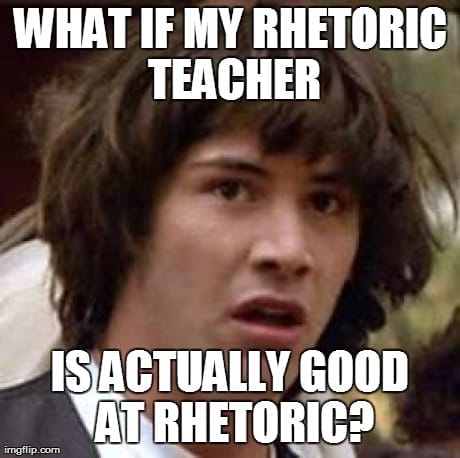
              Meme featuring Keanu Reeves as a teenager from Dazed and Confused. The text says "What if my rhetoric teacher is actually good at rhetoric?" This is a joke about the persuasive nature of rhetorical devices.

              Depending on the type of writing you’re doing, you’ll rely on some of these elements more than others. In non-fiction, logic and credibility are going to be at the forefront of your writing and you’ll want to use rhetoric or a rhetorical device to drive home your knowledge and reliability. You can also use rhetoric to make complicated subjects easier to understand for readers. 

              However, in fiction, emotion is going to play a leading role. While credibility and logic will be important, the rules of your world will need to make sense and readers will need to know which characters to trust. When writing fiction you’ll want to make your readers feel.

              Rhetoric or rhetorical devices can help you do this by helping readers understand a situation more deeply or relate to a character or situation they have no previous understanding of or experience with. 

              How can you do this? By using rhetorical devices.

              Let’s take a look at some different rhetorical devices, the tools you can use you can apply rhetoric to your writing, and how they might help in different types of writing. 

              What are Rhetorical Devices?

              A rhetorical device is a technique used by writers or speakers to convey a message to the audience or to evoke a particular response or emotion. To engage the elements of rhetoric, you can use a rhetorical device. These devices can be used to enhance the meaning of a message, make it more memorable, or make an argument more persuasive. They are used in persuasive speeches, non-fiction, and fiction writing. 

              Here are just a few of the rhetorical devices you could use (because there are a lot).

              Rhetorical Question

              Asking a question not for the sake of getting an answer, but to make a point or draw attention to a topic.

              Examples: “Is the Pope Catholic?” or,  “Are you kidding me?” 

              Alliteration

              The repetition of the same initial sound in a series of words.

              Example: “Peter Piper picked a peck of pickled peppers.”

              Anaphora

              The repetition of a word or phrase at the beginning of successive clauses.

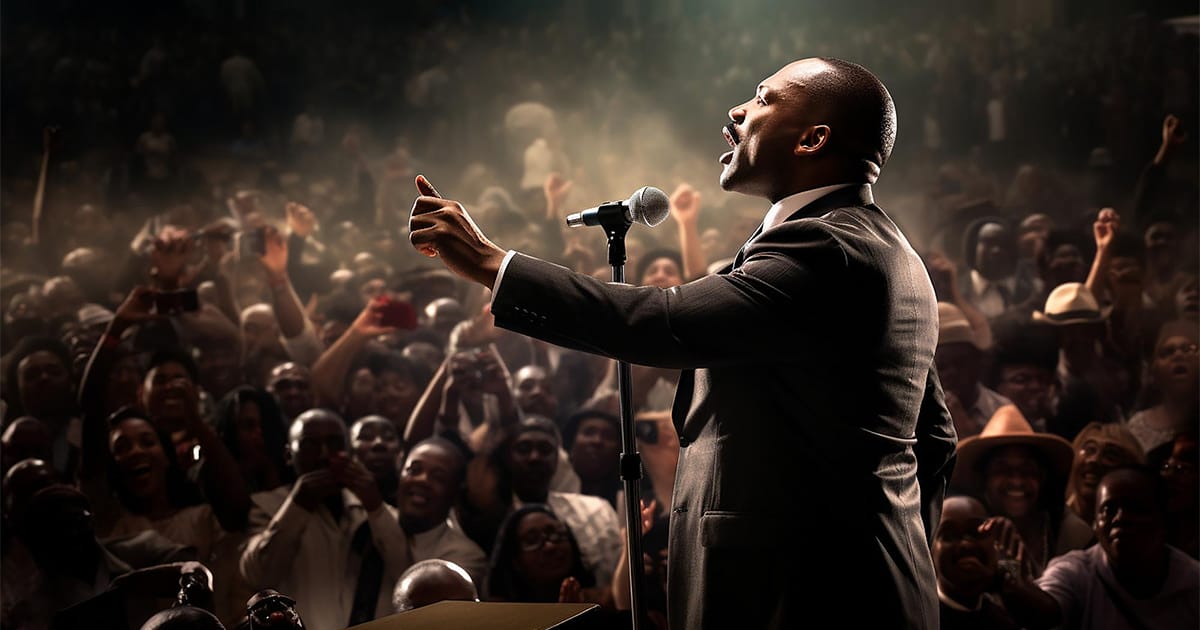
              Example: “I have a dream” from Martin Luther King Jr.’s speech.

              Hyperbole

              Exaggerating for emphasis or effect. 

              Example: “I’m so hungry I could eat a horse.”

              Metaphor

              A metaphor is a direct comparison between two unlike things, stating that one is the other.

              Example:  “All the world’s a stage and all the men and women merely players,” from Shakespeare.

              Oxymoron

              Combining two contradictory terms. 

              Example: “deafening silence.”

              Personification

              Assigning human qualities or characteristics to non-human entities or abstract ideas. 

              Example: “The wind whispered through the trees.”

              Simile

              A comparison between two unlike things using “like” or “as.” 

              Example:  “She sings like an angel.” 

              Famous Examples of Rhetorical Devices

              Rhetorical devices have been used throughout literary and oral history to paint pictures, pull an emotional response from an audience or prove a point.  

              Oxymoron 

              From Shakespeare’s Romeo and Juliet: “Parting is such sweet sorrow.”

              The juxtaposition of “sweet” and “sorrow” captures the complex emotions of love and longing. 

              ​Anaphora

              From Charles Dickens’ A Tale of Two Cities: “It was the best of times, it was the worst of times, it was the age of wisdom, it was the age of foolishness….”

              The repetitive “it was” at the beginning of each clause creates a rhythm and emphasizes the contrasts.

              From Martin Luther King Jr’s I Have a Dream Speech: “So let freedom ring from the prodigious hilltops of New Hampshire. Let freedom ring from the mighty mountains of New York. Let freedom ring from the heightening Alleghenies of Pennsylvania….” 

              Alliteration

              From Shakespeare’s Romeo and Juliet: “From forth the fatal loins of these two foes….” 

              The repetition of the “F” sound is a rhythmic alliteration. 

              These are just a small sample of the examples you can find across literature and of course rhetorical devices are used in movies and modern works as well, even articles, blogs or videos. 

              Why Use Rhetoric in Your Writing?

              Because rhetoric and rhetorical devices are so common and so effective, it can be hard to know when you’re even using them. This might leave you wondering why you should use them. This subtleness shows why we should use them. 

              When an author compares the emotion of a character to an experience or emotion the reader can relate to, it pulls the reader into that emotion so effectively, they don’t even realize they’re being “convinced.” 

              While the average reader might not understand what it feels like to send a loved one off on a quest from whence they may never return, they probably understand the ache that grows in your stomach when you send a child off to their first day of school or even a spouse to train for the military. And even though it’s not directly the same experience, they will start to feel that ache in the moment and may be able to relate more to the character than they did previously. 

              That’s the power of a rhetorical device. So the next time you’re writing, give it a try. Use a rhetorical device to convince your readers they’re feeling an emotion or help them understand a stance you’re making.

              101 Creative Writing Prompts
              That Will Get You Excited to Write

              Grab it for free 👇

                We’ll also send you our newsletter, which offers advice on freelancing and publishing.
                You can unsubscribe at any time.

              • The Hero’s Journey: A Primer For Freelance Writers To Tell Better Stories

                The Hero’s Journey: A Primer For Freelance Writers To Tell Better Stories

                When you know how to tell stories and how to hold attention, it can make you a better freelance writer.

                The Hero’s Journey is a great storytelling framework that should be a part of your writing arsenal so you can master the art of writing for an audience. While you will not always use this framework, there are elements of it you can sprinkle into your writing to make it even stronger.

                It is one thing just to write for clients and churn out good, high-quality content, but knowing what holds the attention of readers and inspires them to stay hooked on every word will keep your career alive for a long time.

                In this article, we will be diving into what The Hero’s Journey is, the basics you need to know, how you can use it in your overall writing, and a brief primer on some other storytelling frameworks you can use if you want to break outside of this method.

                The Hero’s Journey

                Why Does Storytelling Matter?

                Storytelling is an essential part of human communication and connection. No matter how much SEO and other marketing tools out there continue to take presence, the heart of good writing will always revolve around stories we read and share.

                Storytelling allows us to convey complex ideas, emotions, and experiences in a relatable and engaging manner, making information more accessible and memorable.

                Through stories, we can empathize with characters, share wisdom, pass down traditions, and inspire change, fostering a sense of unity and understanding among individuals and communities.

                Depending on the type of writing you do, you can also use it to create fascinating ads, compelling blog posts, and shareable social media posts.

                There are few downsides to learning the basics of storytelling so you can bring it into your writing. It is often something you will have to practice on your own so you can improve your skills in this area. It can also help to read fascinating and famous stories that use various methods so you can understand how they work.

                Why Should Freelance Writers Know How To Tell Stories?

                It is no secret that making it as a freelance writer is not always a walk in the park. When you are a freelance writer, you are battling thousands of other writers out there for a chance to make it.

                While there is an abundance of work to be passed around, there is still something to be said for having tools at your disposal to make you a better freelance writers than other writers out there.

                One of those tools is being able to tell stories that captivate and holds readers attention. One of the great storytelling frameworks is The Hero’s Journey. While you might not be able to tell the whole journey in everything you write, the summary you mainly need to know is that everyone loves a hero’s victory story.

                That could even translate to you telling the story of a local business in your area and the business owner’s challenges as they had to get their business growing.

                The Hero’s Journey is simply a framework for you to use to be able to tell a captivating story, and it is one we have used all throughout history to tell important stories over and over.

                What Is The Hero’s Journey?

                The Hero’s Journey is a narrative framework and storytelling pattern that was popularized by Joseph Campbell, a scholar of mythology and comparative religion, in his book The Hero with a Thousand Faces which was originally published in 1949.

                Campbell’s work explored common themes and structures in myths, legends, and religious stories from various cultures around the world.

                What Are The Steps In The Hero’s Journey?

                If you want the detailed version of this journey, you will want to read his book that is mentioned above. It is a much longer approach and analyzation of each of the steps along the path.

                Here is the short summary of The Hero’s Journey path:

                • The Ordinary World: The hero begins in a familiar and ordinary environment, which may be mundane or even oppressive.
                • Call to Adventure: Something disrupts the hero’s ordinary life and presents a challenge or opportunity. This is the initial call to action that sets the hero on a new path.
                • Refusal of the Call: The hero may initially resist the call to adventure, often due to fear, doubt, or a sense of inadequacy.
                • Meeting the Mentor: The hero encounters a mentor or guide who provides advice, training, or supernatural assistance to help them on their journey.
                • Crossing the Threshold: The hero decides to leave the ordinary world and enters a new, unknown, and often dangerous realm.
                • Tests, Allies, and Enemies: The hero faces a series of trials, meets allies and enemies, and undergoes personal growth and transformation.
                • Approach to the Inmost Cave: The hero approaches a central challenge, often a symbol of their ultimate goal or the villain they must confront.
                • Ordeal: The hero faces a major obstacle or battle, which is a critical and often life-threatening test.
                • Reward (Seizing the Sword): After overcoming the ordeal, the hero reaps a reward, which may be a physical object, knowledge, or personal growth.
                • The Road Back: The hero begins the journey back to the ordinary world, often facing new challenges or pursuing the final confrontation with the antagonist.
                • Resurrection: The hero faces a final, often life-or-death, ordeal that represents the climax of the story. This can involve a confrontation with the main antagonist.
                • Return with the Elixir: The hero returns to the ordinary world with the knowledge, experience, or object gained during the journey, which can bring transformation and positive change to their life or community.

                Examples of The Hero’s Journey

                We will not spend too much time diving into these stories and explaining what they are about, because that could be a whole article in and of itself. However, here are a few stories that embody The Hero’s Journey storytelling formula:

                • The Lord Of The Rings
                • Harry Potter
                • The Lion King
                • The Matrix
                • The Odyssey

                Writing The Anti-Hero’s Journey

                An alternative take to The Hero’s Journey is to create the Anti-Hero’s Journey. There is not a particular framework to follow here, but if you have found that The Hero’s Journey is old, tired, and done too many times already you could challenge yourself to create the opposite story.

                What about the story of someone who did all the wrong steps along the way? Who didn’t follow the traditional path? What about someone who failed along the way and never recovered?

                There are a few different angles you could choose to take if you want to rebel against this type of framework.

                Other Storytelling Frameworks

                Other storytelling frameworks all writers should know:

                • The Story Cycle framework
                • The 3-act structure framework
                • The Pixar framework
                • The StoryBrand framework

                Ready To Become A Freelance Writer?

                If you are ready to take your writing career seriously and start to grow your business, you do not want to miss out on the Freelance Writers Den!

                Advertisement for the Freelance Writers Den, a writing community with more than 300 hour of training for one affordable monthly price

              • 3 Metaphor Examples And When You Should Use One

                3 Metaphor Examples And When You Should Use One

                When it comes to succeeding as a writer, there are a lot of rules and techniques you should know and learn how to use. One of them is how to properly use metaphors in your writing.

                We will be going over what metaphors are, taking a look at some metaphor examples, and going through some other tricks and tips in order to use them in the right way.

                Metaphors can make your writing stronger and give readers something to visualize when they are reading. Imagine when you hear the phrase “couch potato” and while it logically does not make sense, you can also imagine what that is in your head.

                Keep in mind, metaphors are not always something you are going to use in your writing. There is a time and a place to use them, but we will be going over when you should avoid using them, too.

                Metaphor Examples

                New call-to-action

                What Is A Metaphor?

                While you might have a vague idea of what a metaphor is, you might not know exactly how to define what it is. Let’s cover the basics and then dive into more of an explanation.

                According to the Dictionary:

                A metaphor is a figure of speech in which a word or phrase is applied to an object or action to which it is not literally applicable.

                A metaphor is a figure of speech that involves making a direct comparison between two seemingly unrelated things to highlight a similarity between them. Unlike a simile, which uses “like” or “as” to make a comparison explicit, a metaphor uses the imagination to create comparisons.

                Metaphors are often used to make descriptions more vivid, engaging, or expressive by drawing on the reader’s understanding of the compared items.

                Metaphors are often used in literature, poetry, and everyday language to create imagery, enhance communication, and convey abstract ideas in a more relatable and understandable way.

                Why Writers Should Learn To Use Metaphors

                Metaphors can help make your writing memorable. It can help you express deeper emotions and spark the readers imagination while they read it.

                It can make your writing stand out, be more creative, or be more memorable. As you can imagine, all of those are important reasons to use them in your writing if you want to become a full-time writer.

                Even if you do not enter a creative writing field, you should still practice using them every now and then so you can improve your overall writing skills.

                However, that does not mean writers should always use metaphors, as there are times and places to do so.

                When To Use Or Not Use Metaphors

                For the most part, you will want to use metaphors when you are doing any type of creative writing.

                You might not want to use them as often in an academic or business context, depending on what you are writing.

                If you are unsure, you will want to think about the person or audience you are writing for and decide if it is a good idea to include creative writing in it. You will also want to consider if the audience is native speakers to your language because sometimes metaphors will translate in a weird way that can be off-putting.

                Here are some other times you might not want to use metaphors:

                • Technical writing – Most technical writing needs to be straightforward and clear-cut, so it is not the time to be creative.
                • Legal writing – For the same reasons above, you will want to avoid metaphors and creative language in legal writing.
                • Sensitive topics – You never want to come across as trivializing or insensitive in these kinds of situations, so keep the metaphors at bay.
                • Overused – You also do not want to overdo it with. metaphors in any creative writing.

                Metaphor Examples

                Now that we have covered the basics, we will dive into some more specific examples and then give a longer list of other ones you might have heard of.

                Example #1: “Time is money.”

                In this metaphor, time is compared to money, suggesting that just as money is valuable and should be spent wisely, so should one’s time.

                Example #2: “Her smile was a ray of sunshine.”

                This metaphor compares the brightness and warmth of a smile to the qualities of sunlight.

                Example #3: “The world’s a stage.”

                This metaphor implies that life is like a theatrical performance, with people playing different roles and putting on a show for others.

                This one also comes from As You Like It by William Shakespeare, a great piece to dive into if you want to learn about extended metaphors, which we will cover below.

                “All the world’s a stage, and all the men and women merely players.”

                Shakespeare

                Some other metaphor examples that are common in our language:

                • Having a heart of gold
                • Money is the root of all evil
                • She is the bomb
                • He’s is a couch potato
                • Time is money
                • Her voice was music to his ears
                • The world is a melting pot of cultures
                • Life is a rollercoaster with its ups and downs
                • His words were a dagger in my heart
                • She’s a shining star in our organization
                • Love is a battlefield
                • The classroom was a zoo after the teacher left
                • The city is a concrete jungle
                • My heart is a lonely hunter
                • His anger was a volcanic eruption
                • The book was a passport to another world
                • The detective had a mind as sharp as a razor
                • The news hit me like a ton of bricks
                • Time is a thief in the night
                • The idea planted a seed in her mind
                • Her laughter was infectious
                • The politician’s promises were empty words
                • The car roared to life
                • His smile was a beacon of hope
                • Life is a highway
                • He is an early bird

                What Is An Extended Metaphor

                While we have now extensively covered what a metaphor is, but you might be wondering what an extended metaphor is or how they work.

                An extended metaphor is a metaphor introduced and then further developed throughout all or part of a literary work, especially a poem.

                Dictionary.com definition of an extended metaphor

                An extended metaphor is a literary device that occurs when a metaphor is prolonged and developed throughout a piece of writing or a speech, often spanning several sentences, paragraphs, or even an entire work.

                Unlike a regular metaphor, which is a brief comparison, an extended metaphor is sustained and elaborated upon, allowing the writer to explore and explain a complex idea or theme in depth.

                In an extended metaphor, the initial comparison is introduced, and then various facets or aspects of that comparison are explored further, often providing a deeper insight or understanding of the subject matter. This technique is frequently used in poetry, prose, and speeches to create a more profound and lasting impact on the reader or audience.

                These are not something you will often start using when you are learning creative writing. It takes time to learn how to draw out the same meaning across a whole piece.

                Need More Writing Help?

                The book editing checklist and guide below will help you make sure you have not only your metaphors but all of your other editing on point throughout your book.

                Pesky typos and other simple errors are enough to turn off potential readers, so having them sprinkled throughout your book can be a huge problem. You will want to make sure you catch all of the errors before your book is published and this guide can help.

                Get your copy today!

                [sps_form_banner_t form_id=”819bff92-fa7e-4c48-bfa1-c7b928136746″ button_text=”SIGN ME UP!” ty_url=”https://learn.self-publishingschool.com/twl-ty-optin-check-your-email”]

                FREE RESOURCE

                BOOK EDITING CHECKLIST & GUIDE

                Grab your FREE guide now and embark on a journey of refining and enhancing your book. Your readers deserve the best – claim your copy today and make your words shine!

                [/sps_form_banner_t]
              • What is Irony? + 5 Tips To Use It In Your Writing

                What is Irony? + 5 Tips To Use It In Your Writing

                When it comes to learning different ways to write, you will want to spend time learning the advanced techniques to make your writing even stronger.

                In all of your writing techniques, you might have wondered what is irony?

                Irony is a powerful literary device that adds depth and complexity to your writing. It occurs when there’s a gap between expectation and reality, often resulting in a humorous or thought-provoking twist.

                In this article, we will summarize what irony is to help you understand the basics, how to use it in your writing, and a primer on the different types out there to pick from.

                What Is Irony?

                Irony is a literary and rhetorical device that conveys a disconnect or incongruity between what is expected and what actually occurs. It often involves a subtle, often humorous, twist in meaning or situations.

                Irony, in its broadest sense, is the juxtaposition of what on the surface appears to be the case and what is actually the case or to be expected; it is an important rhetorical device and literary technique. Irony can be categorized into different types, including verbal irony, dramatic irony, and situational irony.

                Wikipedia page on “Irony”

                Irony serves various purposes in writing, from humor and satire to commentary on the human experience. It can sometimes be hard to fit into a box and is one of those things you understand when you start to read it.

                When used in an advanced way, irony invites readers to think critically about the world and human nature, challenging them to look beyond the surface of words and actions to uncover deeper layers of meaning.

                What Are Different Types Of Irony

                When it comes to including irony in your writing, there are various forms you can use. You will need to know the differences if you plan to use it in your writing.

                1. Verbal Irony: This occurs when a character says one thing but means another. Sarcasm is a common form of verbal irony, where the speaker intentionally says the opposite of what they mean to mock or criticize.
                2. Dramatic Irony: This occurs when the audience or reader knows something that the characters in a story do not. This knowledge creates tension and often leads to unexpected outcomes.
                3. Situational Irony: In this type, there’s a contrast between what’s expected to happen and what actually happens. It can be both amusing and thought-provoking. For example, a fire station burning down is a situationally ironic event.
                4. Cosmic Irony: This is a broader concept where the universe itself seems to conspire against human desires and expectations. It suggests a sense of fate or destiny that’s often cruel or indifferent.

                For the most part, you will use situational and verbal irony in your writing, but that gives you an overview of some other options, as well.

                How to Use Irony In Your Writing

                Remember that while irony can be a powerful tool, its effectiveness depends on context, tone, and the skill of the writer.

                While irony can be hard to always define, there are a few tips you can keep in mind for you to use to start using irony in your writing.

                1. Consider your audience

                Before you try and use irony in your writing, you will want to think about if your audience is the right kind to appreciate irony.

                For example, if you are writing for a business context, you will most likely not want to use irony because that is not the format for creative writing. What may be ironic to one group of readers might not be to another.

                2. Start doing word play and get creative

                Play with words or phrases that have double meanings. This can lead to humorous or thought-provoking results.

                It will take a while in order to properly use irony in the right situation. Even advanced writers can have a hard time nailing it every time! To get a better grasp of how to use irony, read works by authors who excel at it.

                3. Play with timing

                The timing of your ironic statement can enhance its impact. Place it strategically in your writing to maximize its effect.

                4. Keep consistent with your tone

                Make sure that the ironic statement or situation is consistent with the tone and style of your overall piece. Sudden shifts in tone can be jarring for readers.

                5. Edit ruthlessly

                Irony can be subtle, so revise and edit your work to ensure that the irony is clear and effective. Ask others for feedback to gauge how well it comes across.

                Tips for Using Situational Irony

                For the most part, writers are going to mostly use situational and verbal irony in their writing.

                If you plan to use situational irony in your writing, here are a few tips for this specific type of irony.

                In situational irony, create situations where the outcome is different from what is expected. This can surprise and engage your readers.

                Before you can create situational irony, you need to establish clear expectations or a baseline for what your readers anticipate will happen. Describe the situation, characters, or circumstances in a way that leads your audience to expect a particular outcome or resolution.

                Build tension or anticipation by subtly foreshadowing events or developments that seem to align with these expectations.

                Once you’ve set up the reader’s expectations, subvert them by delivering an outcome that is unexpected and contrary to what was anticipated. The surprise element is key to situational irony.

                Make sure the twist is logical within the context of your story. It shouldn’t come completely out of left field but rather reveal a deeper layer of meaning or an ironic contrast with the established expectations of the storyline.

                Tips for Using Verbal Irony

                If you plan to use verbal irony in your writing, here are a few tips for this specific type of irony.

                Sarcasm is a form of verbal irony that involves mocking or ridiculing. While it can be effective, it should be used carefully, as it can come across as mean-spirited or offensive.

                Exaggeration and understatement are tools to create verbal irony. By downplaying or overstating a situation, you can convey the opposite of what is stated.

                Use situational or character-based context to create a foundation for the irony. For example, if a character is known for their straightforwardness, their use of sarcasm or irony will stand out more.

                Verbal irony should be clear to the reader without being overly explicit. The key is to strike a balance so that the audience grasps the irony without having it explained.

                Use tone, context cues, or subtle hints to guide your readers toward the intended meaning. Be aware that if the irony is too subtle, it may be missed altogether.

                For instance, if you’re writing a story where a character is always pessimistic, you can use verbal irony by having them say something like, “Oh, great, another sunny day,” when the character actually despises sunny weather. The irony lies in the contrast between the words spoken and the character’s true feelings, and the context helps readers understand the intended meaning.

                What To Do Next

                Ready to write your fiction book?

                This writer class will teach you all of the basics you need to know to make passive income as an author!

                Click below to find out more:

                New call-to-action
              • How To Use Storytelling In Writing In 4 Essential Steps

                How To Use Storytelling In Writing In 4 Essential Steps

                You might have heard how important storytelling is when it comes to content and writing in general.

                No matter what type of writing you are doing, learning how to use storytelling to your advantage can help your work stand out and draw in readers.

                If you don’t know how to use storytelling in writing, thankfully there are some tips you can use to bring your writing to life, even if you are not doing creative writing.

                Throughout this article we will break down the fundamentals of storytelling, why all writers should learn the essentials, and then dive into some tactical things you can use in your writing.

                What Is Storytelling?

                Storytelling is the art of using a story to convey a message and to draw readers in and give them a reason to be emotionally involved in your writing.

                Storytelling is the social and cultural activity of sharing stories, sometimes with improvisation, theatrics or embellishment. Every culture has its own stories or narratives, which are shared as a means of entertainment, education, cultural preservation or instilling moral values.

                From Wikipedia

                Once you know the core elements of storytelling, you can start to use those tactics in everything you write to make it more engaging and interesting.

                Most of us think of fiction writing when it comes to storytelling, but you can use it in almost any kind of writing. Even if you do not write fiction, it can be good to practice storytelling as a way to draw more attention to your writing and level up as a writer in general.

                Why Is Storytelling Important?

                For the most part, humans remember and become more attached to stories than almost anything else. There is a reason we love reading books, watching movies, and telling stories at social gatherings. It is because we love that stories do to us.

                For example, we can hear statistics and data about events in the world, but we connect to it and remember things more when storytelling is involved. It is why you can remember stories you heard and can repeat them better than you can recall facts you learned in school.

                When we talk to people in our lives, we share stories and it is how we relate to each other.

                If you want to be a writer, no matter what writing niche you pick, knowing how to use storytelling to your advantage can help grow your career in ways you never planned.

                title card for how to use storytelling in writing

                Why Storytelling Matters In Blogging

                If you want your blog to stand out and start to hook readers, you will need to use elements of storytelling to grab attention.

                It is one of the best ways to build a following and create content that people want to share. Not enough blogs utilize storytelling in their posts, so it is a great tool to use to stand out between so many competitors.

                Including a story is also a way for your reader to really understand and visualize what you are trying to say and understand your message in a way that they would not otherwise.

                Benefits of Using Storytelling

                Storytelling is a great way to grab people’s attention and keep it hooked.

                There is something uniquely human about the love of stories and our desire to always keep them in our lives, even if it is

                You will often find that you can increase engagement as well when you use stories. People love to comment and engage on particular stories.

                Think about the creator behind Humans Of New York who simply walked around New York (and eventually then multiple places in the world) where he would ask people to share their stories. It captivated people around the world and garnered a lot of attention.

                Storytelling gives people a reason to share content, too, as it is more interesting than a blog that is just about a particular topic.

                How to Use Storytelling In Writing

                Now that we have covered the basics of why storytelling matters and what it is, now is the time to dive into the tactical things you can use to start bringing more stories into your writing.

                Determine your main story

                In almost any story, there is a beginning, a middle, and an end. If you want to use storytelling in your writing, you need at least those three main points of your story outlined so you know what to include.

                That makes it incredibly simplified, but it is the best place to start if you are new to telling stories.

                Give people a reason to care

                First, you will need to think about who you are telling the story, the purpose of the story in the first place, and how those two go together.

                Sure, you can write a story for the sake of sharing a story, but often you will have a particular reason to share a certain story and a certain person you want to read it.

                This is especially true if you are blogging or doing any kind of writing for marketing or branding purposes.

                It might seem tedious to spend the amount of time thinking about the reader and what they need out of your writing, but it will be worth it.

                Keep some of these storytelling basics in mind

                There are some things you will and will not want to include in your writing.

                For example, take out cold, boring language. This is particularly common with businesses that use storytelling, where they rely on a ton of jargon and business-speak and avoid getting into the flow of telling a story.

                You will also want to highlight sensations and the senses when it comes to writing a story, since that is what makes them so visual. You will want to talk about how things smell, taste, look, feel, sound, and so on. It can draw them in and help them put themselves in a position to feel the story.

                Write the story as if you were telling it to someone you were with. That is a great way to write a story in a natural way.

                Continue practicing

                One of the main things you need to keep in mind if you want to use storytelling in writing is you will need to practice over and over in order to be an effective storyteller.

                Vertical graphic that says Use these 4 essential steps in your storytelling. 1) determine your story 2) give people a reason to care 3) keep storytelling basics in mind 4) continue practicing