Blog

  • Writing Prompts: 52 Places to Find Them When You Need Inspiration

    Writing Prompts: 52 Places to Find Them When You Need Inspiration

    If you feel like you are stuck in your writing, writing prompts might be just what you need to get out of your rut.

    Whether you’re experiencing writer’s block or you’re tired of your own voice, style or subject-matter, writing prompts can give you a creative jolt to help you begin something new. 

    In addition to being a writer and editor, I teach writing in public schools and in a nearby detention center. This means I regularly use writing prompts with students of all ages. 

    What is a writing prompt? 

    A writing prompt is a brief image or topic that can help writers generate new ideas. Writing prompts can be a great way to inspire ideas in any genre of writing. 

    They can also take a huge variety of forms. Whether you’re inspired by news headlines, objects, one-word prompts, detailed questions or reading a poem or full work of prose, writing prompts can help you explore a particular topic, engage in a “conversation” with other writers or get through writer’s block. 

    Writing prompts can also help you make new or unusual connections between things. I was once asked to write an essay that incorporated a dog, a wristwatch and scuba diver. This prompt resulted in an essay that was published in a magazine.

    Where to find writing prompts

    Writing classes can be wonderful places to encounter interesting prompts, but the internet is also swimming with more prompts than you can ever use. 

    The following list is a collection of some of the resources that can help you generate new work no matter what genre you’re working in.

    While these prompts are grouped in categories, many of the websites offer prompts in multiple genres. Remember that a genre-specific prompt can often be used to generate interesting ideas or connections in other genres, too.

    Here’s where to find writing prompts.

    Fiction writing prompts and creative writing prompts

    1. Poets & Writers: The Time is Now

    Poets & Writers Magazine publishes a new fiction prompt online every Wednesday. These prompts are typically a paragraph in length and they encourage ideas through a series of questions and suggestions.

    2. Self-Publishing School: 400+ Creative Writing Prompts to Find Your Next (Best) Book Idea

    These prompts are aimed at inspiring plot and character development and are meant to generate the sparks needed to fuel writing a book. Sets of prompts are grouped into genres of fiction writing such as mystery, dystopian, fantasy, and more. Each group of prompts is also accompanied by a series of tips for how to write in a particular genre.

    [twl_reusable_block post_id=41455]

    3. 12 Nature-Inspired Creative Writing Prompts

    Nature writing typically brings to mind nonfiction writing, but this list of prompts encourages nature- and place-based storytelling. The prompts contain detailed visual descriptions to help you jump into a particular place or scene. 

    4. Writer’s Digest Creative Writing Prompts

    These prompts are posted weekly and help to generate specific scenes or ideas you can expand on. Most of the prompts are a series of questions to help generate details about plot and character development.

    5. 21 Writing Prompts to Help You Finish an Entire Novel This Summer

    These short prompts offer a topic, scenario or structure broad enough to build a book around. Each prompt is accompanied by a gif that works as an additional prompt for people who are inspired by visual imagery.

    6. Plot Prompts for Fiction: Writer Igniter

    This simple but innovative website offers digital flashcards to help writers explore character, situation, prop, and setting. Four specific cards are offered to the writer and when you finish (or if you want a different idea) you can just press the “shuffle” button and get an entirely new combination to write about. 

    7. Creative Writing Now: Fiction Writing Prompts

    The heart of any story often involves a character’s internal or personal journey. These prompts offer a full paragraph to flesh out a particular character and the personal or relational challenges they are facing.

    8. Creative Writing Now: 44 Short Story Ideas

    Designed for shorter works of fictions, these short story prompts offer brief scenarios for inspiration. Each set of ideas comes with a writing challenge, and you are encouraged to mix and match ideas from each of the prompt lists. There’s even one set of prompts that helps you brainstorm personal fears and habits and helps you fictionalize them. 

    9. ServiceScape Fiction Writing Prompt Generator

    Scroll through a list of fiction sub-genres, such as “utopia,” “space opera,” “science fiction romance,” or many other sub-genres, to pull up a carousel of prompts. Each prompt is about a paragraph long to set the scene and situation—perfect for any fiction writer who just needs a nudge to get them off and running. 

    10. Fiction Prompts on StoryADay with Julie Duffy

    The prompts provided on StoryADay often ask writers to imagine a momentous moment and dive right into the action. These prompts can be great for helping writers craft plot. Each prompt is paired with a photograph, too, which can be another boon for anyone who derives inspiration from imagery. 

    11. The Writer: Writing Prompts

    Writers looking to combine mundane, everyday life with secrets, mysteries, or other strange twists will likely find these prompts intriguing. Paired with colorful and engaging images, these prompts are updated weekly on Fridays.

    12. 40 Short Story Prompts You Can Write in a Day

    If all you need is a scenario, these prompts should do the trick. Each prompt sets up the situation, and it’s up to you to provide the story! 

    13. Random Story Prompt Generator

    Click a button and receive a few random prompts! These work well for writers who just need a handful of objects and archetypal characters for inspiration to strike. And for even more random story prompts, check out the links to other story generators below the prompt box. 

    14. Giant Golden Buddha & 364 More 5-Minute Writing Exercises

    For fiction writers who need inspiration for how to begin, these prompts are detailed and focused enough to help you zero in on an opening paragraph, a brief scene, or a vivid description of a character.

    Flash Fiction Prompts

    15. Laurie Stone’s Flash Fiction Prompts

    The prompts on this website are creative and include sentence fragments, excerpts of poems, and sentences with fill-in-the blank spots. The variety makes these prompts unusual and great for experimentation. 

    16. Bookfox: 50 Flash Fiction Prompts

    Designed for fiction 1,000 words or under, these prompts will likely spark ideas for short stories or even novels. The prompts are grouped by category and each prompt introduces the main character and the tension for a writer to run with. 

    17. 62 of the Best Flash Fiction Story Prompts

    This list of prompts is perfect for fiction writers who want to try their hand at writing flash fiction. Steph Fraser provides an overview of flash fiction and tips for how to write flash stories successfully. This introduction is followed by prompts which are grouped by sub-genres such as “horror” and “romance.” 

    18. 99 Days of Flash Fiction Prompts

    If you need a little more to go on than a few words, but don’t need a full paragraph, these prompts provide brief dialogue and just enough sensory detail to spark a flash story idea.

    19. 100 Days of Fun Flash Fiction Prompts

    These brief prompts created by Eva Deverell are designed to keep you writing every day, but can be used at random, too. As a bonus, her website offers a number of other free writing resources, too! 

    Nonfiction writing prompts

    20. Submittable Prompts

    Writers who submit work to literary magazines are likely familiar with Submittable — but did you know their blog has an archive of writing prompts? Each blog post is accompanied by an image that relates to the theme of the prompts. There are 8-10 prompts focused on a particular idea or theme. Most of these prompts can easily be used for other genres. 

    21. Poets & Writers: The Time is Now

    Poets & Writers Magazine publishes a new nonfiction prompt every Thursday. Writers can also subscribe to the Time is Now weekly e-newsletter to receive prompts for nonfiction as well as fiction and poetry.

    22. The New York Times Learning Network: 550 Prompts for Narrative and Personal Writing

    Not only are these prompts grouped in easy-to-navigate categories, but each prompt is linked to background information, a brief summary of someone’s story as it pertains to the topic, and a series of questions aimed at helping a writer think through the various aspects of a particular prompt. This is a great option for writers who need more than one-word prompts!

    23. Bad-Ass Writing Prompts to Kick-Start Your Creativity

    Each of these prompts lays out a brief scenario and asks a question aimed at self-discovery or introspection. These would be particularly useful for personal essayists or memoirists who are trying to find a way into writing about their bad or regrettable behaviors. 

    24. 10 Ways to Inspire Personal Writing with The New York Times

    Writers with years of expertise and a keen eye for structure and tone will benefit from these advanced writing prompts. Each prompt provides loose guidelines for modeling a piece on the writing published in particular sections of The New York Times. The prompts include links to published work writers might reference as good examples.

    25. Creative Nonfiction Prompts

    The 50 prompts on this list are pulled from Melissa Donovan’s book, “1200 Creative Writing Prompts.” The list is made up of strings of questions that ask writers to recall various types of memories, or to engage with emotional or intellectual responses to music, art, and media. 

    26. Bookfox: 50 Creative Nonfiction Prompts Guaranteed to Inspire

    Most memoirists and personal essayists explore relationships in their writing and this list of prompts is bound to jog particular kinds of memories. Most of the prompts relate to childhood or family relationships, but some prompts focus on other types of relationships, too.

    27. Event: 30 Non-Fiction Writing Prompts

    While some people prefer a word or phrase to spark an idea, others benefit from paragraphs and series of questions, and some enjoy reading a full essay or article before beginning to write. This list of prompts offers all three options for each of the 30 ideas. Some prompts suggest a straightforward retelling, but others suggest looser associations and experimental nonfiction writing.

    28. 11 Strange Fiction/Nonfiction Prompts

    Derived from the quotes of renowned writers, these prompts ask writers to dig deep and consider the connections between small, detailed moments and larger themes or events. The prompts can easily be used for either fiction or nonfiction. 

    29. 10 Easy Writing Prompts to Get Your Life Story Started

    It can be difficult to write about your complex life story in a clear way. Each of these ten prompts provides a frame so that you can dive into one aspect of your life story that will likely illuminate larger themes as you keep writing. 

    30. Writing Class Radio

    Perfect for people who prefer a minimalist approach, Writing Class Radio provides daily prompts of one or two words. The website also hosts a nonfiction writing podcast that features writers sharing work and discussing craft.

    31. Writing Our Lives Personal Essay Prompts

    Writer Vanessa Martír posts prompts weekly. Each prompt invites writers to reflect deeply on a particular memory or set of memories and most prompts include a quote from a book or movie that connects to the topic. Many of the prompts are focused on reflection and healing. 

    32. Journal Writing Prompts for Beginners: 119 Journal Prompts

    You don’t have to seek publication to be a writer. Writing for yourself counts, too! People who want to journal but aren’t sure where to start or what to write each day (or week) will find this list of prompts to be helpful in sparking ideas for topics.

    33. Bernadette Mayer’s List of Journal Ideas

    For beginners and advanced journalers and nonfiction writers, this list is divided into categories to give you ideas for themed journals, topic ideas, and quote fragments meant to inspire. There are also longer prompts that encourage experimentation with structure, form, and collaboration.

    Flash Nonfiction Prompts

    34. Flash Nonfiction Lessons in Concision and Revision

    As a writing instructor, Zoë Bossiere has a lot of wisdom to share about the various kinds of flash nonfiction and the elements that make flash writing different than longer types of writing. Although this is essentially a lesson plan on Assay: A Journal of Nonfiction Studies, writers can learn a lot about the four main types of flash nonfiction, and gain inspiration for their own flash pieces from the many examples and resources that Boossiere provides. 

    35. Documenting Life, Briefly: Flash Nonfiction Prompts

    In each of these prompts, the writer is invited to approach the truth of the world or themselves from a different angle, whether it’s a memorable phone call or something from the news you just can’t shake. Some prompts walk you through a series of steps, and others offer just a couple of lines to help you begin. 

    Poetry writing prompts

    36. Poets & Writers: The Time is Now

    Poets & Writers Magazine releases a new poetry prompt once a week on Tuesdays. You can access these on the website or sign up to receive the prompts in their weekly writing prompt e-newsletter. These prompts are typically in the form of a paragraph with excerpts of poems or quotes accompanied by a series of questions or suggestions.

    37. Think Written: 101 Poetry Writing Prompts

    If you want to jump right into a poem, these prompts are a great way to start. Each prompt is one short sentence and the list is filled with suggestions that will evoke memories or spark your imagination. 

    38. Writer’s Relief: 125 of the Best Writing Prompts for Poets

    These prompts consist of two words or a short phrase or image meant to evoke life memories. The prompts are grouped in categories like “Momentous Occasions” and “Mysterious Places.”

    39. Creative Writing Now: Prompts for Poetry

    These short prompts are open-ended and each one might be used repeatedly to produce different kinds of poems. Many of the prompts suggest using a set of specific words. Using words you might not use ordinarily can help you stretch creatively as a writer!

    40. Poetry Prompt Generator

    Choose the number of words you want to appear on this page, and the number of challenges. Then decide whether you’d like to draw inspiration from an image, and press the “Get Prompt” button. Voila! You now have a set of instructions, a list of words to try to use in your poem, and an image to get your creative juices flowing. 

    41. The Poetry Writing Society: Poetry Writing Prompts

    Each of these prompts involves a series of instructions or steps. For poets who are feeling particularly stuck or benefit from structure, the prompts here just may do the trick. 

    42. Writing Forward Poetry Prompts

    The 25 prompts on this list are pulled from Melissa Donovan’s book, “1200 Creative Writing Prompts.” Books can be great resources for writing prompts and many authors make some of these printed prompts available online. Many of these prompts suggest writing poems that use a specific set of images or sounds.

    43. 30 Writing Prompts for National Poetry Month

    Take your shoes off, grab the nearest book, or find a recipe: Many of these prompts derive inspiration from the objects and ideas that surround you. 

    44. CAConrad’s (Soma)tic Poetry Exercises

    How do you feel about putting a penny under your tongue before writing? For poets or other creative writers looking for embodied experiences to inspire their writing, these exercises are more than just prompts. Each exercise calls on writers to engage in a particular activity while thinking about particular memories and ideas. 

    Writing prompts on social media (including Reddit writing prompts)

    45. Reddit Writing Prompts

    You can find anything on Reddit — including writing prompts. Most of the prompts on Reddit are for fiction writers, but the search bar will turn up other genres, too. Reddit prompts are great for people who want to write and get feedback in an online community.

    46. Tumblr Writing Prompts: Story Prompts

    Tumblr is a virtual treasure trove of writing prompts of any genre and topic you can imagine. Story Prompts curates prompts from across many different Tumblr accounts, but you can also search for specific blogs or genre types.

    47. Facebook Writing Prompts: Windcatchers

    Windcatchers is one of many writing prompt Facebook groups and it is run by writer Michelle Labyrinth. Prompts are posted about once a week and other articles and resources for writers are posted, too. The prompts are generally targeted to nonfiction writers.

    48. Twitter #Writing Prompts

    Hashtags make it easier than ever to find the kind of prompts you are looking for. #writingprompts generates lots of different kinds of prompts, but there are also Twitter accounts you can follow that are devoted to particular kinds of prompts.

    49. TikTok Writing Prompts

    Obsessed with TikTok? You can find writing prompts there, too! Type “writing prompts” into the search feature and you will find a list of the top accounts posting writing prompts. Some accounts post multiple times a day, and others post less frequently but have an archive of prompts you can scroll through. 

    50. YouTube Writing Prompts

    Do you squander valuable writing time by watching too many cat videos on YouTube? Not to worry—there are tons of writing prompt videos on YouTube. Often, the key to inspiration is looking for it in the places you spend the most time.

    51. Instagram #WritingPrompts

    Like Twitter, you can easily find any kind of writing prompt by searching for a specific hashtag. However, Instagram is ideal for the image-oriented writer; many prompts are accompanied by an image or background that can provide additional inspiration.

    52. Pinterest Writing Prompts

    Pinterest is not the first place most writers would think of when searching for prompts, but like Instagram, it has a wealth of image-oriented prompts across all genres. For people who already spend time on Pinterest, this can be a great way to find writing inspiration, too.

    [twl_reusable_block post_id=41455]

    Photo via frantic00 / Shutterstock 

  • 5 Easy Steps to Succeeding at NaNoWriMo this November

    5 Easy Steps to Succeeding at NaNoWriMo this November

    Wondering if there’s a method to succeeding at NaNoWriMo (National Novel Writing Month)?

    Yes, there is. And it’s not nearly as overwhelming as you may think.

    The goal NaNoWriMo is to write a 50,000 word novel in 30 days. But NaNoWriMo doesn’t have to be just for novelists. After all, who says fiction writers get to have all the fun? Who says bloggers can’t use the momentum and hype of NaNoWriMo to give themselves a break when things get a bit topsy-turvy?

    Let’s break this annual challenge down for bloggers. A typical blog post is anywhere from 500 to 2,000 words, and around 300 words if you’re into microblogging. Therefore, 50,000 words translates to 50 to 100 blog posts—or roughly 160 micro blog posts.

    Now, in the realm of the Internet where content is king, it’s safe to assume that the queen behind such a throne is Lady Consistency. For those of you looking to create an empire of followers, you not only have to write content people want to read but you also have to produce content on a regular basis. Sounds easy enough, right? Well, no not really.

    [sps_reusable_block post_id=43050]

    We’ve all had upsets in the writing schedule. Maybe you had to step away from the keyboard because Little Timmy fell down the well again. Maybe you forgot about your Aunt’s five-year anniversary for Mr. Whiskers and you had to run out to purchase enough catnip to redefine the word “catatonic” as an apology. Maybe you found yourself stranded with a flat tire wishing you at least had a horse with no name. The point is, due to health, nearly forgotten prior commitments to loved ones and YouTube Shorts our dear friend Murphy can make consistency anything but a breeze.

    However, imagine if you were prepared for such whoopsie-daisies. Imagine if you had at least 40 articles in your back pocket to choose from on any given day. Imagine all the things you could do guilt-free.

    Say yes to friends and family. Say yes to that vacation you’re eyeing. Say yes to mental health days. Say yes to generating more money as a freelance writer because you can finally afford the time to expand your cyber territory now that your personal blog is taken care of.

    Just don’t say yes quite yet, we still have a bit of quick planning to do before November if we are going to pull this off. No really, it will be quick, only five steps to succeeding at NaNoWriMo.

    5 Steps to Succeeding at NanoWriMo as a Blogger

    Step 1: Generate Ideas

    To write 50,000 words in 30 days, you need to have somewhere around 50 ideas to write about, and the best way to do this is to implement an Idea Journal. An Idea Journal is exactly what it sounds like. It’s a journal that you keep with you (a physical notebook or electronic device) and use to jot down any and all ideas that come to mind.

    Please know that there are no dumb ideas, bad ideas or ideas that are off limits to the Idea Journal. Like a rough draft, nobody but you has to know what’s in it. Besides, it is important that you provide positive reinforcement to your subconscious every time it tosses a spark of creativity out. It keeps writer’s block away.

    Step 2: Plan Your Research

    Once you have roughly 50 ideas to play with it’s time to dig into SEO and figure out what research links you will need at the ready to write your articles.

    Knowing what you want to delve into and where you plan to dig up your information is crucial to churning out content quickly. The less time you spend hunting around Google and Google Analytics when it is time to write, the better chance you have of succeeding at NaNoWriMo. Have at least two or three links for research reference, the links you wish to anchor to your article, and any keywords you plan on using.

    Step 3: Get Organized

    With your article ideas and research mapped out it is time to get organized using your favorite e-calendar. One way to go about this and maintain your sanity is to write two articles a day, Monday to Friday (excluding American Thanksgiving and Black Friday).

    If each article is roughly 1,200 words long then that is 2,400 words a day for 20 days, which is equal to 40 articles or 48,000 words for the month of November. 

    Step 4: Find Your Motivation

    What rewards will you give yourself for completing your writing goal each day? Let’s face it, sometimes telling yourself you did a good job isn’t enough to motivate you to do it again the next day.

    I know for me it isn’t, and I also know that being a writer with ADHD, the things that I rather do outside of writing varies from day to day. So, to motivate myself I figure out what it is I’d rather be doing, and then I tell myself that I can do that activity as soon as I finish my word count.

    However, sometimes we need something extra to keep ourselves in line. What is a price you can pay, but are not willing to pay if a reward isn’t enough? One of my coworkers struggles to get up early in the morning so she made an arrangement with me, a morning person. The deal is that if she doesn’t call me to let me know she is up by 7 a.m., then she has to pay me $50.

    I never thought I would say this, but I have yet to receive $50 from her. Not that I’m disappointed, as I have grown rather fond of her cheerful voice every morning telling me thank you and to have a great day.

    Step 5: Accountabili-buddies

    Writing doesn’t have to be a lonely process, and the fact that NaNoWriMo understands the community is part of what has made it a success since it first began in 1999.

    Every year, NaNoWriMo brings writers together with one common goal: write 50,000 words.

    Each writer is then allowed to run  their own race to completion while surrounding themselves with a supportive network of people who are going through the same ordeal as them.

    So, don’t go it alone. Find someone who can keep you accountable, just like my coworker did with me for getting up in the morning. You can motivate each other when things get tough, remind each other of the rewards you will reap once the hard word is done.

    And hey, maybe one of you will make $50 if the other one decides to slack off and not show up.

    If you’re American, let Thanksgiving be the day you give thanks to yourself and to anyone else who wishes to join you. November can be the most rewarding month of the year!

    Besides, it’s about time someone dethroned December. And to think,  all it takes is 20 days of butt in the seat, fingers at the keyboard and petal to the medal for a worry free blog in the upcoming year.

    What are you waiting for? This is the formula to succeeding at NaNoWriMo as a blogger!

    [sps_reusable_block post_id=43050]

  • How to Use Rhetorical Devices in Your Writing to Persuade and Influence

    How to Use Rhetorical Devices in Your Writing to Persuade and Influence

    From ancient Greek amphitheaters to the far corners of bookstores and even the Internet, rhetorical devices have long been a cornerstone of effective communication.

    While often associated with persuasive speeches, the art of rhetoric extends far beyond the podium, weaving its magic through every type of writing, including fiction. Using rhetorical techniques can make any kind of writing compelling, turning simple messages into memorable narratives. 

    Keep reading to explore rhetorical devices, from what it is to the ways you can utilize it in your writing to captivate readers

    101 Creative Writing Prompts
    That Will Get You Excited to Write

    Grab it for free 👇

      We’ll also send you our newsletter, which offers advice on freelancing and publishing.
      You can unsubscribe at any time.

      What is Rhetoric?

      What is rhetoric exactly? It’s is the art of effective or persuasive speaking or writing, especially the use of certain techniques known as rhetorical devices. 

      In writing, rhetoric is used to persuade, inform, or entertain the reader. 

      Elements of Rhetoric

      To employ rhetoric, you need to understand the elements needed to make it function effectively. Those elements are as follows: 

      Credibility

      Establishing the writer’s or speaker’s credibility and authority is crucial when it comes to convincing an audience of anything. This can be done by demonstrating expertise or shared values with the audience. In fiction, this could also apply to the main character. More often than not, we need to be able to trust our narrator and believe they have some sort of authority to lead us through their journey. 

      Emotion

      Humans are emotional beings. Appealing to your reader’s emotions will help you connect with them and that connection will make it easier to persuade, convince, or lead. Utilizing this element involves creating an emotional response through anecdotes, descriptive language, and the rhetorical devices we will talk about shortly.

      Logic

      Simply put, things need to make sense to a reader or listener if they are going to listen long enough to be persuaded. Making a logical argument for your stance, or regarding the rules of your world, or your character’s actions will make your story more believable. This entails providing clear reasons, evidence, and logical structure to support the argument (or premise) you are presenting. 

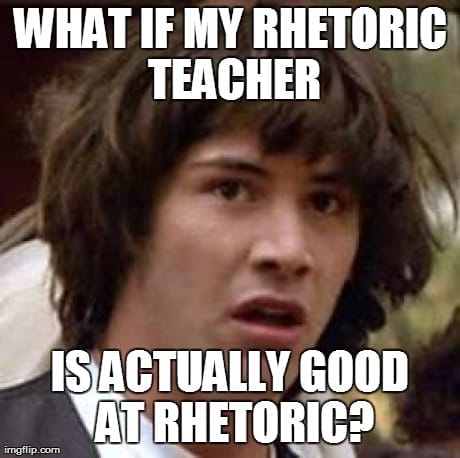
      Meme featuring Keanu Reeves as a teenager from Dazed and Confused. The text says "What if my rhetoric teacher is actually good at rhetoric?" This is a joke about the persuasive nature of rhetorical devices.

      Depending on the type of writing you’re doing, you’ll rely on some of these elements more than others. In non-fiction, logic and credibility are going to be at the forefront of your writing and you’ll want to use rhetoric or a rhetorical device to drive home your knowledge and reliability. You can also use rhetoric to make complicated subjects easier to understand for readers. 

      However, in fiction, emotion is going to play a leading role. While credibility and logic will be important, the rules of your world will need to make sense and readers will need to know which characters to trust. When writing fiction you’ll want to make your readers feel.

      Rhetoric or rhetorical devices can help you do this by helping readers understand a situation more deeply or relate to a character or situation they have no previous understanding of or experience with. 

      How can you do this? By using rhetorical devices.

      Let’s take a look at some different rhetorical devices, the tools you can use you can apply rhetoric to your writing, and how they might help in different types of writing. 

      What are Rhetorical Devices?

      A rhetorical device is a technique used by writers or speakers to convey a message to the audience or to evoke a particular response or emotion. To engage the elements of rhetoric, you can use a rhetorical device. These devices can be used to enhance the meaning of a message, make it more memorable, or make an argument more persuasive. They are used in persuasive speeches, non-fiction, and fiction writing. 

      Here are just a few of the rhetorical devices you could use (because there are a lot).

      Rhetorical Question

      Asking a question not for the sake of getting an answer, but to make a point or draw attention to a topic.

      Examples: “Is the Pope Catholic?” or,  “Are you kidding me?” 

      Alliteration

      The repetition of the same initial sound in a series of words.

      Example: “Peter Piper picked a peck of pickled peppers.”

      Anaphora

      The repetition of a word or phrase at the beginning of successive clauses.

      Example: “I have a dream” from Martin Luther King Jr.’s speech.

      Hyperbole

      Exaggerating for emphasis or effect. 

      Example: “I’m so hungry I could eat a horse.”

      Metaphor

      A metaphor is a direct comparison between two unlike things, stating that one is the other.

      Example:  “All the world’s a stage and all the men and women merely players,” from Shakespeare.

      Oxymoron

      Combining two contradictory terms. 

      Example: “deafening silence.”

      Personification

      Assigning human qualities or characteristics to non-human entities or abstract ideas. 

      Example: “The wind whispered through the trees.”

      Simile

      A comparison between two unlike things using “like” or “as.” 

      Example:  “She sings like an angel.” 

      Famous Examples of Rhetorical Devices

      Rhetorical devices have been used throughout literary and oral history to paint pictures, pull an emotional response from an audience or prove a point.  

      Oxymoron 

      From Shakespeare’s Romeo and Juliet: “Parting is such sweet sorrow.”

      The juxtaposition of “sweet” and “sorrow” captures the complex emotions of love and longing. 

      ​Anaphora

      From Charles Dickens’ A Tale of Two Cities: “It was the best of times, it was the worst of times, it was the age of wisdom, it was the age of foolishness….”

      The repetitive “it was” at the beginning of each clause creates a rhythm and emphasizes the contrasts.

      From Martin Luther King Jr’s I Have a Dream Speech: “So let freedom ring from the prodigious hilltops of New Hampshire. Let freedom ring from the mighty mountains of New York. Let freedom ring from the heightening Alleghenies of Pennsylvania….” 

      Alliteration

      From Shakespeare’s Romeo and Juliet: “From forth the fatal loins of these two foes….” 

      The repetition of the “F” sound is a rhythmic alliteration. 

      These are just a small sample of the examples you can find across literature and of course rhetorical devices are used in movies and modern works as well, even articles, blogs or videos. 

      Why Use Rhetoric in Your Writing?

      Because rhetoric and rhetorical devices are so common and so effective, it can be hard to know when you’re even using them. This might leave you wondering why you should use them. This subtleness shows why we should use them. 

      When an author compares the emotion of a character to an experience or emotion the reader can relate to, it pulls the reader into that emotion so effectively, they don’t even realize they’re being “convinced.” 

      While the average reader might not understand what it feels like to send a loved one off on a quest from whence they may never return, they probably understand the ache that grows in your stomach when you send a child off to their first day of school or even a spouse to train for the military. And even though it’s not directly the same experience, they will start to feel that ache in the moment and may be able to relate more to the character than they did previously. 

      That’s the power of a rhetorical device. So the next time you’re writing, give it a try. Use a rhetorical device to convince your readers they’re feeling an emotion or help them understand a stance you’re making.

      101 Creative Writing Prompts
      That Will Get You Excited to Write

      Grab it for free 👇

        We’ll also send you our newsletter, which offers advice on freelancing and publishing.
        You can unsubscribe at any time.

      • Get Paid to Write Articles: 15 Excellent Publications to Pitch Today

        Get Paid to Write Articles: 15 Excellent Publications to Pitch Today

        As a freelance writer, it can be a struggle to find high-quality paying work. But it’s possible, and we’ll introduce you to 15 publications to pitch so you can get paid to write articles.

        When searching for opportunities, it can feel like the only options available are $5-per-article scams and work from content mills, which can seem like good opportunities—until you check your bank account balance and realize it’ll take ages before your hard work adds up into real earnings.

        Making a living as a freelance writer means you’ll need to master how to get paid to write articles. The good news? There are publications that will pay you a premium to write for them.

        The publications below pay $500 US and up, which may seem like a dream to you (especially if you’re new to the field).

        It isn’t necessarily easy to get into these publications, and it may take time and experience to build up your writing to a level that will help you get paid these rates. But you can take solace in the fact that writing work exists beyond content mills and low-paying gigs.

        While there are probably tens of thousands of magazines that pay writers, a much smaller number compensate writers really well. We’re here to make a living writing rather than fall victim to the old adage of starving artist.

        Ready to get paid to write articles?

        Freelance Writer’s Pitch Checklist
        Grab it for free 👇

        Convince more editors to say YES to your pitches!

          We’ll also send you our weekly newsletter, which offers helpful advice for freelancing and publishing. You can unsubscribe at any time.

          Get Paid to Write Articles from These 15 Platforms

          1. Early American Life

          History buffs, take heed. Early American Life is a print mag focusing on early American style, decorating, and traditions publishes seven times yearly and welcomes the fresh voices of new writers.

          You can submit both shorter stories and features, which run about 2,500 words. The editors estimate a $500 payment for “a first feature from a new writer,” with the opportunity for higher earnings as your skills develop.

          2. Earth Island Journal

          Earth Island Journal wants “compelling and distinctive stories that anticipate environmental concerns before they become pressing problems.” It covers a wide variety of environmental issues including wildlife and land conservation, environmental public policy, climate and energy, animal rights, and environmental justice.

          If you’re an international traveler, it’s a great opportunity. Earth Island is especially hungry for, “on-the-ground reports from outside North America.” The magazine pays 25 cents per word for its print stories, which equates to about $750 to $1,000 for in-depth features (between 2,800 and 4,000 words).

          You can also pitch a shorter online report, especially if you’re a newer writer. While they only pay $200 apiece for stories published online, the journal publishes five days per week and is “always looking for fresh ideas.”

          3. VQR

          VQR is a journal of literature and discussion with a focus on publishing the best writing they can find, from award-winning authors to emerging writers.

          For poetry, it pays $200 per poem (up to four). If they accept a group of five or more poems, you’ll earn $1,000. Prose pays around 25 cents per word, and an accepted short story receives $1,000 or more. Book reviews earn $500 for 2,000 to 2,400 words. VQR has limited reading periods, so check the schedule online before you submit.

          4. The Sun Magazine

          The Sun Magazine is looking for essays, interviews, fiction and poetry. They prefer personal writing but they also accept pieces about political and cultural issues.

          The Sun pays $300 to $2,000 for fiction, essays and interviews, and $100 to $250 for poetry. If your work is accepted, you’ll also get a complimentary one-year subscription.

          5. Boys’ Life

          Boys’ Life is a general-interest monthly magazine has been published by the Boy Scouts of America since 1911. It pays its writers between $500 to $1,200 for nonfiction articles up to 1,200 words. Writing for one of its departments is also an option, where you’d make $100 to $600 for a 600-word article.

          As far as what to write about, there aren’t too many limits. “We cover everything from professional sports to American history to how to pack a canoe,” read the submission guidelines. Most of all, it should be entertaining to the scouts it’s aimed at.

          “Write for a boy you know who is 12,” the editors suggest.

          6. The American Gardener

          The American Gardener is the official publication of the American Horticultural Society, and it caters to “experienced amateur gardeners.”

          It seeks writers for horticulturalist profiles, and articles about innovative approaches to garden design, plant conservation, horticultural therapy, and biodiversity, among others.

          It pays $300 to $600 for feature articles, which usually run 1,500 to 2,500 words. The magazine sometimes offers travel and expense reimbursement.

          7. One Story

          One Story is a literary magazine that features one story per issue, and it is mailed to subscribers every three to four weeks.

          One Story looks for literary fiction in the range of 3,000 to 8,000 words, and stories can be on any subject “as long as they are good.” It offers $500 and 25 copies of the magazine for every accepted contribution, but submissions are not always open.

          As a freelance writer, it can be a struggle to find high-quality paying work. But it's possible, and we'll introduce you to 15 publications to pitch so you can get paid to write articles.

          8. The American Scholar

          Quarterly magazine The American Scholar publishes everything from essays to fiction to poetry on public affairs, literature, science, history, and culture. 

          It will pay up to $500 for accepted pieces of no more than 6,000 words, and if you want to go the digital route, it will pay up to $250 for web-only pieces. Note, however, that The American Scholar does not accept pitches through email—only through online submissions manager system Submittable.

          9. Longreads

          Want to write a 2,000- to 6,000-word long-form article for Longreads? Before you think “yes,” know this: These stories can involve multiple reporting trips, sources, and in-depth research. And while they don’t necessarily need to deal with current events, “they should have an excellent sense of story and purpose and be able to hold a reader’s attention with a compelling premise.”

          Base payment begins at $500, and they’ll even work with you to pay you a solid fee and also cover expenses. 

          10. National Geographic Traveler

          You know it. You’ve read it. And now, you can write for it. As the world’s leading brand in consumer travel, National Geographic Traveler states their publishing goals are to, “find the new, to showcase fresh travel opportunities, to be an advocate for travelers.” No hotel or product reviews here, folks.

          Nat Geo Traveler pays, but their website doesn’t confirm how much. But according to Who Pays Writers, they offer 50 cents per word for 1,000-word features.

          11. NationSwell

          Based in NYC, NationSwell is looking for freelance writers to tell impactful meaningful solutions narrative and feature stories between 800 to 1,500 words about people or organizations solving for America’s issues—like “the woman who took on gun violence by confronting gangs and her local mayor in street rallies, or the group that helps families of murder victims fight back against a system that unfairly punishes them.”

          Pay is 50 to 65 cents per word depending on experience and subject matter.

          12. Alaska Beyond Magazine

          Alaska Beyond Magazine is the monthly in-flight magazine for Alaska Airlines, and it’s looking for writing with vivid visual images, anecdotes and a strong narrative flow. If you can write with a sense of humor, cover business with insight and style, and lend inside perspective to the destination and travel columns, you’re good as gold. 

          Rates begin at $150 to $250 for short articles in the Journal section (200 to 600 words); $150 for business shorts (500 words); $500 for columns (1,600 words); and $700 for features (2,000 to 2,500 words). At this time, they’re not interested in fiction, poetry, or book reviews.

          13. Curbed

          Curbed’s focus is home: architecture, design, real estate, and urban planning. It’s seeking pitches for long-form and narrative stories from freelance writers, and these pitches should dig deep on their preferred topics, whether they are analyses of popular trends, reported pieces, personal essays, or a combination of all of the above. 

          The submission guidelines confirm (but don’t specify) competitive rates for features between 3,000 and 6,000 words—Who Pays Writers reports 20 and 54 cents per word payments, which means, at the very least, you stand to make $600.

          14. JSTOR Daily

          JSTOR Daily is excited by stories that tease out the details or that look at the obvious in a non-obvious way; “subjects that are newsworthy, entertaining, quirky, surprising, and enlightening are right up our alley.” For publication in summer and fall 2020, they’re interested in a reading list or annotated bibliography about structural racism, or work that highlights scholarship by BIPOC.

          Feature stories typically range from 1,800 to 2,000 words. The submission guidelines confirm (but don’t specify) that contributors are paid, so Who Pays Writers reports the average pay is 31 cents per word.

          15. Sierra

          Ever heard of Sierra? It’s the United States’ oldest, largest, and most influential grassroots environmental group. It welcomes ideas from writing pros who can “write smart, fun, incisive, and well-researched stories for a diverse and politically informed national readership.” When you pitch, make sure it reflects an understanding of the Sierra Club’s motto—“Explore, enjoy, and protect the planet”—as well as knowledge of recent issues and topics. 

          Feature articles range from 2,000 words to (rarely) 4,000 words or more with payment starting at $1 per word, rising to $1.50 word for more well-known writers with “crackerjack credentials.”  In some cases, expenses will be paid.

          You can also write for one of their departments, which they say is open to freelancers. Articles are 250 to 1,000 words in length; payment is $250 to $1,000 unless otherwise noted.

          Freelance Writer’s Pitch Checklist
          Grab it for free 👇

          Convince more editors to say YES to your pitches!

            We’ll also send you our weekly newsletter, which offers helpful advice for freelancing and publishing. You can unsubscribe at any time.

            The original version of this story was written by Bamidele Onibalusi. We updated the post so it’s more useful for our readers.

            Photo via Federico Rostagno/ Shutterstock 

          • A Win for the Oxford Comma: This Lawsuit Shows Why It’s So Important

            A Win for the Oxford Comma: This Lawsuit Shows Why It’s So Important

            Who cares about the Oxford comma?

            Historically, the answer has been grammar nerds, Strunk & White, and those who follow the infamous Chicago versus AP writing style guide debate.

            And after this lawsuit a few years ago, we added dairy driver to the list.

            That’s because an appellate court ruled in favor of Maine dairy drivers in a labor dispute that hinged on the oft-debated piece of punctuation.

            For anyone who’s ever wondered what all the fuss is about over Oxford commas, the circuit judge’s 2017 opinion says it all:

            “For want of a comma, we have this case.”

            Barron, Circuit Judge

            Let’s get into why the oxford comma can make such a difference

            What is the Oxford Comma or the Serial Comma?

            For those in need of a grammar rules refresh, here’s a quick overview.

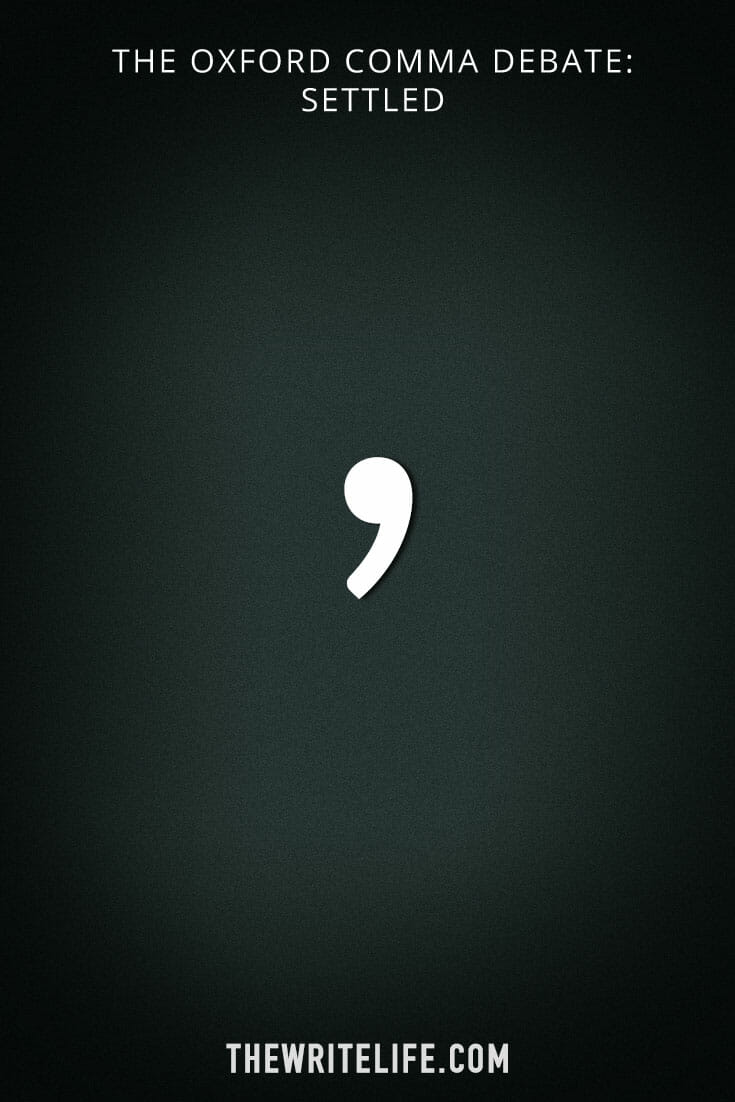
            Sometimes called the serial comma, the Oxford comma is a comma placed between the last two items in a series of three or more.

            For example, the Oxford comma falls after “hat” in this sentence:

            “She wore a jacket, hat, and mittens.”

            While some writing style guides do not use this comma, supporters say it’s necessary to avoid potential ambiguity. And if there’s one thing writers can agree on, it’s the importance of clarity. In some cases, an extra comma matters.

            Does AP Style Use the Oxford Comma?

            The short answer: No.

            Many writers, including journalists, live by the Associated Press stylebook. AP style does not use Oxford commas.

            However, Chicago style does require Oxford commas. That’s the Chicago Manual of Style, which is commonly used by book publishers, academics, and trade publications.

            So the decision about whether to use the serial comma relies on what type of writing you’re doing, and which style guide applies to that project.

            If you’re writing for a news site, you probably want to follow AP style and skip the extra punctuation. If you’re writing a novel you plan to submit to publishers, you probably want to follow Chicago style, which does use the Oxford comma.

            An Example to Follow

            Let’s review how the Oxford comma works.

            Here’s an example of a sentence with the Oxford comma:

            “I admire my parents, Gandhi, and Mother Teresa.”

            It’s clear in this example that I admire my parents, as well as Gandhi, and Mother Teresa.

            But remove that serial comma, and the sentence reads, “I admire my parents, Gandhi and Mother Teresa.”

            One could argue that, written this way, the sentence implies that Gandhi and Mother Teresa are my parents. While the average person would know this isn’t likely to be the case, it illustrates how easily a missing comma can change the meaning of a sentence.

            Dictionary.com offers more funny examples

            It was precisely this type of ambiguity that led to the Maine case with the dairy farmers.

            [sps_reusable_block post_id=43049]

            The Oxford Comma Debate, And A $10 Million Comma

            In this class action lawsuit, drivers for Oakhurst Dairy sued the company over its failure to grant them overtime pay.

            Workers in Maine are entitled to 1.5 times their normal pay for hours worked over 40 per week, according to state law. However, there are exemptions to this rule. Specifically, the law states, companies don’t have to pay overtime for the following activities:

            The canning, processing, preserving, freezing, drying, marketing, storing, packing for shipment or distribution of:

            1. Agricultural produce;
            2. Meat and fish product; and
            3. Perishable foods

            Note the end of the opening line, where there is no comma before the “or.”

            Oakhurst Dairy argued its drivers did not qualify for overtime because they engage in distribution, and the spirit of the law intended to list “packing for shipment” and “distribution” as two separate exempt activities.

            However, the drivers argued the letter of the law said no such thing. Without that telltale Oxford comma, the law could be read to exclude only packing—whether it was packing for shipment or packing for distribution. Distribution by itself, in this case, would not be exempt.

            Without that comma, as the judge maintained, this distinction was not clear-cut:

            If that exemption used a serial comma to mark off the last of the activities that it lists, then the exemption would clearly encompass an activity that the drivers perform. And, in that event, the drivers would plainly fall within the exemption and thus outside the overtime law’s protection. But, as it happens, there is no serial comma to be found in the exemption’s list of activities, thus leading to this dispute over whether the drivers fall within the exemption from the overtime law or not.

            Barron, Circuit Judge

            As a result, the court found in favor of the drivers, costing the dairy an estimated $10 million.

            A Win for the Oxford Comma: This Lawsuit Shows Why It's So Important.

            Comma Rules: To Comma, or Not to Comma?

            As a diehard Oxford comma loyalist, this ruling made my day.

            While many of the sites I write for as a freelance blogger follow AP style, which is sans-serial comma, I still sneak one in when it seems needed to avoid confusion. This case backs up that habit as more than just an old-school tic I haven’t yet let go.

            While the debate may still rage on over whether Oxford commas are necessary all the time, this ruling upholds the practice of using them when they’re essential to ward off ambiguity.

            So, who care about the Oxford comma? The answer, according to the courts, is officially: anyone who’s interested in clarity.

            Take that, AP style!

            [sps_reusable_block post_id=43049]

            This is an updated version of a story that was previously published. We update our posts as often as possible to ensure they’re useful for our readers.

            Photo via Lamai Prasitsuwan/ Shutterstock

          • Bedtime Stories for Adults: 3 Different Ways to Tap Into Your Inner Child

            Bedtime Stories for Adults: 3 Different Ways to Tap Into Your Inner Child

            Remember being wrapped up in your blanket, the lights down low, eyes heavy, and a parent or guardian reading a soothing bedtime story as you drift off into a peaceful sleep? Luckily, you don’t have to be a kid to enjoy a good bedtime story! More and more adults are reclaiming bedtime stories and enjoying the nostalgia, relaxation and much needed break from the hustle and bustle of adulthood. 

            Join us as we tap back into our inner children and explore the world of bedtime stories for adults.

            [sps_reusable_block post_id=43050]

            What are Bedtime Stories for Adults? 

            What exactly do we mean when we say “bedtime stories for adults”?

            Bedtime stories for adults can come in many forms. There are stories specifically designed to help the adult mind fall asleep, but this could also be any story that helps you relax and drift off into dreamland. 

            Imagine: It’s been a long, hard day, week, month or even year and you are absolutely exhausted and yet you still can’t fall asleep.

            Not so hard to imagine? What if you laid down to rest and could escape into a different world, even just for a few minutes, and forget about all your deadlines, responsibilities and stressors and fall into a deep restful sleep with ease? 

            This is where bedtime stories for adults come into play. 

            Why Do Adults Need and Want Bedtime Stories? 

            Modern adult life for many people is one big ball of stress. If you’re anything like me, when does this stress like to make an appearance? (say it louder for the people in the back!)

            At bedtime! 

            Pop Quiz
            When all you want to do is relax and fall asleep in peace, your stressed-out mind decides to: 
            A) Reflect on every embarrassing thing you’ve ever done
            B) Imagine every possible future event and conversation that could ever happen (good or bad)
            C) Meticulously analyze every possible reason for why they’re not texting you back
            D) All of the above

            Just me? (He’s probably in the hospital donating a kidney or saving baby penguins in the Antarctic and doesn’t have cell reception. That must be it.)

            All of this is to say that adults need and want bedtime stories because sometimes we have a lot going on and can’t always turn off our brains.

            Bedtime stories can help distract our brains by focusing on something else, allowing us to fall asleep much faster. 

            Having a non-chemical sleep aid like adult bedtime stories can be a powerful tool for those with sleep problems, or anyone who just wants to create a soothing sleep environment. 

            The Power of Bedtime Stories 

            There are many different reasons why we may have a hard time falling asleep at times. Often, a racing mind is the culprit and bedtime stories have a special power of being able to switch our thinking brain off, help us unwind, and make it easier to fall asleep. 

            The power of stories, particularly auditory versions, is backed up by science. As you fall asleep, your senses power down one by one and the sense of hearing is the last one to turn off. Listening to an adult bedtime story can help your body be able to shut down the other senses more quickly and get you off to sleep faster. 

            Another reason why bedtime stories can work so well is that they can help avoid the sleep paradox.

            You have likely experienced that once you start thinking about it and noticing that you can’t do it, it becomes nearly impossible to sleep. That is the sleep paradox. This is where reading or listening to a bedtime story can take the attention away from thinking about sleep (or lack thereof), replace it with something else to focus on, quiet the mind and help you fall asleep. 

            Different Types of Bedtime Stories 

            Let’s look at some examples of books, audiobooks and podcasts that you can try the next time you find yourself on the midnight sleepy time struggle bus. 

            Books 

            Books are the OG of bedtime stories (at least in my lifetime). Books! Reading before bed is a great habit to build into your night time routine for a number of reasons. 

            • Having a regular bedtime routine helps prompt your brain into knowing that it is time to wind down and get ready to sleep
            • Reading a book keeps you off your phone before bed
            • It gets your mind focused on something other than your thoughts before your head even hits the pillow

            Examples: 

            • Why We Sleep by Matthew Walker: If you are into non-fiction, this book discusses the science of sleep, why it is so important for our overall health and provides tips for good sleep hygiene.
            • Something light and fluffy: If non-fiction and science before bed is not your thing, grab something that is easy to read like a romance or general fiction book. Something that can help you unwind without grabbing your attention so much that you stay up reading all night
            • Something boring: Ever fallen asleep reading a textbook for school? Picking up a book you find boring can help put you to sleep quickly.

            Audiobooks 

            Audiobooks are a fantastic way to incorporate bedtime stories for adults into your life whether it is nightly or just on those particularly difficult nights. Being able to lay there with your eyes closed and the lights off while listening to a story helps your mind enter the world of the book and you can fall right to sleep without having to put the book down. 

            Any book will do, but something nostalgic can be particularly helpful because you are already familiar with the story so your brain can relax that much more. 

            Examples:

            • Harry Potter series by JK Rowling: So many people know and love the Harry Potter series, making it a popular choice for an audiobook reread. These stories often bring back good memories and the familiarity of the story and the movies means our brains don’t have to work too hard to transport us into that world
            • Bedtime Stories for Stressed Out Adults by Lucy Mangan: How fitting? This book incorporates a mix of calming stories, poems and classic favorites specifically designed to help you fall asleep faster

            Note:  worked too well; I fell asleep immediately but I lost one of my airpods 🙁 good news I found it!

            Podcasts

            Podcasts work in a very similar way to audiobooks. You can drift off to sleep to whatever you find relaxing. There is a podcast for everyone about literally any subject you can imagine. As long as it helps you go to sleep, any one will do. However, there are podcasts specifically designed for sleep that you may want to try. 

            Examples: 

            • Sleepy: In this weekly podcast, host Otis Gray reads classic tales in a low, soothing voice to help you turn off your brain and get to bed
            • Nothing Much Happens: In this podcast, host Kathryn Nicolai shares stories where, just as the title suggests, nothing much happens so your mind can focus on resting

            With all of life’s stressors, bedtime does not have to be yet another one. Getting plenty of good quality sleep every night is one of the best things you can do for your health. For a lot of people, that is easier said than done and we may need a bit of help sometimes. Try incorporating bedtime stories for adults into your nightly routine and wake up more refreshed and rejuvenated.

            Sleep tight.

            [sps_reusable_block post_id=43050]

          • 15 Magazines That Will Publish (And Pay For) Your YA and Children’s Stories

            15 Magazines That Will Publish (And Pay For) Your YA and Children’s Stories

            You’ve written and revised your children’s and YA stories more than you can count. Only your trusted circle has witnessed the magical way you weave words together to create fictional and nonfictional worlds for tiny humans—yet, everyone tells you more people need to read your children’s and YA stories. 

            For most writers (or any artist), putting your work out there isn’t an easy step to take, no matter how celebrated you are.

            But while it’s daunting to submit a story to a publication—hearing people’s opinions of your work, eek!—it’s also necessary for great practice for all aspiring authors who eventually want to figure out how to get a literary agent.

            Whether you write short stories, personal essays, poems, or stories for kids, there are tons of magazines that will help bring your story to life for the eager and excited eyes who can’t wait to dig into them. 

            Now, I warn you: These magazines pay for your stories, but the rates won’t keep the lights on in your house. But it’s a great way to begin earning money for your work, which one day will pay the bills. 

            Freelance Writer’s Pitch Checklist
            Grab it for free 👇

            Convince more editors to say YES to your pitches!

              We’ll also send you our weekly newsletter, which offers helpful advice for freelancing and publishing. You can unsubscribe at any time.

              Where to Submit Children’s Stories

              Before you submit a story, always familiarize yourself with the magazine to understand the tone and style of the writing it features. 

              You probably know this already but it bears repeating: Plotting, story construction, character development and more are just as important in children’s and YA stories as they are in adult fiction or other genres—the standards of success aren’t any different. 

              After you craft a children’s short story that’s ready to be judged, here are 15 children’s magazines that want to read your compelling submission.

              1. Bumples

              Founded in 1999, Bumples (for ages 6 to 10) and Bumple Buds (for ages 3 to 5) each publish four issues per year. If you want to submit a story to this interactive online magazine, focus on mystery and adventure stories, as well as fantasy, holiday, sports and animal stories.

              For the 3 to 5 age group, submit a story of no more than 800 words; for the 6 to 10 age group, stick to 2,000 words or less. As you write, keep this in mind: Bumples specializes in illustrated fiction, so the editors select stories and poems where they can animate the characters.

              Read through the writer’s guidelines to learn more—when your story is ready to submit, email it to editor@bumples.com. Editors prefer Word format but they also accept PDFs. 

              Payment: $30 for stories; $20 for poems. 

              2. One Teen Story

              If you’re a young writer—or if you know one—award-winning literary quarterly One Teen Story is the perfect place to submit an original story. 

              Publishing four issues per year that each only contain one story, this magazine features the work of today’s best teen writers from ages 13 to 19. Submissions can fall into any genre of YA fiction (literary, fantasy, sci-fi, romance, horror and more), but they need to be well-written and between 2,000 and 4,500 words. Also, stories should be about the teen experience as well as have teens as the main characters.

              Examples include stories that deal with coming-of-age issues, plus those of identity, friendship and family. Make sure you avoid excessive profanity, sex and drug use. To really get the vote of editors, write a story that is strong enough to stand alone, rather than an excerpt from a work-in-progress, for instance. 

              One Teen Story Teen submissions are now closed but are due to reopen in fall 2021. 

              Payment: $500 upon publication plus 25 copies of the magazine featuring your work.

              3. Cricket Media

              Cricket Media publishes 11 award-winning magazines for children from six months to teens, so they have submission options for all kinds of writers of any experience level.

              Across all its magazines, Cricket Media aims to publish the “finest quality writing and illustration for children of all ages.” Its readers are curious about the world around them and enjoy the artistic expression of these magazine’s crafty stories.

              Its four literary magazines for children up to nine (Babybug®, Ladybug®, Spider® and Cricket®) welcome stories in the genres of illustrated poetry, fiction and literary nonfiction.

              Writers with expertise in science, technology, culture and social studies have five nonfiction magazines (for ages 3-14) to submit to: Click®, Ask®, Muse®, Cobblestone™ and FACES™ World Cultures and Geography.

              Since these stories require more subject-matter knowledge, writers must also submit a resume and several writing samples. To learn more specifics about story length, desired (and undesired) story elements and more for each magazine, start with the general submission guidelines.

              Also an illustrator? View the submission guidelines for artists to find out how to submit there, too. 

              Payment: For the literary magazines, $.25 per word for stories or articles; $3 per line for poems, or $25 max; $75 flat fee for activities and recipes. Rates for nonfiction magazines are negotiated.

              4. U.S. Kids Magazines

              Want to write broadly about health and fitness for kids up to 12 across the U.S.? Publisher of award-winning magazines Humpty Dumpty (ages 2-6) and Jack and Jill (ages 6-12), U.S. Kids Magazines seeks high-quality stories, articles and activities that demonstrate a healthy lifestyle.

              Be humorous, playful and witty in a well-constructed story that starts at a basic reading comprehension level to support young readers—but also doesn’t neglect to sprinkle in advanced information. Editors also want a story that can “appeal to today’s children.” That means if you haven’t been around kids in a while, they suggest you doubly ensure your dialogue and characters are up-to-date and authentic. 

              Jack and Jill accepts full fiction manuscripts of up to 800 words and nonfiction up to 700 words. Humpty Dumpty, on the other hand, wants fiction shorts of 450 words or less, crafts of up to 250 words, poetry up to 12 lines, plus short mini-stories of 70-125 words. 

              Find details about mailing in your transcript in the submission guidelines, plus what kind of stories editors are especially interested in across accepted genres. 

              Payment: $25 and up for Jack and Jill magazine fiction and nonfiction stories; $25 and up for Humpty Dumpty poems, $30 and up for fiction stories, and $40 and up for crafts. 

              5. Hunger Mountain

              Graduate students of Vermont College of Fine Arts’ Writing and Publishing program created Hunger Mountain magazine, which strives to amplify traditionally silenced voices and increase representation in literature. 

              Besides writing that explores, questions and challenges, editors also favor stories that demonstrate what it’s trying to do for others and the world. “We are here to champion writing that upsets systems of power and dominance,” explains the submission guidelines. “Our magazine isn’t going to destroy the cis-heteronormative, white-supremacist, ableist patriarchy, but we are going to try.”

              Above all, Hunger Mountain seeks work that is self-aware and avoids the risk of harm. But don’t be afraid to be humorous, or even to surprise editors with romance (that isn’t cheesy), limericks or poems in the styles of ghazal and golden shovel. 

              Your YA or children’s story submission should be no longer than 8,000 words. 

              Submissions are open until December 1, 2023. 

              Payment: $50 for prose and $25 for poetry. 

              6. Ember: A Journal of Luminous Things

              Ember challenges you to write a story that targets readers who are 10-18, whether it’s poetry (three to 100 lines), a short story or creative non-fiction (up to 12,000 words), or flash fiction (no more than 1,500 words).

              Editors seek “excellent, polished writing” that creates an engaging story—one with no profanity, vulgarity, sex or violence. Plus, keep this in mind: “Submissions with the best chance of acceptance will be meaningful on some level to both older and younger readers without being condescending.”

              What’s neat about this magazine is it offers feedback on your story once you’ve submitted it, even if it hasn’t been selected for publishing. (Although, it’s optional.) 

              Payment: $.02 per word, or $20 per work, whichever is more. 

              7. Spaceports and Spidersilk

              Most of all, this print magazine created by speculative fiction-focused Hiraeth Publishing wants your story to have one element: adventure.

              Published three times per year in February, June and October, Spaceports & Spidersilk wants fantasy, sci-fi and shadow stories (“spooky, but not terrifying”) aimed at readers ages 8-14. It prefers stories with young protagonists, plus those that don’t harp on an overarching lesson. Instead, editors want a good story that “entertains and connects with emotions.”

              Submit genre stories between 1,000 and 3,000 words, flash fiction that’s less than 1,000 words, essays up to 800 words and poetry with no more than 25 lines. Whatever you submit, be sure to follow the magazine’s cardinal rules: No swearing, sex, drugs or sexist language. 

              Check out the writer guidelines to learn how to submit. 

              Payment: $6 for each accepted story; $3 for flash fiction.

              8. Cast of Wonders

              Interested in writing YA sci-fi or fantasy? Cast of Wonders is the leading voice in young adult speculative short fiction, and it wants stories that “evoke a sense of wonder, have deep emotional resonance and have something unreal about them.”

              Stories should be no more than 6,000 words in length and aimed at teens from 12-17. Since the Cast of Wonders podcast sometimes presents stories in audio format, your submission needs to pack a punch: strong pacing, well-defined characters, compelling dialogue and more. 

              Editors want fiction that makes them think; however, they’ll reject stories with graphic depictions of sexual assault, cannibalism or non-consensual sex and/or drug use.

              Submit your thrilling story to the address found in the writer guidelines

              Payment: $.08 per word for original fiction of any length and a $20 flat rate for flash fiction. 

              9. Fun For Kidz

              Created for kids ages 6 to 13—although the 8-10 range is the specific target—Fun For Kidz magazine publishes six issues per year and focuses on the perspective that all children deserve the right to be a child for as long as possible.

              That’s why it publishes timeless topics like pets, nature, hobbies, science, games, sports, careers, and anything else that might capture a younger audience.

              To be published in this magazine, submit a fiction or nonfiction story up to 650 words with lively writing and includes an activity that’s both wholesome and unusual. Feel free to submit more than one story, but be sure to note it on your manuscript. Plus, here’s a pro-tip: to strengthen your chance of selection, attach several high-resolution photos with your submission.

              Fun For Kidz no longer accepts email submissions, so read the submission guidelines to learn where to mail your story. 

              Payment: A minimum of $.05 per word for fiction and nonfiction, plus $5 per high-resolution photo; $10 per poem or puzzle. 

              10. Balloons Lit. Journal

              Accepting of submissions year-round, Balloons Lit. Journal (BLJ) wants to publish quality, unconventional stories for children ages 12 and up from writers of any age. 

              In its biannual issues, BLJ welcomes three to five pieces of poetry in any style and fiction stories up to 2,000 words. However, “If you also have fantastic art and/or photographic work” submit that, too, for extra brownie points. According to the submission guidelines, the editors love pleasant surprises. 

              When deciding which piece to submit, ensure your story, no matter how complex and philosophical, can enlighten and amaze young minds. BLJ isn’t a theme-based journal, so focus on penning a submission that is surprising, humorous, bold, unique, layered, educational and more. 

              Include a cover letter with a brief bio introducing yourself and your background. All submissions to BLJ must be emailed to editorblj@yahoo.com

              Payment: One print copy. 

              11. Smarty Pants

              Smarty Pants Magazine for Kids is a publication that “strives to delight, educate and entertain children from every walk-of-life.” 

              There’s no specified age range in the submission guidelines, but writers should submit a children’s story that’s kid-friendly, violence-free, fun and clever and up to 800 words. If your story’s theme is seasonal, remember to submit your story three months before the occasion. 

              Once you’ve edited and perfected your children’s story, email smartypantsmag@gmail.com and paste it in the body of the email or a Word or Google Doc. 

              Payment: $15 for short stories.

              12. The School Magazine

              Australia’s The School Magazine publishes short stories, articles, plays, poems and activities that have literary and academic merit for kids between 8 and 12. Submit to any of its magazines: Countdown, Blast Off, Orbit or Touchdown.

              Its writer guidelines say readers “respond well to texts that delight, intrigue, challenge and inspire them.” Since The School Magazine’s target audience is exploring their identities and craves insights into the world around them, you’ll do well with a story that reflects the multicultural, diverse society the magazines try to exhibit. 

              No matter if you submit a fiction story, poetry, an article or a play, writing should be energetic and suspenseful with credible characters. Word counts for accepted categories range from 800 to 2,000 words—be sure to use those words on a fresh angle rather than a preachy theme. 

              To submit, scroll up on the contribute page, then click “Contribute” and fill out the generated fields. 

              Payment: The School Magazine pays on publication, plus a repeat fee if a piece is reused in a print version of the magazine. 

              13. Clubhouse

              Focus on the Family Clubhouse magazine (Clubhouse for short) reaches more than 80,000 young readers and parents around the world—all of who turn to the magazine to read adventurous and humorous stories that offer “Scriptural or moral insight.”

              For kids ages 8-12, write fiction (500 to 2,000 words) or nonfiction (400-500 or 800-1,000 words) fast-paced stories that are exciting yet wholesome, plus fresh and creative and feature well-developed characters the same age as the magazine’s target audience. 

              Your fiction stories should be descriptive and engaging, or unique and interesting for nonfiction stories, articles and other materials. If you submit a nonfiction article, keep in mind it must have a Christian angle, though not an overbearing one. As for fiction stories, “they should be built on a foundation of Christian beliefs and family values.”

              Read the submission guidelines to learn the kind of stories Clubhouse seeks, like mystery or sci-fi, and what will get you axed from the shortlist. 

              Payment: Between $.15 and $.25 per word; $200 and up for feature-length fiction stories; $150 and up for nonfiction pieces.

              14. Zizzle

              “We look for stories that will surprise, move and amuse both young and older imaginative minds,” writes Zizzle Literary magazine’s submission guidelines. An anthology book series that brings parents and kids together to foster a love of reading, Zizzle publishes literary fiction that fascinates kids from age 12 and up.

              Your fiction story should have a strong voice and dive deep into themes of meaning and morality that evolve naturally. While Zizzle editors embrace “fresh perspectives on the nuanced joys and tensions in kids’ daily lives and imaginations,” they welcome untraditional storytelling plus tastefully humorous stories. 

              Flash fiction children’s stories should be 500 to 1,200 words and 2,000 to 4,500 words for short stories. Before you submit, note Zizzle requires a $3 submission fee. 

              Payment: $100 for flash stories; $250 for short stories.

              Note: When we checked Zizzle for updates, their website was down so it’s unclear if they’re still around.

              15. Youth Imagination

              On the 21st of each month, Silver Pen Publishing publishes a new series with children’s and YA stories from these genres: fiction, modern, urban or classical fantasy, sci-fi, slipstream, literary, action-adventure and suspense. 

              If you’re a lengthy writer, you’ll love this word-limit: 20,000! For the short story category, submit a story of 1,000 to 8,000 words; no more than 999 for flash fiction. To make the cut, write a well-written story, and focus on technique, voice, characterization and language — that will all play a part in the editors’ decision to accept and publish your story. 

              “Amaze us with your writing, use of language, sense of story, and memorable characters,” writes the guidelines. The kind of story they won’t be amazed by, however, is fan fiction, or one that possesses cliche elements. 

              Submit your story via Submittable

              Payment: $15 per story.

              Note: Youth Imagination closed to submissions in December 2022 and did not re-open in 2023.

              We wish you the best as you submit your children’s and YA stories! It might feel uncomfortable at first—or always—but it’s all part of the journey of being a better, stronger writer. 

              Freelance Writer’s Pitch Checklist
              Grab it for free 👇

              Convince more editors to say YES to your pitches!

                We’ll also send you our weekly newsletter, which offers helpful advice for freelancing and publishing. You can unsubscribe at any time.

                This is an updated version of a story that was previously published. We update our posts as often as possible to ensure they’re useful for our readers.

                Photo by Annie Spratt on Unsplash

              • 5 Steps to Writing Like Stephen King

                5 Steps to Writing Like Stephen King

                Wondering how to make your writing like Stephen King? One does not simply become, “The King of Horror,” because their surname is King, and their preferred genre is horror.

                No, King earned his title and a spot among the best horror authors by having over 60 books published, 350 million plus copies sold, and 12 Bram Stoker Awards in six different categories. But how?

                What makes this man’s writing so grand that he deserves a royal title and a kingdom all his own within our nightmares?

                Did he make some deal with the Devil that granted him incredible talent? Did he find a bottle washed up on Maine’s rocky shore, wipe the dust off the glass and unleash a djinn to grant his greatest desires?

                No, those tales are for the likes of fantasy.

                King, much like the majority of his work, took a realist approach towards success in his early years: He wrote every day. He stuffed countless rejection letters on a railroad spike as a reminder of his goals. He murdered his darlings with the pen as his scalpel. He left droplets of ink for us to follow, so that in five steps we could eke out our own existence in the grim dark world of nightmares to come.

                New call-to-action

                Step 1 to Writing Like Stephen King: Write It Out, Then Pry it Out

                If a word is there just to dress up the page, rip it out. If you see an adverb, carve it out. If your voice becomes passive, shock it until it’s forced to stand out. King has a low tolerance for lengthy exposition with flowery prose, but that is because he prefers to tell it like it is, leaving none of the gritty details out.

                Don’t believe me? Then check out his memoir

                In On Writing: A Memoir of the Craft, King states adverbs pave the road to hell, passive voice makes him want to scream and one of the worst things you can do for your writing is use large unfamiliar words that require the reader to pull a dictionary out. Therefore, the first step to learning to write like the King himself is taking the advice he has already doled out.

                Step 2 to Writing Like Stephen King: Actively Read

                King is a big proponent of reading often and reading actively.

                “If you don’t have time to read, you don’t have the time (or the tools) to write.”

                Stephen King, On Writing

                However, how does a writer read a book any differently than a voracious bibliophile who devours pages during all their waking hours?

                Did you notice that every sentence in the previous step ended with the word “out”? Did you ask why, or did you consider it a lack of foresight on my editor’s part? What if I told you that I crafted the repetition on purpose and with purpose?

                There is a literary device which specifically addresses the use of repetition denoted earlier. This obscure device, an epistrophe, is defined as the use of repetition at the end of a clause or sentence meant to further enhance the author’s idea, and King is no stranger to it or the many other literary tools that are planted throughout his books.

                Before he became a bestselling author, he obtained a bachelor’s degree in English in 1970 from the University of Maine, and in 1971 he began teaching English at Hampden Academy.

                During this time and onwards he observed what the novice, the up and coming and the best of the best printed out. He asked questions about what he witnessed. He kept what he liked and tossed out what he didn’t. Armed with newfound wisdom his writing style from the 70s shifted, and he gave up the role of an outsider in exchange for the knowledge of an insider who understands what makes a literary work a masterpiece.

                Step 3 to Writing like Stephen King: Don’t Steal the Reveal

                Of course, sometimes it’s not about what you see on the page, but rather what you don’t see on it that creates all the difference between writing that is good and writing that holds majesty. The King of Horror understands this, and it is something you can witness in all of his work whether you are reading his first book, Carrie or his latest novel Fairy Tale.

                What is this invisible force that slips between words and hides in the subtext?

                What keeps you reading this line and then moving on with haste to the next one?

                Tension.

                Tension is part of what makes great horror, and King is a master at implementing it. He stays in the present, occasionally visits the past but never rushes beyond a logical assumption when it concerns the narrative’s future.

                Then to move the story forward he shows rather than tells through the character’s dialogue, actions and perspective of the environment. In other words, he understands how syntax correlates to pacing, and how word choice influences perception.

                Step 4 to Writing Like Stephen King: Create a Relatable Protagonist and Promising Antagonist

                Notice I didn’t say likable.

                Let’s face it, everyone has flaws, and our flaws don’t necessarily make us the greatest people to be around. But our stress, our wrath, the skeletons in our closet which we prefer nobody knew about are more visible than we care to admit, especially when desperate times call for less desirable measures. The same should be said for our characters.

                What pushes the protagonist and antagonist to the end of their rope? What does the protagonist do that makes the reader say, “I would too?” How does the antagonist promise to retaliate? 

                The grotesque only appears when the audience relates to the character who is suffering. Give your protagonist relatable qualities, like David Drayton in The Mist, but also make sure they have whatever it takes to get through the hellscape the antagonist creates.

                The tension unfolds between the antagonist and protagonist when each character has a good reason to commit to their action. Make sure the antagonist follows through with their threats when their boundaries are pushed, like Annie Wilkes in Misery, but also make sure that those promises are founded in the logic of their pain. 

                King doesn’t hold back the punches, the amputations, or disembowelment. He tells it like it is in every detail. There is no such thing as mercy when it comes to the undoing of his characters.

                Horror reveals what our characters would do in the worst of times. We as authors, through our unapologetic hands, must break down the relatable image our characters have worked so hard to preserve, and shred the fibers beneath their facade to the point they can no longer deny the pain. Once they are stripped to the bare bones of their essence, then we get to see just how important society’s ethics and morals are. Then we get to address the real horrors of the world. 

                Step 5 to Writing Like Stephen King: Find the Grit in Reality

                Forget the rainbows and the sugar-coated crap of other genres. King’s work is littered with profanity, sardonic remarks, and dry wit. Page after page, he never lets you forget the copper taste of blood or irony that comes with the hard facts of what it is to live with a monster in your head.

                There is a little bit of ugly in everyone and everything, and with the right motivation anyone can do horrible things.

                King is a realist and no matter how you slice and dice his prose this is a truth he never shies from. Don’t coddle the audience, don’t think they can’t handle the truth. Rather document reality’s grit in all its shades of Gray, and let the page reveal It.

                [sps_form_banner_t form_id=”cf746898-63f9-437c-9690-5b3b2ac55ed6″ button_text=”SIGN ME UP!” ty_url=”https://learn.self-publishingschool.com/twl-eg-fofs-ty-page”]

                FREE TRAINING

                The REAL Step-By-Step Process Full-Time Authors Using to Write & Sell More Books

                We’ll show you how to build a sustainable fiction careers in under 60 minutes!

                [/sps_form_banner_t]
              • The Hero’s Journey: A Primer For Freelance Writers To Tell Better Stories

                The Hero’s Journey: A Primer For Freelance Writers To Tell Better Stories

                When you know how to tell stories and how to hold attention, it can make you a better freelance writer.

                The Hero’s Journey is a great storytelling framework that should be a part of your writing arsenal so you can master the art of writing for an audience. While you will not always use this framework, there are elements of it you can sprinkle into your writing to make it even stronger.

                It is one thing just to write for clients and churn out good, high-quality content, but knowing what holds the attention of readers and inspires them to stay hooked on every word will keep your career alive for a long time.

                In this article, we will be diving into what The Hero’s Journey is, the basics you need to know, how you can use it in your overall writing, and a brief primer on some other storytelling frameworks you can use if you want to break outside of this method.

                The Hero’s Journey

                Why Does Storytelling Matter?

                Storytelling is an essential part of human communication and connection. No matter how much SEO and other marketing tools out there continue to take presence, the heart of good writing will always revolve around stories we read and share.

                Storytelling allows us to convey complex ideas, emotions, and experiences in a relatable and engaging manner, making information more accessible and memorable.

                Through stories, we can empathize with characters, share wisdom, pass down traditions, and inspire change, fostering a sense of unity and understanding among individuals and communities.

                Depending on the type of writing you do, you can also use it to create fascinating ads, compelling blog posts, and shareable social media posts.

                There are few downsides to learning the basics of storytelling so you can bring it into your writing. It is often something you will have to practice on your own so you can improve your skills in this area. It can also help to read fascinating and famous stories that use various methods so you can understand how they work.

                Why Should Freelance Writers Know How To Tell Stories?

                It is no secret that making it as a freelance writer is not always a walk in the park. When you are a freelance writer, you are battling thousands of other writers out there for a chance to make it.

                While there is an abundance of work to be passed around, there is still something to be said for having tools at your disposal to make you a better freelance writers than other writers out there.

                One of those tools is being able to tell stories that captivate and holds readers attention. One of the great storytelling frameworks is The Hero’s Journey. While you might not be able to tell the whole journey in everything you write, the summary you mainly need to know is that everyone loves a hero’s victory story.

                That could even translate to you telling the story of a local business in your area and the business owner’s challenges as they had to get their business growing.

                The Hero’s Journey is simply a framework for you to use to be able to tell a captivating story, and it is one we have used all throughout history to tell important stories over and over.

                What Is The Hero’s Journey?

                The Hero’s Journey is a narrative framework and storytelling pattern that was popularized by Joseph Campbell, a scholar of mythology and comparative religion, in his book The Hero with a Thousand Faces which was originally published in 1949.

                Campbell’s work explored common themes and structures in myths, legends, and religious stories from various cultures around the world.

                What Are The Steps In The Hero’s Journey?

                If you want the detailed version of this journey, you will want to read his book that is mentioned above. It is a much longer approach and analyzation of each of the steps along the path.

                Here is the short summary of The Hero’s Journey path:

                • The Ordinary World: The hero begins in a familiar and ordinary environment, which may be mundane or even oppressive.
                • Call to Adventure: Something disrupts the hero’s ordinary life and presents a challenge or opportunity. This is the initial call to action that sets the hero on a new path.
                • Refusal of the Call: The hero may initially resist the call to adventure, often due to fear, doubt, or a sense of inadequacy.
                • Meeting the Mentor: The hero encounters a mentor or guide who provides advice, training, or supernatural assistance to help them on their journey.
                • Crossing the Threshold: The hero decides to leave the ordinary world and enters a new, unknown, and often dangerous realm.
                • Tests, Allies, and Enemies: The hero faces a series of trials, meets allies and enemies, and undergoes personal growth and transformation.
                • Approach to the Inmost Cave: The hero approaches a central challenge, often a symbol of their ultimate goal or the villain they must confront.
                • Ordeal: The hero faces a major obstacle or battle, which is a critical and often life-threatening test.
                • Reward (Seizing the Sword): After overcoming the ordeal, the hero reaps a reward, which may be a physical object, knowledge, or personal growth.
                • The Road Back: The hero begins the journey back to the ordinary world, often facing new challenges or pursuing the final confrontation with the antagonist.
                • Resurrection: The hero faces a final, often life-or-death, ordeal that represents the climax of the story. This can involve a confrontation with the main antagonist.
                • Return with the Elixir: The hero returns to the ordinary world with the knowledge, experience, or object gained during the journey, which can bring transformation and positive change to their life or community.

                Examples of The Hero’s Journey

                We will not spend too much time diving into these stories and explaining what they are about, because that could be a whole article in and of itself. However, here are a few stories that embody The Hero’s Journey storytelling formula:

                • The Lord Of The Rings
                • Harry Potter
                • The Lion King
                • The Matrix
                • The Odyssey

                Writing The Anti-Hero’s Journey

                An alternative take to The Hero’s Journey is to create the Anti-Hero’s Journey. There is not a particular framework to follow here, but if you have found that The Hero’s Journey is old, tired, and done too many times already you could challenge yourself to create the opposite story.

                What about the story of someone who did all the wrong steps along the way? Who didn’t follow the traditional path? What about someone who failed along the way and never recovered?

                There are a few different angles you could choose to take if you want to rebel against this type of framework.

                Other Storytelling Frameworks

                Other storytelling frameworks all writers should know:

                • The Story Cycle framework
                • The 3-act structure framework
                • The Pixar framework
                • The StoryBrand framework

                Ready To Become A Freelance Writer?

                If you are ready to take your writing career seriously and start to grow your business, you do not want to miss out on the Freelance Writers Den!

                Advertisement for the Freelance Writers Den, a writing community with more than 300 hour of training for one affordable monthly price

              • 10 Great Portfolio Websites for Freelance Writers

                10 Great Portfolio Websites for Freelance Writers

                In this age of online everything, your web presence can make or break your freelance career, especially if you’re just starting out as a freelance writer.

                If prospective clients don’t know you by reputation, they need a quick, easy way to suss out your work, your style and your level of professionalism. While social media accounts can do wonders (having a few thousand followers never hurt a freelancer’s credibility), you’ll need more than that as your online calling card.

                That’s where your online portfolio comes into play. Even if you’re not quite ready to start a blog, a simple portfolio website that promotes your freelance writing can do a lot to help you land clients.

                Regardless of which of these portfolio websites you decide to go with, you should aim for these two things:

                1.Easy-to-read clips: If someone is looking to hire you, their main goal in coming to your site is to read your work and see if they like it. Make it simple for them!

                2. Uncluttered design: If a prospective client can’t find what they need in less than 10 seconds, you’ve got too much going on. You’ve lost their attention… and a potential client.

                A photograph of a woman smiling and looking out the window. She is holding an open book in one hand and reading glasses in the other. The text overlay says Portfolio Websites for Freelance Writers

                Easy-to-use Portfolio Websites to Showcase Your Work

                An online portfolio that fulfills these two basic criteria doesn’t have to be complicated to create. You’ve got lots of good portfolio design tools to help you get there! And if you’re looking for free portfolio websites, we’ve got you covered there too.

                When you’re ready to land your next freelance writing job, here are some easy-to-use portfolio websites to choose from.

                1. Squarespace

                Squarespace is an effortless drag-and-drop website builder that offers a stellar visual experience. While this isn’t a traditional portfolio website (nor is it targeted solely at writers), it’s a really good choice if you incorporate design or graphics into your work.

                Their templates give off a clean, minimalist and sophisticated vibe. And their responsive design is rock solid—an important factor when prospective clients want to view your writing on their phones or tablets. While there are many website building tools—like Wix and Weebly—Squarespace comes out ahead for its sleek visual design.

                Cool Feature: Stuck on a design issue while building your portfolio at 3 a.m.? Squarespace’s 24/7 client support (via email or live chat from Monday to Friday) is top-notch. Being able to communicate with a real human being when you have a question or issue can make freelance life that much easier.  

                Free version: No but there is a free trial

                Upgrade option: It costs $12 per month for a personal website with a free custom domain. For business and commerce versions, which include SEO features, advanced analytics, fully-integrated e-commerce and unlimited storage, it costs $18 to $40 per month. 

                2. Clippings.me

                Clippings.me was created explicitly for freelance journalists. It gives you a quick and easy way to show off your favorite clips, and add just enough detail about yourself to make you seem human. Like Journo Portfolio, you can add links, upload PDFs or embed multimedia pieces, including podcasts. And if you get stuck finding the right words to sell yourself or if you need some design guidance, check out their Writing Portfolio Guide

                Clippings.me also offers an open journalism directory where you can browse journalists based on beats or by country to find potential interviewees for the stories you cover You could (hopefully) use it to gain access to more prospective clients.

                Cool Feature: Simplicity is the name of the game. have the bare minimum technical skills but still want a refreshing layout for your online portfolio, this is a great choice.

                Free version: Yes! It’s free for the basic version, which allows up to 10 articles.

                Upgrade option: The pro version costs $9.99 per month, which includes unlimited clippings, downloadable resume on profile, contact forms, search engine optimization (SEO) and portfolio privacy, password-protected portfolio and features like Google Analytics integration so you can measure views.

                3. Muck Rack

                Muck Rack is a media database that helps connect journalists and PR pros—and their platform gives writers a slick way to easily showcase their work. 

                It creates and maintains the portfolio for you by automatically compiling articles, outlets, and social media profiles, which is one of the easiest options in terms of both set-up and maintenance. You can customize your page by adding a bio, listing your beats and spotlighting your best pieces.

                Muck Rack boasts it’s the easiest, most unlimited way to build your portfolio, grow your following and quantify your impact. The best part? It’s all free.

                Cool Feature: Do you ever wonder how big your reach is? With Muck Rack’s Who Shared My Link tool, you can instantly see the total number of social shares for your article and which other journalists shared your stories.

                Free version: Yes! It’s free for all users. Additional features are unlocked for journalists Muck Rack verifies—check out the criteria to become a verified journalist.

                4. The Freelancer by Contently

                The Freelancer by Contently is a portfolio website specifically for freelance writers and journalists. In addition to serving as your online portfolio, it can serve as a place to find work and connect directly with clients. Here are its top three compelling features:

                1. It uses a simple and single-page portfolio interface where you can display an unlimited number of projects or blog posts
                2. Potential clients can filter projects based on the clients you’ve worked with, topics and skills, which are great for writers that work in multiple industries
                3. Freelancers with professional experience might even be contacted for freelance opportunities with clients like Marriott, Microsoft and Walmart 

                Cool Feature: Contently has a rates database so you can see what other freelancers earn, and a freelance rates calculator to help you determine the amount you should charge for each client. 

                Free version: Yes! It’s free for writers. (Clients pay to tap into that network.)

                Want more writing advice?

                Subscribe to get our latest content by email.

                  We won’t send you spam. Unsubscribe at any time.

                  5. Journo Portfolio

                  On Journo Portfolio, you can create a modern, no-fuss online portfolio. The dashboard is easy to use: customize your site’s look with six distinct themes, and sort your clips into any number of pages or content blocks.

                  Another handy feature is the range of ways you can share materials: link directly to clips (just type in the URL and Journo Portfolio will grab the title, publication, date, and content), or upload almost any kind of multimedia, including PDFs, videos and images.

                  Cool Feature: To help you keep track of your metrics, Journo Portfolio’s built-in analytics show you how many visitors your site has had, how long they spent on the site and where they came from. Wanna go the extra mile? integrate your dashboard with your private Google Analytics account so you can access all the raw data available.

                  Free version: Yes! It’s free for a name.journoportfolio.com URL, and you can host up to 10 articles.

                  Upgrade option: For the pro version, pay $5 to $10 per month. That includes unlimited pages, article back-ups, and the ability to use your own domain, like www.yourname.com.

                  6. WordPress.com

                  WordPress is the grandfather of content management platforms. While not specifically geared towards online portfolios, the joy of WordPress is that you can do pretty much anything you want with it. It’s available as a totally free, no-frills blog; a paid version with more bells and whistles; or the “install-it-yourself-and-do-whatever-the-hell-you-like setup.”

                  Your standard WordPress themes aren’t all ideal for portfolio work, but search Google for “WordPress portfolio themes” and you’ll have everything you could ask for—WordPress even offers this dedicated portfolio splash page! This is a great platform for people who want lots of options and total creative control (and who don’t mind fussing around with a little CSS).

                  Cool Feature: Since WordPress is so adaptable, it can be a good place to start if you think you may want something beyond a portfolio site somewhere down the line. That way, when you realize that you want to be both a freelance writer and photographer, you’re not stuck on a platform where you can’t show off your other skills.

                  Free version: Yes! For a basic blog.

                  Upgrade option: For more control over how the site looks and functions, some freelancers choose to upgrade to the $8-per-month premium option. That gives you access to marketing and monetization tools, unlimited premium themes and advanced site design customization. 

                  7. Writer’s Residence

                  Run by Monica Shaw and Tim Harding, a writer and programmer duo in the UK, Writer’s Residence portfolios have two simple goals:

                  1. To make it hassle-free for writers to showcase their best work with a beautiful website
                  2. To give writers a valuable tool that they can use to market their careers

                  Whether you’re an aspiring freelance writer or a published author, Writer’s Residence understands that a well designed website highlights your professionalism and makes it easy for editors to see your work. Bring your own domain or use one of theirs, get creative with their variety of templates and use their “brain-dead simple system” to have your website up and running in 30 minutes. 

                  Cool Feature: No HTML experience? No biggie! When you create a portfolio with Writer’s Residence, they take care of the design so you can stick to your expertise—writing. Here, you’d build your site with plain text using their simple forms. And if you do want to get fancy, customization is an option, too. 

                  Free version: Yes! All accounts come with a 30-day free trial.

                  Upgrade option: After the trial, continue managing your website for $8.99 per month (or £5.49) on this easy platform that lets you upload an unlimited number of writing samples and provides prompt and personal customer support.

                  8. Writerfolio

                  The writing industry is highly competitive—make your writing stand out with an appealing and professional Writerfolio portfolio to leave a great first impression with clients and editors. That’s sure to land you your next writing job!

                  On this platform that also requires no computer skills, you can build a portfolio with unlimited writing samples with attachment uploads, a variety of themes to choose from, an easy fill-in-the-blanks portfolio setup and more. 

                  Cool Feature: They have a 100% satisfaction guarantee—if you’re not 100% happy, they’ll refund you with no questions asked.

                  Free version: No, but you can try out a free demo without evening signing up! 

                  Upgrade option: Memberships cost $4 per month and come with a complete online writing portfolio at yourname.writerfolio.com (but you can use yourname.com, if you already own it).

                  9. Format

                  Any kind of artist can find a home here, from photographers and designers to writers and illustrators. Format provides an impressive selection of curated themes to fit your unique brand, giving you a beautiful digital canvas to show off your best work.

                  Your portfolio with Format will be automatically optimized for mobile—so clients can view your work from any device—and you can enjoy unlimited bandwidth and blog posts, copyright protection for any image you upload, plus social media integration. Format will also give you a free domain name for a year!

                  Need some design inspo? Check out these writer portfolios using Format’s themes. 

                  Cool Feature: For when you need to make a change on-the-fly, Format’s iOS apps make it easy for you to show off your portfolio, manage your menu items and create and write blog posts anywhere you go. 

                  Free version: No, but you can try it free for two weeks to see if it’s a fit!

                  Upgrade option: With the Pro, Pro Plus and Unlimited plans, creatives can tailor their website with dozens of themes, custom code editing, 24/7 support and SEO tools. A bit on the pricey side, monthly membership costs range from $12 to $25

                  10. Carbonmade

                  Carbonmade has been building portfolio tools for creatives since 2005. Fifteen years later, they offer hundreds of features specifically built for creatives:

                  • They can personalize your starting point layouts specifically for your profession
                  • Carbonmade is automatically responsive and optimized for all devices so your site always looks great
                  •  You can link your own domain or choose from the ones included in all plans: name.carbonmade.com, name.portfolio.site or name.gfx.work options
                  • Audio and PDF upload support

                  Cool Feature: Instead of sticking to a certain theme or layout, Carbonmade lets you use dozens of flexible layout blocks to design your website—just drag and drop to create your dream portfolio. No limitations here. 

                  Free version: No, but check out the free trial! 

                  Upgrade option: Monthly membership costs range from $8 to $18. For the cost of two coffee cups per month, writers typically enjoy the $8 plan for access to eight projects and unlimited images and videos. 

                  Examples of online portfolio websites

                  Now that you’ve got lots of portfolio websites to choose from, want to see some of them in action?

                  We’ve compiled a list of online writing portfolios to inspire you. Here’s where to check out some online portfolio examples.

                  Want more writing advice?

                  Subscribe to get our latest content by email.

                    We won’t send you spam. Unsubscribe at any time.

                    The original version of this story was written by Annie Rose Favreau. We updated the post so it’s more useful for our readers.