Blog

  • 34 of the Best Books On Writing: Inspirational Reads

    34 of the Best Books On Writing: Inspirational Reads

    What’s the number one thing you can do to improve your writing? Read. A lot.

    Read anything and everything you can find, and you’ll become a better writer.

    Read your favorite genre, whether that’s historical fiction, creative nonfiction, or personal essays. Read books that are similar to what you like to write. And surround yourself with writer paraphernalia, including great books on writing.

    The titles below will help you with all aspects of your writing, from learning to write better to finding inspiration to figuring out where to pitch your ideas. We’ve even included some books about how to make money writing.

    Books on Becoming a Better Writer

    1. “On Writing” by Stephen King

    Part memoir, part guidebook, this Stephen King classic will appeal even to those who avoid his renowned horror-packed tales. In this book, King discusses how he came to be the writer we know today, plus he shares the basic tools of writing every writer needs.

    2. “Bird by Bird” by Anne Lamott

    Bird by Bird” is an essential part of any writer’s toolbox. In this work, Lamott shares herself and her craft with readers, including anecdotes that tie the pieces together into all-around great writing. If you need help finding your voice and passion, Lamott’s advice is sure to spark creativity.

    3. “Writer’s Market” edited by Robert Lee Brewer

    Writer’s Market” helps aspiring writers become published. Its listings contain hundreds of pages of suggested markets for nonfiction writers, as well as those who want to sell short stories, including details for how to pitch your work. Because this guide is updated regularly, you’ll always have the most up-to-date information about how to publish and get paid for your writing.

    4. “On Writing Well” by William Zinsser

    Although this classic book targets nonfiction writers, Zinsser discusses many forms of writing, from interviewing and telling stories about people to writing about travel. In addition to writing tips on consistency, voice, editing and more, he also includes the fundamentals of craft that can help you grow as a writer in any genre.

    5. “The Elements of Style” by William Strunk, Jr. and E.B. White

    For years, writing teachers have assigned “The Elements of Style” to their students to teach them about grammar, structural writing rules and the principles of composition. Brushing up on the basics from time to time is critical for continually developing your skills, and this book contains simple truths that every writer needs to know.

    6. “The Associated Press Stylebook” by the Associated Press

    AP Style is known by many as the “go-to” writing style for journalists and public relations pros. The Associated Press Stylebook contains more than 3,000 entries detailing rules on grammar, spelling, punctuation, capitalization, abbreviation and word and numeral usage to help you master news writing.

    (Heads up: This stylebook is updated annually, so always be sure you purchase and study the most recent version!

    7. “How to Write Bestselling Fiction” by Dean Koontz

    While many books on this list are aimed at nonfiction writers, this one is for those who dream up their own stories to tell. If anyone is qualified to tell people how to write bestselling fiction, its prolific author Dean Koontz, who’s sold more than 450 million copies of his books. This book was written in 1981 and is out of print, so if you buy it online, you’re paying for a collector’s item. But the book has timeless, valuable insights for writers who manage to snag a copy. (Consider checking your local library!). After four decades, it’s still one of the best books on writing fiction.

    8. “Writing Down the Bones” by Natalie Goldberg

    Goldberg’s insightful book examines the craft of writing including how to start brainstorming, the importance of learning how to listen, the vital role verbs play in writing, and even how to find an inspiring place to write. No matter the stage you’re at with writing, this inspiring read will give you the encouragement you need to keep going.

    9. “Plot & Structure” by James Scott Bell

    Written for fiction writers, this book tackles everything from story structure models and methods to a variety of techniques to help you craft great stories from start to finish. You’ll even find tips on how to create plot diagrams, plus the tools to overcome various plot problems that can arise.

    10. “Writing Short Stories” by Courttia Newland and Tania Hershman

    Broken into three comprehensive parts, this book examines the craft of short stories and teaches writers how to do it successfully. It explores the nature and history of this form, provides useful tips from noteworthy short story writers and how to look deeper into your characters. Plus, if you’re struggling with writer’s block, Newland and Hershman’s book can help you there, too.

    11. “I Should Be Writing: A Writer’s Workshop” by Mur Lafferty

    For writers who should be writing—erm, all of us—this book is like your personal writing workshop condensed into a flexibound journal. Lafferty shares writing exercises to help the strength of your writing blossom, plus writer’s prompts, tips on how to refine your creative process and hone your craft. Most of all, you’ll learn how to ignore your inner writing bully. 

    12. “Getting Into Character: Seven Secrets A Novelist Can Learn From Actors” by Brandilyn Collins

    Award-winning and best-selling novelist of 30 books Brandilyn Collins created this in-depth guide to help writers understand the psychology of your characters. That way, you’ll know how to express it in your stories and bring your characters to life. Because it draws on popular acting methods that’ve been used professionally for decades, reading this book will teach you techniques and concepts that’ll change the way you look at writing.

    13. “Self-Editing for Fiction Writers” by Renni Browne and Dave King

    When you can’t hire a professional editor to ensure your manuscript is print-ready, pick up this book to learn how to edit yourself into print. Written by two professional editors, “Self-Editing for Fiction Writers” teaches editing techniques like dialogue, exposition, point of view and more so you can turn your work-in-progress into published novels and short stories.

    A close-up photo of old books with a text overlay that says 34 Best Books On Writing

    Books on Overcoming the Struggles of Writing

    14. “The Writing Life” by Annie Dillard

    The Pulitzer Prize-winning author of “An American Childhood”  shares words of wisdom in this handy book where she discusses the difficulties of writing. She writes about how it’s sometimes necessary to destroy paragraphs, phrases and words to reform them as something even better. She also shares advice all writers need a reminder of, like this one: Be more diligent and less self-berating. 

    15. “The Artist’s Way” by Julia Cameron

    From time to time, every writer suffers from burnout or writer’s block, and Julia Cameron understands that. Her book focuses on the craft of writing and training yourself to be even more creative.

    She offers valuable techniques, like starting each morning with a free-writing exercise and exploring one subject you find fascinating per week. Her tips for gaining the self-confidence to reinvigorate your creative juices could be of help to any kind of writer.

    16. “Word Work: Surviving and Thriving as a Writer” by Bruce Holland Rogers

    Word Work is packed with practical advice to help you navigate core elements of the writing process. Whether you want to overcome procrastination, find happiness in writing and even conquer writer’s block, this roadmap is filled with useful exercises to help you achieve your goals. It also covers how to handle rejection and success.

    17. “A Writer’s Guide to Persistence” by Jordan Rosenfeld

    This book focuses on how to be a happy and successful writer throughout your career. It covers everything from finding joy as a writer to avoiding burnout to the all-important challenge of balancing writing with a busy life. It also discusses how to fine-tune your craft, get in touch with your creative flow, revise your work, find critiques, and learn how to be resilient.

    18. “War of Art: Break Through the Blocks and Win Your Inner Creative Battles” by Steven Pressfield

    Published in 2012, this book helps writers and creators of all kinds overcome the biggest obstacle of all: our inner naysayer. The Amazon description says this book is “tough love…for yourself,” so if something inside of you keeps you from your biggest accomplishments, this is the right book to pick up.

    PS If you’re a Steven Pressfield fan, be sure to check out selfpublishing’s podcast interview with the author!

    19. “Steal Like an Artist” by Austin Kleon

    Steal Like an Artist: 10 Things Nobody Told You About Being Creative” will help you understand that nothing is original. To discover your true artistic side and build a more creative life, read this book to be inspired by Kleon’s transformative principles about the power of embracing influence. Instead of writing what you know, this read will give you the courage to write what you want and be imaginative in your work.

    Books on Writing as an Art Form

    20. “The Writing Life: Writers on How They Think and Work” edited by Marie Arana

    This book contains columns from a decade of The Washington Post’s “Writing Life” column, with contributors as diverse as Jimmy Carter, Joyce Carol Oates and Carl Sagan. Each essay is paired with biographical information about each author, which helps readers learn more about these skilled contributors and their timeless ideas on the craft of writing.

    21. “The Paris Review Interviews”

    A notable magazine, The Paris Review offers 16 in-depth interviews with some of the leading names in the literature world, from novelists to playwrights and poets. If you want insight into how superstars like Ernest Hemingway, T.S. Eliot, Kurt Vonnegut, Toni Morrison and more penned their esteemed works, check out this book to learn from their revelations.

    22. “Art & Fear: Observations On The Perils (and Rewards) of Artmaking” by David Bayles & Ted Orlando

    This book reflects on the artistic side of being a writer. Making art is no easy feat, and Bayles and Orlando—both artists themselves—explore the challenges of making art and the various obstacles that can discourage people along the way. Originally published in 1994, “Art & Fear is now an underground classic, dishing out relatable, valuable advice about what it means to create.

    23. “The Sense of Style: The Thinking Person’s Guide to Writing in the 21st Century” by Steven Pinker

    Steven Pinker offers a new take on some of the classic writing manuals. Inside “The Sense of Style”, he analyzes examples of modern prose, pointing out fantastic writing styles from those he considers awful. To help you improve, Pinker also provides tips to spruce up lackluster work.

    24. “Zen in the Art of Writing” by Ray Bradbury

    Ray Bradbury, author of “Fahrenheit 451, put together this book of essays portraying his passion for the craft. It was published in the 90s, but this collection still offers wise advice for aspiring and practicing writers.

    25. “The Lonely Voice: A Study of the Short Story” by Frank O’Connor

    World-renowned Irish author Frank O’Connor takes on the short story in this favorite book on writing. Short stories are challenging, but O’Connor shares tips and tactics that can help any writer begin to feel more confident about mastering the art of the short story and crafting their own works. According to many readers and writers, this is one of the best books on writing short stories.

    26. “Consider This” by Chuck Palahniuk

    In this memoir-like read, Palahniuk reflects on the art of storytelling through advice he shares about what makes writing and sharing stories powerful. In between anecdotes and decades-worth of postcards from his time on the road, you’ll find a love story to the world of fiction paired with concrete examples of strong storytelling.

    27. “The Emotional Craft of Fiction” by Donald Maass

    Readers shouldn’t just read your story; they have to feel it as well—that’s what makes strong fiction, according to “The Emotional Craft of Fiction: How to Write the Story Beneath the Surface.” A former literary agent, Maass breaks down story elements to show you how to write fiction that creates an emotional experience for your readers.

    Books on Making Money Writing

    28. “Published. The Proven Path From Blank Page To 10,000 Copies Sold” by Chandler Bolt

    Published.” equips readers with the key to unlock the story that has been burning inside them, calling them to share their wisdom with the world. Then it shows authors how to scale their impact, influence, and income from their books.

    Attorney and self-published author Helen Sedwick uses her 30+ years of legal experience to help aspiring self-publishers navigate the business side of writing. This first-of-its-kind guidebook covers everything from business set up to spotting scams to helping keep writers at their desks and out of court.

    30. “How to Make a Living With Your Writing” by Joanna Penn

    Joanna Penn’s “How to Make a Living With Your Writing” and her companion workbook can help any writer examine their current writing situation and make a plan for the future. Penn discusses her multiple income streams and shares the breakdown of her six-figure writing income, which includes book sales, affiliate marketing commissions, a series of courses she offers and speaking fees.

    31. “Writer for Hire: 101 Secrets to Freelance Success” by Kelly James-Enger

    Divided into five sections James-Enger ’s book dives into critical topics, such as when it makes sense to ignore per-word rates, how to ask for more money, how to set goals and even how to fire troublesome clients. This book is a valuable read if you want to build a sustainable career as a full-time freelance writer.

    32. “Scratch: Writers, Money, and the Art of Making a Living” edited by Manjula Martin

    In her anthology, Martin includes a series of essays and interviews from well-known literary icons such as Roxanne Gay, Cheryl Strayed, Jennifer Weiner, and Jonathan Franzen where they discuss the intersection of writing and money.

    33. “Everybody Writes” by Ann Handley

    This content-creation book, “Everybody Writes: Your Go-To Guide to Creating Ridiculously Good Content, drives home the point that anyone with a website or social media channels is a writer.

    It focuses on how to craft quality writing that boosts business and helps find and retain customers. Plus, it includes writing tips, content help, grammar rules and much more. Despite the growing world of hashtags and abbreviations, writing matters more now than ever.

    34. The Breakout Novelist: How to Craft Novels That Stand Out and Sell” by Donald Maass

    This must-have reference for novel writers provides innovative and practical information about how to turn your writing into engaging and marketable fiction that stands out. With more than 70 exercises to help you evaluate your writing and lessons from Maass’ 30+ years in publishing, you’re sure to walk away with knowledge and strategies to become an author with a successful career.

    Want more writing advice?

    Subscribe to get our latest content by email.

      We won’t send you spam. Unsubscribe at any time.

      This post contains affiliate links. That means if you purchase through our links, you’re supporting The Write Life—and we thank you for that!

      This is an updated version of a story that was previously published. We update our posts as often as possible to ensure they’re useful for our readers.

      Photo via Andrii Kobryn/ Shutterstock

    • 3 Metaphor Examples And When You Should Use One

      3 Metaphor Examples And When You Should Use One

      When it comes to succeeding as a writer, there are a lot of rules and techniques you should know and learn how to use. One of them is how to properly use metaphors in your writing.

      We will be going over what metaphors are, taking a look at some metaphor examples, and going through some other tricks and tips in order to use them in the right way.

      Metaphors can make your writing stronger and give readers something to visualize when they are reading. Imagine when you hear the phrase “couch potato” and while it logically does not make sense, you can also imagine what that is in your head.

      Keep in mind, metaphors are not always something you are going to use in your writing. There is a time and a place to use them, but we will be going over when you should avoid using them, too.

      Metaphor Examples

      New call-to-action

      What Is A Metaphor?

      While you might have a vague idea of what a metaphor is, you might not know exactly how to define what it is. Let’s cover the basics and then dive into more of an explanation.

      According to the Dictionary:

      A metaphor is a figure of speech in which a word or phrase is applied to an object or action to which it is not literally applicable.

      A metaphor is a figure of speech that involves making a direct comparison between two seemingly unrelated things to highlight a similarity between them. Unlike a simile, which uses “like” or “as” to make a comparison explicit, a metaphor uses the imagination to create comparisons.

      Metaphors are often used to make descriptions more vivid, engaging, or expressive by drawing on the reader’s understanding of the compared items.

      Metaphors are often used in literature, poetry, and everyday language to create imagery, enhance communication, and convey abstract ideas in a more relatable and understandable way.

      Why Writers Should Learn To Use Metaphors

      Metaphors can help make your writing memorable. It can help you express deeper emotions and spark the readers imagination while they read it.

      It can make your writing stand out, be more creative, or be more memorable. As you can imagine, all of those are important reasons to use them in your writing if you want to become a full-time writer.

      Even if you do not enter a creative writing field, you should still practice using them every now and then so you can improve your overall writing skills.

      However, that does not mean writers should always use metaphors, as there are times and places to do so.

      When To Use Or Not Use Metaphors

      For the most part, you will want to use metaphors when you are doing any type of creative writing.

      You might not want to use them as often in an academic or business context, depending on what you are writing.

      If you are unsure, you will want to think about the person or audience you are writing for and decide if it is a good idea to include creative writing in it. You will also want to consider if the audience is native speakers to your language because sometimes metaphors will translate in a weird way that can be off-putting.

      Here are some other times you might not want to use metaphors:

      • Technical writing – Most technical writing needs to be straightforward and clear-cut, so it is not the time to be creative.
      • Legal writing – For the same reasons above, you will want to avoid metaphors and creative language in legal writing.
      • Sensitive topics – You never want to come across as trivializing or insensitive in these kinds of situations, so keep the metaphors at bay.
      • Overused – You also do not want to overdo it with. metaphors in any creative writing.

      Metaphor Examples

      Now that we have covered the basics, we will dive into some more specific examples and then give a longer list of other ones you might have heard of.

      Example #1: “Time is money.”

      In this metaphor, time is compared to money, suggesting that just as money is valuable and should be spent wisely, so should one’s time.

      Example #2: “Her smile was a ray of sunshine.”

      This metaphor compares the brightness and warmth of a smile to the qualities of sunlight.

      Example #3: “The world’s a stage.”

      This metaphor implies that life is like a theatrical performance, with people playing different roles and putting on a show for others.

      This one also comes from As You Like It by William Shakespeare, a great piece to dive into if you want to learn about extended metaphors, which we will cover below.

      “All the world’s a stage, and all the men and women merely players.”

      Shakespeare

      Some other metaphor examples that are common in our language:

      • Having a heart of gold
      • Money is the root of all evil
      • She is the bomb
      • He’s is a couch potato
      • Time is money
      • Her voice was music to his ears
      • The world is a melting pot of cultures
      • Life is a rollercoaster with its ups and downs
      • His words were a dagger in my heart
      • She’s a shining star in our organization
      • Love is a battlefield
      • The classroom was a zoo after the teacher left
      • The city is a concrete jungle
      • My heart is a lonely hunter
      • His anger was a volcanic eruption
      • The book was a passport to another world
      • The detective had a mind as sharp as a razor
      • The news hit me like a ton of bricks
      • Time is a thief in the night
      • The idea planted a seed in her mind
      • Her laughter was infectious
      • The politician’s promises were empty words
      • The car roared to life
      • His smile was a beacon of hope
      • Life is a highway
      • He is an early bird

      What Is An Extended Metaphor

      While we have now extensively covered what a metaphor is, but you might be wondering what an extended metaphor is or how they work.

      An extended metaphor is a metaphor introduced and then further developed throughout all or part of a literary work, especially a poem.

      Dictionary.com definition of an extended metaphor

      An extended metaphor is a literary device that occurs when a metaphor is prolonged and developed throughout a piece of writing or a speech, often spanning several sentences, paragraphs, or even an entire work.

      Unlike a regular metaphor, which is a brief comparison, an extended metaphor is sustained and elaborated upon, allowing the writer to explore and explain a complex idea or theme in depth.

      In an extended metaphor, the initial comparison is introduced, and then various facets or aspects of that comparison are explored further, often providing a deeper insight or understanding of the subject matter. This technique is frequently used in poetry, prose, and speeches to create a more profound and lasting impact on the reader or audience.

      These are not something you will often start using when you are learning creative writing. It takes time to learn how to draw out the same meaning across a whole piece.

      Need More Writing Help?

      The book editing checklist and guide below will help you make sure you have not only your metaphors but all of your other editing on point throughout your book.

      Pesky typos and other simple errors are enough to turn off potential readers, so having them sprinkled throughout your book can be a huge problem. You will want to make sure you catch all of the errors before your book is published and this guide can help.

      Get your copy today!

      [sps_form_banner_t form_id=”819bff92-fa7e-4c48-bfa1-c7b928136746″ button_text=”SIGN ME UP!” ty_url=”https://learn.self-publishingschool.com/twl-ty-optin-check-your-email”]

      FREE RESOURCE

      BOOK EDITING CHECKLIST & GUIDE

      Grab your FREE guide now and embark on a journey of refining and enhancing your book. Your readers deserve the best – claim your copy today and make your words shine!

      [/sps_form_banner_t]
    • 6 Personal Narrative Examples For Aspiring Essayists

      6 Personal Narrative Examples For Aspiring Essayists

      If writing a personal essay came with a step-by-step guide—and sadly, it doesn’t—the first step would be to read really good essays.

      Analyze what works and what doesn’t and determine why the author was able to catch an editor’s attention.

      Here are some reflection questions to consider when reading a personal essay:

      • Why does the piece speak to you?
      • Why did you read all the way to the end?
      • How did you walk away from the essay a little bit different than you did before you came into it?

      Then dissect every paragraph, every sentence, every word and apply what you’ve learned to your own work.

      6 Excellent Personal Narrative Examples 

      While there are fantastic examples of stellar essays lurking in nearly every corner of the Internet—and I’m thinking beyond the usual suspects like The New York Times, Oprah and The Washington Postwhen I teach my personal essay writing course, I frequently turn to the following examples for the reasons cited below.

      Here are six must-read personal narrative essay examples.

      1. The Fateful Discovery a Woman Made After the Sudden Death of Her Infant Child by Rebecca Gummere

      Few essays have gutted me to the same degree as Rebecca Gummere’s essay in O, The Oprah Magazine. This is an example of a powerful story—one that is truly unique—and that’s what kept me reading.

      Admittedly, when I read the first two paragraphs of the story, I glazed over. But Gummere used metaphor beautifully, with passages like, “the multiplying cells begin a right-looping arc, developing in the form of a spiral, as would a rose, or a seashell, or a galaxy.” She also uses dialogue that provides just the right pacing, intermixed with those brilliant metaphors:

      “Are you ready?” asks the pathologist.

      I nod, making a chalice of my hands, and he reaches down into the plastic bucket and lifts my son’s heart and lungs out of the water. I feel a slight weight, as if I am holding a kitten or a bird.

      I blink and the world turns sideways beneath me.

      In the paragraphs that follow, she describes her experience, quite literally blow by blow (and I typically avoid clichés; you always should in your writing). The pacing pulls the reader in to the point where it’s impossible to look away. That is good writing. That is putting the reader in a scene with you. That is how you sell an essay.

      There are many other passages I yearn to share, but alas, I don’t want to give too much away. This is an essay you should experience in the moment with the author, just as I did the first time I read it.

      2. In Marriage, Beware of Big Boxes by Cindy Chupack

      For me, this is a “Modern Love” column favorite. And yes, there are many when it comes to Modern Love submissions. In fact, two of the essays I’m providing as samples appeared in The New York Times’ “Modern Love” column. The opening declares a truism that many are afraid to utter aloud:

      In any marriage, even the best marriage, there will come a day when you wonder why you married this person…This handsome, tuxedoed man is publicly binding his life to yours, and you think, ‘It would have to snow inside my house before I would ever feel anything but love for this man.’

      Well, it snowed inside my house.

      Cindy Chupack’s writing is witty, concise and laugh-out-loud funny at times. It’s also honest. Equally important, nearly every woman who has been married to a romantic can find herself inside that story.

      Admittedly, while I read this essay, I was thinking more about my parents’ marriage than my own (my hubby’s gift-giving style is decidedly understated), but the point is, there are universal themes scattered throughout this essay. It boils down to this: Snow, even inside your house, can be quite beautiful.

      3. Mother Rage: Theory and Practice by Anne Lamott

      I had a hard time reading this essay. I wanted to look away, to deny Anne Lamott’s experience, to pretend I can’t relate. But then, I had to press pause and bow down. Lamott’s bravery in this piece, well, it’s almost unparalleled.

      After all, it takes guts to admit this:

      One reason I think we get so angry mad at our children is because we can.

      Who else can you talk to like this? Can you imagine hissing at your partner,

      “You get off the phone NOW! No, NOT in five minutes …”? Or saying to a

      friend, “You get over here right this second! And the longer you make me

      wait, the worse it’s going to be for you.” Or, while talking to a salesman at

      Sear’s who happens to pick up the ringing phone, grabbing his arm too hard and

      shouting, “Don’t you DARE answer the phone when I’m talking to you.

       But underneath the fear I keep finding resiliency, forgiveness, even grace.

      This essay is more of a rant or even a journal entry than a personal essay, but it works because it’s real. It works because her readers see themselves in her words. It works because she doesn’t shy away from the shame or the pain—and she invites her readers to do the same. 

      4. Your Brain’s Response to Your Ex According to Neuroscience by Amy Paturel (Me)

      I frequently share this essay as an example of a reported essay, not because I wrote it, but because my editor said it was a monthly traffic top 10 for Discover Magazine.

      The reason: People can relate to it—and there are scientific reasons behind our shared experiences.

      Seeing him instantly reactivated the networks my mind encoded 15 years before. Throw a bear hug into the mix—and the accompanying flood of oxytocin—and that old brain circuitry lit up like fireworks. Justin Garcia, the associate director for research and education at the Kinsey Institute, says that’s no surprise. Just like a recovering alcoholic craving a drink after decades of sobriety, we can still be drawn to an old lover.

      “It doesn’t mean you still want to be with that person,” he says. “It doesn’t mean there’s something wrong with you. It means there’s a complex physiology associated with romantic attachments that probably stays with us for most of our lives—and that’s not something to be afraid of, particularly if you had a great run.”

      In a sense, this piece gave readers permission to feel all the feels with a former lover, even if there are good reasons why the flame stopped burning.

      5. Connecting My Children to Their Heritage in Mandarin by Connie Chang

      In this piece, Connie Chang transports us into her experience as both a child and a parent, in part by sharing specific details.

      As the daughter of first-generation Chinese immigrants, Chang brilliantly explains what it was like to straddle two worlds—the one that her parents emigrated from and the one where she landed as a young girl. 

      The message was clear in the media and popular culture of the 1980s: It was better to speak English, exclusively and without an accent; to replace thermoses of dumplings with hamburgers. My father’s college classmate, also a Chinese immigrant, proudly boasted that his kids knew no Mandarin, a claim confirmed when his son butchered the pronunciation of his own name while my parents looked on with unconcealed horror.

      The piece is rife with conflict. Chang not only shares her experiences as a young Asian girl trying to assimilate to American life, but also as a parent who wants to preserve her Chinese heritage for her children. The kicker: She realizes how little she remembers of her once native Mandarin.

      Throughout the piece, Chang also educates her reader about the growth in Mandarin immersion schools, the seemingly increasing interest in learning Mandarin, and perhaps most important, how teaching her children Mandarin has resulted in a deeper bond between her children and their grandparents. 

      Buried in Mandarin’s rounded vowels and tones, in the whimsical idioms that pepper our speech, in the Tang era poems every child knows, are irrevocable pieces of me, of my family.

      And there’s the redemption!

      6. Now I Need a Place to Hide Away by Ann Hood

      Ann Hood’s essay is not only a great example of transformation (i.e., I used to…. But now I…), but it also beautifully illustrates how an adept writer can contain a really big story—in this case, the death of a child. Instead of trying to tackle everything from point A to point B chronologically, Hood contains the story with a small piece of the larger puzzle using The Beatles as a vehicle.  

      For Grace’s fourth Christmas, Santa brought her all of the Beatles’ movies on video, a photo book of their career and “The Beatles 1” tape. Before long, playing “Eight Days a Week” as loud as possible became our anthem.

      And this:

      As parents do, I had shared my passions with my children. And when it came to the Beatles, Grace had seized my passion and made it her own. But with her death, that passion was turned upside-down, and rather than bring joy, the Beatles haunted me.

      In this way, The Beatles becomes almost like a character in Hood’s story, a way to illustrate Hood’s tremendous bond with her daughter. It also ensures that each time we hear The Beatles, we recall Hood’s tragic story.

      Freelance Writer’s Pitch Checklist
      Grab it for free 👇

      Convince more editors to say YES to your pitches!

        We’ll also send you our weekly newsletter, which offers helpful advice for freelancing and publishing. You can unsubscribe at any time.

        This is an updated version of a story on personal narrative examples that was previously published. We update our posts as often as possible to ensure they’re useful for our readers.

        Photo via GuadiLab / Shutterstock 

      • 7 Reasons Why You Would Use a Pseudonym For Writing

        7 Reasons Why You Would Use a Pseudonym For Writing

        J.K Rowling.  Dr. Seuss. Mark Twain. Nora Roberts. 

        These authors aren’t who you think they are.

        Well, on paper at least. These authors, and many more, choose to write under a pseudonym, also called a pen name, meaning the names printed on their books are not the names they were born with. 

        Some people might think it’s strange to put a different name on their books, but there is a rich literary history of writers publishing under a name pseudonym. While motivations may have changed throughout history, there are many reasons an author today might choose to publish their work under a pen name even after they’ve become well-established in the industry under a different name. 

        Let’s take a look at some of the reasons a writer might choose to write under a pen name so you can decide if it’s right for you. 

        1. Use a Pseudonym to Explore Different Genres

        Branching out and exploring other genres is a great reason to write under a pseudonym. 

        Authors who start out or make it big in one genre might want to experiment in another. But the marketing techniques and audiences are often different from one genre to another. 

        Romance readers might be drawn to bright, cheerful color palettes, while horror readers know to look for dark shades and sinister taglines. To keep things simple and separate, a writer who began in romance might choose to use a pen name if they want to try writing horror. 

        When J.K Rowling wanted to break away from the world of Harry Potter and Hogwarts and explore a new genre, she wrote under the name Robert Galbraith. 

        J.D. Robb is a bestselling crime and thriller writer…who also happens to be bestselling author Nora Roberts. Though Nora Roberts was already a pen name, she began writing under J.D. Robb to break into the suspense genre and went on to write dozens of books in a futuristic police procedural series. 

        Beyond marketing, a writer who is well-established in one genre might have a hard time convincing their fans they will be able to create compelling stories in a new genre…so, they might want to create a pen name to break away from the reputation they’ve already established. 

        2. Use a Pseudonym for Gender Neutrality

        Authors may use pseudonyms to write under a gender-neutral or opposite gender name to avoid bias or discrimination based on their real gender…because sadly, it still exists (particularly in certain genres). A pseudonym can help boundary pushing authors reach a wider audience or challenge gender stereotypes.

        This is the reason Joanne Kathleen Rowling chose to publish as J.K. Rowling, which is technically a pen name. Her publisher suggested she use her initials to avoid any bias that may have been shown toward her as a woman writing in the primarily male-driven fantasy genre. 

        This technique goes both ways and Wade Rouse, USA TODAY, Publishers Weekly and internationally bestselling author of 13 books, writes his books under the name Viola Shipman. He uses the name and his stories to honor the women, and the voices, that raised him. 

        In the 2010s, 97% of bestsellers in the Spy/Politics genre were men. If you’re a woman who wants to break into this genre and worried you might not be taken seriously in such a male-dominated genre, you might consider using a pen name. 

        If you don’t want your readers to know your gender, identify under a different gender than your birth name, or just don’t want to be a stereotype within a genre due to your gender, you could consider using a pen name. 

        3. Use a Pseudonym for Privacy and Anonymity 

        Using a pseudonym allows authors to maintain their privacy and protect their personal identity. This can be especially important for individuals who want to separate their writing career from their personal life, change careers, or who wish to discuss sensitive or controversial topics without fear of personal repercussions.

        If you’ve established yourself in one career, especially one that practices another type of writing or is fairly public, a pen name can help you keep both careers separate and achieve a level of professionalism in both. For instance, if you’re a reporter with a well-established career and you want to break into fiction writing, you might consider using a pseudonym for your fiction work. 

        If you want to write a memoir and you’re worried about revealing facts or information about your family, you might wish to protect their identities and your own by writing under a pen name. 

        4 More Reasons to Use a Pseudonym 

        You might also choose to write under a pen name of pseudonym if:

        • Your name is common or already used by another author
        • Your name is too similar to an already famous author 
        • Your name is difficult to pronounce or spell 
        • Your name doesn’t fit your genre (Sarah Loveless might be a great romance writer name but probably not a great fit for a horror writer. In this case, Sarah might choose to write under a pen name) 

        How to Choose a Pseudonym/Pen Name 

        There is no right or wrong way to choose a pen name but it’s a good idea to choose one that means something to you, that you like, and you won’t mind seeing and being called if you’re successful! 

        In the case of Wade Rouse, A.K.A. Viola Shipman, he chose his grandmother’s name as his pen name because her heirlooms and family stories inspire his fiction. 

        While the right name should feel right to you, here are some tips to keep in mind when choosing your pseudonym. 

        • Check for availability (websites, social channels, etc)
        • Choose one that fits your genre (look at other author names)
        • Make sure it’s easy to spell and say 
        • Make sure it won’t be confused with another name 
        • Consider how old (or young!) the name makes you sound 
        • Use a pen name generator (you can find these online just by Googling) 

        Should You Use a Pseudonym?

        While these are all reasons why you might choose to use a pen name, the real question is; should you? In the early 1900s, it was fairly easy to disguise your identity by writing under a pseudonym…today, it’s a lot harder. Even when writers choose to write under a pen name, it’s fairly easy to find their true identity. 

        So, if you’re choosing to use a pen name, you should consider how strict you’re going to be about keeping your real identity a secret. 

        If you’re choosing a pen name due to branding and marketing, then it’s not a big deal if your double life is revealed. If you’re trying to stay anonymous, you’re going to have to be a lot more careful. 

        Choosing to write under your real name or use a pseudonym is a big decision and should not be taken lightly. The choice will follow you for your entire career and is a hard choice to undo once you start publishing. Consider your reasons, your audience, and the type of career you’d like to have and then…get writing!

        [sps_form_banner_t form_id=”5c85d7cb-baaa-4fc4-b1be-21bb12a02aa1″ button_text=”SIGN ME UP!” ty_url=”https://learn.self-publishingschool.com/twl-ty-optin-check-your-email”]

        FREE RESOURCE

        Nonfiction Outline Template

        Ready to write? Get the parts of your story RIGHT and finish your book FASTER with this pre-formatted, easy to use, fill-in-the-black template!

        [/sps_form_banner_t]
      • How Many Words in a Novel? (Guide to 18 Genres)

        How Many Words in a Novel? (Guide to 18 Genres)

        Have you ever wondered if there’s a rule for word count? If you’re curious about how many words in a novel is too many (or not enough), then this is the guide you’ve been searching for.

        Because yes, there are “rules.”

        For example, at a breakout session I led at a writers’ conference a writer said to me, “My memoir is 270,000 words long.”

        An editor friend of mine, Shayla Eaton with Curiouser Editing, was sitting in on the breakout. We gave each other knowing glances and, because I didn’t want to break this poor memoirist’s literary heart, I nodded at Shayla to take the lead. Soon after I heard someone mention the words in a novel they had, I held my breath and let the moment pass.

        As nicely but as directly as she could, she explained to the memoirist that a 270,000-word memoir was excessive. Even if she self-publishes, the cost per copy would be high, and few readers would slog through such a tome—particularly for someone who’s not famous.

        And no agents, editors, or publishers would even look past that word count.

        The prose could be as fleet-footed as Fitzgerald’s. The life story could be as compelling as Lincoln’s. The platform could be as broad as Oprah’s. But no agent would get to know that because they’d see “Memoir: 270,000 words” and hit delete before reading further.

        So, what word count should a memoir be? 

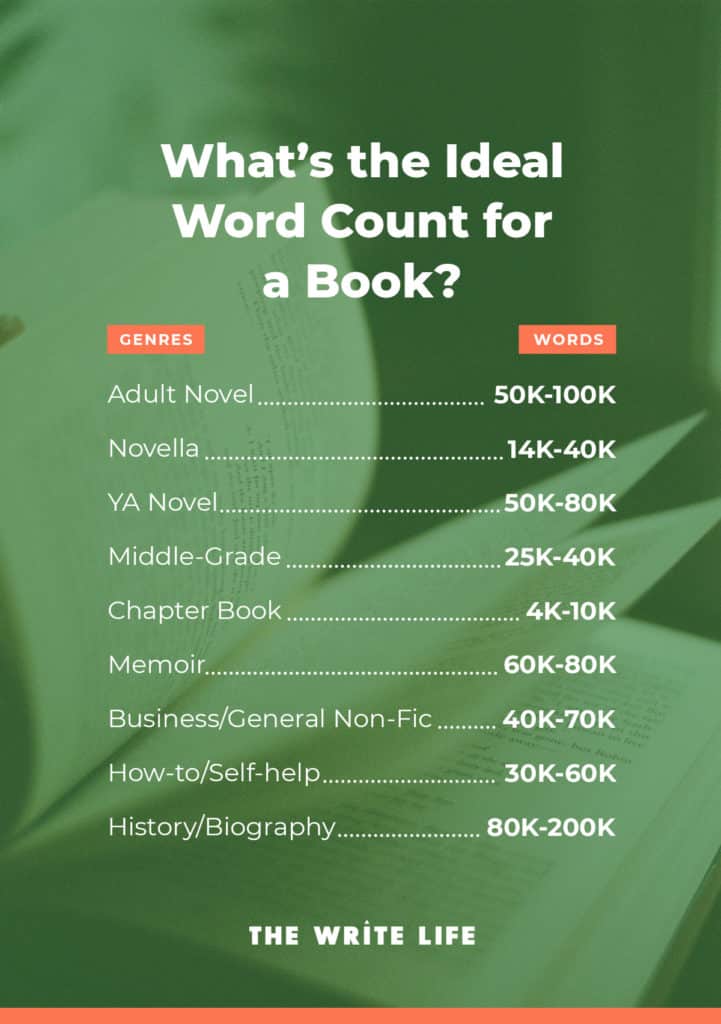
        For that matter, how long should any book be? How many words are in a typical novel? What’s the ideal book word count? 

        If you’re writing your first novel or any book, you’re probably asking these questions.

        How many words in a novel? The short answer is: long enough to tell the story but short enough to consistently hold the reader’s interest.

        The long answer is, well, longer.

        Why Do Novel Word Counts Matter?

        Word count matters because every book, regardless of genre, has an inherent contract with the reader. But that contract is dependent upon the book’s genre.

        For instance, when a reader picks up a thriller, they have certain expectations of what they’re about to read. That includes scenes like “the hero at the mercy of the villain,” but it also includes book length. Because thrillers are about pulse-pounding action and maybe some character development (especially if it’s part of a series), the word count isn’t massive. Thrillers tend to be 70,000 to 90,000 words.

        If you’re not a thriller author, I won’t keep you in suspense. At the end of this article, you’re going to find a guide to suggested word count length for most every popular genre.

        My point is that your genre will likely dictate your word count. There are exceptions, like YA books that exceed 250,000 words, but those tend to be outliers, and first-time authors rarely, if ever, get to be an outlier.

        Additionally, knowing your word count before you start writing can help you better plan your narrative arc as well as your writing schedule.

        Wait…How Many Words in A Novel?

        And what’s the average length of other types of books?

        Before diving into the specifics of genre-based word counts, let’s look at the broader picture of average book length.

        For most publishers, a book is “novel-length” when it’s between 50,000 and 110,000 words.

        At a writers conference I recently attended, publishing veteran Jane Friedman said 80,000 words is good for most fiction, below 60,000 isn’t novel length territory, and above 120,000 is likely too much.

        Writer’s Digest recommends 80,000 to 89,999 words as a “100% safe range for literary, mainstream, women’s, romance, mystery, suspense, thriller and horror.” That’s approximately 300 pages of double-spaced type.

        In “Outlining Your Book in 3 Easy Steps” on Storygrid, editor Shawn Coyne says, “The average novel today is about 90,000 words. Big, epic stories get anywhere from 120,000 to 200,000 words.” But, he also mentions that “The Wizard of Oz was 40,000 words. The Old Man and the Sea was about 25 to 30,000 words, tops.”

        Coyne uses the Nanowrimo word-count length of 50,000 words for his examples, calling 50,000 words a good foundation to build upon.

        So what does that mean for you, author?

        If you’re working on a novel-length book, aim for 50,000 words at the very least, but it’s better to aim for 90,000. Editorial trimming is inevitable.

        However, you’ll also want to take your genre into account.

        words in a novel

        What Should My Book Word Count Be?

        The following are average word-count ranges by genre.

        General Fiction Word Counts

        Fiction Genres Word Counts

        • Mainstream Romance: 70,000–100,000 words
        • Subgenre Romance: 40,000–100,000 words
        • Science Fiction / Fantasy: 90,000–120,000 (and sometimes 150,000) words
        • Historical Fiction: 80,000–100,000
        • Thrillers / Horror / Mysteries / Crime: 70,000–90,000 words
        • Young Adult: 50,000–80,000

        Children’s Books Word Counts

        • Picture Books: 300–800 words
        • Early Readers: 200–3500 words
        • Chapter Books: 4000–10,000 words
        • Middle Grade: 25,000–40,000 words

        Nonfiction Word Counts

        • Standard Nonfiction (Business, Political Science, Psychology, History, etc.): 70,000–80,000 words
        • Memoir: 80,000–100,000 words
        • Biography: 80,000–200,000 words
        • How-To / Self-Help: 40,000–50,000 words

        All of these are average book word count ranges and should not be taken as the definitive word count you must reach in your book. We all know of outliers within each genre that have been published well under, or well over, these word counts.

        Use these numbers as a baseline for your writing goals.

        Know what readers expect in terms of your genre’s word count (even if the reader isn’t aware of their expectations when it comes to how long a book is).

        How Many Words Per Page Can You Expect in a Book? 

        This is another common question, and for most writers it should be easy to answer by using a “word count” feature in your writing tool.

        If you’re writing in Microsoft Word,”word count” is an option under “Tools.” Prefer something different? Here’s how to find word count in Google Docs. You can also track word count in Scrivener.

        The average single-spaced document typed in 12-point font contains about 500 words per page, but that can vary pretty drastically depending on your formatting.

        So, if you have an hour to write and aim to get down 300 words, you might wonder, how many pages is 300 words, and the answer is less than one! Doable, right?

        If you’re thinking bigger and wondering, for example, how many pages is 50,000 words, simply divide your target word count (50,000) by 500 (since that’s the average words per page). Your answer here is 100 pages.

        Don’t let those commas instill fear. Fifty thousand words isn’t that much divided into five days a week for a year. That’s only 193 words per writing day!

        [sps_reusable_block post_id=43061]


        This is an updated version of a story that was previously published. We update our posts as often as possible to ensure they’re useful for our readers.

      • What is Irony? + 5 Tips To Use It In Your Writing

        What is Irony? + 5 Tips To Use It In Your Writing

        When it comes to learning different ways to write, you will want to spend time learning the advanced techniques to make your writing even stronger.

        In all of your writing techniques, you might have wondered what is irony?

        Irony is a powerful literary device that adds depth and complexity to your writing. It occurs when there’s a gap between expectation and reality, often resulting in a humorous or thought-provoking twist.

        In this article, we will summarize what irony is to help you understand the basics, how to use it in your writing, and a primer on the different types out there to pick from.

        What Is Irony?

        Irony is a literary and rhetorical device that conveys a disconnect or incongruity between what is expected and what actually occurs. It often involves a subtle, often humorous, twist in meaning or situations.

        Irony, in its broadest sense, is the juxtaposition of what on the surface appears to be the case and what is actually the case or to be expected; it is an important rhetorical device and literary technique. Irony can be categorized into different types, including verbal irony, dramatic irony, and situational irony.

        Wikipedia page on “Irony”

        Irony serves various purposes in writing, from humor and satire to commentary on the human experience. It can sometimes be hard to fit into a box and is one of those things you understand when you start to read it.

        When used in an advanced way, irony invites readers to think critically about the world and human nature, challenging them to look beyond the surface of words and actions to uncover deeper layers of meaning.

        What Are Different Types Of Irony

        When it comes to including irony in your writing, there are various forms you can use. You will need to know the differences if you plan to use it in your writing.

        1. Verbal Irony: This occurs when a character says one thing but means another. Sarcasm is a common form of verbal irony, where the speaker intentionally says the opposite of what they mean to mock or criticize.
        2. Dramatic Irony: This occurs when the audience or reader knows something that the characters in a story do not. This knowledge creates tension and often leads to unexpected outcomes.
        3. Situational Irony: In this type, there’s a contrast between what’s expected to happen and what actually happens. It can be both amusing and thought-provoking. For example, a fire station burning down is a situationally ironic event.
        4. Cosmic Irony: This is a broader concept where the universe itself seems to conspire against human desires and expectations. It suggests a sense of fate or destiny that’s often cruel or indifferent.

        For the most part, you will use situational and verbal irony in your writing, but that gives you an overview of some other options, as well.

        How to Use Irony In Your Writing

        Remember that while irony can be a powerful tool, its effectiveness depends on context, tone, and the skill of the writer.

        While irony can be hard to always define, there are a few tips you can keep in mind for you to use to start using irony in your writing.

        1. Consider your audience

        Before you try and use irony in your writing, you will want to think about if your audience is the right kind to appreciate irony.

        For example, if you are writing for a business context, you will most likely not want to use irony because that is not the format for creative writing. What may be ironic to one group of readers might not be to another.

        2. Start doing word play and get creative

        Play with words or phrases that have double meanings. This can lead to humorous or thought-provoking results.

        It will take a while in order to properly use irony in the right situation. Even advanced writers can have a hard time nailing it every time! To get a better grasp of how to use irony, read works by authors who excel at it.

        3. Play with timing

        The timing of your ironic statement can enhance its impact. Place it strategically in your writing to maximize its effect.

        4. Keep consistent with your tone

        Make sure that the ironic statement or situation is consistent with the tone and style of your overall piece. Sudden shifts in tone can be jarring for readers.

        5. Edit ruthlessly

        Irony can be subtle, so revise and edit your work to ensure that the irony is clear and effective. Ask others for feedback to gauge how well it comes across.

        Tips for Using Situational Irony

        For the most part, writers are going to mostly use situational and verbal irony in their writing.

        If you plan to use situational irony in your writing, here are a few tips for this specific type of irony.

        In situational irony, create situations where the outcome is different from what is expected. This can surprise and engage your readers.

        Before you can create situational irony, you need to establish clear expectations or a baseline for what your readers anticipate will happen. Describe the situation, characters, or circumstances in a way that leads your audience to expect a particular outcome or resolution.

        Build tension or anticipation by subtly foreshadowing events or developments that seem to align with these expectations.

        Once you’ve set up the reader’s expectations, subvert them by delivering an outcome that is unexpected and contrary to what was anticipated. The surprise element is key to situational irony.

        Make sure the twist is logical within the context of your story. It shouldn’t come completely out of left field but rather reveal a deeper layer of meaning or an ironic contrast with the established expectations of the storyline.

        Tips for Using Verbal Irony

        If you plan to use verbal irony in your writing, here are a few tips for this specific type of irony.

        Sarcasm is a form of verbal irony that involves mocking or ridiculing. While it can be effective, it should be used carefully, as it can come across as mean-spirited or offensive.

        Exaggeration and understatement are tools to create verbal irony. By downplaying or overstating a situation, you can convey the opposite of what is stated.

        Use situational or character-based context to create a foundation for the irony. For example, if a character is known for their straightforwardness, their use of sarcasm or irony will stand out more.

        Verbal irony should be clear to the reader without being overly explicit. The key is to strike a balance so that the audience grasps the irony without having it explained.

        Use tone, context cues, or subtle hints to guide your readers toward the intended meaning. Be aware that if the irony is too subtle, it may be missed altogether.

        For instance, if you’re writing a story where a character is always pessimistic, you can use verbal irony by having them say something like, “Oh, great, another sunny day,” when the character actually despises sunny weather. The irony lies in the contrast between the words spoken and the character’s true feelings, and the context helps readers understand the intended meaning.

        What To Do Next

        Ready to write your fiction book?

        This writer class will teach you all of the basics you need to know to make passive income as an author!

        Click below to find out more:

        New call-to-action
      • How a Freelance Journalist Used Content Marketing to Double Her Income

        How a Freelance Journalist Used Content Marketing to Double Her Income

        I introduced content marketing into my freelance writing business almost a decade ago and when I did my annual review in December of that year, I found—much to my amazement—that my income had doubled from the year before.

        The extra income was all from the content marketing work I’d taken on. Even better? I’d spent only about 20 percent of my time on that work.

        How to Successfully Break Into Journalism in 2024 Free Webinar

        Since then, content marketing has become a staple in my freelance writing business. It has helped me weather the storms when magazine and newspaper income has dried up, and provided a consistent source of assignments and money when I’ve wanted to work on personal projects such as two novels or my website The Wordling

        What content marketing offered was simple: I routinely earn $1 to $2 USD per word for my content marketing stories, the revisions are almost non-existent, the agencies I work with pay as soon as I submit my work, and I’m often given ready-made assignments from clients instead of having to come up with my own ideas.

        For much of my content marketing work in the last few years, I made between $300 and $400 an hour. My highest rate for a content marketing piece was $475 an hour.

        Curious about exploring these kinds of freelance writing jobs? Here’s what you need to know about content marketing.

        Great alternative careers for journalists: Content marketing

        Put simply, it’s when a business decides to use content (blog posts, articles or case studies) as a way to build a relationship with its customer. Good content marketing isn’t about actively selling products or serving an agenda. It’s about providing information, advice, resources and trustworthy content to a business’s clients and customers.

        Here’s the all-important distinction: If a business asks you to write promotional content, such as brochures or sales newsletters, that’s not content marketing. That’s pure and simple marketing copy.

        In truth, content marketing writing often isn’t all that different from the kind of work you’re probably already doing as a journalist or freelance writer.

        Why is content marketing a good opportunity for writers? Let me count the ways.

        1. Great pay

        Let’s get straight to the good stuff. Content marketing writing pays well. I averaged $300 to $400 per hour even at the very beginning, but even if you’re a less experienced writer, finding the right clients could easily mean 50-cents-a-word assignments right off the bat.

        That said, you do need some clips and credits. A new writer would do well to start with blog posts that pay $50 and graduate to greener pastures after getting some experience, especially with traditional media.

        Why? Businesses love to see recognizable names in your portfolio, and they’ll often pay more if you have solid experience and specialized knowledge of their niche or topic.

        In stark contrast to the falling rates many of us see for pieces in newspapers and magazines, in my experience, content marketing rates have only been going up. The more efficiently I work, the more I make.

        2. Enjoyable work

        In my experience, writing good content for businesses isn’t all that different from the work you may be doing as a freelance writer for websites or even newspapers and magazines (with the exception of hard news reporting, of course).

        The point of content marketing is to deliver information to readers that is well researched, trustworthy and entertaining. As a content marketing writer, I’ve been asked to write service stories (how-to pieces), trend stories and profiles in exactly the way I would have written them for a magazine or newspaper.

        And if I’m going to write the same types of stories as I normally would, I’m quite happy to earn substantially more for my time.

        A common misconception among writers is that content marketing writing equals blogging. Since I don’t particularly enjoy blogging for businesses, I’ve stayed away from doing those jobs, and I still get enough work that I routinely have to turn down assignments that don’t appeal to me. Likewise, if you love the idea of writing posts for a company’s blog but don’t want to work on case studies, you’ll likely be able to focus on the work you prefer.

        3. Efficient edits

        This is probably the biggest sell of content marketing writing for me: the ease and efficiency of edits.

        Compared to traditional media, businesses run with a much higher sense of urgency. When a business fails to be efficient, in content or anything else, they lose money. So they learn to get things done pretty quickly, even if they’re a big hairy corporate that requires multiple levels of approval—and this drive for efficiency works in your favor.

        Because business clients are less likely to ask for multiple revisions and aren’t content specialists themselves (which is partly why they’ve hired you), I find they request fewer—and easier—edits. When I spend less time on revisions, I have more time to devote to my next assignment — and I boost my hourly earnings.

        As an entrepreneur myself, the efficiency of most business clients appeals to me greatly. And as a writer who likes to get paid on time, it appeals to me even more.

        4. Quick(er) payment

        Speaking of efficiency, have I mentioned that no matter whether you work through an agency or directly with a client, you’ll often be paid within a week of submitting your work?

        Of course, this depends on your clients and their policies. But in my experience, many clients prefer to pay quickly.

        And some platforms, such as Contently, will pay not on acceptance, but on submission, which does wonders for your cash flow.

        If you pick your clients wisely, work with reputable agencies that have established relationships with clients whose names you recognize, and negotiate your contracts well, you’ll find that chasing invoices will quickly become a thing of the past.

        5. Consistent work

        One of the biggest problems freelancers face—and a common reason why many quit freelancing—is irregular cash flow.

        Traditional media (and even websites) often simply don’t have enough work to give to you on a monthly basis. Even when I had stellar relationships with editors, I could never get more than one article in their magazines each month. Unless you’re blogging for a publication or get on board as a columnist, it’s very difficult to get regular slots in a publication.

        Not so with content marketing writing. In fact, if you provide consistently good work that needs little or no reworking, you’ll find that you can rely on assignments on a weekly basis from the same clients, sometimes even more. This dependable work helps you forecast your income for the month and more importantly, find some stability in your cash flow.

        For all these reasons and more, I’m convinced that content marketing writing is a fantastic opportunity for writers to get paid for their skills. If you’re looking to land higher-paying writing jobs, even as you work on breaking into your dream publications or writing your novel, content marketing could help you make more money as a writer.

        How to Successfully Break Into Journalism in 2024 Free Webinar

        If you’re wondering what opportunities exist for freelance writers in 2024 (hint: there are plenty!) then make sure to register for the free webinar coming up on September 26, 2024 called How to Successfully Break Into Journalism in 2024! You’ll learn about the different types of journalism and what you may best be suited for, and the top skills successful journalists need and what it can lead to.

        This is an updated version of a story that was previously published. We update our posts as often as possible to ensure they’re useful for our readers.

      • What is Blackout Poetry? How to Use Erasure Verse In Your Art

        What is Blackout Poetry? How to Use Erasure Verse In Your Art

        Blackout poetry is for everyone, whether you see yourself as a creative person or you don’t think you have an artistic bone in your body. This unique artform blends literary and visual elements into a cohesive piece that can take infinite forms. 

        You’ve likely come across examples of blackout poetry in school or on social media. This form of expression is a popular choice for teachers and recently has become popular on platforms such as Instagram, Pinterest, and TikTok

        Blackout Poetry 101: An Introduction

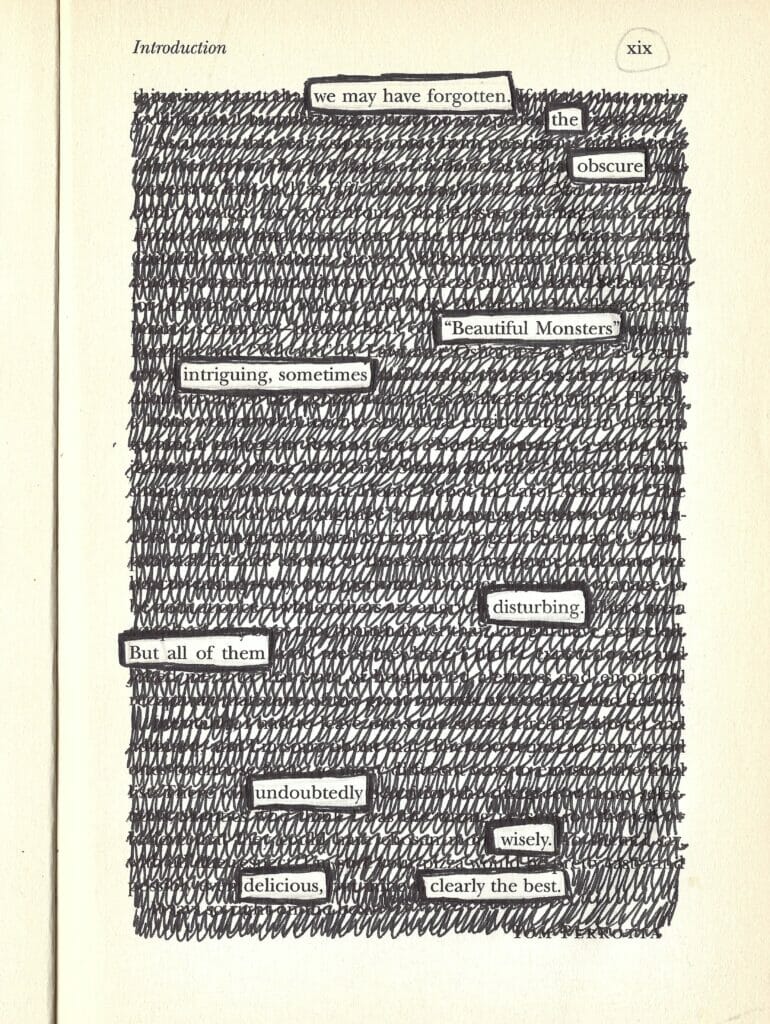
        Based on its title, you may have guessed that blackout poetry, also called erasure poetry or redacted poetry, consists of blacking out sections of text to create a poem from the original text. It’s the art of taking an existing piece of literature and turning it into something completely new. What emerges from the carefully-selected words is new meaning and interpretation not only from the words that remain, but also from those now obscured and the visual it creates. 

        Example of blackout poetry or erasure poetry from Pinterest.

        A Brief History of Blackout Poetry 

        Blackout poetry’s roots trace back as far as the days of Benjamin Franklin. Franklin’s neighbor Caleb Whiteford was known to make redactions on serious stories in the newspaper to create jokes for his friends. While this was not taken seriously at the time, it paved the way for others to practice and build upon this idea of creating new narratives from existing texts. 

        The artform didn’t really take off until 100 years later in the early 20th century. Then, it picked up traction with the avant-garde Dada and Surrealist movements. At a time where artists were eager to break free of traditional artistic norms, blackout poetry created a platform for non-traditional art and expression. 

        Notable figures, including Robert Rauschenberg in the 1950s and Tom Phillips in the 1960s, kept the ball rolling and pushed the artform of blackout poetry to evolve over the decades. Catapulting this form of poetry to the mainstream media can be attributed to the instant New York Times Bestselling Newspaper Blackout published by Austin Kleon in 2010. 

        The Internet and social media have helped blackout poetry increase in popularity as both recreational and serious creators are increasingly able to share their redacted masterpieces with wider audiences. 

        How to Create Blackout Poetry

        This artform can be as simple or complex as you want it to be. The form most of us are familiar with consists of a page of text redacted with thick black marker leaving a careful selection of words behind to create a poem. At its core, it’s simple enough so anyone can partake in this form of expression—but the door is wide open for artistic liberties. 

        Here are 3 Steps to Make Your Own Erasure Poetry

        1. Select your text 

        The original text for blackout poetry can take any form—newspaper, novel, book of poems, essay, textbook or anything in between. There are many angles you can take and connections to be made from the text you choose for your blackout poem. 

        You may choose to select a text that relates to the topic of your poem. Or a piece that actively opposes your views so you can rewrite the story. Perhaps picking a random book off the shelf and seeing what jumps off the page is what sparks your creativity. 

        1. Choose your words carefully

        The next and most crucial step is to select the words to carry your message. As you read through your source text, identify phrases and words that resonate with you and work together to piece together a new narrative. Put a box around the words and phrases that you are going to keep and cross out the rest. 

        1. Design the visual elements

        Now that you have picked out the words to tell your story and can see where they land on the page it’s time to move from the literary into the visual realm to add the next layer of your composition. It’s about the words, but also how they interact visually on the page. 

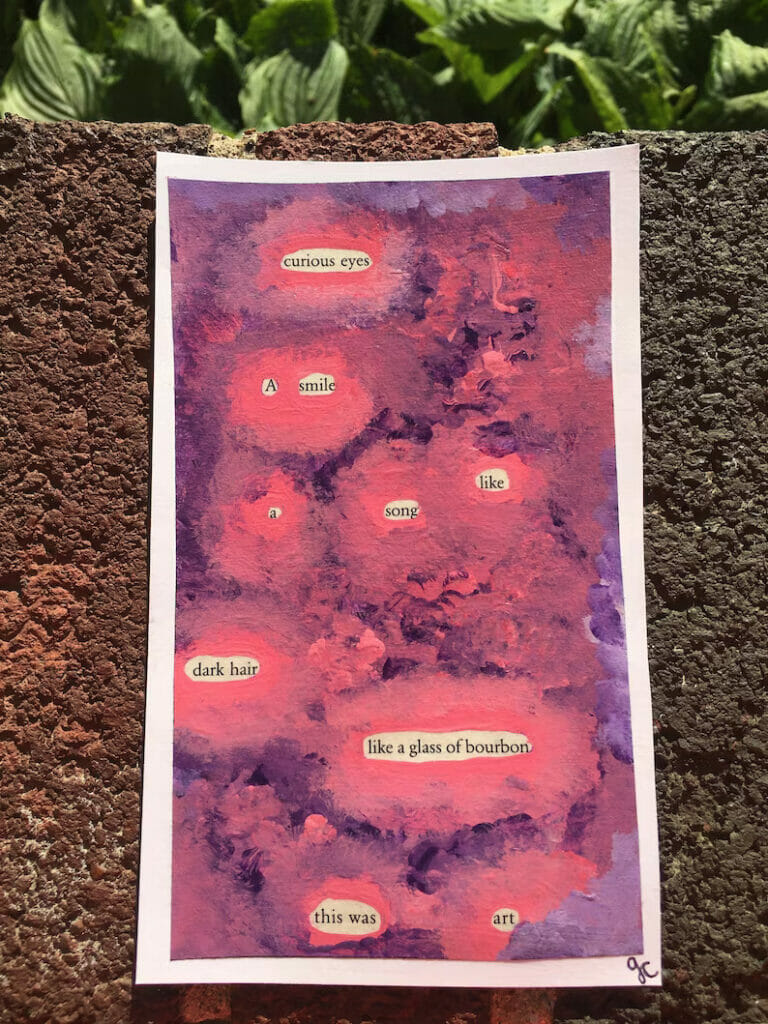
        You may even choose to breathe new life into blackout poetry by skipping the black part of blackout. Many are infusing more creative flare into their work experimenting with different colors, mediums and visuals. These days you can find many examples of blackout poetry that incorporate line art and watercolor paint that push the envelope of design. 

        Example of blackout poetry from Dove and Crow Art

        Why People Like Blackout Poetry 

        There are many reasons why people enjoy creating blackout poetry and why it has become increasingly popular over the years. One big draw is that this form of artistic expression is so accessible.

        Intimidated by a blank page? Not a problem. Can’t draw? You don’t need to. Not good at coming up with words? The words are already there.

        The process of creating blackout poetry makes it possible for people who may not have created art or poetry before to try their hand at it. Those who were already active in the creative space also love blackout poetry for its unique form of expression and limitless possibilities to blend art and wordplay. 

        The practice can bring participants therapeutic benefits from being able to rewrite their own narrative and embrace creativity. Many people find blackout poetry relaxing in ways similar to a coloring book or completing a puzzle. 

        Different people get varying benefits out of creative practices, and blackout poetry is no exception. Some may enjoy it because it fuels their love of reading and helps them build a strong vocabulary. Others may like it because it challenges them to creatively problem solve. While others gravitate toward blackout poetry as an outlet for stress relief or self expression. 

        Whatever the reason, you can’t really go wrong practicing a creative exercise you enjoy. 

        Blackout Poetry in the Digital Age

        Some view social media like TikTok as major time-sucks, while others recognize it as a host of infinite amounts of shared knowledge. One thing about TikTok in particular is that it exposes you to so many new things you would otherwise never have learned about before. 

        If you have ever come across blackout poetry on TikTok, I can almost guarantee that you did not seek it out on your own. Your faithful FYP (for you page) gods delivered to land you on #blackoutpoetrytok.

        One of the great things about social media and the Internet is that anyone can now share their work to inspire others just as anyone can view the work of others and become inspired. 

        The digital age has changed both how we access and create visual poetry. Creators can now experiment with digital tools to produce reimagined blackout poems with new depth, intricacy, and vibrancy. Simple digital tools such as Word and Google Docs or more complex tools like Procreate and Photoshop are bringing new innovation into practices such as blackout poetry. 

        This art form opens up new possibilities for creativity, art, and expression that anyone can take part in. People young or old, artistic or not creative are finding benefits and new meaning from this practice.

        Give it a try. I think you’ll see that those who dare to look will find that there are hidden treasures buried in everyday life. 

        Those who dare to look will find that there are hidden treasures buried in everyday life.

        Example of blackout poetry. The original text said Those who dare to look will find that there are hidden treasures buried in everyday life.

        101 Creative Writing Prompts
        That Will Get You Excited to Write

        Grab it for free 👇

          We’ll also send you our newsletter, which offers advice on freelancing and publishing.
          You can unsubscribe at any time.

        • Publish Your Personal Essay: 22 Magazines and Websites

          Publish Your Personal Essay: 22 Magazines and Websites

          Writing is a solitary act, but the importance of sharing your work can’t be overlooked. A personal essay can endear you to an audience, bring attention to an issue or simply provide comfort to a reader who’s “been there.”

          Journalists might find it difficult to steer away from research rituals to talk about themselves, but think of it this way:

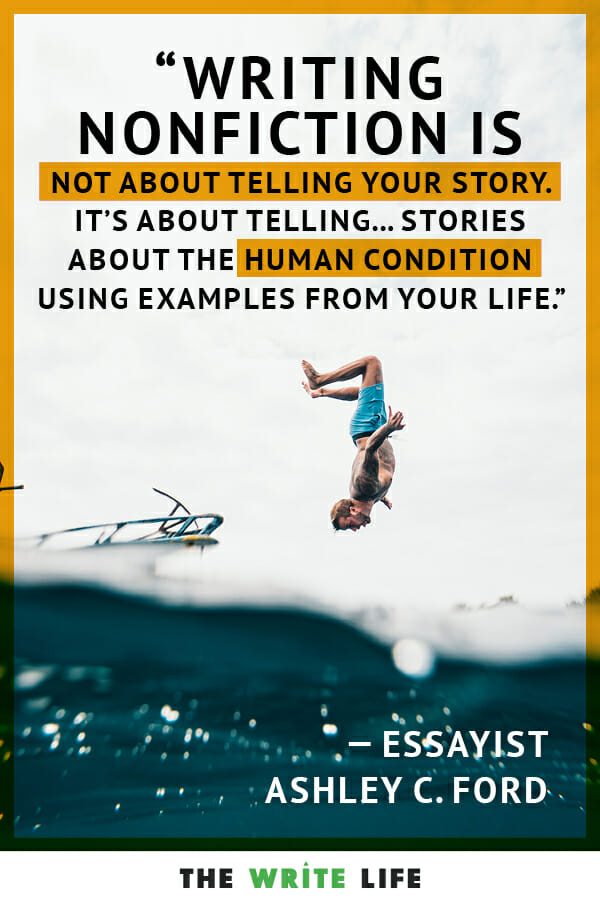
          “Writing nonfiction is not about telling your story. It’s about telling interesting and worthy stories about the human condition using examples from your life.”

          Ashley C. Ford, an essayist who emphasized the importance of creating a clear connection between your personal experience and universal topics

          When writing personal essays, imagine you’re writing through yourself, instead of about yourself—worry less about writing something that seems thrilling or heart-wrenching, and more about your truth and human experience. Believe it or not, someone out there needs your story more than you know. “It’s worth it to write what’s real,” says Ford. 

          Plus, there’s a bonus: You can get paid to publish your personal essay

          Where to submit your personal essays

          Once you’ve read other personal narrative examples and penned your essay, which publications should you contact? Where should you try to sell that personal essay?

          “You might be tempted to focus only on magazines, but there are some great websites that run essays.”

          Amy Paturel, who has taught an online personal essay writing course for a decade. To help her students get published, she compiled a list of 130+ editors who accept (and pay for!) personal stories

          We’ve all heard of The New York Times’ personal essay column—submit to Modern Love is probably already on your to-do list—but there are many other publications that publish personal essays.

          To help you find the right fit, we’ve compiled a list of 22 publications that will consider your personal narrative essay, as well as tips on how to pitch the editor, who to contact and, whenever possible, how much the outlet pays.

          Here are 22 places to submit your personal essay.

          1. Boston Globe

          The Boston Globe Magazine Connections section seeks 650-word first-person essays on relationships of any kind. It pays, though how much is unclear. Submit to magazine@globe.com with “query” in the subject line.

          You  can also submit to Boston Globe Ideas, which accepts pitches and submissions for first-person essays ranging from 650 to 1,000 words. All pitches and submissions should be sent to ideas@globe.com.

          Must-read personal essay:Voyages of Imagination” by Peter Schmidt, or “The Gift of Anger and Brokenheartedness” by Greg M. Epstein

          2. Extra Crispy

          Send your pitches about breakfast, brunch, or the culture of mornings to submissions@extracrispy.com or the editor of the section you’re pitching. Average pay hovers at about 46 cents per word.

          Must-read personal essay: Gina Vaynshteyn’s “When Dumplings Are Resistance

          3. Dame Magazine

          “For women who know better. Smart, fast-paced news and opinions on what matters most in our lives — That’s DAME.” 

          If you’re up for the challenge, send your pitch to editorial@damemagazine.com. Aimed at women in their 30s, the publication covers politics, race, civil rights, disability, class, gender, sex, reproductive rights, LGBTQ issues and much more. Rates are based on type of features, but they typically pay $200 for essays.

          Must-read personal essay: I Wanted Joan Didion’s Heart to Be Messy” by Lauren Sandler

          4. The Christian Science Monitor

          Have an upbeat personal essay between 400 and 800 words on everyday life, like travel, parenting, home, family, gardening, neighborhood, or community?

          Submit to The Christian Science Monitor’s Home Forum. Send your completed essays to homeforum@csmonitor.com. They accept essays on a wide variety of subjects (and encourage timely, newsy topics), but steer clear of topics like death, aging and disease.

          Must-read personal essay: Two Crises, Two Gardens” by Perdita Buchan

          5. Kveller

          Want to write for this Jewish parenting site? To submit, email submissions@kveller.com with “submission” somewhere in the subject line. Include a brief bio, contact information, and your complete original blog post—you can either attach it as a Word document or paste it into the body of the email. Suggested word count: 500-800. Per a well-loved private Facebook group for freelance writers, pay is about $50.

          Must-read personal essay: Faith Gabby-Kalson’s “I’m a Black and Jewish Woman. My Identity Matters.

          6. The Sun Magazine

          Publications in The Sun Magazine have won Pushcart Prizes and been selected for Best American Essays—so if your story gets chosen, you’ll be in good company. And since the editors “tend to favor personal writing,” that I-driven nonfiction essay might just be the perfect fit. (Fiction and poetry are also accepted.)

          Pay ranges from $300 all the way up to $2,000 for accepted personal stories and fiction prose. The easiest way to send your story is online through Submittable, but check the guidelines first before submitting.

          Must-read personal essay:  “The Ramshackle Garden Of Affection” by Ross Gay and Noah Davis  (Editor’s note: The Sun puts its stories behind a paywall, which is why they can afford to pay their writers so well!)

          7. New Statesman

          This U.K. magazine has a helpful contributor’s guide that explains, among many other things, what they’re looking for: Great writing and original reporting that explains and analyses the world today. Unsolicited submissions, while rarely accepted, are paid; if an editor likes your pitch, you’ll hear back in 24 hours. Email submissions@newstatesman.co.uk  to get started.

          Must-read personal essay: Personal Story: How to Lose Your Head” by Emily Bottle

          8. The New York Times

          The popular Modern Love feature accepts submissions of 1,500 to 1,700 words  at modernlove@nytimes.com. Include a Word attachment, but also paste the text into your message. Consult the Times’ page on pitching first (and note that submissions during July and August aren’t considered!), and “like” Modern Love on Facebook for even more insight. Payment is $300, The New York Times writes on its Facebook page.

          This column is famous for helping writers get book or even film contracts. One example is Amy Krouse Rosenthal, whose essay, “You May Want to Marry My Husband” ran in 2017 and prompted a lucrative film rights bidding war ultimately won by Universal Pictures.

          Want to up your chances of getting your submission selected? Check out these Modern Love Column submission tips.

          Must-read personal essay: Relationships Move Fast on a Slow Cargo Ship” by Dev Aujla

          9. Creative Nonfiction Magazine

          One unique aspect to Creative Nonfiction Magazine is their high acceptance rate of unsolicited pitches. It’s a great stop for blossoming writers, as well as those with more experience.

          To submit online, a $3 reading fee is charged to non-subscribers (and the magazine no longer accepts paper submissions). The fee ensures you will be paid if your work is accepted, which typically adds up to a $125 flat rate plus $10 per printed page. Plus, they often run essay contests with prizes ranging from $1,000-$10,000 per winning entry, and reading fees help offset that expense. Read over their submission calls before pitching since each issue sticks to a theme and may have different guidelines. 

          Must-read personal essay:The Dark Month” by Christopher Collins

          10. Slate

          “Slate,” according to its own submission guidelines, “is known for making smart, witty, persuasive statements.” So if you’ve got something to say, email your pitch (not a vague, one- or two-sentence pitch either) to the appropriate section editor, which are all listed for you on the submission guidelines page.

          Send personal essays to laura.bennett@slate.com. Average reported pay is about 24 cents per word.

          Must-read personal essay: Andrea Silenzi’s “My Decade in Online Dating

          11. Slice

          Each print issue has a specific cultural theme and welcomes both fiction and nonfiction—and even poetry! Stories and essays of 5,000 words max earn up to $400. Review periods are limited, so check their submission guidelines to make sure your work will be read with the next issue in mind. The easiest way to send in your work is through Submittable.

          Must-read personal essay: Fire Island,” by Christopher Locke

          12. Motherwell

          Motherwell is a publication that aims to tell all sides of the parenting story. They seek evocative parenting-related personal essay submissions of up to 1,200 words, and all contributors are paid.

          Submit a full piece online via Submittable; for time-sensitive pieces, send an email to motherwellmag@gmail.com with the word “timely” in all caps in the subject line..

          Must-read personal essay:The Irrational Hope of An Infertile Woman” by Amy Gallo Ryan

          13. The Bold Italic

          This publication focuses on California’s Bay Area, and it’s deeply interested in the people who keep San Francisco going. Strong POV and a compelling personal writing style are key. Typical pay is $50 per article, though higher rates can be negotiated for “complex” pieces.

          Send your personal essays that will make these editors weep, cry, laugh or want to eat a burrito to info@thebolditalic.com with the subject line  “Pitch: [Name], [Article Title].”

          Must-read personal essay:How I Came to Respect Chinese Food—and My Heritage” by Eric He

          14. Bustle

          Submit essays about health, mental health, relationships, and identity to the appropriate editor at this lifestyle site geared toward women. 

          For lifestyle pitches, email lifestylepitches@bustle.com; for fashion and beauty pitches, email fashionbeautypitches@bustle.com; for entertainment pitches, email entertainmentpitches@bustle.com. And note that the editors only want pitches, not full drafts. Pay averages about 12 cents per word

          Must-read personal essay:How My Chronic Eczema Tore Down & Built Up My Self-Esteem” by Tori Zhou

          15. The Rumpus

          Focuses on essays that “intersect culture.” Submit finished essays online in the category that fits best, but wait at least  three months before following up.

          Payment is lean, but possible: Eligible contributors can opt in to receive an even share of the $300 budget the publication sets aside monthly.

          Note the regular reading periods for essays: September 1 through October 31, January 1 through February 28, and June 1 through July 31. Timely essays can be sent to mkorbel@therumpus.net; all other essays should be sent through Submittable during open reading periods.

          Must-read personal essay:Dancing Separate, Together” by Russel Janzen

          16. The Penny Hoarder

          This personal-finance website welcomes submissions that discuss ways to make or save money. Read the guidelines before emailing your submission to learn what kind of stories they typically look for—human interest stories, success stories and unique job ideas, or your stories of eating, traveling and doing life on a budget. Articles should be between 700-900 words, and an editor will discuss payment with you if your pitch is accepted. 

          Must-read personal essay: How This Woman Bought Her Dream Home While Making Less Than $60K” by Jen Smith

          17. Vox’s First Person

          The First Person section of Vox.com publishes personal essays “with unique perspectives on complicated issues.” Submit pitches or completed drafts to firstperson@vox.com.

          They are open to a variety of topics, but claim past success with pieces on parenting, relationships, money, identity, mental health, and job/workplace issues—“but we’re always looking for new topics to cover, so if you have a pitch that doesn’t fall into any of these categories, don’t let that stop you from sending it along.” Pay varies.

          Must-read personal essay:Black Kids Are Watching This Moment. What Will It Teach Them?” by Kelly Glass

          18. Narratively

          Narratively accepts pitches and complete pieces that tell “original and untold human stories.” In your story, there should be a “clear narrative arc that shows you developing a new or different perspective by the end of the piece.” Submit online in the category that most closely fits your essay, which should be between 1,500 and 4,000 words. Pay averages 9 cents per word.

          Must-read personal essay: My Father, the QAnon Conspiracy Theorist” by Reed Ryley Grable

          19. Mask Magazine

          Mask Magazine is an “experimental publication in the age of late capitalist world-weariness and discontent.” The story you pitch and submit should be expressive and about an experience, adventure, or tribulation that you learned from, and you don’t have to worry about restricting your creativity to a word count. For pitching, they only accept full submissions—feel free to send a pitch, but you won’t get the greenlight until editors see an early or complete first draft. Pay is between $50 and $200.

          Must-read personal essay: “Fevered Reading” by Ryan Richardson

          20. The Smart Set 

          A journal of arts and culture, The Smart Set accepts submissions and pitches on a rolling basis. Pitch your personal essay of 1500 and 3500 words to smartsetmag@drexel.edu — don’t forget to format your submission as a Word document with Times New Roman 12-point font, double-spaced. The last reported rate for The Smart Set was 20 cents per word

          Must-read personal essay: “White Chapel” by Eric Bryan

          21. PULP Magazine

          Before you pitch this magazine, ask yourself: How does this relate to sex or one’s personal/societal perception of sexuality and/or reproductive rights? A “multimedia sex, sexuality, and reproductive rights publication celebrating this human coil hurtling through time and space,” PULP only accepts fully written pieces via Submittable, and they pay $250 for original content. Heads up: Because they’re a small pub that wants to pay their writers, there’s a $3 reading fee to submit your work. If you can’t swing the cost, let them know (july@thepulpmag.com and katie@thepulpmag.com) and they’ll work something out with you.   

          Must-read personal essay: “Not a “Real” Survivor: The Price Of Opinions In The Anti-Trafficking Movement” by Laura LeMoon

          22. The Virginia Quarterly Review 

          The VQR strives to publish the best writing we can find, whether it be from accomplished and award-winning authors or emerging writers. They’re looking for essay submissions that “look out on the world, rather than within the self,” between 3,500–9,000 words. The pay for prose is generally 25 cents per word, depending on length, and they only accept submissions via Submittable. Note that they read unsolicited fiction, poetry, and nonfiction submissions from July 1 to 31. 

          Must-read personal essay: Hananah Zaheer’s “After the Old City

          A final word of advice on where to publish personal essays

          Find yourself sending pitch after pitch only to never get published? Make sure you’re not making one of these mistakes with your essay.

          “Submit to the places you love that publish work like yours,” essayist Ford advises, but don’t get caught up in the size of the publication. And “recognize that at small publications you’re way more likely to find someone with the time to really help you edit a piece.

          The original version of this story was written by Lisa Rowan. We updated the post so it’s more useful for our readers.

          This post contains affiliate links. That means if you purchase through our links, you’re supporting The Write Life—and we thank you for that!

          Photo via GuadiLab/ Shutterstock 

          Freelance Writer’s Pitch Checklist
          Grab it for free 👇

          Convince more editors to say YES to your pitches!

            We’ll also send you our weekly newsletter, which offers helpful advice for freelancing and publishing. You can unsubscribe at any time.

          • How to Write a Memoir: 7 Ways to Tell a Powerful Story

            How to Write a Memoir: 7 Ways to Tell a Powerful Story

            Whether you curl up with memoirs on a frequent basis or pick one up every now and again, you know powerful memoirs have the capacity to take readers for an exhilarating ride.

            While all memoirs are different, the best ones have certain elements in common. Knowing what makes a memoir compelling and riveting is key when sitting down to craft your own.

            When I teach people how to write a memoir, we talk about how to tell a compelling story.

            In this article, we’ll review some common memoir elements so you can weave them into your own work. Before we start, let’s define memoir.

            What is Memoir?

            Memoir is not an autobiography. In other words, it is not the story of your whole life. Memoir is a slice of life, a story of part of your life or a story from your life.

            The scope of memoir will vary depending on the subject matter, but more often than not, aspiring memoirists come to the page with too much story that needs to be pared down. One way to do that is to get clear about your themes. Memoir is often reined in by the writer knowing what her themes are and writing each scene while holding two questions in mind:

            1. How does this scene relate to my theme?
            2. What sense am I trying to make of my story through writing this scene?

            Memoir is about creating understanding, making sense of your story so that others can relate. Memoir is not “what happened,” because unless you’re famous, what happened to you in your life is not what will draw readers to the page. What draws readers is the subject matter (surviving a trauma, trying to live by the tenets of self-help books, living in prison) or the theme (addiction, parent-child relationships, repeating family patterns, identity). 

            A memoir that lacks an author’s effort to extract meaning from their story is usually a slow read. A reader may find themselves wondering what’s the point? If there’s nothing in the story for the reader, the memoir is lacking reflection and takeaway, which are two key elements that are unique to memoir.  


            The Write Life has teamed up with Self-Publishing School to create a training called, Writing and Publishing Your Life Story. In it, you’ll learn the three core elements of memorable memoirs. Click here to sign up for this free workshop.


            How to Write a Memoir

            If you’re planning to write a memoir, your goal should be to take your readers on a journey they won’t forget. Here are seven tips for how to write a memoir.

            1. Narrow Your Focus

            Your memoir should be written as if the entire book is a snapshot of a theme or two from your lived experience. Consider a pie, where your life represents the whole pie, and you are writing a book about a teeny-tiny sliver.

            Since your memoir is not an autobiography, you can figure out your themes by making a timeline of your life. In the classes I teach, we call these “turning points” and it’s a valuable exercise to discover where the juice is, to sort out where to focus and where you might have the most to extract from your story. You want your readers to walk away knowing you, and a particular experience you lived through, on a much deeper level, but also to apply their own understanding of their own experiences to your story.

            Perhaps you are familiar with Angela’s Ashes by Frank McCourt. This memoir focuses on Frank’s life as a child growing up in Ireland. Angela is his mother, and much of the storyline focuses on the mother-son relationship, and how Frank saw her, as well as the role of outside forces like alcoholism, loss, and trauma on their entire family.

            2. Include More than Just Your Story

            Even as you narrow your focus, we also need to think bigger in our writing pursuits.

            For example, if Kamala Harris wrote a memoir about being a wife and stepmother while pursuing her career, she would pull in tidbits about how she juggled these roles when she had such a big job and big ambitions. She would let us into the intimate moments, including fights she might have had with her husband over the impossible kind of balance women in power who also have families face.  

            Likewise, if Madonna was writing a memoir about reinventing herself after 20 years away from the public spotlight, she most likely would include what it felt like to return to the music scene and how she continued to travel and perform while raising her children.

            How does this apply to you? Imagine you are writing a memoir about your three-week trek through the Himalayan Mountains. While the focus would be on your trip, as well as what you learned about yourself along the way, you would be wise to also include other details about the place, the people your experience, and what you learned not only about yourself, but about human nature and the wider world.

            You could describe the geography and history of the area, share interesting snippets about the people and animals you interacted with, and discuss your exploration of the meaning of it all as you progressed along your arduous journey.

            Your readers want to know about you, but also about what got you to this place to begin with. What prompted the trek? What is your backstory? What did you learn about yourself along the way? It’s these kinds of vivid details and astute observations that make for a powerful memoir.

            3. Tell the Truth

            One of the best tips for how to write a powerful memoir is to be honest and genuine. This is often tricky because we don’t want to hurt or upset the people (our family and friends!) we’ve written into our books. But it’s important that you mine for the truth of your story—even if it makes your journey as an author more difficult.

            When Shannon Hernandez wrote her memoir, Breaking the Silence: My Final Forty Days as a Public School Teacher, she knew she had a major dilemma: “If I opted to tell the whole truth, I would pretty much ensure I would never get a job with New York City Public Schools again.”

            But she also knew teachers, parents and administrators needed to hear why great teachers are leaving education in droves and why the current educational system is not doing what’s best for our nation’s kids.

            “I wrote my book with brutal honesty and it has paid off with my readers. It’s bringing national attention to what is happening behind closed school doors.”

            Shannon Hernandez

            One more note on honesty: Memoirs explore the concept of truth as seen through your eyes. Never write in a snarky manner or with a bitter tone. The motivation for writing a memoir shouldn’t be to exact revenge, whine, or seek forgiveness; it should simply be to share an experience that readers can relate to.

            Don’t exaggerate or bend the truth in your memoir. If you find you can’t remember, that’s alright. You can write composite scenes. You can lean into what “would have been true,” insofar as the details—your mother would have worn a particular style of dress, your best friend would have been chewing her favorite gum, your brother would have yelled something like the insult you decide to write.

            You don’t need to fabricate or embellish, but you also didn’t live your life with a tape recorder strapped to your belt, so memoir is all about recreating what happened while honoring the emotional truth of your story.

            4. Put Your Readers in Your Shoes

            Powerful writers show, not tell. And for a memoir writer, this is essential to your success, because you must invite your reader into your perspective so she can draw her own conclusions.

            The best way to do this is to unfold the story before your reader’s eyes by using vivid language that helps your reader visualize each scene. Mary Karr, author of three memoirs and the book, The Art of Memoir, writes that you must zip the reader into your skin. Another way to think of it is to imagine you’re carrying an old-school camcorder on your shoulder as you guide your reader through the scenes of your life. You want to place your reader right there next to you, or better yet, inside of your experiences. 

            Perhaps you want to explain that your aunt was a “raging alcoholic.” If you say this directly, your description will likely come across as judgmental and critical.

            Instead, paint a picture for your audience so they come to this conclusion on their own. You might write something like this:

            “Vodka bottles littered her bedroom, and I had learned the hard way not to knock on her door until well after noon. Most days she didn’t emerge into our living quarters until closer to sunset, and I would read her facial expression to gauge whether or not I should inquire about money—just so I could eat one meal before bedtime.”

            [sps_reusable_block post_id=43046]

            5. Employ Elements of Fiction to Bring Your Story to Life

            Think of the people in memoirs as characters. A great memoir pulls you into their lives: what they struggle with, what they are successful at, and what they wonder about.

            Many of the best memoir writers focus on a few key characteristics of their characters, allowing the reader to get to know each one in depth. Your readers must be able to feel emotions about your characters—love or hate or something in between.  

            To bring your characters alive, bring details like the characters’ tone of voice, how they talk, their body language and movements, and their style of speech. Read other memoirs to get a sense of how writers introduce place and setting into their stories through their characters—their accents, their behaviors, their shared values.  

            While your memoir is a true story, employing elements of fiction can make it far more powerful and enjoyable for your readers, and one point of craft is learning how to create strong characters your readers will feel like they know.

            6. Create an Emotional Journey

            Don’t aim to knock your readers’ socks off. Knock off their pants, shirt, shoes, and underwear too! Leave your readers with their mouths open in awe, or laughing hysterically, or crying tears of sympathy and sadness—or all three.

            Take them on an emotional journey that motivates them to read the next chapter, wonder about you well after they finish the last page, and tell their friends and colleagues about your book. The best way to evoke these feelings in your readers is to connect your emotions, as the protagonist, with pivotal reflections and takeaways about the happening throughout your narrative arc.

            Most of us are familiar with the narrative arc. In school, our teachers used to draw a “mountain” and once we reached the precipice, we were to fill in the climatic point of the book or story. Your memoir is no different: You need to create enough tension to shape your overall story, as well as each individual chapter, with that narrative arc.

            In Children of the Land by Marcelo Hernandez Garcia, we witness a boy growing up undocumented in the United States, the child of parents who crossed him over the US-Mexico border when he was just five years old. You’ll never find Marcelo telling us he was sad, angry, or devastated. 

            Instead, he writes of his disappointment after his mother didn’t get her green card:

            “It’s okay, mijo, we tried,” Ama said to me as I drove her to church one day.

            “Yeah, Amá, we tried, I said, hoping that between each of our admissions, at least one of us would actually believe it was worth it.

            Marcelo Hernandez Garcia

            Or of his fear when ICE raids his childhood home: 

            We stood there, frozen, unsure of what to do. The inner urge to flee was replaced with paralyzed submission—we were cemented in place. In that moment, if anyone wished to do so, they could have walked through the door, commanded us to cut ourselves open, and we would have probably listened. 

            Macelo Hernandez Garcia

            7. Showcase Your Personal Growth

            By the end of your memoir, you need to have shown growth or change or transformation of yourself, the protagonist of your story.  

            Whatever experiences you had throughout your book will carry more weight when you show how they affected you along your journey, and how you grew and changed as a result of what you lived through, or what you survived. How did what you went through change your approach to life? Change how you thought about others or yourself? Help you become a better or wiser person in some way?

            This is often the hardest part of writing a memoir because it requires introspection—sometimes in the form of hindsight, certainly in the form of self-reflection. It requires you sometimes to write with an understanding that your character might not have known then—at the age you were. This is why it’s so important to learn how to weave in reflections that don’t break the fictive dream.

            You don’t want to constantly interrupt your narrative with asides, like:

            • “Now I understand… ”
            • “I still wish my mother had treated me better … ”

            Instead, allow for the reflection to exist almost as if it’s an omniscient knowing, because in many ways it is. No one knows your story better than you—and you’re allowed, throughout your story—to extract meaning and apply understanding. Not only are you allowed, the genre demands it.  

            If you make meaning from your story, your readers will find meaning in your story too.

            Memoir Examples as Inspiration

            Let’s look at a few memoir examples.

            We broke these into three categories of memoirs, those that can help us learn about structure, theme and takeaway. Each of these are essential elements of the genre.

            Examples of Memoirs that Use an Effective Structure

            Although you’ll hear from memoirists who didn’t use an outline, or who prefer a process over a structured experience, most memoirists can benefit from having a structure in place before they start writing.

            The most straightforward memoirs are those that start at point A and end at point B, moving the reader along in linear time.

            Some examples include coming-of-age memoirs, like Kiese Laymon’s Heavy or Daisy Hernandez’s A Cup of Water Under My Bed, or memoirs that are narrowly focused, like Lori Gottleib’s Maybe You Should Talk to Someone, or Jennifer Pastiloff’s On Being Human.

            Then there are framed memoirs, like Dani Shapiro’s Inheritance which chronicles the A to B linear journey of finding out that the father who raised her was not her biological father, making use of flashback and memory to piece together the front story of what’s happening as she figures out the truth of who she really is. Wild by Cheryl Strayed, is another famous framed memoir, because the A to B story is her trek along the Pacific Crest Trail, but the use of flashback and memory has her constantly leaving the front story and entering into the backstory to give context for why she’s on this journey in the first place. 

            There are also thematic memoirs, like Terese Marie Mailhot’s Heart Berries, which focuses on themes of identity and trauma and its impact on her and her family, but reaches more broadly into the experience of being Native American. 

            Examples of Thematic Memoirs

            Thematic memoirs abound typically sell better than other memoirs because they’re what the industry calls “high-concept,” meaning that they’re easy for buyers and readers to wrap their minds around.

            Countless categories of memoir point to big-picture themes: addiction and recovery; parenting; travel; cooking; coming-of-age; dysfunctional family; religious experience; death and dying; divorce; and more.

            Your theme (or sometimes themes) infuses every chapter you write, and it/they can be quite nuanced. For instance, a theme might be healing through running.

            Once you identify your theme, you must always keep sight of it. I liken this to wearing a pair of tinted glasses. If you put on glasses with purple lenses, you can still see the entirety of the world around you, but you will never forget that you’re wearing the glasses because everything you look at is tinted purple.

            The same should be true with good memoir: introduce the reader to your world, but keep your memoir contained and on point by keeping your principal (and sometimes secondary) themes front and center.

            Single-issue memoirs about things like addiction, body image, or illness — including books like Hunger: A Memoir of (My Body) by Roxane Gay;  Smashed: Story of a Drunken Girlhood by Koren Zailckas; Sick: A Memoir by Porochista Khakpour; or Laura M. Flynn’s Swallow the Ocean: A Memoir, about growing up with a mentally unwell parent are all great examples. 

            For travel memoirs, or food memoirs, or memoirs of leaving home, check out books like The Expedition by Chris Fagan; or A Tiger in the Kitchen by Cheryl Lu-Lien Tan; or Blood, Bones, and Butter by Gabrielle Hamilton.

            Examples of Memoirs with Strong Takeaways

            Takeaway is your gift to the reader. It’s a message, reflection, or truism.

            Sometimes these fall at the end of scenes or the end of chapters, but that’s not always necessary. Takeaway can happen at any moment, when the author shares something heartfelt, universal, and true.

            It’s those moments in reading memoir that hit you hard because you can relate—even if you haven’t had the exact experience the author is describing.

            quote about a memoir's takeaway being a gift to the reader

            Understanding takeaway is a long process, and some authors, when they first start thinking about takeaway, make the mistake of being too overt or trying too hard.

            These are subtle moments of observation about the world around you, a wrapping up of an experience through a lesson learned or the sharing of the way something impacted you. The idea is to sprinkle these moments into your chapters, without overwhelming or spoon-feeding your reader.

            Good writers do this so seamlessly you don’t even realize it happened, except that you feel like he or she has burst your heart, or crushed you with the weight of their insight. You feel like you know the author because it’s as if she’s speaking directly to you.

            Good takeaway is, in fact, mirroring. It’s a way of relaying that we are not alone and the world is a crazy place, isn’t it?

            As an example, here’s a reflective passage from Elizabeth Gilbert’s Eat, Pray, Love: One Woman’s Search for Everything Across Italy, India and Indonesia:

            But is it such a bad thing to live like this for just a little while? Just for a few months of one’s life, is it so awful to travel through time with no greater ambition than to find the next lovely meal? Or to learn how to speak a language for no higher purpose than that it pleases your ear to hear it? Or to nap in a garden, in a patch of sunlight, in the middle of the day, right next to your favorite foundation? And then to do it again the next day? Of course, no one can live like this forever.

            Elizabeth Gilbert

            Not all reflective passages have to be questions, but you can see that this technique is effective. Gilbert is ruminating over the life she’s living, but which she cannot maintain; in her experience—through the vantage point of her American understanding of the world—it’s not possible, and undoubtedly 99% of her readers agree.

            We all know what it feels like to be saddled by the burdens of everyday life. Gilbert’s readers would feel this passage on a visceral level, even if they’d never before been to Italy, because everyone understands the longing that’s wrapped up in allowing yourself to just let down. And that’s what makes this a takeaway; it’s a universal connection to the reader.

            Now get out there and write!

            When you follow these examples and these seven guidelines for writing your memoir, you will captivate your audience and leave them begging for more.

            But more importantly, you will share your own authentic story with the world.

            Ready to learn more about sharing your story with the world?

            [sps_reusable_block post_id=43046]


            This is an updated version of a story that was previously published. We update our posts as often as possible to ensure they’re useful for our readers.