Blog

  • How to be a Lifestyle Blogger: Painless Process + Examples

    How to be a Lifestyle Blogger: Painless Process + Examples

    So many people want to learn how to be a lifestyle blogger, and for good reason. While there are plenty of people who just want to share their life, hacks, and findings with others like them, there are others who want to reap the financial rewards of a successful lifestyle blog.

    Who wouldn’t want to make a living documenting the life they’re living anyway?

    The truth is, while that would be fun and exciting and even seems glamorous at times, there is a lot more that goes into becoming a lifestyle blogger than you might think. Regardless, if you want to make a presence for yourself online, we’ll teach you how to do it.

    Make a Choice: for Fun or for Income?

    This is kind of a trick question because the only sustainable way you’ll make a living through lifestyle blogging is if it’s fun for you.

    But this still begs the question, why are you doing it? Did you hear that you can make a lot of money from learning how to be a lifestyle blogger? Did you see ads of someone promising that you’ll make more than 6-figures from doing it?

    Or do you have an interest in sharing your life, and you thought you’d take your journal and start publishing it online? The difference here is whether or not you’re going to be a lifestyle blogger for the right reasons. Doing it purely for the money won’t work.

    It’s not a get-rich-quick method. It can take a long time of consistent work to start making an income from a lifestyle blog.

    Which means your motive has to be deeper—better—than just making money. Is it? Or will you spend a lot of upfront time only to give up when you realize the work necessary to make that money?

    Now, this doesn’t mean you can’t have a goal to make money blogging. It just means that if money is your only reason for doing it, you’ll run into problems with being consistent and making quality content.

    How to be a Lifestyle Blogger from Start to Finish

    It’s not a fast process. If you’re serious about learning how to be a lifestyle blogger, you may have to strap in for some education. As someone who’s been blogging and managing blogs for 10 years, I’ve narrowed this process to the main important points.

    1. Choose your focus

    Otherwise known as “niche,” the main area you’ll focus on is important for attracting the right audience. You might be thinking, “But Bella, I want to be a lifestyle blogger, isn’t that a niche?” Yes and no. Here’s why:

    Your lifestyle is different than many other people’s. You may be an outdoorsy, nature-loving, holistic leaning person and that means your lifestyle content will be vastly different from the high fashion, modernized lifestyle of another blogger.

    It helps to identify what your “thing” is. Just don’t feel like you need to remain in that box forever. But because you want to be a lifestyle blogger specifically, that box is a big larger than other, more specific niches.

    Your focus will determine many other details when it comes to your process of learning how to be a lifestyle blogger, so spend time to figure out what it really is.

    Here are some questions to ask yourself to discover your focus for lifestyle blogging:

    • What do you get excited about most in life?
    • What do you spend your free time doing?
    • What are others always asking you about?
    • What recommendations to products/services do you find yourself making often?
    • What would people describe you as an expert in?

    As you can see in the screenshot below, Jenna Kutcher has a few key areas that come up first, ranging from motherhood to business, her house decor, marketing topics, and more. So while she can be described as a lifestyle blogger, there are core areas she focuses on blogging about.

    how to be a lifestyle blogger jenna kutcher niche example

    2. Come up with a name

    There’s a ton of information out there to help you come up with a blog name. For me, there are two main options you can use:

    1. Use your name
    2. Create a brand name

    For the first option, the reason is easy. If you want to create a personal brand around you, then using your own name or a variation of it will be enough to get your lifestyle blog off the ground.

    But if you want to create a brand that could potentially grow beyond you one day, or even if you just want something fun and different, coming up with a unique lifestyle blog name can be really helpful. You’ll find quality, profitable blogs with both examples, so it’s up to you to decide.

    And remember, you can always change this. But just remember that it can take a lot of time to rebrand, so give this a lot of thought.

    Here are some tips for creating a lifestyle brand name:

    • Remember to utilize your niche or focus
    • Use alliteration for memorability
    • Take how the words look into consideration
    • Jot down a bunch of words that are related to your niche, then write a bunch of words you’d use to describe yourself or your take on your niche
    • Narrow down the choices
    • See if you can combined a couple words into a single brand name
    • Utilize synonyms for words to help find alliteration opportunities
    • Google names to see if they’re taken already

    Here are some lifestyle blog brand names to inspire you:

    • The Interior Instinct – home decor
    • Home and Hearth – home decor
    • The Design Diary – home decor
    • Healthy Habits Hub – health and wellness
    • Mindful Musing – health and wellness
    • Passport Pages – travel
    • Journey Junkies – travel

    3. Get the domain

    This coincides with step 2 in that you’ll want a name where you can have a clean URL. Meaning, you can get BrandName.com without any dashes or frills. The reason for this is because it’s much more memorable, and assuming you’re in the USA, the “.com” extension is the most widely used and therefore, people will seek that domain.

    Godaddy is a reliable service you can use to purchase the domain, but there’s also NameCheap and Google Domains that come highly recommended.

    When coming up with your blog name, type them into the search bars available on these sites to see if it’s available or taken, like in the example below:

    In many cases, if the name is unique enough, you’ll be able to purchase the domain name for very little. It’s about $15-20 a year to own the domain name, though hosting (having a website set up at that domain) tends to cost a bit more.

    4. Choose a hosting provider

    Depending on which platform you choose to create your site, the hosting may be set up alongside it. Hosting is essentially the place you’ll pay “rent” to have an online property. It costs money to have a website live on the internet, but it’s not crazy expensive.

    You’ll pay anywhere from $15-$100+ a month, depending on how much traffic your site gets. The more traffic, the more you’ll pay to host your website online. If you want the domain you paid for to be used on your website, it will cost money.

    Now, if you want to go the completely free route, you’ll create your website on a platform and won’t need to buy a domain. However, your URL will have the blog builder name along with your blog’s name, like this: yourblogname.wordpress.com if you build it on WordPress.

    There are many hosting providers to choose from, with varying prices and visitor options.

    We recommend you do your own research to make that decision, by simply Googling “hosting providers” and weighing the options for yourself and your own needs.

    5. Design your website

    The platform you choose to build your website will dictate the options you have to design it. By platform, we mean which site you’ll use to edit the site and upload content.

    Popular website platforms you’ve probably heard of are:

    Those are the big four. We recommend WordPress due to its massive popularity, customization plugins, and ample help tutorials online. I personally use Showit because of it’s high level of customization but only recommend it if you love and have an eye for design, and are also good at new technology because it does have a learning curve to use.

    The last three steps will all go hand-in-hand with each other. When you choose hosting, you have to connect it to your platform, connect it to your domain, and then design it. Each platform will have instructions for how to do this, so you’ll have to research this step depending on which you choose.

    You can also always hire these steps to be completed, especially if you’re more interested in learning how to be a lifestyle blogger for the next section and not all the technical aspects.

    6. Create content (blog posts)

    If you’re not a good writer, it’s going to be difficult to write many blog posts. This isn’t to say that you can’t learn how or improve. The very best way to become a better blog writer is to practice. Write, read, edit, repeat. Over time, you’ll get significantly better. Take it from someone who’s been writing blog posts for about 10 years now.

    Apart from the writing quality itself is the content quality. While you don’t have to make every piece of content perfect, you do want it to be worthwhile. Meaning, do your ideas justice and respect the reader. No matter what you’re blogging about, there is someone on the other end seeking something from your posts. They’ve clicked on it and therefore, have dedicated their time to seeing what you have to say.

    Don’t half ass it. There is a responsibility to good content that comes in the form of recognizing that every “hit” your post gets is a real person on the other side. So how do you do that? You write about what you know well, and research what you don’t.

    I can give you dozens of tips to make your blog posts search engine optimized so they show up on Google and other searches, but the fact is that if your content is good, it will naturally meet most metrics that Google is looking at anyway. This includes time on page and engagement metrics like sharing, bookmarking, and how many other pages on your site they’ve visited.

    Blog Post SEO Tips

    If you want your blog posts to show up on search engines, you’ll want to optimize them for it.

    Since my background is SEO (search engine optimization) and content creation, here are my best tips for both:

    1. Use the keyword where it can fit naturally: You wouldn’t actually use a keyword as much as Google wants to see it. But you absolutely cannot go overboard and put it in every sentence. Instead, write in a way that makes the blog post topics, like ours in this post about how to be a lifestyle blogger, come up “naturally”. That very sentence is an example. I used the keyword, but could have used any other example. Find spaces to use it but edit the sentences so it fits and read authentically
    2. Research what is already ranking on Google for your keyword: The SERP (search engine results page) is telling you exactly what searchers want for that keyword. But only look at this for the intent of the keyword. Basically, what information are the blog posts covering that are ranking at the top? This tells you the purpose of people searching the term in the first place. An example of this would be “children’s book characters”. A blogger teaching writing advice might see this keyword and think it’s about writing children’s book characters, but the SERP tells us that the searchers want a list of good characters already existing in books. Figure out what searches want to learn, and make sure to cover that in your blog posts
    3. Write to the intent, but add new information: You want to make sure you’ve got the intent covered, but add new or different information than what’s already ranking. If your blog post is just a rehash of what’s already on Google, the algorithm won’t find it useful to give other searchers access to. If you have new information other blog posts aren’t covering, the algorithm will want to show searchers that, and will therefore boost your blog post’s ranking
    4. Include data, facts, and stats you’ve compiled: This isn’t always relevant but helps significantly. The Google algorithm really values accurate, unique information. If you’re able to answer questions and give insight while citing data you’ve compiled yourself, it’ll be valuable. Just make sure to link to any studies and external sources because external links are important too!
    5. Internally link to similar content: The Google Algorithm builds an identity for your website (sort of). It maps your site’s content to help it understand what you cover and how the posts are connected to one another. By linking from one blog post to another with anchor text (the text that’s linked) that’s the other blog post’s keyword, you’ll help Google understand your site, which will help new and old content rank. That means crafting some sentences to include keywords of related posts, like this one about how to write a good blog post, where appropriate
    6. Be consistent with publishing: If you don’t post new blog posts, the Google algorithm won’t crawl your website. That means your blog posts are much less likely to rank because Google will determine your site to be outdated and inactive. Posting consistently, at least a few times a month, is necessary to get the algorithm to visit your site consistently
    7. Update your old posts yearly: Google wants fresh content, and even old blog posts can be republished after you update them. You can even change the published date so it appears as fresh on the SERP. Just make sure you’re actually updating the post and not just changing the date. The algorithm will be onto you and will ignore your blog post and site
    8. Use a software to check SEO: I fully believe you should be able to fully optimize a blog post by yourself, but there are apps that give you checklists, which are helpful if you’re just starting. Popular ones are Yoast and Rankmath. Add them as plugins to your site so you can see the status of each post as you write it

    Coming Up With Blog Post Ideas

    It always helps to have a backlog of ideas, no matter what niche you’ll be writing in. Sometimes you’ll be inspired randomly and other times you’ll have no idea what to write, but still need to publish a new post to be consistent.

    Here are some blog post types to consider when drafting ideas:

    • How-to style list articles: these perform really well on Google, especially if you give a numbered list. Cover topics in-depth and these can serve as your “pillar” content.
    • Why / benefits articles: Dive into some benefits or reasons someone should pursue certain activities, habits, or products
    • In-depth studies: If you’re the studious type, head to Google Scholar and compile data around an area of your niche to uncover some lesser known information your audience will find helpful
    • Reviews & product features: These style articles are a great way to embed affiliate links to make an income as well as attract brand sponsors. Just write about your experience with a product or service.
    • Life routines and habits: Do you have certain habits and routines that have been helpful? Share your insights with these style blog posts. These often pair well with the why/benefits style articles too.
    • Mistake-style articles: Instead of taking the standard “how to ____” approach to content, you can also make “Mistakes you’re making with ___” and take that angle.

    Whatever types of content you choose to make, remember to be varied in its type. You don’t want only how-to blog posts and you definitely don’t want product review posts only. Create a mix, and link them with one another!

    Bonus Tip for a HUGE Content Backlog:

    When creating a blog post, especially pillar posts, pull out a subheading and create an entire blog post JUST about that. An example for this blog post is the next point below about “promote your content” and this blog post about how to promote your blog posts that goes into even greater detail.

    This will give you a long, comprehensive list that you can internally link and build your website

    7. Promote your content

    If you just want to publish what you like and not worry about attracting any viewers, you can skip this step. But if you actually want to get viewers to your website, you’ll have to promote your content and let the world know there is something on that site.

    There are a ton of ways to do this, but here are the top methods for promoting blog posts:

    • SEO: free promotion by Google if your post ranks high enough for search terms
    • Pinterest: learn the methods of using Pinterest to upload pictures that link to your content
    • Guest posting: ask to write a blog post on another person or company’s website where you can link to your blog
    • Ads: this isn’t as highly recommended because it’s difficult to do well, but you can set up your blogs to run as ads on Facebook or Google
    • Collaboration: connect with other bloggers in your niche and offer to collaborate in some way. This could look like creating a “series” of content but splitting the blog posts between a few people and linking to each other’s blog posts.
    • Social media: if you have an online presence or want to grow one, you can mention or reference your blog posts in your social media posts like in the example by Kate Eskuri below.
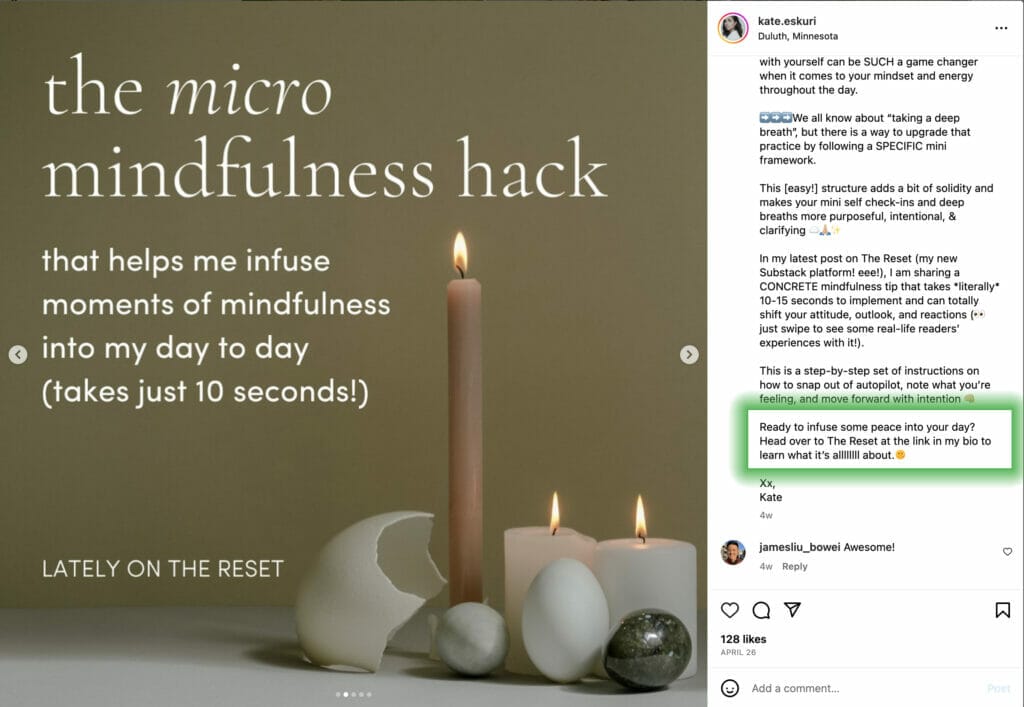
    Promoting your lifestyle blog can be challenging at first, but keep going! Figure out the methods that work best for you by analyzing your social media numbers as well as your traffic sources (with Google Analytics).

    8. Grow your email list (optional)

    It’s optional, but not if you want to monetize your blog or have a list you can use to sell sponsorship slots or sell your own product or service in the future.

    There is a basic method with a lot of room for variability here: create free resources, discounts, or deals and require an email and first name in exchange for it.

    You’ll often see these as pop-ups or offers inside the blog post itself, and you’ll need an email service provider to do this well.

    We recommend these options for service providers:

    • Mailerlite—free version available
    • Flodesk—fair pricing and diverse capabilities
    • Kit—high capabilities, but can be pricey if you get a lot of subscribers

    Examples of Lifestyle Bloggers You Can Learn From

    Note that you will learn from them, not copy. It’s hard to see what someone else is doing and love it, and not copy it. The truth is that doing this will rob you of integrity and it’ll also keep you further from your own, unique brand.

    Instead, if you see something you really like about these lifestyle bloggers, ask yourself what about it you like. Uncover the commonalities you can be intentional about creating anew with your own brand.

    1. Jenna Kutcher
    2. The Foundation Blog by Kate Eskuri (Jenna Kutcher’s sister, actually)
    3. Camille Styles
    4. The Skinny Confidential
    5. Quintessence
    6. Wit & Delight
    7. The Blonde Abroad
    8. Positively Present
    9. The Confused Millennial

    Learning how to be a lifestyle blogger often involves a lot more than you might think. The best advice we can give you is to keep going! If you implement these steps and remain consistent, you’ll have a thriving blog in a matter of a couple years.


    Want more writing advice?

    Subscribe to get our latest content by email.

      We won’t send you spam. Unsubscribe at any time.

    • Is Writing For Newspapers Still A Good Career Path?

      Is Writing For Newspapers Still A Good Career Path?

      For anyone who saw All the President’s Men, dreaming of being a journalist or newspaper writer was a top goal for a lot of people. The industry has changed a lot since then and you might be wondering is writing for newspapers still a good career path?

      It’s no secret that the internet has changed how people consume information.

      More and more people are turning to online resources to get their news, stories, and information. While more and more newspapers are including a digital element, there are still some that are holding strong to print.

      If you include magazines as well, there are quite a few options out there.

      You’ll also have to decide what kind of writing you want to do for newspapers. While journalism is the most well-known, there is also editing, digital options, brand journalism, editorials, and so on.

      Let’s go through the pros and cons of jumping into this industry.

      Is writing for newspapers still a good career path?

      No matter what, the written word will always be important. Whether it’s used to tell stories, inform the public, or keep people up-to-date on a certain industry, the written word will never go away.

      It may or may not take different forms as time goes on, which is why people might still be wondering if it’s worth pursuing writing for newspapers.

      If you’re still wondering whether writing for newspapers is a good career path, let’s take a look at the current landscape along with the pros and cons of choosing such a career.

      The current stats

      While people can debate whether The New York Times still has the same reputation as it did in the past, there’s no doubt it’s one of the most well-known papers. We’ll use it to analyze some of the current salaries and employment stats.

      According to Glassdoor, the average salary for a journalist there is currently $80,278, which is higher than the national average for a journalist at $52,409.

      Keep in mind, they only employ about 1,700 journalists.

      Across the United States, there are currently 46,700 news analysts, reporters, and journalists with a predicted 6% increase in growth.

      Now, something to keep in mind is that not all people who write for newspapers are necessarily journalists. Some people are experts in their field and have a column, or maybe they just have an interesting story to tell and get to write for a local paper.

      Along with writers, there also editors, photographers, videographers, and so on. Including those jobs, there are over 114,000 total employees.

      All of this is to say it’s not exactly a career that has disappeared off the map yet.

      Is Writing For Newspapers Still A Good Career Path?

      Pros of writing for newspapers

      One of the most obvious pros to writing for newspapers is that you’re able to stay on top of current events and tell important stories.

      You’ll be able to find and report on stories that matter to either your local community or to the world at large. This might also put you in touch with fascinating people and can give you insight into the world around you.

      You can write general news or you can specifically report on a certain industry or niche.

      If you love the prestige of getting your byline in a famous paper, all of the hard work to get there might be worth it for you. For some people, getting to work with the big-named papers is enough of a reason for them to persevere.

      Having major bylines can also help you get better writing gigs in the future. For example, major book publishers are more likely to give a book deal to someone with credible bylines versus an unheard of writer.

      Cons of writing for newspapers

      One problem that the industry as a whole is facing is falling employment. Since 2008, U.S. newsroom employment has fallen 26% according to the Pew Research Center. The good news here is that digital-native news organizations are growing.

      Countless journalists have been sharing stories about not being able to make it work on their low incomes. This article, which includes a story from David Rosenfelt who was a journalist for two decades, couldn’t make it work on his $45,000 a year salary.

      Even if you choose to go the freelance route, for smaller publications you will often find that articles are paid under $100 each. That’s not even including the amount of time you’ll need to spend sending pitches and getting on the radar of editors to get those pieces in the first place. (To perfect your pitch, use this template.)

      On top of all of this, payment terms can be fuzzy at best. Some magazines can take months to not only publish your piece but to pay you as well.

      There is no doubt that it is a stressful job. You need to be on top of what’s happening, keep up with sources, and often forget about much work-life balance. It’s not a career that often fits within the 9-to-5 job. You’ll often have to talk to people, hit close deadlines, or write after hours and on weekends.

      You might also need to do internships and find ways to work for free to get your foot in the door. That’s not an easy feat for everyone to pull off.

      Media as an industry in general is a tumultuous industry. There are constant layoffs and major companies buying out different papers. If you want a stable job where you can depend on your workload for years, this might not be a good choice for you.

      How to get into the newspaper writing industry

      With all of the above being said, if you’re still interested in getting into the industry, there are a few things you’ll need to know.

      Currently, 74% of journalists have a journalism degree. As opposed to being a freelance writer, journalists usually have specific training and degrees in the field. Only 4% have other degrees and still work as a journalist.

      If you simply want to write articles for newspapers without necessarily being a journalist, you want to find a unique angle to start to pitch to editors.

      For example, you could become a brand journalist (also called corporate journalism or corporate media) where you report on brands and companies.

      The most important thing is to start building a body of work to send to editors so they can get an idea of your work, your writing style, and the various topics you cover.

    • Freelance or Full Time: Which Journalism Career Path is Right for You?

      Freelance or Full Time: Which Journalism Career Path is Right for You?

      Want to start your journalism career by working in the media industry as a writer? You generally have two options: You can seek employment as a staff member of a publication, or look for freelance writing opportunities.

      How to Successfully Break Into Journalism in 2024 Free Webinar

      As the number of full-time journalism jobs continues to decline and major corporations continue to lay off their editorial staff in droves, many aspiring writers feel there’s more stability in freelancing.

      There are pros and cons to each option—but if you’re new to the world of professional writing jobs, how do you know which is right for you?

      If you’re new to the industry and trying to decide which path is right for you, here’s what you need to know about being a freelancer versus a staff journalist.

      I’ve been on both sides of the equation, and now as an editor who manages both staff writers and a freelance team, I have an even greater appreciation for the roles and responsibilities of each group.

      Staff reporter or freelance journalist? Which journalism career path is right for you?

      Freelance reporting

      As freelance writer Danielle Corcione wrote on Muck Rack (sorry, the link is no longer live), freelance writers often maintain full editorial control of their projects: They can generally choose their own assignments, whether it’s something they pitched an editor or something they elected to write based on an editor’s request.

      Freelance reporters also aren’t typically bound by non-compete agreements, meaning they can write for and get published by a wide range of publications. This kind of variety and freedom is highly appealing to writers who want to try working with different topics, writing styles and editors.

      There are a couple of key advantages to starting off your journalism career as a freelancer.

      There’s a very low entry barrier and you don’t need a journalism degree to do it, so you can start freelancing while you’re still in school like I did, and start building up a portfolio for when (or if) you decide to look for a full-time writing job. If you’re not sure where to start looking for gigs, you can check out these 20 websites.

      The downside, of course, is that you lose much of the stability that comes with traditional employment. You’re responsible for securing your own benefits and budgeting for your income and self-employment taxes (since those won’t automatically be deducted as they would when you’re on payroll).

      It’s also a lot easier for an editor to drop a freelancer than a staffer: A change in the budget or turning in a few bad assignments could mean that your income stream from that publication abruptly ends, so you’ll always need to be planning your next move.

      If you’re considering the freelance path, it’s a good idea to get comfortable pitching editors at a variety of publications and coming up with useful, relevant story ideas for them. When you do pitch, proofread your message for spelling, grammar and punctuation, as well as thoroughly researching the publication and its typical content and style.

      Staff reporting

      Although some might argue traditional journalism is dead (along with the jobs that came with it), there are still full-time jobs to be had in the media industry. They just might look a little bit different than the newspaper reporter jobs of decades past.

      While straight print reporting jobs do still exist, most journalism positions today include a digital component.

      Many staff writers are expected to understand search and social media trends to help inform their story ideas, and knowing how to create and leverage visual assets (e.g. infographics and video content) is a huge plus. These skills are also valued in freelancers, but writers who can offer the complete package stand to go far in the industry.

      As mentioned above, a staff writing job also comes with certain employment benefits and, in many cases, a more predictable schedule that make it more appealing than freelancing. On the flip side, you may end up trading some of your creative and editorial freedom: Tight deadlines, editor demands and last-minute changes of direction are common in newsrooms, and you may find yourself somewhat at the mercy of your company’s leadership and executive teams.

      However, like freelancers, staff writers are often encouraged to pitch their editors, especially as they move up the ranks. You’ll need to be able to come up with well-informed, well-researched pitchesbut unlike freelancers, your income won’t depend on whether your pitch gets accepted or not.

      Because full-time reporters are typically dedicated to a single publication (many media companies have policies against freelancing for direct competitors), they’re able to immerse themselves in the specific beats and audience of that outlet. Therefore, it may be easier for you to come up with “good” pitches as a staffer.

      Still not sure which path to take? Try freelance writing as a side hustle while you work as a staff journalist, just to see which you prefer (or you may decide you can successfully juggle both).

      Either way, it’s important to understand what your responsibilities might entail and make an informed decision about your writing career.

      How to Successfully Break Into Journalism in 2024 Free Webinar

      If you’re wondering what opportunities exist for freelance writers in 2024 (hint: there are plenty!) then make sure to register for the free webinar called How to Successfully Break Into Journalism in 2024! You’ll learn about the different types of journalism and what you may best be suited for, and the top skills successful journalists need and what it can lead to.

    • Citizen Journalism: What Is It and 3 Ways to Get Started

      Citizen Journalism: What Is It and 3 Ways to Get Started

      Citizen journalism, also referred to as collaborative media or grassroots journalism, is a form of journalism where citizens are involved in the collection, reporting, analyzation (and so on) of news.

      With so many people accessing information from smartphones, on social media, or the Internet, people have more ways than ever to instantly share their local stories and experience.

      Technology has changed the landscape when it comes to journalism and how people stay on top of their local news.

      How to Successfully Break Into Journalism in 2024 Free Webinar

      What is citizen journalism?

      Citizen journalism is a type of journalism where the general public is involved in telling the news.

      Journalists cannot be everywhere at once, so having local people report on stories and breaking news can make a huge difference.

      Citizen journalism has always been a channel of journalism, but with smartphones and social media so easily accessible, everyone can now become a reporter.

      CNN even had a great article (you can read it here) on why citizen journalism matters and helps the world know what’s going on.

      Why citizen journalism matters

      Citizen journalism is incredibly important for a society to keep reporting accurate and in real time.

      It also helps people in a community feel like they have a voice and can share their concerns. This form of journalism also includes public debates, submitting their expert opinion to local papers, or sharing their thoughts online.

      It gives citizens the rights to be involved in how news is created and shared, which gives power back to people to be involved in news.

      Many people feel that the big media companies should not have all the say on which stories are told and what information is included, so citizen journalism gives people the power to be deeply involved.

      When citizens can be involved in their own news, it also gives them a reason to care more about what is going on around them and in their world.

      There are also times where journalists and the media cannot get to a location in time and real-time reporting on the ground must be done. That is when citizen journalism becomes critical.

      How to get into citizen journalism

      If you are interested in the news and sharing information, you might have considered becoming a journalist at one point or another.

      However, the traditional journalism path is not for everyone, which is why some people choose to get into citizen journalism. They want to share news and work in media, but they are not looking to go back to school or do internships to get their foot in the door.

      You will still need to study the principles and rules around journalism to make sure you are sharing news that is factual, correct, and within the correct guidelines of news.

      For the most part, you are have to accept that you are going to be fact-checking and on the ground to get information.

      Decide your core issues

      First, you will need to take the time to think about the topics you want to cover.

      Do you want to report on your local neighborhood? Get involved in a topic you are passionate about, such as sports or the environment?

      For the most part, journalists pick a topic they care about deeply to keep reporting on and can stay involved with.

      You might also want to become a news curator, where you share news from a certain topic, go through it all, and share the most important stories in a certain area. This is technically outside traditional “citizen journalism,” but it is something for you to keep in mind when you explore career options in this industry.

      Decide how you will get involved

      Once you know the topics you want to stay involved with and want to care about, you should outline how you want to get involved and what works for you to be able to do so.

      Keep in mind, a lot of citizens are naturally brought into journalism as they can be sources or people who share their expertise and experiences, without becoming completely involved in citizen journalism.

      You can be involved in multiple ways, if that fits your schedule and your desire to be involved deeply in issues. Since you are taking matters into your own hands, you can do it in any way that fits.

      Get involved

      Now that you know what kind of issues you want to stay involved in and know how you want to take action, it is time to put some boots on the ground and get active.

      Whether that means actually taking photos and talking to people to gather the news, reaching out and staying in touch with reporters, or being involved in groups and websites online, you will need to play an active role.

      It may take a while to get the ball rolling in this new option for you, but once you get started and figure out what works for you, it will become easier.

      Whether or not you choose to pursue journalism full time, you will be involved in issues you care about and will know more about what is going on in your community, which is always a good thing.

      Examples of citizen journalism

      Here are some real-world examples of citizen journalism so you can see how it works.

      Keep in mind these are famous moments that changed discourse as we know it. Not all stories will have this level of impact! However, they are prime examples of how citizens can report on the news.

      Abraham Zapruder John F. Kennedy assassination footage

      This is one of the more famous cases of citizen journalism, since Abraham Zapruder was one of the people to film a home movie that captured the assassination of President John F. Kennedy.

      While there were a lot of cameras and photographers that day, his was one of the most clear videos of it happening and it was a video that sent shockwaves around the world. He had no idea just filming that day would be such an important matter.

      George Holliday footage of the Rodney King beating

      George Holliday was a Los Angeles plumber who happened to film the Rodney King beating in 1991. He was a concerned citizen who saw what was happening, filmed it, and sent it to a local news station.

      What to do next

      Are you looking to become a professional writer? Not sure of the various career paths that are available to you?

      How to Successfully Break Into Journalism in 2024 Free Webinar

      If you’re wondering what opportunities exist for freelance writers in 2024 (hint: there are plenty!) then make sure to register for the free webinar called How to Successfully Break Into Journalism in 2024! You’ll learn about the different types of journalism and what you may best be suited for, and the top skills successful journalists need and what it can lead to.

    • Thinking About Writing for Content Mills? Proceed With Caution

      Thinking About Writing for Content Mills? Proceed With Caution

      Are you currently writing for content mills or considering writing for a content mill? Before you sign up please read this first-person case study from writer Adryan Corcione to help aid in your decision.

      A few years back, I was planning baby steps to transition towards full-time freelance writing. At the time, I was working a monotonous day job in real estate content marketing and freelance writing on the side on weeknights and weekends.

      My quest for anchor clients

      My main strategy was securing a handful of anchor clients—or “businesses or individuals with whom you have an ongoing relationship and a steady flow of projects and income,” according to Funds for Writers—to help cover basic living expenses: food, rent, utilities, etc.

      Freelance writers also use the terms “anchor gigs” and “bread and butter gigs” to refer to anchor clients.

      This strategy is how I ended up writing for a content mill—and totally failed at it.

      I won’t say which site it was, but it’s sort of like the Huffington Post (because they don’t pay their writers) and aimed mostly at college students.

      Although this was a publication and not Upwork, I still refer to it as a content mill because of its embarrassingly low wages, which are all-too-common when you’re writing for content mills.

      Case Study: How Writing for Content Mills Was this Writer's Nightmare

      My nightmare of a story writing for content mills

      I came across a listing in a writer’s Facebook Group for a copyediting opportunity.

      After sending off my resume and some writing samples, I quickly received an eager reply to talk about my professional experience over the phone. I was thrilled, not only because of the possibility of securing an anchor client, but finally getting some copyediting experience under my belt.

      Plus, this was happening in an exclusive writer’s circle, so it seemed like a great opportunity to hop on board with.

      When I asked about payment during my initial phone interview, the interviewer said copyeditors earn $1 for every article they submit. To make a “fair” wage of $10 an hour, we were expected to complete at least 10 articles per hour. Shifts were typically between two and four hours, and we’d have multiple a week.

      I had a terrible feeling in my gut: $1 per article? That’s nuts, right?

      However, I was in an awkward position. I wanted to desperately leave my desk job at the time, and I needed anchor gigs I could rely on for a base income—even if it meant writing for content mills. After all, I was looking for experience to carry with me when I applied for higher-paying gigs.

      Plus, I was already having a great conversation with this person, especially since they were enthusiastic about my work, and I didn’t know the average rates for copy editing as a novice.

      Instead of listening to my gut, I continued with the hiring process.

      I attended an hour-long tutorial, but I wasn’t compensated for my time. On top of a low wage, the system was difficult to grasp: lots of documents to fill out, web pages to go through and articles to read. Despite the anxiety I started to feel, I went with the flow and tested it out.

      Soon enough, my first shift came along. My anxieties were validated when I struggled to finish copy editing three articles within an hour. I grew incredibly frustrated at myself.

      Why did I let myself get this far to mess up? In hindsight, my anger was misdirected at myself and should’ve been at the company for thinking I could actually copy edit 10 articles (accurately) in an hour.

      Forget Upwork or Fiverr, I thought, I’m already a screw-up.

      Another writer’s experience writing for content mills

      Not everyone has the same experience with content mills as I do.

      In fact, some writers successfully kicked-off their careers with them and believe they can be a decent starting point for those who want to become a freelance writer.

      For example, full-time freelance writer Ana Gotter describes her experience with Upwork as “[having] consistently had more bad experiences than good ones,” but highly recommends a similar site called ClearVoice. She has also heard about positive experiences with Ebyline from other freelance writers.

      “I did get my first ghostwriting book contract out of it and even made it into Upwork’s Top Talent and Pro programs, but I left the site after they hiked up the rates that freelancers have to pay. It’s also common for writers to do work for extremely low pay for great reviews early on, but this can end up hurting them.”

      If you’re kickstarting your career as a freelance writer, pursuing work through a content mill might not be a terrible idea, but there are some major caveats.

      First, you need to be wise about which sites you’re invested your time into.

      Gotter explains Clearvoice and Ebyline have better success rates compared to Upwork.

      Don’t spend hours creating an extensive profile with recommendations and pursuing projects if the rates are far too low for your income goals. Especially if you’re trying to establish anchor client relationships, don’t dismiss content mills until you try one out for yourself, but know when to walk away once the rates are low.

      Secondly, you need to make sure you’re not putting all of your eggs into the content mill basket. Mills should simply be a means to an end.

      You should still be working on building up your own base of anchor clients outside of the mills—clients who pay more don’t expect you to churn out dozens of articles every day, and will help you earn what you truly deserve.

      Writing for content mills can be a decent way to kick off your freelance career, especially if you’re looking for freelance writing jobs for beginners.

      However, it’s easy to overwork yourself in an environment that typically underpays its employees. Too many times, writers get stuck in the rut of writing for pennies in the mills, and they never take the time to build up their own base of clients that pay quality rates.

      Needless to say, the consensus of freelancers offer two approaches: run away or proceed with caution if considering content mill jobs.

      If you’re wondering what opportunities exist for freelance writers in 2024 (hint: there are plenty!) then make sure to register for the free webinar called How to Successfully Break Into Journalism in 2024! You’ll learn about the different types of journalism and what you may best be suited for, and the top skills successful journalists need and what it can lead to.  

      This is an updated version of a story that was previously published. We update our posts as often as possible to ensure they’re useful for our readers.

    • How Working With an Agency Launched This Freelance Writer’s Career

      How Working With an Agency Launched This Freelance Writer’s Career

      If you’re a writer who has considered working with an agency then you’ll be interested in this first-person case study. Working with agencies isn’t for everyone but for some it can be the financial and career breakthrough you’re looking for as a freelancer.

      It was May 2014, and I was panicking.

      I was laid off from my job at a New York media startup three months before, and was squirreling away whatever severance money I had left.

      To complicate things, I moved to Orlando after getting married, abandoning the biggest media market in the country for a city where media jobs were scant.

      So, I did what any job seeker would do and scoured the job boards.

      I came across the Orlando Public Relations Society’s job board and saw a contract position working for a local marketing agency on a hospital’s website redesign.

      That three-month project launched my freelance career and became part of a strategy I’ve used the last three years to continually increase my income while growing a sustainable freelance content-marketing business.

      Case Study: How Working With an Agency Made this Freelance Writer's Career

      Why working with an agency can help your freelance career

      Most freelancers shy away from working with agencies for two reasons: the positions are usually in-house and the pay can be lower than working directly with a client.

      Those are valid concerns, but with the rise of content marketing there are more opportunities for remote work than ever.

      My first agency project, which involved creating content for a large hospital’s website, required four in-person meetings over three months. I did most of my work from home.

      That first position led to more projects with the agency, producing ghostwritten blog posts, press releases and content for email campaigns. Eventually the agency put me on retainer—and I still work for that team today.

      Freelancing is a hustle.

      Getting clients—and keeping them—is key to building a business. But this is often the most difficult part for freelancers. Marketing takes time, but agencies cut down the lead time for freelancers to get new clients because they’ve already done the hard work of building the relationship. They also manage the whole process, so you don’t have to worry about all the administrative work and meetings that are part of a direct client engagement.

      Over the years, all my agency work has been remote. I’ve worked with an agency in California that hires freelancers to produce longform B2B content, a New York-based content marketing agency that works with Fortune 500 companies and a Boston content marketing agency that does the same thing.

      I’ve also worked with the in-house content studios of a few New York media companies, another type of agency that’s emerged as the content marketing industry has grown. Many of these clients pay $1 a word. Some pay less, but all have given me a steady stream of work, which mostly has helped me avoid the financial ups and downs that are typical with freelancing.

      How to get started working with an agency

      The best thing about working with an agency is that if you’re good, the work keeps coming. But how do you get work in the first place? Follow these tips.

      Start local

      Reach out to local marketing and PR agencies. Marketers are skilled strategists—not skilled writers, so many agencies need people with journalism skills to write for their clients. Consider purchasing a Book of Lists from your local business journal, a comprehensive directory of the top local companies that also has contact info for their key executives. Or, scour online sources to find information for agencies in your area.

      Send a Letter of Introduction

      After you’ve identified companies, send the marketing manager or director a letter of introduction (LOI) highlighting your writing experience and subject expertise. Make the letter concise and tailor it to their business. You may get work right away or it may take months. Either way, an LOI can put you on a marketing manager’s radar and establish an initial relationship.

      Stay connected

      If you live in a smaller town, social media is the best way to expand your reach. Stay active on LinkedIn and Twitter (X), because this is where potential clients live. Engage in conversation, like their posts and share interesting content. Last year, I landed work after staying in touch with a former colleague on LinkedIn who now worked for an in-house content studio. She wouldn’t have known I was now freelancing had I not updated my profile.

      Vertical image with a lightbulb to illustrate how working with an agency can help launch your freelance career.

      Join organizations

      Join the local chapter of a marketing or public relations organization. Attend chapter events or volunteer. Doing this will let you connect with people in the industry you’d likely never meet. If you’re an experienced freelancer, join the American Society of Journalists and Authors (ASJA). ASJA is starting to embrace content marketing and holds virtual events and a big conference every year where you can connect with clients.

      Start a blog

      Start a blog focused on a topic you’re passionate about. I attended a webinar with Skyword, a content marketing agency that works with big clients, and their community manager said they often look at a writer’s blog when selecting freelancers for campaigns. A blog can show potential clients your writing style and knowledge about a topic—and it doesn’t cost you a cent to launch one with a platform like Medium.

      Working for agencies has helped me create a sustainable freelance business.

      I love doing content marketing, but there’s no way I would have written for brands like Hewlett-Packard or Marriott without an agency.

      Freelancing can be feast or famine, but agencies can help you navigate these extremes so you never starve for work.

      If you’re wondering what opportunities exist for freelance writers in 2024 (hint: there are plenty!) then make sure to register for the free webinar called How to Successfully Break Into Journalism in 2024! You’ll learn about the different types of journalism and what you may best be suited for, and the top skills successful journalists need and what it can lead to.  

      This is an updated version of a story that was previously published. We update our posts as often as possible to ensure they’re useful for our readers.

    • 20 Dining, Cooking and Food Magazines to Pitch

      20 Dining, Cooking and Food Magazines to Pitch

      When you savor a meal, are you dreaming of the words you’d use to describe it? Do you salivate at the thought of writing about food for a living? If so, why not try your hand at writing for food magazines?

      Below is a list of publications that accept all sorts of stories about food, ranging from recipes and pieces examining the sustainability of certain practices, to articles exploring the junction of food and travel. We tell you a bit about the media outlet, as well as how you might try to reach an editor there.

      20 Cooking and Food Magazines to Pitch

      Cooking publications and food magazines to pitch

      While we focus here on cooking magazines and food magazines, here’s a tip: don’t limit yourself strictly to publications that only cover food. Many other publications, ranging from travel to regional, include a food or dining section, so keep an open mind when trying to place stories about the culinary world.

      If you’re keen to explore food-writing jobs, try pitching editors at these publications.

      1. Bon Appetit

      Bon Appetit is a well-known fine food magazine, and they also publish regularly online. While they rely on in-house writers for recipes and cooking tips and don’t feature traditional restaurant reviews, they’re open to conversational, funny and passionate freelance pitches for reported features, trend stories, personal essays and opinion pieces.

      To pitch BonAppetit.com, email cooking@bonappetit.com with “PITCH: [your idea here]” as the subject line. We recommend paying close attention to the pitching guide Bon Appetit provides. Last we checked, rates start at $250 for Restaurant Diaries, Highly Recommend and other short-form stories that range 300 to 500 words. 

      2. Catalyst

      Salt Lake City, Utah-based Catalyst Magazine focuses on a wide variety of lifestyle topics, including organic food, gardening/food security and more. 

      Send your query, along with a resume and clips, writers@catalystmagazine.net. And be warned: if your article is accepted, you’ll be expected to write it on spec. It could still be worthwhile, though! You can find the full submission guidelines online.

      3. TASTE

      An online magazine with today’s home cook in mind, TASTE seeks a wide variety of freelance material including original recipes with a clear point of view as well as reported stories, home-cooking advice and more.

      Send your email with the text of the pitch pasted in the body—no attachments!—to Matt Rodbard. Find all the pitching details in their pitching guide.

      4. Disney Food Blog

      If the only thing you love more than food is all things Disney, this blog might be the perfect place for you to show off your skills. Focused primarily on the dining and drinking options around Orlando’s Walt Disney World, Disney Food Blog (DFB) welcomes original articles and photos covering the constantly-changing world of Disney cuisine. And while it doesn’t appear to be a paid opportunity, the editors will allow you to thread one link into your byline.

      For more details, check out the blog’s guest post guidelines.

      5. Eating Well

      “Ingredients for The Good Life” is the motto of this national food magazine dedicated to healthy eating. Articles focus on cooking, nutrition science, culture, food origins and traditions, and even social issues related to food networks.

      Last we checked, this market pays up to $1 per word, and starting with the short, front-of-the-book sections is the best way to break in. They’ve removed their writers’ guidelines but you can find an editor to pitch on this page.

      6. Edible Communities

      The Edible franchise features food-related publications in towns and regions all over the country and beyond, from Edible Brooklyn to Edible Northeast Florida to Edible Vancouver. Each publication has different submission requirements and pay rates, so be sure to click on the individual publication you’re interested in for more details.

      For example, Edible Seattle relies on freelance writers and encourages pitches for a number of its magazine sections, from long-form features, to recipes, to chef profiles. Pay typically ranges from 20 to 30 cents per word.

      7. Epicure & Culture

      “Food, Wine & Culture for the Ethical Traveler” is the tagline for this online publication. Recent food articles include Exploring The Culture of Parsi Cafes In Mumbai, India and  Eating Vegan in Austin, Texas. The writer’s guidelines notes contributors receive a link to their website, social media promotion, and $10 payment upon publication.

      8. Eater

      A national magazine that focuses on reporting on and critically examining all things food and drink, Eater actively seeks pitches from external contributors and pays a competitive rate. (Who Pays Writers reports an average of about 37 cents per word, with some writers having seen rates of up to 67 cents.)

      Be sure to read the lengthy submission guidelines in full before you query the magazine, and be doubly sure you’re not pitching something the magazine’s not looking for… especially since they specifically spell it out.

      9. Kashrus Magazine

      Kosher eating is the focus of Kashrus Magazine covering everything from preparing for Jewish holidays to new Kosher products and even Kosher marijuana.

      You can reach out to an editor at editorial@kashrusmagazine.com.

      10. Kitchn

      Kitchn, a daily web magazine, sees an audience of more than 17 million people, so it’s an understatement to say it would be pretty cool to be featured amongst its colorful, clever posts. And while the bulk of the writing is done by a small, steady team of freelancers, they do accept kitchen projects and recipe links from food bloggersand also hire freelancers from time to time, so keep an eye on their job listings.

      Dinner plate with pasta and a fork poised above it with a bite of pasta loaded on it. The text overlay says 20 Dining, Cooking and Food Magazines for Freelance Writers to Pitch in 2024

      11. Food52

      With articles running the gamut from pillowy-soft cinnamon rolls to one-skillet chicken with brothy beans, Food52 makes food approachable, fun and fascinating—and if you have an idea for a story that might fit its mission, you can contact the editors at pitches@food52.com.

      Click here for full submission guidelines.

      12. Saveur

      Saveur covers the junction of food and travel, featuring everything from recipes and cooking tips to features on specific ingredients and cookbooks.

      To submit ideas, follow the pitch guidelines and email the relevant editors with a summary of the article you’d like to write along with some information about how you’d like to put the article together, such as who you’d like to interview and what angle you’d take.

      13. Extra Crispy

      “Why does anybody in the world ever eat anything but breakfast food?”

      If you were nodding in agreement with Ron Swanson during that particular episode of Parks & Rec, Extra Crispy might be the perfect spot for your food writing. This breakfast-focused blog publishes opinion pieces, serious reported stories, works of humor and more, and is actively open to pitches from outside contributors.

      Check out the pitch guidelines for full details.

      14. Whole Life Times

      This bimonthly magazine depends on freelancers to fill its pages and focuses on holistic and integrative health stories, organic food, sustainability and other topics related to a healthy and progressive lifestyle. Rates vary and can go up to $125 for a 800 to 1,000-word feature, with shorter departments paying less.

      Check out the writers guidelines for more information.

      15. YAM Magazine

      Greater Victoria, Canada, is the focus of the lifestyle YAM magazine covering food and wine, health and fitness, culture, and other topics. 

      It’s worth noting the publication’s lead time is three to four months, so you’ll watch to pitch topics that will be timely and relevant.

      Full submission guidelines, including the most up-to-date point of contact, are available via PDF.

      16. Healthyish

      Healthyish, a Bon Appetit brand, is a site all about delicious healthy foods. It publishes recipes and its typical quarterly editorial packages as well as “conversational, passionate articles that cover the many intersections of food, wellness and culture today.”

      Pay starts at $250 (though shorter columns are $100) and increases based on your experience and also the depth of the piece. If you’re interested in pitching, be sure to read the guidelines first.

      17. Well + Good

      The mission behind this publication is simple: “Decoding and demystifying what it means to live a well life inside and out.” Recent food and nutrition stories cover a variety of topics, from a high-protein baked oats recipe to a cheap iced coffee maker recommendation to paleo breakfast ideas.

      If you’re interested in contributing, check out the pitching guidelines, where you’ll find more information on the types of food stories they’re looking for as well as where to email your pitch.

      18. The Spruce Eats

      The Spruce Eats has a “mission to turn curiosity into confidence.” The magazine evolved from a 25-year archive of recipes, which are constantly updated and tested.

      It has been reported that freelancers can sell pieces for as much as $225 to this publication, but for current rates it’s best to check with the editorial team. You can find the masthead for who to pitch here.

      19. Whetstone Magazine

      If you write about global food culture and origins, then make sure to check out Whetstone Magazine. In 2020, the publication’s founder said they pay $300 per piece.

      To pitch, send your ideas that take an anthropological approach to what’s eaten where and why to editor@whetstonemedia.com.

      20. TheFoodellers

      This food travel website is “always on the lookout for articles on inspirational travel, photo stories, tips, top XX’s, your experiences traveling the world, your recipes, and your food travel experiences in the world.

      The writing guidelines don’t mention pay, but other reports say it runs between $20 and $50 per article so it’s a good idea to check when submitting your ideas.

      If you’re wondering what opportunities exist for freelance writers in 2024 (hint: there are plenty!) then make sure to register for the free webinar called How to Successfully Break Into Journalism in 2024! You’ll learn about the different types of journalism and what you may best be suited for, and the top skills successful journalists need and what it can lead to.  

      This is an updated version of a story that was previously published. We update our posts as often as possible to ensure they’re useful for our readers.

    • Christian Writing Work: 6 Ways To Influence A Massive Market

      Christian Writing Work: 6 Ways To Influence A Massive Market

      If you are looking for Christian writing work, you’re on the cusp of joining a writing niche that is in no way small.

      The faith economy’s annual worth is $1.2 trillion. Much of this is due to writing. Christian writers contribute to the writing world in many ways, a few of which are via personal blogs, journalism, and writing faith-based books.

      Contributing to Christian publications can be a fulfilling way to use your talents. In addition, if you’re hoping to transition out of your traditional 9-5 job, there are specific ways you can pursue full-time Christian writing work. In this article, I first define Christian writing work and then dive into five concrete steps you can take to get started. 

      Christian Writing Work Defined 

      Christian writing work centers on writing, drafting, and editing Christian copy for online or print publication. Whether you naturally gravitate toward online journalism or writing faith-based books, if you want to jump into Christian writing work, there is a place for you.

      It takes writers of all backgrounds and talents to create a well-rounded market. In fact, there are many names you may recognize that make a living in Christian writing and whose work spans a plethora of genres and writing styles.

      You may know Jerry B. Jenkins’ name from his well-known series, Left Behind. Katelyn Beaty is also a Christian writer, but she steers clear of fiction, taking a more journalistic approach. John Piper’s Christian writing work spans the continents in both book and digital form.

      So wherever you find yourself, below are five ways you can get a foot in the door of Christian writing work.

      6 Options To Get Started

      Breaking into any industry can feel intimidating, especially if you don’t know where to start. The good news is there are many different roads you can take to begin Christian writing work. No one option is better than another, it simply depends on what’s best for you and your writing goals. 

      1. Freelancing

      Freelancing is a great first step into Christian writing work due to its availability to writers at various stages in their journey. If you are first starting out, you may want to create a simple website and list your services. This way, when you query potential clients, your website adds legitimacy to your request. 

      There are also many blogs that hire freelancers and pay per word. Other publications pay per article. For instance, Chicken Soup For The Soul reportedly pays $250 per 1,200-word article, as well as free copies of the book itself. 

      Christian writing work may feel difficult to get into, but once you send your first query, you’ve taken that first step. Freelancing is an extremely nonthreatening way to test the waters.

      2. Start Your Own Blog

      In an era of influencers, blogging is another opportunity to make a dent with Christian writing work. Sadie Robertson Huff (Duck Dynasty) is a celebrity influencer who uses blogging to reach her audience. Sarah Young (Jesus Calling) includes a blog on her author website.

      You don’t need to have sold 30 million copies of your book to start a blog, however. In fact, both Sadie and Sarah lacked a writing platform earlier on.  While you can always query established bloggers and ask to guest blog, starting your own blog is a way to get started in Christian writing work. This low investment with potential for high influence is a nearly fail-proof way to get started. 

      Don’t forget to blog regularly, whether a month or once a week, so your growing audience knows what to expect from you. As your audience list grows, your opportunity to monetize your blog will increase as well. 

      3. Submitting to Paid Publications

      Billy Graham started the vision behind the now well-known magazine, Christianity Today. This publication allows freelancers to query ideas, and if accepted, pays them for their article. There are many more paid publications you can check into as you pursue Christian writing work, and here are a few tips for doing so:

      • Query simultaneously
      • Send you best ideas
      • Include a few important credentials 
      • Be brief but efficient 
      • Track your progress 

      A simple Excel spreadsheet or even a good notebook can help you document the responses you receive and the dates you queried which publications. 

      4. Writing A Faith Book

      Sharing your story or writing on faith-based topics is another great way to get into Christian writing work. You can choose to traditionally publish or self-publish your book and even launch a speaking career if your book does well. 

      Authors often use books as the launching pad for their career, pulling quotes for social media, specific topics for speaking events, and even building entire online courses to go with the book.  

      5. Christian Journalism 

      For those with a more journalistic mindset, Christian journalism can be an exciting niche to tap into. You can offer your work in book form with the help of a publisher of Christian books, host a podcast, or craft research articles on the current topics in Christianity. 

      There are so many ways to use journalism in Christian writing work, and many people are paving the way forward in this area. If you have a background in journalism or are currently studying this writing form, you may want to explore the possibilities in this niche. 

      6. Working With Authors

      With millions of books published annually you can rest assured that ghost writers and editors are needed. Working with authors provides writers with a unique look at individual stories, provides a behind-the-curtain glimpse at authors’ lives, and can add credibility to their own Christian writing work. 

      If you are interested in working with an author, whether editing their manuscript or helping them write it, you can start in a few ways:

      • Sit down with an editor and ask for advice 
      • Look for editing jobs at Christian publishing houses 
      • Add this service to your website and begin freelance editing

      Working with authors is one way many well-established writers got into the business, and is a opportunity you can benefit from as well.

      Your New Day Job in Christian Writing Work

      Getting into Christian writing work is an exciting prospect. If you are a person of faith, pursuing this type of work is not only a helpful transition into a new career path, but distinctly fulfilling as well. 

      Here comes the hard part. How do you take the above opportunities and translate them into steps you can take today? Below are a few possibilities that you can pursue with little time investment and zero financial investment: 

      • Build a free website with a template 
      • Email Christian writers in your network asking for advice
      • Browse the above links for paid freelance work
      • Follow this step-by-step process to write your book

      Remember that just like any career shift, solidifying yourself in the industry takes time. Use your credentials to establish your credibility and keep in mind that slow and steady, over time, can yield great results. 

      Before I leave you to get started, here is a simple mindset tip to focus on as you begin your journey: Treat your pursuit of Christian writing work like the day job you one day want it to be. Prioritize it, give it your all, and pursue it relentlessly. Best wishes out there! 

      Want more writing advice?

      Subscribe to get our latest content by email.

        We won’t send you spam. Unsubscribe at any time.

      • How to Network Your Way Into a Successful Writing Career

        How to Network Your Way Into a Successful Writing Career

        If you chose a freelance writing career with the notion you’d spend your days solo, thoughts uninterrupted, blissfully typing away from a location of your choosing…well, you’re in part correct.

        The caveat is—if you plan to make money writing—you’ll need to network effectively with writers and editors alike.

        Rather than looking at other writers as competition, think of it like this: Writing is a team sport and your editor is the MVP. 

        Why it’s necessary for writers to network

        Collectively, writers face a few difficult truths of the trade.

        By connecting with like-minded writers, you’ll create a support system to share ideas, combat backlash from low-paying content mills and increase your visibility (seriously, there’s a lot of noise to cut through these days).  

        Equally as important is the fact that professional networking opens the door to more work. And more work equals more income.

        For example, a prospect recently contacted me with a time-sensitive project proposal.

        Unfortunately, I was booked out beyond her deadline. Rather than turn the prospect away empty handed, I was able to refer her to another writer in my network whom I trust and have good rapport with.

        Alternatively, if a prospect approaches me with a project outside my area of expertise, I’ll turn to my network to find someone who does specialize in the project scope. Both scenarios are a win-win for the client and the writer.

        But networking doesn’t stop among writers—writers must also network to sell ideas, services and products.

        When it comes to selling, networking is key—as I’m sure any salesperson would agree.

        Ultimately, it’s also the writer’s job to sell themselves, which leads to my next point.

        writing career

        How to build relationships with your editors

        Let’s be real: Editors are the MVPs.

        They work tirelessly to field pitches, ensure quality and provide feedback. They sift through the dredges to surface exceptional writing.  

        As writers, we’re not entitled to publication—we must first prove our capabilities. With the editor as gatekeeper, you can see why it’s important to build amicable relationships with the editors you pitch.

        By establishing mutually respectful working relationships, you’ll find good editors challenge and encourage you, ultimately improving your skills and marketability as a writer.

        At the end of the day, you’re responsible for selling your ideas and your ability to execute them.

        Use a pitching strategy that works for you, not against you—you only get one shot to leave a good impression with the editor. Make it a positive one by being professional, sincere and efficient.

        It’s worth noting that rejection comes with the territory of being a professional writer. There are a plethora of reasons your pitches will be rejected, but as it pertains to your relationships with editors, there are a couple guidelines to follow:

        • Do thank the editor for his or her time, always. You can ask for feedback, should they have bandwidth to provide it—but don’t expect it
        • Don’t combat or speak ill of the editor. He or she is simply doing their job—don’t take rejection personally

        Acceptance is a win all around. Rejection is an opportunity to iterate on your idea and pitch it to another editor.

        Rejection by one editor might just be the start of a new working relationship with another.

        Through thick and thin, acceptance and rejection, a collaborative attitude is key. Whether you’re working with an editor or client, maintain a helpful mindset: focus on what you can do for the people you work with and how your written words will provide a solution.

        Employ these tactics to expand your network

        We’re fortunate to have countless resources and networking platforms at our fingertips today. While this does create digital noise, it also cultivates opportunity.

        Consider these three tips for networking, collaborating and getting more leads:

        1. Assemble your own all-star team

        You already know the importance of networking with writers and editors. Now take it one step further by expanding your team to include disciplines related to your writing focus.

        For example, if you’re a website copywriter, it’s valuable to have a network of web designers and developers who you can refer your clients to. Likewise, those designers and developers will refer their clients to you for copy. This also creates a streamlined experience for the client, who no longer needs to search for multiple vendors.

        2. Join networks and get involved

        All you need is an internet connection to find a group of peers in your niche. There’s no shortage of online communities and forums, including the Freelance Writers Den, Writers Cafe and Scribophile to name a few.

        You can also find writerly camaraderie through social media groups such as The Write Life Community, Twitter’s #scriptchat and the Scriptmag Community. And of course, there might just be a writer’s group waiting for your down the (literal) street. Check your area for Meetup groups.

        3. Participate in webinars (or host your own)

        I recently had the chance to attend one of Carol Tice’s webinars about mistakes freelance writers make. During the webinar, I had the opportunity to join a conversation with writers from around the world and share questions, answers and ideas.

        Take note: Carol herself—now a major advocate for freelance writers—has built a large community of writers by hosting webinars and providing resources and support. Consider starting your own community or hosting webinars based on your own unique experience.

        As a freelance writer, it’s vital to be pleasurable to work with—else, there will be another freelancer who is (and therefore gets the gig).

        Strive to be that person. By being an advocate for other freelancers, you’ll soon discover your support network is larger than you imagined.

      • Best Networking Books – Learn From Legendary Reads

        Best Networking Books – Learn From Legendary Reads

        Networking isn’t just about exchanging business cards; it’s an art that can significantly expand your horizons and opportunities, especially in the creative industries.

        Whether you’re a writer, artist, or any creative professional, mastering the art of networking can open doors to collaborations, insights, and pathways that were previously out of reach.

        This article will guide you through the top networking books that offer valuable techniques and insights tailored specifically for creatives like you.

        How to apply ideas from the best networking books

        To truly benefit from these networking books, you must move beyond reading to action.

        Start by setting clear networking goals: What do you wish to achieve? Who are the key people in your field you need to connect with?

        Incorporate one new strategy into your routine each week, whether it’s reaching out to a new contact, attending a networking event, or simply engaging more on professional social media platforms.

        Keep a journal of your networking activities and outcomes to monitor your progress and refine your approach.

        1 – Never Eat Alone – Keith Ferrazzi

        a group of friends eating a meal following advice from the best networking books

        This book emphasizes that networking should be a constant, ongoing process, not a means to an end. Ferrazzi introduces the idea of turning solitary meals into networking opportunities. To implement these ideas, consider joining groups or forums that meet regularly, where eating together fosters an informal atmosphere conducive to forming deeper connections.

        2 – How to Win Friends and Influence People – Dale Carnegie

        Carnegie’s timeless advice focuses on understanding and influencing people, a crucial skill in any creative field. By learning to listen actively and showing genuine interest in others’ projects, you can develop meaningful relationships that go beyond superficial connections. Start applying these principles at industry workshops and seminars where you can practice and refine your interpersonal skills.

        3 – The Tipping Point: How Little Things Can Make a Big Difference – Malcolm Gladwell

        Gladwell discusses how small actions can create significant change, a concept that can be particularly powerful in building a personal brand. Apply these insights by focusing on how you can use social media to effectively share and promote your work. Engaging consistently and authentically can help you reach a tipping point where your audience starts to grow organically.

        4 – Networking for People Who Hate Networking – Devora Zack

        Zack offers strategies tailored for introverts, who often find traditional networking challenging. She suggests choosing environments that naturally facilitate deeper conversation, such as small gatherings or online groups that focus on specific interests. Start by attending smaller, more intimate events where you can have one-on-one conversations, which can be more comfortable and rewarding for introverts.

        5 – Influence: The Psychology of Persuasion – Robert B. Cialdini

        Cialdini’s book delves into the psychology behind why people say “yes” and how to apply these understandings as a creative professional. You can use these principles to enhance your persuasive skills, crucial when pitching ideas or seeking project collaborations. Try implementing one of Cialdini’s principles, such as reciprocity or commitment, by offering something valuable to your network before asking for something in return.

        6 – The Connector’s Way: A Story About Building Business One Relationship at a Time – Patrick Galvin

        a woman making a check in phone call following advice from the book the connector's way

        Galvin illustrates through storytelling the importance of building genuine, long-lasting relationships in business. For creatives, this means focusing on quality over quantity in your connections. Apply this by nurturing a small number of key relationships within your industry, regularly checking in and offering help or resources without expecting immediate returns.

        7 – Dig Your Well Before You’re Thirsty – Harvey Mackay

        Mackay advises that the best time to network is before you need anything, by establishing a broad and deep network. As a creative, start attending diverse industry events and participating in forums outside your immediate field to broaden your perspective and connections. This proactive approach ensures you have a robust support network when you need guidance or opportunities.

        8 – Give and Take: Why Helping Others Drives Our Success – Adam Grant

        Grant explores how success in today’s world is increasingly dependent on how we interact with others. He categorizes people into givers, takers, and matchers, and shows that givers—those who provide support to others without immediate personal gain—often achieve the most success. Reflect on this by volunteering your skills in community projects or mentorship programs, thereby building a reputation as a generous collaborator.

        9 – Enchantment: The Art of Changing Hearts, Minds, and Actions – Guy Kawasaki

        Kawasaki focuses on the power of personal charm in making changes and achieving goals. For creatives, enchantment can be about captivating your audience with your authenticity and passion. Apply Kawasaki’s techniques by enhancing your storytelling skills in your presentations or in the content you create, making sure they resonate on an emotional level with your audience.

        10 – Superconnector: Stop Networking and Start Building Business Relationships that Matter – Scott Gerber & Ryan Paugh

        Gerber and Paugh argue against traditional networking in favor of building meaningful relationships. They suggest using technology to manage your connections more intelligently. As a creative, use CRM tools to keep track of your contacts’ details, interests, and interactions, which can help personalize your communications and strengthen your relationships.

        11 – The Art of Gathering: How We Meet and Why It Matters – Priya Parker

        a gathering at a luxury ski resort to network according to the principles of the art of gathering

        Parker offers a fresh approach to gathering that focuses on purposeful meetings. Creatives can apply these ideas by hosting or attending gatherings that are intentionally structured with clear objectives, such as feedback sessions, collaborative workshops, or thematic meetups that align with your creative goals.

        12 – Making Connections: How to Network Effectively to Build Better Business Relationships – David Cotter

        Cotter provides a step-by-step guide to effective networking, emphasizing strategic approaches to building and maintaining professional relationships. For creatives, this could involve setting specific networking goals for each event you attend, such as meeting potential collaborators or learning about new trends, and following up with new contacts within 24 hours to solidify the connection.

        13 – Friend of a Friend: Understanding the Hidden Networks That Can Transform Your Life and Your Career – David Burkus

        Burkus sheds light on the science of networks and explains how the existing relationships in our lives are instrumental in predicting our success. As a creative, leverage the friends of your friends by asking for introductions to individuals who could provide career guidance or collaborative opportunities. Begin by mapping out your network to identify potential connections that lie just one or two introductions away.

        14 – The Networking Survival Guide: Get the Success You Want By Tapping Into the People You Know – Diane Darling

        Darling offers practical advice for those who find networking intimidating. She breaks down the process into manageable steps. Creatives can apply this by starting with small, informal meetups rather than large-scale professional gatherings. This approach can help build confidence and gradually improve networking skills.

        15 – Power Networking: 55 Secrets for Personal and Professional Success – Donna Fisher & Sandy Vilas

        Fisher and Vilas provide concise, actionable tips that anyone can use to improve their networking skills. For creatives, this could mean focusing on developing a memorable personal brand or elevator pitch that communicates your unique skills and passions in a nutshell. Implement these tips at every opportunity to leave a lasting impression.

        16 – Business Networking and Sex: Not What You Think – Ivan Misner, Hazel M. Walker, and Frank J. De Raffele Jr.

        an all-female networking gathering

        This book explores how gender affects networking strategies and outcomes. As a creative, understanding these dynamics can be crucial. Tailor your approach based on the audience and context to ensure effective communication and relationship building. For instance, emphasize collaboration over competition in mixed-gender networking situations to foster inclusivity.

        17 – Networking Is Not Working: Stop Collecting Business Cards and Start Making Meaningful Connections – Derek Coburn

        Coburn challenges conventional networking tactics and suggests a more strategic approach focused on deeper relationships rather than superficial contacts. Creatives should focus on fostering a few meaningful partnerships that provide mutual value over gathering a large number of loose connections. Prioritize quality over quantity by engaging more thoroughly with fewer people who align with your creative vision.

        18 – The Introvert’s Edge to Networking: Work the Room. Leverage Social Media. Develop Powerful Connections – Matthew Pollard

        Pollard offers tailored advice for introverts, who often struggle with traditional networking settings. As a creative introvert, use digital platforms to make initial contacts and then deepen those connections through one-on-one meetings in comfortable settings. Utilize social media and online forums to showcase your work and attract like-minded individuals.

        19 – Click: Ten Truths for Building Extraordinary Relationships – George Fraser

        Fraser emphasizes the emotional components of successful professional relationships, arguing that personal bonds can greatly enhance business opportunities. For creatives, this means investing time in getting to know your network personally. Share your passions and challenges and listen genuinely to theirs, which can lead to a stronger, more supportive network.

        20 – Social Networking for Career Success – Miriam Salpeter

        Salpeter highlights the importance of social media in modern networking, offering strategies to maximize online presence effectively. Creatives should focus on platforms where their work can shine, like Instagram for artists or Medium for writers. Use these platforms to not only display your work but also to engage directly with peers and potential mentors or collaborators.

        21 – Little Black Book of Connections: 6.5 Assets for Networking Your Way to Rich Relationships – Jeffrey Gitomer

        two people making a networking connection standing in line as per the principles of the little black book of connections

        Gitomer presents networking as a vital asset to career success, emphasizing actionable advice to create and maintain valuable connections. For a creative, implementing Gitomer’s strategies might involve always being prepared with a well-crafted story about your projects or aspirations that you can share in any casual conversation, turning everyday encounters into networking opportunities.

        22 – Mastering Online Meetings: 52 Tips to Engage Virtually and Build Influence – Michael Wilkinson

        Wilkinson provides essential tips for navigating the increasingly common online meetings and virtual workspaces. Creatives should focus on mastering digital communication tools and techniques to present their ideas compellingly and professionally in virtual settings. Implement tips like maintaining eye contact through the camera and using engaging visuals to make your points more impactful.

        23 – The 20-Minute Networking Meeting – Executive Edition: Learn to Network. Get a Job. – Nathan A. Perez and Marcia Ballinger

        Perez and Ballinger boil down the essence of effective networking into concise, manageable meetings. Creatives can apply this streamlined approach by planning focused, time-efficient meetings with potential contacts, ensuring that both parties understand the purpose and desired outcome of the interaction, maximizing both relevance and respect for each other’s time.

        24 – Connect: Building Exceptional Relationships with Family, Friends, and Colleagues – David L. Bradford and Carole Robin

        Bradford and Robin, drawing from their experience at Stanford’s famed Interpersonal Dynamics course, offer insights into creating meaningful and lasting connections. Creatives should apply these principles by fostering transparency and vulnerability in professional relationships, which can lead to deeper connections and more collaborative opportunities.

        25 – Networking for Dummies – Donna Fisher

        This accessible guide demystifies networking for those who may feel overwhelmed by the concept. Creatives can take advantage of Fisher’s straightforward advice by starting with basic networking tasks and gradually advancing to more complex strategies, ensuring a solid foundation of networking skills that can grow and evolve.

        26 – Networking Like a Pro: Turning Contacts into Connections – Ivan Misner, Brian Hilliard

        Misner and Hilliard provide a step-by-step guide to transforming casual contacts into solid professional connections. For creatives, this involves regular follow-ups, sharing useful information or opportunities, and consistently showing genuine interest in the growth and success of their contacts.

        Are you ready to take action on ideas from the best books about networking?

        a woman holding a book at a networking gathering, showing she is ready to take action on the best networking books

        The books featured in this guide offer a comprehensive look at networking from various angles, each providing unique strategies tailored to enhancing your professional connections.

        As a creative, choosing to actively engage with these methods can significantly boost your career.

        Start with one strategy, one book, and one connection. Evaluate what works best for your personal style and professional needs, and let these newfound connections propel you toward greater success.

        Embrace networking as a continuous personal investment, and watch as it opens doors to unexpected and enriching opportunities.