Category: Marketing

  • 7 Ways Freelance Writers Can Use LinkedIn to Attract New Clients

    7 Ways Freelance Writers Can Use LinkedIn to Attract New Clients

    [twl_reusable_block post_id=41455]

    If you only have time for one social marketing platform, here’s a tip: Make it LinkedIn.

    It’s the only social-media platform where you can say, “Hey, do you know anyone who needs a writer?” without getting blocked or banned.

    Everyone is on LinkedIn to do business networking, so it’s cool.

    Maybe you’re there already, and you’ve set up your profile. Hope so! Especially since Google+ died in 2018, LinkedIn has become the social platform great companies visit to search for freelance help, with nearly 660 million users.

    It should only take an hour or so to set up your LinkedIn profile — easy stuff. Once you’ve got your profile up, you may wonder what you should DO to attract prospects and get writing jobs.

    Content marketing on LinkedIn can be a terrific way to attract prospects you’d never meet otherwise. If you never update your status, companies and editors won’t reach out to you because you seem like you’re not active.

    You need to post something fairly regularly — let’s say, at least once a week. Something interesting.

    What sort of content should you post on LinkedIn? You’ll need to be intentional and do this right, to get results. There’s a key first step to decide on, and then you’re ready to impress prospective clients on LinkedIn. Let’s start there.

    How to use LinkedIn as a freelance writer

    Before you get all excited and start posting a lot of random topics on LinkedIn, remember to stay focused on the goal. We’re doing this to attract and connect with our ideal clients, in order to get hired.

    Often, freelance writers like to post and share on LinkedIn about…writing. But that tends to attract other freelance writers, rather than your clients.

    The most effective approach to content marketing on LinkedIn is to choose one top industry niche that you most want to promote right now. Then, stick with it.

    Envision your target. Maybe they’re the editor of a health publication, or the marketing manager at a tech company. Get a picture of them in your head.

    Now, start thinking about their top problems. What keeps them up at night? You want to create  information they would stop scrolling and click on. Must-have knowledge they need.

    Say, like this post one of my coaching students created to target organic farmers:
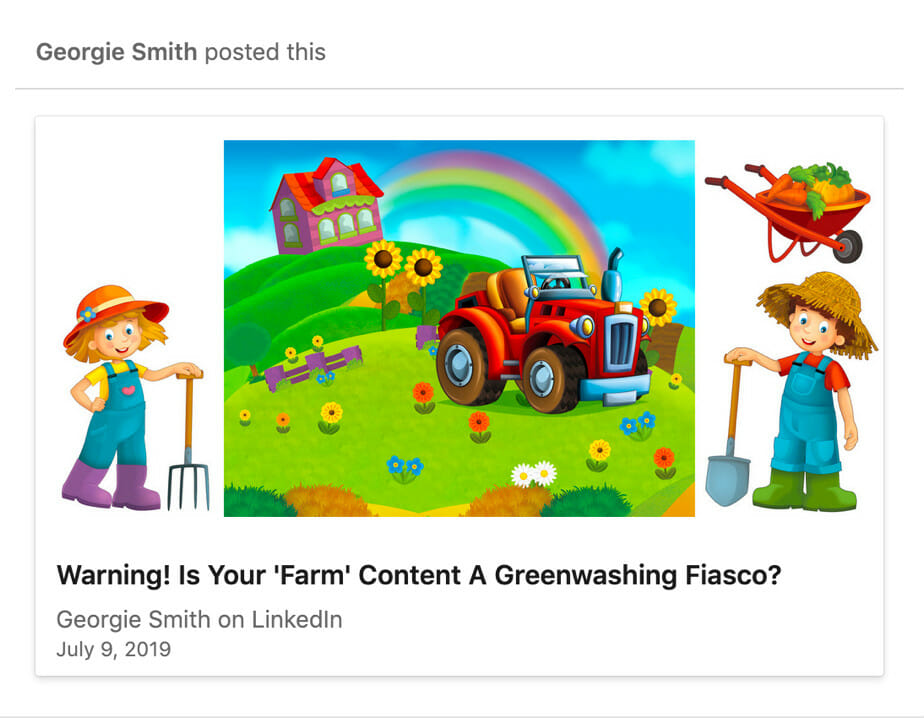
    You can see how an organic farmer would want to read that, to make sure they’re following marketing best practices in their space.

    Once you’ve got your target firmly in mind, it’s time to go beyond simply tossing up one-line status updates.

    Here are my top seven tips for creating LinkedIn content that creates buzz and gets you hired:

    1. Talk about your writing life

    The key to social media is that people don’t want to be hit over the head with sales messages. They want to socialize!

    Status updates are a great place to share happenings in your freelance-writing life. Examples include:

    • Finished a big client project
    • Changed your head shot, writer website, or logo
    • Looking for sources for an article
    • Got new home-office gear or co-working spot
    • Have marketing or writing-tool questions
    • A new piece you wrote just came out

    These are all great things to share on LinkedIn. They don’t scream, “Please, please hire me.” They just quietly keep putting what you do in front of your connections. If they hear of someone who needs a freelance writer, you’re likely to be top of mind.

    Remember, every time you post, connections can see your tagline (which hopefully says exactly what type of freelance writer you are). It’s low-key, free advertising that you are looking for healthcare copywriting clients, or whatever type of writing jobs you indicate.

    For instance, The Renegade Writer co-author Linda Formichelli puts up notices when she lands a new client:
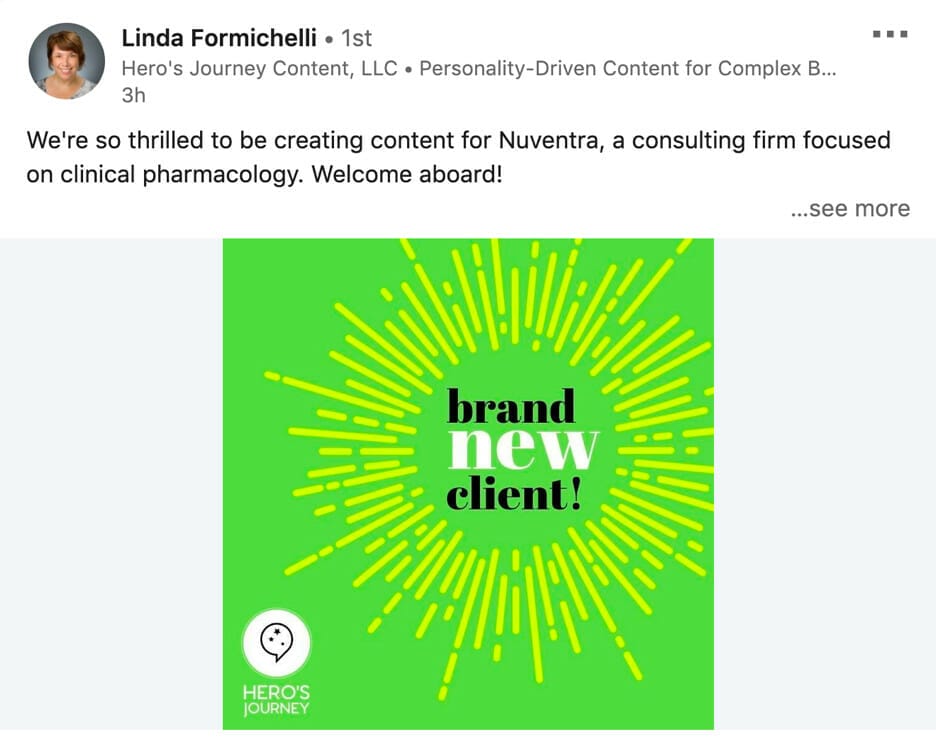
    These slice-of-writing-life anecdotes are quick and easy to put together, and keep educating LinkedIn visitors about what you do. To take your LinkedIn marketing to the next level, consider using Pulse.

    2. Get on Pulse

    Did you know that LinkedIn has its own blog? It’s known as Pulse, and it’s wide-open for (unpaid) contributions.

    I know, writers writing for free — it’s not ideal. But in the case of Pulse, it can be worth the occasional post, due to the platform’s large audience.

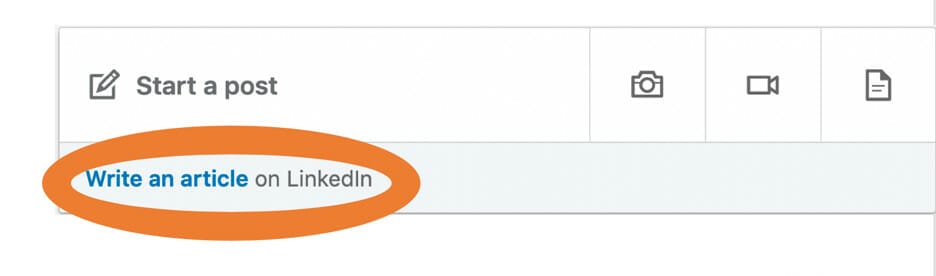
    It used to be hard to figure out how to get on Pulse, but now it’s easy — just look for the ‘Write an article’ link:
    Here’s the magic of Pulse: Posts you publish there get featured on your profile.

    LinkedIn is in the business of promoting its own blog, yo! You can see on the left of this profile shot how the platform lays out Divya’s Pulse post with a nice fat graphic, where status updates get less space:
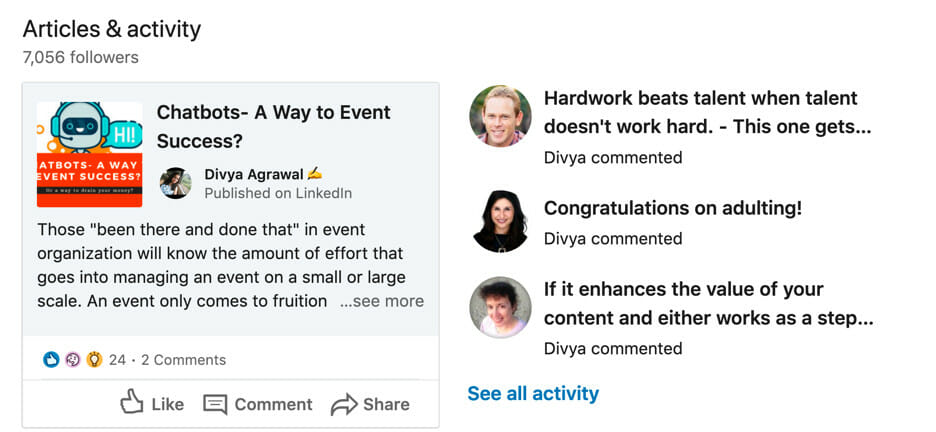
    Even better, your most recent Pulse post gets displayed forever on your profile page. Until you write a new one. You can write one Pulse post a year, and it’ll keep making your profile look sexy, and keep getting readers and comments.

    I’ve seen writers get in the neighborhood of 6,000-10,000 views on enticing Pulse posts. That’s a lot of possible clients, reading your work.

    3. Get visual

    Know what stops the scrolling and makes people pay attention to your content on busy social media sites? Interesting images. It’s worth taking a few minutes to hop to your favorite free-image site and locate something eye-catching.

    For instance, automotive writer Neil Pope recently got a lot of readers to one of his stories by using this traffic-stopping photo:
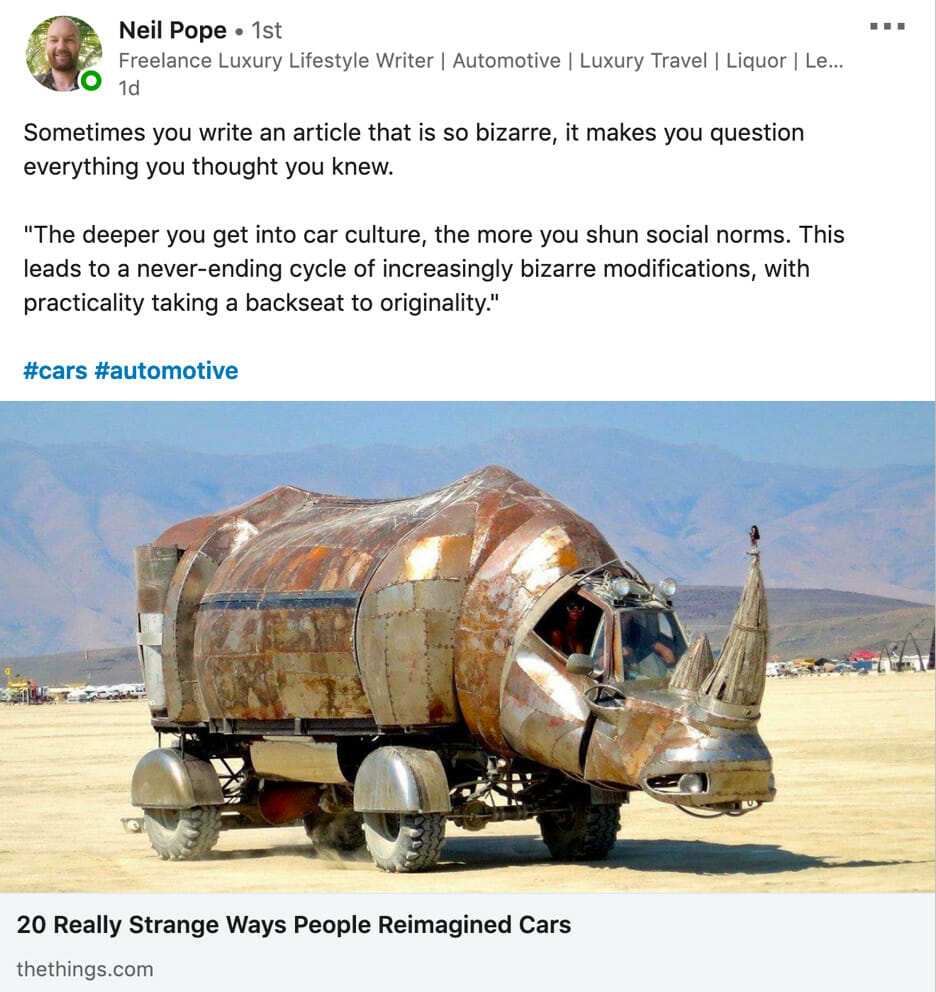
    Unusual, hm? Think about how you could stand out from the pack with your image, not just with the content you post.

    4. Sharing (and commenting) is caring

    One of the cool things about getting exposure on LinkedIn is that you can do it even if you’re super-busy. If you don’t have time to write content for LinkedIn, just curate the week’s most interesting posts for your target client, spin that into a quick post, and you’re done.

    You’ll be surprised how much people appreciate you pulling those resources together for them. You can also get your name in front of top prospects by sharing or commenting on their work, as you see content marketer Tracey Stepanchuk doing here, with a useful piece from Forbes:
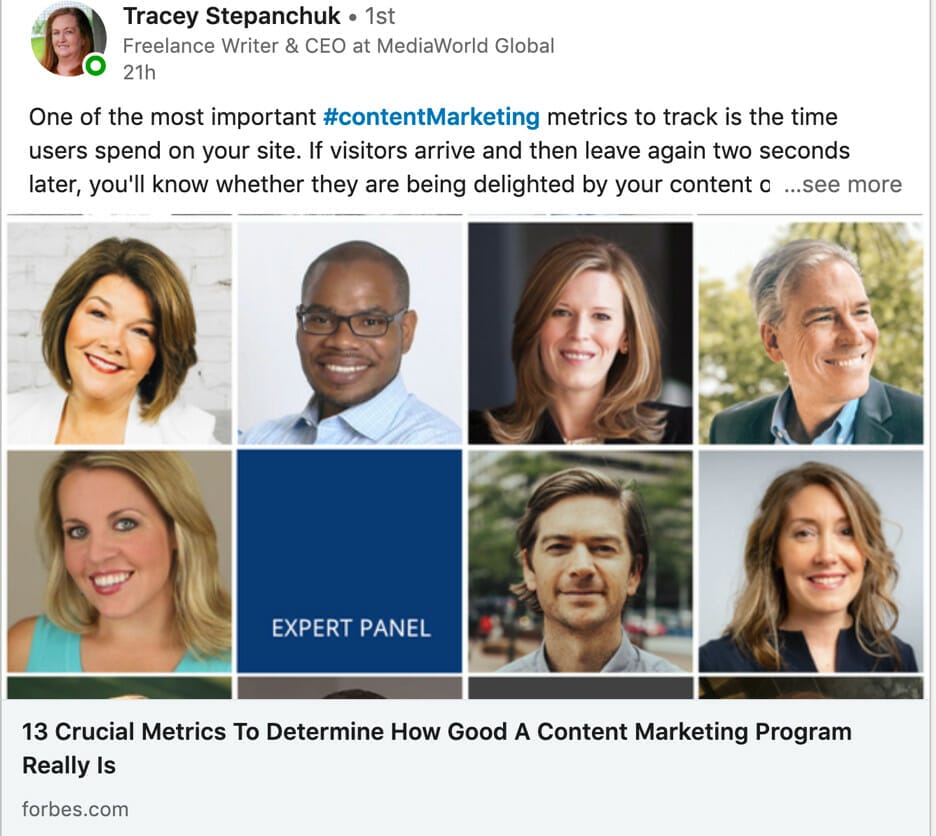
    Even though you didn’t write it, your shares and comments show prospects you follow their industry, know best practices, and are on top of trends.

    5. Be original

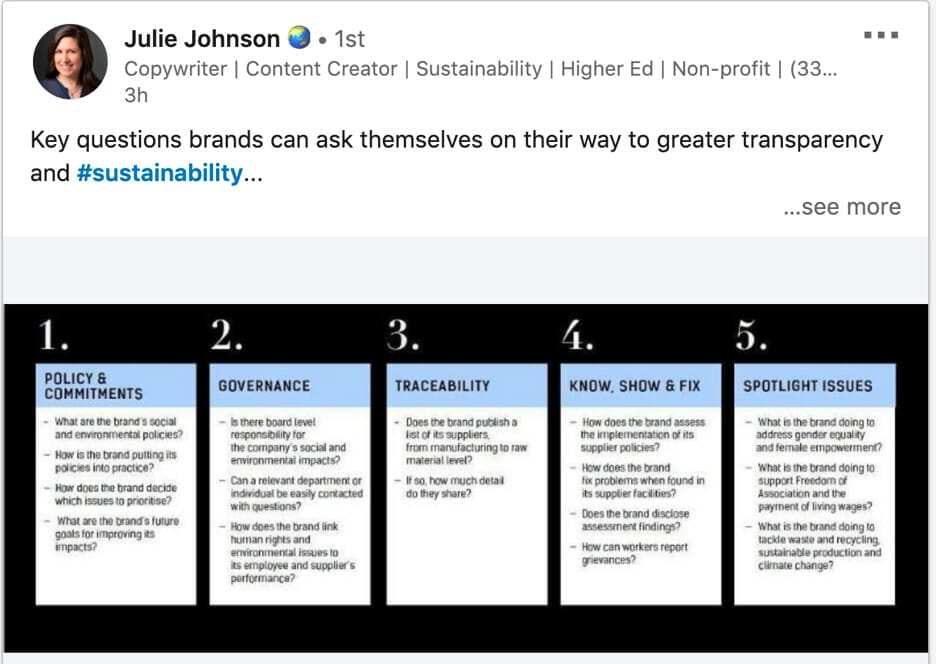
    While curating and sharing others’ content can help present you as an expert writer, creating your own unique content lends even more authority.

    Since all our writing clients are looking for us to deliver something that will set their publication or business apart, create highly original, must-read content on LinkedIn, to show you could deliver that for the client, too.

    For instance, check out this ‘key questions’ post sustainability writer Julie Johnson put together (she gets bonus points for creating a visual version of her content).
    6. Start spreading the news

    If you’re annoyed that you have no easy way to capture email leads from the content you post on LinkedIn, there’s a solution.

    Start up a weekly or monthly newsletter. Then, create a link that brings readers to your own writer website to subscribe and get the full edition. Presto! You’ve got contacts.

    For instance, automotive writer Neil Pope just started spinning all his best LinkedIn content of the week into a newsletter:

    Want to learn more? LinkedIn has newsletter tips.

    7. Discover hashtags — and get trending

    Twitter may have invented the hashtag — but LinkedIn has stolen it, big-time. LinkedIn now auto-suggests possible hashtags for all your content. Use them! Hashtags create easily sortable channels to help readers find what they’re interested in.

    Once you start using hashtags, you can potentially take advantage of a fun new LinkedIn feature — trending in hashtagged channels. LinkedIn editors have started notifying writers whose posts trend in a particular hashtagged category. Like this:
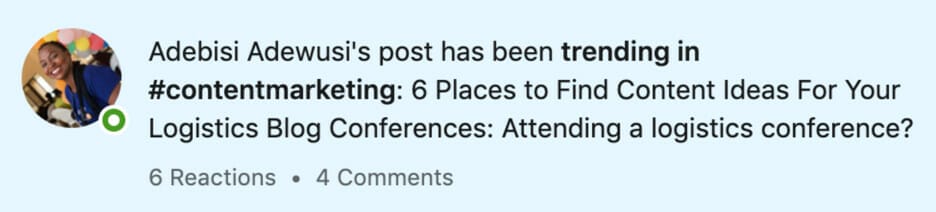
    It’s always an ego boost to hear you’re trending — and better yet, trending means it’s more likely a wider audience will find your post, not just your connections.

    Develop a LinkedIn marketing habit

    Once you get going with updates and posts on LinkedIn, keep it up! Make a commitment to post at lease once or twice a week, to keep your name in front of your prospects.

    What else can you do to build your audience on LinkedIn? Keep sending and accepting more connections.

    Once you top 500 connections, many writers have reported, LinkedIn starts showing their posts to more visitors, and they see an uptick in inbound connection invites, too.

    Try posting some useful information on LinkedIn that your ideal client would want to read — and see what happens.

    Photo via Unsplash

    This post contains affiliate links. That means if you purchase through our links, you’re supporting The Write Life — and we thank you for that!


  • Podcasting for Writers: How to Grow Your Freelance Biz By Starting a Podcast

    Podcasting for Writers: How to Grow Your Freelance Biz By Starting a Podcast

    Much like blogs, podcasts started out more or less with a large group of hobbyists who wanted to talk about their interests. Eventually, also like blogging, podcasting took on a life of its own and established itself as a viable new medium.

    These days, the podcasting landscape is robust and interesting for millions of listeners, including writers. You may already have a few favorite writing podcasts, and if so, you understand the appeal of this typically casual, conversational format. 

    Podcasts aren’t just great for your listening pleasure, though — they could make a valuable addition to your own marketing efforts. Just think: many podcast audiences are already full of your ideal clients and customers. 

    As a writer, you can use podcasts as a new avenue to reach your best markets in ways that raise your profile and build rapport…and that’s good for business!

    If you’ve ever thought about starting your own podcast but you weren’t sure if it was the right move or how you’d pull it off, this post is for you. I’ll show you how to use your own podcast as a marketing tool, go over a few strategies and approaches, and show you how to make podcasts work for you whether you write for others or for yourself. 

    How to know if podcasting is right for you

    I hang out with a lot of marketers, and as much as I love them, I’ve learned to be careful with them because they really dig hype. Many would tell you that if you’re any kind of service provider or a creative professional (*ahem* writers and authors), you must have a podcast. 

    I don’t completely agree, but I do think there are a lot of us in this writerly world who could benefit from doing a podcast. 

    Podcasting might be right for you if: 

    • Learning a new technology is relatively easy for you (meaning, it won’t take you four months just to figure out how to do basic audio editing)
    • You aren’t a perfectionist and you’re ok with the less formal feel of a podcast
    • You’re clear on your intended outcomes for the podcast
    • You have some time to devote to publishing regularly, whether that’s twice a week or twice a month
    • You know the audience you want to reach, whether it’s the type of niche client you serve or the best readers of your books

    As a busy writer, I’m careful before committing to anything that takes up a chunk of time and mental energy. After thinking about podcasting for several years, I finally felt like the time was right to launch one earlier this year. 

    Because I had a stable client load, I felt freer to do things with my own name attached (after spending nearly a decade mostly ghostwriting). I also decided to use a format that would be easy and efficient to produce, which meant my show wouldn’t take up too much time to plan and record. 

    Choosing your audience: The most important step 

    When you’re considering a podcast idea, there are two potential audiences you can reach: the audience of people who do what you do, and the audience of your potential clients or customers. There may be some overlap, but generally these will be two distinct groups of people. 

    I’d advise you to choose one of these groups for your show, because it’s a lot easier to create content for one specific audience than it is to try to balance two different ones. You can always make a second podcast if you love the medium. 

    As a freelance writer, the main benefit to choosing your ideal clients as an audience is that you’ll be creating content that will benefit them, while also setting yourself up as the go-to expert. If your niche is email marketing for small businesses, your podcast could cover all kinds of email marketing topics that these small business owners need to know. 

    What you’re doing is educating your prospective clients on the importance of the service you provide. When they’re ready to move forward with email marketing, you will most likely be the first provider they contact.

    As an author or creative writer, think about what your readers might enjoy hearing from you. It could be book reviews or interesting interviews with other authors in your genre. You could also use the podcast as a place to discuss your thoughts on your genre, or to share poems and shorter pieces you love but haven’t published elsewhere.

    Another fun idea might be to do your podcast in “seasons” with each season documenting the process of planning, drafting, editing, and even launching your next piece. Think about what your readers might enjoy most. When they find your show, they’ll become more attached to you, more aware of your work, and more likely to buy when you have a new publication.

    How to structure your show

    Generally speaking, your podcasts will be one of two formats: you, talking into the mic and sharing your content; or you interviewing someone else. Some shows will be mostly one format with an occasional episode done the other way. 

    Your “talking head” podcasts can be scripted or unscripted, and I’ve heard great podcasts in both styles. I typically prefer this type of podcast myself, because there tends to be one key message or point and the quality is consistent. 

    For my own podcast, I script some episodes, but I’ve found that I prefer just to work up a few talking points for each episode. This is easier and more efficient, because I don’t have to take the time to draft all the copy and I’m able to “go off script” when I think of new points to make as I’m recording. Another benefit to going unscripted is that it takes a lot less time to edit; I don’t correct myself when I’m speaking off the cuff, but when I’m reading there are lots of flubs and re-starts to edit out. 

    If you decide to go for it, expect to make some adjustments along the way. It’s ok to change directions! This is your show, and it makes sense to do what works best for you, even if it takes you a few episodes to work out the kinks.

    Why this format works for lead generation: I chose to target up-and-coming writers as my audience, knowing that having a podcast would also raise my profile and lend credibility to my pitches conversations with prospects. My podcast is very young and it launched with almost no fanfare, but it’s already helped me land some high-end client work. 

    While they aren’t my personal preference, interview shows can be really powerful as a marketing tool if you’re strategic in how you set the show up. One way to do this is to interview colleagues and (possibly) past clients and/or editors about topics related to the work you do.

    For example, ghostwriter Derek Lewis is a ghostwriter specializing in business books. On his podcast, he interviews “authors, business leaders, and publishing industry experts about what it takes to successfully write, publish, and market a business book.” Many of the people he interviews are past clients, and there’s a clear tie-in between the interviews and the service Lewis offers. 

    Why this format works for lead generation: Anyone who’s interested in writing or leveraging a business book could benefit from this podcast, including Lewis’s ideal clients… who then hire Lewis to write their books. He’s clearly the expert, and his client interviews serve as powerful social proof. 

    Not ready for your podcast yet, but curious?

    If you want to see how much a great podcast could do for your writing but you aren’t ready to commit to your own show yet, start pitching to appear on other podcasts. You’ll still get a feel for how podcasting works and start benefiting from the ongoing content marketing and SEO juice baked into podcasting. 

    Look for shows that are geared toward your ideal client and pitch to appear on them. (I often see calls in various Facebook groups for new podcast guests, and that’s an easy way to land spots.) In other words, don’t look just for writing shows; look for the kinds of shows your clients would listen to, and then try to get on those shows. 

    For example, if you want to write for real estate agents, look for podcasts that talk about marketing and lead gen for realtors, and then pitch yourself as a guest to discuss content marketing and how it brings in buyer and listing leads. 

    Your goal is to speak authoritatively about the benefits and value of the service you provide, while making it known that this is something that can be outsourced to someone like you. You’ll be set up as an expert and then you’ve had a chance to get in front of that audience and effectively sell your services without ever saying “Hey, come hire me!” 

    Another example: If you want to sell more books, look for podcasts related to the things your ideal readers would seek out. This might mean you’re looking for shows that do author interviews, shows that support people in your niche, or even shows for writers in your specific genre.

    The goal for you might be to share what makes your work unique and attractive, build your email list, or even do straight promotion of your latest piece. People who enjoy reading your genre will be able to discover you and then become new readers of yours. 

    Should you podcast?

    Podcasting may be the “it thing” right now, but it’s also been around as long as — if not longer than — blogs, which suggests to me that it’s not going anywhere. As a good marketer, you’d do well for yourself to tap into this highly engaged source of leads, however it fits into your business! 

    [twl_reusable_block post_id=41455]

    Photo via antoniodiaz / Shutterstock 

  • A One-Page Website is Quick and Easy to Create — Here’s How

    A One-Page Website is Quick and Easy to Create — Here’s How

    It took me nearly 10 years of freelancing to figure it out, but I finally identified the single greatest stumbling block that would-be freelance writers face: 

    The website. 

    Just think about it — many of us, when getting started, have no idea how to make a website that promotes our freelance writing services and there’s a mountain of decisions to make, plus a steep learning curve facing us. Even with a great tutorial about how to start a blog, it’s tough to get it all sorted out. 

    Why is creating a writer website so challenging?

    Here’s how it often plays out. 

    You want a website but you don’t know how to choose a domain name. Should it be your name? A business name? Something cute and clever? And you’re hesitant to do anything else for your fledgling business until you’ve picked out the greatest business name of all time. 

    Once you move past the name debate and settle on a good option, there’s all the tech to fret over. Talk about intimidating!

    In fact, intimidation is the name of the game, and it goes a lot deeper than just figuring out how to create a website. For many would-be writers, website costs are the first real business expense you incur. You are paying real money to invest in this business…and putting some skin in the game, no matter how small, makes it real. 

    What do humans do when they’re facing something new and scary? We avoid. 

    Enter: Website analysis paralysis. We overplay the significance of every detail to make this procrastination “valid” and then feel justified in delaying the real work of freelance writing (which is, of course, the actual hard part). 

    I’ve seen this cycle play out many dozens if not hundreds of times over the past 10 years, first among my colleagues and then with my students. 

    Here’s an easy solution: Create a one-page website

    Finally, I found a workaround. 

    What I’ve been recommending lately — with good results — is what I call the one-page website. 

    It’s a simple, elegant solution for freelance service providers who don’t have the budget or bandwidth to put together a robust site (the way we’re “supposed to”) but still want something more custom than some of the writing portfolio websites for writers on the market. 

    The one-pager is exactly as it sounds: a website that has one page.

    It can be as stripped-down as a simple landing page or as robust as a multi-section scroll-fest (also known as parallax style). 

    No matter what, everything you need is right there on the front page. 

    The beauty of the one-page website is that it delivers all the necessary information while removing the “pressure” of building and then filling multiple pages of content. For serious beginners who want to do their website “the right way” but find the tech parts too intimidating, the idea of leaning on a one-page theme and writing just a couple of paragraphs is welcome relief. 

    Curious? Let me show you how it works. 

    What should a one-page website for freelance writers include?

    The one-pager distills all the critical information your clients need and presents it in a small, tidy package. This includes: 

    • Your name
    • Your experience
    • The service(s) you offer
    • Samples of your writing
    • Testimonials and social proof
    • How to reach you
    • Great photo of you (highly recommended, but not required)

    That’s it! Certainly there’s more you could include if you wanted, but those are the essentials. 

    Could you come up with a sentence or two for each of these sections? Way faster than writing an entire site’s worth of content? Yep, I thought so. 

    How to build a one-page website

    The most challenging part of putting together a one-page website is finding the template you want to use. 

    I use WordPress and always have, so my go-to for a one-pager is WordPress templates. Many WordPress themes, including free themes, come with built-in one-page templates. A few I’ve heard others recommend are Uncode, OceanWP, Astra (the free Happy Paws theme is a great place to start) and Clear-Fix

    The easiest way to get started on WordPress is through BlueHost. When you buy hosting from this company, it costs just $2.95/month, and they’ll throw in the domain of your choice. Then you can add WordPress to that site with a one-click install. (If this sounds confusing, here’s a guide to starting a blog that walks you through it.) 

    If you need inspiration, The Muse has an interesting collection of one-page websites. Some are extremely simple and look like landing pages; others are more complex and design-focused.

    As you review examples and consider themes and templates, look more at layouts than specific details like colors and images. See where photos are placed on these templates, and think about what photos you’d want there instead. 

    Also keep in mind how you want to approach testimonials; some themes have a whole section devoted to them, and others have section breaks built in throughout the page that might be a good place to park a review or two.

    Building a website from scratch takes some time, especially if you’ve never done it before. If you find yourself spending more than a week or two on it, however, you might be veering into “overcomplication” territory. 

    Lean into the one-page website to streamline the process and get your site built quickly, so you can get onto the part where you build your rock-solid freelance writing business. 

    This post contains affiliate links. That means if you purchase through our links, you’re supporting The Write Life — and we thank you for that!

    Photo via GuadiLab / Shutterstock 

  • 3 Reasons Self-Publishers Should Crowdfund Their Book

    3 Reasons Self-Publishers Should Crowdfund Their Book

    With the explosion of the self-publishing industry and the popularity of platforms like Kickstarter and Indiegogo, crowdfunding has become an increasingly viable option for authors.

    It only takes a cursory search to find encouraging case studies, like how one author raised $12,755 in 30 days to get you excited about the possibilities.

    The excitement is justified, but crowdfunding a book takes a tremendous commitment of time and is a grueling journey for many authors. However, for those who navigate the process, crowdfunding can provide value that stretches far deeper than just earning upfront dollars to finance your book.

    Below are the top three reasons why authors should consider crowdfunding.

    1. Crowdfunding helps defray publishing costs

    First time authors often underestimate the amount of money that it takes to get their book to market.

    In order to bring a polished book to market, an author must plan to invest in at least the following services:

    • Cover design
    • Professional editing
    • Interior/exterior formatting

    These costs can vary widely depending on the level of service you choose.

    For instance, a professional cover design will range anywhere from $100 – $1,500 depending if you choose a provider that repurposes stock images or designs a completely original cover from scratch.

    Beyond that, editing will generally range between $.02 and $.10 per word. This means that a 100,000 word novel could set you back anywhere from $2,000 – $10,000.

    If you are planning on using print on-demand services (such as CreateSpace) or only releasing an ebook, the upfront costs might stop there. But, if you want to do your own print run of physical copies, you’ll have to invest another few thousand dollars to get books in hand.

    What’s so appealing about crowdfunding is that it allows you to raise money before you ever incur these costs. Prior to crowdfunding, these costs might have presented an insurmountable challenge to authors.

    Now, authors have the ability to bring a professional quality book to market without worrying about the ability to float the expenses.

    crowdfund book2. Crowdfunding makes selling your book easier

    Crowdfunding presents a unique opportunity for authors to sell  books and build an audience.

    Successful crowdfunding campaigns do more than just get fans excited about your book. They get fans excited about the book’s journey. With crowdfunding, your backers are more than just customers. Backers become part of the reason that your book exists, and this creates a level of excitement that simply doesn’t occur after your book is printed.

    Further, crowdfunding campaigns inherently impose a sense of urgency.

    One of the most difficult objections to overcome when selling your book is fighting people’s urge to say “I’ll buy it later.” The time limit of crowdfunding campaigns (generally 30 days) helps you push people beyond this hurdle.

    Crowdfunding can put authors in a position to sell more books and build an audience faster than they ever could otherwise. The blend of urgency and excitement that crowdfunding provides is a crucial element in turning interested fans into paying customers.

    3. It can possibly help you get a publisher

    There are a number of crowdfunding platforms for authors to choose from. They range from the mega platforms (like Kickstarter and Indiegogo) to more specialized platforms that specifically target authors. This is where authors can leverage their campaign to potentially get a publisher.

    For instance some platforms such as Inkshares and Unbound actually act as publishing houses themselves. If you run your campaign on their platform, there’s a chance that they will pick you up and bring your book to market.

    Additionally, there are platforms such as Publishizer that will act as your virtual agent. Based on the success of your campaign they will query your book to prospective publishers on your behalf.

    However, authors should be aware that many of the “publishers” that offer authors a deal are actually vanity presses. These companies offer to print your book in exchange for a service fee and provide limited (if any) support on marketing and distribution.

    Depending on your goals, this might still be the right decision, but authors should investigate further before signing on.

    These three factors create a compelling case for authors to launch their book via crowdfunding.

    Savvy authors can utilize crowdfunding as a tool to not only offset the costs of bringing their book to market, but also to accelerate sales and their ability to build an audience. If you are willing to put in the work, crowdfunding can be your ticket to bringing a professional book to market without paying the price.

    Have you considered crowdfunding your book? Let us know in the comments below!

  • 18 Ways to Support an Author (Besides Buying Their Book)

    18 Ways to Support an Author (Besides Buying Their Book)

    If you are an avid reader, then there are authors in your life. Lots of them. You may not know them personally, but you know the genius of their words.

    As an author, my friends and family often ask how they can support me in my writing journey.

    I mean, everyone knows that you can support an author by buying their books. That’s a no-brainer.

    But what if their book isn’t yet published? What if books aren’t in your current budget? What if the author already enjoys fame and fortune and you simply want to show some appreciation for their incredible work?

    Easy.

    Here are 18 ways to support an author without spending a penny.

    1. Follow them on social media

    Authors are constantly looking to grow their readership, and social media is one of the primary channels for doing so.

    2. Engage with them on social media

    Go beyond liking or following and share, comment on, and retweet their content.

    3. Sign up for their email list

    Bonus for this good deed: you’ll often be the first to hear about giveaways and new book launches.

    4. Read their blog

    If they have a blog, check it out. The more eyes, the better.

    5. Engage with their blog

    Comment on posts and share your favorites with your friends. There’s nothing worse than writing a blog that feels like an echo chamber.

    support an author6. Thoughtfully review their books

    Book reviews influence buying decisions, for better or for worse. If you enjoyed a book, leave a review on Amazon, Goodreads or Barnes and Noble.

    7. Spotlight them on your blog

    Offer to interview your favorite author on your blog. This is especially helpful for debut or self-published authors.

    8. Review their book on your blog

    Do you review books on your blog? Go ahead and slot their book(s) in.

    9. Add their book(s) to your Goodreads lists

    Let your fellow bookworms know the author’s book is on your ‘to read’ or ‘currently reading’ list.

    10. Name-drop in conversation

    If people ask about your new favorite books or authors, don’t hesitate to mention them.

    11. Do the book club bump

    Recommend your new favorite books and authors to your book club.

    12. Go straight to the source

    If you’re friend or a fan, why not drop the author an email or social post with compliments? It will absolutely make their day.

    13. Don’t forget the library

    You know, home of all the books? Check out their book from the local library.

    14. Plug the book locally

    If your hometown library or bookstore isn’t already carrying the book, suggest it to them.

    15. Take a selfless selfie

    Share a photo of you with the book or the book against an exciting backdrop on social media and tag the author.

    16. Show up when it matters

    If the author lives nearby or is stopping in your area on a book tour, check out their release party or book signing and bring a couple of friends with you.

    17. Get that book noticed

    Read your hard copy in public (at the coffee shop, on the bus, at the airport), where other nosy readers will take note.

    18. Pay it forward

    Lend or gift your copy of the book to a friend who will enjoy it and ask that they do the same.

    Authors truly appreciate any effort you make to help spread the word and support them.

    You may even make a new friend or pen pal in the process.

    Do you have good author karma? How else can we support authors? Let us know in the comments!

  • Social Media for Writers: 5 Quick Fixes To Build Your Brand

    Social Media for Writers: 5 Quick Fixes To Build Your Brand

    Your social media presence is often the first point of contact for your brand online, so it’s important to be purposeful in how your profiles portray you.

    Even though social media can sometimes feel like an intimidating snowball of doom, it can also be a great way to connect with other writers, editors, agents, and readers. Today I’m going to melt that snowball down a bit by sharing some quick fixes to vastly improve your writer brand social profiles in a just a day (or heck, even a few hours).

    1. Write a stronger bio

    Your bio is generally the first thing people see when they check out your social profile. It is essential to communicate quickly who you are and why someone should care. A vague bio = loss of connection, and connection is the entire reason you’re on social media in the first place.

    First things first, keep your bio pithy and to-the-point.

    Your messaging should be consistent across social platforms, but it doesn’t have to utilize all the same words.

    Also, remember social media is all about person-to-person interaction — even though it doesn’t always feel that way — so your bio should be in first person.

    Follow this basic formula: say what you do  + show why your audience should care + offer proof (awards, education, etc) = great bio.

    On Twitter

    Start with Twitter because the limited word count keeps you focused on just the details that matter.

    Your Twitter bio should include either:

    • A collection of quick one-word descriptors about what you do (i.e. novelist, memoirist, copy-editor, etc.) or
    • A one-liner that gets to the meat of what you do and why they should care.

    For example:

    “I help creative changemakers improve their personal brands [what you do, who you serve/why they care].”

    or

    “Author of cyborg cowboy [unique subject] novels [form] like My Book Title [your work], a NY Times bestseller [proof].

    Optionally, you can hashtag keywords to help you turn up in search. For example, if you include the word ‘personal brand’ in your bio, consider hashtagging #personalbrand. You may also want to tag the company you work for, founded, or write for, so you come up in search for those terms as well (i.e. “Brand Director @BinderCon”).

    On LinkedIn

    Even with more room here, keep your bio tight with these tips:

    • Offer a snippet of backstory or demonstrated expertise that adds credibility, but don’t be too obnoxious in tooting your horn. Tell people a little about what drives you to do the work you do.
    • Be sure to think about who you’re trying to speak to. Colleagues, editors, agents, readers and clients may have slightly different interests.
    • If you have any honors, awards or life experiences that apply to your brand, drop in a short sentence to showcase your accomplishments.
    • Offer an opportunity to keep the conversation going. Invite them to email you, connect or visit your website.

    On Facebook

    Use a pared down combination of your Linkedin and Twitter bios for your Facebook page.  

    With recent Facebook page updates, there are several places to separate specific information: Affiliation, About, Biography, Awards and Story. You can find all of these options under About on the left side of your Facebook page.

    You can also pick categories for your page, which I recommend for search purposes.

    On Instagram

    Your Instagram bio should be very similar to your Twitter version, however, if possible add a couple of key titles to your name field as well. This tactic helps you show up more readily in searches.

    For instance, instead of “Andrea Guevara” I might put “Andrea Guevara, brand strategist.” Try to use terms that you think your audience would use to search. Don’t be afraid to add some emojis!

    2. Take a better profile picture

    Like it or not, humans are visual beings. So don’t use a crappy, poorly-lit selfie for your professional social profile.

    I love you, but get another person to hold the camera. You could prop the camera on a table, or counter and use a timer. Even if it isn’t a professional headshot, surely it will turn out better than a selfie.

    Take the photo today and post it today. It really shouldn’t take long and you’ll be proud of your upgraded look.

    Then when you have more time and a bigger budget, invest in a professional headshot.

    social media for writers3. Upload a powerful cover image

    Your cover image should usually consist of one of these features:

    • A picture of you doing something important (like a Ted talk),
    • A high quality promotional image (like your latest book),
    • An image that portrays the essence of what you do/who you are. For instance, mine is usually a beautiful, evocative nature shot with a short inspiring saying.

    It’s not that you can’t feature other ideas, but remember you’re trying to give people an idea of who you are and what value you offer.

    Specific platform recommendations:

    On Twitter, use a cover image that encapsulates the essence of what you do. For Facebook, go with either an essence of what you do image, or a call to action to “like” the page, or sign up for email list. For Linkedin, I recommend a cover image that demonstrates your expertise (i.e. a photo of you speaking or teaching).

    Also, I know famous people break all of these rules, but don’t base your social profile on their methods. The normal rules do not apply to them — they are already big shots. Once you’re a big shot you can have an enigmatic bio, oddball images and the like. Not until then.

    4. Clean your online house

    As writers, we often feel like we need to be on every new social platform that pops up. I don’t know about you, but I can’t keep up with all of them. And as a brand strategist, trust me when I say that you’ll get a lot farther by doing what you’re best at rather than becoming a social media scatterbrain.

    Let’s get rid of some of your seldom used social accounts.

    Do a quick Google search of your name and see what comes up. If there are any social accounts you don’t really use any more, deactivate them. Don’t delete them though, because you’ll want to keep your username reserved. This helps prevent others from using the same username and creating confusion.

    Don’t worry about having a presence on all the cool kid platforms.

    The two most important principles are to: be where your ideal market (readers) are and keep your profile current and useful. So go ahead and free up some headspace and time by deactivating those ho-hum accounts.

    5. Share quality content, quickly

    Coming up with consistent, quality shareable content is one of the big keys and struggles to building your readership online.

    However, the first step to begin boosting engagement can be simple: Post other people’s excellent content, then interact with others.

    Of course I’m not talking plagiarism here; I’m talking about sharing links to articles, posts, memes, videos, etc.


    But before you just jump in and start spamming your feed — you know when a bazillion posts all from one person fill your feed? Yeah, that’s called spamming.

    Don’t do it; just do this instead:

    • Next, sign up for a FREE Buffer account, It takes thirty seconds.
    • Pick a wonderful piece of content from each of those brands on your list. Create 10 posts within Buffer (you can easily schedule them to drop at later times). Optionally: add a sentence or two about why you like it, or to put it in context.

    Depending on what options you’ve selected, you now have at least a couple days of great content to share.

    Keep up your momentum and schedule yourself ten minutes per day to find more quality posts and schedule them using Buffer and don’t forget to like, retweet and respond while you’re at it.

    If you use this post like a checklist (and you totally should), you will have a better profile picture, a more applicable cover image, a powerful bio, and 10 pieces of quality content scheduled, plus you’ll also deactivate those useless, dusty old social profiles you don’t use. So go ahead and upgrade your online presence today.

    This is an updated version of a story that was previously published. We update our posts as often as possible to ensure they’re useful for our readers.

  • When Does a Writer Rest? It’s Time to Talk About Self-Care

    When Does a Writer Rest? It’s Time to Talk About Self-Care

    Let’s start with some cold reality: My 2017 Q2 sales report is in.

    I sold a grand total of 25 books, between two titles.

    While my publisher assures me this is normal for a small press author between releases, I was somewhat distraught over this report.

    There are a lot of reasons behind this dip in sales. As my publisher pointed out, I was in a lull between releases (my last true launch was March 2016, over a year before). Additionally, my personal life was in upheaval.

    I had just settled back into my home in D.C. and returned to a full-time office job after two years of freelancing and flexibility. Additionally, a loved one was in the midst of chemotherapy treatments, and for whatever reason, the hubs and I had chosen to do an unusual amount of travel during this period.

    In short, it was a busy and overwhelming time in just about every way. I was exhausted. This limited my ability to write consistently, let alone focus on marketing.

    Sometimes, something just has to give.

    There are a few caveats to this that soften the blow. I got 622 downloads of my freebie novella from new email subscribers during this period. Likewise, my social media following grew. And, I did the important work of finding a new, sustainable flow for my writing and marketing, within the parameters of my new life.

    Amazingly, my life has only become more chaotic in the months since the time frame of this report.

    So staring at these cold hard numbers prompted a question.

    When does an author rest? And what is the cost?

    At some point, I speculate that a writer’s platform begins to take on some of its own impetus, and that while one might see a modest dip in sales from a neglectful marketing period, it would be less significant.

    But as a small press author early in my career, if I’m not hustling, the copies don’t get into readers’ hands.

    That pressure is exhausting sometimes.

    I’m not a machine. I can’t hustle-hustle-hustle without a break — and I’ve been trying very hard to summon the Energizer Bunny. But heck, even machines need to recharge.

    Eventually, I must rest too. When I don’t, I start missing things. I make mistakes. My overall quality of work declines, and hard.

    If I’m truly in this for the long tail, there is a much greater cost to not resting than there is to taking an occasional sales hit. Low numbers might hurt my pride, but if exhaustion leads to poor writing quality, there is no recovery.

    No quarter is the end-all or be-all

    This is about the long tail — growing a true career as an author. And if I’m going to do

    that, I need to remain sane and release one knockout story after another.

    Faster would be better, sure, but quality is my queen.

    And if I go on trying to function on four hours of sleep, coffee and cortisol, quality is

    just not going to happen.

    So when I power down for bedtime or allow myself the occasional much-needed morning to sleep in, instead of write, this is what I tell myself when the guilt and ambitions start rising up.

    writing restHarder vs. smarter: Playing the long game

    Work harder all the time is not an option. Thus, I must learn to work smarter.

    My key way of doing this has been to constantly reassess what I’ve done and look for ways to do it better. I also constantly study what other authors are doing that leads to success.

    For example, when I created my freebie novella, I intended to only offer it through my website. But my publisher edited and formatted it, and thus they placed it for purchase on the usual sites. It first showed up on my website, then quietly later released digitally, then in print, for purchase elsewhere.

    If I’d really been thinking ahead, and taking the time to communicate better with my small press, we could have turned this into a proper launch instead of a gradual trickle out. Missed opporunity to gain some serious momentum.

    Lesson learned: An author who is working smarter thinks ahead and sees this type of opportunity. Don’t ever let a new release hit shelves without a bang of celebration around it.

    To take care of your author career, you have to take care of yourself

    So as 2017 continues to escalate the chaos on every single front of my life, I’ve been forced to try a new approach: Resting. Looking out for myself. Slowing down. Saying no, sometimes.

    It’s not easy. But it’s necessary. So I’m trying to retrain my thinking, calibrating for the longer target.

    Call it self-care if you want. I’m calling it a strategy.

    How do you find balance between your author work and rest?

  • The Indie Author’s Guide to Hitting the USA Today Bestseller List

    The Indie Author’s Guide to Hitting the USA Today Bestseller List

    Have you ever dreamed of becoming a bestselling author?

    It’s certainly possible, but not everyone who sells well makes it onto the list. As it turns out, you need to meet certain criteria to even be considered for a list like the USA Today bestseller list.

    Earlier this year, I hit the USA Today bestseller list with a multi-author box set.

    I then joined a second list-aiming set, and in June, I ran a large promotion on my own series bundle. I didn’t make it that time, but I did learn a lot about what it takes to become a bestselling author.

    The USA Today bestseller list ranks the top 150 best-selling books using data collected from the previous week from online and brick-and-mortar retailers. They publish the first 50 in the print version of USA Today and publish the top 150 online every Thursday.

    Making the list can mean exposure for you, and the privilege of adding the title of “USA Today Bestselling Author” to your credentials.

    Think you might want to aim for the list? Here’s what indie authors need to know before running a promotion.

    1. Run your promotion Monday through Sunday

    Keep in mind that the bestseller lists only give a snapshot of what’s selling really well during any given week.

    That means a book that sells well consistently but never sells thousands in one week may never hit the list.

    Likewise, a book that sells really well one week but stops selling well later on — or even goes out of print — can still make it. Even books that are several years old can rise to hit the charts with a good promotional strategy behind them.

    The USA Today list adds up sales from the previous Monday through Sunday to determine the bestsellers for that week. So if you’re going to make a go at it, plan your run for those days.

    (See point #5 if you plan to make a list run on a new release.)

    2. Sell on more than one platform

    To be considered for the USA Today bestseller list, your reported sales have to come from more than one platform.

    That means that if you’re digitally exclusive to Amazon in KDP Select, you don’t have a chance no matter how many copies you sell. (Unless you’re selling enough print copies, which is rare for indie authors.)

    It’s also worth noting that the USA Today list doesn’t collect data from every sales platform. If you’re trying to hit the list by selling enough print copies through print-on-demand (POD) companies like Createspace, those sales won’t count. Furthermore, Google Play isn’t included on their list of contributors, so those sales won’t count, either.

    (You can view a list of contributors here.)

    That said, if you sell enough copies on platforms like Amazon, Nook, and iBooks, all those sales will combine to determine your book’s ranking. Indie authors typically focus on digital sales.

    3. Aim for at least 500 sales on Nook or iBooks

    Amazon is arguably the easiest platform to sell on for indie authors, especially when running a major promotion.

    However, since you need sales on more than one platform, your best shot at getting enough sales as an indie is to focus on iBooks or Nook as your secondary platform.

    However, these two retailers won’t report numbers to the list unless you’ve received 500 U.S. sales for the week. Be sure this goal is part of your promo strategy.

    usa today bestseller list 4. Shoot for 6K U.S. sales minimum

    There is no real number needed to hit the list.

    It all depends on what else is selling that week, and some seasons are more competitive than others. I’ve been told  summertime is a good time to aim for the list because there’s less competition.

    However, 6,000 sales is generally a “safe zone” for making the bottom of the list (though it’s best to aim higher because that number is never a guarantee).

    Also note that these sales have to be in the U.S. to count.

    5. Consider a pre-order period to gather more sales

    Any book can make the bestseller list no matter when it was released. However, many authors aim for the list with a new release. One of the benefits to this strategy is that you can set up digital pre-orders on platforms like Amazon, Nook and iBooks.

    Note that your Amazon sales ranking is determined based on when a pre-order is placed, but the USA Today list counts your pre-order numbers when the book is released. A pre-order period gives you more time to gather those sales.

    A word of warning: Due to time zone differences, pre-order numbers can sometimes hit the night before your scheduled release.

    That’s why if you’re going to go this route, you’ll want to release on a Tuesday. That way if pre-orders do hit the night before, you still get those numbers on Monday, which is when the clock starts for your list run.

    6. Give it all you’ve got

    Make no mistake: Hitting the list isn’t easy, even when multiple authors are working together.

    Expect to invest a lot of money into marketing. How much really depends on your genre since some books are easier to sell than others. I’m in the young adult genre, and several authors I know — including myself — didn’t make it with a $2,000-$3,000 marketing budget.

    That’s just a marketing figure for the week. It doesn’t count the cost of publishing a book, such as the cover design, editing, formatting, etc. You’ll need all those aspects down first before you run a huge marketing campaign.

    It also takes an incredible time commitment. I spent a month of daily work preparing for my solo promotion, but it’s pretty typical for authors to run three-month pre-order periods prior to a list run.

    I won’t claim to be an expert on the USA Today list, and I’m sure much of this information is subject to change over the next few years.

    However, after aiming for the list three times in the past year, I’ve learned a lot about what it takes, and I hope that other indie authors can learn something from it, too.

    Do you plan on trying to hit the USA Today bestseller list within the next year? Tell us about your plans in the comment section.

  • 7 Social Media Tips For Writers Who Want to Get Noticed

    7 Social Media Tips For Writers Who Want to Get Noticed

    Social media is woven into our lives.

    We don’t even think before reaching for our phones to check Facebook and Instagram. We catch ourselves scrolling through our feed or drafting the next clever tweet in our head.

    In a world so entrenched with social media, are we as writers living up to our full social potential? Or do we believe that we somehow can rise above social media and be successful without it?

    Freelance writers often miss key ways they can use social media to their benefit.

    Social media is a gold mine of unlocked potential to build a following, showcase your writing ability and gain exposure. If you are a writer looking to get noticed or inspired, here are seven creative ways you can use social media to do so!

    1. LinkedIn Pulse

    Pulse is LinkedIn’s native article publishing platform.

    This platform gives writers the chance to get original content noticed on LinkedIn by professionals.

    If you publish blog posts or articles, think along the same lines for Pulse. Articles can range from 500-word targeted posts to epic, 2,000+ word pieces.

    The good news? Republishing content from your blog in Pulse is not considered duplicate content by Google. However, I’d still recommend changing a few lines to speak directly to your LinkedIn audience.

    2. Instagram quotes

    Instagram is an untapped gold mine for writers.

    Do you have a book? An ebook? Even a blog? If you’re a writer, you likely have at least one.

    Try using Instagram to showcase quotes from your written work. You can snag quotes and create simple, but beautiful, images. One of my favorite tools to create graphics is Canva. There are hundreds of beautiful templates and layouts you can use to make your quotes stand out!

    Be sure to think hard about your captions! Although Instagram is a visually-dominated social media platform, writers can make great use of the captions.

    Reel those casual scrollers in with a beautiful image, and keep them there with your caption.

    3. Your Instagram bio

    As obvious as it sounds, every author, blogger, and writer needs a snappy Instagram bio to attract potential opportunities.

    This is the #1 area of failure I see on Instagram.

    Who are you? What are you interested in? What do you do? What do you like to do? You want to make your first impression for readers landing on your profile a positive one.

    A stellar bio includes your real name, a brief rundown of your skills, and your website link. Make sure you use your creative flair to set yourself apart. (This is why I love emojis!)

    social media tips

    4. Twitter chats

    Twitter, contrary to popular belief, is one of the most literary social media platforms today.

    You have 140 characters to make your point. What could be more literary than that?

    Twitter Chats are a great way to network, influence and contribute. Many writing chats feature guest influencers and experts, giving you access to some big names to network with.

    Topics range from book discussions (check out the popular #LitChat) to fiction writing support (I recommend #ScribeChat on Thursdays) to the benefits journaling (#JournalChat, also on Thursdays).

    Twitter chats are a creative way writers can use social media to connect with other writers, expand their sphere of influence, and share their knowledge.

    5. Facebook writing groups

    Facebook groups are yet another creative way writers can use social media to get noticed and inspired.

    Joining a Facebook group aimed at writers is a fantastic way to meet and collaborate with other writers. You might even find your next writing gig!

    Facebook writing groups range from small and intimate, to enormous and robust. Topics and focus vary, but the main benefit remains the same: comradery with other writers.

    The Write Life even has its own Facebook group, filled with inspiring writers.

    6. Facebook Instant Articles

    Although Instant Articles isn’t quite what publishers hoped it would be, the platform still holds promise for writers.

    Facebook Instant Articles receive 20 percent more clicks and 30 percent more shares than other articles, according to a statistic from 2016..

    Like Pulse, you can republish content on Facebook’s native platform without it being flagged as duplicate content.

    Yet, unlike Pulse, Facebook has created several integrations that make publishing easy for writers. These integrations with content and blogging systems means there’s no need to recreate articles within Facebook.

    7. Facebook “mini blog”

    We all know that writers can use their Facebook pages or profiles to share blog posts.

    But, what about “blogging” right on your Facebook newsfeed? Authors such as Elizabeth Gilbert do exactly this.

    You can use Facebook not only to share content from other places, but to express your opinions about those pieces. Share your creative edge, your wit, your life. Your sphere of influence will expand simply from being transparent and generous with your writing!

    With these seven creative ways to use social media, let’s stop fighting social media and instead, embrace it. Let’s find more opportunities to get noticed and gain exposure for our work!

    For more helpful articles on how to use social media well, check out these articles:

    This is an updated version of a story that was previously published. We update our posts as often as possible to ensure they’re useful for our readers.

  • 7 Clever Ways to Leverage Reviews in Your Book Marketing

    7 Clever Ways to Leverage Reviews in Your Book Marketing

    When my first novel debuted last year, there was one aspect of its release that scared me stiff: Book reviews.

    I soon found out, I didn’t need to be afraid.

    Sure, the occasional bad review happens. But I was in good hands with my editor and my publisher. They made sure my work was of professional quality, and then they made sure it found the right reviewers.

    A great review from the right publication or influencer can springboard your way to success. Glowing reader reviews can make the difference between a purchase and a quick dismissal, and simply having several reviews for your book can help you get discovered more easily on the big sites like Amazon.

    At first, I was stunned by my positive reviews. But then I realized: It does me no good to sit here and just read rave reviews over and over. (Okay, it did my ego a little good.)

    Once you have reviews of your book, the next critical question is:

    How can I get more from my reviews?

    Good news — there are as many different ways to put your reviews to work as you can imagine. That said, here are seven of my favorites when promoting my own books.

    1. Book cover

    Do you have a particular review quote that sums it all up, or is particularly effusive? Go ahead, slap that baby on your front cover.

    A particularly compelling quote in the corner of your cover can be the difference between someone picking your book up off the shelf and skimming to the next one.

    Don’t forget the back cover, either — that’s more prime real estate, and usually the second place a reader looks when making a purchase decision. Quotes from reviews can also go on the back cover, either above or below your blurb.

    I’ve found this especially useful for in-person events, as I can point directly to what other readers are saying.

    2. Cross-promotion

    You know those pages in your books before and after your novel? Don’t let them go to waste.

    Instead of leaving them blank, use them to give your readers reasons to pick up even more of your work! A well-placed quote can keep your reading reaching to your next release.

    3. Book sales page

    Every book I release, I add a sales page for it on my website. On that sales page I put the cover, the teaser blurb and a review quote.

    There are a few good reasons to do this. First, when someone is browsing from your website, they can’t see a thread of reviews below it like they could on Amazon. And there is a reason this feature is so popular on Amazon–reviews sell books. So help yourself out and share one.

    4. Press releases

    A strong review quote can be a great way to flaunt your credibility when approaching the media. And credibility with the media will get you far, my friend.

    Think about it–especially if you’re in a big city or approaching reporters in a books niche role, these guys get whammied with pitches from authors they have never heard of on a daily basis. Multiple times a day. Each of those authors is convinced they are important and special.

    Don’t be another author trying to tell a reporter you’re important. Killer reviews let you show them instead, with the hard proof.

    5. Launch campaign

    If you have great reviews, you better be making sure your following sees them. Throw those suckers in your newsletter, your blog, your social media, your ads, everywhere.

    After all, these guys are your biggest fans. Don’t miss an opportunity to remind them why, or to get them as excited as possible for your next release.

    Caveat: Don’t blast your readers with reviews all the time. Use them strategically in the most relevant spaces and most impactful times, like a launch.

    [twl_reusable_block post_id=41455]

    6. New hooks

    By paying attention to your readers’ reviews, you can learn a lot about how they perceive and talk about your work. If you can learn to address your readers with this language yourself, you may be able to reach like-minded readers even better.

    For a release I put out last year, a reviewer described my book as “a reverse Persephone story.” I’d never thought of it before, but it was an apt description.

    I’ve started using it to describe the work myself.

    7. Trade up

    Use your existing reviews to bolster your credibility and see if you can reach for even heavier hitters with review publications and influencers.

    For example, if you find a few peer authors in your genre who can give you a good review, why not use those as social proof to see if you can convince a bigger name author in your genre to give it a blurb too?

    Reviews are a valuable endorsement of your writing. So why wouldn’t you broadcast it from the mountaintops? By all means, go ahead.

    In fact, I’ll even go a step further and say that if you have genuine glowing reviews, you’re helping your target audience find their next great read by putting those reviews to good use.

    So don’t let those reviews just queue up under your book’s Amazon page. You worked hard to earn those reviews. Now, it’s time for those reviews to do some work for you.

    How do you put your reviews to work?