Tag: getting started

  • Quitting Your Job to Freelance? How to Keep the Law on Your Side

    Quitting Your Job to Freelance? How to Keep the Law on Your Side

    You’ve been itching to go freelance and leave your job at EasyPub, Inc. You want to call your own shots, set your own hours and work from your own space.

    You have weighed the pros and cons, made a plan, and are ready to turn your side hustle into your full-time job. You have a couple of regular clients on board, with a few more waiting in the wings. You’ve cleaned out that weird little nook in the corner of your house and put in a nice desk and some office trappings so you don’t have to write with your laptop on your knees.

    You’ve given notice to your employer, EasyPub, updated your website, and given yourself a pump-up talk. You’re ready to dive into life as a full-time freelancer!

    Before you do, make sure you’ve planned ahead to get your legal ducks in a row — you don’t want the contract you signed with your employer to come back to bite you.

    If you know your obligations, you’ll be able to prepare to launch your freelance business while staying on the right side of the law. Here are the things you need to consider before you leave your day job.

    1. Your contractual obligations to your existing employer

    If you signed a contract at any time while you were working for the company, you need to check to see if you agreed to these specific provisions. Some companies put these provisions in their employees handbooks, so you’ll need to look at that, too.

    Non-compete clause

    A non-compete agreement prevents you from working in competition with your employer and must be limited in time (generally not more than two years) and geographic scope. Non-competes are enforceable in most, but not all states.

    If you have signed a non-compete, you must read it carefully to determine what you can and cannot do to make a living after you leave the company. For example, a non-compete might say that if you’re a copywriter for a marketing company in Chicago, you can’t work for any competitive company within a 25-mile radius for two years.

    Non-solicitation of customers agreement

    A non-solicitation of customers agreement is designed to prevent former employees from poaching the company’s customers for a limited period of time, usually a year. This is different from a non-compete and is becoming more common.

    If your job involved close interaction with customers, they have a relationship with you. The company doesn’t want to lose the customers when they lose you as an employee.

    As with the non-compete provision, non-solicitation provisions are enforceable in most states, but not all. You will not be able to work with the company’s customers after you leave your job if you signed an agreement with a non-solicitation provision in it. This provision could impact your projected income, if you were planning on continuing to write copy for Acme Corp. as a freelancer.

    Non-solicitation of employees clause

    If you’re leaving your job to start your own company and are planning to hire your own employees, you need to be aware of this provision. Many companies want to protect their workers from being taken by departing employees for a certain period of time, usually a year.

    Again, the company is trying to protect its relationships with contract language and the contract, if reasonable, is enforceable in most states.

    2. Your fiduciary obligations to your existing employer

    A fiduciary obligation is the duty to act in another person’s best interest and not in your own. It means you have to put that other person first — and in this case it’s your employer. When you’re making plans to leave your job, keep these two points in mind.

    Best efforts

    While you are still with EasyPub, you have the obligation to use your best efforts at your job — even while you’re planning to leave it. Don’t get distracted by the excitement of going out on your own and forget to give your all to your current employer before you leave.

    Duty of loyalty

    If you’re a high-level or skilled employee with the company, you owe a duty of loyalty while still employed. When you’re planning to leave your job, you may not take any action that competes with the company (like convincing a prospective customer to hold an assignment until you’re on your own), even if you haven’t signed a non-compete agreement.

    You always want to leave a job on good terms. Building and keeping good relationships with former employers will be useful as you develop your career and perhaps build your own company.

    [bctt tweet=”Leaving your job? Don’t take any action that competes with the company, says @KathrynGoldman”]

    3. Ownership of intellectual property and confidential information

    While working for EasyPub, you had access to the company’s information. Some of the information had to do with customers, some of it related to EasyPub’s business and some of it you created yourself.

    You have obligations to protect EasyPub’s confidential information and to respect its intellectual property even after you leave the company.

    Intellectual property

    Work you created while you were employed by EasyPub belongs to the company unless you have a written agreement that says otherwise.

    When you are making your plans to leave EasyPub, you should not create any work on the company’s time, or using the company’s equipment, materials or other resources.

    To be sure that what you create during this planning stage is yours and not the company’s, you should not use your company-issued laptop or other tools for your side hustle. Don’t use your company email address to do business for your new gig. Keep everything completely separate to protect yourself and your new business.

    Confidential information

    Most companies have provisions in their handbooks that require employees to return all company property, including all information in the employee’s possession, to prevent any disclosure of that information.

    To comply, search your computer, email (including sent and deleted email), any cloud storage services, phone, iPad, and anywhere and everywhere else you might have stored files or data owned by the company.

    Leaving a day job to go out on your own is an exciting time. Reduce the risk and calm your nerves by being thoughtful about how you do it.

    Kathryn is a lawyer, but she’s not your lawyer, so this article isn’t technically legal advice. For legal counsel specific to your situation, please speak with an attorney.

    How did you protect yourself as you prepared to leave a day job?

  • 5 Lessons From J-School That Will Make You a Better Writer

    5 Lessons From J-School That Will Make You a Better Writer

    Becoming a journalist was a long-held dream of mine, and majoring in journalism when I started college was a no-brainer.

    However, during my freshman year I realized reporting was not for me. While I considered switching to a new major, journalism taught me many lessons about both writing and life, and I’m glad I stuck with it. While I now focus more on marketing and PR and won’t be breaking the next presidential scandal, my experience in journalism school was invaluable in shaping me as a writer.

    Considering attending a journalism program? Here are the top things I learned in J-school.

    1.  The worst possible mistake is a factual error

    At Northwestern’s Medill School, the “Medill F” is infamous — it even has its own Twitter account. Anytime a journalism student makes a factual error, he or she automatically fails the assignment.

    Getting the facts straight is crucial. As a journalist (or marketer, communicator or advertiser), you’re only as good as your last story (or Tweet, blog post or press release). If you make mistakes when it comes to the facts, you’ll be sacrificing your reputation.

    The Medill F taught me to review and fact-check my work a extra time before submitting it. It might take a little longer, but consistently providing high-quality, accurate work makes clients happy — and more likely to refer me to their contacts.

    2. A strong knowledge of AP Style and grammar is invaluable

    In the journalism industry, adherence to Associated Press (AP) Style reaches religious levels, and the AP Stylebook is basically a journalist’s holy book. Because of this fervor, journalism school subjected me to class after class of grueling style and grammar training, but I wouldn’t take back one second.

    Think writing AM instead of a.m. won’t make a difference? Think again — unless you’re referencing the radio frequency. A firm knowledge of the rules of writing helps professional writers differentiate themselves from the amateurs and impress clients. Study, practice and hone your skills.

    While different clients will require you to follow different style guides (such as MLA, Chicago, APA or an in-house guide), understanding and sticking to their preferred guide demonstrates your attention to detail — and that helps you stand out as a writer to re-hire.

    3.  Journalists are people too, and people make mistakes

    Factual errors are considered unforgivable sins by some (see “Medill F”), but other journalistic errors are excusable at times. Once, I recorded a great interview on my camera — only to discover that its memory card was full. Another time, my dog actually ate my interview notes.

    While it may be horribly embarrassing to have to ask a source to repeat an interview, more often than not, people are understanding and accommodating. Messing up once in a while is not the end of the world and it doesn’t mean you’re a failure. (Just make sure you learn from your mistakes so you don’t repeat them!)

    4.  Journalism is not for the timid, awkward or fearful

    Journalists are notorious for being nosy, pushy and relentless, but this is how some of the best stories are told. As a measly freshman who’d get nervous interviewing his own mom, I learned quickly that the best stories take some nudging (and sometimes, a little bravado).

    For one project, I chronicled the start of the season for Northwestern’s successful women’s lacrosse team. I wanted footage of a certain early morning boxing workout, but video equipment was not officially allowed into the gym. Regardless, I went to the practice and confidently set up my equipment, though I was nervous. While the gym owner was displeased and clearly wished I wasn’t there, I explained I was capturing footage for a school project and would be out of the way within a few hours. He let me stay. At times, breaking the rules pays off.

    When a source is slow to respond or flat-out rude, persistence is the key to getting that dream interview. Be friendly and gracious, but follow up consistently to pursue the conversation or information you need.

    5.  The human connection is paramount

    Sometimes journalists (and freelance writers) spend hours crafting the perfect set of interview questions only to have them dashed minutes into the interview. Though it may feel like you just wasted your time, you’ve actually stumbled onto something more valuable.

    When you truly connect with someone you’re talking to and the conversation takes on a life of its own, that person becomes more than an interview source. After all, the point of journalism is to tell a story, and the best way to do so is to get lost in a conversation.

    During my junior year, I planned to do a story about senior citizens and the holiday season. I talked to my first sources during Thanksgiving break, and while we started talking about the holidays, the attack on Pearl Harbor came up because that too was toward the end of the year — and I quickly realized that year would be the 70th anniversary.

    Our conversation turned from the holidays to memories of Pearl Harbor and what life was like at the time, as well as what my sources learned from the event and how they thought times had changed. Had I stuck to my original plan, I would have missed an incredible opportunity to tell a great story.

    Have you attended or considered attending journalism school? What were your most important lessons? What do you wish you had learned?

  • 3 Common Writing Myths and How One Writer Challenged Them

    3 Common Writing Myths and How One Writer Challenged Them

    I was a child writer. As early as first or second grade, I spent most of my free time filling up notebooks with story ideas and character sketches. Somewhere in my closet are several picture book manuscripts I wrote during grade school. On my hard drive is a 160,000-word epic of adolescent angst from my last year of high school. I’ve got dozens of scripts and short stories left over from college.

    Fortunately, none of them were published — but it was a close call. During most of that time, I was actively sending out query letters to agents and publishers. I didn’t want to be a published writer when I grew up. I wanted to be one now.

    Looking back, I’m glad it didn’t work out. I’m much more savvy about the publishing industry these days, and I’d rather build up my career slowly than have to distance myself from my embarrassing early work. Besides, a lot of what I believed about writing was just plain wrong.

    The advice I read in how-to guides and on my favorite authors’ blogs wasn’t always what I needed to hear. Here are three false assumptions I’ve had to work hard to overcome:

    1. Writing requires a lot of time

    As a kid, I had the false impression that to be a “real” writer meant writing all the time. One of the reasons I wanted to be published while I was young was so that I wouldn’t be stuck in a day job, trying to finish up a manuscript after a full day’s work.

    Many of the writing guides I read suggested that the average book takes a year to write. But was that a year of full-time writing, or part-time? Would I have to get up at 5 a.m. to squeeze in my writing between other commitments? I squandered my college years, thinking that I couldn’t possibly be a full-time writer and a full-time student. I procrastinated on many of my manuscripts because I wanted to set aside a whole year to write them.

    I couldn’t have been more wrong. Not only was I unlikely to “find the time” all at once, but it flew in the face of how writing actually works for me. Even if I have a full day set aside to write, the most I’m likely to work on a given manuscript is a few hours. Having other commitments and responsibilities — even other writing gigs — can actually increase my productivity, because I can switch between multiple projects.

    Lesson 1: Writing isn’t a zero-sum game; you can fit it in between other gigs. Even full-time writers take on other projects to keep themselves busy.

    2. Creative writing classes are worthless

    As a kid, I remember hearing the same advice from several authors I respected: that you “can’t teach writing”, and the only way to be a better writer is to write. For some reason, that left me with the notion that studying writing wouldn’t get me anywhere — that it wouldn’t be worthwhile to take creative writing classes in college.

    I’d heard that writing seminars were particularly rough on fantasy/sci-fi writers, and that MFA programs were best suited to “literary” fiction. So instead of attending college as a creative writing major, I studied film and signed up for a few writing workshops on the side.

    What I failed to realize was that even if you can’t teach good writing, you can learn a lot from group critiques and by reading your work in front of others. The years when I had deadlines to meet for my fiction classes were the years I was most productive as a writer.

    Not only that, but writing classes and conferences can be key to networking with other writers and keeping tabs on the publishing industry. That’s how you’ll find out which magazines to submit to, which writers’ groups to join and which grants or residencies to apply for.

    Lesson 2: Writing workshops aren’t just about teaching people how to write. They’re also about feedback, deadlines, and making connections.

    3. Self-publishing is bad

    I grew up long before print-on-demand publishing, when “vanity presses” were the latest scam. I’d heard stories about writers who’d paid thousands of dollars to print copies of books that were now sitting unsold in their basements. As far as I was concerned, there was one simple rule: never pay to get published.

    That idea was pretty well-ingrained in my head by the time ebooks came along, and for a while I strongly resisted the urge to self-publish. The few success stories I read about seemed like outliers, and I wouldn’t feel like a “real” writer unless I got a traditional book deal.

    But soon it became obvious that the industry was changing, and an old-school publishing contract was no guarantee of success. Even if I did get one, I’d be expected to do most of the marketing myself, and I’d probably have to pay for a book tour out-of-pocket!

    By choosing the self-publishing route, I can release my books on my own terms, with very little up-front cost. Even if my first books don’t sell, I’ll be learning the process: how to format books for Kindle or print-on-demand; host Goodreads giveaways; run a crowdfunding campaign and more. Why not start learning while I have the chance?

    Lesson 3: Don’t let the stigma of self-publishing scare you off. Getting your books out into the world may be better than letting your manuscripts collect dust.

    What ideas about writing and publishing did you have growing up that may not be true any more? How did you learn to get past your early assumptions about writing?

  • What Are Your Favorite Writing Websites?

    What Are Your Favorite Writing Websites?

    While there’s still time to make progress on your writing goals in 2014 (65 days!), for many, January will mean outlining priorities and kickstarting progress.

    That’s where our 100 Best Websites for Writers list comes in.

    We first published this list in early 2014, and now we’re updating and adding to it for 2015.

    Whether your goal for 2015 is to self-publish a novel or raise your freelance writing rates, up your guest posting game or find a writing partner-in-crime, we’ve got you covered with this list of websites for writers. We want to make sure we include valuable resources, and to do that, we need your help.

    What’s your favorite writing website? Which blogs do you visit for inspiration, information or writing-related entertainment? Which sites have earned bookmark status on your toolbar? Who do you want to nominate for our list?

    Let us know your favorite sites in the comments. We’re looking forward to sharing the list with you in January!

  • John Soares’ Find Your Freelance Writing Niches: Review

    John Soares’ Find Your Freelance Writing Niches: Review

    We review ebooks, courses and tools for writers, so you can make good decisions about how to invest in your writing career.

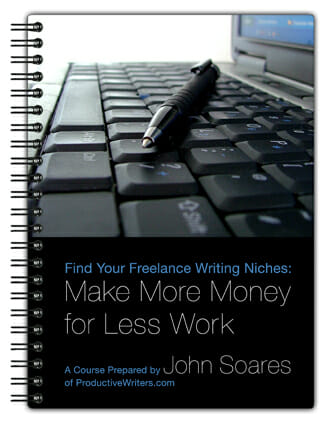
    Course: Find Your Freelance Writing Niches: Make More Money for Less Work

    About the creator: John Soares has been a full-time freelance writer since 1994. He is most known for ProductiveWriters.com, his main website for freelance writers, and his main niche is writing for higher education companies.

    Price: $20

    Who It’s For: New and seasoned freelance writers alike.

    What It Will Help You Do: The course explains why you should specialize, then guides you through the process of choosing niches that offer you the best chance of success.

    What’s Included: A three-part ebook and six exercises to help you implement what you learn.

    Part One (10 pages): Why You Should Specialize. This section examines all the advantages of being a specialist, plus looks at why most generalists don’t get paid as well as specialists do.

    Part Two (6 pages): How to Choose Your Niches. You get detailed guidance on how to mine your own experience and interests to find the niches likely to make you the most money.

    Part Three (9 pages): What to Do Now. This section helps you to develop a game plan to move forward once you’ve determined your niches.

    The Best Part: Doing the exercises forced me to go deeper and brainstorm some niche areas that I hadn’t considered before, like writing about parenting. I’ve got two toddlers and I’m not sure whom I consider an expert in parenting (therapists, pediatricians, etc.?), but I felt like I had to be one in order to write about it.

    I think it’s easy for writers to feel that way about subjects we’re interested in, but it doesn’t have to hold us back. I’ve started by writing (for free) for Liberating Working Moms and have some paid projects coming up talking about pregnancy, birth, infancy, etc. I think I limit myself more than anything!

    What Would Make It Even Better: There were a few instances where John said to “Google something” or go somewhere else for more information, but didn’t provide a link. A link as a starting point would be helpful, but I don’t like when I’m reading a book about how to do something and the author tells me to do more research; that’s why I’m here!

    He also refers to his “success resources page” quite a bit and tells the reader to go there for more information. Again, that’s why I bought this book.

    How It Changed My Life: As I alluded to above, I think the biggest growth I’ve had is in reevaluating my niches and the self-imposed limitations I’ve put on my writing subjects. Some of my niches were givens — for instance, my background is in personal finance, so it’s a natural fit.

    I also solidified several other niche options I hadn’t previously considered. Going forward, I plan to focus on finance, health and fitness, parenting and freelancing. Even though these are my “primary niches,” I’m not going to limit myself to only seeking out jobs in these areas. It is important to specialize, but it’s also important to stay open to learning new things and using different writing muscles.

    Our Recommendation: Overall, the course was a good read, priced right and would be great for a writer who feels lost when it comes to the niches he should focus on or which potential niches he should consider trying.

    This post contains affiliate links. That means if you purchase through our links, you’re supporting The Write Life — and we thank you for that!

  • Your Messy Desk is Hurting Your Writing Career. Here’s How to Declutter

    Your Messy Desk is Hurting Your Writing Career. Here’s How to Declutter

    Do you have a messy desk? It may be affecting your writing career!

    You want to write, but you can’t. It’s not writer’s block, a lack of ideas or a blank wall. Instead, it’s information overload with myriad to-dos fighting for precedence in your mind.

    You start to make a list, but your desk is a mess, with piles of papers (all important), post-it reminders (even more important) and books (most important of all) haphazardly stacked on every inch of space. How can you begin to work in this environment?

    Got a messy desk? What does your #writespace look like? Share a photo on Facebook, Twitter or Pinterest with the hashtag #writespace and tag us @thewritelife!

    Clutter’s effect on creativity and productivity

    Clutter makes it difficult to focus on one task or object, according to researchers at Princeton University’s Neuroscience Institute. Your brain has a limited ability to process information, so a disorganized work environment pulls your attention in different directions—and away from your writing.

    And it’s not just physical clutter; a digital build-up of emails and social media notifications can be just as bad for us, according to Mark Hurst in Bit Literacy: Productivity in the Age of Information and E-mail Overload.

    What does that mean for writers? Dividing your attention between several stimuli—like your novel’s plot hole, your messy desk and your Twitter feed—often results in increased stress and decreased creativity and productivity.

    Try these strategies to take control of the clutter and manage your writing space, both external and internal.

    Messy desk? Declutter your physical space

    Clearing the detritus from your workspace allows you to start fresh. Plus, getting up from your desk and moving around is a great break from work; who knows what new ideas you might inspire by getting your blood flowing?

    1. Clear your desk

    Here’s a quick way to clear your messy desk. Set a timer for five minutes. Take everything off your desk and from your drawers (except your computer or notebook and pen, of course). Put every other item in a box, out of sight. As you work for the next three days, if you need an item, bring it back to your desk.

    2. Organize your less-necessary items

    Anything left in the box after three days isn’t crucial. Go through it and sort the items into two piles: file or discard. Save the items you need, like receipts and invoices, but be tough on yourself. Do you really need those to-do lists from two months ago?

    3. Improve your storage system

    Where you keep your go-to objects is important, but only the ones you use the most should make it to your workspace.

    Place your most used items within reach for easy access, like in the top drawers of your desk or on a nearby shelf. Less-important tools should be out of sight and filed away. While your computer might live on top of your desk, your thesaurus might only come out during rewrites.

    4. Set yourself up for success each day

    Before you quit working at the end of the day, take a few minutes to set everything back in its place. This way, the next time you sit down in your clean, uncluttered space, you’ll be able to get right to work.

    Declutter your mental space

    Even the most spotless desk won’t help a busy, distracted or disorganized mind from focusing on writing. Try one of these strategies to clear your mind and help you get back to work.

    5. Journal

    It’s a popular option for a reason: journaling about what’s bothering you helps reorganize your thoughts. Whether it’s your novel’s plot, your personal life or the challenges of freelance life, writing your problem out will help make space for new approaches and solutions.

    6. Make a to-do list to clean up your messy desk

    Trying to remember everything you need to do in the next day or week isn’t conducive to doing quality work. Instead, follow productivity guru David Allen’s advice and write everything down.

    Create a system to manage your tasks and schedules so you stay organized—and can get back to work. Need help? Try one of these free tools and apps.

    7. Make a to-do-later list

    Don’t stop your writing session to research a quick fact for your story or find that link you want to include in your blog post. Instead, keep a running list of small tasks that come to mind while you’re working, but don’t interrupt your writing. You can always look up a tiny detail, like the price of the first iPhone, once you’ve written the rest of your article or chapter.

    7. Turn off notifications

    Anything that makes a noise or pops up is distracting. Turn off all notification signals while you write: put your phone on silent or Do Not Disturb mode, turn off email notifications and close or silence social media sites.

    8. Clear your inbox

    While you might not want to pursue Inbox Zero, purging your inbox of unread newsletters and messages helps restore a sense of control. Take 30 minutes to scan your emails and delete unnecessary ones.

    Maintain this change by unsubscribing from newsletter that are no longer relevant, or use a service like Unroll.me to bundle them into one scannable message.

    Enjoy your uncluttered writing space

    Putting these strategies to work doesn’t mean you’ll need to become Sam or Susie Spotless, magically organized and perfectly calm; as Mikael Cho points out in a post on Lifehacker, you want the space to feel like it’s yours.

    While clutter has been shown to negatively affect your performance, it is your perception of clutter that matters, not someone else’s. If having a notebook, pen, or a photo of your significant other on your desk, doesn’t feel like clutter to you, then it’s not.

    The key is simply to create more space, both external and internal, in your writing life—helping inspire new ideas, more creativity and better productivity.

    How does cleaning up your messy desk and decluttering your writing space help you? Share your thoughts and photos with the #writespace hashtag on Facebook, Twitter and Pinterest, and tag us @thewritelife!

  • How to Beat Writer’s Block: 5 Ways to Face the Blank Page

    How to Beat Writer’s Block: 5 Ways to Face the Blank Page

    Just as an artist wouldn’t be able to rework a blank canvas, a writer cannot edit a blank page. Making mistakes is part of the process; don’t smother your creativity out of fear and doubt.

    Everyone has ebbs and flows in their creativity. Just as bamboo is strong but bends and sways in the breeze, be flexible in your approach to writing, maintaining an awareness of where you are going and the flexibility of thought to follow wherever your creative process takes you, unencumbered by resistance or doubt.

    “The one thing that you have that nobody else has is you. Your voice, your mind, your story, your vision. So write and draw and build and play and dance and live as only you can,” author Neil Gaiman told The Guardian.

    If you struggle to overcome a fear of the blank page, take a deep breath and try one of these techniques.

    1. Take action

    For many, the blank page can be intimidating and overwhelming. Though just as when you worried about a monster in your closet as a child, to make the monster disappear, all you need to do is open the door.

    Similarly, “open the door” to your creativity by starting to write. The trick — as with honing every skill — is to practice.

    Don’t just plan to write — write. It is only by writing, not dreaming about it, that we develop our own style,” author PD James said, when asked for her favourite writing tips by Guardian Books.

    You wouldn’t trust a heart surgeon who has read books on how to operate, but never actually picked up a scalpel. Reading about writing craft is wonderful, but you also need to write — ideally, every day, even if it’s just for five minutes.

    [bctt tweet=”Reading about writing craft is wonderful, but you also need to write, says @WriterJoMalby“]

    “[The] Resistance knows that the longer we noodle around ‘getting ready,’ the more time and opportunity we’ll have to sabotage ourselves. Resistance loves it when we hesitate, when we over-prepare. The answer: plunge in,” author Steven Pressfield told Krista Stevens in this interview.

    2. Stick with the process

    Be prepared to tolerate the anxiety that comes with not being able to write as well as you’d like, and push through it. Suspending judgment when you’re writing frequently leads to unexpected creative gems.

    “That freedom opens you to the surprising stuff you never saw coming; stuff that makes you smile as you sit there in the coffee shop, your mug of joe cooling because you’ve forgotten to take a sip in 15 solid minutes,” says author and Contributing Editor at Writer’s Digest, Elizabeth Sims.

    “When beginning a writing session, new authors often feel that they must jump off to an excellent start, when all they really need is to start.”

    3. Be willing to write badly

    When we allow ourselves to let go of any preconceptions of what our writing should be, we loosen the creative faucet. Let go of your inner red pen and leave the editing until later.

    [Be] willing to write really badly. It won’t hurt you to do that. I think there is this fear of writing badly. Forget it! Let it float away and the good stuff follows,” says novelist Jennifer Egan in an interview with The Days of Yore.

    “The bad beginning is just something to build on. It’s no big deal. You have to give yourself permission to do that because you can’t expect to write regularly and always write well. That’s when people get into the habit of waiting for the good moments, where I think writer’s block comes from. Maybe good writing isn’t happening, but let some bad writing happen …

    “When I was writing “The Keep,” my writing was so terrible. My working title for that first draft was, A Short Bad Novel. I thought: “How can I disappoint?”

    4. Use freewriting to kickstart your creativity

    Many authors advocate freewriting as a wonderful way of coercing your creativity out of its shell — whether you believe in the idea of a writing muse or not.

    “I have forced myself to begin writing when I’ve been utterly exhausted, when I’ve felt my soul as thin as a playing card, when nothing has seemed worth enduring for another five minutes … and somehow the activity of writing changes everything,” author Joyce Carol Oates told The Paris Review in 1989.

    Whether you use a writing prompt, an image, or a line of text from a favourite book, set a timer, start writing and don’t stop until your time is up. The trick is to keep moving, even if you’re not sure what to say next.

    5. Remember to enjoy yourself

    When we feel barricaded in by deadlines or pressured by outside forces, it’s easy to forget the beauty, joy and fun of writing.

    “Have humility. Remember you don’t know the limits of your own abilities. Successful or not, if you keep pushing beyond yourself, you will enrich your own life — and maybe even please a few strangers,” AL Kennedy told The Guardian.

    Celebrate each writing accomplishment, whether it’s as large as finishing your first draft of a novel or as small as writing the first sentence. The more you enjoy your work, the easier it becomes to write the next sentence and tackle the next writing goal.

    How do you deal with blocked creativity and fear of the blank page?

  • How Your Miserable Day Job Can Help Launch Your Freelance Career

    How Your Miserable Day Job Can Help Launch Your Freelance Career

    Have you experienced this moment? It happens to nearly every independent and spirited writer stuck on the corporate ladder to make ends meet: the moment you’re sitting in your cubicle and the padded beige walls start closing in on you.

    You don’t think you can possibly muster the motivation to sit through one more pointless meeting, read one more unnecessary memo or answer one more stupid email. You feel miserable, uninspired and imprisoned.

    I’ve been there. As an aspiring freelance writer, I wanted to spend every second practicing my craft and seeing the full benefits of my talent and skills — something that was impossible for me to do while working for someone else.

    Eventually my pot of frustrations boiled over and I channeled the energy into motivation, replacing work I despised with a writing career I could love. If you’re feeling the same type of dissatisfaction at work, writing full-time is likely a career you’ve considered – but never had the motivation to start. Fortunately, your miserable job is exactly what you need to give you that final push in launching your freelance writing career.

    Turn your misery into determination

    Being miserable is a mind game. All that hashing and rehashing the things you hate about work adds up to a lot of wasted time and energy!

    Instead of dwelling on job frustrations, I used my misery as willpower to craft my writing business in the wee hours of the morning and motivate me when I encountered rejection or self doubt. My unhappiness with my job made me more determined to live life on my own terms, giving me a mission that no setback could derail.

    Stop pitying yourself and use your misery as fuel. When you catch yourself being negative about work, make a conscious decision to focus on the goals you’re working toward.

    [bctt tweet=”Turn your day job misery into determination, says @trendycheapo on @thewritelife”]

    Use your lunch break to work through your to-do list. Put sticky notes around your desk with motivational quotes on independence, freedom and success. Stay up late to work on your goals, even when you’d rather binge-watch Netflix. Hey, Leslie Knope and Alex Vause can’t save you from desk prison — you’re going to have to save yourself.

    Use your misery to help you make sacrifices

    Writers sacrifice a lot to start their businesses, especially financially. Launch-related costs like website hosting and design can be expensive, though you’ll probably want to bootstrap your business at first. Additionally, you’ll need a sizable emergency fund to support yourself during slower periods of work.

    Use your daily misery as a reminder to stay frugal. Save every last cent you can. Remind yourself that every unnecessary dollar spent is an unnecessary moment in misery. When you feel the urge to spend money, think back to your cubicle cell and remember you’re working towards a bigger purpose: freedom.

    Stop viewing your job as a roadblock and instead recognize its purpose: funding your personal startup.

    Let your misery push you out of your comfort zone

    Networking is essential for a writer, although it can be tough when you’re stuck at a horrible job. You might doubt yourself and feel insecure about what you have to offer others.

    Yet that misery is putting you in the perfect position to take networking risks. You have absolutely nothing to lose and everything to gain by going outside your comfort zone.

    Join a writing group and follow your niche’s leaders on Twitter. Write thoughtful comments, tweets and emails to get noticed. Print business cards and sign up for networking mixers in your area. And when you’re feeling awkward in the corner of a social event, remember that your ticket out of misery is simply making the right connections.

    Use your misery to push you to take the first step — and then the next

    Building a sustainable writing business is tough and takes a while, especially if you want to work full time. Sure, you may not be able to quit your job tomorrow or next month — it took me six months of planning — but focus on your unwavering desire to leave your job for the opportunity to live life your own way.

    If you put in your best effort, your last day at your miserable job will come sooner than you think.

    Image: Turn your misery into motivation

    Are you stuck in a day job, but planning to go freelance?

  • 7 Easy Things You Can Do Right Now to Get More Blog Traffic

    7 Easy Things You Can Do Right Now to Get More Blog Traffic

    This article is excerpted from Chuck’s book, Create Your Writer Platform.

    GIVEAWAY: Chuck is giving away a copy of his book, Create Your Writer Platform, to a random commenter. Comment within two weeks to enter! (Must live in US or Canada to win.) (Update: Williesha won!)

    So you’ve been blogging for a while, you post on a regular schedule for a budding readership, and you’re sharing valuable content. Now what?

    Once you have an established blog with consistent posts, it’s time to examine how to get maximum impact from your site. Make the most of the eyeballs that land on your blog to draw attention to your work. After all, the goal of blogging is to showcase your writing abilities and other services, right?

    Here are seven easy ways to make sure each of your posts gets as much exposure as possible.

    1. Don’t let readers get away easily

    Have links at the end of each post for related reading. If someone is reading your latest post called “How to Price Your Watercolor Paintings,” they obviously have some interest in the subject matter, so guide them to related content on your site to collect more page views.

    At the end of each post, point out and link to past posts on similar subject matter. The goal is to have a visitor bounce from post to post, ping-ponging around your site. The longer they stay and look around, the more they get to your know you, your ideas, your thoughts and your brand.

    Remember that it’s very tough to attract new readers. When one stops by, entice them to stay as long as possible.

    [bctt tweet=”It’s tough to attract new readers. Entice them to stick around, says @ChuckSambuchino”]

    2. Go back and optimize old posts

    When you’re several months in and are starting to get the hang of what works for your blog, you’re going to notice how messy and poor your old posts are. When you have blogging downtime, look through past posts and improve them.

    If there’s no image, add one. If there are no links at the end, include some. If you think a column could be even better with a simple sidebar, add it. There’s a good chance that your current posts have a newer, more visually pleasing format. Make sure to alter older posts to match this improved layout.

    3. While you’re at it, straight up recycle old posts

    It’s likely that some of your early blog writing is excellent, but virtually no eyes saw it because your site had little traffic. So feel free to recycle and reuse that content.

    One option is to repost the content at the top of your blog again. I’ve done this several times and called it a new series named “Blast From the Past.” You could also tweak an older column into a guest post for another site.

    [twl_reusable_block post_id=41455]

    4. Make your most popular posts easy to access

    If it’s possible and you have some impressive posts to share, think about listing your “greatest hits” down the side of your blog. That way, any new visitors can easily move through your best content and quickly see you’re an expert with great information.

    5. Invite quality guest content

    Why do you have to be the only one writing for your blog? Other writers who don’t have a blog of their own are looking for places to share their thoughts. Accept their quality posts with pleasure. It’s free content! You get to run it with hardly any work on your part, rather than composing another column of your own from scratch.

    Try to find a few recurring guest contributors who can consistently provide you with quality columns to run. The more content you have on the site, whether by you or others, the more you’ll turn up in Google search results and draw people to you.

    6. Speaking of Google, do yourself a huge favor and learn about SEO

    Go to Google right now and search for something — anything. Google will display the top 10 search results on the first page. But do you ever wonder why Google displays these 10 first rather than any of the thousands or millions of other results?

    The reason is called SEO: search engine optimization. Search engines such as Google are looking for different things when they report search results back to you. SEO is a vast topic, and plenty of it can get technical if you really want to dig deep, but here are three quick tips to getting more page views through search engines:

    a) Make sure you have a clear, straightforward headline rather than something generic or a pun. If your post is all about how to change a tire, simply call it “How to Change a Tire.” After all, isn’t that exactly what people will search for when they need help? If you title your post with a pun (“Tired Days Are Here Again!”), it’s no surprise that people won’t find it in a search. Consider which of these following two titles will get more hits: “Meet Mollie the Agent,” or “Literary Agent Interview: Mollie Glick of Foundry Literary.” Obviously the second one is a better choice because it contains more key terms people will use in their searches.

    b) Use keywords in your title, subheads and text. If people want to attend a writing event, imagine what they will search for when using Google: “writing conference,” “writing event,” “writing retreat,” “writer’s conference,” etc. The terms are all similar yet slightly different, so try to use as many as you can in your text. That way, Google will see you’re using a variety of relevant terms and process that your post is likely of value, moving it up in the results.

    c) Add images to your post. While they make a post look more pleasing to the eye, they also help with SEO.  For example, in a post on how to change a tire, titling the images How-to-Change-a-tire.jpg and Changing-a-tire-fast.jpg, adds more elements and words for Google to scan when it incorporates you into its results.

    7. Use numbers, subheads and bullet points

    Yes, you want your post to have great writing and provide value. But how you present said good material matters, too. People will have a greater impulsive desire to read your writing if you make it visually pleasing and present information in bite-sized, easy-to-process chunks.

    A quick, obvious tip is to use numbers. Everyone loves posts with numbers, such as “The 10 Best Quarterbacks of All Time” or “44 Crazy Facts About Disneyland.” If your post doesn’t have numbers, break up the text using subheads and bullet points to give people different places that they can jump to around the column. If your post is just one big block of text, then a reader who becomes disinterested will have no choice but to leave your site.

    Let us know in the comments: How do you help more readers see your blog posts?

    Don’t forget to comment to be in the running for Chuck’s book giveaway! You could win a free copy of his latest book, Create Your Writer Platform(Update: Williesha won!)

    Other TWL Guest Posts by Chuck Sambuchino:

    1. How Successful Authors Use Social Media to Sell More Books
    2. The One Big Reason Some Blogs Succeed, While Others Crash and Burn
    3. When Can You Call Yourself A Writer?
  • Make a Living as a Writer: A Simple Strategy That Works

    Make a Living as a Writer: A Simple Strategy That Works

    There is no one way to be a writer, you know. And there is no wrong way that will handicap you forever.

    Writers are usually thrilled at the beginning, eager to dive in and earn a living from their writing skills. Two weeks later, a niggling worry creeps in: how does someone earn a living doing this?

    How to earn money as a writer

    My career began with visions of a novel, a mystery I spent two years writing at night after work. When I could not land an agent, I tossed it on the shelf. However, the writing bug had bit me hard. I set out to write, come hell or high water, using whatever talents I had, for whoever would hire me.

    This mentality helped me develop a formula I use to organize and prioritize my writing work, making sure I maximize my earnings and challenge myself to connect with new markets and clients. Here’s how to put this formula to work for you.

    The 25/50/25 rule

    To make a decent living from your writing and make the most of your time, look at your clients and projects from a new angle. Break your work up into these categories: 25, 50 and another 25 percent blocks of your writing time. (Like this idea? Click to tweet it.)Here’s what that looks like:

    The first 25

    What can you write easily and earn a few dollars doing? The first 25 percent of the formula comprises these projects: the small magazine that loves local writers, the paid blog post, the filler piece, even the writing mill stuff.

    This sort of material isn’t great, but hey, it brings in a check, income you can bank on, as tiny as it may be. It validates you — you are indeed earning a living writing. We all like to succeed, and this is where you feel safe.

    However, you don’t want to get stuck in this rut. Limit this kind of work to 25 percent of your writing time to encourage yourself to stretch further.

    The 50

    These markets challenge your skills and experience. Whether you’re writing newsletters for area businesses, magazine articles, resumes, grants, white papers, or a company’s blog, you’ll figure out your sweet spot after a few months.

    Spend half your writing time seeking and performing for these markets, and expect to land about half the clients you pitch. These venues keep you on your writing game, they pay and many of them become returning clients and markets.

    The second 25

    These markets fall into the “almost impossible” category. You dream of breaking into these babies. You drool over those dollar per word pieces in glossy magazines. You’d love to be a regular blog contributor for a national site or the go-to person for a local business’ copywriting work. These markets scare you to pieces, and you feel you’ll never reach that bar.

    Keep seeking them: the more you study these opportunities, and the more you pitch them, the more you understand them. If you stick around long enough in this business, you’ll reach one. Then two.

    How to put the formula to work for you

    Make sure not to distort these percentages by second-guessing your abilities. There’s a reason for the 25/50/25 rule. It requires you to continually reach up, and as a result, your writing matures.

    Soon your markets in the 50 category are paying more than when you started. Your lower 25 consists of a higher-caliber stable of gigs. And that upper 25, your dream jobs, assumes an even higher status because what you used to put in that category is now in your 50.

    Apply the 25/50/25 rule to more than your markets. Use it for your advertising. Use it for time spent on social media. Use it for your speaking engagements, as I did, growing from online chats, to coffeehouse book clubs to conference keynotes.

    Or let your upper 25 consist of time on your novel, your highest level income dream. After four years of freelancing, I pulled my book off the shelf and dedicated my upper 25 to its future since I’d grown my lower 25 and my 50 to support myself. Lowcountry Bribe was ultimately published, the first in the Carolina Slade Mystery Series.

    Creating a writing business that supports you full time and earns a decent income will not happen overnight. It might take several years.

    But between the 25/50/25 rule and keeping 13 pitches in play at all times, you’ll find yourself earning a living at this craft. Be diligent, and you’re on your way to realizing your writing dreams.

    How do you divide your writing time?