Tag: getting started

  • How to Become a Foreign Correspondent: An Accidental Journalist Shares Her Story

    How to Become a Foreign Correspondent: An Accidental Journalist Shares Her Story

    I liked being in the know when it came to current events. I liked learning from others’ stories. I was competitive by nature, and plenty curious too. On top of all that, I even liked to write.

    Yet still, when I began my first job in journalism at age 22, copyediting a short-lived English-language business magazine in Egypt, I never thought that a career in media would stick. More so, it was an opportunity to make a few hundred dollars a month while learning Arabic and hanging out with friends at Cairo bars that overlooked the mighty (and quite dirty) Nile.

    “I like writing, but I definitely don’t want to be a REPORTER. You know, the sort of person who does interviews and goes to press conferences,” I wrote in a journal at the time.

    Fast forward five years, and now I have a book coming out about exactly that, my life as a foreign correspondent in a country I never dreamed that I would call home, Yemen.

    How did I become a freelance foreign correspondent?

    While there have been some hard knocks along the way, and there are parts of journalism I really — I mean really — don’t like, and I definitely have embarrassed myself in front of editors (“What’s a nut graf?” I once asked the foreign editor of the San Francisco Chronicle during a phone conversation), I wouldn’t trade in this life for anything else.

    That’s what being a freelance foreign correspondent-turned-author has become: a life. It’s far from a 9-5. It’s all-encompassing, and in the end it was exactly what I wanted.

    Furthermore, it wasn’t as hard as one might think to get here. At least not conventionally difficult. Living in a place with scant electricity while trying to file stories for the New York Times, that was hard, but getting the gig wasn’t.

    Learning the tricks of the trade

    After I began the job copyediting at the magazine in Cairo, I was speaking with a friend of a friend at a party late one night over a bottle of duty-free Jameson.

    “You speak Arabic. You’re young. You should do it! Why not?” he encouraged. This twenty-something American, Steve, was a freelance correspondent who wrote for publications like the Christian Science Monitor. He was moving back to the States shortly and thus, he said, was happy to tell me the tricks of the trade. I emailed him the next day, pushing past my defeating headache, and asked if we could meet for coffee.

    That’s when Steve taught me how to pitch a story. All I needed was a good idea and the ability to write, he told me. That’s it. I didn’t need to go to journalism school — though he had — and I didn’t need any fancy accreditations.

    Notably, the fact that we were abroad made my start in journalism all the more possible. The playing field was smaller. That’s why when new graduates ask me how to start a career in journalism, I often tell them to move abroad and find a job at local English-language press, because I know if they are savvy enough, they’ll figure it out from there.

    [bctt tweet=”Want to be a journalist? Move abroad and work for English-language media, says @kasinof”]

    Turning ideas into action

    Back in Cairo at 22, I didn’t think following Steve’s advice would be easy, but it was. I was full of ideas.

    What was interesting about life in Egypt? That Egyptian young people were using Facebook to organize politically in a country where other avenues for freedom of expression were cut off. Another: that Iraqi refugees who worked for the U.S. military during the invasion were now being denied resettlement to the US.

    Making my own lucky break

    I can’t say that I am very proud of my clunky writing from those years, but I was trying. I called editors and bugged them and forced them to listen to me.  Most important of all, every time I crossed paths with a real foreign correspondent, someone established, I showed them I was eager to learn. Occasionally, one of those people would help me.

    That’s how I was connected with the New York Times. A friend in Cairo introduced me to the Times’ Cairo bureau chief. Two years later, he would let me do some work for him. I sat in the paper’s small apartment-turned-office on a tree-lined street in the neighborhood of Zamalek, saw my byline in the New York Times and didn’t believe my eyes.

    Then I moved to Yemen, and then the Arab Spring started. Protests and hope from the Middle East filled the media, but so did violence. The learning curve skyrocketed. I learned about reporting because reporting for the Times was such a serious endeavor. I learned about how humans behave in conflict, and I learned how to weasel my way into interviews with government officials.

    My best advice for aspiring journalists

    When new journalism graduates come to me for advice, they’ll often ask: “How will I know if I have what it takes?”

    The most important thing for someone who is trying to start a career in journalism,” I’ll tell them (and this advice holds true for anyone who wants to be a writer) “is to not be afraid of failure.” Listening to fear when I was in a conflict zone in Yemen was wise. But letting it prohibit me from putting my all into my writing? Never.

    Have you ever dreamed of working as a foreign correspondent?

    If you’re exploring other writing careers, check out this article to find more options to get paid as a writer.

    Perhaps this quiz can help you decide.

  • 9 Powerful Tips for Writing Your First Successful Ebook

    9 Powerful Tips for Writing Your First Successful Ebook

    Ebooks can be life-changing. If you want a steady stream of side income or you’re eager to take the first big step in your career as a writer, writing an ebook is a great place to begin.

    Lots of writers (and would-be writers) recognize that, but have yet to get started on their own ebook. Perhaps you’re one of them: you’re not sure where to begin, or you’re worried about how you’ll find the time.

    I’ve been writing and publishing ebooks — for myself and for clients – since 2008, and I’ve helped lots of writers get their own ebooks finished. I’m focusing here on nonfiction ebooks, but many of the tips will also work for fiction writers.

    These nine tips will help you come up with a great idea, do your research, and get your first draft written.

    TABLE OF CONTENTS

    1. Choose a Topic
    2. Identify Your Unique Expertise
    3. Survey Your Audience
    4. Allocate Time for Research
    5. Read Similar Books
    6. Fact Check
    7. Develop a Full Outline
    8. Write Distraction-Free
    9. Prepare to Sell/Market Your Book
    writing an ebook

    9 Tips for Writing an Ebook for the First Time

    The biggest mistake new writers make when figuring out how to write an ebook is picking an idea they think is good, without exploring whether there’s actually a market for that topic.

    Tip 1: Choose a Topic

    Some topics might sound like great possibilities because you know there’s a big market out there. But don’t decide to write a “dieting book” or “self-help book” (or any other type of book) just because you think it will make money. You may find that the market is saturated, and only established big names are currently selling well.

    Instead, choose a topic that (a) you already know a lot about and (b) you’ll enjoy writing about. This saves you doing lots of research just to get up to speed, and it substantially increases the chance that you’ll see your ebook through to a final draft.

    Tip 2: Identify Your Unique Expertise

    If you’re not sure what your specialist topics are, take a look at your magazine subscriptions or the blogs that you visit frequently. These should give you some clues!

    Once you’ve settled on a topic, dig deeper into these resources. You’ll probably find certain articles crop up again and again (with a different spin each time); these indicate perennially popular topics, and the core idea they cover could be a great topic for an ebook.

    Tip 3: Survey Your Audience

    If you’ve got a blog or an email newsletter, then you’re well ahead in the ebook game. You not only have a ready-made audience for your work, you also have a great source of ideas.

    Two simple ways to do this:

    • Come up with three to seven possible ebook titles or topics, and survey your audience to find out which they prefer. SurveyMonkey is great for this or even a Google Form.
    • Go through comments or emails you’ve received. What questions or problems crop up again and again? Could you write an ebook addressing those?

    Tip 4: Allocate Time for Research

    Many writers find it’s easy to get stuck at the research stage, gathering more and more articles and resources, thumbing through books again and again, jotting down great quotes, facts and references.

    Avoid this by giving yourself a limited amount of time for research. That could mean setting aside, say, two weeks purely for research before you begin writing, or researching for a certain length of time as you come to each new chapter of your ebook.

    Tip 5: Read Similar Books

    This may sound obvious, but some writers are overly reliant on blog posts and articles, and don’t necessarily turn to other (e)books. Whatever your topic, it’s likely you’ll be able to find some similar books and ebooks. If you can’t, you may have to consider whether it’s too obscure to focus on.

    You won’t need to read every word of every book you choose; instead, use the table of contents or index to help you find the parts most relevant to you. These can also help throw up extra ideas on aspects of the topic you might not have considered yet.

    Tip 6: Fact Check

    If your particular topic area has a few oft-quoted facts or statistics, it can be tempting to repeat these without double-checking them. Be careful, though: other authors won’t necessarily have verified the facts themselves.

    Between 2008 and 2011, I wrote a lot of material for personal development and self-improvement blogs. One popular “fact” in this area is about the “Harvard Goal Study.”

    One excellent blogger in the area, though, debunked this in a post Writing Down Your Goals — The Harvard Written Goal Study. Fact or Fiction? This helped open my eyes to the sad truth that some authors make up facts and statistics to suit them, so you do need to look for original studies, government publications, and other reputable sources of information where possible.

    If you come across something presented as fact which seems odd or hard to believe, Snopes.com is a great place to turn for an initial check.

    Tip 7: Develop a Full Outline

    One of the simplest ways to make writing easier is to have a clear outline before you begin. Otherwise, it’s easy to get stuck a couple of chapters into your ebook.

    Your outline should include, at the very least:

    • A title for each chapter. Don’t spend too long agonizing over the exact wording at this stage. It’s usually better to have, say, 15 short chapters instead of five long ones. If your ebook deals with a broad topic, it may also be appropriate to also split it into three to five different parts.
    • Subheadings or subsections for each chapter, with a list of points detailing information you want to cover. You could produce this as a linear list, or you could create a mind-map to help you come up with new ideas and link them in different ways.

    Tip 8: Write Distraction-Free

    For most people, writing is a demanding, high-energy task, and it’s often easy to give in to distractions.

    Don’t put temptation in your path: create a distraction-free environment by using a program that allows for full-screen writing, like Dark Room, Write Room, or Scrivener. Turn off your phone. Sign out of your email account, Facebook, Twitter, Skype, and anything else that might make sounds or pop alerts up on your screen.

    Set yourself up for success by creating an environment that supports your goals.

    Tip 9: Prepare to Sell/Market Your Book

    Once the writing is done comes the hard part: selling and marketing your book! Check out our list of resources for doing just that:

    writing an ebook

    If you’ve got any tips of your own to share about how to write an ebook, or any questions about the ebook-writing process, just pop a comment below.

    This is an updated version of a story that was previously published. We update our posts as often as possible to ensure they’re useful for our readers.

    This post contains affiliate links. That means if you purchase through our links, you’re supporting The Write Life — and we thank you for that!

    Photo via G-Stock Studio / Shutterstock 

  • The 17 Best Writer Websites to Inspire Your Portfolio

    The 17 Best Writer Websites to Inspire Your Portfolio

    Your online portfolio is the portal through which both clients and readers learn about you and your work — and one of the best ways to land writing jobs.

    That means that, for many of us, creating a writer website is hugely intimidating. I put off creating a writer website for months simply because I didn’t know how I wanted to put it together.

    Luckily, you have options. There are as many types of writer websites as there are writers, and you don’t have to make your writer website fit any kind of preconceived template or mold.

    Instead, use your online portfolio to reflect what makes you unique as a writer, and what you have to share with clients, readers and fans.

    [sps_reusable_block post_id=43047]

    Need inspiration? Check out these online portfolio examples

    Don’t make the mistake of thinking that creating your online portfolio has to be a massive project. We’ve showcased lots of portfolio websites that make it easy for you.

    But before you build your own, we’ve got some inspiration to get you started! We found some solid writer websites to share, each with a unique focus and design.

    Here are 17 online portfolio examples.

    1. Elna Cain

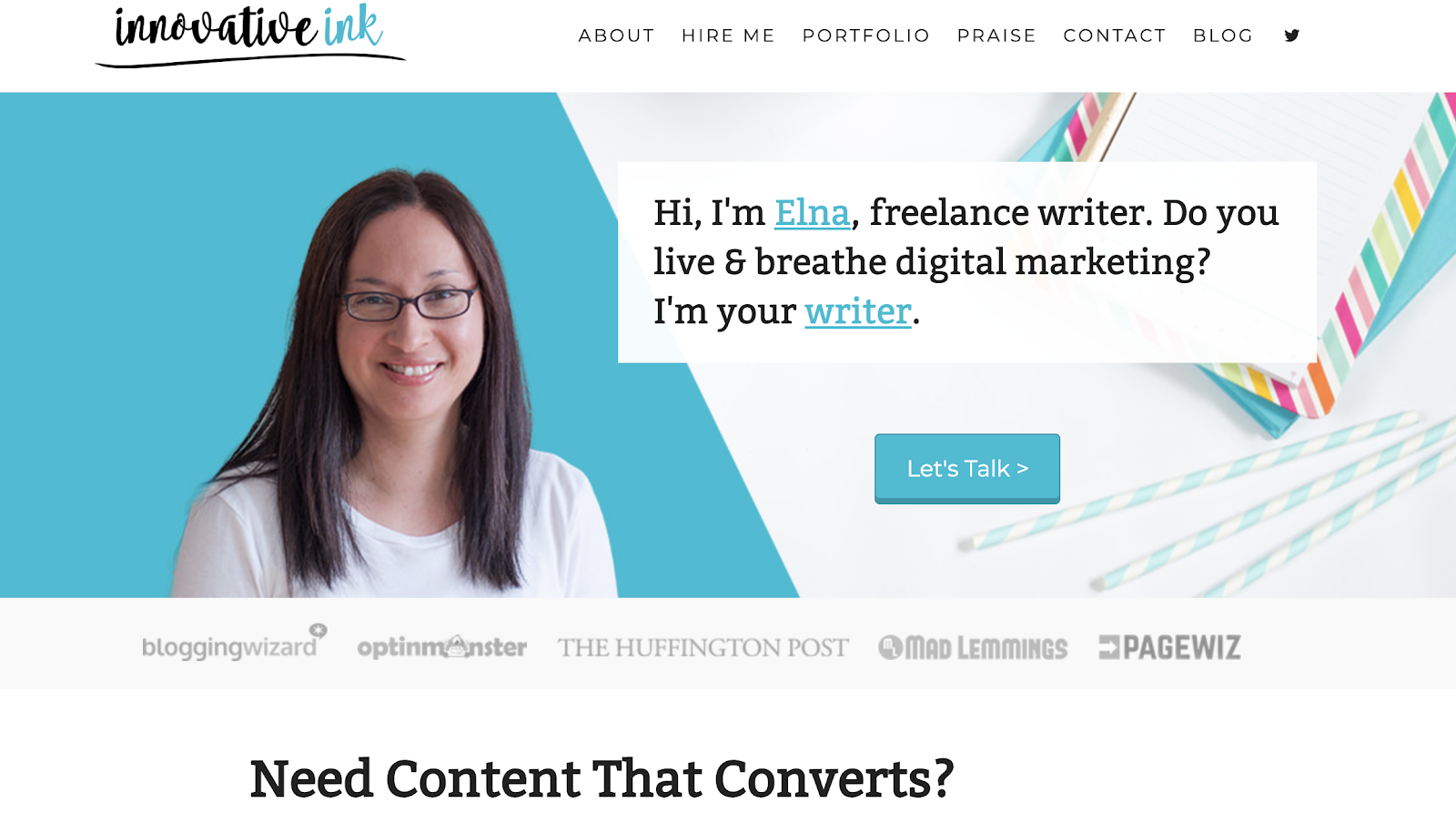
    Elna Cain’s writer website is bold, partly because she blatantly tells you she’s the freelance writer your business or project needs. To further convince you, a row of prominent publications are listed right above her introduction — that’s where she confidently states the problem clients have and how her skills can it. Then, the page ends with glowing client remarks. 

    Elna’s online portfolio shares a variety of ways to get in touch with her for business opportunities and how to keep up with her work online. To assert her expertise in the field, Elna also links her popular blog that’s filled with tips on how to make money with writing. 

    2. Manjula Martin

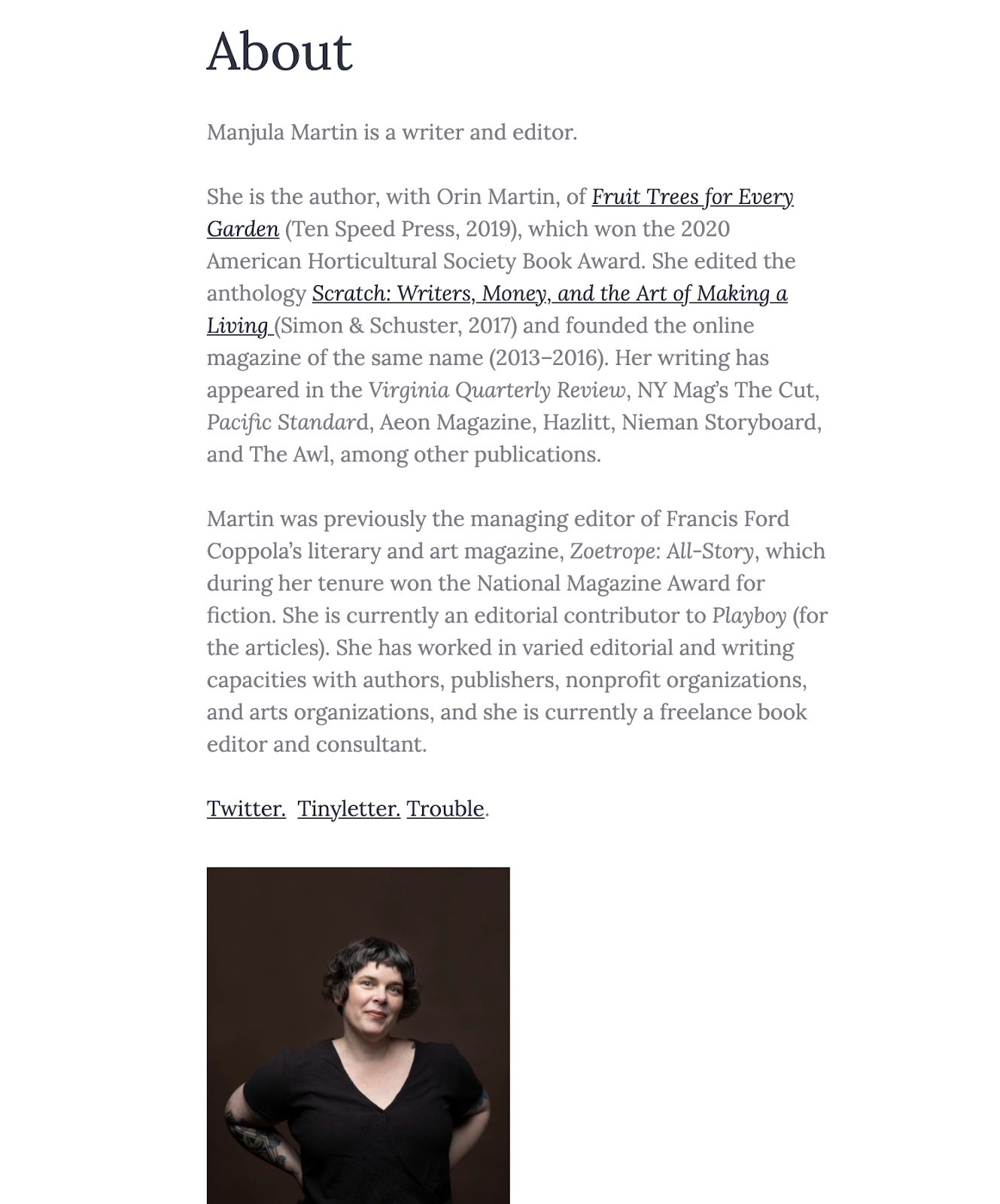
    Manjula Martin’s site is a great example of a basic, straightforward online portfolio: a brief introduction with her resume highlights front-and-center, and lots of links to connect people who want to learn more. She built it on WordPress.

    Manjula’s website works because you learn everything you need to know about her credentials and writing style at a single glance. It’s easy to follow the links and read her clips, and she also gives you many ways to contact her with writing or consulting opportunities.

    3. Ann Friedman

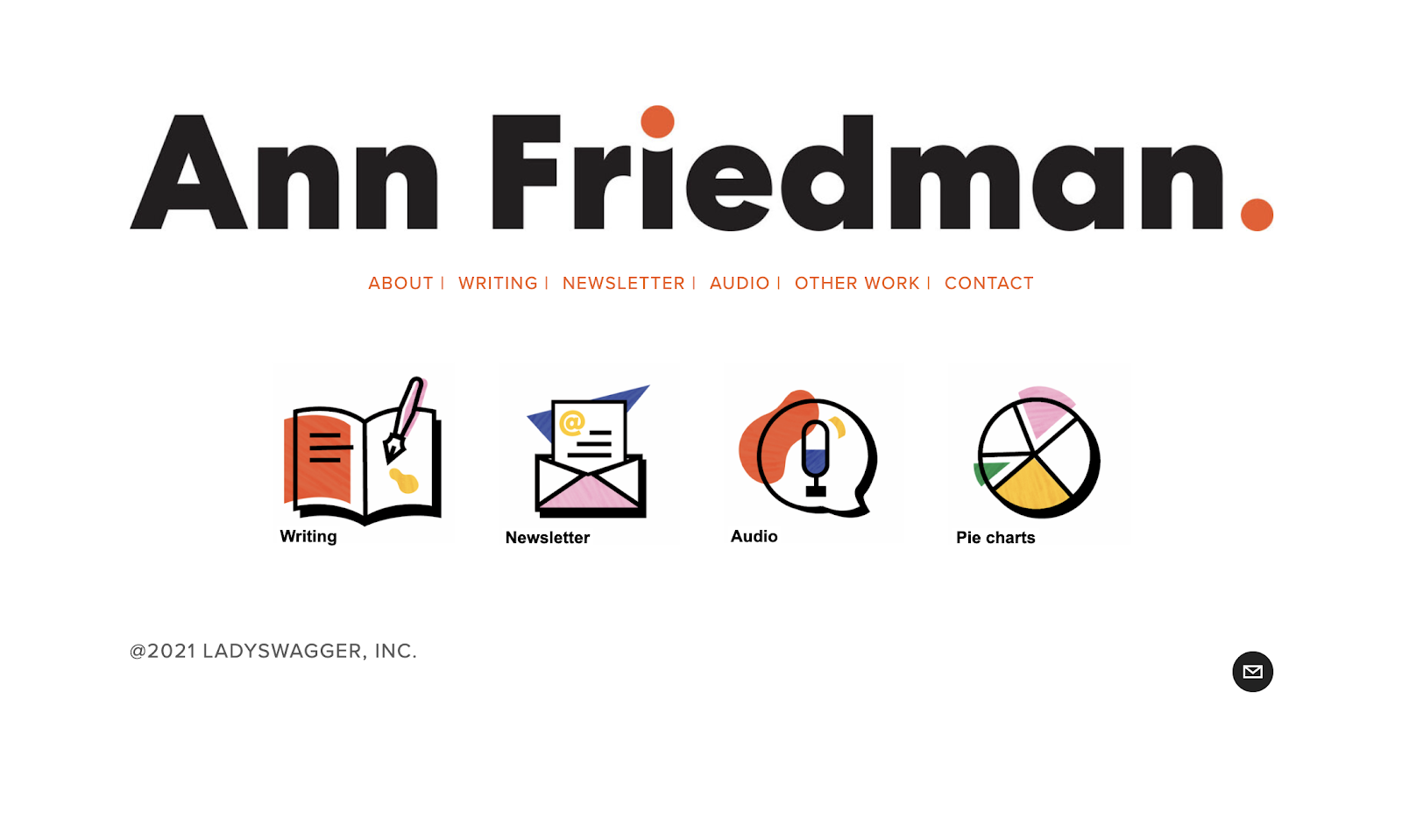
    The first thing you notice on Ann Friedman’s website is how it brightly displays her logo, followed by a row of links to her completed work, newsletter and contact information. Talk about a simple and beautiful landing page! 

    The rest of this writer website contains plenty of unique touches: a general FAQ plus one for her newsletter; a page of various creators, content and organizations she recommends; a thorough contact page; and creatively-titled side work that highlights even more skills beyond her stellar portfolio of work for tons of household brands. There’s no question about who Anne is, the service she provides and how to reach her — this is the goal for all writer websites. 

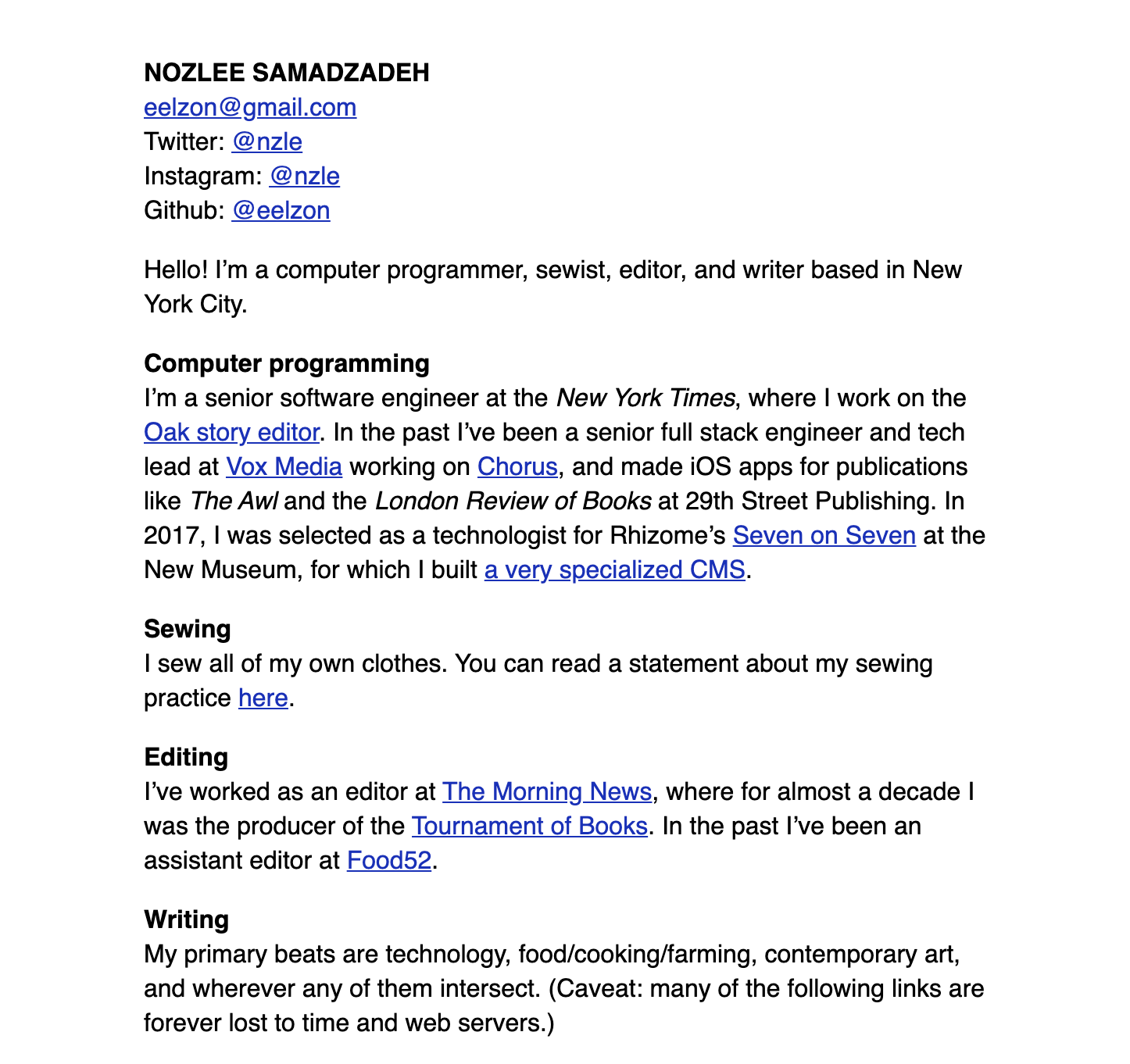
    4. Nozlee Samadzadeh

    It’s possible to create an extremely compelling writer website without a single photo, logo, or image. Nozlee Samadzadeh’s site lists her contact information, concise explanations for her professional experience, and links to her publications, all on a single page.

    Nozlee’s site also includes a short statement of her “primary beats,” which is key info for anyone looking to hire her for a writing job.

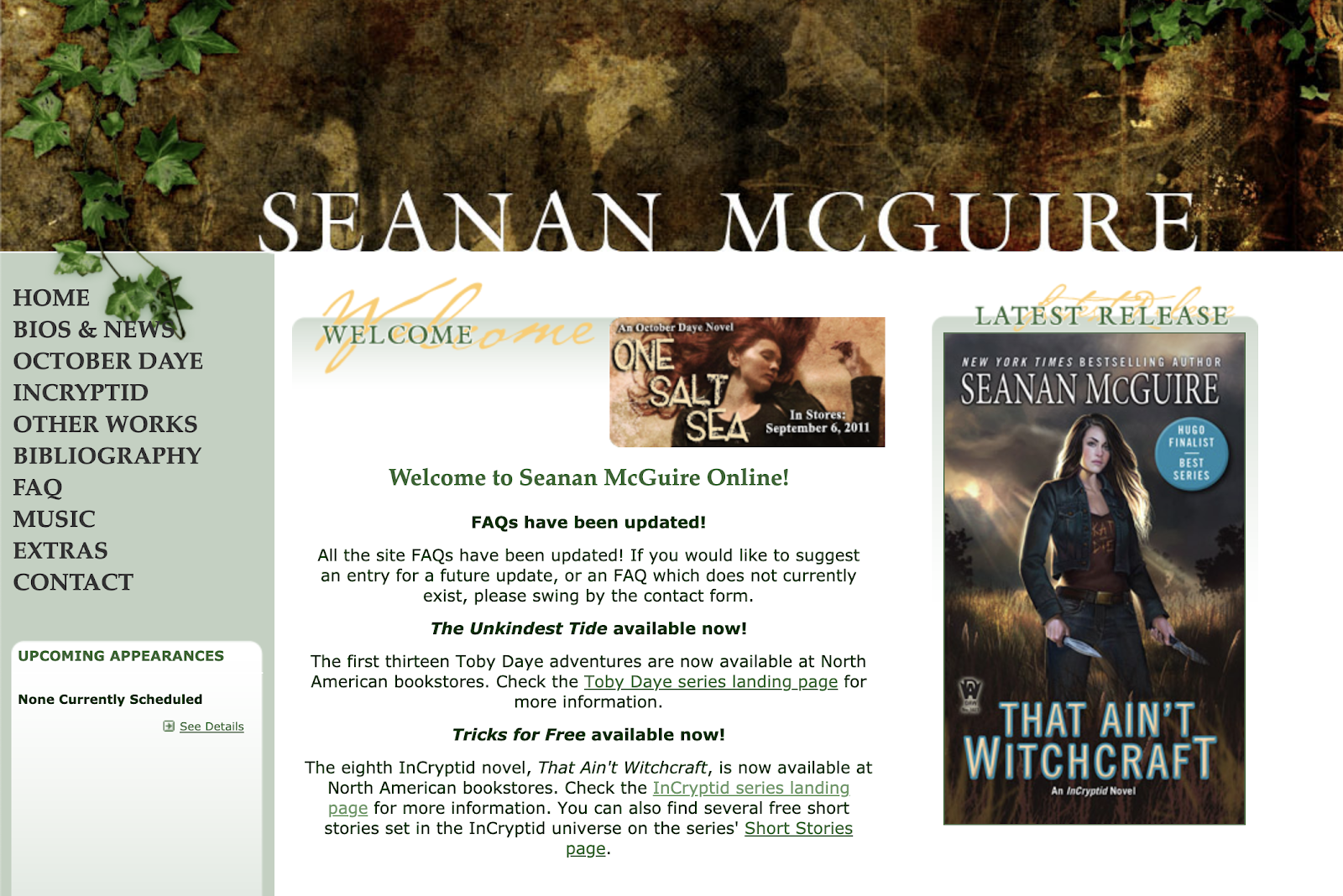
    5. Seanan McGuire

    Seanan McGuire’s writer website instantly immerses you into her urban fantasy world. Her latest release is prominently featured, and the header image and colors help establish her genre to new visitors. The left-hand navigational column provides easy access to important information.

    If you write fiction, especially genre fiction, let your writer website reflect your fictional worlds. Open the door to your fiction by giving readers the chance to see what might be hidden within the pages.

    6. Francesca Nicasio

    Copywriter Francesca Nicasio’s writer website aptly showcases her expertise in writing B2B content around retail, eCommerce, technology, and more. The entire website is structured around one goal: informing readers about her capabilities the very moment they get to her site. 

    What’s the goal of your writer website? Are your skills and services clearly explained?  When users visit your site, do they know what to do if they want to work with you? With her email address displayed largely on the front page, Francesca makes it easy for clients to get in touch with her. Your writer website should do the same.

    [sps_reusable_block post_id=43047]

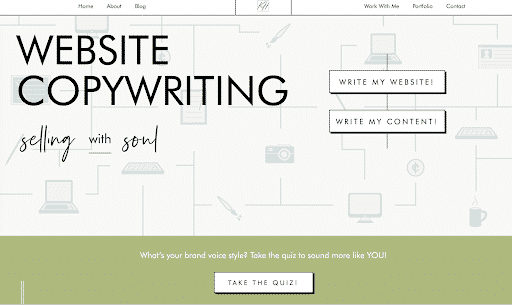
    7. Kayla Hollatz

    “Inviting” is the best way to describe Kayla Hollatz’s writer website. The big, bold words that immediately greet you are enticing enough to make you want to keep exploring her trendy online portfolio. And without needing to scroll too far, Kayla’s concise and effective introduction appears, placed evenly below a prompt to take her brand style quiz. 

    Wherever you go, Kayla’s writer website accomplishes one major thing: She pulls you in by subtly emphasizing her savviness. From spelling out the details of how you’ll work together to sharing impressive client success rates, it’s evident  this writer knows her stuff — and she wants you to learn it, too, hence her quiz and email course. 

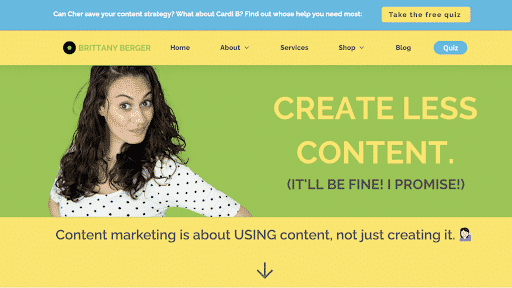
    8. Brittany Berger

    How often are you intrigued by an unpopular opinion? Probably almost always, because, well, you just have to find out how you could possibly be on the wrong side of the truth. That’s what’s awesome about Brittany Berger’s approach to her writer website — she offers a solution most companies think is the problem. 

    Her conversational tone guides you into understanding her logic, and she offers a number of valuable resources to help you learn about being mindful about content creation, and how to be more productive as you do. 

    She created her website on WordPress.

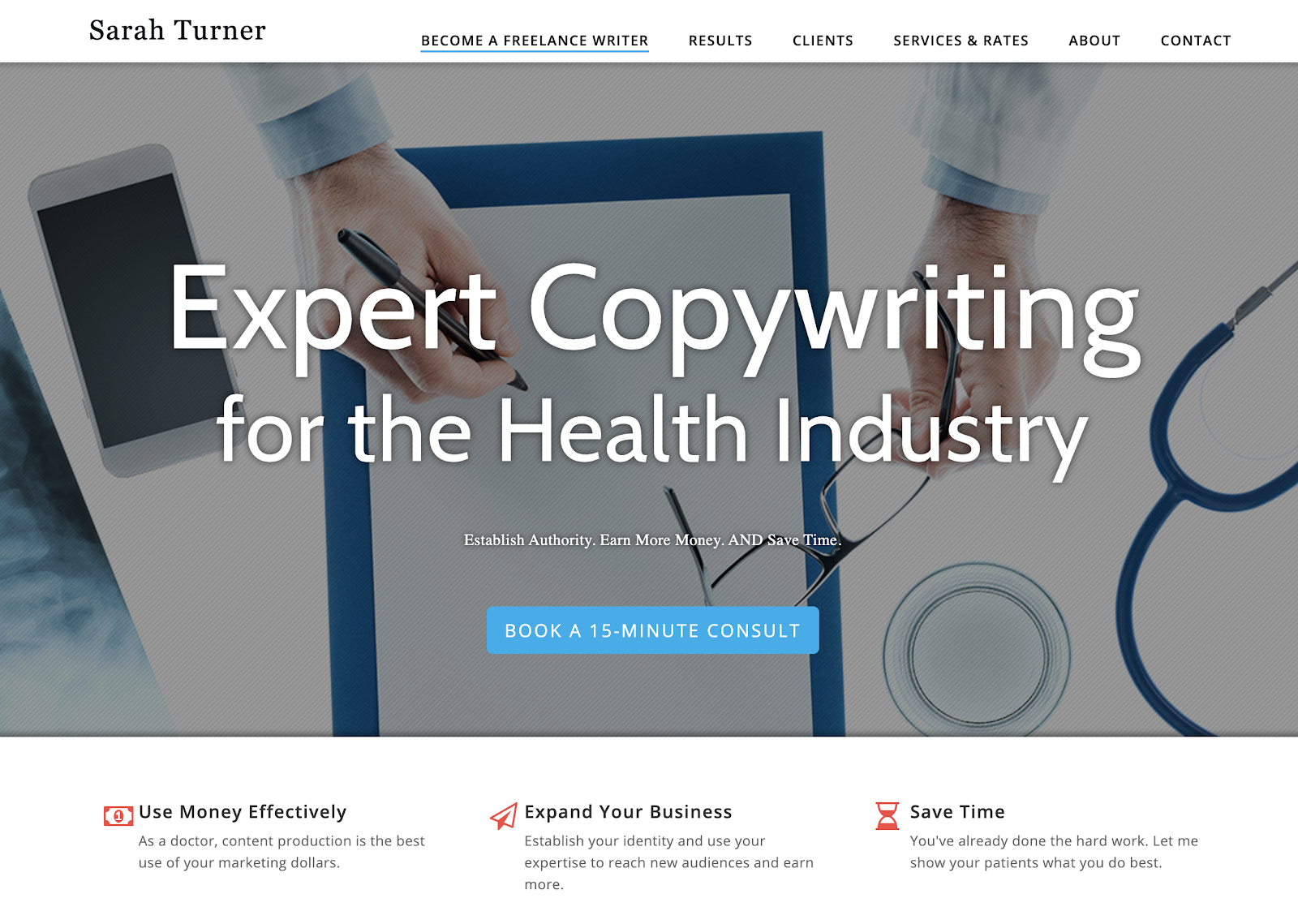
    9. Sarah Turner

    Sarah Turner’s writer website is one of those slick, beautifully designed sites that intimidate the rest of us. It’s the type of site that looks like it requires the assistance of a web designer, which means it’s aspirational for a lot of us, especially those of us who are just getting started as freelancers. In actuality, Sarah’s website was created with the help of WordPress and Themely. 

    However, design isn’t the only aspect that makes Sarah’s writer website great. Her opening sentence clearly highlights her writing niche, how she can use her skills to improve your business in the health industry — the key goal of any resume or website — and includes a direct call to action. 

    You can include a similar paragraph and call to action on your own writer website; no design firm required.

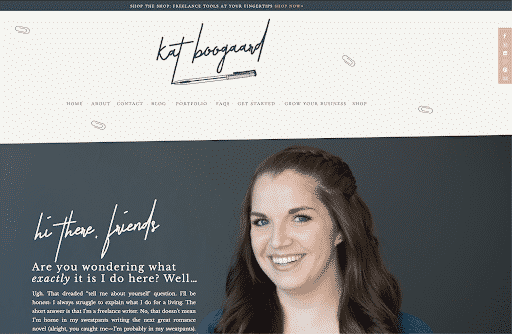
    10. Kat Boogaard

    Freelance writer Kat Boogaard leads with an authentic and friendly voice on her writer website — one that makes you feel like you’ll hit it off with her right away. Amid a fresh and sleek design filled with calming neutral colors, she shares brief paragraphs about who she is, what she writes for clients and how she can help freelance writers grow their businesses.

    Kat’s conveniently-placed menu at the top and bottom of her website is easy to navigate, but one thing I love about her website is how you can find your way around her site without it. As you scroll through the homepage, you’ll find that she takes you from one valuable resource to the next, all without making you feel bombarded. 

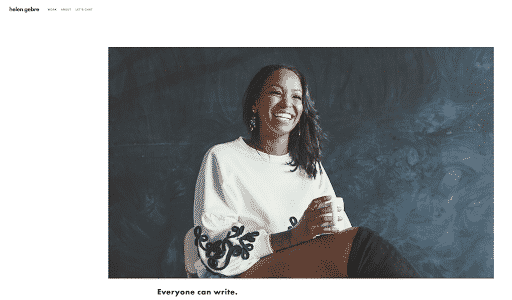
    11. Helen Gebre

    This writer website gets one important thing down pat: You can feel how much Helen Gebre loves the art of writing. She also does this very simply, through an introduction and biography that gives you a glimpse into her personal life, her career and why she does this work. 

    Helen’s website design is simple, likely because she has a diverse portfolio featuring big and bold copywriting decks that span across print and digital writing, social media, video scripts and more. Besides a contact page, she also cleverly set up her phone number as the footer on each page — that way, clients viewing her page know how to reach her immediately. 

    12. Chidinma Nnamani

    Clients visiting B2B writer Chidinma Nnamani’s page learn right away what her expertise is. Throughout her writer website that she designed with WordPress and Elementor, she clearly articulates her skill and experience with B2B writing for the tech, food and digital marketing industries. 

    Besides a clean website design that reflects Chidinma’s design aptitude, her inclusion of a robust services page and a page that details her four-step process for working relationships provide a peek into her professionalism and organizational skills. One more thing to note from this writer website? The frequent “Ready to hire me?” prompts displayed throughout the site! 

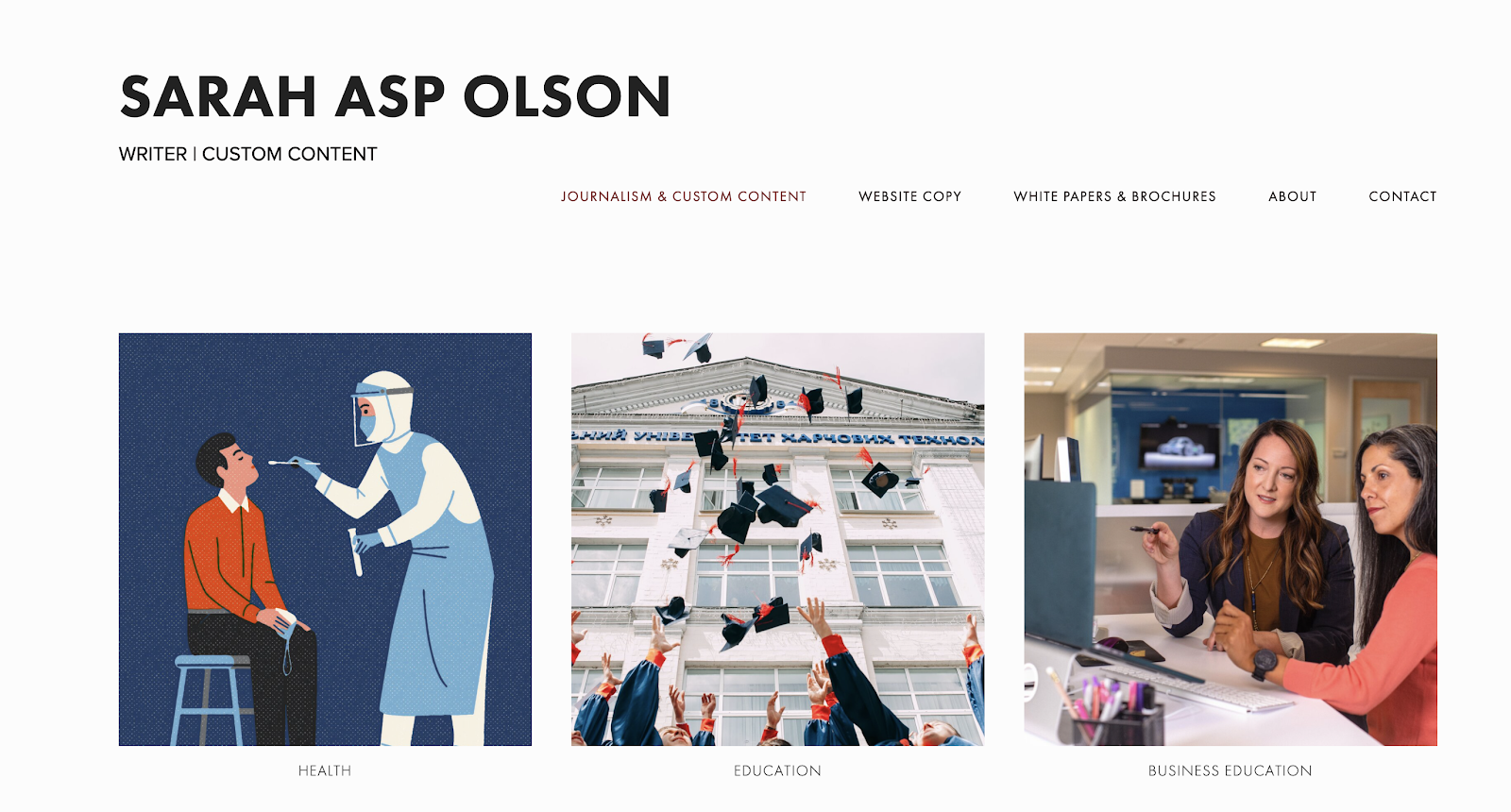
    13. Sarah Asp Olson

    Before you learn about this writer, you first take a tour of her impressive writing clips, which progressively leads you to where you can learn more about and reach out to her. 

    One of the best parts of designing your writer website is all the creative ways you can display your work. Each website on our list brings their own flair to their portfolio, and Sarah Asp Olson is no exception in the way her site only features the content she’s created. Like she does, you can use bright, colorful images that capture the eye to separate the industries you write for. Then, display your samples in bulleted lists, or in rows of hyperlinked thumbnails.

    Remember there are no rules to how you organize your work — just ensure it’s clear, and easy to navigate.

    14. Samar Owais

    What should people learn about you as soon as they visit your writer website? For writer Samar Owais, potential clients find out immediately she can increase conversions and boost sales — and her speedy acknowledgement of these skills and her niche can make a difference in how quickly visitors leave her site. 

    Throughout her writer website, Samar features client testimonials and a valuable email marketing quiz. Additionally, she makes her expertise clear through brief, compelling descriptions that outline how she solves conversion issues as an email conversion strategist and SaaS copywriter. And if anyone wonders why they should work with her, she makes convincing arguments for that, too. 

    15. Muriel Vega

    Don’t you just want to click those icons? That’s the power of color and fun design animation! Atlanta-based writer and editor Muriel Vega’s writer website has a simple design layout, but that doesn’t stop the sense of her personality from seeping through as you learn about her through projects and writing samples. 

    This site is a great reminder that you don’t have to overwhelm your writer website to make an impact — consider who you want to attract, and incorporate engaging design elements that reflect your creativity.

    16. Tyler Koenig

    Copywriting expert Tyler Koenig has a writer website that feels extremely confident and laid-back. Within a well-designed website that tastefully centers the color orange (maybe for basketball?), Tyler provides heaps of value through his email list, webinars, courses and free tips through his blog. 

    “Become your own most trusted copywriter,” he writes on the landing page of his self-paced copywriting courses, which successfully expresses his earnest desire to share his passion to help others grow. Besides that, providing free and paid resources truly highlights your expertise to prospects.

    17. Nicole Dieker (yes, that’s me!)

    My writer website serves two purposes: It’s a place where people can learn more about my freelance and teaching work, and it’s also a blog that focuses on the art and finances of a creative career. I include “where I got published this week” roundups every Friday and finance roundups on the first of every month, along with daily insights on work-life balance, how to earn money for your creative work, the process of writing a novel and more. I also pay writers for guest posts, so pitch me!

    I set up my site through WordPress using a pre-designed template.

    Do you have a writer website you’re proud of, or are you working on one now? Share your experience with us in the comments!

    This is an updated version of a story that was previously published. We update our posts as often as possible to ensure they’re useful for our readers.

    Photo via Zofot/ Shutterstock 

    [sps_reusable_block post_id=43047]

  • How to Write an Invoice in 11 Steps, Plus an Invoice Example

    How to Write an Invoice in 11 Steps, Plus an Invoice Example

    [lwptoc]

    For any type of business to succeed, you have to get paid.

    Whether you do one freelance gig a month or run a full-time writing business, you need to figure out how much your clients owe you and send them a bill. Many companies don’t even think about paying a freelancer until they have an invoice in hand.

    That means you need to know how to write an invoice.

    But where do you start? How do you create a professional-looking bill? How and when do you send it to your client?

    In this post, we’ll explain all the basics behind how to write an invoice. We’ll start off by showing you an invoice example, so you can visualize how all the elements come together. Then we’ll dig into those components, explaining what to include in your invoice. Finally, we’ll discuss how and when to send your invoice.

    If you plan to invoice clients regularly, it’s smart to invest in an invoice generator, so we’ll review your options for those, too.

    Let’s get started with our invoice example.

    How to write an invoice — An example

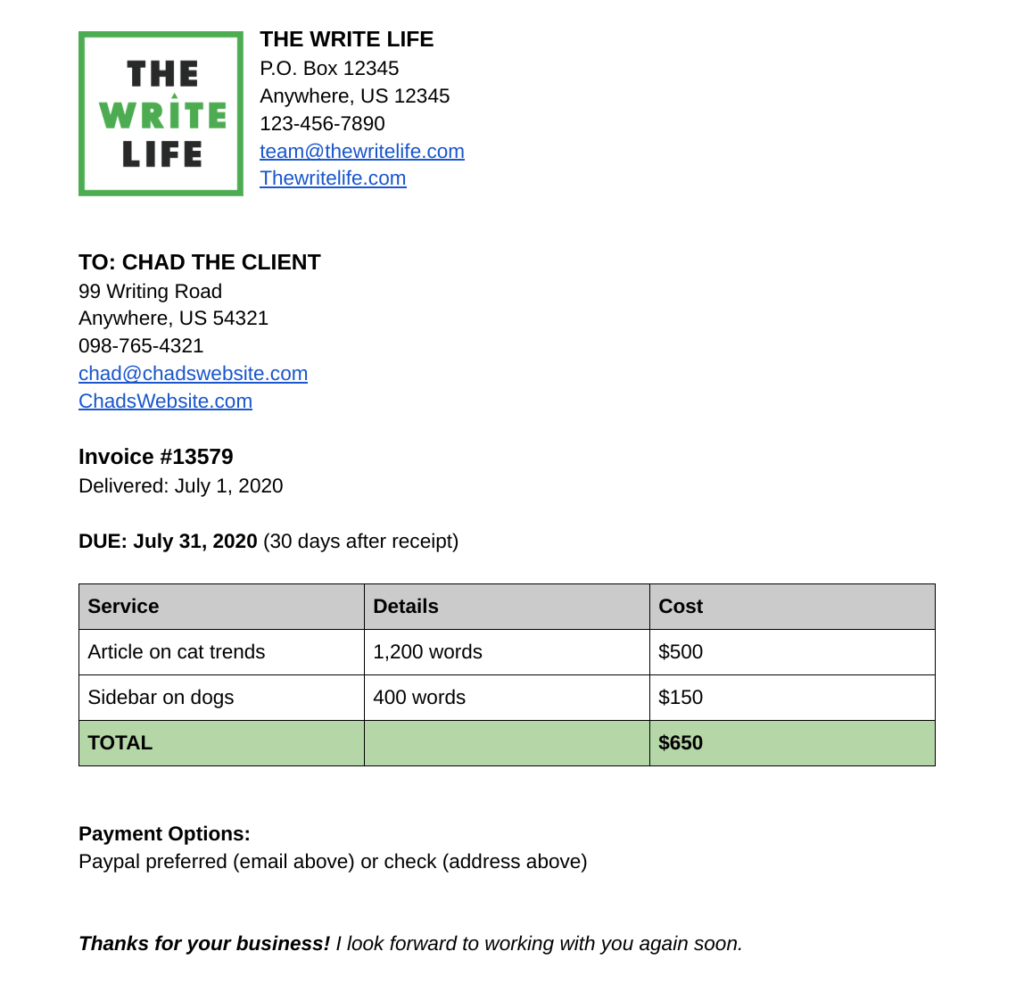
    Here’s a sample invoice that includes all of the elements we’ll detail throughout this post.

    For a downloadable PDF to use as an example, just click on the image.

    We made this sample invoice simple on purpose. You don’t need a fancy invoice, you just need to include all the right information!

    how to write an invoice

    How to make an invoice: Here’s what it should include

    Look, we know it can be daunting to send your first invoice, especially when you want to look professional.

    But you’ve already done the work for your client, and that’s the hardest part! If you’re at the point where you’re creating an invoice, you’ve already figured out how to become a freelance writer.

    Plus, as we saw above with the invoice sample, your invoice doesn’t have to be fancy. It just has to be professional-looking and do the job.

    When you’re learning how to write an invoice, here’s what to include.

    1. A professional header

    The first item on your freelance invoice should be your business name or your full name, in professional and easy-to-read font.

    If you have a logo for your business, include that as part of the header. But don’t worry, you don’t need a logo; you can also just write your name in text. Whether you use a logo or text, the font size of your name or business should be a little bigger than the rest of the text on the invoice, and bolded for emphasis.

    2. Your contact information

    Next you’ll want to include your contact information.

    At the very least, this includes your mailing address, phone number, email address and website, right underneath your business name. To make it easier to read, consider typing the info on several lines like this:

    The Write Life
    P.O. Box 12345
    Anywhere, US 12345
    team@thewritelife.com
    123-456-7890
    thewritelife.com

    You can include your contact information on the top left or right of the invoice. We’ve seen it done both ways.

    3. The client’s contact information

    Next in creating your invoice, you’ll want to specify the recipient, or who the invoice is for. Include the recipient’s name, address, phone number, email address, website and any other information. You might look back at this section later if you need to track down payment, so it helps you to include all the client’s contact information there.

    Some freelancers put their contact information on the opposite side from the client’s contact information, and some freelancers left-align it all. Do what feels right to you!

    4. Invoice number

    Then, on the left of your invoice under all the contact information, add your invoice number.

    What’s an invoice number? It’s simply an identifier that helps you keep track of your invoices. It doesn’t matter what kind of numbering system you use, just make sure it’s in sequential order so you don’t get confused.

    For example, if this is your first invoice, you might start with #1001. Then your next invoice would be #1002, even if it’s for a different client. Each invoice gets a number, so you can easily track who has and hasn’t paid.

    This placement makes it easy to keep track of vital information — for both you and the recipient.

    5. Date prepared

    Add a date that shows when you submitted the invoice to the client.

    The “date prepared” line is important because you’ll need to refer to it if a client takes a long time to pay you. We’ll go into that shortly, under payment terms.

    6. Due date

    Specify when, exactly, the payment is due. The due date is entirely up to you, but most freelancers (and invoicing systems) use a 30-day, 45-day or 60-day timeline. You can also make the invoice “Due upon receipt,” so the recipient is required to pay the invoice promptly.

    This shouldn’t be the first time your client has heard about the due date. When you agreed to do the work — and hopefully signed a contract, or at least agreed to terms via email — you should have set expectations with the client for payment terms.

    If the client doesn’t pay on time, you can refer back to this due date, as well as the prepared date if necessary.

    7. Payment options

    It’s typically helpful to the client if you specify your payment options: whether you prefer to be paid with cash, a check, a credit card or a service like PayPal.

    (If PayPal is your preferred payment method, it’s smart to add your PayPal email address to the invoice, so they send the payment to the right place.)

    Some companies offer direct deposit if you work for them on a regular basis, but more than likely you’ll have to send an invoice to request payment every time you complete a project.

    8. Payment terms

    Along with the required timeline for payment, you might want to specify whether you charge a late fee for invoices that are paid past their due date. Some freelancers use this strategy to enforce getting paid on time. A typical late fee is 20 percent of the invoice fee.

    If you decide to utilize a late fee, we recommend reminding the client at least once or twice that the invoice is overdue, and giving them a chance to pay it without a fee.

    While it’s obviously important that you get paid, you also want to maintain the client relationship, with the goal of being invited to work with the client again in the future.

    9. Breakdown of services

    Finally, add a breakdown of the services rendered so the client knows exactly what they’re paying for.

    If the client hired you for a number of services, add each one to a new line so it’s easy to digest.

    10. Amount due

    Of course, don’t forget to add how much the client owes you!

    If your breakdown of services includes a number of items, show what each of those items cost. This could be a cost per service, or it might be the number of hours you worked at your agreed-upon rate.

    Finally, tally up all those line items to show the full amount due. Bold this amount for emphasis, so it’s easy to see on the invoice when the client needs to figure out how much to pay.

    11. Thank you

    Why not add a personal touch to help maintain the client relationship?

    Below the total, add a thank you note. Or, if you need to include any additional information or reminders, this is a good place to add that as well.

    How to send an invoice

    If you write your invoice by hand, export it as a PDF so the recipient can’t alter it. Then send the invoice PDF to your client as an attachment via email.

    One tip if you invoice by email is to write the invoice number and amount in the subject line of the email. That way it will be easy for you and your client to find, which increases the chances that you’ll get paid on time.

    When to send the invoice

    When you agree with the client on the terms of your work and sign a contract, you should list out how often you plan to invoice and when you should get paid. For instance, for recurring work, you might agree to bill on the first of each month, or bi-weekly so you get paid every other Friday.

    For one-off assignments, the most common practice is to invoice after the work is complete. However, if you’re unsure, you might simply ask your client, “Is our work complete? Shall I send an invoice your way?”

    For big freelance jobs, such as assignments where you and your client have agreed upon a fee of $1,000 or more, you might invoice several times throughout the project. For example, you might invoice for half the fee at the beginning, then half when the project is complete. Or you and your client might agree to milestones that warrant payment, such as finishing an outline for a long project, or completing a draft of the work.

    When to invoice is really up to you; just make sure you and your client agree on this before you start the work.

    Whatever the case, invoice your clients consistently. You’re more likely to get paid on time when your client receives invoices regularly, rather than getting them sporadically.

    Use an invoicing system to simplify this process

    While you can create an invoice on your own or use a free Google Docs invoice template, it’s often easier to use an invoice generator. These systems typically include other features as well that are useful to freelancers, such as time-tracking.

    Invoicing software creates the invoice for you. You add the information, and it lays it out in a way that looks professional.

    It also stores that information, so if you send another invoice to the same client, you don’t have to enter it again. Having all your invoices in one place can also be helpful, and most invoicing software will show you which ones have already been paid and which ones are awaiting payment or overdue.

    There are lots of tools to choose from, and we’ve outlined some of our favorites, including HelloBonsai, Harvest, Freshbooks and ZoHo, in this post on invoice generator options. Many of them offer a free option or at least a free trial.

    Using HelloBonsai

    One software that might help streamline your process is HelloBonsai. It’s an all-in-one product that helps streamline your invoicing, which makes the whole process even easier. It’s also a dream for tax time when you need to have all of your essential documents and financial information in one place.

    The original version of this story was written by Carrie Smith. We updated the post so it’s more useful for our readers.

    Photo via  Andrey_Popov/ Shutterstock 

  • How to Become a Technical Writer: Tips for Lucrative Work

    How to Become a Technical Writer: Tips for Lucrative Work

    The growing field of technical writing — the work of creating user guides for new products, capturing how a business brings aboard a new customer, directing a user step by step through installing new software and thousands of other tasks — is a lucrative one.

    I made the switch to in 2019 and wish I had known about the option far earlier.

    I came to technical writing after working as a newspaper reporter and copy editor. Leaving the profession I’d loved for decades wasn’t easy, but I became even more grateful for my new career when the pandemic started and I became the sole breadwinner for our family of six. Back in March, my husband lost his job and finding a new one in the Covid-ravaged landscape took six months. I don’t like to think how our household would have fared if I’d stayed in journalism. 

    Money isn’t the sole reason to consider a job in technical writing, but it’s no small consideration either.

    My work on a team handling information technology documents for a federal government contractor outside D.C. pays $70,000 — almost twice what I earned at my last newspaper job.

    Want to make the leap into technical writing? Let’s break down what technical writing is and how you can get started in this niche.

    [sps_reusable_block post_id=43047]

    What does a technical writer do? 

    A technical writer puts things simply — translating complex information into a message that allows the intended audience, whether that’s a consumer or a software engineer, to take the desired action. Tech writers must decide the structure for best presenting the information to boost understanding for the end user.

    Tech writers typically churn out standard operating procedure (SOP) documents, technical proposals, online help sections, installation guides, quick reference guides, white papers and more.

    Technical communication is not only about writing, but editing (your own work and the work of others) and keeping terminology usage and other word choices consistent throughout a document and across multiple documents. 

    While the written word remains the focus for most tech writers, their documents increasingly aren’t printed on paper, but rather read online. And tech writers no longer rely on words alone to get their message across but turn to interactive technologies to deliver a blend of text, illustrations, photographs, screenshots, custom graphics, animation, audio and video.

    Tech writers tend to cluster in information technology (IT) fields, with many working in the federal government or for federal contractors. Other popular fields include healthcare, pharmaceuticals, finance, research, engineering and green energy. Some tech writers create documents used solely “in house” while others focus on writing for consumers or the public at large.

    Writers who live in high-tech corridors may have an easier time landing work though one of the silver linings of the pandemic has been an uptick in work-from-home jobs in the field.

    How much can you earn as a technical writer?

    The median salary for a tech writer was $72,850 in May of 2019, according to the Occupational Outlook Handbook put out by the U.S. Bureau of Labor Statistics. 

    That’s more than what comparable media professionals such as editors, writers, authors and public relations specialists make (their median salaries are in the low $60,000s) and significantly more than what reporters, correspondents and broadcast news analysts (with median pay of $46,270 earn.

    There’s also demand for tech writers. In contrast to journalism, where layoffs and even shuttered newsrooms have become the norm, the number of tech writing jobs will grow in the coming decades. 

    Thanks to the ongoing boom in scientific and technical products overall, the U.S. will add 4,300 tech communication jobs between 2019 and 2029, according to the Occupational Outlook Handbook. (The forecast for the reporters category for that same period calls for 5,800 fewer positions, an 11 percent drop.)

    What kind of skills does a tech writer need?

    Mention “technical writing” and many people think of dense documents overflowing with acronyms, abstract concepts and jargon. In other words, not exactly pleasure reading. But the latest trend in tech writing substitutes hard-to-read gobbledygook for text that’s accessible to all. 

    This push, part of what’s known as the plain language movement, aims to make it easier for the public to read, understand and put into use all kinds of important info (everything from legal contracts to the steps involved in asking for a new Social Security card).

    A good tech writer also has a knack for structuring information, laying out the key points in the logical sequence so the end user can zero in on what’s needed without reading every single word. Users can find what they need to know just when they need to know it.

    Other building blocks that help a tech writer transition into the field include:

    • The ability to write clearly, concisely and in a neutral style
    • Curiosity
    • An analytical mind
    • An ease in interacting with busy scientists, engineers, illustrators, researchers, security analysts and various SMEs

    Who should become a technical writer? 

    Most tech comm professionals have at least a bachelor’s degree, often in English, journalism or some other communications specialty. Some tech writers come to the field after careers in academia, elementary education, business or as foreign language translators.

    Recovering journalists are also naturals for making the move to tech writing. Anyone who’s worked in a newsroom is likely an expert in conducting interviews with subject matter experts (SME), including being respectful of the SME’s time but also willing to ask follow up questions or even “dumb” questions if some essentials remain murky.  They know how important it is to aim for perfection — from grammar and punctuation to all the technical details — but still turn in the work on time.

    Being tech savvy in any specialty field is a plus (no tech writer has ever gotten turned down for a job for knowing too much) and being passionate about technology is a given. A person who writes clearly who also has a degree in engineering, computer science or another technical field probably won’t have trouble landing work as a tech writer.

    Whatever your degree or previous professional experience, you’ll want a portfolio to highlight your best work. One way to get some strong samples: Find an entity in need of tech writing and show off what you can do pro bono. Maybe a small business in your neighborhood could use written instructions for a task or a how-to guide to operating a piece of equipment. 

    How to break into technical writing 

    Anyone mulling a tech comm career might want to connect with the Society for Technical Communication. Dating to the early 1950s, it’s the largest organization for tech writers. The STC offers certificates in tech writing and a slew of other resources. It also has local chapters that offer helpful blogs and newsletters along with conferences and networking events. Virtual seminars have become an STC mainstay during the pandemic.

    Other strategies for training to move into tech writing include:

    • Completing free online classes from Ugur Akinci’s Technical Communication Center or another reputable source 
    • Enrolling in a college or university that offers tech writing classes or even degrees. The University of Maryland Global Campus is one good online option.
    • Checking out Techwhirl, an online resource with information helpful to experienced tech comm veterans as well as students and aspiring professionals.
    • Connecting with working professionals through LinkedIn’s tech writers group, Technical Writers United and other groups on Facebook
    • Creating a resume just for tech writing jobs.

    You’ll want to read up on tech writing too. Tom Johnson, a California-based tech writer who started his I’d Rather Be Writing blog more than a decade ago, put together a list of resources he calls 40 Foundational Books for Technical Writing. He includes “Technical Writing Process” by Kieran Morgan and other guides to getting started in tech comm as well as two classics perfect for writers of all stripes: William Zinsser’s “On Writing Well” and Strunk and White’s “Elements of Style.”

    So what’s it really like to be a technical writer? 

    The shorthand on technical writing: It’s a little dull. 

    Maybe that characterization comes from all the onetime journalists working in tech, those diehards who know nothing compares to getting the scoop on election night, snagging an interview with the celebrity visiting town, chasing down the latest twist in a political scandal.

    But tech writing delivers its own quiet satisfaction. The job is not as routine as it might seem at first glance. One day a tech writer is updating an SOP to include newly implemented cybersecurity measures, the next calls for talking with an SME to add another question and answer to a website FAQ page. 

    So while tech writing lacks the buzz that drew me to writing originally, my new gig lets me draw on many of the skills I honed in journalism — but without the late nights, weekend work and Christmas Eves and other holidays stuck in the office. 

    It feels great to know my skills are in demand and that I earn enough to pay my bills and plan for the future.

    If you’re exploring various writing careers, check out this article, where you’ll find even more options to get paid as a writer.

    Perhaps this quiz can help you decide.

    [sps_reusable_block post_id=43047]

    Photo via Dean Drobot / Shutterstock 

  • How to Become a Master Copywriter in Just One Year

    How to Become a Master Copywriter in Just One Year

    Before getting into becoming a master copywriter, let’s be honest: “master” is relative, because even well-known masters of copywriting today still haven’t reached the pinnacle of their craft.

    There’s always something new to learn, something more to discover.

    But there are indeed ways you can rise up the ranks in your copywriting career so that you can call yourself a master (and feel 150 percent confident in that title) – and you can do so in just one year. Possibly even less.

    How to become a copywriter

    Here’s exactly how you can become a master copywriter in less than a year, and in just five easy steps:

    1. Read a whole lot

    Mastering any skill means absorbing all the information and education that possibly exists. Copywriting is no different, and plenty of resources can get that learning going on the path to a solid writing education.

    Head over to Amazon and pick up several copywriting books from renowned leaders in the industry, like Bob Bly, Joe Sugarman and David Ogilvy. It’s best to avoid books from relative unknowns or wannabes; to become a top copywriter, you want to learn from the top leaders in the field.

    Read each book slowly and with high levels of focus. Don’t just skim the content or skip chapters because you think you know what’s in them — you’ll forget 80 percent of everything you’ve read and miss the crucial details that make a big difference.

    Then reread each book as you finish it, taking notes the second time around. Your brain will retain more information and understand it better, thanks to devoted effort. You’ll absorb the education and make it second nature much faster that way.

    2. Practice even more

    Deliberate, intentional practice of each technique you learn is key to mastering it. Think of Olympic athletes who spend years perfecting one specific movement, over and over — you should do the same with every single copywriting technique you learn.

    In fact, lack of practice is one of the most common reasons good copywriters never become great. They don’t put in the extra effort to truly master their craft, and they always stay stuck at status quo because of it.

    So as you read through your books and learn new, specific techniques, take time to practice each one thoroughly. Then practice it some more.

    Have a sheet of paper or your keyboard handy so as you spot a new technique, you can stop right there and try it out immediately, over and over. When you feel you “get” it well, you can move on to the next new technique.

    But that doesn’t mean you should stop practicing. Have individual practice sessions for each technique, then as you become truly confident, integrate two techniques you feel you’ve mastered. Practice them together, as a whole, then add in a third technique you know well.

    Schedule regular, daily practice into your calendar, and put in the effort to continually improve your skills. You’ll pat yourself on the back for going the extra mile.

    Practice, says James Chartrand

    3. Get one-on-one training

    Self-education is great, and it can certainly take you a long way, but there’s nothing better than working one-on-one with a copywriting coach to advance even further towards mastery of your skill.

    After all, this person has been where you are and can show you how to take your copywriting skills to the next level. He or she can provide direct, immediate feedback on what you think you’re doing well enough or what you feel you need work on.

    Feedback from someone better than you is key: You’ll learn which areas need work, exactly what you should do to improve and get confirmation when you’re doing it right – or correction that helps you when you can’t quite get it.

    Group course environments are good if you can’t get a leading copywriter to mentor you personally in a one-on-one environment. You’ll receive less attention in a group because the instructor’s focus is diluted over several students, but it’s definitely better than no feedback at all.

    4. Get over your issues

    The biggest hurdle to becoming a master copywriter isn’t your skill set, your lack of education or your ability to produce good prose – it’s your psyche.

    The biggest roadblocks that slam themselves down in front of would-be copywriting masters are always psychological in nature. They’re rarely skill-related obstacles only. Writer’s block, blank-page syndrome, difficulty knowing what to say, endless editing, performance pressure… those are all common issues that could prevent mastery.

    The good news is that these issues are all in your mind, and you control your mind. There are all sorts of ways you can overcome your writing psychology roadblocks so you can advance to mastery levels.

    It may sound fu-fu, but never underestimate the value of a good therapist or coach. This person can help you overcome writing fears and issues for stress-free copywriting in short order.

    Strategies that could be used include exchanging bad habits for better ones, relaxation techniques, and discussion of fears so you can dissolve them into full confidence.

    A creative psychology coach is often the best person to have on your side, though they’re fairly rare and difficult to find. You’ll reap the rewards, though, and find yourself mastering copywriting at twice the speed you were before.

    5. Expand your knowledge

    Okay: You’ve read the books, taken the training, practiced like mad and sorted out your crazy-making. You’re doing well and feeling great about your copywriting skills!

    Now’s the time to expand and enrich your education in complementary fields, such as sales and marketing, storytelling, consumer psychology and critical thinking. Add a dab of each of these to your copywriting, and you’ll be able to reach new heights in your copywriting career in no time flat.

    In fact, it’s well known that copywriting is simply salesmanship in print. So why not start there?

    Before you get discouraged at all this learning, take heart: You don’t have to become a master in each of these related fields. But with a good working knowledge of related skills sets from different fields, you can integrate each into your copywriting.

    You’ll be well set to take your copywriting skill set to the final levels… and become a master – in less than a year.

    Looking at other writing careers? Check out this article, where you’ll find more options to get paid as a writer.

    Perhaps this quiz can help you decide.

    This is an updated version of a story that was previously published. We update our posts as often as possible to ensure they’re useful for our readers.

  • Working With a Literary Agent: 6 Things You Shouldn’t Expect Them To Do

    Working With a Literary Agent: 6 Things You Shouldn’t Expect Them To Do

    There’s a lot of things that agents do: sell books, edit, negotiate, offer advice and consultation. However, there are a lot of things that don’t fall within our purview. We hope to help guide you on your career path and offer suggestions when to consult other experts (lawyers, accountants etc).

    While most agents handle a wide range of support to their clients sometimes writers build up unrealistic expectations for an agent’s range of work. Literary agents aren’t magicians; we hate to admit it, but there are some limitations to what we can do.

    Since we’ve already reviewed what you can expect from your literary agent, here’s what not to expect.

    1. Constant contact

    Yes, in the age of smartphones, we’re never really unplugged. And as an agent, I’m connected in many ways: Twitter, Instagram, and email in the palm of my hand. However, all agents have personal rules about how we communicate with our clients and how often. Just because we tweet at 9 p.m. on a Friday, doesn’t mean we’re going to respond to your email at that time.

    For my clients that have day jobs or live in other time zones, I make myself available during “off” times. However, you can’t expect that treatment every time, from every agent. I do this on a triage system. Most things in publishing can wait until Monday at 9am.

    2. Editorial advice

    Not all agents are expert editors or choose to spend their time as an agent doing rounds of edits. It’s no secret that agents polish client manuscripts, but not all agents call themselves “editorial agents” and work through draft after draft.

    If that’s something you’re looking for, make sure to ask this question when an agent offers you representation.

    When I’m editing with a client I tell them: “My background is an agent, not an editor. I will edit this to the point where I think it is saleable and then we’ll need an editor to take over.” I want every project to be in the best shape possible and I will work through 1-3 rounds with a client to get it there, but I am agent first, always.

    3. That they’ll put up with being micromanaged

    There’s a high level of trust involved in an agent-author relationship — on both sides. Authors have to trust that their agent is doing their best, and agents have to let authors write. Don’t micromanage your agent by telling them how to do their job. Sign with an agent you trust and respect from the start.

    I’ll always consult with my authors on social media best practices, how to engage professionally with their editor, marketing goals, and what to expect from their relationships with their editor, publicist, and other partners in the process. Bring up any issues and we’ll work through them, but the minutia of the job is best left to the expert: the agent—that’s why you hired us.

    I’m always, always here to have conversations about your vision for your career; I want to hear your goals and dreams. However, remember that I will be doing lots of work behind the scenes at all times so just because you don’t hear from me doesn’t mean I’m not working hard for you.

    4. That they will love everything you write

    This is a hard one to swallow: writers can’t expect that agents will love everything they write. Sometimes it’s a concept that isn’t working. Sometimes it’s a whole draft.

    Be prepared that it will be a collaborative relationship. An agent’s job isn’t to pat you on the back and tell you you’re wonderful. An agent’s job is to manage your career to the best of their abilities. We’re on your side and we want what’s best for you in the moment and long term.

    So when we say that a concept or project isn’t working, it’s not to crush your dreams. It’s to help you get to the BIG idea that is going to take flight and make a splash in this crazy, competitive industry.

    5. That they will sell everything you write

    To some this might be a surprise: agents don’t sell everything they pitch to editors. Even the best of the best have to shelve projects sometimes.

    It’s our job to explore all options, share editors’ feedback and consult on what the next steps should be. We don’t always sell debut novels, and we might go back and ask our client to write another one. We’re not magicians and we can’t make every experience a perfect one, but we use our judgment based on years of experience to steer things in the right direction, whatever that direction is: to a deal, or back to the drawing board. We can’t control the industry. We can only control what we represent.

    6. That they’ll help you finish your book

    We can’t make something out of a partial concept — unless it’s a nonfiction project, but that’s a whole other story. Novels have to be complete, and they have to compel us to sign them and get editors excited about them too.

    Many writers think that once they get an agent, life will be easy. Unfortunately, signing with an agent is only one part of the puzzle. We aren’t going to save you, fix your writing or finish your book. We’re here to help professional writers get book deals. Once you get an agent, that’s when the work begins!

    Have you worked with an agent? Was it what you expected?

    This is an updated version of a story that was previously published. We update our posts as often as possible to ensure they’re useful for our readers.

    Photo via Roman Samborskyi / Shutterstock 

  • Find Online Writing Jobs in Unexpected Places (3 Sites)

    Find Online Writing Jobs in Unexpected Places (3 Sites)

    Ever considered looking on Craiglist or Fiverr for freelance writing gigs?

    These sites probably aren’t top of mind for most writers; we tend to think of them as offering low-paying opportunities, or worse, scams.

    But check out writer Kristen Lawrence’s story: she used Craigslist and Fiverr to make $2,000 a month on freelance writing gigs, she wrote on The Penny Hoarder.

    Shocking, right? On top of those earnings, Lawrence’s experience writing for clients she found on these platforms led to bigger and better jobs. So while writing an article for $5 isn’t sustainable in the long run, the relationship you make with that client could kick-start your freelancing career.

    Here’s what Lawrence had to say about finding online writing jobs via these two websites.

    How to find freelance writing jobs on Fiverr

    Fiverr works best for new writers who are looking to build a professional portfolio. These projects offer little pay, but if all the writing you’ve done is for your own blog, you’ll need to expand your list of clients before you can land bigger fish.

    “It might seem like drudgery to work so hard for such little pay, but you don’t have to stay on Fiverr forever,” Lawrence writes. “I had an account for a couple of months until I started getting more lucrative offers, and then I closed it. I have only been freelance writing since October 2014, so I’m thrilled to have better-paying opportunities coming my way so quickly.”

    Getting jobs on Fiverr is pretty straight forward. As long as your profile is complete and you sell your skills well, you should start seeing requests within a few days.

    What about Craigslist? You’ll find writing jobs there, too

    Through Craigslist, Lawrence found an editing job in Berlin that paid $15 per hour and a freelance writing job based in the States that paid $1,200 per month. One of the benefits of this platform, she says, is that you can look outside your own city for writing opportunities.

    “Look at the writing jobs in major cities, such as Los Angeles, New York City, Boston, Houston, Philadelphia, Miami, London and Berlin, to name a handful,” she writes. “I check the ‘writing/editing’ section under the ‘jobs’ area of major U.S. cities first, then make my way into Canada, and finally Europe and Australia.”

    Another place to find writing gigs: Thumbtack

    While Lawrence didn’t mention Thumbtack, it’s another platform you should know about if you’re trying to break into the freelance writing scene and find clients. Full disclosure: I work for Thumbtack HQ in San Francisco, so yes, I’m biased. But on top of working for their marketing team, I actually use Thumbtack as a professional writer and editor to make money on the side and have gotten a few well-paying jobs there.

    If you’re not familiar, Thumbtack introduces customers to local service providers, from massage therapists to house cleaners to photographers. As a professional, you’ll pay a small fee per introduction, compete against up to four other professionals for the job, and should expect to get hired about one out of 10 times you send a quote.

    Getting a job is pretty straightforward: Write a well-written message that includes your qualifications, personalized to the customer’s project. Have a completed profile with as many reviews as you can get. Have a good profile photo. Follow up. You know the drill.

    Since setting up my profile on Thumbtack, I’ve made $1,000 from clients who have hired me. And here’s the best part: I never would have found these types of jobs otherwise. I tend to do mostly blogging work, but through Thumbtack I was hired to edit a self-published urban suspense novel, write flowery product descriptions for a luxury watch brand and craft professional bios for executives at an electrical subcontracting firm. I wouldn’t even know where else to look for this type of work, yet through Thumbtack, the work found me.

    If you sign up for Thumbtack, you’ll find yourself weeding through quite a few folks looking for writers to contribute content for $25 a post, and don’t waste your money quoting on those jobs. But if you can learn to read between the lines — tip: focus on customers who provide a ton of information as opposed to simply filling out the forms — you will land some quality projects.

    Have you landed freelance writing work in unexpected places? How did you do it?

    Marian Schembari is a writer, blogger and community manager based in San Francisco.

  • The 100 Best Websites for Writers in 2015

    The 100 Best Websites for Writers in 2015

    Editor’s note: Looking for our most updated list of best writing websites? Here’s our list for 2021.

    Ready to improve your writing — and maybe even make a living as a writer — this year? Our 100 Best Websites for Writers list is back and better than ever.

    Thanks to your suggestions, this year’s list of writing websites includes both well-established favorites and bold newcomers. We struggled to whittle it down to just 100 — there are so many fantastic resources out there for writers! — and could probably create a second list of 100 based on all your recommendations. Thank you for taking the time to share your thoughts!

    We’ve broken the list into eight categories: blogging, creativity and craft, entrepreneurship, freelancing, literary agents, marketing, publishing, and writing communities. The writing sites are listed in alphabetical order within each category, and the numbers are included for easy tracking rather than as a ranking.

    If you want to start your own website or blog, here’s our step-by-step guide.

    Whether you’re keen to find better-paying freelance writing jobs or self-publish your NaNoWriMo project, build your email list or strengthen your SEO skills, these sites will help you reach your goals.

    Best websites for bloggers

    1. All Indie Writers

    Developing a successful writing career is hard work, and Jennifer Mattern, founder of All Indie Writers, tells it like it is. AIW is a helpful resource for freelance writers, indie publishers and bloggers; it features a job board, community forums and podcast episodes.

    Post you’ll like: 71 Tools and Tactics for Your Book Marketing Plan

    2. Be a Freelance Blogger

    Sophie Lizard and other fantastic writers behind Be a Freelance Blogger are making their second consecutive appearance on this list. They share useful resources, valuable tips and guest posting opportunities for bloggers looking to earn a living from writing. If you need advice that’s tailored to your specific situation, or if you’d like to connect with like-minded bloggers, check out the BAFB community — it’s completely free.

    Post you’ll like: How to Survive the Business Side of Blogging

    3. Boost Blog Traffic

    Since appearing on our list last year, Boost Blog Traffic has become an even bigger powerhouse in the blogging space. Jon Morrow and his team publish fantastic, in-depth content that will help aspiring — or even expert — writers get more eyes on their work.

    Post you’ll like: 63 Blogging Tools That Will Make You Insanely Productive

    4. Copyblogger

    Founded by Brian Clark in 1998, this epic content marketing and blogging resource is a one-stop shop for bloggers looking to increase traffic, build a large community, sell products and gain exposure. Spend a few hours digging through their archives and you’ll be amazed at the number of takeaways you can immediately apply to your copy and business. Sign up for a free My Copyblogger membership to access 15 ebooks covering everything from keyword research to crafting headlines.

    Post you’ll like: The Ultimate Copy Checklist: 51 Questions to Optimize Every Element of Your Copy

    5. Problogger

    Problogger is the go-to resource for online entrepreneurs and bloggers who want to make a living from their craft. Darren Rowse’s site is a wealth of resources, from its popular job board to workbooks, ebooks and programs to help make your blog a success.

    Post you’ll like: Can You Really Make Money Blogging?

    6. Sark e-media

    With the help of Sarah Arrow’s 30-day blogging challenge (it’s free!), you’ll focus on creating and publishing without waiting for “perfect.” Her advice is motivational and inspirational — it’s the kick-in-the-pants we all need when procrastinating on our writing.

    7. Smart Passive Income

    In the year since we mentioned Smart Passive Income on our 2014 list, creator Pat Flynn has given it a beautiful makeover. Along with the valuable blog posts that help you create a successful blog and business, you’ll find an extensive podcast library and a new series called Ask Pat.

    Post you’ll like: How to Grow Your Blog Audience by Building Relationships With Other Bloggers

    Creativity and Craft for writers

    8. AdviceToWriters

    Curated by Jon Winokur, this site collects quotes from past and present writers, in the form of a Quote of the Day post and daily email. If you’re in need of inspiration, motivation or new ideas, these daily bursts of creativity can give you just that.

    9. Aliventures 

    Author Ali Luke’s site is all about writing, blogging and life as a writer, including behind-the-scenes details. While she’s on maternity leave until later this spring, her vast archives include tons of advice about blogging, freelancing, writing ebooks and creating a loyal reader base.

    Post you’ll like: Finding Time — or Making Time — to Write

    10. Almost Fearless 

    Christine Gilbert is a videographer, storyteller and photographer who teaches courses and workshops on story-driven blogging. She’s working on a book about exploring the world and learning languages with her husband and two young children, and her storytelling advice glows with personality and life.

    Post you’ll like: I Disappear When I Write, But for My Kids I Can’t

    11. Brain Pickings

    Maria Popova believes that multiple points of creativity drive our ideas and stories, and she created Brain Pickings to aggregate diverse, interesting information. When we look for many different sources of inspiration, we can create more complex worlds for our characters and readers. 

    Post you’ll like: Famous Writers’ Sleep Habits vs. Literary Productivity, Visualized

    12. Christina Katz

    Christina Katz teaches writers to become successful at their craft through training and classes. From freelancers looking for a nudge to pitch new markets to new authors preparing to self-publish, many types of writers find helpful advice on this site.

    Post you’ll like: What Writers Don’t Realize About Platform

    13. Daily Writing Tips 

    If you need daily inspiration and writing tips, look no further than this site, which features articles on everything writing-related, including grammar, punctuation, spelling, usage and vocabulary.

    Post you’ll like: 7 Grammatical Errors That Aren’t

    14. Dani Shapiro

    Dani Shapiro’s site is unlike any other. Her words captivate your attention through each post. She shares her personal stories and experiences as a writer, author and storyteller. You’ll find plenty of creative inspiration here, and no doubt relate to her stories about looking inward.

    Post you’ll like: On Getting to Work

    15. Elizabeth Spann Craig

    Mystery author Elizabeth Spann Craig shares advice on writing, character development, productivity and other details around the writing life. She also compiles a weekly list of writing articles that many writers find immensely helpful.

    Post you’ll like: Multiple Projects at Once

    16. Erika Napoletano

    If you need a kick in the butt to overcome writer’s block or get unstuck with your writing business, you need to read this blog. Erika Napoletano offers advice that’s anything but ordinary (and usually NSFW [not safe for work]). You’ll cringe at being called out on chickening out as a writer, but you’ll laugh at the way she does it and feel motivated to step up your game.

    17. Fantasy Author’s Handbook

    Fantasy and science fiction author and editor Philip Athans shares his experience through witty, informative, entertaining and inspiring posts. Whether he’s decoding the legal page of a print book or analyzing word choice, his posts will make you think about your work in a different way. 

    Post you’ll like: Thoughts on the Difference Between Science Fiction and Fantasy

    18. Fiction University

    Instead of sharing advice about what writers should be doing, author Janice Hardy explains how to apply the industry’s advice to your work, including tips on how to plan, write, edit and publish a novel. She also pulls back the curtain on how other successful authors and writers manage their creative processes.

    Post you’ll like: The Inner Struggle: Guides for Using Inner Conflict That Make Sense

    19. Grammar Girl

    With Grammar Girl by your side, you can boost your writing and grammar confidence. Each article and podcast episode is an adventure into the world of the English language, and you’ll likely be able to find any advice you need in the archives or most popular tips categories.

    Post you’ll like: When to Use a Comma Before ‘Because’

    20. Inky Girl

    Inky Girl is all about books for children and young adults. Author and illustrator Debbie Ridpath Ohi creates comics that many writers can relate to, as well as interviews with experts and industry professionals. With her passion for telling stories in unique and interesting ways, you’ll never run out of inspiration.

    Post you’ll like: What Agents, Editors, and Art Directors Look for Online

    21. It Starts With 

    Sarah Peck combines her passion for technology, storytelling and creative design with her background in psychology to share a unique perspective on writing. If you’re looking to successfully mesh your multiple passions, better communicate your story and connect with your readers, it’s time to check out this blog.

    Post you’ll like: 17 Tips, Tricks and Habits I Use for Writing, Creation and Business-Building

    22. Jami Gold

    Paranormal author Jami Gold breaks down the challenges of writing, plotting and character development until they’re easy to understand and overcome. She also offers great worksheets for plot planning, story development, scene strengthening and more.

    Post you’ll like: What Drives a Story: Plot or Characters?

    23. KidLit411

    Keen to write or illustrate books for children? Author Elaine Kiely Kearns and author and illustrator Sylvia Liu compile tons of great advice on planning, creating and publishing your work from around the web. Their Facebook group is a great place to connect with other kidlit writers and even find a critique partner or group.

    Post you’ll like: The Weekly 411

    24. Positive Writer 

    Many writers struggle to carve out time to work. Bryan Hutchinson tackles this challenge head-on in posts on Positive Writer. He believes you should stop seeking approval from others, and offers advice on overcoming doubt and fears as a writer.

    Post you’ll like: Why No One Is Paying Attention to You (And How to Change It)

    25. Procrastiwriter

    It’s time to stop procrastinating and start writing! Written by Shanan Haislip, The Procrastiwriter will help you find the motivation you need to write more, hone your craft, and most importantly, make room for consistent writing.

    Post you’ll like: You Might Be a Writer…

    26. Romance University

    This site offers inspiring advice from a variety of industry professionals and established authors to help you create a successful writing process. While romance writers will find plenty of inspiration in the archives, even writers focused on other fiction genres can learn a lot about craft, marketing and self-publishing.

    27. Sterling Editing

    The Sterling Editing team is comprised of experienced writers, editors and literary agents striving to help writers create their best work. Their weekly “Written on the internet” posts share interesting publishing trends, editing tips and other writing advice from around the web.

    Post you’ll like: Written on the internet

    28. Susan Dennard

    Susan Dennard covers a wide variety of writing-related topics on her blog, with practical solutions and tips for all writers. She offers more great advice in her newsletter, which several TWL readers say are a must-read.

    Post you’ll like: The Writing Is All That Really Matters

    29. The Kill Zone 

    The Kill Zone focuses on writing and publishing fiction, with 11 top mystery and thriller writers posting advice every day of the week. Tune in for thoughtful, informative and entertaining articles on writing craft, marketing and industry trends, as well as “first page critiques” of submitted manuscripts.

    Post you’ll like: Getting Started With Scrivener

    30. The Write Practice

    To become a good writer, you have to practice — it’s as simple as that. The Write Practice, founded by Joe Bunting, offers daily writing prompts, creative writing lessons and a wealth of articles to help you overcome writer’s block.

    Post you’ll like: 10 Questions to Find Your Unique Writing Voice

    31. The Writer and the Critic

    The Writer and the Critic is a bimonthly podcast that discusses all things fiction, book reviews and general industry gossip. You’ll find ideas for blog posts, novels, characters and random storiese. In other words, hosts Kirstyn McDermott and Ian Mond help you find a little bit of everything for your writing.

    Post you’ll like: Episode 40: ‘Dust Devil on a Quiet Street’ and ‘We Are All Completely Besides Ourselves’

    32. The Writing Whisperer

    Shannon Hernandez spent 15 years as a teacher and now empowers other writers to find their voice in a noisy world. Whether you need memoir coaching, copywriting help, publishing advice or all of the above, her site is a full of high-quality information.

    Post you’ll like: 10 Things I Wish I Had Known Before Becoming a Published Author

    33. Write to Done

    Everyone can become a great writer if they direct their practice properly and apply themselves, says Write to Done’s Chief Editor, Mary Jaksch. The site features inspiring articles and how-to posts that will help you become the best writer you can be.

    Post you’ll like: Learn From the Greats: 7 Writing Habits of Amazing Writers

    34. Writers Helping Writers

    Formerly known as The Bookshelf Muse, Writers Helping Writers serves fiction writers of all types and offers tools to help with plot planning, self-editing and promoting your book. You’ll be especially excited about the collection of thesauruses for emotions, talents, skills, physical attributes and other important character traits.

    Post you’ll like: 5 Steps To Find Your Book’s Ideal Audience

    35. YA Confidential

    Young adult fiction has never been so popular, and YA Confidential is one of the best resources out there for writers for teens. Although the site has been on a hiatus for several months, you’ll still find gold in the archives related to writing for young adults, interviews with real teens and more.

    Post you’ll like: In Praise of Rejection

    Entrepreneurship for writers

    36. Alexis Grant

    Writers are not just creatives; they’re also business owners who also have to pay the bills. Along with great advice for freelancers and writers, Alexis Grant also offers several guides, ebooks and courses that help you manage the business side of writing. (Full disclosure: Alexis is Founder and Managing Editor of The Write Life.)

    Post you’ll like: Why You’re Failing to Make a Living as a Writer

    37. Create as Folk

    In the past year, Laura Simms has given Create as Folk an awesome makeover. You’ll find resources for quitting your job, following your passion and making a living doing what you love. She has also taken on guest contributors who share their own perspectives and journeys to creating meaningful work.

    Post you’ll like: Can You Combine All Your Passions Into One Business?

    38. Men with Pens

    Since 2006, James Chartrand’s Men with Pens has helped writers, bloggers and businesses create engaging copy and market their writing to thousands of readers. If you want to achieve better results with your writing and earn more money as a freelance writer, check out the extensive archives.

    Post you’ll like: Why Some People Make Money Writing and Others Never Will

    39. Productive Flourishing

    Productive Flourishing is one of the top websites for creativity, organization and productivity for all types of creatives and entrepreneurs. Founder Charlie Gilkey, who also works as a business coach, offers valuable advice and free planners that are sure to help you get past any creative slump.

    Post you’ll like: 5 Ways to Get Through the Creative Red Zone

    40. Seth Godin

    Bestselling author Seth Godin never ceases to amaze the world with his ideas, advice and aha moments about business. Study his writing to learn how to build a loyal audience, market to your readers and hone your craft.

    Post you’ll like: The Stories We Tell Ourselves

    41. Side Hustle Nation

    Many freelance writers start their careers as side gigs, and Side Hustle Nation is all about empowering your side ventures to propel you to financial freedom. The popular podcast offers interviews with many of the creative entrepreneurs on this list and covers topics related to self-publishing, winning over clients, passive income, recurring revenue and more.

    Post you’ll like: The Self-Publishing Platform That Outsold Amazon

    42. The Art of Non-Conformity

    “You don’t have to live your life the way others expect” is the gist of founder Chris Guillebeau’s advice on his blog and in his books. His approach to business and creativity is unconventional, as he would say, and will have you questioning how you, too, can challenge the status quo.

    Post you’ll like: How to Write a Dozen Novels and Hundreds of Stories

    43. The Creative Penn 

    The Creative Penn is the place to find advice on writing, self-publishing and marketing your new book. In addition to her self-publishing and platform-building advice, Joanna Penn shares how she makes a living as a full-time author and entrepreneur. Her podcast is also popular, offering interviews with dozens of successful writers.

    Post you’ll like: How To Edit Your Book And The Different Kinds Of Professional Editors With Natasa Lekic

    44. Untamed Writing

    “Karen Marston’s no-BS approach is practical, funny and gutsy,” a TWL reader told us. Her blog helps writers develop their skills, pitch new clients with confidence and do great work. Whether she’s challenging common assumptions (“Do you need a blog to become a freelance writer?”) or explaining copywriting concepts, Marston’s advice is anything but generic.

    45. Warrior Writers

    Kristen Lamb is an author and coach who helps writers connect with their readers. She shares advice on topics like writing craft, building a following on social media, navigating the publishing process and making a living as a writer.

    Post you’ll like: 5 Mistakes Killing Self-Published Authors

    Freelance writing

    46. About Freelance Writing 

    If you’re serious about making a living as a writer, this site will give you the information and resources you need. You’ll find a wealth of original articles about being a writer, marketing your craft, and the business of writing archives. The site has been around for more than a decade, and writers keep going back.

    47. Envato Studio and Tuts+

    Previously known as Freelance Switch, the Envato Studio and Tuts+ websites offer the same excellent content and resources for freelance writers, designers and developers. Their in-depth archives are a gold mine for anything freelancing-related, so you’re sure to find the solution to any problem you face.

    Post you’ll like: 5 Secrets to Freelancing Around Your Day Job

    48. Funds for Writers 

    If you’re serious about making a living as a freelance writer, you’ll be excited about C. Hope Clark’s goldmine of resources. She offers information on upcoming contests, freelance writing jobs, connections to publishers, and everything else you need to make money as a writer. Her most popular offering is her newsletter.

    49. Freelancers Union

    Freelancers are also business owners who worry about things like contracts, health insurance, saving for retirement and following up with clients who owe us money. Founded by Sara Horowitz in 2003, the Freelancers Union gives you access to a highly active community, valuable blog articles and local resource connections to tackle each of these challenges. 

    50. Leaving Work Behind

    While Leaving Work Behind has evolved over the past year,Tom Ewer’s blog still aims to help anyone interested in quitting the day job to build an online business. His honest, I’ve-been-there advice is specifically helpful for freelance bloggers, and the site boasts a tight-knit community. LWB is the place to be if you want to  make money as a freelancer.

    Post you’ll like: 15 Actionable Tips for Revamping Your Freelancer Website and Attracting More Clients

    51. LittleZotz Writing

    Freelance writer Lauren Tharp offers an impressive spread of resources for anyone looking to build a writing business. Her blog’s weekly posts, newsletters and two free ebooks help writers hone their skills, find clients and earn money from their work.

    Post you’ll like: What to Do When Writing Keeps You From Writing

    52. Make a Living Writing 

    Carol Tice is a successful freelance writer, and she shares her breadth of experience and knowledge on her blog. She suggests smart changes that will help you move beyond low-paying gigs and actually make a living from freelance writing. Carol also oversees the popular Freelance Writers Den community.

    Post you’ll like: How I Made 6 Figures as a Freelance Writer

    53. My Freelance Life 

    Williesha Morris discusses her entrepreneurial journey on My Freelance Life, helping other freelancers manage their worries and achieve financial success. She approaches freelance writing from a unique and captivating angle, while offering practical ideas.

    Post you’ll like: 12 Business and Blogging Lessons from My First Year

    54. Productive Writers

    John Soares has been a full-time freelance writer since 1994. On Productive Writers, he shares ideas for freelance writers about working  smarter, not harder — and landed higher-paying gigs. He focuses on earning a living without working around the clock. 

    Post you’ll like: When and How a Freelance Writer Should Hire Help

    55. Scratch

    Created by Jane Friedman and Manjula Martin, Scratch is a digital magazine for writers that features in-depth interviews, personal stories from other writers and ways to make a living as a writer. While much of the content is behind a paywall, its “Who Pays Writers?” resource, which is crowd-sourced from freelancers, is incredibly helpful for figuring out what you might earn from various publications.

    Post you’ll like: Who Pays Writers?

    56. The Freelancer

    Contently’s goal with The Freelancer is to help freelancers navigate what can be a confusing business. While it’s not solely focused on writing — photographers, designers and other freelancers will also value this information — the advice on negotiating rates, managing contracts and pitching clients is practical and actionable. Check out the weekly “Ask a Freelancer” column for answers to common questions, and the new Freelance Rates Database for pay information from various publications.

    Post you’ll like: Ask a Freelancer: How Do I Negotiate Higher Rates?

    57. The International Freelancer

    Living outside the U.S. sometimes means managing your freelance career differently than a stateside writer. Mridu Khullar Relph shares tips and strategies learned from her years of experience as a full-time journalist based in London, U.K., and New Delhi, India, making her blog an attractive destination for international writers.

    Post you’ll like: 4 Things You Must Do When Your Ideas Don’t Sell

    58. The Middle Finger Project

    Whether you like it or not, you’ll eventually have to deal with the business side of writing, and The Middle Finger Project is hell-bent on helping you. While creator Ash Ambirge originally focused on creative copywriting and marketing, the site has branched out to include tips for dealing with tough clients and getting paid what you deserve. At times the advice is NSFW (not safe for work), but it’s also fresh, entertaining and motivating. 

    Post you’ll like: Dear Friends: I Work From Home (And Yes It’s a Real Job)

    59. The Renegade Writer

    Linda Formichelli is a freelance writer who earns a living on her own terms. She’s written for publications like Inc., Redbook and Writer’s Digest and makes “a full-time income working part-time hours.” Her blog focuses on building a writing business that works for you, breaking the rules and overcoming your freelancing fears.

    Post you’ll like: Are You Missing Out On This Vital Freelancing Skill?

    60. Writers in Charge

    If you’re ready to start a career as a freelance writer, Writers in Charge is the site for you. Creator Bamidele Onibalusi shares resources to help you take control of your income, make more money and successfully navigate the freelance world.

    Post you’ll like: 110 Websites that Pay You to Contribute an Article, Instantly

    61. Writing Thoughts

    Freelance writer Laura Spencer doesn’t update her blog often, but each post offers gems of inspiration and information. With more than 24 years of writing experience — 13 of them as a freelancer — she shares proven advice on running a freelance business, soliciting feedback and working with clients.

    Post you’ll like: 21 Hard Decisions Freelance Writers Face

    Literary Agents

    62. Bent on Books

    The Bent Agency looks to turn new and aspiring authors into bestsellers. If you’re interested in traditional publishing, Jenny Bent’s blog could help you launch your publishing career and turn your dream of being a published author into reality.

    Post you’ll like: The 7 “Be”-Attitudes of Finding Your Agent

    63. Guide to Literary Agents (Writer’s Digest)

    One of the biggest blogs on publishing, Chuck Sambuchino’s Guide to Literary Agents blog is a must-read if you’re looking to land a literary agent to represent your new book. The site features posts by guest authors, including industry professionals and literary agents. It also includes resources on queries, book marketing, creating an author platform and more.

    Post you’ll like: How I Got My Literary Agent (Series)

    64. Literary Rambles

    Created in 2008 by Casey McCormick and Natalie Aguirre, Literary Rambles covers topics related to children’s books, literary agents and publishing. The interviews and comprehensive profiles of industry experts give writers a behind-the-scenes look at what it takes to write a novel and become a published author.

    Post you’ll like: The Key to Building an Audience, Selling More Books and Finding Success as an Author

    65. Nathan Bransford, Author

    As a published author and former literary agent, Nathan Bransford gives readers an insider’s look into what literary agents do, how to go about finding one, and tips for writing a good query letter. Whether you’re a newbie author or an experienced veteran, you’re sure to learn something new about the publishing industry. 

    Post you’ll like: How to Write a Query Letter

    66. Rachelle Gardner

    Rachelle Gardner’s blog is one of the most popular literary agent resources for a reason: she’s passionate about working with writers and stays updated on what’s happening on both sides of the desk. You’ll find advice about partnering with an agent who’s a good fit for you, what to include in your book proposal, writing a query letter, how book royalties work and more.

    Post you’ll like: Book Covers and My Experience With 99 Designs

    Marketing for writers

    67. Mirasee

    Running a successful writing career means embracing the business and marketing side of being a writer. With the help of Danny Iny’s site, you’ll tackle both with ease. His fantastic resources for guest blogging, advertising, SEO, branding, marketing and more are sure to give you an edge up when it comes to making sales. 

    Post you’ll like: 5 Proven Strategies to Encourage Clients to Pay More for Your Services (and Love It)

    68. Jessica Lawlor 

    Public relations professional and freelance writer Jessica Lawlor is all about getting gutsy: stepping outside your comfort zone to reach your goals and live a life that makes you truly happy. As the founder of the Get Gutsy blog and community, Jessica’s website and newsletter are filled with inspiration, ideas and action items to help you #GetGutsy and step outside your comfort zone.

    Post you’ll like: The 5 Things I Know For Sure About What It Means To Get Gutsy

    69. Kikolani 

    Kristi Hines is a blogging powerhouse, and her site documents her marketing strategies, guest blogging methods and social media tips for writers and professional bloggers. She also discusses the best digital tools for publishing, productivity and content marketing. 

    70. Michael Hyatt

    Marketing expert Michael Hyatt shares advice on everything from blogging to publishing, and his goal is “to help leaders leverage their influence” by managing their platforms. Read his blog for advice on productivity, goal setting, social media and traditional publishing.

    Post you’ll enjoy: Do You Make These 10 Mistakes When You Blog?

    71. Social Triggers

    Derek Halpern mixes psychology and social behavior to develop marketing and pricing ideas that will knock your socks off. His no-nonsense attitude will go a long way toward helping you make more sales, price products based on value and become a profitable freelancer.

    Post you’ll like: Struggling to Make More Sales? Follow These Two Simple Steps

    72. The Story of Telling

    Marketing does not come easily for many writers, but selling your work is all part of making a living as a writer. Bernadette Jiwa is a bestselling business author who shares how to create meaningful work, embrace marketing and tell your best story.

    Post you’ll like: Value Creation and Stories to Believe In

    73. Writing Happiness

    To sell books, novels and products, you have to build a readership of loyal followers, and that’s where Marya comes in. She’s in her fourth year of business and shares her personal experiences, tips and ideas for gaining blog subscribers who become buyers. 

    Post you’ll like: Make These 7 Blog Tweaks and Attract Your Perfect Reader Almost Instantly

    Publishing

    74. A Newbie’s Guide to Publishing

    Author Joe Konrath has published 24 novels and sold millions of books, giving him the experience to create a must-read blog. If you write mysteries, thrillers, horror or sci-fi, you’ll find a ton of helpful advice for writing, editing and publishing your novel.

    Post you’ll like: Agents Behaving Badly

    75. Better Novel Project 

    Have you ever wanted to deconstruct a popular novel to learn how authors create bestsellers? Christine Frazier explores common elements in popular novels, draws conclusions from her findings and creates a master outline for a “better novel.” She offers insights on plot analysis, creating excitement in your novels, word counts and character development.

    Post you’ll like: 6 Writing Rules That Even Bestselling Authors Break

    76. Blots & Plots

    Jenny Bravo, founder of Blots & Plots, focuses on writers and their stories. Through her personal anecdotes and writing advice, you’ll find encouraging ways to bring your story to life and publish your work. Readers love her #TATM series (These Are The Moments), where she details the journey of writing her novel. 

    Post you’ll like: How to Write a Novel With a Dual Timeline

    77. Dean Wesley Smith 

    A professional writer for more than 40 years, Dean Wesley Smith has published independently and traditionally. In addition to the valuable editing, craft and productivity advice in his blog posts, make sure to read the comments — they often offer even more helpful information.

    Post you’ll like: New World of Publishing: Failure Must Be an Option

    78. Diversity in YA

    Authors Malinda Lo and Cindy Pon founded Diversity in YA to celebrate young adult books about diverse characters and subject matter and “to bring attention to books and authors that might fall outside the mainstream.” Read their posts for conversational, nuanced takes on diversity in the publishing industry.

    Post you’ll like: Representing Diversity on 2014 YA Book Covers

    79. Goins, Writer

    Author Jeff Goins has written and published multiple books, and he’s on a mission to help writers tell better stories. Along with building his career as a successful writer, he’s established a community that helps answer questions like “What does it really take to get published?” and “How do successful writers make a living?” His free 31-day writing challenge is also popular.

    Post you’ll like: How to Get People to Care About What You Create

    80. Helping Writers Become Authors

    K.M. Weiland’s site features hundreds of posts about writing, publishing, marketing and other fiction-related topics. If you need help crafting a captivating story, exploring the psychology behind the inspiration, and following through till publication, this site is for you.

    Post you’ll like: What’s the Difference Between Your Story’s Theme and Its Message?

    81. How to Plan, Write and Develop a Book

    Mary Carroll Moore shares weekly tips and techniques on how to structure, create, write and sell your first manuscript — whether it’s a novel, memoir or nonfiction book. She also offers writing classes to help writers hone their craft and navigate the publishing process. 

    Post you’ll like: A Letter to Your Inner Critic: How to Stop the Invisible Sabotage to Your Creativity

    82. Indies Unlimited

    Created to help independent authors write, publish and promote their work, Indies Unlimited is run by a team of writers and publishing industry professionals. With a nearly overwhelming number of posts, tutorials, lists of low-cost books and writing prompts, there’s lots for writers to explore.

    Post you’ll like: How Indies Unlimited Works

    83. Jane Friedman 

    With more than 15 years of experience in publishing, including work with Writer’s Digest, Jane Friedman focuses on moving from writing as a hobby into creating a full-fledged digital publishing career. She shares tips on storytelling, writing techniques and finding your creative inspiration.

    Post you’ll like: How to Get Your Book Published

    84. Lisa Romeo Writes 

    While many TWL readers highlighted the wonderful Friday Fridge Clean Out features, Lisa Romeo also shares posts, interviews and writerly opinion pieces. She writes candidly about what it means to be a writer, from submissions and editing to getting published and dealing with rejection.

    Post you’ll like: Acceptance After Multiple Rejections: It Only Takes One Yes

    85. Live Write Thrive

    Author and editor C.S. Lakin’s blog provides valuable writing tips and editing advice for fiction writers. In addition to focusing on the craft of writing, Live Write Thrive helps writers with their publishing and marketing strategy. If you’re writing a novel in 2015, be sure to check out this site.

    Post you’ll like: 15 Tips for Aspiring Writers from 5 Successful Authors

    86. Novel Publicity 

    Regardless of whether you choose traditional or self-publishing, the Novel Publicity team’s blog offers helpful advice on craft, marketing and publishing. With posts offering writing tips, social media strategy, publishing techniques and more, you’re sure to learn something new each time you visit.

    Post you’ll like: Hey Authors: You’re Doing Twitter Wrong!

    87. Pub(lishing) Crawl

    Run by a group of authors and publishing industry professionals, this site shares advice on writing craft, publishing and marketing, as well as interviews with authors, illustrators and literary agents. The popular “Question of the Month” series is fun to follow as well.

    Post you’ll like: Writing Out of Order

    88. Steve Scott’s Site

    If you want practical ideas on how to sell your books on Amazon and make a living from your writing, you need to read Steve Scott’s blog. The successful Amazon Kindle publisher offers proven strategies and case studies of his publishing experiments to help other writers learn from his efforts. You’ll appreciate his transparent analysis and income reporting for the real numbers and results he shares. 

    Post you’ll like: Amazon Associates: The Best Way to Diversify Your Online Income?

    89. Terribleminds

    Although NSFW (not safe for work), Chuck Wendig’s blog is spot-on and funny. He writes about what it really means to be a writer, author and storyteller, without bothering to be politically correct. Having published both traditionally and on his own, he offers interesting, nuanced comments on publishing industry trends and debates.

    Post you’ll like: What the Hell’s Happening With Kindle Unlimited?

    90. The Book Deal 

    Alan Rinzler has worked in traditional publishing for more than 40 years. His blog is an in-depth look at how to write an attention-getting book proposal, land a literary agent, market your book and otherwise succeed in traditional publishing.

    Post you’ll like: How Authors Support Their Writing Dreams

    91. The Book Designer

    With a background in book design, advertising and layout, Joel Friedlander shares guidance on how to make sure your book looks its best. He touches upon marketing and writing, but readers flock for his advice on cover design and self-publishing, which is detailed and authoritative. Check out his Ebook Cover Design Awards for inspiration for your next ebook cover.

    Post you’ll like: 7 Email Marketing Secrets Every Fiction Writer Should Know

    92. The Passive Voice

    Stay up-to-date on the latest happenings in self- and indie publishing from the perspective of a lawyer who specializes in these topics. Before diving into the world of being a published author, David Vandagriff (aka Passive Guy) will help you arm yourself with the information you’ll need to succeed. 

    93. The Review Review

    If you’re interested in literary magazines, check out The Review Review. It assists writers to better target their submissions to literary magazines by interviewing representatives and analyzing past issues of various publications. The site also offers a classifieds section of magazines looking for submissions. 

    94. Warner Coaching

    Brooke Warner, a publisher and author, is dedicated to demystifying the business of book publishing. She works to give writers the confidence and information they need to publish well and self-promote with confidence. 

    Post you’ll like: Writing When No One Is Listening

    Writing Communities

    95. A Writer’s Bucket List 

    A Writer’s Bucket List is a place for writers who think outside the box, have a sense of humor and enjoy connecting with quirky, like-minded peers. Created by author Dana Sitar, the site features articles from writers in the community, as well as experts who share topics on blogging, freelancing and storytelling. 

    Post you’ll like: Be Picky, Get Paid to Promote Yourself, and Build Your Dream Career

    96. Fantasy Faction

    Fantasy Faction’s discussion forums are invaluable for inspiration and discussion of every aspect of good fantasy writing. They also feature interviews and industry news for fantasy fans.

    Post you’ll like: Fantasy Makes History Cool

    97. Kboards

    Kboards is a site devoted to all things Kindle and has become a powerhouse community for Kindle authors and publishers. This all-inclusive site will keep you updated on the latest Amazon Kindle news, KDP changes and how you can make a living selling ebooks.

    98. She Writes

    Founded by author Kamy Wicoff, She Writes is a community for people who write — yes, men are welcome! With more than 20,000 active members from around the world, you’re bound to find interesting discussions of writing craft, marketing strategies, publishing advice and more.

    99. Wattpad 

    Wattpad is a community of more than 35 million users writing, reading and sharing stories — all for free. Want to share a short story that’s tangential to your novel? Or tempt readers with an excerpt from your upcoming book? This might be the platform for you.

    100. Writer’s Carnival

    Writer’s Carnival draws many novelists wanting to receive useful critiques through prompts and challenges. Explore poetry, flash fiction, short stories and writing contests in this community for writers.

    Which sites do you regularly read and find helpful as a writer? Are there any other sites you think should be on this list?


  • Freelance Writing Rates: 5 Resources for Figuring Out How Much to Charge

    Freelance Writing Rates: 5 Resources for Figuring Out How Much to Charge

    Building your business as a freelance writer often means offering an array of services. Even within a niche like copywriting, for example, you could provide various services, writing About pages, sales pages, product descriptions, even Kickstarter copy.

    The problem is, it’s often difficult to figure out how much to charge for different services. How do you know what rate to set for something like writing a wedding toast, crafting an online dating profile or writing a press release for a corporate client?

    While you’ll find a lot of differing opinions on how to set your rates, it’s also helpful to compare your planned rates to those of other writers. Knowing what other people charge helps you determine whether you’re on the right track and prevents you from undervaluing your skills.

    Researching pay rates can be tricky, but here’s a list of useful resources on rates for different writing gigs, projects and publications.

    1. Writer’s Digest’s Writers’ Market

    While online access to Writer’s Market will set you back $39.99 a year and the book version is $23 on Amazon, Writer’s Digest shares Lynn Wasnak’s “What Should I Charge?”. The chapter’s handy chart lists rates for 150+ writing gigs, including both per-hour and per-project options.

    Where did this information come from? Wasnak compiled the chart from responses to a survey of 23 professional writing and editing organizations, such as American Independent Writers, National Writers Union and Writer’s Guild of America. The survey was conducted in 2010, so rates may have changed slightly since then, but they’re still a great starting point.

    2. Editorial Freelancers Association’s Editorial Rates

    EFA, a non-profit, volunteer-run organization, offers a membership directory, newsletter, job board and online education. Its members have also put together a list of rates for common writing- and editing-related tasks, such as PR writing, ghostwriting and fact-checking.

    The chart includes per-hour, per-page and per-word pay ranges, along with an estimated pace to give writers an idea of how long a project may take. For example, translators usually manage between 300 and 500 words per hour. The rates were last updated in 2012, and as the EFA notes, they “should only be used as a rough guideline.”

    3. Scratch Magazine’s Who Pays Writers

    Looking for an idea of potential payment before you pitch a magazine or online publication?

    Created by writer and Scratch cofounder Manjula Martin, Who Pays Writers is an incredible repository of information about which publications pay writers, how much they pay, and for what kind of work. Anyone can submit a rate, and it’s completely anonymous.

    You’ll likely find conflicting reports of different rates for the same publications; as Martin notes, different writers command different rates based on their levels of experience, relationship with the editor, background and qualifications, etc. Many entries include whether the writer had a contact at the outlet or it was a cold pitch.

    4. Write Jobs

    While Write Jobs is a job board, reviewing its postings can help you establish whether your planned rate is too low, too high or somewhere in the middle. Look for the “With Pay Rates” option in the top menu bar to see only jobs that include pay, then scroll down to review the options.

    Many of the freelance writing jobs are from anonymous companies or Craigslist, so take the rates here with a grain of salt; they’re likely toward the lower end of the spectrum. Definitely don’t price your services lower than these rates, and don’t be afraid to aim higher.

    5. Your favorite search engine

    Am I recommending you simply ask Google, “How much should I charge to write [insert project here]”? Yes!

    Many writers and editors share their rates upfront on their websites; James Chartrand suggests this is one mark of an experienced writer. Not only does this help master writers find their ideal clients — clients who know what they’re getting into and won’t try to negotiate the writer down — but it helps newbies figure out what to charge.

    For example, say you want to start helping authors create and polish query letters to submit to agents. Google serves up several results, including starting rates of $120 to write a query letter, or $25, $30 or $39.99 to critique one.

    This method is a bit more labor-intensive than the others, but it often yields good results. Try wording your search query a bit differently each time, and including words like “rate,” “charge” and “cost.”

    The bottom line

    Researching what other people charge doesn’t tell you exactly how to price your services — you’ll also have to consider your experience, qualifications and financial situation.

    However, it’s a good first step in the process of setting your rates. Knowing what other writers are earning for similar work also helps you identify what sets them apart — a certain skill or certification? A few guest posts on major blogs in your niche? — and include those elements in your business strategy.

    And then, once you’ve gained that experience or earned that recommendation, you can again turn to these resources for information to help you raise your rates.

    What’s your favorite source for freelance writing rate information?