Tag: freelance writing

  • Entry Level Writing Jobs | What You Need to Know and Where to Find the Best Ones

    Entry Level Writing Jobs | What You Need to Know and Where to Find the Best Ones

    If you’re trying to break into the industry, entry level writing jobs can be a good way to get your foot in the door. And yes, contrary to popular belief, you can actually make money from entry-level positions (cue gasps of shock).

    gif of a kitten gasping in response to learning you can make money from entry level writing jobs

    We’re in our digital era—where content is king and screen time is on an Olympic sprint. And despite the low-key threat of artificial intelligence and other tech innovations, the demand for skilled writers is needed now more than ever. Businesses need captivating content (whether it’s binge-worthy blog posts or compelling product descriptions) and are always looking for fresh voices. 

    And that’s where you, the budding freelancer, come into play.

    But of course, knowing there’s a need isn’t much help unless you know where to show up so you can fill the gap. And how do you stand out with all of the other aspiring wordsmith’s out there? That’s what we come in.

    Buckle up and prepare to embark on a whirlwind tour of all things entry level writing jobs—where to find them, how to snag them, and what opportunities they could unlock for your career.  

    Do I Need Formal Qualifications to Secure Entry Level Writing Jobs? 

    Short answer? Not at all. 

    Certifications and degrees are helpful, and certain markets will require advanced education (such as medical writing, which requires expertise in that niche) but they don’t guarantee entry in writing world. In general, having strong writing skills is much more important than academic education.

    There are many different kinds of writing (e.g. business writing, personal essays, travel writing, food writing, etc.), so as long as you understand the assignment then you’re in good shape. Your writing skills are the essential ingredients but in order to secure the ongoing paycheck, you’ll want to know how to make successful pitches too! 

    How Much Do Entry Level Writing Jobs Pay?

    As you grasp the value of your work, learn to tailor your pieces to your target publications, and gain experience, you’ll find your negotiating power—and rates—moving upwards.

    Freelance writers who publish in newspapers or magazine often are paid by the word. If this is the case for you, then your income is a balance between how fast you work and how long your commissioned pieces are.

    If you write for businesses or online sites, then you may find yourself negotiating project rates. In this case, you’re looking for a win-win between their budget and your desired income.

    In either case, the outlet or organization may set the rate, but that doesn’t mean you can’t negotiate. Have a good idea of what you want/need to bring in so you only take on work that aligns with your business plan and values.

    When you’re just getting started as a freelance writer you may not know how long a piece will take you or what it should be valued at, so it will be difficult to set rates. It will take some trial and error to figure out what type of writing best suits you, what you most enjoy, and what price point will help you reach your income goals.

    Don’t worry too much if you end up taking a job where you realize later you’ve undercharged. Take it as a learning experience and raise your rates the next time this type of job comes up.

    Wondering what writers are currently earning? Check out this post from Make a Living Writing

    Where to Find Entry Level Writing Jobs

    It’s one thing to have the desire to break into freelance writing. It’s a whole other thing to actually find quality writing jobs as a beginner! The good news is there are many ways to find and secure well-paid writing jobs, even if you’re just getting started. Here are a few suggestions to try out.

    1. Look for Websites In Need of Updating

    Have you ever strolled around your local digital neighborhood and noticed the small businesses whose websites seem stuck in the 90s? Or perhaps, you’ve stumbled upon those big businesses with blog sections that look about as lively as a tumbleweed town.

    It’s like spotting a cute fixer-upper house and you’re inspired to breathe life into the outdated landing pages or blog posts. 

    You’d be amazed at how many companies have unoptimized About Pages or are missing testimonials or company stories. It’s probably on their to-do list, but it can be difficult to get to these details!

    So here’s a thought: Why not inquire about it? Ask if they could use a freelance writer to update their website a bit. Include a few of your writing pieces that are similar to their industry if you can, it will give them confidence that you’re up to the task. If you don’t have relevant samples then you could mock up some examples to showcase your skills and how you can help. 

    You never know, they might be waiting for someone like you to revitalize their website. 

    2. Utilize Freelance Writing Sites

    There is a lot of debate about platforms such as Upwork or Fiverr. It’s not for everyone. However, it can be a good starting point to get experience and build your writing portfolio.

    Here are the pros: You can establish your profile and highlight your specialties. You can offer an array of services at different rates. Sites like these allow clients to reach out and for freelancers to bid on jobs. You won’t get everything you go for, but since sites like these are largely a numbers game, if you pitch enough eventually you’re bound to get something.

    However, these platforms charge a service fee on each project, and they prefer if you keep communication within the platform rather than taking it private. Working with clients from these platforms may require time and perseverance to secure those big projects that offer a generous paycheck.

    We recommend considering these types of platforms as stepping stones.

    3. Work with Marketing Agencies

    Agencies can be lucrative for writers, and they work especially well if you’d rather not deal directly with clients or find jobs yourself. Marketing agencies handle the administration and account management (for the most part) and pass the writing work to you as it comes in.

    By searching online for marketing agencies within your niche, you may be surprised at how many work with freelancers and are looking for help in the near future. Agency work can be inconsistent but you’ll also likely gain a lot of experience on many different types of writing projects in a short amount of time. 

    4. Network with Other Freelance Writers

    It’s not about what you know but who you know, right? Established freelance writers will tell you most of their high-paying work is generated from referrals and networking

    Whether it’s in person or on social media, be as proactive as possible in reaching out to freelance writers to gain fresh, new opportunities. 

    5. Use Reliable Job Boards

    While pitching can often secure you higher-paying jobs, it can be intimidating and overwhelming. You may choose to apply to postings on job boards instead, which is a bit more passive. 

    The advantage with job boards is it puts you in control when it comes to filtering the type of writing job you want and the kind of company you’d love to work for. Some businesses will offer full-time positions while others will be seeking out freelancers so you can search, sort, and filter down to exactly what you want. 

    Tips to Kickstart Your Writing Career as a Beginner

    So now that we know where to find your first writing jobs and you have a bit of an idea for how much you can expect to be paid, here are some additional tips to help you land that job. 

    Create a Writing Portfolio

    Most clients will want to see some writing samples ahead of time. You’re probably thinking, “I’m new! I have nothing published!”

    Fear not, there are other ways to showcase your skills, even if you’re just showing samples or mock-ups that haven’t actually been published.

    Putting together a writing or social media portfolio shows the prospective client what you’re capable of and demonstrates your competence to do the job well. 

    We recommend creating your portfolio online and sending a link to specific relevant pieces rather than to the entire package. This will help them see you as a professional. 

    Dedicate Yourself to Continual Improvement 

    Just because you’ve secured a writing job doesn’t mean the learning comes to an end. There are always things to learn, ways to improve, and techniques to try.

    You may begin in blogging and realize you could earn more if you also add in search engine optimization (SEO) to your offer. And once you learn SEO, then you see how copywriting can make you even more valuable to clients. As you grow and gain experience with one type of writing, you’ll see even more stepping stones to keep improving. 

    Personalize your Pitches

    If you’re reaching out to clients via email or LinkedIn, then it will benefit you to find ways to stand out in a busy inbox. 

    Here’s a pitch checklist to get you started

    We’d recommend keeping your opening paragraph as concise as possible (you have something like seven to keep someone reading). 

    Also, do your homework so you can mention things in your pitch that resonate with the recipient. Who doesn’t love an email where the sender actually has some idea of who they’re messaging? It will make a much bigger impact than sending a copy-paste generic cold pitch, trust us. Of course you don’t want to cross the line and come off as creepy—keep it professional, yet personable.

    We won’t leave you hanging, of course. Fill in the form below and we’ll send you our pitch checklist, free! 

    Freelance Writer’s Pitch Checklist
    Grab it for free 👇

    Convince more editors to say YES to your pitches!

      We’ll also send you our weekly newsletter, which offers helpful advice for freelancing and publishing. You can unsubscribe at any time.

      Summary

      It’s an incredible feeling when you get that first paying writing job but here’s something even more exciting: Entry level writing jobs aren’t the end of the road for writers, they’re only the beginning.

      This is your springboards for getting into the industry and opening up doors to MORE—more opportunities, more connections, more experiences, and more money. 

      So, here’s to finding jobs that fit your skills, learning how to value your writing, how to negotiate, and how to grow your portfolio one sample at a time.

      Keep writing, keep learning, and remember—every master was once a beginner. 

    • 12 Places to Find Online Transcription Jobs From Home

      12 Places to Find Online Transcription Jobs From Home

      I love typing, but I have zero creative writing ability. ZERO. I’ve blogged before, but it usually means sitting for hours at my computer with a few clumsy sentences written and no ideas for how to proceed. 

      When I got pregnant with my first child, I wanted to take something I knew I was really good at—typing, grammar and punctuation—and turn it into an income-generating side gig I could do at home. 


      Ready to make more money from your freelance writing in any economy?

      Recession-Proof-Freelancer-ebook-freelance-writers
      Download The Recession-Proof Freelancer ebook, your ultimate resources for becoming an unstoppable force in the world of freelancing!

      Here’s how I found my first few transcription jobs

      I found a course, Transcribe Anywhere, and quickly knew I had found something that was going to work for me and help me find transcription jobs that bring in extra income. (Here’s The Write Life’s review of the Transcribe Anywhere course if you want details.)

      Typing exactly what I hear from audio requires no creativity, unless you count the creative punctuation required to break up someone’s looooong run-on sentence into smaller chunks. 

      What it does require is all of the things I already knew I was good at, and the course taught me how to use those skills to build a business. 

      Now two years later, I have three kids (yep… a two-year-old, a one-year-old, and a newborn. No, we don’t get much sleep). I’m still doing transcription jobs from home, and even though my family is growing and keeping me busier than ever, I’m also making more money from transcription than ever before as I get better at my work and find great clients. 

      I work part-time working as a remote transcriptionist, about 20 hours a week, and I’m consistently able to bring in around $2,000 per month for my family. 

      Where to look for transcription jobs

      If you’re looking to get into the world of transcription, I’ve put together a list of companies where you should consider looking for work, including several options for legal transcription jobs. 

      They’re loosely ordered according to how much experience you need to work there and how much you can expect to earn through those jobs. So if you’re aiming for online transcription jobs for beginners, the first few items on this list are the best place to start.

      Keep in mind that most of these companies pay on a per audio minute rate, which does not translate to how long it takes to transcribe it. 

      The general standard in the transcription industry is a 4:1 ratio, meaning it usually takes around four minutes to transcribe one minute of audio. 

      Here’s where to look for online transcription jobs.

      1. Rev

      One of the biggest and most well-known transcription companies, Rev always seems to be hiring new applicants. It has tests that you have to complete before you’re hired—the Rev transcription test and grammar quiz—but it seems to always have work available. 

      Typically, you can choose your own schedule and do as much or as little work as you want. 

      Rev has a reputation for low pay, about 30 cents to $1.10 per audio or video minute. But if you want to get started and have a completely flexible schedule while you’re learning and building your skills, this might be a good fit. It’s also a way to try out online transcription jobs and earn some money to see if you enjoy it before you invest in training.

      No experience is required, although you do have to pass a test. Rev also has options for video captioning work, which pays at 54 cents to $1.10 per audio or video minute, and if you know a foreign language, subtitle work for $1.50 to $3 per audio or video minute.

      My friend and colleague Kristie Cooley started out working for Rev and says: “I enjoyed being able to log on at any time of the day to pick work. Its system is also super user friendly!” On the flip side, however, she also reported that the people who grade your completed transcripts can be inconsistent and give different instructions or feedback. 

      2. TranscribeMe

      TranscribeMe is another good option if you’re looking for online transcription jobs for beginners. 

      The company only pays 25 cents per audio minute, but they break all of their work up into smaller chunks of two to four minutes. That makes this company a nice choice if you have only a limited amount of time to spend on transcription or if you want to gain experience with a large variety of audio materials. 

      3. SyncScript 

      SyncScript’s pay rate still isn’t impressive, but it’s higher than the first two options on this list, starting at 57 cents or 63 cents per audio minute based on the assignment type. This is another company to consider if you’re looking to get your feet wet in the transcription industry. 

      SyncScript is almost always running ads to hire new transcriptionists. The company requires a typing speed of 70+ words per minute and 98 percent accuracy. It also requires new candidates to transcribe a seven-minute test audio and pass a grammar test. Once you’re on the team, they ask you to be available to transcribe a minimum of three audio hours per week. 

      Cooley says about working for SyncScript: “Their communication is awesome! Every single one of the files that I’ve gotten are super clear audio.” 

      4. Focus Forward 

      Focus Forward is another transcription company that lets you work as much or as little as you choose. It does all kinds of transcription, from focus groups, meetings, and TV logging. The company pays 40 cents per audio minute, paid biweekly via PayPal, with opportunities to participate in higher-paying assignments the longer you’re with the company. It, too, requires applicants to pass a transcription test to quality.

      5. Daily Transcription

      Daily Transcription frequently advertises for new transcriptionists to join their team, and it pays a higher rate than some of the companies described above, about 75 cents to 85 cents per audio minute. 

      It provides training so you can learn as you go, and it pays weekly via check. Its work tends to focus on video and television transcription, but you’ll also find some legal and academic work. 

      Daily Transcription requires a skills assessment test and a transcription test to get started, and you need to have typing skills of at least 50 words per minute.

      6. Ubiqus

      I spent some time working for Ubiqus (now Acolad) when I first got started, so I can confirm this is a good company to work for. The company offers general, legal, and medical transcription jobs.

      Their pay structure is a little different than most other companies; it pays per word instead of per audio minute. The rate of pay varies depending on the content of the audio. 

      It’s hard to compare a per-word rate with a per-minute rate, and there are a lot of variables such as how quickly or slowly someone talks, but it roughly averages out to around $1 per audio minute, give or take. I personally prefer a per-minute rate, because then you know exactly how much a job will pay you before you start it. With a per-word rate, you really have no idea how much you’ll make on a job until you’ve already completed it. 

      7. Allegis

      Allegis specializes in all sorts of industries, including insurance and legal transcription (so this company would be a good fit if you decide to take the legal version of the Transcribe Anywhere course, where I did my training). 

      The company sometimes posts openings for novices with no transcription experience. You just have to keep an eye on their job postings. 

      Rates are proportional to the client contract, so Allegis doesn’t provide pay rates on its website. Plus, the amount you earn for transcription jobs depends on how fast (and accurately) you can complete the assignment.

      However, Glassdoor reports that hourly pay ranges from $2 to $36 for transcribing jobs, while one Reddit user says you can expect to make $15 to $20 per hour if you type 100 or more words per minute. 

      It’s challenging to compare a per-hour or per-page rate with a per-audio-minute rate, but generally you have more earning power as a legal transcriptionist than a general transcriptionist because it is a specialized field. Legal transcription jobs are typically formatted very precisely, with specific margins, a set number of lines per page, and a specific number of characters per line, so each page is the same amount of typing. 

      I haven’t worked with Allegis personally, but transcriptionist friends of mine say it requires a weekly quota from transcriptionists, so you don’t have quite the same degree of flexibility. It also has periods of time with less work available, so it’s not always consistent. 

      8. Deposition Services, Inc.

      This is another option for finding legal transcription jobs. Deposition Services, Inc. (now eScribers) provides a two-week online training program for its legal transcription work. It specializes in transcribing depositions, hearings, conferences, and seminars. 

      It pays a per-page rate, but it doesn’t specify publicly what that rate is, only that it equals out to about $15 to $20 per hour. 

      9. Audio Transcription Center

      The Audio Transcription Center has a higher pay rate than many of the previously listed companies for its freelance transcription jobs: $1 per audio minute.

      Its transcription test is challenging, and you’ll likely need a decent amount of experience — especially with focus groups involving multiple speakers—to pass it.

      Much of its work focuses on oral history interviews and focus groups. It has an online application and requires a resume and cover letter as well. It also requires a screenshot of a typing test showing a performance of 75 words per minute or more with at least 98% accuracy. 

      10. TranscriptionServices.com

      Another company that reports its always hiring remote transcriptionists is TranscriptionServices.com.

      It requires that you pass a 10-minute test in order to join the team, and it mentions that it includes pretty challenging audio. Based on the difficulty of its test, this company sounds best suited to those who already have some experience with online transcription jobs under their belts.

      Transcriptionists who work with this company have complete flexibility to set their own schedule with no production commitments. Though the current pay rate is unclear, the website says it pays competitively for transcription work. However, it used to start at $25 per audio hour for very clear audio up to $50 per audio hour for the most challenging audio.

      One noteworthy fact about this company is what it calls its social mission: “For every order, we provide a month’s worth of hearing aid batteries to a recipient in a developing country.”

      11. GMR Transcripts

      GMR Transcription works with universities, government and medical institutions, non-profit organizations and more, so you can expect legal, academic and medical online transcription jobs if you work with this company. 

      Although it doesn’t list pay rates on its website, the company says, “Our transcriptionists/translators typically earn between $1,000 to $3,000 per month, depending on their skills and the kind of work they take.” 

      If you’re willing to take on more difficult assignments or complete assignments with quick turnaround times, you’re likely to earn much more. Plus, although no experience is required for this transcription job, the more you have, the better. 

      To apply, submit a resume and take a short transcription test. Like many others on our list, GMR Transcripts lets you work when you want and as often as you want. And all you need to start is a computer with high-speed internet, Microsoft Office, a foot pedal and over-the-ear headphones. 

      12. Scribie

      Scribie offers general transcription jobs you can do from home, providing freelancers short audio clips of 10-minutes or less that you get to choose yourself—that means you’re not obligated to work on any assignment you’re not interested in. 

      Before you apply and take its certification test, you can practice with tons of its practice tests to ensure your skills are up to par. Because beyond a good typist, the company always wants transcribers who can correct manual and automated transcripts. 

      Once hired, transcription jobs with this company pay $5 to $25 per audio hour. Rather than receive a weekly or monthly payout, your earnings accrue daily in your Scribie account, and you can transfer them to your connected PayPal account at anytime. 

      A bonus: Here’s how to get the best transcription jobs

      I’ve shared lots of companies that are solid options when you’re just getting started as a transcriptionist. But I’ve had the most success—and definitely made the best money—finding my own clients to work for. 

      This can include so many different people and professions: pastors, public speakers, podcasters, lawyers, doctors, writers, journalists, research companies. 

      Marketing yourself and looking for clients is a time-consuming process, but once you find the right ones, your earning potential is much higher working for yourself rather than as a subcontractor for someone else.

      For example, Rev charges their clients $1 per minute for transcription, and they pay their subcontractors about half of those earnings. If you have your own clients and charge them the same rate, you’d keep that entire $1/minute to yourself. 

      When I calculate my hourly rate for transcription jobs, I typically make between $30 to 45 per hour. It’s a broad range because some audios take much longer to do than others, depending on the content and the quality. I’ve increased my hourly rate by having high standards about the type of audio material I accept and using tricks to increase my speed, such as having a multitude of autocorrects. 

      Just keep in mind that when you work for yourself, you’re responsible for all of the go-between with your clients and all of the business management aspects of the job, whereas as a subcontractor, all you really have to focus on is the actual transcription work.

      A few places to look for your own clients include LinkedIn, Facebook groups, and even Craigslist—I found my very best client there, as well as many smaller one-off jobs. You might want to share information about your services on your own website as well, like I do for my company, Q Transcription.

      A final note of encouragement

      As you start out, remember it’s OK to start small.

      I began as a subcontractor for a couple of big transcription companies, and initially, I was thrilled to make around $200 a month. As I got faster and more skillful doing transcription jobs from home, I was able to earn more. 

      After a few months, I knew my abilities were worth more, and I started looking for clients of my own so I could charge a higher rate. 

      I currently have four clients who keep me extremely busy, and I no longer work for any of the companies I started out with. I’m able to make a good income each month while staying home with my children, which is exactly why I got into transcription in the first place. 

      If this sounds totally overwhelming, the Transcribe Anywhere course, where I did my training, includes a module on marketing and building your business. 

      Pro tip: Start with its free transcription mini-course to see if this industry is a good fit for you.

      [sps_reusable_block post_id=43043]

      An original version of this story previously appeared on this page. We updated the post so it’s more useful and accurate for our readers. 

    • Is Writing For Newspapers Still A Good Career Path?

      Is Writing For Newspapers Still A Good Career Path?

      For anyone who saw All the President’s Men, dreaming of being a journalist or newspaper writer was a top goal for a lot of people. The industry has changed a lot since then and you might be wondering is writing for newspapers still a good career path?

      It’s no secret that the internet has changed how people consume information.

      More and more people are turning to online resources to get their news, stories, and information. While more and more newspapers are including a digital element, there are still some that are holding strong to print.

      If you include magazines as well, there are quite a few options out there.

      You’ll also have to decide what kind of writing you want to do for newspapers. While journalism is the most well-known, there is also editing, digital options, brand journalism, editorials, and so on.

      Let’s go through the pros and cons of jumping into this industry.

      Is writing for newspapers still a good career path?

      No matter what, the written word will always be important. Whether it’s used to tell stories, inform the public, or keep people up-to-date on a certain industry, the written word will never go away.

      It may or may not take different forms as time goes on, which is why people might still be wondering if it’s worth pursuing writing for newspapers.

      If you’re still wondering whether writing for newspapers is a good career path, let’s take a look at the current landscape along with the pros and cons of choosing such a career.

      The current stats

      While people can debate whether The New York Times still has the same reputation as it did in the past, there’s no doubt it’s one of the most well-known papers. We’ll use it to analyze some of the current salaries and employment stats.

      According to Glassdoor, the average salary for a journalist there is currently $80,278, which is higher than the national average for a journalist at $52,409.

      Keep in mind, they only employ about 1,700 journalists.

      Across the United States, there are currently 46,700 news analysts, reporters, and journalists with a predicted 6% increase in growth.

      Now, something to keep in mind is that not all people who write for newspapers are necessarily journalists. Some people are experts in their field and have a column, or maybe they just have an interesting story to tell and get to write for a local paper.

      Along with writers, there also editors, photographers, videographers, and so on. Including those jobs, there are over 114,000 total employees.

      All of this is to say it’s not exactly a career that has disappeared off the map yet.

      Is Writing For Newspapers Still A Good Career Path?

      Pros of writing for newspapers

      One of the most obvious pros to writing for newspapers is that you’re able to stay on top of current events and tell important stories.

      You’ll be able to find and report on stories that matter to either your local community or to the world at large. This might also put you in touch with fascinating people and can give you insight into the world around you.

      You can write general news or you can specifically report on a certain industry or niche.

      If you love the prestige of getting your byline in a famous paper, all of the hard work to get there might be worth it for you. For some people, getting to work with the big-named papers is enough of a reason for them to persevere.

      Having major bylines can also help you get better writing gigs in the future. For example, major book publishers are more likely to give a book deal to someone with credible bylines versus an unheard of writer.

      Cons of writing for newspapers

      One problem that the industry as a whole is facing is falling employment. Since 2008, U.S. newsroom employment has fallen 26% according to the Pew Research Center. The good news here is that digital-native news organizations are growing.

      Countless journalists have been sharing stories about not being able to make it work on their low incomes. This article, which includes a story from David Rosenfelt who was a journalist for two decades, couldn’t make it work on his $45,000 a year salary.

      Even if you choose to go the freelance route, for smaller publications you will often find that articles are paid under $100 each. That’s not even including the amount of time you’ll need to spend sending pitches and getting on the radar of editors to get those pieces in the first place. (To perfect your pitch, use this template.)

      On top of all of this, payment terms can be fuzzy at best. Some magazines can take months to not only publish your piece but to pay you as well.

      There is no doubt that it is a stressful job. You need to be on top of what’s happening, keep up with sources, and often forget about much work-life balance. It’s not a career that often fits within the 9-to-5 job. You’ll often have to talk to people, hit close deadlines, or write after hours and on weekends.

      You might also need to do internships and find ways to work for free to get your foot in the door. That’s not an easy feat for everyone to pull off.

      Media as an industry in general is a tumultuous industry. There are constant layoffs and major companies buying out different papers. If you want a stable job where you can depend on your workload for years, this might not be a good choice for you.

      How to get into the newspaper writing industry

      With all of the above being said, if you’re still interested in getting into the industry, there are a few things you’ll need to know.

      Currently, 74% of journalists have a journalism degree. As opposed to being a freelance writer, journalists usually have specific training and degrees in the field. Only 4% have other degrees and still work as a journalist.

      If you simply want to write articles for newspapers without necessarily being a journalist, you want to find a unique angle to start to pitch to editors.

      For example, you could become a brand journalist (also called corporate journalism or corporate media) where you report on brands and companies.

      The most important thing is to start building a body of work to send to editors so they can get an idea of your work, your writing style, and the various topics you cover.

    • Freelance or Full Time: Which Journalism Career Path is Right for You?

      Freelance or Full Time: Which Journalism Career Path is Right for You?

      Want to start your journalism career by working in the media industry as a writer? You generally have two options: You can seek employment as a staff member of a publication, or look for freelance writing opportunities.

      How to Successfully Break Into Journalism in 2024 Free Webinar

      As the number of full-time journalism jobs continues to decline and major corporations continue to lay off their editorial staff in droves, many aspiring writers feel there’s more stability in freelancing.

      There are pros and cons to each option—but if you’re new to the world of professional writing jobs, how do you know which is right for you?

      If you’re new to the industry and trying to decide which path is right for you, here’s what you need to know about being a freelancer versus a staff journalist.

      I’ve been on both sides of the equation, and now as an editor who manages both staff writers and a freelance team, I have an even greater appreciation for the roles and responsibilities of each group.

      Staff reporter or freelance journalist? Which journalism career path is right for you?

      Freelance reporting

      As freelance writer Danielle Corcione wrote on Muck Rack (sorry, the link is no longer live), freelance writers often maintain full editorial control of their projects: They can generally choose their own assignments, whether it’s something they pitched an editor or something they elected to write based on an editor’s request.

      Freelance reporters also aren’t typically bound by non-compete agreements, meaning they can write for and get published by a wide range of publications. This kind of variety and freedom is highly appealing to writers who want to try working with different topics, writing styles and editors.

      There are a couple of key advantages to starting off your journalism career as a freelancer.

      There’s a very low entry barrier and you don’t need a journalism degree to do it, so you can start freelancing while you’re still in school like I did, and start building up a portfolio for when (or if) you decide to look for a full-time writing job. If you’re not sure where to start looking for gigs, you can check out these 20 websites.

      The downside, of course, is that you lose much of the stability that comes with traditional employment. You’re responsible for securing your own benefits and budgeting for your income and self-employment taxes (since those won’t automatically be deducted as they would when you’re on payroll).

      It’s also a lot easier for an editor to drop a freelancer than a staffer: A change in the budget or turning in a few bad assignments could mean that your income stream from that publication abruptly ends, so you’ll always need to be planning your next move.

      If you’re considering the freelance path, it’s a good idea to get comfortable pitching editors at a variety of publications and coming up with useful, relevant story ideas for them. When you do pitch, proofread your message for spelling, grammar and punctuation, as well as thoroughly researching the publication and its typical content and style.

      Staff reporting

      Although some might argue traditional journalism is dead (along with the jobs that came with it), there are still full-time jobs to be had in the media industry. They just might look a little bit different than the newspaper reporter jobs of decades past.

      While straight print reporting jobs do still exist, most journalism positions today include a digital component.

      Many staff writers are expected to understand search and social media trends to help inform their story ideas, and knowing how to create and leverage visual assets (e.g. infographics and video content) is a huge plus. These skills are also valued in freelancers, but writers who can offer the complete package stand to go far in the industry.

      As mentioned above, a staff writing job also comes with certain employment benefits and, in many cases, a more predictable schedule that make it more appealing than freelancing. On the flip side, you may end up trading some of your creative and editorial freedom: Tight deadlines, editor demands and last-minute changes of direction are common in newsrooms, and you may find yourself somewhat at the mercy of your company’s leadership and executive teams.

      However, like freelancers, staff writers are often encouraged to pitch their editors, especially as they move up the ranks. You’ll need to be able to come up with well-informed, well-researched pitchesbut unlike freelancers, your income won’t depend on whether your pitch gets accepted or not.

      Because full-time reporters are typically dedicated to a single publication (many media companies have policies against freelancing for direct competitors), they’re able to immerse themselves in the specific beats and audience of that outlet. Therefore, it may be easier for you to come up with “good” pitches as a staffer.

      Still not sure which path to take? Try freelance writing as a side hustle while you work as a staff journalist, just to see which you prefer (or you may decide you can successfully juggle both).

      Either way, it’s important to understand what your responsibilities might entail and make an informed decision about your writing career.

      How to Successfully Break Into Journalism in 2024 Free Webinar

      If you’re wondering what opportunities exist for freelance writers in 2024 (hint: there are plenty!) then make sure to register for the free webinar called How to Successfully Break Into Journalism in 2024! You’ll learn about the different types of journalism and what you may best be suited for, and the top skills successful journalists need and what it can lead to.

    • Citizen Journalism: What Is It and 3 Ways to Get Started

      Citizen Journalism: What Is It and 3 Ways to Get Started

      Citizen journalism, also referred to as collaborative media or grassroots journalism, is a form of journalism where citizens are involved in the collection, reporting, analyzation (and so on) of news.

      With so many people accessing information from smartphones, on social media, or the Internet, people have more ways than ever to instantly share their local stories and experience.

      Technology has changed the landscape when it comes to journalism and how people stay on top of their local news.

      How to Successfully Break Into Journalism in 2024 Free Webinar

      What is citizen journalism?

      Citizen journalism is a type of journalism where the general public is involved in telling the news.

      Journalists cannot be everywhere at once, so having local people report on stories and breaking news can make a huge difference.

      Citizen journalism has always been a channel of journalism, but with smartphones and social media so easily accessible, everyone can now become a reporter.

      CNN even had a great article (you can read it here) on why citizen journalism matters and helps the world know what’s going on.

      Why citizen journalism matters

      Citizen journalism is incredibly important for a society to keep reporting accurate and in real time.

      It also helps people in a community feel like they have a voice and can share their concerns. This form of journalism also includes public debates, submitting their expert opinion to local papers, or sharing their thoughts online.

      It gives citizens the rights to be involved in how news is created and shared, which gives power back to people to be involved in news.

      Many people feel that the big media companies should not have all the say on which stories are told and what information is included, so citizen journalism gives people the power to be deeply involved.

      When citizens can be involved in their own news, it also gives them a reason to care more about what is going on around them and in their world.

      There are also times where journalists and the media cannot get to a location in time and real-time reporting on the ground must be done. That is when citizen journalism becomes critical.

      How to get into citizen journalism

      If you are interested in the news and sharing information, you might have considered becoming a journalist at one point or another.

      However, the traditional journalism path is not for everyone, which is why some people choose to get into citizen journalism. They want to share news and work in media, but they are not looking to go back to school or do internships to get their foot in the door.

      You will still need to study the principles and rules around journalism to make sure you are sharing news that is factual, correct, and within the correct guidelines of news.

      For the most part, you are have to accept that you are going to be fact-checking and on the ground to get information.

      Decide your core issues

      First, you will need to take the time to think about the topics you want to cover.

      Do you want to report on your local neighborhood? Get involved in a topic you are passionate about, such as sports or the environment?

      For the most part, journalists pick a topic they care about deeply to keep reporting on and can stay involved with.

      You might also want to become a news curator, where you share news from a certain topic, go through it all, and share the most important stories in a certain area. This is technically outside traditional “citizen journalism,” but it is something for you to keep in mind when you explore career options in this industry.

      Decide how you will get involved

      Once you know the topics you want to stay involved with and want to care about, you should outline how you want to get involved and what works for you to be able to do so.

      Keep in mind, a lot of citizens are naturally brought into journalism as they can be sources or people who share their expertise and experiences, without becoming completely involved in citizen journalism.

      You can be involved in multiple ways, if that fits your schedule and your desire to be involved deeply in issues. Since you are taking matters into your own hands, you can do it in any way that fits.

      Get involved

      Now that you know what kind of issues you want to stay involved in and know how you want to take action, it is time to put some boots on the ground and get active.

      Whether that means actually taking photos and talking to people to gather the news, reaching out and staying in touch with reporters, or being involved in groups and websites online, you will need to play an active role.

      It may take a while to get the ball rolling in this new option for you, but once you get started and figure out what works for you, it will become easier.

      Whether or not you choose to pursue journalism full time, you will be involved in issues you care about and will know more about what is going on in your community, which is always a good thing.

      Examples of citizen journalism

      Here are some real-world examples of citizen journalism so you can see how it works.

      Keep in mind these are famous moments that changed discourse as we know it. Not all stories will have this level of impact! However, they are prime examples of how citizens can report on the news.

      Abraham Zapruder John F. Kennedy assassination footage

      This is one of the more famous cases of citizen journalism, since Abraham Zapruder was one of the people to film a home movie that captured the assassination of President John F. Kennedy.

      While there were a lot of cameras and photographers that day, his was one of the most clear videos of it happening and it was a video that sent shockwaves around the world. He had no idea just filming that day would be such an important matter.

      George Holliday footage of the Rodney King beating

      George Holliday was a Los Angeles plumber who happened to film the Rodney King beating in 1991. He was a concerned citizen who saw what was happening, filmed it, and sent it to a local news station.

      What to do next

      Are you looking to become a professional writer? Not sure of the various career paths that are available to you?

      How to Successfully Break Into Journalism in 2024 Free Webinar

      If you’re wondering what opportunities exist for freelance writers in 2024 (hint: there are plenty!) then make sure to register for the free webinar called How to Successfully Break Into Journalism in 2024! You’ll learn about the different types of journalism and what you may best be suited for, and the top skills successful journalists need and what it can lead to.

    • How Working With an Agency Launched This Freelance Writer’s Career

      How Working With an Agency Launched This Freelance Writer’s Career

      If you’re a writer who has considered working with an agency then you’ll be interested in this first-person case study. Working with agencies isn’t for everyone but for some it can be the financial and career breakthrough you’re looking for as a freelancer.

      It was May 2014, and I was panicking.

      I was laid off from my job at a New York media startup three months before, and was squirreling away whatever severance money I had left.

      To complicate things, I moved to Orlando after getting married, abandoning the biggest media market in the country for a city where media jobs were scant.

      So, I did what any job seeker would do and scoured the job boards.

      I came across the Orlando Public Relations Society’s job board and saw a contract position working for a local marketing agency on a hospital’s website redesign.

      That three-month project launched my freelance career and became part of a strategy I’ve used the last three years to continually increase my income while growing a sustainable freelance content-marketing business.

      Case Study: How Working With an Agency Made this Freelance Writer's Career

      Why working with an agency can help your freelance career

      Most freelancers shy away from working with agencies for two reasons: the positions are usually in-house and the pay can be lower than working directly with a client.

      Those are valid concerns, but with the rise of content marketing there are more opportunities for remote work than ever.

      My first agency project, which involved creating content for a large hospital’s website, required four in-person meetings over three months. I did most of my work from home.

      That first position led to more projects with the agency, producing ghostwritten blog posts, press releases and content for email campaigns. Eventually the agency put me on retainer—and I still work for that team today.

      Freelancing is a hustle.

      Getting clients—and keeping them—is key to building a business. But this is often the most difficult part for freelancers. Marketing takes time, but agencies cut down the lead time for freelancers to get new clients because they’ve already done the hard work of building the relationship. They also manage the whole process, so you don’t have to worry about all the administrative work and meetings that are part of a direct client engagement.

      Over the years, all my agency work has been remote. I’ve worked with an agency in California that hires freelancers to produce longform B2B content, a New York-based content marketing agency that works with Fortune 500 companies and a Boston content marketing agency that does the same thing.

      I’ve also worked with the in-house content studios of a few New York media companies, another type of agency that’s emerged as the content marketing industry has grown. Many of these clients pay $1 a word. Some pay less, but all have given me a steady stream of work, which mostly has helped me avoid the financial ups and downs that are typical with freelancing.

      How to get started working with an agency

      The best thing about working with an agency is that if you’re good, the work keeps coming. But how do you get work in the first place? Follow these tips.

      Start local

      Reach out to local marketing and PR agencies. Marketers are skilled strategists—not skilled writers, so many agencies need people with journalism skills to write for their clients. Consider purchasing a Book of Lists from your local business journal, a comprehensive directory of the top local companies that also has contact info for their key executives. Or, scour online sources to find information for agencies in your area.

      Send a Letter of Introduction

      After you’ve identified companies, send the marketing manager or director a letter of introduction (LOI) highlighting your writing experience and subject expertise. Make the letter concise and tailor it to their business. You may get work right away or it may take months. Either way, an LOI can put you on a marketing manager’s radar and establish an initial relationship.

      Stay connected

      If you live in a smaller town, social media is the best way to expand your reach. Stay active on LinkedIn and Twitter (X), because this is where potential clients live. Engage in conversation, like their posts and share interesting content. Last year, I landed work after staying in touch with a former colleague on LinkedIn who now worked for an in-house content studio. She wouldn’t have known I was now freelancing had I not updated my profile.

      Vertical image with a lightbulb to illustrate how working with an agency can help launch your freelance career.

      Join organizations

      Join the local chapter of a marketing or public relations organization. Attend chapter events or volunteer. Doing this will let you connect with people in the industry you’d likely never meet. If you’re an experienced freelancer, join the American Society of Journalists and Authors (ASJA). ASJA is starting to embrace content marketing and holds virtual events and a big conference every year where you can connect with clients.

      Start a blog

      Start a blog focused on a topic you’re passionate about. I attended a webinar with Skyword, a content marketing agency that works with big clients, and their community manager said they often look at a writer’s blog when selecting freelancers for campaigns. A blog can show potential clients your writing style and knowledge about a topic—and it doesn’t cost you a cent to launch one with a platform like Medium.

      Working for agencies has helped me create a sustainable freelance business.

      I love doing content marketing, but there’s no way I would have written for brands like Hewlett-Packard or Marriott without an agency.

      Freelancing can be feast or famine, but agencies can help you navigate these extremes so you never starve for work.

      If you’re wondering what opportunities exist for freelance writers in 2024 (hint: there are plenty!) then make sure to register for the free webinar called How to Successfully Break Into Journalism in 2024! You’ll learn about the different types of journalism and what you may best be suited for, and the top skills successful journalists need and what it can lead to.  

      This is an updated version of a story that was previously published. We update our posts as often as possible to ensure they’re useful for our readers.

    • Christian Writing Work: 6 Ways To Influence A Massive Market

      Christian Writing Work: 6 Ways To Influence A Massive Market

      If you are looking for Christian writing work, you’re on the cusp of joining a writing niche that is in no way small.

      The faith economy’s annual worth is $1.2 trillion. Much of this is due to writing. Christian writers contribute to the writing world in many ways, a few of which are via personal blogs, journalism, and writing faith-based books.

      Contributing to Christian publications can be a fulfilling way to use your talents. In addition, if you’re hoping to transition out of your traditional 9-5 job, there are specific ways you can pursue full-time Christian writing work. In this article, I first define Christian writing work and then dive into five concrete steps you can take to get started. 

      Christian Writing Work Defined 

      Christian writing work centers on writing, drafting, and editing Christian copy for online or print publication. Whether you naturally gravitate toward online journalism or writing faith-based books, if you want to jump into Christian writing work, there is a place for you.

      It takes writers of all backgrounds and talents to create a well-rounded market. In fact, there are many names you may recognize that make a living in Christian writing and whose work spans a plethora of genres and writing styles.

      You may know Jerry B. Jenkins’ name from his well-known series, Left Behind. Katelyn Beaty is also a Christian writer, but she steers clear of fiction, taking a more journalistic approach. John Piper’s Christian writing work spans the continents in both book and digital form.

      So wherever you find yourself, below are five ways you can get a foot in the door of Christian writing work.

      6 Options To Get Started

      Breaking into any industry can feel intimidating, especially if you don’t know where to start. The good news is there are many different roads you can take to begin Christian writing work. No one option is better than another, it simply depends on what’s best for you and your writing goals. 

      1. Freelancing

      Freelancing is a great first step into Christian writing work due to its availability to writers at various stages in their journey. If you are first starting out, you may want to create a simple website and list your services. This way, when you query potential clients, your website adds legitimacy to your request. 

      There are also many blogs that hire freelancers and pay per word. Other publications pay per article. For instance, Chicken Soup For The Soul reportedly pays $250 per 1,200-word article, as well as free copies of the book itself. 

      Christian writing work may feel difficult to get into, but once you send your first query, you’ve taken that first step. Freelancing is an extremely nonthreatening way to test the waters.

      2. Start Your Own Blog

      In an era of influencers, blogging is another opportunity to make a dent with Christian writing work. Sadie Robertson Huff (Duck Dynasty) is a celebrity influencer who uses blogging to reach her audience. Sarah Young (Jesus Calling) includes a blog on her author website.

      You don’t need to have sold 30 million copies of your book to start a blog, however. In fact, both Sadie and Sarah lacked a writing platform earlier on.  While you can always query established bloggers and ask to guest blog, starting your own blog is a way to get started in Christian writing work. This low investment with potential for high influence is a nearly fail-proof way to get started. 

      Don’t forget to blog regularly, whether a month or once a week, so your growing audience knows what to expect from you. As your audience list grows, your opportunity to monetize your blog will increase as well. 

      3. Submitting to Paid Publications

      Billy Graham started the vision behind the now well-known magazine, Christianity Today. This publication allows freelancers to query ideas, and if accepted, pays them for their article. There are many more paid publications you can check into as you pursue Christian writing work, and here are a few tips for doing so:

      • Query simultaneously
      • Send you best ideas
      • Include a few important credentials 
      • Be brief but efficient 
      • Track your progress 

      A simple Excel spreadsheet or even a good notebook can help you document the responses you receive and the dates you queried which publications. 

      4. Writing A Faith Book

      Sharing your story or writing on faith-based topics is another great way to get into Christian writing work. You can choose to traditionally publish or self-publish your book and even launch a speaking career if your book does well. 

      Authors often use books as the launching pad for their career, pulling quotes for social media, specific topics for speaking events, and even building entire online courses to go with the book.  

      5. Christian Journalism 

      For those with a more journalistic mindset, Christian journalism can be an exciting niche to tap into. You can offer your work in book form with the help of a publisher of Christian books, host a podcast, or craft research articles on the current topics in Christianity. 

      There are so many ways to use journalism in Christian writing work, and many people are paving the way forward in this area. If you have a background in journalism or are currently studying this writing form, you may want to explore the possibilities in this niche. 

      6. Working With Authors

      With millions of books published annually you can rest assured that ghost writers and editors are needed. Working with authors provides writers with a unique look at individual stories, provides a behind-the-curtain glimpse at authors’ lives, and can add credibility to their own Christian writing work. 

      If you are interested in working with an author, whether editing their manuscript or helping them write it, you can start in a few ways:

      • Sit down with an editor and ask for advice 
      • Look for editing jobs at Christian publishing houses 
      • Add this service to your website and begin freelance editing

      Working with authors is one way many well-established writers got into the business, and is a opportunity you can benefit from as well.

      Your New Day Job in Christian Writing Work

      Getting into Christian writing work is an exciting prospect. If you are a person of faith, pursuing this type of work is not only a helpful transition into a new career path, but distinctly fulfilling as well. 

      Here comes the hard part. How do you take the above opportunities and translate them into steps you can take today? Below are a few possibilities that you can pursue with little time investment and zero financial investment: 

      • Build a free website with a template 
      • Email Christian writers in your network asking for advice
      • Browse the above links for paid freelance work
      • Follow this step-by-step process to write your book

      Remember that just like any career shift, solidifying yourself in the industry takes time. Use your credentials to establish your credibility and keep in mind that slow and steady, over time, can yield great results. 

      Before I leave you to get started, here is a simple mindset tip to focus on as you begin your journey: Treat your pursuit of Christian writing work like the day job you one day want it to be. Prioritize it, give it your all, and pursue it relentlessly. Best wishes out there! 

      Want more writing advice?

      Subscribe to get our latest content by email.

        We won’t send you spam. Unsubscribe at any time.

      • How to Network Your Way Into a Successful Writing Career

        How to Network Your Way Into a Successful Writing Career

        If you chose a freelance writing career with the notion you’d spend your days solo, thoughts uninterrupted, blissfully typing away from a location of your choosing…well, you’re in part correct.

        The caveat is—if you plan to make money writing—you’ll need to network effectively with writers and editors alike.

        Rather than looking at other writers as competition, think of it like this: Writing is a team sport and your editor is the MVP. 

        Why it’s necessary for writers to network

        Collectively, writers face a few difficult truths of the trade.

        By connecting with like-minded writers, you’ll create a support system to share ideas, combat backlash from low-paying content mills and increase your visibility (seriously, there’s a lot of noise to cut through these days).  

        Equally as important is the fact that professional networking opens the door to more work. And more work equals more income.

        For example, a prospect recently contacted me with a time-sensitive project proposal.

        Unfortunately, I was booked out beyond her deadline. Rather than turn the prospect away empty handed, I was able to refer her to another writer in my network whom I trust and have good rapport with.

        Alternatively, if a prospect approaches me with a project outside my area of expertise, I’ll turn to my network to find someone who does specialize in the project scope. Both scenarios are a win-win for the client and the writer.

        But networking doesn’t stop among writers—writers must also network to sell ideas, services and products.

        When it comes to selling, networking is key—as I’m sure any salesperson would agree.

        Ultimately, it’s also the writer’s job to sell themselves, which leads to my next point.

        writing career

        How to build relationships with your editors

        Let’s be real: Editors are the MVPs.

        They work tirelessly to field pitches, ensure quality and provide feedback. They sift through the dredges to surface exceptional writing.  

        As writers, we’re not entitled to publication—we must first prove our capabilities. With the editor as gatekeeper, you can see why it’s important to build amicable relationships with the editors you pitch.

        By establishing mutually respectful working relationships, you’ll find good editors challenge and encourage you, ultimately improving your skills and marketability as a writer.

        At the end of the day, you’re responsible for selling your ideas and your ability to execute them.

        Use a pitching strategy that works for you, not against you—you only get one shot to leave a good impression with the editor. Make it a positive one by being professional, sincere and efficient.

        It’s worth noting that rejection comes with the territory of being a professional writer. There are a plethora of reasons your pitches will be rejected, but as it pertains to your relationships with editors, there are a couple guidelines to follow:

        • Do thank the editor for his or her time, always. You can ask for feedback, should they have bandwidth to provide it—but don’t expect it
        • Don’t combat or speak ill of the editor. He or she is simply doing their job—don’t take rejection personally

        Acceptance is a win all around. Rejection is an opportunity to iterate on your idea and pitch it to another editor.

        Rejection by one editor might just be the start of a new working relationship with another.

        Through thick and thin, acceptance and rejection, a collaborative attitude is key. Whether you’re working with an editor or client, maintain a helpful mindset: focus on what you can do for the people you work with and how your written words will provide a solution.

        Employ these tactics to expand your network

        We’re fortunate to have countless resources and networking platforms at our fingertips today. While this does create digital noise, it also cultivates opportunity.

        Consider these three tips for networking, collaborating and getting more leads:

        1. Assemble your own all-star team

        You already know the importance of networking with writers and editors. Now take it one step further by expanding your team to include disciplines related to your writing focus.

        For example, if you’re a website copywriter, it’s valuable to have a network of web designers and developers who you can refer your clients to. Likewise, those designers and developers will refer their clients to you for copy. This also creates a streamlined experience for the client, who no longer needs to search for multiple vendors.

        2. Join networks and get involved

        All you need is an internet connection to find a group of peers in your niche. There’s no shortage of online communities and forums, including the Freelance Writers Den, Writers Cafe and Scribophile to name a few.

        You can also find writerly camaraderie through social media groups such as The Write Life Community, Twitter’s #scriptchat and the Scriptmag Community. And of course, there might just be a writer’s group waiting for your down the (literal) street. Check your area for Meetup groups.

        3. Participate in webinars (or host your own)

        I recently had the chance to attend one of Carol Tice’s webinars about mistakes freelance writers make. During the webinar, I had the opportunity to join a conversation with writers from around the world and share questions, answers and ideas.

        Take note: Carol herself—now a major advocate for freelance writers—has built a large community of writers by hosting webinars and providing resources and support. Consider starting your own community or hosting webinars based on your own unique experience.

        As a freelance writer, it’s vital to be pleasurable to work with—else, there will be another freelancer who is (and therefore gets the gig).

        Strive to be that person. By being an advocate for other freelancers, you’ll soon discover your support network is larger than you imagined.

      • The Hero’s Journey: A Primer For Freelance Writers To Tell Better Stories

        The Hero’s Journey: A Primer For Freelance Writers To Tell Better Stories

        When you know how to tell stories and how to hold attention, it can make you a better freelance writer.

        The Hero’s Journey is a great storytelling framework that should be a part of your writing arsenal so you can master the art of writing for an audience. While you will not always use this framework, there are elements of it you can sprinkle into your writing to make it even stronger.

        It is one thing just to write for clients and churn out good, high-quality content, but knowing what holds the attention of readers and inspires them to stay hooked on every word will keep your career alive for a long time.

        In this article, we will be diving into what The Hero’s Journey is, the basics you need to know, how you can use it in your overall writing, and a brief primer on some other storytelling frameworks you can use if you want to break outside of this method.

        The Hero’s Journey

        Why Does Storytelling Matter?

        Storytelling is an essential part of human communication and connection. No matter how much SEO and other marketing tools out there continue to take presence, the heart of good writing will always revolve around stories we read and share.

        Storytelling allows us to convey complex ideas, emotions, and experiences in a relatable and engaging manner, making information more accessible and memorable.

        Through stories, we can empathize with characters, share wisdom, pass down traditions, and inspire change, fostering a sense of unity and understanding among individuals and communities.

        Depending on the type of writing you do, you can also use it to create fascinating ads, compelling blog posts, and shareable social media posts.

        There are few downsides to learning the basics of storytelling so you can bring it into your writing. It is often something you will have to practice on your own so you can improve your skills in this area. It can also help to read fascinating and famous stories that use various methods so you can understand how they work.

        Why Should Freelance Writers Know How To Tell Stories?

        It is no secret that making it as a freelance writer is not always a walk in the park. When you are a freelance writer, you are battling thousands of other writers out there for a chance to make it.

        While there is an abundance of work to be passed around, there is still something to be said for having tools at your disposal to make you a better freelance writers than other writers out there.

        One of those tools is being able to tell stories that captivate and holds readers attention. One of the great storytelling frameworks is The Hero’s Journey. While you might not be able to tell the whole journey in everything you write, the summary you mainly need to know is that everyone loves a hero’s victory story.

        That could even translate to you telling the story of a local business in your area and the business owner’s challenges as they had to get their business growing.

        The Hero’s Journey is simply a framework for you to use to be able to tell a captivating story, and it is one we have used all throughout history to tell important stories over and over.

        What Is The Hero’s Journey?

        The Hero’s Journey is a narrative framework and storytelling pattern that was popularized by Joseph Campbell, a scholar of mythology and comparative religion, in his book The Hero with a Thousand Faces which was originally published in 1949.

        Campbell’s work explored common themes and structures in myths, legends, and religious stories from various cultures around the world.

        What Are The Steps In The Hero’s Journey?

        If you want the detailed version of this journey, you will want to read his book that is mentioned above. It is a much longer approach and analyzation of each of the steps along the path.

        Here is the short summary of The Hero’s Journey path:

        • The Ordinary World: The hero begins in a familiar and ordinary environment, which may be mundane or even oppressive.
        • Call to Adventure: Something disrupts the hero’s ordinary life and presents a challenge or opportunity. This is the initial call to action that sets the hero on a new path.
        • Refusal of the Call: The hero may initially resist the call to adventure, often due to fear, doubt, or a sense of inadequacy.
        • Meeting the Mentor: The hero encounters a mentor or guide who provides advice, training, or supernatural assistance to help them on their journey.
        • Crossing the Threshold: The hero decides to leave the ordinary world and enters a new, unknown, and often dangerous realm.
        • Tests, Allies, and Enemies: The hero faces a series of trials, meets allies and enemies, and undergoes personal growth and transformation.
        • Approach to the Inmost Cave: The hero approaches a central challenge, often a symbol of their ultimate goal or the villain they must confront.
        • Ordeal: The hero faces a major obstacle or battle, which is a critical and often life-threatening test.
        • Reward (Seizing the Sword): After overcoming the ordeal, the hero reaps a reward, which may be a physical object, knowledge, or personal growth.
        • The Road Back: The hero begins the journey back to the ordinary world, often facing new challenges or pursuing the final confrontation with the antagonist.
        • Resurrection: The hero faces a final, often life-or-death, ordeal that represents the climax of the story. This can involve a confrontation with the main antagonist.
        • Return with the Elixir: The hero returns to the ordinary world with the knowledge, experience, or object gained during the journey, which can bring transformation and positive change to their life or community.

        Examples of The Hero’s Journey

        We will not spend too much time diving into these stories and explaining what they are about, because that could be a whole article in and of itself. However, here are a few stories that embody The Hero’s Journey storytelling formula:

        • The Lord Of The Rings
        • Harry Potter
        • The Lion King
        • The Matrix
        • The Odyssey

        Writing The Anti-Hero’s Journey

        An alternative take to The Hero’s Journey is to create the Anti-Hero’s Journey. There is not a particular framework to follow here, but if you have found that The Hero’s Journey is old, tired, and done too many times already you could challenge yourself to create the opposite story.

        What about the story of someone who did all the wrong steps along the way? Who didn’t follow the traditional path? What about someone who failed along the way and never recovered?

        There are a few different angles you could choose to take if you want to rebel against this type of framework.

        Other Storytelling Frameworks

        Other storytelling frameworks all writers should know:

        • The Story Cycle framework
        • The 3-act structure framework
        • The Pixar framework
        • The StoryBrand framework

        Ready To Become A Freelance Writer?

        If you are ready to take your writing career seriously and start to grow your business, you do not want to miss out on the Freelance Writers Den!

        Advertisement for the Freelance Writers Den, a writing community with more than 300 hour of training for one affordable monthly price

      • IAPWE Review: Should I Join? How Much Does it Cost? Is it a Scam?

        IAPWE Review: Should I Join? How Much Does it Cost? Is it a Scam?

        If you’ve been looking for a IAPWE review, you’ve come to the right place. But first things first, what is IAPWE? This stands for the International Association of Professional Writers and Editors and their stated mission is to “bring legitimate opportunities to professional writers and editors.”

        Sounds great, right?

        Before we get too far in, if you’re looking for a quick review here’s what you need to know: IAPWE is more of a job board than an actual program that hires writers. This distinction is quite unclear on their website, which is the main takeaway from this review. We won’t go so far as to call the organization a scam, but there are a few red flags to pay attention to.

        [sps_reusable_block post_id=43043]

        When you Google “International Association of Professional Writers and Editors” or “IAPWE” and look at the “people also ask” area you see questions like,

        • Is the IAPWE or International Association of Professional Writers and Editors legit?
        • How much does the International Association of Professional Writers and Editors pay?
        • Are paid online writing jobs legit?

        So as you can see, other people have questions too.

        We’ll do our best to narrow in on what IAPWE offers, how they accept writers (and what that means exactly), and talk about a few other people’s experiences with the IAPWE program. But first…

        Meme of Futurama character Phillip J. Fry making a suspicious face. The text says "Not sure if this is a scam or the best job ever." This is to illustrate the article IAPWE Review

        Is IAPWE a Scam?

        IAPWE is not BBB accredited and currently has a BBB rating of B.

        Reading through the IAPWE review posts shows quite a few unhappy people, mostly when it comes to canceling their memberships. From the reviews, it sounds like when you’re ready to cancel your annual membership you’ll have to jump through a few hoops.

        IAPWE might post legitimate opportunities in their job board, but one huge problem is they don’t mention how the job board works on their website. It also doesn’t indicate how long it will take to get approved, that you’re not working directly with the company, or that there’s a monthly fee for this service.

        Another confusing aspect of the website is there’s a listed rate, but it’s actually a job board. Does that mean they only post jobs that fit within those rates? Unclear.

        Professional writers and editors are generally happy to pay for membership in a freelancing group or mentorship/networking program, as long as the cost is worth it. However, because the fees seem to be hidden, and reviews indicate the actual writing jobs weren’t worth the cost, that’s a red flag.

        With this in mind, it might not be fair to say IAPWE is a scam, but there are some deceptive tactics. Whether that’s intentional or just poor website design and copywriting…well, we’ll leave that up to you to decide.

        Another note is they don’t post too much on their social media. This on its own doesn’t mean much, but I thought it worth mentioning.

        While I wouldn’t go so far as to call IAPWE a scam, since no one said the jobs themselves are actually fake, the true value the organization brings to freelance writers and editors is unclear.

        IAPWE Reviews (What Others Have to Say)

        I hunted around the Internet to see what people had to say about their firsthand experience with IAPWE. Here are a few less-than-positive ones to check out:

        For a positive review, I found this comment in a Reddit thread,

        I actually know quite a few people that have secured writing gigs via IAPWE. They’re not a “known scam,” they just need a lot of effort to utilize their resources, which can be tedious. I think many people want a quick, easy, high-paying assignment, with little to no effort. As IAPWE is not a get-rich-quick site, it leads to many negative reviews. The moral is: it’s not for everyone. Just because something doesn’t work for you, does not mean it won’t work for others.

        Reddit—PSA: The International Association of Professional Writers and Editors (IAPWE) is apparently not a legit organization.

        What is the International Association of Professional Writers and Editors (IAPWE)?

        IAPWE says it’s an organization that helps writers and editors succeed. Their website has articles and other resources for professionals to help them break into the industry and start their careers. They’re most popular for their job board, which lists a variety of jobs for both writers and editors.

        The questions we’re wondering are: are the jobs good quality and is the organization worth joining?

        How Much Does an IAPWE Membership Cost?

        Once you’re accepted into IAPWE, it seems as though you then need to upgrade your account to be able to access the job opportunities.

        There are conflicting numbers out there, but it seems to currently cost between $6 and $15 per month to access to the job board. This works out to between $72 and $180 per year, and you can write this type of expense off on your taxes in most countries.

        How to Work with IAPWE

        Most reviewers have mentioned coming across IAPWE hiring posts on Craigslist or job boards separate from the IAPWE job board.

        On the IAPWE website, it’s not easy to see how to apply to be a member. I had to search for the page on Google to find the application page!

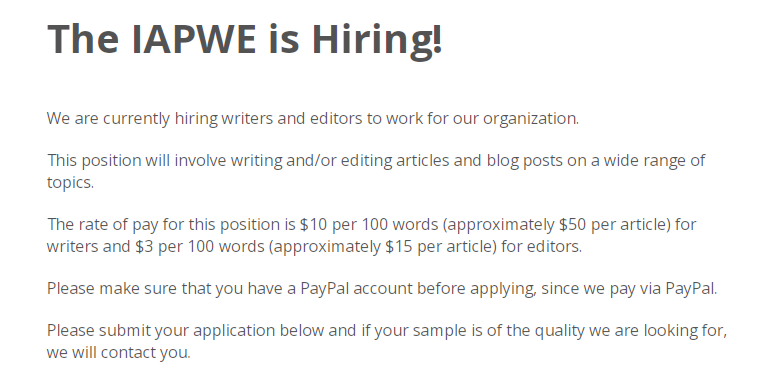
        Below is a screenshot of the application page from 2022, at the time of this articles first writing (it has since been updated).

        This is a screenshot of an application page from IAPWE as part of an IAPWE review. It was taken in 2022

        If you have images turned off, here’s the short version of the screenshot: the IAPWE pay rate is $10 per 100 words and each article is approximately 500 words. For editors, their rate is $3 per 100 words.

        However, on this job post board for IAPWE, the rate is different. It lists $20 per 100 words.

        It also mentions on that site that 17,357 people have applied to this job. It says the salary is $40,000-$50,000 and that applicants must, “Work well as a team member with the rest of our content management and editorial staff.”

        We’ll also point out this information was gathered in 2022 when the article was originally written and it still states this is 2023 when we reviewed the links again.

        Here are the topics they currently offer writers and editors:

        • Health and Beauty
        • Fitness
        • Home Décor
        • Fashion
        • Sports
        • Do It Yourself (DIY)
        • Finance
        • Legal
        • Medical
        • Family/Parenting
        • Relationships
        • Real Estate
        • Restaurants
        • Contracting (Plumbing, Pool Building, Remodeling, etc.)

        Depending on your current rates as a freelance writer or editor, this might seem like a decent amount. But it also might not seem like enough. These rates are better than a lot content mills that pay closer to $0.02 per word instead of $0.10 per word.

        According to online reviews for IAPWE, once you’re approved and accepted as a member, you have access to the job board. You’re not given a position in the company and jobs aren’t a given.

        The organization pulls from 100 different companies—but they claim to only post legitimate freelance jobs. While I did not personally apply for IAPWE, some reviewers said it can take a month or more to hear back from them once you apply.

        Why Writers Should Double-Check Any Program Before Joining

        So many people dream of being able to write and work from home, and scammers know this. You should keep in mind that any program that says it’s an easy to industry to get into in just a few hours should raise some red flags.

        That’s not about this specific program, this should be a rule for any program or organization you want to join going forward.

        If you want to become a freelance writer, just know that there are as many legitimate programs and organizations out there as there are scams. For this reason, it’s always a good idea to do your due diligence and make sure it’s legitimate before you sign up. (Just like you’re doing now!)

        While no program is guaranteed to work and make you rich, you at least need to make sure it’s legitimate and can get you results if you put the work in.

        The Pros and Cons to Wrap Up This IAPWE Review

        You’ve made it to the end of the post! Well done! Here’s a quick review of what we talked about.

        Pros to Joining IAPWE

        • You’ll get access to resources about becoming a professional writer or editor
        • You have access to legitimate jobs all in one place

        Cons to Joining IAPWE

        • You have to pay a monthly fee to access the job board
        • It can be difficult to cancel your membership
        • It’s unclear if the posted jobs are worth the monthly fee

        Here’s an Alternative!

        If you’re just getting started as a freelancer, then we recommend the Freelance Writers Den. They have an incredible community and a wealth of helpful resources to help you grow your income as a freelance writer, editor, proofreader, and more. There is also a monthly fee for this membership program, so once again—make sure it’s right for you before joining!

        For a full review on the program, check out this article.

        [sps_reusable_block post_id=43043]