Tag: tips for writers

  • 7 Tips From The Office Writers to Improve Your Writing

    7 Tips From The Office Writers to Improve Your Writing

    Few shows took comedy by storm more than The Office. It was a hilarious show that was an American version of The Office from the United Kingdom.

    Even years after it aired, it was still the most streamed TV show in 2020.

    Considering how popular the show was, how many actors became famous from it, and how many seasons there were, there is a lot writers can learn from the writers who worked on this show

    We’ll be going through the different writers in the show, dive into some of the tips from The Office writers, and talk about what writers can learn from them.

    Who Were The Writers for The Office?

    If you look at the writing credits for The Office on IMDB, you can see that there are over 50 writing credits for the series.

    The Office was also known for having some of their actors be involved in the writing process and also vice versa.

    Tips From The Office Writers

    Let’s take a look at some of the tips from the writers from The Office and talk about how you can use them to improve your own writing skills.

    Writing tips from Greg Daniels

    Greg Daniels has had a huge career and is one of the main producers of hit shows such as The Office, Parks and Recreation, and King of the Hill. He hasn’t done a lot of interviews, probably because he’s busy writing smash hits, but this was a good nugget from his Vox interview.

    In this quote, he had just been asked how he came up with ideas for Upload.

    I was walking around midtown Manhattan, past all those electronics stores next to Rockefeller Center. They were all advertising CD players, switching to digital from analog. I was trying think of a comedy sketch, so I was thinking, “What else could you digitize? What other things in life would it be ridiculous to digitize?” And I was like, well, the ultimate would be your own mind — where everybody’s digitizing and living in a hosted computer environment, or something.

    Greg Daniels

    The main takeaway from this quote is to draw inspiration from your day-to-day life. Take the time to explore your area and walk around without being nose-deep in your phone and scrolling.

    Look at your surroundings, question things, think of new angles for different things you observe.

    Most great writing (especially comedy writing) comes from simply observing life and writing about it.

    Another writing from Greg:

    “The show had such a different feel and I wanted it to have such a sincere feel to it. The enemy of that to me is the factory TV process which Hollywood is often guilty of —  and I would definitely say I don’t admire too much — because a lot of times in this factory process, the actors are kept apart from the writers. And they distrust each other. And it leads to a certain type of writing where the writers write actor-proof lines which are very joky. Because they don’t trust the actors to deliver them without a set-up and a punchline in the same speech. To me, what was so wonderful about The Office was that behavior was what was funny.”

    Greg Daniels

    If you’re just writing on your own and for your own blog or book, this quote might not apply to you. However, for writers who work on a team or with other people, it’s essential to bring everyone in to the process together.

    For example, if you’re working on website copy, not talking to other people on the marketing team is a problem.

    Writing tips from Mindy Kaling

    Mindy Kaling first had her rise to stardom through working as a writer, executive producer, director, and most notably, acting as the character Kelly Kapoor in The Office.

    Her advice on looking for a mentor:

    “If you have the opportunity to observe someone at work, you are getting mentoring out of them even if they are unaware or resistant. Make a list of the people you think would make the greatest mentor and try to get close.”

    Mindy Kaling

    Lots of writers like to seek out mentors, and you should start with the ones you admire most. Sure, it might be hard to get in touch with someone like John Grisham, but you can sometimes also learn from your favorite writers through the advice they give and the books they write.

    Mindy also has a checklist for characters that she follows:

    Characters are helpful and kind.

    No one is a moron.

    Characters are polite.

    Conflict should never come from a desire to be cruel or mean.

    Do not fear nuance. Comedy from avoiding conflict, not instigating it.

    Characters don’t have to be maxed out to be funny.

    This is a good idea for writers to have a checklist to follow when it comes to their writing. It helps keep you focused and on track.

    Writing tips from Michael Schur

    Michael Schur was not only a producer and writer for The Office, he also helped bring other great shows to life such as The Good Place, Brooklyn Nine-Nine, Master of None, and more.

    Needless to say, he knows what he’s doing when it comes to writing and bringing a story to life.

    “The visual metaphor that [Greg Daniels] gave us for the show at large was like a paved over, concrete, boring looking office parking lot with one little flower peeking up through a crack in the pavement.” 

    Michael Schur

    The lesson from this is to create a vision for your writing. If you don’t know your ultimate goal or outcome, you are going to make mistakes along the way that might take you off track.

    You always want a north star for what you’re creating to bring it to life.

    In this interview with Tim Ferris, which is worth a listen for anyone who wants to become a writer, he goes over his entire career and lessons he’s learned. Let’s look at another gem.

    “And of the many, many rules of creation or of writing that have been taught to me over the years by a number of very smart people, the best and most trustworthy is write what’s interesting.”

    B.J. Novak

    Now, writing what’s interesting is hard, but that’s the cost of making it as a creative writer. If people aren’t interested in what you’re writing about, you won’t get their attention.

    At the same time, that’s what all writing advice can be boiled down to.

    Writing tips from B.J. Novak

    B.J. Novak became famous for writing, producing, directing, and acting in The Office as the character Ryan Howard.

    “We would start with what we would call a Blue Sky period, which was my favorite part of every year. For two, three, or four weeks sometimes, if we had a long time, every single day in the writers room was just, ‘What if…?’”

    B.J. Novak

    While it’s great to have routines and processes for writing, there has to be time where you set aside to just think, daydream, and get creative.

    You need to take the time to think about your story, your writing, and start to think outside the box. How could you improve your writing and your focus?

    Next Steps

    Want to join a ton of other writers that can give you endless writing advice? You will want to check out The Den!

  • Clarity of Writing: 9 Proven Techniques to Writing Well

    Clarity of Writing: 9 Proven Techniques to Writing Well

    While everyone will have their own definition of what good writing looks like, bad writing is more universally recognizable. 

    If you want to write well, it’s essential to write clearly. Anything else is an absolute disservice to your self-respect as a writer, not to mention the time and attention of your reader.

    Sometimes, writers fall into the trap of thinking that if they have an important enough message to share, or an entertaining story to tell, they can get by with not writing clearly. That’s simply not the case. You run a real risk of readers switching off from your work entirely if your writing is unclear.

    Let’s explore the concept of clarity of writing as well as nine techniques to attain it.

    What is clarity in writing?

    Clarity in writing is achieved when your intended meaning is expressed as efficiently as possible.

    To understand what clarity in writing looks like, it’s useful to consider its opposite. 

    When writing is unclear, it causes unnecessary mental effort for your reader. Having to decipher a sentence is not conducive to appreciating or absorbing it.

    So what are some of the main impediments to clarity in writing?

    1. Wordiness. Efficient writers are economical with their words. Saying more with less is a fundamental part of writing well.
    2. Unstructured text. If sentences, paragraphs, and sections or chapters lack a logical flow, your reader will lose focus. A clear structure is essential for effective writing.
    3. Inappropriate language. If you use jargon, metaphors, cultural references, or anything else outside of your intended reader’s expectation or understanding, you sacrifice writing clarity.
    4. Unfocused meaning. Clear writing can only flow from clear thinking. If you’re confused about the point you’re trying to make, or the way you want to express it, you don’t have a chance of writing clearly.

    In essence, anything that makes your writing easier to understand and more enjoyable to read is conducive to writing clarity.

    Anything that detracts from either objective is undesirable and should be eliminated.

    How to achieve clarity in writing – 9 proven techniques

    While understanding the concept of clarity in writing is an essential first step to achieving it, it’s not enough on its own.

    Instead, if you wish to write more clearly, you need to consciously work at it until it becomes instinctive. 

    Here are nine techniques to help you achieve greater clarity of writing.

    1 – Consistent practice

    For most writers, you stand a far better chance of achieving clarity when you write consistently. 

    If you write on an inconsistent basis, you’ll find the act of crafting a sentence to be laborious and unnatural. It’s like attempting exercise when you are out of shape. Even your best efforts will be far less graceful than someone who trains habitually.

    2 – Optimize your writing routine

    It’s not enough to write consistently – you also need to optimize your writing space and writing routine.

    To produce your best work, you need to find the best combination of conditions for yourself. This is a highly personalized process. One writer’s perfect routine would be another’s poison. Furthermore, your preferences will evolve, so don’t be afraid to experiment with aspects of your writing practice in search of greater clarity.

    Some of the factors to experiment with include:

    • The location where you write – at home or in public?
    • The tool you write with – a simple word processor or something with greater functionality? On a laptop, desktop, or by hand?
    • The time of day when you write – when are you at your most productive?
    • Do you write with music, white noise, background noise, or as much silence as possible?
    • Do you consume coffee while you write? Or even write drunk and edit sober?

    Answering these questions and creating a writing routine will make it a lot easier to do your best work.

    3 – Outline in as much detail as you need

    The extent to which you outline, as well as the type of outline you produce, has a direct impact on the clarity of your writing.

    Again, this is highly personal. Some writers find greater clarity by allowing their thoughts to flow freely while they craft. Others find this results in meandering and unfocused text and instead prefer a detailed plan before putting pen to paper.

    4 – Find a drafting and editing process that works for you

    Typically, most writers will benefit from the advice to write without judgment or hesitation during a first draft and to tighten up on the next round. If you try to achieve perfect clarity on your first attempt at a piece you run the risk of getting caught up in the process of evaluating rather than crafting.

    However, some writers report that a quick glance back over a paragraph or section before moving on can be beneficial. Find what works for you.

    5 – Clarity is contextual

    Clear writing for one readership is likely to look entirely different for another. 

    For example, if you’re writing for newcomers to a topic, too much jargon is likely to lead to confusion. However, for an expert readership, clarity will require using more advanced terminology, as anything less will seem oversimplified.

    Clarity is also partially dependent on genre and style. For example, readers familiar with literary techniques such as metaphor or an unreliable narrator will enjoy and appreciate them. Someone unversed in such techniques may well feel confused.

    6 – Read your writing out loud

    Different parts of your brain are used when reading something silently in your mind as opposed to reading it out loud. 

    Something that might seem clear on the page ends up being confusing when spoken. Similarly, your ear will often catch repetition or other impediments to clarity that aren’t apparent when reading silently to yourself. 

    7 – Use writing tools

    Writing apps and tools are no match for a talented human editor. However, they are capable of boosting your writing clarity. Simple, free tools such as Hemingway can easily identify areas of improvement. 

    For a more detailed analysis of your writing and ways in which it can be improved, consider investing in a paid tool such as ProWritingAid or Grammarly Premium.

    8 – Get the right feedback

    We all have blindspots as writers. Whether through ego, or oversight, we’re not as capable of objectively evaluating our own text as someone else is.

    However, remember that clarity is contextual. Ideally, your feedback will be from someone who fits the profile of your ideal reader. You can also join a writing critique group to improve your writing. 

    9 – Stay humble and embrace the journey 

    Perhaps the most important key to achieving clarity of writing is letting go of your ego and being willing to embrace growth.

    Even the best writers were not born that way. Achieving consistent clarity is the result of countless hours that we as readers are often not privy to.

    Having a sense of humor around your lack of clarity is essential. In ‘On Writing’ Stephen King shares his process of writing a rough draft and then revising it for greater clarity. You will notice that King can laugh at his weaknesses and not take them too seriously.

    That’s a Wrap

    Ultimately, achieving greater clarity of writing is down to three essential factors:

    1. Understanding what clear writing looks like and embracing the need to work towards it.
    2. Consistent and optimal writing practice to improve your level of skill and comfort.
    3. The right attitude to growing both as a reader and as a writer, and embracing feedback and criticism without getting hurt or frustrated.

    Fiction and nonfiction alike suffer when the writer’s intended meaning is distorted by wordiness, confusing sentence structure, inappropriate word choices, and other impediments.

    If something is worth writing, it’s worth writing well. Hopefully, by now, that’s clear!

    TWL. CTA. Book Outline Template
  • How to Use Track Changes to Collaborate on Edits With Ease

    How to Use Track Changes to Collaborate on Edits With Ease

    Gone are the days when your edited manuscript returns to you covered in the blood-red slashes of your editor’s unforgiving pen. Today, your edited manuscript most often returns as a Word document covered in the bewildering lines and challenging comments within Word’s Track Changes feature.

    Whether Microsoft meant it as an ode to tradition or a reminder to every writer about the seriousness of editing, these edits are still, by default, set to show up in blood-red starkness.

    Thanks, Microsoft.

    Regardless of your feelings about using Word, it behooves every writer to learn how to use Track Changes.

    When the success of your edit relies on knowing this useful aspect of the world’s most-used word processor, you’ll want to know exactly what you’re doing before diving into your edits.

    What is Track Changes?

    Track Changes does exactly what it says: it tracks the changes made to a Word document.

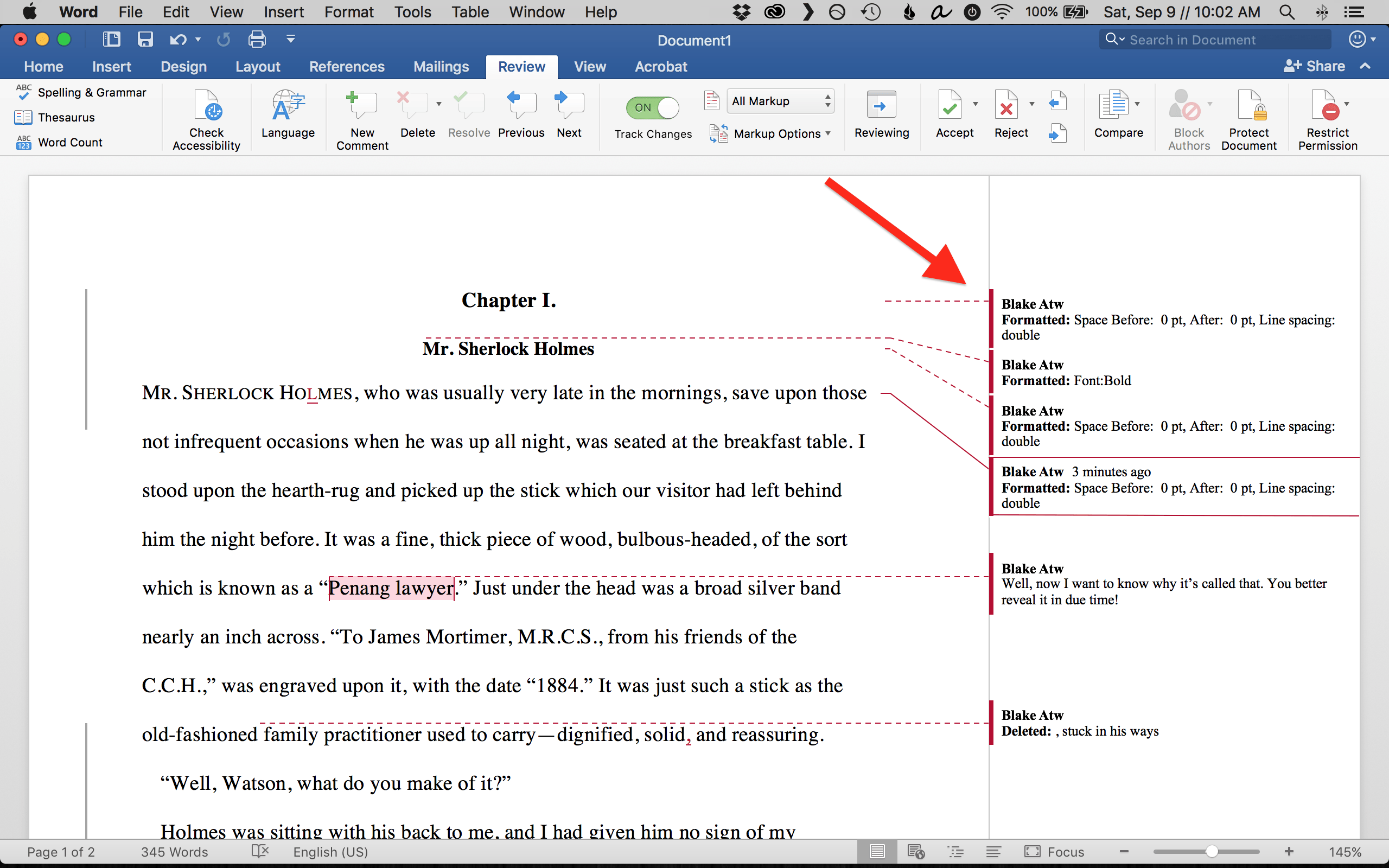
    Every deleted space, every added word, every formatting change and more is meticulously tracked so that any parties working on a document can see the document’s evolution over time as well as who made what change.

    For better or worse, Track Changes is the de facto digital editing tool of choice for editors.

    While Google Docs offers a worthy alternative, especially considering its automatic versioning history, Word’s Track Changes is a stalwart of the editing business for its robust features and relative ease of use.

    How do I use Track Changes?

    First, a note about any tutorial for a major piece of cross-platform software: specific differences abound based on whether you’re using the Windows, Mac, Android or iOS applications and what version number you’re using.

    The screenshots below show the most recent version of Microsoft Word for Mac, and the tutorials speak specifically to Word for Mac users. However, this quick introduction to Track Changes should lead you in the right direction on any platform for the basics of using this editing tool.

    Let’s assume you’ve received an edited manuscript back from your editor, but when you open the Word file they’ve sent, you don’t immediately see anything different. What gives?

    The editor may not have saved the file with Track Changes still turned on. (It happens!) But there are a few simple steps you can take to fix the problem — if you’ve actually been sent an edited file.

    Reviewing this process will also help you understand the basics of working with Track Changes, even if you only plan to use Track Changes for your own first few rounds of self-editing.

    How to turn on Track Changes

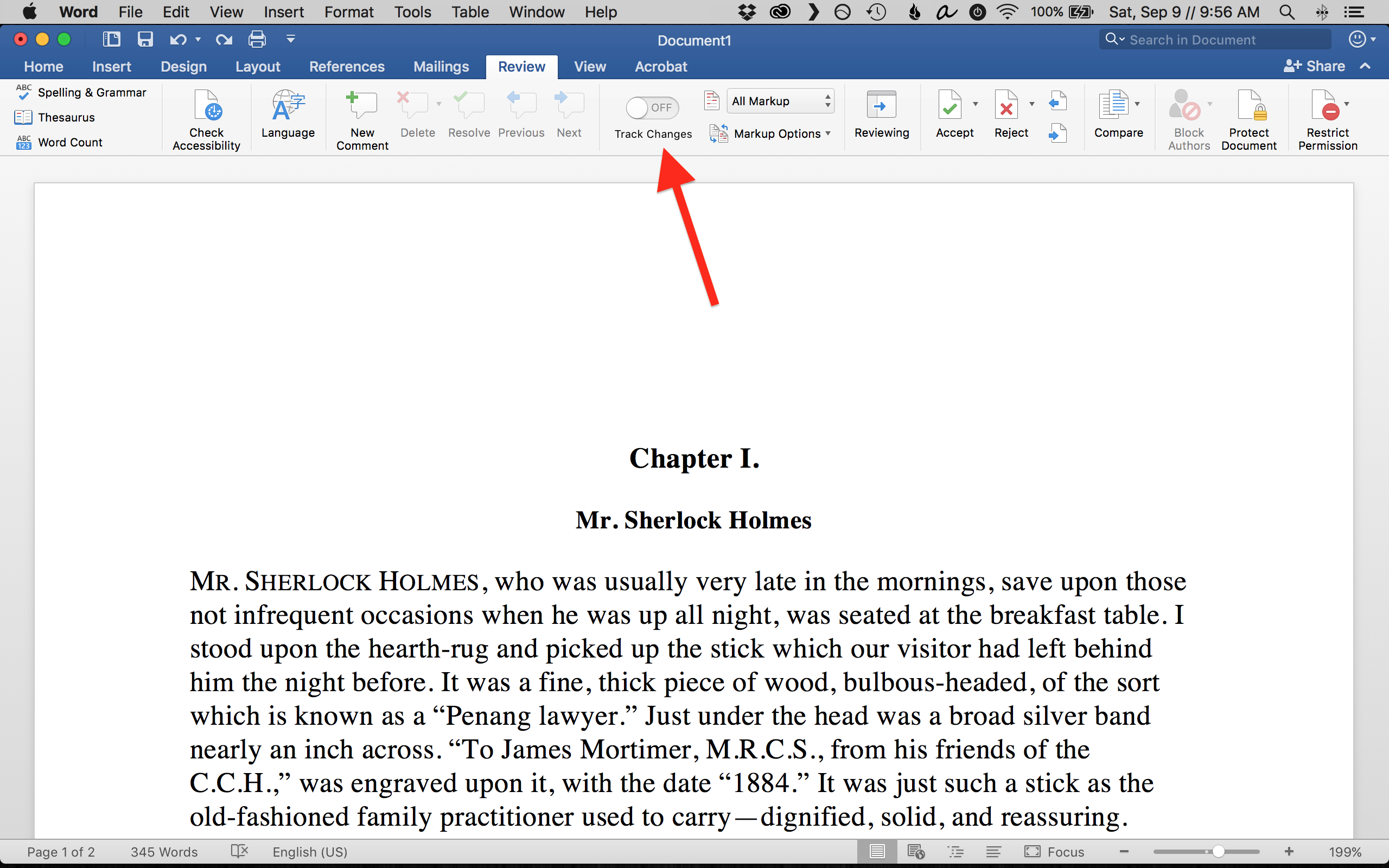
    To see what work your editor has accomplished, click the Review tab, then locate the toggle button titled Track Changes. Click that button to turn Track Changes on.

    Once clicked, you should immediately see a sidebar appear to the right of your text containing your editor’s edits and comments.

    How to use All Markup and Markup Options

    If the Track Changes sidebar fails to appear, try three more actions before contacting your editor to see if they may have sent you the wrong document.

    1. Near the Track Changes button, two drop-down menus show All Markup and Markup Options (or Show Markup on Windows). Clicking on the All Markup drop-down reveals its options:

    • Simple Markup denotes edits with a line on the left-hand side and reveals editorial comments. However, because it’s so simple, it doesn’t show where the precise edit occurred.
    • All Markup reveals every edit inline. This mode shows exactly what your editor did.
    • No Markup presents the edited version to you but without sidebars and without revealing what edits were made. It’s a clean version of the final product after your editor’s edits.
    • Original presents the file as it was before the editor attacked it. This mode may be useful to make comparisons between your version and your editor’s version.

    If this drop-down menu was set to No Markup or Original when you turned on Track Changes, you won’t see any changes. If it’s set to Simple Markup, you may only see minimal changes.

    When you’re first working with an edited document, be sure that All Markup is selected.

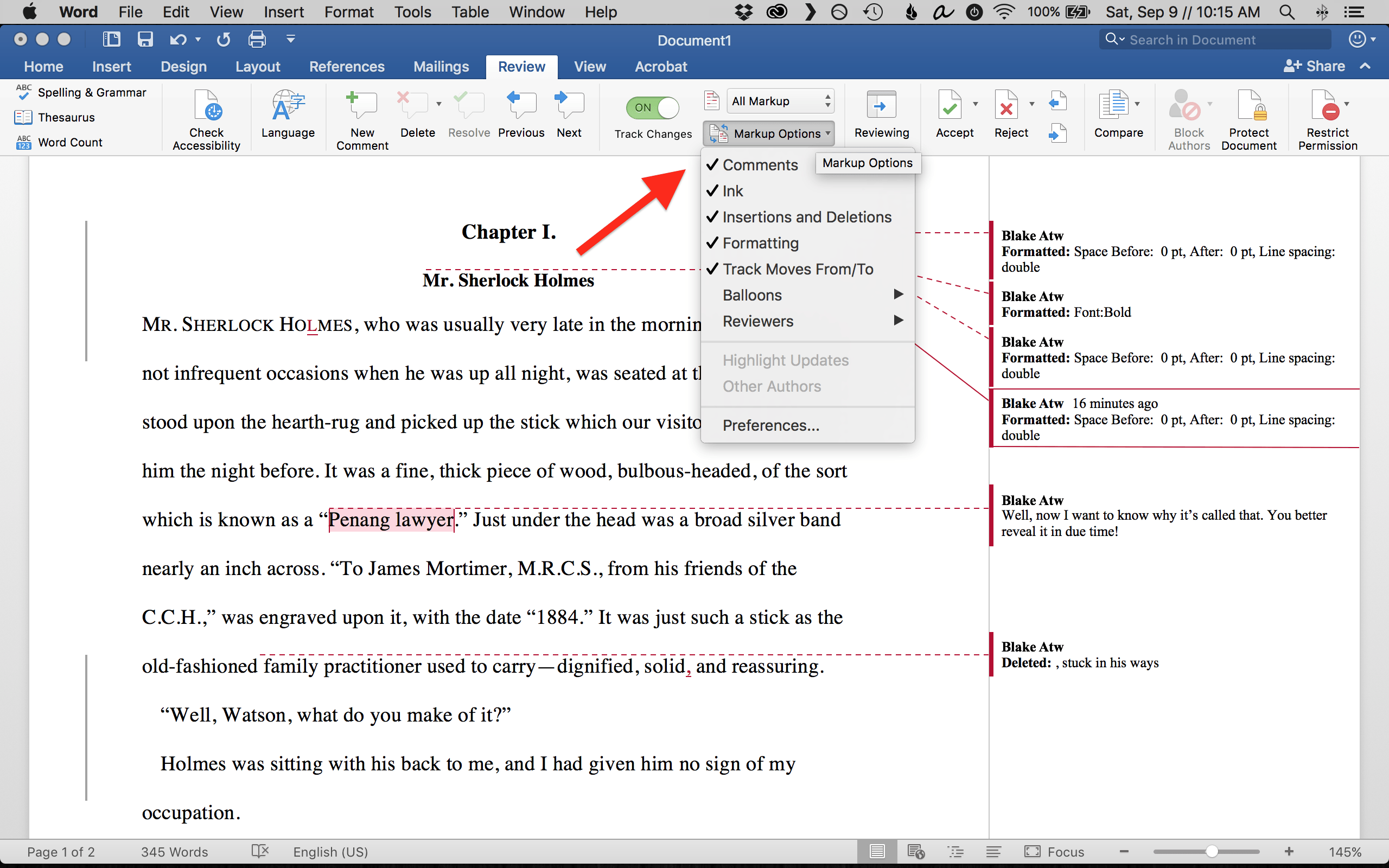
    2. Next, click the Markup Options drop-down menu and ensure that all its items are checked: Comments, Ink, Insertions and Deletions, Formatting, and Track Moves From/To.

    If you only want to remove seeing any of those types of edits, uncheck the selection. For example, to only see insertions and deletions, uncheck every other item.

    3. In that same drop-down menu, go to Reviewers and ensure that All is checked. If you had multiple editors work on the same document (which isn’t recommended) and only want to see one editor’s changes, ensure that they’re the only name checked in this menu.

    If you’ve tried each of these steps and still don’t see your edits, contact your editor.

    How to accept or reject changes in Track Changes

    After ensuring your edits appear, now the real work begins: Accepting or rejecting edits.

    Doing this either locks in the edit or prevents the edit from occurring.

    Within the review tab and to the right of the Markup drop-down menus live the Accept/Reject buttons. To start working through each edit, click within your main text where your first edit occurred or click the first edit in the sidebar. Then, go back to the menu and click Accept or Reject.

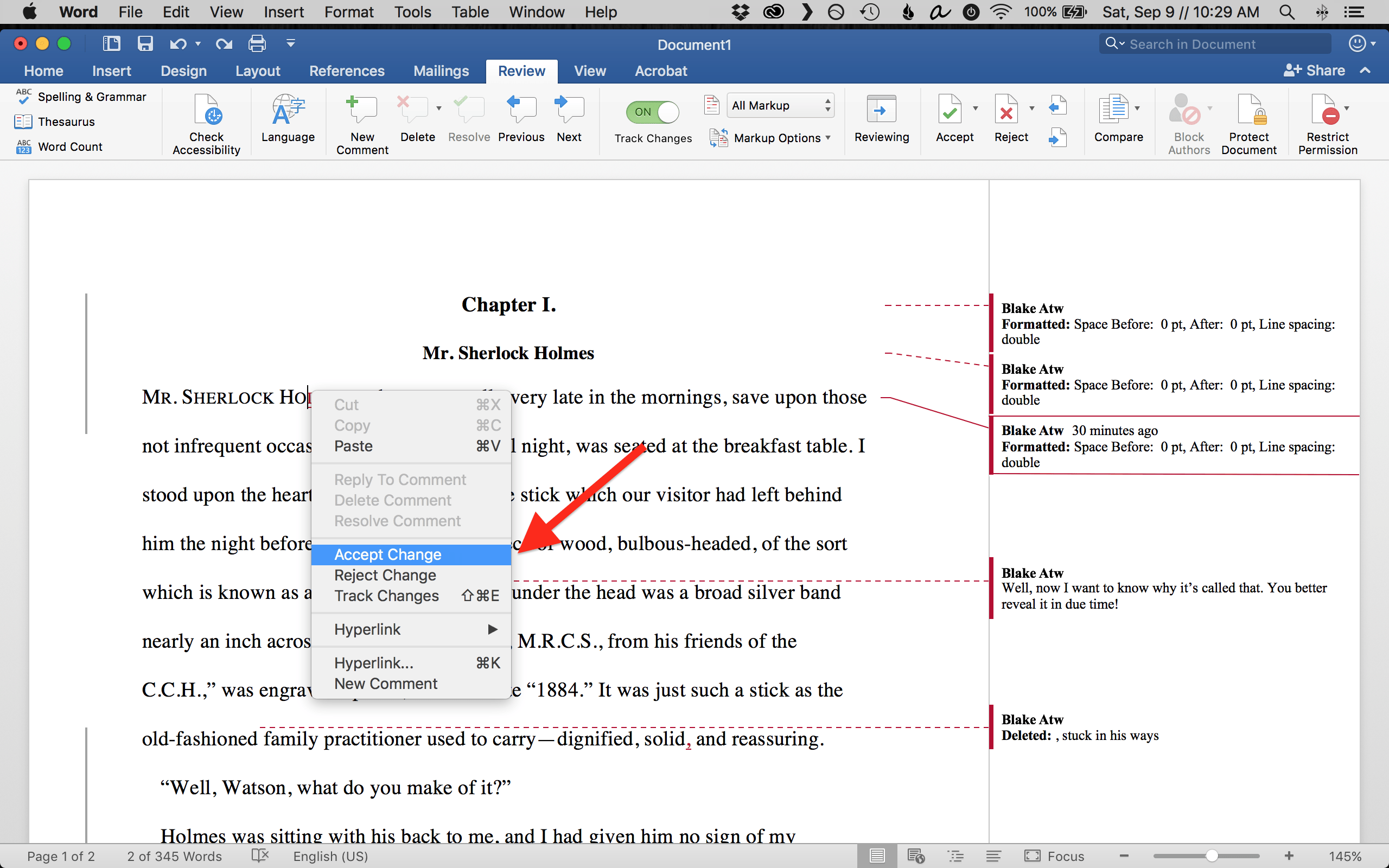
    Word will automatically jump to the next edit, meaning that you can continue to click Accept or Reject without having to click back into the main text or the sidebar edits. You may also right-click any edit and select Accept Change or Reject Change.

    How to reply to comments in Track Changes

    Your editor may leave comments throughout your manuscript. Often, they will ask questions to seek clarification.

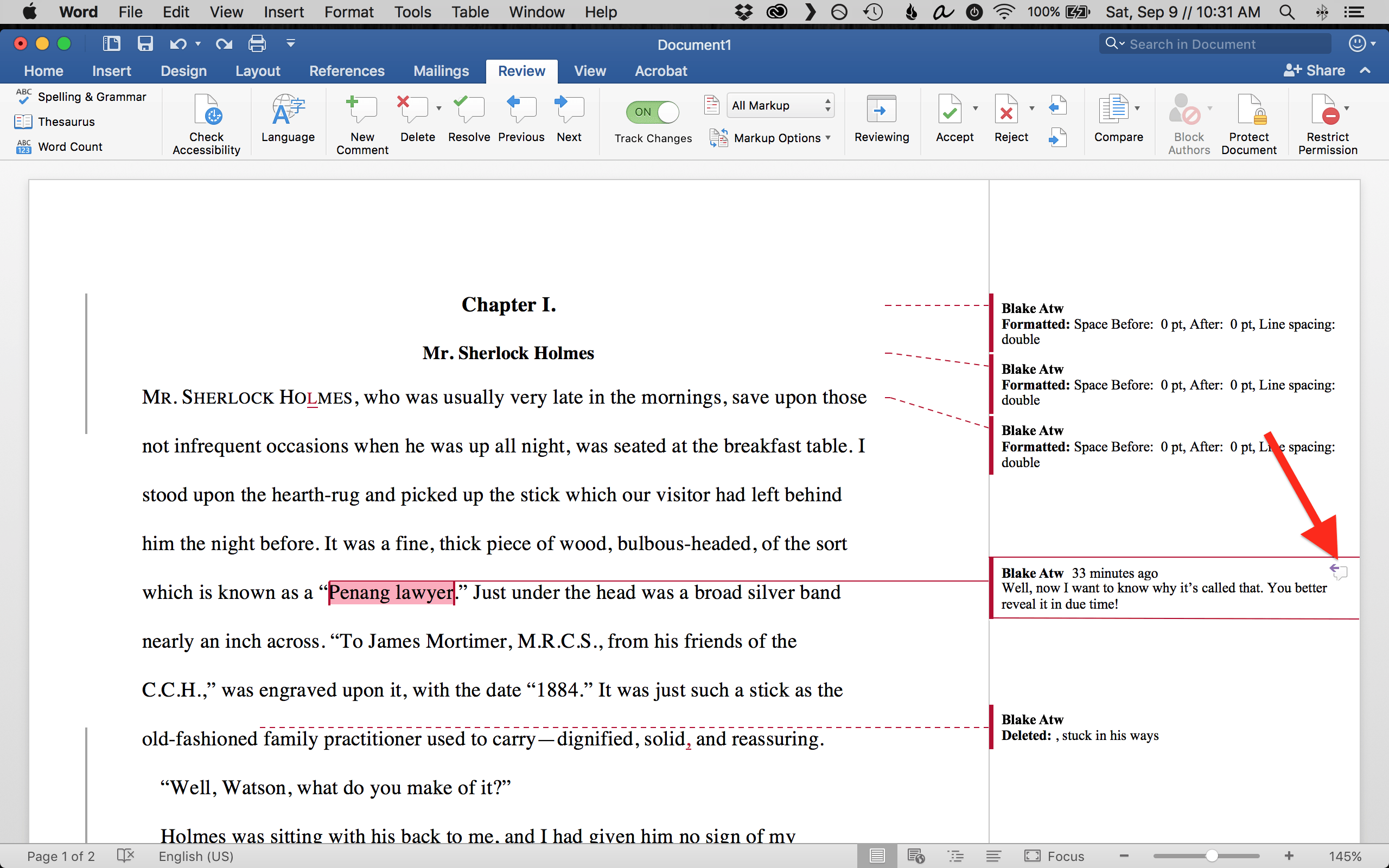
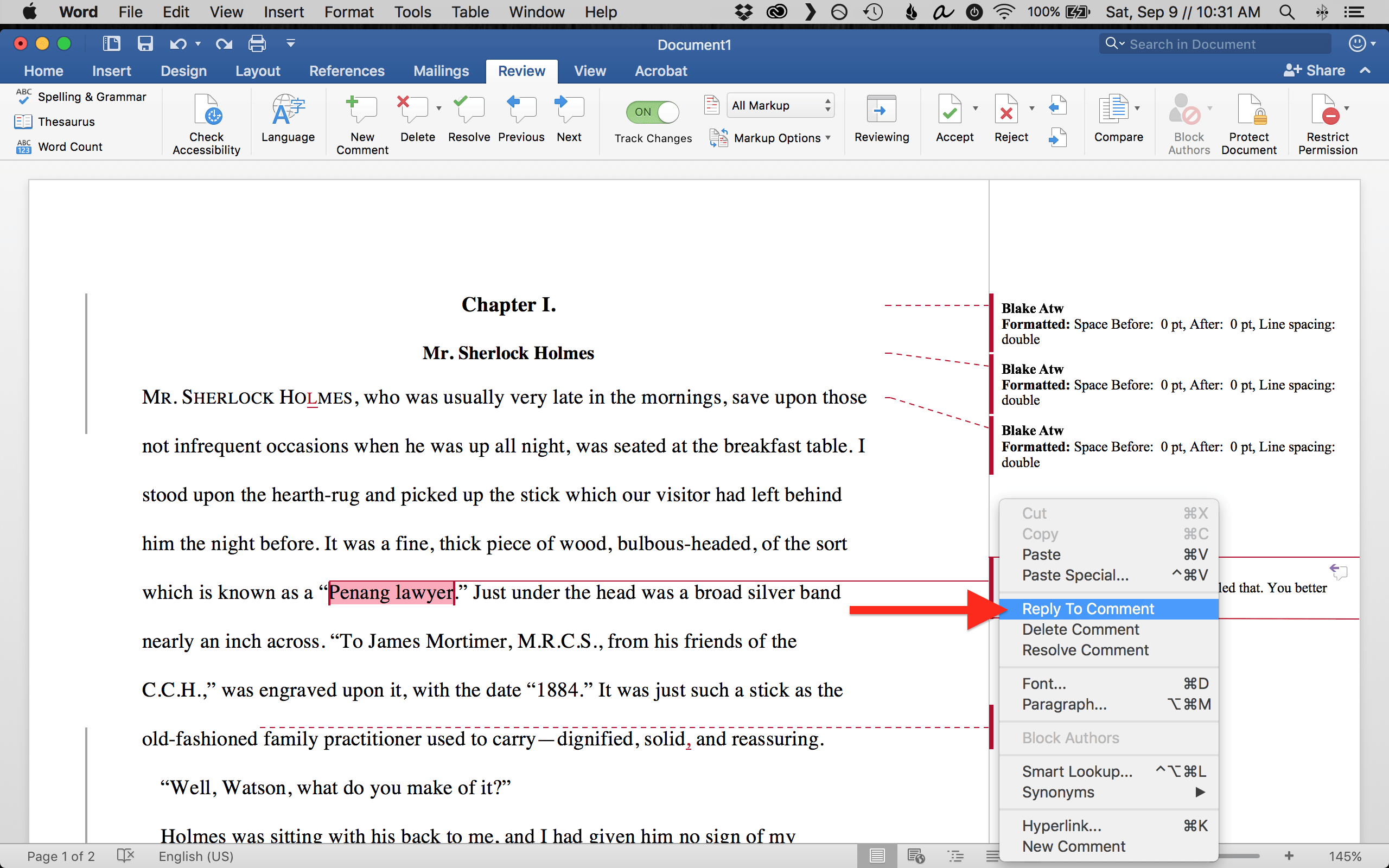
    To reply, either click on the comment icon in the top right of their comment or right-click their comment and select Reply To Comment.

    If a comment needs no reply and you’d like to remove it or archive it, select Delete or Resolve in the Review tab.

    To create your own comments, highlight the part of your main text on which you’d like to comment, then select New Comment in the Review tab.

    This brief, introductory tutorial should give you a firm foundation for tackling edits in Track Changes.

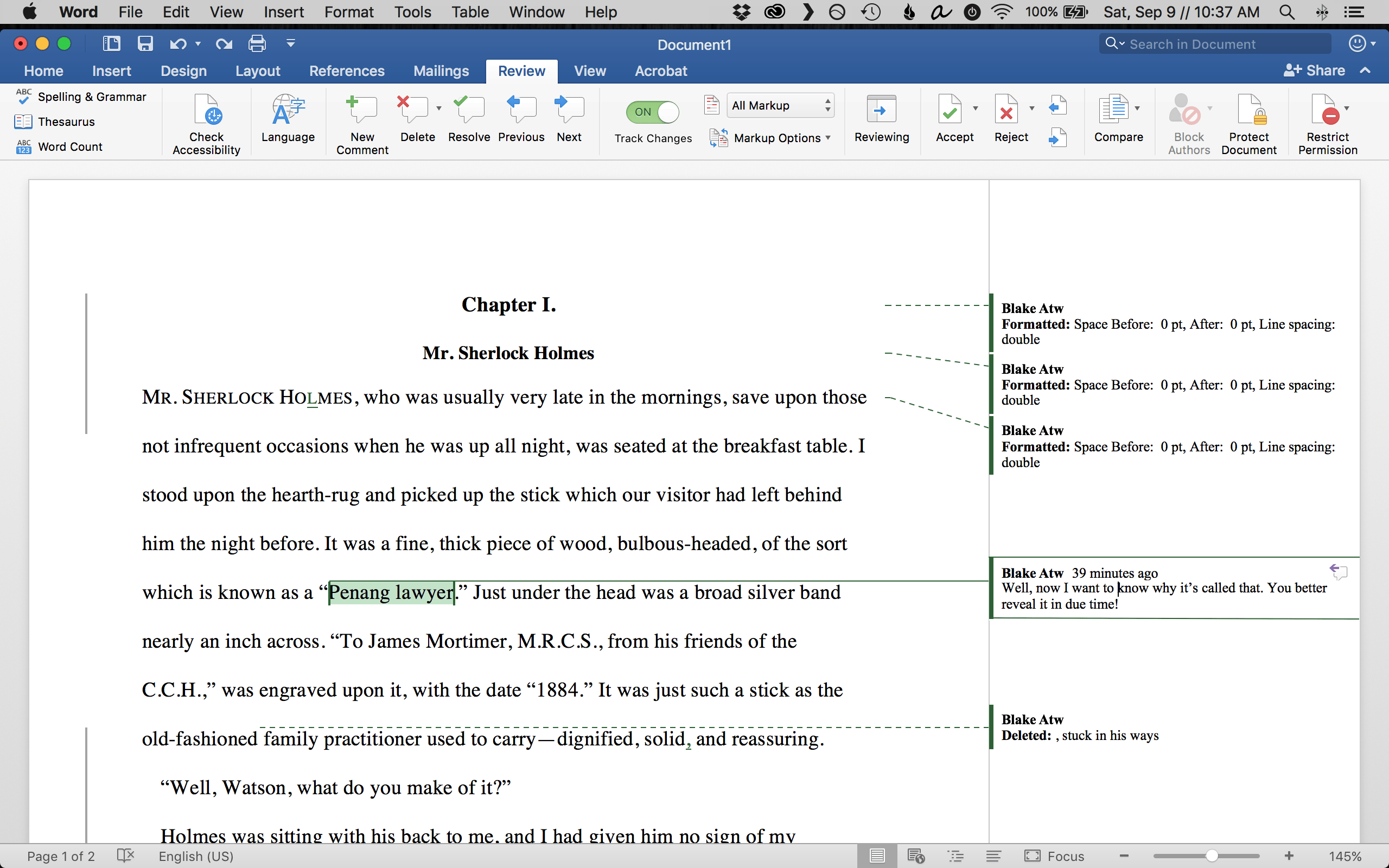
    And if your editor is particularly nice and tech-savvy, they may even use some color other than red to mark up your manuscript.

    If you’ve used Track Changes, what problems have you had? Or, what’s the best comment you’ve received on your writing?

  • Becoming a Writer: 3 Hard Truths Every New Author Faces

    Becoming a Writer: 3 Hard Truths Every New Author Faces

    Like many aspiring writers, my writing career started early.

    I was that introverted six-year-old sitting a safe distance from the playground, nose perpetually glued inside a book. By third grade, I’d finished the entire Goosebumps series. Luckily high school rolled around and I’d graduated to the classics.

    As with many literary students, my obsessive reading habits led to an interest in writing.

    Awestruck by the way my favorite authors so seamlessly painted vivid pictures with words, teleporting my imagination to faraway worlds and back again for the price of a paperback, my inspiration was kindled. So, I earned an English degree and became a writer.

    Along my professional writing journey, I’ve come face-to-face with a few difficult truths of the trade.

    Identifying these truths and understanding how to navigate them will improve your skills as a writer and as a professional, whether you’re freelancing with clients or working full-time with a dedicated team.

    1. Criticism is guaranteed

    You’re going to cross paths with many people who write during your career, from the clients you work with to the graphic designers you collaborate with.

    While this doesn’t necessarily make them writers by trade, you will have to face the fact that because they also communicate through writing, they will have opinions about your writing.

    This will be frustrating at times – trust me, I’ve been there – but I’ve learned a few ways to handle unsolicited feedback.

    First and foremost, listen. Don’t let your ego get between you and criticism because you might miss out on garnering useful feedback. It’s every writer’s job to listen and observe. Even if you don’t receive applicable feedback, you can mine these experiences for a topic to write about, say, for one of your freelance gigs.

    Secondly, you’re going to receive a lot of rejections — via email, snail mail, text message and maybe even by tweet. Know this, process it and grow a thicker skin because there’s no way around it.

    Writing is subjective and not everyone is going to like your writing. That’s okay. Rejections, followed by revisions, are part of the creative process. The best way I’ve found to reduce the frequency of rejections received is to read — set aside time to thoroughly read publications before you submit to them, and take breaks to read between writing and editing your work. Doing this will broaden your perspective and help you better tailor your voice.

    Lastly, know when to brush it all off, have a glass of wine, and get back to writing — because sometimes, you just need to reset.

    2. You won’t always like what you write

    If you’re anything like me, you’re going to find yourself writing about topics you’re not particularly fond of at times. But with a little luck and a lot of perseverance, you will get through this period and find yourself blissfully choosing between projects that interest you.

    For example, my first full-time gig was writing SEO content for an advertising agency.

    Cool, right? Well, I forgot to mention it was an agency servicing “elective healthcare professionals” (AKA plastic surgeons). I never in a million years would have guessed I’d be a tummy tuck expert, but here we are. And I’m grateful for that opportunity because it provided the stepping stone I needed to propel my writing career from zero to something.

    Even if you’ve chosen to pursue a more lucrative day job while spending your evenings working on a novel or essays, you’ll find yourself writing many unsatisfactory first drafts. You will read them over and over, doubting your abilities.

    When I was in this phase of a creative writing project, a wise friend and fellow writer told me, “Doubt is part of the creative process.” This couldn’t be more true.

    Consider every opportunity, and always do your best work. Embrace each step of the process, learn as much as you can and focus on how your present situation can catapult you towards your future goals.

    Regardless of which path you choose for your writing, be patient and persevere. Don’t be discouraged by doubt — only after countless revisions will you begin to fall in love with your own work.

    3. Writing demands perseverance

    Some people are natural athletes who can pike-kick-spike like nobody’s business; others are gifted wordsmiths with an unwavering ability to make sense of nonsense.

    Even if you’re not a natural-born writer, the skills can be learned with enough tenacity.

    There are plenty of resources and techniques to improve your writing. And whenever writer’s block sets in, pick up a book. Reading a well-crafted story always inspires me to get back to the keyboard. They key to practical success is dedication to learning.

    While writing techniques can be learned, intuitive qualities are also central to excelling as a writer. Aspiring writers must be cordially accepting of criticism and capable of empathy. Without these qualities, you may find it difficult to stand out from the crowd.

    Some of the best writers I know are also the most empathetic — able to embrace vulnerability and truly feel the world from the perspectives of others, allowing them to tell authentic stories that resonate with their audience. Empathy will also go a long way in understanding criticism without allowing it to hinder your productivity.

    I encourage everyone to write.

    Stand strong in the face of criticism and persevere through the nights and into the weekends, if you must. After wandering down several career avenues — from video production to project and account management — the path has always led me back to writing.

    Despite these sometimes difficult truths, the fulfillment that comes from writing is worth every rejection letter, every critic and every late night. Writers have the unique gift of storytelling to share with the world.

    And with great writing comes great empowerment.

    What other truths of the trade have you learned to effectively navigate?

  • Get Out of Your Own Way: 6 Creative Tips to Crush Writer’s Block

    Get Out of Your Own Way: 6 Creative Tips to Crush Writer’s Block

    Let’s be honest — being a writer can be torture, right?

    You know what you want to write and the goals you have are real, but sometimes life, excuses and your own fear can get in the way of success.

    There is no magical unicorn that will make the process any easier, but if you make writing a daily habit where you allow room for mistakes and curiosity, you’re on your way to winning the battle.

    How can you make writing be something you don’t dread when you stare at your computer?

    1. Let your words be vomit on the computer

    You have brilliant sparkling ideas dancing around in your head that you envision in such a glowing, perfect spotlight. You sit down to put human, imperfect words to those fantastical ideas and…barf.

    You put barf on the screen.

    You know what? That is the BEST place to start.

    I enjoy writing the most when I give myself permission to let my words be projectile vomit on the computer screen.

    You have an idea in your head right now of what you want to write about, don’t you? It’s so easy to ignore those ideas and convince ourselves they’re just ideas that wouldn’t lead to enough material to write about.

    But you don’t know where the ideas will lead if you don’t try to find out. And finding out means a very messy drawing board and permission to majorly junk it up.

    Instead of pressuring yourself to find perfection,I take a backseat and see where my writing goes. I write very incomplete, incoherent lists, ideas and images. Sometimes I’m able to go back and polish it up relatively quickly. Other times, I’m not, so I walk away and let it simmer, trying not to stress at the huge pile of incomplete garbage I just created.

    The cool thing about ideas is that they evolve from day to day. I’ll be in the shower or driving to work, and the vomit I laid down on my computer soon starts to turn into something more cohesive. Sometimes it matches what was in my head, and sometimes it’s even better if I stay with it.

    2. Quit playing the “writer’s block” card

    Writer’s block is code for “I’m too intimidated I won’t crank out perfection, so I’ve decided to watch Netflix and eat ice cream instead because I know I won’t fail at that.”

    No more. I won’t have it. You can do better.

    If you follow step one of not caring that you have vomit on your computer screen, you will not be blocked.

    The pressure is gone, and you’re left with you and your ideas, working together happily instead of scowling at the screen, wondering why you just couldn’t be something normal like an accountant.

    Writer’s block is saying you’ve put the bar too high, and you’re afraid of not measuring up. Take the bar and put it much lower for the first writing session, so you have permission to simply play with your ideas and words instead of trying to whip them into submission.

    [twl_reusable_block post_id=41455]

    3. Put some fire in your belly

    Although writing should be an activity you look forward to, it’s not a bad idea to put some pressure on yourself to complete projects.

    You have to put deadlines in place or else everything else will always come first like family, friends, work, binge-watching Top Chef — the list goes on.

    I don’t have the luxury to be able to write all day, so I give myself an hour.

    It cuts out the wiggle room to check Facebook or pet the dogs. The hour is my precious time to get to it without second-guessing myself. I almost never get done what I wanted to, but it leaves me hungry for more the next day, and hungry for writing is what I need to be when the alarm goes off at 5 a.m.

    4. Stay organized before your ideas drift away

    Part of holding yourself accountable is making sense of and organizing all the ideas bouncing around in your head.

    Try using Trello to track your ideas and keep you on a solid, tangible path to completion rather than being overwhelmed by all you want to do. If you’re a visual person who likes to see how much you’re completing, this might really work for you.

    And don’t let whispers of ideas get away from you. I jot down everything that zips through my head and go back to it. The other day I wrote “Facebook friends–not really even friends” in my Google docs document. I went back to it later in the week and started fleshing it out and quickly had a very successful blog post on my hands called,  “If I Die Tomorrow, Would My Facebook “Friends” Come to the Funeral?”

    I didn’t know exactly where the piece was going, so I just jotted down the messy, imperfect ideas as they came to me, and eventually the ideas turned into solid sentences and new ideas I didn’t have when I started.

    It was a thread I kept tugging at that started with an idea I had at my day job, but had I not started with the simple act of jotting down my ideas, the piece wouldn’t have been born because it would have remained trapped in my brain that is easily distracted and pulled.

    5. Stop devoting all your time to reading books about being a better writer

    It’s so great to learn from people who have more experience that they want to share with you, but constantly reading books on how to be a better writer is yet another excuse to not write.

    Writing conferences and networking are important to keep your head in the game, but in order to be a part of that game, you first have to write.

    There is no way around simply putting your butt in a chair to write.

    6. Don’t wait for the perfect time to start writing

    I used to be the master at doing everything under the sun before I would park my procrastinating butt down to write.

    I would make excuses like, “I can’t focus on writing if the house isn’t clean.”

    The truth is, there will always be something to pull us away from writing if we let it, but at the end of the day, if we do let it, it means we’re not making writing be an important part of our lives. And that means we won’t succeed.

    The perfect time to write is right now because you are the only you in this world who will put your spin on ideas. We’re not looking for perfection — just you and your ideas you’ve given permission to dance imperfectly onto the screen.

    These steps won’t magically lead you to a land of daily effortless writing. Writing is hard because you care about what you want to say and how you want to reach people. If you didn’t care, it wouldn’t be hard, and you wouldn’t be a writer.

    Now, sit that butt down, write some garbage and keep coming back to it with patience and an open mind. Do the same tomorrow and the next day.