Tag: writing challenges

  • Camp NaNoWriMo – Guide For Writers

    Camp NaNoWriMo – Guide For Writers

    If you’ve spent any amount of time in online writing circles, you’ve probably already heard of NaNoWriMo, an annual contest which challenges its participants to write fifty-thousand words during the month of November. The contest is designed specifically for novelists, but it attracts writers from all corners of the web looking to push their word count to its limit.

    But NaNoWriMo isn’t the only writing contest the organization runs. Have you heard of Camp NaNoWriMo?

    In this article, we’re going to talk about what Camp NaNoWriMo is, why you might be interested, how to enter, and what you can do to make the most of your Camp NaNoWriMo experience.

    What Is Camp NaNoWriMo?

    Camp NaNoWriMo is a writing event which takes place during the months of April and July. Like NaNoWriMo, the event lasts for the entire month. Unlike NaNoWriMo, the event does not involve writing fifty-thousand words! Also, as the name implies, Camp NaNo is more of an event than a contest—you can still win, but there isn’t as much of a competitive edge.

    Let’s break down the rules for Camp NaNoWriMo:

    1. The event begins at the start of the month (either April or July) and ends at the end of the month.

    2. Participants can set their own word goal. This can be fifty-thousand words, but it could also be literally any other number.

    3.  Participants are invited to write anything. Where NaNoWriMo asks its participants to put fifty-thousand words towards, specifically, a fiction novel, Camp NaNo does not. Nonfiction, fan-fiction, memoir, poetry, grocery lists, and break-up texts are all fair game.

    And that’s really all there is to it! This event is more lax compared to NaNoWriMo, and to me, that’s what makes it feel less competitive. Of course, you can technically write whatever you want for NaNoWriMo itself, and there’s no one forcing you to personally decide to write fifty-thousand words (NaNoWriMo is a self-challenge, which means you’re holding yourself accountable for meeting the goal or not).

    However, the lowered expectations around Camp NaNoWriMo create a more relaxed atmosphere. It feels more like a camp, where everyone’s taking a break from their regular stuff to hang out and talk about their projects, meet other writers, and hear from published authors. Camp NaNoWriMo also boasts a host of resources for writers to learn from as they work on their projects.

    Why do Camp NaNoWriMo?

    Maybe you hated NaNoWriMo, and the thought of voluntarily subjecting yourself to another month of similar torture sounds asinine. First, that’s a little dramatic, but second, I think Camp NaNo is worth a shot even if NaNoWriMo didn’t work out for you. Here’s a brief list of reasons why.

    1. It’s easy to participate… and to win

    We’ve already talked about Camp NaNo’s comparatively lax criteria to NaNoWriMo and how that lax criteria gives the whole event a calmer feel, but I’d like to elaborate a little bit here.

    First, even though participants technically can do whatever they want for NaNoWriMo, Camp NaNo means you can set your own goals without feeling left out or anything like that. There’s literally no ideal word count, and that means it’s pretty hard to rib yourself for not getting fifty-thousand words, even if you told yourself you couldn’t.

    Second, participants get two different chances to participate in Camp NaNo—April and July—and that makes it more likely that you’ll be able to do it. November is a busy time of year, especially for students and teachers, and especially with the holiday season right around the corner, so it’s not always possible to drop everything and commit to a project at that time.

    2. Camp NaNoWriMo’s resources can be helpful

    Camp NaNo also boasts resources for writers to take advantage of while they’re working on their projects. Let’s go over two of the biggest features as listed on Camp NaNo’s website.

    First, NaNoWriMo (the organization which hosts both National Novel Writing Month and Camp NaNo—don’t be confused!) hosts regular local writing events like write-ins, author q+a’s, and workshops around specific topics. Check what they’ve got going on in your area, not just during Camp NaNo, but year-round!

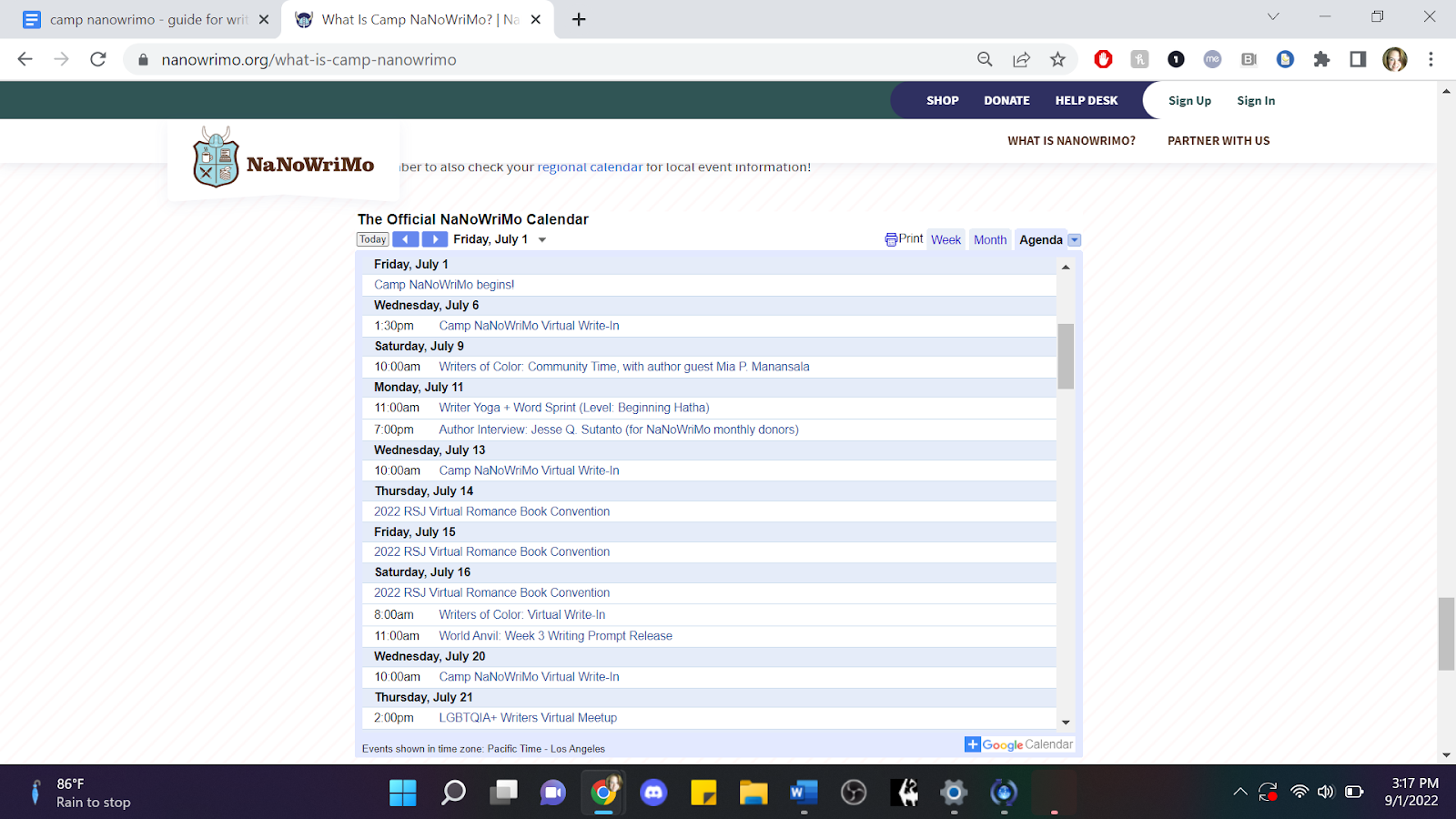
    Here’s the Google Calendar for NaNoWriMo’s events in July, for reference:

    And here’s that same month in agenda form, so you can see the specific events a little more clearly:
    In addition to these local events, Camp NaNo also has Camp Counselors—these are published authors who offer support, advice, and guidance throughout the month. This was the Camp Counselor lineup for July:

    3. Camp NaNoWriMo offers community

    The resources that Camp NaNo has to offer are great for keeping you grounded and supported throughout the process. It’s great to feel like someone’s rooting for you, and it’s awesome to have professionals to turn to for mentorship!

    It’s also great to have a community surrounding your writing and the writing of other authors in your area. You might not know any other writers in your day-to-day life—this is pretty normal! It’s an oft-isolating industry, usually done alone, and usually not involving a ton of connection to other people.

    And if you don’t love the idea of in-person events, guess what? Camp NaNo also has a ton of chances for online connection—their forums allow you to get in touch with local writers online and support one another as you work. You might even make some lifelong friends!

    How to Make the Most of Camp NaNoWriMo

    Now that you know what Camp NaNoWriMo is and why you should definitely try it out, let’s talk about how to make the most of your experience. Even if you prefer not to connect with other writers and instead do Camp NaNo totally solo, some of these tips will help you out!

    1. Pick a project you’re excited about

    Ultimately, you can choose to work on anything, but in my opinion, these kinds of events are best when you’re working on something that excites you. If you’ve got an idea for a book, but you just haven’t found the time to get started, guess what? The time is now! If you’ve got a weird idea for a poetry collection, bam—Camp NaNo material.

    You can also use Camp NaNo to knock out a project that’s been stewing on the back burner for a while. Maybe there’s work to be done, maybe there are essays for college to be written—if it’s not something that you’re super stoked about, at least pick something that you’ll be glad you worked on.

    Is there anything you shouldn’t bring to Camp NaNo, you might ask?

    This is absolutely one-hundred-percent just my opinion, but I don’t like to bring established, deep-in-the-works projects to events like this. Usually I’ve already got a clear idea of where I want to go with the project, so I’m not looking for a ton of feedback, and it’s usually developed enough that there’s not a lot of exciting new stuff happening with it. I’m talking about novels that I’ve already drafted a few times, short stories that just need polishing—stuff like that.

    Camp NaNo creates a ton of energy, and in that way, at least to me, it’s like rocket fuel. Some of your projects or ideas might need rocket fuel to take off and get going—some of your projects might not. You’ll be the best judge of that.

    2. Use Camp NaNoWriMo to establish good writing habits

    Unless you’re already writing for a living, you probably don’t write super regularly. Events like Camp NaNo might be the only months out of the year that you’re consistently returning to the keyboard for regular writing time. And that’s completely fine!

    However, if you want to be a pro, you’re going to have to develop discipline. This doesn’t mean drafting everyday (in fact, it definitely does not mean drafting every day), but it does mean coming to your keyboard as consistently as you can to keep your skills honed and your story fresh.

    Try finding a consistent time to work on your Camp NaNo project. You might find that you work better in the evening, or that you prefer outlining by hand, or that you prefer ten-minute writing sprints to twenty-minute writing sprints. Maybe you envisioned writing during your lunch break, but it turns out the break room at work is way too distracting—that’s good to know! Take note of what works and what doesn’t and bring that knowledge with you beyond Camp NaNo.

    3. Try getting involved with the community around Camp NaNoWriMo

    Of course, the option to do Camp NaNo solo is available to you. It’s a self-challenge, and as such, you’re free to keep to yourself, work on your project, and pat yourself on the back at the end of the month when you’ve completed your goals.

    However, consider this: Camp NaNo is putting you in touch with other writers. Likely, some of these other writers are also readers who might be interested in reading your book when it’s published. And to be clear, I am not saying you should get close to people under the guise of friendship with the ultimate intent of selling them something—in fact, don’t.

    What I am saying is that if you are self-publishing, you’re going to want to build a platform. Platforms require readers, yes, but they also require connections to other authors. Who else is publishing in your genre? What kind of stuff are they writing? Connecting to these other authors means building up your platform a little bit, and that’s going to be absolutely vital when it comes time to publish.

    Additionally, working with other self-published authors is a great opportunity to compare resources. Someone might know a great editor for your genre, and someone else might have already tried the cover designer you have in mind. You can combine knowledge in this way to save yourself some time and make the best decisions possible for yourself and your work.

    4. Have some fun

    Here’s the thing: ultimately, Camp NaNo is meant to be fun. Going in with some kind of plan will help you optimize your experience, but if you don’t have one, I absolutely encourage you to log in on July or April 1st, set up an account, and announce a project, even if you literally just thought of it on the spot. In fact, that might be the most wholesome way to participate.

    However you choose to play, have fun out there!

    Have you ever done Camp NaNo? How did it compare to NaNoWriMo? Let us know in the comments! 

    TWL. CTA. Book Outline Template
  • How Do You Win NaNoWriMo?

    How Do You Win NaNoWriMo?

    In book-writing circles, November is National Novel Writing Month, otherwise known as NaNoWriMo. If you haven’t heard of this annual event, or you’re ready to join the challenge for the first time, this will be a great primer. Here is a brief overview of the rules, along with guidelines to help you win NaNoWriMo.

    How do you win NaNoWriMo?

    “Winning” NaNoWriMo is both simple and hard.

    If you can write 50,000 words between November 1 and November 30 then you win!

    However, actually getting to that word count will take some discipline and strategy. Most people break this big number into a smaller, daily word count of 1,667 to make it feel more achievable. For many, this number is still overwhelming, which is one reason NaNoWriMo is such an exciting challenge. Simple, but not easy.

    Winners receive digital banners and certificates to use on their website or social media and T-shirts are also available for purchase. Sponsors provide other winner goodies, including discounts to writing software and publishing services. The catch? In order to win, you need to register your project on the NaNoWriMo website and log your word count between November 1 and November 30.

    Digital badges and Scrivener discounts aside, the real prize is writing 50,000 words and having a first draft completed in 30 days.

    What are the NaNoWriMo rules?

    While the goal is writing 50,000 words in the month of November, how you get there is flexible. Here is a breakdown of the NaNoWriMo rules to help you stay on track.

    • On November 1, the challenge begins as the clock strikes midnight, local time
    • On November 30, the challenge ends at precisely 11:59:59 p.m. local time
    • For the official challenge, no, you cannot start early or end late. However, you can plan ahead, take notes, create character sketches, etc. before November 1
    • In order to win, your novel must reach minimum 50,000 new and/or rewritten words by the end of the challenge—but your novel doesn’t have to be complete

    That said, “rebelling” is allowed and encouraged, since this is a self-challenge. If your project isn’t a perfect fit and you still want to participate, then do it. For more information on the rules of NaNoWriMo, both official and unofficial, check out this article.

    Additional resources to help you prepare for NaNoWriMo from The Write Life

    These three articles and resources will help you go further with NaNoWriMo specifically. The first is a free tool to help you outline your book before you start writing. The second will help you prepare for NaNoWriMo more fully. The third will help you in your goal-setting so you can actually win the challenge!

    This next set of articles and resources will help you with your novel more holistically. The first will help you get ready to write your novel, but chances are you’re already past that if you’re prepping for NaNoWriMo. The second gives you prompts to get the juices flowing. The third will help you set up routines to write consistently. The fourth is for when you finish writing your rough draft and are ready to self-edit.

    Side note: A lot of people have asked us, “When did NaNoWriMo start? How long has it been a thing?”

    National Novel Writing Month began in 1999 as a challenge between writing friends and has since grown into a global marathon event attracting hundreds of thousands of participants each year. To date, there are nearly 800,000 active novelists and more than 350,000 completed novels as a result of this annual tradition.

    We look forward to seeing you there this November!

  • NaNoWriMo and Beyond: 9 Writing Challenges for Novelists, Poets and More

    NaNoWriMo and Beyond: 9 Writing Challenges for Novelists, Poets and More

    Do you have trouble making time to write? Do you wish you had a community to help you work towards your writing goals, including staying on time and finishing your work?

    Many writers sign up for writing challenges to help them solve these problems and write a large body of work in a short amount of time — or even to build their practice and discipline of writing consistently.

    Besides completing work you can be proud of, participating in writing challenges is amazing because you get to work alongside a group of other writers who all share the same goal: finish that novel, finish that picture book, or write those short stories and poems. You support each other and hold each other accountable.

    Writing challenges that will push you forward

    If you’re up to the task, we’ve come up with some writing challenges to try, whether you’re a novelist, poet, picture-book writer or something in between.

    Here are nine writing challenges to explore.

    1. NaNoWriMo

    Genre: Novel

    This is the one you’ve probably heard of: NaNoWriMo, which stands for National Novel Writing Month, has been an annual November tradition since 1999. During NaNoWriMo, writers around the world challenge themselves to write a 50,000-word novel in 30 days.

    What’s special about 50,000 words? As NaNoWriMo’s organizers explain: “Our experiences since 1999 show that 50,000 is a difficult but doable goal, even for people with full-time jobs and children. The length makes it a short novel (about the length of The Great Gatsby).”

    You’ll need to write about 1,667 words every day to hit this target novel word count, but you won’t be alone; the online NaNoWriMo community helps you track and share your progress while awarding badges for hard work and providing inspiration through interviews with well-known writers and other motivational tools.

    Several writers have published novels they initially drafted during NaNoWriMo, including Sara Gruen’s Water for Elephants and Erin Morgenstern’s The Night Circus. To have the best chance of following in their footsteps, have a through understanding of the rules of NaNoWriMo as well as precisely what you want to get from the experience

    If you’re looking for a similar option, check out Camp NaNoWriMo to experience a writing adventure that offers more flexibility. Hosted annually in April and July, you can set your own writing goal and work on any writing project, novel or not.

    2. NaPoWriMo

    Genre: Poetry

    If NaNoWriMo is National Novel Writing Month, I bet you can guess what NaPoWriMo stands for.

    National Poetry Writing Month takes place every April, and challenges writers to pen 30 poems in 30 days. You’ll have access to daily prompts to help your creative juices flow, but you’re welcome to ignore ‘em, too.

    Independently organized, NaPoWriMo is much smaller than NaNoWriMo, so don’t expect your local library to organize NaPoWriMo nights — unless, of course, you want to organize one on your own!

    Some writers share their NaPoWriMo poems on their websites or via social media, and help spread their love of poetry while showing off their ability to complete the challenge.

    3. StoryADay

    Genre: Short stories

    So we’ve got novel-writing in November and poetry in April. What about short stories? That’s in May and/or September (or whenever you want!), and it’s called StoryADay.

    StoryADay is a little different from NaNoWriMo and NaPoWriMo in that it focuses on completing a short story every day, rather than ending the month with a certain number of stories or a specific word count. But there are rules:

    1. If you miss a day or don’t finish a story, move on. You still have every other day of the month (of your life) which is a new day, on which a new story can be told.
    2. Don’t go back and try to finish yesterday’s story. Leave it. Wash your hands of it. Move on.
    3. As long as you keep writing, you’re not failing.

    Starting — and finishing — a new short story everyday sounds like a much harder challenge than writing a 50,000-word novel in a month; but “sometimes you need a big, hairy audacious goal, to scare your Inner Critic into letting you write.”

    4. 12 x 12

    Genre: Picture books

    If you write picture books, you might want to consider signing up for the 12 x 12 writing challenge created by Julie Hedlund, author of My Love For You Is the Sun. The challenge: write 12 picture books in 12 months!

    Unlike other writing challenges, 12 x 12 comes with a membership fee. The basic package costs $177 and grants you access to writers’ forums, the member Facebook group, feedback from traditionally-published authors and much more. If you choose the higher level membership — which are only available to people who have already participated in at least one year of 12 x 12 — you get to submit your work directly to participating agents.

    Do 12 x 12 writers get published? Absolutely. Check out their list of published writers to get inspired.

    While 12 x 12 is open 24 hours a day, 365 days a year, registration is closed for 2020 and will resume in 2021.

    5. ChaBooCha

    Genre: Young adult

    Young adult writers can use NaNoWriMo to write their books, but there’s also a writing challenge just for them: ChaBooCha, or the Chapter Book Challenge.

    Hosted by writer Rebecca Fyfe, ChaBooCha runs every March and challenges you to “Write one completed first draft of an early reader, chapter book, middle-grade book or YA novel,” from the 1st to the 31st of March. 

    Your results could be anywhere between 1,000 and 80,000 words, depending on whether you’re putting together an early reader or writing the next book in your YA series. Either way, ChaBooCha is there to help you get the job done, with motivational blog posts from authors, agents and publishers — as well as prizes.

    ChaBooCha is open to writers under 17, too! 

    6. YeahWrite

    Genre: Nonfiction, fiction, poetry, microstories

    After reading about all of these programs that challenge you to write 50,000 words or 31 new short stories in a month, are you ready for a writing challenge that’s designed to fit your schedule?

    It’s time to check out YeahWrite, a writing site that issues one writing challenge each week for each of three genres: nonfiction, fiction/poetry and microstories.

    This writing challenge differs from the others on this list because every week, community members vote on a challenge winner. You’re not only participating in a writing challenge, you’re also getting reviewed by other writers — and you might write well enough to win the week!

    YeahWrite is all about community, so it’s free to join. But a paid membership helps keep the site running and gets you access to editorial consultations with YeahWrite editors. There are two membership packages that cost either $25 or $50 per year; each gives you access to editorial evaluations, discounts and more, so check them out!

    7. NaNonFiWriMo

    Genre: Nonfiction 

    The Write Nonfiction in November Challenge (WNFIN) was created by Nina Amir, a coach who inspires writers and bloggers to create published products and careers as authors. Unlike NaNoWriMo, this informal challenge comes with only one rule: You have to commit to starting and finishing a work of nonfiction in a month.

    No one counts how many words you write during the month or even checks what you write. You can write any type of nonfiction, such as a magazine article, blog posts, a white paper, or a book.” And your WNFIN project can even be as short or as long as you like.

    To help you along with the challenge, you can join the WNFIN Facebook page, and the Remote Writing Room provides you with a virtual group of writers you can chat and write twice per week. Plus, check out Nina’s blog for more inspiration and tips to improve your nonfiction writing process.

    Stay tuned for 2020 WNFIN details!

    8. 365 Writing Challenge

    Genre: All genres are welcome

    The benefits of discipline and daily practice can’t be underestimated, and that’s what the 365 Writing Challenge wants to help you develop. Created by Jessica White and her group the 10 Minute Novelists, this challenge has helped hundreds of writers over the past five years write more than 100 million words. To be able to participate, you must be a member of the 10 Minute Novelists Facebook Group.

    All you have to do is set aside 10 minutes every day to write, which is about 100 words a day. You can also use that time to reflect on the writing process, set weekly writing goals, or even flesh out a setting or a character. 

    Upon choosing a membership tier, you’ll be provided a Google Sheet to help you keep track of your daily word count, and at the beginning of each month, Jessica awards badges for the prior month’s achievements.

    It doesn’t matter if you spend 10 minutes or 4 hours a day writing — “the key is consistency so you can grow as a writer and finish your projects.” Look out for 2021 registration details later this year.

    9. The Writer’s Games

    Genre: Short stories and poetry

    The Writer’s Games is a free competition designed to help each individual writer improve his or her craft at an accelerated rate. ​This free six-week, multi-challenge writing competition comes with feedback for every entry, opportunities for publication throughout the competition, and the ability to use judge feedback on previous entries to improve them. 

    Here’s how it works: Each week starting in May and September, a surprise Event is announced and writers have 72 hours to create a short story or poem that fits the Event requirements. Every entry received before the deadline is judged and critiqued by a team and winners are published in a charitable anthology.

    And don’t worry about being eliminated — every registered writer is encouraged to try each of the six Events, even if one of their previous stories was disqualified, which is rare.

    Registration opens April 1 and August 1 for two separate portions, and keep in mind that space is limited.

    So, are you ready to take on one of these writing challenges?

    This is an updated version of a story that was previously published. We update our posts as often as possible to ensure they’re useful for our readers.

    Photo via G-Stock Studio / Shutterstock 

  • Eek! Don’t Be Afraid of These 13 Freelance Writing Challenges

    Eek! Don’t Be Afraid of These 13 Freelance Writing Challenges

    Just in case the abundance of pumpkin-shaped decor in every storefront didn’t tell you, Halloween is on its way.

    But for writers, the scariest situations have nothing to do with masked monsters or creepy, remote cabins. (Actually, a lot of us would probably like to spend some time out in the woods.)

    So we put together this list of some common freelance writing challenges — and our best tips on how to crush them. Whether you’re a beginner yet to publish a single blog post or a full-time freelance vet, here are 13 writing-related conundrums you don’t have to be afraid of.

    1. You want to become a freelance writer, but you don’t know where to start

    There’s nothing more disheartening than compulsively putting words down…only to have them languish in your notebook or hard drive. (Though honestly, that’s how most of us got started.)

    Although writing for yourself can be cathartic, writing for an audience is next-level fulfilling. And, bonus: it can get you paid.

    While there’s no tried and true path to gainful freelance glory, there are some steps you can take to increase your chances of getting those words of yours in front of some eyeballs — and turning them into cold, hard cash in the bargain.

    Here’s our step-by-step guide to becoming a freelance writer, and a foolproof way to make your first $100.

    2. You can’t find work — or at least, work you’re paid for

    Whether you’re looking for a full-time writing job or you’re a freelancer trying to fill out your client roster, finding paid writing work can be notoriously tricky.

    (Most writers are probably familiar with a very particular type of hobgoblin: the client who asks you to work for free, thinking you’ll do it “for the exposure.”)

    Luckily, we’ve got tons of resources to help you find paying gigs. Here are a few posts to start with:

    3. You’ve got clients… but they won’t pay up!

    With pretty much every other job, you can expect to be paid for your efforts — usually on a fairly regular basis.

    Not so, unfortunately, with freelance writing, the career where it’s apparently totally acceptable for a client to pay you literally months after you’ve performed your service.

    There are some effective ways to confront these belated boogeymen, however. Here are seven tips for handling a freelance client who won’t pay up by author and blogger Ali Luke.

    4. You’ve got a hard drive full of essays and stories, but don’t know where to send them

    Everyone talks about writer’s block, but the opposite problem can be just as daunting: having way too many good ideas, and no idea where to put them.

    Whether you write fiction or nonfiction, though, there are plenty of magazines clamoring for your work. Here are 19 websites and magazines that want to publish your personal essays, and 23 that want your short fiction.

    5. You know where your latest piece should live, but you have no idea who or how to pitch it

    So you’ve got a story that’s just perfect for Salon. Or Harper’s. Or… wherever.

    Awesome.

    But how exactly does one go about giving Salon (or Harper’s, or wherever) that intel?

    As difficult and time-consuming as writing the piece itself can be, figuring out how to pitch it — and to whom — is just as important. And it’s complicated enough that it’s definitely its own separate art form.

    So if you’ve yet to pick up your pitching paintbrush, check out this post by veteran freelancer Susan Shain, who’s got all the details on getting your great idea into the right hands.

    Think Freddy Krueger is scary? Try freelance clients who never pay on time.

    6. You have a killer project in mind, but you just can’t make time for it

    Name me a writer — nay, a human being — for whom this scary scenario isn’t a reality.

    Finding the time to follow our passions is difficult, to be sure, but it’s also worth it. And if you’ve got a great story simmering on the back burner, a writer’s residency could be exactly what you need to get it down on paper.

    If you’re unfamiliar with the idea of a writer’s residency, it might sound too good to be true. Basically, an artsy organization puts a roof over your head — and sometimes even feeds you — for a while, specifically so you can take the time you need to work on your creative project.

    Specific expectations about community involvement and monetary contribution vary by program, but most of them are low-cost and many are actually free.

    As in, yes, you could get free room and board — and most importantly, time — to do absolutely nothing but writing. Here are 27 such programs to check out.

    7. You’ve got a great blog idea, but zero technical know-how

    A blog is an amazing way to boost your online presence as a writer, and it can even be a viable business unto itself.

    But even if you have the most amazing blog idea in the world, it’s not going to do squat for you until you turn it into a real, live website.

    If you don’t know WordPress from Word and think a hosting package has something to do with dinner parties, you’re in for a learning curve… but with this step-by-step guide on how to start a blog of your own, it’ll be shallower rather than steeper.

    (Psst: we also have tips for choosing a domain name, if you’re stumped for ideas.)

    If you want to see whether a specific domain is available, try this domain checker:

    8. You’re doing okay as a freelancer, but the money could definitely be better

    Hey, let’s face it. There’s a stereotype about English majors working in coffee shops for a reason.

    But there are plenty of writers who earn a living doing their craft. In fact, some of them earn a darn good one.

    If you’re just scraping by on your freelance income, or if you’re looking to turn your side-hustle full time, check out these six tips. They’ll help you earn more for the work you’re already doing — and find some higher-paying clients to boot. You could also try pitching these outlets, which pay $500 or more.

    We’re not saying you should rush out and put those Louboutins on credit… but you might be able to upgrade to two-ply toilet paper. (Kidding. Kind of.)

    9. You went full-time freelance, and now you don’t even own a pair of non-yoga pants

    This might not sound scary on its surface, but trust us: After a few months of working from home, you’re going to miss wearing real clothes. (And, you know, eating meals at actual meal times.)

    And your wardrobe isn’t all you have to worry about. If you don’t maintain some sort of structure, you may find yourself answering work emails at midnight…or procrastinating until just hours before your deadline.

    But don’t despair! All you need to do to combat this particular beast is to set some non-negotiable rules about your daily routine. Here are a few ideas from freelance writer and novelist Nicole Dieker to serve as a guide.

    10. You’ve got an assignment…but you honestly know nothing about the topic

    As a writer, you’re not expected to be an expert in everything you cover. But you are expected to know how to do the research to cover it well.

    If your go-to research move is simply to Google… well, honestly, that’s part of it. But there’s a lot more to it, too.

    Here are some insider research techniques to help you do (and ace) your writing homework.

    11. You want to write a book, but you have no idea where to start

    Even non-writers often put “writing a book” on their bucket lists.

    But even if you’ve got an amazing idea, getting started can be insanely overwhelming. I mean, we’re talking about a book, here. It’s hard enough just to write a blog post!

    But as our crowded shelves can attest, books do indeed get written — lots of them, in fact. And if you put your mind to it, you can write one, too. Here’s how to get started. (And if you’re extra brave, here’s how to do the whole darn thing in just three weeks.)

    12. Your editor returns your manuscript, and it’s a sea of red

    If you’re like most writers, your words are your babies, so it can be downright painful to see your manuscript covered over with so-called “corrections.”

    But even if your editor has a heavy hand, you can get through the editing process without having a panic attack — we promise. Try these seven stress-free ways to handle notes from your book editor. (And remember: she’s only trying to help. Honest!)

    13. You wrote a book (congrats!)…but no one’s actually buying it

    Writing a book involves jumping so, so many hurdles. Just coming up with a viable idea can take a lifetime, and then there’s the actual writing (and rewriting, and rewriting again). And then you have to find a willing publisher.

    How scary would it be to come through all of that… only to have a finished product that’s just sitting in your basement, collecting dust in cardboard boxes?

    Unfortunately, that fate is a reality for a huge number of authors. But with a little bit of marketing know-how, you can get those books out of the boxes into the hands of new readers.

    Here are some email marketing tips to get your list on board to purchase, as well as nine common marketing mistakes to avoid. If you’re extra tech-savvy and comfortable with the internet, you can also learn how to use social media to your advantage.

    And if all that techno-schmoozing isn’t your bag, no worries. One great way to sell books is to actually get off the computer and go meet your readers in real life.

    See? All those inky nightmares aren’t so scary after all.

    Happy Halloween, writers!

    This post contains affiliate links. That means if you purchase through our links, you’re supporting The Write Life — and we thank you for that!