Category: Uncategorized

  • What I Did to Earn $5,000 in One Month as a New Freelance Writer

    What I Did to Earn $5,000 in One Month as a New Freelance Writer

    I know why you’re reading this.

    You’re exactly where I was about a year ago: Feeling lost. Wondering how you’ll find success as a freelance writer.

    Ready for some good news?

    You can make serious income from writing work. I’m talking “pay your bills and still have plenty left to support your Whole Foods addiction” money here, people.

    I’m not going to sugarcoat it — I had to hustle like crazy at first to make it happen.

    But once I understood the process, the money started pouring in, and I made more than $5,000 in my fourth month as a full-time freelance writer.

    How, you ask?

    Good question. Here’s what I did:

    1. Set crazy goals and worked hard to achieve them

    Full disclosure: I didn’t exactly choose to become a freelance writer.

    I got fired from my full-time job, and suddenly having no source of income motivated me to make freelance writing work for me.

    I knew it was going to be tough, but I was confident in my ability to succeed. So, I told myself that I’d out-earn my previous salary within four months.

    Deep down, I knew it was a crazy goal. But I set it anyway, told myself that it was achievable, and woke up every day with the drive to make it happen.

    And it did happen. I got fired in April 2015, and four months later, made $5,172 from freelance writing work in August 2015 alone.

    If I’d allowed myself to be held back by a negative mindset, it wouldn’t have happened.

    Set an income goal that seems crazy to you but is still achievable. Having a clear goal to work toward will help you grow your business quickly.

    2. Picked a niche

    I worked as a B2B copywriter for IT companies for a while before I became a freelance writer, so I chose that as my niche.

    And you better believe I plastered “B2B Copywriter for IT Service Providers” all over my freelance writer website and social media profiles.

    Why?

    Because a freelance writer known as an expert in a specific niche usually gets more high-paying clients than one who isn’t.

    Think about it. If you were hiring a writer, would you want to work with one who specialized in your industry or one who wrote all sorts of content?

    You’d want the specialist. Every time.

    Your potential clients feel the same way. So pick a niche, and start marketing yourself as an expert in that niche.

    Keep in mind that you can pick multiple niches if you want — the specialization part is what’s important. And you don’t need a crazy amount of expertise on a topic to make it your niche. As long as you can deliver what clients need, you can learn as you go.

    3. Built a strong freelance writer website

    I had a basic portfolio website for a while, but I knew that wasn’t going to cut it if I wanted to make serious money as a freelance writer.

    So, I learned everything I could about WordPress and built a freelance writing website.

    Seems like common sense, right?

    It is. Lots of writers do have a website.

    The problem?

    They create their website from the perspective of a desperate job-seeker who is writing a resume — not an expert business owner who knows how to get results for clients.

    Those writers might as well give themselves a neck tattoo that says “PLEASE UNDERPAY ME.”

    I know that’s harsh, but it’s true. Clients tend to make assumptions about your value based on your website.

    I don’t want you to make the same mistakes that hold other freelance writers back, so keep these tips in mind when you’re creating your freelance writing website:

    • Write your website copy in a way that brands you and attracts your ideal clients. My website has the word “badass” right in the headline because that’s how I talk. That kind of tone sets me apart, and I’ve found that my audience (B2B business owners and marketers) appreciates the straightforward approach. It might offend some people and drive them away, but it doesn’t matter — those people wouldn’t be the right clients for me anyway.
    • Leave out meaningless adjectives, and speak directly to the client’s needs and pain points. No more wasting valuable space on your site talking about how “disciplined” and “passionate” you are as a writer. Clients don’t care about that  they care about what services you can provide for them.
    • Choose a clean design and make sure your site is user friendly. Avoid cluttering your site with unnecessary images and giant walls of text. Instead, use white space to draw the reader’s eyes to the important points. And if you want to find out what people really think of your website, try a free user testing tool like Peek.

    Put yourself in a potential client’s shoes. What are they really looking for when they hire a freelance writer like you? Use your answer to guide you when you’re creating your website.

    4. Cold-pitched my target audience

    Several years ago, I worked as a door-to-door salesperson.

    That’s right — I had to knock on people’s doors and try to sell them cable and internet services.

    My salary was so low that I depended on commission to pay my bills, so I had to hustle.

    Now, I know what you’re probably thinking:

    No wonder you recommend cold pitching. It must be easy for someone who worked in sales!

    But I’m going to let you in on a little secret: it’s not easy.

    It’s terrifying.

    But is it worth it?

    Totally.

    In fact, cold pitching helped me earn $800 in my first month as a freelance writer.

    Now, I didn’t just send pitches to random businesses. I mostly used LimeLeads, a huge database of leads, to look up B2B/IT businesses in my niche.

    But you don’t have to use LimeLeads — you can find potential clients using social media and Google. Then, send each of them a tailored pitch.

    Here are a few tips that’ll help you write effective cold pitches:

    • Include a link to your freelance writing website in your pitch. Your site should have your niche defined in the headline so that potential clients know immediately that you specialize in their industry.
    • Focus on how you’ll get results for the company you’re pitching. Don’t talk about yourself too much in your email. Instead, talk about how you’ll help the company get more customers, build their audience, etc.
    • Avoid pitching like you’re a desperate job seeker. Instead, write like you’re a confident business owner (because you are!), and you’ll be able to demand respect and higher rates.

    Keep in mind that you’ll get rejected tons of times — that’s just how cold pitching works. Most of the cold emails I sent at the beginning of my career were ignored completely.

    But after a while, I started getting responses. Some of those turned into clients.

    So don’t get discouraged if you don’t see immediate results. If you approach cold emailing correctly, you will be able to get new freelance writing clients from it.

    5. Outsourced strategically

    I’ve got a confession to make. I’ve always hated editing.

    Mostly because I’m a perfectionist, which makes self-editing is a huge time suck for me.

    I realized this early on in my freelance writing career, so I started paying an editor to look over all my work, even though I was a broke newbie.

    Yes, outsourcing costs me money, but it saves me far more money in the long run.

    I think about it like this:

    Editing doesn’t make me any money or help me grow my freelance writing business. When I cut editing out of my workday completely, I open up more time to work on tasks that make my business more profitable, like writing or marketing.

    Figure out what tedious tasks you can outsource to make your freelance writing business more profitable.

    Time is money when you’re a freelance writer, so you need all the time you can get.

    6. Rejected low-paying clients

    When you start out, it’s tempting to take whatever work you can get. And if you don’t have any connections, you may have to settle for some low-paying clients at first so you can pay the bills.

    But you shouldn’t do it for long.

    Why?

    Because filling your schedule up with low-paying writing work takes away the free time you could spend marketing yourself to high-paying clients. And before you know it, you end up caught in a vicious cycle of accepting whatever pay you can get.

    Here’s a better idea based on what I did to grow my income quickly:

    Figure out the bare-minimum amount of money you need to survive every month. Once you’re making that amount from your low-paying clients, stop accepting any new low-paying work and spend all of your free time working on marketing yourself and pitching to high-paying clients.

    That way, you can avoid getting stuck in a rut and start growing your business —and your income.

    7. Built a strong social-media presence

    First of all, realize that you shouldn’t immediately expect a flood of high-paying clients from social media. You’ll have to spend some time building a presence and making connections first.

    Here’s a three-step process I used to land clients through social media:

    • Connect with target clients. For example, if you specialize in writing blog posts about marketing, you might connect with content marketing managers at marketing agencies. They’d be the people most likely to give you work.
    • Start liking and commenting on your target clients’ posts. By doing so, you’ll start building relationships with potential clients and get on their radar.
    • Send a client-focused pitch. If you do this after you’ve built a relationship with the potential client on social media, it works like a charm. Be personable and talk about how you can help their business in your pitch. Even if they don’t hire you right away, there’s a good chance they’ll keep you in mind for later or send you a referral.

    I know it’s tempting to send sales pitches to potential clients the moment you connect with them, but don’t do that. You’ll find those clients much more receptive to working with you if you’ve spent significant time building a relationship with them.

    Which of these tactics will you use to increase your freelance writing income? Let’s talk about it in the comments section!


  • You’re Still Not Blogging? Don’t Let These 5 Excuses Stop You

    You’re Still Not Blogging? Don’t Let These 5 Excuses Stop You

    Creating a blog is easier and more accessible than ever, yet writers all over the world hover over keyboards, fearful to hit “publish” and get started.

    It’s easy to get stuck in our own heads and create excuses for why we can’t do something. Blogging is no different.

    I’ve been casually blogging since 2004 (remember Xanga and LiveJournal?) and more seriously on WordPress since 2009. My blog allowed me to quit my job to pursue my dream of running my own business.

    When I talk to fellow writers about blogging, they often tell me, “That’s great you have a blog, but I could never do that.” They share their fears around blogging. They rattle off a laundry list of reasons they can’t do it. They make excuses.

    I get it. Blogging takes time, energy and strategy. It’s daunting. In the beginning, it can feel like a lot of work for little reward. Blogging can take time away from your other writing projects.

    But ultimately, blogging can change your life. It can help you build a personal brand that draws attention to you and your writing. It can lead to book deals, valuable connections and new opportunities. It also helps you improve your own writing skills.

    Don’t have a blog yet? Here’s an easy way to see if your preferred domain is available:

    If you want to see whether a specific domain is available, try this domain checker:

    If you’re nervous about becoming a blogger, stop letting these five fears hold you back from starting a blog.

    1. “Do people even read blogs anymore?”

    Here’s a fun fact to try to wrap your head around: 2.5 quintillion bytes of data are created every single day.

    That’s a lot of content.

    Between blog posts, news articles, snaps, Facebook posts, tweets, live streams, GIFs and pins, we’re in a state of constant content overload. Yet we continue to consume and demand even more content.

    So, yes. People do still read blogs. The way we read blogs and interact with content has changed, but the eyes and opportunity for attention and growth are still ever-present.

    If you put good content into the world and take the time to promote your posts properly, you can build a blog people actually read.

    2. “It’s too late for me to start now.”

    Starting a blog in 2016 when so many veteran bloggers have been at it since the early 2000s can be scary. You may feel like you’ve missed the boat and there’s no way to catch up if you get started now.

    To that I say, It’s never too late. Start now.

    Think about this very website. The Write Life came onto the scene in 2013, relatively “late” in the blogging game. But we have an engaged email community and a strong social media following. All this was built in fewer than than three years.

    In fact, thanks to new social media apps and tools, there’s more opportunity than ever — right now — to create a blog that gets noticed and grows quickly.

    Though Snapchat has been around since 2011, it has exploded in popularity in the past 12 months and bloggers who recognized the opportunity early on are reaping the benefits. Fashion bloggers, travel bloggers and online personalities of all kinds are getting massive attention on Snapchat, and if done smartly, you can actually use the app to send eyes back to your blog.

    Snapchat is just one example here. Newly-introduced Facebook Live is getting lots of press and bloggers everywhere are experimenting. Musical.ly is capturing the attention of teens. Pay attention to new social media sites and see if you can become an early adopter to help grow your blog.

    It may feel like getting started now is a disadvantage, but by being savvy and strategic, you can play catch-up quite quickly.

    3. “I don’t know how to make a website.”

    Sorry, not sorry to be the one to tell you this. Not knowing how to make a website is no longer a valid excuse.

    I know. You’re not a website designer. You don’t know how to code. You’re not a graphic designer, either.

    But that’s the beauty of blogging in 2016. You don’t have to be. Resources like Wix and Squarespace make it easy to create simple websites using drag-and-drop tools. It doesn’t get much easier than that.

    Similarly, consider hiring a web designer. If you’re serious about blogging, it might make sense to invest a bit of money into a professionally designed website that helps grow your brand.

    If money is holding you back, consider bartering with a website or graphic designer. Offer up your writing skills in exchange for website design. A win-win situation for everyone!

    4. “It’s all been said before. I don’t want to get lost in a sea of sameness.”

    I hear would-be bloggers say, “There are already too many blogs out there,” or, “I have nothing new to contribute to the conversation.”

    Yes, this is true. There are so many of blogs in the world; more than 74 million, in fact. And yes, little content is original. Many of the same subjects have been covered over and over again.

    But that doesn’t matter.

    It’s all been said before, but it hasn’t been said by you.

    Whether your blog gets thousands of hits a day or has just five loyal readers, those people want to hear from you because they trust and value your opinion and insights. Your unique spin on a topic might be exactly what someone needs to hear in this moment. Why rob the world of that?

    Don’t let the fear of being another voice in an oversaturated blogosphere hold you back from making your mark.

    5. “What if I lose interest?”

    You start a blog. You’re super pumped about it. You wake up eagerly every morning to publish your latest post. And then a few months later, you feel uninspired. Bored. You’re over it.

    There’s nothing worse than starting a project and having the initial excitement wear off within a few months. This is a common fear that holds would-be bloggers back from getting started.

    It’s a completely valid fear, but one that can easily be smoothed over.

    If you lose interest, pivot. Make a change. It’s your blog and you call the shots.

    Or, go against popular advice to find a niche and instead, choose to keep your blog more general. Rather than cornering yourself into a niche subject that you may lose interest in down the line, write about the subjects you’re most passionate about. Your readers will connect with you more when it’s clear you’re excited about your topic of choice.

    If you let it, blogging can change your world (and your writing career), too.

    But in order to allow that transformation to happen, you need to stop letting fear hold you back. Stop making excuses.

    Get started now. A year from now, six months from now, maybe even a few weeks from now, you’ll be glad you did.

    Are other fears holding you back from starting a blog? Let’s hear them in the comments.

    This post contains affiliate links. That means if you purchase through our links, you’re supporting The Write Life — and we thank you for that!

  • 10 Time-Wasting Blogging Mistakes That Hurt Your Reputation

    10 Time-Wasting Blogging Mistakes That Hurt Your Reputation

    You’ve been blogging for a while.

    You’re putting in the hours and trying to make sure every post is valuable to your readers. In short, you’re working harder than you’ve ever worked before.

    Yet, for some reason, things aren’t going as planned. You have the content, but you’re not getting any engagement. No comments, a couple of shares…and traffic is down.

    It’s easy to get frustrated in these situations. When you’re genuinely working hard and not getting the return on investment, sometimes it’s a sign you’re not channeling your energy the right way.

    Want to hear the good news? It’s never too late to change your strategy.

    Here is a list of blogging mistakes you could be making — and how you can change them!

    1. You think you need X amount of subscribers before selling

    Vanity metrics are everywhere. From Twitter followers to share counts on articles, we are very much used to numbers dictating our work’s worth.

    But there’s no rule stating you need X amount of subscribers or traffic before selling your services.

    When you start making money, you can invest more time and energy into running a website that looks professional and attracts more people. This will allow you to outsource and delegate responsibilities to people who know the ins and outs of web design.

    This doesn’t mean that your blog has to become a sales pitch. Offer your services without overdoing it!

    2. You think you need to be on every social network

    This is an easy trap to fall into.

    In fact, there are multi-million dollar companies that still make this mistake. While a social media presence is necessary, you need to understand that social media requires a lot of time and attention.

    Making social media work effectively means that you have to invest time and energy into the networks that your audience actively uses. Why spend time on Pinterest if they’re using Instagram?

    Choose a maximum of three channels you can dedicate a reasonable amount of time to. Focus on building relationships with people, share their work as well as your own and set aside time to reply to people’s requests.

    Don’t bite off more than you can chew. It’s better to be amazing on three networks than mediocre across six.

    3. You try too hard to be clever or funny

    Above everything, your content must be understandable.

    Using big 10-letter words does not make you exceptionally clever. Forcing humor into every paragraph doesn’t make you funny.

    Focus on clarity.

    Put it this way: If a reader has to pause to think about what you’re trying to say, they’ll get bored and leave. No matter how valuable your advice may be, when the internet is full of articles that get to the point quickly and easily, your reader will just go running to them.

    Don’t turn people away by intimidating them with complicated language or using painfully cliche humor.

    Keep it simple and clear, and drop in some funnies when you can!

    4. You overpromise and underdeliver

    “10 of the best tips from industry professionals.”

    “Double your blog traffic in a day.”

    “Go from 9-5 to freelancer in an instant.”

    You’ve given them the bait by nailing the headline. But is your content actually delivering the promise that you’ve made?

    Understand that blogging is its own form of relationship building.

    Constantly disappointing readers will only hurt your reputation in the long run. Instead of being a reliable source of information, you’ll be known as a person who offers clickbait.

    If you’re getting traffic and not seeing a steady increase in subscribers, consider whether you’re providing the value your audience seeks.

    5. You think blogging is easy

    People often consider blogging as something that can simply be done in their free time. They think it doesn’t require a great deal of energy or attention.

    Writing articles people want to read is hard work.

    You don’t have a management team to turn to if you’re feeling unmotivated and want some support. You don’t have IT on site to run to when there’s a technical difficulty. You don’t have a brand name to rely on.

    Blogging means you have to grind, hustle and push through obstacles by yourself.

    When you make mistakes, you’ve got to pick yourself back up again. Blogging is a lot of things, but easy is not one of them.

    6. You didn’t consider whether you would enjoy writing when it came with a deadline

    Many people consider blogging as a hobby. This means that you have the option to write at your own pace, have no one to answer to when you make a typo and can hit the publish button… well, whenever!

    If you want to monetize your work, blogging is not a side project. You have to produce high quality, creative work on tight deadlines.

    Not in the mood to write 500 words?

    There’s no time to wait it out when your readers are expecting your posts to be published every week. Spend some time creating a sense of structure for yourself.

    You don’t have to create an annual content calendar! Just set deadlines that are within your means and measurable. That way, when the work-load does begin to increase, you’re able to manage it.

    7. You don’t have goals or aren’t measuring them

    Do you want to have contributing writers? Have you planned on guest posting? If so, where?

    How many of your contacts have found you via search, social media, or referrals?

    If you want to turn blogging into a source of income, you have to know your what channels produce the greatest returns. Before you even start thinking about that, set up some objectives to give yourself a sense of direction.

    8. You think you know what great content is

    You’ve spent hours toiling over a single article, hit publish and expect the likes, comments and shares to come rolling in.

    But instead you get this:

    via GIPHY

    This isn’t always easy to accept, but you don’t define what great content is. Your readers do.

    Try to understand your readers, what emotions they relate to, the humor they appreciate and the advice that they need right now.

    Listen. Pay attention to the content that does grab people’s attention and start producing more of it!

    9. You don’t make an effort to network or build a personal brand

    With over 42.6 million WordPress blogs published every month, you need more than a few well-written articles to stand out.

    Knowing people helps. A lot.

    Knowing the right people is a blessing, but that takes time.

    Networking isn’t always easy, but it’s necessary for any business.

    The more people you get to know and actively make an effort to stay in contact with, the more exposure you’re likely to get.

    Don’t forget, referrals are also a significant factor in reputation management. If other people recommend your services, send them a thank you note or offer them a freebie.

    10. You don’t have a way to tackle blogger’s block

    We all have moments where our creativity (momentarily) runs dry.

    And there is absolutely nothing wrong with getting blogger’s block. It’s all part and parcel with the work. But you have to know how to tackle it straight away and rekindle your flame.

    If you want to start turning your blog into a source of income, you can’t afford to go off the grid for weeks at a time. Create a plan that allows you to take a short break, but soon get back to writing. Get into the habit of keeping yourself motivated and staying productive, even when you don’t feel like it.

    The only way to truly learn is to do. Mistakes are all a part of the learning curve and you the ability to get better.

    Mistakes are just evidence that you’re trying more than most. Don’t let any small faults go to your heart.

    Keep going. Because the end result will be worth it.

    Which of these blogging mistakes have you made? How did you recover?

  • Is Your Personality a Match for One of These Writing Careers?

    Is Your Personality a Match for One of These Writing Careers?

    It was not so long ago that options were limited for aspiring writers. There were two ways to find success, and not even those were guaranteed to bring you the fame and money you might’ve craved.

    Whether you wanted to become a best-selling author and tell your stories, or become a journalist and report others’ tales, they were both tough markets to break into.

    But the internet has brought forth many more opportunities and opened doors for those wanting to put pen to paper — or fingers to keyboard.

    It’s now a well of possibilities, and an open field where anyone can try making it as a writer.

    The writing market is still difficult, but it’s more diverse and there are so many branches available for writers that all you have to do is pick one.

    And that’s the tough part: Finding what you like and what suits you in a way that doesn’t compromise who you are.

    More importantly, you need to discover the type of writing that you find most inspirational and enjoyable. What could you write about for the rest of your life? Who would you write it for?

    There are many options, and picking the wrong one might end up killing your muse.

    In order to prevent the dreaded writer’s block, it’s best to do some research to find out what type of writing job is the best fit for your personality.

    If you want your words to make an impact, you need to move away from scribbling notes on napkins and daydreaming about selling a book. You need to work, you need to practice, and you need a bit of luck. But you also need to know which direction you’re heading.

    So, what writing job will best be suited for you? Well, it depends.

    1. The Creative Loner

    Some of the greatest minds in history were loners and introverts, those who enjoyed the fictional world more than the one outside.

    Luckily, writing is usually a solo activity and it’s very accessible for those who prefer to isolate themselves with a hot cup of coffee. Journalism may not be for you, but there are plenty of other options.

    If you have the patience, you could let the creative juices flow and start working on your own novel. Put it all on paper. The chances are slim that J.R.R. Tolkien created Middle Earth in a busy coffee shop. J.K. Rowling came up with the Wizarding World on a lonely train ride, so perhaps you’re on the right path.

    Make sure you read some tips on how to get your imagination flowing and find the right inspiration.

    If your patience is not up to par, become a blogger and write about whatever you want in shorter posts. Take note of the ways you could monetize and turn your blogging hobby into a career.

    2. The Charismatic Extrovert

    You need to tell your own stories because you have a lot of them. Your imagination overflows and you know exactly how to show people your vision using just your words.

    If you close your eyes, you can see it. And, most importantly, you can make others see it as well. These are the writers who can capture the reader’s attention and hold them there with engaging and incredibly fun writing. Be it creating a compelling character, brilliant dialogue, or captivating articles, you know how to communicate with your audience.

    If you thrive on being surrounded by people and experiences drive your writing, you could opt for journalism, relaying the sights you see or events you witness.

    More and more companies are starting to realize the importance of online marketing and promoting their business through various channels. Those companies look for people who are both socially savvy and also talented at crafting compelling online content that will get more traffic directed their way.

    3. The Pondering Genius

    These writers have a natural inclination towards artistic expression that is unmatched. You’re idealistic and philosophical, pondering on abstract concepts and striving for perfection. Each detail is important, and each word can be a symbolic to a beautiful new meaning. You could be a novelist, if only you practiced how to keep your deadlines.

    Perhaps your writing is not meant solely to make people move and act, but also to make them think. These writers are excellent at providing inspiration for others. Your could be a speechwriter for company leaders and politicians. Or you could become a songwriter, bringing true quality to modern music. Ghostwriting is an excellent option, if you don’t care about your name being attached to your work but have a knack for giving depth to others’ thoughts and ideas.

    4. The Diligent Researcher

    If you’re the epitome of patience and highly detail-oriented, there are oodles of job opportunities out there. Your creativity might not burst, and perhaps you don’t like to imagine worlds that don’t exist — and never will.

    You think of the future and you want to be helpful. you’re a fast learner and no detail is too small to escape your attention.

    You can become a technical writer, because you don’t even have to be an expert in the field. You might not know everything about the newest gadget that broke the industry, but you can sure research it until you sound like an expert. If you’re truly a perfectionist, you could opt for academic writing. Use your foreign-language skills to work as a translator or start testing products as a reviewer.

    5. The Explosive Factotum

    They want it done? You’ll get it done. These writers can’t do anything halfway.

    If you’re terrific at accomplishing tasks before deadline, you’re highly productive, and even a little aggressive, there are jobs that will suit your speed. Perhaps you’re a little impatient and a bit disorganized, but there are ways to get your thoughts in order. That shouldn’t limit you.

    You have a strong work ethic and you are ready to face whatever piece is thrown your way.

    A career in copywriting could be well suited to you and it’s one of the higher paying jobs on the writing market today. You need to be fast, creative, and know a lot about everything. Every client is different and you need to be able to mold to their preferences, understand their perspective, and make modifications. Even more, you need to do this all in a timely manner.

    There are many opportunities out there, and you may have a hard time finding the one that’s best suited for you. But all you need to remember is that there is no limit to what you can write. There’s room for everyone today, so pick what you love — what inspires you — and you may be calling yourself a professional writer in no time.

  • This Free Social Media Tool is Perfect for Your Next Book Launch

    This Free Social Media Tool is Perfect for Your Next Book Launch

    You’ve probably heard of crowdfunding before, but what about crowdspeaking?

    Enter Thunderclap, an exciting platform authors, entrepreneurs, activists, consumer brands and nonprofits are using to amplify their messages.

    Here’s how Thunderclap describes itself:

    A tool that lets a message be heard when you and your friends say it together. Think of it as an “online flash mob.” Join a Thunderclap, and you and others will share the same message at the same time, spreading an idea through Facebook, Twitter, and Tumblr that cannot be ignored.”

    Thunderclap allows users to create a campaign by writing a message, gather “supporters” to agree to share the message by a certain deadline; on that specified date, the message is blasted out on Facebook, Twitter and Tumblr, leading to massive social reach and amplification.

    Best of all? It’s free.

    As a communications consultant, I’m always looking for new ways to help my clients share key messages with their desired audiences. When my client and debut author Cara Bradley introduced me to Thunderclap, I jumped at the chance to experiment with using the platform to promote her book.

    “As a new author, I know how important it is for me to spread the word about my book, but I’m also very aware and conscious of coming across as overly self-promotional,” Bradley explained. “I was excited to try Thunderclap because it provided an easy and free way for my friends and community to support me and my book launch.”

    Want to launch a Thunderclap campaign? Here’s a step-by-step breakdown of how we did it.

    Cara Thunderclap campaign 3

    1. Create the campaign

    Creating a campaign is easy and intuitive. Create a login and select “Start a Thunderclap.”

    You’ll need to fill out information in the following fields:

    • Who are you?: Include a short bio here. Thunderclap recommends biographies be one or two sentences, but we copy and pasted Bradley’s 100-word bio with no problem.

    • Name your Thunderclap campaign: Be creative! This is what shows up at the very top of your campaign. For Bradley’s, we went with “Ready to Live On The Verge?”

    • Category: Choose from a dropdown list of campaign categories. Ours fell under “book” but yours might fall under crowdfunding, cause, film, health, or product and politics, among several others.

    • Message: This is the single most important field in the entire campaign, so take your time to think this through. Your message is what supporters agree to share when they back your campaign. Your message can only be 116 characters (not including a link).

      Important to note: you cannot include Twitter handles in your message, but hashtags are allowed.
    • Link: This is the link people will click when your message is amplified. Be sure to link to exactly where you want people to land. Links should not be shortened; Thunderclap will shorten the link for you.

    • Choose an end date: Campaigns only last for a specific amount of time. Thunderclap recommends two-to-three weeks, as a shorter timeframe generally creates a sense of urgency, rather than something that drags out for weeks and weeks. Our campaign lasted 17 days, but Bradley reached her goal well before the deadline.

    • Supporter goal: Thunderclap allows three different options for a supporter goal: Small (100 supporters), medium (250 supporters) and large (500 supporters) Thunderclap encourages users to be realistic; if you don’t reach your campaign goal, your message will not be shared. We decided to play it safe and aimed for 100 supporters.

    • Campaign photo: The campaign photo appears toward the middle of the campaign page. For this book campaign, we used a graphic that included a photo of the book, the title and a brief description.

    • Edit your story: Here’s your chance to go a little wild. Tell your story in as many characters as you’d like! Our approach to the story field was to describe the book, as well as share key testimonials for the book from other authors and influencers in Bradley’s industry.

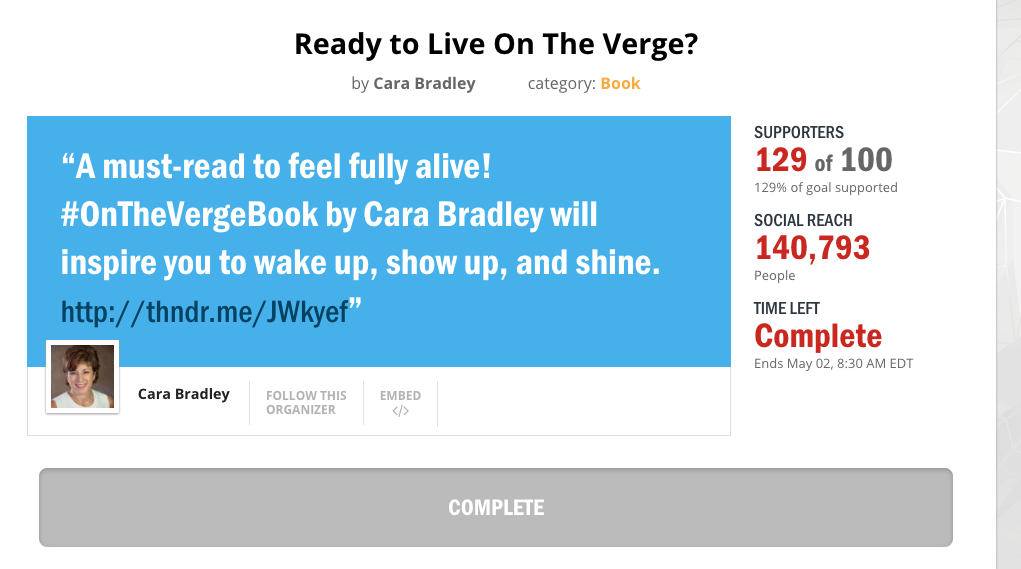
    This is what the complete campaign looked like.

    Thunderclap campaign 2

    Once you finish creating your campaign, you must submit it to Thunderclap for review. They say it takes two or three days, but our campaign was approved almost immediately.

    Be ready to take action once your campaign is live!

    2. Promote your campaign

    Once your campaign is live, you have a limited amount of time to spread the word, so it’s time to get to work.

    Here are some of the tactics we used to promote Bradley’s Thunderclap:

    Social media:

    Naturally, we turned to social media — primarily Facebook and Twitter — to promote the Thunderclap campaign.

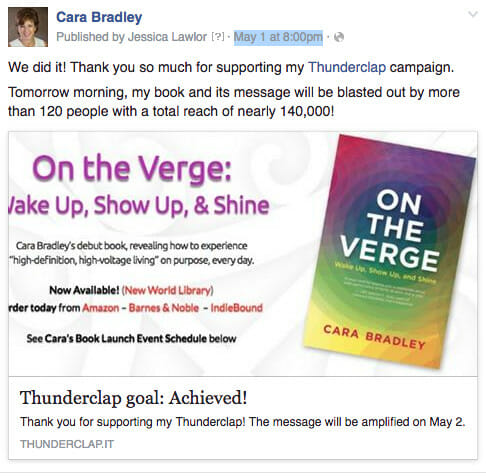
    On Facebook, we announced the Thunderclap campaign, shared an update on the campaign midway through and published a wrap-up thank you post after the campaign was complete.

    Cara Thunderclap FB

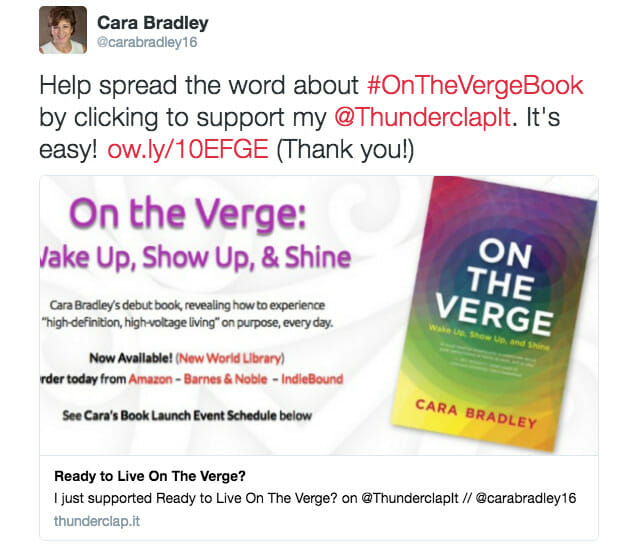
    On Twitter, we scheduled several tweets from the launch of the campaign until the very end to keep up the momentum.

    Cara Thunderclap tweet

    Personal email:

    Bradley sent a personal email to her friends, family and book launch team. In the email, she explained what Thunderclap is, talked about her campaign and asked for their support.

    Here’s sample text you can use in your own campaign:

    I’m writing today to ask one more favor and promise, this task takes less than one minute to complete. It’s to help me spread the word about my Thunderclap to promote the book.

    Thunderclap is a really neat social crowd-speaking platform that helps people be heard by saying something together. It allows a single message to be mass-shared, flash mob-style, so it rises above the noise of your social networks. By boosting the signal at the same time, Thunderclap helps a single person create action and change like never before.

    My goal is to get 100 people to agree to share the below message about my book by X DATE (we’re at Y so far). When I hit 100, on X DATE, that message will be blasted out to all those who agreed to share, spreading my message even farther and wider than I could ever imagine.

    It’s SUPER easy to participate- click THIS LINK and then click “support with Facebook” or “support with Twitter” and voila! That’s it.

    It was most crucial for us to stress how easy supporting Bradley’s Thunderclap would be. We made sure to tell her community it would take less than one minute to complete.

    This email was the single most important promotion tactic we used; your close friends, family and network are the most likely group to want to share their support, so leverage those relationships and don’t be afraid to ask for their help with the campaign.

    Email newsletter:

    Bradley’s been building her email list for quite some time, so when it came time to promote the Thunderclap campaign, we turned to her email community for support.

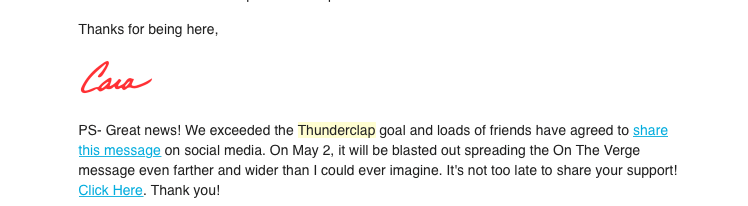
    Thunderclap was included as a message in two of Bradley’s weekly emails in April.

    In the first email, we created a section to explain Thunderclap, similar to the above messaging. In the second email, Bradley had already reached her goal on Thunderclap, but we still wanted to grow her reach, so we included messaging in the “P.S.” section of her email to thank people for adding their support and to give an update on the campaign.

    Cara Thunderclap email newsletter

    3. Prepare website for campaign launch day

    Because the Thunderclap campaign linked back to Bradley’s book landing page, we expected an increase in traffic to her site on the morning the campaign launched.

    To leverage the new eyes visiting the website, we made it a priority to do a quick review to make sure:

    • The book was prominently featured on the homepage of the website
    • The book landing page was up-to-date, clean and easy to navigate
    • It was easy to find links to purchase the book
    • Calls-to-action to join her email list were clear

    Results

    Bradley’s campaign ended on May 2 with 129 out of the target 100 supports — and a total social reach of 140,793. Goal exceeded!

    Cara Thunderclap GA

    Website traffic tripled on May 2 with 68 percent of traffic that day coming from social (i.e. social shares from Thunderclap). Fifty percent of pageviews that day were to the book landing page and Bradley welcomed a handful of new email subscribers that day, as well.

    Most importantly, the message of Bradley’s book was blasted out by more than 120 people with a total reach of more than 140,000. Those who are active on social media know that the long game is more important than short-term wins, and Bradley’s name and book being shared by so many on Facebook, Twitter and Tumbler helps introduce her message to a brand new audience.

    Overall, creating, launching and promoting a Thunderclap campaign took less than three hours, yet created massive buzz and increased interest in Cara and her book.

    What do you think of this method of attracting social momentum? Would you try it for your own book or product release?

  • Skip the Guest Posts: Here’s How to Promote Your Blog

    Skip the Guest Posts: Here’s How to Promote Your Blog

    Know what’s even better than guest posting on a popular blog?

    Getting mentioned or featured by a popular blogger, with a link back to your blog.

    When you have an expert link to you on their blog and say, “Hey, look at this valuable info,” you are golden. No hours of sweating a topic and writing a draft necessary!

    Essentially, a guest post is you promoting yourself on someone else’s platform.

    By contrast, a mention from a top blogger is a recommendation from someone with thousands of loyal followers.

    Which would you rather have? I thought so.

    But there’s a catch: How can you — as a blogger who’s starting out, or has just a small audience — do something noteworthy enough to earn these valuable mentions and links?

    Quick answer: Study what others do in your niche, think about what your readers need most — and then find a way to stand out. Bust a major move.

    You can do it! I know, because I started as a total blogging newbie, and didn’t know any big bloggers. But I managed to get mentioned on many of the top sites in my niche.

    Here are four things I did that helped me get those prized backlinks:

    1. Enter contests

    Whenever you see contests for bloggers, enter.

    In fact, start writing posts with the express purpose of winning contests you know are coming up! Contests are a terrific way to gain a ton of exposure to new readers quickly.

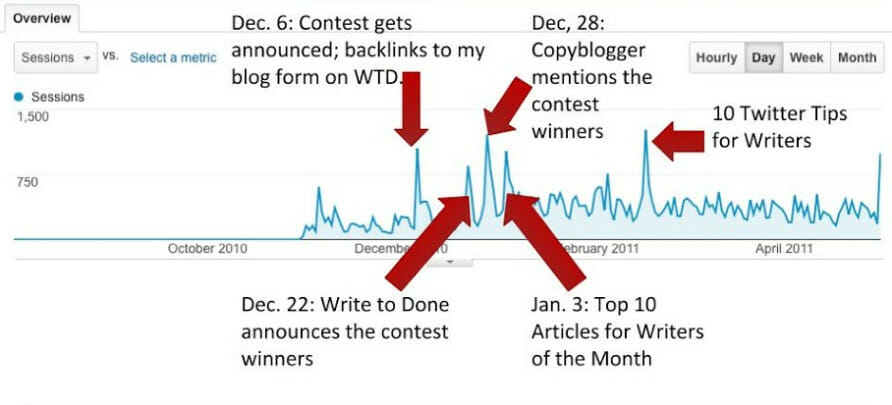
    My blog’s audience skyrocketed at the end of 2010, when I entered the Top 10 Blogs for Writers contest on Write to Done. Readers nominate you, which creates backlinks on Write to Done, even for those who don’t eventually win!

    When I won, that created another backlink and drove more traffic.

    In all, the contest created a major traffic surge for my blog. You can see in the chart below that my blog had only modest traffic before the contest win — 200-300 views a day (I didn’t have Google analytics until November 2010, so the figures start there).

    Soon, I began seeing many days above 1,000 views:

    Carol1.jpg

    With new readers arriving who’d seen the contest link, a couple of blog posts in January and February created similar spikes. Years later, when I analyze my biggest sources of blog traffic, I can still see a steady stream of new readers from my contest wins.

    Writer’s Market has a whole section on contests, and you can Google “blogging contests” to find many online.

    Note: I’m NOT talking about the scammy types of contests where you pay a stiff fee to enter. There are plenty of free or very-low-cost contests, so concentrate on those.

    2. Do something different

    One of the first things I did on my blog was start a petition writers could sign vowing they wouldn’t write a blog post for $15 or less. It was sort of a crazy idea, but it got readers taking action — or talking about why they wouldn’t sign.

    It was something different, and it got some mentions on other blogs.

    I got a taste of what standing out could do for me, and looked to take it a step further.

    In late 2010, I made a decision that if my blog was all about fair pay for writers, I needed to put my money where my mouth was. At the time, few blogs paid.

    So I started paying guest bloggers $50 a post (now $75). More importantly, I began advocating for websites to pay their contributors.

    My pay policy gets my blog mentions and links in many, many roundup posts about paying writing markets on popular blogs. Being a paying market continues to be a point of difference for me — and I consider the money I spend paying writers for guest posts my marketing budget. It’s money well spent.

    3. Provide high-value posts

    We all have days when we crank out a quick idea for our blog because we’re rushed or short of time.

    But if you want top bloggers to take note of you, it requires some serious thinking about your content. Analyze your most popular posts and the most popular posts of big blogs in your niche.

    What are the hot topics that get a spike of readers? That’s what you need to write about.

    I was pretty slow to figure this out. But if my blog is addressing the primal need of helping freelance writers earn more, it would help if I showed them exactly where they can get a better-paying gig! Duh.

    Once I figured it out, it wasn’t even hard to do. When I began paying for guest posts, I started hearing from other paying blogs. In short order, I had a short list.

    When I started publishing big roundup posts of paying markets, these were widely linked to by other blogs. I’ve made these market lists into a regular feature, because they continue to be big traffic drivers.

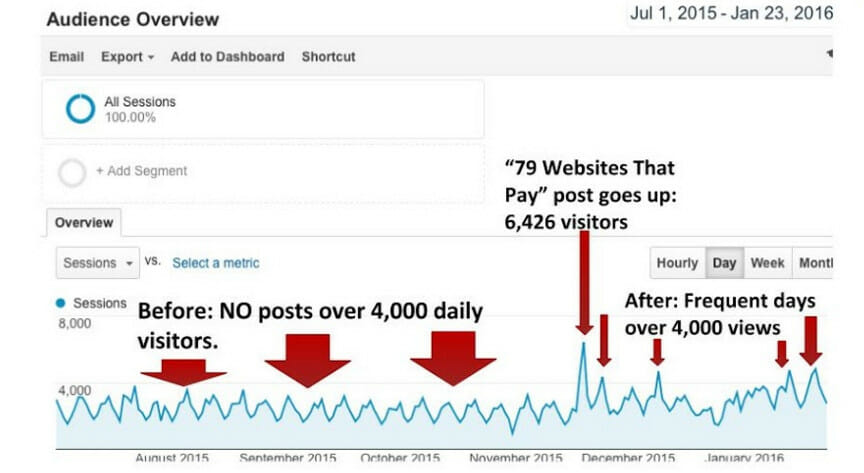
    Here you can see how my most recent, biggest-ever list post created a huge traffic spike that led to a new, higher baseline for post traffic:

    blogging

    This comprehensive list of paying markets created a major traffic surge.

    It’s the sort of event that’s a game-changer for the size of your blog audience.

    4. Be their case study

    Have you used a top blogger’s tip, and it helped you be healthier, wealthier, or happier? Let them know, and offer to serve as a case study.

    Give them a testimonial, do a Skype recording with them, come on their podcast — and they’ll pop you on their sales page and mention your blog for months or possibly years to come.

    I’m a case study inside of several different top bloggers’ courses or communities, and constantly hear from new readers who found me that way.

    Think creatively

    There are plenty of other ways to promote a blog: Press releases, in-person networking, and public speaking spring to mind. Some folks are techy enough to create an awesome tool to get them mentions.

    You know your market, your capabilities, and what the top bloggers in your industry might respond to.

    It’s worth the time to figure out how to stand out and get noticed.

    Of course, unless you’d like to spend hours and hours writing guest posts, when a quick mention from a top blogger can often get you even more visitors back to your blog.

    What strategies have you used to grow your blog’s audience?

  • Think Rules are Made to be Broken? Ignore These Popular Blogging Tips

    Think Rules are Made to be Broken? Ignore These Popular Blogging Tips

    Rules? Yeah, they’re made to be broken.

    In the world of writing, blogging and online marketing, there are a lot of rules and best practices shared by experts and novices alike.

    It can be confusing as a new or even seasoned writer to determine which rules are worth following and which rules might be beneficial to break.

    Finding success online as a writer is certainly not a one-size-fits-all equation. Sometimes it’s smart and strategic to ignore popular advice and go with your gut. There are many different approaches, strategies and tactics to pave a path as a writer.

    Be a rebel! Here are some popular online writing rules worth breaking and stories from successful bloggers who broke them.

    Rule #1: You must select a niche

    This is hands-down the single most popular piece of advice I hear bloggers wax poetic about: Find a niche to build an audience and grow your blog, rather than keeping your content more general.

    After years of niche blogging (one lifestyle blog, one travel blog and one book review blog) I decided “the hell with it!” I’m a multi-passionate person with many interests and I wanted my blog to reflect me as a person. I wanted to build a brand around my name and personality, not a specific interest or area of expertise.

    So, I did. My blog’s general umbrella topic is stepping outside of your comfort zone to reach your goals, but tons of different subjects fit nicely under that more generic concept. And for nearly four years, this approach has worked for me, building a community more than 1,000 strong that allowed me to eventually quit my job to work for myself.

    Instead of cornering yourself into a tiny niche that you may lose interest in, write about the subjects you’re passionate about. Your readers will connect with you more when it’s clear you’re excited about your topic of choice.

    Rule #2: Don’t build your house (or blog) on rented land

    Licensed therapist, coach and writer Melody Wilding has spent the majority of her career rebelling against the traditional way of doing things. That same mindset applies to her blog strategy.

    “I’ve bucked the rule that says ‘don’t build your house on rented land’ or in a nutshell…the prevailing marketing advice that encourages people to build their own blog readership from scratch.”

    As Melody explained, many online marketers encourage newbies to spend the majority of time and effort building their own website, blog and platform, keeping your best content permanently on your online home. Instead, Melody grew her following by leveraging other people’s platforms, audiences and authority to grow her own.

    “Through strategic guest writing and becoming a contributor for major sites when I was first starting out, I 10x’d my audience in a fraction of the time it would have taken me to do on my own,” she explained. “Then, I also had some big names behind me that I could further leverage to grow my audience and subscribers.”

    Fun fact: Melody didn’t even have a blog on her website during her first two years in business, but was still able to successfully grow a following through guest blogging and building an email list.

    Rule #3: It’s all about SEO

    Another popular piece of blogging advice is to make your post as SEO-friendly as possible to ensure the maximum amount of people can find your content when they search on Google. Your headline matters and your post should be scannable with bullets, lists or sections, they say.

    Yes, SEO is important, but when you try to fit your content into a pretty little SEO-happy box, you sometimes leave little room for creativity and personality.

    Many popular blogs recommend crafting post headlines that are quick, to the point and simply explain what the post is about, rather than using a catchy or emotion-driven headline.

    Meanwhile, Mary Catherine Starr of StarrStruck Blog says that she often breaks this rule by writing posts with headlines that her readers will like and understand, but may not necessarily be SEO-worthy.

    Bloggers also recommend writing short, succinct and easily scannable posts by using bullets, sections or creating a list-based post. Mary Catherine says she is proud of her longer, more personal posts that aren’t necessarily formatted as a list or with bullets.

    “Catchy, trendy posts aren’t my style and while they may be a great way to get lots of new visitors or eyes on my blog, I’d rather stay true to what feels authentic to me, even if it won’t make me as popular,” she said.

    Rule #4: Long-form content is where it’s at

    Long-form content is very trendy right now. It makes sense; as this KissMetrics post suggests, “long-form content gets you more of what you want.”

    However, there are definitely times shorter posts can come in handy and be just as useful to your audience as a 4,000 word ebook.

    “When the topic’s right, I’m big on breaking the ‘longer is better’ rule that’s oh-so popular right now,” explains Brittany Berger of Blog Bolder. “Sometimes the topic I’m writing about can be explained clearly in less than ‘the magic 1.5K.’ Continuing to write for the sake of SEO and shares when I’ve already given the reader what they need feels like putting my wants and needs above theirs.”

    Not every blog post you write needs to be an epic, all-encompassing guide or tell-all. If you can get your point across succinctly, do that.

    Rule #5: Monetize your blog as quickly as possible

    A lot of bloggers get in the game because they think they will be able to make a lot of money through their blog or website. Making money online is a great long-term goal to set, but goals like creating awesome content and developing a loyal community should come first.

    Geekadelphia editor-in-chief Mikey Ilagan said, “We’ve been around for nine years and have given a voice to things people might not have heard about otherwise. We actually rejected monetization for the longest time. Now, our Patreon sustains our servers, but building the blog and community was never a financial venture.”

    Instead of chasing the money, chase your community. Build a community that loves you, your content and your brand first and then consider adding monetization into the mix.

    Rule #6: Don’t get too personal on your blog

    You want to be seen as a professional, right? Then, don’t get too personal on your blog. At least, according to some experts.

    Right now, lots of bloggers are talking about the importance of delivering value to your readers. While I don’t disagree with offering your audience value, what about simply sharing good stories that help readers to connect?

    This is the approach The Write Life contributor Marian Schembari has taken with great success, even leading to new clients.

    “The fact that I post about my personal life has been positive,” she shared. “For a long time I worried that posting about my marriage or about money or travel would ruin the brand I’d created as a writer. But really, new clients love sharing stories too, just like normal humans. Now I’m known as a “storyteller” and have had a few new client requests come through from people who want me to share their stories.”

    Rules? Yeah, they’re definitely made to be broken.

    The only rule that always has and always will apply — and we think you should follow this one! — is to be yourself and do you.

    When you’re true to yourself online, your authenticity shines through and your readership will take note, allowing you to grow genuinely and organically.

    Have you broken any popular blogging or writing rules? Tell us all about it in the comments!

    bloggingmyths

  • How to Get People to Read Your Blog: 5 Savvy Strategies You Can Apply Today

    How to Get People to Read Your Blog: 5 Savvy Strategies You Can Apply Today

    So you’ve started a blog. Congratulations! You’ve joined roughly 74 million others, and that’s just counting those who use WordPress.

    (If you still haven’t started a blog, we highly recommend heading over to Bluehost to set one up right now!)

    Many people believe starting a blog is the most challenging part of the process.

    And believe me, I know starting a blog is nothing to sneeze at.  

    But when you start a blog, you feel excited and motivated. In your early days of blogging, the momentum of trying something new and different keeps you going.

    The most difficult part of blogging is what happens (or what doesn’t happen) next: Getting people to actually read your blog.

    “If you build it, they will come,” some say.

    …Not necessarily.

    In order to create a blog that will last for the long haul, build community, perhaps even make money and help you achieve your goals, this is where the hard work begins.

    You need to get people to actually read your blog. Here’s how to do it.

    1. Write amazing content

    First and foremost, your content needs to be amazing. There are way too many blogs out there with mediocre content. Yours needs to be better.

    There are several different ways to write blog content — and some may prove more effective than others. Consider these types of posts to provide value to your audience and keep them coming back for more.

    • Content roundups: A content roundup an authoritative post that lists the top 100 or another number of your choice whatevers (people, products, pieces of advice, podcasts, photos, websites, etc.) in your industry or niche — is an excellent tactic to send traffic your way, create authority and build lasting relationships.
    • Weekly or monthly features: Developing a regular feature, whether weekly or monthly, is a great way to let your audience know what consistency they can expect from you.

    For example, every Sunday I post a feature on my blog called “Start Your Week Right Sunday” where I highlight five to seven awesome links I found throughout the week and share my goals for the week ahead. It gives me the chance to highlight other awesome bloggers (like the content roundup idea above) and gives me at least one post idea per week to keep the content flowing.

    • Personal posts: When it comes to blogging, don’t be afraid to get personal. When you open up and allow yourself to be vulnerable, you show your audience you’re human. It will be easier to develop true relationships with your audience if you are willing to share it all: The good, the bad and everything in between. 
    • Massively useful guides or how-to posts: Creating a tell-all guide or an epic how-to post is a simple way to gain credibility and help your audience by giving them information they need to know at the same time. These types of posts tend to do well over time because they usually rank high in search.

    2. Spend just as much time marketing your content as you do writing it

    Once you publish a blog post, the work is far from over. The only way people are going to know you have new content is if you tell them!

    Time to put on your marketing hat.

    Follow the “rule of three”: When you create a piece of content, promote your new piece of content in at least three different places, at minimum, to make the writing worth your while and to ensure your content is actually being read.

    Here are some places you can share your content:

    • Facebook: Share your post on your personal page, on your brand page if you have one, and in relevant Facebook groups where sharing is allowed. 
    • Twitter: Draft several different versions of tweets to promote one post. Use tools like Hootsuite or Buffer to schedule tweets far into the future to ensure your post is being promoted over a longer period of time. 
    • Instagram: Post a relevant photo or blog graphic on Instagram and change the link in your Instagram profile to the link of the blog post you’re currently promoting. 
    • LinkedIn: Create a status update or consider republishing part of the post using LinkedIn’s powerful publishing platform. Include a link back to your site at the beginning and end of the post to let readers know where the content originally appeared. 
    • Pinterest. Include a photo or graphic with each post so that your content is Pinterest-friendly. Pin your posts to a specific blog board or other relevant board within your Pinterest account. 
    • Snapchat: If you’re active on Snapchat, take a photo of your blog post or create a short video talking about your latest post and encouraging viewers to check out your blog.

    3. Start building your email list, now

    The best thing a new blogger can do is start building your email list from the get-go. Even if you don’t plan to use it right away, starting to collect email addresses is crucial for building a community that trusts and allows you into their precious space: Their email inboxes.

    I recommended getting started  started with Mailchimp. It’s relatively user friendly and free for up to 2,000 subscribers.

    Begin collecting email address on your website by adding call-to-action boxes with HelloBar, an awesome lead generation tool that appears at the top of your website. Include an invitation to join your list at the end of each of your blog posts.

    Want to get even more people to join your list? Offer them a freebie, commonly known as an opt-in or lead magnet. Your lead magnet can be as simple as a one-page PDF checklist or as complex as an ebook, course or video series.

    Think about it this way: Your audience likely spends a lot of time in their inboxes already. When they share their email addresses with you, you increase the chances of them reading your content because you’re reaching them in their own personal space, rather than through a social media account or RSS feed.

    4. Figure out simple SEO

    I’m no SEO expert, but knowing basic principles can help you think differently when crafting blog post headlines and content to help your post rise in search rankings.

    There are easy things you can do to help your SEO, like choosing a keyword, crafting straightforward headlines, adding images to your post, and using numbers, subheads or bullets for easy reading.

    If you’re using WordPress, add a plugin like Yoast SEO to help your post perform better in Google’s eyes. Yoast allows you to preview what your post will look like on Google and allows you to select a keyword and change a post’s meta title and description to help boost your post on search.

    Yoast uses a handy traffic-light image (green=awesome, yellow=getting there, and red=room for improvement) to show how well your post is prepped in terms of SEO before you publish.

    5. Consider guest blogging on sites you admire

    Guest blogging is perhaps one of the top ways to get people to actually read your blog.

    When you write a guest post for another blog, you’re opening yourself up to a whole new audience of people who don’t yet know who you are, but will likely head over to check out your website if they like your guest content.

    Be smart about where you pitch a guest post. Naturally, you want the blog you’re pitching to have a larger and more established audience than your own. When your pitch is accepted, make sure you write an awesomely useful post and if allowed, link back to your website or relevant posts you’ve written.

    Once the post is published, be sure to share it as diligently as you’d share your own content and get to know that community by participating in the discussion in the comments section.

    Similar to guest posting, consider pitching your already-written blog posts to other blogs and websites that are open to republishing or syndicating content. If you write a post you’re proud of, seek another home for that post on a blog that may introduce your work to people who are good candidates for your own community.

    Have other ideas to get people to read your blog? Let’s hear them in the comments!

    This post contains affiliate links. That means if you purchase through our links, you’re supporting The Write Life and we thank you for that!

  • How to Declutter Your Writing Ideas and Finish More Projects

    How to Declutter Your Writing Ideas and Finish More Projects

    A new writer recently asked me, “When you have several half-finished projects, how do you choose which one to start working on again? I look at my writing folder and feel overwhelmed!”

    I know the feeling.

    One of the most frustrating things about being a writer is having too many ideas. Given how hard it is to succeed in the business and how many of us seem to suffer from debilitating writer’s block, “too many ideas” might sound like a blessing.

    But think about how many aha! moments you’ve had. How many brilliant stories you’ve conceived. How many shower thoughts you’ve scribbled into notebooks.

    You can’t write them all.

    But you feel a lingering duty to these unrealized ideas. They sit in the back of your mind like an anchor when you try to move on to the next project.

    How do you prioritize?

    What to do with half-finished writing projects

    I don’t have a perfect solution. My writing folder, too, has loads of half-baked ideas without a clear destiny. I sometimes find myself paralyzed at my computer, unsure which project to focus on.

    But I’ve figured out a few steps that help me clear the clutter and work on what matters.

    1. Know what to let go

    First, you’ll reduce a ton of overwhelm by deciding which projects are lost casuses.

    Give yourself permission to let them go.

    Abandoning projects is scary. You loved the idea once, and you’ve put so much time or energy or passion into it.

    What’s really scary, though, is you’re afraid you’ll never have another good idea. Don’t worry; you definitely will.

    New, better, stronger ideas will always come along. And the effort you’ve put into old projects is never wasted. Consider it exercise that strengthened your writing skills for new ideas.

    You don’t have to completely trash these projects if you’re not ready. I have a folder in my drive called “archived projects” for the stuff I’ve stopped working on. Within that folder is a folder for each year (I told you the ideas never stop coming).

    2. List the steps needed to finish each project

    Once you’ve cleared the roughage, you can start to make sense of the rest.

    Look at each unfinished project, and make a quick list of the steps you need to take to finish it.

    For example, if you’re sitting on a completed manuscript, it may need a few rounds of edits, to be pitched to agents, or to go through the self-publishing process.

    Partially-written books, stories or essays may need a stronger outline, feedback, more research or just time to focus on writing.

    3. Determine which projects are nearest completion

    Now use those project-specific to-do lists to determine which projects are nearest completion. If you focused only on one project, which could you finish soonest?

    This could be as simple as finally submitting an essay you’ve been afraid to act on. Or pitching an article idea you outlined months ago. Or publishing and promoting a forgotten blog post idea.

    4. Pick something near completion and finish it

    In general, I recommend picking up the project that’s nearest completion, and finishing it.

    Try to find something you can accomplish pretty quickly — this week or this month. The accomplishment is motivating, so it’ll be nice to do it soon. Checking off one task makes it a little easier to work on the next thing.

    Be aware as you choose a project, though: Do you dread working on it? Do you find yourself stuck again because the project nearest completion turns out to be something you hate working on?

    Don’t be afraid to let go of more projects at this point.

    If you’ve got a five-year-old, almost-finished project you hate sitting at the top of your to-do list, it’s going to be a roadblock to getting anything done. Archive it, and move on to the projects you love and want to dedicate your time to.

    5. Prioritize what’s left, and make a timeline

    Once you’ve finished a quick project, start to prioritize what’s left (after celebrating, of course). Continue to work on the tasks you can finish quickly, but also set goals for the longer projects.

    The quick projects are nice to finish, because they help you clear the clutter. But if you have a novel that’s five years away from publication, you probably don’t want to keep pushing it off for a year to finish essays, for example.

    Set some reasonable deadlines for yourself. Do you want to have a novel published in the next five years? Ten? How many short stories, poems or essays do you want to submit in a year?

    Create timelines with these goals and project to-do lists in mind, and find time to work on them accordingly.

    Why this system is totally flawed

    Walking through these steps periodically has helped me keep my writing life under control. It keeps me moving forward, instead of getting stuck on useless projects.

    But it’s imperfect.

    The problem is that the ideas never stop coming.

    You won’t go through one spring cleaning and organization of your writing projects and be set for life. You will continue to have new ideas you absolutely love, and you’ll constantly have to re-organize and re-prioritize.

    Keep these steps in mind as you do it, and I hope you’ll be a little less overwhelmed.

    What strategies do you use to prioritize your writing projects?

  • 9 Places to Find an Expert Source for Your Next Article

    9 Places to Find an Expert Source for Your Next Article

    While first-person pieces can provide a valuable personal perspective, sooner or later, you’re going to need to find sources for some of your articles.

    And sometimes finding helpful sources can be tough.

    Whether you need to find a barber or an astronaut, there are ways to find just about any kind of source you need.

    But tracking down these sources isn’t always simple. Sometimes, you need to go through a PR firm or media department, so be sure to contact sources early to leave time for this additional “gatekeeping” step (not to mention top-choice sources may be busy or out of town).

    While it might be a pain to go through a media or PR department, these gatekeepers can be incredibly helpful and assist you by tracking down busy industry executives and professionals who may not be terribly excited to talk to the media. But the PR person’s job is to get publicity for their company, and they may be able to encourage someone to chat with you even when the subject would rather decline.

    Try the techniques below to locate your sources, then use these techniques to have a successful in-person or phone interview.

    1. HARO

    HARO, or “Help a Reporter Out,” can be a reporter’s best friend. To use the service, simply register and submit a free source request, including a synopsis of what you want to learn, any required qualifications, and your reporting deadline. HARO will send your message to its network and potential sources will find their way to your inbox. The site boasts over 475,000 sources in its network.

    I’ve used this service to find experts in fields beyond my normal network as well as to find “regular people” to interview. Many HARO subscribers work full-time for an organization, but still fit other subject criteria you’re looking for (like Uber drivers or baseball coaches).

    2. ProfNet

    ProfNet is similar to HARO in that it helps connect writers with expert sources. Sign up with a query or register for an “expert alert” newsletter that highlights sources for news-worthy events.

    Writing your query? Include a bit about who you’re looking for, your deadline, and even select the regions and types of organizations that will receive your message. I’ve been able to find a number of sources through this network.

    3. Search engines

    Sometimes, using the most basic technique is the best way to find a subject. Go to Google or another search engine and type in what you’re looking for.

    For example, a search of “astronomy experts” brings up a number of great links. They include a link to a listing of astronomy experts at, complete with their contact information and profiles. The first page of the Google results includes similar links to experts at a number of other universities.

    You may have to sort through the Google results to find just the right expert, but simple searches often provide a great place to start.

    4. Use academic sources

    I do a fair amount of science writing, and sometimes I need to reach out to a high-level expert in a given scientific field. I’ll often use Google Scholar to find recent academic papers on the subject I am reporting on, and then I’ll look up the authors of those papers as potential sources.

    The papers themselves frequently provide an email address from the primary author, and faculty are typically easy to look up in university directories.

    Sometimes you’ll have to go through the school’s media department to reach the person you need to, but it’s often worth the hassle. If you can’t identify a specific expert you need to talk to, reach out to the media office and they can likely put you in touch with an expert in that field.

    5. Use social media

    You have your favorite social tools for a reason. Use them! Reaching out via Facebook, Twitter, Instagram, and any other social networks you use is a great way to connect with potential sources, whether you’re looking for someone to comment about their experience with new technology or for a parent struggling with a picky eater.

    You never know who’s following your social media feeds, and some of them might be great sources.

    6. Reach out to your network

    The days of having a physical Rolodex on your desk are long past for most writers, but the days of pulling out your electronic Rolodex are in full force. When you need a source, turn to your email contacts or your mental address book to recall who might be helpful.

    7. Contact past sources

    While you won’t want to repeat your sources frequently, but sometimes it might make sense to use a previous source for a future article. That’s why it makes sense to build relationships with sources so you can easily get answers in the future. If they know you’re professional, they’ll be likely to promptly return your call.

    8. Ask Your Editor

    If you’re struggling to find a source, consider asking your editor if they have someone in their network you can contact. While you won’t want to do this with every story, an editor might be able to help you once in awhile if your other means of source-finding fall through.

    9. Try Industry Sources

    If you’re looking to interview the owner of a floral shop, it only makes sense to call up floral shops near you and see who you can find. But what if you’re not sure which job title would be best to talk to?

    Consider contacting a local professional organization to find someone in the field. If you’re looking to interview a travel expert, consider reaching out to an organization for travel agents to see if they can send a note out to their networks to find a source for you. If you’re lucky, they may already have someone in mind.

    Where do you turn when you need to interview an expert source?