When you see a trend or niche taking over an industry, it’s easy to think, “Did all of these just coincidentally get published at the same time?: More often than not, this is what is called to write to market.
Instead of authors and writers taking a story that they want to tell, they look at what is already doing well in the overall marketplace and create stories and writing similar to what is already selling.
As you can imagine, this can be a powerful tool for writers when used strategically. We’ll be going over what it is, how it works for both authors and freelance writers, and the pros and cons of such a publishing style.
What Does it Mean to Write to Market?
When most people imagine writing books or articles, they imagine a writer who comes up with a unique story and then brings it to life. They imagine some wild tale that the author has been dying to tell and they finally put it all together.
Instead, people who write to market focus on the audience and growing trends first instead of a story they have already created. The audience and the trends dictate what the author writes instead of doing it the other way around. That is, unless, there is some magical overlap between the two.
For writers who already create content online, this might not be a strange concept. Any blog writer knows how important it is to maximize trends and write directly to the audience.
Write to Market: What it Means for Authors
If you’re an author who wants to write to market, you’re going to pick a trending topic that readers are currently buying and create a story that fits into that market.
One quick way to see what is hot and trending to write about is to go to your local bookstore and take a look at the new releases. You can also see some of the most popular books being sold on Amazon, updated hourly, as well. There are thousands of niches and topics to choose from.
If you look long enough, you’ll start to see common themes, patterns, and types of stories. These are exactly the kinds of things you’d want to make notes about if you’re considering doing this.
An example of this type of writing is to think of romance novels with the same types of covers and storylines that have been written over and over through the years. Some years they’re in greater demand than others, but overall it’s a popular style of book that continues to sell well. (50 Shades of Gray, ring a bell?)
Let’s go through the pros and cons of choosing to write to market as an author.
Pros to write to market for authors
One pro of creating a book that’s written to market is that authors might get a chance to write about a topic that they’ve never written about before.
If you’re an author who is looking for some much-needed inspiration and wanting to change it up, finding a completely new topic might be the creative spark you need.
With a trending niche, keep in mind that time is of the essence. While this might be a pro or con for you, depending on how you view it, the good thing is that you’ll need to turn that draft around quickly to make sure you ride the wave of its popularity. The con is also that you’ll need to turn it around quickly.
Following a trend can help you get out of your writing rut and write about something you never have before. If you’ve typically written historical novels, it might be a good change of pace to write a horror book.
Cons for authors to write to market
One big downfall of authors focusing on a write to market book is that the turnaround time can take a long time with traditional publishing.
Authors who choose to self-publish have a better chance of riding the waves than authors who go the traditional route. This is because by the time a book goes through all the traditional editorial stages, often the trend is already over or at least nearing its end.
Another con for authors is that the book might not be a topic they want to write about. They’re going based on what is hot at the time instead of a story that they’re excited to write. That can sometimes make the projects drag on or feel tough to write and put in the hours to get it done.
You might also see your book not do well over the long term. It might only ride the wave of success for a short time and quickly fall off the radar.
Write to Market: What it Means for Freelancers
Unlike authors, freelance writers have much more flexibility when it comes to choosing what to work on.
Similar to picking a niche, when a freelancer chooses to write to market, they are taking a look around at what is popular or in demand for writing.
If you’re in any freelance writing groups, you might also notice which trends more writers are talking about, which might give you some inspiration for topics and niches to write about.
Let’s go through the pros and cons of choosing to write to market as a freelancer.
Picking a niche as a freelance writer
When it comes to picking niches and topics to write about as a freelance writer, often, the sky is the limit. There are more niches out there than you could spend your entire life writing about.
While it might be hard to pick just a few, keep in mind that you can always change it down the line. If you write for an industry for a certain amount of time and then decide to change your mind, you always can.
Generally, it’s a good idea to pick industries and niches you have some experience or knowledge in, only because it’s much easier to write about something you know than something you have to extensively research. Plus, it saves you a lot of time so you can get drafts out faster than you would with a topic you don’t know well.
Looking to get into a hot market? Take a look at this monster list of 115 potential markets to write for.
Pros to writing to market for freelance writers
One great benefit to this is a freelance writer is that you can quickly gain attention and popularity by riding the trending waves at a time.
This is also a quick way to start to grow a following, as you can hop on and ride a trend for a while instead of waiting to put together a huge, labor-intensive project.
As you can imagine, you might also be paid faster than you would with projects that take longer to create. It doesn’t necessarily mean you’ll be paid more over time, but if you need the cash sooner than later, this might be a smart strategy for you.
Cons to writing to market for freelance writers
On the flip side, if you choose to do this as a freelancer, you’ll end up chasing trends. That can be a good or bad thing, depending on how you choose to direct your freelance career.
Having to chase trends means you will have to publish content at a quick rate to make sure you’re keeping up with the trends. This can prevent you from doing necessary deep work and deep dives into your specific niches.
Conclusion
Overall, riding a trend at the right moment can help catapult your writing career, but you’ll want to think deeply about if it’s a strategy that will work for you.
As CEO of your personal brand — yep, you’re not just a writer anymore — you’re in charge of finding new assignments, writing, editing your work, promoting your pieces and seeking out opportunities to continually develop a strong personal brand that sets you up for future success.
If you’re feeling overwhelmed by all the possibilities, we get it. Social media tools can feel daunting, but there are quick things you can do every day to slowly grow a brand that rocks.
Hop over to Part One for tips on using Facebook and Twitter to develop your platform. Then, meet us back here for Part Two on LinkedIn, Instagram, Pinterest and Snapchat.
If you thought LinkedIn was just another career site to repurpose your resume, think again. LinkedIn has emerged as a publishing powerhouse over the past few years. Time to dust off your profile!
If you don’t have your own website or blog, use LinkedIn to write content and share your expertise. If you do have your own blog, republish some of your posts on LinkedIn, sharing a link back to the original post on your site.
LinkedIn shares your post on your profile as well as on the main news feed, allowing your words to be viewed by those who follow you and the greater LinkedIn community.
Update your profile with documents, images and presentations
Gone are the days of copy and pasting resume bullets into LinkedIn and calling it a day. LinkedIn is fancy now!
Now you can add all kinds of media to different positions listed, including presentations, videos, documents and photos. Set yourself apart by making your LinkedIn profile an interesting and visual place to get to know you and your work.
One of the best ways to optimize your LinkedIn profile is to check out this Freelance Writers Den program. They have numerous case studies on how freelance writers are using LinkedIn to get INBOUND leads and land clients.
Instagram
Who doesn’t love scrolling through Instagram? It’s meant to be a beautiful place for creativity, inspiration and eye candy. And it can also help you build a strong writing brand and community.
You get one link
Instagram is notorious for only giving users one link in their profile and not allowing clickable URLs within a post. The truth of the matter is that Instagram doesn’t really want to be a place that sends traffic to your website; instead, it wants to be the place you build your brand and community through compelling images.
However, you do get one link, so use it wisely. Your link appears underneath your bio on your main profile. Most people include their website’s homepage in this space, but don’t be afraid to change the link every so often when you have something specific (an article, blog post, etc.) you want to give a little extra love.
To draw attention to that link, post a relevant image, write a clever caption and then include somewhere in the post the phrase “Link in profile” so folks know to click over to your Instagram homepage if they want more details.
Use Insta-stories
The best way to get your content discovered on Instagram is by using their stories and reels features. Just like Snapchat (which we’ll cover in a minute), Instagram allows you to create short-form stories called Insta-stories.
What are Insta-stories?
They are typically made in 15-second increments of video but can be strung together for as long as you want to record. They can also be photos, music, or text, depending on what you want to post. The trick is that they expire in 24 hours, creating a border-line addictive need for your audience to know what you’re up to.
What are Reels?
Reels are similar to Insta-stories in that they are short-form content, but they are slightly different in that they can last for longer than 24 hours on the platform. They are currently limited to 60 seconds of video, but you can overlay the video with plenty of other features.
If you’re asking yourself, “What would I ever use an Insta-story or Reel to do?” let me challenge you to get creative!
Writers and bestselling authors are using Insta-stories and Reels to show behind the scenes of their days and lifestyles, like Donald Miller. They are using it for podcast and speaking clips and promotion of upcoming events, like Jon Acuff. And they are even using it for audiobook previews, like Rob Bell.
There are plenty of other ways to utilize these powerful aspects of the Instagram platform, including promotional giveaways, announcements, and more. The possibilities are endless if you think creatively.
Use relevant hashtags
Another great way to get your content discovered on Instagram is by using relevant hashtags.
Hashtags are super useful, but can also quickly muck up a post if you use too many or don’t place them properly. If you only plan to use a few hashtags and they make sense within the text of your caption, sprinkle them there.
If there are other hashtags you’d like to use that don’t fit in the post itself, add them in the comments section. This way, when others comment on your post, the hashtags comment is hidden, but they still lead others to find your post.
More is not always better! Don’t pepper your post with dozens of hashtags, although Instagram does allow up to 30 hashtags on a given post. Consider using between five and 10 relevant hashtags on a given Instagram post.
Some favorite and popular hashtags for writers, according to Iconosquare? Try #writing #amwriting #writingcommunity #instawriting and #writinglife.
Pinterest
Pinterest may be best known for tasty recipes and some serious closet inspiration, but it’s also a great place to display your portfolio — and find additional writing inspiration and resources.
Pin articles and blog posts you’ve written, as well as any type of press you’ve received. Let this living resume Pinterest board be a place where you truly shine. (Here’s mine!)
Build your board over time rather than pinning everything at once to give your followers a chance to see the content in their feed as you pin. As you’re pinning archived content, consider posting three to five pins a day; once you’re up to date, pin new articles and posts are they’re published.
Find inspiration and be a resource to other writers
You know all those awesome articles and resources you find and want to save for to read later? Before you know it, you’ve got 25 tabs open in your online browser.
Nope? Just me?
Pin those articles to a Pinterest board about writing, marketing, entrepreneurship or whatever it is you’re hoping to build your brand and expertise in. This type of board not only keeps you organized, but also positions you as a resource for others who may be interested in similar topics.
Pinterest can serve as a great source of referral traffic to your website if you put processes in place to make your writing Pinterest-friendly.
You may not have much control over the images selected to go with your post on external websites, but for your own blog or site, use a free tool like Canva or PicMonkey to create fun graphics. These visual cues will entice viewers to repin your pin and click out of Pinterest to read your content.
Snapchat
If you’ve been ignoring Snapchat because you think it’s just for teens, grab your phone, download the app and prepare to be amazed. With 100 million daily users, Snapchat is nothing to sneeze at.
Create (or simply watch) a Snapchat story
Flex your creativity in a new way by creating a Snapchat story. Perhaps one of the app’s best features, Snapchat stories allow users to create a narrative through photo and video.
Within a story, a Snapchatter can write text, draw pictures, insert emojis, and add filters to mark their location, time, weather, speed and more. Speed videos up, slow ‘em down, put them in reverse; Snapchat allows you to share stories in a unique, fun and unfiltered way.
Consider documenting a day in your writing life using Snapchat. Don’t be afraid to flip the camera and turn it on yourself; Snapchat audiences love to see the person behind the phone. Talk to the camera about your latest writing project or what inspires you to write.
Remember: Snap stories disappear after 24 hours, so you have a limited window of time to share your message.
If you’re not ready to create your own story yet, watch stories of those you follow, or enjoy one from any of the “Live” stories featured that day.
Conclusion
If you’re neglecting social media as a writer, you’re doing yourself a disservice. You’ve invested so much time in creating great written content, don’t click publish and hope people magically find it. With social media, you can now get your written content in front of more eyeballs than ever!
You don’t have to use every social platform available. If you try, you’ll burn yourself out. But you can choose 1 or 2 that appeal to your audience, where your readers are already hanging out, and go for it!
What do you think? What is your favorite social media site? If you have any social media tips for writers, leave a comment and let us know!
This is an updated version of a story that was previously published in 2016. We update our posts as often as possible to ensure they’re useful for our readers.
It’s no secret that we’re expected to do much more these days than simply write.
Congratulations! You are now the CEO of your personal brand.
In addition to writing, it’s also your job to create a strong online platform to share your work, reach new readers and discover opportunities.
One of the most effective ways to build your personal brand is through social media. And these quick social media tips will help you confidently navigate those murky waters and build a writing brand that rocks.
Just like the writing world is always changing, the social media world moves at a ridiculously fast pace. It’s easy to get overwhelmed or even lost by all of the possibilities.
If the thought of adding another social media site to your already long list of things to do as a writer leaves you feeling frazzled, take a deep breath and settle in.
We’ve rounded up some quick tips and ideas for using Facebook and Twitter to develop your platform. Stay tuned for Part Two detailing how to build your personal brand using LinkedIn, Instagram, Pinterest and Snapchat!
While Facebook may be the place Aunt Sally comments on all of your photos and status updates (Thanks, Aunt Sally), it’s also emerged as a bustling social network to build community and meet fellow writers.
Join and participate in relevant Facebook groups for writers
One of the best ways to use Facebook as a writer is by joining relevant groups and communities. Participating in Facebook groups is a great way to meet and network with fellow writers, share resources, gather inspiration and even find new assignments and writing projects.
Your Facebook experience can be as pleasant and interesting as you choose to make it. By unfollowing people who no longer interest you and instead following publications and brands you love, your Facebook newsfeed can become a hotbed for writing inspiration.
Similarly, your Facebook network can help out when you’re in a bind. On deadline and need a last-minute source to interview or a quick quote for a piece? Facebook to the rescue!
Consider posting your sourcing needs in one of the active Facebook groups you’re part of and be amazed at the speed in which you’ll discover potential sources or interviewees.
Let your personal network in on what you’re doing
We tend to associate Facebook with being the social media site we use to share personal photos and stories and to keep in touch with family and friends. However, you never know when your personal life and professional life may have some crossover.
When I quit my job to take my business full time, I began sharing my “Becoming CEO” blog posts on my personal Facebook page. I left the privacy setting for those specific posts open to the public and was amazed at the reach of the posts and the number of people who weren’t my friends who began “following” my personal page.
Several interesting business opportunities have popped up after choosing to share my professional life with my personal network.
Twitter
This fast-paced social media site is the place to share your work, commiserate with fellow writers in real time and find inspiration for future writing projects.
Schedule your tweets ahead of time
An easy way to stay active on Twitter without spending all day online is to pre-schedule your tweets using a social media tool like Hootsuite, Buffer or Edgar.
Every time you craft a new tweet promoting a blog post or article you’ve written, create two or three different versions of that tweet and save them to a spreadsheet or Word document. Before you know it, you’ll have a master list of all the tweets you’ve written to promote your work.
One day each week, sit down with that document and schedule out at least three tweets a day for the next week. Be sure to share both your new content, as well as re-sharing older evergreen content; consider the fact that Twitter moves at a fast clip and just because you tweeted a post three months ago doesn’t mean your following necessarily saw it then.
Make friends and share the love using a “Notice Me” list
Promoting your own work on Twitter is important, but so is being an active part of the Twitter community. In between those tweets sharing your latest blog post or article, be sure to interact with those you follow and share their work, as well.
My favorite way to find great content to share is by monitoring my “Notice Me” list. It’s a curated list of bloggers, writers and entrepreneurs I admire who create great content and who I’d like to make part of my network.
I add these folks to a private Twitter list and check that feed regularly to find interesting content to share and people to chat with on Twitter. Twitter moves quickly and can be daunting, so curating a list of the people you actually want to hear from can help you save time and be more effective.
Share your writing progress with your community on a regular basis
If you’re not interested in live broadcasting your writing sessions (Let’s be honest: No one needs to see my signature PJs-and-messy-hair writing look), consider Periscoping weekly or monthly to update your community on your latest projects and progress.
The good news? Periscope is connected to Twitter, so when you start a broadcast, it sends a tweet to your followers that you’re live, giving your video more reach.
Periscope broadcasts don’t need to be super long to be effective; jumping on for five or 10 minutes is a great way to give your network a visual peek behind the scenes of you and your latest projects.
Stay tuned for Part Two on LinkedIn, Instagram, Pinterest and Snapchat!
Chime in! What’s your favorite social media site? Do you have any social media tips for writers looking to develop a personal brand online?
This is an updated version of a story that was previously published in 2016. We update our posts as often as possible to ensure they’re useful for our readers.
In a long-ago golden age, all a writer had to do was write; he churned out pages, presented them to an editor, and let others worry about promotion and advertising.
Those days are long gone.
Today, writers must be their own most ardent advocate, marketer and promoter. Self-promotion is as integral to writing success as any tool in the writing toolbox. In this post, we’ll look at five marketing strategies that will help you gain more exposure as a writer.
We all know the importance of self-promotion, yet many of us are horrible at it. We’re conscientious in every other aspect of our craft. We outline, we carve out time to write, we edit and do everything else we can for our work to stand out. Except self-promote.
For some fortunate writers, self-promotion is as natural as breathing. For others (especially introverts like me) it’s a daunting task, but one that must be done, and done well.
To advance our careers, we’re expected to promote ourselves unabashedly. The authors whose books get published – once accepted as a reclusive breed – are now vetted by publicists to make sure they’re talk-show ready.”
If you’re a natural introvert, it’s probably not in your nature to draw attention to yourself. Sure, you’re able to take the spotlight when you absolutely have to, and you’re probably good at it when you do, but you’re much more comfortable working behind the scenes.
Nurture
Some of us are raised not to stand out, so we struggle to post that Facebook update about the great review we just got or tweet about our book being on sale.
I’m Jamaican, and contrary to what our reputation might be, Jamaicans are actually a fairly conservative people. Usain Bolt notwithstanding, we’re not raised to toot our own horns — it’s one of the byproducts of the Quaker influence on the island. Those of us who’ve grown up trying to fit a reserved ideal often have a hard time sharing and promoting our work.
Plain old fear of rejection
No one wants to put themselves out there and hear only crickets. We all, in some way, want the approval of others, so when we share our work and get a negative response — or worse, no response — it’s painful. So, we think, why do it all?
Worry about competition
Indie publishing has opened the door for many writers, and the competition to make yourself heard is intense. It’s hard and often discouraging work to differentiate yourself from all the other voices clamoring for attention. When you try, sometimes it leads to…
Burnout
Marketing and self-promotion is hard work even if you enjoy doing it. For those of us who don’t, just the thought of it can raise our stress levels, so we put it off. Then, when the time we’ve grudgingly carved out comes around, the task is so utterly unenjoyable that we burn out quickly and do the bare minimum.
So how can we make self-promotion easier?
1. Create realistic self-promotion goals
If you’re a serious writer, you’re no stranger to creating goals. From finishing a chapter to hitting a specific word count, setting realistic goals is second nature. So what makes our marketing goals different? I’ve spoken with writers just beginning their promotion efforts whose goals included:
Add 100 Twitter followers in a week
Increase sales 4 percent in a month
Build and promote a Facebook fan page and get 50 likes per day
Strictly speaking, none of these goals are impossible, but for first steps, they’re pretty lofty. Instead, set more attainable goals, such as:
Tweet your book/article/reviews twice per day
Submit your book to three review sites per week
Once you achieve these goals, set the bar higher for the next round. Achieving modest goals gives us the confidence to attempt harder ones while avoiding the burnout we feel when our goals are overwhelming. (Click to tweet this idea.)
Ignoring the deep analytics available for your Facebook fan page (and other platforms soon) is the equivalent of stepping into the ring without even having watched a video of your opponent during a fight.”
Even if you’re just beginning your promotion efforts, getting familiar with those tools will give you a huge leg up, allowing you to fine-tune your efforts. Is Instagram not working for you? Drop it. Is Twitter driving sales? Tweet more often.
Whatever the case, concentrating on the platforms that work for you is not only smart, but will keep you motivated as you reach more and more readers.
3. Don’t reinvent the wheel
Chances are your social media feeds are full of people giving great advice about self-promotion, so you don’t have to come up with a plan from scratch. Research how the experts are doing it, then use their tried and true techniques to jump-start your own marketing efforts.
4. Use available tools to your advantage
It’s strange, but sending a tweet or posting a Facebook update about my work in real time is intimidating. It’s much simpler to write my promotional tweets and set them to go out in advance.
To do this, I use Tweetdeck and Buffer. In addition to being solutions for my real-time phobia, they save time, as I can set my tweets and updates and forget them.
5. Shift your focus
In my 9-to-5 career, I’m a Director of a department for a NYC consulting firm, and I constantly present on behalf of my clients. I’ve spoken before senators, commissioners, council members and community groups (often hostile ones), and I’m never flustered. Why?
Because I treat what I do like the business that it is. My career, as important as it is, isn’t held as close to my heart as my writing.
Shifting your focus to seeing your books as commodities to be sold as opposed to the work you hold so near and dear to your heart may help to remove the personal aspect from the equation, thus making promotion easier.
How do you feel about self-promotion? What marketing strategies work for you? Tell us below in the comments.
This post contains affiliate links. That means if you purchase through our links, you’re supporting The Write Life — and we thank you for that!
This is an updated version of a story that was previously published. We update our posts as often as possible to ensure they’re useful for our readers.
How many times each day do you check your email? Five? 10? More than that?
If you’re tuned in to your inbox all the time, you know how powerful email is — even after all these years — for connecting people around the globe. And if you’re not reaching out to your readers via a growing email list, you’re missing out on a valuable opportunity to connect with and build your audience.
We’ll look at the best email marketing platforms in this article, but first, why do you need an email newsletter?
Why Writers Need an Email Newsletter
An easy way to grow your email list is to send out a regular email newsletter to your audience.
So what can a regular email newsletter do?
You can use an email newsletter to:
Stay connected with your readers
Inform your readers of upcoming events or book launches
Send out surveys and get potentially helpful feedback
Attract new readers
Share exclusive insider content
If you don’t already have an email newsletter, it’s time to start thinking about it as a part of your marketing efforts to build an author platform. It will go a long way toward helping you land writing gigs and sell books.
Plus, there are a lot of benefits to writing an email newsletter:
1. It’s easy to get started
I didn’t have to design a site. I didn’t have to make anything pretty. I just started writing.
2. It forces you to write regularly
A lot of us struggle with productivity. The news is distracting, your kids are distracting, the existential dread of the whole year is distracting. And while we should all be extra nice to ourselves during this time of colliding crises and inevitable doom scrolling, we still need to work.
I find that productivity begets productivity, and forcing yourself to write can be a really helpful way to keep writing more.
When I started my newsletter, only a handful of people were opening it. But I told that handful of people I would publish something every Tuesday and I stuck to that promise. Even if it meant getting up at 5 a.m. on Tuesday to make it happen, I didn’t want to let my subscribers down. As my list grew, and I saw that people actually wanted to read my words on a regular basis, so did my commitment to showing up every week and writing something I thought they all might enjoy.
It became this peaceful little garden in the landscape of online distractions where I could take my time and nurture my words. I saw my work reaching people, and it reminded me that I have something special to share with readers. It feels good to do that every single week.
3. Your newsletter is a home for your voice
We’ve all had an editor cut a line that we loved. Editors generally know what they’re doing and those cuts and changes are for good reason. But writers should all have a place where their message and their voice is exactly as they intended it to be.
Your newsletter can be that place.
4. You’ll build credibility
Whether you write about writing, gardening, climate change or comedy, your newsletter is an opportunity to establish your credibility in something.
And you don’t need an editor or a client to approve the topics you want to focus on. You can just write about the thing you love and share it with other people who care about that thing, too.
5. Nobody can take your newsletter away
We’ve all lost a lot during the pandemic. Over 11,000 journalists in newsrooms lost their jobs. Magazines shuttered and layoffs piled high. Freelance writers lost clients and paychecks as everyone tightened their budgets.
But if you build something yourself, like an email list, it can’t be taken away.
6. You can monetize your newsletter — but you don’t have to
After about three months of writing for free, I started charging $5/month for full access to my newsletter. At first, only a handful of subscribers upgraded. But I was honored that anyone who would be willing to pay for my work, and it motivated me to keep at it.
I continued offering more and more value and working hard to give my subscribers the kind of advice and support I wish I’d had when I first started writing professionally.
So now that you’re convinced it is a good idea, let’s look at email platforms.
Which email platform is right for you?
So whether you’re just starting to build your brand as a writer or already have a loyal group of fans who keep asking what you’ve written lately, it’s time to consider growing an email list.
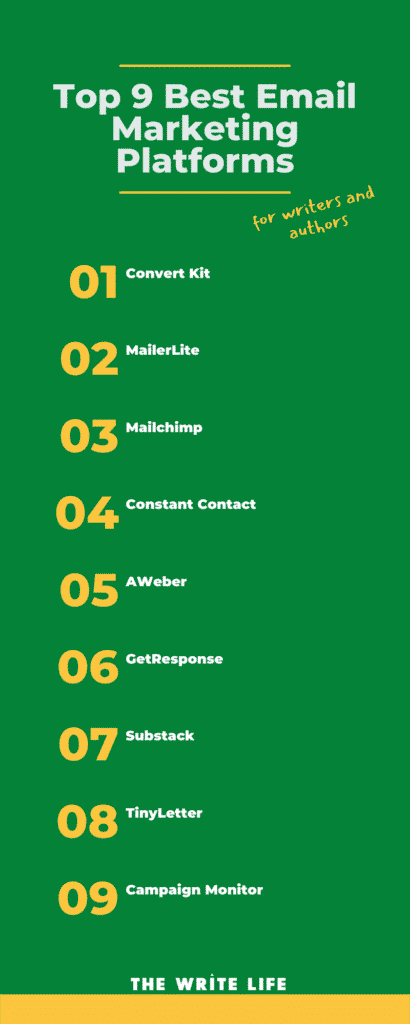
Here’s a peek into some of the most popular email marketing platforms, plus quick pros and cons for each.
This service specializes in email marketing services for bloggers and authors. Key features include easy organization of sequenced courses, customizable automated messages and integration with the ecommerce platforms bloggers favor. Most users say it’s easier to use than the other platforms on this list, so it’s a good starting place for beginners.
Start building your email list with the free ConvertKit plan, good for up to 1000 subscribers. The free plan doesn’t have access to all the more strategic features. To get those, their Creator Plan starts at $9/month.
One other cool feature of this platform is you can easily create unlimited landing pages, sales pages, and forms.
ConvertKit has been growing steadily since its 2013 launch. We moved to this platform in late 2019 and have since enjoyed an increase in subscribers to our email list.
This email platform is best for you if you’re just getting started and have a small list. You can have up to 1,000 subscribers and send up to 12,000 emails in a month for free. In other words, if you had 999 people, you could send 12 times in a month for free. If you had 500 people on your list, you could send 24 times in a month for free.
Overall, it’s a great option for beginners and comparable with Mailchimp and ConvertKit on the free options. For more on pricing, click here.
MailChimp is one of the most popular email services for new businesses building their email lists. Some users think MailChimp is cute, but it can be clunky during the editing process. The big perk is that it’s free for up to 2,000 subscribers and 10,000 sends per month, which is a good starting point for most email newsletters.
While MailChimp is great for new email lists, the full-service features that MailChimp offers are important for the more strategic email marketer.
The recommended Standard package starts at $17 per month.
Constant Contact is geared toward businesses, so if you’re growing your brand, this option might be a good fit. The basic plan starts at $9.99 per month for a list of up to 500. All plans feature unlimited emails and include customer growth tools.
And if you’re not tech-savvy — and maybe don’t have time to even want to learn — Constant Contact offers additional services ranging from account setup to designing blasts for the copy you provide.
Many big-name bloggers swear by AWeber. It was once the DIY choice, because it didn’t have pre-designed templates like many of the other platforms. But AWeber has become more user friendly over the past few years. In fall 2019, the company launched Smart Designer, which analyzes your website to quickly create an email template that matches your brand.
Use AWeber for free and get unlimited emails for up to 500 subscribers. The paid plan with more customizable features starts at $16.15 per month for up to 500 subscribers and $26.15 for up to 2,500 subscribers.
GetResponse offers a free plan for up to 500 contacts. The paid, more comprehensive plans after 500 subscribers start at $12.30 per month Like many of the platforms we describe here, the company offers customizable email templates and landing pages.
If you just want to send emails to your community, GetResponse may not be your first place to start. But if you want to build a marketing funnel and sell products, this is a great all-in-one option packed with marketing tools for you.
This one’s a little different from the rest. Instead of paying a fee to send emails through Substack, your readers pay to receive your messages. Every time you publish, you decide if it’s for all subscribers or just for those who pay a subscription fee you set. If you have paying subscribers, Substack keeps 10% plus about 3% for payment processing fees.
If you want to build your email list to primarily share promotional updates, Substack is probably not right for you. But if you want to monetize your writing beyond traditional or self-publishing and you already have a solid following, it may be worth considering.
TinyLetter is a MailChimp product, and its focus on text makes it a popular choice for writers. And unlike some of the MailChimp products, TinyLetter is completely free to use. The only catch: You’re capped at 5,000 subscribers.
“TinyLetter is to MailChimp what Tumblr is to WordPress: It’s newsletters for dummies,” Rebecca Greenfield explained at Fast Company. “Unlike MailChimp, which caters to businesses and offers all sorts of testing and analytics features, TinyLetter provides just the basics. Writing a message is just like writing an email in Gmail, meaning the process takes only as long as crafting the body text.”
Noted early adopters of TinyLetter include freelancer Ann Friedman. Since she writes for several publications, her weekly newsletter guarantees that fans never miss an article. (Ed. note: Friedman has moved up to TinyLetter parent MailChimp. You can read more about her experience here.)
Pricing plans start at $9 for 2,500 emails — not subscribers — per month. If you want to send unlimited emails or automated messages to your list, pricing starts at $29 per month. Campaign Monitor gets mixed reviews for usability, similar to concerns about MailChimp.
Campaign Monitor also offers users the option to only pay per email campaign, which is perfect if you only plan on sending occasional emails to your readers, when you have an event coming up or when you have a new book coming out.
Next Steps After You Choose an Email Marketing Platform
Regardless of the email marketing platform you choose to use, remember that readers won’t open your emails unless you’re writing interesting content that provides value. And your list won’t grow unless you make compelling content and new offers. So, before you sign up for one of these services, think strategically about how you’ll communicate with your network and what value you’re offering. We put together a list of Email Newsletter Best Practices: 4 Things to Consider that can help you get started.
If you’re an author or writer of any type looking for more information on how to actually grow your email list, check out this article.
Which email list service do you use? Which feature is your favorite? Tell us all about it in the comments!
This is an updated version of a story that was previously published. We update our posts as often as possible to ensure they’re useful for our readers.
This post contains affiliate links. That means if you purchase through our links, you’re supporting The Write Life — and we thank you for that!
Whether you’re a writer, a designer, or a journalist, you’ve probably thought about your personal brand.
Focusing on your personal branding efforts can guide your freelancing career and assignment choices as well as let people know who you are and what you care about. But many look at it as a guide, not a rule.
I identify myself a journalist who champions female friendships, and who often writes about roller derby, grief, and being hearing impaired. I’m known for these topics, but they are by no means a limitation on what I choose to write about, or what assignments I decide to take on.
This self-perception does often influence what I choose to include in my email newsletter, which I send out every two weeks. Each email contains links to any bylines I had in the last 14 days as well as to articles I read and enjoyed.
Subscribers learn more about the topics I am interested in, and I love it when I get email responses or Facebook posts from readers who want to make sure I’ve seen that video of Santa using American Sign Language with a child, or a beautiful personal essay about losing a parent.
My newsletter also provides a way to promote the book I’m working on about learning to play roller derby. Every time I publish a piece and an author bio links readers to my newsletter, I get a small bump of new subscribers and it helps expand my personal branding efforts. These subscribers have the potential to turn into fans — meaning when my book gets published down the road, I’ll have a built-in fanbase of people excited to consume it. (If you’re an author, looking for tips on author branding, check out this article.)
I spoke with the freelance writers behind some extremely successful newsletters to get new ideas for using email marketing to build and further the reach of your personal brand. In this article, we’ll look at 4 newsletter best practices:
Freelance writer Ann Friedman, perhaps the queen of the personal email newsletter, began the Ann Friedman Weekly in March 2013 as a way to keep track of what she produced and consumed each week.
In fall 2015, she surpassed TinyLetter’s subscriber limit and transitioned over to the system’s big brother, MailChimp.
“Eventually it will cost me,” Friedman, who made a deal with MailChimp to provide her first year free, said. “With MailChimp you pay depending on how many subscribers you have. At this point I have almost 23,000 subscribers, which will not be super cheap.”
In December, Friedman began offering a premium version of her newsletter to subscribers for a fee of $5 per year. She also began selling ad space at the bottom of Ann Friedman Weekly, similar to theSkimm’s advertising model.
While Friedman said it’s impossible to say if she’s gotten additional freelance work as a direct result of her newsletter, she feels it can’t be hurting her odds.
“Doing lots of work contributes to me getting more work,” said Friedman. “There’s a cumulative positive effect: The longer you write and the more you write, the more known you are, and the more assignments you get. Sometimes my editors will reply to the newsletters, which is a good thing to have when you’re a freelancer living on the opposite coast.”
She said she doesn’t believe in adhering to a narrow rubric of what she will and will not write.
“There are many things I’m happy I’ve done that I wouldn’t have said yes to [based on those confines],” she said. “But there’s not always a lot of thought that goes into whether I will pursue or not pursue something. The newsletter fits with a lot of my [anchor] statement, and aligns well with my underlying values. One of the important functions it has is that it’s a space I own completely. If I want to change it, I can. It’s something I built myself.”
But then there’s the million-dollar question: How does someone like Ann Friedman grow her email newsletter list?
“I believe very, very strongly in not adding people automatically,” Friedman said. “People do that to me and it’s a huge pet peeve. I know it’s cliche to say people’s email inboxes are sacred, but it’s like barging into someone’s house unannounced, or at least onto their porch.
“Make a really great newsletter that is not self-serving and count on people to evangelize. [One thing I do is] quote people who evangelize for me, as a thank you for doing so.”
Newsletter Best Practices #2: Audience Loyalty and Personal Branding
Liz Galvao also thanks vocal supporters in her funny newsletter.
“I send a tweet every time I send a new email, but your voice is only amplified by other people online,” Galvao said. “Other people spreading the word [is crucial].”
Galvao, a freelance writer, started her newsletter in May 2014 as a way to try out a new platform and have a creative outlet.
“I write a lot of stuff in a character voice or something from a ridiculous point of view [for Reductress], or music reviews that are not about me at all,” she said. “This was an outlet that was me writing for myself, and a way for people to get to know me as a person, and not a satirical voice.”
She commended Marc Maron for being an example of someone who shares with his audience in an authentic, personal way with his podcast, WTF With Marc Maron.
“[On top of doing interviews] he is talking about what’s going on with him,” said Galvao. “That keeps me subscribing to it. It’s not just self-promotional, there’s original content in there too.”
Galvao’s focus on personal branding is also reflected in her newsletter, whether she’s planned it that way or not.
“My knee jerk reaction is, No, I don’t think about my brand!” she said. “But I definitely do. With the newsletter, it just sort of worked out that that the stuff I am including is relevant to what I’m interested in.”
One unexpected benefit of starting a newsletter is creating a built-in audience of readers who look forward to getting her missives.
“You have all these people who get to know you and are used to hearing from you week after week,” said Galvao. “When you send them links to things you wrote, people are more invested in sharing that. There’s a loyalty to the people who subscribe.”
Newsletter Best Practices #3: Creative Freedom
Suzanne Wilder started I Heart Words in 2015 and has enjoyed the thrill of receiving replies from fans and signups from readers she’s never met.
“It’s not a conversation but there’s that possibility for dialogue to come out of it that doesn’t necessarily happen with a blog post,” said Wilder.
“It feels more direct than just posting on my blog. [With Facebook], it’s such a crapshoot of who sees what you post. And with blogging — can you capture someone’s attention at any given moment? When something is in their inbox, there’s more likelihood of someone reading what you’re sending them.”
Her newsletter has a literary focus, but like her personal brand, she doesn’t stick to this as a hard and fast rule. She also includes recipes and gifs, or commentary on TV shows and documentaries.
“My main goal is really just to share interesting things that I find and things with the word and literacy and language bent,” Wilder said. “But it’s not purely literary.”
While her newsletter doesn’t generate income, it does provide plenty of creative freedom and help her personal branding.
“I don’t make any money from my blog, newsletter, Twitter or Instagram,” Wilder said. “There’s not a stake in me losing or gaining readers. Not like fashion or lifestyle bloggers. I don’t have to ask myself, Will I alienate a reader or a sponsor? It’s just a creative outlet for me.”
Newsletter Best Practices #4: Consistency
The women who send Two Bossy Dames every Friday have seen massive success with their email, but lately, they’ve chosen to double down on their social media presence, as well.
“Doing a Twitter hashtag roundup seemed like a very low-key way to raise the profile of our project and figure out if this was really something we could do once a week,” said Willison.
The two decided they could, and their newsletter has ballooned thanks in part to a ringing endorsement from NPR’s Pop Culture Happy Hour podcast, on which Willison is a frequent guest.
Still, the pair also credit their social media savviness with the growth their newsletter has seen. Not every newsletter must be anointed by top podcast brass if its sender is willing to take the time to schedule additional content.
“We are both huge fans of the social media tool Buffer, which allows you to collect material in binges and then release it gradually in scheduled posts,” said Willison.
“The last few months we’ve worked hard to keep our Buffer stocked with good material and it’s really worked out. We’ve only really been tending to it since July and our [Twitter] follower count has increased 400 percent at least.”
“If Buffer would add Tumblr to its supported channels, we would be unstoppable, basically,” Brookover added.
Two Bossy Dames is co-written by two people but has a very clear, consistent voice.
“I don’t think we have ever decided not to share something we otherwise thought was great because it wouldn’t be ‘on brand,’” said Willison.
Beyond that, the newsletter’s growth has been pretty organic, mostly through word-of-mouth endorsements and podcast appearances.
Brookover said that while the success has been fulfilling to see, one of the best parts about creating a newsletter has been the people they’ve met (virtually) along the way.
“I think one of my favorite things about running Two Bossy Dames is that it’s introduced us to smart, sharp, excellent women who have told us that we inspired them to start a side hustle of their own,” she said. “It sets up this great feedback loop of enthusiasm and encouragement.”
What to do next?
If you exercise your creative freedom and post consistently, you’re bound to grow your personal brand. No one looks at the world quite like you do. Then, if you respect people’s inbox, and show loyalty to your audience, your brand and newsletter will thrive.
An email newsletter can be what you want it to be, and it can be as much a reflection of you as a writer as you care to make it.
If you’re thinking about starting one, try signing up for a handful to get a good sense of what you like and don’t like. If you already have one, consider ways you can use these best practices to guide your content.
Editor’s Note: This is a guest post by Elle Griffin.
When I finished writing my novel I did the normal thing: I started pitching it to agents. I think I pitched my book to more than 120 agents in hopes that one of them might sell my book to a big publishing house who would make my book a New York Times bestseller and a hit series for HBO.
But as the rejection letters started rolling in, I realized something. Publishing houses make money by adhering to one simple strategy: Spend $5,000-$10,000 on thousands of author advances, and hope that one of them will go on to become a huge bestseller and earn the company enough money to pay for all the rest.
“There’s a saying in publishing: 80 percent of authors fail, and the 20 percent that succeed pay for all the failures,” says Rachel Deahl, news director for Publishers Weekly. “It’s about building up big bestsellers. They are the people who pay for all the people who don’t make it.”
My book is a strange little gothic novel that might appeal to a couple thousand readers, but certainly not millions. Even if a publishing house did take a chance and decide to publish it, I wouldn’t be guaranteed any marketing. And with only 12-15 percent of the sale my best bet was to earn a couple hundred dollars for my efforts.
As Deahl says, “Most books don’t succeed even with a lot of backing. Combine that with no marketing or publicity, chances are your book isn’t going to sell well.”
[sps_reusable_block post_id=43056]
Serial Fiction Is a Better Monetization Strategy Than Traditional Publishing
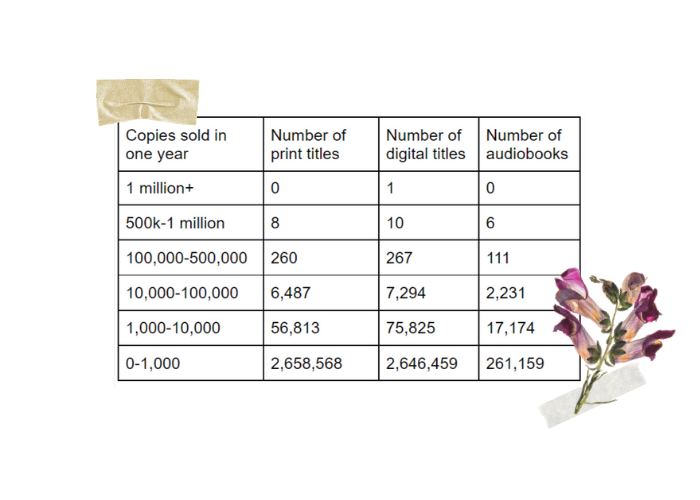
The New York Times caused a stir recently when, in an article about pandemic book sales, it disclosed that “98 percent of the books that publishers released in 2020 sold fewer than 5,000 copies.”
It gets worse. According to Bookstat, which looks at the book publishing market as a whole, there were 2.6 million books sold online in 2020 and only 268 of them sold more than 100,000 copies—that’s only 0.01 percent of books. By far, the more likely outcome is to sell between 0 and 1,000 copies—which is what 96 percent of books did.
And yet, I couldn’t help but wonder if authors could monetize a niche audience. After all, 1,000 readers might not be enough to make it in the big world of publishing contracts and screenplay options, but it could be enough to be profitable—if only creator economy technologies are used.
The “creator economy” is predicated on this very idea. As the going wisdom states: it only takes 1,000 true fans spending $100/year for a creator to earn a salary of $100,000/year. Using our current publishing model, if an author sells 1,000 copies of a book, she will earn $2,250 if published traditionally or $4,200 if self-published. But using the creator economy, an author could release a new chapter every week, charge subscribers $8 or $9 a month, and earn $100,000 a year—from only 1,000 readers.
Non-fiction writers are already doing it. As evidenced by this chart by Alexey Guzey, there are plenty of Substack writers who are putting out quality non-fiction content for their followers and monetizing it—earning in the hundreds of thousands of dollars annually, and in some cases millions, just from reader subscriptions!
But could fiction do the same?
It did once. When Alexandre Dumas debuted The Count of Monte Cristo it was published as a feuilleton—a portion of the weekly newspaper devoted to fiction. From August 1844 to January 1846 his chapters were published in 18 installments for The Journal des Débats, a newspaper that went out to 9,000 to 10,000 paying subscribers in France—and readers were rapt by it.
In the forward to a 2004 translation of the book, the writer Luc Sante wrote: “The effect of the serials, which held vast audiences enthralled . . . is unlike any experience of reading we are likely to have known ourselves, maybe something like that of a particularly gripping television series. Day after day, at breakfast or at work or on the street, people talked of little else.”
It was basically Game of Thrones. Readers could not wait to get their hands on the next chapter and that bode very well for the writer who was not only paid by the newspaper in real-time for his work (by the word), but also grew the popularity of his work over the entirety of the time it was being published.
“The ‘Presse’ pays nearly 300 francs per day for feuilletons to Alexandre Dumas, George Sand, De Balzac, Frederic Soulé, Theophile Gautier, and Jules Sandeau,” Littell’s Little Age, Volume 10 wrote in 1846. “But what will the result be in 1848? That each of these personnages will have made from 32,000 to 64,000 francs per annum for two or three years for writing profitable trash of the color of the foulest mud in Paris?”
That “profitable trash” earned those writers an annual salary of between $202,107 to $404,213 in today’s dollars—and the obvious disdain of that Littell writer who, even then preferred the merits of a bound and published book. The same volume goes on to say that Dumas earned about 10,000 francs ($65,743 today) per installment when he was poached from The Presse by The Constitutionnel in 1845.
Serial Novels are Already Making a Comeback
The serial novel is already making a comeback. On the apps Wattpad and Inkitt, writers can publish chapters as they are written, and followers can read and comment on them in real-time. Wattpad has 90 million users who spend an average of 52 minutes per session reading books online—mostly Millennial and Gen Z. The Inkitt app has 2 million users in the same demographic.
The problem is that authors don’t make money on either platform—readers read for free. There was some hope that would change when Wattpad debuted Paid Stories in 2019, allowing readers to pay for chapters using micropayments—three coins unlock the next chapter—but the author does not get to decide whether or not their content is part of the paid program, the platform does based on how the book performed in its free iteration. And even the best-paid authors aren’t making a living doing it.
Two years into their paid program, Wattpad announced reaching only $1 million in author earnings, split among 550 writers. All things being equal, that’s only $1,818 in total earnings, per author, over a two-year period—and all things are not equal. The more likely scenario is that a small percentage of those 550 made up the bulk of the earnings with pennies left for the rest.
One Wattpad author, who wished to remain anonymous, told me her book reached 20 million free reads on the platform before she was invited to go paid last year. Since then, she has earned a couple million more reads and has averaged $500/month in earnings with her highest month topping out at $1,000. And this is with a YA romance novel—one of the best performing categories on the site.
Now Amazon wants to get in the game. In April of 2021, they announced the launch of Kindle Vella, a Wattpad competitor that allows authors to publish their books serially—and does allow authors to monetize their work. Thus far, no marketing initiatives have endeavored to promote these pioneering authors—but it’s no matter. Writers pour an estimated 1.2-1.4 million books onto Amazon each year and, even if every book sells only 200 copies, the platform will earn 20-50 percent of each sale and win the whole game.
Still, if 20 million people are willing to read a book for free and a couple million more are willing to pay for it, then there is at least a market for serial fiction. The problem is that if authors are only netting $6,000-$12,000 in a year for their work—maybe we don’t have the right platforms yet.
Substack Easily Allows Authors to Monetize Serial Content
I decided to serialize my own novel, releasing one chapter per week from September 2021 through June 2022, and I turned to Substack and Patreon for the experiment. Unlike Wattpad and Inkitt, both platforms allow authors to monetize their work, with readers subscribing directly to their favorite writers.
Publishing on both platforms is free, with Substack and Patreon earning a percentage of income—Substack charges 10 percent of earnings plus a Stripe fee, Patreon charges 5-12 percent of earnings depending on what payment processing services a creator wants access to. And because both platforms allow the author to maintain the rights to their work, there is nothing preventing us from putting our books up on Wattpad, Inkitt, or Kindle after the subscription period ends.
I created accounts on both platforms to test the waters—though each has its share of pros and cons. Patreon, for instance, doesn’t have a free pricing tier which means I would have to build my platform elsewhere before attempting to sell into it. This is why almost all of the 15 authors currently earning more than $4,000/month writing novels on Patreon built their audience on Royal Road, a free serialization platform that lets authors share their chapters as they are written.
“There’s sort of a fixed model for how serialization works in terms of generating revenue—where you start off building an audience on Royal Road and then from there you start a Patreon,” the author Travis Deverell tells me. “And there’s an expectation that your Patreon will have a certain number of advanced chapters ahead of what goes for your Royal Road.”
Deverell’s pen name is Shirtaloon and he earns $28,532 a month from his Patreon supporters. Readers can choose whether they want to read his chapters one week ahead ($1/month), two weeks ahead ($5/month), or four weeks ahead ($10/month) of Royal Road. He also has pricing tiers at $15, $20, and $50 a month which have no additional benefit except supporting an author they love—and fans pay it.
But Royal Road is very genre-specific. In fact, it tends to attract an audience that isn’t well represented elsewhere: hyperniche science fiction and fantasy genres such as litRPG, isekai, and power progression. “Royal Road is such a big platform for building audiences, but the audience is looking for fairly specific stuff at the moment,” Deverell says. “Like Wattpad is great for YA fiction, but Royal Road is a much better fit for what I’m doing.”
Patreon also isn’t well-suited to writing. The author Emilia Rose earns more than $120,000/year serializing erotica on Patreon but plans to move her 3,000 patrons to Litty, a new startup promising to be the “Patreon of fiction” when it launches this fall. “Patreon has set up its website like a blog, which makes the platform incredibly difficult to use for ongoing stories,” Rose says. “Since I release two to five chapters per week of a single story, it is difficult for readers to find previous chapters. From a reader’s perspective, it’s not a great experience.”
Substack, on the other hand, was built for writers. Chapters are delivered via email and books can be separated into “sections,” making the experience easy on the reader. And unlike Patreon, I don’t need to build another platform elsewhere before I can monetize my work. Instead, I can build my audience directly on Substack, writing a free newsletter that upsells into a paid version.
The downside of Substack is that I don’t have access to all the pricing tiers I can get with Patreon—Substack only allows me to have one monthly subscription fee, plus a “lump sum” donation bucket—and I know pricing tiers are a must. After all, why would a reader pay $5/month to read four chapters of a book when they could buy a whole book on Kindle for $1.99? (This is why there are plenty of writers writing novels on Patreon earning $200/month—and plenty of Kindle authors earning $200 total.)
There has to be added value. I want my readers to have the option to join an exclusive online community, be mentioned in the acknowledgments, or even write the foreword for my book. When the book is complete, I want to be able to send autographed, hardcover collector’s edition to premium subscribers, throw a wrap party for my patrons, or even elope to a gothic estate in France to write ghost stories together afterward.
These kinds of value adds are, after all, how the science fiction author N.K. Jemisin achieved Patreon success. She went on to win numerous awards including a Hugo Award and, in 2020, a MacArthur Fellows “genius grant,” but when she first joined Patreon, she simply wanted to make $5,000/month so she could quit her job as a psychologist. She did—and she had five superfans paying $100/month for signed, printed copies of her books and nine paying $50/month for signed-author copies. That’s $950/month in revenue just from her top 14 fans! Authors can’t afford to miss out on that kind of patronage.
Even without pricing tiers, I think Substack is the better bet—the whole process is already built-in and has been proven to work for non-fiction authors. And Substack has made moves to invest in fiction. On June 9th, Business Insider announced that Substack hired Nick Spencer, author of Captain America and The Amazing Spider Man franchises to entice comic-book writers to the platform. They also announced, in August, their first round of investments in comics writers.
Indeed, we may be seeing the beginnings of a surge in fiction writers on the platform. The fiction author Etgar Keret joined the platform in August and the novels Anamnesis and Something Deep are both serializing on Substack. In fact, more authors are putting their novels on the platform every day which makes me wonder whether I should stop looking for where the literary writers are, but where the literary readers are. And we are definitely actively reading (and paying to subscribe to) literary non-fiction on Substack. Maybe we’d read literary fiction there too.
After all, Truman Capote’s novella Breakfast at Tiffany’s was serialized in Esquire before being published by Random House in 1958. The Martian started out as a blog on Andy Weir’s personal website before it was self-published, then traditionally published, then turned into a blockbuster film starring Matt Damon. And in 2020, Lena Dunham serialized her choose-your-own-adventure novel Verified Strangers via Vogue.com.
That’s what Dumas did too. The Count of Monte Cristo was published, not in a literary journal, but in a newspaper—where people were getting their weekly news. Why wouldn’t the sort of people who follow literary journalism and societal critique be the same sort of person who enjoys seeing the Edmond Dantès flee the Chateau d’If via body bag? And Substack is rapidly becoming the newspaper of note for millions of readers.
Of course, to make it on Substack, creators still have to build a platform, publish consistent work to that platform, and attract an audience to that platform, on top of actually writing something good—none of this is easy. But I’m going to run an experiment anyway. With creator economy technologies on the rise and subscription models rapidly proving their viability, I think there’s hope for fiction after all.
I think we’re creating it.
[sps_reusable_block post_id=43056]
Elle Griffin is currently serializing her gothic novel via Substack—and writing a newsletter about it. Subscribe here.
Your online portfolio is the portal through which both clients and readers learn about you and your work — and one of the best ways to land writing jobs.
That means that, for many of us, creating a writer website is hugely intimidating. I put off creating a writer website for months simply because I didn’t know how I wanted to put it together.
Luckily, you have options. There are as many types of writer websites as there are writers, and you don’t have to make your writer website fit any kind of preconceived template or mold.
Instead, use your online portfolio to reflect what makes you unique as a writer, and what you have to share with clients, readers and fans.
[sps_reusable_block post_id=43047]
Need inspiration? Check out these online portfolio examples
Don’t make the mistake of thinking that creating your online portfolio has to be a massive project. We’ve showcased lots of portfolio websites that make it easy for you.
But before you build your own, we’ve got some inspiration to get you started! We found some solid writer websites to share, each with a unique focus and design.
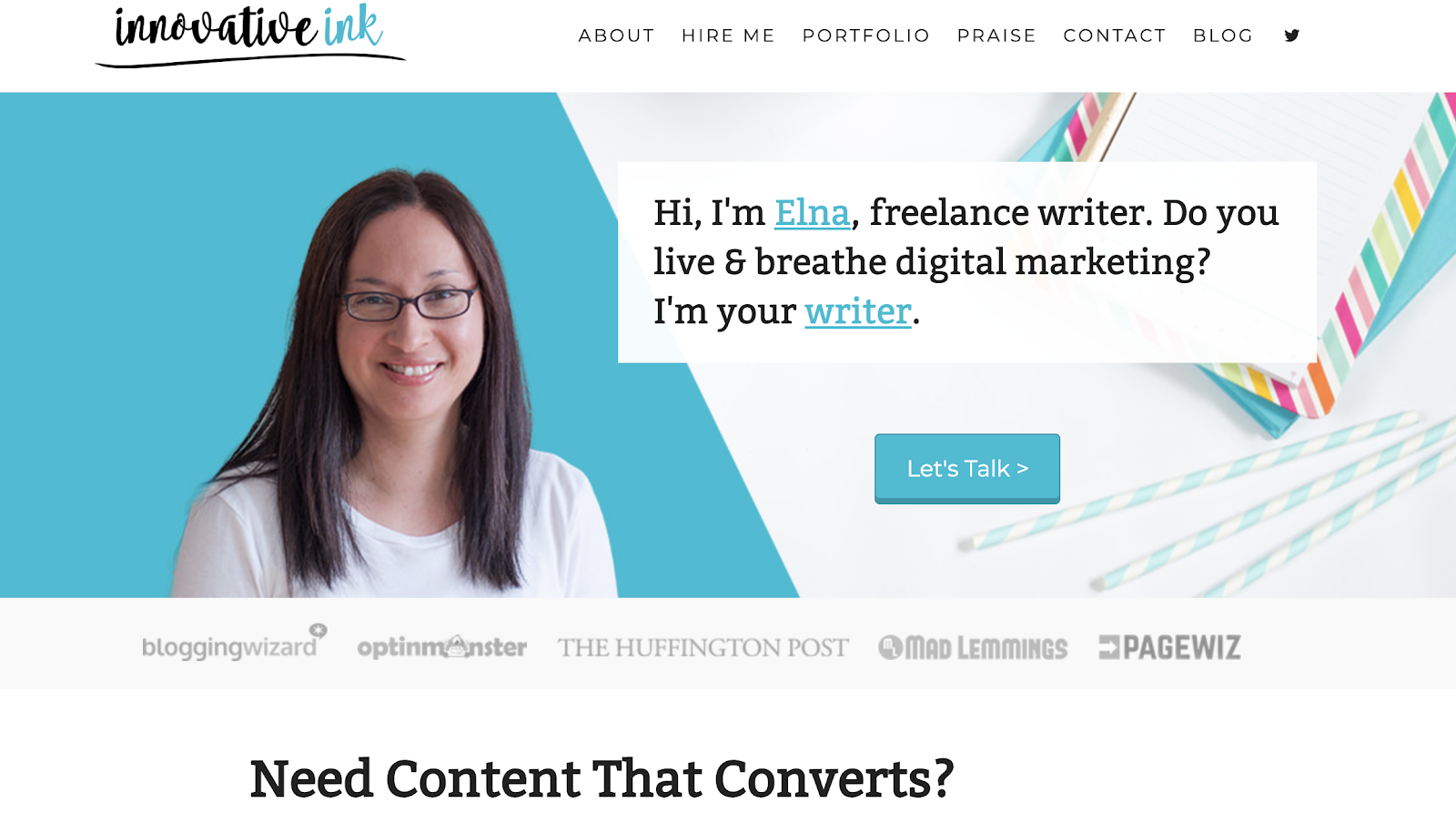
Elna Cain’s writer website is bold, partly because she blatantly tells you she’s the freelance writer your business or project needs. To further convince you, a row of prominent publications are listed right above her introduction — that’s where she confidently states the problem clients have and how her skills can it. Then, the page ends with glowing client remarks.
Elna’s online portfolio shares a variety of ways to get in touch with her for business opportunities and how to keep up with her work online. To assert her expertise in the field, Elna also links her popular blog that’s filled with tips on how to make money with writing.
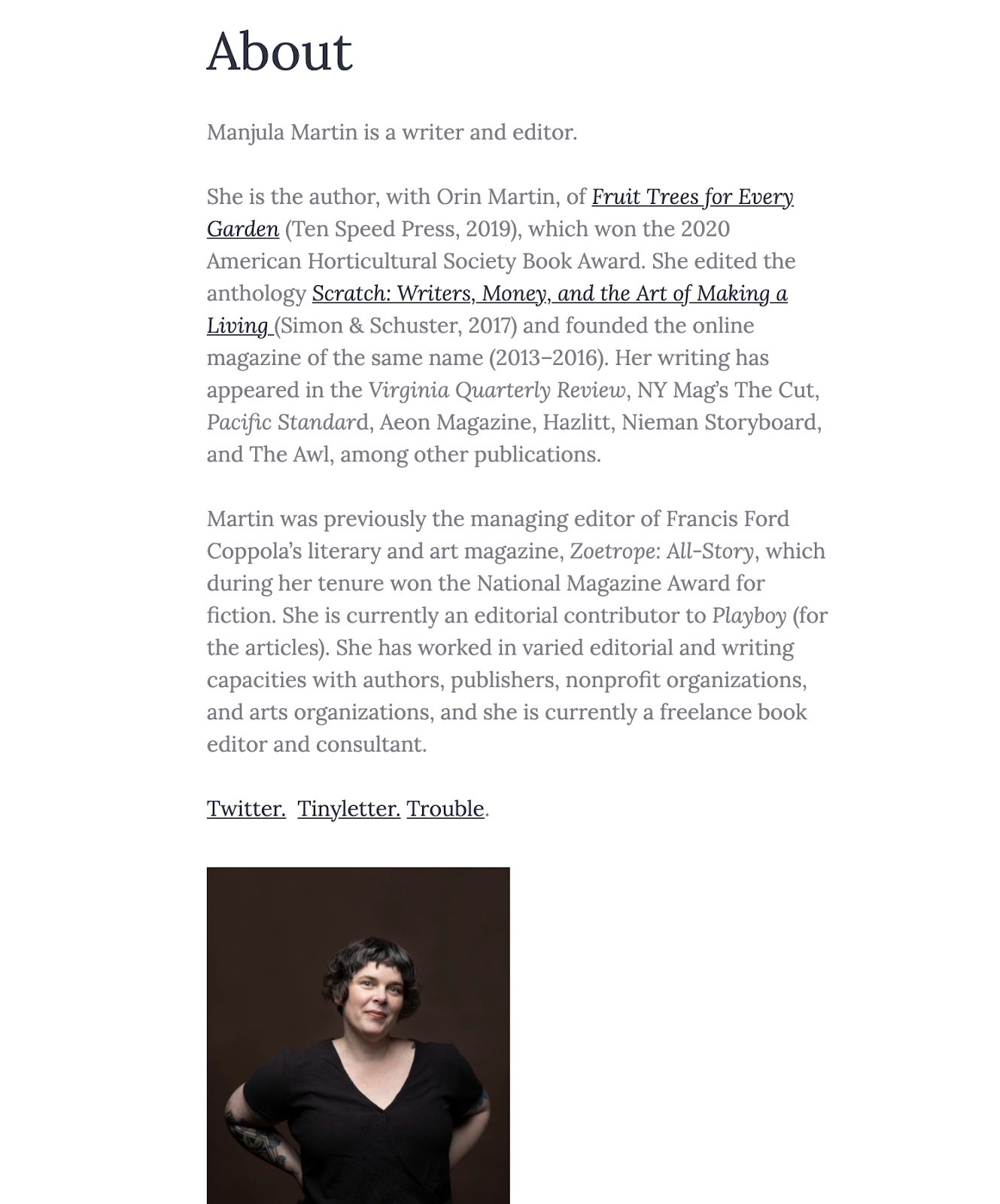
Manjula Martin’s site is a great example of a basic, straightforward online portfolio: a brief introduction with her resume highlights front-and-center, and lots of links to connect people who want to learn more. She built it on WordPress.
Manjula’s website works because you learn everything you need to know about her credentials and writing style at a single glance. It’s easy to follow the links and read her clips, and she also gives you many ways to contact her with writing or consulting opportunities.
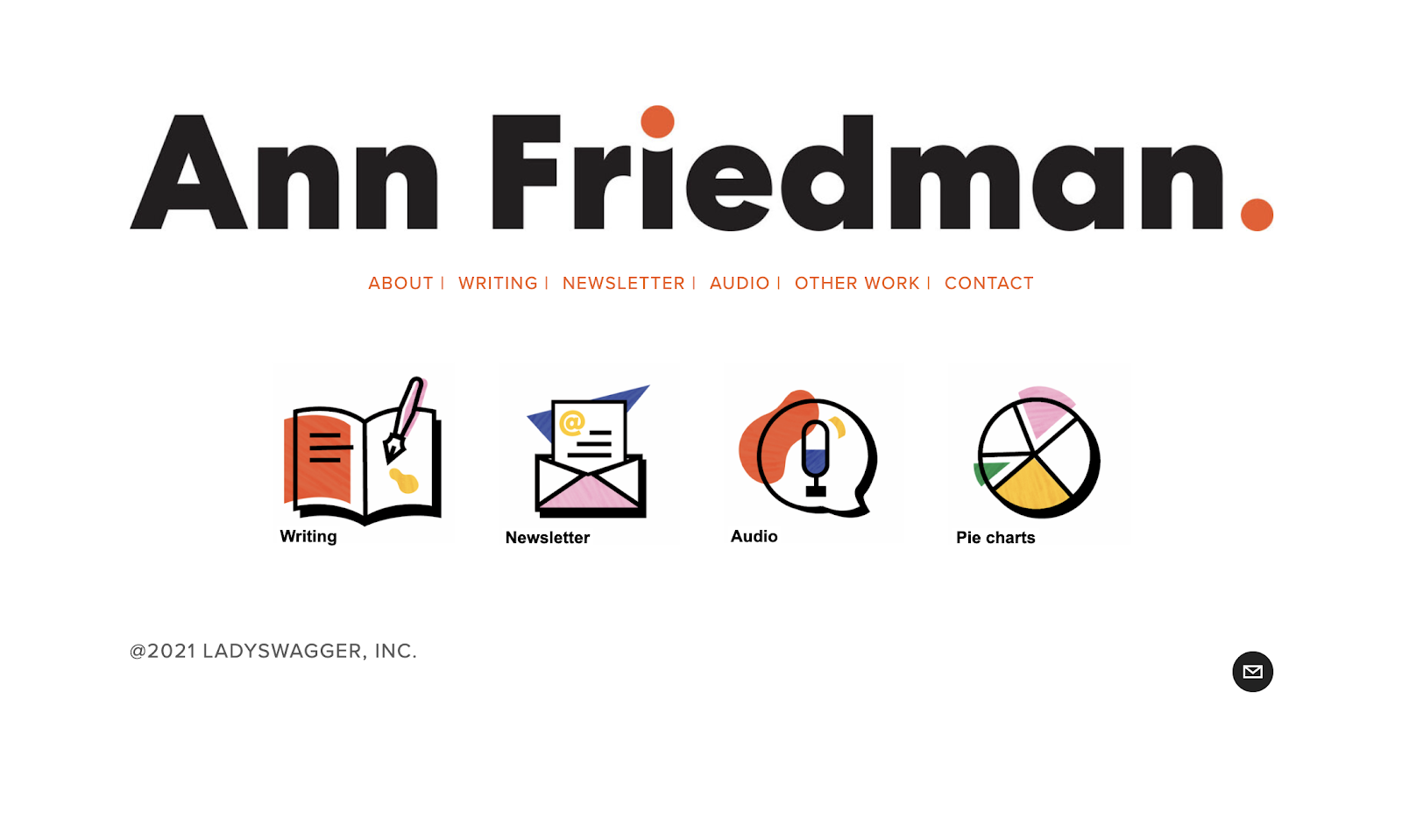
The first thing you notice on Ann Friedman’s website is how it brightly displays her logo, followed by a row of links to her completed work, newsletter and contact information. Talk about a simple and beautiful landing page!
The rest of this writer website contains plenty of unique touches: a general FAQ plus one for her newsletter; a page of various creators, content and organizations she recommends; a thorough contact page; and creatively-titled side work that highlights even more skills beyond her stellar portfolio of work for tons of household brands. There’s no question about who Anne is, the service she provides and how to reach her — this is the goal for all writer websites.
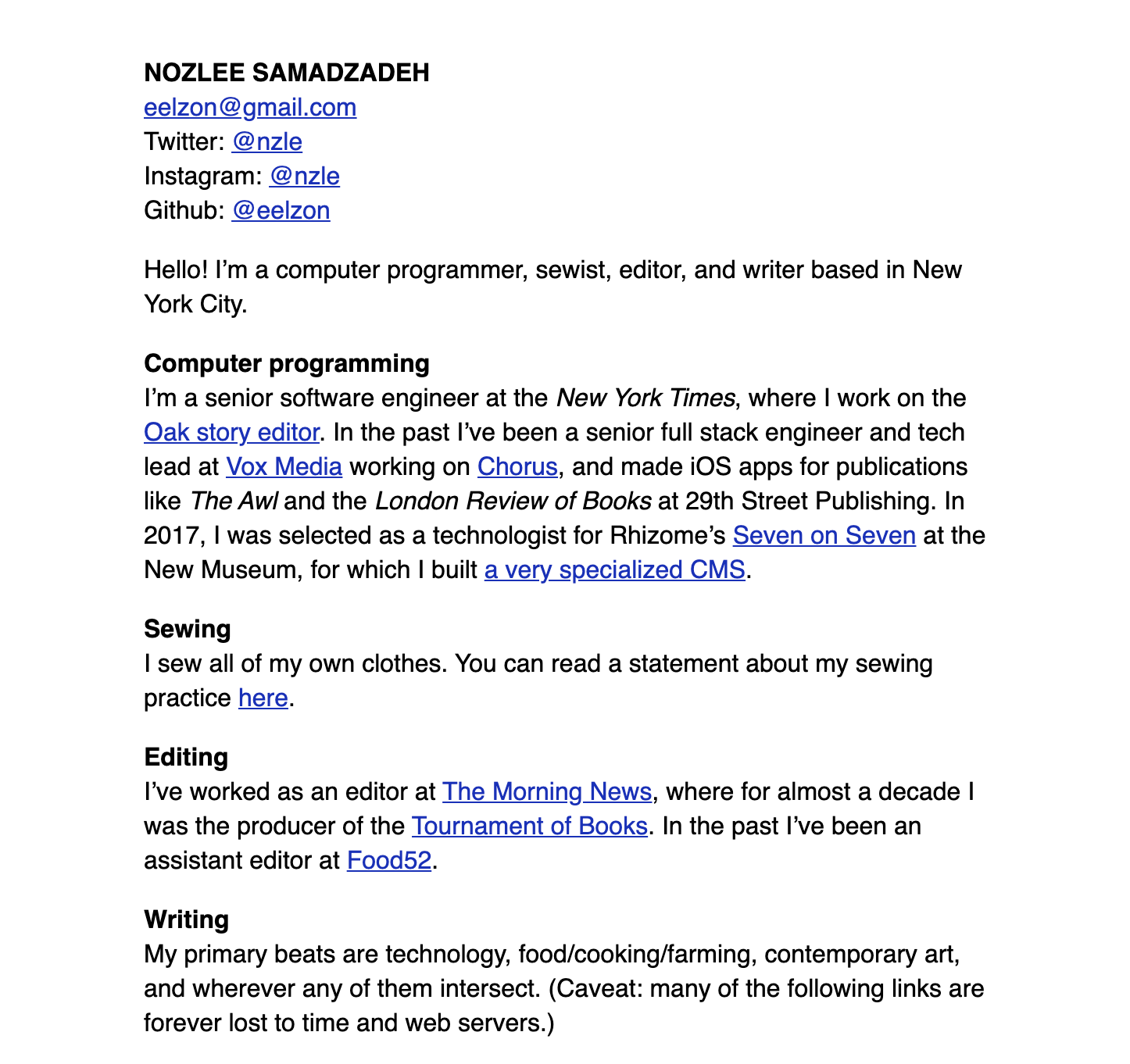
It’s possible to create an extremely compelling writer website without a single photo, logo, or image. Nozlee Samadzadeh’s site lists her contact information, concise explanations for her professional experience, and links to her publications, all on a single page.
Nozlee’s site also includes a short statement of her “primary beats,” which is key info for anyone looking to hire her for a writing job.
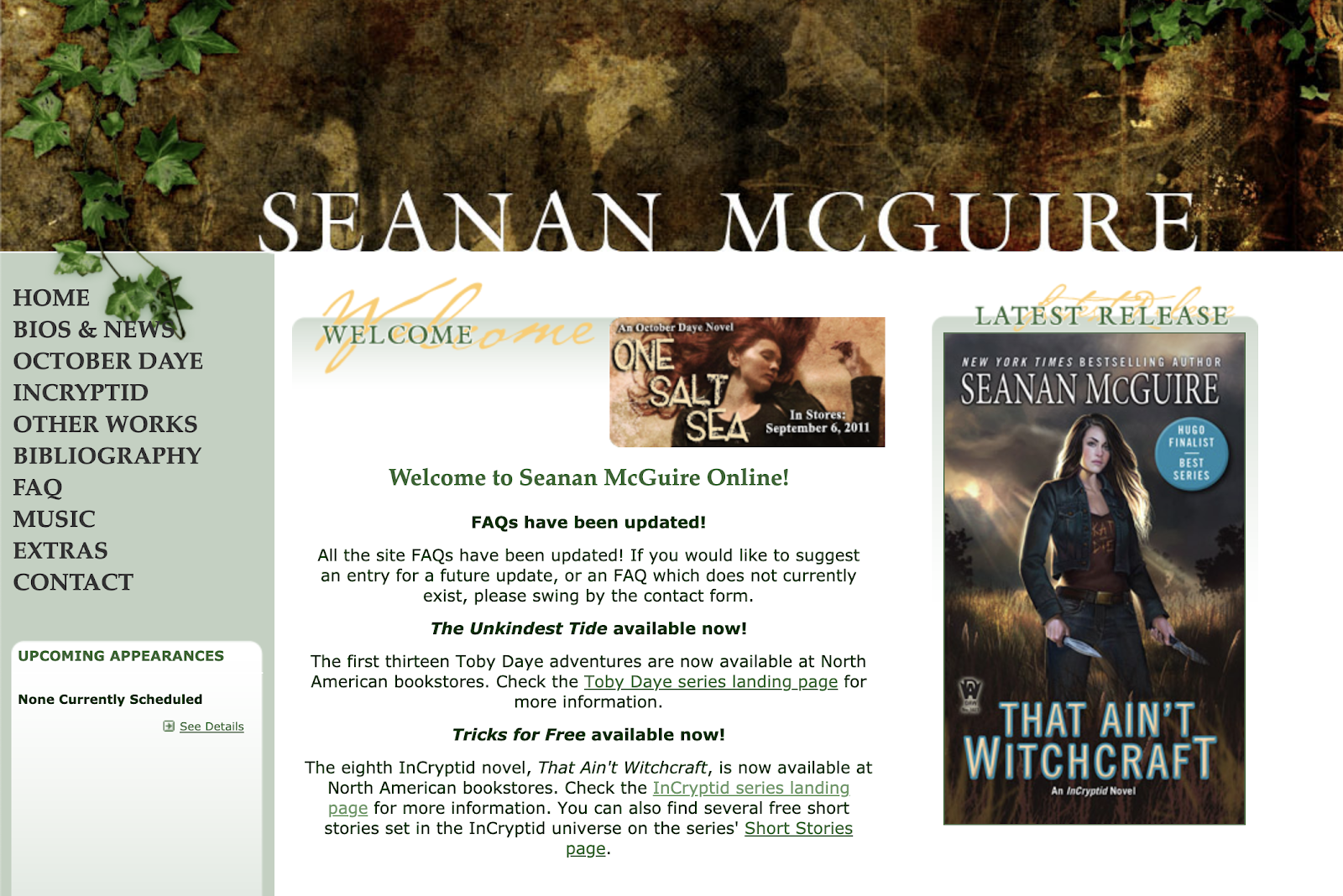
Seanan McGuire’s writer website instantly immerses you into her urban fantasy world. Her latest release is prominently featured, and the header image and colors help establish her genre to new visitors. The left-hand navigational column provides easy access to important information.
If you write fiction, especially genre fiction, let your writer website reflect your fictional worlds. Open the door to your fiction by giving readers the chance to see what might be hidden within the pages.
Copywriter Francesca Nicasio’s writer website aptly showcases her expertise in writing B2B content around retail, eCommerce, technology, and more. The entire website is structured around one goal: informing readers about her capabilities the very moment they get to her site.
What’s the goal of your writer website? Are your skills and services clearly explained? When users visit your site, do they know what to do if they want to work with you? With her email address displayed largely on the front page, Francesca makes it easy for clients to get in touch with her. Your writer website should do the same.
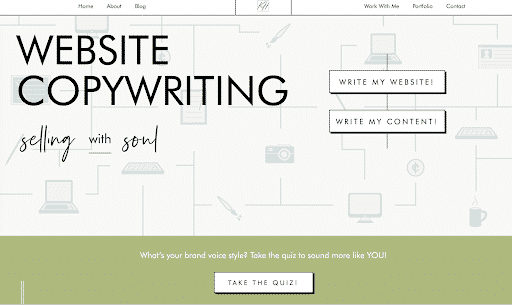
“Inviting” is the best way to describe Kayla Hollatz’s writer website. The big, bold words that immediately greet you are enticing enough to make you want to keep exploring her trendy online portfolio. And without needing to scroll too far, Kayla’s concise and effective introduction appears, placed evenly below a prompt to take her brand style quiz.
Wherever you go, Kayla’s writer website accomplishes one major thing: She pulls you in by subtly emphasizing her savviness. From spelling out the details of how you’ll work together to sharing impressive client success rates, it’s evident this writer knows her stuff — and she wants you to learn it, too, hence her quiz and email course.
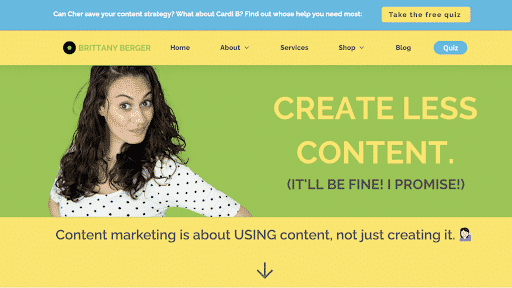
How often are you intrigued by an unpopular opinion? Probably almost always, because, well, you just have to find out how you could possibly be on the wrong side of the truth. That’s what’s awesome about Brittany Berger’s approach to her writer website — she offers a solution most companies think is the problem.
Her conversational tone guides you into understanding her logic, and she offers a number of valuable resources to help you learn about being mindful about content creation, and how to be more productive as you do.
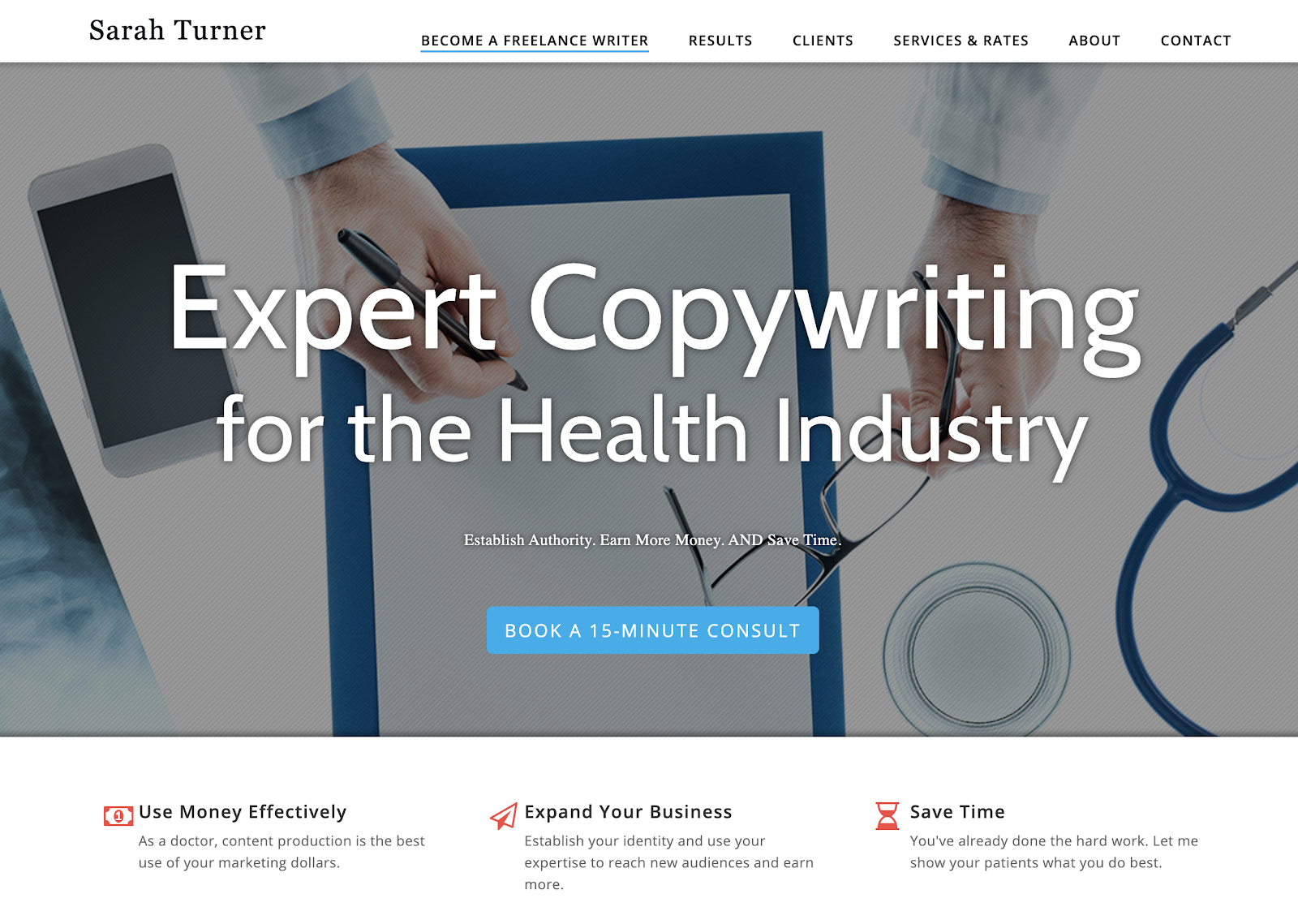
Sarah Turner’s writer website is one of those slick, beautifully designed sites that intimidate the rest of us. It’s the type of site that looks like it requires the assistance of a web designer, which means it’s aspirational for a lot of us, especially those of us who are just getting started as freelancers. In actuality, Sarah’s website was created with the help of WordPress and Themely.
However, design isn’t the only aspect that makes Sarah’s writer website great. Her opening sentence clearly highlights her writing niche, how she can use her skills to improve your business in the health industry — the key goal of any resume or website — and includes a direct call to action.
You can include a similar paragraph and call to action on your own writer website; no design firm required.
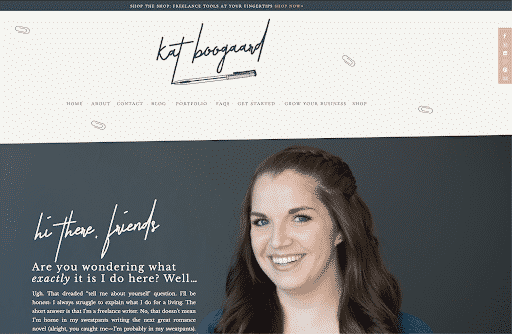
Freelance writer Kat Boogaard leads with an authentic and friendly voice on her writer website — one that makes you feel like you’ll hit it off with her right away. Amid a fresh and sleek design filled with calming neutral colors, she shares brief paragraphs about who she is, what she writes for clients and how she can help freelance writers grow their businesses.
Kat’s conveniently-placed menu at the top and bottom of her website is easy to navigate, but one thing I love about her website is how you can find your way around her site without it. As you scroll through the homepage, you’ll find that she takes you from one valuable resource to the next, all without making you feel bombarded.
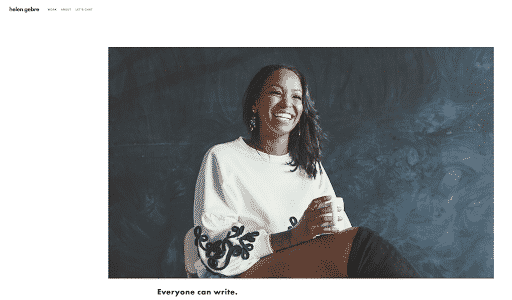
This writer website gets one important thing down pat: You can feel how much Helen Gebre loves the art of writing. She also does this very simply, through an introduction and biography that gives you a glimpse into her personal life, her career and why she does this work.
Helen’s website design is simple, likely because she has a diverse portfolio featuring big and bold copywriting decks that span across print and digital writing, social media, video scripts and more. Besides a contact page, she also cleverly set up her phone number as the footer on each page — that way, clients viewing her page know how to reach her immediately.
Clients visiting B2B writer Chidinma Nnamani’s page learn right away what her expertise is. Throughout her writer website that she designed with WordPress and Elementor, she clearly articulates her skill and experience with B2B writing for the tech, food and digital marketing industries.
Besides a clean website design that reflects Chidinma’s design aptitude, her inclusion of a robust services page and a page that details her four-step process for working relationships provide a peek into her professionalism and organizational skills. One more thing to note from this writer website? The frequent “Ready to hire me?” prompts displayed throughout the site!
Before you learn about this writer, you first take a tour of her impressive writing clips, which progressively leads you to where you can learn more about and reach out to her.
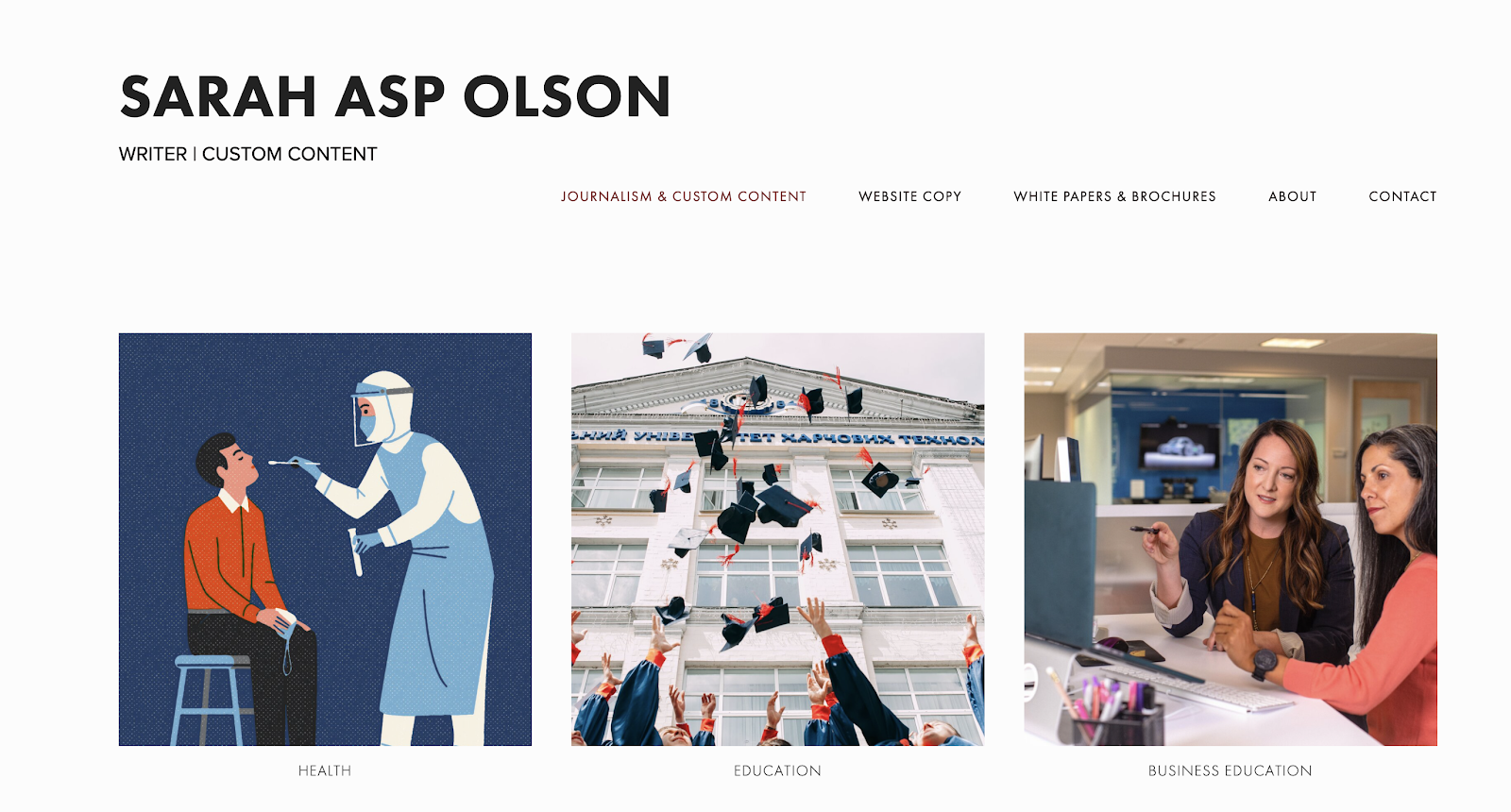
One of the best parts of designing your writer website is all the creative ways you can display your work. Each website on our list brings their own flair to their portfolio, and Sarah Asp Olson is no exception in the way her site only features the content she’s created. Like she does, you can use bright, colorful images that capture the eye to separate the industries you write for. Then, display your samples in bulleted lists, or in rows of hyperlinked thumbnails.
Remember there are no rules to how you organize your work — just ensure it’s clear, and easy to navigate.
What should people learn about you as soon as they visit your writer website? For writer Samar Owais, potential clients find out immediately she can increase conversions and boost sales — and her speedy acknowledgement of these skills and her niche can make a difference in how quickly visitors leave her site.
Throughout her writer website, Samar features client testimonials and a valuable email marketing quiz. Additionally, she makes her expertise clear through brief, compelling descriptions that outline how she solves conversion issues as an email conversion strategist and SaaS copywriter. And if anyone wonders why they should work with her, she makes convincing arguments for that, too.
Don’t you just want to click those icons? That’s the power of color and fun design animation! Atlanta-based writer and editor Muriel Vega’s writer website has a simple design layout, but that doesn’t stop the sense of her personality from seeping through as you learn about her through projects and writing samples.
This site is a great reminder that you don’t have to overwhelm your writer website to make an impact — consider who you want to attract, and incorporate engaging design elements that reflect your creativity.
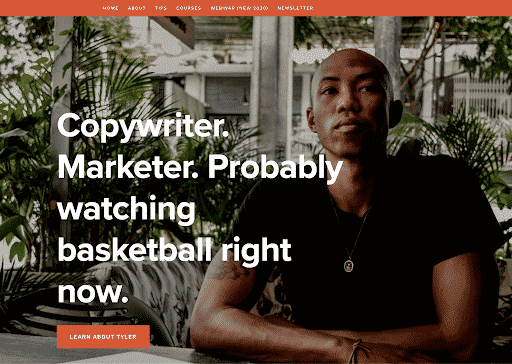
Copywriting expert Tyler Koenig has a writer website that feels extremely confident and laid-back. Within a well-designed website that tastefully centers the color orange (maybe for basketball?), Tyler provides heaps of value through his email list, webinars, courses and free tips through his blog.
“Become your own most trusted copywriter,” he writes on the landing page of his self-paced copywriting courses, which successfully expresses his earnest desire to share his passion to help others grow. Besides that, providing free and paid resources truly highlights your expertise to prospects.
My writer website serves two purposes: It’s a place where people can learn more about my freelance and teaching work, and it’s also a blog that focuses on the art and finances of a creative career. I include “where I got published this week” roundups every Friday and finance roundups on the first of every month, along with daily insights on work-life balance, how to earn money for your creative work, the process of writing a novel and more. I also pay writers for guest posts, so pitch me!
I set up my site through WordPress using a pre-designed template.
Do you have a writer website you’re proud of, or are you working on one now? Share your experience with us in the comments!
This is an updated version of a story that was previously published. We update our posts as often as possible to ensure they’re useful for our readers.
By now we’ve all heard about author platform, even if we’re not entirely sure how to build or maintain one.
But in my everyday work with authors, I’ve noticed many writers aren’t sure how exactly to get started. What should you focus on when you’re being pointed in 20 different directions, and all roads are potentially huge time sucks?
How to start building your author platform
As I explain in this post, author platform includes these components: expertise, contacts, social media, previous media, previous books, personality, existing readership and ability to execute. That breakdown can function as a roadmap for anyone who’s trying to figure out how to get started, especially if you feel like you’re starting at zero.
Ready to build your author platform? Here’s how to start from scratch.
1. Expertise: Write an “I am fabulous” statement
The goal with this step is to pump yourself up. In what specific and particular ways are you awesome? Why are you the person to write your book? Why is it the case that no one but you could write your book? What unique experience do you bring to the table?
Even if your answer is simply that you lived the life you lived — and maybe it was a hard one — you’re awesome for having survived it. If you write fiction, your book likely involves themes or situations you know a lot about, which makes you an expert.
Let your statement be free-flowing, but work hard to pat yourself on the back. While many of us tend to undervalue our abilities,the first step toward being an expert is believing you can be an expert.
You may have to fake it till you make it, and your “I am fabulous” statement can give you the motivation and validation you need to get there.
2. Contacts: Put together a “big mouth list”
Everyone you know is a contact. The more people you know, the more influence you have, especially if you know people in high places.
So what if those influencers are a couple degrees of separation from you? People are surprising in how they choose to support fledgling authors. I’ve witnessed seriously established authors supporting new writers just because it feels good, and they remember what it’s like to be in your position.
In addition to the list of people you’re connected to, create a list of people who might blurb you, from realistic to pie in the sky. Who would be your ideal reader? Who do you dream might one day recommend your book?
3. Social media: Pick just two social channels
That’s right: only two. Set up a profile on each and post once a day.
For most writers, I recommend choosing Facebook and Twitter, but if you’re into other channels or options, give them a shot. If you’re writing something that lends itself to images, join Pinterest. If your work lends itself to video, do YouTube. Experiment to find a social media channel that works for you and your writing.
The key to social media is posting regularly and engaging people. You want shares, because shares lead to more follows. Rather than spreading yourself thin across multiple platforms, focus consistently on the two platforms that provide the most value to you and your work.
It takes forever (seriously) to build up a following on social media, so don’t be discouraged. Celebrate a few likes a week. Manage your expectations. Keep going. Building an author platform is a marathon, not a sprint.
[twl_reusable_block post_id=41455]
4. Previous media and books: Publish an ebook
If you’re starting at zero, you may not have any previously published books or media, like guest posts or podcast interviews. That’s okay.
If you’re working on a book project that you know is going to take some time to complete — a novel or a memoir that’s already been in progress for a few years, for instance — then write a shorter ebook!
It’s surprisingly easy to self-publish an ebook. You want it to be high quality, with great content, a compelling cover and a well-designed interior. Using Amazon, Barnes & Noble, Kobo, iBooks, or e-junkie you can promote and sell your ebook from your website. While marketing your ebook is a topic for another post, figuring out how to write an ebook is a fairly simple process. And voila, you have a book to propel future books.
Media opportunities will come, but any interview you do, blog post you write or opportunity to speak in front of people you come across qualifies as media. Don’t be afraid to showcase these successes on your website and social media channels.
It takes a major shift in consciousness to start self-promoting, but I’ve found the key is in the balance. It’s cool to self-promote if you’re giving your readership fantastic, smart and interesting content — providing value. And it will get more comfortable with practice, I promise.
5. Personality: Figure out your persona
Jeff VanderMeer’s Booklife helped me understand the value of figuring out who you are online.
Some people put it all out there and are wholly themselves online, while others choose to create a persona different from who they are in real life or only show a certain side of themselves. You get to decide, and you’re not wrong or weird or bad if you want to retain a little privacy.
However, being private or an introvert does not mean you should not have a website, or that you can get away with pooh-poohing the importance of an author platform.
It just means you get to set boundaries. Instead of holding technology in contempt, learn to work with what you might not like, and to figure out how to make it work for you.
6. Existing readership: Create an email sign-up form on your website
What? You don’t have a website yet? OK, the first step is to set up your new site. Here’s a guide on how to start a blog.
While you’re at it, create a sign-up form that connects to an email management system; here are a few of our favorite email newsletter platforms to choose from. Put it on your homepage to capture email addresses — and take a deep breath.
Authors often tell me that people they know already have too much email. Get over it. Seriously. Your job is to collect emails, and to send out worthwhile content. It may take a long time to build up your email list, and to figure out exactly what your message is, but you need to practice having a following.
It doesn’t matter if you launch your email list with 20 people on it. That’s exactly what I did, and four years later I’m publishing for 5,000 subscribers who want to hear from me. After all, if they don’t, they can opt out.
But don’t worry about the numbers for now. Just take the first step and set up the form.
The ability to execute, like personality, is sort of a “soft” aspect of author platform, but it matters. It’s about follow-through and the ability to stick to a commitment to create content. It’s about consistency, and showing up even if it seems like no one is listening.
Building an author platform is grueling work, but it’s truly rewarding when you see the occasional spikes in engagement or new followers, or the payoff in the form of positive feedback or sales.
This payoff can only happen if you execute a plan and stick to it.
I know it’s a long haul. I’m out there myself, working on my platform every day, sometimes wondering why I am putting so much effort toward all this personal branding. But if you want to publish, and if you want readers, you have to find a voice, write content, connect with your readers and put yourself out there.
Your hard work will pay off; it just takes some time. Give it time and figure out a schedule that works for you. I recommend blogging once a month and posting on social media once a day, to start. You might increase from there, but again, you can take it little by little and adjust your plan as you figure it out.
The best way to build an author platform is simple: start
Just like you don’t run a marathon without training for weeks or months, you don’t start your author platform full force. Building your platform takes discipline and hard work, but if it weren’t worth it, no one would be doing it.
The key is to find genuine value in your endeavors. Keep going, even when it feels like no one is listening. Eventually people will start to listen, and eventually you will get a comment to a post that makes you realize you’re making a difference, reach a milestone with your contacts that surprises you, or connect with a high-profile writer who supports you just because.
Have faith. Work hard. Don’t dismiss these ideas just because they feel like too much effort, or because starting from zero seems daunting. Everyone started from zero, even your literary heroes. And it’s only with hindsight and effort that anyone has the wisdom to promise that it’s worth it.
I promise, it is. Come on in and test the waters. Wade in slowly. You’ll find your way.
What was the first thing you did to build your author platform? If you’re just starting out, what’s your biggest obstacle?
This is an updated version of a story that was previously published. We update our posts as often as possible to ensure they’re useful for our readers.
It was a dream of mine to start a writing conference and introduce fellow writers to my beautiful Caribbean birthplace.
Although I was raised in California, my ties to Belize are strong. I knew there had not been a novel published internationally by a Belizean since the 1980s. As an author, book coach and avid reader, I also wanted to promote the literary arts in Belize.
I decided to focus the conference on introducing writers to literary agents, since so many writers (including myself) are often misinformed about the process of trying to publish a book with a traditional publisher.
I have a respectable literary resume: my poetry, short stories and essays have received awards and have been published in good literary magazines. For more than 23 years I’ve written a newspaper advice column that reaches 30,000 weekly readers online and in print. I’m the author of “When Your Heart Breaks, It’s Opening to Love,” which received a national award for books that promote tolerance and forgiveness.
But my queries to literary agents went nowhere until I launched the writers conference. Then agents began pursuing me.
Starting a writing conference isn’t easy, but it has been incredibly rewarding.
Developing a writing conference is like starting your own freelance writing businessor a non-profit organization. You need a mission, business plan, budget, marketing strategy and plenty of resilience. I ran an education-based nonprofit in Belize for 16 years, so I understand how things work in the former British colony.
Interested in starting a writing conference? Follow these tips
The good news is that BWC is now entering its third year, and I’ve learned a lot along the way.
If you’re interested in starting a writing conference of your own, follow these tips.
1. Determine what type of conference you would like to start
Do your research.
While there are many writing conferences out there, even those with long track records struggle in today’s climate.
Talk to conference directors. Get to know the conference landscape.
Ask yourself: How is my conference unique? Does it fill a niche that will compel writers to register?
2. Create a budget
BWC’s biggest expense is travel costs, accommodation and meals for two literary agents, my assistant and me.
Many conferences save money by bringing in two or three powerhouse authors and relying on local talent to fill the remaining spots on the schedule. I don’t have that option. The literary community in Belize is nascent and there are no agents based there.
Consider how you will pay for your headliners and how to entice other pros.
At BWC, authors who present workshops pay their own travel costs. In exchange, they receive a discounted conference package and can sell their books at no charge. Our authors are excited to add teaching at an international event to their literary bios and to connect with a new audience of book lovers.
3. Choose a venue
The first BWC was held at a hip beachfront yoga retreat on a bucolic island off the coast of Belize. Some attendees complained that the floor and ceiling fans were insufficient against heat and humidity.
As a result, we moved our conference to a beachfront resort in southern Belize with air conditioning in every room. It’s essential to keep attendees comfortable and happy.
4. Establish an advisory board
Every year I invite a group of smart, accomplished writers to join the BWC board.
This talented group makes decisions, edits publicity-related materials and helps to ensure that BWC benefits attendees personally and professionally. I work from home so having an advisory board also gives me much needed face time with talented peers.
5. Choose your faculty
To find the right agents for BWC, I read a lot of online interviews. I look for agents who are accepting clients, have a track record of publishing deals, are experienced workshop facilitators and whose personalities signal that hanging out with writers for five days at a beachfront resort would be heaven.
After BWC this year, Anjali Singh, an agent with Ayesha Pande Literary, told Poets & Writers magazine that the Belize Writers Conference was good for her soul. A priceless testimonial!
6. Formulate a marketing plan
A marketing plan is a step-by-step strategy to reach the people who will want to attend your conference.
Ask yourself: What’s the hook that will appeal to them?
For BWC, it’s our gorgeous tropical locale and the exceptional experience of working directly with agents. Whether a writer plans to self-publish, hybrid publish, find a small press or a traditional publisher, agents have incredible insight about what makes a successful manuscript.
Once you have your hook, identify your ideal attendees, determine where they hang out online, get your email list ready, line up speaking opportunities and develop collateral material to promote your conference to your target audience.
If you’re an author with book launch experience, you have the skills to market a conference.
7. Be a good literary citizen
BWC inspired me to establish the first literary fellowship for a Belizean in the country’s history. Funded by Copal Distillery Foundation, the writer-in-residence fellowship at the Belize Writers Conference recognizes a talented Belizean writer and funds their BWC tuition and board.
8. Be resilient
As BWC’s conference director, I’ve dealt with situations I never could have imagined, from complaints about humidity to one participant who refused to share her suite with another writer after she agreed to do so.
I’ve learned to think on my feet and not take criticisms personally. I try to ensure that every participant has the best experience possible but I know you can’t please everyone all the time.
9. Plan for the long run
Decide beforehand not to be one and done.
Commit for at least five years. It may take that long to build up the publicity and reputation that will make your conference an attraction and a success.
The BWC is now in its third year and going strong. My focus for 2020 is to create year-round opportunities in the U.S. such as literary readings and author panels to build the bios of writers in our BWC community.