
Tag: online presence

  • How to Write for The Huffington Post and Earn Money for Your Work

    How to Write for The Huffington Post and Earn Money for Your Work

    Guest blogging is a long-term strategy. It can help you build your reputation and establish expertise in your niche, as well as lead to new work opportunities.

    However, where you guest post has a huge effect on your results. Sharing your thoughts on a blog with a lot of clout in your niche will make a much bigger difference to your reputation and traffic than guest-posting on your brother’s blog that only your parents read.

    For many writers, the ultimate guest-posting goal is a mainstream authority publication such as The Huffington Post. It’s not easy to become published on this site, but in my experience it’s certainly worth the effort: Not only did it add to my writing resume, but my first post as a Huffington Post blogger brought in $800 within a few days.

    That’s why I want to share with you how to write for The Huffington Post. Here’s a detailed look at my experience, plus advice from other HuffPo bloggers on how to pitch for the best results and how to make the most of your new byline.

    How to Write for The Huffington Post

    While joining the ranks of Huffington Post bloggers isn’t the easiest task, it is doable. Catherine Alford and others who have succeeded say they did the following:

    • Modeled their post after the style of one of the bloggers in the targeted section
    • Sent a short pitch, emphasizing the most interesting aspects of their idea
    • Sent a complete package, with pitch, author bio and head shot
    • Commented on The Huffington Post Facebook page until invited by an editor to write something
    • Developed a relationship with a current HuffPo blogger by commenting on posts and asked for help submitting a piece to an editor
    • Contacted the editor of the targeted section by email

    Huffington Post blogger Lisa Arends advocates reading posts daily in the section you would like to write for, and contributing “well-thought-out responses.” She says, “Keep this up for a while and you may get lucky and have an editor contact you with a blog idea.” If not, at least you’ve built a reputation for smart comments, which may help when you pitch an idea.

    If none of the above methods work, simply submit a well-written post using the form on The Huffington Post contact page. It asks for your “final or near-final draft,” which must be less than 1,000 words.

    My experience blogging on The Huffington Post

    My story is a little bit different; I was lucky enough to have some help. I had just published my book, 101 Weird Ways to Make Money, and my publisher’s publicist arranged for me to create an article and slideshow for The Huffington Post on weird jobs that can become businesses.

    In that article, I linked to my website, which had been seeing between 700 and 1,000 page views and earning between $12 and $30 daily through Google AdSense, with an average of $20 per day.

    Here’s the traffic and revenue I earned the day the article ran (Monday, August 15, 2011) and the following days:
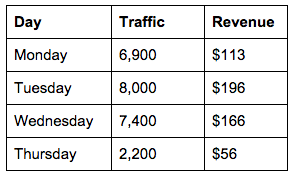
    Huffington Post blog traffic

    After Thursday, the numbers resumed their normal range, though my traffic stayed slightly higher, with 1,200 to 1,500 daily page views. But revenue of $531, instead of the $80 I would normally have earned in four days, suggests the traffic from The Huffington Post link was worth at least $450. Not bad for one post!

    In addition, my website includes links to several of my other sites, so I’m sure I picked up another $50 worth of indirect traffic for those sites. And I linked to my book in the article and author bio, so I sold quite a few copies that week.

    All together, that article and slideshow on The Huffington Post was probably worth $800 in additional income within a few days. In addition, it helped me attract visitors to my sites and promote sales of my book for several months.

    It was a (very busy) year before I realized I had not just a post, but my own blog set up on The Huffington Post. I requested my password and started posting occasionally. The results were never as dramatic as that first post, but I did see increased traffic and book sales. And best of all, the editors never objected to my posts containing relevant links to my own websites.

    How to Earn Money by Writing for Free

    While The Huffington Post does not generally pay its bloggers, as my experience demonstrates, it’s still possible to earn cash by writing for free. Here are the strategies I used:

    Include specific, valuable links

    To start, be strategic when choosing links to include in your author bio. For example, if you’ve written a book or created a course, link to that. If you’re a freelance writer, you’ll want to link to your writer website or online portfolio. If you’ve monetized a website with affiliate products or pay-per-click advertising, link to it.

    In addition, if any of these links are relevant to your post’s content, include them on related anchor text in the body of your post. I’ll reiterate: the links must be relevant. If they’re not, the editors will likely remove them.

    Aim for the front page

    For these links to be valuable, a lot of people need to see and click them, which means you’ll need a lot of readers. I was a extremely lucky with my first post; it was featured on the front page of the HuffPost Small Business section, which brought in a ton of readers. Later posts never approached that level of traffic.

    With these results in mind, it can’t hurt to aim for this special treatment. Look at what’s being shared on your targeted section’s front page. Are the featured articles controversial or fun? Are they short or long? Do they have shocking titles?

    Many big names blog on The Huffington Post, so competition for better placement is tough. When former Secretary of Labor Robert Reich’s post is on the front page of the Politics section, yours isn’t likely to push his aside. On the other hand, he doesn’t write every day. If you’re working in a section with fewer big names, you might have an even better chance to get a good post featured. Study your targeted section to learn the famous bloggers in your niche and how often they post.

    Share your post as much as possible

    Promote your post to your own networks to direct as much traffic to it as possible, as you would with any guest post. Share it with your Facebook and Twitter followers, write a short blurb about it on your blog or email it to your newsletter subscribers.

    With a bit of luck, your HuffPo post might even go viral. Blogger Catherine Alford was lucky enough to see her recent post blow up:

    [It] went hugely viral with more than 220,000 likes and 43,000+ shares. That viral post also led to me getting interviewed on Huffington Post Live, which led to tons of emails and new readers. There’s no doubt that it’s beneficial to any writing career to be an author there.

    Whether or not your post goes viral, you’ll at least point a few new readers toward your site and offerings and add “Huffington Post Blogger” to your resume.

    If you’ve been published on The Huffington Post, how did you do it and what results did you see? If you haven’t, would you like see your byline there?


  • 7 Ways Freelancers Outside the U.S. Can Stand Out and Land More Writing Jobs

    7 Ways Freelancers Outside the U.S. Can Stand Out and Land More Writing Jobs

    Freelancing offers opportunities for writers around the world, but much of the information for writers online is U.S.-focused. When I started my career as a freelance writer and journalist over a decade ago from India, I followed the advice of the U.S.-based writers that had come before me and tried to emulate their strategies.

    I learned how to write great queries and pitches, I practiced brainstorming specific and targeted story ideas, and I found myself a few informal mentors who would answer questions and offer support. I downplayed the fact that I was in India.

    Despite all this, my career stagnated, and I didn’t know why.

    To shake things up, I started experimenting with my approach. Instead of hiding that I was based in New Delhi, India, I started positioning it as a unique advantage. Within a year, I had landed assignments from The New York Times, TIME, Global Post, Marie Claire, and Ms. Magazine.

    As a writer based outside of the U.S., I needed to use slightly different strategies than my peers in those countries. Here’s how to use what I learned to advance your own career as an international freelancer.

    1. Highlight who you are and what you’ve done

    Let me be clear: It’s essential that you focus on your prospect’s needs, be that a corporate client or an editor at a regional magazine. Figure out exactly what your client needs so you can create the perfect pitch.

    However, the problem with pitching from India, China, Costa Rica, Nigeria and other countries is that many editors won’t even look at your story ideas until you’ve convinced them of your professionalism. Perhaps they’ve been burned before, or they simply don’t trust someone they can’t easily reach should something go wrong.

    As an international writer, often you’re going to need to prove your capability more than an American writer would. Your credits, portfolio and experience can go a long way in opening these doors. When you’re writing a query or a Letter of Introduction, make sure to focus on who you are and why you’re the right person for the job.

    2. Ask if they’d like to chat over Skype or the phone

    One of the best things I ever did for my career as an international freelancer was getting on the phone.

    Living so far away from many of them, it was almost a given that I’d never meet my editors. However, being able to see someone, connect with them and have a laugh or two can help cement a relationship — and potentially lead to more work (or at least more email responses).

    So I did the next best thing: I asked if we could Skype or chat over the phone. Even if an editor doesn’t take you up on your offer, asking the question can make you seem accessible and not quite as remote as travel-wary editors might think.

    3. Don’t put your phone number or address on your website

    This is a bit of a controversial point, but in my experience, funny or unpronounceable regional names and unfamiliar area codes can scare off people who aren’t used to working internationally.

    If your clients are international editors at major magazines and newspapers and like the idea of finding people in remote places, you might not need to worry about this advice. However, if you write about health or are looking exclusively for small business clients, your specific location can be a deterrent.

    If your location has no relevance to your work, leave out the specifics. This advice might even hold true for writers living in remote parts of the U.S. or U.K.; you can be just as professional a writer living on a farm in Wisconsin as you would be in New York City.

    4. Have an awesome website and online presence

    Until a prospective client or editor hires you or agrees to talk to you over the phone, the only thing they have to judge you by is your website.

    Your website must shine. It needs to say, “Hey you, undecided over there in the corner, here are the 10 different ways in which I’m the perfect writer for you. Click that button and hire me right now.”

    Whether you have a static site or a blog, an active social media presence or a small one, make sure it reflects your professionalism and skill as a writer.

    5. Make sure you show up in Google searches

    In 2006, quite by accident, my website started showing up as the number one search result on Google for “freelance journalist India.” At the time, I didn’t realize the significance of this accomplishment, especially since I hadn’t been trying to optimize for keywords. What happened next forever changed the way I look at my website.

    Editors from high-profile media outlets, such as US Weekly, ABC News, Marie Claire, NPR, Cosmopolitan and more, found my website while searching for freelance journalists to cover stories in my region. I’ve been contacted by NYC literary agents, by government departments, even by a political campaign (I politely declined).

    The lesson? SEO is crucial. Make sure you show up in Google searches related to your city, country or region (and of course, that the search history is mostly positive). You never know when an overworked editor will need a writer familiar with your area.

    6. Focus on building a portfolio of online work

    At least initially, write for publications with online archives or clickable links.

    Early in my career, I neglected to focus enough on online publications. Even though I’d been published in some impressive publications and had over 100 bylines after my first year in the business, I had no proof: Much of my work was in local publications and wasn’t available online. I’d been published in 20+ countries, but editors had no way of verifying that.

    Make sure your work will be shared online, or find another way to share high-quality images of your work in your portfolio.

    7.  Add humor and personality to your communications

    Your emails, your website, your About page: all are opportunities to showcase that despite the differences in nationalities and location, you’re pretty much a person with the same needs, wants and desires as your editor.

    Your U.S.-based clients might often feel that they have nothing in common with you because you live in a place they’ve only ever seen on the news. Make yourself vulnerable, share a glimpse into your life and show them what you’re really like. Find something that helps you create a connection and a bond, like a shared hobby or interest.

    What do you do differently as a freelancer based outside the U.S.?

  • About to Respond to a Negative Review of Your Book? Read This First

    About to Respond to a Negative Review of Your Book? Read This First

    Have you heard of Stephan J. Harper’s interactive iBook Venice Under Glass?

    If you have, it’s likely that you’ve heard more about the author than the book itself. After a not-so-stellar review of his book at TidBITS, an Apple news website, Harper went on a commenting rampage, picking apart the reviewer’s opinions piece by piece and rebutting nearly every other commenter on the review. It’s a rant of epic proportions.

    After reading through his comments, I can’t tell if he’s serious or if it’s a publicity stunt. Then again, considering the amount of time and effort he’s put into defending his work, it’s likely legitimate, although emotionally charged.

    The entire affair is an extreme example of the absolutely worst way to respond to a book review.

    The only way to respond to a bad book review

    Before publishing my book last year, a wise friend of mine who’s an experienced, published author gave me the best advice about bad reviews: never respond.

    I know how difficult this can be, especially for first-time authors.

    My first Amazon review included two stars and the words “very disappointing.” The reader had expected a different kind of book, so the review seemed unfair to me, as if the book wasn’t being judged on its own merit but on the reader’s desire for something else. One of my “favorite” GoodReads reviews of my book simply states, “Wasn’t great writing, but I really enjoyed the content.” And yet it was granted four stars.

    No writer ever wants to read those kinds of words, and sites like Amazon and GoodReads don’t make it any easier for our egos since they allow authors to reply to their own reviews.

    The one time I replied to a review — and a good review at that — was to correct a factual assumption I thought the reviewer had made. To me, the reviewer seemed to say that I had personally conducted interviews for the book. I simply responded that I’d only done research and quoted from already available interviews.

    The next day, the reviewer had deleted their review! I learned a hard lesson that day, and I hadn’t even responded to a bad review. While those less-than-stellar reviews still haunt me on some days (I’m writing about them here, after all), I know now what every successful writer understands: you can’t please everybody.

    [bctt tweet=”As a writer, you can’t please everybody, says @batwood”]

    Plus, trying to change someone’s mind who’s already decided against your perspective on life, or who despises your writing style, or who just doesn’t like the fact that you’re a fan of the Oxford comma, is like George Bernard Shaw’s famous illustration: “I learned long ago, never to wrestle with a pig. You get dirty, and besides, the pig likes it.”

    A majority of reviewers don’t understand the kind of inner devastation they cause an author when they quickly type and publish two lines of a poor review. What you’ve labored for months on, they’ve minimized in two minutes. From that perspective, it’s enough to make any author’s blood boil.

    And an angry author set loose online can be a dangerous thing. This is exactly why an author has to prevent their inner vitriol from spilling over.

    7 non-career-destroying ways to deal with bad book reviews

    1. Don’t read your reviews

    Yes, there are some authors who follow this rule, though I’d hazard a guess that it’s a hard one to stick to for first-time authors. Don’t worry, though — it’s only the first suggestion.

    2. Print out your bad reviews, then burn them

    It’s a symbolic gesture that releases your inner ire. Alternative disposal methods could include a paper shredder, compost for your garden or turning them into origami.

    3. Respond to your bad reviews . . . in a document that’s never made public

    You’re a writer, so you’re bound to write. Go ahead and give in to every last cutting remark you’d like to make, but ultimately keep those words to yourself.

    4. Talk about it with other writers

    Find a writer’s group, whether in real life or online. Every writer gets a bad review from time to time. When you share your bad reviews with other writers and hear their just-as-bad reviews, laughter inevitably erupts.

    5. Re-read your good reviews

    So long as you keep working at your craft, good reviews will come. Don’t allow one bad review to occupy your mind 90 percent of the time, while letting nine good reviews occupy the remaining 10 percent. (Also, don’t think about your reviews 100 percent of the time).

    6. Realize that writing is a journey, not a destination

    I know I just went cliché on you, but it’s true. Bad reviews bring growth to authors, and if you’re serious about a career in writing, you’ll work through and past any bad review. Don’t allow a bad review to stop you from taking another step.

    7. Start writing your next book

    The best way to get over a bad review is to start your next book. Sure, it may garner a bad review as well, but I’m willing to bet that it’ll be better than your last work. Plus, now you know how to better handle bad reviews.

    How do you deal with bad reviews? If you’re feeling brave, share your worst book review in the comments.

  • 10 Money-Making Tasks Successful Freelance Writers Do Every Day

    10 Money-Making Tasks Successful Freelance Writers Do Every Day

    As a freelance blogger, it’s all too easy to get bogged down with unimportant tasks.

    You know the feeling, when you’re “busy being busy” with all of those tasks that don’t actually lead to more income. For examples:

    • Browsing your social media accounts
    • Reading blog posts
    • Checking your email (again)
    • Tweaking your website design
    • Researching unrelated side projects
    • General web browsing

    While the above tasks have their place — they can be a great break or inspire new ideas — don’t make the mistake of thinking that they’re crucial to your business. Reading blog posts will not make you more money; only taking action will!

    With many other demands on your time, you need to make the most of the precious hours you carve out for blogging. Here are the most important tasks to focus on.

    1. Write a blog post

    As a freelance blogger, you get paid to write blog posts. This is your offering, your craft, your lifeblood. So it makes sense to spend the majority of your time writing posts.

    If you don’t have many clients yet, write posts for your own blog, or better yet, write a guest post (more on that in the next point). The key here is to keep writing. The more you write, the better you will become and the more clients you will sign.

    [bctt tweet=”The more you write, the better you will become and the more clients you will sign.”]

    How much time are you spending writing blog posts?

    2. Outline a pitch for a guest post

    By now, you know the value of guest posting. It gets you in front of new audiences, drives traffic to your website, builds your email list and strengthens your authority and profile.

    What do those benefits have in common? They can all help you earn more money.

    Guest posting has been one of my main lead generation strategies. I target large blogs in my niche and typically get between 10 and 50 new subscribers and one to two new clients per post.

    I feel so strongly about guest posting that I suggest you stop reading this post right now and create a hit list of blogs where you’d like to guest post, craft the perfect pitch and start sending emails.

    How many guest post pitches have you sent in the last two weeks?

    3. Write a newsletter

    You’ve spent all of this time pitching and writing articles so you can build your email list. Then all of your hard work is undone because you don’t take the time to build a relationship with your readers.

    Rather than rushing your newsletter content because you haven’t sent your list anything in weeks, spend time every day writing newsletters for the future.

    Tell personal, relatable stories. Share resources or interesting articles. Ask your readers what they’re struggling with in your niche. Occasionally, throw in a plug for your products or services.

    If you don’t take the time to build a relationship with your readers, you’re wasting an opportunity to connect with lots of prospective clients. They may not have bought your services right away, but they might in the future.

    4. Email prospective clients

    In the sales world, your prospective client list is known as a pipeline. This is where all of your “now” business is.

    What is a prospective client? Someone who inquires about your freelance writing services, but has not yet signed up, for any of these reasons:

    • They’re comparing you with other freelancers
    • They’re still assessing the value of your services
    • They’re just not ready to make a decision

    However, if they’re taking the time to inquire, they likely need your services. They might need time to make a decision, but there’s no harm in following up.

    How? Don’t email them every day asking if they’re ready to start! Rather, focus on providing value, whether that’s recommending them to someone you know in another field, or sending them a link to a useful article. Following up and providing value demonstrates your professionalism and increases your chances of winning the business when your prospective client is ready to make a decision.

    Do you have a list of prospects in this “limbo” stage? What are you doing to get them across the line?

    5. Email your current clients

    Another important money-making task is client communication. When dealing with clients, it’s actually quite hard to over-communicate. Keeping clients informed of your progress — without them having to ask — will increase your reputation and perceived value (and will make it easier to get referrals).

    Never make your client email you to find out where things stand. Make it part of your service standard to keep them up to speed on all projects. Even the most talented writer can lose clients because they weren’t communicative or responsive enough.

    6. Email your former clients

    Finding and landing clients is hard work, so it makes your life much easier if you can encourage repeat business and referral opportunities through your past clients. They know what it’s like working with you, and if you’ve done a good job, are often happy to share their experience with others.

    However, sometimes they need a friendly reminder that you still exist and a straightforward request for referrals.

    When you contact your former clients, don’t make the mistake of emailing them out of the blue and asking for a referral. Instead, provide something of value — then ask.

    Here’s an email I sent to one of my former clients:

    Hi Erin,

    I hope business is going well! I came across this great resource and thought of you:

    https://ecommerce.shopify.com/guides/content-marketing

    I only had a chance to watch a few videos this afternoon, but I plan to set aside some time to get into it tonight. I think a solid content marketing strategy will drastically increase your online presence and your sales.

    Also, the Shopify blog is a great resource for product creators selling online so it might be worth bookmarking, if you haven’t already.

    Let me know what you think.

    See how the email is all about providing value to Erin? Nowhere did I mention that I wanted referrals. Former clients often reply to this kind of email thanking me for the information and asking how business is going — or they mention they know someone who could use my services.

    It’s at this point that I talk more about my business and how I can help them or anyone they know. If there isn’t a fit this time, I make a note to contact them with another valuable resource in a month.

    7. Email your personal network

    Your personal network is anyone who has a positive impact on your business, whether it’s an accountability group, a mentor, or a group of freelancers who can promote your work.

    I use a social contact management system called Nimble to organise all of my contacts, clients and former clients. I love Nimble because it tracks all of my social media interactions with my network in addition to tracking direct email correspondence.

    Like your former and current clients, make sure your communication with your network is about adding value — and every now and then, you can ask them for a favor.

    8. Prospective client meeting

    If you want to dramatically increase your chances of winning business, I suggest you try to get face to face with your prospective clients — or if you’re not local, on a Skype call or Google Hangout.

    Having a meeting gives you a chance to build rapport, talk about your work and showcase your skills in ways that you can’t achieve via email.

    Make sure you know what you want to get out of each prospective client meeting. You want the client to feel like they need your services to help grow their business, so talk about the importance of quality content and what it means for their work. If you can show that you know what their business is about and that you sincerely care about their future growth, it would be hard to say no to you.

    9. Client meeting

    Have you ever felt like you weren’t on the same page as your client? Or maybe you have some new ideas to help their business? Often, a quick meeting helps you get back on track or build a new project.

    Even five minutes of speaking face-to-face (or virtually) lets you get through the equivalent of 10 email replies. Plus, it gives you a chance to build rapport and deepen your business relationship — and a stronger relationship can lead to more opportunities in the future.

    10. Networking meeting

    In addition to emailing your personal network, take the relationship a step further and schedule a call with one of your contacts. It’s similar to having a coffee with a potential referral partner, but much quicker.

    Once again, make sure you have a purpose. Discuss ways you can help one another, educate them on your offerings and showcase your work. Make it as easy as possible for your contact to refer your services to others in his network.

    Did you get 10 out of 10?

    If not, you know what you need to do: take action.

    If so, nice work! You’re building a solid foundation for your business.

    The next challenge is to assess your workflow to ensure you’re spending the majority of your time doing these crucial tasks — ideally, 80%. Using tools, apps and systems will help you maximize your productivity.

    How many of these crucial tasks do you do on a regular basis? Which do you find the most challenging to fit in?

  • 7 More Writing Blogs That Want Your Guest Posts

    7 More Writing Blogs That Want Your Guest Posts

    You’re a great writer. You’re writing excellent posts with nuanced arguments and sharing practical advice and personal experience on your own blog. There’s just one problem: only your sister is reading it.

    Blogging on your own site helps establish your voice and authority, your little corner of the internet. But attracting readers to your blog can be a challenge — where do you find them, and how do you convince them that you’re worth listening to?

    For many bloggers, guest posting is the answer. By sharing your expertise on another blog, you build relationships with other bloggers in your niche and connect with a broader audience — some of whom may be your future readers and customers.

    Danny Iny shared his advice on guest posting back in the early days of TWL, and since the online world changes quickly, we’ve created a new list. Here are seven more blogs to consider pitching when planning your guest posting strategy.

    1. Be a Freelance Blogger

    Created by Sophie Lizard, Be a Freelance Blogger helps writers earn more money by blogging for hire. Many posts focus on finding clients, figuring out how to set your rates and developing your blogging skills. They’re informative, but also entertaining for readers.

    Popular posts include:

    Submitting a guest post to Be a Freelance Blogger is a nine-step process, which sounds intimidating but isn’t actually that complicated. Start by getting to know the blog and its community by reading popular posts and sharing your thoughts in the comments. Brainstorm story ideas, then pitch them to Lauren, BAFB’s Community Manager (lauren@beafreelanceblogger.com). Once she gives you the green light, it’s time to write your first draft!

    For more information on guest posting on BAFB, check out our Guest Blogging Spotlight.

    2. Writer’s Relief

    Founded in 1994, Writer’s Relief helps writers submit their work to literary agents and editors. Their blog offers tips on craft, advice on querying and interviews with successful authors, and they accept guest posts on topics ranging from marketing to conferences to writing inspiration.

    Your submission must be original and unpublished, and should be a maximum of 600 words. Paste it in the body of an email to info@wrelief.com, include your bio and answer this question: “What major thing will readers learn from your article?”

    For more, follow their guidelines and learn from these popular posts:

    3. Writing Forward

    Calling all fiction, poetry and creative nonfiction writers! Writing Forward wants to share your advice on crafting great writing, and they’re open to submissions whether or not you’ve been published elsewhere.

    Popular posts on Writing Forward include:

    There’s no compensation for guest posts, but you’re free to include links to your own blog in your post and bio. Note that commercial or spammy backlinks will not be published.

    Interested? Check out Writing Forward’s guidelines and send a query in the body of your email to founder and editor Melissa Donovan at melissa@writingforward.com.

    4. Live Write Thrive

    Novelist and writing coach C.S. Lakin shares advice on storytelling, writing inspiration and promoting your book. She accepts guest posts related to her “Writing for Life” category and specifically looks for posts that will “encourage, help or instruct writers” to better their craft and share their work.

    Popular guest posts on LWT include:

    Review the guidelines and pitch your ideas through the site’s contact form before writing a post. Note that LWT only runs guest posts once a week and has a long lead time, so you’ll want to get in touch early if you have a specific time frame in mind.

    5. Funds For Writers

    C. Hope Clark runs Funds For Writers, a site dedicated to helping writers earn more money for their work. Each weekly newsletter features a note from Hope, news and opportunities in the writing world, and you guessed it — a guest post. FFW focuses on paying markets, grants, contests, writing jobs, publishers and agents; this is not the place to submit posts about writing craft or character development.

    Guest posts should share your best advice and success stories about building a writing business, breaking into a high-paying niche or unusual ways to earn an income through writing. Recent examples of guest newsletter posts include:

    • Take the Stress Out of Author Marketing
    • Work Smarter 2.0

    Since guest posts are shared in a newsletter, Hope is looking for tight, concise submissions: 600 words, max. Review the guidelines and send your ideas to Hope at hope@fundsforwriters.com.

    6. Writers Helping Writers

    Run by Angela Ackerman and Becca Puglisi, Writers Helping Writers is a resource for writers interested in craft, publishing and marketing. To be accepted, guest posts need to share fresh, practical information that helps writers develop their writing, connect with audiences and improve their promotion strategies.

    Guest posts that have done well include:

    Ready to submit your ideas? Check out their guidelines and submit your suggestions through this form.

    7. Pen & Muse

    Pen & Muse calls itself “a writer’s haven, for writers of all ages and genres.” A team of Muses, led by Kristen Jett and Jolene Haley, shares advice on the world of writing and publishing, including advice on marketing, branding, craft, self-publishing and more.

    Popular posts on the blog include:

    • When You Should and Shouldn’t Use a Pen Name
    • How To Outline Your Novel (Part One)
    • The Secret To Getting An Agent & Getting Your Work Published

    If you’re interested in submitting to Pen & Muse, make sure your work is original and unpublished. For inspiration, consider adding your voice to one of their featured series: How I Plot, What I learned from [Your Most Recently Published Book] or [Title of Your Last Manuscript], My Favorite Editing Trick, or Adding Depth To Your Characters.

    Read the rest of the guidelines, then submit your idea through the contact form on the same page. They’re scheduling up to three months in advance, so be sure to send your idea in early if you have a specific run date in mind.

    For more information on sites that accept guest posts, be sure to follow our series of Guest Blogging Spotlights.

    Now, what are you waiting for? Get pitching!

    Have you submitted a guest post on any of these sites?
    links
    links
    links

  • Andrew Fitzgerald on Adventures in Twitter Fiction: TED Talks for Writers

    Andrew Fitzgerald on Adventures in Twitter Fiction: TED Talks for Writers

    Looking for some writing inspiration? One fantastic source is TED.com, home of “Ideas Worth Spreading.” This series of posts features notable TED talks related to writing, storytelling and creativity. Enjoy!

    Ready to change the way you look at Twitter?

    In this TED talk, Andrew Fitzgerald, a writer and editor who works for Twitter, explores new ways to use the platform for storytelling. Rather than thinking of the social network simply as a means of connecting with others and promoting your work, what if you were to use the medium for inspiration or even distribution?

    Fitzgerald draws parallels to the advent of serial radio shows in the 1930s, saying that “radio is a great example of how a new medium defines new formats which then define new stories.” He explains how this real-time storytelling blurs the lines between fact and fiction and provides opportunities for writers to play with different identities and anonymity while building new and creative stories.

    He references several well-known examples, including Hugh Howey’s self-published short story “Wool” that spawned a succession of sequels; Jennifer Egan’s “Black Box,” a short story tweeted line by line by The New Yorker’s fiction account; and parody stories that build on real-life events, such as the @MayorEmanuel account that documented the events of the Chicago mayoral election with a science fiction twist.

    Find the transcript and audio download on TED.com.

    What do you think of Fitzgerald’s ideas about Twitter storytelling?

  • 7 Easy Things You Can Do Right Now to Get More Blog Traffic

    7 Easy Things You Can Do Right Now to Get More Blog Traffic

    This article is excerpted from Chuck’s book, Create Your Writer Platform.

    GIVEAWAY: Chuck is giving away a copy of his book, Create Your Writer Platform, to a random commenter. Comment within two weeks to enter! (Must live in US or Canada to win.) (Update: Williesha won!)

    So you’ve been blogging for a while, you post on a regular schedule for a budding readership, and you’re sharing valuable content. Now what?

    Once you have an established blog with consistent posts, it’s time to examine how to get maximum impact from your site. Make the most of the eyeballs that land on your blog to draw attention to your work. After all, the goal of blogging is to showcase your writing abilities and other services, right?

    Here are seven easy ways to make sure each of your posts gets as much exposure as possible.

    1. Don’t let readers get away easily

    Have links at the end of each post for related reading. If someone is reading your latest post called “How to Price Your Watercolor Paintings,” they obviously have some interest in the subject matter, so guide them to related content on your site to collect more page views.

    At the end of each post, point out and link to past posts on similar subject matter. The goal is to have a visitor bounce from post to post, ping-ponging around your site. The longer they stay and look around, the more they get to your know you, your ideas, your thoughts and your brand.

    Remember that it’s very tough to attract new readers. When one stops by, entice them to stay as long as possible.

    [bctt tweet=”It’s tough to attract new readers. Entice them to stick around, says @ChuckSambuchino”]

    2. Go back and optimize old posts

    When you’re several months in and are starting to get the hang of what works for your blog, you’re going to notice how messy and poor your old posts are. When you have blogging downtime, look through past posts and improve them.

    If there’s no image, add one. If there are no links at the end, include some. If you think a column could be even better with a simple sidebar, add it. There’s a good chance that your current posts have a newer, more visually pleasing format. Make sure to alter older posts to match this improved layout.

    3. While you’re at it, straight up recycle old posts

    It’s likely that some of your early blog writing is excellent, but virtually no eyes saw it because your site had little traffic. So feel free to recycle and reuse that content.

    One option is to repost the content at the top of your blog again. I’ve done this several times and called it a new series named “Blast From the Past.” You could also tweak an older column into a guest post for another site.

    [twl_reusable_block post_id=41455]

    4. Make your most popular posts easy to access

    If it’s possible and you have some impressive posts to share, think about listing your “greatest hits” down the side of your blog. That way, any new visitors can easily move through your best content and quickly see you’re an expert with great information.

    5. Invite quality guest content

    Why do you have to be the only one writing for your blog? Other writers who don’t have a blog of their own are looking for places to share their thoughts. Accept their quality posts with pleasure. It’s free content! You get to run it with hardly any work on your part, rather than composing another column of your own from scratch.

    Try to find a few recurring guest contributors who can consistently provide you with quality columns to run. The more content you have on the site, whether by you or others, the more you’ll turn up in Google search results and draw people to you.

    6. Speaking of Google, do yourself a huge favor and learn about SEO

    Go to Google right now and search for something — anything. Google will display the top 10 search results on the first page. But do you ever wonder why Google displays these 10 first rather than any of the thousands or millions of other results?

    The reason is called SEO: search engine optimization. Search engines such as Google are looking for different things when they report search results back to you. SEO is a vast topic, and plenty of it can get technical if you really want to dig deep, but here are three quick tips to getting more page views through search engines:

    a) Make sure you have a clear, straightforward headline rather than something generic or a pun. If your post is all about how to change a tire, simply call it “How to Change a Tire.” After all, isn’t that exactly what people will search for when they need help? If you title your post with a pun (“Tired Days Are Here Again!”), it’s no surprise that people won’t find it in a search. Consider which of these following two titles will get more hits: “Meet Mollie the Agent,” or “Literary Agent Interview: Mollie Glick of Foundry Literary.” Obviously the second one is a better choice because it contains more key terms people will use in their searches.

    b) Use keywords in your title, subheads and text. If people want to attend a writing event, imagine what they will search for when using Google: “writing conference,” “writing event,” “writing retreat,” “writer’s conference,” etc. The terms are all similar yet slightly different, so try to use as many as you can in your text. That way, Google will see you’re using a variety of relevant terms and process that your post is likely of value, moving it up in the results.

    c) Add images to your post. While they make a post look more pleasing to the eye, they also help with SEO.  For example, in a post on how to change a tire, titling the images How-to-Change-a-tire.jpg and Changing-a-tire-fast.jpg, adds more elements and words for Google to scan when it incorporates you into its results.

    7. Use numbers, subheads and bullet points

    Yes, you want your post to have great writing and provide value. But how you present said good material matters, too. People will have a greater impulsive desire to read your writing if you make it visually pleasing and present information in bite-sized, easy-to-process chunks.

    A quick, obvious tip is to use numbers. Everyone loves posts with numbers, such as “The 10 Best Quarterbacks of All Time” or “44 Crazy Facts About Disneyland.” If your post doesn’t have numbers, break up the text using subheads and bullet points to give people different places that they can jump to around the column. If your post is just one big block of text, then a reader who becomes disinterested will have no choice but to leave your site.

    Let us know in the comments: How do you help more readers see your blog posts?

    Don’t forget to comment to be in the running for Chuck’s book giveaway! You could win a free copy of his latest book, Create Your Writer Platform(Update: Williesha won!)

    Other TWL Guest Posts by Chuck Sambuchino:

    1. How Successful Authors Use Social Media to Sell More Books
    2. The One Big Reason Some Blogs Succeed, While Others Crash and Burn
    3. When Can You Call Yourself A Writer?
  • The One Big Reason Some Blogs Succeed, While Others Crash and Burn

    The One Big Reason Some Blogs Succeed, While Others Crash and Burn

    This article is excerpted from Chuck’s book, Create Your Writer Platform.

    Most writers’ blogs forever linger in obscurity. These sites never receive a number of page views that would be considered noteworthy (1,000 a day, for instance) or help them sell thousands of books over time.

    If you’re just blogging for fun and don’t care about how many hits you get, that’s one thing. But if you’re using a blog as a means to build your writing network and platform, you’re probably curious about what you can do to attract a bigger readership — and I can tell you how to do just that.

    So what separates the small percentage of larger, successful blogs from the rest of the herd? This is a question I’ve studied for many years, both while building my own Guide to Literary Agents Blog, as well as when I’ve reviewed other writers’ sites.

    The answer is surprisingly simple: the one core element that virtually every successful blog provides. (Note that this key trait is not just relative to blogs; popular social media accounts provide this one thing, too.)

    What trait sets successful blogs apart from the rest?

    Stop for a moment and identify the first websites you visit upon waking in the morning. I’m willing to bet “My email account” and “Facebook” are the top overall responses.

    But why do you visit these websites day in and day out? Why do you spend so much time on them? The answer is so obvious that you might have never put your finger on it. These sites provide immense value to you.

    Email allows you to connect with anyone around the world instantaneously and for free. Stop for a moment and remember how mind-blowing that is. Facebook lets you share news, articles and images with all your friends and relatives around the world — again, for free. You’ve likely been using these sites for so long that you’ve forgotten just how amazing they are — and how tremendous the value is for either.

    And it’s this element — value — that separates the few big sites from the many others.

    Remember that at any given time, dozens (if not hundreds) of things and to-do’s and websites are competing for our attention. That means your blog must provide a darn good incentive to read it. This could mean pulling together hard-to-gather information, or making readers laugh, or informing us, or sharing advice that makes our lives better or easier. Any of these elements translates to value in a blog.

    [twl_reusable_block post_id=41455]

    Am I providing value?

    Let’s say I spend a Saturday with my daughter at a local Cincinnati park. I take great pictures of her on a beautiful sunny day as she swings and slides. Then I think this would make for a great blog column, and post the best pictures online with some silly jokes and comments about how cute she is. Now here comes the money question:

    Do you really give a damn?

    Do you really care about what I did last Saturday?

    In all likelihood, no, you don’t give a damn. You don’t care enough to pull your attention away from countless other (much better) things and glance at my new post. And that is perfectly understandable — because the column provided no true worth for you. In fact, the value was for me; I had a great opportunity to document a fun day with my girl.

    People have a hard time wrapping their head around the very simple fact that much of the blog content they create isn’t really helpful for others, but rather for themselves in some way or another.

    How to create value

    If I truly want to vie for others’ attention, I need to turn the spotlight off myself. The best way to do that is to create something that is of importance not to me, but to people I’ve never met. Note that once I decide to do this, my task immediately becomes more complicated (but that’s a good sign I’m on the right track).

    So while you wouldn’t read that picture-filled post I just created, would you read a different post I wrote called “5 Great Family-Friendly Parks in Cincinnati You Probably Didn’t Know Existed”? I’m guessing you would, because this post has instant and undeniable worth for you. It will make your life easier and better.

    A simple litmus test you can do when considering if a post has enough value to draw people in is to ask this question: Was the post easy to compose or not easy to compose? [bctt tweet=”The more value something provides, typically the more difficult it is to create.”]

    And that’s why most blogs linger in obscurity: because writers don’t spend the amount of time necessary to compose worthwhile content that will demand attention.

    Think about it. How long would it take me to create that original blog post with pictures of my daughter? Probably 20 minutes. But how much time would it take me to compose the second post? A lot longer.

    I’d have to visit the parks or talk to people who had. I’d need to collect images of the parks, and show you screenshots of where they are via Google Maps. And I’d have to write up the perks and boons of each. My guess is it would take me four to eight hours in total. It’s a lot more work, but the end result is much more worthwhile to readers.

    So the next time you go on a vacation to the Maine coast, don’t return and assume strangers will want to hear about how your trip went. Remember what Freakonomics taught us: Incentives make the world go round, so give readers a reason to take notice. If you write about the trip and call it “Our Crazy Vacation on the Coast,” I’m going to ignore it. But if you compose a post called “7 Fun Places to Visit in Portland, Maine,” then you just might catch my attention.

    We’d love to hear from you: How do you create true value in your blog posts?

    [twl_reusable_block post_id=41455]

    The giveaway for Chuck’s book Create Your Writer Platform is now over. Thanks for all your comments. Congrats to Nikki!

    Other TWL Guest Posts by Chuck Sambuchino:

    1. How Successful Authors Use Social Media to Sell More Books

    2. Tips for Pitching a Literary Agent at a Writers’ Conference

    3. When Can You Call Yourself A Writer?
  • 4 Mistakes Even the Best Writers Make on Twitter

    4 Mistakes Even the Best Writers Make on Twitter

    Want to use Twitter to make connections for your writing career? Check out our founder Alexis Grant’s course: Become a Twitter Power User.

    It’s not easy, convincing writers on the value of Twitter. But once the social network begins to make sense to you and you start seeing wins on a regular basis — a publisher links to your blog post, a literary agent responds to your tweet, or maybe you even land a freelance gig through a Twitter connection — you’ll never go back.

    Once you get over that initial hump, it’s time to take it a step further, so you see even more return on your investment. And that’s when you want to make sure to follow the advice below. Will these mistakes doom you forever? No. But they will keep you from turning your own Twitter world into a place where you meet clients, form friendships and cultivate your writing career.

    Here are four mistakes I see writers make on Twitter and why you should be sure to avoid them:

    1. Neglecting to include @mentions

    Adding @mentions is one of the smartest things you can do to grow your Twitter presence, the best way to get a big bang for your buck on this social media channel. For every single tweet you send, look for ways to incorporate an @mention, maybe even two.

    Mention a blogger? Look up that person’s handle and include it in your tweet. Sharing a link from a publication? Add that @mention to your update. Notice someone is simply mentioned in the article you’re sharing? Find a way to work their handle into your tweet, too.

    The @mention is your way of getting the attention of other people, of saying, “Hello! I exist, and I’m tweeting about YOU!” If you fail to include the @mention, that person or publication or organization you’re tweeting about will probably never see what you have to say… and in that case, is your time spent on social media even worth it?

    2. Overlooking the power of Twitter lists

    After the @mention, lists are one of the best ways to get the most out of Twitter — and yet so many people don’t use them. Lists help you filter through all the noise on this platform and hear only the things you want to hear — so you can create connections that matter. (Here’s a great how-to-use-lists guide from Mashable.)

    One of my favorite ways to use Twitter lists is by creating what I call a Notice-Me List. This is a private list that includes lots of people I’m hoping to form a relationship with on Twitter: bloggers, publishers, writers, social media strategists, etc. Anytime I come across someone who I want to know me, I add them to this list, which means the list is always changing.

    But it’s what you do with that list that counts. Once you’ve created it, take a few minutes each day or week to scroll through that list and look for ways to interact with people on it. That could mean @replying to their tweets or RTing their tweets with a short comment, or even clicking through one of the links they share to their blog and leaving a comment on the latest post.

    [bctt tweet=”Creating Twitter lists is great, but what you DO with those lists is what really counts.”]

    By interacting with these people, you’re opening the door to a relationship. If you respond in a smart way, they’ll hopefully write back. And even if they don’t respond, they might notice you and your work — which means they’re far more likely to respond to an email you send down the line.

    3. Procrastinating the move to Hootsuite

    If you’re not using a Twitter application like Hootsuite, Tweetdeck or Buffer, you should be.

    I don’t recommend them for complete Twitter newbies, because it takes a while to understand how to use the platform, and these applications are an added complication. But as soon as you get the hang of how to make connections on Twitter — that includes using @mentions and lists to get the most of the platform — make the switch to an app. It will make your life easier in the long run!

    Of these three tools, I prefer Hootsuite. But all three have loyal users, so you really can’t go wrong choosing one. If you do go with Hootsuite, watch this tutorial from Marian Schembari as a primer.

    4. Thinking that scheduling tweets is a big no-no

    You don’t have to be in front of your computer all day to benefit from Twitter. In fact, the best Twitter users actually schedule their tweets — that is, they create a bunch of tweets whenever they have time and schedule them to go live throughout the day or week. This is how you provide massive value — and become a tweep people want to follow — without spending all day online.

    Now, there are two caveats here. The first: Just because you schedule tweets doesn’t mean you should never hop onto the platform and interact. Some of the best connections I’ve formed have grown out of spontaneous conversation, interacting with other people on the platform. That’s essential — so don’t leave interacting out of the equation.

    Second, scheduling tweets is different than automating them.

    Automation is when you publish a blog post and a Twitter app is set up to automatically tweet that post. Scheduling is when you create a tweet by hand, but schedule it to go live at a later date. (Click to tweet this idea.)

    The main reason automation isn’t a good idea is because it’s not optimized. The tweet that goes out automatically is probably simply a headline and a link — and guess what? That violates our cardinal rule: include an @mention.

    If you want to add @mentions, you have to craft tweets by hand. That also allows you to make other tweaks that will encourage followers to click on the link, like asking questions or adding a #hashtag or putting some tease into your update (aka “This story about two writers earning millions blew us away!”).

    So there you have it — four tips that will help you get more out of Twitter. If you want to put the @mention rule into practice, give us a shout at @TheWriteLife. We’re always happy to make new writing friends!

    Alexis Grant is founder and editor of The Write Life. Check out her course: Become a Twitter Power User.

  • How to Use Quora to Grow Your Blog

    How to Use Quora to Grow Your Blog

    Growing your blog can sometimes feel like a labor of love, with the emphasis on labor.

    It’s not uncommon for bloggers to have a shortage of quality ideas from time to time; coming up with all of that entertaining and challenging content is hard work. Building a community of engaged readers is also a daunting task — how do you convince an audience that your work is worthwhile?

    The way you address these situations can mean the difference between building a thriving and authoritative blog — or causing your readers to look elsewhere.

    One often-overlooked resource is Quora, a social media site that encourages users to ask and answer questions related to their experience and interests. Whether you’ve been struggling to find inspiration for your blog posts or you’re looking to stay on top of trending topics and conversations, Quora could be a great addition to your toolbox. Here’s a quick guide to help you maximize its potential to strengthen your blog.

    Find ideas for new posts

    After you’ve been blogging for a while, you might feel like you’ve covered just about every conceivable topic in your niche. How do you come up with new angles and fresh content?

    Digging through Quora’s archives of questions is sure to inspire an idea or two. When you register, which you can do with a Facebook, Google or Twitter account, choose topics related to your blog’s niche. The site will populate a feed of recent questions and answers tailored to your interests. Go deeper by diving into the comment threads; perhaps you’ll find a new development in your field or a new point of view to tackle in a future blog post.

    Test potential blog post ideas by asking questions

    Asking questions on Quora allows you to “field test” post ideas that you’ve been kicking around. The interest level and answers you receive will help you judge which ideas are worth fleshing out into full posts, and which aren’t a good use of your time.

    To amplify the number of responses you get, try sharing your questions on your Twitter or Facebook feeds using the built-in sharing buttons. Sharing will also promote your work and help you attract more followers.

    Answer questions to position yourself as an expert in your niche

    Running a successful blog relies as much on your communication skills as it does on your ability to appear knowledgeable and authoritative on your chosen topic. With so many other voices clamoring for attention, how can you do this effectively?

    When I want to provide new and relevant content about my blog’s niche — productivity — I browse through the many productivity questions that other people have asked. When I feel my experience is relevant and useful to another user, I respond to their question with my advice, and make a note to write a blog post on that topic.

    By answering questions on Quora (and, eventually, on your own blog) that relate to your area of expertise, you position yourself as an authority on your chosen topic. You’ll also have the opportunity to test your convictions and opinions against individuals who may share your passion, but not your point of view.

    Have you used Quora as a resource for blogging?