Tag: freelancing

  • 14 Ways to Annoy Your Editor: How NOT to Pitch a Guest Post

    14 Ways to Annoy Your Editor: How NOT to Pitch a Guest Post

    I recently had a snafu with my submission to a website, where I’m sure I pissed off the editor, and they pissed me off a little, too.

    On my part, I had a pitch accepted and I submitted the finished guest post in a timely manner, or so I thought. I realized a few days later that I had attached the wrong version, a scrappy early draft. I quickly sent the correct version with my apologies. When I had not heard back three weeks later, I assumed they had scrapped it (deservedly) because of my mistake.

    Then, one day, I received their newsletter and my post was the headline! I was really excited until I realized they had posted the draft version. It was really bad, to the point of being unfinished, and I thought it reflected poorly on both them and me.

    I reached out immediately via email, and direct social media messaging to let them know the problem. There was only a general submissions email, and no way to get in touch with a human directly. After many attempts to reach someone, I finally promoted it the next day because I felt it my duty as a contributor, but it was painful. It has been almost a week, and I have not heard a peep from them.

    Since there are lots of things both bloggers and editors can do (and not do) to make life easier for each other, let’s take a look at both sides. This is the first piece, from an editor’s perspective, and the companion piece is from a contributor’s perspective.

    I reached out to many editors to find out what contributor/submission behaviors irritate them the most, and this is what I found!

    1. Lacking integrity

    If you submit your piece to a site, don’t submit it to 10 other sites at the same time. Editors are not amused when they promote your piece only to see it run on another online publication simultaneously, or a short time later. This may ensure that you are not invited back.

    Along these same lines, plagiarizing is completely unacceptable. One editor shared that she received a submission from a professional writer, that turned out to be completely plagiarized. It was locked in for a place in their editorial calendar, and they didn’t find out it was a copy until the last minute, so you can imagine the chaos it caused.

    2. Not promoting your work

    When you find out when your piece is going to be featured on a specific site, be sure to set aside time on that day to promote it. (For those of you saying “But they don’t tell me when they are going to run it!”, sit tight! We’ll cover that in my upcoming article about things that piss bloggers off.).

    Promotion includes things like sharing it on social media and in some cases, a teaser post. A teaser post should typically go up the same day as the piece, not a week later. If you are unsure of how and when you should promote your featured piece, ask the editor. Most will probably be more than happy to answer that question, since it will benefit them. You should also put the badge for the site (if they have one) in your sidebar, and/or on your “Featured Writing” page in a timely manner.

    One editor specifically disliked it when an author she worked with used the entire first half of her featured post, word for word, in her teaser post, giving readers little incentive to click over to the host site to read the full post. Check out 5 Tips For Writing A Traffic-Inducing Teaser Post for tips on how to do this correctly!

    You also want to be sure to brush up on your social media do’s and dont’s. For example, don’t start your tweet with @nameofsite. This is seen as a reply in the Twittersphere, and will only be seen in the feeds by that site and people following both of you.

    3. Being lazy

    This can relate to any communication with your host site. If, for example, you respond to your editor’s request for your social media links two weeks before it will be published with “I’m on a bus right now, but you can Google them yourself,” you might piss off your editor.

    4. Not following the host site

    It should go without saying that if you are submitting to a site, you should be following them on their social media platforms and subscribed to their newsletter. Surprisingly, this is often not the case.

    This etiquette can go a long way, though. In fact, one editor makes her first order of business, when reviewing a submission, to check and see if the author is already a fan of her site on Twitter and Facebook. If they’re not? Automatic disqualification.

    5. Not responding to comments

    When you are published on a site other than your own, most editors expect you to follow the comments once your post goes live and respond often, especially on the first few days it’s up.

    6. Not being assertive

    Be honest and upfront with your editors. Remember, they’re human and they make mistakes. If they’ve chosen a photo that rubs you the wrong way, or if they’ve written a promo that isn’t a good representation of you, please tell them. In many cases, they’ll change it.

    7. Being a bad sport

    This runs the gamut from complaining directly to editors to publicly calling out an editor for rejecting your piece(s) on social media. I’ve seen it, and it’s ugly. Passive aggressive behavior doesn’t gain you any points either.

    8. Not following directions

    Editors create submission guidelines for a reason, and not reading and following them is a huge pet peeve for editors.

    One editor who provided feedback is very clear about guidelines but often has submissions that don’t follow them. This results in a good bit of time spent doing the work the author should have done like fixing grammar, editing to meet word count requirements and hunting down bios. Similarly, be sure that you are not asking questions about submission guidelines when answers have already been clearly provided on the site.

    9. Not being accessible

    The main gripe of editors here was not that bloggers didn’t get back to them, but more that they can’t easily figure out how to reach people, because a correct email is not included with a submission.

    On a related note, it drives editors crazy when there is no email on your personal website. In many cases, editors will find something on a personal blog and want to proactively reach out to a blogger to ask about syndicating it. It’s frustrating when there is no email on your Contact page. Embedded contact forms are not ideal either, and generally create an extra “barrier” between the blogger and people who would like to reach out.

    10. Freaking out

    Whatever you do, don’t go nuts when there is a hitch with your submission. Remain calm and keep your arms and hands in the blogosphere at all times.

    Several editors noted their irritation with bloggers who contact them in a panic wanting to change something after the post goes live, or who want to include a photo when they didn’t submit anything initially. These are not emergency situations.

    Be thorough in your initial submission to avoid issues like this as much as possible. Nasty emails in the heat of the moment are not good for anyone. Take a deep breath and reach out calmly. Editors will usually accommodate, but a cyber freak-out or irate email may signal the end of your publishing with a specific site. For many editors, being featured is as much about the pleasure of working with someone as it is about the quality of their writing.

    11. Missing deadlines

    This can be having a pitch accepted but not delivering the entire piece by the deadline, or it may be that the article has been delivered, but the editor is left waiting for additional requested information, like social media links, a bio, etc.

    Having to be “chased” down, by your editor is probably a pretty good way to get crossed off the list of welcome contributors in the future.

    12. Not editing before submitting

    Some editors self-identify as “neurotic” about basics like spelling and proper punctuation, so you should be too. Horrible spelling and grammar can overshadow even the best submission.

    Most editors are going to proofread your work, but the less work they have to do, the better it will reflect on you.

    13. Pitching posts that aren’t a good fit

    Or in the wise words of one editor: “Submitting crap and hoping it works.”

    Reading and developing a clear understanding of the tone and content of a site is a must before submitting. Don’t say “You probably won’t like this but I figured I’d try anyway.” You might as well say “I don’t value your time at all.”

    Cold pitching also goes in this category. This would be where a blogger mass-submits something without knowing what the site is about and then is confused as to who they are even talking with when an editor responds.

    14. Being unresponsive to edits

    Difficulty communicating with an author during the editing process can cause editors to wring their hands. This can include not responding to edits in a timely fashion, continuing an endless back and forth of changes, or not being technically savvy enough to participate in editorial discussions or do basic Microsoft Word formatting.

    On the flip side, we received lots of feedback on the types of submission behaviors editors love to see (and do see!). Here are just a few. Bloggers who:

    • Promote not just their feature, but the site in general via social media
    • Write a great teaser post
    • Add the site’s badge to their personal blog
    • Share their post via social media and share other posts from the site the same week their post is featured
    • Submit a well-edited post on time (or ahead of deadline!)
    • Are open to editing suggestions and are supportive of the editor having the final say because they know their mission, standards, formatting and audience best
    • Have a pleasant attitude and a high level of professionalism

    Hopefully this helps some bloggers to sharpen their pencils around submitting work. I run a site about submitting work, and even I learned some things from this feedback to improve my submitting game. I hope you did too.

    If you’re an editor, do any of these behaviors sound familiar? Would you add any others to the list? If you’re a contributor, are any of these suggestions a surprise to you?

    This post originally appeared on Beyond Your Blog.

  • How to Market Yourself as a Freelance Writer: 4 Mistakes to Avoid

    How to Market Yourself as a Freelance Writer: 4 Mistakes to Avoid

    Wondering how to market yourself? When you start a business as a freelance writer, you’re bound to make some mistakes. No matter how many advice columns and guides to freelancing you read, some lessons on how to market yourself can only be learned in the trenches.

    I’ve made many blunders since launching my side gig as a freelancer: letting a pitch sit so long without followup that it’s gotten cold, not keeping my social media voice consistent, not making myself stick to a writing schedule, and more.

    Here are a few of the big mistakes new freelancers tend to make, errors that keep writers from landing the best freelance gigs — so you’ll have a better chance of avoiding them before they bite you.

    1. Scattered, inconsistent presentation

    How to market yourself well comes down to every foothold you have on social media being consistent.

    How confusing would it be if you liked a brand and decided to find out more about it online, only to discover all of its profiles were different?

    Its website was recently rebranded under a new name, one of its social media accounts was full of misspellings, and another account’s latest post was in 2011.

    A lot of freelancers treat their personal brands in this haphazard way, rather than making every platform work together to attract clients.

    The fact is that if you don’t make yourself easy to find, customers won’t take the trouble to hunt you down. And if your offerings aren’t clear, they won’t hire you. Making the message on all your profiles match eliminates confusion and helps you turn inquires into solid leads.

    If your online persona is so fragmented that every account looks like a different person, remedy this by choosing the same professional profile picture and pithy bio for every site.

    Narrow your social presence to just a few sites, like your personal website or blog, LinkedIn and Twitter.

    Lastly, choose a brand voice and stick with it.

    Kristi Hines (known on Twitter as @kikolani), has this down pat with her professional presentation and focus on content marketing. Sports writer Nick McCarvel (@NickMcCarvel) is another good example of consistency. He injects some personal observations and colloquialisms into his Twitter commentary while keeping it businesslike in his commentary articles.

    2. Random posts and self-promotions

    Posting and sharing without any sort of master plan on how to market yourself lessens your chance of attracting good work.

    If you miss direct messages, share little about your industry (other than pleas for someone to hire you), and frequently pop off with curses or squabbles, you’ll alienate potential followers and limit your credibility in marketing yourself.

    For a more tactical approach to social media, start by figuring out when your followers are most active online, and how wide your reach already is. This will help you determine how to market yourself in the best way possible.

    Free monitoring tools can also help with this part. You’ll want to schedule most of your updates for those windows when your followers tend to be online.

    If you don’t think you can come up with something to say every time, start a backlog of drafts that you can release when traffic is high. The frequency with which you post will depend mainly on how often you feel you can say something substantial and relevant.

    When it comes to how to market yourself, it’s better to have a few consistent, quality posts than a full timeline that just sounds like you’re making things up as you go.

    Once you have a basic posting schedule arranged for maximum engagement and an understanding of the tactics of each platform, you should decide exactly what your take on the market should be:

    • Will you position yourself as an expert, here to inform?
    • A learner, posting about your journey as you gain familiarity with the industry?
    • A skeptic, scrutinizing everything you see and sharing how it could have been better?

    Whatever angle you choose, keep it in mind when selecting your brand voice.

    The only thing worse than tacky self-promotion is no self-promotion. Don’t be so falsely humble that you never actually say how good you are at writing, and what you can offer to others.

    Check out Graphic Design Blender’s guide to promoting yourself without tearing others down, being outdone by bigger competitors, or overlooking valuable opportunities.

    Some of their suggestions include promoting yourself offline through strategic relationships and impressive print pieces, and being specific about what you bring to your market niche.

    3. Irregular networking

    Networking is tough. Whether you’re a designer, a writer or an editor, we all experience similar struggles in knowing how to market yourself. But these few tricks can make networking easier.

    • First of all, be bold. Go for the clients you want; don’t just send up little online flares and hope your dream collaborator sees one. A short email introducing yourself and explaining that you’d love to help with any work they have in your field is entirely appropriate. Here’s how to write a tasteful pitch.
    • Don’t assume your family and friends can’t help you just because they aren’t familiar with freelancing. Take time to explain what exactly you do, and they may just know someone who needs your help. “Freelancing” may come across as a lofty concept; they might understand it better as “working with whoever needs you for a one-time job.”
    • Don’t overlook your local market. Dozens of businesses nearby may need you to write copy for them, but they can’t hire you if they don’t know who you are. Chamber of Commerce and similar memberships can offer valuable local connections.
    • Stay humble. Don’t strike out on your own so confident in your previous experience and market knowledge that you don’t think you’ll need help from an old coworker or industry expert. Seek out advice from former connections to show that you still value your relationships with them.

    When networking, the number of inquiries you get will be directly related to the effort you put into making people see you.

    4. Unfamiliarity with competitors’ strategies

    In any business, you’ll have competitors. This isn’t much of a concern when you’re a nine-to-fiver, particularly at a national company where your salary is mostly safe.

    As a freelancer, though, you are the company, and your salary is directly tied to how well you outdistance your competitors. If you’re unaware of current trends, the myriad of other writers who do exactly the same thing as you will snap up available jobs because of their greater savvy.

    One of the most effective strategies is to study the competition. See how they weave their voice into their posts, both on their own platforms and in the work they’re hired to do. Take note of any mistakes they make, and identify how you could do better.

    Going even farther than that, you could try befriending other freelancers in your space. Send them a message offering to meet up (if they’re in your area) or chat online to share ideas, talk about potential collaboration and share tips on how to market yourself.

    Guest posting for each other’s blogs could help both of you, so that’s an option, too.

    Other freelancers are sometimes the only ones who understand your struggles, so you may end up with some true friends after working together, or at least some insight into how other freelancers in your space do business. If you’re craving community as a freelancer, check out the Freelance Writers Den.

    What other mistakes should freelancers avoid? Let us know what you’ve learned the hard way during your time flying solo. You may even make some friends in the comments!

    Need to learn how to do social media better as a writer and author? Check out this free training that we’re offering with Self-Publishing School.

  • How Elance Writing Jobs Helped One Writer Earn $113,553 Last Year

    How Elance Writing Jobs Helped One Writer Earn $113,553 Last Year

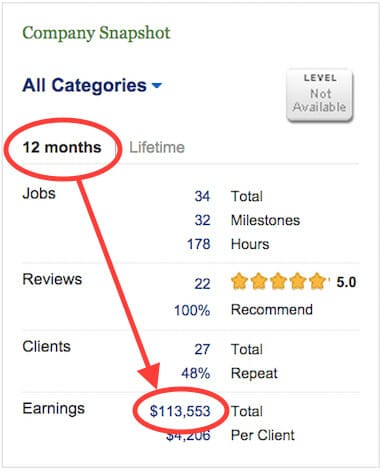
    Most people are surprised to find out that I earned six figures in 12 months using Elance as my only source of clients.

    I get it: In the minds of most writers, freelancing platforms like Elance tend to conjure up images of penny-per-word hell.

    There’s a good reason for this reputation. Many clients are attracted to freelancing sites because they can hire writers at a discount.

    But that’s only part of the story.

    In my experience, Elance also offers writers a great opportunity to make an excellent living — without all the hassles of “real world” freelancing.

    Nor was building up my six-figure Elance income as mysterious or challenging as you might think it would be — especially once I decided to reject conventional wisdom and stop following the masses.

    Even if you’ve had a bad experience freelance bidding sites, bear with me: Here’s how I make money as a freelance writer on Elance.

    Company Snapshot

    Getting started as a freelance writer

    When I set out to become a copywriter and start freelancing in July of 2012 — with no previous experience to speak of — Elance seemed like a good way to get my feet wet.

    So I spent dozens of hours researching the idea, devouring blog posts, articles and forum threads on the subject. Unfortunately, my main takeaway from all this reading was that there seemed to be an invisible “cap” on what an Elance writer could earn.

    But a few weeks into my Elance adventure, I’d already landed two $50-an-hour jobs. At that point, I realized that one of two things was true:

    A) I’d been super lucky and managed to find the only two decent-paying clients on Elance, or

    B) There were more of those decent-paying clients out there, and I could make great money if I could figure out how to attract them.

    So I spent the next few months developing strategies and tactics specifically designed to pull in the highest-quality clients Elance had to offer.

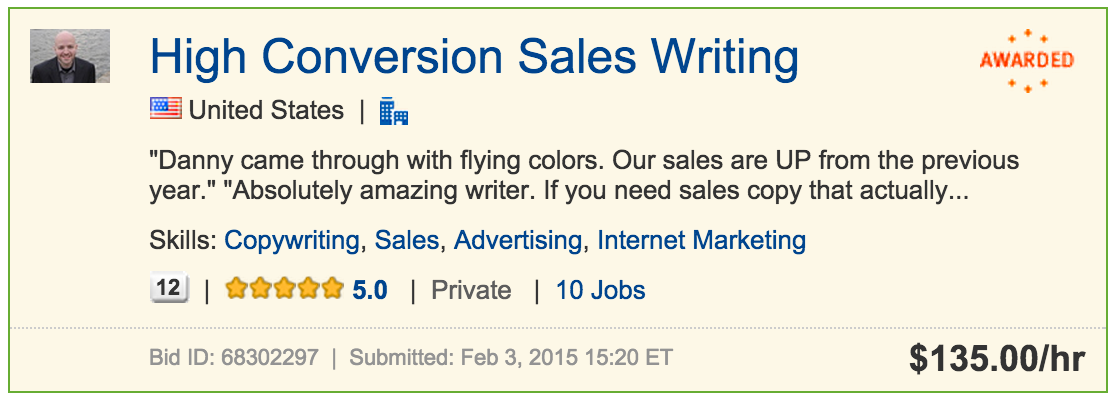
    It wasn’t long before my hourly rate rose from $50, to $75 and ultimately, $125 and beyond.

    High Conversion Sales Writing

    The challenges most freelancers experience on Elance have less to do with supply and demand, and more to do with not knowing how to find and secure the best-paying work.

    Here are some counterintuitive approaches I’ve used to overcome these challenges, winning more work and charging higher rates than my competitors — while spending less time grinding away at the keyboard.

    1. Don’t compete on price

    Lowering your price on Elance can seem like the right way to deal with low-bidding competitors. But it’s a game you won’t win, and can’t even afford to play.

    Personally, I love seeing gaggles of writers racing to the bottom on price: It tells me there’s a lack of quality options available to clients.

    Writers who charge bargain rates don’t have time to hone their craft; they’re too busy working their way to burnout. So I go the opposite way — offering high-quality work for a premium price.

    There’s nothing mysterious about this plan. I spend a lot of time educating myself about my craft and my niche, and it makes me more valuable than most of my competitors.

    Mostly, this strategy involves reading. I regularly pore over a plethora of writing blogs (like the one you’re reading right now) and books like Made to Stick by Chip and Dan Heath (a must-read for all writers), all of which have helped me improve my skills in different ways.

    You might think that all of your competitors are gaining the same knowledge as you are through reading, but they aren’t. This simple habit gives you a huge advantage in the marketplace and allows you to charge above-average prices.

    2. Choose a specialty

    Most Elancers are scared to choose a niche, for fear of shutting out most of the clients they encounter.

    So they stick to being the “Jack of all trades.” Or they choose several niches, and misguidedly try to tie them all together (e.g. Resume Writer / Novel Editor / White Paper Author).

    My advice? Forget about “most clients.”

    Successful freelancing isn’t about catering to the masses. It is, to paraphrase Seth Godin, about finding the “weird” clients who are a perfect fit for you.

    The irony of choosing a specialty on Elance is that, far from limiting yourself, you’ll now appear even more valuable to the clients who want and need you the most. It’ll be easier for them to find you, and easier for you to charge them what you’re really worth.

    3. To win big, aim small

    Bigger jobs on Elance come with a paradox: Though they offer more income potential, they also draw out more competition.

    Like this one:

    Job Ad

    Snagging these long-term or recurring jobs can seem like winning the lottery. But you’re also competing against about as many other people as you would in the actual lottery. Instead, I’ve developed a strategy to flip the odds in my favor.

    Rather than trying to get the client to award me the whole enchilada, I offer them a small trial job. This has many benefits, like:

    • Helping me stand out from the crowd (who are all pushing for the “big contract”)
    • Making it easier for the client to say yes, since there’s less commitment required
    • Giving me added credibility and posture (i.e. I don’t appear desperate)
    • Offering me a chance to test the waters, just in case the client turns out to not be a good fit

    For the job above, instead of forcing the client into the big decision of hiring me for a three-month blogging contract, I suggested we start with a single blog post.

    As you can see from the screenshot below, this approach worked out great for both of us, and has been a great income stream for me over the course of a just a few months.

    Blog Writer - Fixed Price

    (Of course, this strategy requires some confidence, which goes back to expertly honing your skills. As the great Jim Rohn said, “Work harder on yourself than you do on your job.”)

    4. Tap into the “Hidden Elance Economy”

    The only thing more fun than finding lots of clients is having them find you.

    While Elance’s jobs marketplace is great for finding new work, many of the best clients use the “search” feature to scout for writers before they consider posting a job.

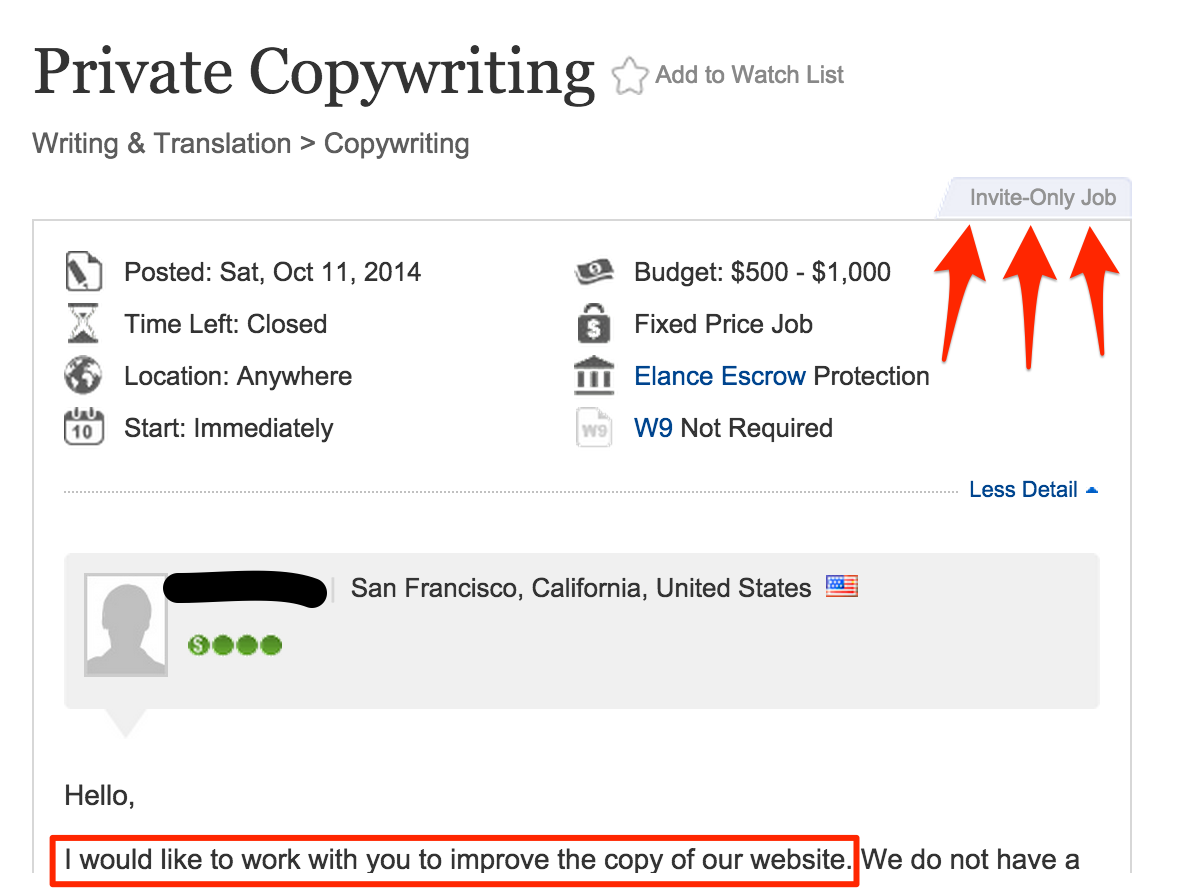
    If one of these clients likes what they see in your profile, they just might go ahead and invite you to a job they created just for you. Like this one:

    Hidden Elance Economy

    I call this the “Hidden Elance Economy” because it’s totally invisible to anyone but you!

    Receiving high-quality, private invites like this one allows you to charge more for your work, and gives you a passive stream of new leads to choose from.

    Here are some tips for taking advantage of these opportunities:

    • Word your profile carefully so clients can easily see exactly what services you offer and the type of client you work best with (if you aren’t sure, don’t worry, you’ll figure it out once you get a feel for the market)
    • Over-deliver to clients so they write you the sort of amazing reviews that attract even more awesome clients
    • End your profile with a call-to-action letting clients know they can invite you to a private job (otherwise, how will they know?)

    Have you found decent-paying writing jobs on Elance?

    In my experience, Elance can be an enormously rewarding source of freelancing business, way beyond what the average writer imagines.

    But you need to choose the right approaches to make it work. “Going with the flow” is just a race to the bottom. Instead, be strategic and you just might find yourself with lucrative jobs and quality clients.

    Have you tried Elance as a source of writing jobs? What was your experience like, and looking back, would you do anything differently?

  • Tracking Freelance Earnings: May Income Report From Nicole Dieker

    Tracking Freelance Earnings: May Income Report From Nicole Dieker

    Hi! If you’re new to this column: I track my freelance income every month and share it with all of you. This is my third year of public income tracking, and my first year sharing my income with The Write Life.

    How often do you stop and take stock of how far you’ve come as a freelancer, and where you’re headed?

    Last month, I focused on taking stock… and now I’m thinking about where I need to go in the future. Having a good handle on how much I’m earning goes a long way toward helping me make those decisions, so let’s have a look at my income for May.

    This month, I met my $5,000/month income goal — whoohoo! — but only received $3,300 in client payments. I also found myself with a snowballing workload. In both cases, I’m planning to solve the problem with a renewed focus on regular contributor gigs and reassessment of how many one-off client assignments I should take on.

    First, let’s take a look at the data: In May, I wrote 57,000 words and had an average per-piece earning of $67. My highest-paid piece was $300, and my lowest-earning piece was $35.

    Completed Pieces: 80

    Work Billed: $5,336.25

    Earnings Received: $3,383.05

    Wow. Although I continued to hit my goal of earning $5,000 a month, only $3,000 got deposited into my bank account. A lot of the work I completed in the past two months won’t get paid until June, and even though I’m expecting a big payday by the end of this month, I still feel a little strapped for cash right now.

    I don’t know how your freelance payments usually arrive, but my regular clients tend to pay either on the 15th or the 30th of the month. When I write a one-off piece for a client, it pays around 30 days after the article is published, but there can sometimes be a three-month lag between final draft submission and article publication.

    So that means you occasionally get months like this May, where you only get paid for a portion of what you bill. The money will still land in my bank account — I’ve only had one instance in my entire freelance career where a client hasn’t paid for the work, and in that case I was able to sell the piece to someone else — but it might take a few months to arrive.

    A new regular contributor gig

    On the positive side, I added a new regular contributor gig to my roster in May, for JoCo Cruise. This is the geek-themed music and comedy cruise I wrote about in my February income report when I described how I rearranged my entire workload to go on vacation.

    I’ve been on that cruise four times, so when the cruise team invited me to blog for their website, I was thrilled. More than thrilled. There may have been some jumping up and down involved.

    Last month one of our commenters asked about how much writing I do “for love” and how much writing I do “for money,” and with this client, I get paid to write about something I love.

    These are the best gigs of all, but they’re also sometimes the hardest; when I’m emotionally invested in a subject, I’m more likely to second-guess myself or overthink my work because I’m so determined to find the perfect way of communicating my emotions. It’s much easier to whip off a quick piece about a goat farm essay contest, and I’d like to think that the ideal freelance career would have a balance between these shorter, easier jobs and the more emotionally involved ones.

    The client snowball effect

    The Matthew Effect applies as much to freelancing as anything else; if you’re a highly visible freelancer, clients contact you to offer gigs, and if you’re not a highly visible freelancer, you have to contact potential clients and ask for work.

    This means that the more freelance work I complete, the more clients contact me to offer new jobs. It also means that I’m now at client saturation, and have started referring new clients to other talented freelancers I know.

    If you’re at the point where you’re getting more client requests than you can handle, don’t just say no; say “no, but I can recommend another freelancer.” That way, you help spread the wealth, and you never know who might recommend you in return. This is how freelancers get jobs that aren’t publicly visible on job boards. Networking is a huge part of the freelancing business.

    Because I’m at capacity, one of my big projects for June is to figure out how to reduce my workload. I have a lot of contributor gigs and plenty of one-off assignments for new clients, and my workday just gets longer and longer. In March, reducing my workload wasn’t a priority. This month, it is my top priority.

    How am I going to cut back? Well, I’m not going to cut any of my regular contributor gigs, since those are both the most rewarding and also provide the closest thing I get to guaranteed recurring income. Instead, I’m going to be a lot pickier about my one-off assignments.

    These assignments tend to take up an excessive amount of my workload, often because each one-off piece comes with a brand new editorial team and a new set of expectations to learn. (Don’t underestimate the value of working with the same editor for over a year. Things go so much faster that way.)

    One-off assignments also, as I noted above, tend to have a several-month lag time between final draft and payment.

    So for June, I have to tell myself: no one-off assignments for new clients unless it’s a dream job.

    How will I know if it’s a dream job? If the idea of taking on this assignment makes me jump up and down, I’m in. If not, I’ll refer the client to another talented freelancer.

    What would you consider a freelancing dream job? Also, do you feel like there’s a difference between the writing you do “for love” and the writing you do “for money?”

    Want to learn how Nicole has come this far in her freelance career? Check out her past income reports for The Write Life:

  • Writing a Salable Personal Essay: 5 Key Questions to Ask Yourself

    Writing a Salable Personal Essay: 5 Key Questions to Ask Yourself

    Even if you’ve spent weeks crafting the perfect personal essay — and friends and family have declared it brilliant, compelling, powerful prose — that doesn’t mean it’s a shoo-in for publication.

    On the contrary. Editors have limited space for personal essays, and often the only way to snag that real estate is to touch them with your story.

    In 2005, I wrote an essay about coming to terms with my flat breasts and boyish shape. It was rejected five times, but I kept up my relentless pursuit to find a published home and before long, Health Magazine snapped it up. Since that first sale, I’ve continued to publish essays (and get paid!) in print and online pubs including Newsweek, The Los Angeles Times, Spirituality & Health, Parents and Women’s Health.

    While I’d like to believe every piece I write is essay gold, the truth is, I never give up on my pursuit of a sale. And that’s more than half the battle when it comes to personal essays.

    Think you have a salable piece? Here are five key questions you need to ask yourself:

    1. Do I have a great story?

    The experience you’re writing about doesn’t have to be life-changing, or even a huge event, but the story should involve some personal transformation. Maybe you survived a pit bull attack, received flowers from a stranger or trashed your wedding dress.

    No matter what the event or experience, it should result in you seeing the world differently than you did before. If your story is something your reader may have experienced (like feeling your baby kick for the first time), you have the extra burden of saying something profound, funny or otherwise important, so you’re not revisiting old territory.

    2. Is this the right time to tell my story?

    If you have an essay that’s relevant to current events or an upcoming holiday, you have a better chance of making a sale.

    Due to publication lag time, if you’re going to claim something is newsworthy, it should have happened within the past few weeks. On the plus side, unless you’re dealing with a newspaper, local magazine or weekly news magazine, timing may not be as critical.

    If you’re looking for a sale though, it doesn’t hurt to send your essay about your relationship with your mother four to six weeks before Mother’s Day (convert weeks to months if you’re targeting a national newsstand magazine).

    3. Does my story have a universal theme?

    A salable essay isn’t just about you! Sure, it may start with your experience, your journal entry or memories and eventually the lesson you learned, but the essay is a way of connecting your unique experience to something your reader can relate to.

    Bottom line: People don’t want to read about your uterus — or your favorite little black dress — unless it means something to them.

    Ask yourself whether your story will touch readers or make them think about an issue differently. Will it motivate them to act (by calling their moms, for example), or change in some way?

    Good essays aren’t just about the first time you fell in love; they’re about the first time I fell in love, too. If you can make your readers recall an event or life experience of their own, then you’re on your way to a great essay.

    4. Does my story have great characters?

    The best essays have identifiable characters. Readers can visualize them, hear them and feel them. They might even recognize the character as someone in their own lives.

    Whether you’re painting a picture of your best friend, a lover or a giant stuffed Elmo, your essay should contain vivid characters. And vivid characters create conflict — either within themselves or with those around them — and that promotes change.

    In personal essays, the character who changes and evolves is you. So in your essays, strive for conflict, both within yourself and with other characters.

    5. Does my story have a clear take-home message?

    Write one sentence describing your take home message. If you find that difficult, you might need to re-work your piece.

    Once you know what the “take-home message” is, re-read every paragraph in your essay and ask yourself if it supports your point.

    It’s tempting to throw in funny anecdotes that are related to your story but don’t apply to the bigger message or theme. Avoid the temptation. After reading your story, readers should be able to clearly state what it’s about. If they can’t, chances are you don’t have a salable piece.

    Even if your story has all of these components, you might not make a sale. The truth is, essay markets are dwindling and the real estate for essays is slim.

    But writing essays isn’t just about making a sale. The practice is also a journey in self-discovery. It allows you to experience your life events twice — once in reality and the second time on the page.

    Think of writing essays as a cathartic exploration of yourself. They’re a form of writing therapy; a method for discovering your own truth; a way to find your true story. These are an essay’s sweetest rewards. The sale is just the frosting.

    How have you sold personal essays? Share your stories in the comments!

    If you’re interested in learning more tools of the essay-writing trade, sign up for Amy Paturel’s six-week online essay-writing workshop. Her next class begins June 15, 2015. Visit www.amypaturel.com/classes for details. Bonus: TWL readers get a 10-percent discount! Contact amy@amypaturel.com to sign up at the discounted rate.

  • Become a Ghostwriter: Here’s How to Write in Someone Else’s Voice

    Become a Ghostwriter: Here’s How to Write in Someone Else’s Voice

    “A ghostwriter.”

    “So, do y—”

    “No, I don’t write about ghosts. And I don’t wear a sheet with holes cut out for eyes while I write.”

    “That’s not what …”

    “Yes it is, and you know it.”

    “OK. You got me. So what do you actually do then?”

    “I write books for other people. Their ideas, my words.”

    “Isn’t that cheating?”

    “No. My clients have great ideas. They just don’t have the time or the know-how to finish writing a book. It’s a win-win.”

    “But how do you write it so it seems like they wrote it?”

    “I’m a ghost. It’s what I do.”

    I’m a nascent ghostwriter, with just one title to my resume and two more nearing completion, but I want to do more. Consequently, I’ve been marketing myself as a ghostwriter. Because of that, I’ve had some variant of the conversation above more times than I can remember.

    When I talk with other writers, they often want to know about two specific issues: how to break into ghostwriting and how to write in another person’s voice. The first issue requires equal parts hard work and luck, but the second can be learned — although it tends to require a significant amount of trial and error.

    I learned the significance of finding the right voice after one of my clients pitched his half-written book to an agent. The agent replied that it was too academic in tone to reach a popular audience, which the author wanted to do. After I was hired to rewrite and expand his initial book, we focused on “popularizing” his book without leaving behind the important information he wanted to convey.

    Through this process, I learned a number of methods on how to write in another person’s voice. (In fact, with proper modification, these methods can be used to find a company’s voice for marketing and to discover characters’ voices in novels.)

    1. Listen

    The simplest and most effective way to write in someone else’s voice is to listen to that person’s voice.

    For instance, this client had 10 hours of video from a conference he’d led using information that would ultimately be in the book. He sent me the video and I transcribed every word. Painstaking? Yes. Worthwhile? Quite.

    In being forced to listen to the way he spoke about his book’s topic, I discovered his voice hiding in plain sight. He wasn’t academic; he was understandable. He wasn’t dull; he was funny. His spoken-word, real-life delivery was much more engaging than what he’d written.

    But you don’t have to rely on your author speaking about his or her topic (though, of course, that’s ideal). You can glean their voice from the conversations you have with them. With their consent, record your conversations, then jot down a few notes after the fact about what struck you: Did he use large words? Did she seem confident in what she was saying? Did he pause for long periods of time? Did she often quote others? What did his body language convey?

    In asking other ghostwriters about how they listen to learn an author’s voice, they offered a number of excellent suggestions for instances when a meeting may not be possible:

    • “Read everything you can from that person: books, speeches, even emails, and any notes-to-self that they’ll share.” — Jennifer Harshman
    • “Write out physically something the author has written. Do it over and over until you get a feel for how things are worded. Talking like that person out loud can help too.” — Jim Woods
    • “Watch videos they may have. Record your calls. Skype if possible so you can also learn their body language. Visualize them speaking, then pretend to be that person as you write.” — Alice Sullivan
    • “Try to never do a ghostwriting project without an in-person meeting. Also, if the client is a speaker, discuss the difference between spoken and written word.” — Mike Loomis

    Essentially, you’re searching for the ways in which they best engage an audience. If you can capture that aspect of your author’s personality in writing, you’ve accomplished much of what’s required of a ghostwriter.

    2. Write

    Robert Frost wrote, “I can see no way out but through.”

    Once you start hearing your author’s voice in your head at night, that’s just about the right time to begin ghostwriting on their behalf. If you never begin writing, you’ll have no idea whether your idea of their voice will translate well to the written page. You must go through to get out, and it will be a laborious process of questioning every word choice, every transition and every edit.

    With the best clients (and I’ve been fortunate to work with all “best clients” so far), you can write and submit a chapter, then receive feedback within an agreed-upon timeframe. This has vacillated between a day and a week with my clients.

    Remember, these are busy professionals who hired me precisely because they’re so busy. Consequently, I have to be flexible with their timeframes, though they still have to be responsive to my needs so that their respective books can be finished on deadline.

    Mike Loomis offers two superb tips for the writing phase: “Ping-pong one chapter until it feels right to everyone” and, “Try to get feedback from a spouse (or someone close to the author) when possible.”

    Feedback is when you’ll really learn whether or not you’ve captured the author’s voice.

    And that moment right before opening your author’s first email reply after you’ve sent the first draft? It’s enough to make any writer want to hide under a sheet.

    3. Bow

    Lastly, be humble when you receive feedback. Though it is your book, it’s not really your book.

    As the client paying you to write a book on her behalf and in her voice, if the author says, “I wouldn’t use that word,” you must delete all instances of that word without hesitation. In fact, the more you can discover about the particular words and turns of phrase the author prefers, the more you’ll be aligned with her voice.

    Quick tip: To prevent yourself from inadvertently using a word the author wouldn’t choose, use a text expansion app like aText (or one of these Windows options) to essentially autocorrect any unintentional word usage.

    Ultimately, you must realize what’s supposed to be on display isn’t your talent — it’s your author’s voice. Like a ghost, the best writers for other people disappear behind the author’s needs.

    If you’re a ghostwriter, what practices and strategies do you use to get inside your author’s mind? If you haven’t tried ghostwriting, will you?

    If you’re exploring other writing careers, check out this article, where you’ll find more options to get paid as a writer.

    Perhaps this quiz can help you decide.

  • Find Online Writing Jobs in Unexpected Places (3 Sites)

    Find Online Writing Jobs in Unexpected Places (3 Sites)

    Ever considered looking on Craiglist or Fiverr for freelance writing gigs?

    These sites probably aren’t top of mind for most writers; we tend to think of them as offering low-paying opportunities, or worse, scams.

    But check out writer Kristen Lawrence’s story: she used Craigslist and Fiverr to make $2,000 a month on freelance writing gigs, she wrote on The Penny Hoarder.

    Shocking, right? On top of those earnings, Lawrence’s experience writing for clients she found on these platforms led to bigger and better jobs. So while writing an article for $5 isn’t sustainable in the long run, the relationship you make with that client could kick-start your freelancing career.

    Here’s what Lawrence had to say about finding online writing jobs via these two websites.

    How to find freelance writing jobs on Fiverr

    Fiverr works best for new writers who are looking to build a professional portfolio. These projects offer little pay, but if all the writing you’ve done is for your own blog, you’ll need to expand your list of clients before you can land bigger fish.

    “It might seem like drudgery to work so hard for such little pay, but you don’t have to stay on Fiverr forever,” Lawrence writes. “I had an account for a couple of months until I started getting more lucrative offers, and then I closed it. I have only been freelance writing since October 2014, so I’m thrilled to have better-paying opportunities coming my way so quickly.”

    Getting jobs on Fiverr is pretty straight forward. As long as your profile is complete and you sell your skills well, you should start seeing requests within a few days.

    What about Craigslist? You’ll find writing jobs there, too

    Through Craigslist, Lawrence found an editing job in Berlin that paid $15 per hour and a freelance writing job based in the States that paid $1,200 per month. One of the benefits of this platform, she says, is that you can look outside your own city for writing opportunities.

    “Look at the writing jobs in major cities, such as Los Angeles, New York City, Boston, Houston, Philadelphia, Miami, London and Berlin, to name a handful,” she writes. “I check the ‘writing/editing’ section under the ‘jobs’ area of major U.S. cities first, then make my way into Canada, and finally Europe and Australia.”

    Another place to find writing gigs: Thumbtack

    While Lawrence didn’t mention Thumbtack, it’s another platform you should know about if you’re trying to break into the freelance writing scene and find clients. Full disclosure: I work for Thumbtack HQ in San Francisco, so yes, I’m biased. But on top of working for their marketing team, I actually use Thumbtack as a professional writer and editor to make money on the side and have gotten a few well-paying jobs there.

    If you’re not familiar, Thumbtack introduces customers to local service providers, from massage therapists to house cleaners to photographers. As a professional, you’ll pay a small fee per introduction, compete against up to four other professionals for the job, and should expect to get hired about one out of 10 times you send a quote.

    Getting a job is pretty straightforward: Write a well-written message that includes your qualifications, personalized to the customer’s project. Have a completed profile with as many reviews as you can get. Have a good profile photo. Follow up. You know the drill.

    Since setting up my profile on Thumbtack, I’ve made $1,000 from clients who have hired me. And here’s the best part: I never would have found these types of jobs otherwise. I tend to do mostly blogging work, but through Thumbtack I was hired to edit a self-published urban suspense novel, write flowery product descriptions for a luxury watch brand and craft professional bios for executives at an electrical subcontracting firm. I wouldn’t even know where else to look for this type of work, yet through Thumbtack, the work found me.

    If you sign up for Thumbtack, you’ll find yourself weeding through quite a few folks looking for writers to contribute content for $25 a post, and don’t waste your money quoting on those jobs. But if you can learn to read between the lines — tip: focus on customers who provide a ton of information as opposed to simply filling out the forms — you will land some quality projects.

    Have you landed freelance writing work in unexpected places? How did you do it?

    Marian Schembari is a writer, blogger and community manager based in San Francisco.

  • Make a Living Writing From the Road: Tips for Working While Traveling

    Make a Living Writing From the Road: Tips for Working While Traveling

    One of the great things about figuring out how to make a living writing is you can work from anywhere.

    You can jump on a plane and then, while on a beach in Thailand or in a ski lodge in Canada, tap away at that laptop to pay for the trip.

    Well, that’s the theory anyhow. But the first time you try working while traveling, you’ll likely find it’s more difficult than anticipated.

    When I first tried to write while traveling, I realized my usual routine was broken. Hunting down morning tea was an adventure rather than a short walk to the kitchen. Hotel checkout times snuck up on me just when I was doing my best writing. And there were distractions; after all, I travel to see things and have new experiences, so it wasn’t easy to fit work into my days on the road.

    Of course, you could just take a vacation from writing and get back to work when you return home. But here’s a thought: If you can learn to write while away from home, you can afford to take trips more often.

    And yes, I did finally learn how to get some work done while traveling. So if you like to travel and want to do more of it, here are some tips for making a living writing while on the road.

    Prepare before you leave to increase productivity

    Your important files need to be available wherever you are. That’s not a problem if you use the same laptop at home and on the road. Otherwise, consider free cloud storage options like Dropbox or Google Documents, so you can access everything regardless of your location. Just remember to upload everything necessary before you leave.

    You can also install a remote access program to use your home computer that lets you log in from anywhere. LifeHacker recommends using either TeamViewer, or the built-in remote connection options available on many Macs and PCs with Windows Professional. All of these options require leaving your computer on with the remote program running, so don’t make the mistake of powering off before you head to the airport.

    I prefer to carry important files on a USB flash drive. That way I can still work where there’s no internet connection, and if my laptop crashes, I can still accomplish some work from any computer. Imagine you’re using your home desktop remotely and it shuts down on day one of a two-week trip. Of course, you could use cloud storage, remote access and a USB flash drive for total safety and convenience, but most of us don’t take that many precautions.

    What about passwords? Don’t leave home without them. Bring a paper list or email it to yourself. For security, add a certain number of digits and letters to each password but leave those off the cheat sheet, making them unusable to anyone who sees the list. Just remember the pattern you add, or you won’t be able to access anything at all!

    Bring tools that will help you write your best

    Even when using a laptop, my big clumsy fingers prefer a regular keyboard, so I take one on road trips. I use a small tape recorder for safely taking notes while driving; many of my best ideas come on long quiet stretches of highway.

    You’ll have to decide which tools are most important for you, but here are some possibilities to consider for your list (and you should have a list, so nothing is forgotten):

    • Laptop
    • USB flash drive
    • Keyboard
    • Mouse and mousepad
    • Extra battery for mouse
    • Camera
    • Pen and paper
    • Tape recorder
    • Headphones
    • USB plugin for wireless mouse and keyboard

    Check your internet connection before you move in

    One night in a hotel, my wife and I had already used the pool and watched a movie when we discovered the wireless signal in our room was worthless. Management moved us despite the room already being well-used, but it was a hassle.

    Lesson learned: Always check the connection before you settle into your room.

    Let your surroundings inspire your work

    You will be distracted from writing when you travel, but you can also be inspired. Once, sitting with my laptop in a rented cabin in the mountains of Colorado, it occurred to me how wonderful it was that I could work from anywhere, so I wrote about that for one of my websites. On another occasion, after a catamaran cruise on Lake Tahoe, I wrote about the experience and sold the article. And many writers find simply changing their setting and routine makes them more reflective and in a position to produce their best personal essays.

    You don’t have to cover travel topics just because you’re traveling. Inspiration can come for just about any niche you work in. If you write about small businesses, check out the ones around you. If you write for a landscaping magazine investigate how yards are commonly landscaped in the cities or countries you visit. Keep an open mind get inspired.

    Develop your own unique travel routine

    Routines keep you focused and prevent deadly procrastination. But since you probably can’t replicate your home pattern, you may need to develop a routine just for traveling.

    I find it easiest to write as soon as I get up in the morning, and maybe for an hour just after I check into a hotel (by that time the pool or bar is calling my name). I also find I can work well at the airport if I arrive a couple hours early, especially if I’ve brought an internet hotspot with me.

    But I have a confession: I can’t write half as much while traveling as I do at home. Instead, I do other things to be productive. For example, long road trips and a micro-cassette recorder help me come home with a ton of new ideas I can execute once I’m back at home. And although it’s tough to write articles in hotel rooms and fast food restaurant booths, when in these places I find it easy to do research and take notes for future articles.

    Of course, what works for me may not work for you. Perhaps you have to stay several days in each place to get some writing done and truly enjoy the trip. Maybe you should go to a coffee shop wherever you are, if that’s how you normally work.

    Write outside, write inside — who knows until you try. To find a routine that works for you, just hit the road and start experimenting.

    Do you try to write when traveling, and if so, what routines work best for you?

  • How to Overcome Social Anxiety When You Work From Home

    How to Overcome Social Anxiety When You Work From Home

    I could tell that my hovering without speaking was making her nervous, and yet I couldn’t seem to move away. Good manners compelled me to thank this woman, an Internet acquaintance and hopefully future colleague, for inviting me to her event.

    And not just inviting me, either, but comping me a ticket, which is how I justified prying myself out of my home office and driving 15 miles on a weeknight.

    When we finally spoke and made it past the introductions, things got even more awkward. I couldn’t seem to form a coherent sentence, and mumbled something about traffic being good.

    Fortunately, she was gracious about my incoherence, but it wasn’t until I sat at a table in a dark corner of the club, waiting for the proceedings to begin, that it hit me — full-time freelance writing is turning me feral. If I was going to keep from losing my social skills entirely, I would need to figure out how to overcome social anxiety.

    An introvert at heart

    I’ve always had some social anxiety, and as a child, my natural introversion was reinforced by interactions with bullies. But I worked hard at getting over it, first in the theater and then in journalism.

    Journalism helped the most, since nothing gets you over your shyness faster than having to ask a government official if he’s embezzling money. And newsrooms may no longer be the chaotic caverns portrayed in old movies, but they’re not quiet places where anyone can hide. Even so, for years working from home was my dream.

    But since I left the newsroom and fulfilled that dream, things have been quiet, so quiet that I often turn on the news for background noise, or play music. This surprised me, since I’ve always needed to get away from noisy situations, if only for a few minutes, to regroup.

    The downsides of working from home

    But all this solitude, while productive writing-wise, is definitely eroding my social skills. Unless I take some action, will there be a time when I’m reduced to grunting, unable to make conversation unless it’s in writing?

    It doesn’t help that, several days a week, the only person I’ll talk to is my husband. He has an exhausting job outside the home, so we don’t even talk that much. When I do get out, I mostly interact with retail workers, who have no interest in chatting, and frankly, I return the sentiment.

    It also doesn’t help that, while I’m lucky to have dear friends, many are in different time zones, while the ones nearby are swamped with work and childcare. We mostly connect via social media, hours or days apart.

    So it’s not surprising I was making my poor hostess uncomfortable. I’m just not used to small talk — that social lubricant that helps turn strangers into at least friendly acquaintances — anymore.

    And as someone who is working hard on building a brand as a freelance writer, I know there is only so much I can do online. Eventually I’m going to have to meet people face to face.

    Reclaiming my social self

    And so, here is my plan for turning myself back into a social person. If you’re feeling similarly feral from your own freelancing solitude, I urge you to consider it as well.

    It won’t be easy, because, as anyone who’s ever freelanced knows, it’s tough to stop working, whether it’s on the weekend or at night. Keep reminding yourself that efforts to reverse your ferality won’t hurt as long as you make sure to meet your deadlines.

    After all, wasn’t setting your own schedule one of the biggest reasons you started freelancing?

    1. Try to attend one social event with mostly strangers each month

    This may not sound like a big step, but it’s terrifying enough to inspire excuses. Take baby steps to reverse your ferality by connecting with people in real life, rather than through a screen.

    No, an event being on a weeknight is not an reason to shirk it. And not being able to bring a date isn’t either, nor is feeling icky and/or unkempt, though a raging flu is a forgivable excuse.

    Speaking of forgiving yourself, it’s okay to be a bit awkward at your first few events. Just try not to spill anything on the host. You’ll be amazed at how many people can relate to social anxiety, especially if they’re also writers.

    2. Become the friend who plans social gatherings

    Yes, it’s exhausting, but it’s usually worth it. Have difficult schedules? Try to plan a few weeks ahead, and offer different alternatives.

    Whoever has the least rigid schedule should be the most accommodating, but just because you freelance doesn’t mean your time isn’t important. Work to find a time that fits into everyone’s schedules, whether you’re planning a drink with one friend or a dinner party with eight.

    Not every meetup needs to be large or elaborate; even a brief coffee date will get you out of the house and socializing. Remember, only you can prevent your friends from feralizing.

    3. Pick up the phone

    Even if it’s just a rambling voicemail, I always enjoy hearing a friendly voice, and I’ll bet your distant friends do too. If they do answer, it’s a great chance to catch up.

    If someone is always hard to reach, try to make a phone date, or get an idea of his availability over social media first. Spontaneity is overrated.

    4. Find other freelancers and form your own newsroom

    I’ve started doing this with a local writer I met through social media. Her social skills are far less rusty than mine, but she, too, is concerned. We meet up at venues away from our own homes, and get a surprising amount of work done, and feel less isolated than if we were in a cafe by ourselves.

    Some freelancers rent office spaces together, some choose coworking spaces, and others try services like ShareDesk that allow you to rent desks in different venues. Beware, though, that those options cost more money than just writing in a cafe, and that the culture may not suit you. (Also, working in pajamas is probably not an option.)

    5. Think like a journalist at social events

    It can be hard to strike up a conversation at social events, but I find going back to my journalism roots helps me out. I’ve had my share of reluctant sources in the past, and my job was to get as much information as possible before they shut me down.

    While there’s no need to be so aggressive in a social situation, I find it helps to have a plan for what you want to learn about your conversation partner. What’s her name? What does she do? Where is she from? What brings her here?

    If the conversation goes no further, move on. It’s all practice — and you’ll be working your way back from the precipice of ferality.

    Have you struggled with isolation or started developing feral tendencies as a result of freelancing? What do you do?

  • This Simple Website Tweak Will Lead to More Freelance Writing Jobs

    This Simple Website Tweak Will Lead to More Freelance Writing Jobs

    If you have a website for your writing business, you undoubtedly have a single goal: You want to land freelance writing jobs.

    That’s great! You should be using your website to reel in clients, but what if you’re not seeing results?

    You know what I mean. You spent weeks of sleepless nights fighting with your theme, researching plugins and arranging your widgets so that you’d have at least a half-decent writing website.

    Do you hear that? That’s nothing but the sound of crickets coming from your contact form. Either nobody cares about your services or you’ve gone the wrong direction with your site.

    Tons of people are looking for writers, so chances are it’s not the former. That leaves your writer website as the issue. Where are you going wrong?

    You don’t have a clear call-to-action

    One thing I see a lot of writers miss is a clear call-to-action (CTA), and it’s crippling your website’s effectiveness.

    What’s a call-to-action? It’s web-speak for asking visitors to do something on your website. That could be signing up for your newsletter, or getting in touch for a quote, or buying an ebook. Getting people to visit your website is only half the battle; you won’t make any progress if they don’t take the action you want them to take.

    In a case study, ContentVerve.com found that tweaking a single word increased click-through rates by 90 percent. Imagine what having a decent CTA could do for you!

    The two most common errors are:

    1. You don’t include a CTA at all

    You might make this first mistake because you’re under the impression your prospects know where to go next. It’s a no-brainer to head to the contact page to get a quote, right?

    However, it’s important to show website visitors what you want them to do next. That way, prospects won’t end up all over the place without any direction.

    Even if “contact me” is implied, it’s worth giving the information explicitly. This way, you get prospects onto page two without them having to think too much about it. Plus, there’s no confusion, such as whether you’re available for hire.

    2. You include too many CTAs

    Here’s an example with too many CTAs:

    Want to learn more about me? Check out my about page, then take a look at my portfolio to view my samples. If you’re still not convinced you want to hire me, visit my testimonials page to see what past clients have to say.

    Ready to get started? Contact me for a quote!

    Here, you’re giving prospects four choices, but exactly what you want them to do next isn’t clear. Should they follow these steps in this exact order? What is the most important step to take next?

    If prospects explore your first three pages before getting to your contact tab, they may get distracted or run out of time before they get a chance to contact you.

    See where both of these mistakes can point clients in the wrong direction?

    How to develop a clear call-to-action

    If your site is falling victim to one of these common errors, here’s how to fix it.

    Step 1: Determine your website’s goal

    As a freelance writer, your main goal is likely to get clients to contact you for your services. It’s not to get them to read your blog or even to download your free gift, yet many writers stick with these CTAs.

    If building your email list or getting exposure on your blog really is the focus of your writer website, then by all means go with it, but be sure you’re really thinking about what you want your site to do for you.

    Step 2: Explore and decide on a CTA variation

    You can say the same thing in lots of ways, so don’t be afraid to experiment with different wording.

    Look back at step 1. Your main CTA should be some variation of this ultimate goal.

    Here are some examples if you decide to go with the “contact me” CTA:

    • Contact me
    • Shoot me an email
    • Get in touch
    • Let’s chat
    • Drop me a line
    • Get a quote
    • Tell me about your content strategy

    Play with CTAs until you find one that fits your goal and your writing voice.

    contact me example

    Step 3: Place it prominently

    A quality CTA includes an eye-catching design, explains editor Ginny Soskey on Hubspot. As she suggests:

    Your CTAs’ colors should contrast with your website design, yet also appear large enough to be noticed (we’ve seen them perform best around 225px wide and 45px high).

    Lots of writers include a link within their content as their CTA. This isn’t a bad way to go if you’re clear about it.

    However, a well-designed CTA button placed prominently is likely to get more attention than a single link in your content, since it really draws the eyes. If your theme doesn’t feature a button on the homepage, create your own at ButtonOptimizer.com and place it above the fold (i.e. so your potential client doesn’t have to scroll to see it).

    contact me example 2

    Not all prospects will land on your website via your homepage, so be sure your CTA is clear across your website. A sidebar button, for example, can also work well so that it appears on all pages.

    Step 4: Consider your alternative CTAs

    I’m not suggesting that you should have only one CTA; I’m only saying it should be clear what your main call-to-action is. You might go with “contact me” as a primary CTA, while a secondary one could be “join my mailing list.”

    When you have more than one CTA, be conscious of how they work together. If your secondary CTA is higher on the page, has more contrasting colors or features a larger content box, it may appear as your primary CTA when that’s not your intent. Take a look at these web design hierarchical elements to make your primary CTA stand out against the others.

    If you have to ask whether your CTA is clear,  it probably isn’t. Even so, it’s worth asking a friend to take a look at your site and to report back on his or her impression.

    Do you feature a clear call-to-action on your site? Tell us what it is and how you draw attention to it! Does it work well for you?